
All Topics  
Mountain Beaver

 
Mountain Beaver

   Email Print
   Bookmark   Link


Mountain Beaver


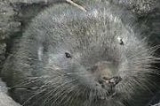
The Mountain Beaver (Aplodontia rufa) is a primitive rodent
Rodent

Rodentia is an Order of mammals also known as rodents, characterised by two continuously growing Incisors#The_Rodent_incisor in the upper and lower jaws which must be kept short by gnawing....
 unrelated to beaver
Beaver

Beavers are two primarily nocturnal, semi-aquatic species of rodent, one native to North America and one to Eurasia. They are known for building dams, canals, and lodges ....
s and not always found in mountain
Mountain

A mountain is a landform that stretches above the surrounding land in a limited area usually in the form of a peak. A mountain is generally steeper than a hill....
ous areas. It has several common names including Aplodontia, Boomer, Ground Bear, and Giant Mole. The name Sewellel Beaver comes from sewellel or suwellel, the Chinookan
Chinookan

Chinookan refers to several groups of Native Americans in the United States in the Pacific Northwest region of the United States. In the early 19th century, the Chinookan peoples lived along the lower and middle Columbia River in present-day Oregon and Washington....
 term for a cloak made from its pelts. This species is the only living member of its genus, Aplodontia, and family, Aplodontiidae.

tain Beavers are brown in color, but fur can range from slightly more reddish to more blackish depending on subspecies.


Discussion
Ask a question about 'Mountain Beaver'
Start a new discussion about 'Mountain Beaver'
Answer questions from other users
Full Discussion Forum


Recent Posts


Encyclopedia


The Mountain Beaver (Aplodontia rufa) is a primitive rodent
Rodent

Rodentia is an Order of mammals also known as rodents, characterised by two continuously growing Incisors#The_Rodent_incisor in the upper and lower jaws which must be kept short by gnawing....
 unrelated to beaver
Beaver

Beavers are two primarily nocturnal, semi-aquatic species of rodent, one native to North America and one to Eurasia. They are known for building dams, canals, and lodges ....
s and not always found in mountain
Mountain

A mountain is a landform that stretches above the surrounding land in a limited area usually in the form of a peak. A mountain is generally steeper than a hill....
ous areas. It has several common names including Aplodontia, Boomer, Ground Bear, and Giant Mole. The name Sewellel Beaver comes from sewellel or suwellel, the Chinookan
Chinookan

Chinookan refers to several groups of Native Americans in the United States in the Pacific Northwest region of the United States. In the early 19th century, the Chinookan peoples lived along the lower and middle Columbia River in present-day Oregon and Washington....
 term for a cloak made from its pelts. This species is the only living member of its genus, Aplodontia, and family, Aplodontiidae.

Characteristics

Mountain Beavers are brown in color, but fur can range from slightly more reddish to more blackish depending on subspecies. There is a light patch under each ear. The animals have distinctively short tails. Adults weigh between about with a few specimens topping . Total length is about with a tail length equal to .

The skull
Skull

The skull is a bone structure found in the head of many animals. The skull supports the structures of the face and protects the head against injury....
 is protrogomorphous. This means that it has no specialized attachments for the masseter muscle
Masseter muscle

In human anatomy, the masseter is one of the muscles of mastication.In the animal kingdom, it is particularly powerful in herbivores to facilitate chewing of plant matter....
s as seen in other rodents. It is flattened and lacks a postorbital process
Postorbital process

The Postorbital Process marks the rear, upper edge of the eye socket and is a projection from the frontal bone.See alsoOrbital process...
. The baculum
Baculum

The baculum is a bone found in the penis of most mammals. It is absent in humans, equidae, marsupials, lagomorphs, and hyenas, and cetaceans among others....
 is thin and distinctly forked. The penis
Penis

The penis is an external sex organ of certain biologically male organisms, in both vertebrates and invertebrates.The penis is a reproductive organ, technically an intromittent organ, and for Eutheria, additionally serves as the external organ of urination....
 is about in length. They do not have a true scrotum
Scrotum

In some male mammals the scrotum is a protuberance of skin and muscle containing the testicles. It is an extension of the abdomen, and is located between the penis and anus....
, but testes move into a position called semiscrotal during the breeding season
Breeding season

The breeding season is the most suitable season, usually with favorable conditions and abundant food and water, for breeding in the wild among some wild animals and birds ....
.

Mountain Beavers have an unusual projection on each molar
Molar (tooth)

Molars are the rearmost and most complicated kind of tooth in most mammals. In many mammals they grind food; hence the Latin name mola, "millstone"....
 and premolar
Premolar

The premolar teeth or bicuspids are transitional teeth located between the Canine_tooth and Molar_ teeth. In humans, there are two premolars per quadrant, making eight premolars total in the mouth....
 which is unique among mammals and allows for easy identification of teeth. This projection points toward the cheek on the upper toothrow, but points toward the tongue on the lower
Mandible

The mandible or inferior maxillary bone forms the lower jaw and holds the lower tooth in place. It also refers to both the upper and lower sections of the beaks of birds....
. The cheek teeth lack the complex folds of other rodents and are instead comprised of a single basin. They are hypsodont
Hypsodont

Hypsodont dentition is characterized by high-crowned tooth and enamel which extends past the gum line . This provides lots of extra material for wear and tear....
 and ever-growing. Two upper and one lower premolars are present, along with all the molars, giving a dental formula
Dentition

Dentition is the tooth development of teeth and their arrangement in the mouth.All mammals except the monotremes, the xenarthrans, the pangolins, and the cetaceans have up to four distinct types of teeth, with a maximum number for each....
 of

Mountain Beavers cannot produce concentrated
Tonicity

Tonicity measures the ability of a solution to exert an osmotic pressure upon the membrane. Osmolality and osmolarity measure concentration of the solutes independently on their ability to cross the membrane....
 urine
Urine

Urine is a liquid waste product of the body secreted by the kidneys by a process of filtration from blood called urination and excreted through the urethra....
. They are thought to be physiologically restricted to the temperate rain forest
Temperate rain forest

Temperate rainforests are coniferous or broadleaf forests that occur in the temperate zone and receive high rainfall....
 regions of the North American Pacific coast and moist microenvironments inland due to their inability to obtain sufficient water in more arid environments. Their karyotype
Karyotype

A karyotype is the characteristic chromosome complement of a eukaryote species. The preparation and study of karyotypes is part of cytogenetics....
 is 2n=46.

Habits and distribution

Mountain Beavers are found from coastal areas of the Pacific Northwest
Pacific Northwest

The Pacific Northwest is a region in the northwest of North America . There are several partially overlapping definitions but the term Pacific Northwest should not be confused with the Northwest Territory or the Northwest Territories of Canada....
 of North America
North America

North America is the northern continent of the Americas, situated in the Earth's northern hemisphere and almost totally in the western hemisphere....
 inland through the Cascade and northern Sierra Nevada mountain ranges. Much of this range consists of low elevation regions, but they can be seen as high as tree line. They can be found in both deciduous and coniferous forests, but throughout most of the range appear to prefer the former. These animals appear to be physiologically limited to moist microenvironments, with most subspecies occurring only in regions with minimal snowfall and cool winters. They do not appear to be able to conserve body heat or warmth as efficiently as other rodents . They do not hibernate
Hibernation

Hibernation is a state of inactivity and Metabolism depression in animals, characterized by lower body temperature, slower breathing, and lower metabolic rate....
.

Mountain Beavers build elaborate burrow systems with chambers devoted to fecal and food caches. They exhibit coprophagy and eat soft fecal pellets to obtain maximum nutrients. Hard fecal
Feces

Feces, faeces, or f?ces is a waste product from an animal's gastrointestinal tract expelled through the anus during defecation....
 pellets are transferred to fecal chambers using their incisors. Food includes fleshy herbs and young shoots of more woody plants. Fern
Fern

A fern is any one of a group of about 20,000 species of plants classified in the phylum or division Pteridophyta, also known as Filicophyta....
s probably make up the bulk of the diet. They appear to be strictly vegetarian. Their consumption of seedling trees has led some to consider them a pest. They appear to build hay
Hay

Hay is a generic term for Poaceae or legumes that have been cut, dried, and stored for use as animal fodder, particularly for grazing animals like cattle, horses, domestic goat, and sheep....
 mounds at some burrow entrances, but whether this behavior is related to water regulation, curing food, or gathering nest materials is debated.

A host of other animals have been documented within the burrow system of Mountain Beavers. These include: Long-tailed Weasel
Long-tailed Weasel

The Long-tailed Weasel is the most widely distributed mustelid in the New World. Its range extends from southern Canada through most of the United States to Mexico, Central America and the northern parts of South America....
s, Ermines
Stoat

The stoat is a small mammal of the family Mustelidae. In North America it is known as the ermine or short-tailed weasel; elsewhere, "ermine" refers to the animal only when it has white fur, which it moults to in winter in snowy parts of its range....
, Minks
American Mink

The American Mink, Neovison vison, is a North American member of the Mustelidae family found in Alaska, Canada and most of the United States....
, Fishers
Fisher (animal)

The fisher is a North American marten, a medium-sized mustelidae. The fisher is agile in trees and has a slender body that allows it to pursue prey into hollow trees or burrows in the ground....
, American Badger
American Badger

The American Badger, Taxidea taxus, is a North American Badger, somewhat similar in appearance to the European Badger.It is found in the western and central United States, northern Mexico and central Canada....
s, raccoons, Western Spotted Skunks, Striped Skunks, Brush Rabbit
Brush Rabbit

The Brush Rabbit , or Western Brush Rabbit, is a species of cottontail rabbit found in western coastal regions of North America, from the Columbia River in Oregon to the southern tip of the Baja California peninsula....
s, Snowshoe Hare
Snowshoe Hare

The Snowshoe Hare , also called the Varying Hare, is a species of hare found in North America. It has the name "snowshoe" because of the large size of its hind feet and the marks its tail leaves....
s, Douglas Squirrel
Douglas Squirrel

The Douglas Squirrel, Tamiasciurus douglasii, is a pine squirrel found in the Pacific coastal states and provinces of North America. It is sometimes known as the Chickaree or Pine Squirrel, but since Chickaree is also used for the American Red Squirrel and Pine Squirrel for the genus Tamiasciurus, these alternative names are better a...
s, Western Jumping Mice, Water Voles
Water Vole (North America)

The Water Vole, Microtus richardsoni, is the largest North American vole. It is found in the northwestern United States and southern parts of western Canada....
, California Voles, White-footed Voles, Western Red-backed Voles, Deer Mice
Peromyscus maniculatus

Peromyscus maniculatus is a rodent native to North America. It is most commonly called the Deer Mouse, although that name is common to most species of Peromyscus and is fairly widespread across the continent, with the major exception being the southeast United States and the far north....
, Bushy-tailed Woodrats, Dusky-footed Woodrats, Botta's Pocket Gopher, American Shrew Mole
American Shrew Mole

The Shrew-mole is the smallest North American mole . It is the only member of the genus Neurotrichus and the tribe Neutrichini....
s, Coast Mole
Coast Mole

The Coast Mole or Pacific Mole is a medium-sized North American mole .It is found in forested and open areas with moist soils along the Pacific coast from southwestern British Columbia to central California....
s, and Pacific Giant Salamander
Pacific giant salamander

Pacific giant salamanders are a family of large salamanders.The family includes only a single genus, Dicamptodon. Specimens are up to 30 cm long, and are found in the Western USA and South Western British Columbia....
s (Carraway and Verts, 1993). Because of their effect on such a wide variety of plants and animals, some ecologists consider Mountain Beavers to be keystone species
Keystone species

A keystone species is a species that has a disproportionate effect on its natural environment relative to its abundance. Such species affect many other organisms in an ecosystem and help to determine the types and numbers of various others species in a community....
.

Known predators include Bobcat
Bobcat

The Bobcat is a North American mammal of the cat family, Felidae. With twelve recognized subspecies, it ranges from southern Canada to northern east Mexico, including most of the continental United States....
s, Coyote
Coyote

The coyote , also known as the prairie wolf, is a species of canid found throughout North America and Central America, ranging from Panama in the south, north through Mexico, the United States, and Canada....
s, Cougars, Golden Eagle
Golden Eagle

The Golden Eagle is one of the best known bird of prey in the Northern Hemisphere. Like all eagles, it belongs to the family Accipitridae. Once widespread across the Holarctic, it has disappeared from many of the more heavily populated areas....
s, and Owl
Owl

The Strigiformes are an order of bird of prey, comprising 200 species. Most are solitary, and Nocturnal animal, with some exceptions . Owls mostly hunt small mammals, insects, and other birds, though a few species specialize in hunting fish....
s. Among the parasites of the Mountain Beaver is the largest flea
Flea

Flea is the common name for insects of the order Siphonaptera which are wingless insects whose mouthparts are adapted for piercing skin and sucking blood....
 known to modern science, Hystrichopsylla schefferi. Females of this flea can be long.

The breeding season is between January-March with 2-3 young born February-April. The young are born hairless, pink, and blind. Longevity
Longevity

The word longevity is sometimes used as a synonym for "life expectancy" in demography. However, this is not the most popular or accepted definition....
 is 5-10 years, fairly long as rodents go. They are not social, though home ranges can overlap.

Mountain Beavers are capable of climbing trees, but rarely travel far from burrows. The thumb
Thumb

The thumb is the Human_anatomical_terms#Anatomical_directions-most finger of the hand. The English adjective for thumb is pollical....
 is slightly opposable and the animals will sit on their hindquarters and manipulate food with their forelimbs
Arm

In anatomy, an arm is one of the upper limbs of an animal. The term arm can also be used for analogous structures, such as one of the paired upper limbs of a four-legged animal, or the cephalopod arm....
 and incisors.

Spelling and etymology


Most references use the spelling Aplodontidae for the family name. This has been deemed incorrect due to the technical rules of converting a genus name into a family name. The proper conversion of Aplodontia to a family name is to drop the -a only and add -idae. Thus, Aplodontiidae is technically correct. This spelling is gaining acceptance in modern texts.

Alternate spellings of the genus name have also been reported, with as many as 30 variants historically. These include Haplodontia, Haplodon, Aploodontia, Apluodontia, and Aplodontie among others. The name Aplodontia means "simple tooth" and is in reference to the single large basin comprising the bulk of each cheek tooth. The specific epithet, rufa means red or reddish.

Subspecies

At present seven subspecies
Subspecies

In biology, subspecies is the taxonomic rank immediately subordinate to a species. A subspecies is a taxonomic group which is less distinct than the Common descent or species from which it originates....
 of Aplodontia rufa are recognized.

Aplodontia rufa californica (Peters, 1864)
Distributed throughout the Sierra Nevada range in Northern California
Northern California

Northern California or Nor Cal is the northern portion of the U.S. state of California. The region contains the San Francisco Bay Area, the state capital, Sacramento, California; as well as the substantial natural beauty of the Sequoia forests, the North Coast, California, the Big Sur coastline area, the Sierra Nevada including Yosem...
 and extreme western Nevada
Nevada

Nevada is a U.S. state located in the Western United States of the United States of America. The capital is Carson City and the largest city is Las Vegas, Nevada....
.


Aplodontia rufa humboldtiana Taylor, 1916
Restricted to the far Northwestern coast of California
California

California is a U.S. state on the West Coast of the United States of the United States, along the Pacific Ocean. It is bordered by Oregon to the north, Nevada to the east, Arizona to the southeast, and to the south the Mexico state of Baja California....
.


Aplodontia rufa nigra Taylor, 1914
Restricted to a small region in southern Mendocino County, California
Mendocino County, California

Mendocino County is a county located on the north coast of the U.S. state of California, north of the greater San Francisco Bay Area and west of the California Central Valley....
.


Aplodontia rufa pacifica Merriam, 1899
Distributed across coastal Oregon
Oregon

Oregon is a U.S. state in the Pacific Northwest region of the United States. The area was inhabited by many indigenous tribes before the arrival of traders, explorers and settlers....
.


Aplodontia rufa phaea Merriam, 1899
Found in a small pocket just Northwest of San Francisco, California
San Francisco, California

The City and County of San Francisco is the fourth most populous city in California and the List of United States cities by population in the United States, with a 2007 estimated population of 799,183....
.


Aplodontia rufa rainieri Merriam, 1899
Found across the Cascade Range
Cascade Range

The Cascade Range is a major mountain range of western North America, extending from southern British Columbia through Washington and Oregon to Northern California....
 from southern British Columbia
British Columbia

British Columbia is the westernmost of Canada's Provinces and territories of Canada and is famed for its natural beauty, as reflected in its Latin motto, Splendor sine occasu ....
 to northern California
California

California is a U.S. state on the West Coast of the United States of the United States, along the Pacific Ocean. It is bordered by Oregon to the north, Nevada to the east, Arizona to the southeast, and to the south the Mexico state of Baja California....
.


Aplodontia rufa rufa (Rafinesque, 1817)
Found along coastal Washington
Washington

Washington is a U.S. state in the Pacific Northwest region of the United States. Washington was carved out of the western part of Washington Territory which had been ceded by Britain in 1846 by the Oregon Treaty as settlement of the Oregon Boundary Dispute....
, particularly on the Olympic Peninsula
Olympic Peninsula

The Olympic Peninsula is the large arm of land in western Washington state that lies across Puget Sound from Seattle, Washington. It is bounded on the west by the Pacific Ocean, the north by the Strait of Juan de Fuca, and the east by Puget Sound and the Hood Canal....
.


Closest relatives


The Mountain Beaver is considered a living fossil
Living fossil

Living fossil is an informal term for any living species of organism which appears to be the same as a species otherwise only known from fossils and which has no close living relatives....
 by many researchers due to the presence of a host of primitive characteristics, particularly the protrogomorphous zygomasseteric system
Zygomasseteric system

The zygomasseteric system in rodents is the anatomical arrangement of the masseter muscle of the jaw and the zygomatic arch of the skull. The anteroposterior or propalinal motion of the rodent jaw is enabled by an extension of the zygomatic arch and the division of the masseter into three distinct parts....
. This condition is similar to what is found in most mammal groups, such as rabbit
Rabbit

Rabbits are small mammals in the family Leporidae of the order Lagomorpha, found in several parts of the world. There are seven different genus in the family taxonomy as rabbits, including the European rabbit , Cottontail rabbit , and the Amami rabbit ....
s, where no extreme specialization of the masseter muscle
Masseter muscle

In human anatomy, the masseter is one of the muscles of mastication.In the animal kingdom, it is particularly powerful in herbivores to facilitate chewing of plant matter....
 has evolved. In the protrogomorphous condition, the masseter muscle does not pass through the infraorbital foramen
Infraorbital foramen

Above the canine fossa is the infraorbital foramen, the end of the infraorbital canal; it transmits the infraorbital artery, vein, and infraorbital nerve....
 as it does in guinea pig
Guinea pig

The guinea pig is a species of rodent belonging to the family Caviidae and the genus Cavia. Despite their common name, these animals are not pigs, nor do they come from Guinea ....
s and mice
Mouse

A mouse is a small animal that belongs to one of numerous species of rodents. The best known mouse species is the House Mouse . It is also a popular pet....
. Likewise, the medial masseter muscle attaches to the base of the zygomatic arch
Zygomatic arch

The zygomatic arch is formed by the zygomatic process of temporal bone and the temporal process of the zygomatic bone , the two being united by an oblique suture; the tendon of the Temporalis passes medial to the arch to gain insertion into the coronoid process of the mandible....
 and does not extend to the region in front of the eye as is seen in squirrel
Squirrel

File:Eichh?rnchen D?sseldorf Hofgarten edit.jpgA squirrel is one of many small or medium-sized rodents in the family Sciuridae. In the English language-speaking world, squirrel commonly refers to members of this family's genus Sciurus and Tamiasciurus, which are tree squirrels with large bushy tails, indigenous to Asia, the America...
s and mice. The Mountain Beaver is the only living rodent with this primitive cranial and muscular feature (except perhaps the blesmol
Blesmol

The blesmols, also known as mole rats, or African mole-rats, are burrowing rodents of the family Bathyergidae. They represent a distinct evolution of a subterranean life among rodents much like the pocket gophers of North America, the tuco-tucos in South America, or the fossorial muroids....
s who clearly evolved protrogomorphy from a hystricomorphous ancestor). The Mountain Beaver was once thought to be related to the earliest protrogomorphous rodents such as the ischyromyids like Paramys
Paramys

Paramys is an extinct genus of rodent from North America, Europe, and Asia. It is one of the oldest genera of rodents known and probably lived in trees....
. Both molecular
Molecular phylogeny

Molecular phylogenetics, also known as molecular systematics, is the use of the structure of molecules to gain information on an organism's evolutionary relationships....
 and morphological phylogeneticists
Phylogenetics

In biology, phylogenetics is the study of evolutionary relatedness among various groups of organisms , which is discovered through molecular sequencing data and morphological data matrices....
 have recently suggested a more distant relationship to these animals.

Molecular results have consistently produced a sister relationship between the Mountain Beaver and the squirrel
Squirrel

File:Eichh?rnchen D?sseldorf Hofgarten edit.jpgA squirrel is one of many small or medium-sized rodents in the family Sciuridae. In the English language-speaking world, squirrel commonly refers to members of this family's genus Sciurus and Tamiasciurus, which are tree squirrels with large bushy tails, indigenous to Asia, the America...
s (family Sciuridae
Sciuridae

The sciurids or squirrels are a large Family of rodents. The word Sciuridae means "shade-tail," and refers to the bushy appendage possessed by many of its members....
). This clade
Clade

A clade is a term used in modern alpha taxonomy, the scientific classification of living and fossil organisms, to describe a monophyletic group, defined as a group consisting of a single common ancestor and all its descendants.The term "monophyletic group" is used in this article in the conventional sense of "an a...
 is referred to as Sciuroidea, Sciuromorpha
Sciuromorpha

The term Sciuromorpha has referred to numerous groups of rodents. In fact, the only family common to all variations is the Sciuridae, the squirrels....
 (not to be confused with the sciuromorphous zygomasseteric system), or Sciurida depending on the author.

According to the fossil
Fossil

Fossils are the preserved remains or trace fossil of animals, plants, and other organisms from the remote past. The totality of fossils, both discovered and undiscovered, and their placement in fossiliferous Rock formations and sedimentary rock layers is known as the fossil record....
 record, the Aplodontoidea split from the squirrels in the Middle or Late Eocene
Eocene

The Eocene Geologic time scale is a major division of the geologic timescale and the second epoch of the Palaeogene period in the Cenozoic era....
 as indicated by the extinct genera †Spurimus and †Prosciurus. The fossil record for the genus Aplodontia itself extends to the Late Pleistocene
Pleistocene

The Pleistocene is the epoch from 1.8 million to 10,000 years Before Present covering the world's recent period of repeated glaciations. The name pleistocene is derived from the Greek and ....
 of North America.