
All Topics  
Woolly mammoth


   Email Print
   Bookmark   Link


Woolly mammoth


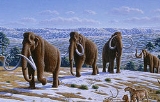
The woolly mammoth (Mammuthus primigenius), also called the tundra mammoth, is an extinct species of mammoth
Mammoth

A mammoth is any species of the extinct genus Mammuthus. These proboscideans are members of the Elephantidae and close relatives of modern elephants....
. This animal is known from bones and frozen carcasses from northern North America
North America

North America is the northern continent of the Americas, situated in the Earth's northern hemisphere and almost totally in the western hemisphere....
 and northern Eurasia
Eurasia

Eurasia is a large landmass covering about 53,990,000 km? or about 10.6% of the Earth's surface . Often considered a single continent, Eurasia comprises the traditional continents of Europe and Asia, concepts which date back to classical antiquity and the borders for which are somewhat arbitrary....
 with the best preserved carcasses in Siberia
Siberia

Siberia , is the name given to the vast region constituting almost all of North Asia and for the most part currently serving as the massive central and eastern portion of the Russian Federation, having served in the same capacity previously for the Soviet Union from its beginning, and the Russian Empire beginning in the 16th century....
.

This mammoth species was first recorded in (possibly 150,000 years old) deposits of the second last glaciation in Eurasia
Eurasia

Eurasia is a large landmass covering about 53,990,000 km? or about 10.6% of the Earth's surface . Often considered a single continent, Eurasia comprises the traditional continents of Europe and Asia, concepts which date back to classical antiquity and the borders for which are somewhat arbitrary....
. They were derived from steppe mammoth
Steppe mammoth

The steppe mammoth, Mammuthus trogontherii, is an extinct species of elephant, that ranged over most of northern Eurasia during the Middle Pleistocene, 600,000-370,000 years ago....
s (Mammuthus trogontherii).

It disappeared from most of its range at the end of the Pleistocene
Pleistocene

The Pleistocene is the epoch from 1.8 million to 10,000 years Before Present covering the world's recent period of repeated glaciations. The name pleistocene is derived from the Greek and ....
, with a dwarfed race still living on Wrangel Island
Wrangel Island

Wrangel Island is an island in the Arctic Ocean, between the Chukchi Sea and East Siberian Sea. Wrangel Island lies astride the 180th meridian meridian ....
 until roughly 1700 BCE.

ly mammoths lived in two groups (maybe subspecies).


Discussion
Ask a question about 'Woolly mammoth'
Start a new discussion about 'Woolly mammoth'
Answer questions from other users
Full Discussion Forum


Encyclopedia


The woolly mammoth (Mammuthus primigenius), also called the tundra mammoth, is an extinct species of mammoth
Mammoth

A mammoth is any species of the extinct genus Mammuthus. These proboscideans are members of the Elephantidae and close relatives of modern elephants....
. This animal is known from bones and frozen carcasses from northern North America
North America

North America is the northern continent of the Americas, situated in the Earth's northern hemisphere and almost totally in the western hemisphere....
 and northern Eurasia
Eurasia

Eurasia is a large landmass covering about 53,990,000 km? or about 10.6% of the Earth's surface . Often considered a single continent, Eurasia comprises the traditional continents of Europe and Asia, concepts which date back to classical antiquity and the borders for which are somewhat arbitrary....
 with the best preserved carcasses in Siberia
Siberia

Siberia , is the name given to the vast region constituting almost all of North Asia and for the most part currently serving as the massive central and eastern portion of the Russian Federation, having served in the same capacity previously for the Soviet Union from its beginning, and the Russian Empire beginning in the 16th century....
.

This mammoth species was first recorded in (possibly 150,000 years old) deposits of the second last glaciation in Eurasia
Eurasia

Eurasia is a large landmass covering about 53,990,000 km? or about 10.6% of the Earth's surface . Often considered a single continent, Eurasia comprises the traditional continents of Europe and Asia, concepts which date back to classical antiquity and the borders for which are somewhat arbitrary....
. They were derived from steppe mammoth
Steppe mammoth

The steppe mammoth, Mammuthus trogontherii, is an extinct species of elephant, that ranged over most of northern Eurasia during the Middle Pleistocene, 600,000-370,000 years ago....
s (Mammuthus trogontherii).

It disappeared from most of its range at the end of the Pleistocene
Pleistocene

The Pleistocene is the epoch from 1.8 million to 10,000 years Before Present covering the world's recent period of repeated glaciations. The name pleistocene is derived from the Greek and ....
, with a dwarfed race still living on Wrangel Island
Wrangel Island

Wrangel Island is an island in the Arctic Ocean, between the Chukchi Sea and East Siberian Sea. Wrangel Island lies astride the 180th meridian meridian ....
 until roughly 1700 BCE.

Adaptations

Woolly mammoths lived in two groups (maybe subspecies). One group stayed in the middle of the high Arctic, while the other group had a much wider range.

Woolly mammoths had a number of adaptations to the cold, most famously the thick layer of shaggy hair, up to to 1 meter in length with a fine underwool, for which the woolly mammoth is named. The coats were similar to those of Muskoxen and it is likely Mammoths moulted in summer. They also had far smaller ears than modern elephants; the largest mammoth ear found so far was only long, compared to for an African elephant. Other characteristic features included a high, peaked head that appears knob-like in many cave paintings and a high shoulder hump resulting from long spines on the neck vertebrae that probably carried fat deposits. Another feature at times found in cave paintings was confirmed by the discovery of the nearly intact remains of a baby Mammoth named "Dima
Dima

Dima is a town and municipality located in the province of Biscay, in the autonomous community of Basque Country , northern Spain.The Axlor archaeological site is nearby....
". Unlike the trunk lobes of living elephants, Dima's upper lip at the tip of the trunk had a broad lobe feature, while the lower lip had a broad, squarish flap.

Their teeth were also adapted to their diet of coarse tundra grasses, with more plates and a higher crown than their southern relatives. Their skin was no thicker than that of present-day elephants, but unlike elephants they had numerous sebaceous gland
Sebaceous gland

Sebaceous glands are small glands in the skin which secrete an oily matter in the hair follicles to lubricate the skin and hair of animals. In humans, they are found in greatest abundance on the face and scalp, though they are distributed throughout all skin sites except the palms and soles....
s in their skin which secreted greasy fat into their hair, improving its insulating qualities. They had a layer of fat up to thick under the skin which, like the blubber
Blubber

Blubber is a thick layer of Blood vessel fat found under the skin of all cetaceans, pinnipeds and sirenians....
 of whales, helped to keep them warm.

Woolly mammoths had extremely long tusks — up to long — which were markedly curved, to a much greater extent than those of elephants. It is not clear whether the tusks were a specific adaptation to their environment, but it has been suggested that mammoths may have used their tusks as shovels to clear snow from the ground and reach the vegetation buried below. This is evidenced by flat sections on the ventral surface of some tusks. It has also been observed in many specimens that there may be an amount of wear on top of the tusk that would suggests some animals had a preference as to which tusk it rested its trunk on.

Extinction

Until recently it was generally assumed that the last woolly mammoths vanished from Europe
Europe

Europe is, conventionally, one of the world's seven continents. Comprising the westernmost peninsula of Eurasia, Europe is generally divided from Asia to its east by the water divide of the Ural Mountains, the Ural , the Caspian Sea, and by the Caucasus Mountains to the southeast....
 and Southern Siberia
Siberia

Siberia , is the name given to the vast region constituting almost all of North Asia and for the most part currently serving as the massive central and eastern portion of the Russian Federation, having served in the same capacity previously for the Soviet Union from its beginning, and the Russian Empire beginning in the 16th century....
 about 10,000 BCE, but new findings show that some were still present there about 8,000 BCE. Only slightly later the woolly mammoths also disappeared from continental Northern Siberia. Woolly mammoths as well as Columbian mammoth
Columbian Mammoth

The 'Columbian Mammoth' is an extinct species of elephant that appeared in North America during the late Pleistocene, It is believed by some people to be the same species as its slightly larger cousin, M....
s disappeared also from the North American continent at the end of the ice age
Ice age

The general term "ice age" or, more precisely, "glacial age" denotes a geological period of long-term reduction in the temperature of the Earth's surface and atmosphere, resulting in an expansion of continental ice sheets, polar ice sheets and alpine glaciers....
. A small population of woolly mammoths survived on St. Paul Island, Alaska, up until 3,750 BCE, while another remained on Wrangel Island
Wrangel Island

Wrangel Island is an island in the Arctic Ocean, between the Chukchi Sea and East Siberian Sea. Wrangel Island lies astride the 180th meridian meridian ....
, located in the Arctic Ocean
Arctic Ocean

The Arctic Ocean, located in the Northern Hemisphere and mostly in the Arctic North Pole region, is the smallest and shallowest of the world's five major oceanic divisions....
, up until 1700 BCE. Possibly due to their limited food supply, these animals were a dwarf variety
Dwarf elephant

Fossil remains of dwarf elephants have been found on the Mediterranean islands of Cyprus, Malta , Crete, Sicily, Sardinia, the Cyclades and the Dodecanese Islands....
, thus much smaller than the original Pleistocene woolly mammoth. However, the Wrangel Island mammoths should not be confused with the Channel Islands Pygmy Mammoth, Mammuthus exilis, which was a different species.

Most woolly mammoths died out at the end of the Pleistocene
Pleistocene

The Pleistocene is the epoch from 1.8 million to 10,000 years Before Present covering the world's recent period of repeated glaciations. The name pleistocene is derived from the Greek and ....
, as a result of climate change and a shift in man's hunting patterns. In 2008 a study conducted by the Museo Nacional de Ciencias Naturales
Museo Nacional de Ciencias Naturales

The Museo Nacional de Ciencias Naturales de Spain is the National Museum of Natural history of Spain. It is in Madrid.Its sections are*Biodiversity,Biology, Evolution...
 in Spain determined that warming temperatures had reduced mammoth habitat to only a fraction of what it once was, putting the woolly mammoth population in sharp decline before the introduction of humans into the territory. Glacial retreat shrank mammoth habitat from 42,000 years ago to 6,000 years ago. Although a similarly drastic loss of habitat occurred at the end of the Saale glaciation 125,000 years ago, human pressure during the later warming period was sufficient to push the mammoth over the brink. The study employed the use of climate models and fossil remains to make these determinations.

The Earth today has no environment similar to the habitat that sustained mammoths. In 1989 the North East science station at Cherskii in Russia
Russia

Russia , or the Russian Federation , is a list of countries spanning more than one continent country extending over much of northern Eurasia....
 began a project to recreate the steppe grassland habitat of the Pleistocene through the introduction of Yakutian horses, Bison
Bison

Bison is a taxonomic group containing six species of large even-toed ungulates within the subfamily Bovinae. Only two of these species still exist: the American bison and the European bison, or wisent , each with two subspecies....
 and other steppe species. Additional to other research planned, scientists hope to clone woolly mammoths, and then re-introduce them to what is now called Pleistocene Park
Pleistocene park

Pleistocene Park in the Sakha Republic in northern Siberia is an attempt by Russian researcher Sergey Zimov to reproduce the ecosystem that flourished during the last ice age, with hopes to back his theory that hunting, and not climate change, destroyed the wildlife....
.

Frozen remains

The woolly mammoth is a common member in the fossil record, but unlike many others are often not actually converted to stone, but are actually preserved since their deaths. This is in part because of their massive size and partially because of the persistence of the frozen climate in which they had lived and, therefore, died. The very first mammoth fossil fully documented by modern science, the Adams mammoth
Adams mammoth

The Adams mammoth is the name given to the first full woolly mammoth, species Mammuthus primigenius, skeleton to be documented in the history of modern science....
, was of this type, but had been allowed to largely decay before its recovery, possibly even having been partially devoured by modern wolves.

Preserved frozen remains of woolly mammoths, with much soft tissue
Soft tissue

In medicine, the term soft tissue refers to Tissue that connect, support, or surround other structures and Organ s of the body.Soft tissue includes tendons, ligaments, fascia, Fibrous connective tissue, fat, and synovial membranes , and muscles, nerves and blood vessels ....
 remaining, have been found in the northern parts of Siberia
Siberia

Siberia , is the name given to the vast region constituting almost all of North Asia and for the most part currently serving as the massive central and eastern portion of the Russian Federation, having served in the same capacity previously for the Soviet Union from its beginning, and the Russian Empire beginning in the 16th century....
. This is a rare occurrence, essentially requiring the animal to have been buried rapidly in liquid or semi-solids such as silt, mud and icy water which then froze. This may have occurred in a number of ways. Mammoths may have been trapped in bogs or quicksands and either died of starvation or exposure, or drowning if they sank under the surface. Though judging by the evidence of undigested food in the stomach and seed pods still in the mouth of many of the specimens, neither starvation nor exposure seem likely. The maturity of this ingested vegetation places the time period in autumn rather than in spring when flowers would be expected. The animals may have fallen through frozen ice into small ponds or potholes, entombing them. Many are certainly known to have been killed in rivers, perhaps through being swept away by river floods. In one location, by the Berelekh River in Yakutia in Siberia, more than 9,000 bones from at least 156 individual mammoths have been found in a single spot, apparently having been swept there by the current.

In 1977, the well-preserved carcass of a 7- to 8-month old baby woolly mammoth, named "Dima
Dima

Dima is a town and municipality located in the province of Biscay, in the autonomous community of Basque Country , northern Spain.The Axlor archaeological site is nearby....
", was discovered. This carcass was recovered from permafrost
Permafrost

In geology, permafrost or permafrost soil is soil at or below the freezing point of water for two or more years. Ice is not always present, as may be in the case of nonporous bedrock, but it frequently occurs and it may be in amounts exceeding the potential hydraulic saturation of the ground material....
 on a tributary of the Kolyma River
Kolyma River

The Kolyma River is a river in northeastern Siberia, whose basin covers parts of the Sakha Republic, Chukotka Autonomous Okrug, and Magadan Oblast of Russia....
 in northeastern Siberia. This baby woolly mammoth weighed approximately at death and was high and long. Radiocarbon dating determined that Dima died about 40,000 years ago. Its internal organs are similar to those of living elephants, but its ears are only one-tenth the size of those of an African elephant of similar age.

In the summer of 1997, a Dolgan
Dolgans

Dolgans are a Turkic languages-speaking people, who mostly inhabit Krasnoyarsk Krai, Russia. The Russian Census counted 7,261 Dolgans. This number includes 5,517 in former Taymyr Autonomous Okrug....
 family named Jarkov discovered a piece of mammoth tusk protruding from the tundra of the Taymyr Peninsula
Taymyr Peninsula

Taymyr Peninsula is a peninsula in Siberia that forms the most northern part of mainland Asia. It lies between the Yenisei Gulf of the Kara Sea and the Khatanga Gulf of the Laptev Sea in Krasnoyarsk Krai, Russia....
 in Siberia
Siberia

Siberia , is the name given to the vast region constituting almost all of North Asia and for the most part currently serving as the massive central and eastern portion of the Russian Federation, having served in the same capacity previously for the Soviet Union from its beginning, and the Russian Empire beginning in the 16th century....
, Russia
Russia

Russia , or the Russian Federation , is a list of countries spanning more than one continent country extending over much of northern Eurasia....
. In September/October 1999 this 20,380-year-old carcass and the surrounding sediment were flown to an ice cave in Khatanga, Taymyr Autonomous Okrug
Taymyr Autonomous Okrug

Taymyr Autonomous Okrug , or Taymyria, was a federal subjects of Russia of Russia , the northernmost in mainland Russia . It is named after the Taymyr Peninsula....
. In October 2000, the careful defrosting operations in this cave began with the use of hairdryers to keep the hair and other soft tissues intact.

In May 2007, the carcass of a six-month-old female woolly mammoth calf
Lyuba

Lyuba is a female woolly mammoth calf which died ca 40,000 years ago at the age of six months. Discovered in May 2007 by reindeer breeder and hunter Yuri Khudi in Russia's Arctic Yamal Peninsula, it was named "Lyuba" after the discoverer's wife....
 was discovered encased in a layer of permafrost
Permafrost

In geology, permafrost or permafrost soil is soil at or below the freezing point of water for two or more years. Ice is not always present, as may be in the case of nonporous bedrock, but it frequently occurs and it may be in amounts exceeding the potential hydraulic saturation of the ground material....
 near the Yuribei River in Russia where it had been buried for 37,000 years. Alexei Tikhonov, the Russian Academy of Science's Zoological Institute's deputy director, has dismissed the prospect of cloning the animal, as the whole cells required for cloning would have burst under the freezing conditions. DNA
DNA

Deoxyribonucleic acid is a nucleic acid that contains the genetics instructions used in the development and functioning of all known living organisms and some viruses....
 is expected to be well-preserved enough to be useful for research on mammoth phylogeny and perhaps physiology
Physiology

Physiology is the study of the mechanical, physical, and biochemical functions of living organisms. Physiology has traditionally been divided between plant physiology and animal and all living things physiology but the principles of physiology are universal, no matter what particular organism is being studied....
 however.

To date, thirty-nine preserved bodies have been found, but only four of them are complete. In most cases the flesh shows signs of decay before its freezing and later desiccation. Stories abound about frozen mammoth carcasses that were still edible once defrosted, but the original sources indicate that the carcasses were in fact terribly decayed, and the stench so unbearable that only the dogs accompanying the finders showed any interest in the flesh.

In addition to frozen carcasses, large amounts of mammoth ivory
Ivory

File:Ivory decoration.jpgIvory is formed from dentine and constitutes the bulk of the teeth and tusks of animals such as the elephant, hippopotamus, walrus, mammoth and narwhal....
 have been found in Siberia. Mammoth tusks have been articles of trade for at least 2,000 years. They have been and are still a highly prized commodity. Güyük, the 13th century Khan of the Mongols, is reputed to have sat on a throne made from mammoth ivory, and even today it is in great demand as a replacement for the now-banned export of elephant ivory.

Ivory from the extinct Wooly Mammoth has been used in the fretboards of many PRS Guitars
PRS Guitars

PRS Guitars is an United States guitar manufacturer headquartered in Stevensville, Maryland. PRS Guitars was founded by guitarist and luthier Paul Reed Smith in 1985....
. The House of Staunton, purveyor of chess equipment, offers a set made from Wooly Mammoth ivory.

Genetics

Since there is a known case in which an Asian elephant
Asian Elephant

The Asian or Asiatic Elephant , sometimes known by the name of one of its subspecies – the Indian Elephant, is one of the three living species of elephant, and the only living species of the genus Elephas....
 and an African elephant have produced a live (though sickly) offspring
Motty

Motty was the only proven Interspecific hybrid between an Asian elephant and an African elephant elephant. The male calf was born on July 11, 1978 in Chester Zoo, to Asian mother Sheba and African father Jumbolino ....
, it has been theorized that if mammoths were still alive today, they would be able to interbreed with Indian elephants. This has led to the idea that perhaps a mammoth-like beast could be recreated by taking genetic material from a frozen mammoth and combining it with that from a modern Indian elephant.
Mammoth Ivory Hg
Scientists hope to retrieve the preserved reproductive organs of a frozen mammoth and revive its sperm cells
Spermatozoon

A sperm, from the ancient Greek word sp???a and and more commonly known as a sperm cell, is the ploidy cell that is the male gamete. It Fertilization an ovum to form a zygote....
. However, not enough genetic material has been found in frozen mammoths for this to be attempted. Another attempt at recreating the mammoth is cloning. Fox News reported that a team of Japanese scientists feels they are getting closer to this goal. A November 4, 2008 article states that the Japanese scientists were successful in finding useful DNA
DNA

Deoxyribonucleic acid is a nucleic acid that contains the genetics instructions used in the development and functioning of all known living organisms and some viruses....
 of mice that had been frozen for 16 years. The scientists did so by looking in the brain, where high concentrations of sugar had preserved the DNA. They hope to use similar methods to find usable mammoth DNA and implant it into unfertilized Asian elephant eggs.

In spite of not yet being able to retrieve this usable DNA, the scientific community has been successful in determining the complete mitochondrial genome
Mitochondrial DNA

Mitochondrial DNA is the DNA located in organelles called mitochondrion. Most other DNA present in eukaryotic organisms is found in the cell nucleus....
 sequence of Mammuthus primigenius. The analysis demonstrates that the divergence of mammoth, African elephant, and Asian elephant occurred over a short time, and confirmed that the mammoth was more closely related to the Asian than to the African elephant. As an important landmark in this direction, in December 2005, a team of American, German, and UK researchers were able to assemble a complete mitochondrial DNA of the mammoth, which allowed them to trace the close evolutionary relationship between mammoths and the Asian elephant. African elephants branched away from the woolly mammoth around 6 million years ago, a moment in time close to that of the similar split between chimps and humans. Many researchers expect that the first fully sequenced nuclear genome of an extinct species will be that of the mammoth. On July 6 2006 it was reported that scientists extracted, amplified and sequenced
DNA sequencing

The term DNA sequencing refers to methods for determining the order of the nucleotide bases, adenine, guanine, cytosine, and thymine, in a molecule of DNA....
 Mc1r, a gene
Gene

A gene is the basic unit of heredity in a living organism. All living things depend on genes. Genes hold the information to build and maintain their cell and pass genetic trait to offspring....
 that influences hair color in mammals, from a 43,000-year old woolly mammoth bone from Siberia
Siberia

Siberia , is the name given to the vast region constituting almost all of North Asia and for the most part currently serving as the massive central and eastern portion of the Russian Federation, having served in the same capacity previously for the Soviet Union from its beginning, and the Russian Empire beginning in the 16th century....
.

In November 2008 it was reported that two professors from Penn State University - Stephan Schuster, professor of biochemistry and molecular biology, and Webb Miller, professor of biology, computer science and engineering - had mapped much of the woolly mammoth's DNA. Their research discovered that there were two distinct groups of woolly mammoths, one which went extinct 45,000 years ago, and a different one which went extinct in 10,000 B.C. Their research also showed that the DNA of the woolly mammoth and the African elephant are 99.4% identical.

While the authors admit they don't know the full size of the genome, they believe they have sequenced about 50% from random fragments.

The team mapped the mammoth's nuclear genome sequence by extracting DNA from the hair of a 20 000 year old mammoth retrieved from permafrost
Permafrost

In geology, permafrost or permafrost soil is soil at or below the freezing point of water for two or more years. Ice is not always present, as may be in the case of nonporous bedrock, but it frequently occurs and it may be in amounts exceeding the potential hydraulic saturation of the ground material....
 and from another mammoth which died some 60 000 years ago. Using hair avoids the problems of DNA contamination caused by bacteria and fungi. Hair produces more intact DNA because of the plastic-like protection afforded by the hair material.

Cryptozoology

There have been occasional claims that the woolly mammoth is not actually extinct, and that small isolated herds might survive in the vast and sparsely inhabited tundra
Tundra

In physical geography, tundra is an biome where the tree growth is hindered by low temperatures and short growing seasons. The term tundra comes from Kildin Sami tund?r, which means "uplands, treeless mountain tract." There are two types of tundra: Arctic tundra and alpine tundra....
 of the northern hemisphere
Northern Hemisphere

The Northern Hemisphere is the half of a planet that is north of the equator?the word sphere literally means 'half sphere'. It is also that half of the celestial sphere north of the celestial equator....
. In the late nineteenth century, there were, according to Bengt Sjögren (1962), persistent rumors about surviving mammoths hiding in Alaska
Alaska

Alaska is the largest U.S. state of the United States by area; it is situated in the northwest extremity of the North American continent, with Canada to the east, the Arctic Ocean to the north, and the Pacific Ocean to the west and south, with Russia further west across the Bering Strait....
. In October 1899, a story about a man named Henry Tukeman detailed his having killed a mammoth in Alaska and that he subsequently donated the specimen to the Smithsonian Institution
Smithsonian Institution

The Smithsonian Institution is an educational and research institute and associated museum complex, administered and funded by the government of the United States and by funds from its Financial endowment, contributions, and profits from its shops and its magazine....
 in Washington, D.C.
Washington, D.C.

Washington, D.C. , formally the District of Columbia and commonly referred to as Washington, the District, or simply D.C., is the Capital of the United States, founded on July 16, 1790....
 However, the museum denied the existence of any mammoth corpse and the story turned out to be a hoax. Sjögren (1962) believes the myth was started when the American
United States

The United States of America is a Federal government constitutional republic comprising U.S. state and a federal district. The country is situated mostly in central North America, where its Contiguous United States and Washington, D.C., the Capital districts and territories, lie between the Pacific Ocean and Atlantic Oceans, Borders of the U...
 biologist Charles Haskins Townsend
Charles Haskins Townsend

Charles Haskins Townsend, Sc.D. was an United States zoology, born at Parnassus, Pennsylvania, Pennsylvania. From 1897 to 1902 he was connected with the United States Fish Commission, serving as chief of the fisheries division....
 traveled in Alaska, saw Eskimo
Eskimo

Eskimos or Esquimaux are indigenous peoples who have traditionally inhabited the circumpolar region from eastern Siberia , across Alaska and Canada, and all of Greenland ....
s trading mammoth tusks, asked if there still were living mammoths in Alaska and provided them with a drawing of the animal.

In the 19th century, several reports of "large shaggy beasts" were passed on to the Russian
Russians

The Russian people are an East Slavs ethnic group, primarily living in Russia and neighboring countries.The English language term Russians is used to refer to the citizens of Russia, regardless of their ethnicity ; in Russian language, the demonym Russian is translated as Rossiyanin ....
 authorities by Siberian tribesman, but no scientific proof ever surfaced. A French
France

France , officially the French Republic , is a country whose Metropolitan France is located in Western Europe and that also comprises various Overseas departments and territories of France....
 chargé d'affaires
Chargé d'affaires

In diplomacy, charg? d?affaires , often shortened to simply charg?, is the title of two classes of diplomacy agents who head a diplomatic mission on a temporary basis....
 working in Vladivostok
Vladivostok

File:vladivostokrussia.jpgVladivostok is Russia's largest port types of inhabited localities in Russia on the Pacific Ocean and the administrative center of Primorsky Krai....
, M. Gallon, claimed in 1946 that in 1920 he met a Russian fur-trapper that claimed to have seen living giant, furry "elephants" deep into the taiga
Taiga

Taiga is a biome characterized by coniferous forests. Covering most of inland Alaska, Canada, Sweden, Finland, inland Norway and Russia , as well as parts of the extreme northern continental United States , northern Kazakhstan and Japan , the taiga is the world's largest terrestrial biome....
. Gallon added that the fur-trapper didn't even know about mammoths before, and that he talked about the mammoths as a forest-animal at a time when they were seen as living on the tundra and snow.

In legends

Legends from dozens of Native American tribes have been interpreted by some as indicative of Proboscidea. One example is from the Kaska
Kaska

The Kaska or Kaska Dena are a First Nations people living mainly in northern British Columbia and the southeastern Yukon in Canada. The Kaska language originally spoken by the Kaska is an Athabaskan languages....
 tribe from northern British Columbia
British Columbia

British Columbia is the westernmost of Canada's Provinces and territories of Canada and is famed for its natural beauty, as reflected in its Latin motto, Splendor sine occasu ....
; in 1917 an ethnologist recorded their tradition of: “A very large kind of animal which roamed the country a long time ago. It corresponded somewhat to white men's pictures of elephants. It was of huge size, in build like an elephant, had tusks, and was hairy. These animals were seen not so very long ago, it is said, generally singly; but none have been seen now for several generations. Indians come across their bones occasionally. The narrator said that he and some others, a few years ago, came on a shoulder-blade... as wide as a table (about three feet).”

External links

  • , Stupid Question, February 14, 2005, by John Ruch.