

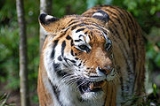
Felidae

Encyclopedia
Felidae is the biological
family of the cats
; a member of this family is called a felid. Felids are the strictest carnivore
s of the thirteen terrestrial families in the order
Carnivora
, although the three families of marine mammals comprising the superfamily pinnipedia
are as carnivorous as the felids. The most familiar felid is the domestic cat, which first became associated with humans about 10,000 years ago, but the family includes all other wild cats including the big cat
s.
Extant felids belong to one of two subfamilies: Pantherinae
(which includes the tiger
, the lion
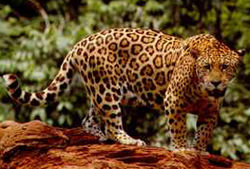
, the jaguar
, and the leopard
), and Felinae
(which includes the cougar, the cheetah
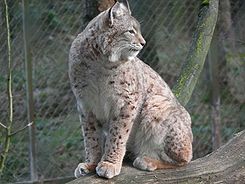
, the lynx
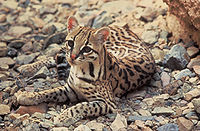
es, the ocelot
, and the domestic cat).
The first felids emerged during the Oligocene
, about 25 million year
s ago. In prehistoric times, there was a third subfamily known as Machairodontinae
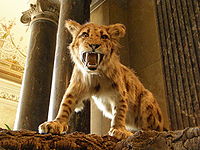
, which included the "saber-toothed cats" such as the well known Smilodon
. There were also other superficially cat-like mammals, such as the marsupial sabertooth Thylacosmilus
or the Nimravidae
, which are not included in Felidae despite superficial similarities
.
originated in Asia and spread across continent
s by crossing land bridge
s. As reported in the journal Science
, testing of mitochondrial
and nuclear DNA
by Warren Johnson and Stephen O'Brien of the U.S. National Cancer Institute
demonstrated that ancient cats evolved into eight main lineages that diverged in the course of at least 10 migrations (in both directions) from continent to continent via the Bering land bridge
and Isthmus of Panama
, with the Panthera
genus being the oldest and the Felis
genus being the youngest. They estimated that 60 percent of the modern species of cats developed within the last million years.
Most felids have a haploid number of 18 or 19. New World cats (those in Central and South America) have a haploid number of 18, possibly due to the combination of two smaller chromosome
s into one larger chromosome. Prior to this discovery, biologists had been largely unable to establish a family tree of cats from the fossil
record because the fossils of different cat species all look very much alike, differing primarily in size.
The felids' closest relatives are thought to be the linsangs, and at one remove the group of civet
s, hyena
s, mongoose
s, and Madagascar carnivores
, with whom they share the Suborder Feliformia
. All felid species share a genetic anomaly that prevents them from tasting sweetness.
, wild felids are generally solitary; feral
domestic cats do, however, form feral cat colonies. Cheetahs are also known to live and hunt in groups. Felids are generally secretive animals, are often nocturnal, and live in relatively inaccessible habitats. Around three-quarters of cat species live in forest
ed terrain, and they are generally agile climbers. However, felids may be found in almost any environment, with some species being native to mountain
ous terrain or desert
s.
Wild felids are native to every continent except Australasia
and Antarctica.
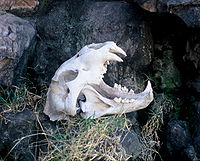 Felids tend to have lithe and flexible bodies with muscular limbs. In the great majority of species, the tail is between a third and a half the length of the body, although there are some exceptions (for example, the bobcat
and margay
). The limbs are digitigrade
with soft toe pads and retractable claws. Compared with most other mammals, the head of cats is highly domed with a short muzzle. The skull possesses wide zygomatic arch
es and a large sagittal crest
, both of which allow for the attachment of strong jaw muscles.
The various species of felids vary greatly in size. One of the smallest is the Black-footed Cat
, measuring 35 to 40 cm (13.8 to 15.7 in) long, while the largest in the wild is the tiger
, which can attain up to 350 centimetres (11.5 ft) in length and weigh 300 kilograms (661.4 lb).
The fur
of felids takes many different forms, being much thicker in those species that live in cold environments, such as the Snow Leopard
. The color of felids is also highly variable—although brown to golden fur is common in most species—usually marked with distinctive spots, stripes, or rosettes. The only felids to lack significant markings are the lion, puma, caracal
and jaguarundi
. Many species exhibit melanism
, in which some individuals have an all-black coat. All felids have a "tear stripe", a black stripe running from the corner of each eye down the side of the muzzle
.
The tongue
of felids is covered with horny papillae
, which help to rasp meat from their prey.
All felids have retractable claws, although in a few species, such as the cheetah
, the claws remain visible even when retracted. The claws are retracted when the animal is relaxed. They are attached to the terminal bone of the toe with a tough ligament
; when the animal contracts muscles in the toe to straighten it, the ligament forces the claw outwards.
Cats have five toes on their forefeet and four on their hindfeet, reflecting their reliance on gripping and holding down their prey with their claws.
. Their night vision is especially good, due to the presence of a tapetum lucidum
, which reflects light back inside the eyeball, and gives felid eyes their distinctive shine. As a result, the eyes of felids are approximately six times more light sensitive than those of humans, and many species are at least partially nocturnal. The retina
of felids also contains a relatively high proportion of rod cell
s, adapted for seeing in conditions of dim light, but they also possess cone cells for sensing color during the day. However, felids appear to have relatively poor color vision in comparison with humans.
The external ears of felids are also large, and especially sensitive to high-frequency sounds in the smaller cats. This sensitivity allows them to locate small rodent
prey; cats themselves do not apparently produce such sounds.
Felids also have a highly developed sense of smell, although not to the degree seen in canids
; this is further supplemented by the presence of a vomeronasal organ
in the roof of the mouth, allowing the animal to "taste" the air. The use of this organ is associated with the Flehmen response
, in which the upper lip is curled upwards.
Felids possess highly sensitive whiskers set deep within the skin, which provide the cat with sensory information about the slightest air movement around it. For this reason, whiskers are very helpful to nocturnal hunters.
Most felids are able to land on their feet after a fall, an ability which relies on vision and the sense of balance
acting together.
, they have the dental formula
: . The canine teeth
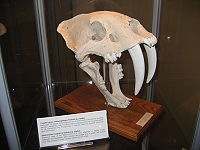
are large, reaching exceptional size in the extinct saber-tooth species. The upper third premolar and lower molar are adapted as carnassial
teeth, suited to tearing and cutting flesh.
The jaws of felids can only move vertically. This prevents them from being able to chew
, but makes it easier for their powerful masseter
jaw muscles to hold struggling prey.
All felids are able to spit, hiss, growl
, snarl, and mew. The first four of these sounds are all used in an aggressive context. The spitting sound is a sudden burst, typically used when making threats, especially towards other species (such as humans). The hiss is a prolonged, atonal sound used in close range to other members of the species, when the animal is uncertain whether to attack or retreat. Growling is used to indicate a willingness to attack, while the higher pitched snarl is used when adopting a defensive posture.
The mewing sound may be used either as a close-contact call, typically between a mother and kittens, or as a louder, longer distance call, primarily during the mating season. There is some variation in the acoustic properties of the mew between different felid species; extreme examples include the whistling sound made by cougars and the mew-grunt of lions and tigers.
Most felids seem to be able to purr
, vibrating the muscles in their larynx
to produce a distinctive buzzing sound. In the wild, purring is used while a mother is caring for kittens. Precisely which species of felid are able to purr is a matter of debate, but the sound has been recorded in most of the smaller species, as well as the cheetah and cougar, and may also be found in the big cats.
Other common felid vocalisations include the gurgle, wah-wah, prusten
, and roar. The first two sounds are found only among the Felinae (small cats). Gurgling is a quiet sound used during meetings between friendly individuals, as well as during courtship and when nursing kittens. The wah-wah is a short, deep-sounding call used in close contact, and is not found in all species (it is, for example, absent in the domestic cat).
In contrast, prusten and roaring are found only in big cats. Prusten is a short, soft, snorting sound reported in tigers, jaguars, snow leopards, and clouded leopards; it is used during contact between friendly individuals. The roar is an especially loud call with a distinctive pattern that depends on the species. Tigers and jaguars have a very snarly roar, while the roar of leopards and lions is much more throaty. Only lions, leopards, tigers and jaguars are truly able to roar, although the loudest mews of snow leopards have a similar, if less structured, sound.
; the Pantherinae
; the Acinonychinae (Cheetahs); the extinct Machairodontinae
; and the extinct Proailurinae.
The last four lineages (5, 6, 7, 8) are more related to each other than to any of the first four (1, 2, 3, 4), and so form a clade
within the Felinae
subfamily of family Felidae.

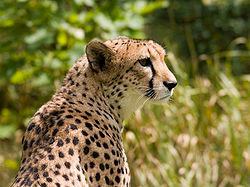

 The following is the complete list of genera within family Felidae grouped according to the traditional phenotypical classification with the corresponding genotypical lineages indicated:
) lived in the late Oligocene
and early Miocene
epochs. During the Miocene it gave way to Pseudaelurus
. Pseudaelurus is believed to be the latest common ancestor of the two extant subfamilies and the extinct subfamily, Machairodontinae
. This group, better known as the saber-tooth cats, became extinct in the Late Pleistocene
era. The group includes the genera Smilodon
, Machairodus
and Homotherium
. The Metailurini
were originally classified as a distinct tribe within the Machairodontinae, though they count as members of the Felinae in recent times. Most extinct cat-like animals, once regarded as members of the Felidae, later turned out to be members of related, but distinct, families: the "false sabretooths" Nimravidae
and Barbourofelidae
. As a result, sabretooth "cats" seem to belong to four different lineages. The total number of fossil felids that are known to science is low compared to other carnivoran families such as dog
s and bear
s. Felidae radiated quite recently and most of the extant species are relatively young.
for extant genera. Pseudaelurus is included here in the Felinae according to McKenna & Bell despite its basal position in felid evolution. Inconsistent with McKenna and Bell, three additional prehistoric genera, Miracinonyx
, Lokontailurus and Xenosmilus
are listed. Sivapanthera is included into the Felinae (not Acinonychinae) and Ischrosmilus is included in the genus Smilodon
.
Biology
Biology is a natural science concerned with the study of life and living organisms, including their structure, function, growth, origin, evolution, distribution, and taxonomy. Biology is a vast subject containing many subdivisions, topics, and disciplines...
family of the cats
Cat
The cat , also known as the domestic cat or housecat to distinguish it from other felids and felines, is a small, usually furry, domesticated, carnivorous mammal that is valued by humans for its companionship and for its ability to hunt vermin and household pests...
; a member of this family is called a felid. Felids are the strictest carnivore
Carnivore
A carnivore meaning 'meat eater' is an organism that derives its energy and nutrient requirements from a diet consisting mainly or exclusively of animal tissue, whether through predation or scavenging...
s of the thirteen terrestrial families in the order
Order (biology)
In scientific classification used in biology, the order is# a taxonomic rank used in the classification of organisms. Other well-known ranks are life, domain, kingdom, phylum, class, family, genus, and species, with order fitting in between class and family...
Carnivora
Carnivora
The diverse order Carnivora |Latin]] carō "flesh", + vorāre "to devour") includes over 260 species of placental mammals. Its members are formally referred to as carnivorans, while the word "carnivore" can refer to any meat-eating animal...
, although the three families of marine mammals comprising the superfamily pinnipedia
Pinniped
Pinnipeds or fin-footed mammals are a widely distributed and diverse group of semiaquatic marine mammals comprising the families Odobenidae , Otariidae , and Phocidae .-Overview: Pinnipeds are typically sleek-bodied and barrel-shaped...
are as carnivorous as the felids. The most familiar felid is the domestic cat, which first became associated with humans about 10,000 years ago, but the family includes all other wild cats including the big cat
Big cat
The term big cat – which is not a biological classification – is used informally to distinguish the larger felid species from smaller ones. One definition of "big cat" includes the four members of the genus Panthera: the tiger, lion, jaguar, and leopard. Members of this genus are the only cats able...
s.
Extant felids belong to one of two subfamilies: Pantherinae
Pantherinae
Pantherinae is the subfamily of the family Felidae, which includes the genera Panthera, Uncia and Neofelis.The divergence of Pantherinae from Felinae has been ranked between six and ten million years ago. DNA analysis suggests that the snow leopard Uncia uncia is basal to the entire Pantherinae and...
(which includes the tiger
Tiger
The tiger is the largest cat species, reaching a total body length of up to and weighing up to . Their most recognizable feature is a pattern of dark vertical stripes on reddish-orange fur with lighter underparts...
, the lion
Lion
The lion is one of the four big cats in the genus Panthera, and a member of the family Felidae. With some males exceeding 250 kg in weight, it is the second-largest living cat after the tiger...
, the jaguar
Jaguar
The jaguar is a big cat, a feline in the Panthera genus, and is the only Panthera species found in the Americas. The jaguar is the third-largest feline after the tiger and the lion, and the largest in the Western Hemisphere. The jaguar's present range extends from Southern United States and Mexico...
, and the leopard
Leopard
The leopard , Panthera pardus, is a member of the Felidae family and the smallest of the four "big cats" in the genus Panthera, the other three being the tiger, lion, and jaguar. The leopard was once distributed across eastern and southern Asia and Africa, from Siberia to South Africa, but its...
), and Felinae
Felinae
Felinae is a subfamily of the family Felidae which includes the genera and species listed below. Most are small to medium-sized cats, although the group does include some larger animals, such as the Cougar and Cheetah....
(which includes the cougar, the cheetah
Cheetah
The cheetah is a large-sized feline inhabiting most of Africa and parts of the Middle East. The cheetah is the only extant member of the genus Acinonyx, most notable for modifications in the species' paws...
, the lynx
Lynx
A lynx is any of the four Lynx genus species of medium-sized wildcats. The name "lynx" originated in Middle English via Latin from Greek word "λύγξ", derived from the Indo-European root "*leuk-", meaning "light, brightness", in reference to the luminescence of its reflective eyes...
es, the ocelot
Ocelot
The ocelot , pronounced /ˈɒsəˌlɒt/, also known as the dwarf leopard or McKenney's wildcat is a wild cat distributed over South and Central America and Mexico, but has been reported as far north as Texas and in Trinidad, in the Caribbean...
, and the domestic cat).
The first felids emerged during the Oligocene
Oligocene
The Oligocene is a geologic epoch of the Paleogene Period and extends from about 34 million to 23 million years before the present . As with other older geologic periods, the rock beds that define the period are well identified but the exact dates of the start and end of the period are slightly...
, about 25 million year
Year
A year is the orbital period of the Earth moving around the Sun. For an observer on Earth, this corresponds to the period it takes the Sun to complete one course throughout the zodiac along the ecliptic....
s ago. In prehistoric times, there was a third subfamily known as Machairodontinae
Machairodontinae
Machairodontinae is an extinct carnivoran mammal subfamily of Felidae endemic to Asia, Africa, North America, South America, and Europe from the Miocene to Pleistocene living from c. 23 Ma until c...
, which included the "saber-toothed cats" such as the well known Smilodon
Smilodon
Smilodon , often called a saber-toothed cat or saber-toothed tiger, is an extinct genus of machairodonts. This saber-toothed cat was endemic to North America and South America, living from near the beginning through the very end of the Pleistocene epoch .-Etymology:The nickname "saber-tooth" refers...
. There were also other superficially cat-like mammals, such as the marsupial sabertooth Thylacosmilus
Thylacosmilus
Thylacosmilus was a genus of sabre-toothed metatherian predators that first appeared during the Miocene. Remains of the animal have been found in parts of South America, primarily Argentina...
or the Nimravidae
Nimravidae
The Nimravidae, sometimes known as false saber-toothed cats, are an extinct family of mammalian carnivores belonging to the suborder Feliformia and endemic to North America, Europe, and Asia living from the Eocene through the Miocene epochs , existing for approximately .-Morphology:Although some...
, which are not included in Felidae despite superficial similarities
Convergent evolution
Convergent evolution describes the acquisition of the same biological trait in unrelated lineages.The wing is a classic example of convergent evolution in action. Although their last common ancestor did not have wings, both birds and bats do, and are capable of powered flight. The wings are...
.
Evolution
There are 41 known species of felids in the world today, which have all descended from the same ancestor. This taxonTaxon
|thumb|270px|[[African elephants]] form a widely-accepted taxon, the [[genus]] LoxodontaA taxon is a group of organisms, which a taxonomist adjudges to be a unit. Usually a taxon is given a name and a rank, although neither is a requirement...
originated in Asia and spread across continent
Continent
A continent is one of several very large landmasses on Earth. They are generally identified by convention rather than any strict criteria, with seven regions commonly regarded as continents—they are : Asia, Africa, North America, South America, Antarctica, Europe, and Australia.Plate tectonics is...
s by crossing land bridge
Land bridge
A land bridge, in biogeography, is an isthmus or wider land connection between otherwise separate areas, over which animals and plants are able to cross and colonise new lands...
s. As reported in the journal Science
Science (journal)
Science is the academic journal of the American Association for the Advancement of Science and is one of the world's top scientific journals....
, testing of mitochondrial
Mitochondrial DNA
Mitochondrial DNA is the DNA located in organelles called mitochondria, structures within eukaryotic cells that convert the chemical energy from food into a form that cells can use, adenosine triphosphate...
and nuclear DNA
Nuclear DNA
Nuclear DNA, nuclear deoxyribonucleic acid , is DNA contained within a nucleus of eukaryotic organisms. In mammals and vertebrates, nuclear DNA encodes more of the genome than the mitochondrial DNA and is composed of information inherited from two parents, one male, and one female, rather than...
by Warren Johnson and Stephen O'Brien of the U.S. National Cancer Institute
National Cancer Institute
The National Cancer Institute is part of the National Institutes of Health , which is one of 11 agencies that are part of the U.S. Department of Health and Human Services. The NCI coordinates the U.S...
demonstrated that ancient cats evolved into eight main lineages that diverged in the course of at least 10 migrations (in both directions) from continent to continent via the Bering land bridge
Bering land bridge
The Bering land bridge was a land bridge roughly 1,000 miles wide at its greatest extent, which joined present-day Alaska and eastern Siberia at various times during the Pleistocene ice ages. Like most of Siberia and all of Manchuria, Beringia was not glaciated because snowfall was extremely light...
and Isthmus of Panama
Isthmus of Panama
The Isthmus of Panama, also historically known as the Isthmus of Darien, is the narrow strip of land that lies between the Caribbean Sea and the Pacific Ocean, linking North and South America. It contains the country of Panama and the Panama Canal...
, with the Panthera
Panthera
Panthera is a genus of the family Felidae , which contains four well-known living species: the tiger, the lion, the jaguar, and the leopard. The genus comprises about half of the Pantherinae subfamily, the big cats...
genus being the oldest and the Felis
Felis
Felis is a genus of cats in the family Felidae, including the familiar domestic cat and its closest wild relatives. The wild species are distributed widely across Europe, southern and central Asia, and Africa; the domestic cat has been introduced worldwide.Members of the genus Felis are all small...
genus being the youngest. They estimated that 60 percent of the modern species of cats developed within the last million years.
Most felids have a haploid number of 18 or 19. New World cats (those in Central and South America) have a haploid number of 18, possibly due to the combination of two smaller chromosome
Chromosome
A chromosome is an organized structure of DNA and protein found in cells. It is a single piece of coiled DNA containing many genes, regulatory elements and other nucleotide sequences. Chromosomes also contain DNA-bound proteins, which serve to package the DNA and control its functions.Chromosomes...
s into one larger chromosome. Prior to this discovery, biologists had been largely unable to establish a family tree of cats from the fossil
Fossil
Fossils are the preserved remains or traces of animals , plants, and other organisms from the remote past...
record because the fossils of different cat species all look very much alike, differing primarily in size.
The felids' closest relatives are thought to be the linsangs, and at one remove the group of civet
Civet
The family Viverridae is made up of around 30 species of medium-sized mammal, including all of the genets, the binturong, most of the civets, and the two African linsangs....
s, hyena
Hyena
Hyenas or Hyaenas are the animals of the family Hyaenidae of suborder feliforms of the Carnivora. It is the fourth smallest biological family in the Carnivora , and one of the smallest in the mammalia...
s, mongoose
Mongoose
Mongoose are a family of 33 living species of small carnivorans from southern Eurasia and mainland Africa. Four additional species from Madagascar in the subfamily Galidiinae, which were previously classified in this family, are also referred to as "mongooses" or "mongoose-like"...
s, and Madagascar carnivores
Eupleridae
The family Eupleridae is a group of carnivorans endemic to Madagascar and comprising 10 known species in seven genera. Probably the best known species is the Fossa , in the subfamily Euplerinae...
, with whom they share the Suborder Feliformia
Feliformia
The Feliformia are a suborder within the order Carnivora and includes cats , hyenas, mongooses, civets and related taxa. The other suborder of Carnivora is Caniformia...
. All felid species share a genetic anomaly that prevents them from tasting sweetness.
Characteristics
Felids are obligate carnivores, requiring a diet of meat and organs to survive. Aside from the lionLion
The lion is one of the four big cats in the genus Panthera, and a member of the family Felidae. With some males exceeding 250 kg in weight, it is the second-largest living cat after the tiger...
, wild felids are generally solitary; feral
Feral
A feral organism is one that has changed from being domesticated to being wild or untamed. In the case of plants it is a movement from cultivated to uncultivated or controlled to volunteer. The introduction of feral animals or plants to their non-native regions, like any introduced species, may...
domestic cats do, however, form feral cat colonies. Cheetahs are also known to live and hunt in groups. Felids are generally secretive animals, are often nocturnal, and live in relatively inaccessible habitats. Around three-quarters of cat species live in forest
Forest
A forest, also referred to as a wood or the woods, is an area with a high density of trees. As with cities, depending where you are in the world, what is considered a forest may vary significantly in size and have various classification according to how and what of the forest is composed...
ed terrain, and they are generally agile climbers. However, felids may be found in almost any environment, with some species being native to mountain
Mountain
Image:Himalaya_annotated.jpg|thumb|right|The Himalayan mountain range with Mount Everestrect 58 14 160 49 Chomo Lonzorect 200 28 335 52 Makalurect 378 24 566 45 Mount Everestrect 188 581 920 656 Tibetan Plateaurect 250 406 340 427 Rong River...
ous terrain or desert
Desert
A desert is a landscape or region that receives an extremely low amount of precipitation, less than enough to support growth of most plants. Most deserts have an average annual precipitation of less than...
s.
Wild felids are native to every continent except Australasia
Australasia
Australasia is a region of Oceania comprising Australia, New Zealand, the island of New Guinea, and neighbouring islands in the Pacific Ocean. The term was coined by Charles de Brosses in Histoire des navigations aux terres australes...
and Antarctica.
Physical appearance
Bobcat
The bobcat is a North American mammal of the cat family Felidae, appearing during the Irvingtonian stage of around 1.8 million years ago . With twelve recognized subspecies, it ranges from southern Canada to northern Mexico, including most of the continental United States...
and margay
Margay
The Margay is a spotted cat native to Middle and South America. Named for Prince Maximilian of Wied-Neuwied, it is a solitary and nocturnal animal that prefers remote sections of the rainforest. Although it was once believed to be vulnerable to extinction, the IUCN now lists it as "Near Threatened"...
). The limbs are digitigrade
Digitigrade
A digitigrade is an animal that stands or walks on its digits, or toes. Digitigrades include walking birds , cats, dogs, and many other mammals, but not plantigrades or unguligrades...
with soft toe pads and retractable claws. Compared with most other mammals, the head of cats is highly domed with a short muzzle. The skull possesses wide zygomatic arch
Zygomatic arch
The zygomatic arch or cheek bone is formed by the zygomatic process of temporal bone and the temporal process of the zygomatic bone , the two being united by an oblique suture; the tendon of the Temporalis passes medial to the arch to gain insertion into the coronoid process...
es and a large sagittal crest
Sagittal crest
A sagittal crest is a ridge of bone running lengthwise along the midline of the top of the skull of many mammalian and reptilian skulls, among others....
, both of which allow for the attachment of strong jaw muscles.
The various species of felids vary greatly in size. One of the smallest is the Black-footed Cat
Black-footed Cat
The black-footed cat is the smallest African cat, and is endemic in the south west arid zone of the southern African subregion. It is one of the lesser studied African carnivores, and has been listed as Vulnerable by IUCN since 2002....
, measuring 35 to 40 cm (13.8 to 15.7 in) long, while the largest in the wild is the tiger
Tiger
The tiger is the largest cat species, reaching a total body length of up to and weighing up to . Their most recognizable feature is a pattern of dark vertical stripes on reddish-orange fur with lighter underparts...
, which can attain up to 350 centimetres (11.5 ft) in length and weigh 300 kilograms (661.4 lb).
The fur
Fur
Fur is a synonym for hair, used more in reference to non-human animals, usually mammals; particularly those with extensives body hair coverage. The term is sometimes used to refer to the body hair of an animal as a complete coat, also known as the "pelage". Fur is also used to refer to animal...
of felids takes many different forms, being much thicker in those species that live in cold environments, such as the Snow Leopard
Snow Leopard
The snow leopard is a moderately large cat native to the mountain ranges of South Asia and Central Asia...
. The color of felids is also highly variable—although brown to golden fur is common in most species—usually marked with distinctive spots, stripes, or rosettes. The only felids to lack significant markings are the lion, puma, caracal
Caracal
The caracal is a fiercely territorial medium-sized cat ranging over Western Asia, South Asia and Africa.The word caracal comes from the Turkish word "karakulak", meaning "black ear". In North India and Pakistan, the caracal is locally known as syahgosh or shyahgosh, which is a Persian term...
and jaguarundi
Jaguarundi
The jaguarundi is a small-sized wild cat native to Central and South America. In 2002, the IUCN classified the jaguarundi as Least Concern as it is likely that no conservation units, with the probable exception of the mega-reserves of the Amazon basin could sustain long-term viable populations. It...
. Many species exhibit melanism
Melanism
Melanism is an undue development of dark-colored pigment in the skin or its appendages, and the opposite of albinism. It is also the medical term for black jaundice.The word is deduced from the , meaning black pigment....
, in which some individuals have an all-black coat. All felids have a "tear stripe", a black stripe running from the corner of each eye down the side of the muzzle
Snout
The snout, or muzzle, is the protruding portion of an animal's face, consisting of its nose, mouth, and jaw.-Terminology:The term "muzzle", used as a noun, can be ambiguous...
.
The tongue
Tongue
The tongue is a muscular hydrostat on the floors of the mouths of most vertebrates which manipulates food for mastication. It is the primary organ of taste , as much of the upper surface of the tongue is covered in papillae and taste buds. It is sensitive and kept moist by saliva, and is richly...
of felids is covered with horny papillae
Filiform papilla
The filiform papillae are one of the four types of lingual papillae, small prominences on the surface of the tongue. The filiform papillae are thin, long "V"-shaped cones that don't contain taste buds but are the most numerous, covering most of the dorsum...
, which help to rasp meat from their prey.
All felids have retractable claws, although in a few species, such as the cheetah
Cheetah
The cheetah is a large-sized feline inhabiting most of Africa and parts of the Middle East. The cheetah is the only extant member of the genus Acinonyx, most notable for modifications in the species' paws...
, the claws remain visible even when retracted. The claws are retracted when the animal is relaxed. They are attached to the terminal bone of the toe with a tough ligament
Ligament
In anatomy, the term ligament is used to denote any of three types of structures. Most commonly, it refers to fibrous tissue that connects bones to other bones and is also known as articular ligament, articular larua, fibrous ligament, or true ligament.Ligament can also refer to:* Peritoneal...
; when the animal contracts muscles in the toe to straighten it, the ligament forces the claw outwards.
Cats have five toes on their forefeet and four on their hindfeet, reflecting their reliance on gripping and holding down their prey with their claws.
Senses
Felids have relatively large eyes, situated to provide binocular visionBinocular vision
Binocular vision is vision in which both eyes are used together. The word binocular comes from two Latin roots, bini for double, and oculus for eye. Having two eyes confers at least four advantages over having one. First, it gives a creature a spare eye in case one is damaged. Second, it gives a...
. Their night vision is especially good, due to the presence of a tapetum lucidum
Tapetum lucidum
The tapetum lucidum is a layer of tissue in the eye of many vertebrate animals....
, which reflects light back inside the eyeball, and gives felid eyes their distinctive shine. As a result, the eyes of felids are approximately six times more light sensitive than those of humans, and many species are at least partially nocturnal. The retina
Retina
The vertebrate retina is a light-sensitive tissue lining the inner surface of the eye. The optics of the eye create an image of the visual world on the retina, which serves much the same function as the film in a camera. Light striking the retina initiates a cascade of chemical and electrical...
of felids also contains a relatively high proportion of rod cell
Rod cell
Rod cells, or rods, are photoreceptor cells in the retina of the eye that can function in less intense light than can the other type of visual photoreceptor, cone cells. Named for their cylindrical shape, rods are concentrated at the outer edges of the retina and are used in peripheral vision. On...
s, adapted for seeing in conditions of dim light, but they also possess cone cells for sensing color during the day. However, felids appear to have relatively poor color vision in comparison with humans.
The external ears of felids are also large, and especially sensitive to high-frequency sounds in the smaller cats. This sensitivity allows them to locate small rodent
Rodent
Rodentia is an order of mammals also known as rodents, characterised by two continuously growing incisors in the upper and lower jaws which must be kept short by gnawing....
prey; cats themselves do not apparently produce such sounds.
Felids also have a highly developed sense of smell, although not to the degree seen in canids
Canidae
Canidae is the biological family of carnivorous and omnivorous mammals that includes wolves, foxes, jackals, coyotes, and domestic dogs. A member of this family is called a canid . The Canidae family is divided into two tribes: Canini and Vulpini...
; this is further supplemented by the presence of a vomeronasal organ
Vomeronasal organ
The vomeronasal organ , or Jacobson's organ, is an auxiliary olfactory sense organ that is found in many animals. It was discovered by Frederik Ruysch and later by Ludwig Jacobson in 1813....
in the roof of the mouth, allowing the animal to "taste" the air. The use of this organ is associated with the Flehmen response
Flehmen response
The flehmen response , also called the flehmen position, flehmen reaction, flehming, or flehmening , is a particular type of curling of the upper lip in ungulates, felids, and many other mammals, which facilitates the transfer of pheromones and other scents into the vomeronasal organ, also called the...
, in which the upper lip is curled upwards.
Felids possess highly sensitive whiskers set deep within the skin, which provide the cat with sensory information about the slightest air movement around it. For this reason, whiskers are very helpful to nocturnal hunters.
Most felids are able to land on their feet after a fall, an ability which relies on vision and the sense of balance
Equilibrioception
Equilibrioception or sense of balance is one of the physiological senses. It helps prevent humans and animals from falling over when walking or standing still. Balance is the result of a number of body systems working together: the eyes , ears and the body's sense of where it is in space ideally...
acting together.
Dentition
Felids have a relatively small number of teeth compared with other carnivorans, a feature associated with their short muzzles. With a few exceptions, such as the lynxLynx
A lynx is any of the four Lynx genus species of medium-sized wildcats. The name "lynx" originated in Middle English via Latin from Greek word "λύγξ", derived from the Indo-European root "*leuk-", meaning "light, brightness", in reference to the luminescence of its reflective eyes...
, they have the dental formula
Dentition
Dentition pertains to the development of teeth and their arrangement in the mouth. In particular, the characteristic arrangement, kind, and number of teeth in a given species at a given age...
: . The canine teeth
Canine tooth
In mammalian oral anatomy, the canine teeth, also called cuspids, dogteeth, fangs, or eye teeth, are relatively long, pointed teeth...
are large, reaching exceptional size in the extinct saber-tooth species. The upper third premolar and lower molar are adapted as carnassial
Carnassial
Carnassials are large teeth found in many carnivorous mammals, used for shearing flesh and bone in a scissor- or shear-like way. In the Carnivora, the carnassials are the modified last upper premolar and the first molar, but in the prehistoric creodonts, the carnassials were further back in the...
teeth, suited to tearing and cutting flesh.
The jaws of felids can only move vertically. This prevents them from being able to chew
Mastication
Mastication or chewing is the process by which food is crushed and ground by teeth. It is the first step of digestion and it increases the surface area of foods to allow more efficient break down by enzymes. During the mastication process, the food is positioned between the teeth for grinding by...
, but makes it easier for their powerful masseter
Masseter muscle
In human anatomy, the masseter is one of the muscles of mastication.In the animal kingdom, it is particularly powerful in herbivores to facilitate chewing of plant matter.-Origin and insertion of the two heads:...
jaw muscles to hold struggling prey.
Vocalisations
All felids share a broadly similar set of vocalisations, although there is some variation between species. In particular, the pitch of calls varies, with larger species producing deeper sounds; overall, the frequency of felid calls ranges between 50–10,000 hertz.All felids are able to spit, hiss, growl
Growling
Growling or growl is a low, guttural vocalization produced by predatory animals as a warning to others, as a sign of aggression, or to express anger. Low or dull rumbling noises may also be emitted by human beings when discontent with something or angry...
, snarl, and mew. The first four of these sounds are all used in an aggressive context. The spitting sound is a sudden burst, typically used when making threats, especially towards other species (such as humans). The hiss is a prolonged, atonal sound used in close range to other members of the species, when the animal is uncertain whether to attack or retreat. Growling is used to indicate a willingness to attack, while the higher pitched snarl is used when adopting a defensive posture.
The mewing sound may be used either as a close-contact call, typically between a mother and kittens, or as a louder, longer distance call, primarily during the mating season. There is some variation in the acoustic properties of the mew between different felid species; extreme examples include the whistling sound made by cougars and the mew-grunt of lions and tigers.
Most felids seem to be able to purr
Purr
A purr is a sound made by all species of felids and is a part of cat communication. It varies between cats , and from species to species, but can be characterized as a tonal buzzing. Domestic cats purr in a frequency of 25 to 150 vibrations per second...
, vibrating the muscles in their larynx
Larynx
The larynx , commonly called the voice box, is an organ in the neck of amphibians, reptiles and mammals involved in breathing, sound production, and protecting the trachea against food aspiration. It manipulates pitch and volume...
to produce a distinctive buzzing sound. In the wild, purring is used while a mother is caring for kittens. Precisely which species of felid are able to purr is a matter of debate, but the sound has been recorded in most of the smaller species, as well as the cheetah and cougar, and may also be found in the big cats.
Other common felid vocalisations include the gurgle, wah-wah, prusten
Prusten
Prusten is a sound made by the tiger and the snow leopard, also known as chuffing or chuffle . It is a low-frequency equivalent to the purring found in domesticated cats. The animal's mouth is closed and it blows through the nostrils, producing a breathy snort...
, and roar. The first two sounds are found only among the Felinae (small cats). Gurgling is a quiet sound used during meetings between friendly individuals, as well as during courtship and when nursing kittens. The wah-wah is a short, deep-sounding call used in close contact, and is not found in all species (it is, for example, absent in the domestic cat).
In contrast, prusten and roaring are found only in big cats. Prusten is a short, soft, snorting sound reported in tigers, jaguars, snow leopards, and clouded leopards; it is used during contact between friendly individuals. The roar is an especially loud call with a distinctive pattern that depends on the species. Tigers and jaguars have a very snarly roar, while the roar of leopards and lions is much more throaty. Only lions, leopards, tigers and jaguars are truly able to roar, although the loudest mews of snow leopards have a similar, if less structured, sound.
Classification
Traditionally, five subfamilies have been distinguished within family Felidae based on phenotypical features: the FelinaeFelinae
Felinae is a subfamily of the family Felidae which includes the genera and species listed below. Most are small to medium-sized cats, although the group does include some larger animals, such as the Cougar and Cheetah....
; the Pantherinae
Pantherinae
Pantherinae is the subfamily of the family Felidae, which includes the genera Panthera, Uncia and Neofelis.The divergence of Pantherinae from Felinae has been ranked between six and ten million years ago. DNA analysis suggests that the snow leopard Uncia uncia is basal to the entire Pantherinae and...
; the Acinonychinae (Cheetahs); the extinct Machairodontinae
Machairodontinae
Machairodontinae is an extinct carnivoran mammal subfamily of Felidae endemic to Asia, Africa, North America, South America, and Europe from the Miocene to Pleistocene living from c. 23 Ma until c...
; and the extinct Proailurinae.
Genetic classification
Genetic research has provided a basis for a more concise classification for the living members of the cat family based on genotypical groupings. Specifically, eight genetic lineages have been identified:- Lineage 1: PantheraPantheraPanthera is a genus of the family Felidae , which contains four well-known living species: the tiger, the lion, the jaguar, and the leopard. The genus comprises about half of the Pantherinae subfamily, the big cats...
, UnciaSnow LeopardThe snow leopard is a moderately large cat native to the mountain ranges of South Asia and Central Asia...
, NeofelisNeofelisThe genus Neofelis comprises two species, the Clouded Leopard and the Sunda Clouded Leopard , which are classified as vulnerable by IUCN. Both species are listed on CITES Appendix I.- Characteristics :... - Lineage 2: PardofelisPardofelisPardofelis was first proposed by the Russian explorer and naturalist Nikolai Severtzov in 1858 as generic name comprising a single felid species occurring in tropical Asia, the marbled cat Pardofelis marmorata....
, CatopumaCatopumaCatopuma is a genus including two small Asian felines, the Bay Cat and the Asian Golden Cat .Both are typically reddish brown in colour, with darker markings on the head. They inhabit forested environments in South East Asia, with the Bay Cat being restricted to the island of Borneo... - Lineage 3: Leptailurus, CaracalCaracalThe caracal is a fiercely territorial medium-sized cat ranging over Western Asia, South Asia and Africa.The word caracal comes from the Turkish word "karakulak", meaning "black ear". In North India and Pakistan, the caracal is locally known as syahgosh or shyahgosh, which is a Persian term...
, Profelis - Lineage 4: LeopardusLeopardusLeopardus is a genus consisting of small spotted cats mostly native to Middle and South America. Very few range into the southern United States. The genus is considered the oldest branch of the part of the cat family to cross into the Americas, followed by the genera Lynx and Puma...
- Lineage 5: LynxLynxA lynx is any of the four Lynx genus species of medium-sized wildcats. The name "lynx" originated in Middle English via Latin from Greek word "λύγξ", derived from the Indo-European root "*leuk-", meaning "light, brightness", in reference to the luminescence of its reflective eyes...
- Lineage 6: PumaPuma (genus)Puma is a genus in Felidae that contains the cougar and the jaguarundi, and may also include several poorly known Old World fossil representatives .-Species:*Puma concolor – CougarPuma pardoides Puma is a genus in Felidae that contains the cougar (also known as the puma, among other names)...
, AcinonyxAcinonyxAcinonyx is a genus of mammals from the family Felidae. It is currently distributed in Africa and Asia, but at one time was also present in Europe. The cheetah is the only extant species in the genus. Wozencraft put the genus Acinonyx in their own monophyletic subfamily, Acinonychinae. Salles ,... - Lineage 7: PrionailurusPrionailurusPrionailurus is a genus of four species of small, spotted wild cats found in Asia. They are typically forest-dwelling. Most are able to swim well; some species are actually semi-aquatic and feed mainly on fish and other aquatic animals....
, Otocolobus - Lineage 8: FelisFelisFelis is a genus of cats in the family Felidae, including the familiar domestic cat and its closest wild relatives. The wild species are distributed widely across Europe, southern and central Asia, and Africa; the domestic cat has been introduced worldwide.Members of the genus Felis are all small...
The last four lineages (5, 6, 7, 8) are more related to each other than to any of the first four (1, 2, 3, 4), and so form a clade
Clade
A clade is a group consisting of a species and all its descendants. In the terms of biological systematics, a clade is a single "branch" on the "tree of life". The idea that such a "natural group" of organisms should be grouped together and given a taxonomic name is central to biological...
within the Felinae
Felinae
Felinae is a subfamily of the family Felidae which includes the genera and species listed below. Most are small to medium-sized cats, although the group does include some larger animals, such as the Cougar and Cheetah....
subfamily of family Felidae.
Extant species
- FAMILY FELIDAE
- Subfamily FelinaeFelinaeFelinae is a subfamily of the family Felidae which includes the genera and species listed below. Most are small to medium-sized cats, although the group does include some larger animals, such as the Cougar and Cheetah....
- Genus FelisFelisFelis is a genus of cats in the family Felidae, including the familiar domestic cat and its closest wild relatives. The wild species are distributed widely across Europe, southern and central Asia, and Africa; the domestic cat has been introduced worldwide.Members of the genus Felis are all small...
[Lineage 8]- Chinese Mountain Cat (Felis bieti)
- Domestic CatCatThe cat , also known as the domestic cat or housecat to distinguish it from other felids and felines, is a small, usually furry, domesticated, carnivorous mammal that is valued by humans for its companionship and for its ability to hunt vermin and household pests...
(Felis catus) - Jungle CatJungle CatThe jungle cat is a medium-sized cat and considered the largest remaining species of the wild cat genus Felis. The species is also called the swamp lynx but is not closely related to the lynxes....
(Felis chaus) - Sand CatSand CatThe sand cat , also referred to as the "sand dune cat", is a small wild cat distributed over African and Asian deserts. The Sand cat lives in arid areas that are too hot and dry even for the African Wildcat: the Sahara, the Arabian Desert, and the deserts of Iran and...
(Felis margarita) - Black-footed CatBlack-footed CatThe black-footed cat is the smallest African cat, and is endemic in the south west arid zone of the southern African subregion. It is one of the lesser studied African carnivores, and has been listed as Vulnerable by IUCN since 2002....
(Felis nigripes) - WildcatWildcatWildcat is a small felid native to Europe, the western part of Asia, and Africa.-Animals:Wildcat may also refer to members of the genus Lynx:...
(Felis silvestris)
- Genus Otocolobus [Lineage 7]
- Pallas's Cat (Otocolobus manul)
- Genus PrionailurusPrionailurusPrionailurus is a genus of four species of small, spotted wild cats found in Asia. They are typically forest-dwelling. Most are able to swim well; some species are actually semi-aquatic and feed mainly on fish and other aquatic animals....
[Lineage 7]- Leopard CatLeopard CatThe leopard cat is a small wild cat of South and East Asia. Since 2002 it has been listed as Least Concern by IUCN as it is widely distributed but threatened by habitat loss and hunting in parts of its range...
(Prionailurus bengalensis) - Iriomote CatIriomote catThe Iriomote cat , is a wild cat about the size of a domestic cat that lives exclusively on the Japanese island of Iriomote. It is considered a "living fossil" by many biologists because it has not changed much from its primitive form...
(Prionailurus iriomotensis) - Flat-headed CatFlat-headed CatThe Flat-headed Cat is a small wild cat patchily distributed in the Thai-Malay Peninsula, Borneo and Sumatra. Since 2008, it has been listed as Endangered by the IUCN due to destruction of wetlands in their habitat...
(Prionailurus planiceps) - Rusty-spotted CatRusty-spotted CatThe Rusty-spotted Cat is the cat family's smallest member and found only in India and Sri Lanka. It has been listed as Vulnerable by IUCN in 2002 as the total effective population size is below 10,000 mature individuals, with a declining trend due to habitat loss, and no subpopulation containing...
(Prionailurus rubiginosus) - Fishing CatFishing CatThe Fishing Cat is a medium-sized wild cat of South and Southeast Asia. In 2008, the IUCN classified the fishing cat as endangered since they are concentrated primarily in wetland habitats, which are increasingly being settled, degraded and converted...
(Prionailurus viverrinus)
- Leopard Cat
- Genus AcinonyxAcinonyxAcinonyx is a genus of mammals from the family Felidae. It is currently distributed in Africa and Asia, but at one time was also present in Europe. The cheetah is the only extant species in the genus. Wozencraft put the genus Acinonyx in their own monophyletic subfamily, Acinonychinae. Salles ,...
[Lineage 6]- CheetahCheetahThe cheetah is a large-sized feline inhabiting most of Africa and parts of the Middle East. The cheetah is the only extant member of the genus Acinonyx, most notable for modifications in the species' paws...
(Acinonyx jubatus)
- Cheetah
- Genus PumaPuma (genus)Puma is a genus in Felidae that contains the cougar and the jaguarundi, and may also include several poorly known Old World fossil representatives .-Species:*Puma concolor – CougarPuma pardoides Puma is a genus in Felidae that contains the cougar (also known as the puma, among other names)...
[Lineage 6]- Cougar (Puma concolor)
- JaguarundiJaguarundiThe jaguarundi is a small-sized wild cat native to Central and South America. In 2002, the IUCN classified the jaguarundi as Least Concern as it is likely that no conservation units, with the probable exception of the mega-reserves of the Amazon basin could sustain long-term viable populations. It...
(Puma yagouaroundi)
- Genus LynxLynxA lynx is any of the four Lynx genus species of medium-sized wildcats. The name "lynx" originated in Middle English via Latin from Greek word "λύγξ", derived from the Indo-European root "*leuk-", meaning "light, brightness", in reference to the luminescence of its reflective eyes...
[Lineage 5]- Canadian Lynx (Lynx canadensis)
- Eurasian LynxEurasian LynxThe Eurasian lynx is a medium-sized cat native to European and Siberian forests, South Asia and East Asia. It is also known as the European lynx, common lynx, the northern lynx, and the Siberian or Russian lynx...
(Lynx lynx) - Iberian LynxIberian LynxThe Iberian lynx, Lynx pardinus, is a critically endangered species native to the Iberian Peninsula in Southern Europe. It is one of the most endangered cat species in the world. According to the conservation group SOS Lynx, if this species died out, it would be one of the few feline extinctions...
(Lynx pardinus) - BobcatBobcatThe bobcat is a North American mammal of the cat family Felidae, appearing during the Irvingtonian stage of around 1.8 million years ago . With twelve recognized subspecies, it ranges from southern Canada to northern Mexico, including most of the continental United States...
(Lynx rufus)
- Genus LeopardusLeopardusLeopardus is a genus consisting of small spotted cats mostly native to Middle and South America. Very few range into the southern United States. The genus is considered the oldest branch of the part of the cat family to cross into the Americas, followed by the genera Lynx and Puma...
[Lineage 4]- Pantanal CatPantanal CatThe Pantanal Cat is a small feline of far south-eastern and central Brazil, Paraguay, northern Argentina and Uruguay. It is named after the Pantanal wetlands in central South America, but mainly occurs in grassland, shrubland, savannas and deciduous forests...
(Leopardus braccatus) - ColocoloColocoloColocolo may refer to:*Colocolo , a Mapuche tribal chief.*Colo Colo creature of the Mapuche mythology.*Colocolo , a South American cat native to Chile.*Colo-Colo, a Chilean football team....
(Leopardus colocolo) - Geoffroy's CatGeoffroy's CatGeoffroy's Cat is a wild cat in the southern and central regions of South America. It is about the size of a domestic cat. While the species is relatively common in many areas, it is considered to be "Near Threatened" by IUCN because of concern over land-use changes in the regions where it lives...
(Leopardus geoffroyi) - KodkodKodkodThe Kodkod , also called Guiña, is the smallest cat in the Americas and also has the smallest distribution, being found primarily in central and southern Chile and marginally in adjoining areas of Argentina...
(Leopardus guigna) - Andean Mountain Cat (Leopardus jacobitus)
- Pampas CatPampas CatThe Colocolo is a small spotted and striped cat native to the west Andean slope in central and northern Chile. Until recently it included the more widespread Pampas Cat and Pantanal Cat , and some maintain these as subspecies of the Colocolo...
(Leopardus pajeros) - OcelotOcelotThe ocelot , pronounced /ˈɒsəˌlɒt/, also known as the dwarf leopard or McKenney's wildcat is a wild cat distributed over South and Central America and Mexico, but has been reported as far north as Texas and in Trinidad, in the Caribbean...
(Leopardus pardalis) - Oncilla (Leopardus tigrinus)
- MargayMargayThe Margay is a spotted cat native to Middle and South America. Named for Prince Maximilian of Wied-Neuwied, it is a solitary and nocturnal animal that prefers remote sections of the rainforest. Although it was once believed to be vulnerable to extinction, the IUCN now lists it as "Near Threatened"...
(Leopardus wiedii)
- Pantanal Cat
- Genus Leptailurus [Lineage 3]
- ServalServalThe serval , Leptailurus serval or Caracal serval, known in Afrikaans as Tierboskat, "tiger-forest-cat", is a medium-sized African wild cat. DNA studies have shown that the serval is closely related to the African golden cat and the caracal...
(Leptailurus serval)
- Serval
- Genus CaracalCaracalThe caracal is a fiercely territorial medium-sized cat ranging over Western Asia, South Asia and Africa.The word caracal comes from the Turkish word "karakulak", meaning "black ear". In North India and Pakistan, the caracal is locally known as syahgosh or shyahgosh, which is a Persian term...
[Lineage 3]- CaracalCaracalThe caracal is a fiercely territorial medium-sized cat ranging over Western Asia, South Asia and Africa.The word caracal comes from the Turkish word "karakulak", meaning "black ear". In North India and Pakistan, the caracal is locally known as syahgosh or shyahgosh, which is a Persian term...
(Caracal caracal)
- Caracal
- Genus Profelis [Lineage 3]
- African Golden CatAfrican Golden CatThe African Golden Cat is a medium-sized wild cat distributed over the rainforests of West and Central Africa. It is about long, and has a tail of about in length...
(Profelis aurata)
- African Golden Cat
- Genus CatopumaCatopumaCatopuma is a genus including two small Asian felines, the Bay Cat and the Asian Golden Cat .Both are typically reddish brown in colour, with darker markings on the head. They inhabit forested environments in South East Asia, with the Bay Cat being restricted to the island of Borneo...
[Lineage 2]- Bay CatBay CatThe Bay Cat , also known as Bornean Cat, Bornean Bay Cat, Bornean Marbled Cat, is a wild cat endemic to the island of Borneo that appears relatively rare compared to sympatric felids, based on the paucity of historical as well as recent records...
(Catopuma badia) - Asian Golden Cat (Catopuma temminckii)
- Bay Cat
- Genus PardofelisPardofelisPardofelis was first proposed by the Russian explorer and naturalist Nikolai Severtzov in 1858 as generic name comprising a single felid species occurring in tropical Asia, the marbled cat Pardofelis marmorata....
[Lineage 2]- Marbled CatMarbled CatThe Marbled Cat is a small wild cat of South and Southeast Asia. Since 2002 it has been listed as vulnerable by IUCN as it occurs at low densities, and its total effective population size is suspected to be fewer than 10,000 mature individuals, with no single population numbering more than...
(Pardofelis marmorata)
- Marbled Cat
- Genus Felis
- Subfamily PantherinaePantherinaePantherinae is the subfamily of the family Felidae, which includes the genera Panthera, Uncia and Neofelis.The divergence of Pantherinae from Felinae has been ranked between six and ten million years ago. DNA analysis suggests that the snow leopard Uncia uncia is basal to the entire Pantherinae and...
- Genus NeofelisNeofelisThe genus Neofelis comprises two species, the Clouded Leopard and the Sunda Clouded Leopard , which are classified as vulnerable by IUCN. Both species are listed on CITES Appendix I.- Characteristics :...
[Lineage 1]- Clouded LeopardClouded LeopardThe clouded leopard is a felid found from the Himalayan foothills through mainland Southeast Asia into China, and has been classified as vulnerable in 2008 by IUCN...
(Neofelis nebulosa) - Sunda Clouded Leopard (Neofelis diardi)
- Clouded Leopard
- Genus PantheraPantheraPanthera is a genus of the family Felidae , which contains four well-known living species: the tiger, the lion, the jaguar, and the leopard. The genus comprises about half of the Pantherinae subfamily, the big cats...
[Lineage 1]- LionLionThe lion is one of the four big cats in the genus Panthera, and a member of the family Felidae. With some males exceeding 250 kg in weight, it is the second-largest living cat after the tiger...
(Panthera leo) - JaguarJaguarThe jaguar is a big cat, a feline in the Panthera genus, and is the only Panthera species found in the Americas. The jaguar is the third-largest feline after the tiger and the lion, and the largest in the Western Hemisphere. The jaguar's present range extends from Southern United States and Mexico...
(Panthera onca) - LeopardLeopardThe leopard , Panthera pardus, is a member of the Felidae family and the smallest of the four "big cats" in the genus Panthera, the other three being the tiger, lion, and jaguar. The leopard was once distributed across eastern and southern Asia and Africa, from Siberia to South Africa, but its...
(Panthera pardus) - TigerTigerThe tiger is the largest cat species, reaching a total body length of up to and weighing up to . Their most recognizable feature is a pattern of dark vertical stripes on reddish-orange fur with lighter underparts...
(Panthera tigris)
- Lion
- Genus Uncia [Lineage 1]
- Snow LeopardSnow LeopardThe snow leopard is a moderately large cat native to the mountain ranges of South Asia and Central Asia...
(Uncia uncia)
- Snow Leopard
- Genus Neofelis
- Subfamily Felinae
Fossil felids
The probably oldest known true felid (ProailurusProailurus
Proailurus was a prehistoric carnivore that lived in Europe and Asia approximately 25 million years ago in the Late Oligocene and Miocene. One recent phylogeny places it as a basal member of the Feloidea, the superfamily that includes mongooses, civets, hyenas, and cats; but other studies suggest...
) lived in the late Oligocene
Oligocene
The Oligocene is a geologic epoch of the Paleogene Period and extends from about 34 million to 23 million years before the present . As with other older geologic periods, the rock beds that define the period are well identified but the exact dates of the start and end of the period are slightly...
and early Miocene
Miocene
The Miocene is a geological epoch of the Neogene Period and extends from about . The Miocene was named by Sir Charles Lyell. Its name comes from the Greek words and and means "less recent" because it has 18% fewer modern sea invertebrates than the Pliocene. The Miocene follows the Oligocene...
epochs. During the Miocene it gave way to Pseudaelurus
Pseudaelurus
Pseudaelurus is a prehistoric cat that lived in Europe, Asia and North America in the Miocene approximately 20-8 million years ago. It is an ancestor of today's felines and pantherines as well as the extinct machairodont saber-tooths, and is a successor to Proailurus...
. Pseudaelurus is believed to be the latest common ancestor of the two extant subfamilies and the extinct subfamily, Machairodontinae
Machairodontinae
Machairodontinae is an extinct carnivoran mammal subfamily of Felidae endemic to Asia, Africa, North America, South America, and Europe from the Miocene to Pleistocene living from c. 23 Ma until c...
. This group, better known as the saber-tooth cats, became extinct in the Late Pleistocene
Pleistocene
The Pleistocene is the epoch from 2,588,000 to 11,700 years BP that spans the world's recent period of repeated glaciations. The name pleistocene is derived from the Greek and ....
era. The group includes the genera Smilodon
Smilodon
Smilodon , often called a saber-toothed cat or saber-toothed tiger, is an extinct genus of machairodonts. This saber-toothed cat was endemic to North America and South America, living from near the beginning through the very end of the Pleistocene epoch .-Etymology:The nickname "saber-tooth" refers...
, Machairodus
Machairodus
Machairodus was a genus of large machairodontine saber-toothed cats that lived in Europe, Asia, Africa and North America during the Miocene through Pleistocene living from 11.6mya—126,000 years ago, existing for approximately .-Species:...
and Homotherium
Homotherium
Homotherium is an extinct genus of machairodontine saber-toothed cats, often termed scimitar cats, endemic to North America, South America, Europe, Asia, and Africa during the Pliocene and Pleistocene epochs , existing for approximately .It first became extinct in Africa some 1.5 million years ago...
. The Metailurini
Metailurini
Metailurini is an extinct tribe of large saber-toothed cats of the subfamily Felinae, that lived in Africa, Asia, Europe, and North America during the Miocene to Pleistocene living from 11.610 mya—11,000 years ago, existing for approximately ....
were originally classified as a distinct tribe within the Machairodontinae, though they count as members of the Felinae in recent times. Most extinct cat-like animals, once regarded as members of the Felidae, later turned out to be members of related, but distinct, families: the "false sabretooths" Nimravidae
Nimravidae
The Nimravidae, sometimes known as false saber-toothed cats, are an extinct family of mammalian carnivores belonging to the suborder Feliformia and endemic to North America, Europe, and Asia living from the Eocene through the Miocene epochs , existing for approximately .-Morphology:Although some...
and Barbourofelidae
Barbourofelidae
Barbourofelidae is an extinct family of mammalian carnivores of the suborder Feliformia, which lived in North America, Eurasia and Africa during the Miocene epoch , existing for approximately .- Taxonomy :...
. As a result, sabretooth "cats" seem to belong to four different lineages. The total number of fossil felids that are known to science is low compared to other carnivoran families such as dog
Dog
The domestic dog is a domesticated form of the gray wolf, a member of the Canidae family of the order Carnivora. The term is used for both feral and pet varieties. The dog may have been the first animal to be domesticated, and has been the most widely kept working, hunting, and companion animal in...
s and bear
Bear
Bears are mammals of the family Ursidae. Bears are classified as caniforms, or doglike carnivorans, with the pinnipeds being their closest living relatives. Although there are only eight living species of bear, they are widespread, appearing in a wide variety of habitats throughout the Northern...
s. Felidae radiated quite recently and most of the extant species are relatively young.
Genera of the Felidae
The list follows McKenna and Bells Classification of Mammals for prehistoric genera (1997) and Wozencraft (2005) in Wilson and Reeders Mammal Species of the WorldMammal Species of the World
Mammal Species of the World, now in its 3rd edition, is a standard reference work in zoology giving descriptions and bibliographic data for the known species of mammals.An updated Third Edition of Mammal Species of the World was published late in 2005:...
for extant genera. Pseudaelurus is included here in the Felinae according to McKenna & Bell despite its basal position in felid evolution. Inconsistent with McKenna and Bell, three additional prehistoric genera, Miracinonyx
Miracinonyx
Miracinonyx is an extinct genus of the family Felidae, endemic to North America during the Pleistocene epoch , existing for approximately ....
, Lokontailurus and Xenosmilus
Xenosmilus
Xenosmilus is a genus of extinct Machairodontinae, or saber-toothed cat. Two fairly intact specimens were found by amateur fossil hunters, in 1983 in the Haile limestone mines in Alachua County, Florida...
are listed. Sivapanthera is included into the Felinae (not Acinonychinae) and Ischrosmilus is included in the genus Smilodon
Smilodon
Smilodon , often called a saber-toothed cat or saber-toothed tiger, is an extinct genus of machairodonts. This saber-toothed cat was endemic to North America and South America, living from near the beginning through the very end of the Pleistocene epoch .-Etymology:The nickname "saber-tooth" refers...
.
- †Proailurinae
- †ProailurusProailurusProailurus was a prehistoric carnivore that lived in Europe and Asia approximately 25 million years ago in the Late Oligocene and Miocene. One recent phylogeny places it as a basal member of the Feloidea, the superfamily that includes mongooses, civets, hyenas, and cats; but other studies suggest...
- †Proailurus
- Felinae
- †PseudaelurusPseudaelurusPseudaelurus is a prehistoric cat that lived in Europe, Asia and North America in the Miocene approximately 20-8 million years ago. It is an ancestor of today's felines and pantherines as well as the extinct machairodont saber-tooths, and is a successor to Proailurus...
- †Sivaelurus
- †Vishnufelis
- †Pikermia
- †Abelia
- †NimravidesNimravidesNimravides was a prehistoric saber-toothed felid that lived in North America during the middle and late Miocene. Despite its scientific name Nimravides does not belong to the Nimravidae, but is a true felid, belonging to the family Felidae....
- †Pratifelis
- †AdelphailurusAdelphailurusAdelphailurus is an extinct genus of saber-toothed cats of the family Felidae and tribe Metailurini which inhabited western North America during the Miocene living from 10.3—5.33 Ma and existed for approximately .-Taxonomy:...
- †MetailurusMetailurusMetailurus is a genus of false saber-toothed cat of the family Felidae, belonging to the tribe Metailurini endemic to North America, Africa, Europe, and Asia during the Miocene to Pleistocene, living from 9 Ma—11,000 years ago and existed for approximately .Metailurus was named by Zdansky...
- †DinofelisDinofelisDinofelis is a genus of sabre-toothed cats belonging to the tribe Metailurini. They were widespread in Europe, Asia, Africa and North America at least 5 million to about 1.2 million years ago...
- †Dolichofelis
- †Sivapardus
- †Jansofelis
- †Sivapanthera
- AcinonyxAcinonyxAcinonyx is a genus of mammals from the family Felidae. It is currently distributed in Africa and Asia, but at one time was also present in Europe. The cheetah is the only extant species in the genus. Wozencraft put the genus Acinonyx in their own monophyletic subfamily, Acinonychinae. Salles ,...
- †MiracinonyxMiracinonyxMiracinonyx is an extinct genus of the family Felidae, endemic to North America during the Pleistocene epoch , existing for approximately ....
- PumaPuma (genus)Puma is a genus in Felidae that contains the cougar and the jaguarundi, and may also include several poorly known Old World fossil representatives .-Species:*Puma concolor – CougarPuma pardoides Puma is a genus in Felidae that contains the cougar (also known as the puma, among other names)...
- FelisFelisFelis is a genus of cats in the family Felidae, including the familiar domestic cat and its closest wild relatives. The wild species are distributed widely across Europe, southern and central Asia, and Africa; the domestic cat has been introduced worldwide.Members of the genus Felis are all small...
- PrionailurusPrionailurusPrionailurus is a genus of four species of small, spotted wild cats found in Asia. They are typically forest-dwelling. Most are able to swim well; some species are actually semi-aquatic and feed mainly on fish and other aquatic animals....
- LynxLynxA lynx is any of the four Lynx genus species of medium-sized wildcats. The name "lynx" originated in Middle English via Latin from Greek word "λύγξ", derived from the Indo-European root "*leuk-", meaning "light, brightness", in reference to the luminescence of its reflective eyes...
- LeopardusLeopardusLeopardus is a genus consisting of small spotted cats mostly native to Middle and South America. Very few range into the southern United States. The genus is considered the oldest branch of the part of the cat family to cross into the Americas, followed by the genera Lynx and Puma...
- Leptailurus
- CaracalCaracalThe caracal is a fiercely territorial medium-sized cat ranging over Western Asia, South Asia and Africa.The word caracal comes from the Turkish word "karakulak", meaning "black ear". In North India and Pakistan, the caracal is locally known as syahgosh or shyahgosh, which is a Persian term...
- Profelis
- CatopumaCatopumaCatopuma is a genus including two small Asian felines, the Bay Cat and the Asian Golden Cat .Both are typically reddish brown in colour, with darker markings on the head. They inhabit forested environments in South East Asia, with the Bay Cat being restricted to the island of Borneo...
- PardofelisPardofelisPardofelis was first proposed by the Russian explorer and naturalist Nikolai Severtzov in 1858 as generic name comprising a single felid species occurring in tropical Asia, the marbled cat Pardofelis marmorata....
- †Pseudaelurus
- PantherinaePantherinaePantherinae is the subfamily of the family Felidae, which includes the genera Panthera, Uncia and Neofelis.The divergence of Pantherinae from Felinae has been ranked between six and ten million years ago. DNA analysis suggests that the snow leopard Uncia uncia is basal to the entire Pantherinae and...
- †Leontoceryx
- †Dromopanthera
- †Schaubia
- †Viretailurus
- PantheraPantheraPanthera is a genus of the family Felidae , which contains four well-known living species: the tiger, the lion, the jaguar, and the leopard. The genus comprises about half of the Pantherinae subfamily, the big cats...
- NeofelisNeofelisThe genus Neofelis comprises two species, the Clouded Leopard and the Sunda Clouded Leopard , which are classified as vulnerable by IUCN. Both species are listed on CITES Appendix I.- Characteristics :...
- Uncia
- †Machairodontinae
- †MachairodusMachairodusMachairodus was a genus of large machairodontine saber-toothed cats that lived in Europe, Asia, Africa and North America during the Miocene through Pleistocene living from 11.6mya—126,000 years ago, existing for approximately .-Species:...
(Late Miocene, Africa, Eurasia, North America) - †HomotheriumHomotheriumHomotherium is an extinct genus of machairodontine saber-toothed cats, often termed scimitar cats, endemic to North America, South America, Europe, Asia, and Africa during the Pliocene and Pleistocene epochs , existing for approximately .It first became extinct in Africa some 1.5 million years ago...
(Pliocene, Pleistocene; Africa, Eurasia, North America) - †XenosmilusXenosmilusXenosmilus is a genus of extinct Machairodontinae, or saber-toothed cat. Two fairly intact specimens were found by amateur fossil hunters, in 1983 in the Haile limestone mines in Alachua County, Florida...
(Pleistocene; North America) - †LokotunjailurusLokotunjailurusLokotunjailurus is the name of a genus of sabre-toothed cats which existed in Kenya and Chad during the Miocene epoch....
(Latest Miocene; Africa) - †MiomachairodusMiomachairodusMiomachairodus was an extinct genus of large saber-toothed cats of the subfamily Machairodontinae, that lived in Europe, Asia, Africa, and North America during most of the Miocene...
(Middle Miocene; Africa, Asia) - †Hemimachairodus
- †ParamachairodusParamachairodusParamachairodus is an extinct genus of saber-tooth cat of the subfamily Machairodontinae endemic to Europe and Asia, during the late Miocene from 15 to 9 Ma....
(Late Miocene; Eurasia, Africa) - †MegantereonMegantereonMegantereon was an ancient machairodontine saber-toothed cat that lived in North America, Eurasia, and Africa. It may be the ancestor of Smilodon.- Fossil range :...
(Pliocene, Pleistocene; North America, Africa, Eurasia) - †SmilodonSmilodonSmilodon , often called a saber-toothed cat or saber-toothed tiger, is an extinct genus of machairodonts. This saber-toothed cat was endemic to North America and South America, living from near the beginning through the very end of the Pleistocene epoch .-Etymology:The nickname "saber-tooth" refers...
(Late Pliocene to Late Pleistocene; North- and South America)
- †Machairodus