

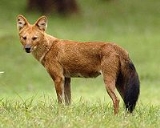
Dhole

Encyclopedia
The dhole is a species of canid
native to South and Southeast Asia. It is the only extant member of the genus
Cuon, which differs from Canis
by the reduced number of molars and greater number of teats. The dholes are classed as endangered by the IUCN, due to ongoing habitat loss, depletion of its prey base, competition from other predators, persecution and possibly diseases from domestic and feral dogs.
The dhole is a highly social animal, living in large clans which occasionally split up into small packs to hunt. It primarily preys on medium-sized ungulates, which it hunts by tiring them out in long chases, and kills by disemboweling them. Unlike most social canids (but similar to African wild dog
s), dholes let their pups eat first at a kill. Though fearful of humans, dhole packs are bold enough to attack large and dangerous animals such as wild boar, water buffalo
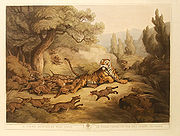
, and even tigers.
Some 19th-century authors connected this word with ‘mad, crazy’, and erroneously compared the Turkish word with and (cf. also dull), which are in fact from Proto-Germanic *dwalaz ‘foolish, stupid’.
Other names for the species include wild dogs, whistling dogs, chennai, red wolves (not to be confused with Canis [lupus] rufus
), red dogs and mountain wolves.
in Assam. In the Himalayas, they are variously known as Bhaosa, Bhansa and Buansu.
in origin, and are more closely related to jackal
s than they are to wolves. It has been theorised that dholes became social animals as an adaptation to living with tigers and leopards.
George Gaylord Simpson
placed dholes under the subfamily Symocyoninae along with the African wild dog
and bush dog
on account of shared anatomical features, namely the reduction of post-carnassial molars. Many have questioned this classification, arguing that these shared features are due to convergent evolution
. Juliet Clutton-Brock
concluded from comparing the morphological, behavioural and ecological characteristics of 39 different canid species that with the exception of skull and dentition, dholes more closely resembled canids of the genus Canis
, Dusicyon
and Alopex than to African wild dogs and bush dogs. A comparative study on dhole and other Canid mtDNA in 1997 showed that dholes diverged from the Lupus lupus lineage before the black-backed Jackal
and the golden jackal
diverged, a couple of million years before the domestication of the dog.
es and well-developed sagittal crest
s. The frontal bone
is inflated, and passes down onto the snout, giving the animals a convex rather than concave profile. The masseter muscle
s are highly developed compared to other canid species, giving the face an almost hyena
-like appearance. The skull is broader, and has a shorter rostrum
than that of domestic dogs and most other canids. The dental formula is
The species uniquely has 6 rather than 7 lower molar
s. The upper molars are weak, being 2-3 times smaller than those of wolves, and have only one cusp
as opposed to 2-4 as is usual in canids, an adaptation thought to improve shearing ability, thus allowing it to compete more successfully with kleptoparasites. The canine teeth are slightly curved and short.
Their limbs are moderately long, and their thorax
es proportional. Along with African wild dog
s, dholes are often referred to as "cat-like" canids, due to their long fine limbs and backbones. They have great jumping and leaping abilities, being able to jump 3-3.5 m (10–12 ft) high, and leap 5–6 m (17–20 ft) long distances in one leap with a running start. Their tails measure 16-17 inches long, and are almost half the length of their bodies, nearly touching the ground when in full winter fur. They are smaller than African wild dogs. Weight ranges from 10 to 25 kg (22 to 55.1 lb), with males averaging about 4.5 kg (9.9 lb) heavier. This dog is 88 to 113 cm (34.6 to 44.5 in) long from the snout to the base of the tail, with the tail averaging 45 cm (17.7 in) in length. Shoulder height is 42 to 55 cm (16.5 to 21.7 in). Like African wild dogs, their ears are rounded rather than pointed. However, unlike the former species, male dholes do not have a clearly visible prepuce
, thus making the sexing of individuals difficult even at close proximity. Unlike members of the Canis
family, females have 12-14 teats rather than 10. They are not as odorous as wolves, jackals and foxes, having a smaller number of anal scent gland
s. It has been estimated that their stomachs can hold 6.5 lb (2.9 kg) of food.
s in adults measure 20–30 mm in length. Dholes in the Moscow Zoo
moult once a year from March to May.
s rather than pack
s, as the latter term refers to a group of animals that always hunt together. In contrast, dhole clans frequently break into small packs of 3-5 animals, particularly during the spring season, as this is the optimal number for catching fawns. Dholes are far less territorial than wolves, with pups from one clan often joining another without trouble once they mature sexually. Clans typically number 5-12 individuals in India, though clans of 40 have been reported. In Thailand, clans rarely exceed three individuals. Unlike other canids, there is no evidence of dholes using urine
to mark their territories or travel routes. They may defecate in conspicuous places, though a territorial function is unlikely, as faeces are mostly deposited within the clan's territory rather than the periphery. Faeces are often deposited in what appear to be communal latrine
s. They do not scrape the earth with their feet as other canids do to mark their territories.
breed mostly in February. Unlike wolf packs, dhole clans may contain more than one breeding female. During mating
, the female assumes a crouched, cat-like position. There is no "tug of war" characteristic of other canids when the male dismounts. Instead, the pair lie on their sides facing each other in a semicircular formation. The gestation period
lasts 60–63 days, with litter sizes averaging 4-6 pups. Their growth rate is much faster than that of wolves, being similar in speed to that of coyote
s. Pups are suckled until at least the age of 58 days. During this time, the pack feeds the mother at the den site. Dholes do not use rendezvous sites to meet their pups as wolves do, though one or more adults will stay with the pups at the den while the rest of the pack hunts. Once weaning
begins, the adults of the clan will regurgitate food for the pups until they are old enough to join in hunting. They remain at the den site till the age of 70–80 days. By the age of six months, pups accompany the adults on hunts, and will assist in killing large prey such as sambar by the age of 8 months.
or porcupine
dens); complex cavernous earth dens with more than one entrance; simple cavernous dens excavated under or between rocks; and complex cavernous dens with several other dens in the vicinity, some of which are interconnected. Dens are typically located under dense scrub or on the banks of dry rivers or creeks. The entrance to a dhole den can be almost vertical, with a sharp turn 3–4 feet down. The tunnel opens into an antechamber, from which extends more than one passage. Some dens may have up to six entrances leading up to 100 feet (30.5 m) of interconnecting tunnels. These "cities" may be developed over many generations of dholes, and are shared by the clan females when raising young together. Like African wild dogs and dingo
es, dholes will avoid killing prey close to their dens.
 Prey animals in India include chital
, sambar, muntjac
, mouse deer, swamp deer, wild boar, gaur
, water buffalo
, banteng
, cattle
, nilgai
, goat
s, Indian hare
s, Himalayan field rat
s and langurs. There is one record of a pack bringing down an Indian elephant
calf in Assam, despite desperate defense of the mother resulting in numerous losses to the pack. In Kashmir, they may hunt markhor
, and thamin in Burma. Javan rusas are hunted in Java. In the Tien Shan and Tarbagatai Mountains
, dholes prey on Siberian ibex
es, arkhar, roe deer
, maral and wild boar. In the Altai and Sayan Mountains
, they prey on musk deer
and reindeer
. In eastern Siberia, they prey on roe deer, Manchurian wapiti
, wild boar, musk deer, and reindeer, while in Primorye
they feed on sika deer
and goral
too. In Mongolia, they prey on argali
and rarely Siberian ibex. Like African wild dogs, but unlike wolves, dholes are not known to attack people. Dholes eat fruit
and vegetable
matter more readily than other canids. In captivity, they eat various kinds of grasses, herbs and leaves, seemingly for pleasure rather than just when ill. In summertime in the Tien Shan Mountains, dholes eat large quantities of mountain rhubarb
. Bael
fruits are also eaten. Although opportunistic, dholes have a seeming aversion to hunting cattle and their calves. Livestock predation by dholes has been a problem in Bhutan since the late 1990s, as domestic animals are often left outside to graze in the forest, sometimes for weeks at a time. Livestock stall-fed at night and grazed near homes are never attacked. Oxen are killed more often than cows are, probably because they are given less protection.
Before embarking on a hunt, clans go through elaborate prehunt social rituals involving nuzzling, body rubbing and homo and heterosexual mounting. Dholes are primarily diurnal hunters, hunting in the early hours of the morning. They rarely hunt nocturnally, except on moonlit nights, indicating that they greatly rely on sight
when hunting. Though not as fast as jackals and foxes, they can chase their prey for many hours. During a pursuit, one or more dholes may take over chasing their prey, while the rest of the pack keeps up at a steadier pace behind, taking over once the other group tires. Most chases are short, lasting only 500 metres. When chasing fleet-footed prey, they run at a pace of 30 mph. Dholes frequently drive their prey into water bodies, where the targeted animal's movements are hindered.
Once large prey is caught, one dhole will grab the prey's nose, while the rest of the pack pulls the animal down by the flanks and hind quarters. They do not use a killing bite to the throat. They occasionally blind their prey by attacking the eyes. Serow
s are among the only ungulate species capable of effectively defending themselves against dhole attacks, due to their thick, protective coats and short, sharp horns capable of easily impaling dholes. They will tear open their prey's flanks and disembowel
it, eating the heart
, liver
, lungs and some sections of the intestines. The stomach
and rumen
are usually left untouched. Prey weighing less than 50 kg is usually killed within two minutes, while large stags may take 15 minutes to die. Once prey is secured, dholes will tear off pieces of the carcass and eat in seclusion. Unlike wolf packs, in which the breeding pair monopolises food, dholes give priority to the pups when feeding at a kill, allowing them to eat first. They are generally tolerant of scavenger
s at their kills.
s and leopard
s. Competition between these species is mostly avoided through differences in prey selection, although there is still substantial dietary overlap. Along with leopards, dholes typically target animals in the 30–175 kg range (mean weights of 35.3 kg for dhole and 23.4 kg for leopard), while tigers selected for prey animals heavier than 176 kg (but their mean prey weight was 65.5 kg). Also, other characteristics of the prey, such as sex, arboreality, and aggressiveness, may play a role in prey selection. For example, dholes preferentially select male chital whereas leopard kill both sexes more evenly (and tigers prefer larger prey altogether), dholes and tigers kill langurs rarely compared to leopards due to the leopard's greater arboreality, while leopards kill wild boar infrequently due to the inability of this relatively light predator to tackle aggressive prey of comparable weight. On some rare occasions, dholes may attack tigers. When confronted by dholes, tigers will seek refuge in trees or stand with their backs to a tree or bush, where they may be mobbed for lengthy periods before finally attempting escape. Escaping tigers are usually killed, while tigers which stand their ground have a greater chance of survival. Tigers are extremely dangerous opponents for dholes, as they have sufficient strength to kill a single dhole with one paw strike. Even a successful tiger kill is usually accompanied by losses to the pack. Dhole packs may steal leopard kills, while leopards may kill dholes if they encounter them singly or in pairs. Because leopards are smaller than tigers, and are more likely to hunt dholes, dhole packs tend to react more aggressively toward them than they do with tigers. It was once thought that dholes were a major factor in reducing Asiatic cheetah
populations, though this is doubtful, as cheetahs live in open areas as opposed to forested areas favoured by dholes.
Dhole packs occasionally attack Asiatic black bear
s and sloth bear
s. When attacking bears, dholes will attempt to prevent them from seeking refuge in caves, and lacerate their hind quarters.
Though usually antagonistic toward wolves, they may hunt and feed alongside one another. They infrequently associate in mixed groups with golden jackal
s. Domestic dogs may kill dholes, though they will feed alongside them on occasion.
es, sometimes rendered as "coo-coo". How this sound is produced is unknown, though it is thought to help in coordinating the pack when travelling through thick brush. When attacking prey, they emit screaming "KaKaKaKAA" sounds. Other sounds include whines (food soliciting), growls (warning), screams, chatterings (both of which are alarm calls) and yapping cries. In contrast to wolves, dholes do not howl.
Dholes have a complex body language
. Friendly or submissive greetings are accompanied by horizontal lip retraction and the lowering of the tail, as well as licking. Playful dholes will open their mouths with their lips retracted and their tails held in a vertical position whilst assuming a play bow. Aggressive or threatening dholes will pucker their lips forward in a snarl and raise the hairs on their backs, as well as keep their tails horizontal or vertical. When afraid, they pull their lips back horizontally with their tails tucked and their ears flat against the skull.
are present in their faeces. It is known that they may suffer from rabies
, canine distemper
, mange
, trypanosomiasis
, canine parvovirus
, and endoparasites like cestodes and roundworms.
southward through Mongolia
, Korea
, China
, Tibet
, Nepal
, India
, and south-eastwards into Myanmar
and Indochina
, Thailand
, Malaysia, Sumatra
and Java
.
During the last glacial period, they ranged across most of Eurasia
, and are known to have once inhabited North America
from a single fossil find in the Gulf of Mexico
. A canid called the Sardinian Dhole
(Cynotherium sardous) lived on the Mediterranean island of Sardinia
during the Pleistocene, but it is not as closely related to the living species as its name would imply.
, Mongolia, Kazakhstan
, Kyrgystan and Tajikistan
. There is one report of a dhole being captured in southern China's Jiangxi province. Dholes still occur in Tibet, particularly in south-east Tibet. They may still be present in North Korea
. They still occur in India south of the Ganges River
, especially in the Central Indian Highlands and the Western
and Eastern Ghats
. Dholes also occur in northeast India's states of Arunachal Pradesh
, Assam
, Meghalaya
and West Bengal
and in Ladakh. They have a precarious, fragmented distribution in Himalaya and north-west India. They are occasionally reported in the Ladakh area of Kashmir
, contiguous with the Tibetan highlands and China. In Nepal, dholes were formerly recorded in Terai
, including the Royal Chitwan National Park
. Dholes were reported in the Dhorpatan
Hunting Reserve in the late 1990s. In Bhutan
, dholes have since recovered from a government sponsored poisoning campaign started in the 1970s, with reports of livestock predation occurring in the lower Kheng
region. It is uncertain if they still occur in Bangladesh
. Camera trapping has confirmed that dholes still occur in 11 survey areas in Myanmar
, where they have replaced tigers as main predators. Dhole populations are highly fragmented in Thailand and Indochina, particularly in Vietnam
. Dholes are known to occur in four sites in northern and central Malaysia. In Java, they appear to be most common in the island's protected eastern and western ends. They are also known to occur in Sumatra's protected areas in the southern, central and northern areas.
. Methods used for dhole hunting included poisoning, snaring, shooting and clubbing at den sites. Native Indian people killed dholes primarily to protect livestock, while British sporthunters during the British Raj
did so under the conviction that dholes were responsible for drops in game populations. Persecution of dholes still occurs with varying degrees of intensity according to region. Bounties paid for dholes used to be 25 rupee
s, though this was reduced to 20 in 1926 after the number of presented dhole carcasses became too numerous to maintain the established reward. In Indochina, dholes suffer heavily from non-selective hunting techniques such as snaring.
The fur trade
does not pose a significant threat to dholes. The people of India do not eat dhole flesh, and their fur is not considered overly valuable. Due to their rarity, dholes were never harvested for their skins in large numbers in the Soviet Union
, and were sometimes accepted as dog or wolf pelts (being labeled as "half wolf" for the latter). The winter fur was prized by the Chinese
, who bought dhole pelts in Ussuriysk
during the late 1860s for 3-4 silver ruble
s. In the early 20th century, dhole pelts reached 8 rubles in Manchuria
. In Semirechye, fur coats made from dhole skin were considered the warmest, but were very costly.
stone of the Bharhut
stupa
dating from 100 B.C.. They are shown waiting by a tree, with a woman or spirit trapped up it, a scene reminiscent of dholes treeing tigers. Dhole-like animals are described in numerous old European texts, including the Ostrogoth
saga
s, where they are portrayed as hell hounds. The demon dogs accompanying Hellequin in Mediaeval French passion play
s, as well as the ones inhabiting the legendary forest of Brocéliande
have been attributed to dholes. It has been suggested that the dangerous wild canids mentioned by Scaliger
as having lived in the forests of Montefalcone
could have been dholes, as they were described as unlike wolves in habits, voice and appearance. The Montefalcone family's coat of arms
had a pair of red dogs as supporters.
Dholes appear in Rudyard Kipling
's Red Dog
, where they are portrayed as aggressive and bloodthirsty animals who descend from the Deccan Plateau
into the Seeonee Hills inhabited by Mowgli
and his adopted wolf pack to cause carnage among the jungle's denizens. They are described as living in packs numbering hundreds of individuals, and that even Shere Khan
and Hathi
make way for them when they descend into the jungle. The dholes are despised by the wolves because of their destructiveness, their habit of not living in dens and the hair between their toes. With Mowgli and Kaa
's help, the Seeonee wolf pack manages to wipe out the dholes by leading them through bee hives and torrential waters before finishing off the rest in battle. They would reappear in two animated television adaptations; Jungle Book Shōnen Mowgli
and Jungle Cubs
.
In an episode called "Alpha" in season six of The X-Files
, a cryptid
dhole from China is blamed for multiple killings. This dhole (Wanshang dhole) is also mentioned in the Angel
episode That Vision Thing. Both episodes were written by Jeffrey Bell
.
kept captured dholes in captivity, and found that with the exception of one animal, they remained shy and vicious even after 10 months. According to Richard Lydekker
, adult dholes are nearly impossible to tame, though pups are docile and can even be allowed to play with domestic dog pups until they reach early adulthood. A dhole may have been presented as a gift to Ibbi-Sin
as tribute.
Although genetic distance
and mitochondrial DNA
studies have proven that dog
s descended from wolves, the dhole is still put forward by some researchers as a more likely candidate. Points raised in favour of the dhole ancestry cite the general domestic dog-like passiveness of the dhole in having its kills taken by humans, which contrasts with the behaviour of sympatric wolves, which will defend their prey aggressively against humans. It is also claimed that dhole skulls bear more similarities to dog skulls than wolves do, with the glaring exception of the dentition.
Canidae
Canidae is the biological family of carnivorous and omnivorous mammals that includes wolves, foxes, jackals, coyotes, and domestic dogs. A member of this family is called a canid . The Canidae family is divided into two tribes: Canini and Vulpini...
native to South and Southeast Asia. It is the only extant member of the genus
Genus
In biology, a genus is a low-level taxonomic rank used in the biological classification of living and fossil organisms, which is an example of definition by genus and differentia...
Cuon, which differs from Canis
Canis
Canis is a genus containing 7 to 10 extant species, including dogs, wolves, coyotes, and jackals, and many extinct species.-Wolves, dogs and dingos:Wolves, dogs and dingos are subspecies of Canis lupus...
by the reduced number of molars and greater number of teats. The dholes are classed as endangered by the IUCN, due to ongoing habitat loss, depletion of its prey base, competition from other predators, persecution and possibly diseases from domestic and feral dogs.
The dhole is a highly social animal, living in large clans which occasionally split up into small packs to hunt. It primarily preys on medium-sized ungulates, which it hunts by tiring them out in long chases, and kills by disemboweling them. Unlike most social canids (but similar to African wild dog
African Wild Dog
Lycaon pictus is a large canid found only in Africa, especially in savannas and lightly wooded areas. It is variously called the African wild dog, African hunting dog, Cape hunting dog, painted dog, painted wolf, painted hunting dog, spotted dog, or ornate wolf...
s), dholes let their pups eat first at a kill. Though fearful of humans, dhole packs are bold enough to attack large and dangerous animals such as wild boar, water buffalo
Water buffalo
The water buffalo is a domesticated bovid widely kept in Asia, Europe and South America.Water buffalo can also refer to:*Wild water buffalo , the wild ancestor of the domestic water buffalo...
, and even tigers.
Naming and etymology
Since these canids are called dholes only in English, the etymology remains unclear, but it probably may come from (‘wolf’).Some 19th-century authors connected this word with ‘mad, crazy’, and erroneously compared the Turkish word with and (cf. also dull), which are in fact from Proto-Germanic *dwalaz ‘foolish, stupid’.
Other names for the species include wild dogs, whistling dogs, chennai, red wolves (not to be confused with Canis [lupus] rufus
Red Wolf
The red wolf is a North American canid which once roamed throughout the Southeastern United States and is a glacial period survivor of the Late Pleistocene epoch...
), red dogs and mountain wolves.
Vernacular names
Vernacular names include lal rakshas (red devil) and rakshur kukur (devil dog) in India, and jungli rakshas or hounds of KaliKali
' , also known as ' , is the Hindu goddess associated with power, shakti. The name Kali comes from kāla, which means black, time, death, lord of death, Shiva. Kali means "the black one". Since Shiva is called Kāla - the eternal time, Kālī, his consort, also means "Time" or "Death" . Hence, Kāli is...
in Assam. In the Himalayas, they are variously known as Bhaosa, Bhansa and Buansu.
- KannadaKannada languageKannada or , is a language spoken in India predominantly in the state of Karnataka. Kannada, whose native speakers are called Kannadigas and number roughly 50 million, is one of the 30 most spoken languages in the world...
: ಸೀಳು ನಾಯಿ (sīḷu nāyi), ಕಾಡು ನಾಯಿ (kāḍu nāyi) - AssameseAssamese languageAssamese is the easternmost Indo-Aryan language. It is used mainly in the state of Assam in North-East India. It is also the official language of Assam. It is also spoken in parts of Arunachal Pradesh and other northeast Indian states. Nagamese, an Assamese-based Creole language is widely used in...
: Raang-kukur - Hindi: Jungli-kutta, Ram-kutta, Son-kutta and Ban-kutta
- MarathiMarathi languageMarathi is an Indo-Aryan language spoken by the Marathi people of western and central India. It is the official language of the state of Maharashtra. There are over 68 million fluent speakers worldwide. Marathi has the fourth largest number of native speakers in India and is the fifteenth most...
: Kolsun, Kolasna, Kolasra and Kolsa - TeluguTelugu languageTelugu is a Central Dravidian language primarily spoken in the state of Andhra Pradesh, India, where it is an official language. It is also spoken in the neighbouring states of Chattisgarh, Karnataka, Maharashtra, Orissa and Tamil Nadu...
: Reza-kukka and Adavi-kukka - MalayalamMalayalam languageMalayalam , is one of the four major Dravidian languages of southern India. It is one of the 22 scheduled languages of India with official language status in the state of Kerala and the union territories of Lakshadweep and Pondicherry. It is spoken by 35.9 million people...
: Chennaya - GondiGondi languageGondi is spoken by the Gondi people. It is a Central-Dravidian language, spoken by about two million people chiefly in the states of Madhya Pradesh, Gujarat, Andhra Pradesh, Maharashtra, Chhattishgarh and in various adjoining areas of neighbouring states...
: Eram-naiko - HoHo languageHo is a Munda language of the Austroasiatic language family spoken primarily in India by about 3,803,126 people. It is written with the Devanagari and the Varang Kshiti scripts. It is spoken by the Ho people. 0.103% of India's Population speaks this language as per the 2001 census.The Script was...
: Tani - TamilTamil languageTamil is a Dravidian language spoken predominantly by Tamil people of the Indian subcontinent. It has official status in the Indian state of Tamil Nadu and in the Indian union territory of Pondicherry. Tamil is also an official language of Sri Lanka and Singapore...
: Vatai-karau - KashmiriKashmiri languageKashmiri is a language from the Dardic sub-group and it is spoken primarily in the Kashmir Valley, in Jammu and Kashmir. There are approximately 5,554,496 speakers in Jammu and Kashmir, according to the Census of 2001. Most of the 105,000 speakers or so in Pakistan are émigrés from the Kashmir...
: Ram-hun - LadakhiLadakhi languageThe Ladakhi language , now also called Bhoti, and by linguists more generally called Western Archaic Tibetan when the Balti and Burig or Purig or Purki dialects are included, is the predominant language in the Ladakh region of the Jammu and Kashmir state of India, and is also spoken in Baltistan...
: Siddaki - TibetanTibetan languageThe Tibetan languages are a cluster of mutually-unintelligible Tibeto-Burman languages spoken primarily by Tibetan peoples who live across a wide area of eastern Central Asia bordering the Indian subcontinent, including the Tibetan Plateau and the northern Indian subcontinent in Baltistan, Ladakh,...
: Hazi and Phara - BhotiaSherpa languageSherpa is a language spoken in parts of Nepal and Sikkim mainly by the Sherpa community. About 130,000 speakers live in Nepal , some 20,000 in India , and some 800 in Tibet ....
: Paoho - LepchaLepcha languageLepcha language, or Róng language , is a Himalayish language spoken by the Lepcha people in Sikkim and parts of West Bengal, Nepal and Bhutan.-Population:...
: Sa-tum - ChineseChinese languageThe Chinese language is a language or language family consisting of varieties which are mutually intelligible to varying degrees. Originally the indigenous languages spoken by the Han Chinese in China, it forms one of the branches of Sino-Tibetan family of languages...
: 豺 Chai - BurmeseBurmese languageThe Burmese language is the official language of Burma. Although the constitution officially recognizes it as the Myanmar language, most English speakers continue to refer to the language as Burmese. Burmese is the native language of the Bamar and related sub-ethnic groups of the Bamar, as well as...
: Tau-khwe - IndonesiaIndonesian languageIndonesian is the official language of Indonesia. Indonesian is a normative form of the Riau Islands dialect of Malay, an Austronesian language which has been used as a lingua franca in the Indonesian archipelago for centuries....
: Ajag - MalayMalay languageMalay is a major language of the Austronesian family. It is the official language of Malaysia , Indonesia , Brunei and Singapore...
: Anjing-utan - NepaliNepali languageNepali or Nepalese is a language in the Indo-Aryan branch of the Indo-European language family.It is the official language and de facto lingua franca of Nepal and is also spoken in Bhutan, parts of India and parts of Myanmar...
: Bankukur - RussianRussian languageRussian is a Slavic language used primarily in Russia, Belarus, Uzbekistan, Kazakhstan, Tajikistan and Kyrgyzstan. It is an unofficial but widely spoken language in Ukraine, Moldova, Latvia, Turkmenistan and Estonia and, to a lesser extent, the other countries that were once constituent republics...
: Красный волк (krasnyy volk) ‘red wolf’ - KoreanKorean languageKorean is the official language of the country Korea, in both South and North. It is also one of the two official languages in the Yanbian Korean Autonomous Prefecture in People's Republic of China. There are about 78 million Korean speakers worldwide. In the 15th century, a national writing...
: 승냥이 (seungnyangi) - GujaratiGujarati languageGujarati is an Indo-Aryan language, and part of the greater Indo-European language family. It is derived from a language called Old Gujarati which is the ancestor language of the modern Gujarati and Rajasthani languages...
: jangli-kutra
Evolution and taxonomy
Dholes are post-PleistocenePleistocene
The Pleistocene is the epoch from 2,588,000 to 11,700 years BP that spans the world's recent period of repeated glaciations. The name pleistocene is derived from the Greek and ....
in origin, and are more closely related to jackal
Jackal
Although the word jackal has been historically used to refer to many small- to medium-sized species of the wolf genus of mammals, Canis, today it most properly and commonly refers to three species: the black-backed jackal and the side-striped jackal of sub-Saharan Africa, and the golden jackal of...
s than they are to wolves. It has been theorised that dholes became social animals as an adaptation to living with tigers and leopards.
George Gaylord Simpson
George Gaylord Simpson
George Gaylord Simpson was an American paleontologist. Simpson was perhaps the most influential paleontologist of the twentieth century, and a major participant in the modern evolutionary synthesis, contributing Tempo and mode in evolution , The meaning of evolution and The major features of...
placed dholes under the subfamily Symocyoninae along with the African wild dog
African Wild Dog
Lycaon pictus is a large canid found only in Africa, especially in savannas and lightly wooded areas. It is variously called the African wild dog, African hunting dog, Cape hunting dog, painted dog, painted wolf, painted hunting dog, spotted dog, or ornate wolf...
and bush dog
Bush Dog
The bush dog is a canid found in Central and South America, including Panama, Colombia, Venezuela, Bolivia, Peru , Ecuador, the Guianas, Paraguay, northeast Argentina and Brazil...
on account of shared anatomical features, namely the reduction of post-carnassial molars. Many have questioned this classification, arguing that these shared features are due to convergent evolution
Convergent evolution
Convergent evolution describes the acquisition of the same biological trait in unrelated lineages.The wing is a classic example of convergent evolution in action. Although their last common ancestor did not have wings, both birds and bats do, and are capable of powered flight. The wings are...
. Juliet Clutton-Brock
Juliet Clutton-Brock
Juliet Clutton-Brock was a senior research worker in the Mammal Section at The Natural History Museum in London from 1969 until her retirement in 1993, and maintains a position there as a research associate...
concluded from comparing the morphological, behavioural and ecological characteristics of 39 different canid species that with the exception of skull and dentition, dholes more closely resembled canids of the genus Canis
Canis
Canis is a genus containing 7 to 10 extant species, including dogs, wolves, coyotes, and jackals, and many extinct species.-Wolves, dogs and dingos:Wolves, dogs and dingos are subspecies of Canis lupus...
, Dusicyon
Dusicyon
Dusicyon is a genus of extinct South American canids. The type species is Dusicyon australis, the extinct Falkland Islands Wolf. In 1914, Oldfield Thomas established the genus Dusicyon, in which he included the Culpeo and other South American foxes...
and Alopex than to African wild dogs and bush dogs. A comparative study on dhole and other Canid mtDNA in 1997 showed that dholes diverged from the Lupus lupus lineage before the black-backed Jackal
Black-backed Jackal
The black-backed jackal , also known as the silver-backed or red jackal, is a species of jackal which inhabits two areas of the African continent separated by roughly 900 km. One region includes the southern-most tip of the continent, including South Africa, Namibia, Botswana, and Zimbabwe...
and the golden jackal
Golden Jackal
The golden jackal , also known as the common jackal, Asiatic jackal, thos or gold-wolf is a Canid of the genus Canis indigenous to north and northeastern Africa, southeastern and central Europe , Asia Minor, the Middle East and southeast Asia...
diverged, a couple of million years before the domestication of the dog.
Subspecies
| Subspecies | Trinomial authority | Description | Range | Synonyms |
|---|---|---|---|---|
| Eastern or Ussuri dhole Cuon a. alpinus |
Pallas Peter Simon Pallas Peter Simon Pallas was a German zoologist and botanist who worked in Russia.- Life and work :Pallas was born in Berlin, the son of Professor of Surgery Simon Pallas. He studied with private tutors and took an interest in natural history, later attending the University of Halle and the University... , 1811 |
The largest subspecies, with a long, narrow face and a skull measuring 189 mm long on average. The winter fur's general tone is intense rusty-red. The top of the head and the outer ears are brownish-rusty with black-brown highlights. The shoulders and upper surface of the back is brownish-rusty with black-brown highlights. The outer sides of the legs are rusty brown, while the inner sides of the legs and lower sides of the body are yellowish. | Russian Far East Russian Far East Russian Far East is a term that refers to the Russian part of the Far East, i.e., extreme east parts of Russia, between Lake Baikal in Eastern Siberia and the Pacific Ocean... , China China Chinese civilization may refer to:* China for more general discussion of the country.* Chinese culture* Greater China, the transnational community of ethnic Chinese.* History of China* Sinosphere, the area historically affected by Chinese culture... , India India India , officially the Republic of India , is a country in South Asia. It is the seventh-largest country by geographical area, the second-most populous country with over 1.2 billion people, and the most populous democracy in the world... , Nepal Nepal Nepal , officially the Federal Democratic Republic of Nepal, is a landlocked sovereign state located in South Asia. It is located in the Himalayas and bordered to the north by the People's Republic of China, and to the south, east, and west by the Republic of India... , Sikkim Sikkim Sikkim is a landlocked Indian state nestled in the Himalayan mountains... , Bhutan Bhutan Bhutan , officially the Kingdom of Bhutan, is a landlocked state in South Asia, located at the eastern end of the Himalayas and bordered to the south, east and west by the Republic of India and to the north by the People's Republic of China... , Kashmir Kashmir Kashmir is the northwestern region of the Indian subcontinent. Until the mid-19th century, the term Kashmir geographically denoted only the valley between the Great Himalayas and the Pir Panjal mountain range... , Tibet Tibet Tibet is a plateau region in Asia, north-east of the Himalayas. It is the traditional homeland of the Tibetan people as well as some other ethnic groups such as Monpas, Qiang, and Lhobas, and is now also inhabited by considerable numbers of Han and Hui people... , Mongolia Mongolia Mongolia is a landlocked country in East and Central Asia. It is bordered by Russia to the north and China to the south, east and west. Although Mongolia does not share a border with Kazakhstan, its western-most point is only from Kazakhstan's eastern tip. Ulan Bator, the capital and largest... , Myanmar Myanmar Burma , officially the Republic of the Union of Myanmar , is a country in Southeast Asia. Burma is bordered by China on the northeast, Laos on the east, Thailand on the southeast, Bangladesh on the west, India on the northwest, the Bay of Bengal to the southwest, and the Andaman Sea on the south.... , Thailand Thailand Thailand , officially the Kingdom of Thailand , formerly known as Siam , is a country located at the centre of the Indochina peninsula and Southeast Asia. It is bordered to the north by Burma and Laos, to the east by Laos and Cambodia, to the south by the Gulf of Thailand and Malaysia, and to the... , Laos Laos Laos Lao: ສາທາລະນະລັດ ປະຊາທິປະໄຕ ປະຊາຊົນລາວ Sathalanalat Paxathipatai Paxaxon Lao, officially the Lao People's Democratic Republic, is a landlocked country in Southeast Asia, bordered by Burma and China to the northwest, Vietnam to the east, Cambodia to the south and Thailand to the west... , Cambodia Cambodia Cambodia , officially known as the Kingdom of Cambodia, is a country located in the southern portion of the Indochina Peninsula in Southeast Asia... , Vietnam Vietnam Vietnam – sometimes spelled Viet Nam , officially the Socialist Republic of Vietnam – is the easternmost country on the Indochina Peninsula in Southeast Asia. It is bordered by China to the north, Laos to the northwest, Cambodia to the southwest, and the South China Sea –... , Java Java Java is an island of Indonesia. With a population of 135 million , it is the world's most populous island, and one of the most densely populated regions in the world. It is home to 60% of Indonesia's population. The Indonesian capital city, Jakarta, is in west Java... and Indonesia Indonesia Indonesia , officially the Republic of Indonesia , is a country in Southeast Asia and Oceania. Indonesia is an archipelago comprising approximately 13,000 islands. It has 33 provinces with over 238 million people, and is the world's fourth most populous country. Indonesia is a republic, with an... |
adustus (Pocock, 1941) antiquus (Matthew and Granger, 1923) clamitans (Heude, 1892) dukhunensis (Sykes, 1831) fumosus (Pocock, 1936) grayiformis (Hodgson, 1863) infuscus (Pocock, 1936) javanicus (Desmarest, 1820) laniger (Pocock, 1936) lepturus (Heude, 1892) primaevus (Hodgson, 1833) rutilans (Müller, 1839) |
| † Extinction In biology and ecology, extinction is the end of an organism or of a group of organisms , normally a species. The moment of extinction is generally considered to be the death of the last individual of the species, although the capacity to breed and recover may have been lost before this point... Late Pleistocene dhole Cuon a. europaeus |
Bourguignat, 1875 | The earliest form to evolve a single cusped, sharply trenchant tooth in place of the lower tubercular molar | Czech Republic Czech Republic The Czech Republic is a landlocked country in Central Europe. The country is bordered by Poland to the northeast, Slovakia to the east, Austria to the south, and Germany to the west and northwest.... , Hungary Hungary Hungary , officially the Republic of Hungary , is a landlocked country in Central Europe. It is situated in the Carpathian Basin and is bordered by Slovakia to the north, Ukraine and Romania to the east, Serbia and Croatia to the south, Slovenia to the southwest and Austria to the west. The... , Austria Austria Austria , officially the Republic of Austria , is a landlocked country of roughly 8.4 million people in Central Europe. It is bordered by the Czech Republic and Germany to the north, Slovakia and Hungary to the east, Slovenia and Italy to the south, and Switzerland and Liechtenstein to the... , Switzerland Switzerland Switzerland name of one of the Swiss cantons. ; ; ; or ), in its full name the Swiss Confederation , is a federal republic consisting of 26 cantons, with Bern as the seat of the federal authorities. The country is situated in Western Europe,Or Central Europe depending on the definition.... and French Riviera French Riviera The Côte d'Azur, pronounced , often known in English as the French Riviera , is the Mediterranean coastline of the southeast corner of France, also including the sovereign state of Monaco... |
|
| †Late Middle Pleistocene dhole Cuon a. fossilis |
Nehring, 1890 | An intermediate form between Cuon a. priscus and Cuon a. europaeus | Heppenloch, Germany Germany Germany , officially the Federal Republic of Germany , is a federal parliamentary republic in Europe. The country consists of 16 states while the capital and largest city is Berlin. Germany covers an area of 357,021 km2 and has a largely temperate seasonal climate... |
|
| Western or Tien Shan dhole Cuon a. hesperius |
Afanasjev and Zolotarev, 1935 | A small subspecies, with a short, wide face and a skull measuring 180 mm long on average. The general tone of the winter fur is lighter coloured than C. a. alpinus, with weakly developed rusty-red tints. The top of the head and outer sides of the ears are reddish-straw coloured. The upper surface of the neck is dirty-white, with a narrow sandy-yellow coloured band running along the upper surface of the back from the ears to the shoulders. The outer surface of the limbs is sandy-yellow, while the flanks and inner sides of the limbs have little to no yellowish tint. | Transoxiana Transoxiana Transoxiana is the ancient name used for the portion of Central Asia corresponding approximately with modern-day Uzbekistan, Tajikistan, southern Kyrgystan and southwest Kazakhstan. Geographically, it is the region between the Amu Darya and Syr Darya rivers... , Eastern Russia and China |
jason (Pocock, 1936) |
| †Early Middle Pleistocene dhole Cuon a. priscus |
Thenius, 1954 | |||
| Sumatran dhole Cuon a. sumatrensis |
Hardwicke, 1821 | A small subspecies, measuring only two feet in length, and standing 14 inches (355.6 mm) high at the shoulder. It has a pointed, black fox-like muzzle with long dark whiskers. The nose and lips are foxy brown mixed with black. The general colour is foxy ferraginous red, with lighter shades on the belly and inner sides of the legs. | Sumatra Sumatra Sumatra is an island in western Indonesia, westernmost of the Sunda Islands. It is the largest island entirely in Indonesia , and the sixth largest island in the world at 473,481 km2 with a population of 50,365,538... and Indonesia |
Anatomy
Dholes have relatively short, heavy and massive skulls, with shortened facial regions, widely separated zygomatic archZygomatic arch
The zygomatic arch or cheek bone is formed by the zygomatic process of temporal bone and the temporal process of the zygomatic bone , the two being united by an oblique suture; the tendon of the Temporalis passes medial to the arch to gain insertion into the coronoid process...
es and well-developed sagittal crest
Sagittal crest
A sagittal crest is a ridge of bone running lengthwise along the midline of the top of the skull of many mammalian and reptilian skulls, among others....
s. The frontal bone
Frontal bone
The frontal bone is a bone in the human skull that resembles a cockleshell in form, and consists of two portions:* a vertical portion, the squama frontalis, corresponding with the region of the forehead....
is inflated, and passes down onto the snout, giving the animals a convex rather than concave profile. The masseter muscle
Masseter muscle
In human anatomy, the masseter is one of the muscles of mastication.In the animal kingdom, it is particularly powerful in herbivores to facilitate chewing of plant matter.-Origin and insertion of the two heads:...
s are highly developed compared to other canid species, giving the face an almost hyena
Hyena
Hyenas or Hyaenas are the animals of the family Hyaenidae of suborder feliforms of the Carnivora. It is the fourth smallest biological family in the Carnivora , and one of the smallest in the mammalia...
-like appearance. The skull is broader, and has a shorter rostrum
Rostrum (anatomy)
The term rostrum is used for a number of unrelated structures in different groups of animals:*In crustaceans, the rostrum is the forward extension of the carapace in front of the eyes....
than that of domestic dogs and most other canids. The dental formula is
The species uniquely has 6 rather than 7 lower molar
Molar (tooth)
Molars are the rearmost and most complicated kind of tooth in most mammals. In many mammals they grind food; hence the Latin name mola, "millstone"....
s. The upper molars are weak, being 2-3 times smaller than those of wolves, and have only one cusp
Cusp (dentistry)
A cusp is an occlusal or incisal eminence on a tooth.Canine teeth, otherwise known as cuspids, each possess a single cusp, while premolars, otherwise known as bicuspids, possess two each. Molars normally possess either four or five cusps...
as opposed to 2-4 as is usual in canids, an adaptation thought to improve shearing ability, thus allowing it to compete more successfully with kleptoparasites. The canine teeth are slightly curved and short.
Their limbs are moderately long, and their thorax
Thorax
The thorax is a division of an animal's body that lies between the head and the abdomen.-In tetrapods:...
es proportional. Along with African wild dog
African Wild Dog
Lycaon pictus is a large canid found only in Africa, especially in savannas and lightly wooded areas. It is variously called the African wild dog, African hunting dog, Cape hunting dog, painted dog, painted wolf, painted hunting dog, spotted dog, or ornate wolf...
s, dholes are often referred to as "cat-like" canids, due to their long fine limbs and backbones. They have great jumping and leaping abilities, being able to jump 3-3.5 m (10–12 ft) high, and leap 5–6 m (17–20 ft) long distances in one leap with a running start. Their tails measure 16-17 inches long, and are almost half the length of their bodies, nearly touching the ground when in full winter fur. They are smaller than African wild dogs. Weight ranges from 10 to 25 kg (22 to 55.1 lb), with males averaging about 4.5 kg (9.9 lb) heavier. This dog is 88 to 113 cm (34.6 to 44.5 in) long from the snout to the base of the tail, with the tail averaging 45 cm (17.7 in) in length. Shoulder height is 42 to 55 cm (16.5 to 21.7 in). Like African wild dogs, their ears are rounded rather than pointed. However, unlike the former species, male dholes do not have a clearly visible prepuce
Foreskin
In male human anatomy, the foreskin is a generally retractable double-layered fold of skin and mucous membrane that covers the glans penis and protects the urinary meatus when the penis is not erect...
, thus making the sexing of individuals difficult even at close proximity. Unlike members of the Canis
Canis
Canis is a genus containing 7 to 10 extant species, including dogs, wolves, coyotes, and jackals, and many extinct species.-Wolves, dogs and dingos:Wolves, dogs and dingos are subspecies of Canis lupus...
family, females have 12-14 teats rather than 10. They are not as odorous as wolves, jackals and foxes, having a smaller number of anal scent gland
Scent gland
Scent glands are found in the genital area of most mammals and in various other parts of the body, such as the underarms of humans and the preorbital glands of deer and muskox. They produce a semi-viscous fluid which contains pheromones. These odor-messengers indicate information such as status,...
s. It has been estimated that their stomachs can hold 6.5 lb (2.9 kg) of food.
Fur
The general tone of the fur is reddish, with the brightest hues occurring in winter. When in their winter fur, the back is clothed in a saturated rusty-red to reddish colour with brownish highlights along the top of the head, neck and shoulders. The throat, chest, flanks, belly and the upper parts of the limbs are less brightly coloured, and are more yellowish in tone. The lower parts of the limbs are whitish, with dark brownish bands on the anterior sides of the forelimbs. The muzzle and forehead are greyish-reddish. The tail is very luxuriant and fluffy, and is mainly of a reddish-ocherous colour, with a dark brown tip. The summer coat is shorter, coarser and darker. The dorsal and lateral guard hairGuard hair
Guard hairs are the longest, coarsest hairs in a mammal's coat, forming the topcoat . They taper to a point and protect the undercoat from the elements. They are often water repellent and stick out above the rest of the coat...
s in adults measure 20–30 mm in length. Dholes in the Moscow Zoo
Moscow Zoo
The Moscow Zoo is a zoo founded in 1864 by a group of professor-biologists, K.F. Rulje, S.A. Usov and A.P. Bogdanov, from the Moscow State University. In 1919, the zoo was nationalized. In 1922, the ownership was transferred to the city of Moscow and has remained under Moscow's control ever...
moult once a year from March to May.
Social and territorial behaviours
Dholes are more social than wolves, and have less of a dominance hierarchy, as seasonal scarcity of food is not a serious concern for them as it is with wolves. In this sense, they closely resemble African wild dogs in social structure. Dominant dholes are hard to identify, as they do not engage in dominance displays as wolves do, though other clan members will show submissive behaviour toward them. They live in clanClan
A clan is a group of people united by actual or perceived kinship and descent. Even if lineage details are unknown, clan members may be organized around a founding member or apical ancestor. The kinship-based bonds may be symbolical, whereby the clan shares a "stipulated" common ancestor that is a...
s rather than pack
Pack (canine)
Pack is a social group of conspecific canids. Not all species of canids - notably the red fox - form packs. Pack size and social behaviour within packs varies across species.-Species which exhibit pack behavior:...
s, as the latter term refers to a group of animals that always hunt together. In contrast, dhole clans frequently break into small packs of 3-5 animals, particularly during the spring season, as this is the optimal number for catching fawns. Dholes are far less territorial than wolves, with pups from one clan often joining another without trouble once they mature sexually. Clans typically number 5-12 individuals in India, though clans of 40 have been reported. In Thailand, clans rarely exceed three individuals. Unlike other canids, there is no evidence of dholes using urine
Urine
Urine is a typically sterile liquid by-product of the body that is secreted by the kidneys through a process called urination and excreted through the urethra. Cellular metabolism generates numerous by-products, many rich in nitrogen, that require elimination from the bloodstream...
to mark their territories or travel routes. They may defecate in conspicuous places, though a territorial function is unlikely, as faeces are mostly deposited within the clan's territory rather than the periphery. Faeces are often deposited in what appear to be communal latrine
Latrine
A latrine is a communal facility containing one or more commonly many toilets which may be simple pit toilets or in the case of the United States Armed Forces any toilet including modern flush toilets...
s. They do not scrape the earth with their feet as other canids do to mark their territories.
Reproduction and development
Among Indian dholes, the mating season occurs between mid-October and January, while captive dholes in the Moscow ZooMoscow Zoo
The Moscow Zoo is a zoo founded in 1864 by a group of professor-biologists, K.F. Rulje, S.A. Usov and A.P. Bogdanov, from the Moscow State University. In 1919, the zoo was nationalized. In 1922, the ownership was transferred to the city of Moscow and has remained under Moscow's control ever...
breed mostly in February. Unlike wolf packs, dhole clans may contain more than one breeding female. During mating
Mating
In biology, mating is the pairing of opposite-sex or hermaphroditic organisms for copulation. In social animals, it also includes the raising of their offspring. Copulation is the union of the sex organs of two sexually reproducing animals for insemination and subsequent internal fertilization...
, the female assumes a crouched, cat-like position. There is no "tug of war" characteristic of other canids when the male dismounts. Instead, the pair lie on their sides facing each other in a semicircular formation. The gestation period
Gestation period
For mammals the gestation period is the time in which a fetus develops, beginning with fertilization and ending at birth. The duration of this period varies between species.-Duration:...
lasts 60–63 days, with litter sizes averaging 4-6 pups. Their growth rate is much faster than that of wolves, being similar in speed to that of coyote
Coyote
The coyote , also known as the American jackal or the prairie wolf, is a species of canine found throughout North and Central America, ranging from Panama in the south, north through Mexico, the United States and Canada...
s. Pups are suckled until at least the age of 58 days. During this time, the pack feeds the mother at the den site. Dholes do not use rendezvous sites to meet their pups as wolves do, though one or more adults will stay with the pups at the den while the rest of the pack hunts. Once weaning
Weaning
Weaning is the process of gradually introducing a mammal infant, either human or animal, to what will be its adult diet and withdrawing the supply of its mother's milk.The process takes place only in mammals, as only mammals produce milk...
begins, the adults of the clan will regurgitate food for the pups until they are old enough to join in hunting. They remain at the den site till the age of 70–80 days. By the age of six months, pups accompany the adults on hunts, and will assist in killing large prey such as sambar by the age of 8 months.
Denning behaviour
Four kinds of den have been described; simple earth dens with one entrance (usually remodeled striped hyenaStriped Hyena
The Striped Hyena is a species of true hyena native to North and East Africa, the Caucasus, the Middle East, Middle and Central Asia and the Indian Subcontinent...
or porcupine
Porcupine
Porcupines are rodents with a coat of sharp spines, or quills, that defend or camouflage them from predators. They are indigenous to the Americas, southern Asia, and Africa. Porcupines are the third largest of the rodents, behind the capybara and the beaver. Most porcupines are about long, with...
dens); complex cavernous earth dens with more than one entrance; simple cavernous dens excavated under or between rocks; and complex cavernous dens with several other dens in the vicinity, some of which are interconnected. Dens are typically located under dense scrub or on the banks of dry rivers or creeks. The entrance to a dhole den can be almost vertical, with a sharp turn 3–4 feet down. The tunnel opens into an antechamber, from which extends more than one passage. Some dens may have up to six entrances leading up to 100 feet (30.5 m) of interconnecting tunnels. These "cities" may be developed over many generations of dholes, and are shared by the clan females when raising young together. Like African wild dogs and dingo
Dingo
The Australian Dingo or Warrigal is a free-roaming wild dog unique to the continent of Australia, mainly found in the outback. Its original ancestors are thought to have arrived with humans from southeast Asia thousands of years ago, when dogs were still relatively undomesticated and closer to...
es, dholes will avoid killing prey close to their dens.
Diet, hunting and feeding behaviours
Chital
The chital or cheetal , also known as chital deer, spotted deer or axis deer is a deer which commonly inhabits wooded regions of Sri Lanka, Nepal, Bangladesh, Bhutan, India, and in small numbers in Pakistan...
, sambar, muntjac
Muntjac
Muntjac, also known as Barking Deer and Mastreani Deer, are small deer of the genus Muntiacus. Muntjac are the oldest known deer, appearing 15–35 million years ago, with remains found in Miocene deposits in France, Germany and Poland....
, mouse deer, swamp deer, wild boar, gaur
Gaur
The gaur , also called Indian bison, is a large bovine native to South Asia and Southeast Asia. The species is listed as vulnerable on the IUCN Red List since 1986 as the population decline in parts of the species' range is likely to be well over 70% over the last three generations...
, water buffalo
Water buffalo
The water buffalo is a domesticated bovid widely kept in Asia, Europe and South America.Water buffalo can also refer to:*Wild water buffalo , the wild ancestor of the domestic water buffalo...
, banteng
Banteng
The banteng , also known as tembadau, is a species of wild cattle found in Southeast Asia.Banteng have been domesticated in several places in Southeast Asia, and there are around 1.5 million domestic banteng, which are called Bali cattle. These animals are used as working animals and for their meat...
, cattle
Cattle
Cattle are the most common type of large domesticated ungulates. They are a prominent modern member of the subfamily Bovinae, are the most widespread species of the genus Bos, and are most commonly classified collectively as Bos primigenius...
, nilgai
Nilgai
The nilgai , sometimes called nilgau, is an antelope, and is one of the most commonly seen wild animals of central and northern India and eastern Pakistan; it is also present in parts of southern Nepal. The mature males appear ox-like and are also known as blue bulls...
, goat
Goat
The domestic goat is a subspecies of goat domesticated from the wild goat of southwest Asia and Eastern Europe. The goat is a member of the Bovidae family and is closely related to the sheep as both are in the goat-antelope subfamily Caprinae. There are over three hundred distinct breeds of...
s, Indian hare
Indian Hare
The Indian Hare , also known as the Black-naped Hare, is a common species of hare found in South Asia. and in java....
s, Himalayan field rat
Himalayan Field Rat
The Himalayan Field Rat is a species of rodent in the family Muridae.It is found in Bangladesh, China, India, Indonesia, Laos, Myanmar, Nepal, Sumatra, Palau, the Philippines, Thailand, and Vietnam.-References:...
s and langurs. There is one record of a pack bringing down an Indian elephant
Indian Elephant
The Indian Elephant is one of three recognized subspecies of the Asian elephant, and native to mainland Asia. Since 1986, Elephas maximus has been listed as endangered by IUCN as the population has declined by at least 50% over the last three generations, estimated to be 60–75 years...
calf in Assam, despite desperate defense of the mother resulting in numerous losses to the pack. In Kashmir, they may hunt markhor
Markhor
The Markhor is a large species of wild goat that is found in northeastern Afghanistan, Pakistan , India, southern Tajikistan and southern Uzbekistan...
, and thamin in Burma. Javan rusas are hunted in Java. In the Tien Shan and Tarbagatai Mountains
Tarbagatai Mountains
Tarbagatai Mountains is a range of mountains located in the north-western parts of Xinjiang, China and East Kazakhstan....
, dholes prey on Siberian ibex
Siberian Ibex
The Siberian Ibex or Common ibex is a species of ibex that lives in central and northern Asia. It has traditionally been treated as a subspecies of the Alpine Ibex, and whether it is specifically distinct from other ibex is still not entirely clear...
es, arkhar, roe deer
Roe Deer
The European Roe Deer , also known as the Western Roe Deer, chevreuil or just Roe Deer, is a Eurasian species of deer. It is relatively small, reddish and grey-brown, and well-adapted to cold environments. Roe Deer are widespread in Western Europe, from the Mediterranean to Scandinavia, and from...
, maral and wild boar. In the Altai and Sayan Mountains
Sayan Mountains
The Sayan Mountains are a mountain range between northwestern Mongolia and southern Siberia, Russia.The Eastern Sayan extends from the Yenisei River at 92° E to the southwest end of Lake Baikal at 106° E...
, they prey on musk deer
Musk deer
Musk deer are artiodactyls of the genus Moschus, the only genus of family Moschidae. They are more primitive than the cervids, or true deer, in not having antlers or facial glands, in having only a single pair of teats, and in possessing a gall bladder, a caudal gland, a pair of tusk-like teeth...
and reindeer
Reindeer
The reindeer , also known as the caribou in North America, is a deer from the Arctic and Subarctic, including both resident and migratory populations. While overall widespread and numerous, some of its subspecies are rare and one has already gone extinct.Reindeer vary considerably in color and size...
. In eastern Siberia, they prey on roe deer, Manchurian wapiti
Manchurian wapiti
The Manchurian wapiti is a subspecies of elk, native to eastern Asia.-Description:This deer is reddish brown during summer, and brownish gray in winter. It has dark hairs on the neck and dark underparts, followed by a light-colored rump patch...
, wild boar, musk deer, and reindeer, while in Primorye
Primorsky Krai
Primorsky Krai , informally known as Primorye , is a federal subject of Russia . Primorsky means "maritime" in Russian, hence the region is sometimes referred to as Maritime Province or Maritime Territory. Its administrative center is in the city of Vladivostok...
they feed on sika deer
Sika Deer
The Sika Deer, Cervus nippon, also known as the Spotted Deer or the Japanese Deer, is a species of deer native to much of East Asia and introduced to various other parts of the world...
and goral
Goral
Goral may refer to:* Three species of Asian ungulates in the genus Naemorhedus.* The Gorals, a people living in southern Poland, northern Slovakia and the Czech Republic....
too. In Mongolia, they prey on argali
Argali
The argali, or the mountain sheep is a wild sheep, which roams the highlands of Central Asia . It is the biggest wild sheep, standing at the shoulder, measuring long and weighing , with a maximum known weight of...
and rarely Siberian ibex. Like African wild dogs, but unlike wolves, dholes are not known to attack people. Dholes eat fruit
Fruit
In broad terms, a fruit is a structure of a plant that contains its seeds.The term has different meanings dependent on context. In non-technical usage, such as food preparation, fruit normally means the fleshy seed-associated structures of certain plants that are sweet and edible in the raw state,...
and vegetable
Vegetable
The noun vegetable usually means an edible plant or part of a plant other than a sweet fruit or seed. This typically means the leaf, stem, or root of a plant....
matter more readily than other canids. In captivity, they eat various kinds of grasses, herbs and leaves, seemingly for pleasure rather than just when ill. In summertime in the Tien Shan Mountains, dholes eat large quantities of mountain rhubarb
Rhubarb
Rhubarb is a group of plants that belong to the genus Rheum in the family Polygonaceae. They are herbaceous perennial plants growing from short, thick rhizomes. They have large leaves that are somewhat triangular-shaped with long fleshy petioles...
. Bael
Bael
Bael Bael (Aegle marmelos) Bael (Aegle marmelos) (Bengal quince, stone apple, Sanskrit : विल्व, Malayalam: കൂവളം, Bengali: বেল, Hindi: बेल (Sirphal), Marathi: बेल or कवीठ (Kaveeth), , Sindhi: ڪاٺ گدرو , Sinhalese: beli, Tamil: வில்வம் is a species of tree native to India...
fruits are also eaten. Although opportunistic, dholes have a seeming aversion to hunting cattle and their calves. Livestock predation by dholes has been a problem in Bhutan since the late 1990s, as domestic animals are often left outside to graze in the forest, sometimes for weeks at a time. Livestock stall-fed at night and grazed near homes are never attacked. Oxen are killed more often than cows are, probably because they are given less protection.
Before embarking on a hunt, clans go through elaborate prehunt social rituals involving nuzzling, body rubbing and homo and heterosexual mounting. Dholes are primarily diurnal hunters, hunting in the early hours of the morning. They rarely hunt nocturnally, except on moonlit nights, indicating that they greatly rely on sight
Visual perception
Visual perception is the ability to interpret information and surroundings from the effects of visible light reaching the eye. The resulting perception is also known as eyesight, sight, or vision...
when hunting. Though not as fast as jackals and foxes, they can chase their prey for many hours. During a pursuit, one or more dholes may take over chasing their prey, while the rest of the pack keeps up at a steadier pace behind, taking over once the other group tires. Most chases are short, lasting only 500 metres. When chasing fleet-footed prey, they run at a pace of 30 mph. Dholes frequently drive their prey into water bodies, where the targeted animal's movements are hindered.
Once large prey is caught, one dhole will grab the prey's nose, while the rest of the pack pulls the animal down by the flanks and hind quarters. They do not use a killing bite to the throat. They occasionally blind their prey by attacking the eyes. Serow
Serow
Serow may refer to:*Three species of Asian ungulate in the genus Capricornis**Japanese Serow**Mainland Serow**Taiwan Serow* Serow, Iran, a city in Urmia County, West Azarbaijan Province, Iran*Alternative spelling of Serov...
s are among the only ungulate species capable of effectively defending themselves against dhole attacks, due to their thick, protective coats and short, sharp horns capable of easily impaling dholes. They will tear open their prey's flanks and disembowel
Disembowelment
Disembowelment is the removal of some or all of the organs of the gastrointestinal tract , usually through a horizontal incision made across the abdominal area. Disembowelment may result from an accident, but has also been used as a method of torture and execution...
it, eating the heart
Heart
The heart is a myogenic muscular organ found in all animals with a circulatory system , that is responsible for pumping blood throughout the blood vessels by repeated, rhythmic contractions...
, liver
Liver
The liver is a vital organ present in vertebrates and some other animals. It has a wide range of functions, including detoxification, protein synthesis, and production of biochemicals necessary for digestion...
, lungs and some sections of the intestines. The stomach
Stomach
The stomach is a muscular, hollow, dilated part of the alimentary canal which functions as an important organ of the digestive tract in some animals, including vertebrates, echinoderms, insects , and molluscs. It is involved in the second phase of digestion, following mastication .The stomach is...
and rumen
Rumen
The rumen, also known as a paunch, forms the larger part of the reticulorumen, which is the first chamber in the alimentary canal of ruminant animals. It serves as the primary site for microbial fermentation of ingested feed...
are usually left untouched. Prey weighing less than 50 kg is usually killed within two minutes, while large stags may take 15 minutes to die. Once prey is secured, dholes will tear off pieces of the carcass and eat in seclusion. Unlike wolf packs, in which the breeding pair monopolises food, dholes give priority to the pups when feeding at a kill, allowing them to eat first. They are generally tolerant of scavenger
Scavenger
Scavenging is both a carnivorous and herbivorous feeding behavior in which individual scavengers search out dead animal and dead plant biomass on which to feed. The eating of carrion from the same species is referred to as cannibalism. Scavengers play an important role in the ecosystem by...
s at their kills.
Relationships with other predators
In some areas, dholes are sympatric to tigerTiger
The tiger is the largest cat species, reaching a total body length of up to and weighing up to . Their most recognizable feature is a pattern of dark vertical stripes on reddish-orange fur with lighter underparts...
s and leopard
Leopard
The leopard , Panthera pardus, is a member of the Felidae family and the smallest of the four "big cats" in the genus Panthera, the other three being the tiger, lion, and jaguar. The leopard was once distributed across eastern and southern Asia and Africa, from Siberia to South Africa, but its...
s. Competition between these species is mostly avoided through differences in prey selection, although there is still substantial dietary overlap. Along with leopards, dholes typically target animals in the 30–175 kg range (mean weights of 35.3 kg for dhole and 23.4 kg for leopard), while tigers selected for prey animals heavier than 176 kg (but their mean prey weight was 65.5 kg). Also, other characteristics of the prey, such as sex, arboreality, and aggressiveness, may play a role in prey selection. For example, dholes preferentially select male chital whereas leopard kill both sexes more evenly (and tigers prefer larger prey altogether), dholes and tigers kill langurs rarely compared to leopards due to the leopard's greater arboreality, while leopards kill wild boar infrequently due to the inability of this relatively light predator to tackle aggressive prey of comparable weight. On some rare occasions, dholes may attack tigers. When confronted by dholes, tigers will seek refuge in trees or stand with their backs to a tree or bush, where they may be mobbed for lengthy periods before finally attempting escape. Escaping tigers are usually killed, while tigers which stand their ground have a greater chance of survival. Tigers are extremely dangerous opponents for dholes, as they have sufficient strength to kill a single dhole with one paw strike. Even a successful tiger kill is usually accompanied by losses to the pack. Dhole packs may steal leopard kills, while leopards may kill dholes if they encounter them singly or in pairs. Because leopards are smaller than tigers, and are more likely to hunt dholes, dhole packs tend to react more aggressively toward them than they do with tigers. It was once thought that dholes were a major factor in reducing Asiatic cheetah
Asiatic Cheetah
The Asiatic Cheetah is now also known as the Iranian Cheetah, as the world's last few are known to survive mostly in Iran. Although recently presumed to be extinct in India, it is also known as the Indian Cheetah...
populations, though this is doubtful, as cheetahs live in open areas as opposed to forested areas favoured by dholes.
Dhole packs occasionally attack Asiatic black bear
Asiatic Black Bear
The Asian black bear , also known as the moon bear or white-chested bear is a medium-sized species of bear, largely adapted for arboreal life, which occurs through much of southern Asia, Korea, northeastern China, the Russian far east and Honshū and Shikoku islands of Japan...
s and sloth bear
Sloth Bear
The sloth bear , also known as the labiated bear, is a nocturnal insectivorous species of bear found wild within the Indian subcontinent. The sloth bear evolved from ancestral brown bears during the Pleistocene and shares features found in insect-eating mammals through convergent evolution...
s. When attacking bears, dholes will attempt to prevent them from seeking refuge in caves, and lacerate their hind quarters.
Though usually antagonistic toward wolves, they may hunt and feed alongside one another. They infrequently associate in mixed groups with golden jackal
Golden Jackal
The golden jackal , also known as the common jackal, Asiatic jackal, thos or gold-wolf is a Canid of the genus Canis indigenous to north and northeastern Africa, southeastern and central Europe , Asia Minor, the Middle East and southeast Asia...
s. Domestic dogs may kill dholes, though they will feed alongside them on occasion.
Communication
Dholes produce whistles resembling the calls of red foxRed Fox
The red fox is the largest of the true foxes, as well as being the most geographically spread member of the Carnivora, being distributed across the entire northern hemisphere from the Arctic Circle to North Africa, Central America, and the steppes of Asia...
es, sometimes rendered as "coo-coo". How this sound is produced is unknown, though it is thought to help in coordinating the pack when travelling through thick brush. When attacking prey, they emit screaming "KaKaKaKAA" sounds. Other sounds include whines (food soliciting), growls (warning), screams, chatterings (both of which are alarm calls) and yapping cries. In contrast to wolves, dholes do not howl.
Dholes have a complex body language
Body language
Body language is a form of non-verbal communication, which consists of body posture, gestures, facial expressions, and eye movements. Humans send and interpret such signals almost entirely subconsciously....
. Friendly or submissive greetings are accompanied by horizontal lip retraction and the lowering of the tail, as well as licking. Playful dholes will open their mouths with their lips retracted and their tails held in a vertical position whilst assuming a play bow. Aggressive or threatening dholes will pucker their lips forward in a snarl and raise the hairs on their backs, as well as keep their tails horizontal or vertical. When afraid, they pull their lips back horizontally with their tails tucked and their ears flat against the skull.
Diseases and parasites
Dholes are vulnerable to a number of different diseases, particularly in areas where they are sympatric with other canid species. Infectious pathogens such as Toxocara canisToxocara canis
Toxocara canis is worldwide distributed helminth parasite of dogs and other canids. T. canis are gonochorists, adult worms measure from 9 to 18 cm, are yellow-white in color, and occur in the intestine of the definitive host. In adult dogs, the infection is usually asymptomatic. By the...
are present in their faeces. It is known that they may suffer from rabies
Rabies
Rabies is a viral disease that causes acute encephalitis in warm-blooded animals. It is zoonotic , most commonly by a bite from an infected animal. For a human, rabies is almost invariably fatal if post-exposure prophylaxis is not administered prior to the onset of severe symptoms...
, canine distemper
Canine distemper
Canine distemper is a viral disease that affects animals in the families Canidae, Mustelidae, Mephitidae, Hyaenidae, Ailuridae, Procyonidae, Pinnipedia, some Viverridae and Felidae...
, mange
Mange
Mange is the common name for a class of persistent contagious skin diseases caused by parasitic mites. Since mites also infect plants, birds, and reptiles, the term "mange," suggesting poor condition of the hairy coat due to the infection, is sometimes reserved only for pathological...
, trypanosomiasis
Trypanosomiasis
Trypanosomiasis or trypanosomosis is the name of several diseases in vertebrates caused by parasitic protozoan trypanosomes of the genus Trypanosoma. Approximately 500,000 men, women and children in 36 countries of sub-Saharan Africa suffer from human African trypanosomiasis which is caused by...
, canine parvovirus
Canine parvovirus
Canine parvovirus type 2 is a contagious virus mainly affecting dogs. The disease is highly contagious and is spread from dog to dog by direct or indirect contact with their feces. It can be especially severe in puppies that are not protected by maternal antibodies or vaccination. It has two...
, and endoparasites like cestodes and roundworms.
Historical
Dholes once ranged throughout most of South, East and Southeast Asia, extending from the Tien Shan and Altai Mountains and the Primorsky KraiPrimorsky Krai
Primorsky Krai , informally known as Primorye , is a federal subject of Russia . Primorsky means "maritime" in Russian, hence the region is sometimes referred to as Maritime Province or Maritime Territory. Its administrative center is in the city of Vladivostok...
southward through Mongolia
Mongolia
Mongolia is a landlocked country in East and Central Asia. It is bordered by Russia to the north and China to the south, east and west. Although Mongolia does not share a border with Kazakhstan, its western-most point is only from Kazakhstan's eastern tip. Ulan Bator, the capital and largest...
, Korea
Korea
Korea ) is an East Asian geographic region that is currently divided into two separate sovereign states — North Korea and South Korea. Located on the Korean Peninsula, Korea is bordered by the People's Republic of China to the northwest, Russia to the northeast, and is separated from Japan to the...
, China
China
Chinese civilization may refer to:* China for more general discussion of the country.* Chinese culture* Greater China, the transnational community of ethnic Chinese.* History of China* Sinosphere, the area historically affected by Chinese culture...
, Tibet
Tibet
Tibet is a plateau region in Asia, north-east of the Himalayas. It is the traditional homeland of the Tibetan people as well as some other ethnic groups such as Monpas, Qiang, and Lhobas, and is now also inhabited by considerable numbers of Han and Hui people...
, Nepal
Nepal
Nepal , officially the Federal Democratic Republic of Nepal, is a landlocked sovereign state located in South Asia. It is located in the Himalayas and bordered to the north by the People's Republic of China, and to the south, east, and west by the Republic of India...
, India
India
India , officially the Republic of India , is a country in South Asia. It is the seventh-largest country by geographical area, the second-most populous country with over 1.2 billion people, and the most populous democracy in the world...
, and south-eastwards into Myanmar
Myanmar
Burma , officially the Republic of the Union of Myanmar , is a country in Southeast Asia. Burma is bordered by China on the northeast, Laos on the east, Thailand on the southeast, Bangladesh on the west, India on the northwest, the Bay of Bengal to the southwest, and the Andaman Sea on the south....
and Indochina
Indochina
The Indochinese peninsula, is a region in Southeast Asia. It lies roughly southwest of China, and east of India. The name has its origins in the French, Indochine, as a combination of the names of "China" and "India", and was adopted when French colonizers in Vietnam began expanding their territory...
, Thailand
Thailand
Thailand , officially the Kingdom of Thailand , formerly known as Siam , is a country located at the centre of the Indochina peninsula and Southeast Asia. It is bordered to the north by Burma and Laos, to the east by Laos and Cambodia, to the south by the Gulf of Thailand and Malaysia, and to the...
, Malaysia, Sumatra
Sumatra
Sumatra is an island in western Indonesia, westernmost of the Sunda Islands. It is the largest island entirely in Indonesia , and the sixth largest island in the world at 473,481 km2 with a population of 50,365,538...
and Java
Java
Java is an island of Indonesia. With a population of 135 million , it is the world's most populous island, and one of the most densely populated regions in the world. It is home to 60% of Indonesia's population. The Indonesian capital city, Jakarta, is in west Java...
.
During the last glacial period, they ranged across most of Eurasia
Eurasia
Eurasia is a continent or supercontinent comprising the traditional continents of Europe and Asia ; covering about 52,990,000 km2 or about 10.6% of the Earth's surface located primarily in the eastern and northern hemispheres...
, and are known to have once inhabited North America
North America
North America is a continent wholly within the Northern Hemisphere and almost wholly within the Western Hemisphere. It is also considered a northern subcontinent of the Americas...
from a single fossil find in the Gulf of Mexico
Gulf of Mexico
The Gulf of Mexico is a partially landlocked ocean basin largely surrounded by the North American continent and the island of Cuba. It is bounded on the northeast, north and northwest by the Gulf Coast of the United States, on the southwest and south by Mexico, and on the southeast by Cuba. In...
. A canid called the Sardinian Dhole
Sardinian Dhole
The Sardinian Dhole Cynotherium sardous was an endemic insular canid, that occurred on the Italian island of Sardinia and the French island of Corsica . It became extinct when humans began to settle on the island.When this canid became confined to the island, it faced a menu consisting of small and...
(Cynotherium sardous) lived on the Mediterranean island of Sardinia
Sardinia
Sardinia is the second-largest island in the Mediterranean Sea . It is an autonomous region of Italy, and the nearest land masses are the French island of Corsica, the Italian Peninsula, Sicily, Tunisia and the Spanish Balearic Islands.The name Sardinia is from the pre-Roman noun *sard[],...
during the Pleistocene, but it is not as closely related to the living species as its name would imply.
Current
There are currently no reports of dholes in RussiaRussia
Russia or , officially known as both Russia and the Russian Federation , is a country in northern Eurasia. It is a federal semi-presidential republic, comprising 83 federal subjects...
, Mongolia, Kazakhstan
Kazakhstan
Kazakhstan , officially the Republic of Kazakhstan, is a transcontinental country in Central Asia and Eastern Europe. Ranked as the ninth largest country in the world, it is also the world's largest landlocked country; its territory of is greater than Western Europe...
, Kyrgystan and Tajikistan
Tajikistan
Tajikistan , officially the Republic of Tajikistan , is a mountainous landlocked country in Central Asia. Afghanistan borders it to the south, Uzbekistan to the west, Kyrgyzstan to the north, and China to the east....
. There is one report of a dhole being captured in southern China's Jiangxi province. Dholes still occur in Tibet, particularly in south-east Tibet. They may still be present in North Korea
North Korea
The Democratic People’s Republic of Korea , , is a country in East Asia, occupying the northern half of the Korean Peninsula. Its capital and largest city is Pyongyang. The Korean Demilitarized Zone serves as the buffer zone between North Korea and South Korea...
. They still occur in India south of the Ganges River
Ganges River
The Ganges or Ganga, , is a trans-boundary river of India and Bangladesh. The river rises in the western Himalayas in the Indian state of Uttarakhand, and flows south and east through the Gangetic Plain of North India into Bangladesh, where it empties into the Bay of Bengal. By discharge it...
, especially in the Central Indian Highlands and the Western
Western Ghats
The Western Ghats, Western Ghauts or the Sahyādri is a mountain range along the western side of India. It runs north to south along the western edge of the Deccan Plateau, and separates the plateau from a narrow coastal plain along the Arabian Sea. The Western Ghats block rainfall to the Deccan...
and Eastern Ghats
Eastern Ghats
The Eastern Ghats or Eastern Ghauts are a discontinuous range of mountains along India's eastern coast. The Eastern Ghats run from West Bengal state in the north, through Orissa and Andhra Pradesh to Tamil Nadu in the south passing some parts of Karnataka. They are eroded and cut through by the...
. Dholes also occur in northeast India's states of Arunachal Pradesh
Arunachal Pradesh
Arunachal Pradesh is a state of India, located in the far northeast. It borders the states of Assam and Nagaland to the south, and shares international borders with Burma in the east, Bhutan in the west, and the People's Republic of China in the north. The majority of the territory is claimed by...
, Assam
Assam
Assam , also, rarely, Assam Valley and formerly the Assam Province , is a northeastern state of India and is one of the most culturally and geographically distinct regions of the country...
, Meghalaya
Meghalaya
Meghalaya is a state in north-eastern India. The word "Meghalaya" literally means the Abode of Clouds in Sanskrit and other Indic languages. Meghalaya is a hilly strip in the eastern part of the country about 300 km long and 100 km wide, with a total area of about 8,700 sq mi . The...
and West Bengal
West Bengal
West Bengal is a state in the eastern region of India and is the nation's fourth-most populous. It is also the seventh-most populous sub-national entity in the world, with over 91 million inhabitants. A major agricultural producer, West Bengal is the sixth-largest contributor to India's GDP...
and in Ladakh. They have a precarious, fragmented distribution in Himalaya and north-west India. They are occasionally reported in the Ladakh area of Kashmir
Kashmir
Kashmir is the northwestern region of the Indian subcontinent. Until the mid-19th century, the term Kashmir geographically denoted only the valley between the Great Himalayas and the Pir Panjal mountain range...
, contiguous with the Tibetan highlands and China. In Nepal, dholes were formerly recorded in Terai
Terai
The Terai is a belt of marshy grasslands, savannas, and forests located south of the outer foothills of the Himalaya, the Siwalik Hills, and north of the Indo-Gangetic Plain of the Ganges, Brahmaputra and their tributaries. The Terai belongs to the Terai-Duar savanna and grasslands ecoregion...
, including the Royal Chitwan National Park
Royal Chitwan National Park
Chitwan National Park is the first national park in Nepal. Formerly called Royal Chitwan National Park it was established in 1973 and granted the status of a World Heritage Site in 1984. It covers an area of and is located in the subtropical Inner Terai lowlands of south-central Nepal in the...
. Dholes were reported in the Dhorpatan
Dhorpatan
Dhorpatan is a village in Baglung District of Nepal, nestled in a large east-west valley south of the Dhaulagiri Himalaya. It is the headquarters of Dhorpatan Hunting Reserve...
Hunting Reserve in the late 1990s. In Bhutan
Bhutan
Bhutan , officially the Kingdom of Bhutan, is a landlocked state in South Asia, located at the eastern end of the Himalayas and bordered to the south, east and west by the Republic of India and to the north by the People's Republic of China...
, dholes have since recovered from a government sponsored poisoning campaign started in the 1970s, with reports of livestock predation occurring in the lower Kheng
Kheng
The Kheng people are an ethnic group of Bhutan, found primarily in the Zhemgang, Trongsa, and Mongar Districts of south central Bhutan. They speak Khengkha, a member of the extended Tibetan language family; the closest related language appears to be Bumthangkha to the north...
region. It is uncertain if they still occur in Bangladesh
Bangladesh
Bangladesh , officially the People's Republic of Bangladesh is a sovereign state located in South Asia. It is bordered by India on all sides except for a small border with Burma to the far southeast and by the Bay of Bengal to the south...
. Camera trapping has confirmed that dholes still occur in 11 survey areas in Myanmar
Myanmar
Burma , officially the Republic of the Union of Myanmar , is a country in Southeast Asia. Burma is bordered by China on the northeast, Laos on the east, Thailand on the southeast, Bangladesh on the west, India on the northwest, the Bay of Bengal to the southwest, and the Andaman Sea on the south....
, where they have replaced tigers as main predators. Dhole populations are highly fragmented in Thailand and Indochina, particularly in Vietnam
Vietnam
Vietnam – sometimes spelled Viet Nam , officially the Socialist Republic of Vietnam – is the easternmost country on the Indochina Peninsula in Southeast Asia. It is bordered by China to the north, Laos to the northwest, Cambodia to the southwest, and the South China Sea –...
. Dholes are known to occur in four sites in northern and central Malaysia. In Java, they appear to be most common in the island's protected eastern and western ends. They are also known to occur in Sumatra's protected areas in the southern, central and northern areas.
Hunting and persecution
Certain people, such as the Kurumbas and some Mon Khmer speaking tribes will appropriate dhole kills. Dholes were persecuted throughout India for bounties until they were given protection by the Wildlife Protection Act of 1972Wildlife Protection Act of 1972
The Wildlife Protection Act of 1972 refers to a sweeping package of legislation enacted in 1972 by the Government of India. Before 1972, India only had five designated national parks...
. Methods used for dhole hunting included poisoning, snaring, shooting and clubbing at den sites. Native Indian people killed dholes primarily to protect livestock, while British sporthunters during the British Raj
British Raj
British Raj was the British rule in the Indian subcontinent between 1858 and 1947; The term can also refer to the period of dominion...
did so under the conviction that dholes were responsible for drops in game populations. Persecution of dholes still occurs with varying degrees of intensity according to region. Bounties paid for dholes used to be 25 rupee
Rupee
The rupee is the common name for the monetary unit of account in India, Sri Lanka, Nepal, Pakistan, Mauritius, Seychelles, Maldives, and formerly in Burma, and Afghanistan. Historically, the first currency called "rupee" was introduced in the 16th century...
s, though this was reduced to 20 in 1926 after the number of presented dhole carcasses became too numerous to maintain the established reward. In Indochina, dholes suffer heavily from non-selective hunting techniques such as snaring.
The fur trade
Fur trade
The fur trade is a worldwide industry dealing in the acquisition and sale of animal fur. Since the establishment of world market for in the early modern period furs of boreal, polar and cold temperate mammalian animals have been the most valued...
does not pose a significant threat to dholes. The people of India do not eat dhole flesh, and their fur is not considered overly valuable. Due to their rarity, dholes were never harvested for their skins in large numbers in the Soviet Union
Soviet Union
The Soviet Union , officially the Union of Soviet Socialist Republics , was a constitutionally socialist state that existed in Eurasia between 1922 and 1991....
, and were sometimes accepted as dog or wolf pelts (being labeled as "half wolf" for the latter). The winter fur was prized by the Chinese
Chinese people
The term Chinese people may refer to any of the following:*People with Han Chinese ethnicity ....
, who bought dhole pelts in Ussuriysk
Ussuriysk
Ussuriysk is a city in Primorsky Krai, Russia, located in the fertile valley of the Razdolnaya River, north of Vladivostok and about from both the Chinese border and the Pacific Ocean. Population: -Medieval history:...
during the late 1860s for 3-4 silver ruble
Ruble
The ruble or rouble is a unit of currency. Currently, the currency units of Belarus, Russia, Abkhazia, South Ossetia and Transnistria, and, in the past, the currency units of several other countries, notably countries influenced by Russia and the Soviet Union, are named rubles, though they all are...
s. In the early 20th century, dhole pelts reached 8 rubles in Manchuria
Manchuria
Manchuria is a historical name given to a large geographic region in northeast Asia. Depending on the definition of its extent, Manchuria usually falls entirely within the People's Republic of China, or is sometimes divided between China and Russia. The region is commonly referred to as Northeast...
. In Semirechye, fur coats made from dhole skin were considered the warmest, but were very costly.
Dholes in folklore, mythology, literature and popular culture
Three dhole-like animals are featured on the copingCoping (architecture)
Coping , consists of the capping or covering of a wall.A splayed or wedge coping slopes in a single direction; a saddle coping slopes to either side of a central high point....
stone of the Bharhut
Bharhut
Bharhut or Barhut , is a location in Satna district in Madhya Pradesh, Central India, known for its famous Buddhist stupa. The Bharhut stupa may have been established by the Maurya king Asoka in the 3rd century BCE, but many works of art were apparently added during the Sunga period, with many...
stupa
Stupa
A stupa is a mound-like structure containing Buddhist relics, typically the remains of Buddha, used by Buddhists as a place of worship....
dating from 100 B.C.. They are shown waiting by a tree, with a woman or spirit trapped up it, a scene reminiscent of dholes treeing tigers. Dhole-like animals are described in numerous old European texts, including the Ostrogoth
Ostrogoth
The Ostrogoths were a branch of the Goths , a Germanic tribe who developed a vast empire north of the Black Sea in the 3rd century AD and, in the late 5th century, under Theodoric the Great, established a Kingdom in Italy....
saga
Saga
Sagas, are stories in Old Norse about ancient Scandinavian and Germanic history, etc.Saga may also refer to:Business*Saga DAB radio, a British radio station*Saga Airlines, a Turkish airline*Saga Falabella, a department store chain in Peru...
s, where they are portrayed as hell hounds. The demon dogs accompanying Hellequin in Mediaeval French passion play
Passion play
A Passion play is a dramatic presentation depicting the Passion of Jesus Christ: his trial, suffering and death. It is a traditional part of Lent in several Christian denominations, particularly in Catholic tradition....
s, as well as the ones inhabiting the legendary forest of Brocéliande
Brocéliande
Brocéliande is the name of a legendary forest that first appears in literature in 1160, in the Roman de Rou, a verse chronicle written by Wace....
have been attributed to dholes. It has been suggested that the dangerous wild canids mentioned by Scaliger
Scaliger
The noble family of the Scaliger were Lords of Verona. When Ezzelino III was elected podestà of the commune in 1226, he was able to convert the office into a permanent lordship...
as having lived in the forests of Montefalcone
Montefalcone
Montefalcone may refer to one of the following comuni in Italy:*Montefalcone Appennino, in the province of Ascoli Piceno*Montefalcone di Val Fortore, in the province of Benevento*Montefalcone nel Sannio, in the province of Campobasso...
could have been dholes, as they were described as unlike wolves in habits, voice and appearance. The Montefalcone family's coat of arms
Coat of arms
A coat of arms is a unique heraldic design on a shield or escutcheon or on a surcoat or tabard used to cover and protect armour and to identify the wearer. Thus the term is often stated as "coat-armour", because it was anciently displayed on the front of a coat of cloth...
had a pair of red dogs as supporters.
Dholes appear in Rudyard Kipling
Rudyard Kipling
Joseph Rudyard Kipling was an English poet, short-story writer, and novelist chiefly remembered for his celebration of British imperialism, tales and poems of British soldiers in India, and his tales for children. Kipling received the 1907 Nobel Prize for Literature...
's Red Dog
Red Dog (Rudyard Kipling)
"Red Dog" is a Mowgli story by Rudyard Kipling.Written at Kipling's home in Brattleboro, Vermont between February and March 1895, it was first published as "Good Hunting: A Story of the Jungle" in The Pall Mall Gazette for July 29 and 30 1895 and McClure's Magazine for August 1895 before appearing...
, where they are portrayed as aggressive and bloodthirsty animals who descend from the Deccan Plateau
Deccan Plateau
The Deccan Plateau is a large plateau in India, making up the majority of the southern part of the country. It rises a hundred meters high in the north, rising further to more than a kilometers high in the south, forming a raised triangle nested within the familiar downward-pointing triangle of...
into the Seeonee Hills inhabited by Mowgli
Mowgli
Mowgli is a fictional character from India who originally appeared in Rudyard Kipling's short story "In the Rukh" and then went on to become the most prominent and memorable character in his fantasies, The Jungle Book and The Second Jungle Book , which also featured stories about other...
and his adopted wolf pack to cause carnage among the jungle's denizens. They are described as living in packs numbering hundreds of individuals, and that even Shere Khan
Shere Khan
Shere Khan is a fictional tiger of the Indian jungle. He is the chief antagonist in two of Rudyard Kipling's Jungle Book stories featuring Mowgli. Shere Khan is named after an Afghan Prince Kipling encountered on his trips to Afghanistan...
and Hathi
Hathi
Hathi is a fictional animal character created by Rudyard Kipling for the Mowgli stories collected in The Jungle Book and The Second Jungle Book . Hathi is a bull elephant that lives in the jungle. Kipling named him after hāthī , the Hindi word for "elephant".-Kipling's character:Hathi is head of...
make way for them when they descend into the jungle. The dholes are despised by the wolves because of their destructiveness, their habit of not living in dens and the hair between their toes. With Mowgli and Kaa
Kaa
Kaa is a fictional and exceptionally long Python molurus from the Mowgli stories written by Rudyard Kipling. Kaa is one of Mowgli's mentors and friends. He, Baloo and Bagheera sing for Mowgli "The Outsong" of the jungle. First introduced in the story "Kaa's Hunting" in The Jungle Book, Kaa is a...
's help, the Seeonee wolf pack manages to wipe out the dholes by leading them through bee hives and torrential waters before finishing off the rest in battle. They would reappear in two animated television adaptations; Jungle Book Shōnen Mowgli
Jungle Book Shonen Mowgli
is an anime adaption of Rudyard Kipling's original collection of stories, The Jungle Book. It aired in 1989, and consists of a total of 52 episodes.-Music:...
and Jungle Cubs
Jungle Cubs
Jungle Cubs is an animated series produced by Disney for ABC in 1996. It was based on their 1967 feature film The Jungle Book, but set in the youth of the animal characters. The show was a hit, running for two seasons in syndication before moving its re-runs to the Disney Channel...
.
In an episode called "Alpha" in season six of The X-Files
The X-Files
The X-Files is an American science fiction television series and a part of The X-Files franchise, created by screenwriter Chris Carter. The program originally aired from to . The show was a hit for the Fox network, and its characters and slogans became popular culture touchstones in the 1990s...
, a cryptid
Cryptid
In cryptozoology and sometimes in cryptobotany, a cryptid is a creature or plant whose existence has been suggested but is unrecognized by scientific consensus and often regarded as highly unlikely. Famous examples include the Yeti in the Himalayas and the Loch Ness Monster in...
dhole from China is blamed for multiple killings. This dhole (Wanshang dhole) is also mentioned in the Angel
Angel (TV series)
Angel is an American television series, a spin-off of the television series Buffy the Vampire Slayer. The series was created by Buffys creator, Joss Whedon, in collaboration with David Greenwalt, and first aired on October 5, 1999...
episode That Vision Thing. Both episodes were written by Jeffrey Bell
Jeffrey Jackson Bell
Jeffrey Bell is a writer/producer best known for his work on television. He began his career writing for The X-Files, where he stayed for three seasons, then became a writer/director/producer on Angel, becoming its showrunner for the final two seasons.He served as executive producer on the pilot...
.
Tameability and possible relation to the dog
Brian Houghton HodgsonBrian Houghton Hodgson
Brian Houghton Hodgson was an early naturalist and ethnologist working in British India and Nepal where he was an English civil servant. He described many species, especially birds and mammals from the Himalayas, and several birds were named after him by others such as Edward Blyth...
kept captured dholes in captivity, and found that with the exception of one animal, they remained shy and vicious even after 10 months. According to Richard Lydekker
Richard Lydekker
Richard Lydekker was an English naturalist, geologist and writer of numerous books on natural history.-Biography:...
, adult dholes are nearly impossible to tame, though pups are docile and can even be allowed to play with domestic dog pups until they reach early adulthood. A dhole may have been presented as a gift to Ibbi-Sin
Ibbi-Sin
Ibbi-Sin, son of Shu-Sin, was king of Sumer and Akkad and last king of the Ur III dynasty, and reigned circa 1963 BC-1940 BC . During his reign, the Sumerian empire was attacked repeatedly by Amorites...
as tribute.
Although genetic distance
Genetic distance
Genetic distance refers to the genetic divergence between species or between populations within a species. It is measured by a variety of parameters. Smaller genetic distances indicate a close genetic relationship whereas large genetic distances indicate a more distant genetic relationship...
and mitochondrial DNA
Mitochondrial DNA
Mitochondrial DNA is the DNA located in organelles called mitochondria, structures within eukaryotic cells that convert the chemical energy from food into a form that cells can use, adenosine triphosphate...
studies have proven that dog
Dog
The domestic dog is a domesticated form of the gray wolf, a member of the Canidae family of the order Carnivora. The term is used for both feral and pet varieties. The dog may have been the first animal to be domesticated, and has been the most widely kept working, hunting, and companion animal in...
s descended from wolves, the dhole is still put forward by some researchers as a more likely candidate. Points raised in favour of the dhole ancestry cite the general domestic dog-like passiveness of the dhole in having its kills taken by humans, which contrasts with the behaviour of sympatric wolves, which will defend their prey aggressively against humans. It is also claimed that dhole skulls bear more similarities to dog skulls than wolves do, with the glaring exception of the dentition.