
Home      Discussion      Topics      Dictionary      Almanac
Signup       Login
Malayan Tapir

Malayan Tapir

Overview
The Malayan Tapir also called the Asian Tapir, is the largest of the four species of tapir
Tapir
A Tapir is a large browsing mammal, similar in shape to a pig, with a short, prehensile snout. Tapirs inhabit jungle and forest regions of South America, Central America, and Southeast Asia. There are four species of Tapirs: the Brazilian Tapir, the Malayan Tapir, Baird's Tapir and the Mountain...

 and the only one native to Asia
Asia
Asia is the world's largest and most populous continent, located primarily in the eastern and northern hemispheres. It covers 8.7% of the Earth's total surface area and with approximately 3.879 billion people, it hosts 60% of the world's current human population...

. The scientific name refers to the East Indies
East Indies
East Indies is a term used by Europeans from the 16th century onwards to identify what is now known as Indian subcontinent or South Asia, Southeastern Asia, and the islands of Oceania, including the Malay Archipelago and the Philippines...

, the species' natural habitat
Habitat
* Habitat , a place where a species lives and grows*Human habitat, a place where humans live, work or play** Space habitat, a space station intended as a permanent settlement...

. In the Malay language
Malay language
Malay is a major language of the Austronesian family. It is the official language of Malaysia , Indonesia , Brunei and Singapore...

, the tapir is commonly referred to as "cipan", "tenuk" or "badak tampong".
Discussion
Ask a question about 'Malayan Tapir'
Start a new discussion about 'Malayan Tapir'
Answer questions from other users
Full Discussion Forum
 
Unanswered Questions
Encyclopedia
The Malayan Tapir also called the Asian Tapir, is the largest of the four species of tapir
Tapir
A Tapir is a large browsing mammal, similar in shape to a pig, with a short, prehensile snout. Tapirs inhabit jungle and forest regions of South America, Central America, and Southeast Asia. There are four species of Tapirs: the Brazilian Tapir, the Malayan Tapir, Baird's Tapir and the Mountain...

 and the only one native to Asia
Asia
Asia is the world's largest and most populous continent, located primarily in the eastern and northern hemispheres. It covers 8.7% of the Earth's total surface area and with approximately 3.879 billion people, it hosts 60% of the world's current human population...

. The scientific name refers to the East Indies
East Indies
East Indies is a term used by Europeans from the 16th century onwards to identify what is now known as Indian subcontinent or South Asia, Southeastern Asia, and the islands of Oceania, including the Malay Archipelago and the Philippines...

, the species' natural habitat
Habitat
* Habitat , a place where a species lives and grows*Human habitat, a place where humans live, work or play** Space habitat, a space station intended as a permanent settlement...

. In the Malay language
Malay language
Malay is a major language of the Austronesian family. It is the official language of Malaysia , Indonesia , Brunei and Singapore...

, the tapir is commonly referred to as "cipan", "tenuk" or "badak tampong".

General appearance and characteristics


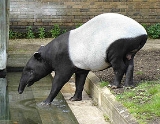
The animal is easily identified by its markings, most notably the light-colored “patch” which extends from its shoulders to its rear. The rest of its hair is black, except for the tips of its ears which, as with other tapirs, are rimmed with white. This pattern is for camouflage
Camouflage
Camouflage is a method of concealment that allows an otherwise visible animal, military vehicle, or other object to remain unnoticed, by blending with its environment. Examples include a leopard's spotted coat, the battledress of a modern soldier and a leaf-mimic butterfly...

: the disrupted coloration makes it more difficult to recognize it as a tapir, and other animals may mistake it for a large rock rather than a form of prey when it is lying down to sleep.

Malayan Tapirs grow to between 6 and 8 feet (1.8 to 2.4 m) in length, stand 3 to 3.5 feet (90 to 107 cm) tall, and typically weigh between 550 and 700 pounds (250 to 320 kg), although they can weigh up to 1,100 pounds (500 kg). The females are usually larger than the males. Like the other types of tapir, they have small stubby tails and long, flexible proboscis
Proboscis
A proboscis is an elongated appendage from the head of an animal, either a vertebrate or an invertebrate. In simpler terms, a proboscis is the straw-like mouth found in several varieties of species.-Etymology:...

es. They have four toes on each front foot and three toes on each back foot. The Malayan Tapir has rather poor eyesight but excellent hearing and sense of smell.

They have a large sagittal crest, a bone running along the middle of the skull that is necessary for muscle attachment. They also have unusually positioned orbits, an unusually shaped cranium with the frontal bones elevated, and a retracted nasal incision. All of these modifications to the normal mammal skull are, of course, to make room for the proboscis to sit. This proboscis caused retraction of bones and cartilage in the face during the evolution of the tapir, and even caused the loss of some cartilages, facial muscles, and the bony wall of the nasal chamber.

Visual


The Malayan tapir has very poor eyesight, and making them rely greatly on their excellent sense of smell and hearing to go about in their everyday lives. The Malayan tapir has small, beady eyes with brown irises on either side of their face. Their eyes are often covered in a blue haze, which is corneal cloudiness thought to be caused by repetitive exposure to light. Cornea
Cornea
The cornea is the transparent front part of the eye that covers the iris, pupil, and anterior chamber. Together with the lens, the cornea refracts light, with the cornea accounting for approximately two-thirds of the eye's total optical power. In humans, the refractive power of the cornea is...

l cloudiness is when the cornea starts to lose its transparency. The cornea is necessary for the transmitting and focusing of outside light as it enters the eye, and when it clouds it can cause vision loss. This causes the Malayan tapir to have very inadequate vision, both on land and in water, a place where they spend the majority of their time. Also, as the tapir is most active at night and since they have poor eyesight, it makes it harder for them to search for food and avoid predators in the dark.

Brevetianus variation


A small number of melanistic
Melanism
Melanism is an undue development of dark-colored pigment in the skin or its appendages, and the opposite of albinism. It is also the medical term for black jaundice.The word is deduced from the , meaning black pigment....

 (all-black) Malayan tapirs have been observed. In 1924, an all-black tapir was sent to Rotterdam Zoo and was classified as a subspecies called Tapirus indicus brevetianus after its discoverer Captain K. Brevet. In 2000, two melanistic tapirs were observed during a study of tigers in the Jerangau Forest Reserve in Malaysia. The cause of this variation may be a genetic abnormality similar to that of black panther
Black panther
A black panther is typically a melanistic color variant of any of several species of larger cat. Wild black panthers in Latin America are black jaguars , in Asia and Africa they are black leopards , and in North America they may be black jaguars or possibly black cougars A black panther is...

s that appear in populations of spotted jaguars. However, unless and until more brevetianus individuals can be studied, the precise explanation for the trait will remain unknown.

Lifecycle


The gestation
Gestation
Gestation is the carrying of an embryo or fetus inside a female viviparous animal. Mammals during pregnancy can have one or more gestations at the same time ....

 period of the Malayan Tapir is approximately 390-395 days, after which a single offspring, weighing around 15 pounds (6.8 kg), is born. Malayan Tapirs are the largest of the four tapir species at birth and grow more quickly than their congener
Congener
Congener has several different meanings depending on the field in which it is used. Colloquially, it is used to mean a person or thing like another, in character or action.-Biology:In biology, congeners are organisms within the same genus...

s. Young tapirs of all species have brown hair with white stripes and spots, a pattern which enables them to hide effectively in the dappled light of the forest. This baby coat fades into adult coloration between four and seven months after birth. Weaning
Weaning
Weaning is the process of gradually introducing a mammal infant, either human or animal, to what will be its adult diet and withdrawing the supply of its mother's milk.The process takes place only in mammals, as only mammals produce milk...

 occurs between six and eight months of age, at which time the babies are nearly full-grown, and the animals reach sexual maturity
Sexual maturity
Sexual maturity is the age or stage when an organism can reproduce. It is sometimes considered synonymous with adulthood, though the two are distinct...

 around age three. Breeding typically occurs in April, May or June, and females generally produce one calf every two years. Malayan Tapirs can live up to 30 years, both in the wild and in captivity.

Behavior


Malayan Tapirs are primarily solitary creatures, marking out large tracts of land as their territory
Territory (animal)
In ethology the term territory refers to any sociographical area that an animal of a particular species consistently defends against conspecifics...

, though these areas usually overlap with those of other individuals. Tapirs mark out their territories by spraying urine
Urine
Urine is a typically sterile liquid by-product of the body that is secreted by the kidneys through a process called urination and excreted through the urethra. Cellular metabolism generates numerous by-products, many rich in nitrogen, that require elimination from the bloodstream...

 on plants, and they often follow distinct paths which they have bulldozed through the undergrowth.

Exclusively a vegetarian
Herbivore
Herbivores are organisms that are anatomically and physiologically adapted to eat plant-based foods. Herbivory is a form of consumption in which an organism principally eats autotrophs such as plants, algae and photosynthesizing bacteria. More generally, organisms that feed on autotrophs in...

, the animal forages for the tender shoots and leaves of more than 115 species of plants (around 30 are particularly preferred), moving slowly through the forest
Forest
A forest, also referred to as a wood or the woods, is an area with a high density of trees. As with cities, depending where you are in the world, what is considered a forest may vary significantly in size and have various classification according to how and what of the forest is composed...

 and pausing often to eat and note the scents left behind by other tapirs in the area. However, when threatened or frightened, the tapir can run quickly, despite its considerable bulk, and they can also defend themselves with their strong jaws and sharp teeth. Malayan Tapirs communicate with high-pitched squeaks and whistles. They usually prefer to live near water and often bathe and swim, and they are also able to climb steep slopes. Tapirs are mainly active at night, though they are not exclusively nocturnal. They tend to eat soon after sunset or before sunrise, and they will often nap in the middle of the night. This type of behavior characterizes them as crepuscular
Crepuscular
Crepuscular animals are those that are active primarily during twilight, that is during dawn and dusk. The word is derived from the Latin word crepusculum, meaning "twilight." Crepuscular is, thus, in contrast with diurnal and nocturnal behavior. Crepuscular animals may also be active on a bright...

 animals.

Habitat, predation, and vulnerability


The Malayan Tapir was once found throughout the tropical lowland rainforest
Rainforest
Rainforests are forests characterized by high rainfall, with definitions based on a minimum normal annual rainfall of 1750-2000 mm...

s of Southeast Asia
Southeast Asia
Southeast Asia, South-East Asia, South East Asia or Southeastern Asia is a subregion of Asia, consisting of the countries that are geographically south of China, east of India, west of New Guinea and north of Australia. The region lies on the intersection of geological plates, with heavy seismic...

, including Cambodia
Cambodia
Cambodia , officially known as the Kingdom of Cambodia, is a country located in the southern portion of the Indochina Peninsula in Southeast Asia...

, Indonesia
Indonesia
Indonesia , officially the Republic of Indonesia , is a country in Southeast Asia and Oceania. Indonesia is an archipelago comprising approximately 13,000 islands. It has 33 provinces with over 238 million people, and is the world's fourth most populous country. Indonesia is a republic, with an...

, Laos
Laos
Laos Lao: ສາທາລະນະລັດ ປະຊາທິປະໄຕ ປະຊາຊົນລາວ Sathalanalat Paxathipatai Paxaxon Lao, officially the Lao People's Democratic Republic, is a landlocked country in Southeast Asia, bordered by Burma and China to the northwest, Vietnam to the east, Cambodia to the south and Thailand to the west...

, Malaysia, Myanmar
Myanmar
Burma , officially the Republic of the Union of Myanmar , is a country in Southeast Asia. Burma is bordered by China on the northeast, Laos on the east, Thailand on the southeast, Bangladesh on the west, India on the northwest, the Bay of Bengal to the southwest, and the Andaman Sea on the south....

 (Burma), Thailand
Thailand
Thailand , officially the Kingdom of Thailand , formerly known as Siam , is a country located at the centre of the Indochina peninsula and Southeast Asia. It is bordered to the north by Burma and Laos, to the east by Laos and Cambodia, to the south by the Gulf of Thailand and Malaysia, and to the...

, and Vietnam
Vietnam
Vietnam – sometimes spelled Viet Nam , officially the Socialist Republic of Vietnam – is the easternmost country on the Indochina Peninsula in Southeast Asia. It is bordered by China to the north, Laos to the northwest, Cambodia to the southwest, and the South China Sea –...

. However, its numbers have decreased in recent years, and today, like all tapirs, it is in danger of extinction
Extinction
In biology and ecology, extinction is the end of an organism or of a group of organisms , normally a species. The moment of extinction is generally considered to be the death of the last individual of the species, although the capacity to breed and recover may have been lost before this point...

.
Because of their size, tapirs have few natural predators, and even reports of killings by tigers are scarce. The main threat to the Malayan tapirs is human activity, including deforestation
Deforestation
Deforestation is the removal of a forest or stand of trees where the land is thereafter converted to a nonforest use. Examples of deforestation include conversion of forestland to farms, ranches, or urban use....

 for agricultural purposes, flooding caused by the damming of rivers for hydroelectric projects, and illegal trade. In Thailand, for instance, capture and sale of a young tapir may be worth US$5500.00. In areas such as Sumatra, where the population is predominantly Muslim
Muslim
A Muslim, also spelled Moslem, is an adherent of Islam, a monotheistic, Abrahamic religion based on the Quran, which Muslims consider the verbatim word of God as revealed to prophet Muhammad. "Muslim" is the Arabic term for "submitter" .Muslims believe that God is one and incomparable...

, tapirs are seldom hunted for food, as their physical similarity to pigs has made tapir meat a taboo, but in some regions they are hunted for sport or shot accidentally when mistaken for other animals. Protected status in Malaysia, Indonesia, and Thailand, which seeks to curb deliberate killing of tapirs but does not address the issue of habitat loss, has had limited effect in reviving or maintaining the population.

External links