
All Topics  
Rattlesnake

 
Rattlesnake

   Email Print
   Bookmark   Link


Rattlesnake


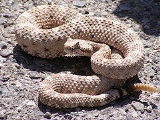
Rattlesnakes are a group of venomous
Venomous snake

A venomous snake is a snake that uses modified saliva, snake venom, usually delivered through highly specialized teeth such as hollow fangs, for the purpose of prey immobilization and self-defense....
 snakes, genera
Genus

A genus is a low-level taxonomic rank used in the classification of living and fossil organisms. The taxonomic ranks are domain , kingdom , phylum, class , order , family , genus, and species....
 Crotalus
Crotalus

Crotalus is a genus of venomous snake Crotalinaes found only in the Americas from southern Canada to northern Argentina. The name is derived from the Greek word krotalon, which means "rattle" or "castanet", and refers to the rattle on the end of the tail that make this group so distinctive....
 and Sistrurus
Sistrurus

Sistrurus is a genus of venomous snake Crotalinae found in Canada, the United States and Mexico. The name is a Latin language form of the Greek language word for "tail rattler" and shares its root with the ancient Egyptian musical instrument, the sistrum, a type of rattle....
. They belong to the subfamily of venomous snakes known commonly as pit viper
Crotalinae

The Crotalinae, or crotalines, are a subfamily of venomous snake Viperidaes found in Asia and the Americas. They are distinguished by the presence of a heat-sensing pit organ located between the eye and the nostril on either side of the head....
s.

e are approximately thirty species of rattlesnake
List of rattlesnake species and subspecies

This list of rattlesnake species and subspecies includes the genus Crotalus and Sistrurus. It follows the Alpha taxonomy currently provided by Integrated Taxonomic Information System, which is based on the continuing work of Dr....
, with numerous subspecies. They receive their name for the rattle
Rattle

Rattle may mean:* Rattle * RATTLE magazine, an American poetry journal* Bird-scaring rattle, a Slovene device used to drive birds off vineyards and a folk instrument...
 located at the tip of their tails. The rattle is used as a warning device when threatened. The scientific name Crotalus derives from the Greek
Greek language

Greek is an Indo-European languages native to the southern Balkan peninsula, the language of the Greek people. It forms an independent branch within Indo-European....
, ???ta???, meaning "castanet
Castanet

Castanets are percussion instrument , much used in Moorish, Ottoman music, Music of ancient Rome, Italian music, Spanish music, Portuguese music and Latin American music....
".


Discussion
Ask a question about 'Rattlesnake'
Start a new discussion about 'Rattlesnake'
Answer questions from other users
Full Discussion Forum


Recent Posts


Encyclopedia


Rattlesnakes are a group of venomous
Venomous snake

A venomous snake is a snake that uses modified saliva, snake venom, usually delivered through highly specialized teeth such as hollow fangs, for the purpose of prey immobilization and self-defense....
 snakes, genera
Genus

A genus is a low-level taxonomic rank used in the classification of living and fossil organisms. The taxonomic ranks are domain , kingdom , phylum, class , order , family , genus, and species....
 Crotalus
Crotalus

Crotalus is a genus of venomous snake Crotalinaes found only in the Americas from southern Canada to northern Argentina. The name is derived from the Greek word krotalon, which means "rattle" or "castanet", and refers to the rattle on the end of the tail that make this group so distinctive....
 and Sistrurus
Sistrurus

Sistrurus is a genus of venomous snake Crotalinae found in Canada, the United States and Mexico. The name is a Latin language form of the Greek language word for "tail rattler" and shares its root with the ancient Egyptian musical instrument, the sistrum, a type of rattle....
. They belong to the subfamily of venomous snakes known commonly as pit viper
Crotalinae

The Crotalinae, or crotalines, are a subfamily of venomous snake Viperidaes found in Asia and the Americas. They are distinguished by the presence of a heat-sensing pit organ located between the eye and the nostril on either side of the head....
s.

Overview

There are approximately thirty species of rattlesnake
List of rattlesnake species and subspecies

This list of rattlesnake species and subspecies includes the genus Crotalus and Sistrurus. It follows the Alpha taxonomy currently provided by Integrated Taxonomic Information System, which is based on the continuing work of Dr....
, with numerous subspecies. They receive their name for the rattle
Rattle

Rattle may mean:* Rattle * RATTLE magazine, an American poetry journal* Bird-scaring rattle, a Slovene device used to drive birds off vineyards and a folk instrument...
 located at the tip of their tails. The rattle is used as a warning device when threatened. The scientific name Crotalus derives from the Greek
Greek language

Greek is an Indo-European languages native to the southern Balkan peninsula, the language of the Greek people. It forms an independent branch within Indo-European....
, ???ta???, meaning "castanet
Castanet

Castanets are percussion instrument , much used in Moorish, Ottoman music, Music of ancient Rome, Italian music, Spanish music, Portuguese music and Latin American music....
". The name Sistrurus is the Latinized form of the Greek
Greek language

Greek is an Indo-European languages native to the southern Balkan peninsula, the language of the Greek people. It forms an independent branch within Indo-European....
 word for "tail rattler" (Se?st??????, Seistrouros) and shares its root with the ancient Egypt
Egypt

Egypt is a country mainly in North Africa, with the Sinai Peninsula forming a land bridge in Western Asia. Covering an area of about , Egypt borders the Mediterranean Sea to the north, the Gaza Strip and Israel to the northeast, the Red Sea to the east, Sudan to the south and Libya to the west....
ian musical instrument, the sistrum
Sistrum

A sistrum is a musical instrument of the percussion instrument family, chiefly associated with ancient Egypt. It consists of a handle and a U-shaped metal frame, made of brass or bronze and between 10 and 30 cm in width....
, a type of rattle. Most rattlesnakes mate in the spring. All species give live birth
Live birth

A live birth occurs when a fetus, whatever its gestational age, exits the maternal body and subsequently shows any sign of life, such as voluntary muscle, heartbeat, or pulsation of the umbilical cord, for however brief a time and regardless of whether the umbilical cord or placenta are intact....
, rather than laying eggs. The young are self-sufficient from birth. As they do not need their mother after birth, the mother does not remain with her young.

Prey

Rattlesnakes consume rodents and other small animals. They subdue their prey quickly with a venom
Venom

Venom is any of a variety of poisons used by certain types of animals. Generally, venom is injected by such means as a bite or a sting....
ous bite as opposed to constricting
Constriction

Sorry, no overview for this topic
. The venom will immediately stun or kill typical prey. A rattlesnake will follow prey that does not quickly succumb to the venom and attempts to escape. Rattlers are known to strike at distances up to two-thirds their body length.

Reproduction

Although many kinds of snakes are oviparous (lay eggs), rattlesnakes are ovoviviparous -- the female retains the eggs in her body that then hatch as they are laid or soon afterwards; or viviparous (give birth to live young). Baby snakes are ready to go as soon as they are hatched or born. There is little to no parental care of the newborn snakes.

The rattle

Rattle
The rattle is composed of a series of nested, hollow beads which are actually modified scales from the tail tip. Each time the snake sheds its skin, a new rattle segment is added. They may shed their skins several times a year depending on food supply and growth rates. Newborn rattlesnakes do not have functional rattles; it isn't until after they have shed their skin for the first time that they gain an additional bead, which beats against the first bead, known as the button, to create the rattling sound. Adult snakes may lose their rattles on occasion, but more appear at each molting. If the rattle absorbs enough water in wet weather, it will not make noise.

Safety and identification


Different species of rattlesnake vary significantly in size, territory, markings, and temperament. If the rattlesnake is not cornered or imminently threatened, it will usually attempt to flee from encounters with humans, but will not always do so. Bites often occur when humans startle the snake or provoke it. Those bitten while provoking rattlesnakes have usually underestimated the range (roughly two-thirds of its total length) and speed with which a coiled snake can strike (literally faster than the human eye can follow). This can be particularly surprising since the snakes can strike without pulling their body back. This reflex hasn't been recorded in any other species. Heavy boots and long pants reinforced with leather or canvas are recommended for hikers in areas known to harbor rattlesnakes.

Guides are available through booksellers, libraries, and local conservation and wildlife management agencies that aid hikers and campers in identifying rattlesnakes. The advice given is to avoid contact with rattlesnakes by remaining observant and not approaching the animals. Hikers are advised to be particularly careful when negotiating fallen logs or boulders and when near rocky outcroppings and ledges where rattlesnakes may be hiding or sunning themselves. However, snakes will occasionally sun themselves in the middle of a trail, so such areas are not the only places where they are encountered. When encountering a rattlesnake on a trail, you are advised to keep your distance and allow the snake room to retreat.

Rattlesnake bites

Rattlesnakes are born with fully functioning fangs capable of injecting venom and can regulate the amount of venom they inject when biting. Generally they deliver a full dose of venom to their prey, but may deliver less venom or none at all when biting defensively. A frightened or injured snake may not exercise such control. Young snakes are to be considered more dangerous, as they have less control over the amount of venom they inject. A young rattlesnake will often simply inject all its venom, which is a deadly amount.

Toxicity

Most species of rattlesnakes have hemotoxic
Hemotoxin

Hemotoxins, haemotoxins or hematotoxins are toxins that destroy red blood cells , disrupt blood thrombus, and/or cause Organ degeneration and generalized Biological tissue damage....
 venom, destroying tissue, degenerating organs and causing coagulopathy
Coagulopathy

Coagulopathy is a medical term for a defect in the body's mechanism for blood clotting....
 (disrupted blood clotting). Some degree of permanent scarring is very likely in the event of a venomous bite, even with prompt, effective treatment, and a severe envenomation
Envenomation

Envenomation is the process by which venom is injected into some animal by the bite of a venomous animal. Many kinds of animals, including mammals , reptiles , spiders , insects , employ venom for hunting and for self defense....
, combined with delayed or ineffective treatment, can lead to the loss of a limb or death. Thus, a rattlesnake bite is always a potentially fatal injury. Untreated rattlesnake bites, especially from larger species, are very often fatal. However, antivenom, when applied in time, reduces the death rate to less than 4%. Around 8,000 people are bitten by venomous snakes in the United States each year. On average, fewer than 15 snakebite deaths are reported.

Some rattlesnakes, especially the tropical species, have neurotoxic
Neurotoxin

A neurotoxin is a toxin that acts specifically on nerve cells , usually by interacting with membrane proteins such as ion channels.Some sources are more general, and define the effect of neurotoxins as occurring at nerve tissue....
 venom. A bite from these snakes can interfere with or shut down parts of the nervous system. In the U.S. the Mojave Rattlesnake (Crotalus scutulatus) in Arizona and parts of California has a neurotoxic venom component known as Mojave Type A toxin. The current antivenom, (FDA-approved in October, 2000) known as Cro-Fab, contains antibodies to Mojave A and B toxins as well as the toxins of most other U.S. pit vipers. Mojave A toxin has been identified present in the venoms of other species of rattlesnakes on occasion. Neurotoxins cause neurological symptoms, paralysis and could result in death due to respiratory paralysis. In the U.S., Central and South America there are another group of neurotoxic snakes known as the Coral Snakes, not related to rattlesnakes but more closely related to the cobra family of Africa and Asia. These snakes can also cause death due to respiratory paralysis if not properly treated.

The Common Kingsnake (Lampropeltis getula
Lampropeltis getula

Lampropeltis getula is a harmless colubrid species found in the United States and Mexico. A distinct color pattern and the common belief that this species actively hunts for venomous snakes helps to protect them from immediate death, which is the usual outcome when snakes encounter people....
), a constrictor
Constrictor

Constrictor may refer to:Biology:* Any snake that kills its prey by constriction* A taxonomic synonym for Boa , a.k.a. boas, a genus of non-venomous boas found in Mexico, Central and South America, Madagascar and on Reunion Island....
, is famous for being largely immune to the venom of rattlesnakes and other viper
Viper

Viper and similar may refer to:...
s, and therefore rattlesnakes form part of this snake's natural diet in the wild.

First aid

When a bite occurs, the amount of venom injected cannot be gauged easily. Symptoms and swelling may occur quickly, and may cause death easily but in some cases hours may pass before serious effects appear.

Experienced health workers typically gauge envenomation in stages ranging from 0, when there is no evident venom, to 5, when there is a life-threatening amount of venom present. The stages reflect the amount of bruising and swelling around the fang marks and the speed with which that bruising and swelling progresses. In more severe envenomation cases (stage 4 or 5) there may also be proximal symptoms, such as lip-tingling, dizziness, bleeding, vomiting, or shock. Difficulty breathing, paralysis, drooling, and massive haemorrhaging are also common symptoms.

Quick medical attention is critical, and treatment typically requires antivenin/antivenom to block the tissue destruction, nerve effects, and blood-clotting disorders common with rattlesnake venom. Most medical experts recommend keeping the area of the bite below the level of the heart. It is important to keep a snake bite victim calm in order to avoid elevating their heart rate and accelerating the circulation of venom within the body. Untrained individuals should not attempt to make incisions at or around bite sites, or to use tourniquets, as either treatment may be more destructive than the envenomation itself.

Any bite from a rattlesnake should be regarded as a life-threatening medical emergency
Medical emergency

A medical emergency is an injury or illness that is Acute and poses an immediate risk to a person's life or long term health. These emergencies may require assistance from another person, who should ideally be suitably qualified to do so, although some of these emergencies can be dealt with by the victim themselves....
 that requires immediate hospital treatment from trained professionals.

Rattlesnakes as food

Rattlesnakes are also a popular food in some southeastern and southwestern American cuisines and are sometimes sold in speciality meat shops. It has a flavor that has been described as similar to chicken
Tastes like chicken

When trying to describe the flavor of a food the listener has never eaten, a common declaration is that it tastes like chicken. The expression has been used so often that it has become somewhat of a clich?....
 or frog legs and a chewy texture similar to alligator.

Rattlesnakes in captivity

There are fairly obvious risks with private ownership of rattlesnakes. A bite can cause death or permanent disability. Even a nonfatal bite can lead to very high costs for emergency medical care. Some jurisdictions outlaw the possession of venomous snakes. Where it is legal, some form of license or insurance policy may be required.

Media


See also

  • List of crotaline species and subspecies
    List of crotaline species and subspecies

    This is a list of all Genus, species and subspecies of the Family Crotalinae, otherwise referred to as crotalines, pit vipers or pitvipers. It follows the Alpha taxonomy currently provided by Integrated Taxonomic Information System, which is based on the continuing work of Dr....


External links

  • Albuquerque,
    Albuquerque, New Mexico

    Albuquerque is the largest List of cities in the United States in the US state of New Mexico, United States. It is the county seat of Bernalillo County, New Mexico and is situated in the central part of the state, straddling the Rio Grande....
     New Mexico
    New Mexico

    New Mexico is a U. S. State located in the Southwestern United States of the United States. Inhabited by Native Americans in the United States populations for many centuries, it has also has been part of the Spanish Empire viceroyalty of New Spain, part of Mexico, and a U.S....
  • Good descriptions of many species with ranges