

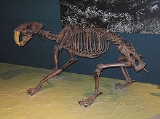
Machairodontinae

Encyclopedia
Machairodontinae is an extinct carnivora
n mammal
subfamily of Felidae
(true cats) endemic to Asia
, Africa
, North America
, South America
, and Europe
from the Miocene
to Pleistocene
living from c. 23 Ma until c. 11,000 years ago.
It contains some of the extinct predators commonly known as "saber-toothed cat
s", including the famed genus Smilodon
as well as other cats with only minor increases in the size and length of their maxillary canine
s. Sometimes other carnivorous mammals with elongated teeth are also called saber-toothed cats, although they do not belong to the felids. Besides the machairodonts, saber-toothed predators arose in Nimravidae
, Barbourofelidae
, Creodonta
(Machaeroides
) and even in a group of sparassodont
metatheria
ns (Thylacosmilus
).
of Africa. The early felid Pseudaelurus
quadridentatus showed a trend towards elongated upper canines and is believed to be at the base of the machairodontine evolution. The earliest known machairodontid genus is the middle Miocene Miomachairodus
from Africa and Turkey. Until the late Miocene machairodontines co-existed at several places together with barbourofelids
, archaic large carnivores which also bore long sabreteeth. Traditionally three different tribes of machairodontines were recognized, the Smilodontini
with typical dirk-toothed forms like Megantereon
and Smilodon
, the Machairodontini
or Homotherini with scimitar-toothed cats like Machairodus
or Homotherium
and the Metailurini
, containing generea like Dinofelis
and Metailurus
. However, recently the Metailurini are grouped within another felid subfamily, the Felinae, not into the Machairodontinae. The last machairodontine genera Smilodon and Homotherium did not disappear until late in the Pleistocene
, roughly 10.000 years ago in the Americas.
The name 'saber-toothed tigers' is misleading. Machairodonts were not even in the same subfamily as tigers, there is no evidence that they had tiger-like coat patterns, and this broad group of animals certainly did not all live or hunt in the same manner as the modern tiger
. DNA analysis
published in 2005 confirmed and clarified cladistic analysis
in showing that the Machairodontinae diverged early from the ancestors of modern cats and are not closely related to any living feline species. Sabertooths also coexisted in many places together with conical-toothed cats. In Africa
and Eurasia, sabertooths competed with several pantherine
s and cheetahs until the early or middle Pleistocene. Homotherium survived in Northern Europe even until the late Pleistocene. In the Americas they coexisted together with the cougar, American lion
, American cheetah, and jaguar
until the late Pleistocene. Saber-toothed and conical-toothed cats competed with each other for food resources, until the last of the former became extinct. All recent felids have more or less conical-shaped upper canines.
often refers to a large range of species identified as the same by the general public because they bear similar long teeth. Many of these species evolved several adaptations along with long teeth to help cope with the problems posed subsequently, so at first glance they may appear very similar, but after a closer look, differences appear that help to define the groups and compared with machairodonts, they are actually rather dissimilar.
The first late saber-tooth instance is a group of animals ancestral to mammals but not yet mammals. Known as synapsid
s or mammal-like reptiles, they were one of the first groups of animals to experiment with specialization of teeth and many had long canines. Some had two pairs of upper canines with two jutting down from each side, but most had one pair of upper extreme canines. Because of their primitiveness, they are extremely easy to tell from machairodonts. With no cononoid process, many sharp "premolars" more like pegs than scissors, a very long, lizard-like head are among several things that mark them out.
The second appearance of long canines is Thylacosmilus. Thylacosmilus is the most unique of the saber-tooth mammals and is also easy to tell apart. It differs from machairodonts in a possessing a very prominent flange and a tooth that is triangular in cross section. The root of the canines is more prominent than in machairodonts and a true sagittal crest
is absent.
The third instance of saber teeth is from order Creodonta. The small and slender Machaeroides bore canines that were thinner than in the average machairodont. Its muzzle was longer and narrower.
The fourth saber-tooth appearance is the ancient family of carnivores, the nimravids and they are notoriously hard to tell apart from machairodonts. Both groups have short skulls, tall sagittal crests, and the general skull shape is very similar. Some have distinctive flanges, some have none at all, so this confuses the matter further. Machairodonts were almost always bigger, though, and their canines were longer and more stout for the most part, but exceptions do appear.
The fifth appearance is the barbourofelids. These carnivores are very closely related to actual cats, and as such, they are hard to tell apart. The best known barbourofelid is Barbourofelis, which differs from most machairodonts by a mandible
that is much heavier and more stout, smaller orbit
s, massive and almost knobby flanges, and canines that are farther back. The average machairodont has well-developed incisors, but barbourofelids were more extreme.
The sixth and last of the saber-tooths to evolve were the machairodonts themselves.
Machairodonts are divided into two types: dirk-toothed and scimitar-toothed. Dirk-toothed cats had elongated, narrow upper canine
s and generally had stocky bodies. Scimitar-toothed cats had broader and shorter upper canines and a typically lithe body form with longer legs. The longer-toothed cats often had a bony flange
that extended from their lower mandible
. However, one genus, Xenosmilus
, known only from two fairly complete fossils, broke this mould, possessing both the stout heavy limbs associated with dirk-toothed cats, and the stout canines of a scimitar-toothed cat.
Carnivores reduced the number of their teeth as they specialized their teeth for eating meat instead of grinding plant or insect matter, and cats have the fewest number of teeth than any other carnivore
group, and machairodonts reduce the number even further. Most machairodonts retain twelve incisor
s (six on top and six on bottom), four canines (two on top and two on bottom), ten premolar
s (six on top and six on bottom), and two molar
s (both on top). Some genera, such as Smilodon, bear only eight premolars with one fewer on the mandible, leaving only four large premolars on the mandible along with two stunted canines and six stout incisors. The canines and are curved back smoothly and serrations are present, but are minor and wear away with age, leaving most middle-aged machairodonts (at about four or five) with no serrations. Hints in the bones such as these help paleontologists to estimate the age of an individual for population
studies of an animal long extinct.
Longer canines necessitate a larger gape. A lion with a gape of 95 degrees could not bear canines that are nine inches long because they would not be able to have a gap between the lower and upper canines larger than an inch or so, not enough to use for killing. Machairodonts, along with the other groups of animals that acquired the relationship of convergent evolution
, needed a way to change their skulls to accommodate the canines in several ways.
The largest inhibitor of a large gape for mammals are the two pairs of large muscles along the back of the jaw: the temporalis and masseter muscles. These muscles of the head have the capacity to be powerful and undergo a great degree of modification for ranging bite forces, but not very elastic due to their thickness, placement, and strength. To open the mouth wider, these species needed to change the formation of these muscles, namely to make them smaller and change their shape. The first step in this was to reduce the coronoid process
. The masseter and especially the temporalis muscles find their insertion point on this jutting strip of bone and reduction of this process meant reduction of the large muscles. Less mass for each muscle allowed greater elasticity and less resistance to a wide gape. Changing the shape of specifically the temporalis muscle in this aspect created a greater distance between the origin and insertion and shaped the muscle to be longer and more compact which is generally a more suitable format for this type of stretching. This reduction led to a bite that is weak (Main article on this page: Derived Anatomy: Bite Strength).
The skulls of machairodonts suggests another change in the shape of the temporalis muscle by means of the origin. The main constraint with the opening of the jaws is that the temporalis muscle will tear if stretched past a critical degree of resting position around the glenoid process when the mouth is opened. In modern felids, the occipital bone
extends backward, but the temporalis muscle that attaches to this surface are strained when opening the jaw wide as the muscle is wrapped around the glenoid process to the back of the zygomatic arch
. To reduce the stretch of the temporalis muscle around the immovable process, Machairodonts developed a skull with an occipital bone much more vertical. As seen to the right, the domestic cat, Felis catus, has a gape of 80 degrees (when compared with the 91 degrees of the African lion, Panthera leo). In the adjacent Smilodon, the gape is a massive 128 degrees and the angle of between the ramus of the mandible and the occipital bone is 100 degrees. The angle between the occipital bone and the mandible is the major limiting factor of the gape, and by reducing the angle of the occipital bone relative to the pallet of the mouth, shown in Smilodon, allowed the gape to increase that much more. Had the occipital bone not been stretched towards the pallet of the mouth (closer to perpendicular
), the gape would theoretically be less at roughly 113 degrees.
Machairodonts also reduced the bottom canines. The rationale for this is simply that the main objective for large clearance for the upper canines would not be to open the mouth wider, per say, but to maintain the distance between the top and bottom canines. If the top canines increase in length, reducing the bottom canines would counteract the distance between the points.
In 2008, Greg Laden covered the work of Per Christiansen on the skull shapes of Machairodonts, nimravids, and barbourofelids in his research article Evolution of Skull and Mandible Shape in Cats. These papers studied the skull shape of the carnivores by mapping various landmarks on different skulls and measuring the change in position of these landmarks to compare average values. These values, described as warps, led to an in depth analysis of the change in form of the skull, mainly to compensate for an increased gape.
In layman’s terms, the skull of these saber-toothed predators are tall from top to bottom and short from front to back. The zygomatic arches are compressed, and the portion of the skull bearing facial features, such as eyes, is higher. The muzzle is shorter.
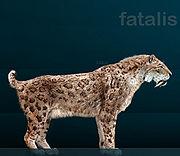
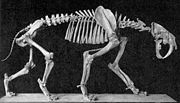

, Megantereon
, and Paramachairodus
, are defined by sturdiness and strength with the most primitive (Paramachairodus) being smaller and more lithe than the more advanced (Smilodon) with the intermediate (Megantereon) falling in between. They were not stamina
runners with short tarsles
and metatarsles
and heavy bodies. When compared with the modern lion, Panthera leo, their ribcages were barrel-like with narrow anterior end and expanded posterior end. Their scapula
e jutted above the normal positioning, especially in Smilodon, for generally unknown reasons. The cervical vertebrae are very sturdy and the attachments for muscles were powerful and strong. The lumbar
section of the vertebrae column was shortened. The tails were, from most primitive to most advanced, growing shorter and shorter, resulting in the bobcat-like tail of Smilodon.
The scimitar-toothed machairodonts, including Machairodus
, Miomachairodus
, Homotherium
, Adelphailurus
, Dinofelis
, Metailurus
, Pontosmilus
, Therailurus, Lokotunjailurus
, and technically Xenosmilus
, are a much more diverse group and most machairodonts fall into this less specialized type. The canines of this larger group are significantly shorter and much more stout for the most part. Because of the diversity of the genera, it is difficult to illustrate a specific type. Homotherium was once thought to be plantigrade
but was proven to be digigrade (Turner, 1997). This group is generally much more lean and smaller on average, though Machairodus was one of if not the largest of all machairodonts. Some display high degrees of sexual dimorphism
, unlike the dirk-toothed cats (Machairodus). Homotherium bore a sloped back that might have made it excellent at running long distances, similar to the extant Crocuta. They usually had longer legs and a more lithe form. The had more teeth than the average dirk-toothed machairodont with six premolar
s on the mandible
. Machairodus appears to have been an excellent jumper.
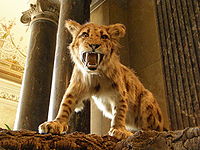
at a rodeo
while it's trying to buck you off," McHenry told LiveScience, "imagine the forces that would go through your skull as it's trying to throw you off. The lion skull actually copes with those [forces] really well, but the saber-cat skull doesn't". The main issue was the stresses suffered by the mandible: a strong force threatened to break the jaw as immense pressure was placed on its weakest points.
When reconstructing the jaw muscles, they discovered that Smilodon only had one third the bite force of a lion by jaw muscles alone. This is part of the poor results of the coping with simulated forces, but when the group reconstructed the neck muscles of both species as well, the nature of Smilodons bite became apparent. Instead of biting with jaw muscles alone, it was aided by neck muscles. The muscles that connected to the back of the skull were strong and depressed the head, forcing the skull down as opposed to pulling the mandible up. When the jaw was hyperextended, the jaw muscles could not contract
, but the neck muscles would press the head down, forcing the canines in whatever resisted them, and when the mouth was closed far enough, the jaw muscles could raise the mandible in some margin.
and has helped to shed some light on the prey species hunted by two genera of machaidodonts: Smilodon and Homotherium. The analysis revealed that Smilodon preyed mainly on bison and horse and occasionally ground sloth and mammoth, while the analysis of Homotherium reveals that this genus ate almost exclusively mammoth.
Though not all bones are preserved well enough to get results from this process, when it can be used, isotope analysis is highly useful. Without knowing exactly what species a predator ate, it is harder to tell what method of killing the animal used. Finds like these can support previous ideas, such as Homotherium the mammoth specialist as described in The Social Hypothesis.
The first change he suggested in the appearance of machairodonts were lower ears, or rather the illusion of lower ears due to the higher sagittal crest. This claim has been generally discarded due to its unique nature: no other modern carnivores have these low set ears for this reason, but alternatively, no other carnivore has such a sagittal crest. For this reason, the positioning of the pinna, or outer ear, along with fur color, are dependent upon the individual doing the reconstruction. Large or small, pointed or rounded, high or low, fossils do not record these characteristics, leaving them up to interpretation.
Miller also suggested a pug-like nose. Aside from the pug and similar dogs, no modern carnivore exhibits a pug-nose. The relatively low distribution of the pug nose has resulted in it being generally ignored. Miller's rationale is based upon the retraction of Smilodon nasal bones. Criticism of Miller's theory compares the nasal bones of lions and tigers. Lions, when compared to tigers, also have strongly retracted nasal bones, but a lion's rhinarium
, or external nose, is no more retracted than the tiger's. Thus the pug-nose of Smilodon proposed by Miller has little evidence in the physical structures of comparable animals.
The third idea proposed is the elongation of the lips by 50 percent. While his other hypotheses have been largely discarded, the last is used significantly in modern depictions. Miller argues that longer lips allows the greater elasticity needed for biting prey with a wider gape. Although this argument has been rebuked strongly within the scientific community, it remains supported nevertheless by artists. Scientific criticism points out that the lips of modern cats, especially larger species, display incredible elasticity and the usual lip length would stretch suitably, despite the larger degree of opening. Regardless, reconstructions of Smilodon, Machairodus, and other species are shown with long lips, often resembling the jowls of large dogs.
s to sore bodies. For a predator, one of the most common significant injuries is a muscle torn from the bone through extreme torsion
or stress. Repeated tearing leads to bony growths on the bone as the body struggles to strengthen the bone and prevent another injury, or distortion of a bone. These are left in the fossil record and by noticing where these injuries are taking place on the bone and discovering what muscle was torn and by knowing what this muscle does, it can be inferred what movements a hunting machairodont used the most and what motions were most dire to subduing prey, how great these injuries were, how well cared for it was or was not during the healing period of this injury, and how it affected the rest of the animal's life.
Christopher Shaw, manager of the George C. Page Museum in Los Angeles, tends to a large number of such deformed Smilodon fossils from the La Brea tar pits, primarily hunting injuries, and is fully involved in the new concept of a social Smilodon and maybe machairodonts as a social group in general. (Main article: Smilodon: Damaged Bones) "Overall," Shaw explains "we found that the most common position for these animals to be stressed in was with their forelegs out, forward, and slightly bent and their front paws in a grasping position. Their hind legs would be crouched in a pushing or pulling stance." This stance suggests Smilodon pulling the prey to the ground. This style of injury, along with the extreme lack of broken canines in Smilodon suggests the belly-bite, or shearing-bite hypothesis in favor of reduced risk to the predators.
The modern cheetah
is a quintessential example of the effect of even minor injuries on a predator. The cheetah is renown for its speed, preying primarily on a small species of gazelle called the Thompson's gazelle, affectionately nicknamed Tommies, who are now quite as fast but more maneuverable. The engagement in a chase between a cheetah and a Tommy is a competition between brute speed and agile footing, each evolving to outpace the other. A common injury for a cheetah is a sprain, and even a minor limp can cause the demise of the individual by starvation. A healthy, able-bodied cheetah struggles to eat well, and an injured cheetah is unable to catch food. Without another animal to support it while injured, most cheetahs suffering from sprains starve. A broken leg or even a jaw from the swift kick of a horse would be a certain death sentence for such a solitary predator. On the other hand, the same injury suffered by a wolf, African painted dog, or even a lion
would probably be healed from because it is more or less cared for while unable to hunt for itself. The severe injuries suffered by many Smilodon individuals strongly suggests a social nature. Even crippled long after the injury healed, animals with swollen ankles, and probably prominent limps and moving limitability persisted for years, and one such case displays a subadult with a pelvis shattered so badly and healed it would barely have been able to use the damaged limb and would have limped slowly, favoring the other three legs, completely unable to hunt on its own.
, such stabbing
would break teeth. Teeth are not made of metal blades, they are made of unsupported enamel
for the most part. Never mind humans having problems with breaking their half-inch teeth, the canines of these animals could exceed a foot
.
, pulled back and tore open the body, possibly tearing intestine
s or other organs from the body. The entire group could move away, leave the kill, and allow it to expire of shock
and blood loss. In his model, the flanges beneath the jaw would be used as an anchor against which the head depressors forced the canines. Though it might be unlikely that the group would retreat (based on the observation that large predators are extremely reluctant to abandon kills) the abdominal-tearing hypothesis has generally been regarded as highly plausible. In the La Brea tar pits, there were rare occurrences of broken canines in Smilodon and this less risky method might have contributed.
For this technique to work, a specific sequence of motions must be followed. First, the animal must be completely subdued, and the predatory machairodonts would need to be social so that several individuals can hold the prey animal down. The individual preparing to deliver the killing bite would open its mouth at maximum gape, and with its mandible, press up on the skin of the belly. Creating a depression where the lower canines and incisors press into the skin, a slight fold is created in the skin above the lower teeth as the mandible is shoved upward. Next, the upper canines are pressed into the skin and the muscles of the neck are used to depress the head, so instead of pulling the jaw up, the skull is pressed down (see the Derived anatomy: Bite Strength for more information on the weak bite of machairodonts). When the canines pierce the skin, they are lowered until the gape of the mouth is roughly forty five degrees, where the mandible is pulled up in addition to the skull still being depressed. When the animal's mouth is closed, it holds a thick flap of skin between its jaws, behind its canines, and the animal uses the muscles of its lower back and forequarters to pull back, tearing the flap clear of the body. This large gash, once opened, leaves intestines uncovered and arteries and veins torn. The bleeding animal would die within minutes, and the shock of repeated bites, tearing innards from the body, could speed up the process.
PhD Larry Dean Martin concludes that Akersten's shearing bite would have been problematic for a machairodont for several reasons. Most ungulate
s are severely sensitive around the belly and hindquarters and most predators find it much easier to capture and subdue an animal similar to the domestic cow, Bos taurus, by manipulating the head and forequarters. By lowering the animal to the ground and placing itself between the pairs of legs, a machairodont suffers great risk of being kicked. The power behind such a kick would easily break teeth, a mandible, or a leg and cripple or kill the cat. In this case, sociability might have solved this issue by having one individual deliver the killing bite while others hold the animal still.
Another issue not solved by numbers is the girth of the belly. The diameter of the abdomen of a large ungulate such as a bison might have been too large, the skin too taunt, for a machairodont to grasp a flap of skin at all, much less tear it away from the body.
Dr. Martin adds a third issue with the shearing bite: the canines need to tear a large hole in the belly of the animal to be successful, but instead, the canines may simply flay the skin and produce two, long slits. This wound may be painful and bleed, but the animal likely would not bleed to death and can still escape and survive to heal instead of bleeding to death as the hypothesis suggests.
In 2004, anatomist Frank Mendel led an experiment in which a pair of mechanical aluminum jaws, cast from the CT scans of a Smilodon fatalis individual from the La Brea tar pits
in California, were used to simulate several biting techniques possibly used by Smilodon, including the shearing bite, on a fresh domestic cow carcass. The information went into a new computer-aided program called CAD, or Vertebrate Analyzer (VA). He found that the belly of the cow was too large in diameter for the canines to puncture the skin, but instead were deflected off the body with the mandible blocking their access. An error, though, in his procedure, might contribute to the results: Akersten's specific method of creating a flap in the skin as described above was not followed accurately. Instead, the mandible was raised to the skull, and because of this flaw, the method cannot be ruled out.
, a bite positioned around the upper section of the throat, to suffocate the prey by compressing the windpipe. Their canines serve to puncture the skin and allow a better grip for the most part and do not do any real damage to the prey. Machairodonts, on the other hand, would have if they used the same technique as their modern cousins.
The major drawback with these methods is the considerable messiness, but that is probably not to be avoided with such canines. A large amount of blood spilled can be smelled by other nearby predators, including the large short-faced bear and dire wolf
. Both of these species, along with other machairodonts, canines, and felids, would have been attracted to the site. Predators often form competitive relationships in which dominance can shift from one species to the other, seen in the modern lion and spotted hyena of Africa, Crocuta crocuta (considering the generally larger groups of hyenas to the more individually powerful lion). In such situations, squabbles are not uncommon. The balance of power and dominance between these top predators remains a mystery because of the social factor. Strength in numbers can be significant in these struggles: a solitary short-faced bear and solitary Smilodon would quickly work out a pecking order with the bear dominate, but seven or more Smilodon might have been able to fend off such a bear. Dire wolves are thought to have traveled in large packs, and while individually subordinate, their large numbers might have forced a group of machairodonts off a kill. Because of the uncertainty, a large part of the niche
of machairodonts is still unknown.
There are several variations on this hypothesis, all of which need a subdued and still animal work best with several individuals:
s. An injury to the throat rivals, in danger of blood loss, any other part of the body. Another variation (Turner, 1997) suggests that advanced machairodonts were highly specialized enough to obtain the specific geometry to puncture four of the major blood vessels in the throat of a prey animal in one bite, but because of the differences of anatomy between species possibly hunted by machairodonts, the geometry needed to kill a horse, for instance, might not work for a bison. This would require the genus or even the specific species to be highly specialized in one species. This might offer yet another explanation for their extinction, for the movement, extinction, or otherwise unavailability of that prey species would lead to the death of its highly dependent predator. The high specialization seems, for the most part, an extreme and unnecessary version of a bite-and-retract version of the throat-shear but the suggestion that a machairodont species became more specialized to hunt one species is usually considered completely acceptable so long as the misconception that the machairodont hunted only that species is taken.
s. With powerful bodies not built for sprinting over long distances and presumably good senses such as smell and sight, it is possible that many, if not most, machairdonts ate what dead they found.
Many modern cats mix the two well. Lion
s are able-bodied hunters but will steal when ever they are given the opportunity. Tiger
s and cougars bury their kills and return after to keep eating, even days after. All cats prefer killing the sick or injured, and it becomes a fine line between an animal so sick it cannot move and an animal that is dead. The farther a predator moves from omnivore
to hypercarnivore, the less and less it will scavange. The canines appear to be used for killing, but their fragile nature may suggest other uses, still unknown. The abundance of Smilodon skeletons in the La Brea tar pits
in California supports the hypothesis well. The animals caught in the pits would have been dying or dead, the kind of meal a true hypercarnivore such as a modern cheetah
would pass up. This hypothesis is the oldest still considered viable.
Opposition to this concept lie in many parts of the cat. The teeth are purely carnivorous, unable to grind plant material such as the omnivorous teeth of dogs and bears, and they are carnassial
s, shaped to efficiently slice flesh, not crunch bone, as with the modern spotted hyena
, which might be all that's left of a carcass once the scavenger gets there. If both sexes bear the infamous canines and there are additional modifications to the skull (as described in Cranial Osteology above), what are the teeth used for if not for killing? The most likely explanation for this hypothesis is, as seen with modern cats, a mixed menu. Even large herbivore
s such as baboon
s, hippopotamus
es, and chimpanzee
s will occasionally scavenge, and large carnivores typically follow the same opprotunistic values, so it is not much of a stretch to say that machairodonts were opprotunists to some degree.
Though it may very well be that Smilodon was a social species, there is little hard evidence for other machairodont species being social. Most notions of sociability in the other species of machairodont is almost pure speculation. There are, however, a handful of coincidences that suggest either sociability in other species or people's ability to jump to conclusions.
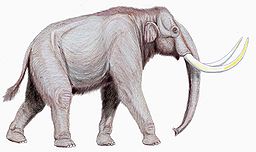 At Friesenhahn Cave, Texas, the remains of almost 400 juvenile mammoths were discovered along with skeletons of Homotherium
. For years, this puzzled the scientific community until the question of social nature rose. It has been suggested that Homotherium groups specialized in hunting young mammoths, which is not an absurd notion considering their strength, and that they dragged the kills into secluded caves to eat out of the open. They also retained excellent nocturnal vision, and hunting at night in the arctic regions would probably have been their prime hunting method.
In the region of Southern Africa
, especially Botswana
, the subspecies of lion rivals the size of tigers and are the largest of the species. In Savute, Botswana
, a single pride of these lions, have learned and specialized in hunting the largest of all prey animals. They're renowned for this tenacious nature and in a massive pride often in excess of thirty individuals, take down giraffe
s, cape buffalo, and, as they're most well known for, elephant
s, in a long, drawn-out struggle that will feed the pride for a week or more. They almost always take place at night when the elephant's vision is hindered. They often begin eating from the rear up, and in a fashion very different from the killing mode for cats, they will often begin to devour the elephant alive until it dies of blood loss. Their progress from hunting calves to subadults to successfully hunting fully grown adults has been observed in a relatively short period of time, short enough for people to observe the gradual change. Another pride in the Linyanti area of Botswana has specialized in hunting hippopotamus
, another daring task.
If the modern lion is capable of, in large numbers, killing weakened adult and healthy subadult elephants, it is likely that the considerably larger Homotherium could have managed the same feat with juvenile mammoths. This is supported by isotopic analysis, described in the section on this page labeled Hunting Strategies: Stable Isotopic Analysis. But the idea that a cat, even one of very large size and possibly social, was able to cooperatively drag a four hundred pound mammoth calf a distance of any real length into a cave without damaging its teeth has aroused great criticism. It sloped back and powerful lumbar section of its vertebrae suggested a bear-like build, so it might have been capable of pulling weights, but to avoid the breaking of its canines, a fate suffered by Machairodus and Smilodon with some frequency, is not seen in Homotherium. The question still remains as to whether scavengers dragged these bones to the cave and had nothing to do with the presence of Homotherium remains there, too, or whether the cats actually cooperatively dragged these kills somehow.
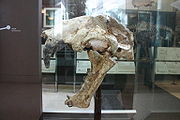 Machairodus
is another genus with little fossil records to suggest a social nature, but canines on these species are broken more often than others and show signs of extensive healing afterward. One of the most complete skulls, a male Machairodus giganteus of China housed by the Babiarz Institute of Paleontological Studies, is offered for purchase by several ostelogical companies including Bone Clones, is an older individual with a broken canine, worn from usage after the break. The individual died, though, of a severe nasal infection, the kind of injury that a social predator would have had a better chance of healing from. The adult canine teeth of juvenile Machairodus took an exceptionally long period of time to come in and be used, so until then was completely dependent on the care of the parents. The difficult feat of caring for helpless offspring has been suggested as a driving factor for human monogamy as brains grew larger. Other species who have especially helpless offspring, such as elephants, group for protection, but other, such as most species of whale, do not. It was likely advantageous for Machairodus to group together, but if there was a stronger factor to be alone, it would not have been truly detrimental, so it is difficult to tell whether the mother alone could support comfortably her toothless cubs until they were three or four.
, a species still extant, is solitary and yet is found in the pits in similar numbers. The social grey wolf and coyote
lived in the region, but their fossils in the pits are rare.
The broken bones still seem to support sociality, however. The best explanation for a solitary animal healing from serious wounds is that cats build up metabolic reserves that can be used in times of need. The cheetah is often viewed as a poor example because it is a specialized species with a more fragile physique than other cats. Larger, more sturdily built cat species, such as lions and leopards, have been observed to recover from severe injuries such as broken jaws and torn muscles.
Carnivora
The diverse order Carnivora |Latin]] carō "flesh", + vorāre "to devour") includes over 260 species of placental mammals. Its members are formally referred to as carnivorans, while the word "carnivore" can refer to any meat-eating animal...
n mammal
Mammal
Mammals are members of a class of air-breathing vertebrate animals characterised by the possession of endothermy, hair, three middle ear bones, and mammary glands functional in mothers with young...
subfamily of Felidae
Felidae
Felidae is the biological family of the cats; a member of this family is called a felid. Felids are the strictest carnivores of the thirteen terrestrial families in the order Carnivora, although the three families of marine mammals comprising the superfamily pinnipedia are as carnivorous as the...
(true cats) endemic to Asia
Asia
Asia is the world's largest and most populous continent, located primarily in the eastern and northern hemispheres. It covers 8.7% of the Earth's total surface area and with approximately 3.879 billion people, it hosts 60% of the world's current human population...
, Africa
Africa
Africa is the world's second largest and second most populous continent, after Asia. At about 30.2 million km² including adjacent islands, it covers 6% of the Earth's total surface area and 20.4% of the total land area...
, North America
North America
North America is a continent wholly within the Northern Hemisphere and almost wholly within the Western Hemisphere. It is also considered a northern subcontinent of the Americas...
, South America
South America
South America is a continent situated in the Western Hemisphere, mostly in the Southern Hemisphere, with a relatively small portion in the Northern Hemisphere. The continent is also considered a subcontinent of the Americas. It is bordered on the west by the Pacific Ocean and on the north and east...
, and Europe
Europe
Europe is, by convention, one of the world's seven continents. Comprising the westernmost peninsula of Eurasia, Europe is generally 'divided' from Asia to its east by the watershed divides of the Ural and Caucasus Mountains, the Ural River, the Caspian and Black Seas, and the waterways connecting...
from the Miocene
Miocene
The Miocene is a geological epoch of the Neogene Period and extends from about . The Miocene was named by Sir Charles Lyell. Its name comes from the Greek words and and means "less recent" because it has 18% fewer modern sea invertebrates than the Pliocene. The Miocene follows the Oligocene...
to Pleistocene
Pleistocene
The Pleistocene is the epoch from 2,588,000 to 11,700 years BP that spans the world's recent period of repeated glaciations. The name pleistocene is derived from the Greek and ....
living from c. 23 Ma until c. 11,000 years ago.
It contains some of the extinct predators commonly known as "saber-toothed cat
Saber-toothed cat
Saber-toothed cat or Sabre-toothed cat refers to the extinct subfamilies of Machairodontinae , Barbourofelidae , and Nimravidae as well as two families related to marsupials that were found worldwide from the Eocene Epoch to the end of the Pleistocene Epoch ,...
s", including the famed genus Smilodon
Smilodon
Smilodon , often called a saber-toothed cat or saber-toothed tiger, is an extinct genus of machairodonts. This saber-toothed cat was endemic to North America and South America, living from near the beginning through the very end of the Pleistocene epoch .-Etymology:The nickname "saber-tooth" refers...
as well as other cats with only minor increases in the size and length of their maxillary canine
Maxillary canine
The maxillary canine is the tooth located laterally from both maxillary lateral incisors of the mouth but mesial from both maxillary first premolars...
s. Sometimes other carnivorous mammals with elongated teeth are also called saber-toothed cats, although they do not belong to the felids. Besides the machairodonts, saber-toothed predators arose in Nimravidae
Nimravidae
The Nimravidae, sometimes known as false saber-toothed cats, are an extinct family of mammalian carnivores belonging to the suborder Feliformia and endemic to North America, Europe, and Asia living from the Eocene through the Miocene epochs , existing for approximately .-Morphology:Although some...
, Barbourofelidae
Barbourofelidae
Barbourofelidae is an extinct family of mammalian carnivores of the suborder Feliformia, which lived in North America, Eurasia and Africa during the Miocene epoch , existing for approximately .- Taxonomy :...
, Creodonta
Creodonta
The creodonts are an extinct order of mammals that lived from the Paleocene to the Miocene epochs. They shared a common ancestor with the Carnivora....
(Machaeroides
Machaeroides
Machaeroides is a genus of sabre-toothed creodont that lived during the Eocene. Its fossils were found in the U.S. state of Wyoming. It is the earliest known sabre-toothed mammal.-Description:...
) and even in a group of sparassodont
Sparassodonta
Sparassodonta is an extinct order of carnivorous metatherian mammals native to South America. They were once considered to be true marsupials, but are now thought to be a sister taxon to them. A number of these mammalian predators closely resemble placental predators that evolved separately on...
metatheria
Metatheria
Metatheria is a grouping within the animal class Mammalia. First proposed by Thomas Henry Huxley in 1880, it is nearly synonymous with the earlier taxon Marsupialia though it is slightly wider since it also contains the nearest fossil relatives of marsupial mammals.The earliest known...
ns (Thylacosmilus
Thylacosmilus
Thylacosmilus was a genus of sabre-toothed metatherian predators that first appeared during the Miocene. Remains of the animal have been found in parts of South America, primarily Argentina...
).
Family Felidae
The Machairodontinae originated in the early or middle MioceneMiocene
The Miocene is a geological epoch of the Neogene Period and extends from about . The Miocene was named by Sir Charles Lyell. Its name comes from the Greek words and and means "less recent" because it has 18% fewer modern sea invertebrates than the Pliocene. The Miocene follows the Oligocene...
of Africa. The early felid Pseudaelurus
Pseudaelurus
Pseudaelurus is a prehistoric cat that lived in Europe, Asia and North America in the Miocene approximately 20-8 million years ago. It is an ancestor of today's felines and pantherines as well as the extinct machairodont saber-tooths, and is a successor to Proailurus...
quadridentatus showed a trend towards elongated upper canines and is believed to be at the base of the machairodontine evolution. The earliest known machairodontid genus is the middle Miocene Miomachairodus
Miomachairodus
Miomachairodus was an extinct genus of large saber-toothed cats of the subfamily Machairodontinae, that lived in Europe, Asia, Africa, and North America during most of the Miocene...
from Africa and Turkey. Until the late Miocene machairodontines co-existed at several places together with barbourofelids
Barbourofelidae
Barbourofelidae is an extinct family of mammalian carnivores of the suborder Feliformia, which lived in North America, Eurasia and Africa during the Miocene epoch , existing for approximately .- Taxonomy :...
, archaic large carnivores which also bore long sabreteeth. Traditionally three different tribes of machairodontines were recognized, the Smilodontini
Smilodontini
Smilodontini is an extinct tribe of "saber-toothed cats", contained within the Machairodontinae subfamily of the Felidae endemic to South America, North America, Europe, Asia, and Africa living during the Miocene to Pleistocene from 10.3 mya—11,000 years ago, existing for approximately .As the name...
with typical dirk-toothed forms like Megantereon
Megantereon
Megantereon was an ancient machairodontine saber-toothed cat that lived in North America, Eurasia, and Africa. It may be the ancestor of Smilodon.- Fossil range :...
and Smilodon
Smilodon
Smilodon , often called a saber-toothed cat or saber-toothed tiger, is an extinct genus of machairodonts. This saber-toothed cat was endemic to North America and South America, living from near the beginning through the very end of the Pleistocene epoch .-Etymology:The nickname "saber-tooth" refers...
, the Machairodontini
Machairodontini
Machairodontini is an extinct tribe of large saber-toothed cats of the subfamily Machairodontinae, that lived in Europe, Asia, Africa, North America, and South America during the Miocene through Pleistocene living from 11.6 mya–11 000 years ago.-Taxonomy:Machairodontini was named...
or Homotherini with scimitar-toothed cats like Machairodus
Machairodus
Machairodus was a genus of large machairodontine saber-toothed cats that lived in Europe, Asia, Africa and North America during the Miocene through Pleistocene living from 11.6mya—126,000 years ago, existing for approximately .-Species:...
or Homotherium
Homotherium
Homotherium is an extinct genus of machairodontine saber-toothed cats, often termed scimitar cats, endemic to North America, South America, Europe, Asia, and Africa during the Pliocene and Pleistocene epochs , existing for approximately .It first became extinct in Africa some 1.5 million years ago...
and the Metailurini
Metailurini
Metailurini is an extinct tribe of large saber-toothed cats of the subfamily Felinae, that lived in Africa, Asia, Europe, and North America during the Miocene to Pleistocene living from 11.610 mya—11,000 years ago, existing for approximately ....
, containing generea like Dinofelis
Dinofelis
Dinofelis is a genus of sabre-toothed cats belonging to the tribe Metailurini. They were widespread in Europe, Asia, Africa and North America at least 5 million to about 1.2 million years ago...
and Metailurus
Metailurus
Metailurus is a genus of false saber-toothed cat of the family Felidae, belonging to the tribe Metailurini endemic to North America, Africa, Europe, and Asia during the Miocene to Pleistocene, living from 9 Ma—11,000 years ago and existed for approximately .Metailurus was named by Zdansky...
. However, recently the Metailurini are grouped within another felid subfamily, the Felinae, not into the Machairodontinae. The last machairodontine genera Smilodon and Homotherium did not disappear until late in the Pleistocene
Pleistocene
The Pleistocene is the epoch from 2,588,000 to 11,700 years BP that spans the world's recent period of repeated glaciations. The name pleistocene is derived from the Greek and ....
, roughly 10.000 years ago in the Americas.
The name 'saber-toothed tigers' is misleading. Machairodonts were not even in the same subfamily as tigers, there is no evidence that they had tiger-like coat patterns, and this broad group of animals certainly did not all live or hunt in the same manner as the modern tiger
Tiger
The tiger is the largest cat species, reaching a total body length of up to and weighing up to . Their most recognizable feature is a pattern of dark vertical stripes on reddish-orange fur with lighter underparts...
. DNA analysis
Polymerase chain reaction
The polymerase chain reaction is a scientific technique in molecular biology to amplify a single or a few copies of a piece of DNA across several orders of magnitude, generating thousands to millions of copies of a particular DNA sequence....
published in 2005 confirmed and clarified cladistic analysis
Cladistics
Cladistics is a method of classifying species of organisms into groups called clades, which consist of an ancestor organism and all its descendants . For example, birds, dinosaurs, crocodiles, and all descendants of their most recent common ancestor form a clade...
in showing that the Machairodontinae diverged early from the ancestors of modern cats and are not closely related to any living feline species. Sabertooths also coexisted in many places together with conical-toothed cats. In Africa
Africa
Africa is the world's second largest and second most populous continent, after Asia. At about 30.2 million km² including adjacent islands, it covers 6% of the Earth's total surface area and 20.4% of the total land area...
and Eurasia, sabertooths competed with several pantherine
Pantherinae
Pantherinae is the subfamily of the family Felidae, which includes the genera Panthera, Uncia and Neofelis.The divergence of Pantherinae from Felinae has been ranked between six and ten million years ago. DNA analysis suggests that the snow leopard Uncia uncia is basal to the entire Pantherinae and...
s and cheetahs until the early or middle Pleistocene. Homotherium survived in Northern Europe even until the late Pleistocene. In the Americas they coexisted together with the cougar, American lion
American lion
The American lion — also known as the North American lion, Naegele’s giant jaguar or American cave lion — is an extinct lion of the family Felidae, endemic to North America during the Pleistocene epoch , existing for approximately...
, American cheetah, and jaguar
Jaguar
The jaguar is a big cat, a feline in the Panthera genus, and is the only Panthera species found in the Americas. The jaguar is the third-largest feline after the tiger and the lion, and the largest in the Western Hemisphere. The jaguar's present range extends from Southern United States and Mexico...
until the late Pleistocene. Saber-toothed and conical-toothed cats competed with each other for food resources, until the last of the former became extinct. All recent felids have more or less conical-shaped upper canines.
Convergent evolution
The term saber-toothed catSaber-toothed cat
Saber-toothed cat or Sabre-toothed cat refers to the extinct subfamilies of Machairodontinae , Barbourofelidae , and Nimravidae as well as two families related to marsupials that were found worldwide from the Eocene Epoch to the end of the Pleistocene Epoch ,...
often refers to a large range of species identified as the same by the general public because they bear similar long teeth. Many of these species evolved several adaptations along with long teeth to help cope with the problems posed subsequently, so at first glance they may appear very similar, but after a closer look, differences appear that help to define the groups and compared with machairodonts, they are actually rather dissimilar.
The first late saber-tooth instance is a group of animals ancestral to mammals but not yet mammals. Known as synapsid
Synapsid
Synapsids are a group of animals that includes mammals and everything more closely related to mammals than to other living amniotes. They are easily separated from other amniotes by having an opening low in the skull roof behind each eye, leaving a bony arch beneath each, accounting for their name...
s or mammal-like reptiles, they were one of the first groups of animals to experiment with specialization of teeth and many had long canines. Some had two pairs of upper canines with two jutting down from each side, but most had one pair of upper extreme canines. Because of their primitiveness, they are extremely easy to tell from machairodonts. With no cononoid process, many sharp "premolars" more like pegs than scissors, a very long, lizard-like head are among several things that mark them out.
The second appearance of long canines is Thylacosmilus. Thylacosmilus is the most unique of the saber-tooth mammals and is also easy to tell apart. It differs from machairodonts in a possessing a very prominent flange and a tooth that is triangular in cross section. The root of the canines is more prominent than in machairodonts and a true sagittal crest
Sagittal crest
A sagittal crest is a ridge of bone running lengthwise along the midline of the top of the skull of many mammalian and reptilian skulls, among others....
is absent.
The third instance of saber teeth is from order Creodonta. The small and slender Machaeroides bore canines that were thinner than in the average machairodont. Its muzzle was longer and narrower.
The fourth saber-tooth appearance is the ancient family of carnivores, the nimravids and they are notoriously hard to tell apart from machairodonts. Both groups have short skulls, tall sagittal crests, and the general skull shape is very similar. Some have distinctive flanges, some have none at all, so this confuses the matter further. Machairodonts were almost always bigger, though, and their canines were longer and more stout for the most part, but exceptions do appear.
The fifth appearance is the barbourofelids. These carnivores are very closely related to actual cats, and as such, they are hard to tell apart. The best known barbourofelid is Barbourofelis, which differs from most machairodonts by a mandible
Mandible
The mandible pronunciation or inferior maxillary bone forms the lower jaw and holds the lower teeth in place...
that is much heavier and more stout, smaller orbit
Orbit
In physics, an orbit is the gravitationally curved path of an object around a point in space, for example the orbit of a planet around the center of a star system, such as the Solar System...
s, massive and almost knobby flanges, and canines that are farther back. The average machairodont has well-developed incisors, but barbourofelids were more extreme.
The sixth and last of the saber-tooths to evolve were the machairodonts themselves.
Genera and phylogeny
Phylogeny of Machairodontines with the three outgroups, Proailurus, Pseudaelurus, and all modern, conicle-toothed cats, with a brief description of each genus:Cranial osteology
The most studied section of the machairodont group is the skull, and specifically the teeth, for obvious reasons. With a large range of genera, good fossil representation for many of the genera, comparable modern relatives, diversity within the group, and a good understanding of the ecosystems inhabited by most genre, it is no surprise that the machairodont subfamily provides one of the most sufficient means of research for the analysis of hypercarnivores, specialization, and the relationships between predator and prey.Machairodonts are divided into two types: dirk-toothed and scimitar-toothed. Dirk-toothed cats had elongated, narrow upper canine
Canine tooth
In mammalian oral anatomy, the canine teeth, also called cuspids, dogteeth, fangs, or eye teeth, are relatively long, pointed teeth...
s and generally had stocky bodies. Scimitar-toothed cats had broader and shorter upper canines and a typically lithe body form with longer legs. The longer-toothed cats often had a bony flange
Flange
A flange is an external or internal ridge, or rim , for strength, as the flange of an iron beam such as an I-beam or a T-beam; or for attachment to another object, as the flange on the end of a pipe, steam cylinder, etc., or on the lens mount of a camera; or for a flange of a rail car or tram wheel...
that extended from their lower mandible
Mandible
The mandible pronunciation or inferior maxillary bone forms the lower jaw and holds the lower teeth in place...
. However, one genus, Xenosmilus
Xenosmilus
Xenosmilus is a genus of extinct Machairodontinae, or saber-toothed cat. Two fairly intact specimens were found by amateur fossil hunters, in 1983 in the Haile limestone mines in Alachua County, Florida...
, known only from two fairly complete fossils, broke this mould, possessing both the stout heavy limbs associated with dirk-toothed cats, and the stout canines of a scimitar-toothed cat.
Carnivores reduced the number of their teeth as they specialized their teeth for eating meat instead of grinding plant or insect matter, and cats have the fewest number of teeth than any other carnivore
Carnivore
A carnivore meaning 'meat eater' is an organism that derives its energy and nutrient requirements from a diet consisting mainly or exclusively of animal tissue, whether through predation or scavenging...
group, and machairodonts reduce the number even further. Most machairodonts retain twelve incisor
Incisor
Incisors are the first kind of tooth in heterodont mammals. They are located in the premaxilla above and mandible below.-Function:...
s (six on top and six on bottom), four canines (two on top and two on bottom), ten premolar
Premolar
The premolar teeth or bicuspids are transitional teeth located between the canine and molar teeth. In humans, there are two premolars per quadrant, making eight premolars total in the mouth. They have at least two cusps. Premolars can be considered as a 'transitional tooth' during chewing, or...
s (six on top and six on bottom), and two molar
Molar (tooth)
Molars are the rearmost and most complicated kind of tooth in most mammals. In many mammals they grind food; hence the Latin name mola, "millstone"....
s (both on top). Some genera, such as Smilodon, bear only eight premolars with one fewer on the mandible, leaving only four large premolars on the mandible along with two stunted canines and six stout incisors. The canines and are curved back smoothly and serrations are present, but are minor and wear away with age, leaving most middle-aged machairodonts (at about four or five) with no serrations. Hints in the bones such as these help paleontologists to estimate the age of an individual for population
Population
A population is all the organisms that both belong to the same group or species and live in the same geographical area. The area that is used to define a sexual population is such that inter-breeding is possible between any pair within the area and more probable than cross-breeding with individuals...
studies of an animal long extinct.
Longer canines necessitate a larger gape. A lion with a gape of 95 degrees could not bear canines that are nine inches long because they would not be able to have a gap between the lower and upper canines larger than an inch or so, not enough to use for killing. Machairodonts, along with the other groups of animals that acquired the relationship of convergent evolution
Convergent evolution
Convergent evolution describes the acquisition of the same biological trait in unrelated lineages.The wing is a classic example of convergent evolution in action. Although their last common ancestor did not have wings, both birds and bats do, and are capable of powered flight. The wings are...
, needed a way to change their skulls to accommodate the canines in several ways.
The largest inhibitor of a large gape for mammals are the two pairs of large muscles along the back of the jaw: the temporalis and masseter muscles. These muscles of the head have the capacity to be powerful and undergo a great degree of modification for ranging bite forces, but not very elastic due to their thickness, placement, and strength. To open the mouth wider, these species needed to change the formation of these muscles, namely to make them smaller and change their shape. The first step in this was to reduce the coronoid process
Coronoid process of the mandible
The mandible's coronoid process is a thin, triangular eminence, which is flattened from side to side and varies in shape and size....
. The masseter and especially the temporalis muscles find their insertion point on this jutting strip of bone and reduction of this process meant reduction of the large muscles. Less mass for each muscle allowed greater elasticity and less resistance to a wide gape. Changing the shape of specifically the temporalis muscle in this aspect created a greater distance between the origin and insertion and shaped the muscle to be longer and more compact which is generally a more suitable format for this type of stretching. This reduction led to a bite that is weak (Main article on this page: Derived Anatomy: Bite Strength).
The skulls of machairodonts suggests another change in the shape of the temporalis muscle by means of the origin. The main constraint with the opening of the jaws is that the temporalis muscle will tear if stretched past a critical degree of resting position around the glenoid process when the mouth is opened. In modern felids, the occipital bone
Occipital bone
The occipital bone, a saucer-shaped membrane bone situated at the back and lower part of the cranium, is trapezoidal in shape and curved on itself...
extends backward, but the temporalis muscle that attaches to this surface are strained when opening the jaw wide as the muscle is wrapped around the glenoid process to the back of the zygomatic arch
Zygomatic arch
The zygomatic arch or cheek bone is formed by the zygomatic process of temporal bone and the temporal process of the zygomatic bone , the two being united by an oblique suture; the tendon of the Temporalis passes medial to the arch to gain insertion into the coronoid process...
. To reduce the stretch of the temporalis muscle around the immovable process, Machairodonts developed a skull with an occipital bone much more vertical. As seen to the right, the domestic cat, Felis catus, has a gape of 80 degrees (when compared with the 91 degrees of the African lion, Panthera leo). In the adjacent Smilodon, the gape is a massive 128 degrees and the angle of between the ramus of the mandible and the occipital bone is 100 degrees. The angle between the occipital bone and the mandible is the major limiting factor of the gape, and by reducing the angle of the occipital bone relative to the pallet of the mouth, shown in Smilodon, allowed the gape to increase that much more. Had the occipital bone not been stretched towards the pallet of the mouth (closer to perpendicular
Perpendicular
In geometry, two lines or planes are considered perpendicular to each other if they form congruent adjacent angles . The term may be used as a noun or adjective...
), the gape would theoretically be less at roughly 113 degrees.
Machairodonts also reduced the bottom canines. The rationale for this is simply that the main objective for large clearance for the upper canines would not be to open the mouth wider, per say, but to maintain the distance between the top and bottom canines. If the top canines increase in length, reducing the bottom canines would counteract the distance between the points.
In 2008, Greg Laden covered the work of Per Christiansen on the skull shapes of Machairodonts, nimravids, and barbourofelids in his research article Evolution of Skull and Mandible Shape in Cats. These papers studied the skull shape of the carnivores by mapping various landmarks on different skulls and measuring the change in position of these landmarks to compare average values. These values, described as warps, led to an in depth analysis of the change in form of the skull, mainly to compensate for an increased gape.
In layman’s terms, the skull of these saber-toothed predators are tall from top to bottom and short from front to back. The zygomatic arches are compressed, and the portion of the skull bearing facial features, such as eyes, is higher. The muzzle is shorter.
Skeletal morphology
The dirk-toothed machairodonts, including SmilodonSmilodon
Smilodon , often called a saber-toothed cat or saber-toothed tiger, is an extinct genus of machairodonts. This saber-toothed cat was endemic to North America and South America, living from near the beginning through the very end of the Pleistocene epoch .-Etymology:The nickname "saber-tooth" refers...
, Megantereon
Megantereon
Megantereon was an ancient machairodontine saber-toothed cat that lived in North America, Eurasia, and Africa. It may be the ancestor of Smilodon.- Fossil range :...
, and Paramachairodus
Paramachairodus
Paramachairodus is an extinct genus of saber-tooth cat of the subfamily Machairodontinae endemic to Europe and Asia, during the late Miocene from 15 to 9 Ma....
, are defined by sturdiness and strength with the most primitive (Paramachairodus) being smaller and more lithe than the more advanced (Smilodon) with the intermediate (Megantereon) falling in between. They were not stamina
Endurance
Endurance is the ability for a human or animal to exert itself and remain active for a long period of time, as well as its ability to resist, withstand, recover from, and have immunity to trauma, wounds, or fatigue. In humans, it is usually used in aerobic or anaerobic exercise...
runners with short tarsles
Metatarsus
The metatarsus or metatarsal bones are a group of five long bones in the foot located between the tarsal bones of the hind- and mid-foot and the phalanges of the toes. Lacking individual names, the metatarsal bones are numbered from the medial side : the first, second, third, fourth, and fifth...
and metatarsles
Metatarsus
The metatarsus or metatarsal bones are a group of five long bones in the foot located between the tarsal bones of the hind- and mid-foot and the phalanges of the toes. Lacking individual names, the metatarsal bones are numbered from the medial side : the first, second, third, fourth, and fifth...
and heavy bodies. When compared with the modern lion, Panthera leo, their ribcages were barrel-like with narrow anterior end and expanded posterior end. Their scapula
Scapula
In anatomy, the scapula , omo, or shoulder blade, is the bone that connects the humerus with the clavicle ....
e jutted above the normal positioning, especially in Smilodon, for generally unknown reasons. The cervical vertebrae are very sturdy and the attachments for muscles were powerful and strong. The lumbar
Lumbar
In tetrapod anatomy, lumbar is an adjective that means of or pertaining to the abdominal segment of the torso, between the diaphragm and the sacrum ...
section of the vertebrae column was shortened. The tails were, from most primitive to most advanced, growing shorter and shorter, resulting in the bobcat-like tail of Smilodon.
The scimitar-toothed machairodonts, including Machairodus
Machairodus
Machairodus was a genus of large machairodontine saber-toothed cats that lived in Europe, Asia, Africa and North America during the Miocene through Pleistocene living from 11.6mya—126,000 years ago, existing for approximately .-Species:...
, Miomachairodus
Miomachairodus
Miomachairodus was an extinct genus of large saber-toothed cats of the subfamily Machairodontinae, that lived in Europe, Asia, Africa, and North America during most of the Miocene...
, Homotherium
Homotherium
Homotherium is an extinct genus of machairodontine saber-toothed cats, often termed scimitar cats, endemic to North America, South America, Europe, Asia, and Africa during the Pliocene and Pleistocene epochs , existing for approximately .It first became extinct in Africa some 1.5 million years ago...
, Adelphailurus
Adelphailurus
Adelphailurus is an extinct genus of saber-toothed cats of the family Felidae and tribe Metailurini which inhabited western North America during the Miocene living from 10.3—5.33 Ma and existed for approximately .-Taxonomy:...
, Dinofelis
Dinofelis
Dinofelis is a genus of sabre-toothed cats belonging to the tribe Metailurini. They were widespread in Europe, Asia, Africa and North America at least 5 million to about 1.2 million years ago...
, Metailurus
Metailurus
Metailurus is a genus of false saber-toothed cat of the family Felidae, belonging to the tribe Metailurini endemic to North America, Africa, Europe, and Asia during the Miocene to Pleistocene, living from 9 Ma—11,000 years ago and existed for approximately .Metailurus was named by Zdansky...
, Pontosmilus
Pontosmilus
Pontosmilus is a genus of machairodontine saber-toothed cats.- References :*...
, Therailurus, Lokotunjailurus
Lokotunjailurus
Lokotunjailurus is the name of a genus of sabre-toothed cats which existed in Kenya and Chad during the Miocene epoch....
, and technically Xenosmilus
Xenosmilus
Xenosmilus is a genus of extinct Machairodontinae, or saber-toothed cat. Two fairly intact specimens were found by amateur fossil hunters, in 1983 in the Haile limestone mines in Alachua County, Florida...
, are a much more diverse group and most machairodonts fall into this less specialized type. The canines of this larger group are significantly shorter and much more stout for the most part. Because of the diversity of the genera, it is difficult to illustrate a specific type. Homotherium was once thought to be plantigrade
Plantigrade
right|151px|thumb|Human skeleton, showing plantigrade habitIn terrestrial animals, plantigrade locomotion means walking with the podials and metatarsals flat on the ground. It is one of three forms of locomotion adopted by mammals...
but was proven to be digigrade (Turner, 1997). This group is generally much more lean and smaller on average, though Machairodus was one of if not the largest of all machairodonts. Some display high degrees of sexual dimorphism
Sexual dimorphism
Sexual dimorphism is a phenotypic difference between males and females of the same species. Examples of such differences include differences in morphology, ornamentation, and behavior.-Examples:-Ornamentation / coloration:...
, unlike the dirk-toothed cats (Machairodus). Homotherium bore a sloped back that might have made it excellent at running long distances, similar to the extant Crocuta. They usually had longer legs and a more lithe form. The had more teeth than the average dirk-toothed machairodont with six premolar
Premolar
The premolar teeth or bicuspids are transitional teeth located between the canine and molar teeth. In humans, there are two premolars per quadrant, making eight premolars total in the mouth. They have at least two cusps. Premolars can be considered as a 'transitional tooth' during chewing, or...
s on the mandible
Mandible
The mandible pronunciation or inferior maxillary bone forms the lower jaw and holds the lower teeth in place...
. Machairodus appears to have been an excellent jumper.
Derived anatomy
At first glance, fossils tell you what and animal ate and how tall it was at the shoulder, but to the trained eye and to a mind able to put the pieces of a puzzle together, they can revel much more. Fossils are the remnants of a living animal and are usually bones which are the bones are the template for a vertebrate in large part. By using the bones and understanding how the living animal's life affects the development, shape, and damages to bones within the creature, a great deal can be learned, much more than just how big it was.Biological illustrations and reconstructions
From the basis of fossils, actual animals can be reconstructed into a biological illustration. Skulls become a template for the animal's face, which is important because it houses more sensory organs than any other body part, is designed to eat, and is something humans as a species relate to. The face of an animal can tell you its diet, when it was active (night versus day), how it tracked down food, what sensory organs it utilized well and what ones it neglected, et cetera. In a biological illustration or reconstruction, the skull (or often the entire body, involving more work and information) are laid over with muscles the animal likely had in life. The estimates of the layout of the muscles are derived from the anatomy of known species, usually extant, and for machairodonts, modern felids work well. Using an actual fossil or cast is typically more desirable than a drawing due to the textures and ridges muscles leave behind that will suggest where they attached, how much stress they underwent, and how strong they were. Reconstructions based on fossils (seen on the right with an extinct pantherine to the right) are usually used for artistic purposes and to help the public understand a species better than they would just viewing a chunk of fossilized bone, but also help scientists to visualize and learn about a species through the intimate analysis required for such a feat of creation. These reconstructions, though, also give insight into a wide range of other topics about a species, from strength to behavior to dangers while living.Bite strength
The jaws of machairodonts, especially more advanced species with longer canines such as Smilodon and Megantereon, are surprisingly weak. The morphology of the skull implied reduced temporalis and masseter muscles (see the Cranial Osteology: Increasing the Gape section of this page) to make ample room for the long canines, but the reduced muscles got little attention until a group of scientists, including Stephen Wroe and Colin McHenry, began to extensively study the skulls. The team compared Smilodon and modern Panthera leo, the lion. Using computer programs, they created digital reconstructions of the two skulls and simulated the stresses of holding onto struggling prey. The stresses were coped well with the lion skull, but Smilodon fared poorly. "Imagine biting onto something like a bullBull
Bull usually refers to an uncastrated adult male bovine.Bull may also refer to:-Entertainment:* Bull , an original show on the TNT Network* "Bull" , an episode of television series CSI: Crime Scene Investigation...
at a rodeo
Rodeo
Rodeo is a competitive sport which arose out of the working practices of cattle herding in Spain, Mexico, and later the United States, Canada, South America and Australia. It was based on the skills required of the working vaqueros and later, cowboys, in what today is the western United States,...
while it's trying to buck you off," McHenry told LiveScience, "imagine the forces that would go through your skull as it's trying to throw you off. The lion skull actually copes with those [forces] really well, but the saber-cat skull doesn't". The main issue was the stresses suffered by the mandible: a strong force threatened to break the jaw as immense pressure was placed on its weakest points.
When reconstructing the jaw muscles, they discovered that Smilodon only had one third the bite force of a lion by jaw muscles alone. This is part of the poor results of the coping with simulated forces, but when the group reconstructed the neck muscles of both species as well, the nature of Smilodons bite became apparent. Instead of biting with jaw muscles alone, it was aided by neck muscles. The muscles that connected to the back of the skull were strong and depressed the head, forcing the skull down as opposed to pulling the mandible up. When the jaw was hyperextended, the jaw muscles could not contract
Contract
A contract is an agreement entered into by two parties or more with the intention of creating a legal obligation, which may have elements in writing. Contracts can be made orally. The remedy for breach of contract can be "damages" or compensation of money. In equity, the remedy can be specific...
, but the neck muscles would press the head down, forcing the canines in whatever resisted them, and when the mouth was closed far enough, the jaw muscles could raise the mandible in some margin.
Stable isotope analysis
It is usually impossible to confirm exactly what species a predator preyed upon, but on occasion, the bone of such a predator is preserved well enough to retain recognizable proteins in the structure of the bone that belong to the species it consumed when alive. The chemical analysis of these proteins is called stable isotope analysisIsotope analysis
Isotope analysis is the identification of isotopic signature, the distribution of certain stable isotopes and chemical elements within chemical compounds. This can be applied to a food web to make it possible to draw direct inferences regarding diet, trophic level, and subsistence...
and has helped to shed some light on the prey species hunted by two genera of machaidodonts: Smilodon and Homotherium. The analysis revealed that Smilodon preyed mainly on bison and horse and occasionally ground sloth and mammoth, while the analysis of Homotherium reveals that this genus ate almost exclusively mammoth.
Though not all bones are preserved well enough to get results from this process, when it can be used, isotope analysis is highly useful. Without knowing exactly what species a predator ate, it is harder to tell what method of killing the animal used. Finds like these can support previous ideas, such as Homotherium the mammoth specialist as described in The Social Hypothesis.
The face of Miller's machairodont
American paleontologist George Miller set forth a set of features not previously thought of in the soft tissues of machairodonts, specifically Smilodon.The first change he suggested in the appearance of machairodonts were lower ears, or rather the illusion of lower ears due to the higher sagittal crest. This claim has been generally discarded due to its unique nature: no other modern carnivores have these low set ears for this reason, but alternatively, no other carnivore has such a sagittal crest. For this reason, the positioning of the pinna, or outer ear, along with fur color, are dependent upon the individual doing the reconstruction. Large or small, pointed or rounded, high or low, fossils do not record these characteristics, leaving them up to interpretation.
Miller also suggested a pug-like nose. Aside from the pug and similar dogs, no modern carnivore exhibits a pug-nose. The relatively low distribution of the pug nose has resulted in it being generally ignored. Miller's rationale is based upon the retraction of Smilodon nasal bones. Criticism of Miller's theory compares the nasal bones of lions and tigers. Lions, when compared to tigers, also have strongly retracted nasal bones, but a lion's rhinarium
Rhinarium
The rhinarium is the moist, naked surface around the nostrils of the nose in most mammals. In actual scientific usage it is typically called a "wet snout" or "wet nose" from its moist and shiny appearance...
, or external nose, is no more retracted than the tiger's. Thus the pug-nose of Smilodon proposed by Miller has little evidence in the physical structures of comparable animals.
The third idea proposed is the elongation of the lips by 50 percent. While his other hypotheses have been largely discarded, the last is used significantly in modern depictions. Miller argues that longer lips allows the greater elasticity needed for biting prey with a wider gape. Although this argument has been rebuked strongly within the scientific community, it remains supported nevertheless by artists. Scientific criticism points out that the lips of modern cats, especially larger species, display incredible elasticity and the usual lip length would stretch suitably, despite the larger degree of opening. Regardless, reconstructions of Smilodon, Machairodus, and other species are shown with long lips, often resembling the jowls of large dogs.
Vocalizations
By comparing the hyoid bones of Smilodon and Panthera leo, it is known that Smildon and possibly other machairodonts could roar like their modern relatives, lions and the other big cats.Injured muscles
Bones are not just bones: they house numerous facts about the living animal difficult to decipher and often the key to understanding what a single bone can tell you is not in the chemistry or the intricate knowledge, but knowing what simply things to look for, such as damage, and how this simple aspect of a bone relates to the animal as a whole when alive. In the case of machairodonts, injuries are the key to working out how they hunted, how they moved, and even their sociability. When an animal, including people, pushes its body too far, injuries occur. These range from broken bones to torn muscles to small sprainSprain
A sprain is an injury in a joint, caused by the ligament being stretched beyond its capacity. A muscular tear caused in the same manner is referred to as a strain. In cases where either ligament or muscle tissue is torn, immobilization and surgical repair may be necessary...
s to sore bodies. For a predator, one of the most common significant injuries is a muscle torn from the bone through extreme torsion
Torsion
The word torsion may refer to the following:*In geometry:** Torsion of a curve** Torsion tensor in differential geometry** The closely related concepts of Reidemeister torsion and analytic torsion ** Whitehead torsion*In algebra:** Torsion ** Tor functor* In medicine:** Ovarian...
or stress. Repeated tearing leads to bony growths on the bone as the body struggles to strengthen the bone and prevent another injury, or distortion of a bone. These are left in the fossil record and by noticing where these injuries are taking place on the bone and discovering what muscle was torn and by knowing what this muscle does, it can be inferred what movements a hunting machairodont used the most and what motions were most dire to subduing prey, how great these injuries were, how well cared for it was or was not during the healing period of this injury, and how it affected the rest of the animal's life.
Christopher Shaw, manager of the George C. Page Museum in Los Angeles, tends to a large number of such deformed Smilodon fossils from the La Brea tar pits, primarily hunting injuries, and is fully involved in the new concept of a social Smilodon and maybe machairodonts as a social group in general. (Main article: Smilodon: Damaged Bones) "Overall," Shaw explains "we found that the most common position for these animals to be stressed in was with their forelegs out, forward, and slightly bent and their front paws in a grasping position. Their hind legs would be crouched in a pushing or pulling stance." This stance suggests Smilodon pulling the prey to the ground. This style of injury, along with the extreme lack of broken canines in Smilodon suggests the belly-bite, or shearing-bite hypothesis in favor of reduced risk to the predators.
The modern cheetah
Cheetah
The cheetah is a large-sized feline inhabiting most of Africa and parts of the Middle East. The cheetah is the only extant member of the genus Acinonyx, most notable for modifications in the species' paws...
is a quintessential example of the effect of even minor injuries on a predator. The cheetah is renown for its speed, preying primarily on a small species of gazelle called the Thompson's gazelle, affectionately nicknamed Tommies, who are now quite as fast but more maneuverable. The engagement in a chase between a cheetah and a Tommy is a competition between brute speed and agile footing, each evolving to outpace the other. A common injury for a cheetah is a sprain, and even a minor limp can cause the demise of the individual by starvation. A healthy, able-bodied cheetah struggles to eat well, and an injured cheetah is unable to catch food. Without another animal to support it while injured, most cheetahs suffering from sprains starve. A broken leg or even a jaw from the swift kick of a horse would be a certain death sentence for such a solitary predator. On the other hand, the same injury suffered by a wolf, African painted dog, or even a lion
Lion
The lion is one of the four big cats in the genus Panthera, and a member of the family Felidae. With some males exceeding 250 kg in weight, it is the second-largest living cat after the tiger...
would probably be healed from because it is more or less cared for while unable to hunt for itself. The severe injuries suffered by many Smilodon individuals strongly suggests a social nature. Even crippled long after the injury healed, animals with swollen ankles, and probably prominent limps and moving limitability persisted for years, and one such case displays a subadult with a pelvis shattered so badly and healed it would barely have been able to use the damaged limb and would have limped slowly, favoring the other three legs, completely unable to hunt on its own.
Hunting techniques
Even if one does not know what a machairodont is, they will surely know what a sabre-toothed cat is. Those canines are legendary and have inspired popular culture and science fiction time and time again, but one of the biggest questions about this predator's biology remains up in the air: how did the living and real animal use those teeth? When considered, they seem only to get in the way, so their enigma has brought up a number of concepts, each with its flaws and its plausibilities, on how the cat with the characturish canines actually killed.Misconceptions
During the initial discovery of saber-toothed fossils, people's worst nightmares seemed to be coming to life and public imagination overruled any substantial factual basis. Images of gaping mouthed Smilodon and Machairodus leaping on the back of massive prey and preparing to stab its teeth into the neck of the violently struggling animal filled books on the subject and the instinctual terror of these ferocious animals waged their representation as terrible monsters that seemed not even the imagination could create. Scientifically, it was thought these canines were used for sexual display, for crushing vertebrae, for tearing open Glyptodonts. As time wore on, the inaccuracies of these ideas became more and more apparent and the division between imagination and reality became more and more defined. While it had been suggested that the teeth of saber-toothed cats were used in the manner of a hand wielding a knifeKnife
A knife is a cutting tool with an exposed cutting edge or blade, hand-held or otherwise, with or without a handle. Knives were used at least two-and-a-half million years ago, as evidenced by the Oldowan tools...
, such stabbing
Stabbing
A stabbing is penetration with a sharp or pointed object at close range. Stab connotes purposeful action, as by an assassin or murderer, but it is also possible to accidentally stab oneself or others.Stabbing differs from slashing or cutting in that the motion of the object used in a stabbing...
would break teeth. Teeth are not made of metal blades, they are made of unsupported enamel
Tooth enamel
Tooth enamel, along with dentin, cementum, and dental pulp is one of the four major tissues that make up the tooth in vertebrates. It is the hardest and most highly mineralized substance in the human body. Tooth enamel is also found in the dermal denticles of sharks...
for the most part. Never mind humans having problems with breaking their half-inch teeth, the canines of these animals could exceed a foot
Foot
The foot is an anatomical structure found in many vertebrates. It is the terminal portion of a limb which bears weight and allows locomotion. In many animals with feet, the foot is a separate organ at the terminal part of the leg made up of one or more segments or bones, generally including claws...
.
Akersten's belly shearing hypothesis
In 1985, American paleontologist William Akersten suggested the shearing-bite. This method of killing is more like the style of killing seen is hyenids and canines today. A group of Machairodonts captured and completely subdued a prey item, holding it still while one from the group bit into the abdominal cavityAbdominal cavity
The abdominal cavity is the body cavity of the human body that holds the bulk of the viscera. It is located below the thoracic cavity, and above the pelvic cavity. Its dome-shaped roof is the thoracic diaphragm , and its oblique floor is the pelvic inlet...
, pulled back and tore open the body, possibly tearing intestine
Intestine
In human anatomy, the intestine is the segment of the alimentary canal extending from the pyloric sphincter of the stomach to the anus and, in humans and other mammals, consists of two segments, the small intestine and the large intestine...
s or other organs from the body. The entire group could move away, leave the kill, and allow it to expire of shock
Acute stress reaction
Acute stress reaction is a psychological condition arising in response to a terrifying or traumatic event...
and blood loss. In his model, the flanges beneath the jaw would be used as an anchor against which the head depressors forced the canines. Though it might be unlikely that the group would retreat (based on the observation that large predators are extremely reluctant to abandon kills) the abdominal-tearing hypothesis has generally been regarded as highly plausible. In the La Brea tar pits, there were rare occurrences of broken canines in Smilodon and this less risky method might have contributed.
For this technique to work, a specific sequence of motions must be followed. First, the animal must be completely subdued, and the predatory machairodonts would need to be social so that several individuals can hold the prey animal down. The individual preparing to deliver the killing bite would open its mouth at maximum gape, and with its mandible, press up on the skin of the belly. Creating a depression where the lower canines and incisors press into the skin, a slight fold is created in the skin above the lower teeth as the mandible is shoved upward. Next, the upper canines are pressed into the skin and the muscles of the neck are used to depress the head, so instead of pulling the jaw up, the skull is pressed down (see the Derived anatomy: Bite Strength for more information on the weak bite of machairodonts). When the canines pierce the skin, they are lowered until the gape of the mouth is roughly forty five degrees, where the mandible is pulled up in addition to the skull still being depressed. When the animal's mouth is closed, it holds a thick flap of skin between its jaws, behind its canines, and the animal uses the muscles of its lower back and forequarters to pull back, tearing the flap clear of the body. This large gash, once opened, leaves intestines uncovered and arteries and veins torn. The bleeding animal would die within minutes, and the shock of repeated bites, tearing innards from the body, could speed up the process.
PhD Larry Dean Martin concludes that Akersten's shearing bite would have been problematic for a machairodont for several reasons. Most ungulate
Ungulate
Ungulates are several groups of mammals, most of which use the tips of their toes, usually hoofed, to sustain their whole body weight while moving. They make up several orders of mammals, of which six to eight survive...
s are severely sensitive around the belly and hindquarters and most predators find it much easier to capture and subdue an animal similar to the domestic cow, Bos taurus, by manipulating the head and forequarters. By lowering the animal to the ground and placing itself between the pairs of legs, a machairodont suffers great risk of being kicked. The power behind such a kick would easily break teeth, a mandible, or a leg and cripple or kill the cat. In this case, sociability might have solved this issue by having one individual deliver the killing bite while others hold the animal still.
Another issue not solved by numbers is the girth of the belly. The diameter of the abdomen of a large ungulate such as a bison might have been too large, the skin too taunt, for a machairodont to grasp a flap of skin at all, much less tear it away from the body.
Dr. Martin adds a third issue with the shearing bite: the canines need to tear a large hole in the belly of the animal to be successful, but instead, the canines may simply flay the skin and produce two, long slits. This wound may be painful and bleed, but the animal likely would not bleed to death and can still escape and survive to heal instead of bleeding to death as the hypothesis suggests.
In 2004, anatomist Frank Mendel led an experiment in which a pair of mechanical aluminum jaws, cast from the CT scans of a Smilodon fatalis individual from the La Brea tar pits
La Brea Tar Pits
The La Brea Tar Pits are a cluster of tar pits around which Hancock Park was formed, in the urban heart of Los Angeles. Asphaltum or tar has seeped up from the ground in this area for tens of thousands of years. The tar is often covered with water...
in California, were used to simulate several biting techniques possibly used by Smilodon, including the shearing bite, on a fresh domestic cow carcass. The information went into a new computer-aided program called CAD, or Vertebrate Analyzer (VA). He found that the belly of the cow was too large in diameter for the canines to puncture the skin, but instead were deflected off the body with the mandible blocking their access. An error, though, in his procedure, might contribute to the results: Akersten's specific method of creating a flap in the skin as described above was not followed accurately. Instead, the mandible was raised to the skull, and because of this flaw, the method cannot be ruled out.
The neck-biting hypotheses
A more common and widely accepted view of machairodont hunting is the throat shearing bite. Modern cats use a throat clampThroat clamp
Throat clamp is method of subduing often seen in predatory felids and occasionally canids and hyaenids. It involves the predator grasping the throat of the prey and clamping tight so that the windpipe is either crushed or blocked. Cats use this to kill prey while dogs and hyenas use this to weaken...
, a bite positioned around the upper section of the throat, to suffocate the prey by compressing the windpipe. Their canines serve to puncture the skin and allow a better grip for the most part and do not do any real damage to the prey. Machairodonts, on the other hand, would have if they used the same technique as their modern cousins.
The major drawback with these methods is the considerable messiness, but that is probably not to be avoided with such canines. A large amount of blood spilled can be smelled by other nearby predators, including the large short-faced bear and dire wolf
Dire Wolf
The Dire Wolf, Canis dirus, is an extinct carnivorous mammal of the genus Canis, and was most common in North America and South America from the Irvingtonian stage to the Rancholabrean stage of the Pleistocene epoch living 1.80 Ma – 10,000 years ago, existing for approximately .- Relationships...
. Both of these species, along with other machairodonts, canines, and felids, would have been attracted to the site. Predators often form competitive relationships in which dominance can shift from one species to the other, seen in the modern lion and spotted hyena of Africa, Crocuta crocuta (considering the generally larger groups of hyenas to the more individually powerful lion). In such situations, squabbles are not uncommon. The balance of power and dominance between these top predators remains a mystery because of the social factor. Strength in numbers can be significant in these struggles: a solitary short-faced bear and solitary Smilodon would quickly work out a pecking order with the bear dominate, but seven or more Smilodon might have been able to fend off such a bear. Dire wolves are thought to have traveled in large packs, and while individually subordinate, their large numbers might have forced a group of machairodonts off a kill. Because of the uncertainty, a large part of the niche
Ecological niche
In ecology, a niche is a term describing the relational position of a species or population in its ecosystem to each other; e.g. a dolphin could potentially be in another ecological niche from one that travels in a different pod if the members of these pods utilize significantly different food...
of machairodonts is still unknown.
There are several variations on this hypothesis, all of which need a subdued and still animal work best with several individuals:
General Bite and Retract
The first hypothesis involving the sensitive neck is that the cat simply restrained the animal and then bit the neck without much specificity to location to cause major blood damage and then retracted to allow the animal to bleed to death. This general bite would be utilized wherever it could be attained for the most part. Stipulations include not biting the back of the neck where contact with vertebrae could break the teeth, but by avoiding the vertebrae, a deep bite anywhere in the neck would prove fatal. This method also needs fewer predators. When compared with the belly-shearing hypothesis, one Megantereon could kill a large deer and possibly Equus the horse with little danger of breaking canines because the bite can be applied while the carnivore keeps its body behind the prey for the most part, avoiding flinging legs while still pressing with its body weight to keep it still. It is a quick bite, much in accordance to the ambush style of stalking and hunting the heavy and strong bodies most machairodonts bear. It is possible, too, for a lone machairodont to wound a large prey animal in this manner, then release and follow it until it falls, but this view on the general bite has been counteracted often. Cats rarely walk away from prey until they've eaten their fill and it involves the risk of other larger, more powerful carnivores stealing the probably loudly staggering animal while the machairodont follows in the shadows.Bite and Compress
When the animal bit as seen to the right, the canines lied behind the windpipe and the premolars would have been encompassing the windpipe. This variation states that the machairodont compressed the windpipe after dealing the bite, serving to both suffocate and wound the prey animal. This method, though, might inhibit the full blow of the wound created by the canines. Keeping the canines in the wound would stifle the blood flow from the body and could keep the animal alive longer, but would quiet the prey from vocalizing. The advantage, though, to the longer canines in this method of killing is essentially nonexistent when compared to the ancestral cats, including Pseudaelurus with its short, conical-shaped canines. If anything, the dangers to breaking teeth held in the throat of a living and panicked animal, even if well restrained, outweighs the possible benefits, so such a killing method would not have driven the group to evolve such canines, obviously used for killing, so this method has often been viewed as improbable.Careful Throat-Shear
The throat of any animal is full of blood vesselBlood vessel
The blood vessels are the part of the circulatory system that transports blood throughout the body. There are three major types of blood vessels: the arteries, which carry the blood away from the heart; the capillaries, which enable the actual exchange of water and chemicals between the blood and...
s. An injury to the throat rivals, in danger of blood loss, any other part of the body. Another variation (Turner, 1997) suggests that advanced machairodonts were highly specialized enough to obtain the specific geometry to puncture four of the major blood vessels in the throat of a prey animal in one bite, but because of the differences of anatomy between species possibly hunted by machairodonts, the geometry needed to kill a horse, for instance, might not work for a bison. This would require the genus or even the specific species to be highly specialized in one species. This might offer yet another explanation for their extinction, for the movement, extinction, or otherwise unavailability of that prey species would lead to the death of its highly dependent predator. The high specialization seems, for the most part, an extreme and unnecessary version of a bite-and-retract version of the throat-shear but the suggestion that a machairodont species became more specialized to hunt one species is usually considered completely acceptable so long as the misconception that the machairodont hunted only that species is taken.
Scavenging
One significant suggestion to the hunting question is that most machairodonts were scavengerScavenger
Scavenging is both a carnivorous and herbivorous feeding behavior in which individual scavengers search out dead animal and dead plant biomass on which to feed. The eating of carrion from the same species is referred to as cannibalism. Scavengers play an important role in the ecosystem by...
s. With powerful bodies not built for sprinting over long distances and presumably good senses such as smell and sight, it is possible that many, if not most, machairdonts ate what dead they found.
Many modern cats mix the two well. Lion
Lion
The lion is one of the four big cats in the genus Panthera, and a member of the family Felidae. With some males exceeding 250 kg in weight, it is the second-largest living cat after the tiger...
s are able-bodied hunters but will steal when ever they are given the opportunity. Tiger
Tiger
The tiger is the largest cat species, reaching a total body length of up to and weighing up to . Their most recognizable feature is a pattern of dark vertical stripes on reddish-orange fur with lighter underparts...
s and cougars bury their kills and return after to keep eating, even days after. All cats prefer killing the sick or injured, and it becomes a fine line between an animal so sick it cannot move and an animal that is dead. The farther a predator moves from omnivore
Omnivore
Omnivores are species that eat both plants and animals as their primary food source...
to hypercarnivore, the less and less it will scavange. The canines appear to be used for killing, but their fragile nature may suggest other uses, still unknown. The abundance of Smilodon skeletons in the La Brea tar pits
La Brea Tar Pits
The La Brea Tar Pits are a cluster of tar pits around which Hancock Park was formed, in the urban heart of Los Angeles. Asphaltum or tar has seeped up from the ground in this area for tens of thousands of years. The tar is often covered with water...
in California supports the hypothesis well. The animals caught in the pits would have been dying or dead, the kind of meal a true hypercarnivore such as a modern cheetah
Cheetah
The cheetah is a large-sized feline inhabiting most of Africa and parts of the Middle East. The cheetah is the only extant member of the genus Acinonyx, most notable for modifications in the species' paws...
would pass up. This hypothesis is the oldest still considered viable.
Opposition to this concept lie in many parts of the cat. The teeth are purely carnivorous, unable to grind plant material such as the omnivorous teeth of dogs and bears, and they are carnassial
Carnassial
Carnassials are large teeth found in many carnivorous mammals, used for shearing flesh and bone in a scissor- or shear-like way. In the Carnivora, the carnassials are the modified last upper premolar and the first molar, but in the prehistoric creodonts, the carnassials were further back in the...
s, shaped to efficiently slice flesh, not crunch bone, as with the modern spotted hyena
Spotted Hyena
The spotted hyena also known as laughing hyena, is a carnivorous mammal of the family Hyaenidae, of which it is the largest extant member. Though the species' prehistoric range included Eurasia extending from Atlantic Europe to China, it now only occurs in all of Africa south of the Sahara save...
, which might be all that's left of a carcass once the scavenger gets there. If both sexes bear the infamous canines and there are additional modifications to the skull (as described in Cranial Osteology above), what are the teeth used for if not for killing? The most likely explanation for this hypothesis is, as seen with modern cats, a mixed menu. Even large herbivore
Herbivore
Herbivores are organisms that are anatomically and physiologically adapted to eat plant-based foods. Herbivory is a form of consumption in which an organism principally eats autotrophs such as plants, algae and photosynthesizing bacteria. More generally, organisms that feed on autotrophs in...
s such as baboon
Baboon
Baboons are African and Arabian Old World monkeys belonging to the genus Papio, part of the subfamily Cercopithecinae. There are five species, which are some of the largest non-hominoid members of the primate order; only the mandrill and the drill are larger...
s, hippopotamus
Hippopotamus
The hippopotamus , or hippo, from the ancient Greek for "river horse" , is a large, mostly herbivorous mammal in sub-Saharan Africa, and one of only two extant species in the family Hippopotamidae After the elephant and rhinoceros, the hippopotamus is the third largest land mammal and the heaviest...
es, and chimpanzee
Chimpanzee
Chimpanzee, sometimes colloquially chimp, is the common name for the two extant species of ape in the genus Pan. The Congo River forms the boundary between the native habitat of the two species:...
s will occasionally scavenge, and large carnivores typically follow the same opprotunistic values, so it is not much of a stretch to say that machairodonts were opprotunists to some degree.
The social hypothesis
Though it has been determined that Smilodon was very likely social (Main Article: The Social Hypothesis, Smilodon), there is little to support ideas of social or solitary behaviors in other Machairodont spcies.Though it may very well be that Smilodon was a social species, there is little hard evidence for other machairodont species being social. Most notions of sociability in the other species of machairodont is almost pure speculation. There are, however, a handful of coincidences that suggest either sociability in other species or people's ability to jump to conclusions.
Frieshenhahn Caves: Mammut and Homotherium
Homotherium
Homotherium is an extinct genus of machairodontine saber-toothed cats, often termed scimitar cats, endemic to North America, South America, Europe, Asia, and Africa during the Pliocene and Pleistocene epochs , existing for approximately .It first became extinct in Africa some 1.5 million years ago...
. For years, this puzzled the scientific community until the question of social nature rose. It has been suggested that Homotherium groups specialized in hunting young mammoths, which is not an absurd notion considering their strength, and that they dragged the kills into secluded caves to eat out of the open. They also retained excellent nocturnal vision, and hunting at night in the arctic regions would probably have been their prime hunting method.
In the region of Southern Africa
Africa
Africa is the world's second largest and second most populous continent, after Asia. At about 30.2 million km² including adjacent islands, it covers 6% of the Earth's total surface area and 20.4% of the total land area...
, especially Botswana
Botswana
Botswana, officially the Republic of Botswana , is a landlocked country located in Southern Africa. The citizens are referred to as "Batswana" . Formerly the British protectorate of Bechuanaland, Botswana adopted its new name after becoming independent within the Commonwealth on 30 September 1966...
, the subspecies of lion rivals the size of tigers and are the largest of the species. In Savute, Botswana
Botswana
Botswana, officially the Republic of Botswana , is a landlocked country located in Southern Africa. The citizens are referred to as "Batswana" . Formerly the British protectorate of Bechuanaland, Botswana adopted its new name after becoming independent within the Commonwealth on 30 September 1966...
, a single pride of these lions, have learned and specialized in hunting the largest of all prey animals. They're renowned for this tenacious nature and in a massive pride often in excess of thirty individuals, take down giraffe
Giraffe
The giraffe is an African even-toed ungulate mammal, the tallest of all extant land-living animal species, and the largest ruminant...
s, cape buffalo, and, as they're most well known for, elephant
Elephant
Elephants are large land mammals in two extant genera of the family Elephantidae: Elephas and Loxodonta, with the third genus Mammuthus extinct...
s, in a long, drawn-out struggle that will feed the pride for a week or more. They almost always take place at night when the elephant's vision is hindered. They often begin eating from the rear up, and in a fashion very different from the killing mode for cats, they will often begin to devour the elephant alive until it dies of blood loss. Their progress from hunting calves to subadults to successfully hunting fully grown adults has been observed in a relatively short period of time, short enough for people to observe the gradual change. Another pride in the Linyanti area of Botswana has specialized in hunting hippopotamus
Hippopotamus
The hippopotamus , or hippo, from the ancient Greek for "river horse" , is a large, mostly herbivorous mammal in sub-Saharan Africa, and one of only two extant species in the family Hippopotamidae After the elephant and rhinoceros, the hippopotamus is the third largest land mammal and the heaviest...
, another daring task.
If the modern lion is capable of, in large numbers, killing weakened adult and healthy subadult elephants, it is likely that the considerably larger Homotherium could have managed the same feat with juvenile mammoths. This is supported by isotopic analysis, described in the section on this page labeled Hunting Strategies: Stable Isotopic Analysis. But the idea that a cat, even one of very large size and possibly social, was able to cooperatively drag a four hundred pound mammoth calf a distance of any real length into a cave without damaging its teeth has aroused great criticism. It sloped back and powerful lumbar section of its vertebrae suggested a bear-like build, so it might have been capable of pulling weights, but to avoid the breaking of its canines, a fate suffered by Machairodus and Smilodon with some frequency, is not seen in Homotherium. The question still remains as to whether scavengers dragged these bones to the cave and had nothing to do with the presence of Homotherium remains there, too, or whether the cats actually cooperatively dragged these kills somehow.
The broken canines of Machairodus
Machairodus
Machairodus was a genus of large machairodontine saber-toothed cats that lived in Europe, Asia, Africa and North America during the Miocene through Pleistocene living from 11.6mya—126,000 years ago, existing for approximately .-Species:...
is another genus with little fossil records to suggest a social nature, but canines on these species are broken more often than others and show signs of extensive healing afterward. One of the most complete skulls, a male Machairodus giganteus of China housed by the Babiarz Institute of Paleontological Studies, is offered for purchase by several ostelogical companies including Bone Clones, is an older individual with a broken canine, worn from usage after the break. The individual died, though, of a severe nasal infection, the kind of injury that a social predator would have had a better chance of healing from. The adult canine teeth of juvenile Machairodus took an exceptionally long period of time to come in and be used, so until then was completely dependent on the care of the parents. The difficult feat of caring for helpless offspring has been suggested as a driving factor for human monogamy as brains grew larger. Other species who have especially helpless offspring, such as elephants, group for protection, but other, such as most species of whale, do not. It was likely advantageous for Machairodus to group together, but if there was a stronger factor to be alone, it would not have been truly detrimental, so it is difficult to tell whether the mother alone could support comfortably her toothless cubs until they were three or four.
Arguments against the social hypothesis
The question of sociality is still controversial. Strong support for the traditional concept of a solitary Smilodon is found in its brain. Most social predators, including humans, grey wolves, and lions, have brains that are slightly larger than those of their loner relatives. Smilodon had a relatively small brain, suggesting less ability for complex cooperative behaviors, such as hunting in groups. The high numbers of Smilodon in the tar pits is often dismissed as evidence for a social nature because the golden eagleGolden Eagle
The Golden Eagle is one of the best known birds of prey in the Northern Hemisphere. Like all eagles, it belongs to the family Accipitridae. Once widespread across the Holarctic, it has disappeared from many of the more heavily populated areas...
, a species still extant, is solitary and yet is found in the pits in similar numbers. The social grey wolf and coyote
Coyote
The coyote , also known as the American jackal or the prairie wolf, is a species of canine found throughout North and Central America, ranging from Panama in the south, north through Mexico, the United States and Canada...
lived in the region, but their fossils in the pits are rare.
The broken bones still seem to support sociality, however. The best explanation for a solitary animal healing from serious wounds is that cats build up metabolic reserves that can be used in times of need. The cheetah is often viewed as a poor example because it is a specialized species with a more fragile physique than other cats. Larger, more sturdily built cat species, such as lions and leopards, have been observed to recover from severe injuries such as broken jaws and torn muscles.
Further reading
- research paper on bite force
- research paper on skull warps
- evolution of feliform saber-tooth skull shape, on Nimravid's Weblog
- analysis of convergent evolution of hypercarnivores
- saber-tooth skull diagrams
- research paper on attraction of carnivores to the sounds of animals in distress
Depictions in artwork
Dioramas
- a diorama of Smilodon and a ground sloth surrounded by flora and fauna of the region at the time.
- Smilodon attacking Megatherium
- http://www.google.com/imgres?imgurl=http://antiquitiescompany.net/wp-content/uploads/2009/09/sabraclose.jpg&imgrefurl=http://antiquitiescompany.net/sabertooth/&usg=__x1nZWAERVFzSChgvXSUIluY6v2U=&h=600&w=900&sz=86&hl=en&start=0&sig2=g9mSMpjvOIEY5Vva-PgmTg&zoom=1&tbnid=8Ko1GV2EEXSIQM:&tbnh=139&tbnw=193&ei=G3cUTuCAFM3HsQKpveHUDw&prev=/search%3Fq%3Dsaber-tooth%2Bcat%2Bdiorama%26um%3D1%26hl%3Den%26biw%3D1280%26bih%3D908%26tbm%3Disch&um=1&itbs=1&iact=rc&dur=316&page=1&ndsp=26&ved=1t:429,r:11,s:0&tx=139&ty=64another Smilodon diorama]
- one of the more well known dioramas...
- http://www.google.com/imgres?imgurl=http://www.evilbrainjono.net/images/tar/sabertooth.jpg&imgrefurl=http://www.evilbrainjono.net/blog%3Ftag%3Dscience%26showcomments%3Dtrue&usg=__5nemRo6gvSNfTwQm9wm6B1Gzd4U=&h=460&w=614&sz=83&hl=en&start=58&sig2=-Dl0g01c-NUgbPjeE9O6HA&zoom=1&tbnid=-1YzTeSLuW2U_M:&tbnh=144&tbnw=204&ei=G3cUTuCAFM3HsQKpveHUDw&prev=/search%3Fq%3Dsaber-tooth%2Bcat%2Bdiorama%26um%3D1%26hl%3Den%26biw%3D1280%26bih%3D908%26tbm%3Disch&um=1&itbs=1&iact=hc&vpx=191&vpy=425&dur=112&hovh=194&hovw=259&tx=166&ty=139&page=3&ndsp=30&ved=1t:429,r:6,s:58&biw=1280&bih=908...and another shot of the same diorama]
- http://www.google.com/imgres?imgurl=http://www.rhinocentral.com/html/prehistoricsculpt/slides/p_0021.jpg&imgrefurl=http://www.rhinocentral.com/html/prehistoricsculpt/prehistorics_1.html&usg=__oAEo9h-cNAH-x_fh-ICyoSk4poQ=&h=367&w=683&sz=40&hl=en&start=117&sig2=ZMtobfTVb7QSl8So2ReZ2g&zoom=1&tbnid=yiEijDi5gc1Q2M:&tbnh=135&tbnw=181&ei=G3cUTuCAFM3HsQKpveHUDw&prev=/search%3Fq%3Dsaber-tooth%2Bcat%2Bdiorama%26um%3D1%26hl%3Den%26biw%3D1280%26bih%3D908%26tbm%3Disch&um=1&itbs=1&iact=rc&dur=230&page=5&ndsp=30&ved=1t:429,r:22,s:117&tx=116&ty=57many images of dioramas with Homotherium scattered among them]


Diagrams
- diagrams by Maricio Anton
- more diagrams by Maricio Anton. All graphite (black and white) drawings belong to Anton, along with several other artists. The second to last drawing depicts the versatility of the general neck bite, and about two thirds of the way down included a comparison of Machairodus and Panthera leo in head and face.
Per Christiansen's skull warps
- figure one of Per Christiansen's work on skull warps showing the landmarks on the skull
- figure two of Per Christiansen's work on skull warps showing how warp scores were acquired using a graph to intersect these landmarks
New versus old ideals
Miller's lips
- biological illustrator Velizar Simeonovski's depiction of Machairodus with Miller's lips in phases of aggression. (Be sure to click anywhere on the page as soon as you enter- it's a slideshow and move to the next image in 5 seconds.)
- Further illustration (Simeonovski) of Miller's lips in phases of nonaggression. (Be sure to click anywhere on the page as soon as you enter- it's a slideshow and move to the next image in 5 seconds.)
- biological artist Maricio Anton's depiction of Machairodus without Miller's lips. (this is a foreign site- the image is two thirds of the way down labeled Image: Mauricio Anton)
- Further illustration (Anton) of a lack of Miller's lips
- Further illustration (Anton) of a lack of Miller's lips with the genus Homotherium
Bite forces: view simulated stresses
- view set up of digital skulls and Smilodon neck muscles
- http://www.pnas.org/content/104/41/16010/F3.large.jpgVon Mises stress under extrinsic loads. The models are subjected to various loads applied to the canines. Jaw and neck “muscles” are used to brace the skull but do not apply forces. (A) Lion with 2,000-N lateral force (extrinsic load case 1: lateral shake). (B) S. fatalis with 2,000-N lateral force (extrinsic load case 1). (C) S. fatalis with 100-Nm axial moment (extrinsic load case 2: twist). (D) S. fatalis with 2,000-N anterior force (extrinsic load case 3: pull-back).]
- http://www.pnas.org/content/104/41/16010/F4.large.jpgVon Mises stress under intrinsic loads (bilateral canine bites). (A) Bite force predicted by 3D dry skull method, adjusted to account for pennation; shown are lion biting at 3,388 N (Left) and S. fatalis biting at 1,104 N (Right). (B and C) S. fatalis biting at the forces calculated from ref. 13 for the regression of bite force on body mass for a 229-kg felid (2,110 N), powered by jaw adductors only (B) and by neck + jaw muscles (C).]


