

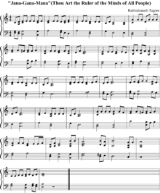
Jana Gana Mana

Encyclopedia
Jana Gana Mana is the national anthem
of India
. Written in highly Sanskrit
ized (Tatsama
) Bengali
, it is the first of five stanzas of a Brahmo
hymn
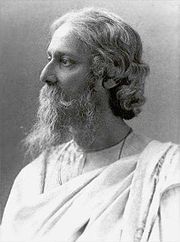
composed and scored by Nobel laureate
Rabindranath Tagore
. It was first sung at the Calcutta Session of the Indian National Congress
on 27 December 1911. Jana Gana Mana was officially adopted by the Constituent Assembly as the Indian national anthem on January 24, 1950.
A formal rendition of the national anthem takes fifty-two seconds. A shortened version consisting of the first and last lines (and taking about 20 seconds to play) is also staged occasionally. Tagore wrote down the English translation of the song and along with Margaret Cousins (an expert in European music and wife of Irish poet James Cousins
), set down the notation which is followed till this day.
It is of interest that another poem by Tagore (Amar Shonar Bangla
) is the national anthem of Bangladesh
.
called Sadhu bhasa
). As quasi-Sanskrit text, it is acceptable in many modern Indic languages, but the pronunciation
varies considerably across India. This is primarily because most Indic languages are abugida
s in that certain unmarked consonants are assumed to have an inherent vowel, but conventions for this differ among the languages of India
. The transcription
below reflects the Bengali pronunciation, in both the Bengali script
and romanization.
 The following translation, attributed to Tagore, is provided by the Government of India's national portal:
This English translation by Tagore is also famous as and continues further to four more stanzas.
, a town located in the Chittoor district
of Andhra Pradesh
state, India
.
Though the Bengali song had been written in 1911, it was largely unknown except to the readers of the Brahmo Samaj journal, Tatva Bodha Prakasika, of which Tagore was the editor.
During 1919, Tagore accepted an invitation from friend and controversial Irish poet James H. Cousins to spend a few days at the Besant Theosophical College
, of which Cousins was the principal. On the evening of February 28,1919 he joined a gathering of students and upon Cousins' request, sang the Jana Gana Mana in Bengali. The college authorities, greatly impressed by the lofty ideals of the song and the praise to God, selected it as their prayer song. In the days that followed, enchanted by the dreamy hills of Madanapalle, Tagore wrote down the English translation of the song and along with Cousins' wife, Margaret (an expert in Western music), set down the notation which is followed till this day. The song was carried beyond the borders of India by the college students and became The Morning Song of India and subsequently the national anthem.
Today, in the library of Besant Theosophical College in Madanapalle
, the framed original English translation of Jana gana Mana, titled as The Morning Song of India in Tagore
's handwriting is displayed.
of George V
, and is considered by some to be in praise of King George V and not God. Tagore however translated Jana Gana Mana in English as the Morning Song of India, addressing God and the motherland in it. For a more detailed discussion on the controversy, see Jana Gana Mana (the complete song)
.
In July 1985 in the state of Kerala
, some of the Jehovah's Witnesses
' children were expelled from school
under the instructions of Deputy Inspector of Schools for having refused to sing the national anthem, Jana Gana Mana. A parent, V. J. Emmanuel, appealed to the Supreme Court of India
for legal remedy. On August 11, 1986, the Supreme Court overruled the Kerala High Court
, and directed the respondent authorities to re-admit the children into the school. The decision went on to add: "Our tradition teaches tolerance
, our philosophy
preaches tolerance, our Constitution
practices tolerance, let us not dilute it".
A controversy swirls around the claim by Captain Ram Singh Thakur
, an associate of Netaji Subhas Chandra Bose, that he, and not Rabindranath Tagore
, wrote the score for the national anthem on Netaji's behest.
An advertisement released in Calcutta newspapers by the Gorkha Hill Council to mark the Netaji Subhas Chandra Bose centenary on January 23, 1997 plunged him into controversy.
The advertisement hailed him as the Gorkha who set the national anthem to music, following sharp reactions that such a claim was never made before. Capt. Ram Singh Thakur
intended to write a letter to President Shankar Dayal Sharma
claiming that his contribution in composing the score of the national anthem is being refuted just because he is a Gorkha
.
Netaji's nephew, Dr Sisir Bose, said that Captain Ram Singh Thakur
had composed the band-score of a Hindi song, Subh Sukh Chain similar to the national anthem, but not identical. Tagore
is widely believed to have himself set the lyrics of Jana Gana Mana to music as early as 1919, like he had done to Amar Shonar Bangla
, now the National Anthem of Bangladesh
, Ekla Cholo Re, another favorite song of Netaji Subhas Chandra Bose, and his numerous other musical compositions, famous as Rabindra Sangeet
.
The credit to Tagore
for the music of Jana Gana Mana is also upheld by the Government of India..
National anthem
A national anthem is a generally patriotic musical composition that evokes and eulogizes the history, traditions and struggles of its people, recognized either by a nation's government as the official national song, or by convention through use by the people.- History :Anthems rose to prominence...
of India
India
India , officially the Republic of India , is a country in South Asia. It is the seventh-largest country by geographical area, the second-most populous country with over 1.2 billion people, and the most populous democracy in the world...
. Written in highly Sanskrit
Sanskrit
Sanskrit , is a historical Indo-Aryan language and the primary liturgical language of Hinduism, Jainism and Buddhism.Buddhism: besides Pali, see Buddhist Hybrid Sanskrit Today, it is listed as one of the 22 scheduled languages of India and is an official language of the state of Uttarakhand...
ized (Tatsama
Tatsama
Tatsama are Sanskrit loanwords in modern Indic languages like Bengali, Marathi, Hindi, Gujarati, Sinhala and Central Dravidian language Telugu. They belong to a higher and more erudite register than common words. That register can be compared to the use of words of Greek origin in English Tatsama...
) Bengali
Bengali language
Bengali or Bangla is an eastern Indo-Aryan language. It is native to the region of eastern South Asia known as Bengal, which comprises present day Bangladesh, the Indian state of West Bengal, and parts of the Indian states of Tripura and Assam. It is written with the Bengali script...
, it is the first of five stanzas of a Brahmo
Brahmo
A Brahmo is either an adherent of Brahmoism to the exclusion of all other religions, or a person with at least one Brahmo parent or guardian and who has never denied his faith...
hymn
Jana Gana Mana (the complete song)
Jana Gana Mana is a five-stanza Brahmo hymn composed and scored in a highly Sanskritized Bengali by Nobel laureate Rabindranath Tagore. The first stanza of the song has been adopted as the National Anthem of India.-Lyrics of all 5 stanzas:...
composed and scored by Nobel laureate
Nobel Prize in Literature
Since 1901, the Nobel Prize in Literature has been awarded annually to an author from any country who has, in the words from the will of Alfred Nobel, produced "in the field of literature the most outstanding work in an ideal direction"...
Rabindranath Tagore
Rabindranath Tagore
Rabindranath Tagore , sobriquet Gurudev, was a Bengali polymath who reshaped his region's literature and music. Author of Gitanjali and its "profoundly sensitive, fresh and beautiful verse", he became the first non-European Nobel laureate by earning the 1913 Prize in Literature...
. It was first sung at the Calcutta Session of the Indian National Congress
Indian National Congress
The Indian National Congress is one of the two major political parties in India, the other being the Bharatiya Janata Party. It is the largest and one of the oldest democratic political parties in the world. The party's modern liberal platform is largely considered center-left in the Indian...
on 27 December 1911. Jana Gana Mana was officially adopted by the Constituent Assembly as the Indian national anthem on January 24, 1950.
A formal rendition of the national anthem takes fifty-two seconds. A shortened version consisting of the first and last lines (and taking about 20 seconds to play) is also staged occasionally. Tagore wrote down the English translation of the song and along with Margaret Cousins (an expert in European music and wife of Irish poet James Cousins
James Cousins
James Henry Cousins was an Irish writer, playwright, actor, critic, editor, teacher and poet. He used several pseudonyms including Mac Oisín and the Hindu name Jayaram....
), set down the notation which is followed till this day.
It is of interest that another poem by Tagore (Amar Shonar Bangla
Amar Shonar Bangla
Amar Shonar Bangla is a 1905 song written and composed by the Bengali poet Rabindranath Tagore , the first ten lines of which were adopted in 1972 as the Bangladeshi national anthem...
) is the national anthem of Bangladesh
Amar Shonar Bangla
Amar Shonar Bangla is a 1905 song written and composed by the Bengali poet Rabindranath Tagore , the first ten lines of which were adopted in 1972 as the Bangladeshi national anthem...
.
Lyrics
The text, though Bengali, is highly sanskritized (written in a literary registerRegister (sociolinguistics)
In linguistics, a register is a variety of a language used for a particular purpose or in a particular social setting. For example, when speaking in a formal setting an English speaker may be more likely to adhere more closely to prescribed grammar, pronounce words ending in -ing with a velar nasal...
called Sadhu bhasa
Sadhu bhasa
Shadhu-Bhasha is a literary variation of Bengali language. It remained as a form only to be used in written form unlike the Cholito-bhasa or the colloquial form.-History:...
). As quasi-Sanskrit text, it is acceptable in many modern Indic languages, but the pronunciation
Pronunciation
Pronunciation refers to the way a word or a language is spoken, or the manner in which someone utters a word. If one is said to have "correct pronunciation", then it refers to both within a particular dialect....
varies considerably across India. This is primarily because most Indic languages are abugida
Abugida
An abugida , also called an alphasyllabary, is a segmental writing system in which consonant–vowel sequences are written as a unit: each unit is based on a consonant letter, and vowel notation is obligatory but secondary...
s in that certain unmarked consonants are assumed to have an inherent vowel, but conventions for this differ among the languages of India
Languages of India
The languages of India belong to several language families, the major ones being the Indo-European languages—Indo-Aryan and the Dravidian languages...
. The transcription
Transcription (linguistics)
Transcription in the linguistic sense is the systematic representation of language in written form. The source can either be utterances or preexisting text in another writing system, although some linguists only consider the former as transcription.Transcription should not be confused with...
below reflects the Bengali pronunciation, in both the Bengali script
Bengali script
The Bengali alphabet is the writing system for the Bengali language. The script with variations is used for Assamese and is basis for Meitei, Bishnupriya Manipuri, Kokborok, Garo and Mundari alphabets. All these languages are spoken in the eastern region of South Asia. Historically, the script has...
and romanization.
Translation into English
This English translation by Tagore is also famous as and continues further to four more stanzas.
Musical Composition and English Translation
Rabindranath Tagore translated Jana Gana Mana from Bengali to English and also set it to music in MadanapalleMadanapalle
Madanapalle , is a town and a Municipality located in the Chittoor district of Andhra Pradesh state, India - population 107,512 . Legend has it that the name of the town was originally " Maryaada raamanna puram" which has over time, changed into " Madanapalle".It is one of the biggest Revenue...
, a town located in the Chittoor district
Chittoor district
Chittoor District , also known as Chittur, is a district of India's Andhra Pradesh state. The district headquarters is Chittoor City. The district has a population of 4,170,468 according to 2011 census of India. Chittoor district is famous for the Tirupati, Kanipakam and Sri Kalahasti temples...
of Andhra Pradesh
Andhra Pradesh
Andhra Pradesh , is one of the 28 states of India, situated on the southeastern coast of India. It is India's fourth largest state by area and fifth largest by population. Its capital and largest city by population is Hyderabad.The total GDP of Andhra Pradesh is $100 billion and is ranked third...
state, India
India
India , officially the Republic of India , is a country in South Asia. It is the seventh-largest country by geographical area, the second-most populous country with over 1.2 billion people, and the most populous democracy in the world...
.
Though the Bengali song had been written in 1911, it was largely unknown except to the readers of the Brahmo Samaj journal, Tatva Bodha Prakasika, of which Tagore was the editor.
During 1919, Tagore accepted an invitation from friend and controversial Irish poet James H. Cousins to spend a few days at the Besant Theosophical College
Besant Theosophical College
Besant Theosophical College is one of the oldest colleges in the Rayalaseema Region of Andhra Pradesh. It was established much before Sri Venkateswara University was established. The college started on 19 July 1915. Initially it was affiliated to Madras University. After that, it got disassociated...
, of which Cousins was the principal. On the evening of February 28,1919 he joined a gathering of students and upon Cousins' request, sang the Jana Gana Mana in Bengali. The college authorities, greatly impressed by the lofty ideals of the song and the praise to God, selected it as their prayer song. In the days that followed, enchanted by the dreamy hills of Madanapalle, Tagore wrote down the English translation of the song and along with Cousins' wife, Margaret (an expert in Western music), set down the notation which is followed till this day. The song was carried beyond the borders of India by the college students and became The Morning Song of India and subsequently the national anthem.
Today, in the library of Besant Theosophical College in Madanapalle
Madanapalle
Madanapalle , is a town and a Municipality located in the Chittoor district of Andhra Pradesh state, India - population 107,512 . Legend has it that the name of the town was originally " Maryaada raamanna puram" which has over time, changed into " Madanapalle".It is one of the biggest Revenue...
, the framed original English translation of Jana gana Mana, titled as The Morning Song of India in Tagore
Tagore
Tagore is the name of a prominent Bengali family of intellectuals, writers and artists, generally known as the Tagore family.People - Jorasanko branch of the Tagore family...
's handwriting is displayed.
Code of conduct
The National Anthem of India is played or sung on various occasions. Instructions have been issued from time to time about the correct versions of the Anthem, the occasions on which these are to be played or sung, and about the need for paying respect to the anthem by observance of proper decorum on such occasions. The substance of these instructions has been embodied in the information sheet issued by the government of India for general information and guidance.Controversies
The poem was composed in December 1911, precisely at the time of the Coronation DurbarDelhi Durbar
The Delhi Durbar , meaning "Court of Delhi", was a mass assembly at Coronation Park, Delhi, India, to mark the coronation of a King and Queen of the United Kingdom. Also known as the Imperial Durbar, it was held three times, in 1877, 1903, and 1911, at the height of the British Empire. The 1911...
of George V
George V of the United Kingdom
George V was King of the United Kingdom and the British Dominions, and Emperor of India, from 6 May 1910 through the First World War until his death in 1936....
, and is considered by some to be in praise of King George V and not God. Tagore however translated Jana Gana Mana in English as the Morning Song of India, addressing God and the motherland in it. For a more detailed discussion on the controversy, see Jana Gana Mana (the complete song)
Jana Gana Mana (the complete song)
Jana Gana Mana is a five-stanza Brahmo hymn composed and scored in a highly Sanskritized Bengali by Nobel laureate Rabindranath Tagore. The first stanza of the song has been adopted as the National Anthem of India.-Lyrics of all 5 stanzas:...
.
In July 1985 in the state of Kerala
Kerala
or Keralam is an Indian state located on the Malabar coast of south-west India. It was created on 1 November 1956 by the States Reorganisation Act by combining various Malayalam speaking regions....
, some of the Jehovah's Witnesses
Jehovah's Witnesses
Jehovah's Witnesses is a millenarian restorationist Christian denomination with nontrinitarian beliefs distinct from mainstream Christianity. The religion reports worldwide membership of over 7 million adherents involved in evangelism, convention attendance of over 12 million, and annual...
' children were expelled from school
School
A school is an institution designed for the teaching of students under the direction of teachers. Most countries have systems of formal education, which is commonly compulsory. In these systems, students progress through a series of schools...
under the instructions of Deputy Inspector of Schools for having refused to sing the national anthem, Jana Gana Mana. A parent, V. J. Emmanuel, appealed to the Supreme Court of India
Supreme Court of India
The Supreme Court of India is the highest judicial forum and final court of appeal as established by Part V, Chapter IV of the Constitution of India...
for legal remedy. On August 11, 1986, the Supreme Court overruled the Kerala High Court
Kerala High Court
High Court of Kerala is the highest court in the Indian state of Kerala and in the Union Territory of Lakshadweep. The High Court of Kerala is headquartered at Kochi...
, and directed the respondent authorities to re-admit the children into the school. The decision went on to add: "Our tradition teaches tolerance
Tolerance
Tolerance or toleration is the practice of permitting a thing of which one disapproves, such as social, ethnic, sexual, or religious practices.Tolerance, tolerant, or toleration may also refer to:...
, our philosophy
Philosophy
Philosophy is the study of general and fundamental problems, such as those connected with existence, knowledge, values, reason, mind, and language. Philosophy is distinguished from other ways of addressing such problems by its critical, generally systematic approach and its reliance on rational...
preaches tolerance, our Constitution
Constitution of India
The Constitution of India is the supreme law of India. It lays down the framework defining fundamental political principles, establishes the structure, procedures, powers, and duties of government institutions, and sets out fundamental rights, directive principles, and the duties of citizens...
practices tolerance, let us not dilute it".
A controversy swirls around the claim by Captain Ram Singh Thakur
Ram Singh Thakur
Captain Ram Singh Thakur was an Indian freedom fighter, musician and the composer of the music of the current band-version of the Indian National Anthem, Jana Gana...
, an associate of Netaji Subhas Chandra Bose, that he, and not Rabindranath Tagore
Rabindranath Tagore
Rabindranath Tagore , sobriquet Gurudev, was a Bengali polymath who reshaped his region's literature and music. Author of Gitanjali and its "profoundly sensitive, fresh and beautiful verse", he became the first non-European Nobel laureate by earning the 1913 Prize in Literature...
, wrote the score for the national anthem on Netaji's behest.
An advertisement released in Calcutta newspapers by the Gorkha Hill Council to mark the Netaji Subhas Chandra Bose centenary on January 23, 1997 plunged him into controversy.
The advertisement hailed him as the Gorkha who set the national anthem to music, following sharp reactions that such a claim was never made before. Capt. Ram Singh Thakur
Ram Singh Thakur
Captain Ram Singh Thakur was an Indian freedom fighter, musician and the composer of the music of the current band-version of the Indian National Anthem, Jana Gana...
intended to write a letter to President Shankar Dayal Sharma
Shankar Dayal Sharma
Shankar Dayal Sharma was the ninth President of India serving from 1992 to 1997. Prior to his presidency, Dr Sharma had been the eighth Vice President of India, serving under President Ramaswamy Venkataraman...
claiming that his contribution in composing the score of the national anthem is being refuted just because he is a Gorkha
Indian Gorkha
Indian Gorkha is a term used to describe the Nepali/Gorkhali-speaking citizens of India. This term tries to make a distinction between the citizens of Nepal and the Indian citizens of Gorkha ethnic group....
.
Netaji's nephew, Dr Sisir Bose, said that Captain Ram Singh Thakur
Ram Singh Thakur
Captain Ram Singh Thakur was an Indian freedom fighter, musician and the composer of the music of the current band-version of the Indian National Anthem, Jana Gana...
had composed the band-score of a Hindi song, Subh Sukh Chain similar to the national anthem, but not identical. Tagore
Tagore
Tagore is the name of a prominent Bengali family of intellectuals, writers and artists, generally known as the Tagore family.People - Jorasanko branch of the Tagore family...
is widely believed to have himself set the lyrics of Jana Gana Mana to music as early as 1919, like he had done to Amar Shonar Bangla
Amar Shonar Bangla
Amar Shonar Bangla is a 1905 song written and composed by the Bengali poet Rabindranath Tagore , the first ten lines of which were adopted in 1972 as the Bangladeshi national anthem...
, now the National Anthem of Bangladesh
Bangladesh
Bangladesh , officially the People's Republic of Bangladesh is a sovereign state located in South Asia. It is bordered by India on all sides except for a small border with Burma to the far southeast and by the Bay of Bengal to the south...
, Ekla Cholo Re, another favorite song of Netaji Subhas Chandra Bose, and his numerous other musical compositions, famous as Rabindra Sangeet
Rabindra Sangeet
Rabindra Sangeet , also known as Tagore Songs in English, is a form of music composed by Rabindranath Tagore who added a new dimension to the musical concept of India in general and Bengal in specific....
.
The credit to Tagore
Tagore
Tagore is the name of a prominent Bengali family of intellectuals, writers and artists, generally known as the Tagore family.People - Jorasanko branch of the Tagore family...
for the music of Jana Gana Mana is also upheld by the Government of India..
See also
- Jana Gana Mana (the complete song)Jana Gana Mana (the complete song)Jana Gana Mana is a five-stanza Brahmo hymn composed and scored in a highly Sanskritized Bengali by Nobel laureate Rabindranath Tagore. The first stanza of the song has been adopted as the National Anthem of India.-Lyrics of all 5 stanzas:...
for lyrics of all 5 stanzas and controversies in detailEnglish Interpretation of Full Jana Gana Mana in TagoreTagoreTagore is the name of a prominent Bengali family of intellectuals, writers and artists, generally known as the Tagore family.People - Jorasanko branch of the Tagore family...
's handwriting - Jana Gana Mana VideoJana Gana Mana VideoThe Jana Gana Mana - Indian National Anthem was a historic video released January 26, 2000 to mark the 50th year of the Indian Republic. It has the distinction of being released by the then President of India, in the Central Hall of the Indian Parliament...
- Vande MataramVande MataramVande Mataram is a poem from the famed novel Anandamath which was written by Bankim Chandra Chattopadhyay in 1882. It was written in Bengali and Sanskrit....
-The National Song of India by Bankim Chandra ChattopadhyayBankim Chandra ChattopadhyayBankim Chandra Chattopadhyay was a famous Bengali writer, poet and journalist. He was the composer of India’s national song Vande Mataram, originally a Bengali and Sanskrit stotra personifying India as a mother goddess and inspiring the activists during the Indian Freedom Movement... - Subh Sukh Chain
- Indian National PledgeIndian National PledgeThe Indian National Pledge is an oath of allegiance to the Republic of India. It is commonly recited by Indians in unison at public events, especially in schools, and during the Independence Day and Republic Day Celebrations.-Origin:...
by Swami VivekanandaSwami VivekanandaSwami Vivekananda , born Narendranath Dutta , was the chief disciple of the 19th century mystic Ramakrishna Paramahansa and the founder of the Ramakrishna Math and the Ramakrishna Mission... - An earlier poem by Tagore (Amar Shonar BanglaAmar Shonar BanglaAmar Shonar Bangla is a 1905 song written and composed by the Bengali poet Rabindranath Tagore , the first ten lines of which were adopted in 1972 as the Bangladeshi national anthem...
) was later selected as the national anthem of Bangladesh. - Ekla Cholo Re by Rabindranath TagoreRabindranath TagoreRabindranath Tagore , sobriquet Gurudev, was a Bengali polymath who reshaped his region's literature and music. Author of Gitanjali and its "profoundly sensitive, fresh and beautiful verse", he became the first non-European Nobel laureate by earning the 1913 Prize in Literature...
External links
- My India My Pride - Know India. National Portal of India. Government of India. (Also contains the official version of the Indian National Anthem in audio format as well as in video format
- Indian Anthem in MIDI Format.
- Streaming audio, lyrics and information for Jana Gana Mana.
- A rendition of Indian Anthem in MP3 format from the Indian embassy in Lisbon, Portugal.
- Genesis of Jana Gana Mana
- Jana Gana Mana (India's National Anthem) - An Inferential Linguistic Analysis from The Hamilton Institute
- Jana Gana Mana (India's Complete National Anthem) 2011 along with The Complete English Translation