


Chaitanya Mahaprabhu

Encyclopedia
Chaitanya Mahaprabhu ' onMouseout='HidePop("28148")' href="/topics/Oriya_language">Oriya
: ଚୈତନ୍ୟ ମହାପ୍ରଭୁ) (1486–1534) was a Vaishnava saint and social reformer in eastern India
(specifically present-day Bangladesh
and states of West Bengal
, Bihar
, Jharkhand
, Manipur
, Assam
, and Orissa
of India
) in the 16th century, believed by followers of Gaudiya Vaishnavism
to be the full incarnation of Lord Krishna
. Sri Krishna Chaitanya was a notable proponent for the Vaishnava school of Bhakti yoga
(meaning loving devotion to Krishna
/God
) based on the philosophy of the Bhagavata Purana
and Bhagavad Gita
. Specifically he worshipped the forms of Radha
and Krishna
and popularised the chanting of the Hare Krishna maha mantra
and has composed Siksastaka
m in Sanskrit
. His line of followers, known as Gaudiya Vaishnavas
, revere him as an Avatar
of Krishna in the mood of Radharani who was prophesised to appear in the later verses of the Bhagavata Purana.
He was also sometimes referred to by the names Gaura (Sanskrit
for golden one) due to his light skin complexion, and Nimai due to his being born underneath a Neem
tree. There are numerous biographies available from the time giving details of Chaitanya's life, the most prominent ones being the Chaitanya Charitamrita
of Krishnadasa Kaviraja
Goswami and the earlier Chaitanya Bhagavata
of Vrindavana Dasa (both originally written in Bangla but now widely available in English and other languages) and the Chaitanya Mangala
, written by Lochana Dasa.
in Nadia
, West Bengal
.Chaitanya's ancestry is a contentious issue between the people of Orissa and West Bengal with Shree Chaitanya having family roots in Jajpur, Orissa
, from where his grandfather, Madhukar Mishra had emigrated to nearby Bengal..
In his youth, Chaitanya Mahäprabhu was primarily known as an erudite scholar, whose learning and skills in argumentation in his locality were second to none. A number of stories also exist telling of Chaitanya's apparent attraction to the chanting
and singing
of Krishna's names from a very young age, but largely this was perceived as being secondary to his interest in acquiring knowledge and studying Sanskrit
. When traveling to Gaya
to perform the shraddha
ceremony for his departed father Chaitanya met his guru
, the ascetic Ishvara Puri
, from whom he received initiation with the Gopala Krishna mantra. This meeting was to mark a significant change in Mahäprabhu's outlook and upon his return to Bengal the local Vaishnavas, headed by Advaita Ächärya
, were stunned at his external sudden 'change of heart' (from 'scholar' to 'devotee') and soon Chaitanya became the eminent leader of their Vaishnava group within Nadia.
After leaving Bengal and receiving entrance into the sannyasa
order by Keshava Bharati
, Chaitanya journeyed throughout the length and breadth of India
for several years, chanting the divine Names of Krishna constantly. He spent the last 24 years of his life in Puri, Orissa
, the great temple city of Jagannäth
. The Suryavanshi Hindu emperor of Orissa, Gajapati Maharaja Prataparudra Dev, regarded the Lord as Krishna's incarnation and was an enthusiastic patron and devotee of Chaitanya's sankeertan party. It was during these years that Lord Chaitanya is believed by His followers to have sank deep into various Divine-Love (samādhi
) and performed pastimes of divine
ecstasy
(bhakti
).
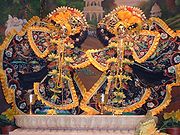
Image:Panca-tattva Altar.jpg|thumb|This is an interactive (clickable) image-map. Click on lotus feet. Sri Krishna
Chaitanya (centre), Sri Nityananda
Prabhu (wearing blue), Sri Advaita Acharya
(with beard), Sri Gadadhara Pandit (purple dhoti), Sri Srivas
Pandit (with shaven head and saffron dhoti). Pancha-Tattva deities: Chaitanya Mahaprabhu
, Nityananda
, Advaita Acharya
, Gadadhara and Srivasa
, installed on a Vaishnava altar. |300 px|alt=Click on lotus feet
rect 248 267 338 353 Chaitanya
rect 156 265 237 347 Nityananda
rect 66 290 154 370 Advaita Acharya
rect 340 262 437 347 Gadadhara
rect 455 267 560 350 Srivasa Thakura
According to beliefs of orthodox followers Caitanya Mahaprabhu united in himself two aspects: ecstatic devotee of Krishna and Krishna himself in inseparable union with Radha
. According to the hagiographies of 16th c. authors he has exhibited his Universal Form identical to that of Krishna
on a number of occasions, notably to Advaita Ācārya and Nityānanda Prabhu.
Chaitanya's epistemological, theological and ontological teachings are summarized as ten roots or maxims dasa mula:
 Despite having been initiated
in the Madhvacharya
tradition and taking sannyasa from Shankara
's tradition, Chaitanya's philosophy is sometimes regarded as a tradition of his own within the Vaishnava framework
- having some marked differences with the practices and the theology
of other followers of Madhvacharya. He took Mantra Upadesa from (Isvara Puri
) and Sanyasa Diksha from Kesava Bharathi. Both these gurus are of Sankarite order of Advaita.
Chaitanya Mahaprabhu is not known to have written anything himself except for a series of verses known as the Siksastaka
, or "eight verses of instruction", which he had spoken, and were recorded by one of his close colleagues. The eight verses created by Mahaprabhu are considered to contain the complete philosophy of Gaudiya Vaishnavism in condensed form. Chaitanya requested a select few among his followers (who later came to be known as the Six Gosvamis of Vrindavan) to systematically present the theology of bhakti he had taught to them in their own writings. The six saints and theologians were Rupa Goswami
, Sanatana Goswami
, Gopala Bhatta Goswami
, Raghunatha Bhatta Goswami
, Raghunatha dasa Goswami
and Jiva Goswami
, a nephew of brothers Rupa and Sanatana. These individuals were responsible for systematizing Gaudiya Vaishnava theology.
Narottama Dasa Thakur
, Srinivasa Acarya and Syamananda Pandit were among the stalwarts of the second generation of Gaudiya Vaishnavism. Having studied under Jiva Goswami, they were instrumental in propagating the teachings of the Goswamis throughout Bengal, Orissa and other regions of Eastern India. Many among their associates, such as Ramacandra Kaviraja and Ganga Narayan Chakravarti, were also eminent teachers in their own right.
The festival of Kheturi, presided over by Jahnava Thakurani, the wife of Nityananda
Prabhu, was the first time the leaders of the various branches of Chaitanya's followers assembled together. Through such festivals, members of the loosely organized tradition became acquainted with other branches along with their respective theological and practical nuances. Around these times, the disciples and descendants of Nityananda
and Advaita Acharya
, headed by Virabhadra and Krishna Mishra respectively, started their family lineages (vamsa) to maintain the tradition. The vamsa descending from Nityananda through his son Virabhadra forms the most prominent branch of the modern Gaudiya tradition, though descendants of Advaita, along with the descendants of many other associates of Chaitanya, maintain their following especially in the rural areas of Bengal. Gopala Guru Goswami, a young associate of Chaitanya and a follower of Vakresvara Pandit, founded another branch based in Orissa. The writings of Gopala, along with those of his disciple Dhyanacandra Goswami, have had a substantial influence on the methods of internal worship in the tradition.
From the very beginning of Chaitanya's bhakti
movement in Bengal, Haridasa Thakur
and others Muslim
or Hindu
by birth were the participants. This openness received a boost from Bhaktivinoda Thakura's broad-minded vision in the late 19th century and was institutionalized by Bhaktisiddhanta Sarasvati in his Gaudiya Matha in the 20th century. In the 20th century the teachings of Chaitanya were brought to the West by A.C. Bhaktivedanta Swami Prabhupada, a representative of Bhaktisiddhanta Sarasvati Thakura
branch of Chaitanya's tradition. Bhaktivedanta Swami founded his movement known as The International Society for Krishna Consciousness (ISKCON) to spread Chaitanya's teachings throughout the world. Saraswata gurus and acharyas, members of the Goswami lineages and several other Hindu sects which revere Chaitanya Mahaprabhu, including devotees from the major Vaishnava holy places in Mathura District, West Bengal and Orissa, also established temples dedicated to Krishna and Chaitanya outside India in the closing decades of the 20th century. In the 21st century Vaishnava bhakti is now also being studied through the academic medium of Krishnology in a number of academic institutions.
, Chaitanya's cultural legacy in Bengal
and Orissa
remains deep, with many residents performing daily worship to him as an avatar of Krishna. Some attribute to him a Renaissance in Bengal, different from the more well known 19th century Bengal Renaissance
. Salimullah Khan, a noted linguist, maintains, "Sixteenth century is the time of Chaitanya Dev, and it is the beginning of Modernism in Bengal. The concept of 'humanity' that came into fruition is contemporaneous with that of Europe
".
Oriya language
Oriya , officially Odia from November, 2011, is an Indian language, belonging to the Indo-Aryan branch of the Indo-European language family. It is mainly spoken in the Indian states of Orissa and West Bengal...
: ଚୈତନ୍ୟ ମହାପ୍ରଭୁ) (1486–1534) was a Vaishnava saint and social reformer in eastern India
India
India , officially the Republic of India , is a country in South Asia. It is the seventh-largest country by geographical area, the second-most populous country with over 1.2 billion people, and the most populous democracy in the world...
(specifically present-day Bangladesh
Bangladesh
Bangladesh , officially the People's Republic of Bangladesh is a sovereign state located in South Asia. It is bordered by India on all sides except for a small border with Burma to the far southeast and by the Bay of Bengal to the south...
and states of West Bengal
West Bengal
West Bengal is a state in the eastern region of India and is the nation's fourth-most populous. It is also the seventh-most populous sub-national entity in the world, with over 91 million inhabitants. A major agricultural producer, West Bengal is the sixth-largest contributor to India's GDP...
, Bihar
Bihar
Bihar is a state in eastern India. It is the 12th largest state in terms of geographical size at and 3rd largest by population. Almost 58% of Biharis are below the age of 25, which is the highest proportion in India....
, Jharkhand
Jharkhand
Jharkhand is a state in eastern India. It was carved out of the southern part of Bihar on 15 November 2000. Jharkhand shares its border with the states of Bihar to the north, Uttar Pradesh and Chhattisgarh to the west, Orissa to the south, and West Bengal to the east...
, Manipur
Manipur
Manipur is a state in northeastern India, with the city of Imphal as its capital. Manipur is bounded by the Indian states of Nagaland to the north, Mizoram to the south and Assam to the west; it also borders Burma to the east. It covers an area of...
, Assam
Assam
Assam , also, rarely, Assam Valley and formerly the Assam Province , is a northeastern state of India and is one of the most culturally and geographically distinct regions of the country...
, and Orissa
Orissa
Orissa , officially Odisha since Nov 2011, is a state of India, located on the east coast of India, by the Bay of Bengal. It is the modern name of the ancient nation of Kalinga, which was invaded by the Maurya Emperor Ashoka in 261 BC. The modern state of Orissa was established on 1 April...
of India
India
India , officially the Republic of India , is a country in South Asia. It is the seventh-largest country by geographical area, the second-most populous country with over 1.2 billion people, and the most populous democracy in the world...
) in the 16th century, believed by followers of Gaudiya Vaishnavism
Gaudiya Vaishnavism
Gaudiya Vaishnavism is a Vaishnava religious movement founded by Chaitanya Mahaprabhu in India in the 16th century. "Gaudiya" refers to the Gauḍa region with Vaishnavism meaning "the worship of Vishnu"...
to be the full incarnation of Lord Krishna
Krishna
Krishna is a central figure of Hinduism and is traditionally attributed the authorship of the Bhagavad Gita. He is the supreme Being and considered in some monotheistic traditions as an Avatar of Vishnu...
. Sri Krishna Chaitanya was a notable proponent for the Vaishnava school of Bhakti yoga
Bhakti yoga
Bhakti yoga is one of the types of yoga mentioned in Hindu philosophies which denotes the spiritual practice of fostering loving devotion to a personal form of God....
(meaning loving devotion to Krishna
Krishna
Krishna is a central figure of Hinduism and is traditionally attributed the authorship of the Bhagavad Gita. He is the supreme Being and considered in some monotheistic traditions as an Avatar of Vishnu...
/God
God
God is the English name given to a singular being in theistic and deistic religions who is either the sole deity in monotheism, or a single deity in polytheism....
) based on the philosophy of the Bhagavata Purana
Bhagavata purana
The Bhāgavata Purāṇa is one of the "Maha" Puranic texts of Hindu literature, with its primary focus on bhakti to the incarnations of Vishnu, particularly Krishna...
and Bhagavad Gita
Bhagavad Gita
The ' , also more simply known as Gita, is a 700-verse Hindu scripture that is part of the ancient Sanskrit epic, the Mahabharata, but is frequently treated as a freestanding text, and in particular, as an Upanishad in its own right, one of the several books that constitute general Vedic tradition...
. Specifically he worshipped the forms of Radha
Radha
Radha , also called Radhika, Radharani and Radhikarani, is the childhood friend and lover of Krishna in the Bhagavata Purana, and the Gita Govinda of the Vaisnava traditions of Hinduism...
and Krishna
Krishna
Krishna is a central figure of Hinduism and is traditionally attributed the authorship of the Bhagavad Gita. He is the supreme Being and considered in some monotheistic traditions as an Avatar of Vishnu...
and popularised the chanting of the Hare Krishna maha mantra
Maha Mantra
Maha Mantra may refer to the following:*Any mantra thought to be particularly "great" or important*A common name for the Hare Krishna mantra in Bengali Vaishnavism*a name of the Aum Namah Shivaya mantra*the Mahamrityunjaya Mantra...
and has composed Siksastaka
Siksastaka
The Siksastaka is a Gaudiya Vaishnava Hindu prayer of eight verses composed in the Sanskrit language. They are believed to be the only verses left personally written by Chaitanya Mahaprabhu, with the majority of his philosophy being codyfied by his primary disciples, known as the Six Goswamis of...
m in Sanskrit
Sanskrit
Sanskrit , is a historical Indo-Aryan language and the primary liturgical language of Hinduism, Jainism and Buddhism.Buddhism: besides Pali, see Buddhist Hybrid Sanskrit Today, it is listed as one of the 22 scheduled languages of India and is an official language of the state of Uttarakhand...
. His line of followers, known as Gaudiya Vaishnavas
Gaudiya Vaishnavism
Gaudiya Vaishnavism is a Vaishnava religious movement founded by Chaitanya Mahaprabhu in India in the 16th century. "Gaudiya" refers to the Gauḍa region with Vaishnavism meaning "the worship of Vishnu"...
, revere him as an Avatar
Avatar
In Hinduism, an avatar is a deliberate descent of a deity to earth, or a descent of the Supreme Being and is mostly translated into English as "incarnation," but more accurately as "appearance" or "manifestation"....
of Krishna in the mood of Radharani who was prophesised to appear in the later verses of the Bhagavata Purana.
He was also sometimes referred to by the names Gaura (Sanskrit
Sanskrit
Sanskrit , is a historical Indo-Aryan language and the primary liturgical language of Hinduism, Jainism and Buddhism.Buddhism: besides Pali, see Buddhist Hybrid Sanskrit Today, it is listed as one of the 22 scheduled languages of India and is an official language of the state of Uttarakhand...
for golden one) due to his light skin complexion, and Nimai due to his being born underneath a Neem
Neem
Azadirachta indica is a tree in the mahogany family Meliaceae. It is one of two species in the genus Azadirachta, and is native to India growing in tropical and semi-tropical regions. Its fruits and seeds are the source of neem oil...
tree. There are numerous biographies available from the time giving details of Chaitanya's life, the most prominent ones being the Chaitanya Charitamrita
Chaitanya Charitamrita
The Chaitanya Charitamrita is one of the primary biographies detailing the life and teachings of Chaitanya Mahaprabhu , a Vaisnava saint and founder of the Gaudiya Vaishnava Sampradaya. It was written by Krishna Das Kaviraja , primarily in the Bengali language, but also including a great number of...
of Krishnadasa Kaviraja
Krishnadasa Kaviraja
Krishna Dasa Kaviraja Goswami was the author of the Chaitanya Charitamrita, a hagiography on the life of the mystic and saint Chaitanya Mahaprabhu , who is considered by the Gaudiya Vaishnava school of Hinduism to be an incarnation of Radha and Krishna combined.-Early life:There is scant...
Goswami and the earlier Chaitanya Bhagavata
Chaitanya Bhagavata
The Chaitanya Bhagavata is a hagiography of Chaitanya Mahaprabhu , the famous Vaishnava saint, written by Vrindavana Dasa Thakura . It was the first full-length work regarding Chaitanya Mahaprabhu written in Bengali language and documents his early life and role as the founder of the Gaudiya...
of Vrindavana Dasa (both originally written in Bangla but now widely available in English and other languages) and the Chaitanya Mangala
Chaitanya Mangala
The Chaitanya Mangala of Lochana Dasa is an important hagiographical work on the celebrated medieval saint, Chaitanya Mahaprabhu in Bengali. This work of Lochana Dasa or Lochananda Dasa is influenced by the Sanskrit Kadacha of Murari Gupta...
, written by Lochana Dasa.
Sri Chaitanya's life
According to the biography, Chaitanya Charitamrita, Nimäi appeared on the full moon night of February 18, 1486, at the time of a lunar eclipse. His parents named him 'Vishvambhar'. Sri Chaitanya was the second son of Jagannath Mishra and his wife Sachi Devi who lived in the town of NabadwipNabadwip
Nabadwip is a city and a municipality in Nadia district in the Indian state of West Bengal. Its name means "9 islands" in the Bengali language. The islands are named Antardwip , Simantadwip, Rudradwip, Madhyadwip, Godrumdwip, Ritudwip, Jahnudwip, Modadrumdwip, and Koladwip...
in Nadia
Nadia District
Nadia district is a district of the state of West Bengal, in the north east of India. It borders with Bangladesh to the east, North 24 Parganas and Hooghly districts to the south, Bardhaman district to the west, and Murshidabad district to the north....
, West Bengal
West Bengal
West Bengal is a state in the eastern region of India and is the nation's fourth-most populous. It is also the seventh-most populous sub-national entity in the world, with over 91 million inhabitants. A major agricultural producer, West Bengal is the sixth-largest contributor to India's GDP...
.Chaitanya's ancestry is a contentious issue between the people of Orissa and West Bengal with Shree Chaitanya having family roots in Jajpur, Orissa
Orissa
Orissa , officially Odisha since Nov 2011, is a state of India, located on the east coast of India, by the Bay of Bengal. It is the modern name of the ancient nation of Kalinga, which was invaded by the Maurya Emperor Ashoka in 261 BC. The modern state of Orissa was established on 1 April...
, from where his grandfather, Madhukar Mishra had emigrated to nearby Bengal..
In his youth, Chaitanya Mahäprabhu was primarily known as an erudite scholar, whose learning and skills in argumentation in his locality were second to none. A number of stories also exist telling of Chaitanya's apparent attraction to the chanting
Japa
Japa is a spiritual discipline involving the meditative repetition of a mantra or name of a divine power. The mantra or name may be spoken softly, enough for the practitioner to hear it, or it may be spoken purely within the recitor's mind...
and singing
Bhajan
A Bhajan is any type of Indian devotional song. It has no fixed form: it may be as simple as a mantra or kirtan or as sophisticated as the dhrupad or kriti with music based on classical ragas and talas. It is normally lyrical, expressing love for the Divine...
of Krishna's names from a very young age, but largely this was perceived as being secondary to his interest in acquiring knowledge and studying Sanskrit
Sanskrit
Sanskrit , is a historical Indo-Aryan language and the primary liturgical language of Hinduism, Jainism and Buddhism.Buddhism: besides Pali, see Buddhist Hybrid Sanskrit Today, it is listed as one of the 22 scheduled languages of India and is an official language of the state of Uttarakhand...
. When traveling to Gaya
Gaya, India
Gaya is the second largest city of Bihar, India, and it is also the headquarters of Gaya District.Gaya is 100 kilometers south of Patna, the capital city of Bihar. Situated on the banks of Falgu River , it is a place sanctified by both the Hindu and the Buddhist religions...
to perform the shraddha
Śrāddha
Śrāddha or Shraaddha is a Sanskrit word which literally means anything or any act that is performed with all sincerity and faith . In the Hindu religion, it is the ritual that one performs to pay homage to one’s 'ancestors' , especially to one’s dead parents...
ceremony for his departed father Chaitanya met his guru
Guru
A guru is one who is regarded as having great knowledge, wisdom, and authority in a certain area, and who uses it to guide others . Other forms of manifestation of this principle can include parents, school teachers, non-human objects and even one's own intellectual discipline, if the...
, the ascetic Ishvara Puri
Isvara Puri
Isvara Puri was a monk of the renunciate order in the Sankarite from Srigeri Saradha Pithan Isvara Puri was a monk of the renunciate order in the Sankarite from Srigeri Saradha Pithan Isvara Puri was a monk of the renunciate order in the Sankarite from Srigeri Saradha Pithan (follow the "puri" name...
, from whom he received initiation with the Gopala Krishna mantra. This meeting was to mark a significant change in Mahäprabhu's outlook and upon his return to Bengal the local Vaishnavas, headed by Advaita Ächärya
Advaita Acharya
Advaita Acharya , born Kamalaksha Bhattacharya, was a notable disciple and companion of the founder of the Gaudiya Vaishnava sect, Chaitanya Mahaprabhu, and guru of Haridasa Thakur...
, were stunned at his external sudden 'change of heart' (from 'scholar' to 'devotee') and soon Chaitanya became the eminent leader of their Vaishnava group within Nadia.
After leaving Bengal and receiving entrance into the sannyasa
Sannyasa
Sannyasa is the order of life of the renouncer within the Hindu scheme of āśramas, or life stages. It is considered the topmost and final stage of the ashram systems and is traditionally taken by men or women at or beyond the age of fifty years old or by young monks who wish to renounce worldly...
order by Keshava Bharati
Kesava Bharati
Sri Kesava Bharati was a member of the Sankarite renunciate order.He bestowed sannyasa on Chaitanya Mahaprabhu when the latter requested it.In the Sri-Gaura-Ganoddesa-dipika of Kavi-karnapura, Kesava Bharati is listed as the reincarnation of Sandipani Muni....
, Chaitanya journeyed throughout the length and breadth of India
India
India , officially the Republic of India , is a country in South Asia. It is the seventh-largest country by geographical area, the second-most populous country with over 1.2 billion people, and the most populous democracy in the world...
for several years, chanting the divine Names of Krishna constantly. He spent the last 24 years of his life in Puri, Orissa
Orissa
Orissa , officially Odisha since Nov 2011, is a state of India, located on the east coast of India, by the Bay of Bengal. It is the modern name of the ancient nation of Kalinga, which was invaded by the Maurya Emperor Ashoka in 261 BC. The modern state of Orissa was established on 1 April...
, the great temple city of Jagannäth
Jagannath
Jagannath is a transcendental non-anthropotheistic Hindu god worshiped primarily by the people of Indian state of Orissa, and, to a great extent, West Bengal...
. The Suryavanshi Hindu emperor of Orissa, Gajapati Maharaja Prataparudra Dev, regarded the Lord as Krishna's incarnation and was an enthusiastic patron and devotee of Chaitanya's sankeertan party. It was during these years that Lord Chaitanya is believed by His followers to have sank deep into various Divine-Love (samādhi
Samadhi
Samadhi in Hinduism, Buddhism,Jainism, Sikhism and yogic schools is a higher level of concentrated meditation, or dhyāna. In the yoga tradition, it is the eighth and final limb identified in the Yoga Sūtras of Patañjali....
) and performed pastimes of divine
Divinity
Divinity and divine are broadly applied but loosely defined terms, used variously within different faiths and belief systems — and even by different individuals within a given faith — to refer to some transcendent or transcendental power or deity, or its attributes or manifestations in...
ecstasy
Religious ecstasy
Religious ecstasy is an altered state of consciousness characterized by greatly reduced external awareness and expanded interior mental and spiritual awareness which is frequently accompanied by visions and emotional/intuitive euphoria...
(bhakti
Bhakti
In Hinduism Bhakti is religious devotion in the form of active involvement of a devotee in worship of the divine.Within monotheistic Hinduism, it is the love felt by the worshipper towards the personal God, a concept expressed in Hindu theology as Svayam Bhagavan.Bhakti can be used of either...
).
Identity
Image:Panca-tattva Altar.jpg|thumb|This is an interactive (clickable) image-map. Click on lotus feet. Sri Krishna
Krishna
Krishna is a central figure of Hinduism and is traditionally attributed the authorship of the Bhagavad Gita. He is the supreme Being and considered in some monotheistic traditions as an Avatar of Vishnu...
Chaitanya (centre), Sri Nityananda
Nityananda
Image:Panca-tattva Altar.jpg|thumb|This is interactive image-map. Click! on lotus feet. Sri Krishna Chaitanya , Sri Nityananda Prabhu , Sri Advaita Acharya , Sri Gadadhara Pandit , Sri Srivas Pandit...
Prabhu (wearing blue), Sri Advaita Acharya
Advaita Acharya
Advaita Acharya , born Kamalaksha Bhattacharya, was a notable disciple and companion of the founder of the Gaudiya Vaishnava sect, Chaitanya Mahaprabhu, and guru of Haridasa Thakur...
(with beard), Sri Gadadhara Pandit (purple dhoti), Sri Srivas
Srivasa Thakura
Image:Panca-tattva Altar.jpg|thumb|This is an interactive image-map. Click! on lotus feet. Sri Krishna Chaitanya , Sri Nityananda Prabhu , Sri Advaita Acharya , Sri Gadadhara Pandit , Sri Srivas Pandit...
Pandit (with shaven head and saffron dhoti). Pancha-Tattva deities: Chaitanya Mahaprabhu
Chaitanya Mahaprabhu
Chaitanya Mahaprabhu was a Vaishnava saint and social reformer in eastern India in the 16th century, believed by followers of Gaudiya Vaishnavism to be the full incarnation of Lord Krishna...
, Nityananda
Nityananda
Image:Panca-tattva Altar.jpg|thumb|This is interactive image-map. Click! on lotus feet. Sri Krishna Chaitanya , Sri Nityananda Prabhu , Sri Advaita Acharya , Sri Gadadhara Pandit , Sri Srivas Pandit...
, Advaita Acharya
Advaita Acharya
Advaita Acharya , born Kamalaksha Bhattacharya, was a notable disciple and companion of the founder of the Gaudiya Vaishnava sect, Chaitanya Mahaprabhu, and guru of Haridasa Thakur...
, Gadadhara and Srivasa
Srivasa Thakura
Image:Panca-tattva Altar.jpg|thumb|This is an interactive image-map. Click! on lotus feet. Sri Krishna Chaitanya , Sri Nityananda Prabhu , Sri Advaita Acharya , Sri Gadadhara Pandit , Sri Srivas Pandit...
, installed on a Vaishnava altar. |300 px|alt=Click on lotus feet
rect 248 267 338 353 Chaitanya
rect 156 265 237 347 Nityananda
Nityananda
Image:Panca-tattva Altar.jpg|thumb|This is interactive image-map. Click! on lotus feet. Sri Krishna Chaitanya , Sri Nityananda Prabhu , Sri Advaita Acharya , Sri Gadadhara Pandit , Sri Srivas Pandit...
rect 66 290 154 370 Advaita Acharya
Advaita Acharya
Advaita Acharya , born Kamalaksha Bhattacharya, was a notable disciple and companion of the founder of the Gaudiya Vaishnava sect, Chaitanya Mahaprabhu, and guru of Haridasa Thakur...
rect 340 262 437 347 Gadadhara
rect 455 267 560 350 Srivasa Thakura
Srivasa Thakura
Image:Panca-tattva Altar.jpg|thumb|This is an interactive image-map. Click! on lotus feet. Sri Krishna Chaitanya , Sri Nityananda Prabhu , Sri Advaita Acharya , Sri Gadadhara Pandit , Sri Srivas Pandit...
According to beliefs of orthodox followers Caitanya Mahaprabhu united in himself two aspects: ecstatic devotee of Krishna and Krishna himself in inseparable union with Radha
Radha
Radha , also called Radhika, Radharani and Radhikarani, is the childhood friend and lover of Krishna in the Bhagavata Purana, and the Gita Govinda of the Vaisnava traditions of Hinduism...
. According to the hagiographies of 16th c. authors he has exhibited his Universal Form identical to that of Krishna
Krishna
Krishna is a central figure of Hinduism and is traditionally attributed the authorship of the Bhagavad Gita. He is the supreme Being and considered in some monotheistic traditions as an Avatar of Vishnu...
on a number of occasions, notably to Advaita Ācārya and Nityānanda Prabhu.
Teachings
Chaitanya has left one written record in Sanskrit called Siksastakam.Chaitanya's epistemological, theological and ontological teachings are summarized as ten roots or maxims dasa mula:
- The statements of amnaya (scripture) are the chief proof. By these statements the following nine topics are taught.
- Krishna is the Supreme Absolute Truth.
- Krishna is endowed with all energies.
- Krishna is the ocean of rasa (theology)Rasa (theology)Rasa is a Sanskrit theological concept specific to Krishna-centered bhakti traditions, such as Gaudiya Vaishnavism. The theological use of the word can be found early, about two thousand years before the Nimbarka or Caitanya schools of bhakti, in a phrase that Chaitanya traditions frequently...
. - The jivas (individual souls) are all separated parts of the Lord.
- In bound state the jivas are under the influence of matter, due to their tatasthaTatasthaIn Hinduism Tatastha-shakti is the spiritual but marginal energy of God, and living beings, Jiva, Atmas have some relationship to it. Although they are eternal, it is their position as marginal energy - between lower material and higher spiritual energy...
nature. - In the liberated state the jivas are free from the influence of matter, due to their tatasthaTatasthaIn Hinduism Tatastha-shakti is the spiritual but marginal energy of God, and living beings, Jiva, Atmas have some relationship to it. Although they are eternal, it is their position as marginal energy - between lower material and higher spiritual energy...
nature. - The jivas and the material world are both different from and identical to the Lord.
- Pure devotion is the practice of the jivas.
- Pure love of Krishna is the ultimate goal.
- Krishna is the only lovable blessing to be received.
Chaitanya's tradition
Initiation
Initiation is a rite of passage ceremony marking entrance or acceptance into a group or society. It could also be a formal admission to adulthood in a community or one of its formal components...
in the Madhvacharya
Madhvacharya
Madhvācārya was the chief proponent of Tattvavāda "Philosophy of Reality", popularly known as the Dvaita school of Hindu philosophy. It is one of the three most influential Vedānta philosophies. Madhvācārya was one of the important philosophers during the Bhakti movement. He was a pioneer in...
tradition and taking sannyasa from Shankara
Adi Shankara
Adi Shankara Adi Shankara Adi Shankara (IAST: pronounced , (Sanskrit: , ) (788 CE - 820 CE), also known as ' and ' was an Indian philosopher from Kalady of present day Kerala who consolidated the doctrine of advaita vedānta...
's tradition, Chaitanya's philosophy is sometimes regarded as a tradition of his own within the Vaishnava framework
Vaishnavism
Vaishnavism is a tradition of Hinduism, distinguished from other schools by its worship of Vishnu, or his associated Avatars such as Rama and Krishna, as the original and supreme God....
- having some marked differences with the practices and the theology
Theology
Theology is the systematic and rational study of religion and its influences and of the nature of religious truths, or the learned profession acquired by completing specialized training in religious studies, usually at a university or school of divinity or seminary.-Definition:Augustine of Hippo...
of other followers of Madhvacharya. He took Mantra Upadesa from (Isvara Puri
Isvara Puri
Isvara Puri was a monk of the renunciate order in the Sankarite from Srigeri Saradha Pithan Isvara Puri was a monk of the renunciate order in the Sankarite from Srigeri Saradha Pithan Isvara Puri was a monk of the renunciate order in the Sankarite from Srigeri Saradha Pithan (follow the "puri" name...
) and Sanyasa Diksha from Kesava Bharathi. Both these gurus are of Sankarite order of Advaita.
Chaitanya Mahaprabhu is not known to have written anything himself except for a series of verses known as the Siksastaka
Siksastaka
The Siksastaka is a Gaudiya Vaishnava Hindu prayer of eight verses composed in the Sanskrit language. They are believed to be the only verses left personally written by Chaitanya Mahaprabhu, with the majority of his philosophy being codyfied by his primary disciples, known as the Six Goswamis of...
, or "eight verses of instruction", which he had spoken, and were recorded by one of his close colleagues. The eight verses created by Mahaprabhu are considered to contain the complete philosophy of Gaudiya Vaishnavism in condensed form. Chaitanya requested a select few among his followers (who later came to be known as the Six Gosvamis of Vrindavan) to systematically present the theology of bhakti he had taught to them in their own writings. The six saints and theologians were Rupa Goswami
Rupa Goswami
Rupa Goswami was an Indian devotional teacher , poet, and philosopher from the Gaudiya Vaishnava tradition of Hinduism. Alongside his brother Sanatana Goswami, he was considered the leader of the Six Goswamis of Vrindavan associated with Chaitanya Mahaprabhu, the Hindu saint believed to be the...
, Sanatana Goswami
Sanatana Goswami
Sanatana Goswami was a principal disciple of Chaitanya Mahaprabhu. Sanatana wrote a number of important works in the bhakti tradition of Gaudiya Vaishnavism and was the seniormost of the influential Six Goswamis of Vrindavan, among whom was his brother Rupa Goswami.-Birth and early years:Sanatana,...
, Gopala Bhatta Goswami
Gopala Bhatta Goswami
Gopala Bhatta Goswami is one of the foremost disciples of the Vaishnava saint, Chaitanya Mahaprabhu, and a leading historical figure in the Gaudiya Vaishnava school of Hinduism...
, Raghunatha Bhatta Goswami
Raghunatha Bhatta Goswami
Raghunatha Bhatta Goswami was a disciple of the Vaishnava saint Chaitanya Mahaprabhu, and member of the influential Gaudiya Vaishnava group collectiveley known as the Six Goswamis of Vrindavan...
, Raghunatha dasa Goswami
Raghunatha dasa Goswami
Raghunatha dasa Goswami, also known as Dasa Goswami, was one of the principal disciples of the Vaishnava saint, Chaitanya Mahaprabhu, the primary six of which were collectively known as the Six Goswamis of Vrindavan. Together the Six Goswamis established the philosophical writings and records which...
and Jiva Goswami
Jiva Goswami
Jiva Goswami is one of the most prolific and important philosopher and saint from the Gaudiya Vaishnava school of Vedanta tradition, producing a great number of philosophical works on the theology and practice of Bhakti yoga, Vaishnava Vedanta and associated disciplines...
, a nephew of brothers Rupa and Sanatana. These individuals were responsible for systematizing Gaudiya Vaishnava theology.
Narottama Dasa Thakur
Narottama Dasa
Narottama Dasa Thakura , also known as Thakura Mahasaya is a Gaudiya Vaishnava saint who was responsible for spreading Vaishnava bhakti throughout Orissa in and outside of Bengal in India. Narottama dasa was the son of King Krishnananda Datta and Narayani Devi who resided in Gopalpur Pargana of the...
, Srinivasa Acarya and Syamananda Pandit were among the stalwarts of the second generation of Gaudiya Vaishnavism. Having studied under Jiva Goswami, they were instrumental in propagating the teachings of the Goswamis throughout Bengal, Orissa and other regions of Eastern India. Many among their associates, such as Ramacandra Kaviraja and Ganga Narayan Chakravarti, were also eminent teachers in their own right.
The festival of Kheturi, presided over by Jahnava Thakurani, the wife of Nityananda
Nityananda
Image:Panca-tattva Altar.jpg|thumb|This is interactive image-map. Click! on lotus feet. Sri Krishna Chaitanya , Sri Nityananda Prabhu , Sri Advaita Acharya , Sri Gadadhara Pandit , Sri Srivas Pandit...
Prabhu, was the first time the leaders of the various branches of Chaitanya's followers assembled together. Through such festivals, members of the loosely organized tradition became acquainted with other branches along with their respective theological and practical nuances. Around these times, the disciples and descendants of Nityananda
Nityananda
Image:Panca-tattva Altar.jpg|thumb|This is interactive image-map. Click! on lotus feet. Sri Krishna Chaitanya , Sri Nityananda Prabhu , Sri Advaita Acharya , Sri Gadadhara Pandit , Sri Srivas Pandit...
and Advaita Acharya
Advaita Acharya
Advaita Acharya , born Kamalaksha Bhattacharya, was a notable disciple and companion of the founder of the Gaudiya Vaishnava sect, Chaitanya Mahaprabhu, and guru of Haridasa Thakur...
, headed by Virabhadra and Krishna Mishra respectively, started their family lineages (vamsa) to maintain the tradition. The vamsa descending from Nityananda through his son Virabhadra forms the most prominent branch of the modern Gaudiya tradition, though descendants of Advaita, along with the descendants of many other associates of Chaitanya, maintain their following especially in the rural areas of Bengal. Gopala Guru Goswami, a young associate of Chaitanya and a follower of Vakresvara Pandit, founded another branch based in Orissa. The writings of Gopala, along with those of his disciple Dhyanacandra Goswami, have had a substantial influence on the methods of internal worship in the tradition.
From the very beginning of Chaitanya's bhakti
Bhakti
In Hinduism Bhakti is religious devotion in the form of active involvement of a devotee in worship of the divine.Within monotheistic Hinduism, it is the love felt by the worshipper towards the personal God, a concept expressed in Hindu theology as Svayam Bhagavan.Bhakti can be used of either...
movement in Bengal, Haridasa Thakur
Haridasa Thakur
Haridasa Thakur was a prominent Muslim-Vaishnava saint, instrumental in the early appearance and spread of Hare Krishna movement. He is considered to be the most famous convert of Chaitanya Mahaprabhu, apart from Rupa Goswami and Sanatana Goswami themselves, and the story of his heroism in the...
and others Muslim
Muslim
A Muslim, also spelled Moslem, is an adherent of Islam, a monotheistic, Abrahamic religion based on the Quran, which Muslims consider the verbatim word of God as revealed to prophet Muhammad. "Muslim" is the Arabic term for "submitter" .Muslims believe that God is one and incomparable...
or Hindu
Hindu
Hindu refers to an identity associated with the philosophical, religious and cultural systems that are indigenous to the Indian subcontinent. As used in the Constitution of India, the word "Hindu" is also attributed to all persons professing any Indian religion...
by birth were the participants. This openness received a boost from Bhaktivinoda Thakura's broad-minded vision in the late 19th century and was institutionalized by Bhaktisiddhanta Sarasvati in his Gaudiya Matha in the 20th century. In the 20th century the teachings of Chaitanya were brought to the West by A.C. Bhaktivedanta Swami Prabhupada, a representative of Bhaktisiddhanta Sarasvati Thakura
Bhaktisiddhanta Sarasvati Thakura
Srila Bhaktisiddhanta Sarasvati Thakur Prabhupada,, was a preacher of Gaudiya Vaishnavism throughout India in the late nineteenth and early twentieth century. He was born as Bimal Prasad Dutta in the seaside pilgrimage town of Jagannath Puri, Orissa, India...
branch of Chaitanya's tradition. Bhaktivedanta Swami founded his movement known as The International Society for Krishna Consciousness (ISKCON) to spread Chaitanya's teachings throughout the world. Saraswata gurus and acharyas, members of the Goswami lineages and several other Hindu sects which revere Chaitanya Mahaprabhu, including devotees from the major Vaishnava holy places in Mathura District, West Bengal and Orissa, also established temples dedicated to Krishna and Chaitanya outside India in the closing decades of the 20th century. In the 21st century Vaishnava bhakti is now also being studied through the academic medium of Krishnology in a number of academic institutions.
Cultural legacy
In addition to his deep influences on HinduismHinduism
Hinduism is the predominant and indigenous religious tradition of the Indian Subcontinent. Hinduism is known to its followers as , amongst many other expressions...
, Chaitanya's cultural legacy in Bengal
Bengal
Bengal is a historical and geographical region in the northeast region of the Indian Subcontinent at the apex of the Bay of Bengal. Today, it is mainly divided between the sovereign land of People's Republic of Bangladesh and the Indian state of West Bengal, although some regions of the previous...
and Orissa
Orissa
Orissa , officially Odisha since Nov 2011, is a state of India, located on the east coast of India, by the Bay of Bengal. It is the modern name of the ancient nation of Kalinga, which was invaded by the Maurya Emperor Ashoka in 261 BC. The modern state of Orissa was established on 1 April...
remains deep, with many residents performing daily worship to him as an avatar of Krishna. Some attribute to him a Renaissance in Bengal, different from the more well known 19th century Bengal Renaissance
Bengal Renaissance
The Bengal Renaissance refers to a social reform movement during the nineteenth and early twentieth centuries in the region of Bengal in Undivided India during the period of British rule...
. Salimullah Khan, a noted linguist, maintains, "Sixteenth century is the time of Chaitanya Dev, and it is the beginning of Modernism in Bengal. The concept of 'humanity' that came into fruition is contemporaneous with that of Europe
Europe
Europe is, by convention, one of the world's seven continents. Comprising the westernmost peninsula of Eurasia, Europe is generally 'divided' from Asia to its east by the watershed divides of the Ural and Caucasus Mountains, the Ural River, the Caspian and Black Seas, and the waterways connecting...
".
See also
- Achintya Bheda AbhedaAchintya Bheda AbhedaAchintya-Bheda-Abheda is a school of Vedanta representing the philosophy of inconceivable one-ness and difference, in relation to the power creation and creator, , svayam bhagavan. and also between God and his energies within the Gaudiya Vaishnava religious tradition...
- AcyutanandaAcyutanandaAchyutananda Das was a 16th century poet seer and Vaisnava saint from Orissa, India. He was considered to have the power to see the past, present and future...
- Adi ShankaraAdi ShankaraAdi Shankara Adi Shankara Adi Shankara (IAST: pronounced , (Sanskrit: , ) (788 CE - 820 CE), also known as ' and ' was an Indian philosopher from Kalady of present day Kerala who consolidated the doctrine of advaita vedānta...
- Chaitanya CharitamritaChaitanya CharitamritaThe Chaitanya Charitamrita is one of the primary biographies detailing the life and teachings of Chaitanya Mahaprabhu , a Vaisnava saint and founder of the Gaudiya Vaishnava Sampradaya. It was written by Krishna Das Kaviraja , primarily in the Bengali language, but also including a great number of...
- GourangaGourangaGauranga is a term popularized by the Hare Krishna movement in the 1970s.It is derived from Sanskrit "having a white or yellowish body", a bahuvrihi compound from "white, yellowish, reddish" and "limb, member; the body"....
- Hare Krishna (mantra)
- Jagannath Temple (Puri)Jagannath Temple (Puri)The Jagannath Temple in Puri is a famous Hindu temple dedicated to Jagannath and located in the coastal town of Puri in the state of Orissa, India. The name Jagannath is a combination of the Sanskrit words Jagat and Nath...
- MadhvacharyaMadhvacharyaMadhvācārya was the chief proponent of Tattvavāda "Philosophy of Reality", popularly known as the Dvaita school of Hindu philosophy. It is one of the three most influential Vedānta philosophies. Madhvācārya was one of the important philosophers during the Bhakti movement. He was a pioneer in...
- NityanandaNityanandaImage:Panca-tattva Altar.jpg|thumb|This is interactive image-map. Click! on lotus feet. Sri Krishna Chaitanya , Sri Nityananda Prabhu , Sri Advaita Acharya , Sri Gadadhara Pandit , Sri Srivas Pandit...
- Pancha Tattva (Vaishnavism)
External links
- Gaudiya Vaishnavism - The Tradition of Chaitanya
- Krishna.com "All about Krishna." Teachings, history, art, MP3s.
- Bhaktivedanta Book Trust Website containing information about books authored by A. C. Bhaktivedanta Swami Prabhupada
- Sri Chaitanya Mahaprabhu: His Life and Precepts
- The Teachings of Lord Chaitanya Online Book
- Srimad Bhagavatam 11.5.32 A Verse from the Bhagavata Purana, which refers to Chaitanya Mahaprabhu
- Scriptural Statements/Predictions regarding Caitanya Mahaprabhu's birth
- Chaitanya Charitamrta Online Biography
- List of biographical works and other sources
- Golden Volcano — A Tragedy of Separation The Golden Volcano of Divine Love (by Srila B.R. Sridhar Maharaj)
- Lord Gouranga and His Message of Devotion (theosophical.ca)
- Chaitanya Mahaprabhu By Mahashakti Dasa
- Lord Gauranga – biography by Swami SivanandaSwami SivanandaSwami Sivananda Saraswati was a Hindu spiritual teacher and a proponent of Yoga and Vedanta. Sivananda was born Kuppuswami in Pattamadai, in the Tirunelveli district of Tamil Nadu. He studied medicine and served in Malaya as a physician for several years before taking up monasticism...