

Thai language

Encyclopedia
Thai also known as Central Thai and Siamese, is the national
and official
language
of Thailand
and the native language
of the Thai people
, Thailand's dominant ethnic group. Thai is a member of the Tai
group of the Tai–Kadai language family
. Historical linguists have been unable to definitively link the Tai–Kadai languages to any other language family. Some words in Thai are borrowed from Pali
, Sanskrit
and Old Khmer
. It is a tonal and analytic language. Thai also has a complex orthography
and relational marker
s. Thai is mutually intelligible
with Lao
, whereas the Isaan dialect is almost the same as Lao.
of Thailand, spoken by over 20 million people (2000), including speakers of Bangkok Thai (the latter is sometimes considered a separate dialect, and sometimes the standard dialect). Khorat Thai
is spoken by about 400,000 (1984) in Nakhon Ratchasima
; it occupies a linguistic position somewhere between Central Thai and Isan
on a dialect continuum
, and may be considered a variant
of either. A majority of the people in the Isan region of Thailand speak a dialect of the Lao language, which has influenced the Central Thai dialect.
In addition to Standard Thai, Thailand is home to other related Tai languages
, including:
Statistics are from Ethnologue 2003-10-4.
Many of these languages are spoken by larger numbers outside of Thailand. Most speakers of dialects and minority languages speak Central Thai as well, since it is the language used in schools and universities all across the kingdom.
Numerous languages not related to Thai are spoken within Thailand by ethnic minority hill tribespeople. These languages include Hmong–Mien (Yao), Karen
, Lisu
, and others.
Standard Thai is composed of several distinct registers
, forms for different social contexts:
Most Thais can speak and understand all of these contexts. Street and elegant Thai are the basis of all conversations; rhetorical, religious and royal Thai are taught in schools as the national curriculum.
, which is modeled after the Brahmic script
from the Indic family. However, in appearance, Thai is closer to Thai Dam script, which may have the same Indian origins as the Khmer script. The language and its script are closely related to the Lao language
and script. Most literate Lao are able to read and understand Thai, as more than half of the Thai vocabulary, grammar, intonation, vowels and so forth are common with the Lao language.
Much like the Burmese adopted the Mon script (which also has Indic origins), the Thais adopted and modified the Khmer script to create their own writing system. While the oldest known inscription in the Khmer language
dates from 611 CE, inscriptions in Thai writing began to appear around 1292 CE. Notable features include:
What comes closest to a standard is the Royal Thai General System of Transcription
(RTGS), published by the Thai Royal Institute. This system is increasingly used in Thailand by central and local governments, especially for road signs. Its main drawbacks are that it does not indicate tone or vowel length. Retro-transliteration, that is, reconstruction of Thai spelling from RTGS romanisation, is not possible.
published an international standard for the transliteration of Thai
into Roman script in September 2003 (ISO 11940
) http://www.iso.org/iso/en/CatalogueDetailPage.CatalogueDetail?CSNUMBER=20574&ICS1=1&ICS2=140&ICS3=10. By adding diacritics to the Latin letters, it makes the transcription reversible, making it a true transliteration
. This system is intended for academic use, but is rarely used in any context.
, Thai can be considered to be an analytic language. The word order
is subject–verb–object, although the subject is often omitted
. Thai pronouns are selected according to the gender and relative status of speaker and audience.
Comparative
s take the form "A X กว่า B" (kwa, [kwàː]), A is more X than B. The superlative
is expressed as "A X ที่สุด" (thi sut, [tʰîːsùt]), A is most X.
Because adjectives can be used as complete predicates, many words used to indicate tense in verbs (see Verbs:Tense below) may be used to describe adjectives.
s do not inflect (i.e. do not change with person, tense, voice, mood, or number) nor are there any participles. Duplication conveys the idea of doing the verb intensively.
The passive voice
is indicated by the insertion of ถูก (thuk, [tʰùːk]) before the verb. For example:
To convey the opposite sense, a sense of having an opportunity arrive, ได้ (dai, [dâj], can) is used. For example:
Note, dai ([dâj] and [dâːj]), though both spelled ได้ , convey two separate meanings. The short vowel dai ([dâj]) conveys an opportunity has arisen and is placed before the verb. The long vowel dai ([dâːj]) is placed after the verb and conveys the idea that one has been given permission or one has the ability to do something. Also see the past tense below.
Negation
is indicated by placing ไม่ (mai,[mâj] not) before the verb.
Tense
is conveyed by tense markers before or after the verb.
Thai exhibits serial verb construction
s, where verbs are strung together. Some word combinations are common and may be considered set phrases.
s are uninflected and have no gender
; there are no article
s.
Nouns are neither singular
nor plural
. Some specific nouns are reduplicated
to form collective
s: เด็ก (dek, child) is often repeated as เด็กๆ (dek dek) to refer to a group of children. The word พวก (phuak, [pʰûak]) may be used as a prefix of a noun or pronoun as a collective to pluralize or emphasise the following word. (พวกผม, phuak phom, [pʰûak pʰǒm], we, masculine; พวกเรา phuak rao, [pʰûak raw], emphasised we; พวกหมา phuak ma, (the) dogs) Plurals are expressed by adding classifier
s, used as measure word
s (ลักษณนาม), in the form of noun-number-classifier (ครูห้าคน, "teacher five person" for "five teachers"). While in English, such classifiers are usually absent ("four chairs") or optional ("two bottles of beer" or "two beers"), a classifier is almost always used in Thai (hence "chair four item" and "beer two bottle").
s are often omitted, with nickname
s used where English would use a pronoun. See informal and formal names for more details. Pronouns, when used, are ranked in honorific registers
, and may also make a T–V distinction in relation to kinship
and social status
. Specialised pronouns are used for those with royal and noble titles
, and for clergy
. The following are appropriate for conversation
al use:
The reflexive pronoun is ตัวเอง (tua eng), which can mean any of: myself, yourself, ourselves, himself, herself, themselves.
This can be mixed with another pronoun to create an intensive pronoun
, such as ตัวผมเอง (tua phom eng, lit: I myself)
or ตัวคุณเอง (tua khun eng, lit: you yourself).
Thai does not have a separate possessive pronoun
. Instead, possession is indicated by the particle ของ (khong). For example, "my mother" is แม่ของผม (mae khong phom, lit: mother of I). This particle is often implicit, so the phrase is shortened to แม่ผม (mae phom).
Thai has many more pronouns than those listed above. Their usage is full of nuances. For example:
s are often untranslatable words added to the end of a sentence to indicate respect, a request, encouragement or other moods (similar to the use of intonation
in English), as well as varying the level of formality. They are not used in elegant (written) Thai. The most common particles indicating respect are ครับ (khrap, [kʰráp], with a high tone) for a man, and ค่ะ (kha, [kʰâ], with a falling tone) for a woman; these can also be used to indicate an affirmative, though the ค่ะ (falling tone) is changed to a คะ (high tone).
Other common particles are:
: mid, low, falling, high and rising, sometimes referred to in older reference works as rectus, gravis, circumflexus, altus and demissus, respectively. The table shows an example of both the phonemic
tones and their phonetic
realization, in the IPA
.
Where English has only a distinction between the voiced, unaspirated /b/ and the unvoiced, aspirated /pʰ/, Thai distinguishes a third sound that is neither voiced nor aspirated, which occurs in English only as an allophone of /p/, approximately the sound of the p in "spin". There is similarly an alveolar /t/, /tʰ/, /d/ triplet. In the velar series there is a /k/, /kʰ/ pair and in the postalveolar series the /t͡ɕ/, /t͡ɕʰ/ pair.
In each cell below, the first line indicates International Phonetic Alphabet (IPA), the second indicates the Thai characters in initial position (several letters appearing in the same box have identical pronunciation).
Of the consonant letters, excluding the disused ฃ and ฅ, seven (ฉ ฌ ผ ฝ ห อ ฮ) cannot be used as a final and the other 35 are grouped as following.
Thai has very limited number of clusters. Original Thai vocabulary introduces only 11 combined patterns:, /kl/, /kw/, /kʰl/, /kʰw/, /pl/, /pʰl/
The number of clusters increases when a few more combinations are presented in loanwords such as อินทรา (/intʰraː/, from Sanskrit indrā) in which extraordinary /tʰr/ is found. However, it can be observed that Thai language supports only those in initial position, with either /r/, /l/, or /w/ as the second consonant sound and not more than two sounds at a time.
, where a dash (–) indicates the position of the initial consonant after which the vowel is pronounced. A second dash indicates that a final consonant must follow.
The vowels each exist in long-short pairs
: these are distinct phoneme
s forming unrelated words in Thai, but usually transliterated the same: เขา (khao) means "he" or "she", while ขาว (khao) means "white".
The long-short pairs are as follows:
.png) The basic vowels can be combined into diphthong
The basic vowels can be combined into diphthong
s. analyze those ending in high vocoids as underlyingly /Vj/ and /Vw/. For purposes of determining tone, those marked with an asterisk are sometimes classified as long:
Additionally, there are three triphthong
s, all of which are long:
For a guide to written vowels, see the Thai alphabet
page.
. Historically, words have most often been borrowed from Sanskrit
and Pāli
; Buddhist
terminology is particularly indebted to these. Old Khmer
has also contributed its share, especially in regard to royal court terminology. Since the beginning of the 20th century, however, the English language
has had the greatest influence, especially for scientific and technical vocabulary. Many Teochew Chinese words are also used, some replacing existing Thai words (for example, the names of basic numbers; see also Sino-Xenic).
As noted above, Thai has several registers, each having certain usages, such as colloquial, formal, literary, and poetic. Thus, the word "eat" can be กิน (kin; common), แดก (daek; vulgar), ยัด (yat; vulgar), บริโภค (boriphok; formal), รับประทาน (rapprathan; formal), ฉัน (chan; religious), or เสวย (sawoei; royal).
Thailand also uses the distinctive Thai six hour clock in addition to the 24 hour clock.
Glossaries and word lists
Dictionaries
Learners' resources
Thai Keyboard
National language
A national language is a language which has some connection—de facto or de jure—with a people and perhaps by extension the territory they occupy. The term is used variously. A national language may for instance represent the national identity of a nation or country...
and official
Official language
An official language is a language that is given a special legal status in a particular country, state, or other jurisdiction. Typically a nation's official language will be the one used in that nation's courts, parliament and administration. However, official status can also be used to give a...
language
Language
Language may refer either to the specifically human capacity for acquiring and using complex systems of communication, or to a specific instance of such a system of complex communication...
of Thailand
Thailand
Thailand , officially the Kingdom of Thailand , formerly known as Siam , is a country located at the centre of the Indochina peninsula and Southeast Asia. It is bordered to the north by Burma and Laos, to the east by Laos and Cambodia, to the south by the Gulf of Thailand and Malaysia, and to the...
and the native language
First language
A first language is the language a person has learned from birth or within the critical period, or that a person speaks the best and so is often the basis for sociolinguistic identity...
of the Thai people
Thai people
The Thai people, or Siamese, are the main ethnic group of Thailand and are part of the larger Tai ethnolinguistic peoples found in Thailand and adjacent countries in Southeast Asia as well as southern China. Their language is the Thai language, which is classified as part of the Kradai family of...
, Thailand's dominant ethnic group. Thai is a member of the Tai
Tai languages
The Tai or Zhuang–Tai languages are a branch of the Tai–Kadai language family. The Tai languages include the most widely spoken of the Tai–Kadai languages, including standard Thai or Siamese, the national language of Thailand; Lao or Laotian, the national language of Laos; Burma's Shan language;...
group of the Tai–Kadai language family
Language family
A language family is a group of languages related through descent from a common ancestor, called the proto-language of that family. The term 'family' comes from the tree model of language origination in historical linguistics, which makes use of a metaphor comparing languages to people in a...
. Historical linguists have been unable to definitively link the Tai–Kadai languages to any other language family. Some words in Thai are borrowed from Pali
Páli
- External links :* *...
, Sanskrit
Sanskrit
Sanskrit , is a historical Indo-Aryan language and the primary liturgical language of Hinduism, Jainism and Buddhism.Buddhism: besides Pali, see Buddhist Hybrid Sanskrit Today, it is listed as one of the 22 scheduled languages of India and is an official language of the state of Uttarakhand...
and Old Khmer
Khmer language
Khmer , or Cambodian, is the language of the Khmer people and the official language of Cambodia. It is the second most widely spoken Austroasiatic language , with speakers in the tens of millions. Khmer has been considerably influenced by Sanskrit and Pali, especially in the royal and religious...
. It is a tonal and analytic language. Thai also has a complex orthography
Orthography
The orthography of a language specifies a standardized way of using a specific writing system to write the language. Where more than one writing system is used for a language, for example Kurdish, Uyghur, Serbian or Inuktitut, there can be more than one orthography...
and relational marker
Marker (linguistics)
In linguistics, a marker is a free or bound morpheme that indicates the grammatical function of the marked word, phrase, or sentence. In analytic languages and agglutinative languages, markers are generally easily distinguished. In fusional languages and polysynthetic languages, this is often not...
s. Thai is mutually intelligible
Mutual intelligibility
In linguistics, mutual intelligibility is recognized as a relationship between languages or dialects in which speakers of different but related languages can readily understand each other without intentional study or extraordinary effort...
with Lao
Lao language
Lao or Laotian is a tonal language of the Tai–Kadai language family. It is the official language of Laos, and also spoken in the northeast of Thailand, where it is usually referred to as the Isan language. Being the primary language of the Lao people, Lao is also an important second language for...
, whereas the Isaan dialect is almost the same as Lao.
Languages and dialects
Standard Thai, also known as Central Thai or Siamese, is the official languageOfficial language
An official language is a language that is given a special legal status in a particular country, state, or other jurisdiction. Typically a nation's official language will be the one used in that nation's courts, parliament and administration. However, official status can also be used to give a...
of Thailand, spoken by over 20 million people (2000), including speakers of Bangkok Thai (the latter is sometimes considered a separate dialect, and sometimes the standard dialect). Khorat Thai
Khorat Thai
Khorat Thai or Korat Thai people refers to an ethnic group named by their main settlement area which is in Nakhon Ratchasima province, unofficially called “Korat”, of Thailand. Korat Thai people call themselves Tai Berng , Tai Derng , or Tai Korat...
is spoken by about 400,000 (1984) in Nakhon Ratchasima
Nakhon Ratchasima
Nakhon Ratchasima or is a city in the north-east of Thailand and gateway to Isan. It is the capital of the Nakhon Ratchasima Province and Nakhon Ratchasima district...
; it occupies a linguistic position somewhere between Central Thai and Isan
Isan language
Isan language is the collective name for the dialects of the Lao language as they are spoken in Thailand. It is spoken by approximately 20 million people, which is nearly one-third of the entire population of Thailand, predominantly in the Isan region of northeastern Thailand. There are also large...
on a dialect continuum
Dialect continuum
A dialect continuum, or dialect area, was defined by Leonard Bloomfield as a range of dialects spoken across some geographical area that differ only slightly between neighboring areas, but as one travels in any direction, these differences accumulate such that speakers from opposite ends of the...
, and may be considered a variant
Variety (linguistics)
In sociolinguistics a variety, also called a lect, is a specific form of a language or language cluster. This may include languages, dialects, accents, registers, styles or other sociolinguistic variation, as well as the standard variety itself...
of either. A majority of the people in the Isan region of Thailand speak a dialect of the Lao language, which has influenced the Central Thai dialect.
In addition to Standard Thai, Thailand is home to other related Tai languages
Tai languages
The Tai or Zhuang–Tai languages are a branch of the Tai–Kadai language family. The Tai languages include the most widely spoken of the Tai–Kadai languages, including standard Thai or Siamese, the national language of Thailand; Lao or Laotian, the national language of Laos; Burma's Shan language;...
, including:
- IsanIsan languageIsan language is the collective name for the dialects of the Lao language as they are spoken in Thailand. It is spoken by approximately 20 million people, which is nearly one-third of the entire population of Thailand, predominantly in the Isan region of northeastern Thailand. There are also large...
(Northeastern Thai), the language of the IsanIsanIsan is the northeastern region of Thailand. It is located on the Khorat Plateau, bordered by the Mekong River to the north and east, by Cambodia to the southeast and the Prachinburi mountains south of Nakhon Ratchasima...
region of Thailand, a socio-culturally distinct Thai-LaoLao languageLao or Laotian is a tonal language of the Tai–Kadai language family. It is the official language of Laos, and also spoken in the northeast of Thailand, where it is usually referred to as the Isan language. Being the primary language of the Lao people, Lao is also an important second language for...
hybrid dialect which is written with the Thai script. It is spoken by about 15 million people (1983). - Galung language, spoken in Nakhon Phanom ProvinceNakhon Phanom ProvinceNakhon Phanom is one of the north-eastern provinces of Thailand. Neighboring provinces are Mukdahan, Sakon Nakhon and Bueng Kan. To the north-east it borders Khammouan of Laos.-Geography:...
of Northeast Thailand. - Northern ThaiNorthern Thai languageNorthern Thai, Lanna, or Kham Mueang is the language of the Thai Yuan people of Lannathai, Thailand. It is a Tai language, closely related to Thai and Lao...
(Phasa Nuea, Lanna, Kam Mueang, or Thai Yuan), spoken by about 6 million (1983) in the formerly independent kingdom of Lanna (Chiang Mai). - Nyaw languageNyaw languageThe Nyaw or Tai Nyaw are an ethnic group of Thailand and Laos, scattered throughout the provinces of Isan such as Nong Khai, Sakon Nakhon, Nakhon Phanom, and parts of areas of Bolikhamxai and Khammouan provinces of Laos...
, spoken mostly in Nakhon Phanom ProvinceNakhon Phanom ProvinceNakhon Phanom is one of the north-eastern provinces of Thailand. Neighboring provinces are Mukdahan, Sakon Nakhon and Bueng Kan. To the north-east it borders Khammouan of Laos.-Geography:...
, Sakhon Nakhon Province, Udon Thani ProvinceUdon Thani ProvinceUdon Thani is one of the north-eastern provinces of Thailand. Neighboring provinces are Nong Khai, Sakon Nakhon, Kalasin, Khon Kaen, Nong Bua Lamphu and Loei.- Geography :...
of Northeast Thailand. - Phuan, spoken by an unknown number of people in central Thailand, Isan and Northern Laos.
- Phu ThaiPhu Thai languagePhu Thai , also known as Phuu Thai, is the language of the Phutai people. It is a closely related language to the Tai Dam, and Tai Don, it is less well related to the Isan and the Lao languages.-Speakers:...
, spoken by about 156,000 around Nakhon Phanom ProvinceNakhon Phanom ProvinceNakhon Phanom is one of the north-eastern provinces of Thailand. Neighboring provinces are Mukdahan, Sakon Nakhon and Bueng Kan. To the north-east it borders Khammouan of Laos.-Geography:...
(1993). - ShanShan languageThe Shan language is the native language of Shan people and spoken mostly in Shan State, Burma. It is also used in pockets of Kachin State in Burma, in northern Thailand, and in Xishuangbanna Dai Autonomous Prefecture, Yunnan Province, China. Shan is a member of the Tai–Kadai language family, and...
(Thai Luang, Tai Long, Thai Yai), spoken by about 56,000 in north-west Thailand along the border with the Shan States of Burma (1993). - Song, spoken by about 20,000 to 30,000 in central and northern Thailand (1982).
- Southern ThaiSouthern Thai languageSouthern Thai or Dambro is a Tai language spoken in the 14 changwat of Southern Thailand as well as by small communities in the northernmost Malaysian states. It is spoken by roughly five million people, and as a second language by the 1.5 million speakers of Patani Malay and other ethnic groups...
(Pak Tai), spoken by about 5 million (1990). - Thai DamTai Dam languageTai Dam Black Tai is a Tai language spoken by the Tai Dam in Vietnam, Laos, Thailand, and China . It is called ภาษาไทดำ "Black Tai language" in Thai and Dǎidānyǔ 傣担语 in Chinese....
, spoken by about 20,000 (1991) in Isan and Saraburi ProvinceSaraburi ProvinceSaraburi is one of the central provinces of Thailand. Neighboring provinces are Lopburi, Nakhon Ratchasima, Nakhon Nayok, Pathum Thani and Ayutthaya. Saraburi has been an important town since ancient times...
. - LüTai Lü languageTai Lü is a language spoken by about 670,000 people in South East Asia. This includes 250,000 people in China, 200,000 in Burma, 134,000 in Thailand, and 5,000 in Vietnam...
(Tai Lue, DaiDaiDai can mean:* Dai people, one of the 56 recognized ethnic minorities of China* Dai , ethnic tribe of Chin, Myanmar* Dai County, in Shanxi, China* Dai , a state during the Spring and Autumn Period...
), spoken by about 78,000 (1993) in northern Thailand.
Statistics are from Ethnologue 2003-10-4.
Many of these languages are spoken by larger numbers outside of Thailand. Most speakers of dialects and minority languages speak Central Thai as well, since it is the language used in schools and universities all across the kingdom.
Numerous languages not related to Thai are spoken within Thailand by ethnic minority hill tribespeople. These languages include Hmong–Mien (Yao), Karen
Karen languages
The Karen languages are tonal languages spoken by some three million Karen people. They are of unclear affiliation within the Tibeto-Burman languages. The Karen languages are written using the Burmese script. The three main branches are Sgaw, Pwo, and Pa'o. Karenni and Kayan are related to the...
, Lisu
Lisu language
Lisu is a tonal Tibeto-Burman language spoken in Yunnan , northern Burma , and Thailand and a small part of India. It is the language of the Lisu minority. Lisu has many dialects that originate from the country in which they live. Hua Lisu, Pai Lisu, and Lu Shi Lisu dialects are spoken in China...
, and others.
Standard Thai is composed of several distinct registers
Register (sociolinguistics)
In linguistics, a register is a variety of a language used for a particular purpose or in a particular social setting. For example, when speaking in a formal setting an English speaker may be more likely to adhere more closely to prescribed grammar, pronounce words ending in -ing with a velar nasal...
, forms for different social contexts:
- Street or common Thai (ภาษาพูด, spoken Thai): informal, without polite terms of address, as used between close relatives and friends.
- Elegant or formal Thai (ภาษาเขียน, written Thai): official and written version, includes respectful terms of address; used in simplified form in newspaperNewspaperA newspaper is a scheduled publication containing news of current events, informative articles, diverse features and advertising. It usually is printed on relatively inexpensive, low-grade paper such as newsprint. By 2007, there were 6580 daily newspapers in the world selling 395 million copies a...
s. - Rhetorical Thai: used for public speaking.
- Religious Thai: (heavily influenced by SanskritSanskritSanskrit , is a historical Indo-Aryan language and the primary liturgical language of Hinduism, Jainism and Buddhism.Buddhism: besides Pali, see Buddhist Hybrid Sanskrit Today, it is listed as one of the 22 scheduled languages of India and is an official language of the state of Uttarakhand...
and PāliPáli- External links :* *...
) used when discussing Buddhism or addressing monks. - Royal Thai (ราชาศัพท์): (influenced by KhmerKhmer languageKhmer , or Cambodian, is the language of the Khmer people and the official language of Cambodia. It is the second most widely spoken Austroasiatic language , with speakers in the tens of millions. Khmer has been considerably influenced by Sanskrit and Pali, especially in the royal and religious...
) used when addressing members of the royal family or describing their activities.
Most Thais can speak and understand all of these contexts. Street and elegant Thai are the basis of all conversations; rhetorical, religious and royal Thai are taught in schools as the national curriculum.
Script
Many scholars believe that the Thai script is derived from the Khmer scriptKhmer script
The Khmer script is an alphasyllabary script used to write the Khmer language . It is also used to write Pali among the Buddhist liturgy of Cambodia and Thailand....
, which is modeled after the Brahmic script
Brāhmī script
Brāhmī is the modern name given to the oldest members of the Brahmic family of scripts. The best-known Brāhmī inscriptions are the rock-cut edicts of Ashoka in north-central India, dated to the 3rd century BCE. These are traditionally considered to be early known examples of Brāhmī writing...
from the Indic family. However, in appearance, Thai is closer to Thai Dam script, which may have the same Indian origins as the Khmer script. The language and its script are closely related to the Lao language
Lao language
Lao or Laotian is a tonal language of the Tai–Kadai language family. It is the official language of Laos, and also spoken in the northeast of Thailand, where it is usually referred to as the Isan language. Being the primary language of the Lao people, Lao is also an important second language for...
and script. Most literate Lao are able to read and understand Thai, as more than half of the Thai vocabulary, grammar, intonation, vowels and so forth are common with the Lao language.
Much like the Burmese adopted the Mon script (which also has Indic origins), the Thais adopted and modified the Khmer script to create their own writing system. While the oldest known inscription in the Khmer language
Khmer language
Khmer , or Cambodian, is the language of the Khmer people and the official language of Cambodia. It is the second most widely spoken Austroasiatic language , with speakers in the tens of millions. Khmer has been considerably influenced by Sanskrit and Pali, especially in the royal and religious...
dates from 611 CE, inscriptions in Thai writing began to appear around 1292 CE. Notable features include:
- It is an abugidaAbugidaAn abugida , also called an alphasyllabary, is a segmental writing system in which consonant–vowel sequences are written as a unit: each unit is based on a consonant letter, and vowel notation is obligatory but secondary...
script, in which the implicit vowel is a short /a/ in a syllable without final consonantConsonantIn articulatory phonetics, a consonant is a speech sound that is articulated with complete or partial closure of the vocal tract. Examples are , pronounced with the lips; , pronounced with the front of the tongue; , pronounced with the back of the tongue; , pronounced in the throat; and ,...
and a short /o/ in a syllable with final consonant. - Tone markers are placed above the final onset consonant of the syllable.
- VowelVowelIn phonetics, a vowel is a sound in spoken language, such as English ah! or oh! , pronounced with an open vocal tract so that there is no build-up of air pressure at any point above the glottis. This contrasts with consonants, such as English sh! , where there is a constriction or closure at some...
s sounding after a consonant are nonsequential: they can be located before, after, above or below the consonant, or in a combination of these positions.
Transcription
There is no universal standard for transcribing Thai into the Latin alphabet. For example, the name of King Rama IX, the present monarch, is transcribed variously as Bhumibol, Phumiphon, phuuM miH phohnM, or many other versions. Guide books, text books and dictionaries may each follow different systems. For this reason, most language courses recommend that learners master the Thai script.What comes closest to a standard is the Royal Thai General System of Transcription
Royal Thai General System of Transcription
The Royal Thai General System of Transcription is the official system for rendering Thai language words in the Latin alphabet, published by the Royal Institute of Thailand...
(RTGS), published by the Thai Royal Institute. This system is increasingly used in Thailand by central and local governments, especially for road signs. Its main drawbacks are that it does not indicate tone or vowel length. Retro-transliteration, that is, reconstruction of Thai spelling from RTGS romanisation, is not possible.
Transliteration
The ISOInternational Organization for Standardization
The International Organization for Standardization , widely known as ISO, is an international standard-setting body composed of representatives from various national standards organizations. Founded on February 23, 1947, the organization promulgates worldwide proprietary, industrial and commercial...
published an international standard for the transliteration of Thai
Thai transliteration
The most widely used Thai romanization system is the Royal Thai General System of Transcription. An international standard, ISO 11940, is used in the academic context....
into Roman script in September 2003 (ISO 11940
ISO 11940
ISO 11940 is an ISO standard for the romanization of the Thai alphabet, published in 1998 and updated in September 2003.-Consonants:The transliteration of the pure consonants is derived from their usual pronunciation as an initial consonant. An unmarked h is used to form digraphs denoting...
) http://www.iso.org/iso/en/CatalogueDetailPage.CatalogueDetail?CSNUMBER=20574&ICS1=1&ICS2=140&ICS3=10. By adding diacritics to the Latin letters, it makes the transcription reversible, making it a true transliteration
Transliteration
Transliteration is a subset of the science of hermeneutics. It is a form of translation, and is the practice of converting a text from one script into another...
. This system is intended for academic use, but is rarely used in any context.
Grammar
From the perspective of linguistic typologyLinguistic typology
Linguistic typology is a subfield of linguistics that studies and classifies languages according to their structural features. Its aim is to describe and explain the common properties and the structural diversity of the world's languages...
, Thai can be considered to be an analytic language. The word order
Word order
In linguistics, word order typology refers to the study of the order of the syntactic constituents of a language, and how different languages can employ different orders. Correlations between orders found in different syntactic subdomains are also of interest...
is subject–verb–object, although the subject is often omitted
Pro-drop language
A pro-drop language is a language in which certain classes of pronouns may be omitted when they are in some sense pragmatically inferable...
. Thai pronouns are selected according to the gender and relative status of speaker and audience.
Adjectives and adverbs
There is no morphological distinction between adverbs and adjectives. Many words can be used in either function. They follow the word they modify, which may be a noun, verb, or another adjective or adverb. Intensity can be expressed by a duplicated word, which is used to mean "very" (with the first occurrence at a higher pitch) or "rather" (with both at the same pitch) (Higbie 187-188). Usually, only one word is duplicated per clause.- คนอ้วน (khon uan, [kʰon ʔûan ]) a fat person
- คนอ้วน ๆ (khon uan uan, [kʰon ʔûan ʔûan]) a very/rather fat person
- คนที่อ้วนเร็วมาก (khon uan rew mak, [khon thîː ʔûan rew mâːk]) a person who becomes/became fat very quickly
- คนที่อ้วนเร็วมาก ๆ (khon uan rew mak mak, [khon thîː ʔûan rew mâːk mâːk]) a person who becomes/became fat very very quickly
Comparative
Comparative
In grammar, the comparative is the form of an adjective or adverb which denotes the degree or grade by which a person, thing, or other entity has a property or quality greater or less in extent than that of another, and is used in this context with a subordinating conjunction, such as than,...
s take the form "A X กว่า B" (kwa, [kwàː]), A is more X than B. The superlative
Superlative
In grammar, the superlative is the form of an adjective that indicates that the person or thing modified has the quality of the adjective to a degree greater than that of anything it is being compared to in a given context. English superlatives are typically formed with the suffix -est In...
is expressed as "A X ที่สุด" (thi sut, [tʰîːsùt]), A is most X.
- เขาอ้วนกว่าฉัน (khao uan kwa chan, [kʰǎw ʔûan kwàː tɕ͡ʰǎn]) S/he is fatter than me.
- เขาอ้วนที่สุด (khao uan thi sut, [kʰǎw ʔûan tʰîːsùt]) S/he is the fattest (of all).
Because adjectives can be used as complete predicates, many words used to indicate tense in verbs (see Verbs:Tense below) may be used to describe adjectives.
- ฉันหิว (chan hiu, [tɕ͡ʰǎn hǐw]) I am hungry.
- ฉันจะหิว (chan cha hiu, [tɕ͡ʰǎn tɕ͡àʔ hǐw]) I will be hungry.
- ฉันกำลังหิว (chan kamlang hiu, [tɕ͡ʰǎn kamlaŋ hǐw]) I am hungry right now.
- ฉันหิวแล้ว (chan hiu laeo, [tɕ͡ʰǎn hǐw lɛ́ːw]) I am already hungry.
- Remark ฉันหิวแล้ว mostly means "I am hungry right now" because normally, แล้ว ([lɛ́ːw]) is a past-tense marker, but แล้ว has many other uses as well. For example, in the sentence, แล้วเธอจะไปไหน ([lɛ́ːw tʰɤː tɕ͡àʔ paj nǎj]): So where are you going?, แล้ว ([lɛ́ːw]) is used as a discourse particle.
Verbs
VerbVerb
A verb, from the Latin verbum meaning word, is a word that in syntax conveys an action , or a state of being . In the usual description of English, the basic form, with or without the particle to, is the infinitive...
s do not inflect (i.e. do not change with person, tense, voice, mood, or number) nor are there any participles. Duplication conveys the idea of doing the verb intensively.
The passive voice
Passive voice
Passive voice is a grammatical voice common in many of the world's languages. Passive is used in a clause whose subject expresses the theme or patient of the main verb. That is, the subject undergoes an action or has its state changed. A sentence whose theme is marked as grammatical subject is...
is indicated by the insertion of ถูก (thuk, [tʰùːk]) before the verb. For example:
- เขาถูกตี (khao thuk ti, [kʰǎw tʰùːk tiː]), He is hit. This describes an action that is out of the receiver's control and, thus, conveys suffering.
To convey the opposite sense, a sense of having an opportunity arrive, ได้ (dai, [dâj], can) is used. For example:
- เขาจะได้ไปเที่ยวเมืองลาว (khao cha dai pai thiao mueang lao, [kʰǎw t͡ɕaʔ dâj paj tʰîow mɯːaŋ laːw]), He gets to visit Laos.
Note, dai ([dâj] and [dâːj]), though both spelled ได้ , convey two separate meanings. The short vowel dai ([dâj]) conveys an opportunity has arisen and is placed before the verb. The long vowel dai ([dâːj]) is placed after the verb and conveys the idea that one has been given permission or one has the ability to do something. Also see the past tense below.
- เขาตีได้ (khao ti dai, [kʰǎw tiː dâːj]), He is/was allowed to hit or He is/was able to hit
Negation
Negation (rhetoric)
In rhetoric, where the role of the interpreter is taken into consideration as a non-negligible factor, negation bears a much wider range of functions and meanings than it does in logic, where the interpretation of signs for negation is constrained by axioms to a few standard options, typically just...
is indicated by placing ไม่ (mai,[mâj] not) before the verb.
- เขาไม่ตี, (khao mai ti) He is not hitting. or He doesn't hit.
Tense
Grammatical tense
A tense is a grammatical category that locates a situation in time, to indicate when the situation takes place.Bernard Comrie, Aspect, 1976:6:...
is conveyed by tense markers before or after the verb.
- PresentPresent tenseThe present tense is a grammatical tense that locates a situation or event in present time. This linguistic definition refers to a concept that indicates a feature of the meaning of a verb...
can be indicated by กำลัง (kamlang, [kamlaŋ], currently) before the verb for ongoing action (like English -ing form), by อยู่ (yu, [jùː]) after the verb, or by both. For example:- เขากำลังวิ่ง (khao kamlang wing, [kʰǎw kamlaŋ wîŋ]), or
- เขาวิ่งอยู่ (khao wing yu, [kʰǎw wîŋ jùː]), or
- เขากำลังวิ่งอยู่ (khao kamlang wing yu, [kʰǎw kamlaŋ wîŋ jùː]), He is running.
- FutureFuture tenseIn grammar, a future tense is a verb form that marks the event described by the verb as not having happened yet, but expected to happen in the future , or to happen subsequent to some other event, whether that is past, present, or future .-Expressions of future tense:The concept of the future,...
can be indicated by จะ (cha, [t͡ɕaʔ], will) before the verb or by a time expression indicating the future. For example:- เขาจะวิ่ง (khao cha wing, [kʰǎw t͡ɕaʔ wîŋ]), He will run or He is going to run
- PastPast tenseThe past tense is a grammatical tense that places an action or situation in the past of the current moment , or prior to some specified time that may be in the speaker's past, present, or future...
can be indicated by ได้ (dai, [dâːj]) before the verb or by a time expression indicating the past. However, แล้ว (laeo, :[lɛ́ːw], already) is more often used to indicate the past tense by being placed behind the verb. Or, both ได้ and แล้ว are put together to form the past tense expression, i.e. Subject + ได้ + Verb + แล้ว. For example:- เขาได้กิน (khao dai kin, [kʰǎw dâːj kin]), He ate
- เขากินแล้ว (khao kin laeo, [kʰǎw kin lɛ́ːw], He (already) ate or He's already eaten
- เขาได้กินแล้ว (khao dai kin laeo, [kʰǎw dâːj kin lɛ́ːw]), He (already) ate or He's already eaten
Thai exhibits serial verb construction
Serial verb construction
The serial verb construction, also known as serialization, is a syntactic phenomenon common to many African, Asian and New Guinean languages...
s, where verbs are strung together. Some word combinations are common and may be considered set phrases.
- เขาไปกินข้าว (khao pai kin khao, [kʰǎw paj kin kʰâːw]) He went out to eat, literally He go eat food
- ฉันฟังไม่เข้าใจ (chan fang mai khao chai, [tɕ͡ʰǎn faŋ mâj kʰâw tɕ͡aj]) I don't understand what was said, literally I listen not understand
- เข้ามา (khao ma, [kʰâw maː]) Come in, literally enter come
- ออกไป! (ok pai, [ʔɔ̀ːk paj]) Leave! or Get out!, literally exit go
Nouns
NounNoun
In linguistics, a noun is a member of a large, open lexical category whose members can occur as the main word in the subject of a clause, the object of a verb, or the object of a preposition .Lexical categories are defined in terms of how their members combine with other kinds of...
s are uninflected and have no gender
Grammatical gender
Grammatical gender is defined linguistically as a system of classes of nouns which trigger specific types of inflections in associated words, such as adjectives, verbs and others. For a system of noun classes to be a gender system, every noun must belong to one of the classes and there should be...
; there are no article
Article (grammar)
An article is a word that combines with a noun to indicate the type of reference being made by the noun. Articles specify the grammatical definiteness of the noun, in some languages extending to volume or numerical scope. The articles in the English language are the and a/an, and some...
s.
Nouns are neither singular
Grammatical number
In linguistics, grammatical number is a grammatical category of nouns, pronouns, and adjective and verb agreement that expresses count distinctions ....
nor plural
Plural
In linguistics, plurality or [a] plural is a concept of quantity representing a value of more-than-one. Typically applied to nouns, a plural word or marker is used to distinguish a value other than the default quantity of a noun, which is typically one...
. Some specific nouns are reduplicated
Reduplication
Reduplication in linguistics is a morphological process in which the root or stem of a word is repeated exactly or with a slight change....
to form collective
Collective number
In linguistics, singulative number and collective number are terms used when the grammatical number for multiple items is the unmarked form of a noun, and the noun is specially marked to indicate a single item...
s: เด็ก (dek, child) is often repeated as เด็กๆ (dek dek) to refer to a group of children. The word พวก (phuak, [pʰûak]) may be used as a prefix of a noun or pronoun as a collective to pluralize or emphasise the following word. (พวกผม, phuak phom, [pʰûak pʰǒm], we, masculine; พวกเรา phuak rao, [pʰûak raw], emphasised we; พวกหมา phuak ma, (the) dogs) Plurals are expressed by adding classifier
Classifier (linguistics)
A classifier, in linguistics, sometimes called a measure word, is a word or morpheme used in some languages to classify the referent of a countable noun according to its meaning. In languages that have classifiers, they are often used when the noun is being counted or specified...
s, used as measure word
Measure word
In linguistics, measure words are words that are used in combination with a numeral to indicate an amount of some noun. They denote a unit or measurement and are used with nouns that are not countable. For instance, in English, is a mass noun and thus one cannot say *"three muds", but one can say...
s (ลักษณนาม), in the form of noun-number-classifier (ครูห้าคน, "teacher five person" for "five teachers"). While in English, such classifiers are usually absent ("four chairs") or optional ("two bottles of beer" or "two beers"), a classifier is almost always used in Thai (hence "chair four item" and "beer two bottle").
Pronouns
Subject pronounPronoun
In linguistics and grammar, a pronoun is a pro-form that substitutes for a noun , such as, in English, the words it and he...
s are often omitted, with nickname
Nickname
A nickname is "a usually familiar or humorous but sometimes pointed or cruel name given to a person or place, as a supposedly appropriate replacement for or addition to the proper name.", or a name similar in origin and pronunciation from the original name....
s used where English would use a pronoun. See informal and formal names for more details. Pronouns, when used, are ranked in honorific registers
Thai honorifics
Honorifics are a class of words or grammatical morphemes that encode a wide variety of social relationships between interlocutors or between interlocutors and referents. Honorific phenomena in Thai include honorific registers, honorific pronominals, and honorific particles.-Historical...
, and may also make a T–V distinction in relation to kinship
Kinship terminology
Kinship terminology refers to the various systems used in languages to refer to the persons to whom an individual is related through kinship. Different societies classify kinship relations differently and therefore use different systems of kinship terminology - for example some languages...
and social status
Social status
In sociology or anthropology, social status is the honor or prestige attached to one's position in society . It may also refer to a rank or position that one holds in a group, for example son or daughter, playmate, pupil, etc....
. Specialised pronouns are used for those with royal and noble titles
Thai royal and noble titles
Thai royal and noble titles are the royal and noble styles signifying relationship to the King introduced by King Trailokanat, who reigned 1448 to 1488. The system is rooted in the Thai language equivalent of feudalism, .It is somewhat similar to that of peerage, but is complicated and usually not...
, and for clergy
Bhikkhu
A Bhikkhu or Bhikṣu is an ordained male Buddhist monastic. A female monastic is called a Bhikkhuni Nepali: ). The life of Bhikkhus and Bhikkhunis is governed by a set of rules called the patimokkha within the vinaya's framework of monastic discipline...
. The following are appropriate for conversation
Conversation
Conversation is a form of interactive, spontaneous communication between two or more people who are following rules of etiquette.Conversation analysis is a branch of sociology which studies the structure and organization of human interaction, with a more specific focus on conversational...
al use:
| Word | RTGS Royal Thai General System of Transcription The Royal Thai General System of Transcription is the official system for rendering Thai language words in the Latin alphabet, published by the Royal Institute of Thailand... |
IPA | Meaning |
|---|---|---|---|
| ผม | phom | [pʰǒm] | I/me (masculine; formal) |
| ดิฉัน | dichan | [dìʔt͡ɕʰán]) | I/me (feminine; formal) |
| ฉัน | chan | [t͡ɕʰǎn] | I/me (masculine or feminine; informal) |
| คุณ | khun | [kʰun] | you (polite) |
| ท่าน | than | [tʰân] | you (polite to a person of high status) |
| เธอ | thoe | [tʰɤː] | you (informal), she/her (informal) |
| เรา | rao | [raw] | we/us, I/me/you (casual) |
| เขา | khao | [kʰǎw] | he/him, she/her |
| มัน | man | [man] | it, he/she (sometimes casual or offensive; if used to refer to a person) |
| พวกเขา | phuak khao | [pʰûak kʰǎw] | they/them |
| พี่ | phi | [pʰîː] | older brother, sister (also used for older acquaintances) |
| น้อง | nong | [nɔːŋ] | younger brother, sister (also used for younger acquaintances) |
| ลูกพี่ ลูกน้อง | luk phi luk nong | [lûːk pʰîː lûːk nɔ́ːŋ] | first cousin (male or female) |
The reflexive pronoun is ตัวเอง (tua eng), which can mean any of: myself, yourself, ourselves, himself, herself, themselves.
This can be mixed with another pronoun to create an intensive pronoun
Intensive pronoun
- In English :An intensive pronoun is a pronoun used to add emphasis to a statement; for example, "I did it myself." While English intensive pronouns use the same form as reflexive pronouns, an intensive pronoun is different from a reflexive, because the pronoun can be removed without altering the...
, such as ตัวผมเอง (tua phom eng, lit: I myself)
or ตัวคุณเอง (tua khun eng, lit: you yourself).
Thai does not have a separate possessive pronoun
Possessive pronoun
A possessive pronoun is a part of speech that substitutes for a noun phrase that begins with a possessive determiner . For example, in the sentence These glasses are mine, not yours, the words mine and yours are possessive pronouns and stand for my glasses and your glasses, respectively...
. Instead, possession is indicated by the particle ของ (khong). For example, "my mother" is แม่ของผม (mae khong phom, lit: mother of I). This particle is often implicit, so the phrase is shortened to แม่ผม (mae phom).
Thai has many more pronouns than those listed above. Their usage is full of nuances. For example:
- "ผม เรา ฉัน ดิฉัน ชั้น หนู กู ข้า กระผม ข้าพเจ้า กระหม่อม อาตมา กัน ข้าน้อย ข้าพระพุทธเจ้า อั๊ว เค้า" all translate to "I", but each expresses a different gender, age, politeness, status, or relationship between speaker and listener.
- เรา (rao) can be first person (I), second person (you), or both (we), depending on the context.
- When speaking to someone older, หนู (nu) is a feminine first person (I). However, when speaking to someone younger, the same word หนู is a neuter second person (you).
- The second person pronoun เธอ (thoe) (lit: you) is semi-feminine. It is used only when the speaker or the listener (or both) are female. Males usually don't address each other by this pronoun.
- Both คุณ (khun) and เธอ (thoe) are polite neuter second person pronouns. However, คุณเธอ (khun thoe) is a feminine derogative third person.
- Instead of a second person pronoun such as "คุณ" (you), it's much more common for unrelated strangers to call each other "พี่ น้อง ลุง ป้า น้า อา ตา ยาย" (brother/sister/aunt/uncle/granny).
- To express deference, the second person pronoun is sometimes replaced by a profession, similar to how, in English, presiding judges are always addressed as "your honor" rather than "you". In Thai, students always address their teachers by "ครู คุณครู อาจารย์" (each means teacher) rather than คุณ (you). Teachers, monks, and doctors are almost always addressed this way.
Particles
The particleGrammatical particle
In grammar, a particle is a function word that does not belong to any of the inflected grammatical word classes . It is a catch-all term for a heterogeneous set of words and terms that lack a precise lexical definition...
s are often untranslatable words added to the end of a sentence to indicate respect, a request, encouragement or other moods (similar to the use of intonation
Intonation (linguistics)
In linguistics, intonation is variation of pitch while speaking which is not used to distinguish words. It contrasts with tone, in which pitch variation does distinguish words. Intonation, rhythm, and stress are the three main elements of linguistic prosody...
in English), as well as varying the level of formality. They are not used in elegant (written) Thai. The most common particles indicating respect are ครับ (khrap, [kʰráp], with a high tone) for a man, and ค่ะ (kha, [kʰâ], with a falling tone) for a woman; these can also be used to indicate an affirmative, though the ค่ะ (falling tone) is changed to a คะ (high tone).
Other common particles are:
| Word | RTGS Royal Thai General System of Transcription The Royal Thai General System of Transcription is the official system for rendering Thai language words in the Latin alphabet, published by the Royal Institute of Thailand... |
IPA | Meaning |
|---|---|---|---|
| จ๊ะ | cha | [t͡ɕáʔ] | indicating a request |
| จ้ะ, จ้า or จ๋า | cha | [t͡ɕâː] | indicating emphasis |
| ละ or ล่ะ | la | [láʔ] | indicating emphasis |
| สิ | si | [sìʔ] | indicating emphasis or an imperative |
| นะ | na | [náʔ] | softening; indicating a request |
Tones
There are five phonemic tonesTone (linguistics)
Tone is the use of pitch in language to distinguish lexical or grammatical meaning—that is, to distinguish or inflect words. All verbal languages use pitch to express emotional and other paralinguistic information, and to convey emphasis, contrast, and other such features in what is called...
: mid, low, falling, high and rising, sometimes referred to in older reference works as rectus, gravis, circumflexus, altus and demissus, respectively. The table shows an example of both the phonemic
Phoneme
In a language or dialect, a phoneme is the smallest segmental unit of sound employed to form meaningful contrasts between utterances....
tones and their phonetic
Phonetics
Phonetics is a branch of linguistics that comprises the study of the sounds of human speech, or—in the case of sign languages—the equivalent aspects of sign. It is concerned with the physical properties of speech sounds or signs : their physiological production, acoustic properties, auditory...
realization, in the IPA
International Phonetic Alphabet
The International Phonetic Alphabet "The acronym 'IPA' strictly refers [...] to the 'International Phonetic Association'. But it is now such a common practice to use the acronym also to refer to the alphabet itself that resistance seems pedantic...
.
| Tone | Thai | Example | Phonemic | Phonetic | Example meaning in English |
|---|---|---|---|---|---|
| mid | สามัญ | นา | /nāː/ | [naː˧] | paddy field |
| low | เอก | หน่า | /nàː/ | [naː˩] | (a nickname) |
| falling | โท | หน้า | /nâː/ | [naː˥˩] | face |
| high | ตรี | น้า | /náː/ | [naː˧˥] or [naː˥] | aunt/uncle (younger than one's parents) |
| rising | จัตวา | หนา | /nǎː/ | [naː˩˩˦] or [naː˩˦] | thick |
Initials
Thai distinguishes among three voice/aspiration patterns for plosive consonants:- unvoiced, unaspirated
- unvoiced, aspirated
- voiced, unaspirated
Where English has only a distinction between the voiced, unaspirated /b/ and the unvoiced, aspirated /pʰ/, Thai distinguishes a third sound that is neither voiced nor aspirated, which occurs in English only as an allophone of /p/, approximately the sound of the p in "spin". There is similarly an alveolar /t/, /tʰ/, /d/ triplet. In the velar series there is a /k/, /kʰ/ pair and in the postalveolar series the /t͡ɕ/, /t͡ɕʰ/ pair.
In each cell below, the first line indicates International Phonetic Alphabet (IPA), the second indicates the Thai characters in initial position (several letters appearing in the same box have identical pronunciation).
| Bilabial Bilabial consonant In phonetics, a bilabial consonant is a consonant articulated with both lips. The bilabial consonants identified by the International Phonetic Alphabet are:... |
Labio- dental Labiodental consonant In phonetics, labiodentals are consonants articulated with the lower lip and the upper teeth.-Labiodental consonant in IPA:The labiodental consonants identified by the International Phonetic Alphabet are:... |
Alveolar Alveolar consonant Alveolar consonants are articulated with the tongue against or close to the superior alveolar ridge, which is called that because it contains the alveoli of the superior teeth... |
Post- alveolar Postalveolar consonant Postalveolar consonants are consonants articulated with the tongue near or touching the back of the alveolar ridge, further back in the mouth than the alveolar consonants, which are at the ridge itself, but not as far back as the hard palate... |
Palatal Palatal consonant Palatal consonants are consonants articulated with the body of the tongue raised against the hard palate... |
Velar Velar consonant Velars are consonants articulated with the back part of the tongue against the soft palate, the back part of the roof of the mouth, known also as the velum).... |
Glottal Glottal consonant Glottal consonants, also called laryngeal consonants, are consonants articulated with the glottis. Many phoneticians consider them, or at least the so-called fricative, to be transitional states of the glottis without a point of articulation as other consonants have; in fact, some do not consider... |
||||||||
|---|---|---|---|---|---|---|---|---|---|---|---|---|---|---|
| Nasal Nasal consonant A nasal consonant is a type of consonant produced with a lowered velum in the mouth, allowing air to escape freely through the nose. Examples of nasal consonants in English are and , in words such as nose and mouth.- Definition :... |
[m] ม |
[n] ณ,น |
[ŋ] ง |
|||||||||||
| Plosive Stop consonant In phonetics, a plosive, also known as an occlusive or an oral stop, is a stop consonant in which the vocal tract is blocked so that all airflow ceases. The occlusion may be done with the tongue , lips , and &... |
[p] ป |
[pʰ] ผ,พ,ภ |
[b] บ |
[t] ฏ,ต |
[tʰ] ฐ,ฑ,ฒ,ถ,ท,ธ |
[d] ฎ,ด |
[k] ก |
[kʰ] ข,ฃ,ค,ฅ,ฆ* |
[ʔ] อ** |
|||||
| Fricative Fricative consonant Fricatives are consonants produced by forcing air through a narrow channel made by placing two articulators close together. These may be the lower lip against the upper teeth, in the case of ; the back of the tongue against the soft palate, in the case of German , the final consonant of Bach; or... |
[f] ฝ,ฟ |
[s] ซ,ศ,ษ,ส |
[h] ห,ฮ |
|||||||||||
| Affricate Affricate consonant Affricates are consonants that begin as stops but release as a fricative rather than directly into the following vowel.- Samples :... |
[t͡ɕ] จ |
[t͡ɕʰ] ฉ, ช, ฌ |
||||||||||||
| Trill Trill consonant In phonetics, a trill is a consonantal sound produced by vibrations between the articulator and the place of articulation. Standard Spanish <rr> as in perro is an alveolar trill, while in Parisian French it is almost always uvular.... |
[r] ร |
|||||||||||||
| Approximant Approximant consonant Approximants are speech sounds that involve the articulators approaching each other but not narrowly enough or with enough articulatory precision to create turbulent airflow. Therefore, approximants fall between fricatives, which do produce a turbulent airstream, and vowels, which produce no... |
[j] ญ,ย |
[w] ว |
||||||||||||
| Lateral approximant |
[l] ล,ฬ |
|||||||||||||
- * ฃ and ฅ are no longer used. Thus, modern Thai is said to have 42 consonant letters.
- ** Initial อ is silent and therefore considered as glottal plosive.
Finals
Although the overall 44 Thai consonant letters provide 21 sounds in case of initials, the case for finals is different. For finals, only eight sounds, as well as no sound, are used. To demonstrate, at the end of a syllable, บ (/b/) and ด (/d/) are devoiced, becoming pronounced as /p/ and /t/ respectively.Of the consonant letters, excluding the disused ฃ and ฅ, seven (ฉ ฌ ผ ฝ ห อ ฮ) cannot be used as a final and the other 35 are grouped as following.
| Bilabial Bilabial consonant In phonetics, a bilabial consonant is a consonant articulated with both lips. The bilabial consonants identified by the International Phonetic Alphabet are:... |
Labio- dental Labiodental consonant In phonetics, labiodentals are consonants articulated with the lower lip and the upper teeth.-Labiodental consonant in IPA:The labiodental consonants identified by the International Phonetic Alphabet are:... |
Alveolar Alveolar consonant Alveolar consonants are articulated with the tongue against or close to the superior alveolar ridge, which is called that because it contains the alveoli of the superior teeth... |
Post- alveolar Postalveolar consonant Postalveolar consonants are consonants articulated with the tongue near or touching the back of the alveolar ridge, further back in the mouth than the alveolar consonants, which are at the ridge itself, but not as far back as the hard palate... |
Palatal Palatal consonant Palatal consonants are consonants articulated with the body of the tongue raised against the hard palate... |
Velar Velar consonant Velars are consonants articulated with the back part of the tongue against the soft palate, the back part of the roof of the mouth, known also as the velum).... |
Glottal Glottal consonant Glottal consonants, also called laryngeal consonants, are consonants articulated with the glottis. Many phoneticians consider them, or at least the so-called fricative, to be transitional states of the glottis without a point of articulation as other consonants have; in fact, some do not consider... |
||||
|---|---|---|---|---|---|---|---|---|---|---|
| Nasal Nasal consonant A nasal consonant is a type of consonant produced with a lowered velum in the mouth, allowing air to escape freely through the nose. Examples of nasal consonants in English are and , in words such as nose and mouth.- Definition :... |
[m] ม |
[n] ญ,ณ,น,ร,ล,ฬ |
[ŋ] ง |
|||||||
| Plosive Stop consonant In phonetics, a plosive, also known as an occlusive or an oral stop, is a stop consonant in which the vocal tract is blocked so that all airflow ceases. The occlusion may be done with the tongue , lips , and &... |
[p] บ,ป,พ,ฟ,ภ |
[t] จ,ช,ซ,ฎ,ฏ,ฐ,ฑ,ฒ, ด,ต,ถ,ท,ธ,ศ,ษ,ส |
[k] ก,ข,ค,ฆ |
[ʔ]* |
||||||
| Fricative Fricative consonant Fricatives are consonants produced by forcing air through a narrow channel made by placing two articulators close together. These may be the lower lip against the upper teeth, in the case of ; the back of the tongue against the soft palate, in the case of German , the final consonant of Bach; or... |
||||||||||
| Affricate Affricate consonant Affricates are consonants that begin as stops but release as a fricative rather than directly into the following vowel.- Samples :... |
||||||||||
| Trill Trill consonant In phonetics, a trill is a consonantal sound produced by vibrations between the articulator and the place of articulation. Standard Spanish <rr> as in perro is an alveolar trill, while in Parisian French it is almost always uvular.... |
||||||||||
| Approximant Approximant consonant Approximants are speech sounds that involve the articulators approaching each other but not narrowly enough or with enough articulatory precision to create turbulent airflow. Therefore, approximants fall between fricatives, which do produce a turbulent airstream, and vowels, which produce no... |
[j] ย |
[w] ว |
||||||||
| Lateral approximant Lateral consonant A lateral is an el-like consonant, in which airstream proceeds along the sides of the tongue, but is blocked by the tongue from going through the middle of the mouth.... |
||||||||||
- * The glottal plosive appears at the end when no final follows a short vowel
Clusters
In Thai, each syllable in a word is considered separate from the others, so combinations of consonants from adjacent syllables are never recognised as a cluster.Thai has very limited number of clusters. Original Thai vocabulary introduces only 11 combined patterns:, /kl/, /kw/, /kʰl/, /kʰw/, /pl/, /pʰl/
The number of clusters increases when a few more combinations are presented in loanwords such as อินทรา (/intʰraː/, from Sanskrit indrā) in which extraordinary /tʰr/ is found. However, it can be observed that Thai language supports only those in initial position, with either /r/, /l/, or /w/ as the second consonant sound and not more than two sounds at a time.
Vowels
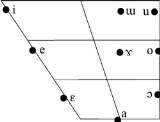
The basic vowels of the Thai language, from front to back and close to open, are given in the following table. The top entry in every cell is the symbol from the International Phonetic Alphabet, the second entry gives the spelling in the Thai alphabetThai alphabet
Thai script , is used to write the Thai language and other, minority, languages in Thailand. It has forty-four consonants , fifteen vowel symbols that combine into at least twenty-eight vowel forms, and four tone marks ....
, where a dash (–) indicates the position of the initial consonant after which the vowel is pronounced. A second dash indicates that a final consonant must follow.
| Front Front vowel A front vowel is a type of vowel sound used in some spoken languages. The defining characteristic of a front vowel is that the tongue is positioned as far in front as possible in the mouth without creating a constriction that would be classified as a consonant. Front vowels are sometimes also... |
Back Back vowel A back vowel is a type of vowel sound used in spoken languages. The defining characteristic of a back vowel is that the tongue is positioned as far back as possible in the mouth without creating a constriction that would be classified as a consonant. Back vowels are sometimes also called dark... |
|||||
|---|---|---|---|---|---|---|
| unrounded | unrounded | rounded | ||||
| short | long | short | long | short | long | |
| Close Close vowel A close vowel is a type of vowel sound used in many spoken languages. The defining characteristic of a close vowel is that the tongue is positioned as close as possible to the roof of the mouth without creating a constriction that would be classified as a consonant.This term is prescribed by the... |
/i/ -ิ |
/iː/ -ี |
/ɯ/ -ึ |
/ɯː/ -ื- |
/u/ -ุ |
/uː/ -ู |
| Close-mid Close-mid vowel A close-mid vowel is a type of vowel sound used in some spoken languages. The defining characteristic of a close-mid vowel is that the tongue is positioned two-thirds of the way from a close vowel to a mid vowel... |
/e/ เ-ะ |
/eː/ เ- |
/ɤ/ เ-อะ |
/ɤː/ เ-อ |
/o/ โ-ะ |
/oː/ โ- |
| Open-mid Open-mid vowel An open-mid vowel is a type of vowel sound used in some spoken languages. The defining characteristic of an open-mid vowel is that the tongue is positioned two-thirds of the way from an open vowel to a mid vowel... |
/ɛ/ แ-ะ |
/ɛː/ แ- |
/ɔ/ เ-าะ |
/ɔː/ -อ |
||
| Open Open vowel An open vowel is defined as a vowel sound in which the tongue is positioned as far as possible from the roof of the mouth. Open vowels are sometimes also called low vowels in reference to the low position of the tongue... |
/a/ -ะ, -ั- |
/aː/ -า |
||||
The vowels each exist in long-short pairs
Vowel length
In linguistics, vowel length is the perceived duration of a vowel sound. Often the chroneme, or the "longness", acts like a consonant, and may etymologically be one, such as in Australian English. While not distinctive in most dialects of English, vowel length is an important phonemic factor in...
: these are distinct phoneme
Phoneme
In a language or dialect, a phoneme is the smallest segmental unit of sound employed to form meaningful contrasts between utterances....
s forming unrelated words in Thai, but usually transliterated the same: เขา (khao) means "he" or "she", while ขาว (khao) means "white".
The long-short pairs are as follows:
| Long | Short | ||||||||
|---|---|---|---|---|---|---|---|---|---|
| Thai | IPA | Example | Thai | IPA | Example | ||||
| –า | /aː/ | ฝาน | /fǎːn/ | 'to slice' | –ะ | /a/ | ฝัน | /fǎn/ | 'to dream' |
| –ี | /iː/ | กรีด | /krìːt/ | 'to cut' | –ิ | /i/ | กริช | /krìt/ | 'kris Kris The kris or keris is an asymmetrical dagger or sword nowadays most strongly associated with the culture of Indonesia, but also indigenous to Malaysia, Southern Thailand and Brunei. It is known as kalis in the southern Philippines. The kris is famous for its distinctive wavy blade , but many have... ' |
| –ู | /uː/ | สูด | /sùːt/ | 'to inhale' | –ุ | /u/ | สุด | /sùt/ | 'rearmost' |
| เ– | /eː/ | เอน | /ʔēːn/ | 'to recline' | เ–ะ | /e/ | เอ็น | /ʔēn/ | 'tendon, ligament' |
| แ– | /ɛː/ | แพ้ | /pʰɛ́ː/ | 'to be defeated' | แ–ะ | /ɛ/ | แพะ | /pʰɛ́ʔ/ | 'goat' |
| –ื- | /ɯː/ | คลื่น | /kʰlɯ̂ːn/ | 'wave' | –ึ | /ɯ/ | ขึ้น | /kʰɯ̂n/ | 'to go up' |
| เ–อ | /ɤː/ | เดิน | /dɤ̄ːn/ | 'to walk' | เ–อะ | /ɤ/ | เงิน | /ŋɤ̄n/ | 'silver' |
| โ– | /oː/ | โค่น | /kʰôːn/ | 'to fell' | โ–ะ | /o/ | ข้น | /kʰôn/ | 'thick (soup)' |
| –อ | /ɔː/ | กลอง | /klɔːŋ/ | 'drum' | เ–าะ | /ɔ/ | กล่อง | /klɔ̀ŋ/ | 'box' |
Diphthong
A diphthong , also known as a gliding vowel, refers to two adjacent vowel sounds occurring within the same syllable. Technically, a diphthong is a vowel with two different targets: That is, the tongue moves during the pronunciation of the vowel...
s. analyze those ending in high vocoids as underlyingly /Vj/ and /Vw/. For purposes of determining tone, those marked with an asterisk are sometimes classified as long:
| Long | Short | ||
|---|---|---|---|
| Thai | IPA | Thai | IPA |
| –าย | /aːj/ | ไ–*, ใ–*, ไ–ย, -ัย | /aj/ |
| –าว | /aːw/ | เ–า* | /aw/ |
| เ–ีย | /iːa/ | เ–ียะ | /ia/ |
| – | – | –ิว | /iw/ |
| –ัว | /uːa/ | –ัวะ | /ua/ |
| –ูย | /uːj/ | –ุย | /uj/ |
| เ–ว | /eːw/ | เ–็ว | /ew/ |
| แ–ว | /ɛːw/ | – | – |
| เ–ือ | /ɯːa/ | เ–ือะ | /ɯa/ |
| เ–ย | /ɤːj/ | – | – |
| –อย | /ɔːj/ | – | – |
| โ–ย | /oːj/ | – | – |
Additionally, there are three triphthong
Triphthong
In phonetics, a triphthong is a monosyllabic vowel combination involving a quick but smooth movement of the articulator from one vowel quality to another that passes over a third...
s, all of which are long:
| Thai | IPA |
|---|---|
| เ–ียว | /iaw/ |
| –วย | /uaj/ |
| เ–ือย | /ɯaj/ |
For a guide to written vowels, see the Thai alphabet
Thai alphabet
Thai script , is used to write the Thai language and other, minority, languages in Thailand. It has forty-four consonants , fifteen vowel symbols that combine into at least twenty-eight vowel forms, and four tone marks ....
page.
Vocabulary
Other than compound words and words of foreign origin, most words are monosyllabicSyllable
A syllable is a unit of organization for a sequence of speech sounds. For example, the word water is composed of two syllables: wa and ter. A syllable is typically made up of a syllable nucleus with optional initial and final margins .Syllables are often considered the phonological "building...
. Historically, words have most often been borrowed from Sanskrit
Sanskrit
Sanskrit , is a historical Indo-Aryan language and the primary liturgical language of Hinduism, Jainism and Buddhism.Buddhism: besides Pali, see Buddhist Hybrid Sanskrit Today, it is listed as one of the 22 scheduled languages of India and is an official language of the state of Uttarakhand...
and Pāli
Páli
- External links :* *...
; Buddhist
Buddhism
Buddhism is a religion and philosophy encompassing a variety of traditions, beliefs and practices, largely based on teachings attributed to Siddhartha Gautama, commonly known as the Buddha . The Buddha lived and taught in the northeastern Indian subcontinent some time between the 6th and 4th...
terminology is particularly indebted to these. Old Khmer
Khmer language
Khmer , or Cambodian, is the language of the Khmer people and the official language of Cambodia. It is the second most widely spoken Austroasiatic language , with speakers in the tens of millions. Khmer has been considerably influenced by Sanskrit and Pali, especially in the royal and religious...
has also contributed its share, especially in regard to royal court terminology. Since the beginning of the 20th century, however, the English language
English language
English is a West Germanic language that arose in the Anglo-Saxon kingdoms of England and spread into what was to become south-east Scotland under the influence of the Anglian medieval kingdom of Northumbria...
has had the greatest influence, especially for scientific and technical vocabulary. Many Teochew Chinese words are also used, some replacing existing Thai words (for example, the names of basic numbers; see also Sino-Xenic).
As noted above, Thai has several registers, each having certain usages, such as colloquial, formal, literary, and poetic. Thus, the word "eat" can be กิน (kin; common), แดก (daek; vulgar), ยัด (yat; vulgar), บริโภค (boriphok; formal), รับประทาน (rapprathan; formal), ฉัน (chan; religious), or เสวย (sawoei; royal).
Thailand also uses the distinctive Thai six hour clock in addition to the 24 hour clock.
See also
- Thai numeralsThai numeralsThai numerals constitute a numeral system of Thai number names for the Khmer numerals traditionally used in Thailand, also used for the more common Arabic numerals, and which follow the Hindu-Arabic numeral system.-Usage:...
- Literature in ThailandLiterature in ThailandThai literature was traditionally heavily influenced by Indian culture. Thailand's national epic is a version of the Ramayana called the Ramakien. A number of versions of the epic were lost in the destruction of Ayutthaya in 1767. Three versions currently exist: one of these was prepared under...
- The Royal Institute of ThailandThe Royal Institute of ThailandThe Royal Institute of Thailand , or RIT in brief, is a Thai public agency called otherwise but having the status equivalent to an independent Department which is not subsidiary to any other agency but comes under the direct supervision of the Prime Minister of Thailand.The...
- Thai honorificsThai honorificsHonorifics are a class of words or grammatical morphemes that encode a wide variety of social relationships between interlocutors or between interlocutors and referents. Honorific phenomena in Thai include honorific registers, honorific pronominals, and honorific particles.-Historical...
External links
Glossaries and word lists
- Thai phrasebook in Wikitravel
- Thai Swadesh list of basic vocabulary words (from Wiktionary's Swadesh-list appendix)
Dictionaries
- English-Thai dictionary, NECTEC English<–>Thai dictionary; free download with sound files.
- English–Thai Dictionary: English–Thai bilingual online dictionary
- The Royal Institute Dictionary, official standard Thai–Thai dictionary
- Longdo Thai Dictionary LongdoDict
- Thai-English dictionary
- Thai2english.com: LEXiTRON-based Thai–English dictionary
Learners' resources
- thai-language.com English speakers' online resource for the Thai language
- Say Hello in the Thai Language
- Thai Language Wiki (Online lectures)
- Spoken Thai (30 exercises with audio)
- Thai books+Audio, a lot of books in Thai with audio.
- USA Foreign Service Institute (FSI) Thai basic course
Thai Keyboard
- Thai Keyboard Virtual Thai Keyboard