
All Topics  
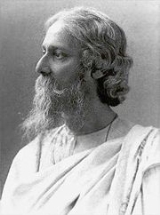
Rabindranath Tagore

 
Rabindranath Tagore

   Email Print
   Bookmark   Link


Rabindranath Tagore


(IPA: ) (7 May 1861 – 7 August 1941), also known by the sobriquet
Sobriquet

A sobriquet is a nickname or a fancy name, usually a familiar name given by others as distinct from a pseudonym assumed as a disguise, but a nickname which is familiar enough such that it can be used in place of a real name without the need of explanation....
 Guru
Guru

A guru is a person who is regarded as having great knowledge, wisdom and authority in a certain area, and who uses these abilities to guide others....
dev
, was a Bengali
Bengali people

The Bengali people are the ethnic community from Bengal in South Asia with a history dating back four millennia. They speak Bengali language , a language of the eastern Indo-Aryan languages branch of the Indo-European languages....
 mystic, Brahmo
Brahmo

"Brahmo" can also refer to Brahmi ScriptA Brahmo is either an adherent of Brahmoism to the exclusion of all other religions, or a person with at least one Brahmo parent or guardian and who has never denied his faith....
 poet, visual artist, playwright, novelist, and composer whose works reshaped Bengali literature
Bengali literature

The term Bengali literature refers to literary works written in Bengali language particularly from Bangladesh and the Indian province of West Bengal....
 and music
Music of Bengal

The music of Bengal, also referred to as Bangla music, comprises a long tradition of religious and secular song-writing over a period of almost a millennium....
 in the late 19th and early 20th centuries. He became Asia's first Nobel laureate
Nobel Prize

The Nobel Prize , established in the 1895 will of Swedish chemist Alfred Nobel; it was first awarded in Nobel Prize in Physics, Nobel Prize in Chemistry, Nobel Prize in Physiology or Medicine, Nobel Prize in Literature, and Nobel Peace Prize in 1901....
 when he won the 1913 Nobel Prize in Literature
Nobel Prize in Literature

The Nobel Prize in Literature is awarded annually, since 1901, to an author from any country who has, in the words from the will of Alfred Nobel, produced "in the field of literature the most outstanding work in an ideal direction" ....
.

A Pirali Brahmin
Pirali Brahmin

A Pirali Brahmin is any member of a subgrouping of Brahmins found throughout Bengal, which is split between India and Bangladesh. Notably, Rabindranath Tagore and the Tagore family are members of this group....
 from Calcutta
Kolkata

, Indian renaming controversy , is the Capital of the Indian States and territories of India of West Bengal. It is located in East India on the east bank of the River Hooghly....
, Bengal
Bengal

Bengal , is a historical and geographical region in the northeast of South Asia. Today it is mainly divided between the independent sovereign nation of the Bangladesh and the state of West Bengal in India, although some regions of the previous kingdoms of Bengal are now part of the neighboring Indian states of Bihar, Assam, Tripura and Oris...
, Tagore first wrote poems
Indian poetry

Indian poetry, and Indian literature in general, has a long history dating back to Vedic period times. They were written in various Languages of India such as Vedic Sanskrit, Sanskrit, Tamil language, Kannada language, Bengali language and Urdu....
 at the age of eight. At the age of sixteen, he published his first substantial poetry under the pseudonym Bhanushingho ("Sun Lion") and wrote his first short stories and dramas in 1877
1877 in literature

The year 1877 in literature involved some significant new books....
.


Discussion
Ask a question about 'Rabindranath Tagore'
Start a new discussion about 'Rabindranath Tagore'
Answer questions from other users
Full Discussion Forum


Recent Posts


Quotations


God, the Great Giver, can open the whole universe to our gaze in the narrow space of a single land.

Jivan-smitri

If you shed tears when you miss the sun, you also miss the stars. ~ 6

In the world's audience hall, the simple blade of grass sits on the same carpet with the sunbeams, and the stars of midnight. ~ 74

In this playhouse of infinite forms I have had my play, and here have I caught sight of him that is formless. ~ 96

Let this be my last word, that I trust in thy love. ~ 326

Let your life lightly dance on the edges of Time like dew on the tip of a leaf. ~ 45


Encyclopedia


(IPA: ) (7 May 1861 – 7 August 1941), also known by the sobriquet
Sobriquet

A sobriquet is a nickname or a fancy name, usually a familiar name given by others as distinct from a pseudonym assumed as a disguise, but a nickname which is familiar enough such that it can be used in place of a real name without the need of explanation....
 Guru
Guru

A guru is a person who is regarded as having great knowledge, wisdom and authority in a certain area, and who uses these abilities to guide others....
dev
, was a Bengali
Bengali people

The Bengali people are the ethnic community from Bengal in South Asia with a history dating back four millennia. They speak Bengali language , a language of the eastern Indo-Aryan languages branch of the Indo-European languages....
 mystic, Brahmo
Brahmo

"Brahmo" can also refer to Brahmi ScriptA Brahmo is either an adherent of Brahmoism to the exclusion of all other religions, or a person with at least one Brahmo parent or guardian and who has never denied his faith....
 poet, visual artist, playwright, novelist, and composer whose works reshaped Bengali literature
Bengali literature

The term Bengali literature refers to literary works written in Bengali language particularly from Bangladesh and the Indian province of West Bengal....
 and music
Music of Bengal

The music of Bengal, also referred to as Bangla music, comprises a long tradition of religious and secular song-writing over a period of almost a millennium....
 in the late 19th and early 20th centuries. He became Asia's first Nobel laureate
Nobel Prize

The Nobel Prize , established in the 1895 will of Swedish chemist Alfred Nobel; it was first awarded in Nobel Prize in Physics, Nobel Prize in Chemistry, Nobel Prize in Physiology or Medicine, Nobel Prize in Literature, and Nobel Peace Prize in 1901....
 when he won the 1913 Nobel Prize in Literature
Nobel Prize in Literature

The Nobel Prize in Literature is awarded annually, since 1901, to an author from any country who has, in the words from the will of Alfred Nobel, produced "in the field of literature the most outstanding work in an ideal direction" ....
.

A Pirali Brahmin
Pirali Brahmin

A Pirali Brahmin is any member of a subgrouping of Brahmins found throughout Bengal, which is split between India and Bangladesh. Notably, Rabindranath Tagore and the Tagore family are members of this group....
 from Calcutta
Kolkata

, Indian renaming controversy , is the Capital of the Indian States and territories of India of West Bengal. It is located in East India on the east bank of the River Hooghly....
, Bengal
Bengal

Bengal , is a historical and geographical region in the northeast of South Asia. Today it is mainly divided between the independent sovereign nation of the Bangladesh and the state of West Bengal in India, although some regions of the previous kingdoms of Bengal are now part of the neighboring Indian states of Bihar, Assam, Tripura and Oris...
, Tagore first wrote poems
Indian poetry

Indian poetry, and Indian literature in general, has a long history dating back to Vedic period times. They were written in various Languages of India such as Vedic Sanskrit, Sanskrit, Tamil language, Kannada language, Bengali language and Urdu....
 at the age of eight. At the age of sixteen, he published his first substantial poetry under the pseudonym Bhanushingho ("Sun Lion") and wrote his first short stories and dramas in 1877
1877 in literature

The year 1877 in literature involved some significant new books....
. In later life Tagore protested strongly against the British Raj
British Raj

British Raj primarily refers to the British rule in the Indian subcontinent between 1858 and 1947; it can also refer to the period of dominion, and even the region under the rule....
 and gave his support to the Indian Independence Movement
Indian independence movement

The term Indian independence movement incorporates various national and regional campaigns, agitations and efforts of both Nonviolent and Revolutionary movement for Indian independence philosophy....
. Tagore's life work endures, in the form of his poetry and the institution he founded, Visva-Bharati University
Visva-Bharati University

Visva Bharati University, Santiniketan is a Central University in India and is located in the Indian state of West Bengal. It is one of the most well-known universities of the country and has been the alma mater of several prominent personalities of the nationalist movement in India....
.

Tagore wrote novels, short stories, songs, dance-dramas, and essays on political and personal topics. Gitanjali
Gitanjali

Gitanjali is a collection of 103 English poems, largely translations, by the Bengali people poet Rabindranath Tagore.This volume became very famous in the West, and was widely translated....
 (Song Offerings), Gora (Fair-Faced), and Ghare-Baire
The Home and the World

The Home and the World 1916 is a 1916 novel by Rabindranath Tagore....
 (The Home and the World) are among his best-known works. His verse, short stories, and novels, which often exhibited rhythmic lyricism, colloquial language, meditative naturalism
Naturalism (literature)

Naturalism is a Literature Literary movement that seeks to replicate a Verisimilitude everyday life, as opposed to such movements as Romanticism or Surrealism, in which subjects may receive highly symbolic, idealistic, or even supernatural treatment....
, and philosophical contemplation, received worldwide acclaim. Tagore was also a cultural reformer and polymath
Polymath

A polymath is a person whose knowledge is not restricted to one subject area. In less formal terms, a polymath may simply refer to someone who is very knowledgeable....
 who modernised Bengali art by rejecting strictures binding it to classical Indian forms. Two songs from his canon are now the national anthems of Bangladesh
Bangladesh

, officially the People's Republic of Bangladesh is a country in South Asia. It is bordered by India on all sides except for a small border with Burma to the far southeast and by the Bay of Bengal to the south....
 and India
India

India, officially the Republic of India , is a country in South Asia. It is the List of countries and outlying territories by total area country by geographical area, the List of countries by population country, and the most populous liberal democracy in the world....
: the Amar Shonar Bangla
Amar Shonar Bangla

Amar Shonar Bangla is a 1906 song written and composed by the poet Rabindranath Tagore, the first ten lines of which were adopted in 1972 as the Bangladesh national anthem....
 and the Jana Gana Mana
Jana Gana Mana

Jana Gana Mana is the national anthem of India. Written in highly Sanskritized Bengali language, it is the first of five stanzas of a Brahmo hymn composed and scored by Nobel Prize in Literature Rabindranath Tagore....
 respectively.

Early life (1861–1901)


Tagore (small)
Tagore (nicknamed "Rabi") was born the youngest of thirteen surviving children in the Jorasanko mansion
Jorasanko Thakur Bari

The Thakurbari...
 in Calcutta (now Kolkata, India) of parents Debendranath Tagore
Debendranath Tagore

Debendranath TagoreBengali script#Bengali symbols was the founder in 1848 of the Brahmo Religion which today is synonymous with Brahmoism the youngest religion of India and Bangladesh....
 (1817-1905) and Sarada Devi(1830-1875). The Tagore family
Tagore family

The Tagore family, with over three hundred years of history, has been one of the leading families of Kolkata, and is regarded as a key influence during the Bengal Renaissance....
 were the Brahmo
Brahmo

"Brahmo" can also refer to Brahmi ScriptA Brahmo is either an adherent of Brahmoism to the exclusion of all other religions, or a person with at least one Brahmo parent or guardian and who has never denied his faith....
 founding fathers of the Adi Dharm
Adi Dharm

Adi Dharm refers to the religion of Adi Brahmo Samaj the first development of Brahmoism and includes those Sadharan Brahmo Samajists who were reintegrated into Brahmoism after the 2nd....
 faith. After undergoing his upanayan
Upanayanam

Upanayana , also called "sacred thread ceremony", is commonly known for being a Hindu rite-of-passage ritual where the concept of Brahman is introduced to a young boy....
 at age eleven, Tagore and his father left Calcutta on 14 February 1873 to tour India for several months, visiting his father's Santiniketan
Santiniketan

Santiniketan is a small town near Bolpur in the Birbhum district of West Bengal, India, approximately 180 kilometres north of Kolkata . It was made famous by Nobel Laureate Rabindranath Tagore, whose vision became what is now a university town that attracts thousands of visitors each year....
 estate and Amritsar
Amritsar

Amritsar is located in the northwestern part of India and is the administrative headquarters of Amritsar district in the States and territories of India of Punjab, India, India....
 before reaching the Himalayan
Himalayas

The Himalaya Range or Himalayas for short , meaning "abode of snow" ), is a mountain range in Asia, separating the Indian subcontinent from the Tibetan Plateau....
 hill station
Hill station

Hill station is a term used for a town usually at somewhat higher elevations. The term was used in colonial Asia , where towns have been founded by European colonial rulers as refuges from the summer heat....
 of Dalhousie
Dalhousie, India

Dalhousie is a city and a municipal council in Chamba district in the state of Himachal Pradesh, India....
. There, Tagore read biographies, studied history, astronomy, modern science, and Sanskrit
Sanskrit

Sanskrit is a historical Indo-Aryan language, one of the liturgical languages of Hinduism and Buddhism, and one of the 22 official languages of India....
, and examined the classical poetry of . In 1877, he rose to notability when he composed several works, including a long poem set in the Maithili
Maithili language

Maithili is a language spoken in the eastern part of India, mainly in the Indian States and territories of India of Bihar and in the eastern Terai region of Nepal....
 style pioneered by Vidyapati
Vidyapati

Vidyapati Thakur , also known by the sobriquet Maithil Kavi Kokil was a Maithili poet and a Sanskrit writer. He was born in the village of Bishphi in Madhubani district of Bihar state, India....
. As a joke, he maintained that these were the lost works of , a newly discovered 17th-century poet. He also wrote "Bhikharini" (1877; "The Beggar Woman"—the Bengali language's first short story) and Sandhya Sangit (1882) —including the famous poem "Nirjharer Swapnabhanga" ("The Rousing of the Waterfall").

Rabindranath Tagore Mrinalini Devi 1883
Seeking to become a barrister
Barrister

A barrister is a lawyer found in many common law jurisdictions that employ a split profession in relation to legal representation. In split professions, the other type of lawyer is the solicitor....
, Tagore enrolled at a public school in Brighton
Brighton

Brighton is a city on the south coast of England and, with its neighbours Hove and Portslade, forms the Brighton and Hove.The ancient settlement of Brighthelmston dates from before the Domesday Book , but it emerged as a health resort during the 18th Century and became a destination for day-trippers after the arrival of the railway in...
, England in 1878. He studied law at University College London
University College London

University College London is a university institution and constituent college of the University of London based primarily in London, England, United Kingdom....
, but returned to Bengal in 1880 without a degree. On 9 December 1883 he married Mrinalini Devi (born Bhabatarini, 1873–1900); they had five children, two of whom later died before reaching adulthood. In 1890, Tagore began managing his family's estates in Shilaidaha, a region now in Bangladesh; he was joined by his wife and children in 1898. Known as "Zamindar
Zamindar

Zamindar , also kniown as Zemindar, Zamindari, Jomidar or the Zamindari System were employed by the Mughal empire to collect taxes from peasants....
 Babu", Tagore traveled across the vast estate while living out of the family's luxurious barge, the Padma, to collect (mostly token) rents and bless villagers; in return, appreciative villagers held feasts in his honour. These years, which composed Tagore's Sadhana period (1891–1895; named for one of Tagore’s magazines), were among his most fecund. During this period, more than half the stories of the three-volume and eighty-four-story Galpaguchchha were written. With irony and emotional weight, they depicted a wide range of Bengali lifestyles, particularly village life.

Rabindranath Tagore Hampstead England 1912
In 1901, Tagore left Shilaidaha
Shilaidaha

Shilaidaha is a place in Kumarkhali Upazila of Kushtia District in Bangladesh. The place is famous for Shilaidaha Kuthibari— a country house made by Dwarkanath Tagore....
 and moved to Santiniketan
Santiniketan

Santiniketan is a small town near Bolpur in the Birbhum district of West Bengal, India, approximately 180 kilometres north of Kolkata . It was made famous by Nobel Laureate Rabindranath Tagore, whose vision became what is now a university town that attracts thousands of visitors each year....
 (West Bengal
West Bengal

West Bengal is a States and territories of India in eastern India. With Bangladesh, which lies on its eastern border, the state forms the ethno-linguistic region of Bengal....
) to found an ashram
Ashram

An "ashram" in ancient India was a Hindu hermitage where sages lived in peace and tranquility amidst nature. Today, the term "ashram" is sometimes used to refer to an intentional community formed primarily for spiritual upliftment of its members, often headed by a religious leader or mysticism....
, which would grow to include a marble-floored prayer hall ("The Mandir"), an experimental school, groves of trees, gardens, and a library. There, Tagore's wife and two of his children died. His father died on 19 January 1905, and he began receiving monthly payments as part of his inheritance. He received additional income from the Maharaja of Tripura
Tripura

is a States and territories of India in North-East India, with an area of 4,036 square mile or 10,453 km?. Tripura is surrounded by Bangladesh on the north, south, and west....
, sales of his family's jewellery, his seaside bungalow in Puri, and mediocre royalties (Rs. 2,000) from his works. By now, his work was gaining him a large following among Bengali and foreign readers alike, and he published such works as Naivedya (1901) and Kheya (1906) while translating his poems into free verse
Free verse

Free Verse poetry does not have a strict pattern of rhyming. It does not have regular meter, rhyme, fixed line length, or a specific stanza pattern....
. On 14 November 1913, Tagore learned that he had won the 1913 Nobel Prize in Literature
Nobel Prize in Literature

The Nobel Prize in Literature is awarded annually, since 1901, to an author from any country who has, in the words from the will of Alfred Nobel, produced "in the field of literature the most outstanding work in an ideal direction" ....
. According to the Swedish Academy
Swedish Academy

The Swedish Academy , founded in 1786 by King Gustav III of Sweden, is one of the Swedish Royal Academies of Sweden. Modelled after the Acad?mie fran?aise, it has 18 members....
, it was given due to the idealistic and—for Western readers—accessible nature of a small body of his translated material, including the 1912 Gitanjali: Song Offerings. In 1915, Tagore received the knight
Knight

File:Gothic armor 2.jpgKnight is the term for a social position originating in the Middle Ages. In the Commonwealth of Nations, knighthood is a non-heritable form of gentry....
hood from the British Crown. But as a mark of rebuke to the rulers, post the Jallianwala Bagh massacre
Jallianwala Bagh massacre

The Jallianwala Bagh Massacre , alternatively known as the Amritsar Massacre, was named after the Jallianwala Bagh in the northern Indian city of Amritsar where, on April 13, 1919, while doing a peaceful demonstration on occasion of Punjabi New Year, British Indian Army soldiers under the command of Brigadier-General Reginald Dyer open...
 in 1919, he renounced the title.

In 1921, Tagore and agricultural economist Leonard Knight Elmhirst set up the Institute for Rural Reconstruction (which Tagore later renamed Shriniketan—"Abode of Wealth") in Surul, a village near the ashram at Santiniketan. Through it, Tagore sought to provide an alternative to Gandhi's symbol- and protest-based Swaraj
Swaraj

Swaraj can mean generally self-governance or "home-rule" but the word usually refers to Mahatma Gandhi's concept for Indian independence movement from foreign domination....
 movement, which he denounced. He recruited scholars, donors, and officials from many countries to help the Institute use schooling to "free village[s] from the shackles of helplessness and ignorance" by "vitaliz[ing] knowledge". In the early 1930s, he also grew more concerned about India's "abnormal caste consciousness" and untouchability, lecturing on its evils, writing poems and dramas with untouchable protagonists, and appealing to authorities at the Guruvayoor Temple to admit Dalits.

Twilight years (1932–1941)

In his last decade, Tagore remained in the public limelight, publicly upbraiding Gandhi for stating that a massive 15 January 1934 earthquake in Bihar
Bihar

Bihar is a States and territories of India in East India. Bihar is the 12th largest state in terms of geographical size 38,202 square mile and 3rd largest by population....
 constituted divine retribution
Divine retribution

Divine retribution is a supernatural punishment usually directed towards all or some portions of humanity by a deity.This theology concept exists in virtually all major religions....
 for the subjugation of Dalits. He also mourned the incipient socioeconomic decline of Bengal and the endemic poverty of Calcutta; he detailed the latter in an unrhymed hundred-line poem whose technique of searing double-vision would foreshadow Satyajit Ray
Satyajit Ray

Satyajit Ray was an Indian Bengali people filmmaker. Ray is regarded as one of the greatest Auteur theory of 20th century Film. Born in the city of Kolkata into a Bengali people family prominent in the world of arts and letters, Ray studied at Presidency College, Calcutta and at the Visva-Bharati University....
's film Apur Sansar. Tagore also compiled fifteen volumes of writings, including the prose-poems works Punashcha (1932), Shes Saptak (1935), and Patraput (1936). He continued his experimentations by developing prose-songs and dance-dramas, including Chitrangada (1914), Shyama (1939), and Chandalika (1938), and wrote the novels Dui Bon (1933), Malancha (1934), and Char Adhyay (1934). Tagore took an interest in science in his last years, writing Visva-Parichay (a collection of essays) in 1937. His exploration of biology, physics, and astronomy impacted his poetry, which often contained extensive naturalism that underscored his respect for scientific laws. He also wove the process of science (including narratives of scientists) into many stories contained in such volumes as Se (1937), Tin Sangi (1940), and Galpasalpa (1941).

Tagore's last four years were marked by chronic pain and two long periods of illness. These began when Tagore lost consciousness in late 1937; he remained comatose and near death for an extended period. This was followed three years later in late 1940 by a similar spell, from which he never recovered. The poetry Tagore wrote in these years is among his finest, and is distinctive for its preoccupation with death. After extended suffering, Tagore died on 7 August 1941 (22 Shravan
Bengali calendar

The Bengali calendar or Bangla calendar is a traditional solar calendar calendar used in Bangladesh and India's eastern states of West Bengal, Assam and Tripura....
 1348) in an upstairs room of the Jorasanko mansion in which he was raised; his death anniversary is still mourned in public functions held across the Bengali-speaking world.

Travels

Tagore Thu
Owing to his notable wanderlust, between 1878 and 1932, Tagore visited more than thirty countries on five continents; many of these trips were crucial in familiarising non-Indian audiences to his works and spreading his political ideas. In 1912, he took a sheaf of his translated works to England, where they impressed missionary and Gandhi protégé Charles F. Andrews, Anglo-Irish poet William Butler Yeats
William Butler Yeats

File:William Butler Yeat by George Charles Beresford.jpgWilliam Butler Yeats was an Irish people poet and dramatist and one of the foremost figures of 20th century in literature....
, Ezra Pound
Ezra Pound

Ezra Weston Loomis Pound was an United States expatriate poetry, critic and intellectual who was a major figure of the Modernist poetry movement in the first half of the 20th century....
, Robert Bridges
Robert Bridges

Robert Seymour Bridges, Order of Merit , was an English poet, and poet laureate from 1913 to 1930....
, Ernest Rhys
Ernest Rhys

Ernest Percival Rhys was a British writer, best known for his role as founding editor of the Everyman's Library series of affordable classics. He wrote essays, stories, poetry, novels and plays....
, Thomas Sturge Moore
Thomas Sturge Moore

Thomas Sturge Moore was an English poet, author and artist. He was born on 4 March 1870 and was educated at Dulwich College, the Croydon Art School and Lambeth Art School....
, and others. Indeed, Yeats wrote the preface to the English translation of Gitanjali, while Andrews joined Tagore at Santiniketan. On 10 November 1912, Tagore toured the United States and the United Kingdom, staying in Butterton
Butterton

Butterton is a small village in the Staffordshire Peak District of England . It is west of Wettonmill in the Manifold Valley and north of Grindon, Staffordshire....
, Staffordshire
Staffordshire

Staffordshire is a landlocked Counties of England in the West Midlands region of England. The county town is Stafford. Part of the National Forest, England lies within its borders....
 with Andrews’ clergymen friends. From 3 May 1916 until April 1917, Tagore went on lecturing circuits in Japan and the United States, during which he denounced nationalism—particularly that of the Japanese and Americans. He also wrote the essay "Nationalism in India", attracting both derision and praise (the latter from pacifists, including Romain Rolland
Romain Rolland

Romain Rolland was a France dramatist, essayist, art historian, mystic and pacifist who was awarded the Nobel Prize for Literature in 1915....
).

Shortly after returning to India, the 63-year-old Tagore visited Peru
Peru

Peru , officially the Republic of Peru , is a country in western South America. It is bordered on the north by Ecuador and Colombia, on the east by Brazil, on the southeast by Bolivia, on the south by Chile, and on the west by the Pacific Ocean....
 at the invitation of the Peruvian government, and took the opportunity to visit Mexico
Mexico

The United Mexican States , commonly known as Mexico , is a federalism constitutionalism republic in North America. It is bordered on the north by the United States; on the south and west by the Pacific Ocean; on the southeast by Guatemala, Belize, and the Caribbean Sea; and on the east by the Gulf of Mexico....
 as well. Both governments pledged donations of $100,000 to the school at Shantiniketan (Visva-Bharati) in commemoration of his visits. A week after his 6 November 1924 arrival in Buenos Aires
Buenos Aires

Buenos Aires is the Capital and largest city of Argentina. It is located on the southern shore of the R?o de la Plata, on the southeastern coast of the South American continent....
, Argentina
Argentina

Argentina, officially the Argentine Republic , is a country in South America, constituted as a federation of 23 provinces and an autonomous city....
, an ill Tagore moved into the Villa Miralrío at the behest of Victoria Ocampo
Victoria Ocampo

Victoria Ocampo was an Argentina intellectual, described by Jorge Luis Borges as la mujer m?s argentina . Best known as an advocate for others and as publisher of the magazine Sur , she was also a writer and critic in her own right....
. He left for India in January 1925. On 30 May 1926, Tagore reached Naples
Naples

Naples is a city in southern Italy, the capital of the region of Campania and of the province of Naples. The city is known for its rich history, art, culture and gastronomy, playing an important role throughout much of its existence; it is over 2,800 years old....
, Italy; he met fascist dictator Benito Mussolini
Benito Mussolini

Benito Amilcare Andrea Mussolini, Order of the Bath Sovereign Military Order of Malta Order of the Tower and Sword was an Italy politician who led the National Fascist Party and is credited with being one of the key figures in the creation of Fascism....
 in Rome
Rome

Rome is the capital city of Italy and Lazio, and is Italy's largest and most populous city, with 2,724,347 residents in an urban area of some ....
 the next day. Their initially warm rapport lasted until Tagore spoke out against Mussolini on 20 July 1926.

Tagore Iran
On 14 July 1927, Tagore and two companions began a four-month tour of Southeast Asia, visiting Bali
Bali

Bali is an Indonesian island located at , the westernmost of the Lesser Sunda Islands, lying between Java to the west and Lombok to the east. It is one of the country's 33 Provinces of Indonesia with the provincial capital at Denpasar towards the south of the island....
, Java, Kuala Lumpur
Kuala Lumpur

Kuala Lumpur , is the largest city of Malaysia. The city proper, making up an area of , has an estimated population of 1.6 million in 2006. Greater Kuala Lumpur, also known as the Klang Valley, is an urban agglomeration of 7.2 million....
, Malacca
Malacca

Malacca is the third smallest States of Malaysia, after Perlis and Penang. It is located in the southern region of the Malay Peninsula, on the Strait of Malacca....
, Penang
Penang

Penang is a States of Malaysia in Malaysia, located on the northwest coast of Peninsular Malaysia by the Strait of Malacca. Penang is the second smallest state in Malaysia after Perlis, and the eighth most populous....
, Siam, and Singapore
Singapore

Singapore , officially the Republic of Singapore, is an island country microstate located at the southern tip of the Malay Peninsula. It lies 137 kilometres north of the equator, south of the Malaysian state of Johor and north of Indonesia's Riau Islands....
. Tagore's travelogues from the tour were collected into the work "Jatri". In early 1930 he left Bengal for a nearly year-long tour of Europe and the United States. Once he returned to the UK, while his paintings were being exhibited in Paris and London, he stayed at a Friends
Religious Society of Friends

The Religious Society of Friends, commonly known as the Quakers, was founded in England in the 17th century as a Christian denomination by people who were dissatisfied with the existing denominations and sects of Christianity....
 settlement in Birmingham
Birmingham

Birmingham is a city status in the United Kingdom and metropolitan borough in the West Midlands of England. Birmingham is the most populous of England's English Core Cities Group, and is the List of United Kingdom cities by population British city after London, with a population of 1,010,200 ....
. There, he wrote his Hibbert Lectures
Hibbert Lectures

The Hibbert Lectures are an annual series of non-sectarian lectures on theological issues. They are sponsored by the Hibbert Trust, which was founded in 1847 by the Unitarianism Robert Hibbert with a goal to uphold "the unfettered exercise of private judgement in matters of religion."....
 for the University of Oxford
University of Oxford

The University of Oxford , located in the city of Oxford, Oxfordshire, England, is the List of oldest universities in continuous operation in the English-speaking world....
 (which dealt with the "idea of the humanity of our God, or the divinity of Man the Eternal") and spoke at London's annual Quaker
Religious Society of Friends

The Religious Society of Friends, commonly known as the Quakers, was founded in England in the 17th century as a Christian denomination by people who were dissatisfied with the existing denominations and sects of Christianity....
 gathering. There (addressing relations between the British and Indians, a topic he would grapple with over the next two years), Tagore spoke of a "dark chasm of aloofness". He later visited Aga Khan III
Aga Khan III

Sultan Mahommed Shah, Aga Khan III, Order of the Star of India, Order of St Michael and St George, Order of the Indian Empire, Royal Victorian Order, Imperial Privy Council was the 48th Shia Imam of the Shia Islam Ismaili Muslims....
, stayed at Dartington Hall
Dartington Hall

The Dartington Hall Trust, near Totnes, Devon, United Kingdom, is a pioneering charity, nurturing ideas to address pressing problems. The charity works for the advancement of the arts, sustainabaility and social justice....
, then toured Denmark
Denmark

Denmark is a Scandinavian country in northern Europe and the senior member of the Kingdom of Denmark. It is the southernmost of the Nordic countries....
, Switzerland
Switzerland

Switzerland is a landlocked Swiss Alps country of roughly 7.7 million people in Western Europe with an area of 41,285 km?. Switzerland is a federal republic consisting of 26 states called Cantons of Switzerland....
, and Germany from June to mid-September 1930, then the Soviet Union
Soviet Union

The Union of Soviet Socialist Republics was a Constitution of the Soviet Union socialist state that existed in Eurasia from 1922 to 1991.The name is a translation of the , romanization of Russian Soyuz Sovetskikh Sotsialisticheskikh Respublik, abbreviated ????, SSSR....
. Lastly, in April 1932, Tagore—who was acquainted with the legends and works of the Persian mystic Hafez
Hafez

Khwaja ?amsu d-Din Mu?ammad Hafez-e ?irazi , known by his pen name Hafez was the most celebrated Persian lyric poet and is often described as poet's poet....
—was invited as a personal guest of Shah
Shah

Shah is a Persian language term for a monarch that has been adopted in many other languages.Shah used as a last name by Jains and Hindus is unrelated....
 Reza Shah Pahlavi of Iran
Iran

Iran , officially the Islamic Republic of Iran and formerly known internationally as Persian Empire until 1935, is a country in Central Eurasia, located on the northeastern shore of the Persian Gulf and the southern shore of the Caspian Sea....
. Such extensive travels allowed Tagore to interact with many notable contemporaries, including Henri Bergson
Henri Bergson

Henri-Louis Bergson was a French philosophy, influential in the first half of the 20th century....
, Albert Einstein
Albert Einstein

Albert Einstein was a Germany-born theoretical physics. He is best known for his theory of relativity and specifically mass?energy equivalence, expressed by the equation E = mc2....
, Robert Frost
Robert Frost

Robert Lee Frost was an American poet. He is highly regarded for his realistic depictions of rural life and his command of American colloquial speech....
, Thomas Mann
Thomas Mann

Paul Thomas Mann was a German literature, short story writer, social critic, philanthropist, essayist, and 1929 Nobel Prize for Literature, known for his series of highly symbolic and irony epic novels and novellas, noted for their insight into the psychology of the artist and the intellectual....
, George Bernard Shaw
George Bernard Shaw

George Bernard Shaw, was an Irish people playwright.Although Shaw's first profitable writing was music and literary criticism, his talent was for drama, and he wrote more than 60 plays....
, H.G. Wells and Romain Rolland
Romain Rolland

Romain Rolland was a France dramatist, essayist, art historian, mystic and pacifist who was awarded the Nobel Prize for Literature in 1915....
. Tagore's last travels abroad, including visits to Persia and Iraq
Iraq

Iraq , officially the Republic of Iraq , is a country in Western Asia spanning most of the northwestern end of the Zagros Mountains, the eastern part of the Syrian Desert and the northern part of the Arabian Desert....
 (in 1932) and Ceylon in 1933, only sharpened his opinions regarding human divisions and nationalism.

Works


Rabindranath Tagore Ra Tha Seal Initials
Tagore's literary reputation is disproportionately influenced by regard for his poetry; however, he also wrote novels, essays, short stories, travelogues, dramas, and thousands of songs. Of Tagore's prose, his short stories are perhaps most highly regarded; indeed, he is credited with originating the Bengali-language version of the genre. His works are frequently noted for their rhythmic, optimistic, and lyrical nature. Such stories mostly borrow from deceptively simple subject matter: the lives of ordinary people.

Novels and non-fiction

Tagore wrote eight novels and four novellas, including Chaturanga, Shesher Kobita
Shesher Kobita

Shesher Kobita is a novel by Rabindranath Tagore. It was first published in book form in 1929. The novel was composed in 1928 and was serialised that year from Bhadro to Choitro in the magazine Probashi....
, Char Odhay, and Noukadubi. Ghare Baire (The Home and the World
The Home and the World

The Home and the World 1916 is a 1916 novel by Rabindranath Tagore....
)—through the lens of the idealistic zamindar protagonist Nikhil—excoriates rising Indian nationalism, terrorism, and religious zeal in the Swadeshi movement
Swadeshi movement

The Swadeshi movement, part of the Indian independence movement, was a successful economic strategy to remove the British Empire from power and improve economic conditions in India through following principles of swadeshi ....
; a frank expression of Tagore's conflicted sentiments, it emerged out of a 1914 bout of depression. Indeed, the novel bleakly ends with Hindu-Muslim sectarian
Sectarianism

Sectarianism is bigotry, discrimination, prejudice or hatred arising from attaching importance to perceived differences between subdivisions within a group, such as between different denominations of a religion or the factions of a political movement....
 violence and Nikhil's being (probably mortally) wounded. In some sense, Gora shares the same theme, raising controversial questions regarding the Indian identity. As with Ghore Baire, matters of self-identity (), personal freedom, and religion are developed in the context of a family story and love triangle. Another powerful story is Jogajog
Jogajog

Jogajog is a novel by Rabindranath Tagore. It was published in book form in 1929 . It was first serialised in the magazine Bichitra from Ashwin 1334 to Choitro 1335....
 (Relationships), where the heroine Kumudini—bound by the ideals of Shiva
Shiva

Shiva: is a major Hinduism god, and one aspect of Trimurti. In the Shaiva tradition of Hinduism, Shiva is seen as the supreme God. In the Smarta tradition, he is one of panchadeva....
-Sati
Dakshayani

Sati or Dakshayani is a Hinduism goddess of marital felicity and longevity; she is worshipped particularly by Hindu women to seek the long life of their husbands....
, exemplified by —is torn between her pity for the sinking fortunes of her progressive
Progressivism

The term progressive has varying meanings in different countries.In some countries, the word refers to left-wing politics. For instance, in the United States, the term progressive emerged in the late 19th century into the 20th century in reference to a more general response to the vast changes brought by industrialization: an alternativ...
 and compassionate elder brother and his foil
Foil (literature)

A foil is a character that contrasts with another character and so highlights various facets of the main character's personality. A foil usually has some important characteristics in common with the other character, such as, frequently, superficial traits or personal history....
: her exploitative, rakish
Rake (character)

A rake is defined as a man that is habituated to immoral conduct. Rakes are frequently stock characters in novels. Often a rake is a man who wastes his fortune on wine, women and song, incurring lavish debts in the process....
, and patriarchical husband. In it, Tagore demonstrates his feminist leanings, using pathos
Pathos

Pathos is one of the three modes of persuasion in rhetoric . Pathos appeals to the audience's emotions. It is a part of Aristotle's philosophy in rhetoric....
 to depict the plight and ultimate demise of Bengali women trapped by pregnancy, duty, and family honour; simultaneously, he treats the decline of Bengal's landed oligarchy.

Other novels were more uplifting: Shesher Kobita (translated twice—Last Poem and Farewell Song) is his most lyrical novel, with poems and rhythmic passages written by the main character (a poet). It also contains elements of satire and postmodernism
Postmodernism

Postmodernism literally means 'after the modernist movement'. While "modern" itself refers to something "related to the present", the movement of modernism and the following reaction of postmodernism are defined by a set of perspectives....
; stock character
Stock character

A stock character is one which relies heavily on cultural types or names for his or her personality, manner of speech, and other characteristics....
s gleefully attack the reputation of an old, outmoded, oppressively renowned poet who, incidentally, goes by the name of Rabindranath Tagore. Though his novels remain among the least-appreciated of his works, they have been given renewed attention via film adaptations by such directors
Film director

A film director, or filmmaker, is a person who directs the making of a film. A film director visualizes the Screenplay, controlling a film's artistic and dramatic aspects, while guiding the technical crew and actors in the fulfillment of his or her vision....
 as Satyajit Ray
Satyajit Ray

Satyajit Ray was an Indian Bengali people filmmaker. Ray is regarded as one of the greatest Auteur theory of 20th century Film. Born in the city of Kolkata into a Bengali people family prominent in the world of arts and letters, Ray studied at Presidency College, Calcutta and at the Visva-Bharati University....
; these include Chokher Bali
Chokher Bali (film)

Chokher Bali is a Bengali cinema film based on the novel Chokher Bali by Rabindranath Tagore. It was directed by Rituparno Ghosh in 2003 and stars Prasenjit as Mahendra, Aishwarya Rai as Binodini and Raima Sen as Ashalata....
 and Ghare Baire
Ghare Baire (film)

Ghare Baire is a 1984 film by Bengali director Satyajit Ray, based upon the novel The Home and the World by Rabindranath Tagore. It features Soumitra Chatterjee, Victor Banerjee , Jennifer Kendal and Swatilekha Chatterjee, married Sengupta....
; many have soundtracks featuring selections from Tagore's own Rabindra sangeet
Rabindra Sangeet

Rabindra Sangeet , also known as Tagore Songs in English language, is a form of music composed by Rabindranath Tagore who added a new dimension to the musical concept of India in general and Bengal in specific....
. Tagore wrote many non-fiction books, writing on topics ranging from Indian history
History of India

The known history of India begins with the Indus Valley Civilization, which spread and flourished in the north-western part of the Indian subcontinent, from c....
 to linguistics. Aside from autobiographical works, his travelogues, essays, and lectures were compiled into several volumes, including Europe Jatrir Patro (Letters from Europe) and Manusher Dhormo (The Religion of Man).

Music and artwork

Rabindranath Tagore Untitled Dacing Girl
Tagore was a prolific musician and painter, writing around 2,230 songs. They comprise rabindrasangit
Rabindra Sangeet

Rabindra Sangeet , also known as Tagore Songs in English language, is a form of music composed by Rabindranath Tagore who added a new dimension to the musical concept of India in general and Bengal in specific....
 (—"Tagore Song"), now an integral part of Bengali culture. Tagore's music is inseparable from his literature, most of which—poems or parts of novels, stories, or plays alike—became lyrics for his songs. Primarily influenced by the thumri
Thumri

Thumri is a common genre of semi-Hindustani classical music Music of India.The text is romantic or devotional in nature, and usually revolves around a girl's love for Krishna....
 style of Hindustani classical music
Hindustani classical music

Hindustani Classical Music is the Hindustani or erstwhile North Indian style of Indian classical music. Originating in the Vedic period, it is a tradition that has been evolving from the 12th century AD, in what is now North India, Bangladesh, and Pakistan, and also Nepal and Afghanistan, and is today one of the two main parts of Indian clas...
, they ran the entire gamut of human emotion, ranging from his early dirge
Dirge

ExamplesExamples of dirges include:*Dies Irae*The Lyke-Wake Dirge*"Quiet Please" radio drama theme*Caoineadh Airt U? Laoghaire*Just a Closer Walk With Thee...
-like Brahmo devotional hymns to quasi-erotic compositions. They emulated the tonal color of classical raga
Raga

Raga refers to musical mode used in Indian classical music. It is a series of five or more musical notes upon which a melody is made. In the Indian musical tradition, ragas are associated with different times of the day, or with seasons....
s
to varying extents. Though at times his songs mimicked a given raga's melody and rhythm faithfully, he also blended elements of different ragas to create innovative works.

For Bengalis, their appeal, stemming from the combination of emotive strength and beauty described as surpassing even Tagore's poetry, was such that the Modern Review
Modern Review (London)

Modern Review was the name of a London-based magazine reviewing popular arts and culture, founded by Julie Burchill, Cosmo Landesman and its editor, Toby Young....
 observed that "[t]here is in Bengal no cultured home where Rabindranath's songs are not sung or at least attempted to be sung ... Even illiterate villagers sing his songs". Music critic Arthur Strangways
Arthur Strangways

Arthur Henry Fox Strangways was a music critic who wrote for The Observer....
 of The Observer
The Observer

The Observer is a United Kingdom newspaper published on Sundays. In about the same place on the political spectrum as its daily sister paper The Guardian, it takes a Liberalism/social democratic line on most issues....
 first introduced non-Bengalis to rabindrasangeet with his book The Music of Hindostan, which described it as a "vehicle of a personality ... [that] go behind this or that system of music to that beauty of sound which all systems put out their hands to seize." Among them are Bangladesh's national anthem Amar Shonar Bangla and India's national anthem Jana Gana Mana ; Tagore thus became the only person ever to have written the national anthems of two nations. In turn, rabindrasangeet influenced the styles of such musicians as sitar
Sitar

The sitar is a plucked stringed instrument. It uses sympathetic strings along with a long hollow neck and a gourd resonance chamber to produce a very rich sound with complex harmonic resonance....
 maestro Vilayat Khan
Vilayat Khan

Ustad Vilayat Khan was one of India's well known sitar maestros, born in Gauripur in Mymensingh District, Bengal . He recorded his first 78-RPM disc at the age of 8, and gave his last concert in 2004 at the age of 75....
, and the sarod
Sarod

The sarod is a stringed musical instrument, used mainly in Indian classical music. Along with the sitar, it is the most popular and prominent instrument in Hindustani classical music....
iyas
Buddhadev Dasgupta and Amjad Ali Khan
Amjad Ali Khan

Ustad Amjad Ali Khan is a highly acclaimed Indian sarod player and composer....
.

Rabindranath Tagore Rabindra Bhavana Collection 2155 Pastel Mask
At age sixty, Tagore took up drawing and painting; successful exhibitions of his many works—which made a debut appearance in Paris upon encouragement by artists he met in the south of France—were held throughout Europe. Tagore—who likely exhibited protanopia ("color blindness"), or partial lack of (red-green, in Tagore's case) colour discernment—painted in a style characterised by peculiarities in aesthetics and colouring schemes. Nevertheless, Tagore took to emulating numerous styles, including that of craftwork by the Malanggan people of northern New Ireland
New Ireland (island)

New Ireland is a large island in Papua New Guinea, approximately 8,650 km? in area. It is the main and largest island of the New Ireland Province....
, Haida
Haida

The Haida are an Indigenous peoples of the Pacific Northwest Coast of North America. The Haida territories comprise the archipelago of the Queen Charlotte Islands, known in the Haida language as Haida Gwaii , and the southern half of Prince of Wales Island in the southernmost Alaska Panhandle, which is the home of a subgroup called the '...
 carvings from the west coast of Canada (British Columbia), and woodcuts by Max Pechstein
Max Pechstein

Max Hermann Pechstein , was a German people expressionist Painting and printmaker, and a member of Die Br?cke group....
. Tagore also had an artist's eye for his own handwriting, embellishing the scribbles, cross-outs, and word layouts in his manuscripts with simple artistic leitmotif
Leitmotif

A leitmotif is a recurring musical Theme , associated with a particular person, place, or idea. The word has also been used by extension to mean any sort of recurring theme, whether in music, literature, or the life of a fictional character or a real person....
s, including simple rhythmic designs.

Theatrical pieces

Tagore's experience in theatre began at age sixteen, when he played the leading role in his brother Jyotirindranath's adaptation of Molière
Molière

Jean-Baptiste Poquelin, also known by his stage name Moli?re, was a French playwright and actor who is considered one of the greatest masters of comedy in Western literature....
's Le Bourgeois Gentilhomme. At age twenty, he wrote his first drama-opera—Valmiki Pratibha (The Genius of Valmiki)—which describes how the bandit Valmiki
Valmiki

Valmiki is celebrated as the poet harbinger in Sanskrit literature. He is the author of the epic, Ramayana, based on the attribution in the text of the epic itself....
 reforms his ethos, is blessed by Saraswati
Saraswati

Hindus believe that Saraswati is the Devi of knowledge, music and the arts. Saraswati has been identified with the Vedic period Saraswati River....
, and composes the Ramayana. Through it, Tagore vigorously explores a wide range of dramatic styles and emotions, including usage of revamped kirtan
Kirtan

Kirtan is call-and-response chanting performed in India's devotional traditions.. When this chanting is done as a private meditation it is called japa but performed congregationally with instruments, and often dancing, it is called kirtan or sankirtan ....
s
and adaptation of traditional English and Irish folk melodies as drinking song
Drinking song

A drinking song is a song sung while drinking, that is, consuming Alcoholic beverage. Some drinking songs are about drink, but many are not. Groups which still have a drinking song tradition include Rugby Football players, Hash House Harriers, air force fighter pilots, and Fraternities and sororities....
s. Another notable play, Dak Ghar (The Post Office), describes how a child—striving to escape his stuffy confines—ultimately "fall[s] asleep" (which suggests his physical death). A story with worldwide appeal (it received rave reviews in Europe), Dak Ghar dealt with death as, in Tagore's words, "spiritual freedom" from "the world of hoarded wealth and certified creeds". During World War II, Polish doctor and educator Janusz Korczak
Janusz Korczak

Janusz Korczak, the pen name of Henryk Goldszmit was a Polish-Jewish children's literature, pediatrics, and child pedagogy, known as Pan Doktor ....
 selected "The Post Office" as the play the orphans in his care in the Warsaw Ghetto
Warsaw Ghetto

The Warsaw Ghetto was the largest of the Jewish ghettos located in the territory of General Government during the Second World War.The Warsaw Ghetto was established by the German General Government Hans Frank on October 16, 1940....
 would perform. This occurred on July 18, 1942, less than three weeks before they were to be deported to the Treblinka death camp. According to his main English-language biographer, Betty Jean Lifton, in her book The King of Children, Dr. Korszak thought a great deal about whether one should be able to determine when and how to die. He may have been trying to find a way for the children in his orphanage to accept death.

His other works—emphasizing fusion of lyrical flow and emotional rhythm tightly focused on a core idea—were unlike previous Bengali dramas. His works sought to articulate, in Tagore's words, "the play of feeling and not of action". In 1890 he wrote Visarjan (Sacrifice), regarded as his finest drama. The Bengali-language originals included intricate subplot
Subplot

A subplot, sometimes referred to as a "B story" or a "C story" and so on, is a secondary Plot strand that is auxiliary to the main plot.Subplots may connect to main plots, in either time and place or in thematic significance....
s and extended monologue
Monologue

A monologue is an extended uninterrupted Oratory or poem by a single person. The person may be speaking his or her thoughts aloud or directly addressing other people, e.g....
s. Later, his dramas probed more philosophical and allegorical themes; these included Dak Ghar. Another is Tagore's Chandalika (Untouchable Girl), which was modeled on an ancient Buddhist legend describing how Ananda
Ananda

Ananda was one of many principal disciples and a devout attendant of the Gotama Buddha. Amongst the Buddha's many disciples, Ananda had the most retentive memory and most of the Sutra in the Sutta Pitaka are attributed to his recollection of the Buddha's teachings during the First Buddhist Council....
—the Gautama Buddha
Gautama Buddha

Siddhartha Gautama was a Spirituality teacher in the northern region of the Indian subcontinent who founded Buddhism. He is generally seen by Buddhists as the Supreme Buddhahood of our age....
's disciple—asks water of an Adivasi
Adivasi

Adivasis is an umbrella term for a heterogeneous set of ethnic and tribal groups believed to be the aboriginal population of India. They comprise a substantial indigenous peoples minority of the population of India....
 ("untouchable") girl. Lastly, among his most famous dramas is Raktakaravi (Red Oleanders), which tells of a kleptocratic king who enriches himself by forcing his subjects to mine. The heroine, Nandini, eventually rallies the common people to destroy these symbols of subjugation. Tagore's other plays include Chitrangada, Raja, and Mayar Khela. Dance dramas based on Tagore's plays are commonly referred to as rabindra nritya natya
Rabindra Nritya Natya

Rabindra nritya natya is the term given to the three dance-dramas composed by Bengal's poet laureate Rabindranath Tagore: Chitrangada, Chandalika and Shyama....
s
.

Short stories


Tagore's "Sadhana" period, comprising the four years from 1891 to 1895, was named for one of Tagore’s magazines. This period was among Tagore's most fecund, yielding more than half the stories contained in the three-volume Galpaguchchha, which itself is a collection of eighty-four stories. Such stories usually showcase Tagore’s reflections upon his surroundings, on modern and fashionable ideas, and on interesting mind puzzles (which Tagore was fond of testing his intellect with). Tagore typically associated his earliest stories (such as those of the "Sadhana" period) with an exuberance of vitality and spontaneity; these characteristics were intimately connected with Tagore’s life in the common villages of, among others, Patisar, Shajadpur, and Shilaida while managing the Tagore family’s vast landholdings. There, he beheld the lives of India’s poor and common people; Tagore thereby took to examining their lives with a penetrative depth and feeling that was singular in Indian literature up to that point.

In "The Fruitseller from Kabul", Tagore speaks in first person as town-dweller and novelist who chances upon the Afghani
Afghanistan

Afghanistan , officially the Islamic republic of Afghanistan, is a landlocked country that is located approximately in the center of Asia....
 seller. He attempts to distil the sense of longing felt by those long trapped in the mundane and hardscrabble confines of Indian urban life, giving play to dreams of a different existence in the distant and wild mountains: "There were autumn mornings, the time of year when kings of old went forth to conquest; and I, never stirring from my little corner in Calcutta, would let my mind wander over the whole world. At the very name of another country, my heart would go out to it ... I would fall to weaving a network of dreams: the mountains, the glens, the forest .... ". Many of the other Galpaguchchha stories were written in Tagore’s Sabuj Patra period (1914–1917; also named for one of Tagore's magazines).
Asit Kumar Haldar 1913 the Beginning Tagore
Tagore's Golpoguchchho (Bunch of Stories) remains among Bengali literature's most popular fictional works, providing subject matter for many successful films and theatrical plays. Satyajit Ray
Satyajit Ray

Satyajit Ray was an Indian Bengali people filmmaker. Ray is regarded as one of the greatest Auteur theory of 20th century Film. Born in the city of Kolkata into a Bengali people family prominent in the world of arts and letters, Ray studied at Presidency College, Calcutta and at the Visva-Bharati University....
's film Charulata
Charulata

Charulata , sometimes released in the English-speaking world as The Lonely Wife, is a 1964 film by Bengali director Satyajit Ray, based upon the novella Nastanirh by Rabindranath Tagore....
 was based upon Tagore's controversial novella, Nastanirh
Nastanirh

Nastanirh , , is a Bengali language novella by Rabindranath Tagore. It is the basis for the noted 1964 film, Charulata by Satyajit Ray....
 (The Broken Nest). In Atithi (also made into a film), the young Brahmin
Brahmin

Brahmin is the class of educators, law makers, scholars and preachers of Dharma in Hinduism. It is said to occupy the highest position among the varna in Hinduism of Hinduism....
 boy Tarapada shares a boat ride with a village zamindar
Zamindar

Zamindar , also kniown as Zemindar, Zamindari, Jomidar or the Zamindari System were employed by the Mughal empire to collect taxes from peasants....
. The boy reveals that he has run away from home, only to wander around ever since. Taking pity, the zamindar adopts him and ultimately arranges his marriage to the zamindar's own daughter. However, the night before the wedding, Tarapada runs off—again. Strir Patra (The Letter from the Wife) is among Bengali literature's earliest depictions of the bold emancipation of women. The heroine Mrinal, the wife of a typical patriarchical
Patriarchy

Patriarchy can be defined as the structuring of society on the basis of family units, where fathers have primary Social responsibility for the welfare of, and authority over, their families....
 Bengali middle class man, writes a letter while she is traveling (which constitutes the whole story). It details the pettiness of her life and struggles; she finally declares that she will not return to her husband's home with the statement Amio bachbo. Ei bachlum ("And I shall live. Here, I live").

In Haimanti, Tagore takes on the institution of Hindu
Hinduism

'Hinduism' is the predominant religion of the Indian subcontinent. Hinduism is often referred to as , a Sanskrit phrase meaning "the eternal dharma", by its practitioners....
 marriage, describing the dismal lifelessness of married Bengali women, hypocrisies plaguing the Indian middle class
Middle class

Middle class is the group of people in contemporary society who are between the working class and nobility. This socioeconomic class includes professionals, highly skilled workers, and lower and middle management....
es, and how Haimanti, a sensitive young woman, must—due to her sensitiveness and free spirit—sacrifice her life. In the last passage, Tagore directly attacks the Hindu custom of glorifying Sita
SITA

SITA is a multinational corporation information technology company specialising in providing IT and telecommunication services to the aviation industry....
's attempted self-immolation
Self-immolation

Self-immolation is often used to refer to suicide by fire. The Latin root of immolate means sacrifice, rather than referring to burning, so more generally self-immolation means suicide without specifying the method....
 as a means of appeasing her husband Rama
RAMA

Rama is a first-person adventure game developed and published by Sierra Entertainment in 1996. The game is based on Arthur C. Clarke's books Rendezvous with Rama and Rama II and supports both DOS and Microsoft Windows 95....
's doubts. Tagore also examines Hindu-Muslim
Islam

Islam is a Monotheism, Abrahamic religion originating with the teachings of the Prophets of Islam Muhammad, a 7th century Arab religious and political figure....
 tensions in Musalmani Didi, which in many ways embodies the essence of Tagore's humanism
Humanism

Humanism is a broad category of ethics that affirm the dignity and worth of all people, based on the ability to determine right and wrong by appealing to universal human qualities, particularly rationalism, without resorting to the supernatural or alleged divine authority from religious texts....
. On the other hand, Darpaharan exhibits Tagore's self-consciousness, describing a young man harboring literary ambitions. Though he loves his wife, he wishes to stifle her own literary career, deeming it unfeminine. Tagore himself, in his youth, seems to have harbored similar ideas about women. Darpaharan depicts the final humbling of the man via his acceptance of his wife's talents. As many other Tagore stories, Jibito o Mrito provides the Bengalis with one of their more widely used epigrams: Kadombini moriya proman korilo she more nai ("Kadombini died, thereby proved that she hadn't").

Poetry

394 Baul Singers Sml
Tagore's poetry—which varied in style from classical formalism to the comic, visionary, and ecstatic—proceeds out a lineage established by 15th- and 16th-century poets. Tagore was also influenced by the mysticism of the rishi
Rishi

A rishi denotes a poet-sage through whom the Vedic hymns flowed, credited also as divine scribes. According to post-Vedic tradition the rishi is a "seer" or "shaman" to whom the Vedas were "originally revealed" through states of higher consciousness....
-authors who—including Vyasa
Vyasa

Vyasa is a central and revered figure in the majority of Hinduism traditions. He is also sometimes called Veda Vyasa , or Krishna Dvaipayana ....
—wrote the Upanishad
Upanishad

The Upanishads are Hindu scriptures that constitute the core teachings of Vedanta. They do not belong to any particular period of Sanskrit literature: the oldest, such as the Brhadaranyaka and Chandogya Upanishads, date to the late Brahmana period , while the latest were composed in the medieval and early modern period....
s, the Bhakta
Bhakti

Bhakti is a word of Sanskrit origin meaning devotion. Within Vaishnavism bhakti is only used in conjunction with Vishnu, Krishna or of the associated avatar, who are the source of attractiveness....
-Sufi
Sufism

Sufi is generally understood to be the inner, mystical dimension of Islam. A practitioner of this tradition is generally known as a ufi , though some adherents of the tradition reserve this term only for those practitioners who have attained the goals of the Sufi tradition....
 mystic Kabir
Kabir

Kabir }}...
, and Ramprasad
Ramprasad Sen

Ramprasad Sen was a Bengali mystic poet and singer of Hindu devotional songs, specially Shyama Sangeet . He is almost always referred to as Ramprasad, and his songs are known as Ramprasadi....
. Yet Tagore's poetry became most innovative and mature after his exposure to rural Bengal's folk music
Folk music

Folk music can have a number of different meanings, including:* Traditional music: The original meaning of the term "folk music" was synonymous with the term "Traditional music", also often including World Music and Roots music; the term "Traditional music" was given its more specific meaning to distinguish it from the other definition...
, which included ballads sung by folk singer
Folk Singer

Folk Singer is an album by Muddy Waters. Waters plays Steel-string guitar, backed by Willie Dixon on string bass, Clifton James on drums, and Buddy Guy on acoustic guitar....
s—especially the bard
Bard

In Celts society, a bard was a professional poet, paid by a monarch to praise the sovereign's activities.The term acquired generic meanings of an epic author/singer/narrator or any poets, especially famous ones....
 
Lalon

Fakir Lalon Shah , also known as Lalon Shah , was a Bengali philosopher poet. He lived in the village of Cheuria in the area known as Nodia in the Bengal Presidency of British India, corresponding to the district of Kushtia in present-day Bangladesh....
. These—which were rediscovered and popularised by Tagore—resemble 19th-century hymns that emphasize inward divinity and rebellion against religious and social orthodoxy. During his Shilaidaha years, his poems took on a lyrical quality, speaking via the maner manus (the Bauls' "man within the heart") or meditating upon the jivan devata ("living God within"). This figure thus sought connection with divinity through appeal to nature and the emotional interplay of human drama. Tagore used such techniques in his poems (which chronicle the romance between Radha
Radha

Radha is the principal consort of Krishna in the Srimad Bhagavatam, and the Gita Govinda of the Hinduism religion. Radha is almost always depicted alongside Krishna and features prominently within the theology of today's Gaudiya Vaishnava religion, which regards Radha as the original Goddess or Shakti....
 and Krishna
Krishna

Krishna is a deity worshiped across many traditions in Hinduism in a variety of different perspectives. While many Vaishnava groups recognize him as an avatar of Vishnu, other traditions within Krishnaism consider Krishna to be svayam bhagavan, or the supreme being....
), which he repeatedly revised over the course of seventy years.

Later, Tagore responded to the (mostly) crude emergence of modernism
Modernism

Modernism, in its broadest definition, is modern thought, character, or practice. More specifically, the term describes both a set of cultural tendencies and an array of associated cultural movements, originally arising from wide-scale and far-reaching changes to Western culture in the late nineteenth and early twentieth century....
 and realism
Literary realism

Literary realism most often refers to the trend, beginning with certain works of French literature of the 19th century and extending to late-nineteenth- and early-twentieth-century authors in various countries, towards depictions of contemporary life and society 'as they were'....
 in Bengali literature by writing experimental works in the 1930s. Examples works include Africa and Camalia, which are among the better known of his latter poems. He also occasionally wrote poems using Shadhu Bhasha (a Sanskrit
Sanskrit

Sanskrit is a historical Indo-Aryan language, one of the liturgical languages of Hinduism and Buddhism, and one of the 22 official languages of India....
ised dialect of Bengali); later, he began using Cholti Bhasha (a more popular dialect). Other notable works include Manasi, Sonar Tori (Golden Boat), Balaka (Wild Geese—the title being a metaphor
Metaphor

Metaphor is language that directly compares seemingly unrelated subjects. It is a figure of speech that compares two or more things without using the words "like" or "as." More generally, a metaphor describes a first subject as being or equal to a second object in some way....
 for migrating souls), and Purobi. Sonar Toris most famous poem—dealing with the ephemeral nature of life and achievement—goes by the same name; it ends with the haunting phrase "????? ???? ???? ????? ???? / ???? ??? ???? ??? ????? ???" ("Shunno nodir tire rohinu pori / Jaha chhilo loe gêlo shonar tori"—"all I had achieved was carried off on the golden boat—only I was left behind."). Internationally, Gitanjali is Tagore's best-known collection, winning him his Nobel Prize. Song VII (????????? 127) of Gitanjali:

Gitanjali Title Page Rabindranath Tagore
???? ? ??? ??????? ??? ??? ??????,
????? ???? ???? ?? ?? ????? ???????
?????? ?? ???? ???? ??????? ????? ???,
????? ??? ???? ?? ??? ???? ??????

????? ???? ???? ?? ??? ???? ???? ???,
?????? ????? ????? ???? ?? ??? ????
???? ???? ??? ??? ??? ??? ????? ????,
??? ???? ???? ??? ??? ????? ????
Amar e gan chherechhe tar shôkol ôlongkar
Tomar kachhe rakhe ni ar shajer ôhongkar
Ôlongkar je majhe pôre milônete aral kôre,
Tomar kôtha dhake je tar mukhôro jhôngkar.

Tomar kachhe khate na mor kobir gôrbo kôra,
Môhakobi, tomar paee dite chai je dhôra.
Jibon loe jôton kori jodi shôrol bãshi gori,
Apon shure dibe bhori sôkol chhidro tar.


Free-verse translation by Tagore (
Gitanjali, verse VII):
"My song has put off her adornments. She has no pride of dress and decoration. Ornaments would mar our union; they would come between thee and me; their jingling would drown thy whispers."
"My poet's vanity dies in shame before thy sight. O master poet, I have sat down at thy feet. Only let me make my life simple and straight, like a flute of reed for thee to fill with music."


"Klanti" (; "Fatigue"), the sixth poem in
Gitali, reads:

???????? ???? ????? ???,?????,
??? ??? ??????? ???? ????
?? ?? ????? ?? ?? ????? ??? ??????,
?? ????? ????? ???,????? ??? ???????

?? ????? ????? ???,?????,
????-???? ????? ??? ????
????? ???? ????????????? ?????? ???? ????? ??????,
??? ??????? ????? ???, ????? ??? ???????
Klanti amar khôma kôro, probhu
Pôthe jodi pichhie pori kobhu
Ei je hia thôro thôro kãpe aji êmontôro,
Ei bedona khôma kôro, khôma kôro probhu.

Ei dinota khôma kôro, probhu,
Pichhon-pane takai jodi kobhu.
Diner tape roudrojalae shukae mala pujar thalae,
Shei mlanota khôma kôro, khôma kôro, probhu.


Tagore's poetry has been set to music by various composers, among them classical composer Arthur Shepherd's triptych for soprano and string quartet, as well as composer Garry Schyman
Garry Schyman

Garry Schyman is an United States composer....
's "Praan," an adaptation of Tagore's poem "Stream of Life" from Gitanjali. The latter was composed and recorded with vocals by Palbasha Siddique
Palbasha Siddique

Palbasha Siddique is an American singer. She is best known for her performance on "Praan", a song written by Garry Schyman for Matt Harding's "Dancing 2008" video....
 to accompany Internet celebrity Matt Harding
Matt Harding

Matthew "Matt" Harding is an United States video game designer and Internet celebrity known as Dancing Matt for his viral videos that show him dancing in front of landmarks and street scenes in various international locations....
's 2008 viral video
Viral video

A Viral phenomenon video is a video clip that gains widespread popularity through the process of Internet sharing, typically through email or Instant messaging, blogs and other media sharing websites....
.

Political views


Gandhi Shantiniketan 1940
Marked complexities characterise Tagore's political views. He criticised European imperialism and supported Indian nationalists and, although he himself vehemently denied it at the time, the evidence produced during the Hindu-German Conspiracy trial, as well as some later accounts, he was aware of the conspiracy and even interviewed the then Japanese premier Count Terauchi and former premier Count Okuma on behalf of the conspirators to try and enlist Japanese support. However, he also lampooned the Swadeshi movement
Swadeshi movement

The Swadeshi movement, part of the Indian independence movement, was a successful economic strategy to remove the British Empire from power and improve economic conditions in India through following principles of swadeshi ....
, denouncing it in "The Cult of the Charka
Spinning wheel

A spinning wheel is a device for spinning thread or yarn from natural or synthetic fibers....
", an acrid 1925 essay. Instead, he emphasized self-help and intellectual uplift of the masses, stating that British imperialism was a "political symptom of our social disease", urging Indians to accept that "there can be no question of blind revolution, but of steady and purposeful education".

Such views inevitably enraged many, placing his life in danger. He narrowly escaped assassination by Indian expatriates during his stay in a San Francisco hotel in late 1916. The plot failed only because the would-be assassins fell into argument. Yet Tagore wrote songs lionizing the Indian independence movement
Indian independence movement

The term Indian independence movement incorporates various national and regional campaigns, agitations and efforts of both Nonviolent and Revolutionary movement for Indian independence philosophy....
 and renounced his knighthood
List of people who have declined a British honour

The following is a partial list of people who have declined a British honours system, such as a knighthood or an honour usually within the Order of the British Empire....
 in protest against the 1919 Jallianwala Bagh Massacre
Jallianwala Bagh massacre

The Jallianwala Bagh Massacre , alternatively known as the Amritsar Massacre, was named after the Jallianwala Bagh in the northern Indian city of Amritsar where, on April 13, 1919, while doing a peaceful demonstration on occasion of Punjabi New Year, British Indian Army soldiers under the command of Brigadier-General Reginald Dyer open...
. Two of Tagore's more politically charged compositions, "Chitto Jetha Bhayshunyo
Chitto jetha bhayshunyo

Chitto jetha bhayshunyo is among one of the most quoted poems in India and Bangladesh.Written by Rabindranath Tagore before India's independence, it represents Tagore's dream of how the new, awakened India should be....
" ("Where the Mind is Without Fear") and "Ekla Chalo Re
Ekla chalo re

Jodi Tor Dak Shune Keu Na Ashe , often shortened to Ekla Cholo Re is a song written by Rabindranath Tagore, part of the Rabindra Sangeet canon....
" ("If They Answer Not to Thy Call, Walk Alone"), gained mass appeal, with the latter favoured by Gandhi. Despite his tumultuous relations with Gandhi, Tagore was key in resolving a Gandhi-Ambedkar
B. R. Ambedkar

Bhimrao Ramji Ambedkar , also known as Babasaheb, was an Indian nationalist, jurist, Dalit political leader and a Buddhist revivalist. He was also the chief architect of the Indian Constitution....
 dispute involving separate electorates for untouchables, ending Gandhi's fast "unto death".

Tagore also criticised orthodox (rote-oriented) education, lampooning it in the short story "The Parrot's Training", where a bird is caged by tutors and force-fed pages torn from books until it dies. These views led Tagore, while visiting Santa Barbara, California
Santa Barbara, California

Santa Barbara is a city in Santa Barbara County, California, United States. Situated on an east-west trending section of coastline, the only such section on the west coast, between the steeply-rising Santa Ynez Mountains and the sea, and having a Mediterranean climate, it is called California's "South Coast", and is also sometimes referred to...
 on 11 October 1917 to conceive of a new type of university, desiring to "make [his ashram at] Santiniketan the connecting thread between India and the world [and] a world center for the study of humanity somewhere beyond the limits of nation and geography." The school, which he named Visva-Bharati had its foundation stone laid on 22 December 1918; it was later inaugurated on 22 December 1921. Here, Tagore implemented a
brahmacharya
Brahmacharya

Brahmacharya is one of the foundational commitments in the practice of Yoga for achieving enlightenment, and is also the first ashram in Vedic culture, in which a person is dedicated to the quest for self-realisation....
pedagogical structure employing guru
Guru

A guru is a person who is regarded as having great knowledge, wisdom and authority in a certain area, and who uses these abilities to guide others....
s to provide individualised guidance for pupils. Tagore worked hard to fundraise for and staff the school, even contributing all of his Nobel Prize monies. Tagore’s duties as steward and mentor at Santiniketan kept him busy; he taught classes in mornings and wrote the students' textbooks in afternoons and evenings. Tagore also fundraised extensively for the school in Europe and the U.S. between 1919 and 1921.

Impact and legacy

Rabindranath Tagore Bust Patel Memorial (cropped)
Tagore's legacy can be felt through the many festivals held worldwide in his honour—examples include the annual Bengali festival/celebration of
Kabipranam (Tagore's birthday anniversary), the annual Tagore Festival held in Urbana, Illinois
Urbana, Illinois

Urbana is the county seat of Champaign County, Illinois, Illinois, United States. As of the 2007 population estimates, the population was 39,484....
 in the United States, the
Rabindra Path Parikrama walking pilgrimages leading from Calcutta to Shantiniketan, and ceremonial recitals of Tagore's poetry held on important anniversaries. This legacy is most palpable in Bengali culture, ranging from language and arts to history and politics; indeed, Nobel laureate Amartya Sen
Amartya Sen

Amartya Kumar Sen Order of the Companions of Honour , is a Bengali people Indian economist, philosopher, and a winner of the Nobel Memorial Prize in Economic Sciences in 1998, "for his contributions to welfare economics" for his work on famine, human development theory, welfare economics, the underlying mechanisms of poverty, and political C...
 noted that even for modern Bengalis, Tagore was a "towering figure", being a "deeply relevant and many-sided contemporary thinker". Tagore's collected Bengali-language writings—the 1939
—is also canonized as one of Bengal's greatest cultural treasures, while Tagore himself has been proclaimed "the greatest poet India has produced".

Tagore was famed throughout much of Europe, North America, and East Asia. He was key in founding Dartington Hall School
Dartington Hall

The Dartington Hall Trust, near Totnes, Devon, United Kingdom, is a pioneering charity, nurturing ideas to address pressing problems. The charity works for the advancement of the arts, sustainabaility and social justice....
, a progressive coeducational institution; in Japan, he influenced such figures as Nobel laureate Yasunari Kawabata
Yasunari Kawabata

was a Japanese short story writer and novelist whose spare, lyrical, subtly-shaded prose works won him the Nobel Prize for Literature in 1968, the first Japanese author to receive the award....
. Tagore's works were widely translated into English, Dutch, German, Spanish, and other European languages by Czech
Czech Republic

The Czech Republic , is a landlocked country in Central Europe. The country borders Poland to the northeast, Germany to the west, Austria to the south and Slovakia to the east....
 indologist
Indology

Indology is the academic study of the languages, texts, history and cultures of the Indian subcontinent, and as such a subset of Asian studies....
 Vincenc Lesný, French Nobel laureate André Gide
André Gide

Andr? Paul Guillaume Gide was a France author and winner of the Nobel Prize in literature in 1947. Gide's career ranged from its beginnings in the Symbolism movement, to the advent of Anti-imperialism between the two World Wars....
, Russian poet Anna Akhmatova
Anna Akhmatova

Anna Akhmatova was the pen name of Anna Andreevna Gorenko, a Russian poet credited with a large influence on Russian literature.Akhmatova's work ranges from short lyric poems to universalized, ingeniously structured cycles, such as , her tragic masterpiece about the Great Purge....
, former Turkish Prime Minister Bülent Ecevit
Bülent Ecevit

Mustafa B?lent Ecevit was a Turkey politician, poet, writer and journalist, who was leader of Republican People's Party , later of the Democratic Left Party and four-time Prime Minister of Turkey....
 and others. In the United States, Tagore's popular lecturing circuits (especially those between 1916–1917) were widely attended and acclaimed. Nevertheless, several controversies involving Tagore resulted in a decline in his popularity in Japan and North America after the late 1920s, contributing to his "near total eclipse" outside of Bengal.

Tagore, through Spanish translations of his works, also influenced leading figures of Spanish literature
Spanish literature

This article refers to the literature of Spain. It includes Spanish poetry, prose and novels. For Spanish American literature specifically, see Latin American literature....
, including Chile
Chile

Chile, officially the Republic of Chile , is a country in South America occupying a long and narrow coastal strip wedged between the Andes mountains and the Pacific Ocean....
ans Pablo Neruda
Pablo Neruda

Pablo Neruda was the pen name and, later, legal name of the Chilean writer and politician Neftal? Ricardo Reyes Basoalto. Neruda assumed his pen name as a teenager, partly because it was in vogue, partly to hide his poetry from his father, a rigid man who wanted his son to have a "practical" occupation....
 and Gabriela Mistral
Gabriela Mistral

Gabriela Mistral was the pseudonym of Lucila de Mar?a del Perpetuo Socorro Godoy Alcayaga, a Chilean Poetry, educator, diplomat, and Feminism who was the first Latin American to win the Nobel Prize in Literature, in 1945....
, Mexican
Mexico

The United Mexican States , commonly known as Mexico , is a federalism constitutionalism republic in North America. It is bordered on the north by the United States; on the south and west by the Pacific Ocean; on the southeast by Guatemala, Belize, and the Caribbean Sea; and on the east by the Gulf of Mexico....
 writer Octavio Paz
Octavio Paz

Octavio Paz Lozano was a Mexican writer, poet, and diplomacy, and the winner of the 1990 Nobel Prize for Literature....
, and Spaniards
Spain

Spain or the Kingdom of Spain , is a country located in Southern Europe on the Iberian Peninsula.The Spanish constitution does not establish any official denomination of the country, even though Espa?a , Estado espa?ol and Naci?n espa?ola are used interchangeably....
 José Ortega y Gasset
José Ortega y Gasset

Jos? Ortega y Gasset was a Spain philosophy....
, Zenobia Camprubí
Zenobia Camprubí

Zenobia Camprub? Aymar was a Spain-born writer and poet; she was also a noted translator of the works of Rabindranath Tagore. She was born in Malgrat de Mar, Barcelona, Spain to a Puerto Rico mother and a Catalonia father....
, and Juan Ramón Jiménez
Juan Ramón Jiménez

Juan Ram?n Jim?nez Mantec?n was a Spain List of poets, a prolific writer who received the Nobel Prize in Literature in 1956. One of Jim?nez's most important contributions to modern poetry was his advocacy of the French concept of "pure poetry."...
. Between 1914 and 1922, the Jiménez-Camprubí spouses translated no less than twenty-two of Tagore's books from English into Spanish. Jiménez, as part of this work, also extensively revised and adapted such works as Tagore's
The Crescent Moon. Indeed, during this time, Jiménez developed the now-heralded innovation of "naked poetry" . Ortega y Gasset wrote that "Tagore's wide appeal [may stem from the fact that] he speaks of longings for perfection that we all have ... Tagore awakens a dormant sense of childish wonder, and he saturates the air with all kinds of enchanting promises for the reader, who ... pays little attention to the deeper import of Oriental mysticism". Tagore's works were published in free editions around 1920 alongside works by Dante Alighieri
Dante Alighieri

Durante degli Alighieri , commonly known as Dante Alighieri, was a Florence poet of the Middle Ages. His Magnum opus, the Divine Comedy , is often considered the greatest literary work composed in the Italian language and a masterpiece of world literature....
, Miguel de Cervantes
Miguel de Cervantes

Miguel de Cervantes Saavedra was a Spanish novelist, poet, and playwright. His magnum opus, Don Quixote, considered the first modern novel by many, is a classic of Western literature and is regularly regarded among the best novels ever written....
, Johann Wolfgang von Goethe
Johann Wolfgang von Goethe

was a Germans writer and according to George Eliot, "Germany's greatest man of letters? and the last true polymath to walk the earth." Goethe's works span the fields of poetry, drama, literature, theology, philosophy, humanism and science....
, Plato
Plato

Plato , was a Classical Greece Greeks philosopher, mathematician, writer of philosophical dialogues, and founder of the Platonic Academy in Ancient Athens, the first institution of higher learning in the western world....
, and Leo Tolstoy
Leo Tolstoy

Leo Tolstoy, or Count Lev Nikolayevich Tolstoy Tolstoy's further talents as essayist, dramatist and Education reform made him the most influential member of the aristocracy Tolstoy....
.

Tagore's talents came to be regarded as overrated by several Westerners, none of whom had read his poetry in the original Bengali. Graham Greene
Graham Greene

Henry Graham Greene Order of Merit, Order of the Companions of Honour was an English writer best known as a novelist, but who also produced short stories, plays, screenplays, travel writing and criticism....
 doubted that "anyone but Mr. Yeats can still take his poems very seriously." Modern remnants of a once widespread Latin America
Latin America

Latin America is a region of the Americas where Romance languages ? particularly Spanish language and Portuguese language, and variably French language ? are primarily spoken....
n reverence of Tagore were discovered, for example, by an astonished Salman Rushdie
Salman Rushdie

Sir Ahmed Salman Rushdie is a British Indian novelist and essayist. He first achieved fame with his second novel, Midnight's Children , which won the Booker Prize in 1981....
 during a trip to Nicaragua
Nicaragua

Nicaragua officially the Republic of Nicaragua , is a representative democracy republic. It is the largest state in Central America with an area of 130,000 km2, about the size of the state of New York....
.

Bibliography (partial)


See also


Citations


Further reading


Bhattacharjere, Dr. Shashwata Rabindra Nattya Dharar Prothem parjay, Jtatiya sahittaya prokasoni, Dhaka.Bangladesh

External links