

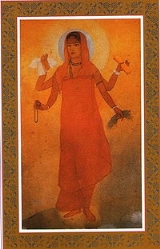
Vande Mataram

Encyclopedia
Vande Mataram is a poem from the famed novel Anandamath
which was written by Bankim Chandra Chattopadhyay
in 1882. It was written in Bengali
and Sanskrit.
It is a hymn to Goddess Durga
, identified as the national personification of India
. It played a vital role in the Indian independence movement
, first sung in a political context by Rabindranath Tagore
at the 1896 session of the Indian National Congress
.
In 1950 (after India's independence), the song's first two verses were given the official status of the "national song" of the Republic of India, distinct from the national anthem of India Jana Gana Mana
.
shujolang shupholang
môloyôjoshitolam
shoshsho shêmolang
matorom
bônde matorom
shubhro jotsna
pulokito jaminim
phullo kushumito
drumodôloshobhinim
shuhashinim
shumodhuro bhashinim
shukhodang bôrodang
matorom
bônde matorom
|
Anandamath
Anandamath is a Bengali novel, written by Bankim Chandra Chatterji and published in 1882. Set in the background of the Sannyasi Rebellion in the late 18th century, it is considered one of the most important novels in the history of Bengali and Indian literature...
which was written by Bankim Chandra Chattopadhyay
Bankim Chandra Chattopadhyay
Bankim Chandra Chattopadhyay was a famous Bengali writer, poet and journalist. He was the composer of India’s national song Vande Mataram, originally a Bengali and Sanskrit stotra personifying India as a mother goddess and inspiring the activists during the Indian Freedom Movement...
in 1882. It was written in Bengali
Bengali language
Bengali or Bangla is an eastern Indo-Aryan language. It is native to the region of eastern South Asia known as Bengal, which comprises present day Bangladesh, the Indian state of West Bengal, and parts of the Indian states of Tripura and Assam. It is written with the Bengali script...
and Sanskrit.
It is a hymn to Goddess Durga
Durga
For the 1985 Hindi Film of Rajesh Khanna see DurgaaIn Hinduism, Durga ; ; meaning "the inaccessible" or "the invincible"; , durga) or Maa Durga "one who can redeem in situations of utmost distress" is a form of Devi, the supremely radiant goddess, depicted as having eighteen arms, riding a lion...
, identified as the national personification of India
India
India , officially the Republic of India , is a country in South Asia. It is the seventh-largest country by geographical area, the second-most populous country with over 1.2 billion people, and the most populous democracy in the world...
. It played a vital role in the Indian independence movement
Indian independence movement
The term Indian independence movement encompasses a wide area of political organisations, philosophies, and movements which had the common aim of ending first British East India Company rule, and then British imperial authority, in parts of South Asia...
, first sung in a political context by Rabindranath Tagore
Rabindranath Tagore
Rabindranath Tagore , sobriquet Gurudev, was a Bengali polymath who reshaped his region's literature and music. Author of Gitanjali and its "profoundly sensitive, fresh and beautiful verse", he became the first non-European Nobel laureate by earning the 1913 Prize in Literature...
at the 1896 session of the Indian National Congress
Indian National Congress
The Indian National Congress is one of the two major political parties in India, the other being the Bharatiya Janata Party. It is the largest and one of the oldest democratic political parties in the world. The party's modern liberal platform is largely considered center-left in the Indian...
.
In 1950 (after India's independence), the song's first two verses were given the official status of the "national song" of the Republic of India, distinct from the national anthem of India Jana Gana Mana
Jana Gana Mana
Jana Gana Mana is the national anthem of India. Written in highly Sanskritized Bengali, it is the first of five stanzas of a Brahmo hymn composed and scored by Nobel laureate Rabindranath Tagore. It was first sung at the Calcutta Session of the Indian National Congress on 27 December 1911...
.
Lyrics
The two verses of Vande Mataram adopted as the "National song" read as follows:shujolang shupholang
môloyôjoshitolam
shoshsho shêmolang
matorom
bônde matorom
shubhro jotsna
pulokito jaminim
phullo kushumito
drumodôloshobhinim
shuhashinim
shumodhuro bhashinim
shukhodang bôrodang
matorom
bônde matorom
|
|}
Translation into English
Here is the translation in proseProse
Prose is the most typical form of written language, applying ordinary grammatical structure and natural flow of speech rather than rhythmic structure...
of the above two stanzas rendered by Sri Aurobindo Ghose. This has also been adopted by the Government of India's national portal It should be noted that the original Vande Mataram consists of six stanzas and the translation in prose
Prose
Prose is the most typical form of written language, applying ordinary grammatical structure and natural flow of speech rather than rhythmic structure...
for the complete poem by Shri Aurobindo appeared in Karmayogin, 20 November 1909.
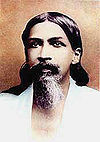
Apart from the above prose
Prose
Prose is the most typical form of written language, applying ordinary grammatical structure and natural flow of speech rather than rhythmic structure...
translation, Sri Aurobindo
Sri Aurobindo
Sri Aurobindo , born Aurobindo Ghosh or Ghose , was an Indian nationalist, freedom fighter, philosopher, yogi, guru, and poet. He joined the Indian movement for freedom from British rule and for a duration became one of its most important leaders, before developing his own vision of human progress...
also translated Vande Mataram into a verse
Verse (poetry)
A verse is formally a single line in a metrical composition, e.g. poetry. However, the word has come to represent any division or grouping of words in such a composition, which traditionally had been referred to as a stanza....
form known as Mother, I Bow to Thee.
Sri Aurobindo
Sri Aurobindo
Sri Aurobindo , born Aurobindo Ghosh or Ghose , was an Indian nationalist, freedom fighter, philosopher, yogi, guru, and poet. He joined the Indian movement for freedom from British rule and for a duration became one of its most important leaders, before developing his own vision of human progress...
commented thus on his English translation of the poem:
Verse translation of Vande Mataram in Hindi
A verse translation of Vande Mataram was done by an IndiaIndia
India , officially the Republic of India , is a country in South Asia. It is the seventh-largest country by geographical area, the second-most populous country with over 1.2 billion people, and the most populous democracy in the world...
n poet laureate
Poet Laureate
A poet laureate is a poet officially appointed by a government and is often expected to compose poems for state occasions and other government events...
. The tune of this Hindi
Hindi
Standard Hindi, or more precisely Modern Standard Hindi, also known as Manak Hindi , High Hindi, Nagari Hindi, and Literary Hindi, is a standardized and sanskritized register of the Hindustani language derived from the Khariboli dialect of Delhi...
song assimilates to Sare Jahan Se Achcha, another famous Urdu
Urdu
Urdu is a register of the Hindustani language that is identified with Muslims in South Asia. It belongs to the Indo-European family. Urdu is the national language and lingua franca of Pakistan. It is also widely spoken in some regions of India, where it is one of the 22 scheduled languages and an...
song of Allama Iqbal. The same translation is reproduced hereunder:
तुझको नमन करें हम, हे मातृभूमि भारत! हे मातृभूमि भारत! हे पितृभूमि भारत!!
जलवायु अन्न सुमधुर, फल फूल दायिनी माँ! धन धान्य सम्पदा सुख, गौरव प्रदायिनी माँ!!
शत-शत नमन करें हम, हे मातृभूमि भारत!
अति शुभ्र ज्योत्स्ना से, पुलकित सुयामिनी है। द्रुमदल लतादि कुसुमित, शोभा सुहावनी है।।
यह छवि स्वमन धरें हम, हे मातृभूमि भारत! तुझको नमन करें हम, हे मातृभूमि भारत!!
हे मातृभूमि भारत! हे पितृभूमि भारत!!
कसकर कमर खड़े हैं, हम कोटि सुत तिहारे। क्या है मजाल कोई, दुश्मन तुझे निहारे।।
अरि-दल दमन करें हम, हे मातृभूमि भारत! तुझको नमन करें हम, हे मातृभूमि भारत!!
हे मातृभूमि भारत! हे पितृभूमि भारत!!
तू ही हमारी विद्या, तू ही परम धरम है। तू ही हमारा मन है, तू ही वचन करम है।।
तेरा भजन करें हम, हे मातृभूमि भारत! तुझको नमन करें हम, हे मातृभूमि भारत!!
हे मातृभूमि भारत! हे पितृभूमि भारत!!
तेरा मुकुट हिमालय, उर-माल यमुना-गंगा। तेरे चरण पखारे, उच्छल जलधि तरंगा।।
अर्पित सु-मन करें हम, हे मातृभूमि भारत! तुझको नमन करें हम, हे मातृभूमि भारत!!
हे मातृभूमि भारत! हे पितृभूमि भारत!!
बैठा रखी है हमने, तेरी सु-मूर्ति मन में। फैला के हम रहेंगे, तेरा सु-यश भुवन में।।
गुंजित गगन करें हम, हे मातृभूमि भारत! तुझको नमन करें हम, हे मातृभूमि भारत!!
हे मातृभूमि भारत! हे पितृभूमि भारत!!
पूजा या पन्थ कुछ हो, मानव हर-एक नर है। हैं भारतीय हम सब, भारत हमारा घर है।।
ऐसा मनन करें हम, हे मातृभूमि भारत! तुझको नमन करें हम, हे मातृभूमि भारत!!
हे मातृभूमि भारत! हे पितृभूमि भारत!!
Composition
Bankim Chandra Chatterjee was one of the earliest graduates of the newly-established Calcutta University. After his BA, he joined the British IndianBritish Raj
British Raj was the British rule in the Indian subcontinent between 1858 and 1947; The term can also refer to the period of dominion...
government as a civil servant, becoming a District Magistrate and later a District Collector. Chatterjee was very interested in recent events in Indian and Bengali history, particularly the Revolt of 1857 and the previous century's Sannyasi Rebellion
Sannyasi Rebellion
The Sannyasi Rebellion or Sannyasi Revolt is a term used to describe activities of sannyasis and fakirs, or Hindu and Muslim ascetics respectively, in Bengal, India in the late 18th century...
. Around the same time, the administration was trying to promote God Save the Queen
God Save the Queen
"God Save the Queen" is an anthem used in a number of Commonwealth realms and British Crown Dependencies. The words of the song, like its title, are adapted to the gender of the current monarch, with "King" replacing "Queen", "he" replacing "she", and so forth, when a king reigns...
as the anthem for Indian subjects, which Indian nationalists disliked. It is generally believed that the concept of Vande Mataram came to Bankim Chandra Chatterjee when he was still a government official, around 1876.
Chatterjee wrote the poem in a spontaneous session using words from Sanskrit
Sanskrit
Sanskrit , is a historical Indo-Aryan language and the primary liturgical language of Hinduism, Jainism and Buddhism.Buddhism: besides Pali, see Buddhist Hybrid Sanskrit Today, it is listed as one of the 22 scheduled languages of India and is an official language of the state of Uttarakhand...
and Bengali
Bengali language
Bengali or Bangla is an eastern Indo-Aryan language. It is native to the region of eastern South Asia known as Bengal, which comprises present day Bangladesh, the Indian state of West Bengal, and parts of the Indian states of Tripura and Assam. It is written with the Bengali script...
. The poem was published in Chatterjee's book Anandamatha in 1882, which is set in the events of the Sannyasi Rebellion.
Jadunath Bhattacharya was asked to set a tune for this poem just after it was written.
Indian independence movement
Indian independence movement
The term Indian independence movement encompasses a wide area of political organisations, philosophies, and movements which had the common aim of ending first British East India Company rule, and then British imperial authority, in parts of South Asia...
. Large rallies, fermenting initially in Bengal
Bengal
Bengal is a historical and geographical region in the northeast region of the Indian Subcontinent at the apex of the Bay of Bengal. Today, it is mainly divided between the sovereign land of People's Republic of Bangladesh and the Indian state of West Bengal, although some regions of the previous...
, in the major metropolis of Calcutta, would work themselves up into a patriotic fervour by shouting the slogan "Vande Mataram", or "Hail to the Mother(land)!" The British, fearful of the potential danger of an incited Indian populace, at one point banned the utterance of the motto in public forums, and imprisoned many freedom fighters for disobeying the proscription. Rabindranath Tagore sang Vande Mataram in 1896 at the Calcutta Congress Session held at Beadon Square. Dakhina Charan Sen sang it five years later in 1901 at another session of the Congress at Calcutta. Poet Sarala Devi Chaudurani sang the song in the Benares Congress Session in 1905. Lala Lajpat Rai
Lala Lajpat Rai
Lala Lajpat Rai was an Indian author, freedom fighter and politician who is chiefly remembered as a leader in the Indian fight for freedom from the British Raj. He was popularly known as Punjab Kesari or Sher-e-Punjab meaning the samem and was part of the Lal Bal Pal trio...
started a journal called Vande Mataram from Lahore
Lahore
Lahore is the capital of the Pakistani province of Punjab and the second largest city in the country. With a rich and fabulous history dating back to over a thousand years ago, Lahore is no doubt Pakistan's cultural capital. One of the most densely populated cities in the world, Lahore remains a...
. Hiralal Sen
Hiralal Sen
Hiralal Sen was an Indian photographer generally considered one of India's first filmmakers. He is also credited with creating India's first advertising films and quite possibly India's first political film...
made India's first political film in 1905 which ended with the chant. Matangini Hazra
Matangini Hazra
Matangini Hazra was an Indian revolutionary who participated in the Indian independence movement until she was shot dead by the British Indian police in front of the Tamluk Police Station on September 29, 1942...
's last words as she was shot to death by the Crown police
Crown colony
A Crown colony, also known in the 17th century as royal colony, was a type of colonial administration of the English and later British Empire....
were Vande Mataram
In 1907, Bhikaiji Cama
Bhikaiji Cama
Bhikaiji Rustom CamaBhikhai- is the name as it appears in the biographies. Another common form is Bhikai- , as it appears on the postage stamp. The name is also frequently misspelled 'Bhikha-' , which is a male name...
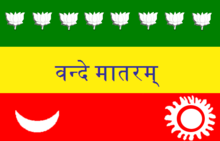
(1861–1936) created the first version of India's national flag (the Tiranga) in Stuttgart, Germany, in 1907. It had Vande Mataram written on it in the middle band.
Adoption as "national song"
Tagore's Jana Gana ManaJana Gana Mana
Jana Gana Mana is the national anthem of India. Written in highly Sanskritized Bengali, it is the first of five stanzas of a Brahmo hymn composed and scored by Nobel laureate Rabindranath Tagore. It was first sung at the Calcutta Session of the Indian National Congress on 27 December 1911...
was chosen as the National Anthem
National anthem
A national anthem is a generally patriotic musical composition that evokes and eulogizes the history, traditions and struggles of its people, recognized either by a nation's government as the official national song, or by convention through use by the people.- History :Anthems rose to prominence...
of the 1947 Republic of India.
Vande Mataram was rejected on the grounds that Muslim
Muslim
A Muslim, also spelled Moslem, is an adherent of Islam, a monotheistic, Abrahamic religion based on the Quran, which Muslims consider the verbatim word of God as revealed to prophet Muhammad. "Muslim" is the Arabic term for "submitter" .Muslims believe that God is one and incomparable...
s, Christians, Parsis, Sikhs, Arya Samajis and others who opposed idol worship felt offended by its depiction of the nation as "Mother Durga
Durga
For the 1985 Hindi Film of Rajesh Khanna see DurgaaIn Hinduism, Durga ; ; meaning "the inaccessible" or "the invincible"; , durga) or Maa Durga "one who can redeem in situations of utmost distress" is a form of Devi, the supremely radiant goddess, depicted as having eighteen arms, riding a lion...
", a Hindu goddess. Muslims also felt that its origin as part of Anandamatha, a novel they felt had an anti-Muslim message.
The designation as "national song" predates independence, dating to 1937. At this date, the Indian National Congress discussed at length the status of the song. It was pointed out then that though the first two stanzas began with an unexceptionable evocation of the beauty of the motherland, in later stanzas there are references where the motherland is likened to the Hindu goddess Durga
Durga
For the 1985 Hindi Film of Rajesh Khanna see DurgaaIn Hinduism, Durga ; ; meaning "the inaccessible" or "the invincible"; , durga) or Maa Durga "one who can redeem in situations of utmost distress" is a form of Devi, the supremely radiant goddess, depicted as having eighteen arms, riding a lion...
. Therefore, INC decided to adopt only the first two stanzas as the national song.
The controversy becomes more complex in the light of Rabindranath Tagore
Rabindranath Tagore
Rabindranath Tagore , sobriquet Gurudev, was a Bengali polymath who reshaped his region's literature and music. Author of Gitanjali and its "profoundly sensitive, fresh and beautiful verse", he became the first non-European Nobel laureate by earning the 1913 Prize in Literature...
's rejection of the song as one that would unite all communities in India. In his letter to Subhash Chandra Bose
Subhash Chandra Bose
Subhas Chandra Bose known by name Netaji was an Indian revolutionary who led an Indian national political and military force against Britain and the Western powers during World War II. Bose was one of the most prominent leaders in the Indian independence movement and is a legendary figure in...
(1937), Tagore wrote:
"The core of Vande Mataram is a hymn to goddess Durga: this is so plain that there can be no debate about it. Of course Bankimchandra does show Durga to be inseparably united with Bengal in the end, but no Mussulman [Muslim] can be expected patriotically to worship the ten-handed deity as 'Swadesh' [the nation]. This year many of the special [Durga] Puja numbers of our magazines have quoted verses from Vande Mataram—proof that the editors take the song to be a hymn to Durga. The novel Anandamath is a work of literature, and so the song is appropriate in it. But Parliament is a place of union for all religious groups, and there the song cannot be appropriate. When Bengali Mussulmans show signs of stubborn fanaticism, we regard these as intolerable. When we too copy them and make unreasonable demands, it will be self-defeating."
In a postscript to this same letter, Tagore says:
"Bengali Hindus have become agitated over this matter, but it does not concern only Hindus. Since there are strong feelings on both sides, a balanced judgment is essential. In pursuit of our political aims we want peace, unity and good will—we do not want the endless tug of war that comes from supporting the demands of one faction over the other."
Rajendra Prasad
Rajendra Prasad
Dr. Rajendra Prasad was an Indian politician and educator. He was one of the architects of the Indian Republic, having drafted its first constitution and serving as the first president of independent India...
, who was presiding the Constituent Assembly
Constituent assembly
A constituent assembly is a body composed for the purpose of drafting or adopting a constitution...
on January 24, 1950, made the following statement which was also adopted as the final decision on the issue:
View of Muslim institutions
Many Muslim organizations in IndiaIslam in India
Islam is the second-most practiced religion in the Republic of India after Hinduism, with more than 13.4% of the country's population ....
have declared fatwa
Fatwa
A fatwā in the Islamic faith is a juristic ruling concerning Islamic law issued by an Islamic scholar. In Sunni Islam any fatwā is non-binding, whereas in Shia Islam it could be considered by an individual as binding, depending on his or her relation to the scholar. The person who issues a fatwā...
s against singing Vande Mataram, due to the song giving a notion of worshipping Mother India
Bharat Mata
Bhārat Mātā , Mother India, or Bhāratāmbā is the national personification of India as a mother goddess...
, which they consider to be shirk (idolatry). Muslim institutions in general, see Vande Mataram in a negative light. Though a number of Muslim organizations and individuals have opposed Vande Mataram being used as a "national song" of India, citing many religious reasons, some Muslim personalities have admired and even praised Vande Mataram as the "National Song of India". Arif Mohammed Khan, a former Union Minister in the Rajiv Gandhi
Rajiv Gandhi
Rajiv Ratna Gandhi was the sixth Prime Minister of India . He took office after his mother's assassination on 31 October 1984; he himself was assassinated on 21 May 1991. He became the youngest Prime Minister of India when he took office at the age of 40.Rajiv Gandhi was the elder son of Indira...
government, wrote an Urdu translation of Vande Mataram which starts as Tasleemat, maan tasleemat.
All India Sunni Ulema Board on Sept 6, 2006, issued a fatwa that the Muslims can sing the first two verses of the song. The Board president Moulana Mufti Syed Shah Badruddin Qadri Aljeelani said that "If you bow at the feet of your mother with respect, it is not shirk
Shirk (polytheism)
In Islam, shirk is the sin of idolatry or polytheism. i.e. the deification or worship of anyone or anything other than the singular God, or more literally the establishment of "partners" placed beside God...
but only respect." Shia scholar and All India Muslim Personal Law Board vice-president Maulana Kalbe Sadiq stated on Sept 5, 2006 that scholars need to examine the term "vande." He asked, "Does it mean salutation or worship?"
View of Sikh institutions
Shiromani Gurudwara Parbandhak Committee or SGPC, the paramount representative body in the Sikh PanthPanth
Panthan is the term used for several religious traditions in India.A panth is founded by a guru or an acharya, and is often led by scholars or senior practitioners of the tradition.Some of the major panthas in India are:...
, requested that the Sikhs not sing "Vande Mataram" in the schools and institutions on its centenary on Sept 7, 2006. SGPC head, Avtar Singh Makkar, expressed concern that "imposing a song that reflected just one religion was bound to hurt the sentiments of the Muslims, Sikhs, Christians and other religious minorities. The DSGMC (Delhi Sikh Gurudwara Management Committee) has called singing of "Vande Mataram" against Sikh tenents as the Sikhs sought "sarbat da bhala" (universal welfare) and did not believe in "devi and devta". DSGMC head H. S. Sarna also added that the song "Vande Mataram" had been rejected long before by well known freedom fighter Sikhs like Baba Kharak Singh and Master Tara Singh
Master Tara Singh
Master Tara Singh Malhotra was a prominent Sikh political and religious leader in the first half of the 20th century...
.
View of Christian institutions
Fr. Cyprian Kullu from Jharkhand stated in an interview with AsiaNews: "The song is a part of our history and national festivity and religion should not be dragged into such mundane things. The Vande Mataram is simply a national song without any connotation that could violate the tenets of any religion." However, some Christian institutions such as Our Lady of Fatima Convent School in Patiala did not sing the song on its 100th anniversary as mandated by the state. Christians make a distinction between "veneration" and "worship," and even though the song falls into neither of these categories, some Christians may have declined to sing the national song because of their understanding of its intention and content.2006 controversy
On August 22, 2006, there was a row in the Lok SabhaLok Sabha
The Lok Sabha or House of the People is the lower house of the Parliament of India. Members of the Lok Sabha are elected by direct election under universal adult suffrage. As of 2009, there have been fifteen Lok Sabhas elected by the people of India...
of the Indian Parliament over whether singing of Vande Mataram in schools should be made mandatory. The ruling United Progressive Alliance
United Progressive Alliance
The United Progressive Alliance is a ruling coalition of center-left political parties heading the government of India. The coalition is led by the Indian National Congress , which is currently the single largest political party in the Lok Sabha...
(UPA) coalition and Opposition members debated the Government's stance that singing the national song Vande Mataram on September 7, 2006, to mark the 125th year celebration of its creation should be voluntary. This led to the House's being adjourned twice. Human Resources Development Minister Arjun Singh
Arjun Singh
Arjun Singh was an Indian politician from the Indian National Congress party. He was the Union Minister of Human Resource Development in the Manmohan Singh cabinet from 2004 to 2009....
noted that it was not binding on citizens to sing the song. Arjun Singh had earlier asked all state governments to ensure that the first two stanzas of the song were sung in all schools on that day. Bharatiya Janata Party
Bharatiya Janata Party
The Bharatiya Janata Party ,; translation: Indian People's Party) is one of the two major political parties in India, the other being the Indian National Congress. Established in 1980, it is India's second largest political party in terms of representation in the parliament...
(BJP) Deputy Leader V. K. Malhotra wanted the Government to clarify whether singing the national song on September 7 in schools was mandatory or not. On August 28, targeting the BJP, Congress spokesman Abhishek Singhvi said that in 1998 when Atal Behari Vajpayee of the BJP was the Prime Minister, the BJP supported a similar circular issued by the Uttar Pradesh government to make the recitation compulsory. But Vajpayee had then clarified that it was not necessary to make it compulsory.
On September 7, 2006, the nation celebrated the national song. Television channels showed school children singing the song at the notified time. Some Muslim groups had discouraged parents from sending their wards to school because of the issue, after the BJP had repeatedly insisted that the national song must be sung. However, many Muslims did participate in the celebrations.
Performances and interpretations
The poem has been set to a large number of tunes. The oldest surviving audio recordings date to 1907, and there have been more than a hundred different versions recorded throughout the 20th century. Many of these versions have employed traditional South Asian classicalHindustani classical music
Hindustani classical music is the Hindustani or North Indian style of Indian classical music found throughout the northern Indian subcontinent. The style is sometimes called North Indian Classical Music or Shāstriya Sangeet...
raga
Raga
A raga is one of the melodic modes used in Indian classical music.It is a series of five or more musical notes upon which a melody is made...
s. Versions of the song have been visualized on celluloid in a number of films, including Leader, Amar Asha, and Anand Math
Anand Math
Anand Math is a 1952 Hindi patriotic-historical film directed by Hemen Gupta, based on Anandamath, the famous Bengali novel written by Bankim Chandra Chattopadhyay in 1882...
. It is widely believed that the tune set for All India Radio
All India Radio
All India Radio , officially known since 1956 as Akashvani , is the radio broadcaster of India and a division of Prasar Bharati. Established in 1936, it is the sister service of Prasar Bharati's Doordarshan, the national television broadcaster. All India Radio is one of the largest radio networks...
station version was composed by Ravi Shankar
Ravi Shankar
Ravi Shankar , often referred to by the title Pandit, is an Indian musician and composer who plays the plucked string instrument sitar. He has been described as the best known contemporary Indian musician by Hans Neuhoff in Musik in Geschichte und Gegenwart.Shankar was born in Varanasi and spent...
. In 1997, as part of the 50th anniversary celebrations of the Independence of India, a musical album
Vande Mataram (album)
Vande Mataram is a 1997 studio album by Indian musician A. R. Rahman. It is the largest selling Indian non-film album to date. It released on December 9, 1997 by Columbia Records, a music label under Sony Music...
composed by A. R. Rahman
A. R. Rahman
Allah Rakha Rahman is an Indian composer, singer-songwriter, record producer, musician, and philanthropist. Described as the world's most prominent and prolific film composer by Time, his works are notable for integrating eastern classical music with electronic music sounds, world music genres and...
, titled Vande Mataram, was released. The version of the song played in it has become its most popular interpretation in recent years. In 2002, BBC World Service
BBC World Service
The BBC World Service is the world's largest international broadcaster, broadcasting in 27 languages to many parts of the world via analogue and digital shortwave, internet streaming and podcasting, satellite, FM and MW relays...
conducted an international poll to choose ten most famous songs of all time. Around 7000 songs were selected from all over the world. Vande Mataram, in a version
Vande Mataram (album)
Vande Mataram is a 1997 studio album by Indian musician A. R. Rahman. It is the largest selling Indian non-film album to date. It released on December 9, 1997 by Columbia Records, a music label under Sony Music...
by A. R. Rahman
A. R. Rahman
Allah Rakha Rahman is an Indian composer, singer-songwriter, record producer, musician, and philanthropist. Described as the world's most prominent and prolific film composer by Time, his works are notable for integrating eastern classical music with electronic music sounds, world music genres and...
, was ranked second. All India Radio's version, as well as A.R. Rahman's version, are in Desh
Desh (raga)
Desh is a Hindustani classical raga.-Technical description:The raga is of Audav-sampurna nature, i.e., in its arohana only five notes are used, whereas the avarohana uses all the seven notes....
raga
Raga
A raga is one of the melodic modes used in Indian classical music.It is a series of five or more musical notes upon which a melody is made...
.
See also
- http://wikisource.org/wiki/%E0%A4%B8%E0%A4%BE%E0%A4%AE%E0%A5%82%E0%A4%B9%E0%A4%BF%E0%A4%95_%E0%A4%B0%E0%A4%BE%E0%A4%B7%E0%A5%8D%E0%A4%9F%E0%A5%8D%E0%A4%B0%E0%A4%97%E0%A4%BE%E0%A4%A8_(%E0%A4%B5%E0%A4%A8%E0%A5%8D%E0%A4%A6%E0%A5%87%E0%A4%AE%E0%A4%BE%E0%A4%A4%E0%A4%B0%E0%A4%AE_%E0%A4%95%E0%A4%BE_%E0%A4%B9%E0%A4%BF%E0%A4%A8%E0%A5%8D%E0%A4%A6%E0%A5%80-%E0%A4%95%E0%A4%BE%E0%A4%B5%E0%A5%8D%E0%A4%AF%E0%A4%BE%E0%A4%A8%E0%A5%81%E0%A4%B5%E0%A4%BE%E0%A4%A6)]Verse translation of Vande Mataram in Hindi सामूहिक राष्ट्रगान (वन्देमातरम का हिन्दी काव्यानुवाद)Vande Mataram- All stanzas in Bengali script with English translation by Sri Aurobindo GhoseVande Matarm- All stanzas in Devanagri script
- Anandmath- The novel from which Vande Mataram gained popularity
- Indian National AnthemJana Gana ManaJana Gana Mana is the national anthem of India. Written in highly Sanskritized Bengali, it is the first of five stanzas of a Brahmo hymn composed and scored by Nobel laureate Rabindranath Tagore. It was first sung at the Calcutta Session of the Indian National Congress on 27 December 1911...
- Saare Jahan Se AchchaSaare Jahan Se AchchaSaare Jahan Se Achchha , formal name: Tarana-e-Hindi , is one of the enduring patriotic poems of the Urdu language...
- Bharat MataBharat MataBhārat Mātā , Mother India, or Bhāratāmbā is the national personification of India as a mother goddess...
- Vande Mataram (album)Vande Mataram (album)Vande Mataram is a 1997 studio album by Indian musician A. R. Rahman. It is the largest selling Indian non-film album to date. It released on December 9, 1997 by Columbia Records, a music label under Sony Music...
External links
- Vande Mataram Sung by Lata Mangeshkar in Anand Math
- Vande Mataram Sung by Hemant Kumar Mukhopadhaya in Anand Math
- Download the most simple and most elegant version of Vande Mataram from the National Portal of India, Government of India.
- Vande Mataram against Sikh tenets
- "How Secular is Vande Mataram?" AG Noorani on the controversy
- Boycott threat over Indian song - BBC
- 1937 Congress Resolution on validity of Muslim objection to this song
- "Vande Mataram and Muslims" - Islamic Voice (magazine)Islamic Voice (magazine)Islamic Voice is a monthly Islamic magazine published in Bangalore. It is the largest English language Muslim publication in India. It is a comprehensive magazine, places a relatively high emphasis on social issues and strives to have a broad appeal....
- Vande Matram is back as a handle to beat Muslims with
- Historical perspective from Islamic Voice
- Keyboard Notes for playing this song