

Anglo-Iraqi War

Encyclopedia
The Anglo-Iraqi War was the name of the British campaign against the rebel
government of Rashid Ali in the Kingdom of Iraq
during the Second World War. The war lasted from 2 May to 31 May 1941. The campaign resulted in the re-occupation of Iraq
by British armed forces
and the return to power of the ousted pro-British Regent
of Iraq, Prince
'Abd al-Ilah
. The campaign further fuelled nationalist
resentment in Iraq toward the British-supported Hashemite
monarchy
.
(also referred to as Mesopotamia
) was governed by the United Kingdom
under a League of Nations mandate
; the British Mandate of Mesopotamia, until 1932 when Iraq became nominally independent. Before granting independence, the United Kingdom concluded the Anglo-Iraqi Treaty
of 1930. This treaty had several conditions, which included permission to establish military bases for British use and provide all facilities for the unrestricted movement of British forces through the country upon request to the Iraqi government. The conditions of the treaty were imposed by the United Kingdom to ensure continued control of Iraq's petroleum
resources. Many Iraqis resented these conditions and felt that their country and its monarchy were still under the effective control of the British Government.
However, following 1937, no British troops were left in Iraq and the Iraqi government had become solely responsible for the internal security of the country. In accordance with the Anglo-Iraqi Treaty, the British Royal Air Force
(RAF) had been allowed to retain two bases; RAF Shaibah
, near Basra
, and RAF Habbaniya
, between Ramadi
and Fallujah
. Air Vice-Marshal
H. G. Smart
was the commander of RAF Habbaniya and Air Officer Commanding
of all RAF forces in Iraq
. The bases in Iraq had a dual role: protecting Britain's petroleum interests and maintaining a link in the air route between Egypt
and India
. In addition RAF Habbaniya was also a training base and was protected by a small detachment of RAF ground forces
and locally raised Iraqi troops.
With the outbreak of the Second World War in September 1939 the Iraqi Government broke off diplomatic relations with Nazi Germany
. However, the United Kingdom wanted the Iraqi Government to take a further step and declare war upon Germany. In March 1940, the nationalist and anti-British Rashid Ali replaced Nuri as-Said
. Ali made covert contacts with German representatives in the Middle East
, though he was not yet an openly pro-Axis supporter.
In June 1940, when Fascist Italy joined the war, on the side of Germany, the Iraqi government did not break off diplomatic relations, as they had done with Germany. Thus the Italian Legation in Baghdad became the chief centre for Axis propaganda and for fomenting anti-British feeling. In this they were aided by Mohammad Amin al-Husayni
, the Grand Mufti of Jerusalem
. The Grand Mufti had fled from Palestine shortly before the outbreak of war and later received asylum in Baghdad.
In January 1941, there was a political crisis within Iraq and the threat of civil war was looming. Rashid Ali resigned as Prime Minister
of Iraq and was replaced by Taha al-Hashimi
. Public opinion started to change in Iraq as the Italians suffered a series of setbacks in the African and Mediterranean theatre.
of Iraq, Amir Abdul Illah
, learnt of a plot to arrest him and he fled Baghdad
for RAF Habbaniya. From Habbaniya he was flown to Basra and given refuge on the gunboat
HMS Cockchafer
.
On 1 April, Rashid Ali, along with four top level Army and Air Force officers; known as the "Golden Square
," seized power via a coup d'état
and Rashid Ali proclaimed himself Chief of the "National Defence Government." The Golden Square deposed Prime Minister Taha al-Hashimi
and Rashid Ali once again became Prime Minister of Iraq. Rashid Ali did not move to overthrow the monarchy
and named a new Regent to King Faisal II
, Sherif Sharaf. The leaders of the "National Defence Government" proceeded to arrest many pro-British citizens and politicians. However, a good number of those sought managed to escape by various means through Amman
in Transjordan
.
The immediate plans of Iraq's new leaders were to refuse further concessions to the United Kingdom, to retain diplomatic links with Fascist Italy, and to expel most prominent pro-British politicians from the country. The plotters of the coup considered the United Kingdom to be weak and believed that its government would negotiate with their new government regardless of its legality. On 17 April, Rashid Ali, on behalf of the "National Defence Government," asked Germany for military assistance in the event of war with the British. Ultimately, Rashid Ali attempted to restrict British rights guaranteed under Article 5 of the 1930 treaty when he insisted that newly arrived British troops be quickly transported through Iraq and to Palestine.
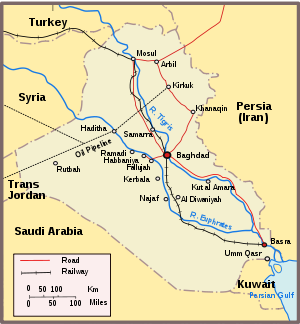
The RIrA was composed of four infantry divisions with some 60,000 men distributed for the most part into four infantry divisions and one mechanized brigade. The 1st
and 3rd
Divisions were stationed near Baghdad. Also based within Baghdad was the Independent Mechanized Brigade, composed of a light tank company, an armoured car company, two battalions of "mechanized" infantry transported in trucks, a "mechanized" machine-gun company, and a "mechanized" artillery brigade. The Iraqi 2nd Division
was stationed in Kirkuk
and the 4th Division
was in Al Diwaniyah
on the main rail line from Baghdad to Basra. Unlike the modern use of the term "mechanized," in 1941 "mechanized" for the RIrA meant transported by trucks.
In addition to the regular army, the Iraqis fielded some police units and approximately 500 "irregulars
" under Arab guerrilla leader Fawzi al-Qawuqji
. Fawzi al-Qawuqji was a ruthless fighter who did not hesitate to murder or mutilate his prisoners. For the most part, Fawzi al-Qawuqji and his irregulars operated in the area between Rutbah and Ramadi
before being chased back into Syria.
 The RIrAF had a total of 116 aircraft in 7 squadrons and a training school. Between 50 and 60 Iraqi aircraft were in serviceable condition. Most Iraqi fighter and bomber aircraft were located at the newly re-named "Rashid Airfield" in Baghdad (formerly RAF Hinaidi
) or in Mosul
. Four squadrons and the Flying Training School were based in Baghdad. Two squadrons with close co-operation and general purpose aircraft were based in Mosul. The Iraqis flew an assortment of aircraft types that included Gladiator
biplane fighters, Breda 65 fighter bombers, Savoia SM79
medium bombers, Northrop/Douglas 8A
fighter bombers, Hawker Nisr
biplane close co-operation aircraft, Vickers Vincent biplane light bombers, de Havilland Dragon
biplane general purpose aircraft, de Havilland Dragonfly
biplane general purpose aircraft, and Tiger Moth
biplane trainers. In addition to the 116 aircraft, the Iraqi Air Force had another 9 aircraft not allocated to specific squadrons and 19 aircraft available in reserve.
The Royal Iraqi Navy (RIrN) had four 100-ton Thornycroft
gunboat
s, one pilot vessel, and one minesweeper
. All were armed and all were based in the Shatt al-Arab waterways.
forces available within Iraq were very limited. Air Vice-Marshal Smart commanded the Royal Air Force
-led inter-service
command
, "British Forces in Iraq
."
Ground forces available to Smart included Number 1 Armoured Car Company RAF
and six companies of Assyrian Levies
. The armoured car company comprised 18 ancient Rolls Royce armoured cars
of World War I
vintage. The Assyrian Levies totaled almost 2,000 locally raised officers and other ranks under the command of about 20 British officers.
At RAF Habbaniah, the 4th Service Flying Training School had a wide variety of obsolescent bombers, fighters and trainers. However, many of the 84 aircraft available could not be flown or were not appropriate for offensive use. In addition, at the start of battle, there were about 1000 RAF personnel but only 39 pilots. All told, on 1 April, the British had 3 old Gladiator
biplane fighters, 30 Hawker Audax biplane close co-operation aircraft, 7 Fairey Gordon
biplane bombers, 27 twin-engine Oxford
trainers, 28 Hawker Hart
biplane light bombers (the "bomber" version of the Hawker Audax), 20 Hart trainers, and 1 Bristol Blenheim Mk1
bomber. The Gladiators were used as officers' runabouts. The Hawker Audaxes could carry eight 20 lb bombs (12 Audaxes were modified to carry two 250 lb bombs). The Fairy Gordons could each carry two 250 lb bombs. The Oxfords were converted from carrying smoke bombs to carrying eight 20 lb bombs. The Hawker Harts could carry two 250 lb bombs. The Hawker trainers had no weaponry. The Blenheim left for good on 3 May. There was also an "RAF Iraq Communications Flight" at Habbaniya with 3 Vickers Valentia flying boats.
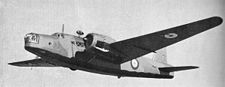
At RAF Shaibah there was the No. 244 Bomber Squadron
with some Vickers Vincents.
The naval forces available to support British actions in Iraq were part of the East Indies Station
and included vessels from the Royal Navy
, the Royal Australian Navy
, the Royal New Zealand Navy
, and the Royal Indian Navy
.
Winston Churchill
advocated the non-recognition of Rashid Ali or his illegal
"National Defence Government."
On 2 April, Sir
Kinahan Cornwallis
, the new British Ambassador to Iraq, arrived in Baghdad. He had much experience in Mesopotamia
and had spent twenty years in the country as the advisor to King Faisal I
. Cornwallis was highly regarded and he was sent to Iraq with the understanding that he would be able to hold a more forceful line with the new Iraqi government than had hitherto been the case. Unfortunately, Cornwallis arrived in Iraq too late to prevent the outbreak of war.
On 6 April, AVM Smart requested reinforcements, but his request was rejected by Air Officer Commanding
in the Middle East
Sir Arthur Longmore
. At this point in the war
, the situation developing in Iraq did not figure highly in British priorities. Churchill wrote, "Libya
counts first, withdrawal of troops from Greece
second. Tobruk
shipping, unless indispensable to victory, must be fitted in as convenient. Iraq can be ignored and Crete
worked up later."
The British Chiefs-of-Staff
, with the vocal support of the Commander-in-Chief, India
General
Claude Auchinleck
, were in favour of armed intervention. However, the three Commander-in-Chief
s, of the British armed forces in the Middle East and eastern Mediterranean area, already heavily committed with fighting in Libya
, in East Africa
, and in Greece
, suggested the only forces they would be able to use against Iraq was a single battalion of infantry, based within Palestine, and the aircraft already based within Iraq. The Government of India
had a long standing commitment to prepare one infantry division in case it should be needed to protect the Anglo-Iranian oilfields and in July 1940 the leading brigade of this division, the 5th Indian Infantry Division, was ordered to be dispatched to Iraq. However, in August the division was placed under the command of Middle East Command
and was diverted to the Sudan
. Since then, India Command had been investigating the move of troops by air from India to RAF Shaibah.
, and asked him what force could be quickly sent from India to Iraq. Amery contacted General Auchinleck and Lord Linlithgow
, Viceroy and Governor-General of India
, the same day. The response from India was that the majority of one brigade group
, that was due to set sail for Malaya
on 10 April, could be diverted to Basra and the rest of the group dispatched ten days later. In addition 390 British infantrymen could be flown from India into RAF Shaibah. It was also stated that when shipping became available this force could quickly be built up to a division in strength. On 10 April this offer was accepted by London and the move of these forces was codenamed Operation Sabine. On the same day General Archibald Wavell
, Commander-in-Chief of Middle East Command, informed London that he could no longer spare the one battalion in Palestine and urged for firm diplomatic action, and possibly a demonstration of air strength, to be taken rather than military intervention.
On 10 April, Major-General William Fraser
assumed control over Iraqforce
, the land forces from India headed for Basra. Fraser was given the following instructions: (i) "The object of his force was to occupy the Basra-Shabai area in order to ensure the safe disembarkation of further reinforcements and to enable a base to be established in that area. (ii) The attitude of the Iraqi Army and local authorities was still uncertain and it was possible that attempts might be made to oppose the disembarkation of his force. In framing his plan for disembarkation, he was, therefore, to act in the closest concert with the officer commanding the Naval Forces. (iii) Should the disembarkation be opposed, he was to overcome the Iraqi forces by force and occupy suitable defensive positions ashore as quickly as possible. (iv) The greatest care was to be taken not to infringe on the neutrality of Iran."
Starting in early April, preparations in case of hostilities were made at Habbaniya. Aircraft were modified to allow them to carry bombs, while light bombers such as the Hawker Audax
were modified to carry larger bombs.
On 12 April, Convoy BP7, left Karachi
. The convoy was composed of eight transports escorted by the Grimsby Class sloop
HMAS Yarra
. The forces transported by the convoy were under the command of Major-General Fraser, the commanding officer of the 10th Indian Infantry Division
. The forces being transported consisted of two senior staff officers from the l0th Indian Division headquarters, the 20th Indian Infantry Brigade
, the personnel of the Royal Artillery's 3rd Field Regiment; but without their guns, and certain ancillary troops.
 On 13 April, the Royal Navy
force of four ships in the Persian Gulf
were reinforced by the aircraft carrier
HMS Hermes
and two light cruiser
s, the HMS Emerald
and the HMNZS Leander
. The HMS Hermes carried the Fairey Swordfish
torpedo bombers of 814 Squadron
. The naval vessels which covered the disembarkation at Basra consisted of the aircraft carrier HMS Hermes, the light cruiser HMS Emerald, the light cruiser HMNZS Leander, the sloop
HMS Falmouth
, the gunboat HMS Cockchafer, the sloop HMS Seabelle, the minesweeper
sloop HMIS Lawrence, and the sloop HMAS Yarra.
On the morning of 15 April, Convoy BP7 was met at sea by HMS Seabelle from Basra. Later in the day the escort was reinforced by HMS Falmouth. On I7 April, the convoy was joined by HMIS Lawrence and then proceeded towards the entrance of the Shatt al-Arab. On 18 April, the convoy moved up the Shatt al-Arab and arrived at Basra at 0930 hrs. HMS Emerald was already in Basra. On the same day, the HMNZS Leander was released from support duties in the Persian Gulf.
On 16 April, the Iraqi Government was informed that the British were going to invoke the Anglo-Iraq treaty to move troops through the country to Palestine. Rashid Ali raised no objection.
(1st KORR) was flown into RAF Shaibah from Karachi in India. Colonel
Ouvry Roberts
, the Chief Staff Officer of the 10th Indian Infantry Division, arrived with the 1st KORR. By 18 April, the airlift
of the 1st KORR to Shaibah was completed. The troop-carrying aircraft
used for this airlift were 7 Valentias and 4 Atalantas
supplemented by 4 DC-2s
which had recently arrived in India.
On 18 April, the 20th Indian Infantry Brigade landed at Basra. Brigadier
Donald Powell
commanded this brigade. The 20th Indian Infantry Brigade included the 2nd battalion 8th Gurkha Rifles
, 2nd battalion 7th Gurkha Rifles
, and the 3rd battalion 11th Sikh Regiment
. The landing of the force transported by Convoy BP7 was covered by infantry of the 1st KORR which had arrived the previous day by air. The landing was unopposed.
By 19 April, the disembarkation of the force transported by Convoy BP7 at Basra was completed. On the same day, seven aircraft were flown into RAF Habbaniya to bolster the air force there. Following the landing of the 20th Indian Infantry Brigade, Rashid Ali requested that the brigade be moved quickly through the country and that no more troops should arrive until the previous force had left. Sir Kinahan Cornwallis, the British Ambassador to Iraq, referred the issue to London
and London replied that they had no interest in moving the troops out of the country and wanted to establish them within Iraq. Cornwallis was also instructed not to inform Rashid Ali who, as he had taken control of the country via a coup d'état, had no right to be informed about British troop movements.
On 20 April, Churchill had written to Anthony Eden
, the Foreign Secretary, and indicated that it should be made clear to Ambassador Cornwallis that the chief interest in sending troops to Iraq was the covering and establishment of a great assembly base near Basra. It was to be understood that what happened "up country," with the exception of Habbaniya, was at that time on an "altogether lower priority." Churchill went on to indicate that the treaty rights were invoked to cover the disembarkation, but that force would have been used if it had been required. Cornwallis was directed not to make agreements with an Iraqi government which had usurped its power. In addition, he was directed to avoid entangling himself with explanations to the Iraqis.
Also on 29 April, the British Ambassador, Sir Kinahan Cornwallis, advised that all British women and children should leave Baghdad; 230 civilians were escorted by road to Habbaniya and during the following days were gradually airlifted to Shaibah. A further 350 civilians took refuge in the British Embassy and 150 British civilians in the American Legation.
.
to the south of the base. Prior to dawn, reconnaissance aircraft were launched from RAF Habbaniya and reported that at least two battalions, with artillery, had taken up position on the plateau.
By May 1, the Iraqi forces surrounding Habbaniya had swelled to an infantry brigade, two mechanized battalions, a mechanized artillery brigade with 12 3.7-inch howitzers
, a field artillery brigade with 12 18-pounder cannons
and four 4.5-inch howitzers
, 12 Crossley six-wheeled armoured cars
, a number of Fiat light tanks
, a mechanized machine gun company, a mechanized signal company, and a mixed battery of anti-aircraft and anti-tank guns. This totaled 9,000 regular troops along with an undetermined number of tribal irregulars and about 50 guns.
, Air Vice-Marshal
H. G. Smart, stating that the plateau had been occupied for a training exercise. The envoy also informed Air Vice-Marshal Smart that all flying should cease immediately and demanded that no movements, either ground or air, take place from the base. Air Vice-Marshal Smart replied that any interference with the normal training carried out at the base would be treated as an act of war. Sir Kinahan Cornwallis, the British Ambassador located at the British Embassy in Baghdad and in contact with RAF Habbaniya via wireless
, fully supported this action.
British reconnaissance aircraft, already in the air, continued to relay information to the base; they reported that the Iraqi positions on the plateau were being steadily reinforced, they also reported that Iraqi troops had occupied the town of Fallujah
.
At 11:30 hours, the Iraqi envoy again made contact with Air Vice-Marshal Sharp and accused the British of violating the Anglo-Iraqi treaty. Air Vice-Marshal Smart replied that this was a political matter and he would have to refer the accusation to Ambassador Cornwallis. Meanwhile, Iraqi forces had now occupied vital bridges over the Tigris
and Euphrates
rivers as well as reinforcing their garrison at Ramadi
; thus effectively cutting off RAF Habbaniya except from the air.
Air Vice-Marshal Smart controlled a base with a population of around 9,000 civilians that was indefensible with the force of roughly 2,500 men currently available. The 2,500 men included air crew and Assyrian Levies
and the loyalty of the Assyrian Levies had yet to be proven. There was also the possibility that the Iraqi rebels were waiting for dark before attacking. As a result, Air Vice-Marshal Smart decided to accept the tactical risks and stick to Middle East Command's policy of avoiding aggravation in Iraq by, for the moment, not launching a pre-emptive strike.
bombers to RAF Shaibah. The British Ambassador signalled the Foreign Office
that he regarded the Iraqi actions as an act of war, which required an immediate air response. He also informed them that he intended to demand the withdrawal of the Iraqi forces and permission to launch air strikes to restore control, even if the Iraqi troops overlooking Habbaniya did withdraw it would only postpone aerial attacks.
Still in contact with the British Embassy and with the approval of Ambassador Cornwallis, Air Vice-Marshal Smart decided to launch air strikes against the plateau the following morning without issuing an ultimatum
; as with foreknowledge the Iraqi force might start to shell the airbase and halt any attempt to launch aircraft.
s were launched against the Iraqis from RAF Habbaniya. While the largest number of British troops were ultimately assembled in the Basra area, an advance from Basra was not immediately practicable and did not get under way until after Rashid Ali's government was already collapsing.
Initially, the Iraqi siege of RAF Habbaniya and the ability of the besieged
British force there to withstand the siege was the primary focus of the conflict. Air Vice-Marshal Sharp's decision to strike at the Iraqi positions with air power
not only allowed his force to withstand the siege, but to neutralize much of Iraq's air power. While the relief force from Palestine arrived in Habbaniya after the siege was over, it did allow an immediate change over to the offensive.
attacks with as many aircraft as possible. At 05:00 on 2 May, 33 aircraft from Habbaniya, out of the 56 operational aircraft based there, and eight Wellington bombers, from Shaibah, began their attack. Within minutes the Iraqis on the escarpment replied by shelling the base, damaging some planes on the ground. The Royal Iraqi Air Force (RIrAF) also joined in the fray over Habbaniya. RAF attacks were also made against Iraqi air fields near Baghdad, which resulted in 22 aircraft being destroyed on the ground; further attacks were made against the railway and Iraqi positions near Shaibah, with the loss of two planes. Throughout the day the pilots, from Habbaniya, flew 193 sortie
s and claimed direct hits on Iraqi transports, armoured cars and artillery pieces; however five aircraft had been destroyed and several others had been put out of service. On the base 13 people had lost their lives and a further 29 wounded, including nine civilians.
By the end of the day, the Iraqi force, outside of Habbaniya, had grown to roughly a brigade
.
Iraqi army were preparing for morning prayers when the attack was launched. When the news reached the Grand Mufti in Baghdad, he immediately declared a jihad
against the United Kingdom. In addition, the flow of Iraq Petroleum Company
oil to Haifa
was completely severed.
On 3 May, the British bombing of the Iraqis continued; troop and gun positions on the plateau were targeted as well the supply line to Baghdad. The RIrAF base at Rashid was also attacked and an Iraqi Savoia SM 79
bomber was intercepted and shot down heading for Habbaniya. The following day further air attacks were carried out on RIrA troop positions and the RIrAF. A bombing raid was conducted by eight Wellington bombers on Rashid, which was briefly engaged by Iraqi fighters but no losses were suffered. Bristol Blenheim
s, escorted by Hurricanes
, also conducted strafing attacks against airfields at Baghdad, Rashid and Mosul
.
On 5 May, due to a car accident, Air Vice-Marshal Smart was evacuated to Basra and then onward to India. Colonel Roberts assumed de facto
command of the land operations at RAF Habbaniya after the departure of Smart. Air Vice-Marshal John D'Albiac
, from Greece, was to take command over aerial forces at Habbaniya and of all RAF forces in Iraq. Further aerial attacks were conducted against the plateau during the day and following nightfall Colonel Roberts ordered a sortie by the King's Own Royal Regiment
(1st KORR) against the Iraqi positions on the plateau. The attack was supported by the Assyrian levies, some RAF armoured cars and two First World War-era 4.5 inch howitzers
. The 4.5 in howitzers had been put in working order by some British gunners but had previously been decorating the entrance of the base's officers' mess.
, one Italian tank, ten Crossley armoured cars, 79 trucks, three 20 mm anti-aircraft guns with 2,500 shells, 45 Bren light machine-guns, eleven Vickers machine gun
s, and 340 rifles with 500,000 rounds of ammunition.
The investment of Habbaniya, by Iraqi forces, had come to an end. The British garrison had suffered 13 men killed, 21 badly wounded, and four men were suffering battle fatigue
. The garrison had inflicted between 500–1000 casualties on the besieging force and numerous more men had been taken prisoner. On 6 May alone, 408 Iraqi troops were captured. The Chiefs-of-Staff
now ordered that it was essential to continue to hit the Iraqi armed forces hard by every means available but avoiding direct attacks on the civilian population. The British objective was to safeguard British interests from Axis intervention in Iraq, to defeat the rebels and discredit Rashid’s government.
road, occupied by Iraqi troops. The 1st KORR and the Assyrian levies, supported by the RAF armoured cars, assaulted the position driving the Iraqis out and taking over 300 prisoners. The Iraqi force retreating from Habbaniya met with an Iraqi column moving towards Habbaniya from Fallujah in the afternoon. The two Iraqi forces met around 5 miles (8 km) east of Habbaniya on the Fallujah road. The reinforcing Iraqi column was soon spotted and 40 aircraft from RAF Habbaniya arrived to attack; the two Iraqi columns were paralysed and within two hours, more than 1,000 Iraqi casualties were inflicted and further prisoners were taken. Later in the afternoon Iraqi aircraft carried out three raids on the airbase and inflicted some damage.
Over the course of the next few days, the RAF, from Habbaniya and Shaibah, effectively eliminated the RIrAF. However, from 11 May, German Air Force (Luftwaffe
) aircraft took the place of the Iraqi aircraft.
On 3 May, German Foreign Minister Joachim von Ribbentrop
persuaded German dictator Adolf Hitler
to secretly return Dr. Fritz Grobba
to Iraq to head up a diplomatic mission to channel support to the Rashid Ali regime. The British quickly learned of the German arrangements through intercepted Italian diplomatic transmissions.
On 6 May, in accordance with the Paris Protocols
, Germany concluded a deal with the Vichy French government to release war materials, including aircraft, from sealed stockpiles in Syria
and transport them to the Iraqis. The French also agreed to allow passage of other weapons and material as well as loaning several airbases in northern Syria, to Germany, for the transport of German aircraft to Iraq. Between 9 May and the end of the month, about one-hundred German and about twenty Italian aircraft landed on Syrian airfields.
Werner Junck
received orders that he was to take a small force to Iraq, where they were to operate out of Mosul
. The British quickly learned of the German arrangements through intercepted Italian diplomatic transmissions. Between 10 and 15 May the aircraft arrived in Mosul via Vichy French airbases, in Syria
, and then commenced regular aerial attacks on British forces. The arrival of these aircraft was the direct result of fevered consultations between Baghdad and Berlin in the days following Air Vice-Marshal Smart's strikes on the Iraqi forces above Habbaniya. The Luftwaffe force, under the direction of Lieutenant General Hans Jeschonnek
, was named "Flyer Command Iraq
" (Fliegerführer Irak
) and was under the tactical command of Colonel Werner Junck. At least 20 bombers were initially promised however in the end Junck's unit consisted of between 21 and 29 aircraft all painted with Royal Iraqi Air Force markings..
 On 11 May, the first three Luftwaffe planes arrived at Mosul via Syria. On 15 May, an aircraft carrying Major
Axel von Blomberg
flew from Mosul to Baghdad. Axel von Blomberg was part of the military mission to Iraq which had the cover name "Special Staff F
" (Sonderstab F) commanded by General
Hellmuth Felmy
. Axel von Blomberg was tasked with heading up a Brandenburgers Commando
reconnaissance group in Iraq that was to precede Fliegerführer Irak. Axel von Blomberg was also tasked with integrating Fliegerführer Irak with Iraqi forces in operations against the British. On its approach to Baghdad, the aircraft was engaged by Iraqi ground fire. As a result, von Blomberg was shot and was found to be dead when the aircraft landed.
During this time, Germany and the Soviet Union
were still allies (due to the Molotov-Ribbentrop pact of 1939) and this was reflected in Soviet actions regarding Iraq. On 12 May, according to Time Magazine, the Soviet Union recognized Rashid Ali's "National Defence Government." On 18 May, the New York Times indicated that an Iraqi-Soviet exchange of notes at Ankara
established diplomatic relations between the two governments.
. The Iraqis took delivery of 15,500 rifles, with six-million rounds of ammunition, 200 machine guns, with 900 belts of ammunition, and four 75 mm field guns together with 10,000 shells. Two additional deliveries were made on 26 and 28 May, which included eight 155 mm guns, with 6,000 shells, 354 machine pistols, 30,000 grenades, and 32 trucks.
On 14 May, according to Winston Churchill, the RAF was authorized to act against German aircraft in Syria and on Vichy French airfields. On the same day, two over-laden Heinkel 111 bombers were left in Palmyra
in central Syria because they had damaged rear wheels. British fighters entered French air space and strafed and disabled the damaged Heinkels.
By 18 May, Junck's force had been whittled down to 8 Messerschmitt 110 fighters, 4 Heinkel 111 bombers, and 2 Junkers 52 transports. This represented roughly a 30 percent loss of his original force. With few replacements available, no spares, poor fuel, and aggressive attacks by the British, this rate of attrition did not bode well for Fliegerführer Irak. Indeed, near the end of May, Junck had lost 14 Messerschmitts and 5 Heinkels.
s of the Royal Italian Air Force (Regia Aeronautica Italiana
) arrived at Mosul to operate under German command. By 29 May, Italian aircraft were reported in the skies over Baghdad. According to Churchill, the Italian aircraft accomplished nothing.
Plans were drawn up to supply troops, but the German high command was hesitant and required the permission of Turkey
for passage. In the end the Luftwaffe found conditions in Iraq intolerable, as spare parts were not available and even the quality of aircraft fuel was far below the Luftwaffe's requirements. With each passing day fewer aircraft remained serviceable and, ultimately, all Luftwaffe personnel were evacuated on the last remaining Heinkel He 111.
for the "National Defence Government." On 1 May, the police opened fire on British workers in Rutbah. The police were reportedly joined by the Arab guerilla leader Fawzi al-Qawuqji
and his irregulars
. In response to these Iraqi actions, Major-General Clark had ordered the mechanized squadron of the Transjordan Frontier Force
(TJFF), which was based at H4, to seize the fort for the British. When the members of the TJFF refused, they were marched back to H3 and disarmed.
By the end of the first day of airstrikes, there had been reports that elements of the Royal Iraqi Army (RIrA) was advancing on the town of Rutbah. C Company of the 1st Battalion The Essex Regiment
was ordered to travel from Palestine to pumping station H4, between Haifa and Iraq; from here the company would join a detachment of RAF armoured cars
and defend the position from the Iraqi rebels.
On May 4, Churchill ordered Wavell to dispatch a force from Palestine. On 5 May, Wavell was placed in command of operations in northern Iraq and General
Henry Maitland Wilson
was called back from Greece to take command of forces in Palestine and Transjordan. The Defence Committee and Chiefs-of-Staff
rationale for taking military action against the Iraqi rebels was that they needed to secure the country from Axis intervention and considered Rashid Ali to have been conspiring with the Axis powers. The Chiefs-of-Staff accepted full responsibility for the dispatch of troops to Iraq.
On 8 May, the fort at Rutbah was still occupied by the Iraqi Desert Police and by Fawzi al-Qawuqji's irregulars. But, by this date, the fort was invested by the Arab Legion
. On 9 May, H4-based Blenheims of 203 Squadron
bombed the Iraqis in the fort. However, even with the bombing, the Iraqis maintained control of the fort and the Arab Legion was unable to take it by force of arms. The Legionnaires returned to H3 to replenish water and ammunition supplies. On 10 May, the Iraqis abandoned the fort, and Glubb Pasha and the Arab Legion returned and occupied it.
, short for Habbaniya Force. The force was placed under the command of Major-General George Clark
. Clark was already the commander of the 1st Cavalry Division which included the 4th Cavalry Brigade
, the 5th Cavalry Brigade
, and the 6th Cavalry Brigade
. After Wavell complained that using any of the force stationed in Palestine for service in Iraq would put Palestine and Egypt at risk, Churchill wrote Hastings Ismay, Secretary of the Chiefs-of-Staff Committee, and asked: "Why would the force mentioned, which seems considerable, be deemed insufficient to deal with the Iraq Army?" Concerning the 1st Cavalry Division specifically, he wrote: "Fancy having kept the cavalry division in Palestine all this time without having the rudiments of a mobile column organized!" On balance, Wavell wrote that the 1st Cavalry Division in Palestine had been stripped of its artillery, its Engineers, its Signals, and its transport to provide for the needs of other formations in Greece, North Africa, and East Africa. While one motorised cavalry brigade could be provided, this was only possible by pooling the whole of the divisional motor transport.
It was after the TJFF refused to enter Iraq that Clark decided to divide Habforce into two columns. The first column was a flying column
codenamed Kingcol
. Kingcol was named after its commanding officer, Brigadier
James Kingstone
, and was composed of the 4th Cavalry Brigade
, two companies of the 1st battalion The Essex Regiment, the Number 2 Armoured Car Company RAF
, and a battery of 25 pounder howitzers
from the 60th Field Regiment, Royal Artillery
. The second column, the Habforce main force, under the command of Lieutenant-Colonel J. S. Nichols, was composed of the remaining elements of the 1st battalion The Essex Regiment, the remainder of the 60th Field Regiment, Royal Artillery, one anti-tank battery, and ancillary services. In addition to Kingcol and the Habforce main force, there was available to Major-General Clark a 400-man strong detachment of the Arab Legion
(al-Jaysh al-Arabī) in the Emirate of Transjordan
. The Arab Legion consisted of three mechanized squadrons transported in a mixture of civilian Ford trucks and equipped with home-made armoured cars
. Unlike the TJFF, the Arab Legion was not part of the British Army
. Instead, the Arab Legion was the regular Army of Transjordan and it was commanded by Lieutenant-General John Bagot Glubb
, also known as "Glubb Pasha."
with orders to reach Habbaniya as quickly as possible. The occasion was the last all-horse exercise in British military history. On 13 May, Kingcol arrived in Rutbah but found no military presence there. Glubb Pasha and the Arab Legion had already moved on. The flying column under Brigadier Kingstone then conducted maintenance at Rutbah before moving on themselves.
On 15 May, the first contact was made with the Iraqi military when a Blenheim bomber strafed the column and dropped a bomb; however, no damage was inflicted and no casualties were sustained. On 16 May, further bombing attacks was made against the column when it was attacked by the Luftwaffe, again no damage was sustained however there were a few casualties.
Also on 15 May, Fraser went sick and was replaced as the commander of the 10th Indian Division; His illness had led to him losing the confidence of his own staff and he was replaced by the newly promoted Major-General William Slim
. Slim would go onto show himself as one of the most dynamic and innovative British commanders of the war. Also in early May, Longmore was replaced as Air Officer Commanding in the Middle East by his deputy, Sir Arthur Tedder.
was holding the town and bridge of Fallujah denying the road to Baghdad; a further Brigade group was holding the town of Ramadi, west of Habbaniya, barring all movement westwards. Colonel Roberts dismissed the idea of attacking Ramadi because it was still garrisoned heavily by the Iraqi Army and was largely cut off by self-imposed flooding. Roberts would leave Ramadi isolated and, instead, secure the strategically important bridge over the Euphrates at Fallujah.
In the week following the withdrawal of the Iraqi forces near Habbaniya, Colonel Roberts formed what became known as, the "Habbaniya Brigade." The brigade was formed by grouping the 1st battalion The Essex Regiment from Kingcol with further infantry reinforcements that had arrived from Basra, the 2nd battalion 4th Gurkha Rifles, and some light artillery.
During the night of the 17–18 May, elements of the Gurkha battalion, a company of RAF Assyrian Levies, RAF Armoured Cars and some captured Iraqi howitzers crossed the Euphrates using improvised cable ferries. They crossed the river at Sin el Dhibban and approached Falluja from the village of Saqlawiyah
. During the early hours of the day, one company of the 1st battalion KORR were air transported by 4 Valentias and landed on the Baghdad road beyond the town near Notch Fall. A company of RAF Assyrian Levies, supported by artillery from Kingcol, was ordered to secure the bridge across the river. Throughout the day the RAF bombed positions in the town and along the Baghdad road, avoiding a general bombardment of the town because of the civilian population. On 19 May, 57 aircraft began bombarding Iraqi positions within and around Fallujah before dropping leaflets requesting the garrison to surrender; no response was given and further bombing operations took place. The RAF dropped ten tons of bombs on Fallujah in 134 sorties. During the afternoon a ten minute bombardment of Iraqi trenches near the bridge was made before the Assyrian Levies advanced, covered by artillery fire. Facing little opposition they captured the bridge within 30 minutes, they were then met by an Iraqi envoy who offered the surrender of the garrison and the town. 300 prisoners were taken and no casualties had been sustained by the British force. The Luftwaffe responded to the British capture of the city by attacking the H airfield, destroying and damaging several aircraft and inflicting a number of casualties.
On 18 May, Major-General Clark and AVM D'Albiac arrived in Habbaniya by air. They determined not to interfere with the ongoing operations of Colonel Roberts. On 21 May, having secured Fallujah, Roberts returned to Shaibah and to his duties with the 10th Indian Infantry Division.
 On 22 May, the Iraqi 6th Infantry Brigade, of the Iraqi 3rd Infantry Division
, conducted a counterattack
against the British forces within Fallujah. The Iraqi attack started at 02:30 hours supported by a number of Italian-built light tanks
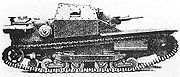
. By 03:00 the Iraqis reached the north-eastern outskirts of the town. Two light tanks, which had penetrated into the town, were quickly destroyed. By dawn British counterattacks had pushed the Iraqis out of north-eastern Fallujah. The Iraqis now switched their attack to the south-eastern edge of the town. But this attack met stiff resistance from the start and made no progress. By 10:00 Kingstone arrived with reinforcements, from Habbaniya, who were immediately thrown into battle. The newly arrived infantry companies, of the Essex Regiment, methodically cleared the Iraqi positions house-by-house. By 18:00 the remaining Iraqis had fled or were taken prisoner, sniper fire was silenced, six Iraqi light tanks were captured, and the town was secure.
On 23 May, aircraft of Fliegerführer Irak made a belated appearance. British positions at Fallujuh were strafed on three separate occasions. But, while a nuisance, the attacks by the Luftwaffe accomplished little. Only one day earlier an air assault coordinated with Iraqi ground forces might have changed the outcome of the counterattack.
, under Brigadier Powell, were used to occupy these sites. Between 18 April and 29 April, two convoys had landed this brigade in the Basra area. 2nd battalion 8th Gurkha Rifles
guarded the RAF airfield at Shabaih, 3rd battalion 11th Sikh Regiment
secured the Maqil docks, and 2nd battalion 7th Gurkha Rifles
was held in reserve. Otherwise, no major operations took place in the Basra area. The principal difficulty was that there were insufficient troops to take over Maqil, Ashar, and Basra City concurrently. While the Iraqi troops in Basra agreed to withdraw on 2 May, they failed to do so.
On 6 May, the 21st Indian Infantry Brigade
under the command of Brigadier C. J. Weld
arrived and disembarked at Basra. This was the 10th Indian Infantry Division's second brigade to arrive in Iraq. The 21st Indian Infantry Brigade included 4th battalion 13th Frontier Force Rifles
, 2nd battalion 4th Gurkha Rifles, and 2nd battalion 10th Gurkha Rifles
.
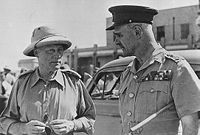 On 8 May, operations in Iraq were passed, from under the control of Auchinleck's India Command, to the command of Wavell’s Middle East Command. Lieutenant-General Edward Quinan
arrived from India to replace Fraser as commander of Iraqforce. Quinan's immediate task was to secure Basra as a base. He was ordered by Wavell not to advance north until the co-operation of the local tribes was fully assured. Quinan could also not contemplate any move north for three months on account of the flooding of the Tigris and Euphrates. Directives were issued to Quinan prior to his assuming command. On 2 May, he had been directed as follows: "(a) Develop and organise the port of Basra to any extent necessary to enable such forces, our own or Allied, as might be required to operate in the Middle East including Egypt, Turkey, Iraq, and Iran, to be maintained. (b) Secure control of all means of communication, including all aerodromes and landing grounds in Iraq, and develop these to the extent requisite to enable the Port of Basra to function to its fullest capacity." Quinan was further instructed to "begin at once to plan a system of defences to protect the Basra Base against attack by armoured forces supported by strong air forces, and also to be ready to take special measures to protect: (i) Royal Air Force installations and personnel at Habbaniya and Shaiba. (ii) The lives of British subjects in Baghdad and elsewhere in Iraq. (iii) The Kirkuk oilfields and the pipe line to Haifa." Lastly, Quinan was directed "to make plans to protect the Anglo-Iranian Oil Company's installations and its British employees in South West Iran if necessary." Quinan was informed that "it was the intention to increase his force up to three infantry divisions and possibly also an armoured division, as soon as these troops could be despatched from India."
On 27 May, the forces from Basra started to advance northwards. In Operation Regulta, the 20th Indian Infantry Brigade, known as the "Euphrates Brigade," advanced along the Euphrates by boat and by road. In Operation Regatta, the 21st Indian Infantry Brigade, known as the "Tigris Brigade," advanced up the Tigris by boat to Kut
.
On May 30, the 10th Indian Infantry Division's third brigade, 25th Indian Infantry Brigade
under Brigadier Ronald Mountain
, arrived and disembarked at Basra. The 25th Indian Infantry Brigade included 3rd battalion 9th Jat Regiment
, 2nd battalion 11th Royal Sikh Regiment
, and 1st battalion 5th Mahratta Light Infantry
.
In June 1941, additional British forces arrived in Basra from India. On 9 June, the 17th Indian Infantry Brigade
arrived and, on 16 June, the 24th Indian Infantry Brigade
arrived.
after successfully defending Fallujah. Major-General Clark decided to maintain the momentum because he expected that the Iraqis did not appreciate just how small and just how vulnerable his forces actually were. Clark had a total of about 1,450 men to attack at least 20,000 Iraqi defenders. However, Clark did enjoy an advantage in the air
.
, and many members of the "National Defence Government" fled to Persia. After Persia, they went on to Germany
.
On the morning of 31 May, the Mayor of Baghdad and a delegation approached British forces at the Washash Bridge. With the Mayor was Sir Kinahan Cornwallis
, the British Ambassador, who had been confined to the British Embassy in Baghdad for the past four weeks. Terms were quickly reached and an armistice
was signed. The Iraqi armed forces in the vicinity of Baghdad still greatly outnumbered the British and the British decided not to occupy Baghdad immediately. This was done partly to disguise the weakness of British forces outside the city. On 1 June, Abdul Illah
returned to Baghdad as the Regent and the monarchy and a pro-British government were put back in place. On 2 June, Jamil al-Midfai
was named Prime Minister.
. Much of the violence was channelled towards the city's Jewish Quarter
. Some 120 Jewish residents
lost their lives and about 850 were injured before the Iraqi police were ordered to restore order with live ammunition.
At least two British accounts of the conflict praised the efforts of the air and ground forces at RAF Habbaniya. According to Churchill, the landing of the 20th Indian Infantry Brigade at Basra on 18 April was "timely." In his opinion, the landing forced Rashid Ali into premature action. However, Churchill added that the "spirited defence" of Habbaniya by the Flying School was a "prime factor" in British success. Wavell wrote that the "gallant defence" of Habbaniya and the bold advance of Habforce discouraged the Iraqi Army, while the Germans in their turn were prevented from sending further reinforcements by "the desperate resistance of our troops in Crete, and their crippling losses in men and aircraft."
On 18 June, Lieutenant-General Quinan was given command of all British and Commonwealth forces in Iraq. Before this, Iraqforce was more or less limited to the forces landed at and advancing from Basra.
After the Anglo-Iraq War, elements of Iraqforce (known as Iraq Command from 21 June) were used to attack the Vichy French-held Mandate of Syria during the Syria-Lebanon campaign
, which started 8 June and ended 14 July. Iraq Command (known as Persia and Iraq Force from 1 September) was also used to attack Persia during the Anglo-Soviet invasion of Persia
, which took place in August to September 1941. Forward defences against a possible German invasion from the north through the Caucasus
were created in 1942 and the strength of Persia and Iraq Force (Paiforce
) peaked at the equivalent of over 10 brigades before the Russians halted the German threat at the Battle of Stalingrad
. After 1942, Iraq and Persia were used to transit war material
to the Soviet Union
and the British military presence became mainly lines of communication troops.
On 20 June, Churchill told Wavell that he was to be replaced by Auchinleck. Of Wavell, Auchinleck wrote: "In no sense do I wish to infer that I found an unsatisfactory situation on my arrival - far from it. Not only was I greatly impressed by the solid foundations laid by my predecessor, but I was also able the better to appreciate the vastness of the problems with which he had been confronted and the greatness of his achievements, in a command in which some 40 different languages are spoken by the British and Allied Forces."
British forces were to remain in Iraq until 26 October 1947 and the country remained effectively under British control. The British considered the occupation of Iraq necessary to ensure that access to its strategic oil resources be maintained. On 18 August 1942, General Maitland Wilson was appointed Commander-in-Chief of the Persia and Iraq Command
. By 15 September, he was headquartered in Baghdad. Wilson's primary task was "to secure at all costs from land and air attack the oil fields and oil installations in Persia and Iraq." His secondary task was "to ensure the transport from the Persian Gulf ports of supplies to Russia to the maximum extent possible without prejudicing [his] primary task."
While Rashid Ali and his supporters were in alliance with the Nazi regime in Germany, the war demonstrated that Iraq's independence was at best conditional on British approval of the government's actions. Rashid Ali and the Mufti of Jerusalem
fled to Persia, then to Turkey
, then to Italy, and finally to Berlin
, Germany, where Ali was welcomed by Hitler as head of the Iraqi government-in-exile.
Rebellion
Rebellion, uprising or insurrection, is a refusal of obedience or order. It may, therefore, be seen as encompassing a range of behaviors aimed at destroying or replacing an established authority such as a government or a head of state...
government of Rashid Ali in the Kingdom of Iraq
Kingdom of Iraq
The Kingdom of Iraq was the sovereign state of Iraq during and after the British Mandate of Mesopotamia. The League of Nations mandate started in 1920. The kingdom began in August 1921 with the coronation of Faisal bin al-Hussein bin Ali al-Hashemi as King Faisal I...
during the Second World War. The war lasted from 2 May to 31 May 1941. The campaign resulted in the re-occupation of Iraq
Iraq
Iraq ; officially the Republic of Iraq is a country in Western Asia spanning most of the northwestern end of the Zagros mountain range, the eastern part of the Syrian Desert and the northern part of the Arabian Desert....
by British armed forces
British Armed Forces
The British Armed Forces are the armed forces of the United Kingdom of Great Britain and Northern Ireland.Also known as Her Majesty's Armed Forces and sometimes legally the Armed Forces of the Crown, the British Armed Forces encompasses three professional uniformed services, the Royal Navy, the...
and the return to power of the ousted pro-British Regent
Regent
A regent, from the Latin regens "one who reigns", is a person selected to act as head of state because the ruler is a minor, not present, or debilitated. Currently there are only two ruling Regencies in the world, sovereign Liechtenstein and the Malaysian constitutive state of Terengganu...
of Iraq, Prince
Prince
Prince is a general term for a ruler, monarch or member of a monarch's or former monarch's family, and is a hereditary title in the nobility of some European states. The feminine equivalent is a princess...
'Abd al-Ilah
'Abd al-Ilah
Crown Prince Abd al-Ilāh of Hejaz, GCB, GCMG, GCVO was a cousin and brother-in-law of King Ghazi of the Kingdom of Iraq. Abdul Ilah served as Regent for King Faisal II from April 4, 1939 to May 2, 1953, when Faisal came of age...
. The campaign further fuelled nationalist
Nationalism
Nationalism is a political ideology that involves a strong identification of a group of individuals with a political entity defined in national terms, i.e. a nation. In the 'modernist' image of the nation, it is nationalism that creates national identity. There are various definitions for what...
resentment in Iraq toward the British-supported Hashemite
Hashemite
Hashemite is the Latinate version of the , transliteration: Hāšimī, and traditionally refers to those belonging to the Banu Hashim, or "clan of Hashim", a clan within the larger Quraish tribe...
monarchy
Monarchy
A monarchy is a form of government in which the office of head of state is usually held until death or abdication and is often hereditary and includes a royal house. In some cases, the monarch is elected...
.
Background
The Kingdom of IraqKingdom of Iraq
The Kingdom of Iraq was the sovereign state of Iraq during and after the British Mandate of Mesopotamia. The League of Nations mandate started in 1920. The kingdom began in August 1921 with the coronation of Faisal bin al-Hussein bin Ali al-Hashemi as King Faisal I...
(also referred to as Mesopotamia
Mesopotamia
Mesopotamia is a toponym for the area of the Tigris–Euphrates river system, largely corresponding to modern-day Iraq, northeastern Syria, southeastern Turkey and southwestern Iran.Widely considered to be the cradle of civilization, Bronze Age Mesopotamia included Sumer and the...
) was governed by the United Kingdom
United Kingdom
The United Kingdom of Great Britain and Northern IrelandIn the United Kingdom and Dependencies, other languages have been officially recognised as legitimate autochthonous languages under the European Charter for Regional or Minority Languages...
under a League of Nations mandate
League of Nations mandate
A League of Nations mandate was a legal status for certain territories transferred from the control of one country to another following World War I, or the legal instruments that contained the internationally agreed-upon terms for administering the territory on behalf of the League...
; the British Mandate of Mesopotamia, until 1932 when Iraq became nominally independent. Before granting independence, the United Kingdom concluded the Anglo-Iraqi Treaty
Anglo-Iraqi Treaty (1930)
The Anglo-Iraqi Treaty of 1930 was a treaty of alliance between the United Kingdom of Great Britain and Northern Ireland and the British-Mandate-controlled administration of the Hashemite Kingdom of Iraq. The treaty was between the governments of George V of the United Kingdom and Faisal I of Iraq...
of 1930. This treaty had several conditions, which included permission to establish military bases for British use and provide all facilities for the unrestricted movement of British forces through the country upon request to the Iraqi government. The conditions of the treaty were imposed by the United Kingdom to ensure continued control of Iraq's petroleum
Petroleum
Petroleum or crude oil is a naturally occurring, flammable liquid consisting of a complex mixture of hydrocarbons of various molecular weights and other liquid organic compounds, that are found in geologic formations beneath the Earth's surface. Petroleum is recovered mostly through oil drilling...
resources. Many Iraqis resented these conditions and felt that their country and its monarchy were still under the effective control of the British Government.
However, following 1937, no British troops were left in Iraq and the Iraqi government had become solely responsible for the internal security of the country. In accordance with the Anglo-Iraqi Treaty, the British Royal Air Force
Royal Air Force
The Royal Air Force is the aerial warfare service branch of the British Armed Forces. Formed on 1 April 1918, it is the oldest independent air force in the world...
(RAF) had been allowed to retain two bases; RAF Shaibah
RAF Shaibah
RAF Shaibah was an RAF station situated at Shaibah about 13 miles south west of the city of Basrah in Iraq. The area was the site of a battle with Turkish Forces during the Mesopotamian campaign of the First World War....
, near Basra
Basra
Basra is the capital of Basra Governorate, in southern Iraq near Kuwait and Iran. It had an estimated population of two million as of 2009...
, and RAF Habbaniya
RAF Habbaniya
Royal Air Force Station Habbaniya, more commonly known as RAF Habbaniya, was a Royal Air Force station at Habbaniyah, about west of Baghdad in modern day Iraq, on the banks of the Euphrates near Lake Habbaniyah...
, between Ramadi
Ramadi
Ramadi is a city in central Iraq, about west of Baghdad. It is the capital of Al Anbar Governorate.-History:Ramadi is located in a fertile, irrigated, alluvial plain.The Ottoman Empire founded Ramadi in 1869...
and Fallujah
Fallujah
Fallujah is a city in the Iraqi province of Al Anbar, located roughly west of Baghdad on the Euphrates. Fallujah dates from Babylonian times and was host to important Jewish academies for many centuries....
. Air Vice-Marshal
Air Vice-Marshal
Air vice-marshal is a two-star air-officer rank which originated in and continues to be used by the Royal Air Force. The rank is also used by the air forces of many countries which have historical British influence and it is sometimes used as the English translation of an equivalent rank in...
H. G. Smart
Harry George Smart
Harry George Smart, CBE, DFC, AFC, is best known as the commander of RAF Habbaniya during the first part of the Anglo-Iraqi War. Smart was a British officer in the British Army, the Royal Flying Corps, the Royal Australian Air Force, and the Royal Air Force...
was the commander of RAF Habbaniya and Air Officer Commanding
Air Officer Commanding
Air Officer Commanding is a title given in the air forces of Commonwealth nations to an air officer who holds a command appointment. Thus, an air vice marshal might be the AOC 38 Group...
of all RAF forces in Iraq
RAF Iraq Command
Iraq Command was the RAF commanded inter-service command in charge of British forces in Iraq in the 1920s and early 1930s, during the period of the British Mandate of Mesopotamia. It continued as British Forces in Iraq until 1941 when it was replaced by AHQ Iraq...
. The bases in Iraq had a dual role: protecting Britain's petroleum interests and maintaining a link in the air route between Egypt
Kingdom of Egypt
The Kingdom of Egypt was the first modern Egyptian state, lasting from 1922 to 1953. The Kingdom was created in 1922 when the British government unilaterally ended its protectorate over Egypt, in place since 1914. Sultan Fuad I became the first king of the new state...
and India
British Raj
British Raj was the British rule in the Indian subcontinent between 1858 and 1947; The term can also refer to the period of dominion...
. In addition RAF Habbaniya was also a training base and was protected by a small detachment of RAF ground forces
RAF Regiment
The Royal Air Force Regiment is a specialist airfield defence corps founded by Royal Warrant in 1942. After a 32 week trainee gunner course, its members are trained and equipped to prevent a successful enemy attack in the first instance; minimise the damage caused by a successful attack; and...
and locally raised Iraqi troops.
With the outbreak of the Second World War in September 1939 the Iraqi Government broke off diplomatic relations with Nazi Germany
Nazi Germany
Nazi Germany , also known as the Third Reich , but officially called German Reich from 1933 to 1943 and Greater German Reich from 26 June 1943 onward, is the name commonly used to refer to the state of Germany from 1933 to 1945, when it was a totalitarian dictatorship ruled by...
. However, the United Kingdom wanted the Iraqi Government to take a further step and declare war upon Germany. In March 1940, the nationalist and anti-British Rashid Ali replaced Nuri as-Said
Nuri as-Said
Nuri Pasha al-Said was an Iraqi politician during the British Mandate and during the Kingdom of Iraq. He served in various key cabinet positions, and served seven terms as Prime Minister of Iraq....
. Ali made covert contacts with German representatives in the Middle East
Middle East
The Middle East is a region that encompasses Western Asia and Northern Africa. It is often used as a synonym for Near East, in opposition to Far East...
, though he was not yet an openly pro-Axis supporter.
In June 1940, when Fascist Italy joined the war, on the side of Germany, the Iraqi government did not break off diplomatic relations, as they had done with Germany. Thus the Italian Legation in Baghdad became the chief centre for Axis propaganda and for fomenting anti-British feeling. In this they were aided by Mohammad Amin al-Husayni
Mohammad Amin al-Husayni
Haj Mohammed Effendi Amin el-Husseini was a Palestinian Arab nationalist and Muslim leader in the British Mandate of Palestine. From as early as 1920, in order to secure the independence of Palestine as an Arab state he actively opposed Zionism, and was implicated as a leader of a violent riot...
, the Grand Mufti of Jerusalem
Grand Mufti of Jerusalem
The Grand Mufti of Jerusalem is the Sunni Muslim cleric in charge of Jerusalem's Islamic holy places, including the Al-Aqsa Mosque.-Ottoman era:...
. The Grand Mufti had fled from Palestine shortly before the outbreak of war and later received asylum in Baghdad.
In January 1941, there was a political crisis within Iraq and the threat of civil war was looming. Rashid Ali resigned as Prime Minister
Prime minister
A prime minister is the most senior minister of cabinet in the executive branch of government in a parliamentary system. In many systems, the prime minister selects and may dismiss other members of the cabinet, and allocates posts to members within the government. In most systems, the prime...
of Iraq and was replaced by Taha al-Hashimi
Taha al-Hashimi
Taha al-Hashimi served briefly as prime minister of Iraq for two months, from February 1, 1941, to April 1, 1941. He was appointed prime minister by the regent, 'Abd al-Ilah, following the first ouster of the pro-Axis government of Rashid Ali al-Kaylani during World War II...
. Public opinion started to change in Iraq as the Italians suffered a series of setbacks in the African and Mediterranean theatre.
Coup d'état
On 31 March, the RegentRegent
A regent, from the Latin regens "one who reigns", is a person selected to act as head of state because the ruler is a minor, not present, or debilitated. Currently there are only two ruling Regencies in the world, sovereign Liechtenstein and the Malaysian constitutive state of Terengganu...
of Iraq, Amir Abdul Illah
'Abd al-Ilah
Crown Prince Abd al-Ilāh of Hejaz, GCB, GCMG, GCVO was a cousin and brother-in-law of King Ghazi of the Kingdom of Iraq. Abdul Ilah served as Regent for King Faisal II from April 4, 1939 to May 2, 1953, when Faisal came of age...
, learnt of a plot to arrest him and he fled Baghdad
Baghdad
Baghdad is the capital of Iraq, as well as the coterminous Baghdad Governorate. The population of Baghdad in 2011 is approximately 7,216,040...
for RAF Habbaniya. From Habbaniya he was flown to Basra and given refuge on the gunboat
Insect class gunboat
The Insect class patrol boats were a class of small, but well-armed Royal Navy ships designed for use in shallow rivers or inshore. They were intended for use on the Danube...
HMS Cockchafer
HMS Cockchafer (1915)
HMS Cockchafer was a Royal Navy Insect class gunboat. She was built by Barclay Curle and launched on 17 December 1915 as the 5th Royal Navy ship to carry this name...
.
On 1 April, Rashid Ali, along with four top level Army and Air Force officers; known as the "Golden Square
Golden Square (Iraq)
The Golden Square was a group of four officers of the Iraqi armed forces who played a part in Iraqi politics throughout the 1930s and early 1940s...
," seized power via a coup d'état
Iraq coup (1941)
The 1941 Iraqi coup d'état, also known as the Rashid Ali Al-Gaylani coup or the Golden Square coup was a pro-Nazi military coup in Iraq on April 1, 1941 that overthrew the regime of Regent 'Abd al-Ilah and installed Rashid Ali as Prime Minister...
and Rashid Ali proclaimed himself Chief of the "National Defence Government." The Golden Square deposed Prime Minister Taha al-Hashimi
Taha al-Hashimi
Taha al-Hashimi served briefly as prime minister of Iraq for two months, from February 1, 1941, to April 1, 1941. He was appointed prime minister by the regent, 'Abd al-Ilah, following the first ouster of the pro-Axis government of Rashid Ali al-Kaylani during World War II...
and Rashid Ali once again became Prime Minister of Iraq. Rashid Ali did not move to overthrow the monarchy
Monarchy
A monarchy is a form of government in which the office of head of state is usually held until death or abdication and is often hereditary and includes a royal house. In some cases, the monarch is elected...
and named a new Regent to King Faisal II
Faisal II of Iraq
Faisal II was the last King of Iraq. He reigned from 4 April 1939 until July 1958, when he was killed during the "14 July Revolution" together with several members of his family...
, Sherif Sharaf. The leaders of the "National Defence Government" proceeded to arrest many pro-British citizens and politicians. However, a good number of those sought managed to escape by various means through Amman
Amman
Amman is the capital of Jordan. It is the country's political, cultural and commercial centre and one of the oldest continuously inhabited cities in the world. The Greater Amman area has a population of 2,842,629 as of 2010. The population of Amman is expected to jump from 2.8 million to almost...
in Transjordan
Transjordan
The Emirate of Transjordan was a former Ottoman territory in the Southern Levant that was part of the British Mandate of Palestine...
.
The immediate plans of Iraq's new leaders were to refuse further concessions to the United Kingdom, to retain diplomatic links with Fascist Italy, and to expel most prominent pro-British politicians from the country. The plotters of the coup considered the United Kingdom to be weak and believed that its government would negotiate with their new government regardless of its legality. On 17 April, Rashid Ali, on behalf of the "National Defence Government," asked Germany for military assistance in the event of war with the British. Ultimately, Rashid Ali attempted to restrict British rights guaranteed under Article 5 of the 1930 treaty when he insisted that newly arrived British troops be quickly transported through Iraq and to Palestine.
Iraqi forces
Before the war, the United Kingdom provided support and training to the Royal Iraqi Army (RIrA) and the Royal Iraqi Air Force (RIrAF) through a small military mission based in Baghdad. From 1938, Major-General G. G. Waterhouse commanded the British mission.The RIrA was composed of four infantry divisions with some 60,000 men distributed for the most part into four infantry divisions and one mechanized brigade. The 1st
1st Division (Iraq)
The 1st Division, Iraqi Army is a formation of the Army formed c.2005-2007.The 1st Division was originally formed from the battalions of the Iraqi Intervention Force....
and 3rd
3rd Division (Iraq)
The 3rd Division is a formation of the Iraqi Army. It was active by 1941, disbanded along with the rest of the Iraqi Army in 2003, but reactivated by 2005.-History:...
Divisions were stationed near Baghdad. Also based within Baghdad was the Independent Mechanized Brigade, composed of a light tank company, an armoured car company, two battalions of "mechanized" infantry transported in trucks, a "mechanized" machine-gun company, and a "mechanized" artillery brigade. The Iraqi 2nd Division
2nd Division (Iraq)
The 2nd Division is a formation of the Iraqi Army. It is headquartered at Mosul. The 2nd Division is one of the most experienced formations in the Iraqi Army. The division is today engaged in totality in the city of Mosul to assure its security....
was stationed in Kirkuk
Kirkuk
Kirkuk is a city in Iraq and the capital of Kirkuk Governorate.It is located in the Iraqi governorate of Kirkuk, north of the capital, Baghdad...
and the 4th Division
4th Division (Iraq)
The 4th Division is a infantry formation of the Iraqi Army. It was formed before 1941, disbanded in 2003, but reactivated after 2004.It was one of the four original divisions of the Iraqi Army, being active in 1941. At the beginning of the Anglo-Iraqi War it was in Al Diwaniyah on the main rail...
was in Al Diwaniyah
Al Diwaniyah
Al Diwaniyah is the capital city of Iraq's Al-Qādisiyyah Governorate. In 2002, its population was estimated at 440,927. The area around Al Diwaniyah, which is well irrigated from the nearby Euphrates river, is often considered to be one on the most fertile parts of Iraq, and is heavily cultivated...
on the main rail line from Baghdad to Basra. Unlike the modern use of the term "mechanized," in 1941 "mechanized" for the RIrA meant transported by trucks.
In addition to the regular army, the Iraqis fielded some police units and approximately 500 "irregulars
Irregular military
Irregular military refers to any non-standard military. Being defined by exclusion, there is significant variance in what comes under the term. It can refer to the type of military organization, or to the type of tactics used....
" under Arab guerrilla leader Fawzi al-Qawuqji
Fawzi Al-Qawuqji
Fawzi al-Qawuqji was the field commander of the Arab Liberation Army during the 1948 Arab-Israeli War in Palestine, and a rival of the principal Palestinian Arab leader, the Grand Mufti of Jerusalem, Haj Amin al-Husseini.-Biography:...
. Fawzi al-Qawuqji was a ruthless fighter who did not hesitate to murder or mutilate his prisoners. For the most part, Fawzi al-Qawuqji and his irregulars operated in the area between Rutbah and Ramadi
Ramadi
Ramadi is a city in central Iraq, about west of Baghdad. It is the capital of Al Anbar Governorate.-History:Ramadi is located in a fertile, irrigated, alluvial plain.The Ottoman Empire founded Ramadi in 1869...
before being chased back into Syria.
RAF Hinaidi
Royal Air Force Station Hinaidi, more commonly known as RAF Hinaida, was a British Royal Air Force station near Baghdad in the Kingdom of Iraq...
) or in Mosul
Mosul
Mosul , is a city in northern Iraq and the capital of the Ninawa Governorate, some northwest of Baghdad. The original city stands on the west bank of the Tigris River, opposite the ancient Assyrian city of Nineveh on the east bank, but the metropolitan area has now grown to encompass substantial...
. Four squadrons and the Flying Training School were based in Baghdad. Two squadrons with close co-operation and general purpose aircraft were based in Mosul. The Iraqis flew an assortment of aircraft types that included Gladiator
Gloster Gladiator
The Gloster Gladiator was a British-built biplane fighter. It was used by the Royal Air Force and the Royal Navy and was exported to a number of other air forces during the late 1930s. It was the RAF's last biplane fighter aircraft and was rendered obsolete by newer monoplane designs even as it...
biplane fighters, Breda 65 fighter bombers, Savoia SM79
Savoia-Marchetti SM.79
The Savoia-Marchetti SM.79 Sparviero was a three-engined Italian medium bomber with a wood and metal structure. Originally designed as a fast passenger aircraft, this low-wing monoplane, in the years 1937–39, set 26 world records that qualified it for some time as the fastest medium bomber in the...
medium bombers, Northrop/Douglas 8A
Northrop A-17
The Northrop A-17, a development of the Northrop Gamma 2F was a two seat, single engine, monoplane, attack bomber built in 1935 by the Northrop Corporation for the US Army Air Corps.-Development and design:...
fighter bombers, Hawker Nisr
Hawker Hart
The Hawker Hart was a British two-seater biplane light bomber of the Royal Air Force , which had a prominent role during the RAF's inter-war period. The Hart was designed during the 1920s by Sydney Camm and built by Hawker Aircraft...
biplane close co-operation aircraft, Vickers Vincent biplane light bombers, de Havilland Dragon
De Havilland Dragon
|-See also:-References:Bibliography ISBN 0-85177-813-5...
biplane general purpose aircraft, de Havilland Dragonfly
De Havilland Dragonfly
-References:*The Illustrated Encyclopedia of Aircraft . London: Orbis Publishing.*Hayes, P & King, B. de Havilland biplane transports. Coulsden: Gatwick Aviation Society ISBN 0 95304132 8...
biplane general purpose aircraft, and Tiger Moth
Tiger moth
Tiger moths are moths of the family Arctiidae.Tiger moth may also refer to:*de Havilland Tiger Moth, an aircraft; an aerobatic and trainer tailwheel biplane*de Havilland DH.71 Tiger Moth, an earlier monoplane produced by de Havilland...
biplane trainers. In addition to the 116 aircraft, the Iraqi Air Force had another 9 aircraft not allocated to specific squadrons and 19 aircraft available in reserve.
The Royal Iraqi Navy (RIrN) had four 100-ton Thornycroft
John I. Thornycroft & Company
John I. Thornycroft & Company Limited, usually known simply as Thornycroft was a British shipbuilding firm started by John Isaac Thornycroft in the 19th century.-History:...
gunboat
Gunboat
A gunboat is a naval watercraft designed for the express purpose of carrying one or more guns to bombard coastal targets, as opposed to those military craft designed for naval warfare, or for ferrying troops or supplies.-History:...
s, one pilot vessel, and one minesweeper
Minesweeper (ship)
A minesweeper is a small naval warship designed to counter the threat posed by naval mines. Minesweepers generally detect then neutralize mines in advance of other naval operations.-History:...
. All were armed and all were based in the Shatt al-Arab waterways.
British and commonwealth forces
On 1 April 1941, when the Iraqi coup d'état took place, the British and CommonwealthCommonwealth of Nations
The Commonwealth of Nations, normally referred to as the Commonwealth and formerly known as the British Commonwealth, is an intergovernmental organisation of fifty-four independent member states...
forces available within Iraq were very limited. Air Vice-Marshal Smart commanded the Royal Air Force
Royal Air Force
The Royal Air Force is the aerial warfare service branch of the British Armed Forces. Formed on 1 April 1918, it is the oldest independent air force in the world...
-led inter-service
British Armed Forces
The British Armed Forces are the armed forces of the United Kingdom of Great Britain and Northern Ireland.Also known as Her Majesty's Armed Forces and sometimes legally the Armed Forces of the Crown, the British Armed Forces encompasses three professional uniformed services, the Royal Navy, the...
command
Command (military formation)
A command in military terminology is an organisational unit that the individual in Military command has responsibility for. A Commander will normally be specifically appointed into the role in order to provide a legal framework for the authority bestowed...
, "British Forces in Iraq
RAF Iraq Command
Iraq Command was the RAF commanded inter-service command in charge of British forces in Iraq in the 1920s and early 1930s, during the period of the British Mandate of Mesopotamia. It continued as British Forces in Iraq until 1941 when it was replaced by AHQ Iraq...
."
Ground forces available to Smart included Number 1 Armoured Car Company RAF
Number 1 Armoured Car Company RAF
The Number 1 Armoured Car Company RAF was a military unit of the Britain's Royal Air Force which played a role in the defense of RAF Habbaniya during World War II.- Creation :...
and six companies of Assyrian Levies
Assyrian Levies
The Iraq Levies was the first Iraqi military forces established by the British in British controlled Iraq. The Iraq Levies were a most noteworthy feature of the Kingdom of Iraq, and especially of northern Iraq during the years of the mandate, and no account of the Assyrians or indeed of Iraq itself...
. The armoured car company comprised 18 ancient Rolls Royce armoured cars
Rolls-Royce Armoured Car
The Rolls-Royce armoured car was a British armoured car developed in 1914 and used in World War I and in the early part of World War II.-Production history:...
of World War I
World War I
World War I , which was predominantly called the World War or the Great War from its occurrence until 1939, and the First World War or World War I thereafter, was a major war centred in Europe that began on 28 July 1914 and lasted until 11 November 1918...
vintage. The Assyrian Levies totaled almost 2,000 locally raised officers and other ranks under the command of about 20 British officers.
At RAF Habbaniah, the 4th Service Flying Training School had a wide variety of obsolescent bombers, fighters and trainers. However, many of the 84 aircraft available could not be flown or were not appropriate for offensive use. In addition, at the start of battle, there were about 1000 RAF personnel but only 39 pilots. All told, on 1 April, the British had 3 old Gladiator
Gloster Gladiator
The Gloster Gladiator was a British-built biplane fighter. It was used by the Royal Air Force and the Royal Navy and was exported to a number of other air forces during the late 1930s. It was the RAF's last biplane fighter aircraft and was rendered obsolete by newer monoplane designs even as it...
biplane fighters, 30 Hawker Audax biplane close co-operation aircraft, 7 Fairey Gordon
Fairey Gordon
|-See also:-External links:* * *...
biplane bombers, 27 twin-engine Oxford
Airspeed Oxford
The Airspeed AS.10 Oxford was a twin-engine aircraft used for training British Commonwealth aircrews in navigation, radio-operating, bombing and gunnery during the Second World War.-Design and development:...
trainers, 28 Hawker Hart
Hawker Hart
The Hawker Hart was a British two-seater biplane light bomber of the Royal Air Force , which had a prominent role during the RAF's inter-war period. The Hart was designed during the 1920s by Sydney Camm and built by Hawker Aircraft...
biplane light bombers (the "bomber" version of the Hawker Audax), 20 Hart trainers, and 1 Bristol Blenheim Mk1
Bristol Blenheim
The Bristol Blenheim was a British light bomber aircraft designed and built by the Bristol Aeroplane Company that was used extensively in the early days of the Second World War. It was adapted as an interim long-range and night fighter, pending the availability of the Beaufighter...
bomber. The Gladiators were used as officers' runabouts. The Hawker Audaxes could carry eight 20 lb bombs (12 Audaxes were modified to carry two 250 lb bombs). The Fairy Gordons could each carry two 250 lb bombs. The Oxfords were converted from carrying smoke bombs to carrying eight 20 lb bombs. The Hawker Harts could carry two 250 lb bombs. The Hawker trainers had no weaponry. The Blenheim left for good on 3 May. There was also an "RAF Iraq Communications Flight" at Habbaniya with 3 Vickers Valentia flying boats.
At RAF Shaibah there was the No. 244 Bomber Squadron
No. 244 Squadron RAF
No. 244 Squadron RAF was a Royal Air Force Squadron formed as an anti–submarine unit in World War I and a bomber unit in the Middle East in World War II.-Formation and World War I:No...
with some Vickers Vincents.
The naval forces available to support British actions in Iraq were part of the East Indies Station
East Indies Station
The East Indies Station was a formation of the British Royal Navy from 1865 to 1941.From 1831 to 1865 the East Indies and the China Station were a single command known as the East Indies and China Station...
and included vessels from the Royal Navy
Royal Navy
The Royal Navy is the naval warfare service branch of the British Armed Forces. Founded in the 16th century, it is the oldest service branch and is known as the Senior Service...
, the Royal Australian Navy
Royal Australian Navy
The Royal Australian Navy is the naval branch of the Australian Defence Force. Following the Federation of Australia in 1901, the ships and resources of the separate colonial navies were integrated into a national force: the Commonwealth Naval Forces...
, the Royal New Zealand Navy
Royal New Zealand Navy
The Royal New Zealand Navy is the maritime arm of the New Zealand Defence Force...
, and the Royal Indian Navy
Royal Indian Navy
The Royal Indian Navy was the naval force of British India. Along with the Presidency armies and the later British Indian Army it comprised the Armed Forces of British India....
.
British response
The British perspective was that relations with Rashid Ali's "National Defence Government" had become increasingly unsatisfactory. By treaty, Iraq was pledged to provide assistance to the United Kingdom in war and to permit the passage of British troops through Iraq. There was a British Military Mission with the Iraq Army and the Royal Air Force had stations at Habbaniya and at Shaibah. From the outset, British Prime MinisterPrime Minister of the United Kingdom
The Prime Minister of the United Kingdom of Great Britain and Northern Ireland is the Head of Her Majesty's Government in the United Kingdom. The Prime Minister and Cabinet are collectively accountable for their policies and actions to the Sovereign, to Parliament, to their political party and...
Winston Churchill
Winston Churchill
Sir Winston Leonard Spencer-Churchill, was a predominantly Conservative British politician and statesman known for his leadership of the United Kingdom during the Second World War. He is widely regarded as one of the greatest wartime leaders of the century and served as Prime Minister twice...
advocated the non-recognition of Rashid Ali or his illegal
Stratocracy
A stratocracy is a form of government headed by military chiefs; the term is derived from two Greek terms signifying army and power. It is not the same as a military dictatorship where the military's political power is not enforced or even supported by other laws...
"National Defence Government."
On 2 April, Sir
Sir
Sir is an honorific used as a title , or as a courtesy title to address a man without using his given or family name in many English speaking cultures...
Kinahan Cornwallis
Kinahan Cornwallis
Sir Kirnahan Cornwallis, GCMG, CBE, DSO was a British administrator and diplomat best known for being an advisor to King Faisal and for being the British Ambassador to the Kingdom of Iraq during the Anglo-Iraqi War.-Biography:...
, the new British Ambassador to Iraq, arrived in Baghdad. He had much experience in Mesopotamia
Mesopotamia
Mesopotamia is a toponym for the area of the Tigris–Euphrates river system, largely corresponding to modern-day Iraq, northeastern Syria, southeastern Turkey and southwestern Iran.Widely considered to be the cradle of civilization, Bronze Age Mesopotamia included Sumer and the...
and had spent twenty years in the country as the advisor to King Faisal I
Faisal I of Iraq
Faisal bin Hussein bin Ali al-Hashemi, was for a short time King of the Arab Kingdom of Syria or Greater Syria in 1920, and was King of the Kingdom of Iraq from 23 August 1921 to 1933...
. Cornwallis was highly regarded and he was sent to Iraq with the understanding that he would be able to hold a more forceful line with the new Iraqi government than had hitherto been the case. Unfortunately, Cornwallis arrived in Iraq too late to prevent the outbreak of war.
On 6 April, AVM Smart requested reinforcements, but his request was rejected by Air Officer Commanding
Air Officer Commanding
Air Officer Commanding is a title given in the air forces of Commonwealth nations to an air officer who holds a command appointment. Thus, an air vice marshal might be the AOC 38 Group...
in the Middle East
RAF Middle East Command
Middle East Command was a command of the Royal Air Force formed on December 29, 1941 by renaming Headquarters RAF Middle East. During the early part of the Second World War the Command was one of the three major British service commands in the Middle East, the others being the British Army's...
Sir Arthur Longmore
Arthur Longmore
Air Chief Marshal Sir Arthur Murray Longmore GCB, DSO was an early naval aviator, before reaching high rank in the Royal Air Force.-Biography:...
. At this point in the war
World War II
World War II, or the Second World War , was a global conflict lasting from 1939 to 1945, involving most of the world's nations—including all of the great powers—eventually forming two opposing military alliances: the Allies and the Axis...
, the situation developing in Iraq did not figure highly in British priorities. Churchill wrote, "Libya
Western Desert Campaign
The Western Desert Campaign, also known as the Desert War, was the initial stage of the North African Campaign during the Second World War. The campaign was heavily influenced by the availability of supplies and transport. The ability of the Allied forces, operating from besieged Malta, to...
counts first, withdrawal of troops from Greece
Battle of Greece
The Battle of Greece is the common name for the invasion and conquest of Greece by Nazi Germany in April 1941. Greece was supported by British Commonwealth forces, while the Germans' Axis allies Italy and Bulgaria played secondary roles...
second. Tobruk
Siege of Tobruk
The siege of Tobruk was a confrontation that lasted 240 days between Axis and Allied forces in North Africa during the Western Desert Campaign of the Second World War...
shipping, unless indispensable to victory, must be fitted in as convenient. Iraq can be ignored and Crete
Battle of Crete
The Battle of Crete was a battle during World War II on the Greek island of Crete. It began on the morning of 20 May 1941, when Nazi Germany launched an airborne invasion of Crete under the code-name Unternehmen Merkur...
worked up later."
The British Chiefs-of-Staff
Chiefs of Staff Committee
The Chiefs of Staff Committee is composed of the most senior military personnel in the British Armed Forces.-History:The Chiefs of Staff Committee was initially established as a sub-committee of the Committee of Imperial Defence in 1923. It remained as such until the abolition of the CID upon the...
, with the vocal support of the Commander-in-Chief, India
Commander-in-Chief, India
During the period of the British Raj, the Commander-in-Chief, India was the supreme commander of the Indian Army. The Commander-in-Chief and most of his staff were based at General Headquarters, India, and liaised with the civilian Governor-General of India...
General
General
A general officer is an officer of high military rank, usually in the army, and in some nations, the air force. The term is widely used by many nations of the world, and when a country uses a different term, there is an equivalent title given....
Claude Auchinleck
Claude Auchinleck
Field Marshal Sir Claude John Eyre Auchinleck, GCB, GCIE, CSI, DSO, OBE , nicknamed "The Auk", was a British army commander during World War II. He was a career soldier who spent much of his military career in India, where he developed a love of the country and a lasting affinity for the soldiers...
, were in favour of armed intervention. However, the three Commander-in-Chief
Commander-in-Chief
A commander-in-chief is the commander of a nation's military forces or significant element of those forces. In the latter case, the force element may be defined as those forces within a particular region or those forces which are associated by function. As a practical term it refers to the military...
s, of the British armed forces in the Middle East and eastern Mediterranean area, already heavily committed with fighting in Libya
Western Desert Campaign
The Western Desert Campaign, also known as the Desert War, was the initial stage of the North African Campaign during the Second World War. The campaign was heavily influenced by the availability of supplies and transport. The ability of the Allied forces, operating from besieged Malta, to...
, in East Africa
East African Campaign (World War II)
The East African Campaign was a series of battles fought in East Africa during World War II by the British Empire, the British Commonwealth of Nations and several allies against the forces of Italy from June 1940 to November 1941....
, and in Greece
Battle of Greece
The Battle of Greece is the common name for the invasion and conquest of Greece by Nazi Germany in April 1941. Greece was supported by British Commonwealth forces, while the Germans' Axis allies Italy and Bulgaria played secondary roles...
, suggested the only forces they would be able to use against Iraq was a single battalion of infantry, based within Palestine, and the aircraft already based within Iraq. The Government of India
British Raj
British Raj was the British rule in the Indian subcontinent between 1858 and 1947; The term can also refer to the period of dominion...
had a long standing commitment to prepare one infantry division in case it should be needed to protect the Anglo-Iranian oilfields and in July 1940 the leading brigade of this division, the 5th Indian Infantry Division, was ordered to be dispatched to Iraq. However, in August the division was placed under the command of Middle East Command
Middle East Command
The Middle East Command was a British Army Command established prior to the Second World War in Egypt. Its primary role was to command British land forces and co-ordinate with the relevant naval and air commands to defend British interests in the Middle East and eastern Mediterranean region.The...
and was diverted to the Sudan
Sudan
Sudan , officially the Republic of the Sudan , is a country in North Africa, sometimes considered part of the Middle East politically. It is bordered by Egypt to the north, the Red Sea to the northeast, Eritrea and Ethiopia to the east, South Sudan to the south, the Central African Republic to the...
. Since then, India Command had been investigating the move of troops by air from India to RAF Shaibah.
Brigade group diverted from Malaya
On 8 April, Winston Churchill contacted Leo Amery, Secretary of State for IndiaSecretary of State for India
The Secretary of State for India, or India Secretary, was the British Cabinet minister responsible for the government of India and the political head of the India Office...
, and asked him what force could be quickly sent from India to Iraq. Amery contacted General Auchinleck and Lord Linlithgow
Victor Hope, 2nd Marquess of Linlithgow
Victor Alexander John Hope, 2nd Marquess of Linlithgow KG, KT, GCSI, GCIE, OBE, PC was a British statesman who served as Governor-General and Viceroy of India from 1936 to 1943.-Early life and family:...
, Viceroy and Governor-General of India
Governor-General of India
The Governor-General of India was the head of the British administration in India, and later, after Indian independence, the representative of the monarch and de facto head of state. The office was created in 1773, with the title of Governor-General of the Presidency of Fort William...
, the same day. The response from India was that the majority of one brigade group
Brigade group
A brigade group is a term used primarily in armies of the Commonwealth of Nations for an ad hoc arrangement of forces and not a permanent organisation whereas, with a capital G, a Brigade Group is....
, that was due to set sail for Malaya
British Malaya
British Malaya loosely described a set of states on the Malay Peninsula and the Island of Singapore that were brought under British control between the 18th and the 20th centuries...
on 10 April, could be diverted to Basra and the rest of the group dispatched ten days later. In addition 390 British infantrymen could be flown from India into RAF Shaibah. It was also stated that when shipping became available this force could quickly be built up to a division in strength. On 10 April this offer was accepted by London and the move of these forces was codenamed Operation Sabine. On the same day General Archibald Wavell
Archibald Wavell, 1st Earl Wavell
Field Marshal Archibald Percival Wavell, 1st Earl Wavell GCB, GCSI, GCIE, CMG, MC, PC was a British field marshal and the commander of British Army forces in the Middle East during the Second World War. He led British forces to victory over the Italians, only to be defeated by the German army...
, Commander-in-Chief of Middle East Command, informed London that he could no longer spare the one battalion in Palestine and urged for firm diplomatic action, and possibly a demonstration of air strength, to be taken rather than military intervention.
On 10 April, Major-General William Fraser
William Archibald Kenneth Fraser
William Archibald Kenneth Fraser, CB, CBE, DSO, MVO, MC was an officer in the British Indian Army during World War I and World War II.-Biography:...
assumed control over Iraqforce
Iraqforce
Iraqforce was a British and Commonwealth formation that came together in the Kingdom of Iraq. The formation fought in the Middle East during World War II.-Background:...
, the land forces from India headed for Basra. Fraser was given the following instructions: (i) "The object of his force was to occupy the Basra-Shabai area in order to ensure the safe disembarkation of further reinforcements and to enable a base to be established in that area. (ii) The attitude of the Iraqi Army and local authorities was still uncertain and it was possible that attempts might be made to oppose the disembarkation of his force. In framing his plan for disembarkation, he was, therefore, to act in the closest concert with the officer commanding the Naval Forces. (iii) Should the disembarkation be opposed, he was to overcome the Iraqi forces by force and occupy suitable defensive positions ashore as quickly as possible. (iv) The greatest care was to be taken not to infringe on the neutrality of Iran."
Starting in early April, preparations in case of hostilities were made at Habbaniya. Aircraft were modified to allow them to carry bombs, while light bombers such as the Hawker Audax
Hawker Hart
The Hawker Hart was a British two-seater biplane light bomber of the Royal Air Force , which had a prominent role during the RAF's inter-war period. The Hart was designed during the 1920s by Sydney Camm and built by Hawker Aircraft...
were modified to carry larger bombs.
On 12 April, Convoy BP7, left Karachi
Karachi
Karachi is the largest city, main seaport and the main financial centre of Pakistan, as well as the capital of the province of Sindh. The city has an estimated population of 13 to 15 million, while the total metropolitan area has a population of over 18 million...
. The convoy was composed of eight transports escorted by the Grimsby Class sloop
Grimsby class sloop
With the realisation that war was approaching, 13 Grimsby class sloops were laid down in the mid to late 1930s. Of these eight were built in the United Kingdom for the Royal Navy, four in Australia for the Royal Australian Navy and one for India...
HMAS Yarra
HMAS Yarra (U77)
HMAS Yarra , named for the Yarra River, was a Grimsby class sloop of the Royal Australian Navy that served during World War II. Commissioned in 1936, Yarra spent the early part of the war in Australian waters, then was transferred to the East Indies Station in 1940...
. The forces transported by the convoy were under the command of Major-General Fraser, the commanding officer of the 10th Indian Infantry Division
Indian 10th Infantry Division
The Indian 10th Infantry Division was a war formed Infantry division of the Indian Army during World War II. In four years, the division traveled over from Tehran to Trieste, fought three little wars, and fought two great campaigns: Anglo-Iraqi War, Invasion of Syria-Lebanon, Anglo-Soviet invasion...
. The forces being transported consisted of two senior staff officers from the l0th Indian Division headquarters, the 20th Indian Infantry Brigade
20th Indian Infantry Brigade
The 20th Indian Infantry Brigade was an Infantry formation of the Indian Army during World War II. It was formed in September 1940, by the conversion of the Khojak Brigade and assigned to the 9th Indian Infantry Division...
, the personnel of the Royal Artillery's 3rd Field Regiment; but without their guns, and certain ancillary troops.
Royal Navy
The Royal Navy is the naval warfare service branch of the British Armed Forces. Founded in the 16th century, it is the oldest service branch and is known as the Senior Service...
force of four ships in the Persian Gulf
Persian Gulf
The Persian Gulf, in Southwest Asia, is an extension of the Indian Ocean located between Iran and the Arabian Peninsula.The Persian Gulf was the focus of the 1980–1988 Iran-Iraq War, in which each side attacked the other's oil tankers...
were reinforced by the aircraft carrier
Aircraft carrier
An aircraft carrier is a warship designed with a primary mission of deploying and recovering aircraft, acting as a seagoing airbase. Aircraft carriers thus allow a naval force to project air power worldwide without having to depend on local bases for staging aircraft operations...
HMS Hermes
HMS Hermes (95)
HMS Hermes was an aircraft carrier built for the Royal Navy. The ship was begun during World War I and finished after the war ended. She was the world's first ship to be designed and built as an aircraft carrier, although the Imperial Japanese Navy's was the first to be commissioned...
and two light cruiser
Light cruiser
A light cruiser is a type of small- or medium-sized warship. The term is a shortening of the phrase "light armored cruiser", describing a small ship that carried armor in the same way as an armored cruiser: a protective belt and deck...
s, the HMS Emerald
HMS Emerald (D66)
HMS Emerald was an Emerald-class light cruiser of the Royal Navy. She was built by Armstrong , with the keel being laid down on 23 September 1918...
and the HMNZS Leander
HMNZS Leander
HMNZS Leander was a light cruiser which served with the Royal New Zealand Navy during World War II. She was the lead ship of a class of eight ships, the Leander class light cruiser and was initially named HMS Leander.- History :...
. The HMS Hermes carried the Fairey Swordfish
Fairey Swordfish
The Fairey Swordfish was a torpedo bomber built by the Fairey Aviation Company and used by the Fleet Air Arm of the Royal Navy during the Second World War...
torpedo bombers of 814 Squadron
814 Naval Air Squadron
814 Naval Air Squadron is a squadron of the Royal Navy Fleet Air Arm. It was formed in December 1938 and has been disbanded and reformed several times. Its nickname is "the Flying Tigers", not to be confused with the American Volunteer squadron of WWII....
. The naval vessels which covered the disembarkation at Basra consisted of the aircraft carrier HMS Hermes, the light cruiser HMS Emerald, the light cruiser HMNZS Leander, the sloop
Sloop
A sloop is a sail boat with a fore-and-aft rig and a single mast farther forward than the mast of a cutter....
HMS Falmouth
HMS Calliope (shore establishment)
HMS Calliope is a training centre and 'stone frigate' of the Royal Naval Reserve, located in Gateshead, Tyne and Wear.-History:A Tyne-based division of the Royal Naval Reserve was established in 1905, and used the old Calypso class third class cruiser HMS Calliope as its drill ship...
, the gunboat HMS Cockchafer, the sloop HMS Seabelle, the minesweeper
Minesweeper (ship)
A minesweeper is a small naval warship designed to counter the threat posed by naval mines. Minesweepers generally detect then neutralize mines in advance of other naval operations.-History:...
sloop HMIS Lawrence, and the sloop HMAS Yarra.
On the morning of 15 April, Convoy BP7 was met at sea by HMS Seabelle from Basra. Later in the day the escort was reinforced by HMS Falmouth. On I7 April, the convoy was joined by HMIS Lawrence and then proceeded towards the entrance of the Shatt al-Arab. On 18 April, the convoy moved up the Shatt al-Arab and arrived at Basra at 0930 hrs. HMS Emerald was already in Basra. On the same day, the HMNZS Leander was released from support duties in the Persian Gulf.
On 16 April, the Iraqi Government was informed that the British were going to invoke the Anglo-Iraq treaty to move troops through the country to Palestine. Rashid Ali raised no objection.
First arrivals in Basra
On 17 April, the 1st Battalion King's Own Royal RegimentKing's Own Royal Regiment (Lancaster)
The King's Own Royal Regiment was an infantry regiment of the line of the British Army, which served under various titles from 1680 to 1959. Its lineage is continued today by the Duke of Lancaster's Regiment.-History:...
(1st KORR) was flown into RAF Shaibah from Karachi in India. Colonel
Colonel
Colonel , abbreviated Col or COL, is a military rank of a senior commissioned officer. It or a corresponding rank exists in most armies and in many air forces; the naval equivalent rank is generally "Captain". It is also used in some police forces and other paramilitary rank structures...
Ouvry Roberts
Ouvry Lindfield Roberts
General Sir Ouvry Lindfield Roberts, GCB, KBE, DSO was an officer in the British Army and the British Indian Army during World War I and World War II.-Military career:...
, the Chief Staff Officer of the 10th Indian Infantry Division, arrived with the 1st KORR. By 18 April, the airlift
Airlift
Airlift is the act of transporting people or cargo from point to point using aircraft.Airlift may also refer to:*Airlift , a suction device for moving sand and silt underwater-See also:...
of the 1st KORR to Shaibah was completed. The troop-carrying aircraft
Military transport aircraft
Military transport aircraft are typically fixed and rotary wing cargo aircraft which are used to deliver troops, weapons and other military equipment by a variety of methods to any area of military operations around the surface of the planet, usually outside of the commercial flight routes in...
used for this airlift were 7 Valentias and 4 Atalantas
Armstrong Whitworth Atalanta
-See also:-References:FootnotesNotesBibliography* Flight, 8 July 1932, pp. 619–623.* Flight, 15 July 1932, pp. 661–665.* The Illustrated Encyclopedia of Aircraft . London: Orbis Publishing, 1985....
supplemented by 4 DC-2s
Douglas DC-2
The Douglas DC-2 was a 14-seat, twin-engine airliner produced by the American company Douglas Aircraft Corporation starting in 1934. It competed with the Boeing 247...
which had recently arrived in India.
On 18 April, the 20th Indian Infantry Brigade landed at Basra. Brigadier
Brigadier
Brigadier is a senior military rank, the meaning of which is somewhat different in different military services. The brigadier rank is generally superior to the rank of colonel, and subordinate to major general....
Donald Powell
Donald Powell
Donald Powell was an officer in the British Indian Army during World War II'-Biography:As part of Iraqforce , Brigadier Powell commanded the 20th Indian Brigade of the Indian 10th Infantry Division during the Anglo-Iraqi War, the Syria-Lebanon campaign, and the Anglo-Soviet invasion of...
commanded this brigade. The 20th Indian Infantry Brigade included the 2nd battalion 8th Gurkha Rifles
8 Gorkha Rifles
The 8 Gorkha Rifles is a Gorkha regiment of the Indian Army. It was raised in 1824 as part of the British East India Company and later transferred to the British Indian Army after the Indian Rebellion of 1857. The regiment served in the World War I and World War II, before being one of the Gurkha...
, 2nd battalion 7th Gurkha Rifles
7th Duke of Edinburgh's Own Gurkha Rifles
The 7th Gurkha Rifles started as a regiment of the British Indian Army, before being transferred to the British Army following India's independence.-Formation:...
, and the 3rd battalion 11th Sikh Regiment
11th Sikh Regiment
The 11th Sikh Regiment were an infantry regiment of the British Indian Army. They could trace their origins to 1922, when after World War I the Indian government reformed the army moving from single battalion regiments to multi battalion regiments....
. The landing of the force transported by Convoy BP7 was covered by infantry of the 1st KORR which had arrived the previous day by air. The landing was unopposed.
By 19 April, the disembarkation of the force transported by Convoy BP7 at Basra was completed. On the same day, seven aircraft were flown into RAF Habbaniya to bolster the air force there. Following the landing of the 20th Indian Infantry Brigade, Rashid Ali requested that the brigade be moved quickly through the country and that no more troops should arrive until the previous force had left. Sir Kinahan Cornwallis, the British Ambassador to Iraq, referred the issue to London
London
London is the capital city of :England and the :United Kingdom, the largest metropolitan area in the United Kingdom, and the largest urban zone in the European Union by most measures. Located on the River Thames, London has been a major settlement for two millennia, its history going back to its...
and London replied that they had no interest in moving the troops out of the country and wanted to establish them within Iraq. Cornwallis was also instructed not to inform Rashid Ali who, as he had taken control of the country via a coup d'état, had no right to be informed about British troop movements.
On 20 April, Churchill had written to Anthony Eden
Anthony Eden
Robert Anthony Eden, 1st Earl of Avon, KG, MC, PC was a British Conservative politician, who was Prime Minister from 1955 to 1957...
, the Foreign Secretary, and indicated that it should be made clear to Ambassador Cornwallis that the chief interest in sending troops to Iraq was the covering and establishment of a great assembly base near Basra. It was to be understood that what happened "up country," with the exception of Habbaniya, was at that time on an "altogether lower priority." Churchill went on to indicate that the treaty rights were invoked to cover the disembarkation, but that force would have been used if it had been required. Cornwallis was directed not to make agreements with an Iraqi government which had usurped its power. In addition, he was directed to avoid entangling himself with explanations to the Iraqis.
Additional arrivals
On 29 April, having sailed from Bombay, the remaining elements of the 20th Infantry Brigade arrived at Basra on the three transports of Convoy BN1. On 30 April, when Rashid Ali was informed that ships containing additional British forces had arrived, he refused permission for troops to disembark from them and began organising for an armed demonstration at RAF Habbaniya. He did this while fully anticipating German assistance would be forthcoming in the guise of aircraft and airborne troops. Rashid Ali decided against opposing the landings at Basra.Also on 29 April, the British Ambassador, Sir Kinahan Cornwallis, advised that all British women and children should leave Baghdad; 230 civilians were escorted by road to Habbaniya and during the following days were gradually airlifted to Shaibah. A further 350 civilians took refuge in the British Embassy and 150 British civilians in the American Legation.
Reinforcement of Habbaniya
By the end of the month, Colonel Roberts and 300 of the 1st KORR had been flown from RAF Shaibah to RAF Habbaniya to reinforce the latter base. Other than the 1st KORR, there were no trained British troops at Habbaniya bar the Number 1 Armoured Car Company RAFNumber 1 Armoured Car Company RAF
The Number 1 Armoured Car Company RAF was a military unit of the Britain's Royal Air Force which played a role in the defense of RAF Habbaniya during World War II.- Creation :...
.
Iraqi moves and escalation to war
At 03:00 hours on 30 April, RAF Habbaniya was warned by the British Embassy that Iraqi forces had left their bases, at Baghdad, and were heading west. The Iraqi force was composed of between 6,000–9,000 troops with up to 30 artillery pieces. Within a few hours of RAF Habbaniya being warned, Iraqi forces occupied the plateauPlateau
In geology and earth science, a plateau , also called a high plain or tableland, is an area of highland, usually consisting of relatively flat terrain. A highly eroded plateau is called a dissected plateau...
to the south of the base. Prior to dawn, reconnaissance aircraft were launched from RAF Habbaniya and reported that at least two battalions, with artillery, had taken up position on the plateau.
By May 1, the Iraqi forces surrounding Habbaniya had swelled to an infantry brigade, two mechanized battalions, a mechanized artillery brigade with 12 3.7-inch howitzers
3.7 inch Mountain Howitzer
The Ordnance QF 3.7 Inch Mountain Howitzer was an artillery weapon, used by British and Commonwealth armies in World War I and World War II, and between the wars.-History:...
, a field artillery brigade with 12 18-pounder cannons
Ordnance QF 18 pounder
The Ordnance QF 18 pounder, or simply 18-pounder Gun, was the standard British Army field gun of the World War I era. It formed the backbone of the Royal Field Artillery during the war, and was produced in large numbers. It was also used by British and Commonwealth Forces in all the main theatres,...
and four 4.5-inch howitzers
QF 4.5 inch Howitzer
The Ordnance QF 4.5 inch Howitzer was the standard British Empire field howitzer of the First World War era. It replaced the BL 5 inch Howitzer and equipped some 25% of the field artillery. It entered service in 1910 and remained in service through the interwar period and was last used in...
, 12 Crossley six-wheeled armoured cars
Crossley Motors
Crossley Motors was a British motor vehicle manufacturer based in Manchester, England. They produced approximately 19,000 high quality cars from 1904 until 1938, 5,500 buses from 1926 until 1958 and 21,000 goods and military vehicles from 1914 to 1945.Crossley Brothers, originally...
, a number of Fiat light tanks
L3/35
The L3/35 or Carro Veloce CV-35 was an Italian tank used before and during World War II. Although designated a light tank by the Italian Army, its turretless configuration, weight and firepower make it closer to contemporary tankettes....
, a mechanized machine gun company, a mechanized signal company, and a mixed battery of anti-aircraft and anti-tank guns. This totaled 9,000 regular troops along with an undetermined number of tribal irregulars and about 50 guns.
Iraqi demands
At 06:00 hours, an Iraqi envoy presented a message to the Air Officer CommandingAir Officer Commanding
Air Officer Commanding is a title given in the air forces of Commonwealth nations to an air officer who holds a command appointment. Thus, an air vice marshal might be the AOC 38 Group...
, Air Vice-Marshal
Air Vice-Marshal
Air vice-marshal is a two-star air-officer rank which originated in and continues to be used by the Royal Air Force. The rank is also used by the air forces of many countries which have historical British influence and it is sometimes used as the English translation of an equivalent rank in...
H. G. Smart, stating that the plateau had been occupied for a training exercise. The envoy also informed Air Vice-Marshal Smart that all flying should cease immediately and demanded that no movements, either ground or air, take place from the base. Air Vice-Marshal Smart replied that any interference with the normal training carried out at the base would be treated as an act of war. Sir Kinahan Cornwallis, the British Ambassador located at the British Embassy in Baghdad and in contact with RAF Habbaniya via wireless
Wireless
Wireless telecommunications is the transfer of information between two or more points that are not physically connected. Distances can be short, such as a few meters for television remote control, or as far as thousands or even millions of kilometers for deep-space radio communications...
, fully supported this action.
British reconnaissance aircraft, already in the air, continued to relay information to the base; they reported that the Iraqi positions on the plateau were being steadily reinforced, they also reported that Iraqi troops had occupied the town of Fallujah
Fallujah
Fallujah is a city in the Iraqi province of Al Anbar, located roughly west of Baghdad on the Euphrates. Fallujah dates from Babylonian times and was host to important Jewish academies for many centuries....
.
At 11:30 hours, the Iraqi envoy again made contact with Air Vice-Marshal Sharp and accused the British of violating the Anglo-Iraqi treaty. Air Vice-Marshal Smart replied that this was a political matter and he would have to refer the accusation to Ambassador Cornwallis. Meanwhile, Iraqi forces had now occupied vital bridges over the Tigris
Tigris
The Tigris River is the eastern member of the two great rivers that define Mesopotamia, the other being the Euphrates. The river flows south from the mountains of southeastern Turkey through Iraq.-Geography:...
and Euphrates
Euphrates
The Euphrates is the longest and one of the most historically important rivers of Western Asia. Together with the Tigris, it is one of the two defining rivers of Mesopotamia...
rivers as well as reinforcing their garrison at Ramadi
Ramadi
Ramadi is a city in central Iraq, about west of Baghdad. It is the capital of Al Anbar Governorate.-History:Ramadi is located in a fertile, irrigated, alluvial plain.The Ottoman Empire founded Ramadi in 1869...
; thus effectively cutting off RAF Habbaniya except from the air.
Situation at RAF Habbaniya
During the morning, Smart and Roberts surveyed the situation, they determined that they were exposed to attack on two sides and dominated by Iraqi artillery; a single hit from an Iraqi gun might destroy the water tower or power station and, as a result, cripple resistance at Habbaniya in one blow - the base seemed at the mercy of the Iraqi rebels. The garrison did not have enough small arms and, apart from a few mortars, no artillery support.Air Vice-Marshal Smart controlled a base with a population of around 9,000 civilians that was indefensible with the force of roughly 2,500 men currently available. The 2,500 men included air crew and Assyrian Levies
Assyrian Levies
The Iraq Levies was the first Iraqi military forces established by the British in British controlled Iraq. The Iraq Levies were a most noteworthy feature of the Kingdom of Iraq, and especially of northern Iraq during the years of the mandate, and no account of the Assyrians or indeed of Iraq itself...
and the loyalty of the Assyrian Levies had yet to be proven. There was also the possibility that the Iraqi rebels were waiting for dark before attacking. As a result, Air Vice-Marshal Smart decided to accept the tactical risks and stick to Middle East Command's policy of avoiding aggravation in Iraq by, for the moment, not launching a pre-emptive strike.
Further exchanges
Further exchanges of messages took place between the British and Iraqi forces but none were able to defuse the situation. Air Vice-Marshal Smart again requested reinforcements and this time Air Officer Commanding Sir Arthur Longmore ordered 18 Vickers WellingtonVickers Wellington
The Vickers Wellington was a British twin-engine, long range medium bomber designed in the mid-1930s at Brooklands in Weybridge, Surrey, by Vickers-Armstrongs' Chief Designer, R. K. Pierson. It was widely used as a night bomber in the early years of the Second World War, before being displaced as a...
bombers to RAF Shaibah. The British Ambassador signalled the Foreign Office
Foreign and Commonwealth Office
The Foreign and Commonwealth Office, commonly called the Foreign Office or the FCO is a British government department responsible for promoting the interests of the United Kingdom overseas, created in 1968 by merging the Foreign Office and the Commonwealth Office.The head of the FCO is the...
that he regarded the Iraqi actions as an act of war, which required an immediate air response. He also informed them that he intended to demand the withdrawal of the Iraqi forces and permission to launch air strikes to restore control, even if the Iraqi troops overlooking Habbaniya did withdraw it would only postpone aerial attacks.
Decision to launch air strikes made
Also on 1 May, Ambassador Cornwallis received a response giving him full authority to take any steps needed to ensure the withdrawal of the Iraqi armed forces. Churchill also sent a personal reply, stating: "If you have to strike, strike hard. Use all necessary force." In the event that contact broke down between the British Embassy in Baghdad and the air base in Habbaniya, Air Vice-Marshal Sharp was given permission to act on his own authority.Still in contact with the British Embassy and with the approval of Ambassador Cornwallis, Air Vice-Marshal Smart decided to launch air strikes against the plateau the following morning without issuing an ultimatum
Ultimatum
An ultimatum is a demand whose fulfillment is requested in a specified period of time and which is backed up by a threat to be followed through in case of noncompliance. An ultimatum is generally the final demand in a series of requests...
; as with foreknowledge the Iraqi force might start to shell the airbase and halt any attempt to launch aircraft.
Combat Operations
Most combat operations of the Anglo-Iraqi War centered on the Habbaniya area. Starting early on 2 May, British airstrikeAirstrike
An air strike is an attack on a specific objective by military aircraft during an offensive mission. Air strikes are commonly delivered from aircraft such as fighters, bombers, ground attack aircraft, attack helicopters, and others...
s were launched against the Iraqis from RAF Habbaniya. While the largest number of British troops were ultimately assembled in the Basra area, an advance from Basra was not immediately practicable and did not get under way until after Rashid Ali's government was already collapsing.
Initially, the Iraqi siege of RAF Habbaniya and the ability of the besieged
Siege
A siege is a military blockade of a city or fortress with the intent of conquering by attrition or assault. The term derives from sedere, Latin for "to sit". Generally speaking, siege warfare is a form of constant, low intensity conflict characterized by one party holding a strong, static...
British force there to withstand the siege was the primary focus of the conflict. Air Vice-Marshal Sharp's decision to strike at the Iraqi positions with air power
Aerial warfare
Aerial warfare is the use of military aircraft and other flying machines in warfare, including military airlift of cargo to further the national interests as was demonstrated in the Berlin Airlift...
not only allowed his force to withstand the siege, but to neutralize much of Iraq's air power. While the relief force from Palestine arrived in Habbaniya after the siege was over, it did allow an immediate change over to the offensive.
Siege of Habbaniya
Air Vice-Marshal Smart's tactics, to defend the Habbaniya, was to mount continuous bombing and strafingStrafing
Strafing is the practice of attacking ground targets from low-flying aircraft using aircraft-mounted automatic weapons. This means, that although ground attack using automatic weapons fire is very often accompanied with bombing or rocket fire, the term "strafing" does not specifically include the...
attacks with as many aircraft as possible. At 05:00 on 2 May, 33 aircraft from Habbaniya, out of the 56 operational aircraft based there, and eight Wellington bombers, from Shaibah, began their attack. Within minutes the Iraqis on the escarpment replied by shelling the base, damaging some planes on the ground. The Royal Iraqi Air Force (RIrAF) also joined in the fray over Habbaniya. RAF attacks were also made against Iraqi air fields near Baghdad, which resulted in 22 aircraft being destroyed on the ground; further attacks were made against the railway and Iraqi positions near Shaibah, with the loss of two planes. Throughout the day the pilots, from Habbaniya, flew 193 sortie
Sortie
Sortie is a term for deployment or dispatch of one military unit, be it an aircraft, ship, or troops from a strongpoint. The sortie, whether by one or more aircraft or vessels, usually has a specific mission....
s and claimed direct hits on Iraqi transports, armoured cars and artillery pieces; however five aircraft had been destroyed and several others had been put out of service. On the base 13 people had lost their lives and a further 29 wounded, including nine civilians.
By the end of the day, the Iraqi force, outside of Habbaniya, had grown to roughly a brigade
Brigade
A brigade is a major tactical military formation that is typically composed of two to five battalions, plus supporting elements depending on the era and nationality of a given army and could be perceived as an enlarged/reinforced regiment...
.
Iraqis taken by surprise
The British attack on 2 May took the Iraqis completely by surprise. While the Iraqis on the escarpment carried live ammunition, many Iraqi soldiers were under the impression that they were on a training exercise. Rashid Ali and the members of the Golden Square were shocked by the fact that the British defenders at RAF Habbaniya were prepared to fight rather than negotiate a peaceful surrender. To compound the surprise and shock, many members of the MuslimMuslim
A Muslim, also spelled Moslem, is an adherent of Islam, a monotheistic, Abrahamic religion based on the Quran, which Muslims consider the verbatim word of God as revealed to prophet Muhammad. "Muslim" is the Arabic term for "submitter" .Muslims believe that God is one and incomparable...
Iraqi army were preparing for morning prayers when the attack was launched. When the news reached the Grand Mufti in Baghdad, he immediately declared a jihad
Jihad
Jihad , an Islamic term, is a religious duty of Muslims. In Arabic, the word jihād translates as a noun meaning "struggle". Jihad appears 41 times in the Quran and frequently in the idiomatic expression "striving in the way of God ". A person engaged in jihad is called a mujahid; the plural is...
against the United Kingdom. In addition, the flow of Iraq Petroleum Company
Iraq Petroleum Company
The Iraq Petroleum Company , until 1929 called Turkish Petroleum Company , was an oil company jointly owned by some of the world's largest oil companies, which had virtual monopoly on all oil exploration and production in Iraq from 1925 to 1961...
oil to Haifa
Haifa
Haifa is the largest city in northern Israel, and the third-largest city in the country, with a population of over 268,000. Another 300,000 people live in towns directly adjacent to the city including the cities of the Krayot, as well as, Tirat Carmel, Daliyat al-Karmel and Nesher...
was completely severed.
On 3 May, the British bombing of the Iraqis continued; troop and gun positions on the plateau were targeted as well the supply line to Baghdad. The RIrAF base at Rashid was also attacked and an Iraqi Savoia SM 79
Savoia-Marchetti SM.79
The Savoia-Marchetti SM.79 Sparviero was a three-engined Italian medium bomber with a wood and metal structure. Originally designed as a fast passenger aircraft, this low-wing monoplane, in the years 1937–39, set 26 world records that qualified it for some time as the fastest medium bomber in the...
bomber was intercepted and shot down heading for Habbaniya. The following day further air attacks were carried out on RIrA troop positions and the RIrAF. A bombing raid was conducted by eight Wellington bombers on Rashid, which was briefly engaged by Iraqi fighters but no losses were suffered. Bristol Blenheim
Bristol Blenheim
The Bristol Blenheim was a British light bomber aircraft designed and built by the Bristol Aeroplane Company that was used extensively in the early days of the Second World War. It was adapted as an interim long-range and night fighter, pending the availability of the Beaufighter...
s, escorted by Hurricanes
Hawker Hurricane
The Hawker Hurricane is a British single-seat fighter aircraft that was designed and predominantly built by Hawker Aircraft Ltd for the Royal Air Force...
, also conducted strafing attacks against airfields at Baghdad, Rashid and Mosul
Mosul
Mosul , is a city in northern Iraq and the capital of the Ninawa Governorate, some northwest of Baghdad. The original city stands on the west bank of the Tigris River, opposite the ancient Assyrian city of Nineveh on the east bank, but the metropolitan area has now grown to encompass substantial...
.
On 5 May, due to a car accident, Air Vice-Marshal Smart was evacuated to Basra and then onward to India. Colonel Roberts assumed de facto
De facto
De facto is a Latin expression that means "concerning fact." In law, it often means "in practice but not necessarily ordained by law" or "in practice or actuality, but not officially established." It is commonly used in contrast to de jure when referring to matters of law, governance, or...
command of the land operations at RAF Habbaniya after the departure of Smart. Air Vice-Marshal John D'Albiac
John D'Albiac
Air Marshal Sir John Henry D'Albiac KCVO, KBE, CB, DSO was a senior commander in the Royal Air Force during World War II.-Biography:...
, from Greece, was to take command over aerial forces at Habbaniya and of all RAF forces in Iraq. Further aerial attacks were conducted against the plateau during the day and following nightfall Colonel Roberts ordered a sortie by the King's Own Royal Regiment
King's Own Royal Regiment (Lancaster)
The King's Own Royal Regiment was an infantry regiment of the line of the British Army, which served under various titles from 1680 to 1959. Its lineage is continued today by the Duke of Lancaster's Regiment.-History:...
(1st KORR) against the Iraqi positions on the plateau. The attack was supported by the Assyrian levies, some RAF armoured cars and two First World War-era 4.5 inch howitzers
QF 4.5 inch Howitzer
The Ordnance QF 4.5 inch Howitzer was the standard British Empire field howitzer of the First World War era. It replaced the BL 5 inch Howitzer and equipped some 25% of the field artillery. It entered service in 1910 and remained in service through the interwar period and was last used in...
. The 4.5 in howitzers had been put in working order by some British gunners but had previously been decorating the entrance of the base's officers' mess.
Iraqis abandon escarpment
Late on 6 May, the Iraqis besieging Habbaniya pulled out. By dawn on Wednesday 7 May, RAF armoured cars reconnoitred the top of the escarpment and reported it to be deserted. The Iraqi force had abandoned substantial quantities of arms and equipment; the British garrison gained six Czechoslovakian-built 3.7 inch howitzers along with 2,400 shells, one 18-pounder gunOrdnance QF 18 pounder
The Ordnance QF 18 pounder, or simply 18-pounder Gun, was the standard British Army field gun of the World War I era. It formed the backbone of the Royal Field Artillery during the war, and was produced in large numbers. It was also used by British and Commonwealth Forces in all the main theatres,...
, one Italian tank, ten Crossley armoured cars, 79 trucks, three 20 mm anti-aircraft guns with 2,500 shells, 45 Bren light machine-guns, eleven Vickers machine gun
Vickers machine gun
Not to be confused with the Vickers light machine gunThe Vickers machine gun or Vickers gun is a name primarily used to refer to the water-cooled .303 inch machine gun produced by Vickers Limited, originally for the British Army...
s, and 340 rifles with 500,000 rounds of ammunition.
The investment of Habbaniya, by Iraqi forces, had come to an end. The British garrison had suffered 13 men killed, 21 badly wounded, and four men were suffering battle fatigue
Combat stress reaction
Combat stress reaction , in the past commonly known as shell shock or battle fatigue, is a range of behaviours resulting from the stress of battle which decrease the combatant's fighting efficiency. The most common symptoms are fatigue, slower reaction times, indecision, disconnection from one's...
. The garrison had inflicted between 500–1000 casualties on the besieging force and numerous more men had been taken prisoner. On 6 May alone, 408 Iraqi troops were captured. The Chiefs-of-Staff
Chiefs of Staff Committee
The Chiefs of Staff Committee is composed of the most senior military personnel in the British Armed Forces.-History:The Chiefs of Staff Committee was initially established as a sub-committee of the Committee of Imperial Defence in 1923. It remained as such until the abolition of the CID upon the...
now ordered that it was essential to continue to hit the Iraqi armed forces hard by every means available but avoiding direct attacks on the civilian population. The British objective was to safeguard British interests from Axis intervention in Iraq, to defeat the rebels and discredit Rashid’s government.
Iraqi reinforcements attacked
Meanwhile, Iraqi reinforcements were approaching Habbaniya. RAF armoured cars, reconnoitring ahead, soon discovered the village of Sin el Dhibban, on the FallujahFallujah
Fallujah is a city in the Iraqi province of Al Anbar, located roughly west of Baghdad on the Euphrates. Fallujah dates from Babylonian times and was host to important Jewish academies for many centuries....
road, occupied by Iraqi troops. The 1st KORR and the Assyrian levies, supported by the RAF armoured cars, assaulted the position driving the Iraqis out and taking over 300 prisoners. The Iraqi force retreating from Habbaniya met with an Iraqi column moving towards Habbaniya from Fallujah in the afternoon. The two Iraqi forces met around 5 miles (8 km) east of Habbaniya on the Fallujah road. The reinforcing Iraqi column was soon spotted and 40 aircraft from RAF Habbaniya arrived to attack; the two Iraqi columns were paralysed and within two hours, more than 1,000 Iraqi casualties were inflicted and further prisoners were taken. Later in the afternoon Iraqi aircraft carried out three raids on the airbase and inflicted some damage.
Churchill praises Smart
Also on 7 May, apparently unaware of Smart's injury, Churchill sent the following message to Smart:Over the course of the next few days, the RAF, from Habbaniya and Shaibah, effectively eliminated the RIrAF. However, from 11 May, German Air Force (Luftwaffe
Luftwaffe
Luftwaffe is a generic German term for an air force. It is also the official name for two of the four historic German air forces, the Wehrmacht air arm founded in 1935 and disbanded in 1946; and the current Bundeswehr air arm founded in 1956....
) aircraft took the place of the Iraqi aircraft.
Axis intervention
During the time leading up to the coup d’etat, Rashid Ali’s supporters had been informed that Germany was willing to recognize the independence of Iraq from the British Empire. There had also been discussions on war material being sent to support the Iraqis and other Arab factions in fighting the British.On 3 May, German Foreign Minister Joachim von Ribbentrop
Joachim von Ribbentrop
Ulrich Friedrich Wilhelm Joachim von Ribbentrop was Foreign Minister of Germany from 1938 until 1945. He was later hanged for war crimes after the Nuremberg Trials.-Early life:...
persuaded German dictator Adolf Hitler
Adolf Hitler
Adolf Hitler was an Austrian-born German politician and the leader of the National Socialist German Workers Party , commonly referred to as the Nazi Party). He was Chancellor of Germany from 1933 to 1945, and head of state from 1934 to 1945...
to secretly return Dr. Fritz Grobba
Fritz Grobba
Fritz Konrad Ferdinand Grobba is best remembered for being a German diplomat during the interwar period and World War II.-Biography:...
to Iraq to head up a diplomatic mission to channel support to the Rashid Ali regime. The British quickly learned of the German arrangements through intercepted Italian diplomatic transmissions.
On 6 May, in accordance with the Paris Protocols
Paris Protocols
The Paris Protocols was an agreement between Nazi Germany and Vichy France negotiated in May 1941. Admiral François Darlan represented the French and the German ambassador to France, Otto Abetz, represented the Germans. The Paris Protocols granted the Germans military facilities in Syria,...
, Germany concluded a deal with the Vichy French government to release war materials, including aircraft, from sealed stockpiles in Syria
French Mandate of Syria
Officially the French Mandate for Syria and the Lebanon was a League of Nations mandate founded after the First World War and the partitioning of the Ottoman Empire...
and transport them to the Iraqis. The French also agreed to allow passage of other weapons and material as well as loaning several airbases in northern Syria, to Germany, for the transport of German aircraft to Iraq. Between 9 May and the end of the month, about one-hundred German and about twenty Italian aircraft landed on Syrian airfields.
Fliegerführer Irak
Also on 6 May Luftwaffe ColonelOberst
Oberst is a military rank in several German-speaking and Scandinavian countries, equivalent to Colonel. It is currently used by both the ground and air forces of Austria, Germany, Switzerland, Denmark and Norway. The Swedish rank överste is a direct translation, as are the Finnish rank eversti...
Werner Junck
Werner Junck
Werner Junck was a German World War II Luftwaffe Generalleutnant and the one time commander of Fliegerführer Irak...
received orders that he was to take a small force to Iraq, where they were to operate out of Mosul
Mosul
Mosul , is a city in northern Iraq and the capital of the Ninawa Governorate, some northwest of Baghdad. The original city stands on the west bank of the Tigris River, opposite the ancient Assyrian city of Nineveh on the east bank, but the metropolitan area has now grown to encompass substantial...
. The British quickly learned of the German arrangements through intercepted Italian diplomatic transmissions. Between 10 and 15 May the aircraft arrived in Mosul via Vichy French airbases, in Syria
French Mandate of Syria
Officially the French Mandate for Syria and the Lebanon was a League of Nations mandate founded after the First World War and the partitioning of the Ottoman Empire...
, and then commenced regular aerial attacks on British forces. The arrival of these aircraft was the direct result of fevered consultations between Baghdad and Berlin in the days following Air Vice-Marshal Smart's strikes on the Iraqi forces above Habbaniya. The Luftwaffe force, under the direction of Lieutenant General Hans Jeschonnek
Hans Jeschonnek
Hans Jeschonnek was a German Generaloberst and a Chief of the General Staff of Nazi Germany′s Luftwaffe during World War II. He committed suicide in August 1943.-Biography:...
, was named "Flyer Command Iraq
Fliegerführer Irak
Flyer Command Iraq was a unit of the German Air Force sent to Iraq in May 1941 as part of a German mission to support the regime of Rashid Ali during the Anglo-Iraqi War...
" (Fliegerführer Irak
Fliegerführer Irak
Flyer Command Iraq was a unit of the German Air Force sent to Iraq in May 1941 as part of a German mission to support the regime of Rashid Ali during the Anglo-Iraqi War...
) and was under the tactical command of Colonel Werner Junck. At least 20 bombers were initially promised however in the end Junck's unit consisted of between 21 and 29 aircraft all painted with Royal Iraqi Air Force markings..
Major (Germany)
Major is a rank of the German military which dates back to the Middle Ages.It equates to Major in the British and US Armies, and is rated OF-3 in NATO.During World War II, the SS equivalent was Sturmbannführer....
Axel von Blomberg
Axel von Blomberg
Axel von Blomberg was an officer in the German Air Force before and during World War II. He is best known for the role he played during the Anglo-Iraqi War.-Biography:...
flew from Mosul to Baghdad. Axel von Blomberg was part of the military mission to Iraq which had the cover name "Special Staff F
Special Staff F
Special Staff F was the cover name for a German military mission to Iraq during World War II. Sonderstab F was created on 20 May 1941 and ceased to exist on 20 June 1941.-Description:...
" (Sonderstab F) commanded by General
General der Flieger
General der Flieger was a General’s rank of the German Luftwaffe.The rank was equivalent to the long established General der Kavallerie, General der Artillerie and General der Infanterie...
Hellmuth Felmy
Hellmuth Felmy
Hellmuth Felmy was a Nazi war criminal, German military officer during World War I, the interwar period, and World War II.-Biography:On 28 May 1885, Helmuth Felmy was born in Berlin in what was then the German Empire...
. Axel von Blomberg was tasked with heading up a Brandenburgers Commando
Brandenburgers
The Brandenburgers were members of the Brandenburg German Special Forces unit during World War II.Units of Brandenburgers operated in almost all fronts - the invasion of Poland, Denmark and Norway, in the Battle of France, in Operation Barbarossa, in Finland, Greece and the invasion of Crete,...
reconnaissance group in Iraq that was to precede Fliegerführer Irak. Axel von Blomberg was also tasked with integrating Fliegerführer Irak with Iraqi forces in operations against the British. On its approach to Baghdad, the aircraft was engaged by Iraqi ground fire. As a result, von Blomberg was shot and was found to be dead when the aircraft landed.
During this time, Germany and the Soviet Union
Soviet Union
The Soviet Union , officially the Union of Soviet Socialist Republics , was a constitutionally socialist state that existed in Eurasia between 1922 and 1991....
were still allies (due to the Molotov-Ribbentrop pact of 1939) and this was reflected in Soviet actions regarding Iraq. On 12 May, according to Time Magazine, the Soviet Union recognized Rashid Ali's "National Defence Government." On 18 May, the New York Times indicated that an Iraqi-Soviet exchange of notes at Ankara
Ankara
Ankara is the capital of Turkey and the country's second largest city after Istanbul. The city has a mean elevation of , and as of 2010 the metropolitan area in the entire Ankara Province had a population of 4.4 million....
established diplomatic relations between the two governments.
Vichy French supplies from Syria
On 13 May, the first trainload of supplies, from Syria, arrived in Mosul via TurkeyTurkey
Turkey , known officially as the Republic of Turkey , is a Eurasian country located in Western Asia and in East Thrace in Southeastern Europe...
. The Iraqis took delivery of 15,500 rifles, with six-million rounds of ammunition, 200 machine guns, with 900 belts of ammunition, and four 75 mm field guns together with 10,000 shells. Two additional deliveries were made on 26 and 28 May, which included eight 155 mm guns, with 6,000 shells, 354 machine pistols, 30,000 grenades, and 32 trucks.
On 14 May, according to Winston Churchill, the RAF was authorized to act against German aircraft in Syria and on Vichy French airfields. On the same day, two over-laden Heinkel 111 bombers were left in Palmyra
Palmyra
Palmyra was an ancient city in Syria. In the age of antiquity, it was an important city of central Syria, located in an oasis 215 km northeast of Damascus and 180 km southwest of the Euphrates at Deir ez-Zor. It had long been a vital caravan city for travellers crossing the Syrian desert...
in central Syria because they had damaged rear wheels. British fighters entered French air space and strafed and disabled the damaged Heinkels.
By 18 May, Junck's force had been whittled down to 8 Messerschmitt 110 fighters, 4 Heinkel 111 bombers, and 2 Junkers 52 transports. This represented roughly a 30 percent loss of his original force. With few replacements available, no spares, poor fuel, and aggressive attacks by the British, this rate of attrition did not bode well for Fliegerführer Irak. Indeed, near the end of May, Junck had lost 14 Messerschmitts and 5 Heinkels.
Italian contribution
On 27 May, after being invited by Germany, 12 Italian Fiat CR.42Fiat CR.42
The Fiat CR.42 Falco was a single-seat sesquiplane fighter which served primarily in Italy's Regia Aeronautica before and during World War II. The aircraft was produced by the Turin firm, and entered service, in smaller numbers, with the air forces of Belgium, Sweden and Hungary...
s of the Royal Italian Air Force (Regia Aeronautica Italiana
Regia Aeronautica
The Italian Royal Air Force was the name of the air force of the Kingdom of Italy. It was established as a service independent of the Royal Italian Army from 1923 until 1946...
) arrived at Mosul to operate under German command. By 29 May, Italian aircraft were reported in the skies over Baghdad. According to Churchill, the Italian aircraft accomplished nothing.
Plans were drawn up to supply troops, but the German high command was hesitant and required the permission of Turkey
Turkey
Turkey , known officially as the Republic of Turkey , is a Eurasian country located in Western Asia and in East Thrace in Southeastern Europe...
for passage. In the end the Luftwaffe found conditions in Iraq intolerable, as spare parts were not available and even the quality of aircraft fuel was far below the Luftwaffe's requirements. With each passing day fewer aircraft remained serviceable and, ultimately, all Luftwaffe personnel were evacuated on the last remaining Heinkel He 111.
Advance from Palestine
On 2 May, the day AVM Sharp launched his airstrikes, Wavell continued to urge for further diplomatic action to be taken with the Iraqi government to end the current situation and accept the Turkish government’s offer of mediation. He was informed by the Defence Committee that there would be no accepting the Turkish offer and that the situation in Iraq had to be restored.Rutbah
Before Sharp launched his airstrikes on 2 May, members of the Iraqi Desert Police had seized the fort at RutbahAr Rutba
Ar Rutbah is an Iraqi town in western Al Anbar province. The population is approximately 55,000. It occupies a strategic location on the Amman-Baghdad road, and the Mosul-Haifa pipeline...
for the "National Defence Government." On 1 May, the police opened fire on British workers in Rutbah. The police were reportedly joined by the Arab guerilla leader Fawzi al-Qawuqji
Fawzi Al-Qawuqji
Fawzi al-Qawuqji was the field commander of the Arab Liberation Army during the 1948 Arab-Israeli War in Palestine, and a rival of the principal Palestinian Arab leader, the Grand Mufti of Jerusalem, Haj Amin al-Husseini.-Biography:...
and his irregulars
Irregular military
Irregular military refers to any non-standard military. Being defined by exclusion, there is significant variance in what comes under the term. It can refer to the type of military organization, or to the type of tactics used....
. In response to these Iraqi actions, Major-General Clark had ordered the mechanized squadron of the Transjordan Frontier Force
Transjordan Frontier Force
The Transjordan Frontier Force was formed, on 1 April 1926, as a para-military border guard to defend Trans-Jordan's northern and southern borders. The TJFF was also an Imperial Service regiment whose Imperial Service soldiers agreed to serve wherever required and not just within the borders of...
(TJFF), which was based at H4, to seize the fort for the British. When the members of the TJFF refused, they were marched back to H3 and disarmed.
By the end of the first day of airstrikes, there had been reports that elements of the Royal Iraqi Army (RIrA) was advancing on the town of Rutbah. C Company of the 1st Battalion The Essex Regiment
Essex Regiment
The Essex Regiment was an infantry regiment of the British Army that saw active service from 1881 to 1958. Members of the regiment were recruited from across Essex county. Its lineage is continued by the Royal Anglian Regiment.-Origins:...
was ordered to travel from Palestine to pumping station H4, between Haifa and Iraq; from here the company would join a detachment of RAF armoured cars
Number 2 Armoured Car Company RAF
The Number 2 Armoured Car Company RAF was a military unit of the British Royal Air Force which was part of Habforce and Kingcol during World War II.- Creation :...
and defend the position from the Iraqi rebels.
On May 4, Churchill ordered Wavell to dispatch a force from Palestine. On 5 May, Wavell was placed in command of operations in northern Iraq and General
General
A general officer is an officer of high military rank, usually in the army, and in some nations, the air force. The term is widely used by many nations of the world, and when a country uses a different term, there is an equivalent title given....
Henry Maitland Wilson
Henry Maitland Wilson, 1st Baron Wilson
Field Marshal Henry Maitland Wilson, 1st Baron Wilson, GCB, GBE, DSO , also known as "Jumbo" Wilson, saw active service in the Second Boer War and First World War, and became a senior British general in the Middle East and Mediterranean during the Second World War...
was called back from Greece to take command of forces in Palestine and Transjordan. The Defence Committee and Chiefs-of-Staff
Chiefs of Staff Committee
The Chiefs of Staff Committee is composed of the most senior military personnel in the British Armed Forces.-History:The Chiefs of Staff Committee was initially established as a sub-committee of the Committee of Imperial Defence in 1923. It remained as such until the abolition of the CID upon the...
rationale for taking military action against the Iraqi rebels was that they needed to secure the country from Axis intervention and considered Rashid Ali to have been conspiring with the Axis powers. The Chiefs-of-Staff accepted full responsibility for the dispatch of troops to Iraq.
On 8 May, the fort at Rutbah was still occupied by the Iraqi Desert Police and by Fawzi al-Qawuqji's irregulars. But, by this date, the fort was invested by the Arab Legion
Arab Legion
The Arab Legion was the regular army of Transjordan and then Jordan in the early part of the 20th century.-Creation:...
. On 9 May, H4-based Blenheims of 203 Squadron
No. 203 Squadron RAF
No. 203 Squadron RAF was originally formed as No. 3 Squadron Royal Naval Air Service. It was renumbered No. 203 when the Royal Air Force was formed on 1 April 1918.-First World War:...
bombed the Iraqis in the fort. However, even with the bombing, the Iraqis maintained control of the fort and the Arab Legion was unable to take it by force of arms. The Legionnaires returned to H3 to replenish water and ammunition supplies. On 10 May, the Iraqis abandoned the fort, and Glubb Pasha and the Arab Legion returned and occupied it.
Habbaniya Force
The force put together in Palestine by Wavell was codenamed HabforceHabforce
Habforce was a British Army military unit created during the Anglo-Iraqi War and still active during the Syria-Lebanon Campaign.-Creation and composition:...
, short for Habbaniya Force. The force was placed under the command of Major-General George Clark
John George Walters Clark
John George Walters Clark CB, MC was a British army officer in both World War I and World War II.-Early life:Clark was commissioned into the 16th The Queen's Lancers in 1911 and fought with them during World War I. In 1917 he was awarded the Military Cross...
. Clark was already the commander of the 1st Cavalry Division which included the 4th Cavalry Brigade
4th Cavalry Brigade (United Kingdom)
The 4th Cavalry Brigade was formation of Regiments of the British Army during the First World War, which was formed again in 1939 from Yeomanry Regiments for service during the Second World War...
, the 5th Cavalry Brigade
5th Cavalry Brigade (United Kingdom)
The 5th Cavalry Brigade, was a part of the British Army, it served in both world wars in World War One it was part of the 2nd Cavalry Division, and during the Second World War it was formed in 1939 from Yeomanry Regiments and part of the 1st Cavalry Division....
, and the 6th Cavalry Brigade
6th Cavalry Brigade (United Kingdom)
The 6th Cavalry Brigade was part of the 1st Cavalry Division , which was a British Army First World War and Second World War formation formed in 1939 from Yeomanry Regiments.- History in World War Two :...
. After Wavell complained that using any of the force stationed in Palestine for service in Iraq would put Palestine and Egypt at risk, Churchill wrote Hastings Ismay, Secretary of the Chiefs-of-Staff Committee, and asked: "Why would the force mentioned, which seems considerable, be deemed insufficient to deal with the Iraq Army?" Concerning the 1st Cavalry Division specifically, he wrote: "Fancy having kept the cavalry division in Palestine all this time without having the rudiments of a mobile column organized!" On balance, Wavell wrote that the 1st Cavalry Division in Palestine had been stripped of its artillery, its Engineers, its Signals, and its transport to provide for the needs of other formations in Greece, North Africa, and East Africa. While one motorised cavalry brigade could be provided, this was only possible by pooling the whole of the divisional motor transport.
It was after the TJFF refused to enter Iraq that Clark decided to divide Habforce into two columns. The first column was a flying column
Flying column
A flying column is a small, independent, military land unit capable of rapid mobility and usually composed of all arms. It is often an ad hoc unit, formed during the course of operations....
codenamed Kingcol
Kingcol
-Creation and composition:Kingcol was created to allow a portion of Habforce to relieve RAF Habbaniya as soon as possible. The column was named after its commander, Brigadier J.J. Kingstone...
. Kingcol was named after its commanding officer, Brigadier
Brigadier
Brigadier is a senior military rank, the meaning of which is somewhat different in different military services. The brigadier rank is generally superior to the rank of colonel, and subordinate to major general....
James Kingstone
James Joseph Kingstone
Brigadier James Joseph Kingstone DSO MC was an officer in the British Army during World War II.During the Anglo-Iraqi War, Brigadier Kingstone was under the command of Major General J. G. W...
, and was composed of the 4th Cavalry Brigade
4th Cavalry Brigade (United Kingdom)
The 4th Cavalry Brigade was formation of Regiments of the British Army during the First World War, which was formed again in 1939 from Yeomanry Regiments for service during the Second World War...
, two companies of the 1st battalion The Essex Regiment, the Number 2 Armoured Car Company RAF
Number 2 Armoured Car Company RAF
The Number 2 Armoured Car Company RAF was a military unit of the British Royal Air Force which was part of Habforce and Kingcol during World War II.- Creation :...
, and a battery of 25 pounder howitzers
Ordnance QF 25 pounder
The Ordnance QF 25 pounder, or more simply, 25-pounder or 25-pdr, was introduced into service just before World War II, during which it served as the major British field gun/howitzer. It was considered by many to be the best field artillery piece of the war, combining high rates of fire with a...
from the 60th Field Regiment, Royal Artillery
Royal Artillery
The Royal Regiment of Artillery, commonly referred to as the Royal Artillery , is the artillery arm of the British Army. Despite its name, it comprises a number of regiments.-History:...
. The second column, the Habforce main force, under the command of Lieutenant-Colonel J. S. Nichols, was composed of the remaining elements of the 1st battalion The Essex Regiment, the remainder of the 60th Field Regiment, Royal Artillery, one anti-tank battery, and ancillary services. In addition to Kingcol and the Habforce main force, there was available to Major-General Clark a 400-man strong detachment of the Arab Legion
Arab Legion
The Arab Legion was the regular army of Transjordan and then Jordan in the early part of the 20th century.-Creation:...
(al-Jaysh al-Arabī) in the Emirate of Transjordan
Transjordan
The Emirate of Transjordan was a former Ottoman territory in the Southern Levant that was part of the British Mandate of Palestine...
. The Arab Legion consisted of three mechanized squadrons transported in a mixture of civilian Ford trucks and equipped with home-made armoured cars
Improvised fighting vehicle
An improvised fighting vehicle is a combat vehicle resulting from modifications to a civilian or military non-combat vehicle in order to give it a fighting capability...
. Unlike the TJFF, the Arab Legion was not part of the British Army
British Army
The British Army is the land warfare branch of Her Majesty's Armed Forces in the United Kingdom. It came into being with the unification of the Kingdom of England and Scotland into the Kingdom of Great Britain in 1707. The new British Army incorporated Regiments that had already existed in England...
. Instead, the Arab Legion was the regular Army of Transjordan and it was commanded by Lieutenant-General John Bagot Glubb
John Bagot Glubb
Lieutenant-General Sir John Bagot Glubb KCB, CMG, DSO, OBE, MC better known as Glubb Pasha , was a British soldier, scholar and author, best known for leading and training Transjordan's Arab Legion 1939-1956 as its commanding general...
, also known as "Glubb Pasha."
Kingcol
During the morning of 11 May, Kingcol departed from HaifaHaifa
Haifa is the largest city in northern Israel, and the third-largest city in the country, with a population of over 268,000. Another 300,000 people live in towns directly adjacent to the city including the cities of the Krayot, as well as, Tirat Carmel, Daliyat al-Karmel and Nesher...
with orders to reach Habbaniya as quickly as possible. The occasion was the last all-horse exercise in British military history. On 13 May, Kingcol arrived in Rutbah but found no military presence there. Glubb Pasha and the Arab Legion had already moved on. The flying column under Brigadier Kingstone then conducted maintenance at Rutbah before moving on themselves.
On 15 May, the first contact was made with the Iraqi military when a Blenheim bomber strafed the column and dropped a bomb; however, no damage was inflicted and no casualties were sustained. On 16 May, further bombing attacks was made against the column when it was attacked by the Luftwaffe, again no damage was sustained however there were a few casualties.
Also on 15 May, Fraser went sick and was replaced as the commander of the 10th Indian Division; His illness had led to him losing the confidence of his own staff and he was replaced by the newly promoted Major-General William Slim
William Slim, 1st Viscount Slim
Field Marshal William Joseph "Bill"'Slim, 1st Viscount Slim, KG, GCB, GCMG, GCVO, GBE, DSO, MC, KStJ was a British military commander and the 13th Governor-General of Australia....
. Slim would go onto show himself as one of the most dynamic and innovative British commanders of the war. Also in early May, Longmore was replaced as Air Officer Commanding in the Middle East by his deputy, Sir Arthur Tedder.
Arrival at Habbaniya
During the late evening of 17 May, Kingcol arrived in the vicinity of Habbaniya. The next morning the column entered the RAF base and throughout the day the remainder of the 1st battalion The Essex Regiment were airlifted into the base. The force dispatched from Palestine to relieve the Iraqi siege of RAF Habbaniya arrived approximately twelve days after the siege was lifted.Battle of Fallujah
With Habbaniya secure, the next objective for British forces was to secure the town of Falluja as a preliminary objective before being able to march on Baghdad. An Iraqi Brigade groupBrigade group
A brigade group is a term used primarily in armies of the Commonwealth of Nations for an ad hoc arrangement of forces and not a permanent organisation whereas, with a capital G, a Brigade Group is....
was holding the town and bridge of Fallujah denying the road to Baghdad; a further Brigade group was holding the town of Ramadi, west of Habbaniya, barring all movement westwards. Colonel Roberts dismissed the idea of attacking Ramadi because it was still garrisoned heavily by the Iraqi Army and was largely cut off by self-imposed flooding. Roberts would leave Ramadi isolated and, instead, secure the strategically important bridge over the Euphrates at Fallujah.
In the week following the withdrawal of the Iraqi forces near Habbaniya, Colonel Roberts formed what became known as, the "Habbaniya Brigade." The brigade was formed by grouping the 1st battalion The Essex Regiment from Kingcol with further infantry reinforcements that had arrived from Basra, the 2nd battalion 4th Gurkha Rifles, and some light artillery.
During the night of the 17–18 May, elements of the Gurkha battalion, a company of RAF Assyrian Levies, RAF Armoured Cars and some captured Iraqi howitzers crossed the Euphrates using improvised cable ferries. They crossed the river at Sin el Dhibban and approached Falluja from the village of Saqlawiyah
Saqlawiyah
Aş Şaqlāwīyah is a city in Al Anbar Province, in central Iraq. It is located roughly 5 miles northwest of the city of Fallujah.Saqlawiyah is a rural city in between Habbaniyah and Fallujah that sits on the major freeway. Due to the canal network that runs through the area, agriculture is an...
. During the early hours of the day, one company of the 1st battalion KORR were air transported by 4 Valentias and landed on the Baghdad road beyond the town near Notch Fall. A company of RAF Assyrian Levies, supported by artillery from Kingcol, was ordered to secure the bridge across the river. Throughout the day the RAF bombed positions in the town and along the Baghdad road, avoiding a general bombardment of the town because of the civilian population. On 19 May, 57 aircraft began bombarding Iraqi positions within and around Fallujah before dropping leaflets requesting the garrison to surrender; no response was given and further bombing operations took place. The RAF dropped ten tons of bombs on Fallujah in 134 sorties. During the afternoon a ten minute bombardment of Iraqi trenches near the bridge was made before the Assyrian Levies advanced, covered by artillery fire. Facing little opposition they captured the bridge within 30 minutes, they were then met by an Iraqi envoy who offered the surrender of the garrison and the town. 300 prisoners were taken and no casualties had been sustained by the British force. The Luftwaffe responded to the British capture of the city by attacking the H airfield, destroying and damaging several aircraft and inflicting a number of casualties.
On 18 May, Major-General Clark and AVM D'Albiac arrived in Habbaniya by air. They determined not to interfere with the ongoing operations of Colonel Roberts. On 21 May, having secured Fallujah, Roberts returned to Shaibah and to his duties with the 10th Indian Infantry Division.
Iraqi counterattack
3rd Division (Iraq)
The 3rd Division is a formation of the Iraqi Army. It was active by 1941, disbanded along with the rest of the Iraqi Army in 2003, but reactivated by 2005.-History:...
, conducted a counterattack
Counterattack
A counterattack is a tactic used in response against an attack. The term originates in military strategy. The general objective is to negate or thwart the advantage gained by the enemy in attack and the specific objectives are usually to regain lost ground or to destroy attacking enemy units.It is...
against the British forces within Fallujah. The Iraqi attack started at 02:30 hours supported by a number of Italian-built light tanks
L3/35
The L3/35 or Carro Veloce CV-35 was an Italian tank used before and during World War II. Although designated a light tank by the Italian Army, its turretless configuration, weight and firepower make it closer to contemporary tankettes....
. By 03:00 the Iraqis reached the north-eastern outskirts of the town. Two light tanks, which had penetrated into the town, were quickly destroyed. By dawn British counterattacks had pushed the Iraqis out of north-eastern Fallujah. The Iraqis now switched their attack to the south-eastern edge of the town. But this attack met stiff resistance from the start and made no progress. By 10:00 Kingstone arrived with reinforcements, from Habbaniya, who were immediately thrown into battle. The newly arrived infantry companies, of the Essex Regiment, methodically cleared the Iraqi positions house-by-house. By 18:00 the remaining Iraqis had fled or were taken prisoner, sniper fire was silenced, six Iraqi light tanks were captured, and the town was secure.
On 23 May, aircraft of Fliegerführer Irak made a belated appearance. British positions at Fallujuh were strafed on three separate occasions. But, while a nuisance, the attacks by the Luftwaffe accomplished little. Only one day earlier an air assault coordinated with Iraqi ground forces might have changed the outcome of the counterattack.
Jezireh
During this period of time, Glubb Pasha's Legionnaires dominated the tribal country north of Fallujah between the Euphrates and the Tigris, an area known as Jezireh. Lieutenant-General Glubb had been instructed to persuade the local tribes to stop supporting Rashid Ali's government. Using a combination of propaganda and raids against Iraqi government posts, his actions proved to be remarkably successful. The British also used this period of time to increase air activity against the northern airfields of the Luftwaffe and to finally crush the German effort to support the Iraqis.Basra
In response to the initial Iraqi moves, the 10th Indian Infantry Division, under Major-General Fraser, occupied Basra airport, the city's docks, and the power station. Elements of the 20th Indian Infantry Brigade20th Indian Infantry Brigade
The 20th Indian Infantry Brigade was an Infantry formation of the Indian Army during World War II. It was formed in September 1940, by the conversion of the Khojak Brigade and assigned to the 9th Indian Infantry Division...
, under Brigadier Powell, were used to occupy these sites. Between 18 April and 29 April, two convoys had landed this brigade in the Basra area. 2nd battalion 8th Gurkha Rifles
8 Gorkha Rifles
The 8 Gorkha Rifles is a Gorkha regiment of the Indian Army. It was raised in 1824 as part of the British East India Company and later transferred to the British Indian Army after the Indian Rebellion of 1857. The regiment served in the World War I and World War II, before being one of the Gurkha...
guarded the RAF airfield at Shabaih, 3rd battalion 11th Sikh Regiment
11th Sikh Regiment
The 11th Sikh Regiment were an infantry regiment of the British Indian Army. They could trace their origins to 1922, when after World War I the Indian government reformed the army moving from single battalion regiments to multi battalion regiments....
secured the Maqil docks, and 2nd battalion 7th Gurkha Rifles
7th Duke of Edinburgh's Own Gurkha Rifles
The 7th Gurkha Rifles started as a regiment of the British Indian Army, before being transferred to the British Army following India's independence.-Formation:...
was held in reserve. Otherwise, no major operations took place in the Basra area. The principal difficulty was that there were insufficient troops to take over Maqil, Ashar, and Basra City concurrently. While the Iraqi troops in Basra agreed to withdraw on 2 May, they failed to do so.
On 6 May, the 21st Indian Infantry Brigade
21st Indian Infantry Brigade
The 21st Indian Infantry Brigade was an Infantry formation of the Indian Army during World War II. It was converted from the Quetta Brigade in September 1940, and assigned to the 9th Indian Infantry Division. In March 1941, it was transferred to the 10th Indian Infantry Division and took part in...
under the command of Brigadier C. J. Weld
Charles Joseph Weld
Charles Joseph Weld CIE MC was an officer in the British Indian Army during the interwar years, World War II, and post-war.As part of Iraqforce, Brigadier Weld commanded the 21st Indian Brigade of the Indian 10th Infantry Division during the Anglo-Iraqi War and the Syria-Lebanon campaign.As part...
arrived and disembarked at Basra. This was the 10th Indian Infantry Division's second brigade to arrive in Iraq. The 21st Indian Infantry Brigade included 4th battalion 13th Frontier Force Rifles
13th Frontier Force Rifles
The 13th Frontier Force Rifles was part of the British Indian Army, and after 1947, Pakistan Army. It was formed in 1922 by amalgamation of five existing regiments and consisted of five regular battalions.-History:...
, 2nd battalion 4th Gurkha Rifles, and 2nd battalion 10th Gurkha Rifles
10th Princess Mary's Own Gurkha Rifles
The 10th Princess Mary's Own Gurkha Rifles, , was originally an infantry regiment of the British Indian Army. The regiment was first formed in 1890, taking its lineage from a police unit and over the course of its existence it had a number of changes in designation and composition...
.
Ashar
Starting on 7 May and ending 8 May, elements of the 20th Indian Infantry Brigade and the 21st Indian Infantry Brigade captured Ashar, near Basra. Ashar was well defended and the Iraqi defenders inflicted a number of casualties on the British attackers. The British units involved were A, B, C, and D companies of 2nd battalion 8th Gurkha Rifles and a half section of Rolls Royce armoured cars from 4th battalion 13th Frontier Force Rifles. 2nd battalion 4th Gurkha Rifles was held in reserve. As a result of the successful action against Ashar, Basra City was secured without a fight. However, armed resistance from Iraqi police and Army units continued until 17 May. While the Basra area was now secured, it was flood season in Iraq and the difficulty of northward movement from Basra by rail, road, or river towards Baghdad stifled further operations. In addition, Iraqi forces occupied points along the Tigris and along the railway to further discourage northward movement.Edward Quinan
General Sir Edward Pellew Quinan KCB, KCIE, DSO, OBE was a British army commander during the Second World War. In the early part of his career, he was involved in Indian Army campaigns in Afghanistan and Waziristan on the North West Frontier of the Indian Empire, also known as the British Raj...
arrived from India to replace Fraser as commander of Iraqforce. Quinan's immediate task was to secure Basra as a base. He was ordered by Wavell not to advance north until the co-operation of the local tribes was fully assured. Quinan could also not contemplate any move north for three months on account of the flooding of the Tigris and Euphrates. Directives were issued to Quinan prior to his assuming command. On 2 May, he had been directed as follows: "(a) Develop and organise the port of Basra to any extent necessary to enable such forces, our own or Allied, as might be required to operate in the Middle East including Egypt, Turkey, Iraq, and Iran, to be maintained. (b) Secure control of all means of communication, including all aerodromes and landing grounds in Iraq, and develop these to the extent requisite to enable the Port of Basra to function to its fullest capacity." Quinan was further instructed to "begin at once to plan a system of defences to protect the Basra Base against attack by armoured forces supported by strong air forces, and also to be ready to take special measures to protect: (i) Royal Air Force installations and personnel at Habbaniya and Shaiba. (ii) The lives of British subjects in Baghdad and elsewhere in Iraq. (iii) The Kirkuk oilfields and the pipe line to Haifa." Lastly, Quinan was directed "to make plans to protect the Anglo-Iranian Oil Company's installations and its British employees in South West Iran if necessary." Quinan was informed that "it was the intention to increase his force up to three infantry divisions and possibly also an armoured division, as soon as these troops could be despatched from India."
Regulta and Regatta
On 23 May, Wavell flew to Basra to discuss further reinforcements and operations in Iraq with Auchinleck. Additionally, he instructed Quinan, commanding the Indian forces there, to make plans for an advance from Basra towards Baghdad.On 27 May, the forces from Basra started to advance northwards. In Operation Regulta, the 20th Indian Infantry Brigade, known as the "Euphrates Brigade," advanced along the Euphrates by boat and by road. In Operation Regatta, the 21st Indian Infantry Brigade, known as the "Tigris Brigade," advanced up the Tigris by boat to Kut
Kut
Al-Kūt is a city in eastern Iraq, on the left bank of the Tigris River, about 160 kilometres south east of Baghdad. the estimated population is about 374,000 people...
.
On May 30, the 10th Indian Infantry Division's third brigade, 25th Indian Infantry Brigade
25th Indian Infantry Brigade
The 25th Indian Infantry Brigade was an Infantry formation of the Indian Army during World War II. It was formed in February, 1941 at Ahmednagar in India and assigned to the 10th Indian Infantry Division....
under Brigadier Ronald Mountain
Ronald Gervase Mountain
Ronald Gervase Mountain was an officer in the British Indian Army during World War II. "Gervase" may also be spelled "Gervais."-Biography:Mountain was born in Caistor, Lincolnshire...
, arrived and disembarked at Basra. The 25th Indian Infantry Brigade included 3rd battalion 9th Jat Regiment
Jat Regiment
The Jat Regiment is an infantry regiment of the Indian Army and is one of the longest serving and most decorated regiments of the Indian Army. The regiment has won 19 battle honours between 1839 to 1947 and post independence 5 battle honours, Two Ashok Chakras, eight Mahavir Chakras, eight Kirti...
, 2nd battalion 11th Royal Sikh Regiment
11th Sikh Regiment
The 11th Sikh Regiment were an infantry regiment of the British Indian Army. They could trace their origins to 1922, when after World War I the Indian government reformed the army moving from single battalion regiments to multi battalion regiments....
, and 1st battalion 5th Mahratta Light Infantry
Maratha Light Infantry
The Maratha Light Infantry is a light infantry regiment of the Indian Army. It was formed as the 103rd Maharattas in 1768, making it the most senior light infantry regiment of the Army....
.
In June 1941, additional British forces arrived in Basra from India. On 9 June, the 17th Indian Infantry Brigade
17th Indian Infantry Brigade
The 17th Indian Infantry Brigade was an Infantry formation of the Indian Army during World War II. It was formed in November 1940, at the Delhi Cantonment in India and assigned to the 8th Indian Infantry Division. They were sent to participate in the Anglo-Iraqi War and the Syria-Lebanon Campaign...
arrived and, on 16 June, the 24th Indian Infantry Brigade
24th Indian Infantry Brigade
The 24th Indian Infantry Brigade was an Infantry formation of the Indian Army during World War II. The brigade was formed in February 1941, in India and at first assigned to the 10th Indian Infantry Division, and fought in the Anglo-Iraqi War. The brigade was transferred to the 8th Indian Infantry...
arrived.
Iraqi collapse
The British forces from Habbaniya pressed on to BaghdadBaghdad
Baghdad is the capital of Iraq, as well as the coterminous Baghdad Governorate. The population of Baghdad in 2011 is approximately 7,216,040...
after successfully defending Fallujah. Major-General Clark decided to maintain the momentum because he expected that the Iraqis did not appreciate just how small and just how vulnerable his forces actually were. Clark had a total of about 1,450 men to attack at least 20,000 Iraqi defenders. However, Clark did enjoy an advantage in the air
Air supremacy
Air supremacy is the complete dominance of the air power of one side's air forces over the other side's, during a military campaign. It is the most favorable state of control of the air...
.
Baghdad
On the night of 27 May, the British advance on Baghdad began. The advance made slow progress and was hindered by extensive inundations and by the many destroyed bridges over the irrigation waterways which had to be crossed. Faced with Clark's advance, the government of Rashid Ali collapsed. On 29 May, Rashid Ali, the Grand MuftiMohammad Amin al-Husayni
Haj Mohammed Effendi Amin el-Husseini was a Palestinian Arab nationalist and Muslim leader in the British Mandate of Palestine. From as early as 1920, in order to secure the independence of Palestine as an Arab state he actively opposed Zionism, and was implicated as a leader of a violent riot...
, and many members of the "National Defence Government" fled to Persia. After Persia, they went on to Germany
Nazi Germany
Nazi Germany , also known as the Third Reich , but officially called German Reich from 1933 to 1943 and Greater German Reich from 26 June 1943 onward, is the name commonly used to refer to the state of Germany from 1933 to 1945, when it was a totalitarian dictatorship ruled by...
.
On the morning of 31 May, the Mayor of Baghdad and a delegation approached British forces at the Washash Bridge. With the Mayor was Sir Kinahan Cornwallis
Kinahan Cornwallis
Sir Kirnahan Cornwallis, GCMG, CBE, DSO was a British administrator and diplomat best known for being an advisor to King Faisal and for being the British Ambassador to the Kingdom of Iraq during the Anglo-Iraqi War.-Biography:...
, the British Ambassador, who had been confined to the British Embassy in Baghdad for the past four weeks. Terms were quickly reached and an armistice
Armistice
An armistice is a situation in a war where the warring parties agree to stop fighting. It is not necessarily the end of a war, but may be just a cessation of hostilities while an attempt is made to negotiate a lasting peace...
was signed. The Iraqi armed forces in the vicinity of Baghdad still greatly outnumbered the British and the British decided not to occupy Baghdad immediately. This was done partly to disguise the weakness of British forces outside the city. On 1 June, Abdul Illah
'Abd al-Ilah
Crown Prince Abd al-Ilāh of Hejaz, GCB, GCMG, GCVO was a cousin and brother-in-law of King Ghazi of the Kingdom of Iraq. Abdul Ilah served as Regent for King Faisal II from April 4, 1939 to May 2, 1953, when Faisal came of age...
returned to Baghdad as the Regent and the monarchy and a pro-British government were put back in place. On 2 June, Jamil al-Midfai
Jamil al-Midfai
Jamil al-Midfai was an Iraqi politician. He served as that country's prime minister on five separate occasions:# November 9, 1933 – August 25, 1934# March 1, 1935 – March 16, 1935...
was named Prime Minister.
Aftermath
In the immediate aftermath of the fall of Rashid Ali's "National Defence Government" and the armistice, Baghdad was torn apart by rioting and lootingFarhud
Farhud refers to the pogrom or "violent dispossession" carried out against the Jewish population of Baghdad, Iraq, on June 1-2, 1941 during the Jewish holiday of Shavuot. The riots occurred in a power vacuum following the collapse of the pro-Nazi government of Rashid Ali while the city was in a...
. Much of the violence was channelled towards the city's Jewish Quarter
Jewish quarter (diaspora)
In the Jewish Diaspora, a Jewish quarter is the area of a city traditionally inhabited by Jews. Jewish quarters, like the Jewish ghettos in Europe, were often the outgrowths of segregated ghettos instituted by the surrounding Christian authorities. A Yiddish term for a Jewish quarter or...
. Some 120 Jewish residents
History of the Jews in Iraq
The history of the Jews in Iraq is documented from the time of the Babylonian captivity c. 586 BCE. Iraqi Jews constitute one of the world's oldest and most historically significant Jewish communities....
lost their lives and about 850 were injured before the Iraqi police were ordered to restore order with live ammunition.
At least two British accounts of the conflict praised the efforts of the air and ground forces at RAF Habbaniya. According to Churchill, the landing of the 20th Indian Infantry Brigade at Basra on 18 April was "timely." In his opinion, the landing forced Rashid Ali into premature action. However, Churchill added that the "spirited defence" of Habbaniya by the Flying School was a "prime factor" in British success. Wavell wrote that the "gallant defence" of Habbaniya and the bold advance of Habforce discouraged the Iraqi Army, while the Germans in their turn were prevented from sending further reinforcements by "the desperate resistance of our troops in Crete, and their crippling losses in men and aircraft."
On 18 June, Lieutenant-General Quinan was given command of all British and Commonwealth forces in Iraq. Before this, Iraqforce was more or less limited to the forces landed at and advancing from Basra.
After the Anglo-Iraq War, elements of Iraqforce (known as Iraq Command from 21 June) were used to attack the Vichy French-held Mandate of Syria during the Syria-Lebanon campaign
Syria-Lebanon campaign
The Syria–Lebanon campaign, also known as Operation Exporter, was the Allied invasion of Vichy French-controlled Syria and Lebanon, in June–July 1941, during World War II. Time Magazine referred to the fighting as a "mixed show" while it was taking place and the campaign remains little known, even...
, which started 8 June and ended 14 July. Iraq Command (known as Persia and Iraq Force from 1 September) was also used to attack Persia during the Anglo-Soviet invasion of Persia
Anglo-Soviet invasion of Iran
The Anglo-Soviet invasion of Iran was the Allied invasion of the Imperial State of Iran during World War II, by British, Commonwealth, and Soviet armed forces. The invasion from August 25 to September 17, 1941, was codenamed Operation Countenance...
, which took place in August to September 1941. Forward defences against a possible German invasion from the north through the Caucasus
Caucasus
The Caucasus, also Caucas or Caucasia , is a geopolitical region at the border of Europe and Asia, and situated between the Black and the Caspian sea...
were created in 1942 and the strength of Persia and Iraq Force (Paiforce
Iraqforce
Iraqforce was a British and Commonwealth formation that came together in the Kingdom of Iraq. The formation fought in the Middle East during World War II.-Background:...
) peaked at the equivalent of over 10 brigades before the Russians halted the German threat at the Battle of Stalingrad
Battle of Stalingrad
The Battle of Stalingrad was a major battle of World War II in which Nazi Germany and its allies fought the Soviet Union for control of the city of Stalingrad in southwestern Russia. The battle took place between 23 August 1942 and 2 February 1943...
. After 1942, Iraq and Persia were used to transit war material
Persian Corridor
The Persian Corridor is the name for a supply route through Iran into Soviet Azerbaijan by which British aid and American Lend-Lease supplies were transferred to the Soviet Union during World War II.-Background:...
to the Soviet Union
Soviet Union
The Soviet Union , officially the Union of Soviet Socialist Republics , was a constitutionally socialist state that existed in Eurasia between 1922 and 1991....
and the British military presence became mainly lines of communication troops.
On 20 June, Churchill told Wavell that he was to be replaced by Auchinleck. Of Wavell, Auchinleck wrote: "In no sense do I wish to infer that I found an unsatisfactory situation on my arrival - far from it. Not only was I greatly impressed by the solid foundations laid by my predecessor, but I was also able the better to appreciate the vastness of the problems with which he had been confronted and the greatness of his achievements, in a command in which some 40 different languages are spoken by the British and Allied Forces."
British forces were to remain in Iraq until 26 October 1947 and the country remained effectively under British control. The British considered the occupation of Iraq necessary to ensure that access to its strategic oil resources be maintained. On 18 August 1942, General Maitland Wilson was appointed Commander-in-Chief of the Persia and Iraq Command
Persia and Iraq Command
The Persia and Iraq Command was a British Army Command established in September 1942 in Baghdad. Its primary role was to secure from land and air attack the oilfields and oil installations in Persia and Iraq...
. By 15 September, he was headquartered in Baghdad. Wilson's primary task was "to secure at all costs from land and air attack the oil fields and oil installations in Persia and Iraq." His secondary task was "to ensure the transport from the Persian Gulf ports of supplies to Russia to the maximum extent possible without prejudicing [his] primary task."
While Rashid Ali and his supporters were in alliance with the Nazi regime in Germany, the war demonstrated that Iraq's independence was at best conditional on British approval of the government's actions. Rashid Ali and the Mufti of Jerusalem
Mohammad Amin al-Husayni
Haj Mohammed Effendi Amin el-Husseini was a Palestinian Arab nationalist and Muslim leader in the British Mandate of Palestine. From as early as 1920, in order to secure the independence of Palestine as an Arab state he actively opposed Zionism, and was implicated as a leader of a violent riot...
fled to Persia, then to Turkey
Turkey
Turkey , known officially as the Republic of Turkey , is a Eurasian country located in Western Asia and in East Thrace in Southeastern Europe...
, then to Italy, and finally to Berlin
Berlin
Berlin is the capital city of Germany and is one of the 16 states of Germany. With a population of 3.45 million people, Berlin is Germany's largest city. It is the second most populous city proper and the seventh most populous urban area in the European Union...
, Germany, where Ali was welcomed by Hitler as head of the Iraqi government-in-exile.
Battle honours
The British and Commonwealth system of battle honours recognised participation in the Anglo-Iraq War by the award to 16 units of the battle honour Iraq 1941, for service in Iraq between the 2–31 May 1941. The award was accompanied by honours for three actions during the war: Defence of Habbaniya awarded to one unit for operations against the Iraqi rebels between 2–6 May, Falluja awarded to two units for operations against the Iraqi rebels between 19–22 May, and Baghdad 1941 awarded to two units for operations against the Iraqi rebels between 28–31 May.See also
- Mesopotamian Campaign of World War IMesopotamian CampaignThe Mesopotamian campaign was a campaign in the Middle Eastern theatre of World War I fought between the Allies represented by the British Empire, mostly troops from the Indian Empire, and the Central Powers, mostly of the Ottoman Empire.- Background :...
- Great Iraqi Revolution of 1920Iraqi revolt against the BritishThe Iraqi Revolt against the British , or the Great Iraqi Revolution of 1920, started in Baghdad in the summer of 1920 with mass demonstrations of both Sunni and Shia, including protests by embittered officers from the old Ottoman army, against the policies of British Acting Civil Commissioner Sir...
- RAF Iraq CommandRAF Iraq CommandIraq Command was the RAF commanded inter-service command in charge of British forces in Iraq in the 1920s and early 1930s, during the period of the British Mandate of Mesopotamia. It continued as British Forces in Iraq until 1941 when it was replaced by AHQ Iraq...
- British-Iraqi relationsBritish-Iraqi relationsBritish–Iraqi relations are foreign relations between Iraq and the United Kingdom. Sanctions against Iraq prevented any form of economic relations with the United Kingdom and any other country for thirteen years...
- German-Iraqi relations
- Führer Directive No. 30Fuhrer Directive No. 30Führer Directive No. 30 was a directive issued by German dictator Adolf Hitler during World War II.-Overview and background:Führer Directive No. 30 dealt with German intervention in support of Arab nationalists in the Kingdom of Iraq...
- Iraq-Italy relations
- Mulla EffendiMulla EffendiMulla Abu Bakr Effendi, also Mulla Effendi , also Abu Bakr IIII or Küçük Mulla was a senior Kurdish Muslim cleric, Islamic philosopher, scholar, astronomer, politician, and a prominent Iraqi personality from Arbil, Iraq.Mulla Effendi was born into a respected and intellectual family of Islamic...
- KurdishKurdish peopleThe Kurdish people, or Kurds , are an Iranian people native to the Middle East, mostly inhabiting a region known as Kurdistan, which includes adjacent parts of Iran, Iraq, Syria, and Turkey...
MuslimMuslimA Muslim, also spelled Moslem, is an adherent of Islam, a monotheistic, Abrahamic religion based on the Quran, which Muslims consider the verbatim word of God as revealed to prophet Muhammad. "Muslim" is the Arabic term for "submitter" .Muslims believe that God is one and incomparable...
cleric and politicianPoliticianA politician, political leader, or political figure is an individual who is involved in influencing public policy and decision making...
who protected the Royal FamilyRoyal familyA royal family is the extended family of a king or queen regnant. The term imperial family appropriately describes the extended family of an emperor or empress, while the terms "ducal family", "grand ducal family" or "princely family" are more appropriate to describe the relatives of a reigning...
during the conflict - Hastings Ismay - Secretary of the Chiefs-of-Staff CommitteeChiefs of Staff CommitteeThe Chiefs of Staff Committee is composed of the most senior military personnel in the British Armed Forces.-History:The Chiefs of Staff Committee was initially established as a sub-committee of the Committee of Imperial Defence in 1923. It remained as such until the abolition of the CID upon the...
during the conflict (First Sea LordFirst Sea LordThe First Sea Lord is the professional head of the Royal Navy and the whole Naval Service; it was formerly known as First Naval Lord. He also holds the title of Chief of Naval Staff, and is known by the abbreviations 1SL/CNS...
, Dudley PoundDudley PoundAdmiral of the Fleet Sir Alfred Dudley Pickman Rogers Pound GCB OM GCVO RN was a British naval officer who served as First Sea Lord, professional head of the Royal Navy from June 1939 to September 1943.- Early life :...
of the Royal NavyRoyal NavyThe Royal Navy is the naval warfare service branch of the British Armed Forces. Founded in the 16th century, it is the oldest service branch and is known as the Senior Service...
; Chief of the Imperial General Staff, John DillJohn DillField Marshal Sir John Greer Dill, GCB, CMG, DSO was a British commander in World War I and World War II. From May 1940 to December 1941 he was the Chief of the Imperial General Staff, the professional head of the British Army, and subsequently in Washington, as Chief of the British Joint Staff...
of the British ArmyBritish ArmyThe British Army is the land warfare branch of Her Majesty's Armed Forces in the United Kingdom. It came into being with the unification of the Kingdom of England and Scotland into the Kingdom of Great Britain in 1707. The new British Army incorporated Regiments that had already existed in England...
; and Chief of the Air Staff, Charles HungerfordCharles Portal, 1st Viscount Portal of HungerfordMarshal of the Royal Air Force Charles Frederick Algernon Portal, 1st Viscount Portal of Hungerford KG GCB OM DSO & Bar MC was a senior Royal Air Force officer and an advocate of strategic bombing...
of the Royal Air ForceRoyal Air ForceThe Royal Air Force is the aerial warfare service branch of the British Armed Forces. Formed on 1 April 1918, it is the oldest independent air force in the world...
) - GocolGocolGocol was a flying column created by the British Army shortly after the Anglo-Iraqi War had ended.-Creation and composition:Gocol was a truck-borne flying column created in early June 1941 specifically to pursue and capture Dr. Fritz Grobba, the German Ambassador to the Kingdom of Iraq...
- MercolMercolMercol was a flying column created by the British Army shortly after the Anglo-Iraqi War had ended.-Creation and composition:Mercol was a truck-borne flying column created in early June 1941 specifically with the task of rounding up irregular troops under Fawzi al-Qawuqji. In addition to Mercol,...
- Nazi relations with the Arab worldNazi relations with the Arab worldDuring the era of Nazi Germany , the relationship between the Nazi movement and leadership and the Arab world encompassed contempt, propaganda, collaboration and in some instances emulation.-Nazi perspective towards the Arabs:...