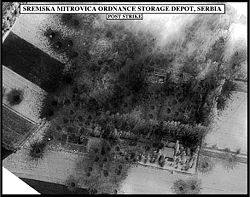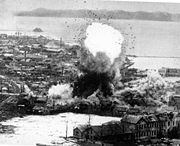
An
air strike is a
military strikeA military strike is a limited attack on a specified target. Strikes are used, amongst other things, to render facilities inoperable , to assassinate enemy leaders, and to limit supply to enemy troops. A strike can often be the prelude to a war or siege, whose initial strike is for a strategic or...
by
air forceAn air force, also known in some countries as an air army or historically an army air corps, is in the broadest sense, the national military that primarily conducts aerial warfare...
s or other
military aviationMilitary aviation is the use of aircraft and other flying machines for the purposes of conducting or enabling warfare, including national airlift capacity to provide logistical supply to forces stationed in a theater or along a front. Air power includes the national means of conducting such...
assets against either a suspected or a confirmed enemy ground position. Air strikes are commonly delivered from aircraft such as
bomberA bomber is a military aircraft designed to attack ground and sea targets, primarily by dropping bombs on them.-Classifications of bombers:...
s,
ground attack aircraftGround-attack aircraft are military aircraft designed to attack targets on the ground and are often deployed as close air support for, and in proximity to, their own ground forces. The proximity to friendly forces require precision strikes from these aircraft that are not possible with typical...
,
strike fighterA strike fighter is a fighter aircraft which is also capable of attacking surface targets, including ships. It differs from a ground-attack aircraft in that the aircraft remains a capable fighter. Previously, an airstrike on a ground target would usually involve bombers, defended by fighters...
s, and Attack helicopters. Weapons used in an airstrike can range from
machine gunA machine gun is a fully automatic mounted or portable firearm, usually designed to fire rifle bullets in quick succession from an ammunition belt or large-capacity magazine, typically at a rate of several hundred rounds per minute...
bulletA bullet is a projectile propelled by a firearm, sling, or air gun. A bullet does not contain explosives, but damages the intended target by its impact or penetration...
s,
missileA missile is a self-propelled projectile used as a weapon. Missiles are typically propelled by rockets or jet engines. Missiles generally have one or more explosive warheads, although other weapon types may also be used...
s, to various types of
bombA bomb is any of a range of explosive devices that typically rely on the exothermic chemical reaction of an explosive material to produce an extremely sudden and violent release of energy. The word comes from the Greek word βόμβος , an onomatopoetic term with approximately the same meaning as...
s. Air strikes are sometimes initiated in
strategic bombingStrategic bombing is a military strategy used in a total war with the goal of defeating an enemy nation-state by destroying its economic ability to wage war rather than destroying its land or naval forces...
s, but the term generally refers to tactical intervention by airpower on the battlefield.
Air strikes may be followed by
artilleryArtillery is a military combat Arm that employs weapons capable of discharging large projectiles in combat. They are generally capable of adding considerable fire power to the military capability of an armed force...
,
armorA tank is a tracked, armoured fighting vehicle designed for front-line combat which combines operational mobility and tactical offensive and defensive capabilities...
, or
infantryInfantrymen are soldiers who are specifically trained for the role of fighting on foot to engage the enemy face to face and have historically borne the brunt of the casualties of combat in wars. As the oldest branch of the Combat Arms they are the backbone of armies...
assaults, dependent on the military situation at hand.
An
air strike is a
military strikeA military strike is a limited attack on a specified target. Strikes are used, amongst other things, to render facilities inoperable , to assassinate enemy leaders, and to limit supply to enemy troops. A strike can often be the prelude to a war or siege, whose initial strike is for a strategic or...
by
air forceAn air force, also known in some countries as an air army or historically an army air corps, is in the broadest sense, the national military that primarily conducts aerial warfare...
s or other
military aviationMilitary aviation is the use of aircraft and other flying machines for the purposes of conducting or enabling warfare, including national airlift capacity to provide logistical supply to forces stationed in a theater or along a front. Air power includes the national means of conducting such...
assets against either a suspected or a confirmed enemy ground position. Air strikes are commonly delivered from aircraft such as
bomberA bomber is a military aircraft designed to attack ground and sea targets, primarily by dropping bombs on them.-Classifications of bombers:...
s,
ground attack aircraftGround-attack aircraft are military aircraft designed to attack targets on the ground and are often deployed as close air support for, and in proximity to, their own ground forces. The proximity to friendly forces require precision strikes from these aircraft that are not possible with typical...
,
strike fighterA strike fighter is a fighter aircraft which is also capable of attacking surface targets, including ships. It differs from a ground-attack aircraft in that the aircraft remains a capable fighter. Previously, an airstrike on a ground target would usually involve bombers, defended by fighters...
s, and Attack helicopters. Weapons used in an airstrike can range from
machine gunA machine gun is a fully automatic mounted or portable firearm, usually designed to fire rifle bullets in quick succession from an ammunition belt or large-capacity magazine, typically at a rate of several hundred rounds per minute...
bulletA bullet is a projectile propelled by a firearm, sling, or air gun. A bullet does not contain explosives, but damages the intended target by its impact or penetration...
s,
missileA missile is a self-propelled projectile used as a weapon. Missiles are typically propelled by rockets or jet engines. Missiles generally have one or more explosive warheads, although other weapon types may also be used...
s, to various types of
bombA bomb is any of a range of explosive devices that typically rely on the exothermic chemical reaction of an explosive material to produce an extremely sudden and violent release of energy. The word comes from the Greek word βόμβος , an onomatopoetic term with approximately the same meaning as...
s. Air strikes are sometimes initiated in
strategic bombingStrategic bombing is a military strategy used in a total war with the goal of defeating an enemy nation-state by destroying its economic ability to wage war rather than destroying its land or naval forces...
s, but the term generally refers to tactical intervention by airpower on the battlefield.
Air strikes may be followed by
artilleryArtillery is a military combat Arm that employs weapons capable of discharging large projectiles in combat. They are generally capable of adding considerable fire power to the military capability of an armed force...
,
armorA tank is a tracked, armoured fighting vehicle designed for front-line combat which combines operational mobility and tactical offensive and defensive capabilities...
, or
infantryInfantrymen are soldiers who are specifically trained for the role of fighting on foot to engage the enemy face to face and have historically borne the brunt of the casualties of combat in wars. As the oldest branch of the Combat Arms they are the backbone of armies...
assaults, dependent on the military situation at hand. Air strikes are commonly used when ground attacks are ineffective, when ground forces need to be used in conjunction with
close air supportIn military tactics, close air support is air action against hostile targets that requires detailed coordination and integration with ground forces. It is typically used to support ground troops, providing firepower at critical points....
, or when public opinion in the nation or around the world would not support a ground attack.
Air strikes are controlled by trained observers, often translating the requests of ground troops. The coordination and authorization of air strikes is carried out at command levels to ensure minimal "collateral damage" or "fratricidal fire".
History
On November 1, 1911,
ItalianThe Kingdom of Italy was a state forged in 1861 by the unification of Italy under the influence of the Kingdom of Sardinia which is its legal predecessor State, and with the decisive help of France and Great Britain...
aviator Second Lieutenant Giulio Gavotti dropped four bombs on two Turkish-held
oasesIn geography, an oasis or cienega is an isolated area of vegetation in a desert, typically surrounding a spring or similar water source...
in Libya, carrying out the world's first air strikes as part of the
Italo-Turkish WarThe Italo-Turkish or Turco-Italian War was fought between the Ottoman Empire and the Kingdom of Italy from September 29, 1911 to October 18, 1912.As a result of this conflict, Italy was awarded the Ottoman provinces of Tripolitania, Fezzan, and Cyrenaica...
.
One of the first examples of an Allied use of an airstrike during
World War IWorld War I , also known as the First World War, the Great War, and the War to End All Wars, was a global military conflict which involved most of the world's great powers, assembled in two opposing alliances: the Triple Entente and the Triple Alliance...
was at the
Battle of Neuve ChapelleThe Battles of Neuve Chapelle and Artois was a battle in the First World War. It was a British offensive in the Artois region and broke through at Neuve-Chapelle but they were unable to exploit the advantage.The battle began on 10 March 1915...
in 1915 when the
RFCThe Royal Flying Corps was the over-land air arm of the British military during most of the First World War. During the early part of the war, the RFC's responsibilities were centred on support of the British Army, via artillery cooperation and photographic reconnaissance...
dropped bombs on German rail communications.
"Broken Arrow"
The United States military code word for calling in all available aircraft for an air strike to support a ground unit facing imminent defeat in a battle was "Broken Arrow".
The code has been depicted during the movie
We Were SoldiersWe Were Soldiers is a 2002 American war film that dramatized the Battle of Ia Drang in November 1965, the first major engagement of United States military forces in the Vietnam War. The film was directed by Randall Wallace and stars Mel Gibson. It is based on the book We Were Soldiers Once… And...
, depicting the battle at
Landing Zone X-RayThe Battle of Ia Drang was one of the first major battles between the United States Army and the People's Army of Vietnam during the Vietnam War....
in the
Ia Drang ValleyThe Ia Drang Valley is a valley located near Pleiku in Central Highlands of Vietnam.On November 14, 1965, 450 American soldiers of the 1st Air Cavalry Division were airlifted by helicopter to this valley with the intention of locating and eliminating North Vietnamese forces...
during the
Vietnam WarThe Vietnam War or the Second Indochina War was a Cold War military conflict that occurred in Vietnam, Laos, and Cambodia from 1959 to 30 April 1975...
.
Collateral damage
In any air strike, there is a risk of injuring, killing, or destroying non-combatants, allies or non-military buildings. This is called
collateral damageCollateral damage is damage that is unintended or incidental to the intended outcome. The term originated in the United States military, but it has since expanded into broader use.-Etymology:...
.
Collateral damage can be advantageous by damaging nearby enemy troops and installations. The negative side effects to collateral damage may include the infliction of damage to civilian facilities and
accidental injury of friendly troopsFriendly fire is an expression meaning fire from one's own side or allied forces, as opposed to fire coming from enemy forces, and was a tactic originally adopted by the United States military....
near the target.
The amount of civilian collateral damage caused by air strikes has decreased dramatically since its peak during the
World War IIWorld War II, or the Second World War , was a global military conflict which involved a majority of the world's nations, including all great powers, organized into two opposing military alliances: the Allies and the Axis...
era, when air strikes were carried out with
'dumb' bombsAn unguided bomb is an aircraft-delivered bomb that does not contain a guidance system and hence, simply follows a ballistic trajectory.....
- bombs without any guidance systems. The strategy was to use large numbers of bombers and bombs in the hope that some of the bombs that were dropped struck the intended target.
There have been claims that lately, with the increased availability of precision-guided missiles and smart bombs by the military in the modern era, recent conflicts such as Operation Desert Storm and the
2003 Invasion of IraqThe 2003 invasion of Iraq, was led by the United States, backed by British forces and smaller contingents from Australia, Denmark, Poland and Spain. Four countries participated with troops during the initial invasion phase, which lasted from March 20 to May 1...
have seen decreased civilian collateral damage as compared to previous wars, such as the
Allied incendiary bombing raids on DresdenThe Bombing of Dresden by the British Royal Air Force and United States Army Air Force between 13 February and 15 February 1945 remains one of the most controversial Allied actions of the Second World War...
, the
German bombing of CoventryThe Coventry blitz was a series of bombing raids that took place in the English city of Coventry. The city was bombed many times during World War II by the Nazi German Air Force...
during
the BlitzThe Blitz was the sustained bombing of Britain by Nazi Germany between 7 September 1940 and 10 May 1941, in World War II. While the Blitz hit many towns and cities across the country, it began with the bombing of London for 57 consecutive nights...
, and the American air strikes on the Japanese mainland during the Second World War.
See also
- Aerial bombing of cities
The aerial bombing of cities began in 1911, developed through World War I, grew to a vast scale in World War II, and continues to the present day.-Italian-Turkish War of 1911-1912:...
- Aerial warfare
Aerial warfare is the use of military aircraft and other flying machines in warfare, including military airlift of cargo to further the national interests as was demonstrated in the Berlin Airlift...
- Air attack
Air attack may refer to:* An air raid, a military attack by aircraft* An airstrike, a tactical military attack by aircraft against ground targets* An aerial firefighting mission or series of missions* The 1996 Air Attack arcade game by Comad...
- Air raid
Air raid refers to an attack by aircraft against ground targets. The term is generally used for strategic bombing attacks, while airstrike is used for smaller tactical attacks.-Attack:...
- Time On Target
Time On Target is the co-ordination of artillery fire by many weapons so that all the munitions arrive at the target at precisely the same time. The military standard is + or - three seconds from the prescribed time of impact. In terms of place, the historical standard was for the impact to occur...