

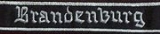
Brandenburgers

Encyclopedia
Germany
Germany , officially the Federal Republic of Germany , is a federal parliamentary republic in Europe. The country consists of 16 states while the capital and largest city is Berlin. Germany covers an area of 357,021 km2 and has a largely temperate seasonal climate...
Special Forces
Special forces
Special forces, or special operations forces are terms used to describe elite military tactical teams trained to perform high-risk dangerous missions that conventional units cannot perform...
unit during World War II
World War II
World War II, or the Second World War , was a global conflict lasting from 1939 to 1945, involving most of the world's nations—including all of the great powers—eventually forming two opposing military alliances: the Allies and the Axis...
.
Units of Brandenburgers operated in almost all fronts - the invasion of Poland, Denmark and Norway
Operation Weserübung
Operation Weserübung was the code name for Germany's assault on Denmark and Norway during the Second World War and the opening operation of the Norwegian Campaign...
, in the Battle of France
Battle of France
In the Second World War, the Battle of France was the German invasion of France and the Low Countries, beginning on 10 May 1940, which ended the Phoney War. The battle consisted of two main operations. In the first, Fall Gelb , German armoured units pushed through the Ardennes, to cut off and...
, in Operation Barbarossa
Operation Barbarossa
Operation Barbarossa was the code name for Germany's invasion of the Soviet Union during World War II that began on 22 June 1941. Over 4.5 million troops of the Axis powers invaded the USSR along a front., the largest invasion in the history of warfare...
, in Finland
Finland
Finland , officially the Republic of Finland, is a Nordic country situated in the Fennoscandian region of Northern Europe. It is bordered by Sweden in the west, Norway in the north and Russia in the east, while Estonia lies to its south across the Gulf of Finland.Around 5.4 million people reside...
, Greece
Battle of Greece
The Battle of Greece is the common name for the invasion and conquest of Greece by Nazi Germany in April 1941. Greece was supported by British Commonwealth forces, while the Germans' Axis allies Italy and Bulgaria played secondary roles...
and the invasion of Crete, Romania
Romania
Romania is a country located at the crossroads of Central and Southeastern Europe, on the Lower Danube, within and outside the Carpathian arch, bordering on the Black Sea...
, Bulgaria
Bulgaria
Bulgaria , officially the Republic of Bulgaria , is a parliamentary democracy within a unitary constitutional republic in Southeast Europe. The country borders Romania to the north, Serbia and Macedonia to the west, Greece and Turkey to the south, as well as the Black Sea to the east...
and Yugoslavia
Invasion of Yugoslavia
The Invasion of Yugoslavia , also known as the April War , was the Axis Powers' attack on the Kingdom of Yugoslavia which began on 6 April 1941 during World War II...
. Some units were sent to infiltrate India
India
India , officially the Republic of India , is a country in South Asia. It is the seventh-largest country by geographical area, the second-most populous country with over 1.2 billion people, and the most populous democracy in the world...
, Afghanistan
Afghanistan
Afghanistan , officially the Islamic Republic of Afghanistan, is a landlocked country located in the centre of Asia, forming South Asia, Central Asia and the Middle East. With a population of about 29 million, it has an area of , making it the 42nd most populous and 41st largest nation in the world...
, Middle East
Middle East
The Middle East is a region that encompasses Western Asia and Northern Africa. It is often used as a synonym for Near East, in opposition to Far East...
countries and South Africa
South Africa
The Republic of South Africa is a country in southern Africa. Located at the southern tip of Africa, it is divided into nine provinces, with of coastline on the Atlantic and Indian oceans...
. They also trained for Operation Felix
Operation Felix
Operation Felix was the codename for a proposed German seizure of Gibraltar during World War II. It never got beyond the staff study stage, even though planning continued into 1944, primarily because of Francisco Franco's reluctance to commit Spain to enter the war on the Axis...
(the planned seizure of Gibraltar
Gibraltar
Gibraltar is a British overseas territory located on the southern end of the Iberian Peninsula at the entrance of the Mediterranean. A peninsula with an area of , it has a northern border with Andalusia, Spain. The Rock of Gibraltar is the major landmark of the region...
), and Operation Sea Lion (the planned invasion of Great Britain
Great Britain
Great Britain or Britain is an island situated to the northwest of Continental Europe. It is the ninth largest island in the world, and the largest European island, as well as the largest of the British Isles...
). The unit had stunning successes early in the war acting as advance units that captured strategic bridges, tunnels and rail yards in Poland and the Netherlands.
| Brandenburger Regiment |
|---|
| Bataillon Ebbinghaus |
| Lehr und Bau Kompanie z.b.V. 800 |
| Bataillon Brandenburg |
| Regiment Brandenburg |
| Division Brandenburg |
| Infanterie-Division Brandenburg (mot) |
| Panzergrenadier-Division Brandenburg |
The unit was the brainchild of Hauptmann (Captain) Theodor von Hippel
Theodor von Hippel
Theodor von Hippel was the German army and intelligence officer responsible for the formation and training of the Brandenburgers commando unit. As a Hauptmann , von Hippel had served under General Paul von Lettow-Vorbeck during the First World War in the East African theatre, where Lettow-Vorbeck...
who, after having his idea rejected by the traditionalist Reichswehr
Reichswehr
The Reichswehr formed the military organisation of Germany from 1919 until 1935, when it was renamed the Wehrmacht ....
, approached Admiral Wilhelm Canaris
Wilhelm Canaris
Wilhelm Franz Canaris was a German admiral, head of the Abwehr, the German military intelligence service, from 1935 to 1944 and member of the German Resistance.- Early life and World War I :...
, commander of the German Intelligence Service, the Abwehr
Abwehr
The Abwehr was a German military intelligence organisation from 1921 to 1944. The term Abwehr was used as a concession to Allied demands that Germany's post-World War I intelligence activities be for "defensive" purposes only...
.
Regiment Brandenburg evolved out of the Abwehr's 2nd Department, and was used as a commando unit during the first years of the war. Initially the unit consisted mainly of former German expatriates fluent in other languages. Until 1944 it was an OKH
Oberkommando des Heeres
The Oberkommando des Heeres was Nazi Germany's High Command of the Army from 1936 to 1945. The Oberkommando der Wehrmacht commanded OKH only in theory...
unit rather than a unit of the regular army (Heer
German Army
The German Army is the land component of the armed forces of the Federal Republic of Germany. Following the disbanding of the Wehrmacht after World War II, it was re-established in 1955 as the Bundesheer, part of the newly formed West German Bundeswehr along with the Navy and the Air Force...
). The unit steadily expanded until it was reallocated to the Großdeutschland Panzer Korps to be used as a frontline combat unit.
Origins – the Abwehr
During World War IWorld War I
World War I , which was predominantly called the World War or the Great War from its occurrence until 1939, and the First World War or World War I thereafter, was a major war centred in Europe that began on 28 July 1914 and lasted until 11 November 1918...
, General Paul von Lettow-Vorbeck, Commander of the East Africa
East Africa
East Africa or Eastern Africa is the easterly region of the African continent, variably defined by geography or geopolitics. In the UN scheme of geographic regions, 19 territories constitute Eastern Africa:...
n theatre, conducted a brilliant guerrilla
Guerrilla warfare
Guerrilla warfare is a form of irregular warfare and refers to conflicts in which a small group of combatants including, but not limited to, armed civilians use military tactics, such as ambushes, sabotage, raids, the element of surprise, and extraordinary mobility to harass a larger and...
war against the Allied colonial troops. At the same time in the Middle East, T. E. Lawrence
T. E. Lawrence
Lieutenant Colonel Thomas Edward Lawrence, CB, DSO , known professionally as T. E. Lawrence, was a British Army officer renowned especially for his liaison role during the Arab Revolt against Ottoman Turkish rule of 1916–18...
was enjoying great success using Arab hit-and-run tactics against the Turks
Ottoman Empire
The Ottoman EmpireIt was usually referred to as the "Ottoman Empire", the "Turkish Empire", the "Ottoman Caliphate" or more commonly "Turkey" by its contemporaries...
. Hauptmann Theodor von Hippel had served under Lettow-Vorbeck in Africa, and after the war became a strong advocate of the tactics pioneered by his former commander and the British Lawrence.
Hippel's vision was reminiscent of that of David Stirling
David Stirling
Colonel Sir Archibald David Stirling, DSO, DFC, OBE was a Scottish laird, mountaineer, World War II British Army officer, and the founder of the Special Air Service.-Life before the war:...
, founder of the British SAS
Special Air Service
Special Air Service or SAS is a corps of the British Army constituted on 31 May 1950. They are part of the United Kingdom Special Forces and have served as a model for the special forces of many other countries all over the world...
. Hippel proposed that small, élite units, highly trained in sabotage and fluent in foreign languages, could operate behind enemy lines and wreak havoc with the enemy's command, communication and logistical tails. When Hippel approached the Reichswehr
Reichswehr
The Reichswehr formed the military organisation of Germany from 1919 until 1935, when it was renamed the Wehrmacht ....
, his idea was rebuffed. The traditionalist Prussia
Prussia
Prussia was a German kingdom and historic state originating out of the Duchy of Prussia and the Margraviate of Brandenburg. For centuries, the House of Hohenzollern ruled Prussia, successfully expanding its size by way of an unusually well-organized and effective army. Prussia shaped the history...
n officers saw this clandestine form of warfare would be an affront to the rules of war, and claimed that men who fought that way would not deserve to be called soldiers. Undaunted, Hippel then took his idea to Admiral Wilhelm Canaris
Wilhelm Canaris
Wilhelm Franz Canaris was a German admiral, head of the Abwehr, the German military intelligence service, from 1935 to 1944 and member of the German Resistance.- Early life and World War I :...
, commander of the German Intelligence service, the Abwehr
Abwehr
The Abwehr was a German military intelligence organisation from 1921 to 1944. The term Abwehr was used as a concession to Allied demands that Germany's post-World War I intelligence activities be for "defensive" purposes only...
. Hippel was employed in the Abwehr's 2nd Department, and given the task of making his vision a reality.
Bataillon Ebbinghaus – Poland
The original formation, designated Bataillon Ebbinghaus was formed mostly from VolksdeutscheVolksdeutsche
Volksdeutsche - "German in terms of people/folk" -, defined ethnically, is a historical term from the 20th century. The words volk and volkische conveyed in Nazi thinking the meanings of "folk" and "race" while adding the sense of superior civilization and blood...
who were fluent in Polish. The battalion was formed with support of the OKW, which had been arranged by Canaris, but meant that the unit fell under Wehrmacht command.
Fall Weiss (Plan White), involved small groups of German special forces dressed in civilian clothes crossing the Polish border the night before the German invasion and seizing key strategic points before dawn on the day of the invasion. The secret Abwehr
Abwehr
The Abwehr was a German military intelligence organisation from 1921 to 1944. The term Abwehr was used as a concession to Allied demands that Germany's post-World War I intelligence activities be for "defensive" purposes only...
battalion detailed to undertake these operations was given the euphemistic title of "Construction Training Company 800 for Special Duties". A group under the command of Lieutenant Hans-Albrecht Herzner had to capture a railway station at Mosty
Mosty
Mosty may refer to:* Dlouhé Mosty, part of Františkovy Lázně, Czech Republic* Mosty u Českého Těšína, village near Český Těšín, Czech Republic, now part of that town* Mosty u Jablunkova, village in Frýdek-Místek District, Czech Republic...
in the Jablunkov Pass
Jablunkov Pass
Jablunkov Pass is a mountain pass in the Beskids, located in the elevation of 553 m above sea level, in the Czech Republic, near the border with Poland and Slovakia....
to prevent the destruction of a railway tunnel. Crossing the border on August 26, 1939 Herzner's group managed to capture the railway station at Mosty later that afternoon. Out of contact with the Abwehr, Herzner did not know that the previous evening, after the British and French hinted at further appeasement of Hitler's demands, Adolf Hitler
Adolf Hitler
Adolf Hitler was an Austrian-born German politician and the leader of the National Socialist German Workers Party , commonly referred to as the Nazi Party). He was Chancellor of Germany from 1933 to 1945, and head of state from 1934 to 1945...
had postponed the invasion; every other commando unit had been informed of this except his. It was not until 9.35am the following day that the Abwehr finally managed to get through to Herzner and order him to release his Polish prisoners and return (see Jabłonków Incident
Jabłonków Incident
Jabłonków Incident refers to the events of the night of August 25/26, 1939, along the Polish - Slovak border. On that night, a group of German Military Intelligence armed agents attacked a rail station in Mosty. The main purpose of the attack was to capture the Jablunkov Pass, with its strategic...
).
During the invasion of Poland itself, Battalion Ebbinghaus had a magnificent debut. The Ebbinghausers had created confusion in the Polish rear by capturing or destroying major road and rail junctions, as well as helping the advancing troops by securing vital bridges and other strategic targets and preventing their demolition. Despite the success of the Bataillon Ebbinghaus, it was disbanded immediately after the campaign.
Abwehr takes control – Brandenburgers
Canaris gave Hippel the go-ahead to create an Abwehr controlled unit along the lines of the Ebbinghaus Battalion. Basing the new formation on many of the former Ebbinghausers, Hippel formed the original regimentRegiment
A regiment is a major tactical military unit, composed of variable numbers of batteries, squadrons or battalions, commanded by a colonel or lieutenant colonel...
, Lehr und Bau Kompanie z.b.V. 800 (or Training and Construction Company No. 800) on 25 October 1939.
Recruitment for the company was almost directly contrary to those of Heinrich Himmler
Heinrich Himmler
Heinrich Luitpold Himmler was Reichsführer of the SS, a military commander, and a leading member of the Nazi Party. As Chief of the German Police and the Minister of the Interior from 1943, Himmler oversaw all internal and external police and security forces, including the Gestapo...
's SS. Rather than recruiting only those who embodied the Aryan
Aryan
Aryan is an English language loanword derived from Sanskrit ārya and denoting variously*In scholarly usage:**Indo-Iranian languages *in dated usage:**the Indo-European languages more generally and their speakers...
ideal of the übermensch, Hippel scoured the Reich to find Slavs, Poles and other ethnics willing to fight for Germany. Every recruit had to be fluent in at least one foreign language. However, many recruits were fluent in several. The recruits were also schooled in the customs and traditions of their specific region. Knowing every habit and mannerism in their area of operations would enable the men to blend in and operate as effective saboteurs.
The formation was barracked at Stendal in the old Mark of Brandenburg
Brandenburg
Brandenburg is one of the sixteen federal-states of Germany. It lies in the east of the country and is one of the new federal states that were re-created in 1990 upon the reunification of the former West Germany and East Germany. The capital is Potsdam...
, Berlin
Berlin
Berlin is the capital city of Germany and is one of the 16 states of Germany. With a population of 3.45 million people, Berlin is Germany's largest city. It is the second most populous city proper and the seventh most populous urban area in the European Union...
, and had training grounds nearby in Friedenthal (Oranienburg). The influx of new recruits meant that on 15 December 1939, less than three months after its founding, the company was expanded and redesignated Bataillon Brandenburg (Brandenburg Battalion). The men of the Bataillon came to be known as the Brandenburgers.
The original battalion consisted of four companies
Company (military unit)
A company is a military unit, typically consisting of 80–225 soldiers and usually commanded by a Captain, Major or Commandant. Most companies are formed of three to five platoons although the exact number may vary by country, unit type, and structure...
; organised along ethnic 'Front' lines, as shown below. The battalion also included a Motorcycle platoon and a Fallschirm-platoon.
- 1. Kompanie (based in Baden bei WienBaden bei Wien-Points of interest:The town offers several parks and a picturesque surrounding, of which the most frequented is the Helenental valley. Not far from Baden, the valley is crossed by a widespread aqueduct of the Vienna waterworks...
), men from Baltic/Russian territories - 2. Kompanie (based in Brandenburg an der Havel), men who had lived in English-speaking territories and North Africa
- 3. Kompanie (based in Bad MünstereifelBad MünstereifelBad Münstereifel is a historical spa town in the district of Euskirchen, Germany, with about 19,000 inhabitants, situated in the far south of the German state of North Rhine-Westphalia...
), SudetenSudetenlandSudetenland is the German name used in English in the first half of the 20th century for the northern, southwest and western regions of Czechoslovakia inhabited mostly by ethnic Germans, specifically the border areas of Bohemia, Moravia, and those parts of Silesia being within Czechoslovakia.The...
Germans / Yugoslavia - 4. Kompanie (based in the Lower RhineLower Rhine region (Germany)The Lower Rhine region or Niederrhein is a region around the Lower Rhine section of the river Rhine in North-Rhine Westphalia, Germany between approximately Neuss and Düsseldorf in the South and the Dutch border around Emmerich in the North...
), Volksdeutsche Ethnic Germans from countries such as PolandPolandPoland , officially the Republic of Poland , is a country in Central Europe bordered by Germany to the west; the Czech Republic and Slovakia to the south; Ukraine, Belarus and Lithuania to the east; and the Baltic Sea and Kaliningrad Oblast, a Russian exclave, to the north...
As the battalion expanded further, it created more mixed units. The so-called Arabic Brigade was nominally connected to the Brandenburgers, took its orders from the German oriental mission, and was composed mainly of men from the Caucasus
Caucasus
The Caucasus, also Caucas or Caucasia , is a geopolitical region at the border of Europe and Asia, and situated between the Black and the Caspian sea...
.
France and the Low Countries – Yugoslavia
The Brandenburgers saw extensive action in Fall Gelb. On 8 May, two nights before the opening of the offensive the Brandenburgers went into action. Donning the enemies' uniforms over their own German ones (so they could quickly change in case of capture and be treated as POWs rather than spies and facing execution), small groups began to cross the border into the NetherlandsNetherlands
The Netherlands is a constituent country of the Kingdom of the Netherlands, located mainly in North-West Europe and with several islands in the Caribbean. Mainland Netherlands borders the North Sea to the north and west, Belgium to the south, and Germany to the east, and shares maritime borders...
, Belgium
Belgium
Belgium , officially the Kingdom of Belgium, is a federal state in Western Europe. It is a founding member of the European Union and hosts the EU's headquarters, and those of several other major international organisations such as NATO.Belgium is also a member of, or affiliated to, many...
and Luxembourg
Luxembourg
Luxembourg , officially the Grand Duchy of Luxembourg , is a landlocked country in western Europe, bordered by Belgium, France, and Germany. It has two principal regions: the Oesling in the North as part of the Ardennes massif, and the Gutland in the south...
.
One of many actions from the opening days of the campaign was the seizure of the Meuse
Meuse River
The Maas or Meuse is a major European river, rising in France and flowing through Belgium and the Netherlands before draining into the North Sea...
bridge in the Dutch town of Gennep
Gennep
Gennep is a municipality and a city in the southeastern Netherlands.- Population centres :Aaldonk, Dam, De Looi, Diekendaal, Gennep, Heijen, Hekkens, Milsbeek, Ottersum, Smele, Ven-Zelderheide and Zelder.- The city of Gennep :...
. An 8 man team, led by Leutnant Wilhelm Walther, was given the task of capturing the bridge intact. At 2am on May 10, Walther's team, now disguised as Dutch military police
Military police
Military police are police organisations connected with, or part of, the military of a state. The word can have different meanings in different countries, and may refer to:...
escorting German prisoners, made their assault. Two guard posts were destroyed, but three Brandenburgers were wounded and the team was pinned down. Dressed in a Dutch uniform, Walther advanced across the bridge. The confused defenders hesitated, allowing the rest of the team to take them out, seizing the bridge and disabling the detonator
Detonator
A detonator is a device used to trigger an explosive device. Detonators can be chemically, mechanically, or electrically initiated, the latter two being the most common....
s. Many more operations like this took place over the course of the campaign.
However on another bridge, Brandenburgers were arrested by Dutch troops and shot as spies.
After the capitulation of France, the Brandenburgers (along with the elite Infantrie-Regiment Großdeutschland) were moved to northern France in preparation for Operation Seelöwe. After the invasion was called off, the Battalion moved to southern France and began training for another operation that was not to be, Operation Felix
Operation Felix
Operation Felix was the codename for a proposed German seizure of Gibraltar during World War II. It never got beyond the staff study stage, even though planning continued into 1944, primarily because of Francisco Franco's reluctance to commit Spain to enter the war on the Axis...
, the proposed assault on Gibraltar
Gibraltar
Gibraltar is a British overseas territory located on the southern end of the Iberian Peninsula at the entrance of the Mediterranean. A peninsula with an area of , it has a northern border with Andalusia, Spain. The Rock of Gibraltar is the major landmark of the region...
.
During this time, the Battalion was again enlarged, and redesignated Regiment Brandenburg. Along with the increase in size, the Regiment also received Coastal Raider and specialist Tropical components.
After Benito Mussolini
Benito Mussolini
Benito Amilcare Andrea Mussolini was an Italian politician who led the National Fascist Party and is credited with being one of the key figures in the creation of Fascism....
's botched invasion of Greece, Hitler was forced to postpone his invasion of the Soviet Union
Soviet Union
The Soviet Union , officially the Union of Soviet Socialist Republics , was a constitutionally socialist state that existed in Eurasia between 1922 and 1991....
and invade Yugoslavia and Greece – a plan codenamed Operation Marita – and to be launched on 6 April 1941. Again, the Brandenburgers were to play a role, with a large 54 man team from III./Regiment Brandenburg (the Sudeten and Slavic battalion) seizing the vital dockyards at Orşova
Orsova
Orșova is a port city on the Danube river in southwestern Romania's Mehedinți County. It is one of four localities in the county located in the Banat historical region. It is situated just above the Iron Gates, on the spot where the Cerna River meets the Danube.- History :The first documented...
on the Danube
Danube
The Danube is a river in the Central Europe and the Europe's second longest river after the Volga. It is classified as an international waterway....
a day before the opening of the campaign.
Training and structure
Despite the increased size, the Brandenburgers were still highly skilled. The training was physically and mentally demanding, with focuses on foreign languages, small unit tacticsSmall unit tactics
Small unit tactics is the application of military doctrine for the combat deployment of platoons and smaller units in a particular strategic and logistic environment.-Squad Structure:...
, parachuting
Parachuting
Parachuting, also known as skydiving, is the action of exiting an aircraft and returning to earth with the aid of a parachute. It may or may not involve a certain amount of free-fall, a time during which the parachute has not been deployed and the body gradually accelerates to terminal...
, demolitions, covert operation
Covert operation
A covert operation is a military, intelligence or law enforcement operation that is carried clandestinely and, often, outside of official channels. Covert operations aim to fulfill their mission objectives without any parties knowing who sponsored or carried out the operation...
s, use of vehicles and aircraft and familiarity with enemy weapons, including tank
Tank
A tank is a tracked, armoured fighting vehicle designed for front-line combat which combines operational mobility, tactical offensive, and defensive capabilities...
s. Some sub-units were specifically trained as pilots or trained in forgery
Forgery
Forgery is the process of making, adapting, or imitating objects, statistics, or documents with the intent to deceive. Copies, studio replicas, and reproductions are not considered forgeries, though they may later become forgeries through knowing and willful misrepresentations. Forging money or...
, demolitions or camouflage
Camouflage
Camouflage is a method of concealment that allows an otherwise visible animal, military vehicle, or other object to remain unnoticed, by blending with its environment. Examples include a leopard's spotted coat, the battledress of a modern soldier and a leaf-mimic butterfly...
. One company was formed from 127 expert cross country skiers, and was specially trained to fight in the frozen wastes of the northern Soviet Union
Soviet Union
The Soviet Union , officially the Union of Soviet Socialist Republics , was a constitutionally socialist state that existed in Eurasia between 1922 and 1991....
. The company was also equipped with dog sled
Dog sled
A dog sled is a sled pulled by one or more sled dogs used to travel over ice and through snow. Numerous types of sleds are used, depending on their function. They can be used for dog sled racing.-History:...
s.
In action, a Brandenburger unit could consist of two-man teams, to 12-man squad
Squad
In military terminology, a squad is a small military unit led by a non-commissioned officer that is subordinate to an infantry platoon. In countries following the British Army tradition this organization is referred to as a section...
s, to full 300-man companies, depending on the mission requirements. At this stage in the war, virtually all Brandenburger operations took place behind enemy lines.
Despite these precautions to remain within the rules of war, all Brandenburgers carried a suicide pill
Suicide pill
A Cyanide pill is a pill, capsule, ampoule or tablet containing a fatally poisonous substance that a person ingests deliberately in order to quickly cause his/her own life to end...
when operating behind enemy lines.
North Africa
When the Afrika KorpsAfrika Korps
The German Africa Corps , or the Afrika Korps as it was popularly called, was the German expeditionary force in Libya and Tunisia during the North African Campaign of World War II...
shipped to Libya, Brandenburgers did also. The men, raised as four companies of special Tropical Units, were fluent in either English
English language
English is a West Germanic language that arose in the Anglo-Saxon kingdoms of England and spread into what was to become south-east Scotland under the influence of the Anglian medieval kingdom of Northumbria...
or Arabic
Arabic language
Arabic is a name applied to the descendants of the Classical Arabic language of the 6th century AD, used most prominently in the Quran, the Islamic Holy Book...
and used captured British
United Kingdom
The United Kingdom of Great Britain and Northern IrelandIn the United Kingdom and Dependencies, other languages have been officially recognised as legitimate autochthonous languages under the European Charter for Regional or Minority Languages...
vehicles to operate behind enemy lines in raids and reconnaissance
Reconnaissance
Reconnaissance is the military term for exploring beyond the area occupied by friendly forces to gain information about enemy forces or features of the environment....
missions, mirroring the actions of the British LRDG. Generalfeldmarschall Erwin Rommel
Erwin Rommel
Erwin Johannes Eugen Rommel , popularly known as the Desert Fox , was a German Field Marshal of World War II. He won the respect of both his own troops and the enemies he fought....
at first disapproved of the Brandenburgers, but after he saw the damage being inflicted by the LRDG and Stirling's SAS, he realised their value and accepted their unorthodox methods. The unit was charged with disrupting British supply lines, but it was difficult to resupply them or provide transportation, so most men were either killed or captured.
Operation Barbarossa - Ostfront
The first German units to cross the Soviet frontier in June 1941 were the men of the Brandenburg Regiment. On the first day, Brandenburgers seized road and rail junctions, secured river crossings and wreaked havoc with the already inadequate Soviet communications and supply lines.During the early days of Barbarossa, a Brandenburger unit seized the bridge over the Daugava in Dünaburg (in Latvia
Latvia
Latvia , officially the Republic of Latvia , is a country in the Baltic region of Northern Europe. It is bordered to the north by Estonia , to the south by Lithuania , to the east by the Russian Federation , to the southeast by Belarus and shares maritime borders to the west with Sweden...
). This prevented a halt in the advance of Heeresgruppe Nord
Army Group North
Army Group North was a German strategic echelon formation commanding a grouping of Field Armies subordinated to the OKH during World War II. The army group coordinated the operations of attached separate army corps, reserve formations, rear services and logistics.- Formation :The Army Group North...
on Leningrad
Saint Petersburg
Saint Petersburg is a city and a federal subject of Russia located on the Neva River at the head of the Gulf of Finland on the Baltic Sea...
.
Meanwhile, the "Küstenjäger-Abteilung" (or Coastal Raiders Battalion) performed many amphibious
Amphibious warfare
Amphibious warfare is the use of naval firepower, logistics and strategy to project military power ashore. In previous eras it stood as the primary method of delivering troops to non-contiguous enemy-held terrain...
raids along the coasts of the Black Sea
Black Sea
The Black Sea is bounded by Europe, Anatolia and the Caucasus and is ultimately connected to the Atlantic Ocean via the Mediterranean and the Aegean seas and various straits. The Bosphorus strait connects it to the Sea of Marmara, and the strait of the Dardanelles connects that sea to the Aegean...
, The Baltic
Baltic Sea
The Baltic Sea is a brackish mediterranean sea located in Northern Europe, from 53°N to 66°N latitude and from 20°E to 26°E longitude. It is bounded by the Scandinavian Peninsula, the mainland of Europe, and the Danish islands. It drains into the Kattegat by way of the Øresund, the Great Belt and...
and the Sea of Azov
Sea of Azov
The Sea of Azov , known in Classical Antiquity as Lake Maeotis, is a sea on the south of Eastern Europe. It is linked by the narrow Strait of Kerch to the Black Sea to the south and is bounded on the north by Ukraine mainland, on the east by Russia, and on the west by the Ukraine's Crimean...
.
In Ukraine
Ukraine
Ukraine is a country in Eastern Europe. It has an area of 603,628 km², making it the second largest contiguous country on the European continent, after Russia...
, the Brandenburgers operated in co-operation with the volunteer Ukrainian unit Ukrainische Gruppe Nachtigall in support of Heeresgruppe Süd
Army Group South
Army Group South was the name of a number of German Army Groups during World War II.- Poland campaign :Germany used two army groups to invade Poland in 1939: Army Group North and Army Group South...
. The units enjoyed overwhelming success, despite the questionable actions of some of the Ukrainian units.
In early August 1942, a Brandenburger unit of 62 Baltic and Sudeten Germans led by Freiherr
Freiherr
The German titles Freiherr and Freifrau and Freiin are titles of nobility, used preceding a person's given name or, after 1919, before the surname...
Adrian von Fölkersam penetrated farther into enemy territory than any other German unit. They had been ordered to seize and secure the vital Maikop
Maikop
Maykop or Maikop may refer to:*Maykop, capital of the Republic of Adygea, Russia*Maykop culture, prehistoric culture of the northern Caucasus, ca. 3500 BCE–2500 BCE...
oilfields. Disguised as dreaded NKVD
NKVD
The People's Commissariat for Internal Affairs was the public and secret police organization of the Soviet Union that directly executed the rule of power of the Soviets, including political repression, during the era of Joseph Stalin....
men, and driving Soviet trucks, Fölkersam's unit passed through the Soviet front lines and moved deep into hostile territory. The Brandenburgers ran into a large group of Red Army
Red Army
The Workers' and Peasants' Red Army started out as the Soviet Union's revolutionary communist combat groups during the Russian Civil War of 1918-1922. It grew into the national army of the Soviet Union. By the 1930s the Red Army was among the largest armies in history.The "Red Army" name refers to...
deserters fleeing from the front. Fölkersam saw an opportunity to use them to the unit's advantage. By persuading them to return to the Soviet cause, he was able to join with them and move almost at will through the Russian lines.
Operating under false identity of NKVD Major Truchin based in Stalingrad, Fölkersam explained his role in recovering the deserters to the Soviet commander in charge of Maikop's defenses. The commander not only believed Fölkersam, but the next day gave him a personal tour of the city's defenses. By August 8, the German spearheads were only 12 miles away. The Brandenburgers made their move. Using grenades to simulate an artillery attack, they knocked out the military communications center for the city. Fölkersam then went to the Russian defenders and told them that a withdrawal was taking place. Having seen Fölkersam with their commander and lacking any communications to rebut or confirm his statement, the Soviets began to evacuate Maikop. The German spearhead entered the city without a fight on August 9, 1942.
This is only one example of the hundreds of missions performed by the Brandenburgers during the advance into Russia.
By 1943, the most common mission assignment was long range reconnaissance. During the 1942 advance of Heeresgruppe Süd
Army Group South
Army Group South was the name of a number of German Army Groups during World War II.- Poland campaign :Germany used two army groups to invade Poland in 1939: Army Group North and Army Group South...
in Ukraine, the Brandenburgers revived their role from the early days of the campaign, forging ahead of the Panzer
Panzer
A Panzer is a German language word that, when used as a noun, means "tank". When it is used as an adjective, it means either tank or "armoured" .- Etymology :...
columns, seizing bridges, road and rail junctions, and attacking the Soviet command and control structure. Mostly, these missions were performed by units of 20-60 Brandenburgers, dressed as Soviets and driving captured Red Army vehicles.
Between January and April 1943, the Brandenburgers were expanded to the size of a division
Division (military)
A division is a large military unit or formation usually consisting of between 10,000 and 20,000 soldiers. In most armies, a division is composed of several regiments or brigades, and in turn several divisions typically make up a corps...
, and specialized subunits for U-boat
U-boat
U-boat is the anglicized version of the German word U-Boot , itself an abbreviation of Unterseeboot , and refers to military submarines operated by Germany, particularly in World War I and World War II...
crews, air defense, artillery
Artillery
Originally applied to any group of infantry primarily armed with projectile weapons, artillery has over time become limited in meaning to refer only to those engines of war that operate by projection of munitions far beyond the range of effect of personal weapons...
, tank, antitank and combat engineering were created. Men were transferred from the Afrika Korps and Kriegsmarine
Kriegsmarine
The Kriegsmarine was the name of the German Navy during the Nazi regime . It superseded the Kaiserliche Marine of World War I and the post-war Reichsmarine. The Kriegsmarine was one of three official branches of the Wehrmacht, the unified armed forces of Nazi Germany.The Kriegsmarine grew rapidly...
, and also Muslims from Yugoslavia and volunteers from India.
Brandenburg Division - the Balkans
By late 1942, the majority of the Brandenburg regiment was being used in fire brigade duties, acting as elite infantry and plugging gaps in the German lines. In February 1943, the Brandenburgers were pulled out of the line and moved back to Germany. The Regiment was being expanded again, this time to become Division Brandenburg. The division's first commander was to be Generalmajor Alexander von Pfuhlstein. The division was to be formed by four regiments. One regiment was returned to the Eastern front, to resume duties as a fire brigade, One battalion was sent to Africa to continue harassing the Allies in the Mediterranean. The remainder of the division was sent to the Balkans, to engage in anti-PartisanPartisans (Yugoslavia)
The Yugoslav Partisans, or simply the Partisans were a Communist-led World War II anti-fascist resistance movement in Yugoslavia...
operations.
On May 25, 1944, specialist members of the division, attached to SS-Fallschirmjäger-Bataillon 500, took part in Operation Rösselsprung
Operation Rösselsprung
The Raid on Drvar , codenamed Operation Rösselsprung , was an attack by the Waffen-SS and the Luftwaffe that aimed to disrupt the command structure of the Yugoslav Partisans by eliminating their Supreme Headquarters, and capturing their commander, Marshal Josip Broz Tito...
, an airborne operation to capture Yugoslav Partisan leader Josip Broz Tito
Josip Broz Tito
Marshal Josip Broz Tito – 4 May 1980) was a Yugoslav revolutionary and statesman. While his presidency has been criticized as authoritarian, Tito was a popular public figure both in Yugoslavia and abroad, viewed as a unifying symbol for the nations of the Yugoslav federation...
at his headquarters near Drvar
Drvar
Drvar is a town and municipality in western Bosnia and Herzegovina, located on the road between Bosansko Grahovo and Bosanski Petrovac, also near Glamoč. It is administratively part of Canton 10 of the Federation....
, thereby ending communist resistance in the Balkans. Tito escaped just before the SS-Fallschirmjäger reached the cave in which he made his headquarters and the SS-Fallschirmjäger were forced to withdraw to the town cemetery, where they dug in and endured a night of ferocious partisan assaults. German casualties were 213 killed, 881 wounded, and 51 missing, with a total of about 6000 on the Partisan side (German wartime estimates). SS-Fallschirmjäger-Btl 500 was all but wiped out, one of four times this happened to the unit and its successor, SS-Fallschirmjäger-Btl 600, in the eighteen months from November 1943 to May 1945.
Dodecanese Islands
In mid 1943, King Victor Emmanuel III of Italy ousted the Fascist dictatorship of Benito MussoliniBenito Mussolini
Benito Amilcare Andrea Mussolini was an Italian politician who led the National Fascist Party and is credited with being one of the key figures in the creation of Fascism....
and changed sides. Following this, many Brandenburger units were moved from the Balkans, and took part in actions to disarm Italian soldiers and secure regions vital to the German war effort.
One vital area was the island of Kos
Kos
Kos or Cos is a Greek island in the south Sporades group of the Dodecanese, next to the Gulf of Gökova/Cos. It measures by , and is from the coast of Bodrum, Turkey and the ancient region of Caria. Administratively the island forms a separate municipality within the Kos peripheral unit, which is...
, in the Dodecanese
Dodecanese
The Dodecanese are a group of 12 larger plus 150 smaller Greek islands in the Aegean Sea, of which 26 are inhabited. Τhis island group generally defines the eastern limit of the Sea of Crete. They belong to the Southern Sporades island group...
island chain off the coast of Turkey
Turkey
Turkey , known officially as the Republic of Turkey , is a Eurasian country located in Western Asia and in East Thrace in Southeastern Europe...
. Kos had been secured by British troops in September 1943, and a large garrison of allied Italian troops was also present. The island had a vital airstrip, and had to be recaptured. Along with Luftwaffe
Luftwaffe
Luftwaffe is a generic German term for an air force. It is also the official name for two of the four historic German air forces, the Wehrmacht air arm founded in 1935 and disbanded in 1946; and the current Bundeswehr air arm founded in 1956....
Fallschirmjäger
Fallschirmjäger
are German paratroopers. Together with the Gebirgsjäger they are perceived as the elite infantry units of the German Army....
s, men of the Küstenjäger-Abteilung along with the Fallschirm-Kompanie of the Brandenburg Division took part. The Brandenburgers, under command of Leutnant Langbein, landed at night on the southern coast of the island, and quickly subdued the beach defenses, controlled by Italian troops. The unit then advanced to the town encountering no resistance, and began clearing the town. The British and Italians attacked later in the evening, the Brandenburgers repulsed them and then assaulted and captured the British and Italian positions, linking up with the Fallschirmjäger
Fallschirmjäger
are German paratroopers. Together with the Gebirgsjäger they are perceived as the elite infantry units of the German Army....
s and securing the island.
Loss of Abwehr control - transfer to the Front
Since the beginning, Admiral Canaris and the Abwehr had been watched closely by Himmler's SS and in particular by Walter SchellenbergWalter Schellenberg
Walther Friedrich Schellenberg was a German SS-Brigadeführer who rose through the ranks of the SS to become the head of foreign intelligence following the abolition of the Abwehr in 1944.-Biography:...
, Chief of Amt VI, Ausland-SD that made up the foreign intelligence branch of the SD
Sicherheitsdienst
Sicherheitsdienst , full title Sicherheitsdienst des Reichsführers-SS, or SD, was the intelligence agency of the SS and the Nazi Party in Nazi Germany. The organization was the first Nazi Party intelligence organization to be established and was often considered a "sister organization" with the...
.
The anti-Nazi views of the Abwehr came to a head in July 1944, when several high ranking Abwehr officials, including Canaris himself, were implicated in the July 20 plot
July 20 Plot
On 20 July 1944, an attempt was made to assassinate Adolf Hitler, Führer of the Third Reich, inside his Wolf's Lair field headquarters near Rastenburg, East Prussia. The plot was the culmination of the efforts of several groups in the German Resistance to overthrow the Nazi-led German government...
to kill Hitler. Control of the Brandenburg division was passed to the SD, but in September 1944 it was decided that special operations units were no longer necessary. The Brandenburg Division became Infanterie-Division Brandenburg (mot), was equipped as a motorised infantry division and transferred to the Eastern front.
1,800 men (including Freiherr Adrian von Fölkersam) managed to obtain transfers to SS-Standartenführer Otto Skorzeny
Otto Skorzeny
Otto Skorzeny was an SS-Obersturmbannführer in the German Waffen-SS during World War II. After fighting on the Eastern Front, he was chosen as the field commander to carry out the rescue mission that freed the deposed Italian dictator Benito Mussolini from captivity...
's 502nd SS Jäger Battalion and continue operating as special forces till the end of the war.
For the rest of the division, the return to conventional operations damaged morale
Morale
Morale, also known as esprit de corps when discussing the morale of a group, is an intangible term used to describe the capacity of people to maintain belief in an institution or a goal, or even in oneself and others...
, but despite this, the Brandenburgers were still considered élite, and so was assigned to Panzerkorps Großdeutschland along with its old training partner from 1940-41, the Großdeutschland division. The Brandenburg fought well in the Eastern front, being involved in the fighting retreat through the Baltic States
Baltic states
The term Baltic states refers to the Baltic territories which gained independence from the Russian Empire in the wake of World War I: primarily the contiguous trio of Estonia, Latvia, Lithuania ; Finland also fell within the scope of the term after initially gaining independence in the 1920s.The...
and into East Prussia
East Prussia
East Prussia is the main part of the region of Prussia along the southeastern Baltic Coast from the 13th century to the end of World War II in May 1945. From 1772–1829 and 1878–1945, the Province of East Prussia was part of the German state of Prussia. The capital city was Königsberg.East Prussia...
.
In late 1944, the division was equipped with a Panzer Regiment and redesignated Panzergrenadier-Division Brandenburg and returned to the front. The Brandenburgers were involved in heavy fighting near Memel
Battle of Memel
The Battle of Memel or the Siege of Memel took place when the Soviets launched their Memel Offensive Operation in late 1944. The offensive led to a three-month siege against German forces in a small bridgehead in the town and its port....
, until their withdrawal, along with the Großdeutschland, via ferry to Pillau
Baltiysk
Baltiysk , prior to 1945 known by its German name Pillau , is a seaport town and the administrative center of Baltiysky District of Kaliningrad Oblast, located on the northern part of the Vistula Spit, on the shore of the Strait of Baltiysk separating the Vistula Bay from the Gdańsk Bay. Baltiysk...
. The division was all but annihilated during the heavy fighting near Pillau, and while some survivors surrendered to the British in Schleswig-Holstein
Schleswig-Holstein
Schleswig-Holstein is the northernmost of the sixteen states of Germany, comprising most of the historical duchy of Holstein and the southern part of the former Duchy of Schleswig...
in May, many Brandenburgers, highly skilled in evading detection, simply disappeared.
Postwar period: ex-Brandenburgers as advisers in foreign service
The Brandenburgers who escaped death or capture during the war were, like many special forces soldiers, not willing or able to lay down the sword and return to civilian life.Orders of battle
Battalion Brandenburg - December 1939- 1. Company
- 2. Company
- 3. Company
- 4. Company
- Motorcycle platoon
- Parachute platoon
Division Brandenburg – February 1943 - March 1944
- Division staff
- Jäger Regiment - 1 Brandenburg
- Jäger Regiment - 2 Brandenburg
- Jäger Regiment - 3 Brandenburg
- Jäger Regiment - 4 Brandenburg
- Tropische Einheiten Brandenburg
- Coastal Raiders Battalion Brandenburg
- Parachute Battalion Brandenburg
- Signal Company Brandenburg
- Independent Companies -
- 14.Company
- 15.Parachute Company
- Auxiliary Units -
- Lehrregiment Brandenburg z.b.v Nr.800 (Training Regiment)
Panzergrenadier-Division Brandenburg - 1944-1945.
- Division Staff
- Panzer Regiment Brandenburg
- Jäger(mot) Regiment 1 Brandenburg
- Jäger(mot) Regiment 2 Brandenburg
- PanzerjägerPanzerjägerPanzerjäger was a branch of service of the Wehrmacht during the Second World War which were the anti-tank arm-of-service who operated anti-tank artillery, and made exclusive use of the tank destroyers which were also named Panzerjäger...
Battalion Brandenburg - Artillery Regiment Brandenburg
- Heeres Flak Battalion Brandenburg
- Reconnaissance Battalion Brandenburg
- Pionier Battalion Brandenburg
- Signals Battalion Brandenburg
- Supply Train
See also
- Battle of Velikiye LukiBattle of Velikiye LukiThe Velikiye Luki offensive operation was executed by the forces of the Red Army's Kalinin Front against the Wehrmacht's 3rd Panzer Army during the Winter Campaign of 1942-1943 with the objective of liberating the Russian city of Velikiye Luki as part of the northern pincer of the Rzhev-Sychevka...
- KSKKSKKSK may refer to:* Karşıyaka S.K., a sports club from Izmir, Turkey* Kill Switch...Klick, an American industrial band* Kissing Suzy Kolber, a sports blog* Kommando Spezialkräfte, part of Germany's Special Forces...
or Kommando SpezialkräfteKommando SpezialkräfteThe KSK Kommando Spezialkräfte is an elite military unit composed of Special Operations soldiers from the ranks of Germany’s Bundeswehr and organized as such under the Division Spezielle Operationen . The unit has received many decorations and awards from both NATO and its affiliates...
, has a disputed heritage of the Brandenburgers - Special Staff FSpecial Staff FSpecial Staff F was the cover name for a German military mission to Iraq during World War II. Sonderstab F was created on 20 May 1941 and ceased to exist on 20 June 1941.-Description:...