


Vickers Wellington

Encyclopedia
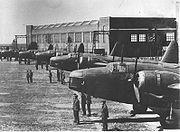
The Vickers Wellington was a British
twin-engine, long range medium bomber
designed in the mid-1930s at Brooklands
in Weybridge, Surrey, by Vickers-Armstrongs' Chief Designer, R. K. Pierson. It was widely used as a night bomber
in the early years of the Second World War
, before being displaced as a bomber by the larger four-engine "heavies" such as the Avro Lancaster
. The Wellington continued to serve throughout the war in other duties, particularly as an anti-submarine aircraft
. It was the only British bomber to be produced for the entire duration of the war. The Wellington was popularly known as the Wimpy by service personnel, after J. Wellington Wimpy
from the Popeye
cartoons and a Wellington "B for Bertie" had a starring role in the 1942 Oscar-nominated Powell and Pressburger film One of Our Aircraft Is Missing
.
The Wellington was one of two bombers named after Arthur Wellesley, 1st Duke of Wellington
, the other being the Vickers Wellesley
.
.png) The Wellington used a geodesic construction method, which had been devised by Barnes Wallis
The Wellington used a geodesic construction method, which had been devised by Barnes Wallis
inspired by his work on airship
s, and had previously been used to build the single-engine Wellesley
light bomber
. The fuselage
was built up from 1650 elements, consisting of aluminium alloy (duralumin
) W-beams that were formed into a large framework. Wooden batten
s were screwed onto the aluminium, and these were covered with Irish linen
, which, once treated with many layers of dope
, formed the outer skin of the aircraft. The metal lattice gave the structure tremendous strength, because any one of the stringers could support some of the weight from even the opposite side of the aircraft. Blowing out one side's beams would still leave the aircraft as a whole intact; as a result, Wellingtons with huge areas of framework missing continued to return home when other types would not have survived; the dramatic effect was enhanced by the doped fabric skin burning off, leaving the naked frames exposed (see photo).
In one case as a result of a fire in the wing caused by battle damage a Wellington co-pilot was forced to climb out of the aircraft while in flight kicking holes in the doped fabric for foot and hand holds and physically smother the burning upper wing covering. The aircraft returned home safely and the airman concerned, Sergent James Allen Ward
was awarded the Victoria Cross
for his actions.
The geodesic structure also gave a very strong but light structure for its large size, which gave the Wellington a load and range to power ratio advantage over similar aircraft, without sacrificing robustness or protective devices such as armour plate
or self-sealing fuel tank
s.
However, the construction system also had a distinct disadvantage in that it took considerably longer to build a Wellington than other designs using monocoque
construction techniques. Also, it was difficult to cut holes into the fuselage to provide additional access or equipment fixtures. The Leigh light
, for instance, was deployed through the mounting for the absent FN9 ventral turret
. Nevertheless, in the late 1930s Vickers succeeded in building Wellingtons at a rate of one a day at Weybridge and 50 a month at the Chester factory (located at Broughton
in North Wales
). Peak wartime production in 1942 saw monthly rates of 70 achieved at Weybridge
, 130 at Broughton and 102 at Blackpool
.
The Wellington went through a total of 16 variants during its production life plus a further two training
conversions after the war. The prototype serial K4049 designed to satisfy Ministry Specification B.9/32, first flew as a Type 271 (and initially named Crecy) from Brooklands on 15 June 1936 with chief test pilot Joseph Summers
as pilot. After many changes to the design, it was accepted on 15 August 1936 for production with the name Wellington. The first model was the Wellington Mark I, powered by a pair of 1,050 hp (780 kW) Bristol Pegasus engines, of which 180 were built, 150 for the Royal Air Force
and 30 for the Royal New Zealand Air Force
(which were transferred to the RAF on the outbreak of war and used by 75 Squadron
). The Mark I first entered service with No. 9 Squadron RAF in October 1938. Improvements to the turrets resulted in 183 Mark IA Wellingtons, which equipped the RAF Bomber Command
heavy bomber
squadrons at the outbreak of war. The Wellington was initially outnumbered by its twin-engine contemporaries, the Handley Page Hampden
and the Armstrong Whitworth Whitley
, but ultimately outlasted them in productive service.
The number of Wellingtons built totalled 11,461 of all versions, the last of which was rolled out on 13 October 1945.
against the clock. The bomber was assembled in new world record time of 23 hours 50 minutes, and took off after 24 hours 48 minutes, beating the previous record of 48 hours set by an American factory in California. The effort was filmed for the Ministry of Information, forming the basis of a newsreel
Worker's Week-End, broadcast in Britain and America.
Squadrons, along with Bristol Blenheim
s, on German shipping at Brunsbüttel
on 4 September 1939. During this raid, the two Wellingtons became the first aircraft shot down on the Western Front
. Numbers 9, 37 and 149 Squadrons saw action on 18 December 1939 on a mission
against German shipping on the Schillig Roads and Wilhelmshaven
. Luftwaffe fighter
s destroyed 12 of the bombers and badly damaged three others; thus highlighting the aircraft's vulnerability to attacking fighters, having neither self-sealing fuel tanks nor sufficient defensive armament. In particular, while the aircraft's nose and tail turrets protected against attacks from the front and rear, the Wellington had no defences against attacks from the beam and above, as it had not been believed that such attacks were possible owing to the high speed of aircraft involved. As a consequence, Wellingtons were switched to night operations and participated in the first night raid on Berlin
on 25 August 1940. In the first 1,000-aircraft raid on Cologne
, on 30 May 1942, 599 out of 1,046 aircraft were Wellingtons (101 of them were flown by Polish
aircrew).
With Bomber Command, Wellingtons flew 47,409 operations, dropped 41,823 tons (37,941 tonnes) of bombs and lost 1,332 aircraft in action.
Coastal Command Wellingtons carried out anti-submarine duties and sank their first enemy vessel on 6 July 1942. DWI versions (see below) fitted with a 48 ft (14.63 m) diameter metal hoop were used for exploding enemy mines by generating a powerful magnetic field as it passed over them. In 1944, Wellingtons of Coastal Command were deployed to Greece
, and performed various support duties during the RAF involvement in the Greek Civil War
. A few Wellingtons were operated by the Hellenic Air Force
.
While the Wellington was superseded in the European Theatre, it remained in operational service for much of the war in the Middle East
, and in 1942, Wellingtons based in India
became the RAF's first long-range bomber operating in the Far East
. It was particularly effective with the South African Air Force
in North Africa
. This versatile aircraft also served in anti-submarine duties with 26 Squadron SAAF
based in Takoradi, Gold Coast
(now known as Ghana
).
In late 1944, a radar-equipped Wellington was modified for use by the RAF's Fighter Interception Unit
as what would now be described as an Airborne Early Warning and Control aircraft. It operated at an altitude of some 4000 ft (1,219 m) over the North Sea
to control de Havilland Mosquito
fighters intercepting Heinkel He 111
bombers flying from Dutch
airbases and carrying out airborne launches of the V-1 flying bomb
.
The Wellington is listed in the appendix to the novel KG 200 as one flown by the German secret operations unit KG 200
, which also tested, evaluated and sometimes clandestinely operated captured enemy aircraft during the Second World War.
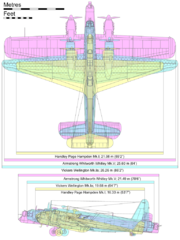 Type 271: The first Wellington bomber prototype.
Type 285 Wellington Mark I: One pre-production prototype. Powered by two Bristol Pegasus X radial piston engines.
Type 290 Wellington Mark I: The first production version. Powered by two 1,000 hp (750 kW) Bristol Pegasus XVIII radial piston engines. Fitted with Vickers gun turrets, 183 built at Weybridge and Chester.
Type 408 Wellington Mark IA: Production version built to B Mark II specifications with provision for either Pegasus or Rolls-Royce Merlin
engines, although only the two 1,000 hp (750 kW) Pegasus XVIII engines were used in practice. Main landing gear moved forward 3 in (8 cm). Fitted with Nash & Thomson
gun turrets. 187 built at Weybridge and Chester.
Type 416 Wellington Mark IC: The first main production variant was the Mark IC which added waist guns to the Mark IA. A total of 2,685 were produced. The Mark IC had a crew of six; a pilot, radio operator, navigator/bomb aimer, observer/nose gunner, tail gunner and waist gunner. 2,685 built at Weybridge, Chester and Blackpool.
Type 406 Wellington Mark II: The B Mark II was identical to the Mark IC with the exception of the powerplant; using the 1,145 hp (855 kW) Rolls-Royce Merlin
X engine instead. 400 were produced at Weybridge.
Type 417 Wellington B Mark III: The next significant variant was the B Mark III which featured the 1,375 hp (1,205 kW) Bristol Hercules
III or XI engine and a four-gun tail turret, instead of two-gun. A total of 1,519 Mark IIIs were built and became mainstays of Bomber Command through 1941. 1,517 built at Chester and Blackpool.
Type 424 Wellington B Mark IV: The 220 B Mark IV Wellingtons used the 1,200 hp (900 kW) Pratt & Whitney Twin Wasp engine and were flown by two Polish squadrons
. 220 built at Chester.
Type 442 Wellington B Mark VI: Pressurised with a long wingspan and 1,600 hp (1,190 kW) Merlin R6SM (60-series, two-stage) engines, 63 were produced and were operated by 109 Squadron
and as Gee radio navigation trainers. 63 built at Weybridge. This is the aircraft that spurred Rolls-Royce
into developing the two-stage supercharged Merlin 60-series engine.
Type 440 Wellington B Mark X: The most widely produced variant of which 3,804 were built. It was similar to the Mark III except for the 1,675 hp (1,250 kW) Hercules VI or XVI powerplant and a fuselage structure of light alloy, instead of steel. The Mark X was the basis for a number of Coastal Command versions. 3,803 built at Chester and Blackpool.
. 307 built built at Weybridge, 58 fitted with the Leigh Light
.
Type 458 Wellington GR Mark XI: Maritime version of B Mark X with an ordinary nose turret and mast radar ASV Mark II instead of chin radome, no waist guns, 180 built at Weybridge and Blackpool.
Type 455 Wellington GR Mark XII: Maritime version of B Mark X armed with torpedo
es and with a chin radome housing the ASV Mark III radar
, single nose machine gun, 58 built at Weybridge and Chester.
Type 466 Wellington GR Mark XIII: Maritime version of B Mark X with an ordinary nose turret and mast radar ASV Mark II instead of chin radome, no waist guns, 844 built Weybridge and Blackpool.
Type 467 Wellington GR Mark XIV: Maritime version of B Mark X with a chin radome housing the ASV Mark III radar
and added RP-3
explosive rocket
rails to the wings, 841 built at Weybridge, Chester and Blackpool.
Wellington C Mark XVI: Service conversions of the Wellington Mark IC into unarmed transport aircraft. Able to carry up to 18 troops.
Type 490 Wellington T Mark XVIII: Production version. Powered by two Bristol Hercules XVI radial piston engines. 80 built at Blackpool, plus some conversions.
Wellington T Mark XIX: Service conversions of the Wellington Mark X used for navigation training. Remained in use as a trainer until 1953.
Type 619 Wellington T Mark X: Postwar conversions of the Wellington Bomber into training aircraft by Boulton Paul in Wolverhampton
. For navigation training the front turret was removed and replaced by a fairing and the interior re-equipped. Some were sold to France
and Greece
.
Type 299 Wellington Mark III prototype: Two only.
Type 410 Wellington Mark IV prototype: Serial R1220. Powered by two Pratt & Whitney Twin Wasp radial piston engines.
Type 416 Wellington (II): The original Wellington II prototype was converted with the installation of a 40 mm (1.57 in) Vickers S gun in the dorsal position.
Type 418 Wellington DWI Mark I: Conversion of four Wellington Mark IAs to minesweeping
aircraft. Fitted with Ford V-8 petrol engine and Maudsley electrical generator
to induce magnetic field
in a 48 ft (14.63 m) diameter loop mounted under fuselage. They had a solid nose with a bracket supporting the loop, which was also supported under the rear fuselage and the wings, outboard of the engines. DWI stood for Directional Wireless Installation – a cover story for the true purpose of the loop.
Type 419 Wellington DWI Mark II: DWI Mark I aircraft upgraded by installation of De Havilland Gipsy engine for increased generation power. At least 11 further aircraft converted to this standard.
Type 407 and Type 421 Wellington Mark V :Second and first prototypes respectively: Three were built, designed for pressurised, high-altitude operations using turbocharged
Hercules VIII engines.
Wellington Mark VI: One high-altitude prototype only. Wellington Mark V with Merlin 60-series engines
Type 449 Wellington Mark VIG: Production version of Type 431. Two aircraft only.
Wellington Mark VII: Single aircraft, built as a test-bed for the 40 mm Vickers S gun turret.
Type 435 Wellington Mark IC: Conversion of one Wellington to test Turbinlite
.
Type 437 Wellington Mark IX: One Mark IC conversion for troop transport.
Type 439 Wellington Mark II: One Wellington Mark II was converted with the installation of a 40 mm Vickers S gun in the nose.
Type 443 Wellington Mark V: One Wellington was used to test the Bristol Hercules VIII engine.
Type 445 Wellington (I): One Wellington was used to test the Whittle W2B/23
turbojet engine, the engine was fitted in the tail of the aircraft.
Type 454 and Type 459 Wellington Mark IX: Prototypes with ASV Mark II, ASV Mark III radars, and powered by two Bristol Hercules VI and XVI radial piston engines.
Type 470 and Type 486 Wellington: This designation covers two Wellington Mark II aircraft fitted with the Whittle W2B and W2/700 respectively.
Type 478 Wellington Mark X: One Wellington was used to test the Bristol Hercules 100 engine.
Type 602 Wellington Mark X: One Wellington was fitted with two Rolls-Royce Dart
turboprop engines.
Wellington Mark III: One Wellington was used for glider tug, for glider clearance for Hadrian
, Hotspur and Horsa
gliders.
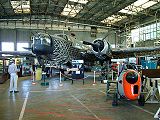 There are two surviving complete Vickers Wellingtons; both are preserved in the United Kingdom. Some other substantial parts also survive.
United Kingdom
The United Kingdom of Great Britain and Northern IrelandIn the United Kingdom and Dependencies, other languages have been officially recognised as legitimate autochthonous languages under the European Charter for Regional or Minority Languages...
twin-engine, long range medium bomber
Medium bomber
A medium bomber is a bomber aircraft designed to operate with medium bombloads over medium distances; the name serves to distinguish them from the larger heavy bombers and smaller light bombers...
designed in the mid-1930s at Brooklands
Brooklands
Brooklands was a motor racing circuit and aerodrome built near Weybridge in Surrey, England. It opened in 1907, and was the world's first purpose-built motorsport venue, as well as one of Britain's first airfields...
in Weybridge, Surrey, by Vickers-Armstrongs' Chief Designer, R. K. Pierson. It was widely used as a night bomber
Bomber
A bomber is a military aircraft designed to attack ground and sea targets, by dropping bombs on them, or – in recent years – by launching cruise missiles at them.-Classifications of bombers:...
in the early years of the Second World War
World War II
World War II, or the Second World War , was a global conflict lasting from 1939 to 1945, involving most of the world's nations—including all of the great powers—eventually forming two opposing military alliances: the Allies and the Axis...
, before being displaced as a bomber by the larger four-engine "heavies" such as the Avro Lancaster
Avro Lancaster
The Avro Lancaster is a British four-engined Second World War heavy bomber made initially by Avro for the Royal Air Force . It first saw active service in 1942, and together with the Handley Page Halifax it was one of the main heavy bombers of the RAF, the RCAF, and squadrons from other...
. The Wellington continued to serve throughout the war in other duties, particularly as an anti-submarine aircraft
Anti-submarine warfare
Anti-submarine warfare is a branch of naval warfare that uses surface warships, aircraft, or other submarines to find, track and deter, damage or destroy enemy submarines....
. It was the only British bomber to be produced for the entire duration of the war. The Wellington was popularly known as the Wimpy by service personnel, after J. Wellington Wimpy
J. Wellington Wimpy
J. Wellington Wimpy, generally referred to as Wimpy, is one of the characters in the long-running comic strip Popeye, created by E. C. Segar and originally called Thimble Theatre, and in the Popeye cartoons based upon the strip...
from the Popeye
Popeye
Popeye the Sailor is a cartoon fictional character created by Elzie Crisler Segar, who has appeared in comic strips and animated cartoons in the cinema as well as on television. He first appeared in the daily King Features comic strip Thimble Theatre on January 17, 1929...
cartoons and a Wellington "B for Bertie" had a starring role in the 1942 Oscar-nominated Powell and Pressburger film One of Our Aircraft Is Missing
One of Our Aircraft is Missing
One of Our Aircraft is Missing is a 1942 British war film, the fourth collaboration between the British writer-director-producer team of Michael Powell and Emeric Pressburger and the first film they made under the banner of The Archers...
.
The Wellington was one of two bombers named after Arthur Wellesley, 1st Duke of Wellington
Arthur Wellesley, 1st Duke of Wellington
Field Marshal Arthur Wellesley, 1st Duke of Wellington, KG, GCB, GCH, PC, FRS , was an Irish-born British soldier and statesman, and one of the leading military and political figures of the 19th century...
, the other being the Vickers Wellesley
Vickers Wellesley
The Vickers Wellesley was a British 1930s light bomber built by Vickers-Armstrongs at Brooklands near Weybridge, Surrey, for the Royal Air Force...
.
Design and development
Barnes Wallis
Sir Barnes Neville Wallis, CBE FRS, RDI, FRAeS , was an English scientist, engineer and inventor. He is best known for inventing the bouncing bomb used by the RAF in Operation Chastise to attack the dams of the Ruhr Valley during World War II...
inspired by his work on airship
Airship
An airship or dirigible is a type of aerostat or "lighter-than-air aircraft" that can be steered and propelled through the air using rudders and propellers or other thrust mechanisms...
s, and had previously been used to build the single-engine Wellesley
Vickers Wellesley
The Vickers Wellesley was a British 1930s light bomber built by Vickers-Armstrongs at Brooklands near Weybridge, Surrey, for the Royal Air Force...
light bomber
Light bomber
A light bomber is a relatively small and fast class of military bomber aircraft which were primarily employed before the 1950s. Such aircraft would typically not carry more than one ton of ordnance....
. The fuselage
Fuselage
The fuselage is an aircraft's main body section that holds crew and passengers or cargo. In single-engine aircraft it will usually contain an engine, although in some amphibious aircraft the single engine is mounted on a pylon attached to the fuselage which in turn is used as a floating hull...
was built up from 1650 elements, consisting of aluminium alloy (duralumin
Duralumin
Duralumin is the trade name of one of the earliest types of age-hardenable aluminium alloys. The main alloying constituents are copper, manganese, and magnesium. A commonly used modern equivalent of this alloy type is AA2024, which contains 4.4% copper, 1.5% magnesium, 0.6% manganese and 93.5%...
) W-beams that were formed into a large framework. Wooden batten
Batten
A batten is a thin strip of solid material, typically made from wood, plastic or metal. Battens are used in building construction and various other fields as both structural and purely cosmetic elements...
s were screwed onto the aluminium, and these were covered with Irish linen
Irish linen
Irish linen is the brand name given to linen produced in Ireland. Linen is cloth woven from, or yarn spun from the flax fibre, which was grown in Ireland for many years before advanced agricultural methods and more suitable climate led to the concentration of quality flax cultivation in northern...
, which, once treated with many layers of dope
Aircraft dope
thumb|right|[[United Kingdom military aircraft serials|2699]] a [[World War I]] [[Royal Aircraft Factory B.E.2]] finished in a clear dopeAircraft dope is a plasticised lacquer that is applied to fabric-covered aircraft...
, formed the outer skin of the aircraft. The metal lattice gave the structure tremendous strength, because any one of the stringers could support some of the weight from even the opposite side of the aircraft. Blowing out one side's beams would still leave the aircraft as a whole intact; as a result, Wellingtons with huge areas of framework missing continued to return home when other types would not have survived; the dramatic effect was enhanced by the doped fabric skin burning off, leaving the naked frames exposed (see photo).
In one case as a result of a fire in the wing caused by battle damage a Wellington co-pilot was forced to climb out of the aircraft while in flight kicking holes in the doped fabric for foot and hand holds and physically smother the burning upper wing covering. The aircraft returned home safely and the airman concerned, Sergent James Allen Ward
James Allen Ward
James Allen Ward VC was a New Zealand recipient of the Victoria Cross, the highest and most prestigious award for gallantry in the face of the enemy that can be awarded to British and Commonwealth forces.-Biography:...
was awarded the Victoria Cross
Victoria Cross
The Victoria Cross is the highest military decoration awarded for valour "in the face of the enemy" to members of the armed forces of various Commonwealth countries, and previous British Empire territories....
for his actions.
The geodesic structure also gave a very strong but light structure for its large size, which gave the Wellington a load and range to power ratio advantage over similar aircraft, without sacrificing robustness or protective devices such as armour plate
Vehicle armour
Military vehicles are commonly armoured to withstand the impact of shrapnel, bullets, missiles, or shells, protecting the personnel inside from enemy fire. Such vehicles include tanks, aircraft, and ships....
or self-sealing fuel tank
Self-sealing fuel tank
In aviation, self-sealing fuel tank is a fuel tank technology in wide use since World War II that prevents fuel tanks primarily on aircraft from leaking fuel and igniting after being damaged by enemy fire....
s.
However, the construction system also had a distinct disadvantage in that it took considerably longer to build a Wellington than other designs using monocoque
Monocoque
Monocoque is a construction technique that supports structural load by using an object's external skin, as opposed to using an internal frame or truss that is then covered with a non-load-bearing skin or coachwork...
construction techniques. Also, it was difficult to cut holes into the fuselage to provide additional access or equipment fixtures. The Leigh light
Leigh light
The Leigh Light was a British World War II era anti-submarine device used in the Second Battle of the Atlantic.It was a powerful carbon arc searchlight of 24 inches diameter fitted to a number of the British Royal Air Force's Coastal Command patrol bombers to help them spot surfaced...
, for instance, was deployed through the mounting for the absent FN9 ventral turret
Nash & Thomson
Nash & Thompson was a British engineering firm that specialised in the production of hydraulically-operated gun turrets for aircraft. The company was also an important manufacturer of hydraulic powered radar scanners, used on radar systems such as H2S and AI Mark VIII.- History :Nash & Thompson was...
. Nevertheless, in the late 1930s Vickers succeeded in building Wellingtons at a rate of one a day at Weybridge and 50 a month at the Chester factory (located at Broughton
Hawarden Airport
Hawarden Airport , is a small airport in Hawarden situated in North East Wales close to the border with England and west southwest of the city of Chester. The airport is owned and operated by BAE Systems. A long term tenancy agreement has been signed with Airbus UK, giving rights as the sole...
in North Wales
North Wales
North Wales is the northernmost unofficial region of Wales. It is bordered to the south by the counties of Ceredigion and Powys in Mid Wales and to the east by the counties of Shropshire in the West Midlands and Cheshire in North West England...
). Peak wartime production in 1942 saw monthly rates of 70 achieved at Weybridge
Weybridge
Weybridge is a town in the Elmbridge district of Surrey in South East England. It is bounded to the north by the River Thames at the mouth of the River Wey, from which it gets its name...
, 130 at Broughton and 102 at Blackpool
Blackpool
Blackpool is a borough, seaside town, and unitary authority area of Lancashire, in North West England. It is situated along England's west coast by the Irish Sea, between the Ribble and Wyre estuaries, northwest of Preston, north of Liverpool, and northwest of Manchester...
.
The Wellington went through a total of 16 variants during its production life plus a further two training
Trainer (aircraft)
A trainer is a class of aircraft designed specifically to facilitate in-flight training of pilots and aircrews. The use of a dedicated trainer aircraft with additional safety features—such as tandem flight controls, forgiving flight characteristics and a simplified cockpit arrangement—allows...
conversions after the war. The prototype serial K4049 designed to satisfy Ministry Specification B.9/32, first flew as a Type 271 (and initially named Crecy) from Brooklands on 15 June 1936 with chief test pilot Joseph Summers
Joseph Summers
Captain Joseph "Mutt" Summers, CBE , was chief test pilot at Vickers-Armstrongs and Supermarine.During his career Summers flew numerous prototype aircraft , from the Supermarine Spitfire, to the Vickers Valiant...
as pilot. After many changes to the design, it was accepted on 15 August 1936 for production with the name Wellington. The first model was the Wellington Mark I, powered by a pair of 1,050 hp (780 kW) Bristol Pegasus engines, of which 180 were built, 150 for the Royal Air Force
Royal Air Force
The Royal Air Force is the aerial warfare service branch of the British Armed Forces. Formed on 1 April 1918, it is the oldest independent air force in the world...
and 30 for the Royal New Zealand Air Force
Royal New Zealand Air Force
The Royal New Zealand Air Force is the air arm of the New Zealand Defence Force...
(which were transferred to the RAF on the outbreak of war and used by 75 Squadron
No. 75 Squadron RAF
No. 75 Squadron of the Royal Air Force operated as a bomber unit in World War II, before being transferred to the Royal New Zealand Air Force in 1945.-First World War, Royal Flying Corps, Home Defence Squadron :...
). The Mark I first entered service with No. 9 Squadron RAF in October 1938. Improvements to the turrets resulted in 183 Mark IA Wellingtons, which equipped the RAF Bomber Command
RAF Bomber Command
RAF Bomber Command controlled the RAF's bomber forces from 1936 to 1968. During World War II the command destroyed a significant proportion of Nazi Germany's industries and many German cities, and in the 1960s stood at the peak of its postwar military power with the V bombers and a supplemental...
heavy bomber
Heavy bomber
A heavy bomber is a bomber aircraft of the largest size and load carrying capacity, and usually the longest range.In New START, the term "heavy bomber" is used for two types of bombers:*one with a range greater than 8,000 kilometers...
squadrons at the outbreak of war. The Wellington was initially outnumbered by its twin-engine contemporaries, the Handley Page Hampden
Handley Page Hampden
The Handley Page HP.52 Hampden was a British twin-engine medium bomber of the Royal Air Force serving in the Second World War. With the Whitley and Wellington, the Hampden bore the brunt of the early bombing war over Europe, taking part in the first night raid on Berlin and the first 1,000-plane...
and the Armstrong Whitworth Whitley
Armstrong Whitworth Whitley
The Armstrong Whitworth A.W.38 Whitley was one of three British twin-engine, front line medium bomber types in service with the Royal Air Force at the outbreak of the Second World War...
, but ultimately outlasted them in productive service.
The number of Wellingtons built totalled 11,461 of all versions, the last of which was rolled out on 13 October 1945.
Construction record
As a propaganda and morale boosting exercise, in October 1943 workers at the Vickers Broughton factory gave up their weekend to build Wellington number LN514Vickers Wellington LN514
Vickers Wellington LN514 was a Vickers Wellington bomber built in 1943 in record time, as part of a British propaganda effort during the Second World War....
against the clock. The bomber was assembled in new world record time of 23 hours 50 minutes, and took off after 24 hours 48 minutes, beating the previous record of 48 hours set by an American factory in California. The effort was filmed for the Ministry of Information, forming the basis of a newsreel
Newsreel
A newsreel was a form of short documentary film prevalent in the first half of the 20th century, regularly released in a public presentation place and containing filmed news stories and items of topical interest. It was a source of news, current affairs and entertainment for millions of moviegoers...
Worker's Week-End, broadcast in Britain and America.
Operational history
The first RAF bombing attack of the war was made by Wellingtons of No. 9 and No. 149No. 149 Squadron RAF
No. 149 Squadron RAF was a Royal Air Force Squadron between 1918 and 1956. Formed 1918 in the Royal Flying Corps as a night-bomber unit, it remained in that role for the rest of its existence which spanned three periods between 1918 and 1956.-World War I:...
Squadrons, along with Bristol Blenheim
Bristol Blenheim
The Bristol Blenheim was a British light bomber aircraft designed and built by the Bristol Aeroplane Company that was used extensively in the early days of the Second World War. It was adapted as an interim long-range and night fighter, pending the availability of the Beaufighter...
s, on German shipping at Brunsbüttel
Brunsbüttel
Brunsbüttel is a town in the district of Dithmarschen, in Schleswig-Holstein, northern Germany that lies on the mouth of the Elbe river, near the North Sea. It is the location of the western entrance to the Kiel Canal, the eastern entrance being located at Kiel-Holtenau...
on 4 September 1939. During this raid, the two Wellingtons became the first aircraft shot down on the Western Front
Western Front (World War II)
The Western Front of the European Theatre of World War II encompassed, Denmark, Norway, Luxembourg, Belgium, the Netherlands, France, and West Germany. The Western Front was marked by two phases of large-scale ground combat operations...
. Numbers 9, 37 and 149 Squadrons saw action on 18 December 1939 on a mission
Battle of the Heligoland Bight (1939)
The Battle of the Heligoland Bight was the first "named" air battle of the Second World War, which began the longest air campaign of the war, the Defence of the Reich. On 18 December 1939, a force of three RAF bomber squadrons with a total of 24 aircraft set off to engage German ships in the...
against German shipping on the Schillig Roads and Wilhelmshaven
Wilhelmshaven
Wilhelmshaven is a coastal town in Lower Saxony, Germany. It is situated on the western side of the Jade Bight, a bay of the North Sea.-History:...
. Luftwaffe fighter
Fighter aircraft
A fighter aircraft is a military aircraft designed primarily for air-to-air combat with other aircraft, as opposed to a bomber, which is designed primarily to attack ground targets...
s destroyed 12 of the bombers and badly damaged three others; thus highlighting the aircraft's vulnerability to attacking fighters, having neither self-sealing fuel tanks nor sufficient defensive armament. In particular, while the aircraft's nose and tail turrets protected against attacks from the front and rear, the Wellington had no defences against attacks from the beam and above, as it had not been believed that such attacks were possible owing to the high speed of aircraft involved. As a consequence, Wellingtons were switched to night operations and participated in the first night raid on Berlin
Berlin
Berlin is the capital city of Germany and is one of the 16 states of Germany. With a population of 3.45 million people, Berlin is Germany's largest city. It is the second most populous city proper and the seventh most populous urban area in the European Union...
on 25 August 1940. In the first 1,000-aircraft raid on Cologne
Cologne
Cologne is Germany's fourth-largest city , and is the largest city both in the Germany Federal State of North Rhine-Westphalia and within the Rhine-Ruhr Metropolitan Area, one of the major European metropolitan areas with more than ten million inhabitants.Cologne is located on both sides of the...
, on 30 May 1942, 599 out of 1,046 aircraft were Wellingtons (101 of them were flown by Polish
Poland
Poland , officially the Republic of Poland , is a country in Central Europe bordered by Germany to the west; the Czech Republic and Slovakia to the south; Ukraine, Belarus and Lithuania to the east; and the Baltic Sea and Kaliningrad Oblast, a Russian exclave, to the north...
aircrew).
With Bomber Command, Wellingtons flew 47,409 operations, dropped 41,823 tons (37,941 tonnes) of bombs and lost 1,332 aircraft in action.
Coastal Command Wellingtons carried out anti-submarine duties and sank their first enemy vessel on 6 July 1942. DWI versions (see below) fitted with a 48 ft (14.63 m) diameter metal hoop were used for exploding enemy mines by generating a powerful magnetic field as it passed over them. In 1944, Wellingtons of Coastal Command were deployed to Greece
Greece
Greece , officially the Hellenic Republic , and historically Hellas or the Republic of Greece in English, is a country in southeastern Europe....
, and performed various support duties during the RAF involvement in the Greek Civil War
Greek Civil War
The Greek Civil War was fought from 1946 to 1949 between the Greek governmental army, backed by the United Kingdom and United States, and the Democratic Army of Greece , the military branch of the Greek Communist Party , backed by Bulgaria, Yugoslavia and Albania...
. A few Wellingtons were operated by the Hellenic Air Force
Hellenic Air Force
The Hellenic Air Force, abbreviated to HAF is the air force of Greece. The mission of the Hellenic Air Force is to guard and protect Greek airspace, provide air assistance and support to the Hellenic Army and the Hellenic Navy, as well as the provision of humanitarian aid in Greece and around the...
.
While the Wellington was superseded in the European Theatre, it remained in operational service for much of the war in the Middle East
Middle East
The Middle East is a region that encompasses Western Asia and Northern Africa. It is often used as a synonym for Near East, in opposition to Far East...
, and in 1942, Wellingtons based in India
India
India , officially the Republic of India , is a country in South Asia. It is the seventh-largest country by geographical area, the second-most populous country with over 1.2 billion people, and the most populous democracy in the world...
became the RAF's first long-range bomber operating in the Far East
Far East
The Far East is an English term mostly describing East Asia and Southeast Asia, with South Asia sometimes also included for economic and cultural reasons.The term came into use in European geopolitical discourse in the 19th century,...
. It was particularly effective with the South African Air Force
South African Air Force
The South African Air Force is the air force of South Africa, with headquarters in Pretoria. It is the world's second oldest independent air force, and its motto is Per Aspera Ad Astra...
in North Africa
North Africa
North Africa or Northern Africa is the northernmost region of the African continent, linked by the Sahara to Sub-Saharan Africa. Geopolitically, the United Nations definition of Northern Africa includes eight countries or territories; Algeria, Egypt, Libya, Morocco, South Sudan, Sudan, Tunisia, and...
. This versatile aircraft also served in anti-submarine duties with 26 Squadron SAAF
26 Squadron SAAF
26 Squadron SAAF is a disbanded squadron of the South African Air Force. The squadron was based at Takoradi, Gold Coast on the West Coast of Africa during World war II. They flew Vickers Wellingtons on anti-submarine and convoy escort patrols over the Atlantic. The squadron was seconded to No. 298...
based in Takoradi, Gold Coast
Gold Coast (British colony)
The Gold Coast was a British colony on the Gulf of Guinea in west Africa that became the independent nation of Ghana in 1957.-Overview:The first Europeans to arrive at the coast were the Portuguese in 1471. They encountered a variety of African kingdoms, some of which controlled substantial...
(now known as Ghana
Ghana
Ghana , officially the Republic of Ghana, is a country located in West Africa. It is bordered by Côte d'Ivoire to the west, Burkina Faso to the north, Togo to the east, and the Gulf of Guinea to the south...
).
In late 1944, a radar-equipped Wellington was modified for use by the RAF's Fighter Interception Unit
Fighter Interception Unit
The Fighter Interception Unit was a special interceptor aircraft unit of the Royal Air Force during the Second World War. It was part of Air Defence of Great Britain....
as what would now be described as an Airborne Early Warning and Control aircraft. It operated at an altitude of some 4000 ft (1,219 m) over the North Sea
North Sea
In the southwest, beyond the Straits of Dover, the North Sea becomes the English Channel connecting to the Atlantic Ocean. In the east, it connects to the Baltic Sea via the Skagerrak and Kattegat, narrow straits that separate Denmark from Norway and Sweden respectively...
to control de Havilland Mosquito
De Havilland Mosquito
The de Havilland DH.98 Mosquito was a British multi-role combat aircraft that served during the Second World War and the postwar era. It was known affectionately as the "Mossie" to its crews and was also nicknamed "The Wooden Wonder"...
fighters intercepting Heinkel He 111
Heinkel He 111
The Heinkel He 111 was a German aircraft designed by Siegfried and Walter Günter in the early 1930s in violation of the Treaty of Versailles. Often described as a "Wolf in sheep's clothing", it masqueraded as a transport aircraft, but its purpose was to provide the Luftwaffe with a fast medium...
bombers flying from Dutch
Netherlands
The Netherlands is a constituent country of the Kingdom of the Netherlands, located mainly in North-West Europe and with several islands in the Caribbean. Mainland Netherlands borders the North Sea to the north and west, Belgium to the south, and Germany to the east, and shares maritime borders...
airbases and carrying out airborne launches of the V-1 flying bomb
V-1 flying bomb
The V-1 flying bomb, also known as the Buzz Bomb or Doodlebug, was an early pulse-jet-powered predecessor of the cruise missile....
.
The Wellington is listed in the appendix to the novel KG 200 as one flown by the German secret operations unit KG 200
KG 200
Kampfgeschwader 200 was a Luftwaffe unit during World War II. The unit was the Luftwaffe's special operations wing that carried out long-distance reconnaissance flights, tested new aircraft designs, and operated captured aircraft....
, which also tested, evaluated and sometimes clandestinely operated captured enemy aircraft during the Second World War.
Bomber variants
Type 285 Wellington Mark I: One pre-production prototype. Powered by two Bristol Pegasus X radial piston engines.
Type 290 Wellington Mark I: The first production version. Powered by two 1,000 hp (750 kW) Bristol Pegasus XVIII radial piston engines. Fitted with Vickers gun turrets, 183 built at Weybridge and Chester.
Type 408 Wellington Mark IA: Production version built to B Mark II specifications with provision for either Pegasus or Rolls-Royce Merlin
Rolls-Royce Merlin
The Rolls-Royce Merlin is a British liquid-cooled, V-12, piston aero engine, of 27-litre capacity. Rolls-Royce Limited designed and built the engine which was initially known as the PV-12: the PV-12 became known as the Merlin following the company convention of naming its piston aero engines after...
engines, although only the two 1,000 hp (750 kW) Pegasus XVIII engines were used in practice. Main landing gear moved forward 3 in (8 cm). Fitted with Nash & Thomson
Nash & Thomson
Nash & Thompson was a British engineering firm that specialised in the production of hydraulically-operated gun turrets for aircraft. The company was also an important manufacturer of hydraulic powered radar scanners, used on radar systems such as H2S and AI Mark VIII.- History :Nash & Thompson was...
gun turrets. 187 built at Weybridge and Chester.
Type 416 Wellington Mark IC: The first main production variant was the Mark IC which added waist guns to the Mark IA. A total of 2,685 were produced. The Mark IC had a crew of six; a pilot, radio operator, navigator/bomb aimer, observer/nose gunner, tail gunner and waist gunner. 2,685 built at Weybridge, Chester and Blackpool.
Type 406 Wellington Mark II: The B Mark II was identical to the Mark IC with the exception of the powerplant; using the 1,145 hp (855 kW) Rolls-Royce Merlin
Rolls-Royce Merlin
The Rolls-Royce Merlin is a British liquid-cooled, V-12, piston aero engine, of 27-litre capacity. Rolls-Royce Limited designed and built the engine which was initially known as the PV-12: the PV-12 became known as the Merlin following the company convention of naming its piston aero engines after...
X engine instead. 400 were produced at Weybridge.
Type 417 Wellington B Mark III: The next significant variant was the B Mark III which featured the 1,375 hp (1,205 kW) Bristol Hercules
Bristol Hercules
|-See also:-Bibliography:*Gunston, B. Classic World War II Aircraft Cutaways. Osprey. ISBN 1-85532-526-8*Gunston, Bill. World Encyclopedia of Aero Engines. Cambridge, England. Patrick Stephens Limited, 1989. ISBN 1-85260-163-9...
III or XI engine and a four-gun tail turret, instead of two-gun. A total of 1,519 Mark IIIs were built and became mainstays of Bomber Command through 1941. 1,517 built at Chester and Blackpool.
Type 424 Wellington B Mark IV: The 220 B Mark IV Wellingtons used the 1,200 hp (900 kW) Pratt & Whitney Twin Wasp engine and were flown by two Polish squadrons
Polish Air Force
The Polish Air Force is the military Air Force wing of the Polish Armed Forces. Until July 2004 it was officially known as Wojska Lotnicze i Obrony Powietrznej...
. 220 built at Chester.
Type 442 Wellington B Mark VI: Pressurised with a long wingspan and 1,600 hp (1,190 kW) Merlin R6SM (60-series, two-stage) engines, 63 were produced and were operated by 109 Squadron
No. 109 Squadron RAF
No. 109 Squadron RAF was an aircraft squadron of the Royal Air Force during World War II. It operated Wellington VIs.-History:The squadron first formed on 1 November 1917 as 109 Squadron Royal Flying Corps at South Carlton in 1917 operating the de Havilland DH.9 until it was disbanded on 19 August...
and as Gee radio navigation trainers. 63 built at Weybridge. This is the aircraft that spurred Rolls-Royce
Rolls-Royce Limited
Rolls-Royce Limited was a renowned British car and, from 1914 on, aero-engine manufacturing company founded by Charles Stewart Rolls and Henry Royce on 15 March 1906 as the result of a partnership formed in 1904....
into developing the two-stage supercharged Merlin 60-series engine.
Type 440 Wellington B Mark X: The most widely produced variant of which 3,804 were built. It was similar to the Mark III except for the 1,675 hp (1,250 kW) Hercules VI or XVI powerplant and a fuselage structure of light alloy, instead of steel. The Mark X was the basis for a number of Coastal Command versions. 3,803 built at Chester and Blackpool.
Coastal Command variants
Type 429 Wellington GR Mark VIII: Mark IC conversion for Coastal Command service. Roles included reconnaissance, anti-submarine and anti-shipping attack. A Coastal Command Wimpy was the first aircraft to be fitted with the anti-submarine Leigh lightLeigh light
The Leigh Light was a British World War II era anti-submarine device used in the Second Battle of the Atlantic.It was a powerful carbon arc searchlight of 24 inches diameter fitted to a number of the British Royal Air Force's Coastal Command patrol bombers to help them spot surfaced...
. 307 built built at Weybridge, 58 fitted with the Leigh Light
Leigh light
The Leigh Light was a British World War II era anti-submarine device used in the Second Battle of the Atlantic.It was a powerful carbon arc searchlight of 24 inches diameter fitted to a number of the British Royal Air Force's Coastal Command patrol bombers to help them spot surfaced...
.
Type 458 Wellington GR Mark XI: Maritime version of B Mark X with an ordinary nose turret and mast radar ASV Mark II instead of chin radome, no waist guns, 180 built at Weybridge and Blackpool.
Type 455 Wellington GR Mark XII: Maritime version of B Mark X armed with torpedo
Torpedo
The modern torpedo is a self-propelled missile weapon with an explosive warhead, launched above or below the water surface, propelled underwater towards a target, and designed to detonate either on contact with it or in proximity to it.The term torpedo was originally employed for...
es and with a chin radome housing the ASV Mark III radar
Radar
Radar is an object-detection system which uses radio waves to determine the range, altitude, direction, or speed of objects. It can be used to detect aircraft, ships, spacecraft, guided missiles, motor vehicles, weather formations, and terrain. The radar dish or antenna transmits pulses of radio...
, single nose machine gun, 58 built at Weybridge and Chester.
Type 466 Wellington GR Mark XIII: Maritime version of B Mark X with an ordinary nose turret and mast radar ASV Mark II instead of chin radome, no waist guns, 844 built Weybridge and Blackpool.
Type 467 Wellington GR Mark XIV: Maritime version of B Mark X with a chin radome housing the ASV Mark III radar
Radar
Radar is an object-detection system which uses radio waves to determine the range, altitude, direction, or speed of objects. It can be used to detect aircraft, ships, spacecraft, guided missiles, motor vehicles, weather formations, and terrain. The radar dish or antenna transmits pulses of radio...
and added RP-3
RP-3
The RP-3 , was a British rocket used in the Second World War. Though primarily an air-to-ground weapon, it saw limited use in other roles. Its 60 lb warhead gave rise to the alternative name of the "60 lb rocket"; the 25 lb solid-shot armour piercing variant was referred to as the "25 lb rocket"...
explosive rocket
Rocket
A rocket is a missile, spacecraft, aircraft or other vehicle which obtains thrust from a rocket engine. In all rockets, the exhaust is formed entirely from propellants carried within the rocket before use. Rocket engines work by action and reaction...
rails to the wings, 841 built at Weybridge, Chester and Blackpool.
Transport variants
Wellington C Mark XV: Service conversions of the Wellington Mark IA into unarmed transport aircraft. Able to carry up to 18 troops.Wellington C Mark XVI: Service conversions of the Wellington Mark IC into unarmed transport aircraft. Able to carry up to 18 troops.
Trainer variants
Type 487 Wellington T Mark XVII: Service conversions of the Wellington bomber into training aircraft with Air Intercept radar. Powered by two Bristol Hercules XVII radial piston engines.Type 490 Wellington T Mark XVIII: Production version. Powered by two Bristol Hercules XVI radial piston engines. 80 built at Blackpool, plus some conversions.
Wellington T Mark XIX: Service conversions of the Wellington Mark X used for navigation training. Remained in use as a trainer until 1953.
Type 619 Wellington T Mark X: Postwar conversions of the Wellington Bomber into training aircraft by Boulton Paul in Wolverhampton
Wolverhampton
Wolverhampton is a city and metropolitan borough in the West Midlands, England. For Eurostat purposes Walsall and Wolverhampton is a NUTS 3 region and is one of five boroughs or unitary districts that comprise the "West Midlands" NUTS 2 region...
. For navigation training the front turret was removed and replaced by a fairing and the interior re-equipped. Some were sold to France
France
The French Republic , The French Republic , The French Republic , (commonly known as France , is a unitary semi-presidential republic in Western Europe with several overseas territories and islands located on other continents and in the Indian, Pacific, and Atlantic oceans. Metropolitan France...
and Greece
Greece
Greece , officially the Hellenic Republic , and historically Hellas or the Republic of Greece in English, is a country in southeastern Europe....
.
Experimental and conversion variants
Type 298 Wellington Mark II prototype: One aircraft L4250. Powered by two 1,145 hp (854 kW) Rolls-Royce Merlin inline piston engines.Type 299 Wellington Mark III prototype: Two only.
Type 410 Wellington Mark IV prototype: Serial R1220. Powered by two Pratt & Whitney Twin Wasp radial piston engines.
Type 416 Wellington (II): The original Wellington II prototype was converted with the installation of a 40 mm (1.57 in) Vickers S gun in the dorsal position.
Type 418 Wellington DWI Mark I: Conversion of four Wellington Mark IAs to minesweeping
Minesweeper (ship)
A minesweeper is a small naval warship designed to counter the threat posed by naval mines. Minesweepers generally detect then neutralize mines in advance of other naval operations.-History:...
aircraft. Fitted with Ford V-8 petrol engine and Maudsley electrical generator
Electrical generator
In electricity generation, an electric generator is a device that converts mechanical energy to electrical energy. A generator forces electric charge to flow through an external electrical circuit. It is analogous to a water pump, which causes water to flow...
to induce magnetic field
Magnetic field
A magnetic field is a mathematical description of the magnetic influence of electric currents and magnetic materials. The magnetic field at any given point is specified by both a direction and a magnitude ; as such it is a vector field.Technically, a magnetic field is a pseudo vector;...
in a 48 ft (14.63 m) diameter loop mounted under fuselage. They had a solid nose with a bracket supporting the loop, which was also supported under the rear fuselage and the wings, outboard of the engines. DWI stood for Directional Wireless Installation – a cover story for the true purpose of the loop.
Type 419 Wellington DWI Mark II: DWI Mark I aircraft upgraded by installation of De Havilland Gipsy engine for increased generation power. At least 11 further aircraft converted to this standard.
Type 407 and Type 421 Wellington Mark V :Second and first prototypes respectively: Three were built, designed for pressurised, high-altitude operations using turbocharged
Turbocharger
A turbocharger, or turbo , from the Greek "τύρβη" is a centrifugal compressor powered by a turbine that is driven by an engine's exhaust gases. Its benefit lies with the compressor increasing the mass of air entering the engine , thereby resulting in greater performance...
Hercules VIII engines.
Wellington Mark VI: One high-altitude prototype only. Wellington Mark V with Merlin 60-series engines
Type 449 Wellington Mark VIG: Production version of Type 431. Two aircraft only.
Wellington Mark VII: Single aircraft, built as a test-bed for the 40 mm Vickers S gun turret.
Type 435 Wellington Mark IC: Conversion of one Wellington to test Turbinlite
Turbinlite
The Helmore/GEC Turbinlite was a 2,700 million candela searchlight fitted in the nose of a number of British Douglas Havoc night fighters during the early part of the Second World War and around the time of The Blitz....
.
Type 437 Wellington Mark IX: One Mark IC conversion for troop transport.
Type 439 Wellington Mark II: One Wellington Mark II was converted with the installation of a 40 mm Vickers S gun in the nose.
Type 443 Wellington Mark V: One Wellington was used to test the Bristol Hercules VIII engine.
Type 445 Wellington (I): One Wellington was used to test the Whittle W2B/23
Power Jets W.2
|-See also:-Bibliography:*Gunston, Bill. World Encyclopedia of Aero Engines. Cambridge, England. Patrick Stephens Limited, 1989. ISBN 1-85260-163-9*Jane's Fighting Aircraft of World War II. London. Studio Editions Ltd, 1998...
turbojet engine, the engine was fitted in the tail of the aircraft.
Type 454 and Type 459 Wellington Mark IX: Prototypes with ASV Mark II, ASV Mark III radars, and powered by two Bristol Hercules VI and XVI radial piston engines.
Type 470 and Type 486 Wellington: This designation covers two Wellington Mark II aircraft fitted with the Whittle W2B and W2/700 respectively.
Type 478 Wellington Mark X: One Wellington was used to test the Bristol Hercules 100 engine.
Type 602 Wellington Mark X: One Wellington was fitted with two Rolls-Royce Dart
Rolls-Royce Dart
|-See also:-Bibliography:* Gunston, Bill. World Encyclopedia of Aero Engines. Cambridge, England. Patrick Stephens Limited, 1989. ISBN 1-85260-163-9-External links:*...
turboprop engines.
Wellington Mark III: One Wellington was used for glider tug, for glider clearance for Hadrian
Waco CG-4
The Waco CG-4 was the most widely used United States troop/cargo military glider of World War II. It was designated the CG-4 by the United States Army Air Forces, and named Hadrian in British military service....
, Hotspur and Horsa
Airspeed Horsa
The Airspeed AS.51 Horsa was a British World War II troop-carrying glider built by Airspeed Limited and subcontractors and used for air assault by British and Allied armed forces...
gliders.
Survivors
- Wellington Mark IA serial number N2980 is on display at Brooklands MuseumBrooklands MuseumBrooklands Museum is an independent charitable trust, established in 1987, whose aim is to conserve, protect and interpret the unique heritage of the Brooklands site. It is located south of Weybridge, Surrey and was first opened regularly in 1991 on of the original 1907 motor-racing circuit...
at BrooklandsBrooklandsBrooklands was a motor racing circuit and aerodrome built near Weybridge in Surrey, England. It opened in 1907, and was the world's first purpose-built motorsport venue, as well as one of Britain's first airfields...
, Surrey. Built at Brooklands and first flown in November 1939, this aircraft took part in the RAF's daylight bombing raids on Germany early in WW2 but later lost power during a training flight on 31st December 1940 and ditched in Loch NessLoch NessLoch Ness is a large, deep, freshwater loch in the Scottish Highlands extending for approximately southwest of Inverness. Its surface is above sea level. Loch Ness is best known for the alleged sightings of the cryptozoological Loch Ness Monster, also known affectionately as "Nessie"...
. All the occupants survived except the rear gunner, who was killed when his parachute failed to open. The aircraft was recovered from the bottom of Loch Ness in September 1985 and restored in the late 1980s and 1990s. A new Wellington exhibition around N2980 was officially opened by Robin Holmes, Penelope KeithPenelope KeithPenelope Anne Constance Keith, CBE, DL is an English actress.Having started her television career in the 1950s, Penelope Keith became a household name in the United Kingdom in the 1970s when she played Margo Leadbetter in the sitcom The Good Life...
, Norman Parker and Ken WallisKen WallisWing Commander Kenneth Horatio Wallis MBE, DEng , CEng, FRAeS, FSETP, PhD , RAF , is one of the leading exponents of autogyros. He has held 34 records relating to them.-Early life:...
on 15th June 2011 - the 75th anniversary of the first flight of the type's effective prototype in 1936. - Wellington T Mark X serial number MF628 is held by the Royal Air Force Museum. It was delivered to RAF No.18 MU (Maintenance Unit) for storage at RAF Tinwald DownsRAF Tinwald DownsRAF Tinwald Downs was a former Royal Air Force station located near Tinwald, Scotland. The airfield opened on 17 June 1940 and was sold in 1960 to a private firm.The disused airfield is now used as the Dumfries Aviation Museum.-History:...
, DumfriesDumfriesDumfries is a market town and former royal burgh within the Dumfries and Galloway council area of Scotland. It is near the mouth of the River Nith into the Solway Firth. Dumfries was the county town of the former county of Dumfriesshire. Dumfries is nicknamed Queen of the South...
, as a Wellington Mark X, on 11 May 1944. In March 1948 the front gun turret was removed in its conversion to a T Mark X for its role as a post-war aircrew trainer; the RAF Museum later refitted the front gun turret in keeping with its original build as a Mark X.In Autumn 2010, this aircraft was taken to the RAF Museum's site at CosfordRoyal Air Force Museum CosfordThe Royal Air Force Museum Cosford is a museum dedicated to the history of aviation, and the Royal Air Force in particular. The museum is a non-departmental public body sponsored by the Department for Culture, Media and Sport and a registered charity...
for restoration over the next four or five years.
Specifications (Wellington Mark IC)
See also
External links
- Wellington Bomber Crews and Their Experiences
- A Polish Wellington bomber pilot recalls his war
- Cover Illustration August 1940 Popular MechanicsPopular MechanicsPopular Mechanics is an American magazine first published January 11, 1902 by H. H. Windsor, and has been owned since 1958 by the Hearst Corporation...