

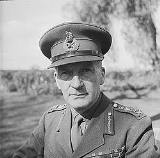
John Dill

Encyclopedia
Field Marshal
Sir John Greer Dill, GCB, CMG, DSO
(25 December 1881 - 4 November 1944) was a British commander in World War I and World War II. From May 1940 to December 1941 he was the Chief of the Imperial General Staff, the professional head of the British Army, and subsequently in Washington, as Chief of the British Joint Staff Mission and then Senior British Representative on the Combined Chiefs of Staff
, played a significant role during World War II in the formation of the "special relationship
" between the United Kingdom and the United States.
, County Armagh
, Ireland in 1881, his father was the local bank manager and his mother was a Greer from Woodville, Lurgan
. Always intended for a career in the services, Dill attended Cheltenham College
and the Royal Military College
at Sandhurst. On 8 May 1901 he was commissioned as a second lieutenant
in the 1st battalion of the Leinster Regiment
and was posted to South Africa
to see out the Second Boer War
.
on 15 August 1906, having previously been assistant adjutant from 1902. Promoted captain
on 12 July 1911, he was seconded to study at the Staff College, Camberley
from 1 February 1913, and was still there on the outbreak of the First World War. He became brigade-major of the 25th brigade (8th division) in France where he was present at Neuve Chapelle
. By the end of the war he was a brigadier
and had been Mentioned in Despatches eight times. He was appointed a Companion of the Order of St Michael and St George (CMG) in the 1918 New Year Honours
. He also received a number of foreign decorations for his service, including the Légion d'honneur, in the degree of Officer
, the French Croix de guerre
, Commander of the Order of the Crown (Belgium)
, Officer of the Order of the Crown of Romania
.
After the war he gained a reputation as a gifted army instructor. In the 1928 New Year Honours he was appointed a Companion of the Order of the Bath (CB). In 1929 he was posted to India and in 1930 was promoted to major general before returning to appointments at the Staff College (for in fact the third time but this time as Commandant
) and then to the War Office
as Director of Military Operations and Intelligence, holding that post until 1 September 1936. Alongside his other positions, he was appointed to the largely honorary role of Colonel of the East Lancashire Regiment
on 24 December 1932.
 Dill was appointed General Officer Commanding
British forces in Palestine on 8 September 1936, holding the post until 1937, and was knighted in the 1937 Coronation
Honours with his promotion to Knight Commander of the Order of the Bath (KCB), and he was then appointed General Officer Commanding, Aldershot Command
but at the outbreak of World War II he initially had to watch younger, junior officers be promoted over him. Seen as something of a dinosaur and poorly regarded by both Winston Churchill
and Leslie Hore-Belisha
, Minister for War, Dill was eventually posted as commander of I Corps in France on 3 September 1939. He was promoted to full general
on 1 October 1939 (with seniority backdated to 5 December 1937). On returning to the UK in April 1940, Dill was appointed Vice Chief of the Imperial General Staff (and a member of the Army Council
), under CIGS William Ironside, by the then Prime Minister
Neville Chamberlain
. On 27 May 1940, after Chamberlain had been replaced by Churchill, Dill replaced Ironside as CIGS. Later in 1940, Dill became ADC General to King George VI
.
Dill was promoted field marshal
on 18 November 1941 but by this time it was clear how poorly he and Churchill got on. Dill gained a reputation as unimaginative and obstructionist. Keen to get him out of the way, Churchill at the end of 1941 had Dill advanced to Knight Grand Cross of the Order of the Bath (GCB) and posted him to Washington as his personal representative where he became Chief of the British Joint Staff Mission, then Senior British Representative on the Combined Chiefs of Staff.
He showed a great flair as a diplomatic military presence. In 1943 alone he attended the Quebec Conference
, the Casablanca Conference, the Tehran Conference
and meetings in India, China and Brazil. He also served briefly on the combined policy committee set up by the British and United States governments under the Quebec Agreement
to oversee the construction of the atomic bomb
.
In the United States he was immensely important in making the Chiefs of Staff committee — which included members from both countries — function, often promoting unity of action. He was particularly friendly with General George Marshall
and the two exercised a great deal of influence on President Roosevelt who described Dill as "the most important figure in the remarkable accord which has been developed in the combined operations of our two countries".
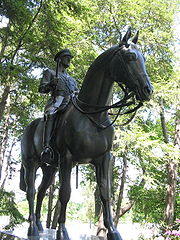 Dill served in Washington
until his death from aplastic anaemia in November 1944. His funeral arrangements reflected the great professional and personal respect and affection that he had earned. A memorial service was held in Washington National Cathedral
and the route of the cortege was lined by some thousands of troops, following which he was interred in Arlington National Cemetery
, where a simple service was conducted at the graveside. A witness recorded that "I have never seen so many men so visibly shaken by sadness. Marshall's face was truly stricken ...". He was sorely missed by the American Joint Chiefs of Staff, who sent a fulsome message of condolence to their British colleagues:
He was posthumously awarded an American Distinguished Service Medal
in 1944 as well as receiving an unprecedented joint resolution of the United States Congress
appreciating his services.
Field Marshal
Field Marshal is a military rank. Traditionally, it is the highest military rank in an army.-Etymology:The origin of the rank of field marshal dates to the early Middle Ages, originally meaning the keeper of the king's horses , from the time of the early Frankish kings.-Usage and hierarchical...
Sir John Greer Dill, GCB, CMG, DSO
Distinguished Service Order
The Distinguished Service Order is a military decoration of the United Kingdom, and formerly of other parts of the British Commonwealth and Empire, awarded for meritorious or distinguished service by officers of the armed forces during wartime, typically in actual combat.Instituted on 6 September...
(25 December 1881 - 4 November 1944) was a British commander in World War I and World War II. From May 1940 to December 1941 he was the Chief of the Imperial General Staff, the professional head of the British Army, and subsequently in Washington, as Chief of the British Joint Staff Mission and then Senior British Representative on the Combined Chiefs of Staff
Combined Chiefs of Staff
The Combined Chiefs of Staff was the supreme military command for the western Allies during World War II. It was a body constituted from the British Chiefs of Staff Committee and the American Joint Chiefs of Staff....
, played a significant role during World War II in the formation of the "special relationship
Special relationship
The Special Relationship is a phrase used to describe the exceptionally close political, diplomatic, cultural, economic, military and historical relations between the United Kingdom and the United States, following its use in a 1946 speech by British statesman Winston Churchill...
" between the United Kingdom and the United States.
Early life
Born in LurganLurgan
Lurgan is a town in County Armagh, Northern Ireland. The town is near the southern shore of Lough Neagh and in the north-eastern corner of the county. Part of the Craigavon Borough Council area, Lurgan is about 18 miles south-west of Belfast and is linked to the city by both the M1 motorway...
, County Armagh
County Armagh
-History:Ancient Armagh was the territory of the Ulaid before the fourth century AD. It was ruled by the Red Branch, whose capital was Emain Macha near Armagh. The site, and subsequently the city, were named after the goddess Macha...
, Ireland in 1881, his father was the local bank manager and his mother was a Greer from Woodville, Lurgan
Lurgan
Lurgan is a town in County Armagh, Northern Ireland. The town is near the southern shore of Lough Neagh and in the north-eastern corner of the county. Part of the Craigavon Borough Council area, Lurgan is about 18 miles south-west of Belfast and is linked to the city by both the M1 motorway...
. Always intended for a career in the services, Dill attended Cheltenham College
Cheltenham College
Cheltenham College is a co-educational independent school, located in Cheltenham, Gloucestershire, England.One of the public schools of the Victorian period, it was opened in July 1841. An Anglican foundation, it is known for its classical, military and sporting traditions.The 1893 book Great...
and the Royal Military College
Royal Military Academy Sandhurst
The Royal Military Academy Sandhurst , commonly known simply as Sandhurst, is a British Army officer initial training centre located in Sandhurst, Berkshire, England...
at Sandhurst. On 8 May 1901 he was commissioned as a second lieutenant
Second Lieutenant
Second lieutenant is a junior commissioned officer military rank in many armed forces.- United Kingdom and Commonwealth :The rank second lieutenant was introduced throughout the British Army in 1871 to replace the rank of ensign , although it had long been used in the Royal Artillery, Royal...
in the 1st battalion of the Leinster Regiment
Prince of Wales's Leinster Regiment
The Prince of Wales's Leinster Regiment was an infantry regiment of the line in the British Army, formed in 1881 by the amalgamation of the 100th Regiment of Foot and the 109th Regiment of Foot...
and was posted to South Africa
South Africa
The Republic of South Africa is a country in southern Africa. Located at the southern tip of Africa, it is divided into nine provinces, with of coastline on the Atlantic and Indian oceans...
to see out the Second Boer War
Second Boer War
The Second Boer War was fought from 11 October 1899 until 31 May 1902 between the British Empire and the Afrikaans-speaking Dutch settlers of two independent Boer republics, the South African Republic and the Orange Free State...
.
Military career
Dill was appointed regimental adjutantAdjutant
Adjutant is a military rank or appointment. In some armies, including most English-speaking ones, it is an officer who assists a more senior officer, while in other armies, especially Francophone ones, it is an NCO , normally corresponding roughly to a Staff Sergeant or Warrant Officer.An Adjutant...
on 15 August 1906, having previously been assistant adjutant from 1902. Promoted captain
Captain (OF-2)
The army rank of captain is a commissioned officer rank historically corresponding to command of a company of soldiers. The rank is also used by some air forces and marine forces. Today a captain is typically either the commander or second-in-command of a company or artillery battery...
on 12 July 1911, he was seconded to study at the Staff College, Camberley
Staff College, Camberley
Staff College, Camberley, Surrey, was a staff college for the British Army from 1802 to 1997, with periods of closure during major wars. In 1997 it was merged into the new Joint Services Command and Staff College.-Origins:...
from 1 February 1913, and was still there on the outbreak of the First World War. He became brigade-major of the 25th brigade (8th division) in France where he was present at Neuve Chapelle
Battle of Neuve Chapelle
The Battles of Neuve Chapelle and Artois was a battle in the First World War. It was a British offensive in the Artois region and broke through at Neuve-Chapelle but they were unable to exploit the advantage.The battle began on 10 March 1915...
. By the end of the war he was a brigadier
Brigadier
Brigadier is a senior military rank, the meaning of which is somewhat different in different military services. The brigadier rank is generally superior to the rank of colonel, and subordinate to major general....
and had been Mentioned in Despatches eight times. He was appointed a Companion of the Order of St Michael and St George (CMG) in the 1918 New Year Honours
New Year Honours
The New Year Honours is a part of the British honours system, being a civic occasion on the New Year annually in which new members of most Commonwealth Realms honours are named. The awards are presented by the reigning monarch or head of state, currently Queen Elizabeth II...
. He also received a number of foreign decorations for his service, including the Légion d'honneur, in the degree of Officer
Légion d'honneur
The Legion of Honour, or in full the National Order of the Legion of Honour is a French order established by Napoleon Bonaparte, First Consul of the Consulat which succeeded to the First Republic, on 19 May 1802...
, the French Croix de guerre
Croix de guerre
The Croix de guerre is a military decoration of France. It was first created in 1915 and consists of a square-cross medal on two crossed swords, hanging from a ribbon with various degree pins. The decoration was awarded during World War I, again in World War II, and in other conflicts...
, Commander of the Order of the Crown (Belgium)
Order of the Crown (Belgium)
The Order of the Crown is an Order of Belgium which was created on 15 October 1897 by King Leopold II in his capacity as ruler of the Congo Free State. The order was first intended to recognize heroic deeds and distinguished service achieved from service in the Congo Free State - many of which acts...
, Officer of the Order of the Crown of Romania
Order of the Crown (Romania)
The Order of the Crown is a chivalric order set up on 14 March 1881 by King Carol I of Romania to commemorate the establishment of the Kingdom of Romania...
.
After the war he gained a reputation as a gifted army instructor. In the 1928 New Year Honours he was appointed a Companion of the Order of the Bath (CB). In 1929 he was posted to India and in 1930 was promoted to major general before returning to appointments at the Staff College (for in fact the third time but this time as Commandant
Commandant
Commandant is a senior title often given to the officer in charge of a large training establishment or academy. This usage is common in anglophone nations...
) and then to the War Office
War Office
The War Office was a department of the British Government, responsible for the administration of the British Army between the 17th century and 1964, when its functions were transferred to the Ministry of Defence...
as Director of Military Operations and Intelligence, holding that post until 1 September 1936. Alongside his other positions, he was appointed to the largely honorary role of Colonel of the East Lancashire Regiment
East Lancashire Regiment
The East Lancashire Regiment was, from 1881 to 1958, an infantry regiment of the British Army. The regiment was formed under the Childers Reforms by the amalgamation of two 30th and 59th Regiments of Foot with the militia and rifle volunteer units of eastern Lancashire...
on 24 December 1932.
General Officer Commanding
General Officer Commanding is the usual title given in the armies of Commonwealth nations to a general officer who holds a command appointment. Thus, a general might be the GOC II Corps or GOC 7th Armoured Division...
British forces in Palestine on 8 September 1936, holding the post until 1937, and was knighted in the 1937 Coronation
Coronation of the British monarch
The coronation of the British monarch is a ceremony in which the monarch of the United Kingdom is formally crowned and invested with regalia...
Honours with his promotion to Knight Commander of the Order of the Bath (KCB), and he was then appointed General Officer Commanding, Aldershot Command
Aldershot Command
-History:After the success of the Chobham Manoeuvres of 1853, a permanent training camp was established at Aldershot in 1854 on the recommendation of the Commander-in-Chief, Viscount Hardinge...
but at the outbreak of World War II he initially had to watch younger, junior officers be promoted over him. Seen as something of a dinosaur and poorly regarded by both Winston Churchill
Winston Churchill
Sir Winston Leonard Spencer-Churchill, was a predominantly Conservative British politician and statesman known for his leadership of the United Kingdom during the Second World War. He is widely regarded as one of the greatest wartime leaders of the century and served as Prime Minister twice...
and Leslie Hore-Belisha
Leslie Hore-Belisha, 1st Baron Hore-Belisha
Isaac Leslie Hore-Belisha, 1st Baron Hore-Belisha PC was a British Liberal, then National Liberal Member of Parliament and Cabinet Minister. He later joined the Conservative Party...
, Minister for War, Dill was eventually posted as commander of I Corps in France on 3 September 1939. He was promoted to full general
General (United Kingdom)
General is currently the highest peace-time rank in the British Army and Royal Marines. It is subordinate to the Army rank of Field Marshal, has a NATO-code of OF-9, and is a four-star rank....
on 1 October 1939 (with seniority backdated to 5 December 1937). On returning to the UK in April 1940, Dill was appointed Vice Chief of the Imperial General Staff (and a member of the Army Council
Army Council (1904)
The Army Council is a governing board for the British military organization. It was created in 1904 along with other institutional changes made in that year to the British Army....
), under CIGS William Ironside, by the then Prime Minister
Prime Minister of the United Kingdom
The Prime Minister of the United Kingdom of Great Britain and Northern Ireland is the Head of Her Majesty's Government in the United Kingdom. The Prime Minister and Cabinet are collectively accountable for their policies and actions to the Sovereign, to Parliament, to their political party and...
Neville Chamberlain
Neville Chamberlain
Arthur Neville Chamberlain FRS was a British Conservative politician who served as Prime Minister of the United Kingdom from May 1937 to May 1940. Chamberlain is best known for his appeasement foreign policy, and in particular for his signing of the Munich Agreement in 1938, conceding the...
. On 27 May 1940, after Chamberlain had been replaced by Churchill, Dill replaced Ironside as CIGS. Later in 1940, Dill became ADC General to King George VI
George VI of the United Kingdom
George VI was King of the United Kingdom and the Dominions of the British Commonwealth from 11 December 1936 until his death...
.
Dill was promoted field marshal
Field Marshal
Field Marshal is a military rank. Traditionally, it is the highest military rank in an army.-Etymology:The origin of the rank of field marshal dates to the early Middle Ages, originally meaning the keeper of the king's horses , from the time of the early Frankish kings.-Usage and hierarchical...
on 18 November 1941 but by this time it was clear how poorly he and Churchill got on. Dill gained a reputation as unimaginative and obstructionist. Keen to get him out of the way, Churchill at the end of 1941 had Dill advanced to Knight Grand Cross of the Order of the Bath (GCB) and posted him to Washington as his personal representative where he became Chief of the British Joint Staff Mission, then Senior British Representative on the Combined Chiefs of Staff.
He showed a great flair as a diplomatic military presence. In 1943 alone he attended the Quebec Conference
Quebec Conference, 1943
The First Quebec Conference was a highly secret military conference held during World War II between the British, Canadian and United States governments. The conference was held in Quebec City, August 17, 1943 – August 24, 1943. It took place at the Citadelle and at the Château Frontenac. The...
, the Casablanca Conference, the Tehran Conference
Tehran Conference
The Tehran Conference was the meeting of Joseph Stalin, Franklin D. Roosevelt and Winston Churchill between November 28 and December 1, 1943, most of which was held at the Soviet Embassy in Tehran, Iran. It was the first World War II conference amongst the Big Three in which Stalin was present...
and meetings in India, China and Brazil. He also served briefly on the combined policy committee set up by the British and United States governments under the Quebec Agreement
Quebec Agreement
The Quebec Agreement is an Anglo-Canadian-American document outlining the terms of nuclear nonproliferation between the United Kingdom and the United States, and signed by Winston Churchill and Franklin Delano Roosevelt on August 19, 1943, two years before the end of World War II, in Quebec City,...
to oversee the construction of the atomic bomb
Nuclear weapon
A nuclear weapon is an explosive device that derives its destructive force from nuclear reactions, either fission or a combination of fission and fusion. Both reactions release vast quantities of energy from relatively small amounts of matter. The first fission bomb test released the same amount...
.
In the United States he was immensely important in making the Chiefs of Staff committee — which included members from both countries — function, often promoting unity of action. He was particularly friendly with General George Marshall
George Marshall
George Catlett Marshall was an American military leader, Chief of Staff of the Army, Secretary of State, and the third Secretary of Defense...
and the two exercised a great deal of influence on President Roosevelt who described Dill as "the most important figure in the remarkable accord which has been developed in the combined operations of our two countries".
Death
Washington, D.C.
Washington, D.C., formally the District of Columbia and commonly referred to as Washington, "the District", or simply D.C., is the capital of the United States. On July 16, 1790, the United States Congress approved the creation of a permanent national capital as permitted by the U.S. Constitution....
until his death from aplastic anaemia in November 1944. His funeral arrangements reflected the great professional and personal respect and affection that he had earned. A memorial service was held in Washington National Cathedral
Washington National Cathedral
The Washington National Cathedral, officially named the Cathedral Church of Saint Peter and Saint Paul, is a cathedral of the Episcopal Church located in Washington, D.C., the capital of the United States. Of neogothic design, it is the sixth-largest cathedral in the world, the second-largest in...
and the route of the cortege was lined by some thousands of troops, following which he was interred in Arlington National Cemetery
Arlington National Cemetery
Arlington National Cemetery in Arlington County, Virginia, is a military cemetery in the United States of America, established during the American Civil War on the grounds of Arlington House, formerly the estate of the family of Confederate general Robert E. Lee's wife Mary Anna Lee, a great...
, where a simple service was conducted at the graveside. A witness recorded that "I have never seen so many men so visibly shaken by sadness. Marshall's face was truly stricken ...". He was sorely missed by the American Joint Chiefs of Staff, who sent a fulsome message of condolence to their British colleagues:
We feel we share equally with you the loss to our combined war effort resulting from the death of Field Marshal Sir John Dill. His character and wisdom, his selfless devotion to the allied cause, made his contribution to the combined British-American war effort of outstanding importance. It is not too much to say that probably no other individual was more responsible for the achievement of complete cooperation in the work of the Combined Chiefs of Staff.
... we have looked to him with complete confidence as a leader in our combined deliberations. He has been a personal friend of all of us ...
We mourn with you the passing of a great and wise soldier, and a great gentleman. His task in this war has been well done.
He was posthumously awarded an American Distinguished Service Medal
Distinguished Service Medal (United States)
The Distinguished Service Medal is the highest non-valorous military and civilian decoration of the United States military which is issued for exceptionally meritorious service to the government of the United States in either a senior government service position or as a senior officer of the United...
in 1944 as well as receiving an unprecedented joint resolution of the United States Congress
United States Congress
The United States Congress is the bicameral legislature of the federal government of the United States, consisting of the Senate and the House of Representatives. The Congress meets in the United States Capitol in Washington, D.C....
appreciating his services.
Honours and awards
- Knight Grand Cross of the Order of the Bath - 1942 (KCB - 1937; CB - 1928)
- Companion of the Order of St Michael and St George - 1918
- Distinguished Service OrderDistinguished Service OrderThe Distinguished Service Order is a military decoration of the United Kingdom, and formerly of other parts of the British Commonwealth and Empire, awarded for meritorious or distinguished service by officers of the armed forces during wartime, typically in actual combat.Instituted on 6 September...
- 1915 - Mentioned in Despatches - 17 February 1915, 22 June 1915, 15 June 1916, 4 January 1917, 15 May 1917, 11 December 1917, 20 December 1918 and 5 July 1919
- Distinguished Service Medal (United States)Distinguished Service Medal (United States)The Distinguished Service Medal is the highest non-valorous military and civilian decoration of the United States military which is issued for exceptionally meritorious service to the government of the United States in either a senior government service position or as a senior officer of the United...
- 21 November 1944 (posthumously) - Officer of the Légion d'honneurLégion d'honneurThe Legion of Honour, or in full the National Order of the Legion of Honour is a French order established by Napoleon Bonaparte, First Consul of the Consulat which succeeded to the First Republic, on 19 May 1802...
(France) - Croix de guerreCroix de guerreThe Croix de guerre is a military decoration of France. It was first created in 1915 and consists of a square-cross medal on two crossed swords, hanging from a ribbon with various degree pins. The decoration was awarded during World War I, again in World War II, and in other conflicts...
(France) - Commander of the Order of the Crown (Belgium)Order of the Crown (Belgium)The Order of the Crown is an Order of Belgium which was created on 15 October 1897 by King Leopold II in his capacity as ruler of the Congo Free State. The order was first intended to recognize heroic deeds and distinguished service achieved from service in the Congo Free State - many of which acts...
- Croix de guerreCroix de guerreThe Croix de guerre is a military decoration of France. It was first created in 1915 and consists of a square-cross medal on two crossed swords, hanging from a ribbon with various degree pins. The decoration was awarded during World War I, again in World War II, and in other conflicts...
(Belgium) - Officer of the Order of the Crown of RomaniaOrder of the Crown (Romania)The Order of the Crown is a chivalric order set up on 14 March 1881 by King Carol I of Romania to commemorate the establishment of the Kingdom of Romania...
- Grand Cross of the Order of St Olav - 26 November 1943
- Order of Polonia Restituta, 1st classPolonia RestitutaThe Order of Polonia Restituta is one of Poland's highest Orders. The Order can be conferred for outstanding achievements in the fields of education, science, sport, culture, art, economics, defense of the country, social work, civil service, or for furthering good relations between countries...
- 22 July 1941