

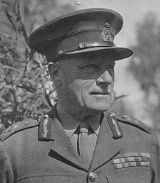
Edward Quinan

Encyclopedia
General
Sir Edward Pellew Quinan KCB
, KCIE
, DSO
, OBE
(9 January 1885 – 13 November 1960) was a British army commander during the Second World War. In the early part of his career, he was involved in Indian Army
campaigns in Afghanistan
and Waziristan
on the North West Frontier of the Indian Empire, also known as the British Raj
. During World War I
he served with the Indian Army forces in France and Mesopotamia, and was wounded. In 1920, he attended Staff College at Quetta and served as DAQMG Meerut from 1923 to 1926. After attending the Senior Officers School at Belgaum in 1927, he was posted to 3rd Battalion 8th Punjab Regiment (now 3 Baloch) in 1928. From 1930 to 1932, he commanded the battalion at Jhansi. In 1932, Quinan was posted as an Instructor at the Indian Staff College in Quetta before being promoted to major general in 1938. During 1941, Quinan commanded the British and Indian Army
forces in the Anglo-Iraqi War
, the Syria-Lebanon campaign
and the Anglo-Soviet invasion of Iran
. He continued serving in the Middle East until 1943 when he returned to India commanding North West Army. He retired later in 1943 due to a downgrading of his fitness status. He was appointed Colonel of 8th Punjab Regiment in 1945.
descent and was born in Calcutta on 9 January 1885. His father died when he was ten years old. Although his mother later remarried, he was brought up and educated in Dublin by his grandparents and aunts until he went to Sandhurst
in 1903.
He was commissioned into the Indian Army (27th Punjabis
) in 1905. Before World War I
, he served on active service on the North West Frontier of the British Indian Empire. During the war he fought in France
and Mesopotamia
. He served at the battles of Neuve Chapelle
, Loos
and the attempt to relieve Kut
al Amara and was wounded at Beit Aisa.
He returned to India and the Frontier and was a staff officer in the 1919 Afghan War
. On one occasion, the aircraft in which he was conducting reconnaissance crashed but he survived unhurt. He wrote the official history of the campaign which is considered by military experts to be the model of a campaign history. He was awarded an OBE
for his staff work during this campaign. In 1930, he rose to the command of 3rd Battalion 8th Punjab Regiment
) and was selected to attend the Imperial Defence College
; an indication of his suitability for high command.
While in command at Jhansi in 1930, Amy Johnson
, the famous British pilot, made a heavy landing on the parade ground during her epic flight from London
to Australia
. Quinan was instrumental in getting her Gypsy Moth repaired.
As a colonel in 1933, he was appointed an Instructor at the Indian Army Staff College
in Quetta
which is now in Pakistan
. Among his immediate predecessors at the College was Auchinleck
and his successor in 1934 was Montgomery. He then returned to his command in Jhansi
.
In 1936, during the short reign of King Edward VIII
, Quinan was appointed Aide-de-camp
Brigadier to the King Emperor. He was posted to Dacca to assist in anti-terrorist operations against those fighting for Indian independence. Early in 1938, he was forced to take sick leave due to high blood pressure and convalesced for a number of months in Osborne House
before being declared fit again for active service. He commanded his troops in the campaign against the Faqir of Ipi
in Waziristan
and was awarded the Distinguished Service Order
. Despite his illness, he was promoted to major general
at the end of 1938.
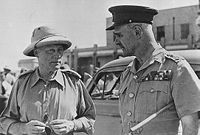 Quinan spent the early years of the Second World War on the North West Frontier but in 1941, he was promoted to lieutenant general, consulted General Sir Archibald Wavell in Cairo and was sent to command the Indian Army Corps in the landing at Basra, Iraq
, and was appointed GOC British Troops in Iraq (Iraqforce
).
At that time, the pro-German government of Iraq led by Rashid Ali al-Kaylani
had tried to capture the RAF base at Habbaniya
and force the British to leave the country. During the short Anglo-Iraqi War
, Quinan's invasion from the south, supported by British troops from Trans-Jordan overthrew the Axis-leaning Iraqi government and replaced it with a pro-British one. He became GOC 10th Army
in Persia and Iraq Command. As the Luftwaffe
had used bases in Syria to support the Iraqis, an operation
was planned to invade Syria from Palestine, supported by Quinan's troops in Iraq and replace the Vichy French
government of Syria and Lebanon with a Free French
one. This was completed successfully. Later in 1941, he planned and executed the invasion of Persia
. The principal reason for this was to secure the supply lines to the Soviet Union
and to protect British oil installations in Abadan. The Shah of Iran Reza Pahlavi
was considered to be pro-German so he was deposed and replaced by his son, Mohammad Reza Pahlavi
.
He was knighted in the birthday honours of 1942 and made Knight Commander of the Order of the Indian Empire. In August 1942, he was promoted to be a full general.
In 1943 he left the Middle East and was appointed GOC-in-C North West Army, India. Three months later, on November 16, 1943, he retired for medical reasons, a recurrence of his previous problem of high blood pressure, and returned to Britain. In 1945 he was awarded the Knight Commander of the Order of the Bath. He lived quietly in Somerset until his death on 13 November 1960.
.
His renowned attention to detail was noted in his Times
obituary, which recorded that he “astonished, and sometimes appalled his subordinates by his meticulous attention to the duties of the smallest units under his command.”
General (United Kingdom)
General is currently the highest peace-time rank in the British Army and Royal Marines. It is subordinate to the Army rank of Field Marshal, has a NATO-code of OF-9, and is a four-star rank....
Sir Edward Pellew Quinan KCB
Order of the Bath
The Most Honourable Order of the Bath is a British order of chivalry founded by George I on 18 May 1725. The name derives from the elaborate mediæval ceremony for creating a knight, which involved bathing as one of its elements. The knights so created were known as Knights of the Bath...
, KCIE
Order of the Indian Empire
The Most Eminent Order of the Indian Empire is an order of chivalry founded by Queen Victoria in 1878. The Order includes members of three classes:#Knight Grand Commander #Knight Commander #Companion...
, DSO
Distinguished Service Order
The Distinguished Service Order is a military decoration of the United Kingdom, and formerly of other parts of the British Commonwealth and Empire, awarded for meritorious or distinguished service by officers of the armed forces during wartime, typically in actual combat.Instituted on 6 September...
, OBE
Order of the British Empire
The Most Excellent Order of the British Empire is an order of chivalry established on 4 June 1917 by George V of the United Kingdom. The Order comprises five classes in civil and military divisions...
(9 January 1885 – 13 November 1960) was a British army commander during the Second World War. In the early part of his career, he was involved in Indian Army
British Indian Army
The British Indian Army, officially simply the Indian Army, was the principal army of the British Raj in India before the partition of India in 1947...
campaigns in Afghanistan
Afghanistan
Afghanistan , officially the Islamic Republic of Afghanistan, is a landlocked country located in the centre of Asia, forming South Asia, Central Asia and the Middle East. With a population of about 29 million, it has an area of , making it the 42nd most populous and 41st largest nation in the world...
and Waziristan
Waziristan
Waziristan is a mountainous region near the Northwest of Pakistan, bordering Afghanistan and covering some 11,585 km² . The area is entirely populated by ethnic Pashtuns . The language spoken in the valley is Pashto/Pakhto...
on the North West Frontier of the Indian Empire, also known as the British Raj
British Raj
British Raj was the British rule in the Indian subcontinent between 1858 and 1947; The term can also refer to the period of dominion...
. During World War I
World War I
World War I , which was predominantly called the World War or the Great War from its occurrence until 1939, and the First World War or World War I thereafter, was a major war centred in Europe that began on 28 July 1914 and lasted until 11 November 1918...
he served with the Indian Army forces in France and Mesopotamia, and was wounded. In 1920, he attended Staff College at Quetta and served as DAQMG Meerut from 1923 to 1926. After attending the Senior Officers School at Belgaum in 1927, he was posted to 3rd Battalion 8th Punjab Regiment (now 3 Baloch) in 1928. From 1930 to 1932, he commanded the battalion at Jhansi. In 1932, Quinan was posted as an Instructor at the Indian Staff College in Quetta before being promoted to major general in 1938. During 1941, Quinan commanded the British and Indian Army
British Indian Army
The British Indian Army, officially simply the Indian Army, was the principal army of the British Raj in India before the partition of India in 1947...
forces in the Anglo-Iraqi War
Anglo-Iraqi War
The Anglo-Iraqi War was the name of the British campaign against the rebel government of Rashid Ali in the Kingdom of Iraq during the Second World War. The war lasted from 2 May to 31 May 1941. The campaign resulted in the re-occupation of Iraq by British armed forces and the return to power of the...
, the Syria-Lebanon campaign
Syria-Lebanon campaign
The Syria–Lebanon campaign, also known as Operation Exporter, was the Allied invasion of Vichy French-controlled Syria and Lebanon, in June–July 1941, during World War II. Time Magazine referred to the fighting as a "mixed show" while it was taking place and the campaign remains little known, even...
and the Anglo-Soviet invasion of Iran
Anglo-Soviet invasion of Iran
The Anglo-Soviet invasion of Iran was the Allied invasion of the Imperial State of Iran during World War II, by British, Commonwealth, and Soviet armed forces. The invasion from August 25 to September 17, 1941, was codenamed Operation Countenance...
. He continued serving in the Middle East until 1943 when he returned to India commanding North West Army. He retired later in 1943 due to a downgrading of his fitness status. He was appointed Colonel of 8th Punjab Regiment in 1945.
Early years and career in Indian Army
E. P. Quinan was of Anglo-IrishAnglo-Irish
Anglo-Irish was a term used primarily in the 19th and early 20th centuries to identify a privileged social class in Ireland, whose members were the descendants and successors of the Protestant Ascendancy, mostly belonging to the Church of Ireland, which was the established church of Ireland until...
descent and was born in Calcutta on 9 January 1885. His father died when he was ten years old. Although his mother later remarried, he was brought up and educated in Dublin by his grandparents and aunts until he went to Sandhurst
Royal Military Academy Sandhurst
The Royal Military Academy Sandhurst , commonly known simply as Sandhurst, is a British Army officer initial training centre located in Sandhurst, Berkshire, England...
in 1903.
He was commissioned into the Indian Army (27th Punjabis
27th Punjabis
The 27th Punjabis were an infantry regiment of the British Indian Army. It was raised in 1857, as the 19th Regiment of Punjab Infantry. It was designated as the 27th Punjabis in 1903 and became 3rd Battalion 15th Punjab Regiment in 1922...
) in 1905. Before World War I
World War I
World War I , which was predominantly called the World War or the Great War from its occurrence until 1939, and the First World War or World War I thereafter, was a major war centred in Europe that began on 28 July 1914 and lasted until 11 November 1918...
, he served on active service on the North West Frontier of the British Indian Empire. During the war he fought in France
France
The French Republic , The French Republic , The French Republic , (commonly known as France , is a unitary semi-presidential republic in Western Europe with several overseas territories and islands located on other continents and in the Indian, Pacific, and Atlantic oceans. Metropolitan France...
and Mesopotamia
Mesopotamia
Mesopotamia is a toponym for the area of the Tigris–Euphrates river system, largely corresponding to modern-day Iraq, northeastern Syria, southeastern Turkey and southwestern Iran.Widely considered to be the cradle of civilization, Bronze Age Mesopotamia included Sumer and the...
. He served at the battles of Neuve Chapelle
Battle of Neuve Chapelle
The Battles of Neuve Chapelle and Artois was a battle in the First World War. It was a British offensive in the Artois region and broke through at Neuve-Chapelle but they were unable to exploit the advantage.The battle began on 10 March 1915...
, Loos
Battle of Loos
The Battle of Loos was one of the major British offensives mounted on the Western Front in 1915 during World War I. It marked the first time the British used poison gas during the war, and is also famous for the fact that it witnessed the first large-scale use of 'new' or Kitchener's Army...
and the attempt to relieve Kut
Kut
Al-Kūt is a city in eastern Iraq, on the left bank of the Tigris River, about 160 kilometres south east of Baghdad. the estimated population is about 374,000 people...
al Amara and was wounded at Beit Aisa.
He returned to India and the Frontier and was a staff officer in the 1919 Afghan War
Third Anglo-Afghan War
The Third Anglo-Afghan War began on 6 May 1919 and ended with an armistice on 8 August 1919. It was a minor tactical victory for the British. For the British, the Durand Line was reaffirmed as the political boundary between the Emirate of Afghanistan and British India and the Afghans agreed not to...
. On one occasion, the aircraft in which he was conducting reconnaissance crashed but he survived unhurt. He wrote the official history of the campaign which is considered by military experts to be the model of a campaign history. He was awarded an OBE
Order of the British Empire
The Most Excellent Order of the British Empire is an order of chivalry established on 4 June 1917 by George V of the United Kingdom. The Order comprises five classes in civil and military divisions...
for his staff work during this campaign. In 1930, he rose to the command of 3rd Battalion 8th Punjab Regiment
8th Punjab Regiment
The 8th Punjab Regiment was a regiment of the British Indian Army from 1922 to 1947. It was transferred to Pakistan Army on Partition of India in 1947 and merged with the Baluch Regiment in 1956.-Madras Infantry:...
) and was selected to attend the Imperial Defence College
Royal College of Defence Studies
The Royal College of Defence Studies is an internationally-renowned institution and component of the Defence Academy of the United Kingdom...
; an indication of his suitability for high command.
While in command at Jhansi in 1930, Amy Johnson
Amy Johnson
Amy Johnson CBE, was a pioneering English aviator. Flying solo or with her husband, Jim Mollison, Johnson set numerous long-distance records during the 1930s...
, the famous British pilot, made a heavy landing on the parade ground during her epic flight from London
London
London is the capital city of :England and the :United Kingdom, the largest metropolitan area in the United Kingdom, and the largest urban zone in the European Union by most measures. Located on the River Thames, London has been a major settlement for two millennia, its history going back to its...
to Australia
Australia
Australia , officially the Commonwealth of Australia, is a country in the Southern Hemisphere comprising the mainland of the Australian continent, the island of Tasmania, and numerous smaller islands in the Indian and Pacific Oceans. It is the world's sixth-largest country by total area...
. Quinan was instrumental in getting her Gypsy Moth repaired.
As a colonel in 1933, he was appointed an Instructor at the Indian Army Staff College
Command and Staff College
The Command and Staff College was established in 1907 at Quetta, Balochistan, British Raj, now in Pakistan, and is the oldest and the most prestigious institution of the Pakistan Army. It was established in 1905 in Deolali and moved to its present location at Quetta in 1907 under the name of Quetta...
in Quetta
Quetta
is the largest city and the provincial capital of the Balochistan Province of Pakistan. Known as the "Fruit Garden of Pakistan" due to the diversity of its plant and animal wildlife, Quetta is home to the Hazarganji Chiltan National Park, which contains some of the rarest species of wildlife in the...
which is now in Pakistan
Pakistan
Pakistan , officially the Islamic Republic of Pakistan is a sovereign state in South Asia. It has a coastline along the Arabian Sea and the Gulf of Oman in the south and is bordered by Afghanistan and Iran in the west, India in the east and China in the far northeast. In the north, Tajikistan...
. Among his immediate predecessors at the College was Auchinleck
Claude Auchinleck
Field Marshal Sir Claude John Eyre Auchinleck, GCB, GCIE, CSI, DSO, OBE , nicknamed "The Auk", was a British army commander during World War II. He was a career soldier who spent much of his military career in India, where he developed a love of the country and a lasting affinity for the soldiers...
and his successor in 1934 was Montgomery. He then returned to his command in Jhansi
Jhansi
Jhansi Hindi:झाँसी, , Marathi: झाशी, is a historical city of India. Jhansi is the administrative headquarters of Jhansi District and Jhansi Division. The original walled city grew up around its stone fort, which crowns a neighboring rock. This district is on the bank of river Betwa.The National...
.
In 1936, during the short reign of King Edward VIII
Edward VIII of the United Kingdom
Edward VIII was King of the United Kingdom and the Dominions of the British Commonwealth, and Emperor of India, from 20 January to 11 December 1936.Before his accession to the throne, Edward was Prince of Wales and Duke of Cornwall and Rothesay...
, Quinan was appointed Aide-de-camp
Aide-de-camp
An aide-de-camp is a personal assistant, secretary, or adjutant to a person of high rank, usually a senior military officer or a head of state...
Brigadier to the King Emperor. He was posted to Dacca to assist in anti-terrorist operations against those fighting for Indian independence. Early in 1938, he was forced to take sick leave due to high blood pressure and convalesced for a number of months in Osborne House
Osborne House
Osborne House is a former royal residence in East Cowes, Isle of Wight, UK. The house was built between 1845 and 1851 for Queen Victoria and Prince Albert as a summer home and rural retreat....
before being declared fit again for active service. He commanded his troops in the campaign against the Faqir of Ipi
Faqir of Ipi
Faqir of Ipi born Mirza Ali Khan was a Pashtun from today's North-Waziristan Pakistan, Federally Administrated Tribal Areas. His followers addressed him as 'Haji Sahib'...
in Waziristan
Waziristan
Waziristan is a mountainous region near the Northwest of Pakistan, bordering Afghanistan and covering some 11,585 km² . The area is entirely populated by ethnic Pashtuns . The language spoken in the valley is Pashto/Pakhto...
and was awarded the Distinguished Service Order
Distinguished Service Order
The Distinguished Service Order is a military decoration of the United Kingdom, and formerly of other parts of the British Commonwealth and Empire, awarded for meritorious or distinguished service by officers of the armed forces during wartime, typically in actual combat.Instituted on 6 September...
. Despite his illness, he was promoted to major general
Major General
Major general or major-general is a military rank used in many countries. It is derived from the older rank of sergeant major general. A major general is a high-ranking officer, normally subordinate to the rank of lieutenant general and senior to the ranks of brigadier and brigadier general...
at the end of 1938.
Second World War service in the Middle East
Iraq
Iraq ; officially the Republic of Iraq is a country in Western Asia spanning most of the northwestern end of the Zagros mountain range, the eastern part of the Syrian Desert and the northern part of the Arabian Desert....
, and was appointed GOC British Troops in Iraq (Iraqforce
Iraqforce
Iraqforce was a British and Commonwealth formation that came together in the Kingdom of Iraq. The formation fought in the Middle East during World War II.-Background:...
).
At that time, the pro-German government of Iraq led by Rashid Ali al-Kaylani
Rashid Ali al-Kaylani
Rashid Aali al-Gaylani served as Prime Minister of the Kingdom of Iraq on three occasions. He is chiefly remembered as an Arab nationalist who attempted to remove the British influence from Iraq...
had tried to capture the RAF base at Habbaniya
RAF Habbaniya
Royal Air Force Station Habbaniya, more commonly known as RAF Habbaniya, was a Royal Air Force station at Habbaniyah, about west of Baghdad in modern day Iraq, on the banks of the Euphrates near Lake Habbaniyah...
and force the British to leave the country. During the short Anglo-Iraqi War
Anglo-Iraqi War
The Anglo-Iraqi War was the name of the British campaign against the rebel government of Rashid Ali in the Kingdom of Iraq during the Second World War. The war lasted from 2 May to 31 May 1941. The campaign resulted in the re-occupation of Iraq by British armed forces and the return to power of the...
, Quinan's invasion from the south, supported by British troops from Trans-Jordan overthrew the Axis-leaning Iraqi government and replaced it with a pro-British one. He became GOC 10th Army
British Tenth Army
The Tenth Army was a unit of the British Army during World War II created in Iraq and formed from the major part of "Paiforce"...
in Persia and Iraq Command. As the Luftwaffe
Luftwaffe
Luftwaffe is a generic German term for an air force. It is also the official name for two of the four historic German air forces, the Wehrmacht air arm founded in 1935 and disbanded in 1946; and the current Bundeswehr air arm founded in 1956....
had used bases in Syria to support the Iraqis, an operation
Syria-Lebanon campaign
The Syria–Lebanon campaign, also known as Operation Exporter, was the Allied invasion of Vichy French-controlled Syria and Lebanon, in June–July 1941, during World War II. Time Magazine referred to the fighting as a "mixed show" while it was taking place and the campaign remains little known, even...
was planned to invade Syria from Palestine, supported by Quinan's troops in Iraq and replace the Vichy French
Vichy France
Vichy France, Vichy Regime, or Vichy Government, are common terms used to describe the government of France that collaborated with the Axis powers from July 1940 to August 1944. This government succeeded the Third Republic and preceded the Provisional Government of the French Republic...
government of Syria and Lebanon with a Free French
Free French Forces
The Free French Forces were French partisans in World War II who decided to continue fighting against the forces of the Axis powers after the surrender of France and subsequent German occupation and, in the case of Vichy France, collaboration with the Germans.-Definition:In many sources, Free...
one. This was completed successfully. Later in 1941, he planned and executed the invasion of Persia
Anglo-Soviet invasion of Iran
The Anglo-Soviet invasion of Iran was the Allied invasion of the Imperial State of Iran during World War II, by British, Commonwealth, and Soviet armed forces. The invasion from August 25 to September 17, 1941, was codenamed Operation Countenance...
. The principal reason for this was to secure the supply lines to the Soviet Union
Soviet Union
The Soviet Union , officially the Union of Soviet Socialist Republics , was a constitutionally socialist state that existed in Eurasia between 1922 and 1991....
and to protect British oil installations in Abadan. The Shah of Iran Reza Pahlavi
Reza Pahlavi
Reza Pahlavi may refer to:*Reza Shah , aka Reza Shah Pahlavi, Shah of Persia from 1925 until 1935 and Shah of Iran from 1935 until 1941* Mohammad Reza Pahlavi , Shah of Iran from 1941 to 1979, son of Reza Shah...
was considered to be pro-German so he was deposed and replaced by his son, Mohammad Reza Pahlavi
Mohammad Reza Pahlavi
Mohammad Rezā Shāh Pahlavi, Shah of Iran, Shah of Persia , ruled Iran from 16 September 1941 until his overthrow by the Iranian Revolution on 11 February 1979...
.
He was knighted in the birthday honours of 1942 and made Knight Commander of the Order of the Indian Empire. In August 1942, he was promoted to be a full general.
In 1943 he left the Middle East and was appointed GOC-in-C North West Army, India. Three months later, on November 16, 1943, he retired for medical reasons, a recurrence of his previous problem of high blood pressure, and returned to Britain. In 1945 he was awarded the Knight Commander of the Order of the Bath. He lived quietly in Somerset until his death on 13 November 1960.
Assessment
Quinan is now one of the "forgotten generals" of the Second World War. There are probably several reasons for this. He never commanded in a campaign against major Axis forces and so did not come to the public's notice. His style of command involved detailed planning and staff work for campaigns, as befitted his past as a successful staff officer on the North West Frontier. While this was effective on the Frontier and in Iraq and Iran, in the fast moving style of warfare that developed during the Second World War, this attention to detail was not always considered appropriate by political leaders such as ChurchillWinston Churchill
Sir Winston Leonard Spencer-Churchill, was a predominantly Conservative British politician and statesman known for his leadership of the United Kingdom during the Second World War. He is widely regarded as one of the greatest wartime leaders of the century and served as Prime Minister twice...
.
His renowned attention to detail was noted in his Times
The Times
The Times is a British daily national newspaper, first published in London in 1785 under the title The Daily Universal Register . The Times and its sister paper The Sunday Times are published by Times Newspapers Limited, a subsidiary since 1981 of News International...
obituary, which recorded that he “astonished, and sometimes appalled his subordinates by his meticulous attention to the duties of the smallest units under his command.”