

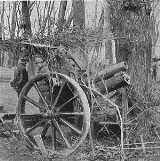
QF 4.5 inch Howitzer

Encyclopedia
The Ordnance QF 4.5 inch Howitzer was the standard British Empire field (or ‘light’) howitzer of the First World War era. It replaced the BL 5 inch Howitzer
and equipped some 25% of the field artillery. It entered service in 1910 and remained in service through the interwar period and was last used in the field by British forces in early 1942. It was generally horse drawn until mechanisation in the 1930s. It was used by British and Commonwealth Forces in most theatres, by Russia and by British troops in Russia in 1919. Its calibre (114mm) and hence shell weight were greater than those of the equivalent German field howitzer (105mm), France did not have an equivalent. In the Second World War it equipped some units of the BEF
and British, Australian, New Zealand and South African batteries in East Africa and the Middle and Far East.
(1899–1902) the British government realised its field artillery
was being overtaken by the more modern "quick firing" guns and howitzers of other major powers. The Krupp field howitzers used by the Boers had particularly impressed the British. The usefulness of field howitzers and the need for them to form part of an infantry division’s artillery were reinforced by reports from the Russo-Japanese War in 1904.
In 1900 Cabinet ordered Field Marshal Lord Roberts, the Commander-in-Chief in South Africa to send home artillery brigade and battery commanders “selected for their eminence and experience” to form an Equipment Committee. The committee was chaired by General Sir George Marshall, who had been artillery commander in South Africa. It formed in January 1901 with wide ranging terms of reference concerning artillery equipment from guns and howitzers to harness design and instruments.
The Committee swiftly established requirements and invited proposals from British gun makers. None were satisfactory and compared poorly with a captured Krupp 12 cm Howitzer. A purchase of Krupp howitzers was discussed including visits to Essen. However, by 1905 the Committee was sufficiently satisfied to recommend the production of trial equipments from Ordnance Factories, Armstrong, Vickers and the Coventry Ordnance Works (a joint venture by several Coventry engineering companies). Testing in 1906 showed the Coventry design was by far the most satisfactory and a battery’s worth were ordered for trials. In 1908, after trials the 4.5 inch Howitzer was recommended for service, albeit with a shortened barrel.
The 4.5 inch Howitzer was used on most fronts during the First World War. On the Western Front its normal scale was 1 battery to every 3 batteries of 18 pounder. Initially 4.5 inch Howitzers equipped a Howitzer Brigade RFA in each infantry division. In the original British Expeditionary Force in 1914 this brigade had 3 batteries each with 6 howitzers. Subsequent batteries had only 4 howitzers. In 1916 all batteries on the Western Front started being increased to 6 howitzers and later that year the Howitzer Brigades were disbanded and a howitzer battery added to each Field Brigade RFA as the fourth battery. This organisation continued between the wars.
It remained in service during the inter-war period and was used in various campaigns in that time. However, apart from changes to ammunition the howitzer itself remained unchanged except for carriage modifications to enable mechanisation.
During the Second World War they served with the BEF in France and although many were lost they were the most widely available artillery piece until 25 pounder production developed. They were used in the Middle and Far East theatres as well as for training and were gradually replaced by 25 pounder.
) cartridge case containing the propellant charge. The cartridge case also provides obturation, or sealing the chamber. This howitzer was the largest calibre of British QF field artillery ordnance.
Apart from extensive experimentation with shell and rifling designs, two problems had slowed its development, both were howitzer specific issues. The first was the need for an adjustable quick firing recoil system to prevent the breach striking the ground when fired at high elevation angles. The second was the suitable design for a range scale in yards able to accommodate a choice of propelling charges. The first was solved by use of “cut-off-gear” that allowed 40 inches of recoil when the barrel was horizontal but only 20 inches when it was at 45 degrees. The second led to the range scale being designed for charge 4 and a “range rule” provided to convert the actual range for other charges to a false range set on the charge 4 scale.
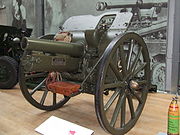
4.5 inch was a quick firing horse-drawn field howitzer designed to be towed behind a limber and 6 horses. The barrel was built-up A tube with a horizontal sliding block breach. It fired a separate round (i.e. shell and cartridge were loaded separately). The lower carriage comprised a box trail. The limited traverse saddle supported the elevating mass and a shield. It was designed for one-man laying with both traverse and elevations sights and controls on the left. Recoil system was below the barrel and used a hydraulic buffer with a hydro-pneumatic recuperator to return the barrel to its firing position.
4.5 inch was fitted with rocking bar open sights including a deflection scale and a strip elevation. By 1914 it had the Number 7 Dial Sight in Carrier Number 7 Dial Sight Number 1. This carrier was reciprocating (i.e. it could be cross-levelled), it had an integral elevation scale drum and a mounting for the sight clinometer (used for the angle of sight). The Number 7 Dial Sight was a modified version of the German Goertz panoramic sight.
The only changes to the ordnance, creating the Mark II in 1917, with a reduced twist in the rifling (from 1:15 to 1:20) and changes to correct design defects in the breach to reduce the effect of firing stresses.
From the 1920s the carriage was upgraded. First to Mk 1R (solid rubber tyres) then to Mk 1P (new wheels, axles, brakes and pneumatic tyres) for vehicle towing. Two versions of this appeared, in one stub axles were fitted below the original axle, later an entirely new axle was introduced. The similarly wheeled No 26 artillery trailer was introduced to replace the limber. Unlike most other guns and howitzers in British service, calibrating Probert sights were not fitted to 4.5 inch Howitzer.
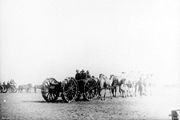 The QF 4.5 served throughout the Great War, principally with the Royal Field Artillery
, beginning with 182 guns in 1914, with 3,177 more produced during the war.
At the beginning of the First World War a Brigade
of three 6-gun howitzer batteries was part of each British Infantry
Division
. In February 1917 Divisional artilleries were consolidated into two field brigades each with three batteries (A, B, C) of 18 pounder guns
and one battery (D) of 4.5-inch howitzers. The balance were formed into Army Field Brigades with the same organisation.
Following experience gained in the Battle of the Somme in Summer 1916, its role on the Western Front
was defined in January 1917 as "neutralising guns with gas shell, for bombarding weaker defences, enfilading communications trenches, for barrage work, especially at night, and for wire cutting in such places which the field guns could not reach".
During advances such as at Messines
in June 1917 the gun was typically employed in "standing barrages" of HE on the enemy forward positions ahead of the 18 pounders' creeping barrage, and gas shelling following bombardments.
There were 984 guns in service on the Western Front at the armistice and 25,326,276 rounds had been fired.
4.5-howitzers were also used by British batteries in the campaigns in Gallipoli, the Balkans, Palestine, Italy and Mesopotamia.
In 1919 small numbers were used in the successful 3rd Afghan War and Waziristan Campaign and in Mesopotamia 1920-21.
 4.5 inch Howitzers equipped some batteries of the British Expeditionary Force
in France in 1940. 96 were lost, leaving 403 in world-wide service (only 82 outside UK) with the British Army, plus those held by Australia, Canada, New Zealand and South Africa. The British holdings were expected to increase to 561 by August 1940 due to completion of reconditioning and repairs.
4.5 inch howitzers equipped British and Australian batteries in the Western Desert in 1940 and 1941 and Australian unit in Syria. The batteries with the 4th and 5th Indian Divisions went with them to East Africa and South African batteries with 4.5 inch howitzers also fought in this very successful campaign.
In the Far East in 1941 4.5 inch howitzers equipped some British and Australian batteries in Malaya and a troop in each mountain battery in Hong Kong. The 4.5s of 155th (Lanarkshire Yeomanry
) Field Regiment were instrumental in holding back Japanese attacks at the Battle of Kampar
in late December 1941. The last operational use of 4.5 by the British Army was in early 1942 in Malaya.
The last operational use of 4.5 by the British Army was probably in late 1941 or early 1942 in Malaya. They were withdrawn from field formations in 1943 and declared obsolete in 1944 when ammunition stocks ran out.
It is worth noting that the QF 4.5 survived in use with the Irish Army
until the 1960s. They were fired by the FCA (An Fórsa Cosanta Áitiúil - Local Defence Force) on the Glen of Imaal firing range, County Wicklow circa 1976. Some retired examples exist today, such as those preserved at Collins Barracks, Cork
and two in Aiken Barracks, Dundalk.
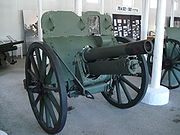 Britain supplied 24 howitzers to Finland for use in the Winter War
of 1939-1940. Finland obtained 30 more from Spain in July 1940 and all guns were used in the Continuation War
of 1941-1944. It was designated 114 H/18 in Finnish service. Some of the guns were used in the BT-42
self-propelled artillery piece.

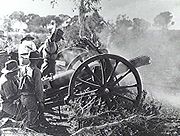
New types of shell were introduced during the First World war. These were chemical at the end of 1915, incendiary shells in 1916 and smoke shells in 1917. Smoke shells were phosphorus filled with both steel and cast iron bodies.
A new streamlined shell (HE Mk 1D) was also introduced to increase maximum range from 6600 yards of the older 3C.R.H. (Calibres Radius Head) models to 7300 yards.
BL 5 inch Howitzer
The Ordnance BL 5 inch Howitzer was initially introduced to provide the Royal Field Artillery with continuing explosive shell capability following the decision to concentrate on shrapnel for field guns in the 1890s.-Sudan Campaign:...
and equipped some 25% of the field artillery. It entered service in 1910 and remained in service through the interwar period and was last used in the field by British forces in early 1942. It was generally horse drawn until mechanisation in the 1930s. It was used by British and Commonwealth Forces in most theatres, by Russia and by British troops in Russia in 1919. Its calibre (114mm) and hence shell weight were greater than those of the equivalent German field howitzer (105mm), France did not have an equivalent. In the Second World War it equipped some units of the BEF
British Expeditionary Force (World War II)
The British Expeditionary Force was the British force in Europe from 1939–1940 during the Second World War. Commanded by General Lord Gort, the BEF constituted one-tenth of the defending Allied force....
and British, Australian, New Zealand and South African batteries in East Africa and the Middle and Far East.
Origin and Use
During the Second Boer WarSecond Boer War
The Second Boer War was fought from 11 October 1899 until 31 May 1902 between the British Empire and the Afrikaans-speaking Dutch settlers of two independent Boer republics, the South African Republic and the Orange Free State...
(1899–1902) the British government realised its field artillery
Field artillery
Field artillery is a category of mobile artillery used to support armies in the field. These weapons are specialized for mobility, tactical proficiency, long range, short range and extremely long range target engagement....
was being overtaken by the more modern "quick firing" guns and howitzers of other major powers. The Krupp field howitzers used by the Boers had particularly impressed the British. The usefulness of field howitzers and the need for them to form part of an infantry division’s artillery were reinforced by reports from the Russo-Japanese War in 1904.
In 1900 Cabinet ordered Field Marshal Lord Roberts, the Commander-in-Chief in South Africa to send home artillery brigade and battery commanders “selected for their eminence and experience” to form an Equipment Committee. The committee was chaired by General Sir George Marshall, who had been artillery commander in South Africa. It formed in January 1901 with wide ranging terms of reference concerning artillery equipment from guns and howitzers to harness design and instruments.
The Committee swiftly established requirements and invited proposals from British gun makers. None were satisfactory and compared poorly with a captured Krupp 12 cm Howitzer. A purchase of Krupp howitzers was discussed including visits to Essen. However, by 1905 the Committee was sufficiently satisfied to recommend the production of trial equipments from Ordnance Factories, Armstrong, Vickers and the Coventry Ordnance Works (a joint venture by several Coventry engineering companies). Testing in 1906 showed the Coventry design was by far the most satisfactory and a battery’s worth were ordered for trials. In 1908, after trials the 4.5 inch Howitzer was recommended for service, albeit with a shortened barrel.
The 4.5 inch Howitzer was used on most fronts during the First World War. On the Western Front its normal scale was 1 battery to every 3 batteries of 18 pounder. Initially 4.5 inch Howitzers equipped a Howitzer Brigade RFA in each infantry division. In the original British Expeditionary Force in 1914 this brigade had 3 batteries each with 6 howitzers. Subsequent batteries had only 4 howitzers. In 1916 all batteries on the Western Front started being increased to 6 howitzers and later that year the Howitzer Brigades were disbanded and a howitzer battery added to each Field Brigade RFA as the fourth battery. This organisation continued between the wars.
It remained in service during the inter-war period and was used in various campaigns in that time. However, apart from changes to ammunition the howitzer itself remained unchanged except for carriage modifications to enable mechanisation.
During the Second World War they served with the BEF in France and although many were lost they were the most widely available artillery piece until 25 pounder production developed. They were used in the Middle and Far East theatres as well as for training and were gradually replaced by 25 pounder.
Features
QF stands for "Quick Firing", a British term for ordnance that fire ammunition with a metal (usually brassBrass
Brass is an alloy of copper and zinc; the proportions of zinc and copper can be varied to create a range of brasses with varying properties.In comparison, bronze is principally an alloy of copper and tin...
) cartridge case containing the propellant charge. The cartridge case also provides obturation, or sealing the chamber. This howitzer was the largest calibre of British QF field artillery ordnance.
Apart from extensive experimentation with shell and rifling designs, two problems had slowed its development, both were howitzer specific issues. The first was the need for an adjustable quick firing recoil system to prevent the breach striking the ground when fired at high elevation angles. The second was the suitable design for a range scale in yards able to accommodate a choice of propelling charges. The first was solved by use of “cut-off-gear” that allowed 40 inches of recoil when the barrel was horizontal but only 20 inches when it was at 45 degrees. The second led to the range scale being designed for charge 4 and a “range rule” provided to convert the actual range for other charges to a false range set on the charge 4 scale.
4.5 inch was a quick firing horse-drawn field howitzer designed to be towed behind a limber and 6 horses. The barrel was built-up A tube with a horizontal sliding block breach. It fired a separate round (i.e. shell and cartridge were loaded separately). The lower carriage comprised a box trail. The limited traverse saddle supported the elevating mass and a shield. It was designed for one-man laying with both traverse and elevations sights and controls on the left. Recoil system was below the barrel and used a hydraulic buffer with a hydro-pneumatic recuperator to return the barrel to its firing position.
4.5 inch was fitted with rocking bar open sights including a deflection scale and a strip elevation. By 1914 it had the Number 7 Dial Sight in Carrier Number 7 Dial Sight Number 1. This carrier was reciprocating (i.e. it could be cross-levelled), it had an integral elevation scale drum and a mounting for the sight clinometer (used for the angle of sight). The Number 7 Dial Sight was a modified version of the German Goertz panoramic sight.
The only changes to the ordnance, creating the Mark II in 1917, with a reduced twist in the rifling (from 1:15 to 1:20) and changes to correct design defects in the breach to reduce the effect of firing stresses.
From the 1920s the carriage was upgraded. First to Mk 1R (solid rubber tyres) then to Mk 1P (new wheels, axles, brakes and pneumatic tyres) for vehicle towing. Two versions of this appeared, in one stub axles were fitted below the original axle, later an entirely new axle was introduced. The similarly wheeled No 26 artillery trailer was introduced to replace the limber. Unlike most other guns and howitzers in British service, calibrating Probert sights were not fitted to 4.5 inch Howitzer.
Production
By the outbreak of war in 1914 192 guns had been produced, 39 being for imperial forces, this was less than ordered. Coventry Ordnance Works was the main supplier, with Ordnance Factory Woolwich producing substantial numbers. Other suppliers of complete equipments were Bethlehem Steel and before the outbreak of war a small number from Vickers. The Austin Motor Company produced some carriages. Total wartime production was 3384 guns (i.e. barrels) and 3437 carriages. 400 4.5 inch Howitzers were supplied to Russia in 1916-17.First World War
Royal Field Artillery
The Royal Field Artillery of the British Army provided artillery support for the British Army. It came into being when the Royal Artillery was divided on 1 July 1899, it was reamalgamated back into the Royal Artillery in 1924....
, beginning with 182 guns in 1914, with 3,177 more produced during the war.
At the beginning of the First World War a Brigade
Brigade
A brigade is a major tactical military formation that is typically composed of two to five battalions, plus supporting elements depending on the era and nationality of a given army and could be perceived as an enlarged/reinforced regiment...
of three 6-gun howitzer batteries was part of each British Infantry
Infantry
Infantrymen are soldiers who are specifically trained for the role of fighting on foot to engage the enemy face to face and have historically borne the brunt of the casualties of combat in wars. As the oldest branch of combat arms, they are the backbone of armies...
Division
Division (military)
A division is a large military unit or formation usually consisting of between 10,000 and 20,000 soldiers. In most armies, a division is composed of several regiments or brigades, and in turn several divisions typically make up a corps...
. In February 1917 Divisional artilleries were consolidated into two field brigades each with three batteries (A, B, C) of 18 pounder guns
Ordnance QF 18 pounder
The Ordnance QF 18 pounder, or simply 18-pounder Gun, was the standard British Army field gun of the World War I era. It formed the backbone of the Royal Field Artillery during the war, and was produced in large numbers. It was also used by British and Commonwealth Forces in all the main theatres,...
and one battery (D) of 4.5-inch howitzers. The balance were formed into Army Field Brigades with the same organisation.
Following experience gained in the Battle of the Somme in Summer 1916, its role on the Western Front
Western Front (World War I)
Following the outbreak of World War I in 1914, the German Army opened the Western Front by first invading Luxembourg and Belgium, then gaining military control of important industrial regions in France. The tide of the advance was dramatically turned with the Battle of the Marne...
was defined in January 1917 as "neutralising guns with gas shell, for bombarding weaker defences, enfilading communications trenches, for barrage work, especially at night, and for wire cutting in such places which the field guns could not reach".
During advances such as at Messines
Battle of Messines
The Battle of Messines was a battle of the Western front of the First World War. It began on 7 June 1917 when the British Second Army under the command of General Herbert Plumer launched an offensive near the village of Mesen in West Flanders, Belgium...
in June 1917 the gun was typically employed in "standing barrages" of HE on the enemy forward positions ahead of the 18 pounders' creeping barrage, and gas shelling following bombardments.
There were 984 guns in service on the Western Front at the armistice and 25,326,276 rounds had been fired.
4.5-howitzers were also used by British batteries in the campaigns in Gallipoli, the Balkans, Palestine, Italy and Mesopotamia.
Between the Wars
Several batteries of 4.5 inch Howitzer arrived in North Russia shortly before the armistice on the Western Front and remained there through much of 1919.In 1919 small numbers were used in the successful 3rd Afghan War and Waziristan Campaign and in Mesopotamia 1920-21.
Second World War
British Expeditionary Force (World War II)
The British Expeditionary Force was the British force in Europe from 1939–1940 during the Second World War. Commanded by General Lord Gort, the BEF constituted one-tenth of the defending Allied force....
in France in 1940. 96 were lost, leaving 403 in world-wide service (only 82 outside UK) with the British Army, plus those held by Australia, Canada, New Zealand and South Africa. The British holdings were expected to increase to 561 by August 1940 due to completion of reconditioning and repairs.
4.5 inch howitzers equipped British and Australian batteries in the Western Desert in 1940 and 1941 and Australian unit in Syria. The batteries with the 4th and 5th Indian Divisions went with them to East Africa and South African batteries with 4.5 inch howitzers also fought in this very successful campaign.
In the Far East in 1941 4.5 inch howitzers equipped some British and Australian batteries in Malaya and a troop in each mountain battery in Hong Kong. The 4.5s of 155th (Lanarkshire Yeomanry
Lanarkshire Yeomanry
The Lanarkshire Yeomanry was a yeomanry regiment of the British Army, first raised in 1819, which served as a dismounted infantry regiment in the First World War and provided two field artillery regiments in the Second World War, before being amalgamated into The Queen's Own Lowland Yeomanry in...
) Field Regiment were instrumental in holding back Japanese attacks at the Battle of Kampar
Battle of Kampar
The Battle of Kampar was an engagement of the Malayan Campaign during World War II, involving British and Indian troops from the 11th Indian Infantry Division and the Japanese 5th Division....
in late December 1941. The last operational use of 4.5 by the British Army was in early 1942 in Malaya.
The last operational use of 4.5 by the British Army was probably in late 1941 or early 1942 in Malaya. They were withdrawn from field formations in 1943 and declared obsolete in 1944 when ammunition stocks ran out.
Irish service
The 4.5 inch howitzer entered Irish service in 1925 to equip the newly formed 3rd Field Battery. Additional equipment received by the Irish army in 1941 included four 4.5 inch howitzers. In 1943/44, 20 additional 4.5 inch howitzers were received. 38 4.5 inch howitzers used by the reserve FCA.It is worth noting that the QF 4.5 survived in use with the Irish Army
Irish Army
The Irish Army, officially named simply the Army is the main branch of the Defence Forces of Ireland. Approximately 8,500 men and women serve in the Irish Army, divided into three infantry Brigades...
until the 1960s. They were fired by the FCA (An Fórsa Cosanta Áitiúil - Local Defence Force) on the Glen of Imaal firing range, County Wicklow circa 1976. Some retired examples exist today, such as those preserved at Collins Barracks, Cork
Cork (city)
Cork is the second largest city in the Republic of Ireland and the island of Ireland's third most populous city. It is the principal city and administrative centre of County Cork and the largest city in the province of Munster. Cork has a population of 119,418, while the addition of the suburban...
and two in Aiken Barracks, Dundalk.
Finnish service
Winter War
The Winter War was a military conflict between the Soviet Union and Finland. It began with a Soviet offensive on 30 November 1939 – three months after the start of World War II and the Soviet invasion of Poland – and ended on 13 March 1940 with the Moscow Peace Treaty...
of 1939-1940. Finland obtained 30 more from Spain in July 1940 and all guns were used in the Continuation War
Continuation War
The Continuation War was the second of two wars fought between Finland and the Soviet Union during World War II.At the time of the war, the Finnish side used the name to make clear its perceived relationship to the preceding Winter War...
of 1941-1944. It was designated 114 H/18 in Finnish service. Some of the guns were used in the BT-42
BT-42
The BT-42 was a Finnish assault gun, constructed during the Continuation War. It was constructed from captured Soviet BT-7 light tanks and British 4.5-inch howitzers from 1918, which had been donated during the Winter War...
self-propelled artillery piece.
Notable actions
- A section (2 guns) of D Battery, 276 Brigade RFA fought a notable action in stopping the German counter-attack at Little Priel Farm, S.E. of Epéhy, during the Battle of Cambrai on 30 November 1917. Sergeant C.E. GourleyCyril Edward GourleyCyril Edward Gourley VC MM was an English recipient of the Victoria Cross, the highest and most prestigious award for gallantry in the face of the enemy that can be awarded to British and Commonwealth forces.-Details:...
was awarded the Victoria CrossVictoria CrossThe Victoria Cross is the highest military decoration awarded for valour "in the face of the enemy" to members of the armed forces of various Commonwealth countries, and previous British Empire territories....
for leading this action.
Extended specification
- Gun
- overall length: 5 ft 10 in
- bore length: 60 inches
- weight: 972 lb (Mk1), 1,021 lb (Mk2) including breech
- Rifling: PPS 32 grooves
- Twist: 1 in 20-15 increasing twist (Mk I)
1 in 20 uniform twist (Mk II) - Breech: horizontal sliding block
- Carriage
- weight: 27 cwt (1,372 kg) total weight
- Width: 6 ft 9 inches
- recoil: 40 inches (0° elevation) 20 inches (45° elevation)
- Elevation: -5° to +45°
- Traverse: 3° right and left
- Gunshield:
- Limber
- Capacity:
- weight:
- Ammunition
- "Shell HE" Mk 12 to 16 - 4.3 lb Amatol or TNT filled. Minor differences between marks
- "Shell Smoke Bursting" Mk 3 to 11 - White phosphorus filled
- "Shell Smoke Base Ejection" Mk 1 - Hexachloroethane/Zinc filled
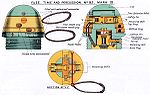
- "Shell Star" Mk 3 - Star unit & parachute with Fuze Time & Percussion No 221
-
- Shell weight: 35 lbs
- Propellant charge: 5 parts, from .4 to 1 lb loaded into a 3.4 inch long brass case
Ammunition
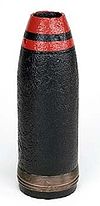
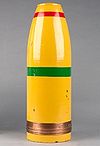
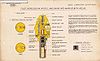
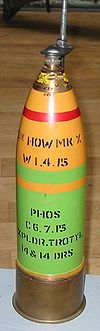
4.5 inch ammunition was separate loading, the shell and cartridge were loaded separately, with charge bags being removed from the cartridge as necessary. The full charge was charge 5, i.e. the cartridge case had an irremovable charge (1) and four incremental bags. Shells were delivered fuzed. In 1914 the ammunition scale for 4.5 in howitzers was 70% Shrapnel and 30% HE.New types of shell were introduced during the First World war. These were chemical at the end of 1915, incendiary shells in 1916 and smoke shells in 1917. Smoke shells were phosphorus filled with both steel and cast iron bodies.
A new streamlined shell (HE Mk 1D) was also introduced to increase maximum range from 6600 yards of the older 3C.R.H. (Calibres Radius Head) models to 7300 yards.
 |
 |
 |
 |
 |
 |
 |
Contained 492 balls, 35/lb |
Amatol Amatol is a highly explosive material made from a mixture of TNT and ammonium nitrate. Its name originates from the words ammonium and toluene... or trotyl (TNT) Contained 4 lb 10oz (2.09 kg) explosive |
See also
- HowitzerHowitzerA howitzer is a type of artillery piece characterized by a relatively short barrel and the use of comparatively small propellant charges to propel projectiles at relatively high trajectories, with a steep angle of descent...
- 10.5 cm Feldhaubitze 98/0910.5 cm Feldhaubitze 98/09The 10.5 cm Feldhaubitze 98/09 was a howitzer used by Germany in World War I.-History:It was originally built by Rheinmetall as the 10.5 cm Feldhaubitze 98, an old-fashioned, fixed-recoil weapon, but was redesigned by Krupp between 1902 and 1904 with a new recoil mechanism and a new carriage...
Early German equivalent - 10.5 cm leFH 1610.5 cm leFH 16The 10.5 cm leichte Feldhaubitze 16 was a field howitzer used by Germany in World War I and World War II. It shared the same carriage as the 7.7 cm FK 16. Guns turned over to Belgium as reparations after World War I were taken into Heer service after the conquest of Belgium as the 10.5 cm leFH 327...
Later German equivalent - List of howitzers
Surviving examples
- Royal Artillery Museum, Woolwich, London
- Imperial War Museum, Duxford, England
- Artillery Museum, Hämeenlinna, Finland
- Collins Barracks, CorkCollins Barracks (Cork)Collin's Barracks is a military barracks on the Old Youghal Road on the north side of Cork in Ireland.Originally erected between 1801 and 1806, the works were completed by Abraham Hargrave to designs by John Gibson in a prominent position on the hills overlooking the city and the River...
, Ireland - BallincolligBallincolligBallincollig is a satellite town in County Cork, Ireland, approximately 9 km west of Cork city. It is located beside the River Lee on the R608 regional road. In 2006 the population of Ballincollig DED was 16,308. The nearest towns include: Ballinora, Ovens, Killumney, Inniscarra, Blarney ,...
Barracks Square, Ireland - Army Memorial Museum & School of Artillery, Waiouru, New Zealand
- Auckland War Memorial Museum, New Zealand
- Royal Australian Artillery National Museum, North Head, Sydney, Australia
- The Central Museum of The Royal Regiment of Canadian Artillery, Shilo Manitoba
- Aiken Barracks, Dundalk, Ireland
- 2-15 FAR BN HQ, FT. Drum, NY, USA
External links
- Douglas T Hamilton, "High-explosive shell manufacture; a comprehensive treatise". New York: Industrial Press, 1916. Ch. VII : Specifications and manufacturing method for British 4.5 inch howitzer shell.
- Chris Baker, The British artillery weapons of 1914-1918
- RA 1939-1945
- British 4.5 inch QF Howitzer, LANDSHIPS