


Iraq Petroleum Company

Encyclopedia
The Iraq Petroleum Company (IPC), until 1929 called Turkish Petroleum Company (TPC), was an oil company
jointly owned by some of the world's largest oil companies, which had virtual monopoly
on all oil exploration and production in Iraq from 1925 to 1961. Being involved in other parts of the Middle East, the company played a major role in the discovery and development of oil resources in the region.
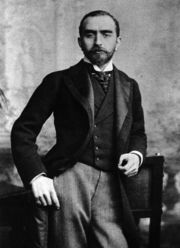 The foreunner of the Iraq Petroleum Company (IPC) was the Turkish Petroleum Company, which grew out of the growing belief, in the late 19th century, that the lands of the Ottoman Empire
contained substantial reservoirs of oil. The first interest was shown by German companies, who were already involved in the building of the Berlin-Baghdad railway, followed by British interests. In 1911, in an attempt to reconcile competing British and German interests in the region, a British company known as African and Eastern Concession Ltd was formed.
The following year, this company became the Turkish Petroleum Company (TPC), formed with the purpose of seeking a concession from the Ottoman Empire
to explore for oil
in Mesopotamia (now Iraq
). The owners were a group of large European companies - the Deutsche Bank, the Anglo Saxon Oil Company (a subsidiary of Royal Dutch/Shell
) , the National Bank of Turkey (a British concern) - and Armenian-born businessman Calouste Gulbenkian
. The driving force behind its creation was Gulbenkian, and the largest single shareholder was the British Government-controlled Anglo-Persian Oil Company, which by 1914 held 50% of the shares. TPC received a promise of a concession from the Ottoman government but the outbreak of World War I
in 1914 put a stop to all exploration plans.
When the Ottoman Empire was broken up in the aftermath of the war, the question of shareholding in TPC became a major issue at the 1920 San Remo conference
, where the future of all non-Turkish
and Arab
-majority areas of the former Ottoman Empire were substantially decided. A rising demand for petroleum during the war had demonstrated to the big powers the importance of having their own sources of oil. One of the original partners of TPC had been a German
oil company, and the French
had seized those shares as enemy property and demanded entrance into TPC through those. Both the Italian
and United States
governments demanded that their oil companies should be partners as well. After prolonged and sometimes sharp diplomatic exchanges, US oil companies were permitted to buy into the TPC, but it would take several years until the negotiations were completed.
was located by geologist J.M. Muir just north of Kirkuk
. Drilling started, and in the early hours nof 14 October 1927 oil was struck. Many tons of oil were spilled before the gushing well was brought under control, and the oil field soon proved to be extensive.
), Royal Dutch/Shell, the Compagnie Française des Pétroles (CFP, which in 1991 became Total
), and the Near East Development Corporation (a consortium
of five large US oil companies, among them Standard Oil of New Jersey and Socony-Vacuum); and the remaining 5% to Calouste Gulbenkian. TPC was to be organized as a nonprofit company, registered in Britain, that produced crude oil for a fee for its parent companies, based on their shares. The company itself was only allowed to refine and sell to Iraq's internal market, in order to prevent any competition with the parent companies.
The agreement, known as Red Line Agreement
after a red line was drawn around the former boundaries of the Ottoman Empire (with the exception of Kuwait), effectively bound the partners to act together within the red line. The writer Stephen Hemsley Longrigg, a former IPC employee, noted that "the Red Line Agreement, variously assessed as a sad case of wrongful cartelization or as an enlightened example of international co‑operation and fair-sharing, was to hold the field for twenty years and in large measure determined the pattern and tempo of oil development over a large part of the Middle East". Apart from in Saudi Arabia and Bahrain where ARAMCO and BAPCO respectively prevailed, IPC monopolized oil exploration inside the Red Line during this period. The Agreement lasted until 1948 when two of the American partners broke free (see Demise of the Red Line Agreement below).
The big loser was Iraq. The San Remo conference had stipulated that Iraqis should be allowed 20% of the company if they wanted to invest in it, but the oil companies successfully resisted Iraqi efforts to participate, despite pressure by the British government to accept Iraqi shareholders.
In 1929 the TPC was renamed the Iraq Petroleum Company.
, the world was awash with oil and greater output from Iraq would simply have driven the price down to even lower levels. Delaying tactics were employed not only in actual drilling and development, but also in conducting negotiations on such matters as pipeline rights-of-way.
The owners of IPC had conflicting interests: the Anglo-Persian Oil Company, Royal Dutch/Shell and Standard Oil had access to major sources of crude oil outside Iraq, and therefore wanted to hold the Iraqi concessions in reserve, whilst CFP and the other companies pushed for rapid development of Iraqi oil as they had limited crude oil supplies. These competing interests delayed the development of the Iraqi fields, and IPC's concession eventually expired because the companies failed to meet certain performance requirements, such as the construction of pipelines and shipping terminals. The concession was renegotiated in 1931, however, giving the company a 70 year concession on an enlarged 83200 square kilometres (32,123.7 sq mi) area east of the Tigris River. In return, the Iraqi government demanded, and received, additional payments and loans, as well as the promise that IPC would complete two oil pipelines to the Mediterranean
by 1935 - something CFP had demanded for a long time, in order to get its share of the oil quickly to France.
Different routes and terminal locations on the Mediterranean coast were sought by the French, who favored a northern route through Syria
and Lebanon
terminating at the city of Tripoli on the Lebanese coast, and the British and the Iraqis who preferred a southern route, terminating at Haifa
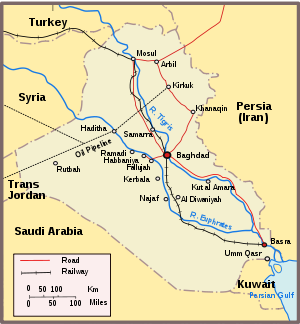
, in what then was Palestine. The issue was settled by a compromise which provided for the construction of two pipelines, each with a throughput capacity of 2,000,000 tons a year. The length of the Northern line would be 532 miles (856.2 km), that of the Southern line 620 miles (997.8 km). In 1934, the pipelines were completed from Kirkuk to Al Hadithah
, and from there, to both Tripoli and Haifa; the Kirkuk field was brought online the same year. Only in 1938, nine years after the discovery, did IPC begin to export oil in significant quantities.
The Kirkuk production averaged 4 million tons per year until World War II
, when restricted shipping in the Mediterranean forced down the production sharply. Although the Iraq Government tried to open up the country to competition, the company taking up the new concession was bought out by IPC and, under the name of the Mosul Petroleum Company, was duly gathered into the IPC ‘family’ of associated companies (see below). The company also got the concession rights to southern Iraq in 1938, and founded the Basrah Petroleum Company (BPC) as their wholly owned subsidiary to develop the southern region of Iraq.
In 1933, IPC joined negotiations for an oil concession in Al-Hasa
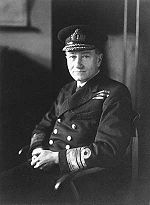
province, Saudi Arabia, bidding against Standard Oil of California (SOCAL). Represented by Stephen Hemsley Longrigg
, the company's bid failed when it offered payment in rupees rather than the gold that King Abdul-Aziz (also known as Ibn Saud) desired. SOCAL gained the concession, and went on to discover oil at Dammam
in 1938. Thereafter, IPC concentrated its efforts in Arabia in developing its Qatar oil concession (oil discovered 1939), Abu Dhabi (oil discovered in 1959), Oman (see Petroleum Development Oman
) and the Aden Protectorates (in today's Yemen
). IPC personnel carried out a series of ground-breaking explorations in southern Arabia during these years.
The failure of IPC to secure concessions in Bahrain and Saudi Arabia should not obscure the fact that elsewhere in the Middle East the company was successful in closing the open door to outsiders. The principal competitors for concessions were British Oil Development Co. Ltd., and Standard Oil Co. of Califorina. When these companies became interested in concessions in Iraq and other Middle East countries, IPC sought to exclude them by the simple device of buying up concessions within the red-line area. So successful were its efforts that by the end of 1944 1PC was operating in over 467055 square miles (1,209,666.9 km²) of territory in various parts of the area. The Company had extended its operations by exploration permits and concession agreements over an area larger in size than the states of Texas, Oklahoma, Arkansas, and Louisiana combined. In addition, IPC attempted, though without success, to extend further its area of control by seeking concessions or exploration permits in Turkey and in the neutral zones of Kuwait and Saudi Arabia.
IPC was also interested in other ventures apart from oil, such as potash mining in Trans-Jordan, asphalt in Syria (for which it set up a company, Societe Industrielle des Asphaltes et Petroles de Lattique) and salt
mining in the Aden Protectorates - although this latter venture was never developed. The company created air transport companies, the Iraq Petroleum Transport Company and Transports du Proche Orient, to operate aircraft and vessels to ferry people and equipment to the remoter parts of its concession areas.
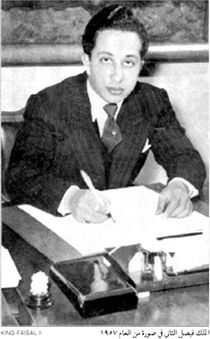
 There were no serious issues between the IPC and the Iraqi government during the Hashemite Monarchy (1932–58): the Hashemites were extremely pro-west, in fact they had been installed by the British, and therefore tensions were minimized. They were dependent on the British militarily and had essentially pledged allegiance to them through the Baghdad Pact. The Hashemites’ main disputes centered on increasing the amount of crude oil extracted, getting more Iraqis involved in the process of producing the oil and getting more royalties. In 1952, terms that were more generous to the Iraqi government were negotiated. These terms were largely based on the far more lucrative terms of the Aramco-Saudi agreement of December 1950. One could argue that a determinant in these negotiations was the friendly atmosphere in which they were conducted.
 This atmosphere did not exist during negotiations between the IPC and revolutionary governments following the overthrow of the Hashemite monarchy in 1958. Relations between the two can be examined on two major factors. First, oil was a vital part of the Iraqi economy. Because of this, the IPC had a huge impact on the amount of revenue that the government generated and thus had a certain amount of influence over the government. The second major factor was inability of the Iraqi government at that time to source the technical knowledge and skill necessary to take over oil operations in the country.
However the economic situation at the time did not permit Qasim to nationalize the IPC – western nations had boycotted Iranian oil when Mossadeq nationalized its oil company and could be expected to do the same in this case. (It is likely that nationalization would have been Qasim’s favored route had he had the necessary capabilities). Further, Iraqis lacked the technical and managerial capabilities to run the IPC. Qasim needed the oil revenues to run his government and to keep the military satisfied. Therefore, Qasim resorted to many other tactics including increasing transit rates at Basra by 1,200%. In response, the IPC stopped producing oil that used Basra as a shipping point. The ensuing confrontation was the lowest point in relations between the two up to this point.
By the end of the confrontation, Qasim had appropriated 99.5% of the lands given to the IPC. One major difference between these negotiations and the negotiations of 1952 was the negotiating stance of the Iraqi government. Whereas they had been more willing to accommodate the IPC in 1952, many of Qasim’s positions were non-negotiable. However this should not be surprising because it was expected that Qasim would take advantage of growing Arab nationalism and a sense amongst many ordinary Iraqis that they were being exploited by the west.
However this was not enough for the Iraqi government and they issued a new set of demands in November 1970 which essentially involved more Iraqi control of operations and more Iraqi profit-taking. Dissatisfied with the IPC’s unwillingness to negotiate on Iraq’s terms, the Iraqi government gave the IPC an ultimatum with similar demands in May 1972. The IPC tried to offer a compromise solution but the Ba’athist Iraqi government rejected the offer and nationalized the IPC on June 1, 1972.
The Kirkuk field still forms the basis for northern Iraqi oil production. Kirkuk has over 10 billion barrels (1.6 km³) of remaining proven oil reserves
. The Jambur, Bai Hassan, and Khabbaz fields are the only other currently producing oil fields in northern Iraq. While Iraq's northern oil industry remained relatively unscathed during the Iran-Iraq War, an estimated 60% of the facilities in southern and central Iraq were damaged in the Gulf War
. Post-1991 fighting between Kurdish and Iraqi forces in northern Iraq resulted in temporary sabotage of the Kirkuk field's facilities. In 1996, production capacity in northern and central Iraq was estimated at between 0.7 to 1 million barrels (110,000 to 160,000 m³) per day, down from around 1.2 million barrels (190,000 m³) per day before the Gulf War.
, Royal Dutch Shell
, ExxonMobil
, Total S.A.
and Partex
, reflecting the historical make-up of the Iraq Petroleum Company. The current Abu Dhabi onshore oil concession is due to expire in January, 2014.
External Links
Petroleum
Petroleum or crude oil is a naturally occurring, flammable liquid consisting of a complex mixture of hydrocarbons of various molecular weights and other liquid organic compounds, that are found in geologic formations beneath the Earth's surface. Petroleum is recovered mostly through oil drilling...
jointly owned by some of the world's largest oil companies, which had virtual monopoly
Monopoly
A monopoly exists when a specific person or enterprise is the only supplier of a particular commodity...
on all oil exploration and production in Iraq from 1925 to 1961. Being involved in other parts of the Middle East, the company played a major role in the discovery and development of oil resources in the region.
Turkish Petroleum Company
Ottoman Empire
The Ottoman EmpireIt was usually referred to as the "Ottoman Empire", the "Turkish Empire", the "Ottoman Caliphate" or more commonly "Turkey" by its contemporaries...
contained substantial reservoirs of oil. The first interest was shown by German companies, who were already involved in the building of the Berlin-Baghdad railway, followed by British interests. In 1911, in an attempt to reconcile competing British and German interests in the region, a British company known as African and Eastern Concession Ltd was formed.
The following year, this company became the Turkish Petroleum Company (TPC), formed with the purpose of seeking a concession from the Ottoman Empire
Ottoman Empire
The Ottoman EmpireIt was usually referred to as the "Ottoman Empire", the "Turkish Empire", the "Ottoman Caliphate" or more commonly "Turkey" by its contemporaries...
to explore for oil
Petroleum
Petroleum or crude oil is a naturally occurring, flammable liquid consisting of a complex mixture of hydrocarbons of various molecular weights and other liquid organic compounds, that are found in geologic formations beneath the Earth's surface. Petroleum is recovered mostly through oil drilling...
in Mesopotamia (now Iraq
Iraq
Iraq ; officially the Republic of Iraq is a country in Western Asia spanning most of the northwestern end of the Zagros mountain range, the eastern part of the Syrian Desert and the northern part of the Arabian Desert....
). The owners were a group of large European companies - the Deutsche Bank, the Anglo Saxon Oil Company (a subsidiary of Royal Dutch/Shell
Royal Dutch Shell
Royal Dutch Shell plc , commonly known as Shell, is a global oil and gas company headquartered in The Hague, Netherlands and with its registered office in London, United Kingdom. It is the fifth-largest company in the world according to a composite measure by Forbes magazine and one of the six...
) , the National Bank of Turkey (a British concern) - and Armenian-born businessman Calouste Gulbenkian
Calouste Gulbenkian
Calouste Sarkis Gulbenkian was an Armenian businessman and philanthropist. He played a major role in making the petroleum reserves of the Middle East available to Western development...
. The driving force behind its creation was Gulbenkian, and the largest single shareholder was the British Government-controlled Anglo-Persian Oil Company, which by 1914 held 50% of the shares. TPC received a promise of a concession from the Ottoman government but the outbreak of World War I
World War I
World War I , which was predominantly called the World War or the Great War from its occurrence until 1939, and the First World War or World War I thereafter, was a major war centred in Europe that began on 28 July 1914 and lasted until 11 November 1918...
in 1914 put a stop to all exploration plans.
When the Ottoman Empire was broken up in the aftermath of the war, the question of shareholding in TPC became a major issue at the 1920 San Remo conference
San Remo conference
The San Remo Conference was an international meeting of the post-World War I Allied Supreme Council, held in Sanremo, Italy, from 19 to 26 April 1920. It was attended by the four Principal Allied Powers of World War I who were represented by the prime ministers of Britain , France and Italy and...
, where the future of all non-Turkish
Turkey
Turkey , known officially as the Republic of Turkey , is a Eurasian country located in Western Asia and in East Thrace in Southeastern Europe...
and Arab
Arab
Arab people, also known as Arabs , are a panethnicity primarily living in the Arab world, which is located in Western Asia and North Africa. They are identified as such on one or more of genealogical, linguistic, or cultural grounds, with tribal affiliations, and intra-tribal relationships playing...
-majority areas of the former Ottoman Empire were substantially decided. A rising demand for petroleum during the war had demonstrated to the big powers the importance of having their own sources of oil. One of the original partners of TPC had been a German
Germany
Germany , officially the Federal Republic of Germany , is a federal parliamentary republic in Europe. The country consists of 16 states while the capital and largest city is Berlin. Germany covers an area of 357,021 km2 and has a largely temperate seasonal climate...
oil company, and the French
France
The French Republic , The French Republic , The French Republic , (commonly known as France , is a unitary semi-presidential republic in Western Europe with several overseas territories and islands located on other continents and in the Indian, Pacific, and Atlantic oceans. Metropolitan France...
had seized those shares as enemy property and demanded entrance into TPC through those. Both the Italian
Italy
Italy , officially the Italian Republic languages]] under the European Charter for Regional or Minority Languages. In each of these, Italy's official name is as follows:;;;;;;;;), is a unitary parliamentary republic in South-Central Europe. To the north it borders France, Switzerland, Austria and...
and United States
United States
The United States of America is a federal constitutional republic comprising fifty states and a federal district...
governments demanded that their oil companies should be partners as well. After prolonged and sometimes sharp diplomatic exchanges, US oil companies were permitted to buy into the TPC, but it would take several years until the negotiations were completed.
Oil Found in 1927
TPC obtained a concession to explore for oil in 1925, in return for a promise that the Iraqi government would receive a royalty for every ton of oil extracted, but linked to the oil companies' profits and not payable for the first 20 years. The concession required the company to select 24 rectangular plots of 8 square miles (20.7 km²) each for drilling operations. Two wells were started at Pulkanah and one each at Khashm al Ahmar, Injanah and Qaiyarah. Kirkuk was included as the sixth location. The well at Baba GurgurBaba Gurgur
Baba Gurgur is a large oil field near the city of Kirkuk which was the first to be discovered in Northern Iraq in 1927....
was located by geologist J.M. Muir just north of Kirkuk
Kirkuk
Kirkuk is a city in Iraq and the capital of Kirkuk Governorate.It is located in the Iraqi governorate of Kirkuk, north of the capital, Baghdad...
. Drilling started, and in the early hours nof 14 October 1927 oil was struck. Many tons of oil were spilled before the gushing well was brought under control, and the oil field soon proved to be extensive.
Red Line Agreement and the creation of IPC
The discovery hastened the negotiations over the composition of TPC, and on 31 July 1928 the shareholders signed a formal partnership agreement. Shares werre held in the following proportions: 23.75% each to the Anglo-Persian Oil Company (which in 1935 became the Anglo-Iranian Oil Company (AIOC) and in 1954 the British Petroleum Company, later BPBP
BP p.l.c. is a global oil and gas company headquartered in London, United Kingdom. It is the third-largest energy company and fourth-largest company in the world measured by revenues and one of the six oil and gas "supermajors"...
), Royal Dutch/Shell, the Compagnie Française des Pétroles (CFP, which in 1991 became Total
Total S.A.
Total S.A. is a French multinational oil company and one of the six "Supermajor" oil companies in the world.Its businesses cover the entire oil and gas chain, from crude oil and natural gas exploration and production to power generation, transportation, refining, petroleum product marketing, and...
), and the Near East Development Corporation (a consortium
Consortium
A consortium is an association of two or more individuals, companies, organizations or governments with the objective of participating in a common activity or pooling their resources for achieving a common goal....
of five large US oil companies, among them Standard Oil of New Jersey and Socony-Vacuum); and the remaining 5% to Calouste Gulbenkian. TPC was to be organized as a nonprofit company, registered in Britain, that produced crude oil for a fee for its parent companies, based on their shares. The company itself was only allowed to refine and sell to Iraq's internal market, in order to prevent any competition with the parent companies.
The agreement, known as Red Line Agreement
Red Line Agreement
The Red Line Agreement is the name given to an agreement signed by partners in the Turkish Petroleum Company on July 31, 1928. The aim of the agreement was to formalize the corporate structure of TPC and bind all partners to a self-denial clause that prohibited any of its shareholders from...
after a red line was drawn around the former boundaries of the Ottoman Empire (with the exception of Kuwait), effectively bound the partners to act together within the red line. The writer Stephen Hemsley Longrigg, a former IPC employee, noted that "the Red Line Agreement, variously assessed as a sad case of wrongful cartelization or as an enlightened example of international co‑operation and fair-sharing, was to hold the field for twenty years and in large measure determined the pattern and tempo of oil development over a large part of the Middle East". Apart from in Saudi Arabia and Bahrain where ARAMCO and BAPCO respectively prevailed, IPC monopolized oil exploration inside the Red Line during this period. The Agreement lasted until 1948 when two of the American partners broke free (see Demise of the Red Line Agreement below).
The big loser was Iraq. The San Remo conference had stipulated that Iraqis should be allowed 20% of the company if they wanted to invest in it, but the oil companies successfully resisted Iraqi efforts to participate, despite pressure by the British government to accept Iraqi shareholders.
In 1929 the TPC was renamed the Iraq Petroleum Company.
Delayed Production Start
The original concession of March 14, 1925 covered all of Iraq, but IPC was reluctant to develop it quickly and production was restricted to fields constituting only one-half of 1 percent of the country's total area. During the Great DepressionGreat Depression
The Great Depression was a severe worldwide economic depression in the decade preceding World War II. The timing of the Great Depression varied across nations, but in most countries it started in about 1929 and lasted until the late 1930s or early 1940s...
, the world was awash with oil and greater output from Iraq would simply have driven the price down to even lower levels. Delaying tactics were employed not only in actual drilling and development, but also in conducting negotiations on such matters as pipeline rights-of-way.
The owners of IPC had conflicting interests: the Anglo-Persian Oil Company, Royal Dutch/Shell and Standard Oil had access to major sources of crude oil outside Iraq, and therefore wanted to hold the Iraqi concessions in reserve, whilst CFP and the other companies pushed for rapid development of Iraqi oil as they had limited crude oil supplies. These competing interests delayed the development of the Iraqi fields, and IPC's concession eventually expired because the companies failed to meet certain performance requirements, such as the construction of pipelines and shipping terminals. The concession was renegotiated in 1931, however, giving the company a 70 year concession on an enlarged 83200 square kilometres (32,123.7 sq mi) area east of the Tigris River. In return, the Iraqi government demanded, and received, additional payments and loans, as well as the promise that IPC would complete two oil pipelines to the Mediterranean
Mediterranean Sea
The Mediterranean Sea is a sea connected to the Atlantic Ocean surrounded by the Mediterranean region and almost completely enclosed by land: on the north by Anatolia and Europe, on the south by North Africa, and on the east by the Levant...
by 1935 - something CFP had demanded for a long time, in order to get its share of the oil quickly to France.
Different routes and terminal locations on the Mediterranean coast were sought by the French, who favored a northern route through Syria
Syria
Syria , officially the Syrian Arab Republic , is a country in Western Asia, bordering Lebanon and the Mediterranean Sea to the West, Turkey to the north, Iraq to the east, Jordan to the south, and Israel to the southwest....
and Lebanon
Lebanon
Lebanon , officially the Republic of LebanonRepublic of Lebanon is the most common term used by Lebanese government agencies. The term Lebanese Republic, a literal translation of the official Arabic and French names that is not used in today's world. Arabic is the most common language spoken among...
terminating at the city of Tripoli on the Lebanese coast, and the British and the Iraqis who preferred a southern route, terminating at Haifa
Haifa
Haifa is the largest city in northern Israel, and the third-largest city in the country, with a population of over 268,000. Another 300,000 people live in towns directly adjacent to the city including the cities of the Krayot, as well as, Tirat Carmel, Daliyat al-Karmel and Nesher...
, in what then was Palestine. The issue was settled by a compromise which provided for the construction of two pipelines, each with a throughput capacity of 2,000,000 tons a year. The length of the Northern line would be 532 miles (856.2 km), that of the Southern line 620 miles (997.8 km). In 1934, the pipelines were completed from Kirkuk to Al Hadithah
Haditha
Haditha is a city in the western Iraqi Al Anbar Governorate, about 240 km northwest of Baghdad. It is a farming town situated on the Euphrates River at . Its population of around 100,000 people is predominantly Sunni Muslim Arabs...
, and from there, to both Tripoli and Haifa; the Kirkuk field was brought online the same year. Only in 1938, nine years after the discovery, did IPC begin to export oil in significant quantities.
The Kirkuk production averaged 4 million tons per year until World War II
World War II
World War II, or the Second World War , was a global conflict lasting from 1939 to 1945, involving most of the world's nations—including all of the great powers—eventually forming two opposing military alliances: the Allies and the Axis...
, when restricted shipping in the Mediterranean forced down the production sharply. Although the Iraq Government tried to open up the country to competition, the company taking up the new concession was bought out by IPC and, under the name of the Mosul Petroleum Company, was duly gathered into the IPC ‘family’ of associated companies (see below). The company also got the concession rights to southern Iraq in 1938, and founded the Basrah Petroleum Company (BPC) as their wholly owned subsidiary to develop the southern region of Iraq.
IPC Partner Disputes
Three issues caused protracted negotiations among the partner groups of IPC:- Revision of the Anglo-Iranian royalty: when the Iraq concession of 1925 was revised in March 1931, and IPC was granted a blanket concession over 32000 square miles (82,879.6 km²) of territory east of the Tigris River, the question arose as to whether Anglo-Persian's 10 percent royalty should be extended to include the new area. After lengthy negotiations the groups arrived at a compromise settlement in November 1934, which stipulated that D'Arcy Exploration (Anglo-Iranian) would be entitled to a 7.5-percent royalty on such oil as was produced from the 32000 square miles (82,879.6 km²) covered by the revised Iraq concession, the oil to be delivered free of cost at the field, with IPC paying the royalty due the Iraq Government.
- Tax matters: since IPC was a British-chartered company, the British groups would not have been subject to double taxation. The non-British groups, however, did not relish the idea of having the earnings of IPC taxed once by the British Government and again by their own governments. Eventually the groups agreed to transfer all pipeline operations to IPC, and price crude to the groups on the basis of management's estimate of British income tax cost plus 1 shilling profit per ton. Under this plan IPC's profits were nominal and its tax liability to the British Government was relatively small.
- Demise of the Red Line Agreement: two of the American oil companies in IPC were offered a partnership with ARAMCO to develop the oil resources of Saudi Arabia. Their partners in IPC refused to release them from the Red Line Agreement. After the Americans claimed that World War II had ended the Agreement, protracted legal proceedings with Gulbenkian followed. Eventually the case was settled out of court and the American partners joined ARAMCO. The French Government and Gulbenkian had withdrawn their objections in exchange for a greater share of IPC's output, and the Red Line agreement boundaries were redrawn to exclude Saudi Arabia, Yemen, Bahrain, Egypt, Israel, and the western-half of Jordan.
IPC Operations Outside Iraq
As the Red Line Agreement defined the company's sphere of operations well beyond the boundaries of Iraq, IPC looked for oil elsewhere in the Middle East. It created associated companies, one for each territory to be explored. These companies would obtain from the sovereign power an exploration licence covering simple exploration over a defined geographical area, or a concession permitting exploration and the production of oil. By 1948, the Company had created 12 companies with concessions or exploration licences: Petroleum Development (Cyprus Ltd), Lebanon Petroleum Company Ltd, Petroleum Development (Palestine) Ltd, Syrian Petroleum Company Ltd, Trans-Jordan Petroleum Company Ltd, Mosul Petroleum Company Ltd, Basrah Petroleum Company Ltd, Petroleum Development (Qatar) Ltd, Petroleum Development (Trucial Coast) Ltd, Petroleum Development (Oman and Dhofar) Ltd, Petroleum Concessions Ltd (for the Aden Protectorates), Petroleum Development (Western Arabia) Ltd.In 1933, IPC joined negotiations for an oil concession in Al-Hasa
Al-Hasa
Al-Ahsa is the largest governorate in Saudi Arabia's Eastern Province, named after Al-Ahsa oasis. The name Al-Ahsa is also given to the biggest city in the region, Hofuf. In classic Arabic, Ahsa means the sound of water underground. It has one of the largest oases in the world with Date Palms of...
province, Saudi Arabia, bidding against Standard Oil of California (SOCAL). Represented by Stephen Hemsley Longrigg
Stephen Hemsley Longrigg
Stephen Hemsley Longrigg was a British military governor, petroleum company manager and a leading authority on the history of oil in the Middle East...
, the company's bid failed when it offered payment in rupees rather than the gold that King Abdul-Aziz (also known as Ibn Saud) desired. SOCAL gained the concession, and went on to discover oil at Dammam
Dammam
Dammam is the capital of the Eastern Province of Saudi Arabia, the most oil-rich region in the world. The judicial and administrative bodies of the province and several government departments are located in the city. Dammam is the largest city in the Eastern Province and third largest in Saudi...
in 1938. Thereafter, IPC concentrated its efforts in Arabia in developing its Qatar oil concession (oil discovered 1939), Abu Dhabi (oil discovered in 1959), Oman (see Petroleum Development Oman
Petroleum Development Oman
Petroleum Development of Oman is the foremost exploration and production company in the Sultanate. It accounts for more than 90% of the country's crude-oil production and nearly all of its natural-gas supply...
) and the Aden Protectorates (in today's Yemen
Yemen
The Republic of Yemen , commonly known as Yemen , is a country located in the Middle East, occupying the southwestern to southern end of the Arabian Peninsula. It is bordered by Saudi Arabia to the north, the Red Sea to the west, and Oman to the east....
). IPC personnel carried out a series of ground-breaking explorations in southern Arabia during these years.
The failure of IPC to secure concessions in Bahrain and Saudi Arabia should not obscure the fact that elsewhere in the Middle East the company was successful in closing the open door to outsiders. The principal competitors for concessions were British Oil Development Co. Ltd., and Standard Oil Co. of Califorina. When these companies became interested in concessions in Iraq and other Middle East countries, IPC sought to exclude them by the simple device of buying up concessions within the red-line area. So successful were its efforts that by the end of 1944 1PC was operating in over 467055 square miles (1,209,666.9 km²) of territory in various parts of the area. The Company had extended its operations by exploration permits and concession agreements over an area larger in size than the states of Texas, Oklahoma, Arkansas, and Louisiana combined. In addition, IPC attempted, though without success, to extend further its area of control by seeking concessions or exploration permits in Turkey and in the neutral zones of Kuwait and Saudi Arabia.
IPC was also interested in other ventures apart from oil, such as potash mining in Trans-Jordan, asphalt in Syria (for which it set up a company, Societe Industrielle des Asphaltes et Petroles de Lattique) and salt
mining in the Aden Protectorates - although this latter venture was never developed. The company created air transport companies, the Iraq Petroleum Transport Company and Transports du Proche Orient, to operate aircraft and vessels to ferry people and equipment to the remoter parts of its concession areas.
IPC-Government Relations
The Qasim Era
Beginning in the early 1950s, as the strength of nationalism in Iraq grew, the focus came to bear on foreign control over the oil production of the country. Abd al-Karim Qasim was a nationalist Iraqi Army general who seized power in a 1958 coup d'état in which the Iraqi monarchy was eliminated. He ruled the country as Prime Minister of Iraq until his downfall and death in 1963. Before the coup, he used the fact that the IPC was producing oil for western nations rather than for the benefit of Iraq citizens as one of his main points of contention with the Iraqi government. Once in power, he was critical of several aspects of the IPC. First, he was critical of the monetary arrangement between the IPC and the government. He also did not appreciate the monopoly that the IPC had been granted.However the economic situation at the time did not permit Qasim to nationalize the IPC – western nations had boycotted Iranian oil when Mossadeq nationalized its oil company and could be expected to do the same in this case. (It is likely that nationalization would have been Qasim’s favored route had he had the necessary capabilities). Further, Iraqis lacked the technical and managerial capabilities to run the IPC. Qasim needed the oil revenues to run his government and to keep the military satisfied. Therefore, Qasim resorted to many other tactics including increasing transit rates at Basra by 1,200%. In response, the IPC stopped producing oil that used Basra as a shipping point. The ensuing confrontation was the lowest point in relations between the two up to this point.
By the end of the confrontation, Qasim had appropriated 99.5% of the lands given to the IPC. One major difference between these negotiations and the negotiations of 1952 was the negotiating stance of the Iraqi government. Whereas they had been more willing to accommodate the IPC in 1952, many of Qasim’s positions were non-negotiable. However this should not be surprising because it was expected that Qasim would take advantage of growing Arab nationalism and a sense amongst many ordinary Iraqis that they were being exploited by the west.
1972 Nationalization
Throughout the 1960s, the Iraqi government criticized the IPC and used the IPC as a central piece of their anti-western propaganda. The Soviet-Iraqi agreement of 1969 emboldened the Iraqi government and in 1970 they made a list of demands including ownership of 20% of the company’s assets and more control. The IPC by this time was taking the Iraqi government very seriously and made some huge concessions. They agreed to increase oil production substantially and also increase the price of its crude oil in certain areas. They also offered an advance payment on royalties.However this was not enough for the Iraqi government and they issued a new set of demands in November 1970 which essentially involved more Iraqi control of operations and more Iraqi profit-taking. Dissatisfied with the IPC’s unwillingness to negotiate on Iraq’s terms, the Iraqi government gave the IPC an ultimatum with similar demands in May 1972. The IPC tried to offer a compromise solution but the Ba’athist Iraqi government rejected the offer and nationalized the IPC on June 1, 1972.
The Kirkuk field still forms the basis for northern Iraqi oil production. Kirkuk has over 10 billion barrels (1.6 km³) of remaining proven oil reserves
Oil reserves
The total estimated amount of oil in an oil reservoir, including both producible and non-producible oil, is called oil in place. However, because of reservoir characteristics and limitations in petroleum extraction technologies, only a fraction of this oil can be brought to the surface, and it is...
. The Jambur, Bai Hassan, and Khabbaz fields are the only other currently producing oil fields in northern Iraq. While Iraq's northern oil industry remained relatively unscathed during the Iran-Iraq War, an estimated 60% of the facilities in southern and central Iraq were damaged in the Gulf War
Gulf War
The Persian Gulf War , commonly referred to as simply the Gulf War, was a war waged by a U.N.-authorized coalition force from 34 nations led by the United States, against Iraq in response to Iraq's invasion and annexation of Kuwait.The war is also known under other names, such as the First Gulf...
. Post-1991 fighting between Kurdish and Iraqi forces in northern Iraq resulted in temporary sabotage of the Kirkuk field's facilities. In 1996, production capacity in northern and central Iraq was estimated at between 0.7 to 1 million barrels (110,000 to 160,000 m³) per day, down from around 1.2 million barrels (190,000 m³) per day before the Gulf War.
IPC Today
IPC itself has ceased to exist in all but name on paper. An associated company, Abu Dhabi Petroleum Company (ADPC) - formerly Petroleum Development (Trucial Coast) Ltd - is today the only survivor of the IPC group of associated companies. ADPC still holds 40% of the onshore concession in Abu Dhabi, the majority 60% being held by the Abu Dhabi National Oil Company (ADNOC) on behalf of the Abu Dhabi Government. Operations are carried out by the local operating company, ADCO (The Abu Dhabi Company for Onshore Oil Operations) which is jointly owned by ADNOC and the ADPC shareholders, BPBP
BP p.l.c. is a global oil and gas company headquartered in London, United Kingdom. It is the third-largest energy company and fourth-largest company in the world measured by revenues and one of the six oil and gas "supermajors"...
, Royal Dutch Shell
Royal Dutch Shell
Royal Dutch Shell plc , commonly known as Shell, is a global oil and gas company headquartered in The Hague, Netherlands and with its registered office in London, United Kingdom. It is the fifth-largest company in the world according to a composite measure by Forbes magazine and one of the six...
, ExxonMobil
ExxonMobil
Exxon Mobil Corporation or ExxonMobil, is an American multinational oil and gas corporation. It is a direct descendant of John D. Rockefeller's Standard Oil company, and was formed on November 30, 1999, by the merger of Exxon and Mobil. Its headquarters are in Irving, Texas...
, Total S.A.
Total S.A.
Total S.A. is a French multinational oil company and one of the six "Supermajor" oil companies in the world.Its businesses cover the entire oil and gas chain, from crude oil and natural gas exploration and production to power generation, transportation, refining, petroleum product marketing, and...
and Partex
Partex
Partex Oil and Gas Corporation is an oil company which is fully owned by the Calouste Gulbenkian Foundation, from Lisbon, Portugal.-History:...
, reflecting the historical make-up of the Iraq Petroleum Company. The current Abu Dhabi onshore oil concession is due to expire in January, 2014.
Publications and Films
In 1948, IPC published its Handbook of the Territories which Form the Theatre of Operations of the Iraq Petroleum Company Limited and its Associated Companies authored by Stephen Hemsley Longrigg. The IPC Film Unit produced a number of short films, most notably The Third River, a film produced in 1952 about operations around the Iraq-Mediterranean pipeline, and Rivers of Time, produced in 1957, about the history of Mesopotamia. The company published a monthly magazine, entitled Iraq Petroleum, from August 1951 until April/May 1957. An insert in the January 1957 edition read "In the light of present circumstances it has been found necessary to restrict the production of Iraq Petroleum and ... publication will be bi-monthly until further notice." An in-house company magazine, The Crescent, continued in print until the 1970s. The IPC Newsletter, a quarterly magazine for IPC pensioners, was first issued in 1974 and is still in publication to this day.See also
- Baba GurgurBaba GurgurBaba Gurgur is a large oil field near the city of Kirkuk which was the first to be discovered in Northern Iraq in 1927....
- Abd al-Karim Qasim
- Anglo-Iraqi WarAnglo-Iraqi WarThe Anglo-Iraqi War was the name of the British campaign against the rebel government of Rashid Ali in the Kingdom of Iraq during the Second World War. The war lasted from 2 May to 31 May 1941. The campaign resulted in the re-occupation of Iraq by British armed forces and the return to power of the...
- Oil reserves in IraqOil reserves in IraqOil reserves in Iraq will be the largest in the world according to recent geological surveys and seismic data. The Iraqi government has stated that new exploration showed Iraq has the world’s largest proven oil reserves, with more than 350 billion barrels...
- Red Line AgreementRed Line AgreementThe Red Line Agreement is the name given to an agreement signed by partners in the Turkish Petroleum Company on July 31, 1928. The aim of the agreement was to formalize the corporate structure of TPC and bind all partners to a self-denial clause that prohibited any of its shareholders from...
External Links
- Iraq Petroleum Company at Al-Mashriq website http://almashriq.hiof.no/lebanon/300/380/388/ipc/