
Home      Discussion      Topics      Dictionary      Almanac
Signup       Login
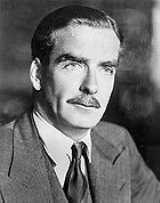
Anthony Eden

Anthony Eden

Overview
Robert Anthony Eden, 1st Earl of Avon, KG
Order of the Garter
The Most Noble Order of the Garter, founded in 1348, is the highest order of chivalry, or knighthood, existing in England. The order is dedicated to the image and arms of St...

, MC
Military Cross
The Military Cross is the third-level military decoration awarded to officers and other ranks of the British Armed Forces; and formerly also to officers of other Commonwealth countries....

, PC
Privy Council of the United Kingdom
Her Majesty's Most Honourable Privy Council, usually known simply as the Privy Council, is a formal body of advisers to the Sovereign in the United Kingdom...

 (12 June 1897 – 14 January 1977) was a British Conservative
Conservative Party (UK)
The Conservative Party, formally the Conservative and Unionist Party, is a centre-right political party in the United Kingdom that adheres to the philosophies of conservatism and British unionism. It is the largest political party in the UK, and is currently the largest single party in the House...

 politician, who was Prime Minister
Prime Minister of the United Kingdom
The Prime Minister of the United Kingdom of Great Britain and Northern Ireland is the Head of Her Majesty's Government in the United Kingdom. The Prime Minister and Cabinet are collectively accountable for their policies and actions to the Sovereign, to Parliament, to their political party and...

 from 1955 to 1957. He was also Foreign Secretary
Secretary of State for Foreign and Commonwealth Affairs
The Secretary of State for Foreign and Commonwealth Affairs, commonly referred to as the Foreign Secretary, is a senior member of Her Majesty's Government heading the Foreign and Commonwealth Office and regarded as one of the Great Offices of State...

 for three periods between 1935 and 1955, including during the Second World War.
Discussion
Ask a question about 'Anthony Eden'
Start a new discussion about 'Anthony Eden'
Answer questions from other users
Full Discussion Forum
 
Quotations

Our quarrel is not with Egypt, still less with the Arab world. It is with Gamal Abdel Nasser|Colonel Nasser. He has shown that he is not a man who can be trusted to keep an agreement. Now he has torn up all his country's promises to the Suez Canal Company and has even gone back on his own statements.

"Oil route 'a matter of life and death'", The Times, 9 August 1956, p. 6.

We cannot agree that an act of plunder which threatens the livelihood of many nations should be allowed to succeed.

Conclusion of broadcast, 8 August 1956.

There is now doubt in our minds that Nasser, whether he likes it or not, is now effectively in Russian hands, just as Mussolini was in Hitler's. It would be as ineffective to show weakness to Nasser now in order to placate him as it was to show weakness to Mussolini.

Eden to President Eisenhower (1 October, 1956).

All my life, I've been a man of peace, working for peace, striving for peace, negotiating for peace. I've been a League of Nations man and a United Nations man and I'm still the same man with the same convictions, the same devotion to peace. I couldn't be other even if I wished. But I'm utterly convinced that the action we have taken is right.

BBC television broadcast to the nation (3 November, 1956).

If we had allowed things to drift, everything would have gone from bad to worse. Nasser would have become a kind of Moslem Mussolini, and our friends in Iraq, Jordan, Saudi Arabia, and even Iran would gradually have been brought down. His efforts would have spread westwards, and Libya and North Africa would have been brought under his control.

Eden to Eisenhower (5 November, 1956).

It has had the effect of making us the 49th state [of America].

On Harold Macmillan|Harold Macmillan's government policies, to Robert Gascoyne-Cecil, 5th Marquess of Salisbury|Lord Salisbury (28 December, 1957).

Although [in 1937] we might still hope to prevent the divisions of Europe into Fascist and anti-Fascist camps, our real affinities and interests, strategic as well as political, lay with France, a fact which some of my colleagues were most reluctant to realise.

Anthony Eden, The Eden Memoirs: Facing the Dictators (Cassell, 1962), pp. 486-7.
Encyclopedia
Robert Anthony Eden, 1st Earl of Avon, KG
Order of the Garter
The Most Noble Order of the Garter, founded in 1348, is the highest order of chivalry, or knighthood, existing in England. The order is dedicated to the image and arms of St...

, MC
Military Cross
The Military Cross is the third-level military decoration awarded to officers and other ranks of the British Armed Forces; and formerly also to officers of other Commonwealth countries....

, PC
Privy Council of the United Kingdom
Her Majesty's Most Honourable Privy Council, usually known simply as the Privy Council, is a formal body of advisers to the Sovereign in the United Kingdom...

 (12 June 1897 – 14 January 1977) was a British Conservative
Conservative Party (UK)
The Conservative Party, formally the Conservative and Unionist Party, is a centre-right political party in the United Kingdom that adheres to the philosophies of conservatism and British unionism. It is the largest political party in the UK, and is currently the largest single party in the House...

 politician, who was Prime Minister
Prime Minister of the United Kingdom
The Prime Minister of the United Kingdom of Great Britain and Northern Ireland is the Head of Her Majesty's Government in the United Kingdom. The Prime Minister and Cabinet are collectively accountable for their policies and actions to the Sovereign, to Parliament, to their political party and...

 from 1955 to 1957. He was also Foreign Secretary
Secretary of State for Foreign and Commonwealth Affairs
The Secretary of State for Foreign and Commonwealth Affairs, commonly referred to as the Foreign Secretary, is a senior member of Her Majesty's Government heading the Foreign and Commonwealth Office and regarded as one of the Great Offices of State...

 for three periods between 1935 and 1955, including during the Second World War.

In the post-war years, Eden was a protagonist of the change in British policy on war criminal trials, which was perhaps best symbolised by his signature under the pardon conceded to the German Field Marshal Albert Kesselring
Albert Kesselring
Albert Kesselring was a German Luftwaffe Generalfeldmarschall during World War II. In a military career that spanned both World Wars, Kesselring became one of Nazi Germany's most skilful commanders, being one of 27 soldiers awarded the Knight's Cross of the Iron Cross with Oak Leaves, Swords...

 on 24 October 1952.

Eden's worldwide reputation as an opponent of appeasement
Appeasement
The term appeasement is commonly understood to refer to a diplomatic policy aimed at avoiding war by making concessions to another power. Historian Paul Kennedy defines it as "the policy of settling international quarrels by admitting and satisfying grievances through rational negotiation and...

, a "Man of Peace", and a skilled diplomat was overshadowed in the second year of his premiership when the United States refused to support the Anglo-French military response to the Suez Crisis
Suez Crisis
The Suez Crisis, also referred to as the Tripartite Aggression, Suez War was an offensive war fought by France, the United Kingdom, and Israel against Egypt beginning on 29 October 1956. Less than a day after Israel invaded Egypt, Britain and France issued a joint ultimatum to Egypt and Israel,...

, which critics across party lines regarded as an historic setback for British foreign policy
Foreign relations of the United Kingdom
The diplomatic foreign relations of the United Kingdom are implemented by the United Kingdom's Foreign and Commonwealth Office. The UK was the world's foremost power during the 19th and early 20th centuries. Throughout history it has wielded significant influence upon other nations via the British...

, signalling the end of British predominance in the Middle East.

He is generally ranked among the least successful British Prime Ministers of the twentieth century, although two broadly sympathetic biographies (in 1986 and 2003) have gone some way to redressing the balance of opinion. Since the mid-1980s there has been a great reassessment of Eden's handling of the Suez Crisis, particularly in light of the Gulf War
Gulf War
The Persian Gulf War , commonly referred to as simply the Gulf War, was a war waged by a U.N.-authorized coalition force from 34 nations led by the United States, against Iraq in response to Iraq's invasion and annexation of Kuwait.The war is also known under other names, such as the First Gulf...

.

Early life


Eden was born at Windlestone Hall
Windlestone Hall
Windlestone Hall is a 19th century country house in the ownership of Durham County Council, situated near Rushyford, County Durham, England. It is a Listed building....

, County Durham
County Durham
County Durham is a ceremonial county and unitary district in north east England. The county town is Durham. The largest settlement in the ceremonial county is the town of Darlington...

, England, into a very conservative landed gentry family. He was a younger son of Sir William Eden, baronet
Baronet
A baronet or the rare female equivalent, a baronetess , is the holder of a hereditary baronetcy awarded by the British Crown...

, from an old titled family
Eden Baronets
The Eden Baronetcy, of West Auckland in the County of Durham, and the Eden Baronetcy, of Maryland in North America, are two titles in the Baronetage of England and Baronetage of Great Britain respectively that have been united under a single holder since 1844.The Eden Baronetcy of West Auckland was...

. His mother, Sybil Frances Grey, was a member of the famous Grey
Earl Grey
Earl Grey is a title in the Peerage of the United Kingdom. It was created in 1806 for General Charles Grey, 1st Baron Grey. He had already been created Baron Grey, of Howick in the County of Northumberland, in 1801, and was made Viscount Howick, in the County of Northumberland, at the same time as...

 family of Northumberland
Northumberland
Northumberland is the northernmost ceremonial county and a unitary district in North East England. For Eurostat purposes Northumberland is a NUTS 3 region and is one of three boroughs or unitary districts that comprise the "Northumberland and Tyne and Wear" NUTS 2 region...

 (see below). This was perhaps the meaning of Rab Butler
Rab Butler
Richard Austen Butler, Baron Butler of Saffron Walden, KG CH DL PC , who invariably signed his name R. A. Butler and was familiarly known as Rab, was a British Conservative politician...

's later gibe that Eden—in later life a handsome but ill-tempered man—was "half mad baronet, half beautiful woman".

There was speculation for many years that Eden's father was the politician and man of letters George Wyndham
George Wyndham
George Wyndham PC was a British Conservative politician, man of letters, noted for his elegance, and one of The Souls.-Background and education:...

, but this is considered impossible as Wyndham was in South Africa at the time of Eden's conception. His mother was rumoured to have had an affair with Wyndham. Eden had an elder brother called John, who was killed in action in 1914 and a younger brother, Nicholas, who was killed when the battlecruiser
Battlecruiser
Battlecruisers were large capital ships built in the first half of the 20th century. They were developed in the first decade of the century as the successor to the armoured cruiser, but their evolution was more closely linked to that of the dreadnought battleship...

 HMS Indefatigable
HMS Indefatigable (1909)
HMS Indefatigable was a battlecruiser of the Royal Navy and the lead ship of her class. Her keel was laid down in 1909 and she was commissioned in 1911...

 blew up and sank at the Battle of Jutland
Battle of Jutland
The Battle of Jutland was a naval battle between the British Royal Navy's Grand Fleet and the Imperial German Navy's High Seas Fleet during the First World War. The battle was fought on 31 May and 1 June 1916 in the North Sea near Jutland, Denmark. It was the largest naval battle and the only...

 in 1916.

Education and War service


Eden was educated at two independent school
Independent school
An independent school is a school that is independent in its finances and governance; it is not dependent upon national or local government for financing its operations, nor reliant on taxpayer contributions, and is instead funded by a combination of tuition charges, gifts, and in some cases the...

s: at Sandroyd School
Sandroyd School
Sandroyd School is an independent co-educational preparatory school for both day and boarding pupils in Rushmore Park, near the village of Tollard Royal in Wiltshire.- Introduction :...

 from 1907–1910, at the time based in Cobham
Cobham, Surrey
Cobham is a town in the Borough of Elmbridge in Surrey, England, about south-west of central London and north of Leatherhead. Elmbridge has been acclaimed by the Daily Mail as the best place to live in the UK, and Cobham is a prosperous part of the London commuter belt...

 in Surrey
Surrey
Surrey is a county in the South East of England and is one of the Home Counties. The county borders Greater London, Kent, East Sussex, West Sussex, Hampshire and Berkshire. The historic county town is Guildford. Surrey County Council sits at Kingston upon Thames, although this has been part of...

 (and now the home of Reed's School), followed by Eton College
Eton College
Eton College, often referred to simply as Eton, is a British independent school for boys aged 13 to 18. It was founded in 1440 by King Henry VI as "The King's College of Our Lady of Eton besides Wyndsor"....

, in Eton
Eton, Berkshire
Eton is a town and civil parish in Berkshire, England, lying on the opposite bank of the River Thames to Windsor and connected to it by Windsor Bridge. The parish also includes the large village of Eton Wick, 2 miles west of the town, and has a population of 4,980. Eton was in Buckinghamshire until...

 in Berkshire
Berkshire
Berkshire is a historic county in the South of England. It is also often referred to as the Royal County of Berkshire because of the presence of the royal residence of Windsor Castle in the county; this usage, which dates to the 19th century at least, was recognised by the Queen in 1957, and...

, where he won a Divinity
Divinity (academic discipline)
Divinity is the study of Christian and other theology and ministry at a school, divinity school, university, or seminary. The term is sometimes a synonym for theology as an academic, speculative pursuit, and sometimes is used for the study of applied theology and ministry to make a distinction...

 prize and excelled at cricket, rugby and rowing, winning House colour
Colours, standards and guidons
In military organizations, the practice of carrying colours, standards or Guidons, both to act as a rallying point for troops and to mark the location of the commander, is thought to have originated in Ancient Egypt some 5,000 years ago...

s in the latter.

During the First World War, Eden served with the 21st (Yeoman Rifles) Battalion of the King's Royal Rifle Corps
King's Royal Rifle Corps
The King's Royal Rifle Corps was a British Army infantry regiment, originally raised in colonial North America as the Royal Americans, and recruited from American colonists. Later ranked as the 60th Regiment of Foot, the regiment served for more than 200 years throughout the British Empire...

, and reached the rank of captain
Captain (British Army and Royal Marines)
Captain is a junior officer rank of the British Army and Royal Marines. It ranks above Lieutenant and below Major and has a NATO ranking code of OF-2. The rank is equivalent to a Lieutenant in the Royal Navy and to a Flight Lieutenant in the Royal Air Force...

. He received a Military Cross
Military Cross
The Military Cross is the third-level military decoration awarded to officers and other ranks of the British Armed Forces; and formerly also to officers of other Commonwealth countries....

, and at the age of twenty-one became the youngest brigade-major in the British Army. At a conference in the early 1930s, he and Adolf Hitler
Adolf Hitler
Adolf Hitler was an Austrian-born German politician and the leader of the National Socialist German Workers Party , commonly referred to as the Nazi Party). He was Chancellor of Germany from 1933 to 1945, and head of state from 1934 to 1945...

 observed that they had probably fought on opposite sides of the trenches in the Ypres
Ypres
Ypres is a Belgian municipality located in the Flemish province of West Flanders. The municipality comprises the city of Ypres and the villages of Boezinge, Brielen, Dikkebus, Elverdinge, Hollebeke, Sint-Jan, Vlamertinge, Voormezele, Zillebeke, and Zuidschote...

 sector.

After the war, he studied at Christ Church
Christ Church, Oxford
Christ Church or house of Christ, and thus sometimes known as The House), is one of the largest constituent colleges of the University of Oxford in England...

 at the University of Oxford
University of Oxford
The University of Oxford is a university located in Oxford, United Kingdom. It is the second-oldest surviving university in the world and the oldest in the English-speaking world. Although its exact date of foundation is unclear, there is evidence of teaching as far back as 1096...

, where he graduated in Oriental Languages. He was fluent in French, German and Persian
Persian language
Persian is an Iranian language within the Indo-Iranian branch of the Indo-European languages. It is primarily spoken in Iran, Afghanistan, Tajikistan and countries which historically came under Persian influence...

, and also spoke Russian and Arabic. His main leisure interest at the time was art, and he took no part in undergraduate politics.

Life and career


Like many aspirant politicians Captain Eden, as he was still known, first contested a seat where he had little chance of winning in the November 1922 general election, and was then elected Member of Parliament
Member of Parliament
A Member of Parliament is a representative of the voters to a :parliament. In many countries with bicameral parliaments, the term applies specifically to members of the lower house, as upper houses often have a different title, such as senate, and thus also have different titles for its members,...

 for Warwick and Leamington in the December 1923 general election, as a Conservative
Conservative Party (UK)
The Conservative Party, formally the Conservative and Unionist Party, is a centre-right political party in the United Kingdom that adheres to the philosophies of conservatism and British unionism. It is the largest political party in the UK, and is currently the largest single party in the House...

, at the age of twenty-six. Also in that year he married Beatrice Beckett
Beatrice Beckett
Beatrice Helen Beckett was the first wife of the British statesman Anthony Eden.- Early life :She was the third daughter of Sir William Gervase Beckett, baronet , a banker, Conservative MP, and chairman of the Yorkshire Post, and his wife, the Honourable Mabel Theresa Duncombe...

. They had three sons, one of whom died in infancy, but the marriage was not a success and later broke up under the strain of a son missing in action during the latter half of the Second World War.

In the 1924–1929 Conservative Government, Eden was first Parliamentary Private Secretary
Parliamentary Private Secretary
A Parliamentary Private Secretary is a role given to a United Kingdom Member of Parliament by a senior minister in government or shadow minister to act as their contact for the House of Commons; this role is junior to that of Parliamentary Under-Secretary, which is a ministerial post, salaried by...

 to the Home Secretary, Sir William Joynson Hicks, and then in 1926 to the Foreign Secretary Sir Austen Chamberlain
Austen Chamberlain
Sir Joseph Austen Chamberlain, KG was a British statesman, recipient of the Nobel Peace Prize and half-brother of Neville Chamberlain.- Early life and career :...

. In 1931 he held his first ministerial office as Under-Secretary
Parliamentary Under-Secretary of State
A Parliamentary Under-Secretary of State is the lowest of three tiers of government minister in the government of the United Kingdom, junior to both a Minister of State and a Secretary of State....

 for Foreign Affairs
Foreign policy
A country's foreign policy, also called the foreign relations policy, consists of self-interest strategies chosen by the state to safeguard its national interests and to achieve its goals within international relations milieu. The approaches are strategically employed to interact with other countries...

. In 1934 he was appointed Lord Privy Seal
Lord Privy Seal
The Lord Privy Seal is the fifth of the Great Officers of State in the United Kingdom, ranking beneath the Lord President of the Council and above the Lord Great Chamberlain. The office is one of the traditional sinecure offices of state...

 and Minister for the League of Nations
League of Nations
The League of Nations was an intergovernmental organization founded as a result of the Paris Peace Conference that ended the First World War. It was the first permanent international organization whose principal mission was to maintain world peace...

 in Stanley Baldwin
Stanley Baldwin
Stanley Baldwin, 1st Earl Baldwin of Bewdley, KG, PC was a British Conservative politician, who dominated the government in his country between the two world wars...

's Government.

Like many of his generation who had served in the First World War, Eden was strongly anti-war
Anti-war
An anti-war movement is a social movement, usually in opposition to a particular nation's decision to start or carry on an armed conflict, unconditional of a maybe-existing just cause. The term can also refer to pacifism, which is the opposition to all use of military force during conflicts. Many...

, and strove to work through the League of Nations to preserve European peace. However, he was among the first to recognise that peace could not be maintained by appeasement of Nazi Germany
Nazi Germany
Nazi Germany , also known as the Third Reich , but officially called German Reich from 1933 to 1943 and Greater German Reich from 26 June 1943 onward, is the name commonly used to refer to the state of Germany from 1933 to 1945, when it was a totalitarian dictatorship ruled by...

 and fascist Italy. He privately opposed the policy of the Foreign Secretary, Sir Samuel Hoare, of trying to appease Italy during its invasion of Abyssinia
Second Italo-Abyssinian War
The Second Italo–Abyssinian War was a colonial war that started in October 1935 and ended in May 1936. The war was fought between the armed forces of the Kingdom of Italy and the armed forces of the Ethiopian Empire...

 (Ethiopia
Ethiopia
Ethiopia , officially known as the Federal Democratic Republic of Ethiopia, is a country located in the Horn of Africa. It is the second-most populous nation in Africa, with over 82 million inhabitants, and the tenth-largest by area, occupying 1,100,000 km2...

) in 1935. When Hoare resigned after the failure of the Hoare-Laval Pact
Hoare-Laval Pact
The Hoare-Laval Pact was a December 1935 proposal by British Foreign Secretary Samuel Hoare and French Prime Minister Pierre Laval for ending the Second Italo-Abyssinian War. Italy had wanted to take Abyssinia as part of its empire, and have an empire like the Romans had, and also to avenge...

, Eden succeeded him as Foreign Secretary. When Eden had his first audience with King George V, the King is said to have remarked, "No more coals to Newcastle, no more Hoares to Paris."

At this stage in his career Eden was considered as something of a leader of fashion. He regularly wore a Homburg
Homburg (hat)
A homburg is a felt hat, a Tyrolean hat-style fedora, characterized by a single dent running down the center of the crown and a stiff brim shaped in a "kettle curl". The Homburg is a stiff, formal felt hat....

 hat (similar to a trilby but more rigid), which became known in Britain as an "Anthony Eden
Anthony Eden hat
An "Anthony Eden" hat, or simply an "Anthony Eden", was a silk-brimmed, black felt Homburg of the kind favoured in the 1930s by Anthony Eden, later 1st Earl of Avon . Eden was a Cabinet Minister in the British National Government, holding the offices of Lord Privy Seal from 1934–35 and Foreign...

".

Foreign secretary and resignation (1935–38)


Eden became Foreign Secretary at a time when Britain was having to adjust its foreign policy
Foreign policy
A country's foreign policy, also called the foreign relations policy, consists of self-interest strategies chosen by the state to safeguard its national interests and to achieve its goals within international relations milieu. The approaches are strategically employed to interact with other countries...

 to face the rise of the fascist powers. He supported the policy of non-interference in the Spanish Civil War
Spanish Civil War
The Spanish Civil WarAlso known as The Crusade among Nationalists, the Fourth Carlist War among Carlists, and The Rebellion or Uprising among Republicans. was a major conflict fought in Spain from 17 July 1936 to 1 April 1939...

 through conferences like the Nyon Conference
Nyon Conference
The Nyon Conference, held in Nyon, Switzerland, in September 1937, addressed international piracy in the Mediterranean Sea, especially piracy aimed at intervention in the Spanish Civil War...

, and supported prime minister Neville Chamberlain
Neville Chamberlain
Arthur Neville Chamberlain FRS was a British Conservative politician who served as Prime Minister of the United Kingdom from May 1937 to May 1940. Chamberlain is best known for his appeasement foreign policy, and in particular for his signing of the Munich Agreement in 1938, conceding the...

 in his efforts to preserve peace through reasonable concessions to Germany. The Italian-Ethiopian War was brewing, and Eden tried in vain to persuade Mussolini to submit the dispute to the League of Nations. The Italian dictator scoffed at Eden publicly as "the best dressed fool in Europe." He did not protest when Britain and France failed to oppose Hitler's
Adolf Hitler
Adolf Hitler was an Austrian-born German politician and the leader of the National Socialist German Workers Party , commonly referred to as the Nazi Party). He was Chancellor of Germany from 1933 to 1945, and head of state from 1934 to 1945...

 reoccupation of the Rhineland
Remilitarization of the Rhineland
The Remilitarization of the Rhineland by the German Army took place on 7 March 1936 when German military forces entered the Rhineland. This was significant because it violated the terms of the Locarno Treaties and was the first time since the end of World War I that German troops had been in this...

 in 1936. When the French requested a meeting with a view to some kind of military action in response to Hitler's occupation, Eden in a statement firmly ruled out any military assistance to France.

His resignation in February 1938 was largely attributed to growing dissatisfaction with Chamberlain`s
Neville Chamberlain
Arthur Neville Chamberlain FRS was a British Conservative politician who served as Prime Minister of the United Kingdom from May 1937 to May 1940. Chamberlain is best known for his appeasement foreign policy, and in particular for his signing of the Munich Agreement in 1938, conceding the...

 policy of Appeasement
Appeasement
The term appeasement is commonly understood to refer to a diplomatic policy aimed at avoiding war by making concessions to another power. Historian Paul Kennedy defines it as "the policy of settling international quarrels by admitting and satisfying grievances through rational negotiation and...

. That is, however, disputed by new research; it was not the question if there should be negotiations with Italy, but only when they should start and how far they should be carried. Similarly, he at no point registered his dissatisfaction with the appeasement policy directed towards Nazi Germany in his period as Foreign Secretary. He became a Conservative dissenter leading a group conservative whip David Margesson called the "Glamour Boys," and a leading anti-appeaser like Winston Churchill
Winston Churchill
Sir Winston Leonard Spencer-Churchill, was a predominantly Conservative British politician and statesman known for his leadership of the United Kingdom during the Second World War. He is widely regarded as one of the greatest wartime leaders of the century and served as Prime Minister twice...

, who led a similar group called "The Old Guard."

Although Churchill claimed to have lost sleep the night of Eden's resignation (later recounted in his wartime memoirs The Gathering Storm, 1948), they were not allies, and did not see eye to eye until Churchill became Prime Minister. There was much speculation that Eden would become a rallying point for all the disparate opponents of Neville Chamberlain, but his position declined heavily amongst politicians as he maintained a low profile, avoiding confrontation, though he opposed the Munich Agreement
Munich Agreement
The Munich Pact was an agreement permitting the Nazi German annexation of Czechoslovakia's Sudetenland. The Sudetenland were areas along Czech borders, mainly inhabited by ethnic Germans. The agreement was negotiated at a conference held in Munich, Germany, among the major powers of Europe without...

 and abstained in the vote on it in the House of Commons. However, he remained popular in the country at large, and in later years was often wrongly supposed to have resigned as Foreign Secretary in protest at the Munich Agreement.

In a 1967 interview Eden explained his decision to resign: "It was not over protocol, Chamberlain's communicating with Mussolini without telling me. I never cared a goddamn, a tuppence about protocol. The reason for my resignation was that we had an agreement with Mussolini about the Mediterranean and Spain, which he was violating by sending troops to Spain, and Chamberlain wanted to have another agreement. I thought Mussolini should honor the first one before we negotiated for the second. I was trying to fight a delaying action for Britain, and I could not go along with Chamberlain's policy."

Second World War (1939–45)


In September 1939, on the outbreak of war, Eden, who had briefly rejoined the army with the rank of major
Major
Major is a rank of commissioned officer, with corresponding ranks existing in almost every military in the world.When used unhyphenated, in conjunction with no other indicator of rank, the term refers to the rank just senior to that of an Army captain and just below the rank of lieutenant colonel. ...

, returned to Chamberlain's government as Secretary of State for Dominion Affairs
Secretary of State for Dominion Affairs
The position of Secretary of State for Dominion Affairs was a British cabinet level position created in 1925 responsible for British relations with the Dominions — Canada, Australia, New Zealand, South Africa, Newfoundland, and the Irish Free State, as well as the self-governing colony of...

, but was not in the War Cabinet
War Cabinet
A War Cabinet is a committee formed by a government in a time of war. It is usually a subset of the full executive cabinet of ministers. It is also quite common for a War Cabinet to have senior military officers and opposition politicians as members....

. As a result, he was not a candidate for the Premiership when Chamberlain resigned after Germany invaded France in May 1940 and Churchill became Prime Minister. Churchill appointed Eden Secretary of State for War
Secretary of State for War
The position of Secretary of State for War, commonly called War Secretary, was a British cabinet-level position, first held by Henry Dundas . In 1801 the post became that of Secretary of State for War and the Colonies. The position was re-instated in 1854...

.

At the end of 1940 Eden returned to the Foreign Office, and in this role became a member of the executive committee of the Political Warfare Executive
Political Warfare Executive
During World War II, the Political Warfare Executive was a British clandestine body created to produce and disseminate both white and black propaganda, with the aim of damaging enemy morale and sustaining the morale of the Occupied countries....

 in 1941. Although he was one of Churchill's closest confidants, his role in wartime was restricted because Churchill conducted the most important negotiations, with Franklin D. Roosevelt
Franklin D. Roosevelt
Franklin Delano Roosevelt , also known by his initials, FDR, was the 32nd President of the United States and a central figure in world events during the mid-20th century, leading the United States during a time of worldwide economic crisis and world war...

 and Joseph Stalin
Joseph Stalin
Joseph Vissarionovich Stalin was the Premier of the Soviet Union from 6 May 1941 to 5 March 1953. He was among the Bolshevik revolutionaries who brought about the October Revolution and had held the position of first General Secretary of the Communist Party of the Soviet Union's Central Committee...

, himself, but Eden served loyally as Churchill's lieutenant.

Nevertheless he was in charge of handling much of the relations between Britain and de Gaulle
Charles de Gaulle
Charles André Joseph Marie de Gaulle was a French general and statesman who led the Free French Forces during World War II. He later founded the French Fifth Republic in 1958 and served as its first President from 1959 to 1969....

 during the last years of the war. Eden was often critical of the emphasis Churchill put on the Special Relationship
Special relationship
The Special Relationship is a phrase used to describe the exceptionally close political, diplomatic, cultural, economic, military and historical relations between the United Kingdom and the United States, following its use in a 1946 speech by British statesman Winston Churchill...

 with the United States, and was often disappointed by American treatment of their British allies.

In 1942 Eden was given the additional job of Leader of the House of Commons
Leader of the House of Commons
The Leader of the House of Commons is a member of the Cabinet of the United Kingdom who is responsible for arranging government business in the House of Commons...

. He was considered for various other major jobs during and after the war, including Commander-in-Chief Middle East in 1942 (this would have been a very unusual appointment as Eden was a civilian; General Harold Alexander was in fact appointed), Viceroy of India in 1943 (General Archibald Wavell was appointed to this job), or Secretary-General of the newly formed United Nations Organisation in 1945. In 1943 with the revelation of the Katyn Massacre
Katyn massacre
The Katyn massacre, also known as the Katyn Forest massacre , was a mass execution of Polish nationals carried out by the People's Commissariat for Internal Affairs , the Soviet secret police, in April and May 1940. The massacre was prompted by Lavrentiy Beria's proposal to execute all members of...

 Eden refused to help the Polish Government in Exile
Polish government in Exile
The Polish government-in-exile, formally known as the Government of the Republic of Poland in Exile , was the government in exile of Poland formed in the aftermath of the Invasion of Poland of September 1939, and the subsequent occupation of Poland by Nazi Germany and the Soviet Union, which...

.

In 1944 Eden went to Moscow to negotiate with the Soviet Union at the Tolstoy Conference. Eden also opposed the Morgenthau Plan
Morgenthau Plan
The Morgenthau Plan, proposed by United States Secretary of the Treasury Henry Morgenthau, Jr., advocated that the Allied occupation of Germany following World War II include measures to eliminate Germany's ability to wage war.-Overview:...

 to deindustrialise Germany. After the Stalag Luft III murders
Stalag Luft III murders
The Stalag Luft III murders was a war crime perpetrated by members of the Gestapo following the "Great Escape" of Allied prisoners of war from the German Air Force prison camp known as Stalag Luft III on March 25, 1944. Of a total of 76 successful escapees, 73 were recaptured, mostly within days of...

 he vowed in the House of Commons to bring the perpetrators of the crime to "exemplary justice", leading to a successful manhunt after the war by the Royal Air Force
Royal Air Force
The Royal Air Force is the aerial warfare service branch of the British Armed Forces. Formed on 1 April 1918, it is the oldest independent air force in the world...

 Special Investigation Branch
Special Investigation Branch
The Special Investigation Branch is the name given to the detective branches of all three British military police arms: the Royal Navy Police, Royal Military Police and Royal Air Force Police. It is most closely associated with the Royal Military Police, which has the largest SIB. SIB members...

.

Eden's eldest son, Pilot Officer
Pilot Officer
Pilot officer is the lowest commissioned rank in the Royal Air Force and the air forces of many other Commonwealth countries. It ranks immediately below flying officer...

 Simon Gascoigne Eden, went missing in action, later declared deceased, while serving as a navigator
Navigator
A navigator is the person on board a ship or aircraft responsible for its navigation. The navigator's primary responsibility is to be aware of ship or aircraft position at all times. Responsibilities include planning the journey, advising the Captain or aircraft Commander of estimated timing to...

 with the RAF
Royal Air Force
The Royal Air Force is the aerial warfare service branch of the British Armed Forces. Formed on 1 April 1918, it is the oldest independent air force in the world...

 in Burma, in June 1945. There was a close bond between Anthony and Simon, and Simon's death was a great personal shock to his father, who nevertheless accepted it. Lady Eden reportedly reacted differently to her son's loss, and this led to a breakdown in the marriage. De Gaulle
Charles de Gaulle
Charles André Joseph Marie de Gaulle was a French general and statesman who led the Free French Forces during World War II. He later founded the French Fifth Republic in 1958 and served as its first President from 1959 to 1969....

 wrote him a personal letter of condolence in French.

In 1945, he was mentioned by Halvdan Koht
Halvdan Koht
Halvdan Koht was a Norwegian historian and politician representing the Labour Party.As a politician he served as the Norwegian Minister of Foreign Affairs from 1935 to 1941. He was never elected as a member of the Parliament of Norway, but was a member of Bærum municipal council in 1917–1919 and...

 among seven candidates that were qualified for the Nobel Prize in Peace. However, he did not explicitly nominate any of them. The person actually nominated was Cordell Hull
Cordell Hull
Cordell Hull was an American politician from the U.S. state of Tennessee. He is best known as the longest-serving Secretary of State, holding the position for 11 years in the administration of President Franklin Delano Roosevelt during much of World War II...

.

Opposition (1945–51)


After the Labour Party
Labour Party (UK)
The Labour Party is a centre-left democratic socialist party in the United Kingdom. It surpassed the Liberal Party in general elections during the early 1920s, forming minority governments under Ramsay MacDonald in 1924 and 1929-1931. The party was in a wartime coalition from 1940 to 1945, after...

 won the 1945 elections, Eden went into opposition as Deputy Leader
Deputy Leader
A deputy leader in the Westminster system is the second-in-command of a political party, behind the party leader. Deputy leaders often become deputy prime minister when their parties are elected to government. In opposition, deputy leaders often lead Question Time sessions when the party leader is...

 of the Conservative Party. Many felt that Churchill should have retired and allowed Eden to become party leader, but Churchill refused to consider this. As early as the spring of 1946 Eden openly asked Churchill to retire in his favour. He was in any case depressed during this period by the break-up of his first marriage and the death of his eldest son. Churchill was in many ways only "part-time Leader of the Opposition", given his many journeys abroad and his literary work, and left the day-to-day-work largely to Eden. Eden was largely regarded as lacking sense of party politics and contact with the common man.
In these opposition years, however, he developed some knowledge about domestic affairs and created the idea of a "property-owning-democracy", which Margaret Thatcher's
Margaret Thatcher
Margaret Hilda Thatcher, Baroness Thatcher, was Prime Minister of the United Kingdom from 1979 to 1990...

 government attempted to achieve decades later. His domestic agenda is overall considered centre-left.

Between 1946 and 1950, whilst separated from his wife, Eden conducted an open affair with Dorothy, Countess Beatty whilst she was married to David, Earl Beatty
David Beatty, 2nd Earl Beatty
David Field Beatty, 2nd Earl Beatty , known as Viscount Borodale from 1919 to 1936, was a British Conservative Party politician.-Family:...


Anthony Eden is the great-great-grandnephew of author Emily Eden
Emily Eden
Emily Eden was an English poet and novelist who gave witty pictures of English life in the early 19th century.Born in Westminster, Eden was the seventh daughter of William Eden, 1st Baron Auckland, and the great-great-great-aunt of Anthony Eden...

 and wrote an introduction to her 1860 novel The Semi-Detached Couple in 1947.

Return to government (1951–55)


In 1951, the Conservatives returned to office and Eden became Foreign Secretary for a third time, as well as Deputy Prime Minister. Churchill was largely a figurehead in this government, and Eden had an effective control of British foreign policy for the first time, as the Empire declined and the Cold War
Cold War
The Cold War was the continuing state from roughly 1946 to 1991 of political conflict, military tension, proxy wars, and economic competition between the Communist World—primarily the Soviet Union and its satellite states and allies—and the powers of the Western world, primarily the United States...

 grew more intense. He dealt effectively with the various crises of the period, although Britain was no longer the world power
World Power
World Power is the debut album of German Eurodance project Snap!, released in 1990 on Bookmark/Ariola Records. The album received generally positive reviews from music critics, as the project's musical style and its vocalists, Turbo B and Penny "Tiny" Ford, were well-received...

 it had been before the war. The success of the 1954 Geneva Conference
Geneva Conference (1954)
The Geneva Conference was a conference which took place in Geneva, Switzerland, whose purpose was to attempt to find a way to unify Korea and discuss the possibility of restoring peace in Indochina...

 on Indo-China ranks as his outstanding achievement of his third term in the Foreign Office.

Eden had grave misgivings about American foreign policy under Secretary of State John Foster Dulles
John Foster Dulles
John Foster Dulles served as U.S. Secretary of State under President Dwight D. Eisenhower from 1953 to 1959. He was a significant figure in the early Cold War era, advocating an aggressive stance against communism throughout the world...

 and President Dwight D. Eisenhower
Dwight D. Eisenhower
Dwight David "Ike" Eisenhower was the 34th President of the United States, from 1953 until 1961. He was a five-star general in the United States Army...

. He was irked by Dulles's policy of "brinkmanship", or display of muscle, in relations with the Communist world. He was also critical of the United States decision not to sign the 1954 Geneva accord on Vietnam, of which he was an architect.

During the summer and fall of 1954, the Anglo-Egyptian agreement to withdraw all British forces from Egypt was also negotiated and ratified. In 1950 he and Beatrice Eden were finally divorced, and in 1952 he married Churchill's niece, Clarissa Spencer-Churchill (b. 1920), a nominal Roman Catholic who was fiercely criticised by Catholic writer Evelyn Waugh
Evelyn Waugh
Arthur Evelyn St. John Waugh , known as Evelyn Waugh, was an English writer of novels, travel books and biographies. He was also a prolific journalist and reviewer...

 for marrying a divorced man. This second marriage was much more successful than his first had been. In 1954 he was made a Knight of the Garter and became Sir Anthony Eden.

The release of war criminals


Upon regaining office, Winston Churchill and Eden moved for the release of the German war criminals still in British custody, following a policy focused on Anti-Communism
Anti-communism
Anti-communism is opposition to communism. Organized anti-communism developed in reaction to the rise of communism, especially after the 1917 October Revolution in Russia and the beginning of the Cold War in 1947.-Objections to communist theory:...

 and the emerging Cold War
Cold War
The Cold War was the continuing state from roughly 1946 to 1991 of political conflict, military tension, proxy wars, and economic competition between the Communist World—primarily the Soviet Union and its satellite states and allies—and the powers of the Western world, primarily the United States...

. This policy had been discreetly pursued since at least 1947, when Churchill and Harold Alexander had pressured Clement Attlee
Clement Attlee
Clement Richard Attlee, 1st Earl Attlee, KG, OM, CH, PC, FRS was a British Labour politician who served as the Prime Minister of the United Kingdom from 1945 to 1951, and as the Leader of the Labour Party from 1935 to 1955...

 to commute the death sentence on the German Field Marshal
Field Marshal
Field Marshal is a military rank. Traditionally, it is the highest military rank in an army.-Etymology:The origin of the rank of field marshal dates to the early Middle Ages, originally meaning the keeper of the king's horses , from the time of the early Frankish kings.-Usage and hierarchical...

 Albert Kesselring
Albert Kesselring
Albert Kesselring was a German Luftwaffe Generalfeldmarschall during World War II. In a military career that spanned both World Wars, Kesselring became one of Nazi Germany's most skilful commanders, being one of 27 soldiers awarded the Knight's Cross of the Iron Cross with Oak Leaves, Swords...

, which had been handed down by a British Military Court in Venice
Venice
Venice is a city in northern Italy which is renowned for the beauty of its setting, its architecture and its artworks. It is the capital of the Veneto region...

 on 6 May 1947. Kesselring had been called to account for atrocities perpetrated in Italy during the Second World War, such as the massacre of more than 1,400 innocent civilians in a series of violent reprisals, including the Ardeatine massacre
Ardeatine massacre
The Fosse Ardeatine massacre was a mass execution carried out in Rome on 24 March 1944 by German occupation troops during the Second World War as a reprisal for a partisan attack conducted on the previous day in central Rome....

.

In December 1951 Eden introduced to the Cabinet a cleverly drafted policy, according to which pre-trial custody should be counted against sentences inflicted upon war criminals, effectively reducing them. The policy, which apparently aimed only to promote an equitable principle, exploited a loophole which in certain instances was effectively used to double a prison reduction already in effect, as for example, in the case of the German Field Marshal Erich von Manstein
Erich von Manstein
Erich von Manstein was a field marshal in World War II. He became one of the most prominent commanders of Germany's World War II armed forces...

.

Von Manstein was mainly accused of orders equating Partisans to Jews, thus aiming at their indiscriminate extermination. Churchill donated money to von Manstein's defence, and openly branded the trial against the German Field Marshal as yet another effort by the then ruling Attlee government to appease the Soviets
Soviet Union
The Soviet Union , officially the Union of Soviet Socialist Republics , was a constitutionally socialist state that existed in Eurasia between 1922 and 1991....

.

Anticipating an extensive interpretation of the pre-trial custody reduction, the Tribunal that condemned von Manstein on 19 December 1949 explicitly stated in its ruling that "The period during which the accused has been in custody has been taken into account". Nevertheless, Eden pushed ahead with the idea that it was legitimate to subtract the pre-trial custody time from the period decreed by judicial decision even in cases such as von Manstein's.

The pressure on Eden and the government to resolve the war criminals issue as quickly as possible increased during the summer of 1952, coinciding with the looming question of the ratification of the European Defence Community Treaty by West Germany. A lobby that included Harold Alexander (then Minister of Defence
Minister of Defence (UK)
The post of Minister of Defence was responsible for co-ordination of defence and security from its creation in 1940 until its abolition in 1964. The post was a Cabinet level post and generally ranked above the three service ministers, some of whom, however, continued to also serve in...

) and Basil Liddell Hart
Basil Liddell Hart
Sir Basil Henry Liddell Hart , usually known before his knighthood as Captain B. H. Liddell Hart, was an English soldier, military historian and leading inter-war theorist.-Life and career:...

 strove to this end, echoing the calls in the same direction coming from the German Chancellor Konrad Adenauer
Konrad Adenauer
Konrad Hermann Joseph Adenauer was a German statesman. He was the chancellor of the West Germany from 1949 to 1963. He is widely recognised as a person who led his country from the ruins of World War II to a powerful and prosperous nation that had forged close relations with old enemies France,...

, and the press campaign orchestrated in West Germany for the pardoning of most war criminals. Alexander in particular had gone to considerable lengths to justify their release in one way or another, tactically and falsely emphasising health issues and, almost incredibly, the "melancholy" experienced by jailed war criminals.

Under Eden, who as Foreign Minister had taken over responsibility after the withdrawal of the British High Commission from the International Military Tribunal
Nuremberg Trials
The Nuremberg Trials were a series of military tribunals, held by the victorious Allied forces of World War II, most notable for the prosecution of prominent members of the political, military, and economic leadership of the defeated Nazi Germany....

, with the clear approval of Churchill, and based on the tactics suggested by Alexander, which included adequately priming prison doctors of which medical aspects to emphasise, both Kesselring (July) and Manstein (August) were released from prison under medical pretexts during the summer of 1952, allegedly because they needed urgent hospitalisation for treating, respectively, an "exploratory operation" on a throat cancer, and cataracts. Following their operations, both were conveniently left in liberty for an indefinite convalescence period, and were not to set foot again in jail.

Ivone Kirkpatrick
Ivone Kirkpatrick
His Excellency Sir Ivone Augustine Kirkpatrick GCB, GCMG was a British diplomat who served most notably as the British High Commissioner in Germany after the war, and as the Permanent Under-Secretary at the Foreign Office -Summary:Kirkpatrick left school to join the Royal Inniskilling Fusiliers...

 swiftly suggested that Adenauer propose the application of the same principal to the US High Commission, which helped West Germany not to misunderstand the real significance of the "medical" release of the Field Marshals, and the policy pursued by both the British and the US governments.

However, to make the path taken by the British government towards the war criminals clear to German public opinion, a more explicit gesture was deemed to be necessary. Therefore, on 24 October 1952 Eden signed an act of clemency in favour of the German Field Marshal Albert Kesselring
Albert Kesselring
Albert Kesselring was a German Luftwaffe Generalfeldmarschall during World War II. In a military career that spanned both World Wars, Kesselring became one of Nazi Germany's most skilful commanders, being one of 27 soldiers awarded the Knight's Cross of the Iron Cross with Oak Leaves, Swords...

. Kesselring, who was pardoned in consideration of his allegedly cancerous throat, addressed a rally of veterans immediately after his release, calling for the wholesale liberation of all war criminals.

Afterwards Kesselring lived an active public life for another eight years, mostly rallying far right veterans as leader of the organisation Stahlhelm, Bund der Frontsoldaten
Stahlhelm, Bund der Frontsoldaten
The Stahlhelm, Bund der Frontsoldaten also known in short form as Der Stahlhelm was one of the many paramilitary organizations that arose after the defeat of World War I in the Weimar Republic...

, a post to which he had been elected while still in prison.

Thus Eden, albeit with some reluctance and attention for legal stricture, had put his signature upon a policy commenced by Churchill which, by means of a broad campaign of rehabilitation of German military personalities, was aimed at re-establishing a strong army in what was then West Germany, as a central part of the NATO front line at the height of Cold War
Cold War
The Cold War was the continuing state from roughly 1946 to 1991 of political conflict, military tension, proxy wars, and economic competition between the Communist World—primarily the Soviet Union and its satellite states and allies—and the powers of the Western world, primarily the United States...

.

When Churchill took over the Foreign Office because of Eden's serious health problems in 1953, the plan for liberating the war criminals was brought to its logical conclusion. Selwyn Lloyd
Selwyn Lloyd
John Selwyn Brooke Lloyd, Baron Selwyn-Lloyd CH PC CBE TD , known for most of his career as Selwyn Lloyd, was a British Conservative Party politician who served as Foreign Secretary from 1955 to 1960, then as Chancellor of the Exchequer until 1962...

, the Minister of State in the Foreign Office with responsibility for German Affairs, was given carte-blanche to resolve the issue of war criminals, now seen as no more than embarrassing. On 6 May 1953 Manstein was pardoned, and in 1956 he returned to service upon Adenauer's call, assuming an important official role in the resurrection of the German Army.

Prime minister (1955–57)


In April 1955 Churchill finally retired, and Eden succeeded him as Prime Minister. He was a very popular figure, as a result of his long wartime service and his famous good looks and charm. His famous words "Peace comes first, always" added to his already substantial popularity.

On taking office he immediately called a general election
United Kingdom general election, 1955
The 1955 United Kingdom general election was held on 26 May 1955, four years after the previous general election. It resulted in a substantially increased majority of 60 for the Conservative government under new leader and prime minister Sir Anthony Eden against Labour Party, now in their 20th year...

 for 27 May 1955, at which he increased the Conservative majority from seventeen to sixty, a majority which broke a ninety year record for any UK government. The 1955 general election was the last in which the Conservatives won the majority share of the votes in Scotland. But Eden had never held a domestic portfolio and had little experience in economic matters. He left these areas to his lieutenants such as Rab Butler
Rab Butler
Richard Austen Butler, Baron Butler of Saffron Walden, KG CH DL PC , who invariably signed his name R. A. Butler and was familiarly known as Rab, was a British Conservative politician...

, and concentrated largely on foreign policy, forming a close relationship with U.S. President Dwight Eisenhower. Eden's attempts to maintain overall control of the Foreign Office drew widespread criticism.

Eden has the distinction of being the British prime minister to oversee the lowest unemployment figures of the post World War II era, with unemployment standing at just over 215,000 in July 1955 - barely 1% of the workforce.

Suez (1956)


The alliance with the US proved not universal, however, when in July 1956 Gamal Abdel Nasser
Gamal Abdel Nasser
Gamal Abdel Nasser Hussein was the second President of Egypt from 1956 until his death. A colonel in the Egyptian army, Nasser led the Egyptian Revolution of 1952 along with Muhammad Naguib, the first president, which overthrew the monarchy of Egypt and Sudan, and heralded a new period of...

, President of Egypt
Egypt
Egypt , officially the Arab Republic of Egypt, Arabic: , is a country mainly in North Africa, with the Sinai Peninsula forming a land bridge in Southwest Asia. Egypt is thus a transcontinental country, and a major power in Africa, the Mediterranean Basin, the Middle East and the Muslim world...

, unexpectedly nationalised (seized) the Suez Canal
Suez Canal
The Suez Canal , also known by the nickname "The Highway to India", is an artificial sea-level waterway in Egypt, connecting the Mediterranean Sea and the Red Sea. Opened in November 1869 after 10 years of construction work, it allows water transportation between Europe and Asia without navigation...

, following the withdrawal of Anglo
United Kingdom
The United Kingdom of Great Britain and Northern IrelandIn the United Kingdom and Dependencies, other languages have been officially recognised as legitimate autochthonous languages under the European Charter for Regional or Minority Languages...

-American
United States
The United States of America is a federal constitutional republic comprising fifty states and a federal district...

 funding for the Aswan Dam
Aswan Dam
The Aswan Dam is an embankment dam situated across the Nile River in Aswan, Egypt. Since the 1950s, the name commonly refers to the High Dam, which is larger and newer than the Aswan Low Dam, which was first completed in 1902...

. This was in breach of the agreement Nasser had signed on 19 October 1954. The Soviet Union and Yugoslavia were certain to block any sanctions against Nasser at the United Nations. The UK and a conference of other nations met in London following the "nationalisation" in an attempt to resolve the crisis through diplomatic means. However, a series of eighteen proposals, including an offer of Egyptian representation on the board of the Suez Canal Company and a share of profits, were rejected by Nasser. Eden feared that Nasser intended to form an Arab Alliance that would cut off oil supplies to Europe and, in conjunction with France, decided he should be removed from power. The canal had been built in the 19th century by the Suez Canal Company through a concession from the viceroy of Egypt, but later became owned by its British and French shareholders.

Eden, drawing on his experience in the 1930s, saw Nasser as another Mussolini
Benito Mussolini
Benito Amilcare Andrea Mussolini was an Italian politician who led the National Fascist Party and is credited with being one of the key figures in the creation of Fascism....

, considering the two men aggressive nationalist socialists determined to invade other countries. Eden even responded by plotting to assassinate Nasser by enlisting Miles Copeland
Miles Copeland, Jr.
Miles Axe Copeland, Jr. was an American musician, businessman, and CIA officer who was closely involved in major foreign-policy operations from the 1950s to the 1980s...

's assistance, since he was apparently a close friend of Nasser's. Others believed that Nasser was acting from legitimate patriotic concerns and the nationalisation was determined by the Foreign Office to be legal. The Attorney General, Sir Reginald Manningham-Buller, was not asked for his opinion officially but made his views known through the Lord Chancellor that the government's contemplated armed strike against Egypt would be unlawful.

Anthony Nutting
Anthony Nutting
Sir Harold Anthony Nutting, 3rd Baronet was a British diplomat and Conservative Party politician.-Early and private life:...

 recalled that Eden told him, "What's all this nonsense about isolating Nasser or 'neutralising' him as you call it? I want him destroyed, can't you understand? I want him murdered, and if you and the Foreign Office don't agree, then you'd better come to the cabinet and explain why." When Nutting pointed out that they had no alternative government to replace Nasser, Eden apparently replied, "I don't give a damn if there's anarchy and chaos in Egypt." At a private meeting at Downing Street on 16 October 1956 Eden showed several ministers a plan, apparently devised by General Maurice Challe
Maurice Challe
Maurice Challe was a French general during the Algerian War, one of four generals who took part in the Algiers putsch...

. Israel would invade Egypt, Britain and France would give an ultimatum telling both sides to stop and, when one refused, send in forces to enforce the ultimatum, separate the two sides - and occupy the Canal and get rid of Nasser. When Nutting suggested the Americans should be consulted Eden replied, "I will not bring the Americans into this ... Dulles has done enough damage as it is. This has nothing to do with the Americans. We and the French must decide what to do and we alone."

Eden initially considered sending the army into Libya
Libya
Libya is an African country in the Maghreb region of North Africa bordered by the Mediterranean Sea to the north, Egypt to the east, Sudan to the southeast, Chad and Niger to the south, and Algeria and Tunisia to the west....

, but then decided this risked inflaming Arab opinion. Unlike the French prime minister Guy Mollet
Guy Mollet
Guy Mollet was a French Socialist politician. He led the French Section of the Workers' International party from 1946 to 1969 and was Prime Minister in 1956–1957.-Early life and World War II:...

, who saw regaining the Canal as the primary objective, Eden believed the real need was to remove Nasser from office. He hoped that if the Egyptian army was swiftly and humiliatingly defeated by the Anglo-French forces then the Egyptian people would rise up against Nasser. Eden told Field Marshal Sir Bernard Montgomery that the overall aim of the mission was simply, "To knock Nasser off his perch." In the absence of a popular uprising Eden and Mollet would say that Egyptian forces were incapable of defending their country and therefore Anglo-French forces would have to return to guard the Suez Canal.

Eden believed that if Nasser were seen to get away with seizing the Canal then Egypt and other Arab countries might move closer to the Soviet Union. Western Europe got 80-90% of their oil supplies from the Middle East. If Nasser were seen to get away with it, then other Middle East countries might be encouraged to nationalise their oil. The invasion, he contended at the time, and again in a 1967 interview, was aimed at maintaining the sanctity of international agreements and at preventing future unilateral denunciation of treaties. In September 1956 a plan was drawn up to reduce the flow of water in the Nile by using dams in an attempt to damage Nasser's position. However, the plan was abandoned because it would take months to implement, and due to fears that it could affect other countries like Uganda and Kenya.

In October 1956, after months of negotiation and attempts at mediation had failed to dissuade Nasser, Britain and France, in conjunction with Israel
Israel
The State of Israel is a parliamentary republic located in the Middle East, along the eastern shore of the Mediterranean Sea...

, invaded Egypt and occupied the Suez Canal Zone. But Eisenhower was an advocate of decolonisation, and he immediately and strongly opposed the invasion. Over the years many theories have been suggested for Eisenhower's unexpected resistance. While Eisenhower was strongly opposed to Nasser, he believed military means could only be used after every other method had been seen to fail, and in any case the American people as a whole were not in favour of fighting a war in the Middle East.

Eisenhower did not see Nasser as a serious threat to the West, but he was concerned that the Soviets might side with Egypt. The United States acquired relatively little oil through the Suez Canal (about 15% of their national requirement in 1956) and the economic importance to America of the nationalisation of the canal was minimal. US investments in the Suez Canal Company was also negligible. Eisenhower wanted to be seen as a man who could broker peace at an international level in regions that could be described fragile in terms of peace. Eisenhower feared a huge backlash amongst the Arab nations if Egypt suffered an humiliating defeat at the hands of the British, French and Israelis—as seemed likely. He believed this would push Egypt and other Arab nations closer to the Soviets. It was well known that the USSR wanted a permanent warm water naval base in the Mediterranean Sea, which her Black Sea's fleet could use.

Eden, who faced domestic pressure from his party to take action, as well as stopping the decline of British influence in the Middle East, had ignored Britain's financial dependence on the U.S. in the wake of the Second World War, and had overestimated US loyalty towards its closest ally. At the 'Law not War' rally in Trafalgar Square
Trafalgar Square
Trafalgar Square is a public space and tourist attraction in central London, England, United Kingdom. At its centre is Nelson's Column, which is guarded by four lion statues at its base. There are a number of statues and sculptures in the square, with one plinth displaying changing pieces of...

 on 4 November 1956, Eden was ridiculed by Aneurin Bevan
Aneurin Bevan
Aneurin "Nye" Bevan was a British Labour Party politician who was the Deputy Leader of the Labour Party from 1959 until his death in 1960. The son of a coal miner, Bevan was a lifelong champion of social justice and the rights of working people...

: 'Sir Anthony Eden has been pretending that he is now invading Egypt in order to strengthen the United Nations. Every burglar of course could say the same thing, he could argue that he was entering the house in order to train the police. So, if Sir Anthony Eden is sincere in what he is saying, and he may be, he may be, then if he is sincere in what he is saying then he is too stupid to be a prime minister'. However, modern historians agree that the majority of public opinion in the UK was on Eden's side. Eden was forced to bow to American diplomatic and financial pressure, and protests at home, by calling a ceasefire when Anglo-French forces had captured only 23 miles of the Canal. With the US threatening to devalue sterling, the Cabinet divided, and the Chancellor of the Exchequer Harold Macmillan
Harold Macmillan
Maurice Harold Macmillan, 1st Earl of Stockton, OM, PC was Conservative Prime Minister of the United Kingdom from 10 January 1957 to 18 October 1963....

 threatening to resign unless an immediate ceasefire was called, Eden was under immense pressure. He considered defying the calls until the commander on the ground told him it could take up to six days for the Anglo-French troops to secure the entire Canal zone. The Suez Crisis
Suez Crisis
The Suez Crisis, also referred to as the Tripartite Aggression, Suez War was an offensive war fought by France, the United Kingdom, and Israel against Egypt beginning on 29 October 1956. Less than a day after Israel invaded Egypt, Britain and France issued a joint ultimatum to Egypt and Israel,...

 is widely taken as marking the end of Britain's status as a superpower, although in reality this had happened by the end of the Second World War.

Suez damaged, in many eyes, Eden's reputation for statesmanship and led to a breakdown in his health
Health
Health is the level of functional or metabolic efficiency of a living being. In humans, it is the general condition of a person's mind, body and spirit, usually meaning to be free from illness, injury or pain...

. He went on vacation to Ian Fleming
Ian Fleming
Ian Lancaster Fleming was a British author, journalist and Naval Intelligence Officer.Fleming is best known for creating the fictional British spy James Bond and for a series of twelve novels and nine short stories about the character, one of the biggest-selling series of fictional books of...

's estate on Jamaica
Jamaica
Jamaica is an island nation of the Greater Antilles, in length, up to in width and 10,990 square kilometres in area. It is situated in the Caribbean Sea, about south of Cuba, and west of Hispaniola, the island harbouring the nation-states Haiti and the Dominican Republic...

 in November 1956, at a time when he was still determined to soldier on as Prime Minister. His health, however, did not improve and during his absence from London, his Chancellor Harold Macmillan
Harold Macmillan
Maurice Harold Macmillan, 1st Earl of Stockton, OM, PC was Conservative Prime Minister of the United Kingdom from 10 January 1957 to 18 October 1963....

 and Rab Butler
Rab Butler
Richard Austen Butler, Baron Butler of Saffron Walden, KG CH DL PC , who invariably signed his name R. A. Butler and was familiarly known as Rab, was a British Conservative politician...

 worked to manoeuvre him out of office. On the morning of the ceasefire Eisenhower agreed to meet with Eden to publicly resolve their differences, but this offer was later withdrawn after Secretary of State Dulles advised that it could inflame the Middle Eastern situation further.

The Observer newspaper accused Eden of lying to parliament over the Suez Crisis, while right-wing Conservative MPs criticised his calling a ceasefire before the Canal was taken. Eden easily survived a vote of confidence in the House of Commons on 8 November. While Eden was in Jamaica other members of the government discussed on 20 November how to counter charges that the UK and France had worked in collusion with Israel in order to seize the Canal, but they decided there was very little evidence in the public domain. In his final statement to the House of Commons as Prime Minister on 20 December 1956, Eden told MPs "there was not foreknowledge that Israel would attack Egypt"; however, papers released in January 1987 showed the entire Cabinet had been informed of the plan on 23 October 1956.

1957 resignation


Eden resigned on 9 January 1957, officially due to ill health. Churchill, who had released a statement supporting Eden's military response to the Suez Crisis, advised him to only give health concerns as the reason for his resignation. Macmillan, despite having himself been one of the architects of Suez, succeeded him as Prime Minister on the following day. Shortly afterwards Eden and his wife left England for a holiday in New Zealand.

Eden retained much of his personal popularity in Britain, was created Earl of Avon
Earl of Avon
Earl of Avon was a title in the Peerage of the United Kingdom. It was created in 1961 for the former Prime Minister Anthony Eden, together with the subsidiary title Viscount Eden, of Royal Leamington Spa in the County of Warwick, also in the Peerage of the United Kingdom...

 in 1961, and entered the House of Lords
House of Lords
The House of Lords is the upper house of the Parliament of the United Kingdom. Like the House of Commons, it meets in the Palace of Westminster....

. In retirement Eden was particularly bitter that Eisenhower had initially indicated British and French troops should be allowed to remain around Port Said, only for the US ambassador Henry Cabot Lodge, Jr.
Henry Cabot Lodge, Jr.
Henry Cabot Lodge, Jr. was a Republican United States Senator from Massachusetts and a U.S. ambassador to the United Nations, South Vietnam, West Germany, and the Holy See . He was the Republican nominee for Vice President in the 1960 Presidential election.-Early life:Lodge was born in Nahant,...

 to press for an immediate withdrawal at the UN, thereby rendering the operation a complete failure. Eden felt the Eisenhower administration's unexpected opposition was hypocritical in light of the 1953 Iranian coup d'état and the 1954 Guatemalan coup d'état.

In his 1987 book "Spycatcher" Peter Wright
Peter Wright
Peter Maurice Wright was an English scientist and former MI5 counterintelligence officer, noted for writing the controversial book Spycatcher, which became an international bestseller with sales of over two million copies...

 revealed that, following the imposed ending to the military operation, Eden reactivated the assassination option for a second time. By this time virtually all MI6 assets in Egypt had been rounded up by Nasser, and a new operation, using renegade Egyptian officers, was drawn up. However it failed principally because the cache of weapons which had been hidden on the outskirts of Cairo was found to be defective.

Suez in retrospect


In 1986, Eden's official biographer Robert Rhodes James
Robert Rhodes James
Sir Robert Vidal Rhodes James was a British historian and Conservative Member of Parliament. He was born in India and began his education in private schools there, returning to England to attend Sedbergh School and then Worcester College, Oxford.He wrote his first book, a much-acclaimed biography...

 re-evaluated sympathetically Eden's stance over Suez and in 1990, following the Iraqi invasion of Kuwait
Invasion of Kuwait
The Invasion of Kuwait, also known as the Iraq-Kuwait War, was a major conflict between the Republic of Iraq and the State of Kuwait, which resulted in the seven-month long Iraqi occupation of Kuwait, which subsequently led to direct military intervention by United States-led forces in the Gulf...

, James asked: "Who can now claim that Eden was wrong?". Such arguments turn mostly on whether, as a matter of policy, the Suez operation was fundamentally flawed or whether, as such "revisionists" thought, the lack of American support conveyed the impression that the West was divided and weak. Anthony Nutting
Anthony Nutting
Sir Harold Anthony Nutting, 3rd Baronet was a British diplomat and Conservative Party politician.-Early and private life:...

, who resigned as a Foreign Office Minister over Suez, expressed the former view in 1967, the year of the Arab-Israeli Six-Day War
Six-Day War
The Six-Day War , also known as the June War, 1967 Arab-Israeli War, or Third Arab-Israeli War, was fought between June 5 and 10, 1967, by Israel and the neighboring states of Egypt , Jordan, and Syria...

, when he wrote that "we had sown the wind of bitterness and we were to reap the whirlwind of revenge and rebellion". Conversely, D. R. Thorpe
D. R. Thorpe
D. R. Thorpe is an historian and biographer who has written biographies of three British Prime Ministers of the mid 20th century, Sir Anthony Eden, Sir Alec Douglas-Home and Harold Macmillan.-Education and academic career:...

, another of Eden's biographers, suggests that had the Suez venture succeeded, "there would almost certainly have been no Middle East war in 1967, and probably no Yom Kippur War
Yom Kippur War
The Yom Kippur War, Ramadan War or October War , also known as the 1973 Arab-Israeli War and the Fourth Arab-Israeli War, was fought from October 6 to 25, 1973, between Israel and a coalition of Arab states led by Egypt and Syria...

 in 1973 also".

According to Richard Nixon
Richard Nixon
Richard Milhous Nixon was the 37th President of the United States, serving from 1969 to 1974. The only president to resign the office, Nixon had previously served as a US representative and senator from California and as the 36th Vice President of the United States from 1953 to 1961 under...

, the then US President Dwight D. Eisenhower
Dwight D. Eisenhower
Dwight David "Ike" Eisenhower was the 34th President of the United States, from 1953 until 1961. He was a five-star general in the United States Army...

 subsequently regretted his hostile stance over Suez, as apparently did former Secretary of State John Foster Dulles
John Foster Dulles
John Foster Dulles served as U.S. Secretary of State under President Dwight D. Eisenhower from 1953 to 1959. He was a significant figure in the early Cold War era, advocating an aggressive stance against communism throughout the world...

 on his deathbed. Thorpe highlighted these latter regrets in his biography of Harold Macmillan. Dulles tried hard to prevent the fighting, but every step he took, in Eden's eyes, only encouraged Nasser and made inevitable a military effort to topple him. Oddly enough, it was Dulles' privately expressed belief that Eden was wishy-washy on the question of using force but that he was being pushed by the man who succeeded him, Harold Macmillan, and by others in the Cabinet, including Lord Salisbury.

Guy Millard, Eden's Private Secretary, who thirty years later, in a radio interview, spoke publicly for the first time on the crisis, made an insider's judgement about Eden, "It was his mistake of course and a tragic and disastrous mistake for him. I think he overestimated the importance of Nasser, Egypt, the Canal, even of the Middle East itself." While British actions in 1956 are routinely described as "imperialistic", the motivation was in fact economic. Eden was a liberal supporter of nationalist ambitions, such as over Sudanese independence. His 1954 Suez Canal Base Agreement (withdrawing British troops from Suez in return for certain guarantees) was sold to the Conservative Party against Churchill's wishes.

Health issues


Eden’s life was changed forever by a medical mishap: during an operation in 1953 to remove gallstone
Gallstone
A gallstone is a crystalline concretion formed within the gallbladder by accretion of bile components. These calculi are formed in the gallbladder, but may pass distally into other parts of the biliary tract such as the cystic duct, common bile duct, pancreatic duct, or the ampulla of...

s his bile duct
Bile duct
A bile duct is any of a number of long tube-like structures that carry bile.Bile, required for the digestion of food, is excreted by the liver into passages that carry bile toward the hepatic duct, which joins with the cystic duct to form the common bile duct, which opens into the intestine.The...

 was damaged, leaving him susceptible to recurrent infections, biliary obstruction and liver failure. He suffered from cholangitis, an abdominal infection which became so agonising that he was admitted to hospital in 1956 with a temperature reaching 106F. He required major surgery on three occasions to alleviate the problem. Eden would almost certainly have become Prime Minister when Churchill suffered a severe stroke on 23 June 1953, had he not been recovering from surgery in the United States at the time.

He was also prescribed Benzedrine
Benzedrine
Benzedrine is the trade name of the racemic mixture of amphetamine . It was marketed under this brandname in the USA by Smith, Kline & French in the form of inhalers, starting in 1928...

, the wonder drug of the 1950s. Regarded then as a harmless stimulant
Stimulant
Stimulants are psychoactive drugs which induce temporary improvements in either mental or physical function or both. Examples of these kinds of effects may include enhanced alertness, wakefulness, and locomotion, among others...

, it belongs to the family of drugs called amphetamines, and at that time they were prescribed and used in a very casual way. Among the side effects
Adverse effect
In medicine, an adverse effect is a harmful and undesired effect resulting from a medication or other intervention such as surgery.An adverse effect may be termed a "side effect", when judged to be secondary to a main or therapeutic effect. If it results from an unsuitable or incorrect dosage or...

 of Benzedrine are insomnia
Insomnia
Insomnia is most often defined by an individual's report of sleeping difficulties. While the term is sometimes used in sleep literature to describe a disorder demonstrated by polysomnographic evidence of disturbed sleep, insomnia is often defined as a positive response to either of two questions:...

, restlessness and mood swings, all of which Eden actually suffered during the Suez Crisis. His drug use is now commonly agreed to have been a part of the reason for the Prime Minister's ill judgment. Eden was in fact secretly hospitalised with a high fever, possibly as a result of his heavy medication, on 5–8 October 1956. He underwent further surgery at a New York hospital in April 1957.

In November 2006 private papers uncovered in the Eden family archives disclosed that he had been prescribed a powerful combination of amphetamines and barbiturates called drinamyl. Better known in post-war Britain as "purple hearts", they can impair judgement, cause paranoia and even make the person taking them lose contact with reality. Drinamyl was banned in 1978.

Rejected plan for union between Britain and France


British Government cabinet papers from September 1956, during Eden's term as Prime Minister, have shown that French Prime Minister
Prime minister
A prime minister is the most senior minister of cabinet in the executive branch of government in a parliamentary system. In many systems, the prime minister selects and may dismiss other members of the cabinet, and allocates posts to members within the government. In most systems, the prime...

 Guy Mollet
Guy Mollet
Guy Mollet was a French Socialist politician. He led the French Section of the Workers' International party from 1946 to 1969 and was Prime Minister in 1956–1957.-Early life and World War II:...

 approached the British Government suggesting the idea of an economic and political union between France and Great Britain. This was a similar offer, in reverse, to that made by Churchill (drawing on a plan devised by Leo Amery) in June 1940.

The offer by Guy Mollet
Guy Mollet
Guy Mollet was a French Socialist politician. He led the French Section of the Workers' International party from 1946 to 1969 and was Prime Minister in 1956–1957.-Early life and World War II:...

 was referred to by Sir John Colville
John Colville (civil servant)
Sir John Rupert "Jock" Colville, CB, CVO , was a British civil servant. He is best known for his diaries, which provide an intimate view of number 10 Downing Street during the wartime Prime Ministership of Winston Churchill....

, Churchill's former private secretary, in his collected diaries, The Fringes of Power (1985), his having gleaned the information in 1957 from Air Chief Marshal Sir William Dickson
William Dickson (RAF officer)
Marshal of the Royal Air Force Sir William Forster Dickson GCB, KBE, DSO, AFC was a Royal Naval Air Service aviator during World War I, an middle-ranking Royal Air Force officer during the inter-war years and a senior Royal Air Force commander during and after World War II...

 during an air flight (and, according to Colville, after several whiskies and soda). Mollet's request for Union with Britain was rejected by Eden, but the additional possibility of France joining the Commonwealth of Nations
Commonwealth of Nations
The Commonwealth of Nations, normally referred to as the Commonwealth and formerly known as the British Commonwealth, is an intergovernmental organisation of fifty-four independent member states...

 was considered, although similarly rejected. Colville noted, in respect of Suez, that Eden and his Foreign Secretary Selwyn Lloyd
Selwyn Lloyd
John Selwyn Brooke Lloyd, Baron Selwyn-Lloyd CH PC CBE TD , known for most of his career as Selwyn Lloyd, was a British Conservative Party politician who served as Foreign Secretary from 1955 to 1960, then as Chancellor of the Exchequer until 1962...

 "felt still more beholden to the French on account of this offer".

Retirement from politics


Eden soon retired and lived quietly with his second wife Clarissa
Clarissa Eden, Countess of Avon
Anne Clarissa Eden, Countess of Avon is the widow of Sir Anthony Eden, 1st Earl of Avon , who was British Prime Minister from 1955-1957. She married Eden in 1952, becoming Lady Eden in 1954 when he was made a Knight of the Garter and Countess of Avon in 1961 on his elevation to the peerage...

, formerly Clarissa Spencer-Churchill, niece of Sir Winston, in 'Rose Bower' by the banks of the River Ebble
River Ebble
The River Ebble is one the five rivers of the English city of Salisbury.Rising at Alvediston 12 miles to the west it joins the River Avon 2 miles south of Salisbury at Bodenham , after flowing through Ebbesbourne Wake, Fifield Bavant, Little London, Knapp, Mount Sorrel, Broad Chalke, Stoke...

 in Broad Chalke
Broad Chalke
Broad Chalke, sometimes spelled Broadchalke , Broad Chalk or Broadchalk, is a village and civil parish in Wiltshire, England, about 8 miles west of the city of Salisbury. The 2001 Census recorded a parish population of 652 but this has now risen to around 850...

, Wiltshire
Wiltshire
Wiltshire is a ceremonial county in South West England. It is landlocked and borders the counties of Dorset, Somerset, Hampshire, Gloucestershire, Oxfordshire and Berkshire. It contains the unitary authority of Swindon and covers...

. He published a highly acclaimed personal memoir, Another World (1976), as well as several volumes of political memoirs, in which he, however, denied that there had been any collusion with France and Israel. In his view, American Secretary of State
Secretary of State
Secretary of State or State Secretary is a commonly used title for a senior or mid-level post in governments around the world. The role varies between countries, and in some cases there are multiple Secretaries of State in the Government....

 John Foster Dulles
John Foster Dulles
John Foster Dulles served as U.S. Secretary of State under President Dwight D. Eisenhower from 1953 to 1959. He was a significant figure in the early Cold War era, advocating an aggressive stance against communism throughout the world...

, whom he particularly disliked, was responsible for the ill fate of the Suez adventure. In an October press conference, barely three weeks before the fighting began, Dulles had coupled the Suez Canal issue with colonialism, and his statement infuriated Eden and much of the UK as well. "The dispute over Nasser's seizure of the canal," wrote Eden, "had, of course, nothing to do with colonialism, but was concerned with international rights." He added that "if the United States had to defend her treaty rights in the Panama Canal, she would not regard such action as colonialism." This lack of candour further diminished his standing and a principal concern in his later years was trying to rebuild his reputation that was severely damaged by Suez, sometimes taking legal action to protect his viewpoint. It was not until some years after his death that a more balanced view of Suez came to be advanced by some historians and other commentators in the light of subsequent events.

Eden faulted the United States for forcing him to withdraw, but he took credit for United Nations action in patrolling the Israeli-Egyptian borders. Eden said of the invasion, "Peace at any price has never averted war. We must not repeat the mistakes of the prewar years by behaving as though the enemies of peace and order are armed with only good intentions." Recalling the incident in a 1967 interview, he declared, "I am still unrepentant about Suez. People never look at what would have happened if we had done nothing. There is a parallel with the 1930s. If you allow people to break agreements with impunity, the appetite grows to feed on such things. I don't see what other we ought to have done. One cannot dodge. It is hard to act rather than dodge." In his 1967 interview (which he stipulated would not be used until after his death), Eden acknowledged secret dealings with the French and "intimations" of the Israeli attack. He insisted, however, that "the joint enterprise and the preparations for it were justified in the light of the wrongs it [the Anglo-French invasion] was designed to prevent." "I have no apologies to offer," Eden declared.

Eden sat for extensive interviews for the famed multi-part Thames Television production, The World at War
The World at War (TV series)
The World at War is a 26-episode British television documentary series chronicling the events of World War II. It was produced by Jeremy Isaacs, narrated by Laurence Olivier and has a score composed by Carl Davis...

, which was first broadcast in 1973. He also featured frequently in Marcel Ophüls
Marcel Ophuls
Marcel Ophüls is a documentary film maker and former actor.He was born in Frankfurt, Germany, the son of the director Max Ophüls...

' 1969 documentary Le chagrin et la pitié
The Sorrow and the Pity
The Sorrow and the Pity is a two-part 1969 documentary film by Marcel Ophüls about the French Resistance and collaboration between the Vichy government and Nazi Germany during World War II. The film uses interviews with a German officer, collaborators, and resistance fighters from...

, discussing the occupation of France
German occupation of France in World War II
The Military Administration in France was an interim occupation authority established by Nazi Germany during World War II. It remained in existence from May 1940 to December 1944. As a result of the defeat of France and its Allies in the Battle of France, the French cabinet sought a cessation...

 in a wider geopolitical context. He spoke impeccable, if accented, French. From 1945 to 1973, Eden was Chancellor
Chancellor (education)
A chancellor or vice-chancellor is the chief executive of a university. Other titles are sometimes used, such as president or rector....

 of the University of Birmingham
University of Birmingham
The University of Birmingham is a British Redbrick university located in the city of Birmingham, England. It received its royal charter in 1900 as a successor to Birmingham Medical School and Mason Science College . Birmingham was the first Redbrick university to gain a charter and thus...

, England. In a television interview in 1966 he called on the United States to halt its bombing of North Vietnam to concentrate on developing a peace plan "that might conceivably be acceptable to Hanoi." The bombing of North Vietnam, he argued, would never settle the conflict in South Vietnam. "On the contrary," he declared, "bombing creates a sort of David and Goliath complex in any country that has to suffer—as we had to, and as I suspect the Germans had to, in the last war."

Illness and death


On a trip to the United States in 1976–1977 to spend Christmas and New Year with Averell and Pamela Harriman
Pamela Harriman
Pamela Beryl Harriman , also known as Pamela Churchill Harriman, was an English-born socialite who was married and linked to important and powerful men. In later life, she became a political activist for the United States Democratic Party and a diplomat...

, his health rapidly deteriorated. At his family's request, James Callaghan
James Callaghan
Leonard James Callaghan, Baron Callaghan of Cardiff, KG, PC , was a British Labour politician, who was Prime Minister of the United Kingdom from 1976 to 1979 and Leader of the Labour Party from 1976 to 1980...

 arranged for an RAF
Royal Air Force
The Royal Air Force is the aerial warfare service branch of the British Armed Forces. Formed on 1 April 1918, it is the oldest independent air force in the world...

 plane that was already in America to divert to Miami to fly him home. The Earl of Avon died from liver cancer
Hepatocellular carcinoma
Hepatocellular carcinoma is the most common type of liver cancer. Most cases of HCC are secondary to either a viral hepatitide infection or cirrhosis .Compared to other cancers, HCC is quite a rare tumor in the United States...

 in Salisbury on 14 January 1977, at the age of 79. Born in the year of Queen Victoria's Diamond Jubilee, he thus died in the year of Queen Elizabeth II's Silver Jubilee. He was survived by Clarissa.

Anthony Eden was buried in St Mary's churchyardat Alvediston
Alvediston
Alvediston is a village and civil parish in Wiltshire, England, with a population of 91 . It is about eight miles east of Shaftesbury, at , and is the source of the River Ebble....

, just three miles upstream from 'Rose Bower' at the source of the River Ebble. Eden's papers are housed at the University of Birmingham
University of Birmingham
The University of Birmingham is a British Redbrick university located in the city of Birmingham, England. It received its royal charter in 1900 as a successor to Birmingham Medical School and Mason Science College . Birmingham was the first Redbrick university to gain a charter and thus...

 Special Collections.

Eden's surviving son, Nicholas Eden
Nicholas Eden, 2nd Earl of Avon
Nicholas Eden, 2nd Earl of Avon , styled Viscount Eden between 1961 and 1977, was a British Conservative politician and younger son of Prime Minister Anthony Eden and his first wife, Beatrice...

 (1930–1985), known as Viscount Eden until 1977, was also a politician and a minister in the Thatcher
Margaret Thatcher
Margaret Hilda Thatcher, Baroness Thatcher, was Prime Minister of the United Kingdom from 1979 to 1990...

 government until his premature death from AIDS
AIDS
Acquired immune deficiency syndrome or acquired immunodeficiency syndrome is a disease of the human immune system caused by the human immunodeficiency virus...

 at the age of 54.

Character and speaking style


Anthony Eden always made a particularly cultured appearance, well-mannered and good-looking. This gave him huge popular support throughout his political life, but some contemporaries felt that he was merely a superficial person lacking any deeper convictions. That view was enforced by his very pragmatic
Pragmatism
Pragmatism is a philosophical tradition centered on the linking of practice and theory. It describes a process where theory is extracted from practice, and applied back to practice to form what is called intelligent practice...

 approach to politics. Sir Oswald Mosley, for example, said that he never understood why Eden was so strongly pushed by the Tory
Tory
Toryism is a traditionalist and conservative political philosophy which grew out of the Cavalier faction in the Wars of the Three Kingdoms. It is a prominent ideology in the politics of the United Kingdom, but also features in parts of The Commonwealth, particularly in Canada...

 party, while he felt that Eden's abilities were very much inferior to those of Harold Macmillan
Harold Macmillan
Maurice Harold Macmillan, 1st Earl of Stockton, OM, PC was Conservative Prime Minister of the United Kingdom from 10 January 1957 to 18 October 1963....

 and Oliver Stanley
Oliver Stanley
Oliver Frederick George Stanley MC, PC was a prominent British Conservative politician who held many ministerial posts before his early death when it was expected he would soon assume higher office....

. Also, Secretary of State
Secretary of State
Secretary of State or State Secretary is a commonly used title for a senior or mid-level post in governments around the world. The role varies between countries, and in some cases there are multiple Secretaries of State in the Government....

 Dean Acheson
Dean Acheson
Dean Gooderham Acheson was an American statesman and lawyer. As United States Secretary of State in the administration of President Harry S. Truman from 1949 to 1953, he played a central role in defining American foreign policy during the Cold War...

 regarded him as a quite old-fashioned amateur in politics typical of the British Establishment. However, recent biographies put more emphasis on Eden's achievements in foreign policy, and perceive him to have held deep convictions regarding world peace and security as well as a strong social conscience.

Eden was for all his abilities not a very effective public speaker. Too often in his career, for instance in the late 1930s, following his resignation from Chamberlain's
Neville Chamberlain
Arthur Neville Chamberlain FRS was a British Conservative politician who served as Prime Minister of the United Kingdom from May 1937 to May 1940. Chamberlain is best known for his appeasement foreign policy, and in particular for his signing of the Munich Agreement in 1938, conceding the...

 government, his parliamentary performances disappointed many of his followers. Churchill
Winston Churchill
Sir Winston Leonard Spencer-Churchill, was a predominantly Conservative British politician and statesman known for his leadership of the United Kingdom during the Second World War. He is widely regarded as one of the greatest wartime leaders of the century and served as Prime Minister twice...

 once even commented on an Eden speech that the latter had used every cliché
Cliché
A cliché or cliche is an expression, idea, or element of an artistic work which has been overused to the point of losing its original meaning or effect, especially when at some earlier time it was considered meaningful or novel. In phraseology, the term has taken on a more technical meaning,...

 except "God is love
God Is Love
God Is Love is an album by Dave Fitzgerald. Released in 2004, it is the latest release from flute and saxophone player from this founding member of Iona.-Track listing:# "Opening"# "Ubi Caritas"# "God So Loved"# "Love"# "Agnus Dei"# "Ma Navu"...

". His inability to express himself clearly is often attributed to shyness and lack of self-confidence. Eden is known to have been much more direct in meeting with his secretaries and advisors than in Cabinet
Cabinet (government)
A Cabinet is a body of high ranking government officials, typically representing the executive branch. It can also sometimes be referred to as the Council of Ministers, an Executive Council, or an Executive Committee.- Overview :...

 meetings and public speeches, sometimes tending to become enraged and behaving "like a child", only to regain his temper within a few minutes.

Eden in popular culture


As Secretary of State for War in 1940, Eden authorised the setting-up of the Local Defence Volunteers (soon renamed the Home Guard). In the film of the TV sitcom Dad's Army
Dad's Army
Dad's Army is a British sitcom about the Home Guard during the Second World War. It was written by Jimmy Perry and David Croft and broadcast on BBC television between 1968 and 1977. The series ran for 9 series and 80 episodes in total, plus a radio series, a feature film and a stage show...

, the (fictional) Walmington-on-Sea platoon is formed in response to Eden's radio broadcast. The debonair Sergeant Wilson takes enormous pride in being often said to resemble Eden.

Eden is mentioned by Ed Norton on The Honeymooners saying that because of the residency requirements that Anthony Eden could never be a member of The Racoon Lodge.

Eden is also mentioned in a song by The Kinks
The Kinks
The Kinks were an English rock band formed in Muswell Hill, North London, by brothers Ray and Dave Davies in 1964. Categorised in the United States as a British Invasion band, The Kinks are recognised as one of the most important and influential rock acts of the era. Their music was influenced by a...

, "She's Bought a Hat Like Princess Marina" from the 1969 album Arthur (Or the Decline and Fall of the British Empire)
Arthur (Or the Decline and Fall of the British Empire)
Arthur is the seventh studio album by English rock band The Kinks, released in October 1969. Kinks frontman Ray Davies constructed the concept album as the soundtrack to a Granada Television play and developed the storyline with novelist Julian Mitchell; however, the television programme was...

.

Eden is mentioned in the 1993 film The Remains of the Day
The Remains of the Day
The Remains of the Day is Kazuo Ishiguro's third published novel. One of the most highly-regarded post-war British novels, the work was awarded the Man Booker Prize for Fiction in 1989...

when Anthony Hopkins
Anthony Hopkins
Sir Philip Anthony Hopkins, KBE , best known as Anthony Hopkins, is a Welsh actor of film, stage and television...

´s character mentions that Eden has also been a guest at Darlington Hall.

Eden appears as a character in the 2008 play Never So Good
Never So Good (play)
Never So Good is a 2008 play by Howard Brenton, which portrays the life and career of Harold Macmillan, a 20th-century Conservative British politician who served as Prime Minister...

—portrayed as a hysterical, pill-addicted wreck, spying on members of his own Cabinet by ordering government chauffeurs to report on their comings and goings. He is shown being overwhelmed by the chaos of the Suez Crisis
Suez Crisis
The Suez Crisis, also referred to as the Tripartite Aggression, Suez War was an offensive war fought by France, the United Kingdom, and Israel against Egypt beginning on 29 October 1956. Less than a day after Israel invaded Egypt, Britain and France issued a joint ultimatum to Egypt and Israel,...

 and eventually forced out of office by his Conservative Party
Conservative Party (UK)
The Conservative Party, formally the Conservative and Unionist Party, is a centre-right political party in the United Kingdom that adheres to the philosophies of conservatism and British unionism. It is the largest political party in the UK, and is currently the largest single party in the House...

 colleagues, at the urging of the American government.

Eden appears as a character in James P. Hogan
James P. Hogan (writer)
James Patrick Hogan was a British science fiction author.-Biography:Hogan was born in London, England. He was raised in the Portobello Road area on the west side of London...

's science-fiction novel The Proteus Operation
The Proteus Operation
The Proteus Operation is a science fiction novel which was written by James P. Hogan and published in 1985. Alternate history, time travel, and parallel universes form the basis of its plot, in which a group of military commandos, diplomats, and scientists travel back to 1939...

.

Antifolk band The Atomic Penguins released a free album download, titled 'Touch My Chin, Anthony Eden'.

The Eden Government

  • Prime Minister
    Prime minister
    A prime minister is the most senior minister of cabinet in the executive branch of government in a parliamentary system. In many systems, the prime minister selects and may dismiss other members of the cabinet, and allocates posts to members within the government. In most systems, the prime...

    : Sir Anthony Eden
  • Lord Chancellor
    Lord Chancellor
    The Lord High Chancellor of Great Britain, or Lord Chancellor, is a senior and important functionary in the government of the United Kingdom. He is the second highest ranking of the Great Officers of State, ranking only after the Lord High Steward. The Lord Chancellor is appointed by the Sovereign...

    : Lord Kilmuir
  • Lord President of the Council
    Lord President of the Council
    The Lord President of the Council is the fourth of the Great Officers of State of the United Kingdom, ranking beneath the Lord High Treasurer and above the Lord Privy Seal. The Lord President usually attends each meeting of the Privy Council, presenting business for the monarch's approval...

     and Leader of the House of Lords
    Leader of the House of Lords
    The Leader of the House of Lords is a member of the Cabinet of the United Kingdom who is responsible for arranging government business in the House of Lords. The role is always held in combination with a formal Cabinet position, usually one of the sinecure offices of Lord President of the Council,...

    : Lord Salisbury
    Robert Gascoyne-Cecil, 5th Marquess of Salisbury
    Robert Arthur James Gascoyne-Cecil, 5th Marquess of Salisbury, KG, PC , known as Viscount Cranborne from 1903 to 1947, was a British Conservative politician.-Background:...

  • Lord Privy Seal
    Lord Privy Seal
    The Lord Privy Seal is the fifth of the Great Officers of State in the United Kingdom, ranking beneath the Lord President of the Council and above the Lord Great Chamberlain. The office is one of the traditional sinecure offices of state...

     and Leader of the House of Commons
    Leader of the House of Commons
    The Leader of the House of Commons is a member of the Cabinet of the United Kingdom who is responsible for arranging government business in the House of Commons...

    : Harry Crookshank
    Harry Crookshank, 1st Viscount Crookshank
    Harry Frederick Comfort Crookshank, 1st Viscount Crookshank CH, PC , was a British Conservative politician. He was Minister of Health between 1951 and 1952 and Leader of the House of Commons between 1951 and 1952....

  • Chancellor of the Exchequer
    Chancellor of the Exchequer
    The Chancellor of the Exchequer is the title held by the British Cabinet minister who is responsible for all economic and financial matters. Often simply called the Chancellor, the office-holder controls HM Treasury and plays a role akin to the posts of Minister of Finance or Secretary of the...

    : R.A. Butler
    Rab Butler
    Richard Austen Butler, Baron Butler of Saffron Walden, KG CH DL PC , who invariably signed his name R. A. Butler and was familiarly known as Rab, was a British Conservative politician...

  • Foreign Secretary: Harold Macmillan
    Harold Macmillan
    Maurice Harold Macmillan, 1st Earl of Stockton, OM, PC was Conservative Prime Minister of the United Kingdom from 10 January 1957 to 18 October 1963....

  • Home Secretary: Gwilym Lloyd George
    Gwilym Lloyd George, 1st Viscount Tenby
    Major Gwilym Lloyd George, 1st Viscount Tenby PC TD was a British politician and cabinet minister. A younger son of Prime Minister David Lloyd George, he served as Home Secretary from 1954 to 1957....

  • Secretary of State for the Colonies
    Secretary of State for the Colonies
    The Secretary of State for the Colonies or Colonial Secretary was the British Cabinet minister in charge of managing the United Kingdom's various colonial dependencies....

    : Alan Lennox-Boyd
  • Secretary of State for Commonwealth Relations
    Secretary of State for Commonwealth Relations
    The Secretary of State for Commonwealth Relations was a British Cabinet office existing between 1947 and 1966, responsible for dealing with British relationship with members of the Commonwealth of Nations . The position was created out of the old position of Secretary of State for Dominion Affairs...

    : Lord Home
    Alec Douglas-Home
    Alexander Frederick Douglas-Home, Baron Home of the Hirsel, KT, PC , known as The Earl of Home from 1951 to 1963 and as Sir Alec Douglas-Home from 1963 to 1974, was a British Conservative politician who served as Prime Minister of the United Kingdom from October 1963 to October 1964.He is the last...

  • President of the Board of Trade: Peter Thorneycroft
    Peter Thorneycroft
    George Edward Peter Thorneycroft, Baron Thorneycroft CH, PC , was a British Conservative Party politician. He served as Chancellor of the Exchequer between 1957 and 1958.-Biography:...

  • Chancellor of the Duchy of Lancaster
    Chancellor of the Duchy of Lancaster
    The Chancellor of the Duchy of Lancaster is, in modern times, a ministerial office in the government of the United Kingdom that includes as part of its duties, the administration of the estates and rents of the Duchy of Lancaster...

    : Lord Woolton:
  • Minister of Education: Sir David Eccles
    David Eccles, 1st Viscount Eccles
    David McAdam Eccles, 1st Baron Eccles and 1st Viscount Eccles, CH, KCVO, MP, PC was an English Conservative politician....

    :
  • Secretary of State for Scotland
    Secretary of State for Scotland
    The Secretary of State for Scotland is the principal minister of Her Majesty's Government in the United Kingdom with responsibilities for Scotland. He heads the Scotland Office , a government department based in London and Edinburgh. The post was created soon after the Union of the Crowns, but was...

    : James Stuart
    James Stuart, 1st Viscount Stuart of Findhorn
    James Gray Stuart, 1st Viscount Stuart of Findhorn CH MVO MC and Bar PC was a Scottish Unionist politician.Born in Edinburgh, Stuart was the son of Morton Gray Stuart, 17th Earl of Moray, and Edith Douglas Palmer....

  • Minister of Agriculture
    Minister of Agriculture, Fisheries and Food
    The Minister of Agriculture, Fisheries and Food was a UK cabinet position, responsible for the Ministry of Agriculture, Fisheries and Food. The post was originally named President of the Board of Agriculture and was created in 1889...

    : Derick Heathcoat Amory
    Derick Heathcoat Amory
    Derick Heathcoat-Amory, 1st Viscount Amory was a British Conservative politician. He served as Chancellor of the Exchequer from 1958 to 1960 and as Chancellor of the University of Exeter from 1972 to 1981.-Background and education:...

  • Minister of Labour and National Service: Sir Walter Turner Monckton
  • Minister of Defence: Selwyn Lloyd
    Selwyn Lloyd
    John Selwyn Brooke Lloyd, Baron Selwyn-Lloyd CH PC CBE TD , known for most of his career as Selwyn Lloyd, was a British Conservative Party politician who served as Foreign Secretary from 1955 to 1960, then as Chancellor of the Exchequer until 1962...

  • Minister of Housing and Local Government: Duncan Sandys
    Duncan Sandys
    Edwin Duncan Sandys, Baron Duncan-Sandys CH PC was a British politician and a minister in successive Conservative governments in the 1950s and 1960s...

  • Minister of Pensions and National Insurance: Osbert Peake
    Osbert Peake, 1st Viscount Ingleby
    Osbert Peake, 1st Viscount Ingleby PC was a British Conservative Party politician. He served as Minister of National Insurance and then as Minister of Pensions and National Insurance from 1951 to 1955....


Changes
  • December 1955: Rab Butler
    Rab Butler
    Richard Austen Butler, Baron Butler of Saffron Walden, KG CH DL PC , who invariably signed his name R. A. Butler and was familiarly known as Rab, was a British Conservative politician...

     succeeds Harry Crookshank as Lord Privy Seal and Leader of the House of Commons. Harold Macmillan succeeds Butler as Chancellor of the Exchequer. Selwyn Lloyd succeeds Macmillan as Foreign Secretary. Sir Walter Monckton succeeds Lloyd as Minister of Defence. Iain Macleod
    Iain Macleod
    Iain Norman Macleod was a British Conservative Party politician and government minister.-Early life:...

     succeeds Monckton as Minister of Labour and National Service. Lord Selkirk
    George Douglas-Hamilton, 10th Earl of Selkirk
    Group Captain George "Geordie" Nigel Douglas-Hamilton, 10th Earl of Selkirk, KT, GCMG, GBE, AFC, AE, PC, QC , was a Scottish nobleman and Conservative politician.-Early life:...

     succeeds Lord Woolton as Chancellor of the Duchy of Lancaster. The Minister of Public Works, Patrick Buchan-Hepburn, enters the Cabinet. The Minister of Pensions and National Insurance leaves the Cabinet upon Peake's retirement.
  • October 1956: Sir Walter Monckton becomes Paymaster-General
    Paymaster-General
    HM Paymaster General is a ministerial position in the United Kingdom. The Paymaster General is in charge of the Office of HM Paymaster General , which held accounts at the Bank of England on behalf of Government departments and selected other public bodies...

    . Antony Henry Head succeeds Monckton as Minister of Defence.


Eden's initial cabinet is remarkable for the fact that 10 out of the original 18 members were Old Etonians: Eden, Salisbury, Crookshank, Macmillan, Home, Stuart, Thorneycroft, Heathcoat Amory, Sandys and Peake were all educated at Eton.

Ancestry


Partial bibliography

  • The Eden Memoirs: Facing the Dictators. London. Casell, 1962. Covers early career and first period as Foreign Secretary, to 1938.
  • The Eden Memoirs: the Reckoning. London. Casell, 1965. Covers 1938–1945.
  • The Eden Memoirs: Full Circle. London. Casell, 1960. Covers postwar career.

External links