

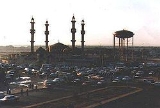
Kirkuk

Encyclopedia
Kirkuk is a city in Iraq
and the capital of Kirkuk Governorate.
It is located in the Iraqi governorate
of Kirkuk, 236 kilometres (146.6 mi) north of the capital, Baghdad
. Kirkuk city lies 83 km south of Arbil
, 149 km southeast of Mosul
, 97 km west of Sulaymaniyah
, and 116 km northeast Tikrit
It stands on the site of the ancient Assyria
n capital of Arrapha
,
which sits near the Khasa River
on the ruins of a 5,000-year-old settlement (Kirkuk Citadel
). Arrapha reached great importance under the Assyrians in the 10th and 11th centuries BC. Because of the strategic geographical location of the city, Kirkuk was the battle ground for three empires—the Neo Assyrian Empire, Babylonia
, and Media
—which controlled the city at various times.
Kirkuk lies in a wide zone with an ethnically mixed population, which has moreover experienced dramatic demographic changes in the course of the twentieth century. Kurds, Turkmen and Arabs lay conflicting claims to this zone, and all have their historical accounts and memories to buttress their claims.
Historically, the city has always been considered by Kurds and Turkmens as a cultural capital. It was named the "capital of Iraqi culture" by the ministry of culture in 2010.
The city currently consists of Kurds
, Arabs, Iraqi Turkmens and some Assyrians
. Since the fall of Saddam Hussein in 2003, the Kurdish population in the city is estimated to have increased from 150,000 to 350,000.
era, a Korkura is mentioned by Ptolemy
, which is believed to refer either to Kirkuk or to the site of Baba Gurgur
three miles (5 km) from the city. Under Greek reign it was known as Karkha D-Bet Slokh, which means 'Citadel of the House of Seleucid' in Mesopotamian Aramaic, the lingua franca
of the Fertile Crescent
in that era.
The region around Kirkuk was known in Aramaic and Syriac sources as "Beth Garmai" , which means the "place of bones" in a reference to bones of slaughtered Achaemenids which littered the plains after a decisive battle between Alexander the Great and Darius III.
It is also thought that region was known during the Parthian
and Sassanid
periods as Garmakan, which means the 'Land of Warmth' or the 'Hot Land' in Persian
. In the modern Persian and Kurdish languages too "Garm" means warmth; the name is still used by the Kurds in the form Garmian
with the same meaning.
And from the 7th century, when Muslim Arabs conquered the area, up to the medieval era, Arab writers simply used the name Kirkheni (Syriac for "citadel") to refer to the city. Some Arabs used the names Bajermi or Jermakan (both Semitic variations of Aryan 'Garmakan').
A cuneiform script
found in 1927 at the foot of Kirkuk Citadel
stated that the city of Erekha of Babylonia was on the site of Kirkuk. Other sources consider Erekha to have been simply one part of the larger Arrapha metropolis.
dwellers who were known as Gutian people by lowland-dwellers of Southern Mesopotamia. Under its ancient name Arraphkha, Kirkuk was capital of Kingdom of Gutium
which is mentioned in cuneiform records about 2400 BC.
The small Hurrian kingdom of Arraphka, of which modern Kirkuk was the capital, was situated along the southeastern edge of the area under Aryan Mittanian domination. From 1500 to 1360 BC all kings of Assyria were vassals of kingdom of Mittani. Assyria's revolt against the Hurrian kingdom of Mittani probably led to fall of the kingdom in the 14th BC century and ultimately contributed to Mittani empires’s collapse.
The city reached great prominence in the 10th and 11th centuries BC under Assyria
n rule. However in 6th BC, Assyria was conquered by a union of Medes
, remaining Hurrian-related tribes, and Babylonians. After Achaemenids had the region under their dominion; in the Parthia
n and Sassanid eras Kirkuk was capital of a local kingdom called Garmakan (Persian: گرمیان Garmian
).
invaded the Sassanid empire in the 7th century AD. Up to the end of the 14th century AD, Kirkuk often administratively and economically belonged to Daquq
and they were both at the same time in contact with Arbil
, the modern capital of Iraqi Kurdistan
, and Sharazor
and their extensions. In the medieval era the city was part - and since the 16th century the capital - of the ancient wilayet of Sharazor
which is still important to Kurdistan's economy.
i and the Hadidi
. The Tikriti family was the main Arab
family in Kirkuk coming from Tikrit
in 17th century. Other Arab
tribes who settled in Kirkuk during the Ottoman
Period are the Al-Ubaid and the Al-Jiburi . The Al-Ubaid came from just northwest of Mosul when they were forced out of the area by other Arab tribes of that region. They settled in the Hawija district in Kirkuk in 1935 during the government of Yasin al-Hashimi
.
have a long history in Kirkuk before the Baban
family. The Baban
family was a Kurdish family that, in the 18th and 19th centuries, dominated the political life of the province of Sharazor
, in present-day Iraqi Kurdistan. The first member of the clan to gain control of the province and its capital, Kirkuk, was Sulayman Beg. Enjoying almost full autonomy, the Baban family established Kirkuk as their capital. This persisted even after the Babans moved their administration to the new town of Sulaymaniya, named after the dynasty’s founder, in the late 18th century.
during the Umayyads and Abbasid
eras as military recruits. Considerable Turkmen settlement began during the Seljuq
era when Toghrul entered Iraq in 1055 with his army composed mostly of Oghuz Turks
. Kirkuk remained under the control of the Seljuq
Empire for 63 years. The Turkmen
settlement in Kirkuk was further expanded later during the Ottoman Era, when people were brought to the city from Turkey. Tuzhurmati has been one of the historical Turkmen settlement in Iraq.
During the Ottoman period the Turkmen were the predominant population of Kirkuk city but Kurds constituted the majority of the rural population of Kirkuk.
, the British occupied Kirkuk on May 7, 1918. Abandoning the city after about two weeks, the British returned to Kirkuk a few months later after the Armistice of Mudros
. Kirkuk avoided the troubles caused by the British-backed Shaykh Mahmud, who quickly attempted to defy the British and establish his own fiefdom in Sulaymaniyah
. The townspeople and tribesmen of Kirkuk, notably the Talabani shaykhs, demanded to be excluded from Shaykh Mahmud's area of authority before he was put in place.
and Great Britain
desperately wanted control of the wilayet of Mosul (of which Kirkuk was a part), the Treaty of Lausanne
in 1923 failed to solve the issue. For this reason, the question of Mosul was sent to the League of Nations
. A committee traveled to the area before coming to a final decision: the territory south of the "Brussels line" belonged to Iraq. Kirkuk then became a part of the Kingdom of Iraq
.
("St. Blaze" or father blaze in Turkmen and Kurdish) near Kirkuk. The Kirkuk oil field was brought into use by the Iraq Petroleum Company
(IPC) in 1934. The field has remained the basis of northern Iraqi oil production with over ten billion barrels (1.6 km³) of proven remaining oil reserves as of 1998. After about seven decades of operation, Kirkuk still produces up to one million
barrels a day, almost half of all Iraqi oil exports.
The exploitation of Kirkuk’s oil, which began around 1930, attracted both Arabs and Kurds to the city in search of work. Kirkuk, which had been a predominantly Turkmen city, gradually lost its uniquely Turkmen character. At the same time, large numbers of Kurds from the mountains were settling in the uninhabited but cultivable rural parts of the district of Kirkuk. The influx of Kurds into Kirkuk continued through the 1960s.
According to the 1957 census, Kirkuk was 40% Iraqi Turkmen
, 35% Kurdish
with Arabs less than 25% of its population.
Some analysts believe that poor reservoir
-management practices during the Saddam Hussein
years may have seriously, and even permanently, damaged Kirkuk's oil field. One example showed an estimated 1500000000 barrels (238,480,942,500 l) of excess fuel oil being reinjected. Other problems include refinery residue and gas-stripped oil
. Fuel oil reinjection has increased oil viscosity
at Kirkuk making it more difficult and expensive to get the oil out of the ground.
Overall, between April 2003 and late December 2004 there were an estimated 123 attacks on Iraqi energy infrastructures, including the country's 7,000 km-long pipeline
system. In response to these attacks, which cost Iraq
billions of US dollars in lost oil-export revenues and repair costs, the US
military set up the Task Force Shield
to guard Iraq's energy infrastructure and the Kirkuk-Ceyhan Oil Pipeline
in particular. In spite of the fact that little damage was done to Iraq's oil fields during the war itself, looting
and sabotage
after the war ended was highly destructive and accounted for perhaps eighty percent of the total damage.
The discovery of vast quantities of oil in the region after World War I
provided the impetus for the annexation of the former Ottoman
Wilayah
of Mosul
(of which the Kirkuk region was a part), to the Iraqi Kingdom, established in 1921. Since then and particularly from 1963 onwards, there have been continuous attempts to transform the ethnic make-up of the region.
Pipelines from Kirkuk run through Turkey
to Ceyhan
on the Mediterranean Sea
and were one of the two main routes for the export of Iraqi oil under the Oil-for-Food Programme
following the Gulf War
of 1991. This was in accordance with a United Nations
mandate that at least 50% of the oil exports pass through Turkey. There were two parallel lines built in 1977 and 1987.
teaching in schools. However, it reserved judgment on the territorial extent of Kurdistan, pending a new census
. Such a census, according to Kurds would surely have shown a solid Kurdish majority in the city of Kirkuk and the surrounding oilfields, as well as in the secondary oil-bearing Kurdish area of Khanaqin
, south of the Kurdish city of Sulaymaniyah
(Kurdish: Sîlemanî). A census was not scheduled until 1977, by which time the autonomy deal was dead. In June 1973, with Ba'ath-Kurdish relations already souring, the guerrilla leader Mullah Mustafa Barzani
laid formal claim to the Kirkuk oilfields.
Baghdad
interpreted this as a virtual declaration of war, and, in March 1974, unilaterally decreed an autonomy statute. The new statute was a far cry from the 1970 Manifesto, and its definition of the Kurdish autonomous area explicitly excluded the oil-rich areas of Kirkuk, Khanaqin and Shingal/Sinjar
. In tandem with the 1970–1974 autonomy process, the Iraqi regime carried out a comprehensive administrative reform, in which the country's sixteen provinces, or governorates, were renamed and in some cases had their boundaries altered. The old province of Kirkuk was split in half. The area around the city itself was named At-Ta'mim ("nationalization"), and its boundaries were redrawn to give an Arab
majority.
According to Human Rights Watch
, from the 1991 Gulf War
until 2003, the former Iraqi government systematically expelled an estimated 500.000, Kurds and some Assyrians
from Kirkuk and other towns and villages in this oil-rich region. Most have settled in the Kurdish-controlled northern provinces. Meanwhile, the Iraqi government resettled Arab families in their place in an attempt to reduce the political power and presence of ethnic minorities, a process known as Arabization
.
The "Arabization" of Kirkuk and other oil-rich regions is not a recent phenomenon. Successive governments have sought at various times to reduce the ethnic minority populations residing there since the discovery of significant oil deposits in the 1920s. By the mid-1970s, the Ba'ath Party government that seized power in 1968 embarked on a concerted campaign to alter the demographic makeup of multi-ethnic Kirkuk. The campaign involved the massive relocation of tens of thousands of ethnic minority families from Kirkuk, Sinjar, Khanaqin, and other areas, transferring them to purpose-built resettlement camps. This policy was intensified after the failed Kurdish
uprising in March 1991. Those expelled included individuals who had refused to sign so-called "nationality correction" forms, introduced by the authorities prior to the 1997 population census, requiring members of ethnic groups residing in these districts to relinquish their Kurdish
or Assyrians identities and to register officially as Arabs. The Iraqi authorities also seized their property and assets; those who were expelled to areas controlled by Kurdish forces were stripped of all possessions and their ration cards were withdrawn.
and British
military forces led an invasion of Iraq
in March 2003, driving Saddam Hussein
and his Ba'ath Party from power. A caretaker government was created until the establishment of a democratically-elected government.
Since April 2003, thousands of internally displaced Kurd
s have returned to Kirkuk and other Arabized regions to reclaim their homes and lands which have since been occupied by Arabs from central and southern Iraq.
Under the supervision of chief executive of Coalition Provisional Authority
L. Paul Bremer
, a convention was held on May 24, 2003 to select the first City Council in the history of this oil-rich, ethnically divided city. Each of the city's four major ethnic groups was invited to send a 39-member delegation
from which they would be allowed to select six to sit on the City Council. Another six council members were selected from among 144 delegates to represent independents social groups such as teachers, lawyers, religious leaders and artists.
Kirkuk's 30 members council is made up of five blocs of six members each. Four of those blocs are formed along ethnic lines- Kurd
s, Arab
s, Assyria
n and Turkmen
- and the fifth is made up of independents
. Turkmen and Arabs complained, however, that Kurd
s hold five of the seats in the independent block. They are also frustrated that their only representative at the council's helm was an assistant mayor whom they considered pro-Kurdish. Abdul Rahman Mustafa
, a Baghdad
-educated lawyer was elected mayor by 20 votes
to 10. The appointment of an Arab, Ismail Ahmed Rajab Al Hadidi
, as deputy mayor went some way towards addressing Arab concerns.
On June 30, 2005, through a secret direct voting process, with the participation of the widest communities in the province and despite all the political legal security complexities of this process in the country generally and in Kirkuk in particular, Kirkuk witnessed the birth of its first elected Provincial Council. The Independent Electoral Commission of Iraq IECI approved and announced the outcomes of this process, which filled the 41 seats of Kirkuk Provincial Council
as follows:
The new Kirkuk Provincial Council
started its second turn on March 6, 2005. Its inaugural session was dedicated to the introduction of its new members, followed by an oath ceremony supervised by Judge Thahir Hamza Salman, the Head of Kirkuk Appellate Court.
, Prime Minister for the Patriotic Union of Kurdistan
and the Kurdistan Regional Government
said that Kirkuk was originally a Kurdish city; it belonged to Kurds rather than to the Iraqi government, and only its oil made it a source of tension and that's why "We have a claim to Kirkuk rooted in history, geography and demographics. This is a recipe for civil war
if you don't [address its governance] right".
According to the Kurds, the conquerors of Kurdistan have tried to destroy the numerous Kurdish emirates one after the other. Apart from their historical claim for Kirkuk, the Kurds invoke Article 58 of the Administration for the state of Iraq for the transitional period, also known as Administrative Law of March 8, 2004 which is considered the interim constitution of Iraq by the now-dissolved Iraqi Governing Council
. Article 58 states in part: The Iraqi Transitional Government
shall act expeditious measures to remedy the injustice caused by the previous regime's practice in the demographic character of certain regions, including Kirkuk, by deporting and expelling them from their place of residence and forcing migration in and out of the region.
A referendum on whether Kirkuk province should become part of Iraqi Kurdistan
was due to be held in November 2007 but has been delayed repeatedly, and currently has no firm date. In December 2007, US Secretary of State Condoleezza Rice
made an unscheduled visit to Kirkuk before proceeding to Baghdad
, where she called on Iraqi leaders to urgently implement a national reconciliation roadmap.
The archaeological sites of Qal'at Jarmo
and Yorgan Tepe are found at the outskirts of the modern city. In 1997, there were reports that the government of Saddam Hussein
"demolished Kirkuk's historic citadel with its mosques and ancient church".
The architectural heritage of Kirkuk sustained serious damage during World War I
(when some pre-Muslim Assyrian Christian monuments were destroyed) and, more recently, during the Iraq War. Simon Jenkins
reported in June 2007 that "eighteen ancient shrines have been lost, ten in Kirkuk and the south in the past month alone".
BSh) with extremely hot and dry summers and cool, rainy winters.
Iraq
Iraq ; officially the Republic of Iraq is a country in Western Asia spanning most of the northwestern end of the Zagros mountain range, the eastern part of the Syrian Desert and the northern part of the Arabian Desert....
and the capital of Kirkuk Governorate.
It is located in the Iraqi governorate
Governorates of Iraq
||Iraq is composed of 18 provinces :#Baghdād #Salāh ad-Dīn #Diyālā #Wāsit #Maysān #Al-Basrah #Dhī Qār #Al-Muthannā #Al-Qādisiyyah...
of Kirkuk, 236 kilometres (146.6 mi) north of the capital, Baghdad
Baghdad
Baghdad is the capital of Iraq, as well as the coterminous Baghdad Governorate. The population of Baghdad in 2011 is approximately 7,216,040...
. Kirkuk city lies 83 km south of Arbil
Arbil
Arbil / Hewlêr is the fourth largest city in Iraq after Baghdad, Basra and Mosul...
, 149 km southeast of Mosul
Mosul
Mosul , is a city in northern Iraq and the capital of the Ninawa Governorate, some northwest of Baghdad. The original city stands on the west bank of the Tigris River, opposite the ancient Assyrian city of Nineveh on the east bank, but the metropolitan area has now grown to encompass substantial...
, 97 km west of Sulaymaniyah
Sulaymaniyah
Sulaymaniyah is a city in Iraqi Kurdistan, Iraq. It is the capital of Sulaymaniyah Governorate. Sulaymaniyah is surrounded by the Azmar Range, Goizja Range and the Qaiwan Range in the north east, Baranan Mountain in the south and the Tasluje Hills in the west. The city has a semi-arid climate with...
, and 116 km northeast Tikrit
Tikrit
Tikrit is a town in Iraq, located 140 km northwest of Baghdad on the Tigris river . The town, with an estimated population in 2002 of about 260,000 is the administrative center of the Salah ad Din Governorate.-Ancient times:...
It stands on the site of the ancient Assyria
Assyria
Assyria was a Semitic Akkadian kingdom, extant as a nation state from the mid–23rd century BC to 608 BC centred on the Upper Tigris river, in northern Mesopotamia , that came to rule regional empires a number of times through history. It was named for its original capital, the ancient city of Assur...
n capital of Arrapha
Arrapha
Arrapha was an ancient Assyrian city that existed in what is today the city of Kirkuk, Iraq. The city was founded around 2000 BC and derived its name from the old Assyrian word Arabkha which was later changed to Arrapha...
,
which sits near the Khasa River
Khasa River
The Khasa River is a winterbourne river which runs through the city of Kirkuk in northern Iraq. It dries up completely in the summer but turns into a raging river in the winter, flooding its banks at times as happened in the 1950s. The river has symbolic value to the city's inhabitants. It is one...
on the ruins of a 5,000-year-old settlement (Kirkuk Citadel
Kirkuk Citadel
The Kirkuk Citadel is located in the centre of the city of Kirkuk in Iraq, and is considered to be the oldest part of the city. The citadel stands on an artificial mound 130 feet high located on a plateau across the Khasa River...
). Arrapha reached great importance under the Assyrians in the 10th and 11th centuries BC. Because of the strategic geographical location of the city, Kirkuk was the battle ground for three empires—the Neo Assyrian Empire, Babylonia
Babylonia
Babylonia was an ancient cultural region in central-southern Mesopotamia , with Babylon as its capital. Babylonia emerged as a major power when Hammurabi Babylonia was an ancient cultural region in central-southern Mesopotamia (present-day Iraq), with Babylon as its capital. Babylonia emerged as...
, and Media
Medes
The MedesThe Medes...
—which controlled the city at various times.
Kirkuk lies in a wide zone with an ethnically mixed population, which has moreover experienced dramatic demographic changes in the course of the twentieth century. Kurds, Turkmen and Arabs lay conflicting claims to this zone, and all have their historical accounts and memories to buttress their claims.
Historically, the city has always been considered by Kurds and Turkmens as a cultural capital. It was named the "capital of Iraqi culture" by the ministry of culture in 2010.
The city currently consists of Kurds
Kurdish people
The Kurdish people, or Kurds , are an Iranian people native to the Middle East, mostly inhabiting a region known as Kurdistan, which includes adjacent parts of Iran, Iraq, Syria, and Turkey...
, Arabs, Iraqi Turkmens and some Assyrians
Assyrian people
The Assyrian people are a distinct ethnic group whose origins lie in ancient Mesopotamia...
. Since the fall of Saddam Hussein in 2003, the Kurdish population in the city is estimated to have increased from 150,000 to 350,000.
Etymology
The ancient name of Kirkuk was the Assyrian Arraphka. During the ParthianParthian Empire
The Parthian Empire , also known as the Arsacid Empire , was a major Iranian political and cultural power in ancient Persia...
era, a Korkura is mentioned by Ptolemy
Ptolemy
Claudius Ptolemy , was a Roman citizen of Egypt who wrote in Greek. He was a mathematician, astronomer, geographer, astrologer, and poet of a single epigram in the Greek Anthology. He lived in Egypt under Roman rule, and is believed to have been born in the town of Ptolemais Hermiou in the...
, which is believed to refer either to Kirkuk or to the site of Baba Gurgur
Baba Gurgur
Baba Gurgur is a large oil field near the city of Kirkuk which was the first to be discovered in Northern Iraq in 1927....
three miles (5 km) from the city. Under Greek reign it was known as Karkha D-Bet Slokh, which means 'Citadel of the House of Seleucid' in Mesopotamian Aramaic, the lingua franca
Lingua franca
A lingua franca is a language systematically used to make communication possible between people not sharing a mother tongue, in particular when it is a third language, distinct from both mother tongues.-Characteristics:"Lingua franca" is a functionally defined term, independent of the linguistic...
of the Fertile Crescent
Fertile Crescent
The Fertile Crescent, nicknamed "The Cradle of Civilization" for the fact the first civilizations started there, is a crescent-shaped region containing the comparatively moist and fertile land of otherwise arid and semi-arid Western Asia. The term was first used by University of Chicago...
in that era.
The region around Kirkuk was known in Aramaic and Syriac sources as "Beth Garmai" , which means the "place of bones" in a reference to bones of slaughtered Achaemenids which littered the plains after a decisive battle between Alexander the Great and Darius III.
It is also thought that region was known during the Parthian
Parthian Empire
The Parthian Empire , also known as the Arsacid Empire , was a major Iranian political and cultural power in ancient Persia...
and Sassanid
Sassanid Empire
The Sassanid Empire , known to its inhabitants as Ērānshahr and Ērān in Middle Persian and resulting in the New Persian terms Iranshahr and Iran , was the last pre-Islamic Persian Empire, ruled by the Sasanian Dynasty from 224 to 651...
periods as Garmakan, which means the 'Land of Warmth' or the 'Hot Land' in Persian
Persian language
Persian is an Iranian language within the Indo-Iranian branch of the Indo-European languages. It is primarily spoken in Iran, Afghanistan, Tajikistan and countries which historically came under Persian influence...
. In the modern Persian and Kurdish languages too "Garm" means warmth; the name is still used by the Kurds in the form Garmian
Garmian
Garmian, is a historical region around the city of Kirkuk in northern Iraq. It is located at southeast of the Little Zab, southwest of the mountains of Shahrazor, northeast of the Tigris and the Jabal Hamrin, although sometimes including parts of southwest of the Jabal Hamrin, and northwest of...
with the same meaning.
And from the 7th century, when Muslim Arabs conquered the area, up to the medieval era, Arab writers simply used the name Kirkheni (Syriac for "citadel") to refer to the city. Some Arabs used the names Bajermi or Jermakan (both Semitic variations of Aryan 'Garmakan').
A cuneiform script
Cuneiform script
Cuneiform script )) is one of the earliest known forms of written expression. Emerging in Sumer around the 30th century BC, with predecessors reaching into the late 4th millennium , cuneiform writing began as a system of pictographs...
found in 1927 at the foot of Kirkuk Citadel
Kirkuk Citadel
The Kirkuk Citadel is located in the centre of the city of Kirkuk in Iraq, and is considered to be the oldest part of the city. The citadel stands on an artificial mound 130 feet high located on a plateau across the Khasa River...
stated that the city of Erekha of Babylonia was on the site of Kirkuk. Other sources consider Erekha to have been simply one part of the larger Arrapha metropolis.
History
Originally the city was founded by Hurrian-related Zagros-TaurusTaurus Mountains
Taurus Mountains are a mountain complex in southern Turkey, dividing the Mediterranean coastal region of southern Turkey from the central Anatolian Plateau. The system extends along a curve from Lake Eğirdir in the west to the upper reaches of the Euphrates and Tigris rivers in the east...
dwellers who were known as Gutian people by lowland-dwellers of Southern Mesopotamia. Under its ancient name Arraphkha, Kirkuk was capital of Kingdom of Gutium
Gutium
The Gutians were a tribe that overran southern Mesopotamia when the Akkadian empire collapsed in approximately 2154 BC....
which is mentioned in cuneiform records about 2400 BC.
The small Hurrian kingdom of Arraphka, of which modern Kirkuk was the capital, was situated along the southeastern edge of the area under Aryan Mittanian domination. From 1500 to 1360 BC all kings of Assyria were vassals of kingdom of Mittani. Assyria's revolt against the Hurrian kingdom of Mittani probably led to fall of the kingdom in the 14th BC century and ultimately contributed to Mittani empires’s collapse.
The city reached great prominence in the 10th and 11th centuries BC under Assyria
Assyria
Assyria was a Semitic Akkadian kingdom, extant as a nation state from the mid–23rd century BC to 608 BC centred on the Upper Tigris river, in northern Mesopotamia , that came to rule regional empires a number of times through history. It was named for its original capital, the ancient city of Assur...
n rule. However in 6th BC, Assyria was conquered by a union of Medes
Medes
The MedesThe Medes...
, remaining Hurrian-related tribes, and Babylonians. After Achaemenids had the region under their dominion; in the Parthia
Parthia
Parthia is a region of north-eastern Iran, best known for having been the political and cultural base of the Arsacid dynasty, rulers of the Parthian Empire....
n and Sassanid eras Kirkuk was capital of a local kingdom called Garmakan (Persian: گرمیان Garmian
Garmian
Garmian, is a historical region around the city of Kirkuk in northern Iraq. It is located at southeast of the Little Zab, southwest of the mountains of Shahrazor, northeast of the Tigris and the Jabal Hamrin, although sometimes including parts of southwest of the Jabal Hamrin, and northwest of...
).
After the Islamic conquest
Arab MuslimsArab Muslims
Arab Muslims are adherents of the religion of Islam who identify linguistically, culturally, or genealogically as Arabs. They greatly outnumber other ethnic groups in the Middle East. Muslims who are not Arabs are called mawali by Arab Muslims....
invaded the Sassanid empire in the 7th century AD. Up to the end of the 14th century AD, Kirkuk often administratively and economically belonged to Daquq
Daquq
Daquq or Daquqa, Dakuk, Daqooq, Tavuk or Tawuq is a historic town in Iraq south of Kirkuk. It is the capital of Daquq District, one of the four Districts of Kirkuk Governorate...
and they were both at the same time in contact with Arbil
Arbil
Arbil / Hewlêr is the fourth largest city in Iraq after Baghdad, Basra and Mosul...
, the modern capital of Iraqi Kurdistan
Iraqi Kurdistan
Iraqi Kurdistan or Kurdistan Region is an autonomous region of Iraq. It borders Iran to the east, Turkey to the north, Syria to the west and the rest of Iraq to the south. The regional capital is Arbil, known in Kurdish as Hewlêr...
, and Sharazor
Sharazor
Sharazor was the name of a Sassanid district , Kurdish kingdom, Ottoman vilayet and finally a Sanjak of Mosul vilayet situated to the southern and eastern part of what is now known as Iraqi Kurdistan....
and their extensions. In the medieval era the city was part - and since the 16th century the capital - of the ancient wilayet of Sharazor
Sharazor
Sharazor was the name of a Sassanid district , Kurdish kingdom, Ottoman vilayet and finally a Sanjak of Mosul vilayet situated to the southern and eastern part of what is now known as Iraqi Kurdistan....
which is still important to Kurdistan's economy.
Arab immigration
The principal Arab extended families in the city of Kirkuk were: the TikritTikrit
Tikrit is a town in Iraq, located 140 km northwest of Baghdad on the Tigris river . The town, with an estimated population in 2002 of about 260,000 is the administrative center of the Salah ad Din Governorate.-Ancient times:...
i and the Hadidi
Hadidi
One of the families of Jordan. The tribe is situated in As-Salt, the first capital of Jordan, which is located in the middle of the Hashemite kingdom of Jordan. Most of the members of this family are highly educated people and occupying very good positions in Jordan.There are also parts of the...
. The Tikriti family was the main Arab
Arab
Arab people, also known as Arabs , are a panethnicity primarily living in the Arab world, which is located in Western Asia and North Africa. They are identified as such on one or more of genealogical, linguistic, or cultural grounds, with tribal affiliations, and intra-tribal relationships playing...
family in Kirkuk coming from Tikrit
Tikrit
Tikrit is a town in Iraq, located 140 km northwest of Baghdad on the Tigris river . The town, with an estimated population in 2002 of about 260,000 is the administrative center of the Salah ad Din Governorate.-Ancient times:...
in 17th century. Other Arab
Arab
Arab people, also known as Arabs , are a panethnicity primarily living in the Arab world, which is located in Western Asia and North Africa. They are identified as such on one or more of genealogical, linguistic, or cultural grounds, with tribal affiliations, and intra-tribal relationships playing...
tribes who settled in Kirkuk during the Ottoman
Ottoman Empire
The Ottoman EmpireIt was usually referred to as the "Ottoman Empire", the "Turkish Empire", the "Ottoman Caliphate" or more commonly "Turkey" by its contemporaries...
Period are the Al-Ubaid and the Al-Jiburi . The Al-Ubaid came from just northwest of Mosul when they were forced out of the area by other Arab tribes of that region. They settled in the Hawija district in Kirkuk in 1935 during the government of Yasin al-Hashimi
Yasin al-Hashimi
Yasin al-Hashimi was an Iraqi politician who served twice as that country's prime minister. Like many of Iraq's early leaders, Hashimi, who was born Yasin Hilmi Salman, served as an officer during Ottoman control of the country...
.
Kurdish presence
KurdsKurdish people
The Kurdish people, or Kurds , are an Iranian people native to the Middle East, mostly inhabiting a region known as Kurdistan, which includes adjacent parts of Iran, Iraq, Syria, and Turkey...
have a long history in Kirkuk before the Baban
Baban
Baban were a Kurdish principality and ruling family originating from Darishmana in the region of Pijder. The founder of the dynasty and its first ruler was Fakih Ahmed a descendent of the ancient house of Soran. He also had a brother named Khidder Ahmed who lived with him...
family. The Baban
Baban
Baban were a Kurdish principality and ruling family originating from Darishmana in the region of Pijder. The founder of the dynasty and its first ruler was Fakih Ahmed a descendent of the ancient house of Soran. He also had a brother named Khidder Ahmed who lived with him...
family was a Kurdish family that, in the 18th and 19th centuries, dominated the political life of the province of Sharazor
Sharazor
Sharazor was the name of a Sassanid district , Kurdish kingdom, Ottoman vilayet and finally a Sanjak of Mosul vilayet situated to the southern and eastern part of what is now known as Iraqi Kurdistan....
, in present-day Iraqi Kurdistan. The first member of the clan to gain control of the province and its capital, Kirkuk, was Sulayman Beg. Enjoying almost full autonomy, the Baban family established Kirkuk as their capital. This persisted even after the Babans moved their administration to the new town of Sulaymaniya, named after the dynasty’s founder, in the late 18th century.
Turkmen immigration
Turkmens migrated to IraqIraq
Iraq ; officially the Republic of Iraq is a country in Western Asia spanning most of the northwestern end of the Zagros mountain range, the eastern part of the Syrian Desert and the northern part of the Arabian Desert....
during the Umayyads and Abbasid
Abbasid
The Abbasid Caliphate or, more simply, the Abbasids , was the third of the Islamic caliphates. It was ruled by the Abbasid dynasty of caliphs, who built their capital in Baghdad after overthrowing the Umayyad caliphate from all but the al-Andalus region....
eras as military recruits. Considerable Turkmen settlement began during the Seljuq
Great Seljuq Empire
The Great Seljuq Empire was a medieval Persianate, Turko-Persian Sunni Muslim empire, originating from the Qynyq branch of Oghuz Turks. The Seljuq Empire controlled a vast area stretching from the Hindu Kush to eastern Anatolia and from Central Asia to the Persian Gulf...
era when Toghrul entered Iraq in 1055 with his army composed mostly of Oghuz Turks
Oghuz Turks
The Turkomen also known as Oghuz Turks were a historical Turkic tribal confederation in Central Asia during the early medieval Turkic expansion....
. Kirkuk remained under the control of the Seljuq
Great Seljuq Empire
The Great Seljuq Empire was a medieval Persianate, Turko-Persian Sunni Muslim empire, originating from the Qynyq branch of Oghuz Turks. The Seljuq Empire controlled a vast area stretching from the Hindu Kush to eastern Anatolia and from Central Asia to the Persian Gulf...
Empire for 63 years. The Turkmen
Turkmen people
The Turkmen are a Turkic people located primarily in the Central Asian states of Turkmenistan, Afghanistan, and northeastern Iran. They speak the Turkmen language, which is classified as a part of the Western Oghuz branch of the Turkic languages family together with Turkish, Azerbaijani, Qashqai,...
settlement in Kirkuk was further expanded later during the Ottoman Era, when people were brought to the city from Turkey. Tuzhurmati has been one of the historical Turkmen settlement in Iraq.
During the Ottoman period the Turkmen were the predominant population of Kirkuk city but Kurds constituted the majority of the rural population of Kirkuk.
British occupation
At the end of World War IWorld War I
World War I , which was predominantly called the World War or the Great War from its occurrence until 1939, and the First World War or World War I thereafter, was a major war centred in Europe that began on 28 July 1914 and lasted until 11 November 1918...
, the British occupied Kirkuk on May 7, 1918. Abandoning the city after about two weeks, the British returned to Kirkuk a few months later after the Armistice of Mudros
Armistice of Mudros
The Armistice of Moudros , concluded on 30 October 1918, ended the hostilities in the Middle Eastern theatre between the Ottoman Empire and the Allies of World War I...
. Kirkuk avoided the troubles caused by the British-backed Shaykh Mahmud, who quickly attempted to defy the British and establish his own fiefdom in Sulaymaniyah
Sulaymaniyah
Sulaymaniyah is a city in Iraqi Kurdistan, Iraq. It is the capital of Sulaymaniyah Governorate. Sulaymaniyah is surrounded by the Azmar Range, Goizja Range and the Qaiwan Range in the north east, Baranan Mountain in the south and the Tasluje Hills in the west. The city has a semi-arid climate with...
. The townspeople and tribesmen of Kirkuk, notably the Talabani shaykhs, demanded to be excluded from Shaykh Mahmud's area of authority before he was put in place.
Entry Into the Kingdom of Iraq
As both TurkeyTurkey
Turkey , known officially as the Republic of Turkey , is a Eurasian country located in Western Asia and in East Thrace in Southeastern Europe...
and Great Britain
Great Britain
Great Britain or Britain is an island situated to the northwest of Continental Europe. It is the ninth largest island in the world, and the largest European island, as well as the largest of the British Isles...
desperately wanted control of the wilayet of Mosul (of which Kirkuk was a part), the Treaty of Lausanne
Treaty of Lausanne
The Treaty of Lausanne was a peace treaty signed in Lausanne, Switzerland on 24 July 1923, that settled the Anatolian and East Thracian parts of the partitioning of the Ottoman Empire. The treaty of Lausanne was ratified by the Greek government on 11 February 1924, by the Turkish government on 31...
in 1923 failed to solve the issue. For this reason, the question of Mosul was sent to the League of Nations
League of Nations
The League of Nations was an intergovernmental organization founded as a result of the Paris Peace Conference that ended the First World War. It was the first permanent international organization whose principal mission was to maintain world peace...
. A committee traveled to the area before coming to a final decision: the territory south of the "Brussels line" belonged to Iraq. Kirkuk then became a part of the Kingdom of Iraq
Kingdom of Iraq
The Kingdom of Iraq was the sovereign state of Iraq during and after the British Mandate of Mesopotamia. The League of Nations mandate started in 1920. The kingdom began in August 1921 with the coronation of Faisal bin al-Hussein bin Ali al-Hashemi as King Faisal I...
.
Discovery of oil
In 1927 a huge oil gusher was discovered at Baba GurgurBaba Gurgur
Baba Gurgur is a large oil field near the city of Kirkuk which was the first to be discovered in Northern Iraq in 1927....
("St. Blaze" or father blaze in Turkmen and Kurdish) near Kirkuk. The Kirkuk oil field was brought into use by the Iraq Petroleum Company
Iraq Petroleum Company
The Iraq Petroleum Company , until 1929 called Turkish Petroleum Company , was an oil company jointly owned by some of the world's largest oil companies, which had virtual monopoly on all oil exploration and production in Iraq from 1925 to 1961...
(IPC) in 1934. The field has remained the basis of northern Iraqi oil production with over ten billion barrels (1.6 km³) of proven remaining oil reserves as of 1998. After about seven decades of operation, Kirkuk still produces up to one million
Million
One million or one thousand thousand, is the natural number following 999,999 and preceding 1,000,001. The word is derived from the early Italian millione , from mille, "thousand", plus the augmentative suffix -one.In scientific notation, it is written as or just 106...
barrels a day, almost half of all Iraqi oil exports.
The exploitation of Kirkuk’s oil, which began around 1930, attracted both Arabs and Kurds to the city in search of work. Kirkuk, which had been a predominantly Turkmen city, gradually lost its uniquely Turkmen character. At the same time, large numbers of Kurds from the mountains were settling in the uninhabited but cultivable rural parts of the district of Kirkuk. The influx of Kurds into Kirkuk continued through the 1960s.
According to the 1957 census, Kirkuk was 40% Iraqi Turkmen
Iraqi Turkmen
The Iraqi Turkmen are an ethnic group who mainly reside in northern Iraq. Estimates of their numbers vary dramatically, in accordance with Iraq's assimilation policies no realistic and independent census results have been revealed regarding the Iraqi Turkmen population...
, 35% Kurdish
Kurdish people
The Kurdish people, or Kurds , are an Iranian people native to the Middle East, mostly inhabiting a region known as Kurdistan, which includes adjacent parts of Iran, Iraq, Syria, and Turkey...
with Arabs less than 25% of its population.
Some analysts believe that poor reservoir
Oil reservoir
A petroleum reservoir, or oil and gas reservoir, is a subsurface pool of hydrocarbons contained in porous or fractured rock formations. The naturally occurring hydrocarbons, such as crude oil or natural gas, are trapped by overlying rock formations with lower permeability...
-management practices during the Saddam Hussein
Saddam Hussein
Saddam Hussein Abd al-Majid al-Tikriti was the fifth President of Iraq, serving in this capacity from 16 July 1979 until 9 April 2003...
years may have seriously, and even permanently, damaged Kirkuk's oil field. One example showed an estimated 1500000000 barrels (238,480,942,500 l) of excess fuel oil being reinjected. Other problems include refinery residue and gas-stripped oil
Petroleum
Petroleum or crude oil is a naturally occurring, flammable liquid consisting of a complex mixture of hydrocarbons of various molecular weights and other liquid organic compounds, that are found in geologic formations beneath the Earth's surface. Petroleum is recovered mostly through oil drilling...
. Fuel oil reinjection has increased oil viscosity
Viscosity
Viscosity is a measure of the resistance of a fluid which is being deformed by either shear or tensile stress. In everyday terms , viscosity is "thickness" or "internal friction". Thus, water is "thin", having a lower viscosity, while honey is "thick", having a higher viscosity...
at Kirkuk making it more difficult and expensive to get the oil out of the ground.
Overall, between April 2003 and late December 2004 there were an estimated 123 attacks on Iraqi energy infrastructures, including the country's 7,000 km-long pipeline
Pipeline transport
Pipeline transport is the transportation of goods through a pipe. Most commonly, liquids and gases are sent, but pneumatic tubes that transport solid capsules using compressed air are also used....
system. In response to these attacks, which cost Iraq
Iraq
Iraq ; officially the Republic of Iraq is a country in Western Asia spanning most of the northwestern end of the Zagros mountain range, the eastern part of the Syrian Desert and the northern part of the Arabian Desert....
billions of US dollars in lost oil-export revenues and repair costs, the US
United States
The United States of America is a federal constitutional republic comprising fifty states and a federal district...
military set up the Task Force Shield
Task Force Shield
Task Force Shield was set up by the Coalition Provisional Authority in 2003 to provide security for Iraq's critical oil infrastructure. The Task Force was originally composed of a small team of American military personnel, contractors from the UK-based firm Erinys International, and Iraqis hired,...
to guard Iraq's energy infrastructure and the Kirkuk-Ceyhan Oil Pipeline
Kirkuk-Ceyhan Oil Pipeline
Kirkuk–Ceyhan Oil Pipeline is a long pipeline. It is Iraq's largest crude oil export line.-Technical description:...
in particular. In spite of the fact that little damage was done to Iraq's oil fields during the war itself, looting
Looting
Looting —also referred to as sacking, plundering, despoiling, despoliation, and pillaging—is the indiscriminate taking of goods by force as part of a military or political victory, or during a catastrophe, such as during war, natural disaster, or rioting...
and sabotage
Sabotage
Sabotage is a deliberate action aimed at weakening another entity through subversion, obstruction, disruption, or destruction. In a workplace setting, sabotage is the conscious withdrawal of efficiency generally directed at causing some change in workplace conditions. One who engages in sabotage is...
after the war ended was highly destructive and accounted for perhaps eighty percent of the total damage.
The discovery of vast quantities of oil in the region after World War I
World War I
World War I , which was predominantly called the World War or the Great War from its occurrence until 1939, and the First World War or World War I thereafter, was a major war centred in Europe that began on 28 July 1914 and lasted until 11 November 1918...
provided the impetus for the annexation of the former Ottoman
Ottoman Empire
The Ottoman EmpireIt was usually referred to as the "Ottoman Empire", the "Turkish Empire", the "Ottoman Caliphate" or more commonly "Turkey" by its contemporaries...
Wilayah
Subdivisions of the Ottoman Empire
The subdivisions of the Ottoman Empire were administrative divisions of the state organisation of the Ottoman Empire. Outside this system were various types of vassal and tributary states....
of Mosul
Mosul
Mosul , is a city in northern Iraq and the capital of the Ninawa Governorate, some northwest of Baghdad. The original city stands on the west bank of the Tigris River, opposite the ancient Assyrian city of Nineveh on the east bank, but the metropolitan area has now grown to encompass substantial...
(of which the Kirkuk region was a part), to the Iraqi Kingdom, established in 1921. Since then and particularly from 1963 onwards, there have been continuous attempts to transform the ethnic make-up of the region.
Pipelines from Kirkuk run through Turkey
Turkey
Turkey , known officially as the Republic of Turkey , is a Eurasian country located in Western Asia and in East Thrace in Southeastern Europe...
to Ceyhan
Ceyhan
Ceyhan is a city in southeast Turkey and with 105,000 inhabitants it is the second largest city of Adana Province after the capital Adana. Ceyhan is the transportation hub for Middle Eastern, Central Asian and Russian oil and natural gas. It is situated on the Ceyhan River, from which it takes...
on the Mediterranean Sea
Mediterranean Sea
The Mediterranean Sea is a sea connected to the Atlantic Ocean surrounded by the Mediterranean region and almost completely enclosed by land: on the north by Anatolia and Europe, on the south by North Africa, and on the east by the Levant...
and were one of the two main routes for the export of Iraqi oil under the Oil-for-Food Programme
Oil-for-Food Programme
The Oil-for-Food Programme , established by the United Nations in 1995 was established with the stated intent to allow Iraq to sell oil on the world market in exchange for food, medicine, and other humanitarian needs for ordinary Iraqi citizens without allowing Iraq to boost its military...
following the Gulf War
Gulf War
The Persian Gulf War , commonly referred to as simply the Gulf War, was a war waged by a U.N.-authorized coalition force from 34 nations led by the United States, against Iraq in response to Iraq's invasion and annexation of Kuwait.The war is also known under other names, such as the First Gulf...
of 1991. This was in accordance with a United Nations
United Nations
The United Nations is an international organization whose stated aims are facilitating cooperation in international law, international security, economic development, social progress, human rights, and achievement of world peace...
mandate that at least 50% of the oil exports pass through Turkey. There were two parallel lines built in 1977 and 1987.
1970 Autonomy Agreement
On paper, the Autonomy Agreement of March 11, 1970, recognized the legitimacy of Kurdish participation in government and Kurdish languageKurdish language
Kurdish is a dialect continuum spoken by the Kurds in western Asia. It is part of the Iranian branch of the Indo-Iranian group of Indo-European languages....
teaching in schools. However, it reserved judgment on the territorial extent of Kurdistan, pending a new census
Census
A census is the procedure of systematically acquiring and recording information about the members of a given population. It is a regularly occurring and official count of a particular population. The term is used mostly in connection with national population and housing censuses; other common...
. Such a census, according to Kurds would surely have shown a solid Kurdish majority in the city of Kirkuk and the surrounding oilfields, as well as in the secondary oil-bearing Kurdish area of Khanaqin
Khanaqin
Khanaqin is a city in Iraq. It is located at 34.3°N, 45.4°E in the Diyala Governorate, near the Iranian border on a tributary of the Diyala River...
, south of the Kurdish city of Sulaymaniyah
Sulaymaniyah
Sulaymaniyah is a city in Iraqi Kurdistan, Iraq. It is the capital of Sulaymaniyah Governorate. Sulaymaniyah is surrounded by the Azmar Range, Goizja Range and the Qaiwan Range in the north east, Baranan Mountain in the south and the Tasluje Hills in the west. The city has a semi-arid climate with...
(Kurdish: Sîlemanî). A census was not scheduled until 1977, by which time the autonomy deal was dead. In June 1973, with Ba'ath-Kurdish relations already souring, the guerrilla leader Mullah Mustafa Barzani
Mustafa Barzani
Mustafa Barzani also known as Mullah Mustafa was a Kurdish nationalist leader, and the most prominent political figure in the modern Kurdish politics. In 1946 he was chosen as the leader of the Kurdistan Democratic Party to lead the Kurdish revolution against Iraqi regimes...
laid formal claim to the Kirkuk oilfields.
Baghdad
Baghdad
Baghdad is the capital of Iraq, as well as the coterminous Baghdad Governorate. The population of Baghdad in 2011 is approximately 7,216,040...
interpreted this as a virtual declaration of war, and, in March 1974, unilaterally decreed an autonomy statute. The new statute was a far cry from the 1970 Manifesto, and its definition of the Kurdish autonomous area explicitly excluded the oil-rich areas of Kirkuk, Khanaqin and Shingal/Sinjar
Sinjar
Sinjar is the name of a town and district in northwestern Iraq's Ninawa Governorate near the Syrian border. Its population at the time of the 2006 census was 39,875....
. In tandem with the 1970–1974 autonomy process, the Iraqi regime carried out a comprehensive administrative reform, in which the country's sixteen provinces, or governorates, were renamed and in some cases had their boundaries altered. The old province of Kirkuk was split in half. The area around the city itself was named At-Ta'mim ("nationalization"), and its boundaries were redrawn to give an Arab
Arab
Arab people, also known as Arabs , are a panethnicity primarily living in the Arab world, which is located in Western Asia and North Africa. They are identified as such on one or more of genealogical, linguistic, or cultural grounds, with tribal affiliations, and intra-tribal relationships playing...
majority.
According to Human Rights Watch
Human Rights Watch
Human Rights Watch is an international non-governmental organization that conducts research and advocacy on human rights. Its headquarters are in New York City and it has offices in Berlin, Beirut, Brussels, Chicago, Geneva, Johannesburg, London, Los Angeles, Moscow, Paris, San Francisco, Tokyo,...
, from the 1991 Gulf War
Gulf War
The Persian Gulf War , commonly referred to as simply the Gulf War, was a war waged by a U.N.-authorized coalition force from 34 nations led by the United States, against Iraq in response to Iraq's invasion and annexation of Kuwait.The war is also known under other names, such as the First Gulf...
until 2003, the former Iraqi government systematically expelled an estimated 500.000, Kurds and some Assyrians
Assyrian people
The Assyrian people are a distinct ethnic group whose origins lie in ancient Mesopotamia...
from Kirkuk and other towns and villages in this oil-rich region. Most have settled in the Kurdish-controlled northern provinces. Meanwhile, the Iraqi government resettled Arab families in their place in an attempt to reduce the political power and presence of ethnic minorities, a process known as Arabization
Arabization
Arabization or Arabisation describes a growing cultural influence on a non-Arab area that gradually changes into one that speaks Arabic and/or incorporates Arab culture...
.
The "Arabization" of Kirkuk and other oil-rich regions is not a recent phenomenon. Successive governments have sought at various times to reduce the ethnic minority populations residing there since the discovery of significant oil deposits in the 1920s. By the mid-1970s, the Ba'ath Party government that seized power in 1968 embarked on a concerted campaign to alter the demographic makeup of multi-ethnic Kirkuk. The campaign involved the massive relocation of tens of thousands of ethnic minority families from Kirkuk, Sinjar, Khanaqin, and other areas, transferring them to purpose-built resettlement camps. This policy was intensified after the failed Kurdish
Kurdish people
The Kurdish people, or Kurds , are an Iranian people native to the Middle East, mostly inhabiting a region known as Kurdistan, which includes adjacent parts of Iran, Iraq, Syria, and Turkey...
uprising in March 1991. Those expelled included individuals who had refused to sign so-called "nationality correction" forms, introduced by the authorities prior to the 1997 population census, requiring members of ethnic groups residing in these districts to relinquish their Kurdish
Kurdish people
The Kurdish people, or Kurds , are an Iranian people native to the Middle East, mostly inhabiting a region known as Kurdistan, which includes adjacent parts of Iran, Iraq, Syria, and Turkey...
or Assyrians identities and to register officially as Arabs. The Iraqi authorities also seized their property and assets; those who were expelled to areas controlled by Kurdish forces were stripped of all possessions and their ration cards were withdrawn.
Kirkuk after 2003
AmericanUnited States
The United States of America is a federal constitutional republic comprising fifty states and a federal district...
and British
United Kingdom
The United Kingdom of Great Britain and Northern IrelandIn the United Kingdom and Dependencies, other languages have been officially recognised as legitimate autochthonous languages under the European Charter for Regional or Minority Languages...
military forces led an invasion of Iraq
2003 invasion of Iraq
The 2003 invasion of Iraq , was the start of the conflict known as the Iraq War, or Operation Iraqi Freedom, in which a combined force of troops from the United States, the United Kingdom, Australia and Poland invaded Iraq and toppled the regime of Saddam Hussein in 21 days of major combat operations...
in March 2003, driving Saddam Hussein
Saddam Hussein
Saddam Hussein Abd al-Majid al-Tikriti was the fifth President of Iraq, serving in this capacity from 16 July 1979 until 9 April 2003...
and his Ba'ath Party from power. A caretaker government was created until the establishment of a democratically-elected government.
Since April 2003, thousands of internally displaced Kurd
Kürd
Kürd or Kyurd or Kyurt may refer to:*Kürd Eldarbəyli, Azerbaijan*Kürd Mahrızlı, Azerbaijan*Kürd, Goychay, Azerbaijan*Kürd, Jalilabad, Azerbaijan*Kürd, Qabala, Azerbaijan*Qurdbayram, Azerbaijan...
s have returned to Kirkuk and other Arabized regions to reclaim their homes and lands which have since been occupied by Arabs from central and southern Iraq.
Under the supervision of chief executive of Coalition Provisional Authority
Coalition Provisional Authority
The Coalition Provisional Authority was established as a transitional government following the invasion of Iraq by the United States and its allies, members of the Multi-National Force – Iraq which was formed to oust the government of Saddam Hussein in 2003...
L. Paul Bremer
L. Paul Bremer
Lewis Paul "Jerry" Bremer III is an American diplomat. He is most notable for being the U.S. Administrator to Iraq charged with overseeing the country's occupation after the 2003 invasion. In his role as head of the Coalition Provisional Authority, he reported primarily to the U.S. Secretary of...
, a convention was held on May 24, 2003 to select the first City Council in the history of this oil-rich, ethnically divided city. Each of the city's four major ethnic groups was invited to send a 39-member delegation
Delegation
Delegation is the assignment of authority and responsibility to another person to carry out specific activities. However the person who delegated the work remains accountable for the outcome of the delegated work. Delegation empowers a subordinate to make decisions, i.e...
from which they would be allowed to select six to sit on the City Council. Another six council members were selected from among 144 delegates to represent independents social groups such as teachers, lawyers, religious leaders and artists.
Kirkuk's 30 members council is made up of five blocs of six members each. Four of those blocs are formed along ethnic lines- Kurd
Kürd
Kürd or Kyurd or Kyurt may refer to:*Kürd Eldarbəyli, Azerbaijan*Kürd Mahrızlı, Azerbaijan*Kürd, Goychay, Azerbaijan*Kürd, Jalilabad, Azerbaijan*Kürd, Qabala, Azerbaijan*Qurdbayram, Azerbaijan...
s, Arab
Arab
Arab people, also known as Arabs , are a panethnicity primarily living in the Arab world, which is located in Western Asia and North Africa. They are identified as such on one or more of genealogical, linguistic, or cultural grounds, with tribal affiliations, and intra-tribal relationships playing...
s, Assyria
Assyria
Assyria was a Semitic Akkadian kingdom, extant as a nation state from the mid–23rd century BC to 608 BC centred on the Upper Tigris river, in northern Mesopotamia , that came to rule regional empires a number of times through history. It was named for its original capital, the ancient city of Assur...
n and Turkmen
Iraqi Turkmen
The Iraqi Turkmen are an ethnic group who mainly reside in northern Iraq. Estimates of their numbers vary dramatically, in accordance with Iraq's assimilation policies no realistic and independent census results have been revealed regarding the Iraqi Turkmen population...
- and the fifth is made up of independents
Independent (politician)
In politics, an independent or non-party politician is an individual not affiliated to any political party. Independents may hold a centrist viewpoint between those of major political parties, a viewpoint more extreme than any major party, or they may have a viewpoint based on issues that they do...
. Turkmen and Arabs complained, however, that Kurd
Kürd
Kürd or Kyurd or Kyurt may refer to:*Kürd Eldarbəyli, Azerbaijan*Kürd Mahrızlı, Azerbaijan*Kürd, Goychay, Azerbaijan*Kürd, Jalilabad, Azerbaijan*Kürd, Qabala, Azerbaijan*Qurdbayram, Azerbaijan...
s hold five of the seats in the independent block. They are also frustrated that their only representative at the council's helm was an assistant mayor whom they considered pro-Kurdish. Abdul Rahman Mustafa
Abdul Rahman Mustafa
Abdul Rahman Mustafa, The Kurdish mayor-governor of Kirkuk, was elected in 2003 by multiethnic Kirkuk City Council under supervision of Coalition Provisional Authority in Post-Saddam Hussein Iraq. Has a law degree from Baghdad University...
, a Baghdad
Baghdad
Baghdad is the capital of Iraq, as well as the coterminous Baghdad Governorate. The population of Baghdad in 2011 is approximately 7,216,040...
-educated lawyer was elected mayor by 20 votes
Votes
Votes are a people of Votia in Ingria, the part of modern day northwestern Russia that is roughly southwest of Saint Petersburg and east of the Estonian border-town of Narva. Their own ethnic name is Vadjalain . The Finnic Votic language spoken by Votes is close to extinction. Votians were one of...
to 10. The appointment of an Arab, Ismail Ahmed Rajab Al Hadidi
Ismail Ahmed Rajab Al Hadidi
Ismail Ahmed Rajab Al Hadidi, the Arabic deputy for the Kurdish mayor-governor of city of Kirkuk in Iraq. Al Hadid was born in 1955, was elected as deputy for the mayor of Kirkuk, Abdul Rahman Mustafa in 2003 by the multiethnic city council of Kirkuk, after a Coalition Provisional Authority's...
, as deputy mayor went some way towards addressing Arab concerns.
On June 30, 2005, through a secret direct voting process, with the participation of the widest communities in the province and despite all the political legal security complexities of this process in the country generally and in Kirkuk in particular, Kirkuk witnessed the birth of its first elected Provincial Council. The Independent Electoral Commission of Iraq IECI approved and announced the outcomes of this process, which filled the 41 seats of Kirkuk Provincial Council
Kirkuk Provincial Council
The Kirkuk Provincial Court is the court of the At-Ta'mim Governorate , centered in Kirkuk, Iraq. Its inaugural session was dedicated to having the introduction of its new members then followed by the oath ceremony that was supervised by Judge Thahir Hamza Salman, the Head of Kirkuk Appellate...
as follows:
- 26 seats 367 List Kirkuk Brotherhood List KBL
- 8 seats 175 List Iraqi Turkmen Front ITF
- 5 seats 299 List Iraqi Republic Gathering
- 1 seats 178 List Turkmen Islamic Coalition
- 1 seats 289 List Iraqi National Gathering
The new Kirkuk Provincial Council
Kirkuk Provincial Council
The Kirkuk Provincial Court is the court of the At-Ta'mim Governorate , centered in Kirkuk, Iraq. Its inaugural session was dedicated to having the introduction of its new members then followed by the oath ceremony that was supervised by Judge Thahir Hamza Salman, the Head of Kirkuk Appellate...
started its second turn on March 6, 2005. Its inaugural session was dedicated to the introduction of its new members, followed by an oath ceremony supervised by Judge Thahir Hamza Salman, the Head of Kirkuk Appellate Court.
Demographics
| 1957 Census results for Kirkuk Province | |||||||
| Mother tongue | Kirkuk City | Rest of Kirkuk Province | Total | Percentage of total population | |||
|---|---|---|---|---|---|---|---|
| Arabic Arabic language Arabic is a name applied to the descendants of the Classical Arabic language of the 6th century AD, used most prominently in the Quran, the Islamic Holy Book... |
27,127 | 82,493 | 109,620 | 28.2% | |||
| Kurdish Kurdish language Kurdish is a dialect continuum spoken by the Kurds in western Asia. It is part of the Iranian branch of the Indo-Iranian group of Indo-European languages.... |
40,047 | 147,546 | 187,593 | 48.2% | |||
| Turkish Turkish language Turkish is a language spoken as a native language by over 83 million people worldwide, making it the most commonly spoken of the Turkic languages. Its speakers are located predominantly in Turkey and Northern Cyprus with smaller groups in Iraq, Greece, Bulgaria, the Republic of Macedonia, Kosovo,... |
45,306 | 38,065 | 83,371 | 21.4% | |||
| Syriac Syriac language Syriac is a dialect of Middle Aramaic that was once spoken across much of the Fertile Crescent. Having first appeared as a script in the 1st century AD after being spoken as an unwritten language for five centuries, Classical Syriac became a major literary language throughout the Middle East from... |
1,509 | 96 | 1,605 | 0.4% | |||
| Hebrew Hebrew language Hebrew is a Semitic language of the Afroasiatic language family. Culturally, is it considered by Jews and other religious groups as the language of the Jewish people, though other Jewish languages had originated among diaspora Jews, and the Hebrew language is also used by non-Jewish groups, such... |
101 | 22 | 123 | 0.03 | |||
| Other | 6,330 | 215 | 6,545 | 1.77% | |||
| Total | 120,402 | 268,437 | 388,829 | 100% | |||
Future of Kirkuk
Barham SalihBarham Salih
Barham Ahmad Salih is an Iraqi Kurdish politician. He is currently the prime minister of the Kurdistan Region of Iraq. He is married and has a daughter who attended Princeton University and a son who graduated from King's Academy in Madaba, Jordan and currently attends Columbia.-Early life:Dr....
, Prime Minister for the Patriotic Union of Kurdistan
Patriotic Union of Kurdistan
The Patriotic Union of Kurdistan is a Kurdish political party in Iraqi Kurdistan. The Patriotic Union of Kurdistan was founded on June 1, 1975, by coordinations between Jalal Talabani and Nawshirwan Mustafa...
and the Kurdistan Regional Government
Kurdistan Regional Government
The Kurdistan Regional Government , , is the official ruling body of the predominantly Kurds-populated Kurdistan Region in Northern Iraq...
said that Kirkuk was originally a Kurdish city; it belonged to Kurds rather than to the Iraqi government, and only its oil made it a source of tension and that's why "We have a claim to Kirkuk rooted in history, geography and demographics. This is a recipe for civil war
Civil war
A civil war is a war between organized groups within the same nation state or republic, or, less commonly, between two countries created from a formerly-united nation state....
if you don't [address its governance] right".
According to the Kurds, the conquerors of Kurdistan have tried to destroy the numerous Kurdish emirates one after the other. Apart from their historical claim for Kirkuk, the Kurds invoke Article 58 of the Administration for the state of Iraq for the transitional period, also known as Administrative Law of March 8, 2004 which is considered the interim constitution of Iraq by the now-dissolved Iraqi Governing Council
Iraqi Governing Council
The Iraqi Governing Council was the provisional government of Iraq from July 13, 2003 to June 1, 2004. It was established by and served under the United States-led Coalition Provisional Authority...
. Article 58 states in part: The Iraqi Transitional Government
Iraqi Transitional Government
The Iraqi Transitional Government was the government of Iraq from May 3rd, 2005, when it replaced the Iraqi Interim Government, until May 20th, 2006, when it was replaced by the first permanent government....
shall act expeditious measures to remedy the injustice caused by the previous regime's practice in the demographic character of certain regions, including Kirkuk, by deporting and expelling them from their place of residence and forcing migration in and out of the region.
A referendum on whether Kirkuk province should become part of Iraqi Kurdistan
Iraqi Kurdistan
Iraqi Kurdistan or Kurdistan Region is an autonomous region of Iraq. It borders Iran to the east, Turkey to the north, Syria to the west and the rest of Iraq to the south. The regional capital is Arbil, known in Kurdish as Hewlêr...
was due to be held in November 2007 but has been delayed repeatedly, and currently has no firm date. In December 2007, US Secretary of State Condoleezza Rice
Condoleezza Rice
Condoleezza Rice is an American political scientist and diplomat. She served as the 66th United States Secretary of State, and was the second person to hold that office in the administration of President George W. Bush...
made an unscheduled visit to Kirkuk before proceeding to Baghdad
Baghdad
Baghdad is the capital of Iraq, as well as the coterminous Baghdad Governorate. The population of Baghdad in 2011 is approximately 7,216,040...
, where she called on Iraqi leaders to urgently implement a national reconciliation roadmap.
Main sights
Ancient architectural monuments of Kirkuk include:- the citadelKirkuk CitadelThe Kirkuk Citadel is located in the centre of the city of Kirkuk in Iraq, and is considered to be the oldest part of the city. The citadel stands on an artificial mound 130 feet high located on a plateau across the Khasa River...
- the qishla
- the Prophet Daniel's Tomb
- the market Bazari Pirehmerd.
The archaeological sites of Qal'at Jarmo
Jarmo
Jarmo is an archeological site located in northern Iraq on the foothills of Zagros Mountains east of Kirkuk city. It is known as the oldest agricultural community in the world, dating back to 7000 BCE. Jarmo is broadly contemporary with such other important Neolithic sites such as Jericho in the...
and Yorgan Tepe are found at the outskirts of the modern city. In 1997, there were reports that the government of Saddam Hussein
Saddam Hussein
Saddam Hussein Abd al-Majid al-Tikriti was the fifth President of Iraq, serving in this capacity from 16 July 1979 until 9 April 2003...
"demolished Kirkuk's historic citadel with its mosques and ancient church".
The architectural heritage of Kirkuk sustained serious damage during World War I
World War I
World War I , which was predominantly called the World War or the Great War from its occurrence until 1939, and the First World War or World War I thereafter, was a major war centred in Europe that began on 28 July 1914 and lasted until 11 November 1918...
(when some pre-Muslim Assyrian Christian monuments were destroyed) and, more recently, during the Iraq War. Simon Jenkins
Simon Jenkins
Sir Simon David Jenkins is a British newspaper columnist and author, and since November 2008 has been chairman of the National Trust. He currently writes columns for both The Guardian and London's Evening Standard, and was previously a commentator for The Times, which he edited from 1990 to 1992...
reported in June 2007 that "eighteen ancient shrines have been lost, ten in Kirkuk and the south in the past month alone".
Climate
Kirkuk experiences a hot semi-arid climate (Köppen climate classificationKöppen climate classification
The Köppen climate classification is one of the most widely used climate classification systems. It was first published by Crimea German climatologist Wladimir Köppen in 1884, with several later modifications by Köppen himself, notably in 1918 and 1936...
BSh) with extremely hot and dry summers and cool, rainy winters.
Notable people from Kirkuk
- Hijri DedeHijri DedeHijri Dede was a poet from Kirkuk, Iraq. His poems were written mainly in the Turkish language but he also composed works in Persian and Kurdish. He was believed to belong to the kurdish Gurani community in Kirkuk....
(KurdishKurdish languageKurdish is a dialect continuum spoken by the Kurds in western Asia. It is part of the Iranian branch of the Indo-Iranian group of Indo-European languages....
poetPoetA poet is a person who writes poetry. A poet's work can be literal, meaning that his work is derived from a specific event, or metaphorical, meaning that his work can take on many meanings and forms. Poets have existed since antiquity, in nearly all languages, and have produced works that vary...
) - Rafiq HilmiRafiq HilmiRafiq Hilmi was a Kurdish historian, writer and politician born in Kirkuk. He was founder of the Kurdish party Hîwa in 1938 and author of many books on the history of Kurdistan and Kurdish language...
(a KurdishKurdish peopleThe Kurdish people, or Kurds , are an Iranian people native to the Middle East, mostly inhabiting a region known as Kurdistan, which includes adjacent parts of Iran, Iraq, Syria, and Turkey...
poetPoetA poet is a person who writes poetry. A poet's work can be literal, meaning that his work is derived from a specific event, or metaphorical, meaning that his work can take on many meanings and forms. Poets have existed since antiquity, in nearly all languages, and have produced works that vary...
, writerWriterA writer is a person who produces literature, such as novels, short stories, plays, screenplays, poetry, or other literary art. Skilled writers are able to use language to portray ideas and images....
and academic) - Adnan KarimAdnan KarimAdnan Karim is a prominent Kurdish singer from Kirkuk, Iraq.He was born in 1963 in Kirkuk, an ancient and oil rich city in Kurdistan, with a significant Kurdish minority. Although coming from a financially challenged family, he received a high level of education...
(KurdishKurdish peopleThe Kurdish people, or Kurds , are an Iranian people native to the Middle East, mostly inhabiting a region known as Kurdistan, which includes adjacent parts of Iran, Iraq, Syria, and Turkey...
musician) - Younis MahmoudYounis MahmoudYounis Mahmoud Khalef is an Iraqi football striker who currently playes for Al-Wakrah. He was recently removed from his previous club, Al-Gharafa in Qatar despite being the top goal scorer in the league for the third time in five years. He is also the captain of the Iraq national football team...
(Captain of the IraqIraqIraq ; officially the Republic of Iraq is a country in Western Asia spanning most of the northwestern end of the Zagros mountain range, the eastern part of the Syrian Desert and the northern part of the Arabian Desert....
i soccer team) - Ali Mardan (KurdishKurdish peopleThe Kurdish people, or Kurds , are an Iranian people native to the Middle East, mostly inhabiting a region known as Kurdistan, which includes adjacent parts of Iran, Iraq, Syria, and Turkey...
musician) - Mama RishaMama RishaNajmadin Shukr Rauf or Mama Risha , was a prominent member of the Peshmerga, in northern Iraq during the Kurdish prolonged warfare with the Iraqi Government armed forces in their struggle for self-ruled northern Iraq.Born in village of Talaban near Kirkuk into a poor family, he enjoys near...
(prominent member of the PeshmergaPeshmergaPeshmerga or Peshmerge is the term used by Kurds to refer to armed Kurdish fighters. Literally meaning "those who face death" the Peshmerga forces of Kurdistan have been in existence since the advent of the Kurdish independence movement in the early 1920s, following the collapse of the Ottoman...
) - Bakr SidqiBakr SidqiBakr Sidqi , an Iraqi nationalist and general of Kurdish origin, but not a Kurdish nationalist, was born 1890 in Kirkuk and assassinated on August 12, 1937, at Mosul.-Biography:...
(Kurdish Iraqi general) - Sheikh Rezza TalabaniSheikh Rezza TalabaniSheikh Riza Talabani , a celebrated Kurdish poet from Kirkuk, Iraq. Talabani wrote his poetry in Kurdish, Turkish, Persian, and Arabic. Some of Sheikh Riza's poems considered by some historian as a credible testimony to the history of the city of Kirkuk...
(KurdishKurdish peopleThe Kurdish people, or Kurds , are an Iranian people native to the Middle East, mostly inhabiting a region known as Kurdistan, which includes adjacent parts of Iran, Iraq, Syria, and Turkey...
poetPoetA poet is a person who writes poetry. A poet's work can be literal, meaning that his work is derived from a specific event, or metaphorical, meaning that his work can take on many meanings and forms. Poets have existed since antiquity, in nearly all languages, and have produced works that vary...
) - Mehmet TürkmehmetMehmet TürkmehmetMehmet Türkmehmet is an Iraqi Turkmen professional football midfielder.He currently plays for Sanliurfaspor in the TFF Second League.-External links:*...
(TurkishTurkish peopleTurkish people, also known as the "Turks" , are an ethnic group primarily living in Turkey and in the former lands of the Ottoman Empire where Turkish minorities had been established in Bulgaria, Cyprus, Bosnia and Herzegovina, Georgia, Greece, Kosovo, Macedonia, and Romania...
soccer player) - Hussen Ali (KurdishKurdish peopleThe Kurdish people, or Kurds , are an Iranian people native to the Middle East, mostly inhabiting a region known as Kurdistan, which includes adjacent parts of Iran, Iraq, Syria, and Turkey...
musician) - Seyyid Abdullah Pasha Ottoman Grand Vizier (1747–1750)
- Ibtisam AbdallahIbtisam AbdallahIbtisam Abdallah is a noted Iraqi novelist, short-story writer and literary translator.She was born in Kirkuk but has lived mostly in Baghdad. As of 2001, she had published four novels and one collection of short stories. The best known of her novels is Mesopotamia, published in Baghdad in 2001...
, novelist and short story writer - Jabbar Jabbari (Writer, poet)
External links
- Iraq Image - Kirkuk Satellite Observation
- Human Rights Watch Report: Kurdish Autonomy and Arabization, 1993
- Human Rights Developments in Government-controlled Iraq, 2001
- IRAQ: PEOPLE COME FIRST, 2003
- International Humanitarian Law Issues In A Potential War In Iraq, 2003
- Amnesty International Report: Decades of human rights abuse in Iraq, 2003
- Reversing Arabization of Kirkuk, 2004
- Iraq: In Kurdistan, Land Disputes Fuel Unrest, 2004
- German-kurdish homepage for politics and culture
- Insurgents stir up strife in Kirkuk
- Kurds flee Iraqi town, March 15, 2003; named Kurds' preferred capital
- Key Targets in Iraq, Anthony H. Cordesman, CSIS, February 1998; information about the oil resources and facilities
- Brief Summary of Kirkuk History
- Kirkuk in Old Ages
- Numerous research about Kirkuk