


Treaty of Karlowitz

Encyclopedia
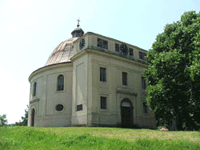
Sremski Karlovci
Sremski Karlovci is a town and municipality in Serbia, in the autonomous province of Vojvodina, situated on the bank of the river Danube, 8 km from Novi Sad...
(a town in modern-day Serbia
Serbia
Serbia , officially the Republic of Serbia , is a landlocked country located at the crossroads of Central and Southeast Europe, covering the southern part of the Carpathian basin and the central part of the Balkans...
), concluding the Austro-Ottoman War
Great Turkish War
The Great Turkish War refers to a series of conflicts between the Ottoman Empire and contemporary European powers, then joined into a Holy League, during the second half of the 17th century.-1667–1683:...
of 1683–1697 in which the Ottoman side had been defeated at the Battle of Zenta
Battle of Zenta
The Battle of Zenta or Battle of Senta, fought on 11 September 1697 just south of Zenta , on the east side of the Tisza river, was a major engagement in the Great Turkish War and one of the most decisive defeats in Ottoman history...
. It marks the end of Ottoman control in much of Central Europe
Central Europe
Central Europe or alternatively Middle Europe is a region of the European continent lying between the variously defined areas of Eastern and Western Europe...
and the beginning of the empire's phase of stagnation
Stagnation of the Ottoman Empire
The Stagnation of the Ottoman Empire is the period following the Growth of the Ottoman Empire . During this period the empire continued to have military might. The next period would be shaped by the decline of their military power which followed the loss of huge territories...
, and established the Habsburg Monarchy
Habsburg Monarchy
The Habsburg Monarchy covered the territories ruled by the junior Austrian branch of the House of Habsburg , and then by the successor House of Habsburg-Lorraine , between 1526 and 1867/1918. The Imperial capital was Vienna, except from 1583 to 1611, when it was moved to Prague...
as the dominant power in Central and Southeastern Europe.
Following a two-month congress between the Ottoman Empire on one side and the Holy League of 1684
Holy League (1684)
Holy League of 1684 was initiated in by Pope Innocent XI, and composed of the Holy Roman Empire, the Polish-Lithuanian Commonwealth and the Venetian Republic. Tsardom of Russia joined the League in 1686. This alliance opposed the Ottoman Empire in the Great Turkish War and lasted until the Treaty...
, a coalition of the Holy Roman Empire
Holy Roman Empire
The Holy Roman Empire was a realm that existed from 962 to 1806 in Central Europe.It was ruled by the Holy Roman Emperor. Its character changed during the Middle Ages and the Early Modern period, when the power of the emperor gradually weakened in favour of the princes...
, the Polish–Lithuanian Commonwealth, the Republic of Venice
Republic of Venice
The Republic of Venice or Venetian Republic was a state originating from the city of Venice in Northeastern Italy. It existed for over a millennium, from the late 7th century until 1797. It was formally known as the Most Serene Republic of Venice and is often referred to as La Serenissima, in...
and Peter I of Russia
Peter I of Russia
Peter the Great, Peter I or Pyotr Alexeyevich Romanov Dates indicated by the letters "O.S." are Old Style. All other dates in this article are New Style. ruled the Tsardom of Russia and later the Russian Empire from until his death, jointly ruling before 1696 with his half-brother, Ivan V...
, a treaty was signed on 26 January 1699. Habsburg Monarchy
Habsburg Monarchy
The Habsburg Monarchy covered the territories ruled by the junior Austrian branch of the House of Habsburg , and then by the successor House of Habsburg-Lorraine , between 1526 and 1867/1918. The Imperial capital was Vienna, except from 1583 to 1611, when it was moved to Prague...
received Ottoman Egir Province, Varad Province, much of the Budin Province
Budin Province, Ottoman Empire
Budin Eyalet was an administrative unit of the Ottoman Empire in Central Europe and the Balkans...
, northern part of the Temeşvar Province and parts of Bosnia Province
Bosnia Eyalet
The Eyalet of Bosnia or Bosnia Beylerbeylik was a eyalet and beylerbeylik of the Ottoman Empire, mostly based on the territory of the present-day state of Bosnia and Herzegovina as well as most of Slavonia, Lika, and Dalmatia in present-day Croatia...
.
The Principality of Transylvania remained nominally independent but was subjected to direct rule of Austrian governors.
Venice obtained most of Dalmatia
Dalmatia
Dalmatia is a historical region on the eastern coast of the Adriatic Sea. It stretches from the island of Rab in the northwest to the Bay of Kotor in the southeast. The hinterland, the Dalmatian Zagora, ranges from fifty kilometers in width in the north to just a few kilometers in the south....
along with the Morea
Morea
The Morea was the name of the Peloponnese peninsula in southern Greece during the Middle Ages and the early modern period. It also referred to a Byzantine province in the region, known as the Despotate of Morea.-Origins of the name:...
(the Peloponnesus peninsula in southern Greece). Poland recovered Podolia
Podolia
The region of Podolia is an historical region in the west-central and south-west portions of present-day Ukraine, corresponding to Khmelnytskyi Oblast and Vinnytsia Oblast. Northern Transnistria, in Moldova, is also a part of Podolia...
. The Ottomans retained Belgrade.
See also
- There was no agreement about the Holy Grave, although it was talked about it in Karlowitz.
- Alexander MavrocordatosAlexander MavrocordatosAlexander Mavrocordato was a member of the Greek family Mavrocordatos, a doctor of philosophy and medicine of the University of Bologna, and dragoman to Sultan Mehmed IV in 1673 - notably employed in negotiations with the Habsburg Monarchy during the Great Turkish War.Alexander Mavrocordatos was...
Sources
- Bideleux, Robert., Jeffries, Ian., A History of Eastern Europe: Crisis and Change, Routledge, New York, 1998 ISBN 0415161118