

.gif)
Baranya (region)

Encyclopedia
Danube
The Danube is a river in the Central Europe and the Europe's second longest river after the Volga. It is classified as an international waterway....
and the Drava
Drava
Drava or Drave is a river in southern Central Europe, a tributary of the Danube. It sources in Toblach/Dobbiaco, Italy, and flows east through East Tirol and Carinthia in Austria, into Slovenia , and then southeast, passing through Croatia and forming most of the border between Croatia and...
rivers. Its territory is divided between Hungary
Hungary
Hungary , officially the Republic of Hungary , is a landlocked country in Central Europe. It is situated in the Carpathian Basin and is bordered by Slovakia to the north, Ukraine and Romania to the east, Serbia and Croatia to the south, Slovenia to the southwest and Austria to the west. The...
and Croatia
Croatia
Croatia , officially the Republic of Croatia , is a unitary democratic parliamentary republic in Europe at the crossroads of the Mitteleuropa, the Balkans, and the Mediterranean. Its capital and largest city is Zagreb. The country is divided into 20 counties and the city of Zagreb. Croatia covers ...
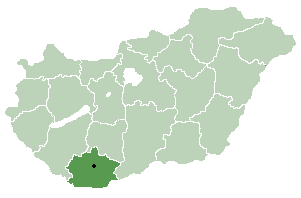
. In Hungary, the region is included into Baranya
Baranya (county)
Baranya is the name of an administrative county in present Hungary, in the Baranya region, and also in the former Kingdom of Hungary ....
county, while in Croatia, it is included into Osijek-Baranja county
Osijek-Baranja County
Osijek-Baranja county is a county in Croatia, located in northeastern Slavonia and Baranja. Its center is Osijek; other cities include Đakovo, Našice, Valpovo, Belišće, Beli Manastir.-Administrative divisions:Osijek-Baranja county is divided into:...
.
Name
The name of the region come from the SlavicSlavic languages
The Slavic languages , a group of closely related languages of the Slavic peoples and a subgroup of Indo-European languages, have speakers in most of Eastern Europe, in much of the Balkans, in parts of Central Europe, and in the northern part of Asia.-Branches:Scholars traditionally divide Slavic...
word 'bara', which means 'swamp', thus the name of Baranya means 'a swamp land'. Even today large parts of the region are swamps, such as the natural reservation Kopački Rit
Kopacki Rit
Kopački Rit , is a nature park in eastern Croatia. It is located northwest of the confluence of the Drava and the Danube, situated at the border with Serbia. It comprises many backwaters and ponds along the Danube...
in its southeast. Another theory states that the name of the region come from the Hungarian word 'bárány', which means 'lamb'.
History
During the history, the region of Baranya was part of the Roman EmpireRoman Empire
The Roman Empire was the post-Republican period of the ancient Roman civilization, characterised by an autocratic form of government and large territorial holdings in Europe and around the Mediterranean....
, the Hunnic Empire
Huns
The Huns were a group of nomadic people who, appearing from east of the Volga River, migrated into Europe c. AD 370 and established the vast Hunnic Empire there. Since de Guignes linked them with the Xiongnu, who had been northern neighbours of China 300 years prior to the emergence of the Huns,...
, the Kingdom of the Ostrogoths, the Kingdom of the Lombards
Lombards
The Lombards , also referred to as Longobards, were a Germanic tribe of Scandinavian origin, who from 568 to 774 ruled a Kingdom in Italy...
, the Avar Kingdom
Eurasian Avars
The Eurasian Avars or Ancient Avars were a highly organized nomadic confederacy of mixed origins. They were ruled by a khagan, who was surrounded by a tight-knit entourage of nomad warriors, an organization characteristic of Turko-Mongol groups...
, the Frankish Empire
Frankish Empire
Francia or Frankia, later also called the Frankish Empire , Frankish Kingdom , Frankish Realm or occasionally Frankland, was the territory inhabited and ruled by the Franks from the 3rd to the 10th century...
, the Balaton Principality
Balaton Principality
The Principality of Lower Pannonia was a Slavic principality located in the western part of the Pannonian plain, between the rivers Danube to its east The Principality of Lower Pannonia (also called Pannonia, Lower Pannonia, Pannonian Principality, Transdanubian Principality, Slavic Pannonian...
, the Bulgarian Empire
Bulgarian Empire
Bulgarian Empire is a term used to describe two periods in the medieval history of Bulgaria, during which it acted as a key regional power in Europe in general and in Southeastern Europe in particular, rivalling Byzantium...
, the Kingdom of Hungary
Kingdom of Hungary
The Kingdom of Hungary comprised present-day Hungary, Slovakia and Croatia , Transylvania , Carpatho Ruthenia , Vojvodina , Burgenland , and other smaller territories surrounding present-day Hungary's borders...
, the Ottoman Empire
Ottoman Empire
The Ottoman EmpireIt was usually referred to as the "Ottoman Empire", the "Turkish Empire", the "Ottoman Caliphate" or more commonly "Turkey" by its contemporaries...
, the Habsburg Monarchy
Habsburg Monarchy
The Habsburg Monarchy covered the territories ruled by the junior Austrian branch of the House of Habsburg , and then by the successor House of Habsburg-Lorraine , between 1526 and 1867/1918. The Imperial capital was Vienna, except from 1583 to 1611, when it was moved to Prague...
, the Austrian Empire
Austrian Empire
The Austrian Empire was a modern era successor empire, which was centered on what is today's Austria and which officially lasted from 1804 to 1867. It was followed by the Empire of Austria-Hungary, whose proclamation was a diplomatic move that elevated Hungary's status within the Austrian Empire...
and the Austria-Hungary
Austria-Hungary
Austria-Hungary , more formally known as the Kingdoms and Lands Represented in the Imperial Council and the Lands of the Holy Hungarian Crown of Saint Stephen, was a constitutional monarchic union between the crowns of the Austrian Empire and the Kingdom of Hungary in...
. Since 1918/1921, the region was divided between Hungary
Hungary
Hungary , officially the Republic of Hungary , is a landlocked country in Central Europe. It is situated in the Carpathian Basin and is bordered by Slovakia to the north, Ukraine and Romania to the east, Serbia and Croatia to the south, Slovenia to the southwest and Austria to the west. The...
and the Kingdom of Serbs, Croats and Slovenes (later known as Yugoslavia
Yugoslavia
Yugoslavia refers to three political entities that existed successively on the western part of the Balkans during most of the 20th century....
).
The region of Baranya was settled by the Slavs in the 6th century, and in the 9th century, it was part of the Slavic Balaton Principality
Balaton Principality
The Principality of Lower Pannonia was a Slavic principality located in the western part of the Pannonian plain, between the rivers Danube to its east The Principality of Lower Pannonia (also called Pannonia, Lower Pannonia, Pannonian Principality, Transdanubian Principality, Slavic Pannonian...
. Hungarians arrived to the area in the 9th century, and Baranya county arose as one of the first comitatus of the Kingdom of Hungary
Kingdom of Hungary
The Kingdom of Hungary comprised present-day Hungary, Slovakia and Croatia , Transylvania , Carpatho Ruthenia , Vojvodina , Burgenland , and other smaller territories surrounding present-day Hungary's borders...
, in the 11th century. This county included not only present-day region of Baranya, but also one part of present-day Slavonia
Slavonia
Slavonia is a geographical and historical region in eastern Croatia...
, on the southern side of the river Drava
Drava
Drava or Drave is a river in southern Central Europe, a tributary of the Danube. It sources in Toblach/Dobbiaco, Italy, and flows east through East Tirol and Carinthia in Austria, into Slovenia , and then southeast, passing through Croatia and forming most of the border between Croatia and...
. In the 16th century, the Ottoman Empire
Ottoman Empire
The Ottoman EmpireIt was usually referred to as the "Ottoman Empire", the "Turkish Empire", the "Ottoman Caliphate" or more commonly "Turkey" by its contemporaries...
captured Baranya, and included it into the sanjak
Sanjak
Sanjaks were administrative divisions of the Ottoman Empire. Sanjak, and the variant spellings sandjak, sanjaq, and sinjaq, are English transliterations of the Turkish word sancak, meaning district, banner, or flag...
of Mohács
Mohács
Mohács is a town in Baranya county, Hungary on the right bank of the Danube.-History:Two famous battles took place there:# Battle of Mohács, 1526# Battle of Mohács, 1687...
, an Ottoman administrative unit, with the seat in the town of Mohács
Mohács
Mohács is a town in Baranya county, Hungary on the right bank of the Danube.-History:Two famous battles took place there:# Battle of Mohács, 1526# Battle of Mohács, 1687...
.
In the end of the 17th century, Baranya was captured by Habsburg Monarchy
Habsburg Monarchy
The Habsburg Monarchy covered the territories ruled by the junior Austrian branch of the House of Habsburg , and then by the successor House of Habsburg-Lorraine , between 1526 and 1867/1918. The Imperial capital was Vienna, except from 1583 to 1611, when it was moved to Prague...
, and was included into restored Baranya County within the Habsburg Kingdom of Hungary
Kingdom of Hungary
The Kingdom of Hungary comprised present-day Hungary, Slovakia and Croatia , Transylvania , Carpatho Ruthenia , Vojvodina , Burgenland , and other smaller territories surrounding present-day Hungary's borders...
. In 1848, the proclaimed borders of Serbian Vojvodina
Serbian Vojvodina
The Serbian Vojvodina was a Serbian autonomous region within the Austrian Empire...
included Baranya, but the Serbian
Serbs
The Serbs are a South Slavic ethnic group of the Balkans and southern Central Europe. Serbs are located mainly in Serbia, Montenegro and Bosnia and Herzegovina, and form a sizable minority in Croatia, the Republic of Macedonia and Slovenia. Likewise, Serbs are an officially recognized minority in...
troops did not manage to take control of the region. In 1918, the entire region was captured by Serbian troops and was administered by the newly created Kingdom of Serbs, Croats and Slovenes (later known as Yugoslavia). For a short time (in 1918-1919), Baranya was part of Banat, Bačka and Baranja
Banat, Backa and Baranja
Banat, Bačka and Baranja was a de facto province of the Kingdom of Serbia and the Kingdom of Serbs, Croats and Slovenes between October 1918 and March 1919...
region, which was governed by the People's Administration from Novi Sad
Novi Sad
Novi Sad is the capital of the northern Serbian province of Vojvodina, and the administrative centre of the South Bačka District. The city is located in the southern part of Pannonian Plain on the Danube river....
. By the Treaty of Trianon
Treaty of Trianon
The Treaty of Trianon was the peace agreement signed in 1920, at the end of World War I, between the Allies of World War I and Hungary . The treaty greatly redefined and reduced Hungary's borders. From its borders before World War I, it lost 72% of its territory, which was reduced from to...
(part of the Versailles peace) in 1920, the Baranya region was formally divided between Hungary and the Yugoslavia, but de facto remained under the administration of the latter until 1921.
On August 14, 1921, the Serb-Hungarian Baranya-Baja Republic
Baranya-Baja Republic
The Serb-Hungarian Baranya-Baja Republic was a short-lived, Soviet-oriented mini-state, proclaimed in Pécs on 14 August 1921, on occupied Hungarian territory during the peacemaking aftermath of the first World War, tolerated and fostered by...
was proclaimed. It included northern parts of Baranya and Bačka
Backa
Bačka is a geographical area within the Pannonian plain bordered by the river Danube to the west and south, and by the river Tisza to the east of which confluence is located near Titel...
regions, which were assigned to Hungary by the treaty. The republic was led by the President of the Executive Committee Petar Dobrović
Petar Dobrovic
Petar Dobrović was a famous Serbian painter and politician born in Hungary.A proponent of Serbian colorism, he was known for portraits and landscapes...
(14–25 August 1921). On August 21–25, 1921, the Republic was abolished and its territory was included into Hungary (represented by Hungarian Commissioner Károly Soós Bádoki), as was previously decided by the Treaty of Trianon. The northern part of Baranya in Hungary was included into Baranya county. The southern (Yugoslav) part of the region was part of Novi Sad county between 1918 and 1922, part of Bačka oblast between 1922 and 1929, and in 1929 it was included into the Danube Banovina
Danube Banovina
The Danube Banovina or Danube Banate was a province of the Kingdom of Yugoslavia between 1929 and 1941. This province consisted of the geographical regions of Syrmia, Bačka, Banat, Baranja, Šumadija, and Braničevo. The capital city of the Danube Banovina was Novi Sad...
, a province of the Kingdom of Yugoslavia. In 1941, the Yugoslav Baranya was occupied by Hungary
Hungarian occupation of Baranja and Bačka, 1941–1944
The Hungarian occupation of Bačka and Baranja regions of Yugoslavia lasted from 1941 to 1944. It began on 11 April 1941 with the deployment of 80,000 troops. The Hungarian Third Army met no resistance. However, the local Volksdeutsche minority, which was mostly pro-Nazi oriented, had already...
, but it was returned to Yugoslavia in 1944.
In 1944-1945, Yugoslav Baranya was part of Vojvodina
Vojvodina
Vojvodina, officially called Autonomous Province of Vojvodina is an autonomous province of Serbia. Its capital and largest city is Novi Sad...
, while in 1945 it was assigned to the People's Republic of Croatia. During the War in Croatia in 1991 it came under control of the SAO Eastern Slavonia, Baranja and Western Srem
Eastern Slavonia, Baranja and Western Srem
Eastern Slavonia, Baranja and Western Syrmia was a self-proclaimed Serb political entity in eastern Croatia, established during Yugoslav wars. Eastern Slavonia, Baranja and Western Syrmia was one of three SAO Krajina proclaimed at the territory of Socialist Republic of Croatia and last and the...
, which became part of the Republic of Serbian Krajina
Republic of Serbian Krajina
The Republic of Serbian Krajina was a self-proclaimed Serb entity within Croatia. Established in 1991, it was not recognized internationally. It formally existed from 1991 to 1995, having been initiated a year earlier via smaller separatist regions. The name Krajina means "frontier"...
. After the war ended (in 1995), it was peacefully integrated into Croatia in 1998, by the Erdut Agreement
Erdut Agreement
The Erdut Agreement , officially the Basic Agreement on the Region of Eastern Slavonia, Baranja and Western Sirmium, was the agreement reached on November 12, 1995 between the authorities of the Republic of Croatia and the local Serb authorities of the Eastern Slavonia, Baranja and Western Syrmia...
. According to the agreement, it was administered by the administration of the United Nations from 1996 to 1998, when it was returned to full sovereignty of Croatia. Today, it is part of that republic's Osijek-Baranja county
Osijek-Baranja County
Osijek-Baranja county is a county in Croatia, located in northeastern Slavonia and Baranja. Its center is Osijek; other cities include Đakovo, Našice, Valpovo, Belišće, Beli Manastir.-Administrative divisions:Osijek-Baranja county is divided into:...
.
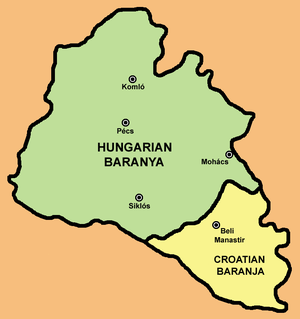
Hungarian Baranya
- PécsPécsPécs is the fifth largest city of Hungary, located on the slopes of the Mecsek mountains in the south-west of the country, close to its border with Croatia. It is the administrative and economical centre of Baranya county...
(158,942) - KomlóKomlóKomló is a town in Baranya county, Hungary. The name of the settlement is derived from the local crop of hops , an ingredient of beer. By the 18th century a depiction of this plant running up a support already featured on the herald of the town....
(27,462) - MohácsMohácsMohács is a town in Baranya county, Hungary on the right bank of the Danube.-History:Two famous battles took place there:# Battle of Mohács, 1526# Battle of Mohács, 1687...
(19,085) - SzigetvárSzigetvár-History:The town's fortress was the setting of the Battle of Szigetvár in 1566. It was a sanjak centre at first in Budin Province , later in Kanije Province .There was already a bum in the marshland back in the Celtic and Roman times...
(11,492) - SiklósSiklósSiklós is a town in Baranya county, Hungary. It is located around .-Notable people:* George Mikes , Hungarian-born British author most famous for his humorous commentaries on various countries....
(10,384) - SzentlőrincSzentlorincSzentlőrinc is a town in Baranya county, Hungary....
(7,265) - PécsváradPécsvárad-Sightseeings:Among the most significant Hungarian heritage from the Middle Ages is the castle built on a Benedictine monastery commissioned by King St Stephen. The building complex is now used as a museum and a hotel.-External links:*...
(4,104) - BólyBólyBóly is a town in Baranya county, Hungary....
(3,715) - SásdSásdSásd is a town in Baranya county, Hungary....
(3,570) - HarkányHarkányHarkány is a town in Baranya county, Hungary.-History:The area has been inhabited since medieval times, the name Nagh Harkan was mentioned in a document from the year 1323...
(3,519) - SellyeSellyeSellye is a town in Baranya county, Hungary. It is the centre of the Ormánság, a region located in the southern part of Baranya county....
(3,248) - VillányVillányVillány is a town in Baranya county, Hungary that is famous for its wine.-Etymology:The name derives from the Hungarian word for lightning, villám...
(2,793)
Croatian Baranja

- Beli ManastirBeli ManastirBeli Manastir is a town and municipality in eastern Croatia, the principal town of the Croatian part of Baranja, in the Osijek-Baranja county.-Name:...
(10,986) - DardaDarda, CroatiaDarda is a village and a municipality just north of Osijek, Croatia, across the Drava river in Baranja. The population is 7,062 people.-Geography:The municipality of Darda includes following settlements:...
(7,062) - BiljeBiljeBilje is a village and municipality on the outskirts of nature park Kopački Rit in the region of Baranja, Osijek-Baranja County, Croatia, situated 8 km northeast of Osijek.-Geography:...
(5,480) - Kneževi VinogradiKneževi VinogradiKneževi Vinogradi is a village and municipality in Croatia. It is situated in the Osijek-Baranja County, on the southern slopes of Bansko Brdo, 11 km southeast of Beli Manastir. Its elevation is 103 m...
(5,186) - DražDraž- External links :* * http://www.tzbaranje.hr/hr/odredista/draz/ * http://www.zbirka-draz.net/...
(3,356) - ČeminacCeminacČeminac is a village and municipality in Osijek-Baranja county, Croatia. There are 2,856 inhabitants in the municipality.-Geography:Čeminac is located in the central part of Croatian Baranja and it is surrounded by the municipalities of: Jagodnjak, Beli Manastir, Kneževi Vinogradi, Bilje, and...
(2,856) - PetlovacPetlovacPetlovac is a village and municipality in the western part of Baranja, which comprise the northern part of Osijek-Baranja County in Croatia.-Demographics:Municipality of Petlovac has 2,743 inhabitants , including: *71.35% Croats...
(2,743) - JagodnjakJagodnjakJagodnjak is a village and a municipality in the Osijek-Baranja County, Croatia. Jagodnjak development index is less than 50% of the Croatian average, which classifies them into 10% of the poorest municipalities...
(2,537) - PopovacPopovacPopovac is a village and municipality in Osijek-Baranja County, Croatia. There are 2,427 inhabitants in the municipality.-Name:Its name derived from the Slavic word "pop"...
(2,427)
The main settlement in the Croatian Baranja is Beli Manastir
Beli Manastir
Beli Manastir is a town and municipality in eastern Croatia, the principal town of the Croatian part of Baranja, in the Osijek-Baranja county.-Name:...
with a population of 8,671 (2001 census). Most of the municipalities in Croatian Baranja has a Croat
Croats
Croats are a South Slavic ethnic group mostly living in Croatia, Bosnia and Herzegovina and nearby countries. There are around 4 million Croats living inside Croatia and up to 4.5 million throughout the rest of the world. Responding to political, social and economic pressure, many Croats have...
ethnic majority. The municipality of Jagodnjak
Jagodnjak
Jagodnjak is a village and a municipality in the Osijek-Baranja County, Croatia. Jagodnjak development index is less than 50% of the Croatian average, which classifies them into 10% of the poorest municipalities...
has a Serb
Serbs
The Serbs are a South Slavic ethnic group of the Balkans and southern Central Europe. Serbs are located mainly in Serbia, Montenegro and Bosnia and Herzegovina, and form a sizable minority in Croatia, the Republic of Macedonia and Slovenia. Likewise, Serbs are an officially recognized minority in...
ethnic majority and the municipality of Kneževi Vinogradi
Kneževi Vinogradi
Kneževi Vinogradi is a village and municipality in Croatia. It is situated in the Osijek-Baranja County, on the southern slopes of Bansko Brdo, 11 km southeast of Beli Manastir. Its elevation is 103 m...
has a Hungarian relative majority.
Historical Baranya
According to the census of 1910, the whole Baranya region (Baranya county) had 352,478 inhabitants. Population by language (1910 census):- HungarianHungarian languageHungarian is a Uralic language, part of the Ugric group. With some 14 million speakers, it is one of the most widely spoken non-Indo-European languages in Europe....
= 199,659 (56.64%) - GermanGerman languageGerman is a West Germanic language, related to and classified alongside English and Dutch. With an estimated 90 – 98 million native speakers, German is one of the world's major languages and is the most widely-spoken first language in the European Union....
= 112,297 (31.86%) - SerbianSerbian languageSerbian is a form of Serbo-Croatian, a South Slavic language, spoken by Serbs in Serbia, Bosnia and Herzegovina, Montenegro, Croatia and neighbouring countries....
= 13,048 (3.70%) - CroatianCroatian languageCroatian is the collective name for the standard language and dialects spoken by Croats, principally in Croatia, Bosnia and Herzegovina, the Serbian province of Vojvodina and other neighbouring countries...
= 10,159 (2.88%)
Hungarian Baranya
In 2001, the population of Hungarian Baranya (Baranya county) numbered 407,448 inhabitants, including: http://www.nepszamlalas.hu/eng/volumes/06/00/tabeng/4/load01_11_0.html- Hungarians = 375,611 (92.19%)
- GermansGermansThe Germans are a Germanic ethnic group native to Central Europe. The English term Germans has referred to the German-speaking population of the Holy Roman Empire since the Late Middle Ages....
= 22,720 (5.58%) - Roma = 10,623 (2.61%)
- CroatsCroatsCroats are a South Slavic ethnic group mostly living in Croatia, Bosnia and Herzegovina and nearby countries. There are around 4 million Croats living inside Croatia and up to 4.5 million throughout the rest of the world. Responding to political, social and economic pressure, many Croats have...
= 7,294 (1.79%) - others.
Croatian Baranja
In 2001, the population of Croatian Baranja numbered 42,633 inhabitants, including: http://www.dzs.hr/Hrv/censuses/Census2001/Popis/H01_02_02/H01_02_02_zup14.html- CroatsCroatsCroats are a South Slavic ethnic group mostly living in Croatia, Bosnia and Herzegovina and nearby countries. There are around 4 million Croats living inside Croatia and up to 4.5 million throughout the rest of the world. Responding to political, social and economic pressure, many Croats have...
= 23,693 (55.57%) - SerbsSerbsThe Serbs are a South Slavic ethnic group of the Balkans and southern Central Europe. Serbs are located mainly in Serbia, Montenegro and Bosnia and Herzegovina, and form a sizable minority in Croatia, the Republic of Macedonia and Slovenia. Likewise, Serbs are an officially recognized minority in...
= 8,592 (20.15%) - Hungarians = 7,114 (16.69%)
- others.
See also
- Baranya (historic county)
- Baranya (county)Baranya (county)Baranya is the name of an administrative county in present Hungary, in the Baranya region, and also in the former Kingdom of Hungary ....
- Osijek-Baranja countyOsijek-Baranja CountyOsijek-Baranja county is a county in Croatia, located in northeastern Slavonia and Baranja. Its center is Osijek; other cities include Đakovo, Našice, Valpovo, Belišće, Beli Manastir.-Administrative divisions:Osijek-Baranja county is divided into:...
- Srem-Baranja Oblast
- Baranya-Baja RepublicBaranya-Baja RepublicThe Serb-Hungarian Baranya-Baja Republic was a short-lived, Soviet-oriented mini-state, proclaimed in Pécs on 14 August 1921, on occupied Hungarian territory during the peacemaking aftermath of the first World War, tolerated and fostered by...