


Eastern Rite Catholic Churches

Encyclopedia
The Eastern Catholic Churches are autonomous, self-governing (in Latin, sui iuris
) particular church
es in full
communion
with the Bishop of Rome
, the Pope
. Together with the Latin Church
, they compose the worldwide Catholic Church. They preserve some centuries-old eastern liturgical, devotional and theological traditions, shared in most cases with the various other Eastern Christian churches
with which they were once associated. A few have never been out of communion with the Pope, a claim made, for instance, by the Maronites
. Although the churches with which most were formerly associated may be of traditions out of communion with each other (Eastern Orthodox Church
, Oriental Orthodoxy
, Church of the East
), Eastern Catholic churches of whatever tradition are all in communion with one another and with the Latin or Western church. However, they vary in theological emphasis, forms of liturgical worship
and popular piety, canonical discipline and terminology. They all recognize the central role
of the Bishop of Rome within the College of Bishops
and his infallibility when speaking ex cathedra
. A number of theological concerns or, in the case of the Eastern Orthodox churches, differences primarily in understanding the role of the Bishop of Rome separate them even from their counterparts of similar tradition but out of communion with Rome, which in general do not admit them to the Eucharist or the other sacraments.
Historically, Eastern Catholic Churches were located in Eastern Europe
, the Asian Middle East
, Northern Africa
and India
. Due to migration they are now also in Western Europe
, the Americas and Oceania
, where eparchies
have been established alongside the Latin diocese
s. Eritrea
has only an Eastern Catholic
hierarchy, with no Latin structure.
The terms Byzantine Catholic and Greek Catholic are used of those who belong to Churches that use the Byzantine Rite
. The terms Oriental Catholic and Eastern Catholic include these, but are broader, since they also cover Catholics who follow the Alexandrian
, Antiochian, Armenian
and Chaldean
liturgical traditions.
, but not an autonomous one in the sense in which the word is applied to these 22 Churches.) They follow different Eastern Christian liturgical traditions: Alexandrian
, Antiochian
, Armenian
, Byzantine
and Chaldean
. Canonically, each Eastern Catholic Church is sui iuris
or autonomous with respect to other Catholic Churches, whether Eastern or Latin, though all accept the spiritual and juridical authority of the Pope. Thus a Maronite Catholic is normally subject only to a Maronite bishop. However, if members of a particular Church are so few that no hierarchy of their own has been established, their spiritual care is entrusted to a bishop of another ritual Church. For example, in Eritrea
Latin Rite Catholics are in the care of the Ethiopian Catholic Church
.
Theologically, all the particular Churches can be viewed as "sister Churches". According to the Second Vatican Council
these Eastern Churches, along with the larger Latin Church share "equal dignity, so that none of them is superior to the others as regards rite, and they enjoy the same rights and are under the same obligations, also in respect of preaching the Gospel
to the whole world (cf. Mark 16:15) under the guidance of the Roman Pontiff."
The Eastern Catholic Churches are in full
communion
of faith. Whilst they accept of authority of the See of Rome, they retain their distinctive liturgical rites
, laws and customs, traditional devotions and have their own theological emphases. Terminology may vary: for instance, diocese and eparchy, vicar general and protosyncellus
, confirmation and chrismation
are respectively Western and Eastern terms for the same realities. The mysteries (sacraments) of baptism
and chrismation are generally administered, according to the ancient tradition of the Church, one immediately after the other. Infants who are baptized and chrismated are also given the Eucharist
.
The Eastern Catholic Churches are represented in the Holy See
and the Roman Curia
through the Congregation for the Oriental Churches
, which "is made up of a Cardinal Prefect (who directs and represents it with the help of a Secretary) and 27 Cardinals, one Archbishop and 4 Bishops, designated by the Pope ad qui[n]quennium. Members by right are the Patriarchs and the Major Archbishops of the Oriental Churches and the President of the Pontifical Council for the Promotion of Unity among Christians."
, among which the Roman Rite
is the most widespread.
, which include the majority Roman Rite
, but also the Ambrosian Rite
, the Mozarabic Rite
, and others.
In the Code of Canons of the Eastern Churches
(published in 1990), the terms autonomous Church and rite are thus defined: "A group of Christian faithful linked in accordance with the law by a hierarchy and expressly or tacitly recognized by the supreme authority of the Church as autonomous is in this Code called an autonomous Church" (canon 27); "1. A rite is the liturgical, theological, spiritual and disciplinary patrimony, culture and circumstances of history of a distinct people, by which its own manner of living the faith is manifested in each autonomous [sui iuris] Church. 2. The rites treated in this code, unless otherwise stated, are those that arise from the Alexandrian, Antiochene, Armenian, Chaldean and Constantinopolitan traditions" (canon 28) When speaking of the Eastern Catholic Churches, the 1983 Latin Code of Canon Law uses the terms "ritual Church" or "ritual Church sui iuris" (canons 111 and 112), and also speaks of "a subject of an Eastern rite" (canon 1015 §2), "Ordinaries of another rite" (canon 450 §1), "the faithful of a specific rite" (canon 476), etc. The Second Vatican Council spoke of the Eastern Catholic Churches as "particular Churches or rites".
The use of the term "rite" to refer to the Eastern and Western Churches has now become rare. A publication of the then-National Council of Catholic Bishops explains: "We have been accustomed to speaking of the Latin (Roman or Western) Rite or the Eastern Rites to designate these different Churches. However, the Church's contemporary legislation as contained in the Code of Canon Law and the Code of Canons of the Eastern Churches makes it clear that we ought to speak, not of rites, but of Churches. Canon 112 of the Code of Canon Law uses the phrase 'autonomous ritual Churches' to designate the various Churches." And a writer in a periodical of January 2006 declared: "The Eastern Churches are still mistakenly called 'Eastern-rite' Churches, a reference to their various liturgical histories. They are most properly called Eastern Churches, or Eastern Catholic Churches."
. Official Catholic documents no longer use the term, due to its perceived negative overtones. According to Eastern Orthodox Professor John Erickson of St Vladimir's Theological Seminary
, "The term 'uniate' itself, once used with pride in the Roman communion, had long since come to be considered as pejorative. 'Eastern Rite Catholic' also was no longer in vogue because it might suggest that the Catholics in question differed from Latins only in the externals of worship. The Second Vatican Council affirmed rather that Eastern Catholics constituted churches, whose vocation was to provide a bridge to the separated churches of the East." An acceptable, commonly used term is now united Oriental Churches.
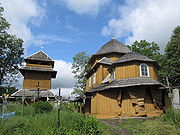 Most Eastern Catholic Churches arose when a group within an ancient Christian Church
that was in disagreement with the See of Rome returned to full communion
with that See. Three Eastern Catholic churches have never broken communion with the Bishop of Rome since the beginning: (a) The Maronite Church
was never out of communion with Rome, and has no counterpart in the Eastern Orthodox communion
. (b) The Italo-Albanian Catholic Church
which, unlike the Maronite Church, uses the same liturgical rite
as the Eastern Orthodox Church
.(c) The Syro-Malabar Church
, based in Kerala
, India
. Other Christians of Kerala, who were originally of the same East-Syrian tradition, passed instead to the West-Syrian tradition and now form part of Oriental Orthodoxy
. Some from the Oriental Orthodox in India reunited with the Bishop of Rome in 1930 and became the Syro-Malankara Catholic Church
, another Eastern sui juris church within the Catholic Church.
The canon law
that the Eastern Catholic Churches have in common was codified in the 1990 Code of Canons of the Eastern Churches. The dicastery
that works with the Eastern Catholic Churches is the Congregation for the Oriental Churches
, which, by law, includes as members all Eastern Catholic patriarchs and major archbishops.
(Copts), Antioch
(Syrians, Melkites, Maronites), Babylonia
(Chaldaeans), Cilicia
(Armenians), Kiev
-Halych
(Ukrainians), Ernakulam
-Angamaly
(Syro-Malabars), Trivandrum
(Syro-Malankaras
), and Făgăraş-Alba Iulia (Romanians
). The Eastern Churches are governed under the Code of Canons of the Eastern Churches.
or departure from the true faith (orthodoxy
). Communion has been broken also because of disagreement about questions of authority or the legitimacy of the election of a particular bishop. In these latter cases, each side accuses the other of schism
, but not of heresy.
Major breaches of communion:
Within each Church, no longer in communion with the Church of Rome, there arose a group that considered it important to restore that communion. The See of Rome accepted them without requiring that they adopt the customs of the Latin Church, so that they all have their own "liturgical, theological, spiritual and disciplinary heritage, differentiated by peoples' culture and historical circumstances, that finds expression in each sui iuris Church's own way of living the faith".
At a meeting at Balamand Monastery
, Lebanon
in June 1993, the Joint International Commission for the Theological Dialogue between the Catholic Church and the Orthodox Church declared that these initiatives that "led to the union of certain communities with the See of Rome and brought with them, as a consequence, the breaking of communion with their Mother Churches of the East ... took place not without the interference of extra-ecclesial interests" (section 8 of the document). Likewise, the Commission acknowledged that "unacceptable means" were used in attempts to force Eastern Catholics to return to the Orthodox Church (paragraph 11). The missionary outlook and proselytism
that accompanied the Unia (paragraph 10), was recognized to be incompatible with the rediscovery of each other as "Sister Churches" (section 12). Thus, the Commission concluded that the "missionary apostolate ... which has been called 'uniatism', can no longer be accepted either as a method to be followed nor as a model of the unity our Churches are seeking."
At the same time, the Commission stated:
show that Syriac Christians
make up 47% of Eastern Catholics and Byzantine Christians make up 46%. The three largest Eastern churches are the Byzantine Ukrainian Greek Catholic Church
with 4.3 million members (25%), the Syriac Syro-Malabar Catholic Church
at 3.9 million faithful (23%), and the Maronite Eastern Catholic Church of Lebanon with 3.29 million faithful (20%).
On 30 November 1894 Pope Leo XIII
issued the apostolic constitution
Orientalium Dignitas
in which he stated:
As Adrian Fortescue wrote, Pope Leo "begins by explaining again that the ancient Eastern rites are a witness to the Apostolicity of the Catholic Church, that their diversity, consistent with unity of the faith, is itself a witness to the unity of the Church, that they add to her dignity and honour. He says that the Catholic Church does not possess one rite only, but that she embraces all the ancient rites of Christendom; her unity consists not in a mechanical uniformity of all her parts, but on the contrary, in their variety, according in one principle and vivified by it."
Leo declared still in force Pope Benedict XIV
's encyclical
Demandatam
, addressed to the Patriarch and the Bishops of the Melkite Catholic Church, in which Pope Benedict forbade Latin Rite clergy to induce Melkite Catholics to transfer to the Latin rite, and he broadened this prohibition to cover all Eastern Catholics, declaring: "Any Latin rite missionary, whether of the secular or religious clergy, who induces with his advice or assistance any Eastern rite faithful to transfer to the Latin rite, will be deposed and excluded from his benefice in addition to the ipso facto suspension a divinis and other punishments that he will incur as imposed in the aforesaid Constitution Demandatam."
(21 November 1964), dealing with the Churches of Eastern Christianity
, the Second Vatican Council
directed that the traditions of the Eastern Catholic Churches should be maintained. It declared that "it is the mind of the Catholic Church that each individual Church or Rite should retain its traditions whole and entire and likewise that it should adapt its way of life to the different needs of time and place" (paragraph 2), and that they should all "preserve their legitimate liturgical rite and their established way of life, and ... these may not be altered except to obtain for themselves an organic improvement" (para. 6; cf. 22). It confirmed and approved the ancient discipline of the sacraments existing in the Eastern Churches, and the ritual practices connected with their celebration and administration, and declared its ardent desire that this should be re-established, if circumstances warranted (para. 12). It applied this in particular to administration of Confirmation by priests (para. 13). It expressed the wish that, where the permanent diaconate
(ordination as deacons of men who are not intended afterwards to become priests) had fallen into disuse, it should be restored (section 17). Paragraphs 7-11 are devoted to the powers of the patriarchs and major archbishops of the Eastern Churches, whose rights and privileges, it says, should be re-established in accordance with the ancient tradition of each of the Churches and the decrees of the ecumenical council
s, adapted somewhat to modern conditions. Where there is need, new patriarchates should be established either by an ecumenical council
or by the Bishop of Rome.
(21 November 1964) deals with the Eastern Catholic Churches in paragraph 23, stating:
(also of 21 November 1964) deals with the Eastern Catholic Churches in paragraphs 14-17.
the need for a common code for the Eastern Churches was discussed, but no concrete action was taken. Only after the benefits of the 1917 Latin Code were appreciated was a serious effort made to create a similar code for the Eastern Catholic Churches. This came to fruition with the promulgation in 1990 of the Code of Canons of the Eastern Churches
, which came into effect in 1991. It is a framework document that lays out the canons that are a consequence of the common patrimony of the Churches of the East: each individual sui iuris Church has its own canons, its own particular law, layered on top of this code.
on the Roman rite
, 'in the very nature of things, affect other rites
as well'." The Instruction states:
Past interventions by the Holy See, the Instruction said, were in some ways defective and needed revision, but often served also as a safeguard against aggressive initiatives.
gives the following list of Eastern Catholic Churches with the principal see of each and the countries (or larger political areas) where they have ecclesiastical jurisdiction
, to which are here added the date of union or foundation in parenthesis and the membership in brackets. The total membership is about 16,336,000.
Note: Georgian Byzantine-Rite Catholics
are not recognized as a particular Church
(cf. canon 27 of the Code of Canons of the Eastern Churches). The majority of Eastern Catholic Christians in the Georgian Republic
worship under the form of the Armenian liturgical rite
.
The list shows that an individual autonomous particular Church may have distinct jurisdictions (local particular Churches) in several countries.
The Ruthenian Catholic Church is organized in an exceptional way because of a constituent metropolia: the Byzantine Catholic Metropolitan Church of Pittsburgh
is also, unofficially, referred to as the Byzantine Catholic Church in America. Canon law treats it as if it held the rank of an autonomous ("sui iuris") metropolitan particular Church because of the circumstances surrounding its 1969 establishment as an ecclesiastical province. At that time, conditions in the Rusyn
homeland, known as Carpatho-Rus
, admitted no other solution because the Byzantine Catholic Church had been forcibly suppressed by the Soviet authorities. When Communist rule ended, the Eparchy of Mukacheve (founded in 1771) re-emerged. It has some 320,000 adherents, greater than the number in the Pittsburgh metropolia. In addition, an apostolic exarchate established in 1996 for Catholics of Byzantine rite in the Czech Republic is classed as another part of the Ruthenian Catholic Church.
On the EWTN website the Apostolic Exarchate for Byzantine-rite Catholics in the Czech Republic is mentioned in a list of Eastern Churches, of which all the rest are autonomous particular Churches. This is a mistake, since recognition within the Catholic Church of the autonomous status of a particular Church can only be granted by the Holy See (cf. canon 27 of the Code of Canons of the Eastern Churches), which instead classifies this Church as one of the constituent local particular Churches of the autonomous (sui iuris) Ruthenian Catholic Church.
Catholics within the Georgian Catholic Church
as a separate particular Church with a reunion date of either 1861 or 1917. A study by Deacon Methodios Stadnik states: "The Georgian Byzantine Catholic Exarch, Fr. Shio Batmanishviii (sic), and two Georgian Catholic priests of the Latin rite were executed by the Soviet authorities in 1937 after having been held in captivity in Solovki prison and the northern gulags from 1923." In his book The Forgotten: Catholics of the Soviet Union Empire from Lenin through Stalin, Father Christopher Zugger writes: "By 1936, the Byzantine Catholic Church of Georgia had two communities, served by a bishop and four priests, with 8,000 believers", and he identifies the bishop as Shio Batmalashvili. The Ukrainian Helsinki Human Rights
Union mentions "the Catholic administrator for Georgia Shio Batmalashvili" as one of those who were executed as "anti-Soviet elements" in 1937.
The second of these sources calls Batmalashvili a bishop. The first is ambiguous, calling him an Exarch but giving him the title of Father. The third merely refers to him as "the Catholic administrator" without specifying whether he was a bishop or a priest and whether he was in charge of a Latin or a Byzantine jurisdiction.
If Batmalashvili was an Exarch, and not instead a bishop connected with the Latin diocese of Tiraspol, which had its seat at Saratov
on the Volga River
, to which Georgian Catholics even of Byzantine rite belonged this would mean that a Georgian Byzantine-Rite Catholic Church existed, even if only as a local particular Church. However, since the establishment of a new hierarchical jurisdiction must be published in the Acta Apostolicae Sedis
, and no mention of the setting up of such a jurisdiction for Byzantine Georgian Catholics exists in that official gazette of the Holy See, the claim appears to be unfounded.
The Annuario Pontificio
of the Catholic Church does not mention Batmalashvili in its editions of the 1930s. If indeed he was a bishop, he may then have been one of those secretly ordained for the service of the Church in the Soviet Union
by French Jesuit Bishop Michel d'Herbigny
, who was head of the Pontifical Commission for Russia from 1925 to 1934. In the circumstances of that time, the Holy See would have been incapable of setting up a new Byzantine exarchate within the Soviet Union, since Byzantine Catholics in the Soviet Union were being forced to join the Russian Orthodox Church
.
Batmalashvili's name is not among those given in Roman Catholic Regional Hierarchy as the four "underground" apostolic administrators (only one of whom appears to have been a bishop) for the four sections into which the diocese of Tiraspol was divided after the resignation in 1930 of its already exiled last bishop, Joseph Aloysius Kessler. This source gives Father Stefan Demurow as apostolic administrator
of "Tbilisi and Georgia" and says he was executed in 1938. Other sources associate Father Demurow with Azerbaijan
and say that, rather than being executed, he died in a Siberia
n concentration camp
.
Until 1994, the United States annual publication
Catholic Almanac used to go further, listing "Georgian" among the Byzantine Churches. Until corrected in 1995, it appears to have been making a mistake similar to that made on the equally unofficial EWTN site about the Czech Byzantine Catholics.
There was also a short-lived Byzantine Catholic movement among the ethnic Estonians in the Orthodox Church in Estonia during the interwar period
of the 20th century, consisting of two to three parishes, not raised to the level of a local particular church with its own head. This group was liquidated by the Soviet regime and is now extinct.
are bound to observe their own rite faithfully," priests are occasionally given permission to celebrate the liturgy of a rite other than the priest's own rite, by what is known as a grant of "biritual faculties". The reason for this permission is usually the service of Catholics who have no priest of their own rite. Thus priests of the Syro-Malabar Church
working as missionaries in areas of India in which there were no structures of their own Church, were authorized to use the Roman Rite in those areas, and Latin-Rite priests are, after due preparation, given permission to use an Eastern rite for the service of members of an Eastern Catholic Church living in a country in which there are no priests of their own particular Church.
For a just cause, and with the permission of the local bishop, priests of different autonomous ritual Churches may concelebrate; however, the rite of the principal celebrant is used whilst each priest wears the vestments of his own rite. For this no indult of bi-ritualism is required.
Biritual faculties may concern not only clergy but also religious, enabling them to become members of an institute of an autonomous Church other than their own.
The laity should foster an appreciation of their own rite, and should observe that rite unless there is good reason e.g. a Latin Rite Catholic living in an exclusively Ethiopian Rite country. This does not forbid occasional or even, for a just cause, habitual participation in the liturgy of a different autonomous Church, Western or Eastern. The obligation of assisting at the Eucharist or, for members of some Eastern Churches, at Vespers, is satisfied wherever the liturgy is celebrated in a Catholic rite.
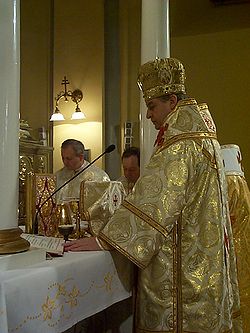
and the resulting controversies have played a role in the relationship between the two groups in some Western countries
.
Most Eastern Churches distinguish between "monastic" and "non-monastic" clergy. Monastics
do not necessarily live as monks or in monasteries, but have spent at least part of their period of training in such a context. Their monastic vows
include a vow of celibate chastity.
Bishops are normally selected from the monastic clergy, and in most Eastern Catholic Churches a large percentage of priests and deacons also are celibate, while a portion of the clergy (typically, parish priests) may be married. If someone preparing for the diaconate or priesthood wishes to marry, this must happen before ordination.
In countries where Eastern traditions prevail, a married clergy caused little controversy; but it aroused opposition in other countries to which Eastern Catholics migrated; this was particularly so in the United States. In response to requests from the Latin bishops of those countries, the Sacred Congregation for the Propagation of the Faith
set out rules in a letter of 2 May 1890 to François-Marie-Benjamin Richard
, the Archbishop of Paris, which the Congregation applied on 1 May 1897 to the United States, stating that only celibates or widowed priests coming without their children should be permitted in the United States. This rule was restated with special reference to Catholics of Ruthenian Rite
by the 1 March 1929 decree Cum data fuerit, which was renewed for a further ten years in 1939. Dissatisfaction by many Ruthenian Catholics in the United States gave rise to the American Carpatho-Russian Orthodox Diocese
. This rule was abolished with the promulgation of the Decree on the Catholic churches of the Eastern Rite; since then, married men have been ordained to the priesthood in the United States, and numerous married priests have come from eastern countries to serve parishes in the Americas.
Three Eastern Catholic Churches have decided to adopt mandatory clerical celibacy, as in the Latin Church: the India-based Syro-Malankara Catholic Church
and Syro-Malabar Catholic Church
, and the Ethiopian Catholic Church
, which has a long widespread tradition of monasticism.
Particular
Sui iuris
Sui iuris, commonly also spelled sui juris, is a Latin phrase that literally means “of one’s own laws”.-Secular law:In civil law the phrase sui juris indicates legal competence, the capacity to manage one’s own affairs...
) particular church
Particular Church
In Catholic canon law, a Particular Church is an ecclesial community headed by a bishop or someone recognised as the equivalent of a bishop.There are two kinds of particular Churches:# Local particular Churches ...
es in full
Full communion
In Christian ecclesiology, full communion is a relationship between church organizations or groups that mutually recognize their sharing the essential doctrines....
communion
Communion (Christian)
The term communion is derived from Latin communio . The corresponding term in Greek is κοινωνία, which is often translated as "fellowship". In Christianity, the basic meaning of the term communion is an especially close relationship of Christians, as individuals or as a Church, with God and with...
with the Bishop of Rome
Diocese of Rome
The Diocese of Rome is a diocese of the Catholic Church in Rome, Italy. The bishop of Rome is the Pope, who is the Supreme Pontiff and leader of the Catholic Church...
, the Pope
Pope
The Pope is the Bishop of Rome, a position that makes him the leader of the worldwide Catholic Church . In the Catholic Church, the Pope is regarded as the successor of Saint Peter, the Apostle...
. Together with the Latin Church
Latin Church
The Latin Church is the largest particular church within the Catholic Church. It is a particular church not on the level of the local particular churches known as dioceses or eparchies, but on the level of autonomous ritual churches, of which there are 23, the remaining 22 of which are Eastern...
, they compose the worldwide Catholic Church. They preserve some centuries-old eastern liturgical, devotional and theological traditions, shared in most cases with the various other Eastern Christian churches
Eastern Christianity
Eastern Christianity comprises the Christian traditions and churches that developed in the Balkans, Eastern Europe, Asia Minor, the Middle East, Northeastern Africa, India and parts of the Far East over several centuries of religious antiquity. The term is generally used in Western Christianity to...
with which they were once associated. A few have never been out of communion with the Pope, a claim made, for instance, by the Maronites
Maronites
Maronites , is an ethnoreligious group in the Middle East that have been historically tied with Lebanon. They derive their name from the Syriac saint Mar Maron whose followers moved to Mount Lebanon from northern Syria establishing the Maronite Church....
. Although the churches with which most were formerly associated may be of traditions out of communion with each other (Eastern Orthodox Church
Eastern Orthodox Church
The Orthodox Church, officially called the Orthodox Catholic Church and commonly referred to as the Eastern Orthodox Church, is the second largest Christian denomination in the world, with an estimated 300 million adherents mainly in the countries of Belarus, Bulgaria, Cyprus, Georgia, Greece,...
, Oriental Orthodoxy
Oriental Orthodoxy
Oriental Orthodoxy is the faith of those Eastern Christian Churches that recognize only three ecumenical councils — the First Council of Nicaea, the First Council of Constantinople and the First Council of Ephesus. They rejected the dogmatic definitions of the Council of Chalcedon...
, Church of the East
Church of the East
The Church of the East tāʾ d-Maḏnḥāʾ), also known as the Nestorian Church, is a Christian church, part of the Syriac tradition of Eastern Christianity. Originally the church of the Persian Sassanid Empire, it quickly spread widely through Asia...
), Eastern Catholic churches of whatever tradition are all in communion with one another and with the Latin or Western church. However, they vary in theological emphasis, forms of liturgical worship
Christian liturgy
A liturgy is a set form of ceremony or pattern of worship. Christian liturgy is a pattern for worship used by a Christian congregation or denomination on a regular basis....
and popular piety, canonical discipline and terminology. They all recognize the central role
Primacy of the Roman Pontiff
The primacy of the Bishop of Rome is an ecclesiastical doctrine held by some branches of Christianity, most notably the Catholic Church, the Eastern Orthodox Church and the Anglican Communion. The doctrine concerns the respect and authority that is due to the Bishop of Rome from bishops and their...
of the Bishop of Rome within the College of Bishops
College of Bishops
The term "College of Bishops" is used in Catholic theology to denote the bishops in communion with the Pope as a body, not as individuals...
and his infallibility when speaking ex cathedra
Papal infallibility
Papal infallibility is a dogma of the Catholic Church which states that, by action of the Holy Spirit, the Pope is preserved from even the possibility of error when in his official capacity he solemnly declares or promulgates to the universal Church a dogmatic teaching on faith or morals...
. A number of theological concerns or, in the case of the Eastern Orthodox churches, differences primarily in understanding the role of the Bishop of Rome separate them even from their counterparts of similar tradition but out of communion with Rome, which in general do not admit them to the Eucharist or the other sacraments.
Historically, Eastern Catholic Churches were located in Eastern Europe
Eastern Europe
Eastern Europe is the eastern part of Europe. The term has widely disparate geopolitical, geographical, cultural and socioeconomic readings, which makes it highly context-dependent and even volatile, and there are "almost as many definitions of Eastern Europe as there are scholars of the region"...
, the Asian Middle East
Middle East
The Middle East is a region that encompasses Western Asia and Northern Africa. It is often used as a synonym for Near East, in opposition to Far East...
, Northern Africa
North Africa
North Africa or Northern Africa is the northernmost region of the African continent, linked by the Sahara to Sub-Saharan Africa. Geopolitically, the United Nations definition of Northern Africa includes eight countries or territories; Algeria, Egypt, Libya, Morocco, South Sudan, Sudan, Tunisia, and...
and India
Christianity in India
Christianity is India's third-largest religion, with approximately 24 million followers, constituting 2.3% of India's population. The works of scholars and Eastern Christian writings and 14th century Portuguese missionaries created an illusion to convert Indians that Christianity was introduced to...
. Due to migration they are now also in Western Europe
Western Europe
Western Europe is a loose term for the collection of countries in the western most region of the European continents, though this definition is context-dependent and carries cultural and political connotations. One definition describes Western Europe as a geographic entity—the region lying in the...
, the Americas and Oceania
Oceania
Oceania is a region centered on the islands of the tropical Pacific Ocean. Conceptions of what constitutes Oceania range from the coral atolls and volcanic islands of the South Pacific to the entire insular region between Asia and the Americas, including Australasia and the Malay Archipelago...
, where eparchies
Eparchy
Eparchy is an anglicized Greek word , authentically Latinized as eparchia and loosely translating as 'rule over something,' like province, prefecture, or territory, to have the jurisdiction over, it has specific meanings both in politics, history and in the hierarchy of the Eastern Christian...
have been established alongside the Latin diocese
Diocese
A diocese is the district or see under the supervision of a bishop. It is divided into parishes.An archdiocese is more significant than a diocese. An archdiocese is presided over by an archbishop whose see may have or had importance due to size or historical significance...
s. Eritrea
Eritrea
Eritrea , officially the State of Eritrea, is a country in the Horn of Africa. Eritrea derives it's name from the Greek word Erethria, meaning 'red land'. The capital is Asmara. It is bordered by Sudan in the west, Ethiopia in the south, and Djibouti in the southeast...
has only an Eastern Catholic
Ethiopian Catholic Church
The Ethiopian Catholic Church is a Metropolitan sui iuris Eastern particular Church within the Catholic Church. Established in 1930, its membership includes inhabitants of Ethiopia and Eritrea....
hierarchy, with no Latin structure.
The terms Byzantine Catholic and Greek Catholic are used of those who belong to Churches that use the Byzantine Rite
Byzantine Rite
The Byzantine Rite, sometimes called the Rite of Constantinople or Constantinopolitan Rite is the liturgical rite used currently by all the Eastern Orthodox Churches, by the Greek Catholic Churches , and by the Protestant Ukrainian Lutheran Church...
. The terms Oriental Catholic and Eastern Catholic include these, but are broader, since they also cover Catholics who follow the Alexandrian
Alexandrian Rite
The Alexandrian Rite is officially called the Liturgy of Saint Mark, traditionally regarded as the first bishop of Alexandria. The Alexandrian Rite contains elements from the liturgy of Saint Basil, Cyril the Great, and Saint Gregory Nazianzus...
, Antiochian, Armenian
Armenian Rite
The Armenian Rite is an independent liturgy. This rite is used by both the Armenian Apostolic and Armenian Catholic Churches; it is also the rite of a significant number of Eastern Catholic Christians in the Republic of Georgia....
and Chaldean
East Syrian Rite
The East Syrian Rite is a Christian liturgy, also known as the Assyro-Chaldean Rite, Assyrian or Chaldean Rite, and the Persian Rite although it originated in Edessa, Mesopotamia...
liturgical traditions.
Juridical status
The term Eastern Catholic Churches refers to 22 of the 23 autonomous particular Churches in communion with the Bishop of Rome. (Every diocese is a particular ChurchParticular Church
In Catholic canon law, a Particular Church is an ecclesial community headed by a bishop or someone recognised as the equivalent of a bishop.There are two kinds of particular Churches:# Local particular Churches ...
, but not an autonomous one in the sense in which the word is applied to these 22 Churches.) They follow different Eastern Christian liturgical traditions: Alexandrian
Alexandrian Rite
The Alexandrian Rite is officially called the Liturgy of Saint Mark, traditionally regarded as the first bishop of Alexandria. The Alexandrian Rite contains elements from the liturgy of Saint Basil, Cyril the Great, and Saint Gregory Nazianzus...
, Antiochian
Antiochene Rite
Antiochene Rite designates the family of liturgies originally used in the Patriarchate of Antioch.-Liturgies in the Antiochene Rite:The family of liturgies include the Apostolic Constitutions; then that of St. James in Greek, the Syriac Liturgy of St. James, and the other Syriac Anaphoras. The line...
, Armenian
Armenian Rite
The Armenian Rite is an independent liturgy. This rite is used by both the Armenian Apostolic and Armenian Catholic Churches; it is also the rite of a significant number of Eastern Catholic Christians in the Republic of Georgia....
, Byzantine
Byzantine Rite
The Byzantine Rite, sometimes called the Rite of Constantinople or Constantinopolitan Rite is the liturgical rite used currently by all the Eastern Orthodox Churches, by the Greek Catholic Churches , and by the Protestant Ukrainian Lutheran Church...
and Chaldean
East Syrian Rite
The East Syrian Rite is a Christian liturgy, also known as the Assyro-Chaldean Rite, Assyrian or Chaldean Rite, and the Persian Rite although it originated in Edessa, Mesopotamia...
. Canonically, each Eastern Catholic Church is sui iuris
Sui iuris
Sui iuris, commonly also spelled sui juris, is a Latin phrase that literally means “of one’s own laws”.-Secular law:In civil law the phrase sui juris indicates legal competence, the capacity to manage one’s own affairs...
or autonomous with respect to other Catholic Churches, whether Eastern or Latin, though all accept the spiritual and juridical authority of the Pope. Thus a Maronite Catholic is normally subject only to a Maronite bishop. However, if members of a particular Church are so few that no hierarchy of their own has been established, their spiritual care is entrusted to a bishop of another ritual Church. For example, in Eritrea
Eritrea
Eritrea , officially the State of Eritrea, is a country in the Horn of Africa. Eritrea derives it's name from the Greek word Erethria, meaning 'red land'. The capital is Asmara. It is bordered by Sudan in the west, Ethiopia in the south, and Djibouti in the southeast...
Latin Rite Catholics are in the care of the Ethiopian Catholic Church
Ethiopian Catholic Church
The Ethiopian Catholic Church is a Metropolitan sui iuris Eastern particular Church within the Catholic Church. Established in 1930, its membership includes inhabitants of Ethiopia and Eritrea....
.
Theologically, all the particular Churches can be viewed as "sister Churches". According to the Second Vatican Council
Second Vatican Council
The Second Vatican Council addressed relations between the Roman Catholic Church and the modern world. It was the twenty-first Ecumenical Council of the Catholic Church and the second to be held at St. Peter's Basilica in the Vatican. It opened under Pope John XXIII on 11 October 1962 and closed...
these Eastern Churches, along with the larger Latin Church share "equal dignity, so that none of them is superior to the others as regards rite, and they enjoy the same rights and are under the same obligations, also in respect of preaching the Gospel
Gospel
A gospel is an account, often written, that describes the life of Jesus of Nazareth. In a more general sense the term "gospel" may refer to the good news message of the New Testament. It is primarily used in reference to the four canonical gospels of Matthew, Mark, Luke, and John...
to the whole world (cf. Mark 16:15) under the guidance of the Roman Pontiff."
The Eastern Catholic Churches are in full
Full communion
In Christian ecclesiology, full communion is a relationship between church organizations or groups that mutually recognize their sharing the essential doctrines....
communion
Communion (Christian)
The term communion is derived from Latin communio . The corresponding term in Greek is κοινωνία, which is often translated as "fellowship". In Christianity, the basic meaning of the term communion is an especially close relationship of Christians, as individuals or as a Church, with God and with...
of faith. Whilst they accept of authority of the See of Rome, they retain their distinctive liturgical rites
Liturgy
Liturgy is either the customary public worship done by a specific religious group, according to its particular traditions or a more precise term that distinguishes between those religious groups who believe their ritual requires the "people" to do the "work" of responding to the priest, and those...
, laws and customs, traditional devotions and have their own theological emphases. Terminology may vary: for instance, diocese and eparchy, vicar general and protosyncellus
Protosyncellus
A protosyncellus or protosynkellos is the principal deputy of the bishop of an eparchy for the exercise of administrative authority in an Eastern Orthodox or Eastern Catholic church...
, confirmation and chrismation
Chrismation
Chrismation is the name given in Eastern Orthodox, Oriental Orthodox and Eastern Catholic churches, as well as in the Assyrian Church of the East, Anglican, and in Lutheran initiation rites, to the Sacrament or Sacred Mystery more commonly known in the West as confirmation, although Italian...
are respectively Western and Eastern terms for the same realities. The mysteries (sacraments) of baptism
Baptism
In Christianity, baptism is for the majority the rite of admission , almost invariably with the use of water, into the Christian Church generally and also membership of a particular church tradition...
and chrismation are generally administered, according to the ancient tradition of the Church, one immediately after the other. Infants who are baptized and chrismated are also given the Eucharist
Eucharist
The Eucharist , also called Holy Communion, the Sacrament of the Altar, the Blessed Sacrament, the Lord's Supper, and other names, is a Christian sacrament or ordinance...
.
The Eastern Catholic Churches are represented in the Holy See
Holy See
The Holy See is the episcopal jurisdiction of the Catholic Church in Rome, in which its Bishop is commonly known as the Pope. It is the preeminent episcopal see of the Catholic Church, forming the central government of the Church. As such, diplomatically, and in other spheres the Holy See acts and...
and the Roman Curia
Roman Curia
The Roman Curia is the administrative apparatus of the Holy See and the central governing body of the entire Catholic Church, together with the Pope...
through the Congregation for the Oriental Churches
Congregation for the Oriental Churches
The Congregation for the Oriental Churches is the dicastery of the Roman Curia responsible for contact with the Eastern Catholic Churches for the sake of assisting their development, protecting their rights and also maintaining whole and entire in the one Catholic Church, alongside the liturgical,...
, which "is made up of a Cardinal Prefect (who directs and represents it with the help of a Secretary) and 27 Cardinals, one Archbishop and 4 Bishops, designated by the Pope ad qui[n]quennium. Members by right are the Patriarchs and the Major Archbishops of the Oriental Churches and the President of the Pontifical Council for the Promotion of Unity among Christians."
Terminology
Although Eastern Catholics are in communion with the Pope, and are members of the larger Catholic Church, also called the Roman Catholic Church, they are not members of the Western or Latin Church, which uses the Latin liturgical ritesLatin liturgical rites
Latin liturgical rites used within that area of the Catholic Church where the Latin language once dominated were for many centuries no less numerous than the liturgical rites of the Eastern autonomous particular Churches. Their number is now much reduced...
, among which the Roman Rite
Roman Rite
The Roman Rite is the liturgical rite used in the Diocese of Rome in the Catholic Church. It is by far the most widespread of the Latin liturgical rites used within the Western or Latin autonomous particular Church, the particular Church that itself is also called the Latin Rite, and that is one of...
is the most widespread.
"Rite"
Care must be taken to distinguish differing meanings of the word "rite". Apart from its reference to the liturgical patrimony of a particular Church, the word has been and is still sometimes, even if rarely, used of the particular Church itself. Thus, the term Latin rite can refer either to the Latin Church or to one or more of the Latin liturgical ritesLatin liturgical rites
Latin liturgical rites used within that area of the Catholic Church where the Latin language once dominated were for many centuries no less numerous than the liturgical rites of the Eastern autonomous particular Churches. Their number is now much reduced...
, which include the majority Roman Rite
Roman Rite
The Roman Rite is the liturgical rite used in the Diocese of Rome in the Catholic Church. It is by far the most widespread of the Latin liturgical rites used within the Western or Latin autonomous particular Church, the particular Church that itself is also called the Latin Rite, and that is one of...
, but also the Ambrosian Rite
Ambrosian Rite
Ambrosian Rite, also called the Milanese Rite, is a Catholic liturgical Western Rite. The rite is named after Saint Ambrose, a bishop of Milan in the fourth century...
, the Mozarabic Rite
Mozarabic Rite
The Mozarabic, Visigothic, or Hispanic Rite is a form of Catholic worship within the Latin Rite of the Catholic Church, and in the Spanish Reformed Episcopal Church . Its beginning dates to the 7th century, and is localized in the Iberian Peninsula...
, and others.
In the Code of Canons of the Eastern Churches
Code of Canons of the Eastern Churches
The Code of Canons of the Eastern Churches is the title of the 1990 codification of the common portions of the Canon Law for the 22 of the 23 sui iuris Churches in the Catholic Church. The Roman or Latin rite Church is guided by its own particular Canons...
(published in 1990), the terms autonomous Church and rite are thus defined: "A group of Christian faithful linked in accordance with the law by a hierarchy and expressly or tacitly recognized by the supreme authority of the Church as autonomous is in this Code called an autonomous Church" (canon 27); "1. A rite is the liturgical, theological, spiritual and disciplinary patrimony, culture and circumstances of history of a distinct people, by which its own manner of living the faith is manifested in each autonomous [sui iuris] Church. 2. The rites treated in this code, unless otherwise stated, are those that arise from the Alexandrian, Antiochene, Armenian, Chaldean and Constantinopolitan traditions" (canon 28) When speaking of the Eastern Catholic Churches, the 1983 Latin Code of Canon Law uses the terms "ritual Church" or "ritual Church sui iuris" (canons 111 and 112), and also speaks of "a subject of an Eastern rite" (canon 1015 §2), "Ordinaries of another rite" (canon 450 §1), "the faithful of a specific rite" (canon 476), etc. The Second Vatican Council spoke of the Eastern Catholic Churches as "particular Churches or rites".
The use of the term "rite" to refer to the Eastern and Western Churches has now become rare. A publication of the then-National Council of Catholic Bishops explains: "We have been accustomed to speaking of the Latin (Roman or Western) Rite or the Eastern Rites to designate these different Churches. However, the Church's contemporary legislation as contained in the Code of Canon Law and the Code of Canons of the Eastern Churches makes it clear that we ought to speak, not of rites, but of Churches. Canon 112 of the Code of Canon Law uses the phrase 'autonomous ritual Churches' to designate the various Churches." And a writer in a periodical of January 2006 declared: "The Eastern Churches are still mistakenly called 'Eastern-rite' Churches, a reference to their various liturgical histories. They are most properly called Eastern Churches, or Eastern Catholic Churches."
"Uniate"
The term Uniat or Uniate is applied to those Eastern Catholic churches which were previously Eastern Orthodox churches, primarily by Eastern Orthodox. The term is considered to have a derogatory connotation, though it was occasionally used by Latin and Eastern Catholics, prior to the Second Vatican CouncilSecond Vatican Council
The Second Vatican Council addressed relations between the Roman Catholic Church and the modern world. It was the twenty-first Ecumenical Council of the Catholic Church and the second to be held at St. Peter's Basilica in the Vatican. It opened under Pope John XXIII on 11 October 1962 and closed...
. Official Catholic documents no longer use the term, due to its perceived negative overtones. According to Eastern Orthodox Professor John Erickson of St Vladimir's Theological Seminary
Seminary
A seminary, theological college, or divinity school is an institution of secondary or post-secondary education for educating students in theology, generally to prepare them for ordination as clergy or for other ministry...
, "The term 'uniate' itself, once used with pride in the Roman communion, had long since come to be considered as pejorative. 'Eastern Rite Catholic' also was no longer in vogue because it might suggest that the Catholics in question differed from Latins only in the externals of worship. The Second Vatican Council affirmed rather that Eastern Catholics constituted churches, whose vocation was to provide a bridge to the separated churches of the East." An acceptable, commonly used term is now united Oriental Churches.
Emergence of Eastern Catholics
Christian Church
The Christian Church is the assembly or association of followers of Jesus Christ. The Greek term ἐκκλησία that in its appearances in the New Testament is usually translated as "church" basically means "assembly"...
that was in disagreement with the See of Rome returned to full communion
Full communion
In Christian ecclesiology, full communion is a relationship between church organizations or groups that mutually recognize their sharing the essential doctrines....
with that See. Three Eastern Catholic churches have never broken communion with the Bishop of Rome since the beginning: (a) The Maronite Church
Maronite Church
The Syriac Maronite Church of Antioch is an Eastern Catholic Church in full communion with the Holy See of Rome . It traces its heritage back to the community founded by Maron, a 4th-century Syriac monk venerated as a saint. The first Maronite Patriarch, John Maron, was elected in the late 7th...
was never out of communion with Rome, and has no counterpart in the Eastern Orthodox communion
Eastern Orthodox Church
The Orthodox Church, officially called the Orthodox Catholic Church and commonly referred to as the Eastern Orthodox Church, is the second largest Christian denomination in the world, with an estimated 300 million adherents mainly in the countries of Belarus, Bulgaria, Cyprus, Georgia, Greece,...
. (b) The Italo-Albanian Catholic Church
Italo-Greek Catholic Church
The Italo-Greek Catholic Church is one of the 22 Eastern Catholic Churches which, together with the Latin Church, comprise the Catholic Church...
which, unlike the Maronite Church, uses the same liturgical rite
Byzantine Rite
The Byzantine Rite, sometimes called the Rite of Constantinople or Constantinopolitan Rite is the liturgical rite used currently by all the Eastern Orthodox Churches, by the Greek Catholic Churches , and by the Protestant Ukrainian Lutheran Church...
as the Eastern Orthodox Church
Eastern Orthodox Church
The Orthodox Church, officially called the Orthodox Catholic Church and commonly referred to as the Eastern Orthodox Church, is the second largest Christian denomination in the world, with an estimated 300 million adherents mainly in the countries of Belarus, Bulgaria, Cyprus, Georgia, Greece,...
.(c) The Syro-Malabar Church
Syro-Malabar Catholic Church
The Syro-Malabar Catholic Church in India is an East Syrian Rite, Major Archiepiscopal Church in full communion with the Catholic Church. It is one of the 22 sui iuris Eastern Catholic Churches in the Catholic Church. It is the largest of the Saint Thomas Christian denominations with more than 3.6...
, based in Kerala
Kerala
or Keralam is an Indian state located on the Malabar coast of south-west India. It was created on 1 November 1956 by the States Reorganisation Act by combining various Malayalam speaking regions....
, India
India
India , officially the Republic of India , is a country in South Asia. It is the seventh-largest country by geographical area, the second-most populous country with over 1.2 billion people, and the most populous democracy in the world...
. Other Christians of Kerala, who were originally of the same East-Syrian tradition, passed instead to the West-Syrian tradition and now form part of Oriental Orthodoxy
Oriental Orthodoxy
Oriental Orthodoxy is the faith of those Eastern Christian Churches that recognize only three ecumenical councils — the First Council of Nicaea, the First Council of Constantinople and the First Council of Ephesus. They rejected the dogmatic definitions of the Council of Chalcedon...
. Some from the Oriental Orthodox in India reunited with the Bishop of Rome in 1930 and became the Syro-Malankara Catholic Church
Syro-Malankara Catholic Church
The Syro-Malankara Catholic Church is an Eastern Catholic Church in full communion with the Holy See...
, another Eastern sui juris church within the Catholic Church.
The canon law
Canon law
Canon law is the body of laws & regulations made or adopted by ecclesiastical authority, for the government of the Christian organization and its members. It is the internal ecclesiastical law governing the Catholic Church , the Eastern and Oriental Orthodox churches, and the Anglican Communion of...
that the Eastern Catholic Churches have in common was codified in the 1990 Code of Canons of the Eastern Churches. The dicastery
Dicastery
Dicastery is an Italicism sometimes used in English to refer to the Departments of the Roman Curia....
that works with the Eastern Catholic Churches is the Congregation for the Oriental Churches
Congregation for the Oriental Churches
The Congregation for the Oriental Churches is the dicastery of the Roman Curia responsible for contact with the Eastern Catholic Churches for the sake of assisting their development, protecting their rights and also maintaining whole and entire in the one Catholic Church, alongside the liturgical,...
, which, by law, includes as members all Eastern Catholic patriarchs and major archbishops.
Supreme authority of the Church
Under the Code of Canons of the Eastern Churches, the Pope has supreme, full, immediate and universal ordinary authority in the Church, which he can always freely exercise. The full description is under Title 3, Canons 42 to 54 of the Code of Canons of the Eastern Churches.Eastern patriarchs and major archbishops
The Catholic patriarchs and major archbishops derive their titles from the sees of AlexandriaAlexandria
Alexandria is the second-largest city of Egypt, with a population of 4.1 million, extending about along the coast of the Mediterranean Sea in the north central part of the country; it is also the largest city lying directly on the Mediterranean coast. It is Egypt's largest seaport, serving...
(Copts), Antioch
Antioch
Antioch on the Orontes was an ancient city on the eastern side of the Orontes River. It is near the modern city of Antakya, Turkey.Founded near the end of the 4th century BC by Seleucus I Nicator, one of Alexander the Great's generals, Antioch eventually rivaled Alexandria as the chief city of the...
(Syrians, Melkites, Maronites), Babylonia
Babylonia
Babylonia was an ancient cultural region in central-southern Mesopotamia , with Babylon as its capital. Babylonia emerged as a major power when Hammurabi Babylonia was an ancient cultural region in central-southern Mesopotamia (present-day Iraq), with Babylon as its capital. Babylonia emerged as...
(Chaldaeans), Cilicia
Cilicia
In antiquity, Cilicia was the south coastal region of Asia Minor, south of the central Anatolian plateau. It existed as a political entity from Hittite times into the Byzantine empire...
(Armenians), Kiev
Kiev
Kiev or Kyiv is the capital and the largest city of Ukraine, located in the north central part of the country on the Dnieper River. The population as of the 2001 census was 2,611,300. However, higher numbers have been cited in the press....
-Halych
Halych
Halych is a historic city on the Dniester River in western Ukraine. The town gave its name to the historic province and kingdom of Kingdom of Galicia–Volhynia, of which it was the capital until the early 14th century, when the seat of the local princes was moved to Lviv...
(Ukrainians), Ernakulam
Ernakulam
Ernakulam refers to the downtown area or the western part of the mainland of Kochi city in Kerala, India. The city is the most urban part of Kochi and has lent its name to the Ernakulam district. Ernakulam is called the commercial capital of the state of Kerala and is a main nerve of business in...
-Angamaly
Angamaly
Angamaly is a satellite town of the city of Kochi, situated north of the city center and a municipality in Ernakulam district, Kerala, India. It is one of the entry points or gateways to Ernakulam district from northern Kerala...
(Syro-Malabars), Trivandrum
Thiruvananthapuram
Thiruvananthapuram , formerly known as Trivandrum, is the capital of the Indian state of Kerala and the headquarters of the Thiruvananthapuram District. It is located on the west coast of India near the extreme south of the mainland...
(Syro-Malankaras
Syro-Malankara Catholic Church
The Syro-Malankara Catholic Church is an Eastern Catholic Church in full communion with the Holy See...
), and Făgăraş-Alba Iulia (Romanians
Romanian Church United with Rome, Greek-Catholic
The Romanian Church United with Rome, Greek-Catholic is an Eastern Catholic Church which is in full union with the Roman Catholic Church. It is ranked as a Major Archiepiscopal Church and uses the Byzantine liturgical rite in the Romanian language....
). The Eastern Churches are governed under the Code of Canons of the Eastern Churches.
Historical background
Communion between Christian Churches has been broken over matters of faith, when each side accused the other of heresyHeresy
Heresy is a controversial or novel change to a system of beliefs, especially a religion, that conflicts with established dogma. It is distinct from apostasy, which is the formal denunciation of one's religion, principles or cause, and blasphemy, which is irreverence toward religion...
or departure from the true faith (orthodoxy
Orthodoxy
The word orthodox, from Greek orthos + doxa , is generally used to mean the adherence to accepted norms, more specifically to creeds, especially in religion...
). Communion has been broken also because of disagreement about questions of authority or the legitimacy of the election of a particular bishop. In these latter cases, each side accuses the other of schism
Schism (religion)
A schism , from Greek σχίσμα, skhísma , is a division between people, usually belonging to an organization or movement religious denomination. The word is most frequently applied to a break of communion between two sections of Christianity that were previously a single body, or to a division within...
, but not of heresy.
Major breaches of communion:
- In 431 the Churches that accepted the teaching of the First Council of Ephesus (which condemned the views of NestoriusNestoriusNestorius was Archbishop of Constantinople from 10 April 428 to 22 June 431.Drawing on his studies at the School of Antioch, his teachings, which included a rejection of the long-used title of Theotokos for the Virgin Mary, brought him into conflict with other prominent churchmen of the time,...
) classified as heretics those who rejected the Council's statements. Those who accepted it lived mostly in the Roman EmpireRoman EmpireThe Roman Empire was the post-Republican period of the ancient Roman civilization, characterised by an autocratic form of government and large territorial holdings in Europe and around the Mediterranean....
and classified themselves as orthodox; they considered the others, who lived mainly under Persian rule, as NestorianNestorianismNestorianism is a Christological doctrine advanced by Nestorius, Patriarch of Constantinople from 428–431. The doctrine, which was informed by Nestorius's studies under Theodore of Mopsuestia at the School of Antioch, emphasizes the disunion between the human and divine natures of Jesus...
heretics. These had a period of great expansion in Asia. Monuments of their presence still exist in China. Now they are relatively few in numbers and are divided into three Churches, of which the Chaldaean ChurchChaldean Catholic ChurchThe Chaldean Catholic Church , is an Eastern Syriac particular church of the Catholic Church, maintaining full communion with the Bishop of Rome and the rest of the Catholic Church...
, which is in communion with Rome, is the most numerous, while the others have recently split between the Assyrian Church of the EastAssyrian Church of the EastThe Assyrian Church of the East, officially the Holy Apostolic Catholic Assyrian Church of the East ʻIttā Qaddishtā w-Shlikhāitā Qattoliqi d-Madnĕkhā d-Āturāyē), is a Syriac Church historically centered in Mesopotamia. It is one of the churches that claim continuity with the historical...
and the Ancient Church of the EastAncient Church of the EastThe Ancient Church of the East was established in 1968. It follows the traditions of one of the oldest Christian churches, the Church of the East, whose origins trace back to the See of Seleucia-Ctesiphon in central Mesopotamia...
.
- In 451 those who accepted the Council of ChalcedonCouncil of ChalcedonThe Council of Chalcedon was a church council held from 8 October to 1 November, 451 AD, at Chalcedon , on the Asian side of the Bosporus. The council marked a significant turning point in the Christological debates that led to the separation of the church of the Eastern Roman Empire in the 5th...
similarly classified those who rejected it as MonophysiteMonophysitismMonophysitism , or Monophysiticism, is the Christological position that Jesus Christ has only one nature, his humanity being absorbed by his Deity...
heretics. The Churches that refused to accept the Council considered instead that it was they who were orthodox; they reject the description Monophysite, preferring instead MiaphysiteMiaphysitismMiaphysitism is a Christological formula of the Oriental Orthodox Churches and of the various churches adhering to the first three Ecumenical Councils...
. They are often called, in English, Oriental Orthodox ChurchOriental OrthodoxyOriental Orthodoxy is the faith of those Eastern Christian Churches that recognize only three ecumenical councils — the First Council of Nicaea, the First Council of Constantinople and the First Council of Ephesus. They rejected the dogmatic definitions of the Council of Chalcedon...
es, to distinguish them from the Eastern Orthodox ChurchEastern Orthodox ChurchThe Orthodox Church, officially called the Orthodox Catholic Church and commonly referred to as the Eastern Orthodox Church, is the second largest Christian denomination in the world, with an estimated 300 million adherents mainly in the countries of Belarus, Bulgaria, Cyprus, Georgia, Greece,...
es. This distinction—by which the words oriental and eastern, words that in themselves have exactly the same meaning, are used as labels for two different realities—is impossible in most other languages and is not universally accepted even in English. These churches are also referred to as pre-Chalcedonian or, now more rarely, as non-Chalcedonian or anti-Chalcedonian. In languages other than English, other means are used to distinguish the two families of Churches. Some reserve the term "Orthodox" for those that are here called "Eastern Orthodox" Churches, but members of what are then called "Oriental/Eastern Orthodox" Churches consider this unfair.
- The East–West SchismEast–West SchismThe East–West Schism of 1054, sometimes known as the Great Schism, formally divided the State church of the Roman Empire into Eastern and Western branches, which later became known as the Eastern Orthodox Church and the Roman Catholic Church, respectively...
came about in a context of cultural differencesCultural identityCultural identity is the identity of a group or culture, or of an individual as far as one is influenced by one's belonging to a group or culture. Cultural identity is similar to and has overlaps with, but is not synonymous with, identity politics....
between the Greek-speaking East and the Latin-speaking West and of rivalry between the Churches in Rome—which claimed a primacy not merely of honour but also of authority—and in ConstantinopleConstantinopleConstantinople was the capital of the Roman, Eastern Roman, Byzantine, Latin, and Ottoman Empires. Throughout most of the Middle Ages, Constantinople was Europe's largest and wealthiest city.-Names:...
, which claimed parity with Rome. The rivalry and lack of comprehension gave rise to controversies, some of which appear already in the acts of the Quinisext CouncilQuinisext CouncilThe Quinisext Council was a church council held in 692 at Constantinople under Justinian II. It is often known as the Council in Trullo, because it was held in the same domed hall where the Sixth Ecumenical Council had met...
of 692. At the Council of FlorenceCouncil of FlorenceThe Council of Florence was an Ecumenical Council of the Roman Catholic Church. It began in 1431 in Basel, Switzerland, and became known as the Council of Ferrara after its transfer to Ferrara was decreed by Pope Eugene IV, to convene in 1438...
(1431–1445), these controversies about Western theological elaborations and usages were identified as, chiefly, the insertion of "Filioque" in the Nicene CreedNicene CreedThe Nicene Creed is the creed or profession of faith that is most widely used in Christian liturgy. It is called Nicene because, in its original form, it was adopted in the city of Nicaea by the first ecumenical council, which met there in the year 325.The Nicene Creed has been normative to the...
, the use of unleavened breadFlatbreadA flatbread is a simple bread made with flour, water, and salt and then thoroughly rolled into flattened dough. Many flatbreads are unleavened: made without yeast or sourdough culture: although some flatbread is made with yeast, such as pita bread....
for the EucharistEucharistThe Eucharist , also called Holy Communion, the Sacrament of the Altar, the Blessed Sacrament, the Lord's Supper, and other names, is a Christian sacrament or ordinance...
, PurgatoryPurgatoryPurgatory is the condition or process of purification or temporary punishment in which, it is believed, the souls of those who die in a state of grace are made ready for Heaven...
, and the authority of the Pope. The schism is conventionally dated to 1054, when the Patriarch of Constantinople and the Papal LegatePapal legateA papal legate – from the Latin, authentic Roman title Legatus – is a personal representative of the pope to foreign nations, or to some part of the Catholic Church. He is empowered on matters of Catholic Faith and for the settlement of ecclesiastical matters....
Humbert of MourmoutiersHumbert of MourmoutiersHumbert of Moyenmoutier was a French prelate, Roman Catholic cardinal and Benedictine oblate, given by his parents to the monastery of Moyenmoutier in Lorraine...
issued mutual excommunicationExcommunicationExcommunication is a religious censure used to deprive, suspend or limit membership in a religious community. The word means putting [someone] out of communion. In some religions, excommunication includes spiritual condemnation of the member or group...
s that have since been revoked. In spite of that event, for many years both Churches continued to maintain friendly relations and seemed to be unaware of any formal or final rupture. However, estrangement continued to grow. In 1190 Theodore BalsamonTheodore BalsamonTheodore Balsamon was a canonist of the Greek Orthodox Church and 12th century Orthodox Patriarch of Antioch.Born in the second half of the 12th century at Constantinople; died there, after 1195...
, Patriarch of AntiochPatriarch of AntiochPatriarch of Antioch is a traditional title held by the Bishop of Antioch. As the traditional "overseer" of the first gentile Christian community, the position has been of prime importance in the church from its earliest period...
, declared that "no Latin should be given Communion unless he first declares that he will abstain from the doctrines and customs that separate him from us"; and the sack of ConstantinopleConstantinopleConstantinople was the capital of the Roman, Eastern Roman, Byzantine, Latin, and Ottoman Empires. Throughout most of the Middle Ages, Constantinople was Europe's largest and wealthiest city.-Names:...
in 1204 by the participants in the Fourth CrusadeFourth CrusadeThe Fourth Crusade was originally intended to conquer Muslim-controlled Jerusalem by means of an invasion through Egypt. Instead, in April 1204, the Crusaders of Western Europe invaded and conquered the Christian city of Constantinople, capital of the Eastern Roman Empire...
was seen as the West's ultimate outrage. By then, each side considered that the other no longer belonged to the Church that was orthodox and catholic. But with the passage of centuries, it became customary to refer to the Eastern side as the Orthodox Church and the Western as the Catholic Church, without either side thereby renouncing its claim to be the truly orthodox or the truly catholic Church. The Churches that sided with Constantinople are known collectively as the Eastern Orthodox ChurchEastern Orthodox ChurchThe Orthodox Church, officially called the Orthodox Catholic Church and commonly referred to as the Eastern Orthodox Church, is the second largest Christian denomination in the world, with an estimated 300 million adherents mainly in the countries of Belarus, Bulgaria, Cyprus, Georgia, Greece,...
es.
Within each Church, no longer in communion with the Church of Rome, there arose a group that considered it important to restore that communion. The See of Rome accepted them without requiring that they adopt the customs of the Latin Church, so that they all have their own "liturgical, theological, spiritual and disciplinary heritage, differentiated by peoples' culture and historical circumstances, that finds expression in each sui iuris Church's own way of living the faith".
At a meeting at Balamand Monastery
Balamand Monastery
The Balamand Monastery , is an Antiochian Orthodox monastery founded in 1157 in Balamand near Tripoli, Lebanon.- References :...
, Lebanon
Lebanon
Lebanon , officially the Republic of LebanonRepublic of Lebanon is the most common term used by Lebanese government agencies. The term Lebanese Republic, a literal translation of the official Arabic and French names that is not used in today's world. Arabic is the most common language spoken among...
in June 1993, the Joint International Commission for the Theological Dialogue between the Catholic Church and the Orthodox Church declared that these initiatives that "led to the union of certain communities with the See of Rome and brought with them, as a consequence, the breaking of communion with their Mother Churches of the East ... took place not without the interference of extra-ecclesial interests" (section 8 of the document). Likewise, the Commission acknowledged that "unacceptable means" were used in attempts to force Eastern Catholics to return to the Orthodox Church (paragraph 11). The missionary outlook and proselytism
Proselytism
Proselytizing is the act of attempting to convert people to another opinion and, particularly, another religion. The word proselytize is derived ultimately from the Greek language prefix προσ- and the verb ἔρχομαι in the form of προσήλυτος...
that accompanied the Unia (paragraph 10), was recognized to be incompatible with the rediscovery of each other as "Sister Churches" (section 12). Thus, the Commission concluded that the "missionary apostolate ... which has been called 'uniatism', can no longer be accepted either as a method to be followed nor as a model of the unity our Churches are seeking."
At the same time, the Commission stated:
- Concerning the Eastern Catholic Churches, it is clear that they, as part of the Catholic Communion, have the right to exist and to act in response to the spiritual needs of their faithful.
- The Oriental Catholic Churches who have desired to re-establish full communion with the See of Rome and have remained faithful to it, have the rights and obligations connected with this communion.
Numbers
Eastern Catholic Churches make up a small percentage of the membership in the Catholic Church when compared to the Latin Rite, which has over one billion members. The 2008 statistics collected by the CNEWACatholic Near East Welfare Association
The Catholic Near East Welfare Association is an agency of the Holy See, founded by Pope Pius XI in 1926 to support the churches and peoples of the Middle East, Northeast Africa, India and Eastern Europe. Its first President was Edmund A. Walsh, S.J. The current President is the Reverend Monsignor...
show that Syriac Christians
Syriac Christianity
Syriac or Syrian Christianity , the Syriac-speaking Christians of Mesopotamia, comprises multiple Christian traditions of Eastern Christianity. With a history going back to the 1st Century AD, in modern times it is represented by denominations primarily in the Middle East and in Kerala, India....
make up 47% of Eastern Catholics and Byzantine Christians make up 46%. The three largest Eastern churches are the Byzantine Ukrainian Greek Catholic Church
Ukrainian Greek Catholic Church
The Ukrainian Greek Catholic Church , Ukrainska Hreko-Katolytska Tserkva), is the largest Eastern Rite Catholic sui juris particular church in full communion with the Holy See, and is directly subject to the Pope...
with 4.3 million members (25%), the Syriac Syro-Malabar Catholic Church
Syro-Malabar Catholic Church
The Syro-Malabar Catholic Church in India is an East Syrian Rite, Major Archiepiscopal Church in full communion with the Catholic Church. It is one of the 22 sui iuris Eastern Catholic Churches in the Catholic Church. It is the largest of the Saint Thomas Christian denominations with more than 3.6...
at 3.9 million faithful (23%), and the Maronite Eastern Catholic Church of Lebanon with 3.29 million faithful (20%).
| Name | Juridical status | Population | Eparchies / Jurisdictions |
Bishops |
|---|---|---|---|---|
| Albanian Byzantine Catholic Church Albanian Byzantine Catholic Church The Albanian Byzantine Catholic Church is an autonomous Byzantine Rite particular Church in communion with Rome, whose members live in Albania... |
Eparchial church | 3,845 | 1 | 1 |
| Armenian Catholic Church Armenian Catholic Church |- |The Armenian Catholic Church is an Eastern Catholic Church sui juris in union with the other Eastern Rite, Oriental Rite and Latin Rite Catholics who accept the Bishop of Rome as spiritual leader of the Church. It is regulated by Eastern canon law... |
Patriarchate | 593,459 | 17 | 15 |
| Bulgarian Greek Catholic Church Bulgarian Greek Catholic Church The Bulgarian Greek Catholic Church is a Byzantine Rite sui juris particular Church in full union with the Roman Catholic Church.-Middle Ages:... |
Eparchial church | 10,000 | 1 | 1 |
| Chaldean Catholic Church Chaldean Catholic Church The Chaldean Catholic Church , is an Eastern Syriac particular church of the Catholic Church, maintaining full communion with the Bishop of Rome and the rest of the Catholic Church... |
Patriarchate | 490,371 | 22 | 17 |
| Coptic Catholic Church Coptic Catholic Church The Coptic Catholic Church is an Alexandrian Rite particular Church in full communion with the Pope of Rome. Historically, Coptic Catholics represent a schism from the Coptic Orthodox Church, leaving that church in order to come into full communion with the Bishop of Rome.The current Coptic... |
Patriarchate | 163,630 | 7 | 10 |
| Ethiopian Catholic Church Ethiopian Catholic Church The Ethiopian Catholic Church is a Metropolitan sui iuris Eastern particular Church within the Catholic Church. Established in 1930, its membership includes inhabitants of Ethiopia and Eritrea.... |
Metropolitanate | 229,547 | 6 | 7 |
| Eparchy of Krizevci Eparchy of Križevci The Eparchy of Križevci, sometimes referred to as the Croatian Greek Catholic Church or the Croatian Byzantine Catholic Church, is a recognized sui iuris Catholic Church listed in the Annuario Pontificio among the Eastern Catholic Churches of Constantinopolitan or Byzantine tradition as the Church... |
Eparchial church | 58,915 | 3 | 4 |
| Greek Byzantine Catholic Church Greek Byzantine Catholic Church The Greek Byzantine Catholic Church is a sui iuris particular Church in full union with the Roman Catholic Church which uses the Byzantine liturgical rite in the Koine Greek and modern Greek languages... |
Eparchial church | 2,525 | 2 | 1 |
| Hungarian Byzantine Catholic Church | Eparchial church | 290,000 | 2 | 2 |
| Italo-Albanian Byzantine Catholic Church | Eparchial church | 61,487 | 3 | 2 |
| Maronite Catholic Church | Patriarchate | 3,290,539 | 25 | 41 |
| Melkite Greek-Catholic Church | Patriarchate | 1,614,604 | 25 | 30 |
| Romanian Greek-Catholic Church | Major Archiepiscopate | 707,452 | 6 | 8 |
| Ruthenian Byzantine Catholic Church Ruthenian Catholic Church The Ruthenian Catholic Church is a sui iuris Eastern Catholic Church , which uses the Divine Liturgy of the Constantinopolitan Byzantine Eastern Rite. Its roots are among the Rusyns who lived in the region called Carpathian Ruthenia, in and around the Carpathian Mountains... |
Metropolitanate (in USA) | 646,243 | 6 | 7 |
| Slovak Byzantine Catholic Church Slovak Greek Catholic Church The Slovak Greek Catholic Church, or Slovak Byzantine Catholic Church, is a Byzantine Rite particular Church in full union with the Roman Catholic Church. L'Osservatore Romano of January 31, 2008 reported that, in Slovakia alone, it had some 350,000 faithful, 374 priests and 254 parishes... |
Metropolitanate | 239,394 | 4 | 5 |
| Syriac Catholic Church Syriac Catholic Church The Syriac Catholic Church is a Christian church in the Levant having practices and rites in common with the Syriac Orthodox Church. They are one of the Eastern Catholic Churches following the Antiochene rite, the Syriac tradition of Antioch, along with the Maronites and Syro-Malankara Christians... |
Patriarchate | 158,818 | 14 | 10 |
| Syro-Malabar Catholic Church Syro-Malabar Catholic Church The Syro-Malabar Catholic Church in India is an East Syrian Rite, Major Archiepiscopal Church in full communion with the Catholic Church. It is one of the 22 sui iuris Eastern Catholic Churches in the Catholic Church. It is the largest of the Saint Thomas Christian denominations with more than 3.6... |
Major Archiepiscopate | 3,828,591 | 27 | 40 |
| Syro-Malankara Catholic Church Syro-Malankara Catholic Church The Syro-Malankara Catholic Church is an Eastern Catholic Church in full communion with the Holy See... |
Major Archiepiscopate | 420,081 | 6 | 8 |
| Ukrainian Greek-Catholic Church | Major Archiepiscopate | 4,350,735 | 31 | 44 |
| Other jurisdictions | Ordinariates | 147,600 | 5 | - |
Orientalium Dignitas
On 30 November 1894 Pope Leo XIII
Pope Leo XIII
Pope Leo XIII , born Vincenzo Gioacchino Raffaele Luigi Pecci to an Italian comital family, was the 256th Pope of the Roman Catholic Church, reigning from 1878 to 1903...
issued the apostolic constitution
Apostolic constitution
An apostolic constitution is the highest level of decree issued by the Pope. The use of the term constitution comes from Latin constitutio, which referred to any important law issued by the Roman emperor, and is retained in church documents because of the inheritance that the canon law of the...
Orientalium Dignitas
Orientalium Dignitas
Orientalium Dignitas is a papal encyclical concerning the Eastern Catholic churches issued by Pope Leo XIII on November 30, 1894. The encyclical further established the rights of the Eastern Catholic churches...
in which he stated:
The Churches of the East are worthy of the glory and reverence that they hold throughout the whole of Christendom in virtue of those extremely ancient, singular memorials that they have bequeathed to us. For it was in that part of the world that the first actions for the redemption of the human race began, in accord with the all-kind plan of God. They swiftly gave forth their yield: there flowered in first blush the glories of preaching the True Faith to the nations, of martyrdom, and of holiness. They gave us the first joys of the fruits of salvation. From them has come a wondrously grand and powerful flood of benefits upon the other peoples of the world, no matter how far-flung. When blessed Peter, the Prince of the Apostles, intended to cast down the manifold wickedness of error and vice, in accord with the will of Heaven, he brought the light of divine Truth, the Gospel of peace, freedom in Christ to the metropolis of the Gentiles.
As Adrian Fortescue wrote, Pope Leo "begins by explaining again that the ancient Eastern rites are a witness to the Apostolicity of the Catholic Church, that their diversity, consistent with unity of the faith, is itself a witness to the unity of the Church, that they add to her dignity and honour. He says that the Catholic Church does not possess one rite only, but that she embraces all the ancient rites of Christendom; her unity consists not in a mechanical uniformity of all her parts, but on the contrary, in their variety, according in one principle and vivified by it."
Leo declared still in force Pope Benedict XIV
Pope Benedict XIV
Pope Benedict XIV , born Prospero Lorenzo Lambertini, was Pope from 17 August 1740 to 3 May 1758.-Life:...
's encyclical
Encyclical
An encyclical was originally a circular letter sent to all the churches of a particular area in the ancient Catholic Church. At that time, the word could be used for a letter sent out by any bishop...
Demandatam
Demandatam
Demandatam coelitus humilitati nostrae is an encyclical, promulgated by Pope Benedict XIV on December 24, 1743, about the Melkite Greek Catholic Church. It is addressed to the Patriarch of Antioch Cyril VI Tanas and to all Melkite bishops under his jurisdiction, and is generally not considered ex...
, addressed to the Patriarch and the Bishops of the Melkite Catholic Church, in which Pope Benedict forbade Latin Rite clergy to induce Melkite Catholics to transfer to the Latin rite, and he broadened this prohibition to cover all Eastern Catholics, declaring: "Any Latin rite missionary, whether of the secular or religious clergy, who induces with his advice or assistance any Eastern rite faithful to transfer to the Latin rite, will be deposed and excluded from his benefice in addition to the ipso facto suspension a divinis and other punishments that he will incur as imposed in the aforesaid Constitution Demandatam."
Modern reforms
There had been confusion on the part of Western clergy as to the legitimacy of a presence of the Churches of the East in countries seen as belonging to the West, despite firm and repeated papal confirmation of these Churches' universal character. The Second Vatican Council brought the reform impulse to visible fruition. Several documents, both during and after Vatican II have led to significant reform and development within the Eastern Catholic Churches.Orientalium Ecclesiarum
In the decree Orientalium EcclesiarumOrientalium Ecclesiarum
Orientalium Ecclesiarum is the Decree on the Eastern Catholic Churches from the Second Vatican Council. One of the shorter such documents, it was passed by the assembled bishops by a vote of 2,110 to 39 and promulgated by Pope Paul VI on November 21, 1964...
(21 November 1964), dealing with the Churches of Eastern Christianity
Eastern Christianity
Eastern Christianity comprises the Christian traditions and churches that developed in the Balkans, Eastern Europe, Asia Minor, the Middle East, Northeastern Africa, India and parts of the Far East over several centuries of religious antiquity. The term is generally used in Western Christianity to...
, the Second Vatican Council
Second Vatican Council
The Second Vatican Council addressed relations between the Roman Catholic Church and the modern world. It was the twenty-first Ecumenical Council of the Catholic Church and the second to be held at St. Peter's Basilica in the Vatican. It opened under Pope John XXIII on 11 October 1962 and closed...
directed that the traditions of the Eastern Catholic Churches should be maintained. It declared that "it is the mind of the Catholic Church that each individual Church or Rite should retain its traditions whole and entire and likewise that it should adapt its way of life to the different needs of time and place" (paragraph 2), and that they should all "preserve their legitimate liturgical rite and their established way of life, and ... these may not be altered except to obtain for themselves an organic improvement" (para. 6; cf. 22). It confirmed and approved the ancient discipline of the sacraments existing in the Eastern Churches, and the ritual practices connected with their celebration and administration, and declared its ardent desire that this should be re-established, if circumstances warranted (para. 12). It applied this in particular to administration of Confirmation by priests (para. 13). It expressed the wish that, where the permanent diaconate
Deacon
Deacon is a ministry in the Christian Church that is generally associated with service of some kind, but which varies among theological and denominational traditions...
(ordination as deacons of men who are not intended afterwards to become priests) had fallen into disuse, it should be restored (section 17). Paragraphs 7-11 are devoted to the powers of the patriarchs and major archbishops of the Eastern Churches, whose rights and privileges, it says, should be re-established in accordance with the ancient tradition of each of the Churches and the decrees of the ecumenical council
Ecumenical council
An ecumenical council is a conference of ecclesiastical dignitaries and theological experts convened to discuss and settle matters of Church doctrine and practice....
s, adapted somewhat to modern conditions. Where there is need, new patriarchates should be established either by an ecumenical council
Ecumenical council
An ecumenical council is a conference of ecclesiastical dignitaries and theological experts convened to discuss and settle matters of Church doctrine and practice....
or by the Bishop of Rome.
Lumen Gentium
The Second Vatican Council's Dogmatic Constitution on the Church, Lumen GentiumLumen Gentium
Lumen Gentium, the Dogmatic Constitution on the Church, is one of the principal documents of the Second Vatican Council. This dogmatic constitution was promulgated by Pope Paul VI on November 21, 1964, following approval by the assembled bishops by a vote of 2,151 to 5...
(21 November 1964) deals with the Eastern Catholic Churches in paragraph 23, stating:
By divine ProvidenceDivine ProvidenceIn Christian theology, divine providence, or simply providence, is God's activity in the world. " Providence" is also used as a title of God exercising His providence, and then the word are usually capitalized...
it has come about that various churches, established in various places by the apostles and their successors, have in the course of time coalesced into several groups, organically united, which, preserving the unity of faith and the unique divine constitution of the universal Church, enjoy their own discipline, their own liturgical usage, and their own theological and spiritual heritage. Some of these churches, notably the ancient patriarchal churches, as parent-stocks of the Faith, so to speak, have begotten others as daughter churches, with which they are connected down to our own time by a close bond of charity in their sacramental life and in their mutual respect for their rights and duties. This variety of local churches with one common aspiration is splendid evidence of the catholicity of the undivided Church. In like manner the Episcopal bodies of today are in a position to render a manifold and fruitful assistance, so that this collegiate feeling may be put into practical application.
Unitatis Redintegratio
The decree Unitatis RedintegratioUnitatis Redintegratio
Unitatis Redintegratio is the Second Vatican Council's Decree on Ecumenism. It was passed by a vote of 2,137 to 11 of the bishops assembled and was promulgated by Pope Paul VI on November 21, 1964...
(also of 21 November 1964) deals with the Eastern Catholic Churches in paragraphs 14-17.
Code of Canons of the Eastern Churches
During the First Vatican CouncilFirst Vatican Council
The First Vatican Council was convoked by Pope Pius IX on 29 June 1868, after a period of planning and preparation that began on 6 December 1864. This twentieth ecumenical council of the Roman Catholic Church, held three centuries after the Council of Trent, opened on 8 December 1869 and adjourned...
the need for a common code for the Eastern Churches was discussed, but no concrete action was taken. Only after the benefits of the 1917 Latin Code were appreciated was a serious effort made to create a similar code for the Eastern Catholic Churches. This came to fruition with the promulgation in 1990 of the Code of Canons of the Eastern Churches
Code of Canons of the Eastern Churches
The Code of Canons of the Eastern Churches is the title of the 1990 codification of the common portions of the Canon Law for the 22 of the 23 sui iuris Churches in the Catholic Church. The Roman or Latin rite Church is guided by its own particular Canons...
, which came into effect in 1991. It is a framework document that lays out the canons that are a consequence of the common patrimony of the Churches of the East: each individual sui iuris Church has its own canons, its own particular law, layered on top of this code.
Liturgical prescriptions
The Instruction for Applying the Liturgical Prescriptions of the Code of Canons of the Eastern Churches of 6 January 1996 was aimed at bringing together in one place the developments that took place in previous texts. This Instruction is "an expository expansion based upon the canons, with constant emphasis upon the preservation of Eastern liturgical traditions and a return to those usages whenever possible—certainly in preference to the usages of the Latin church, however much some principles and norms of the conciliar constitutionSacrosanctum Concilium
Sacrosanctum Concilium, the Constitution on the Sacred Liturgy, is one of the constitutions of the Second Vatican Council. It was approved by the assembled bishops by a vote of 2,147 to 4 and promulgated by Pope Paul VI on December 4, 1963...
on the Roman rite
Roman Rite
The Roman Rite is the liturgical rite used in the Diocese of Rome in the Catholic Church. It is by far the most widespread of the Latin liturgical rites used within the Western or Latin autonomous particular Church, the particular Church that itself is also called the Latin Rite, and that is one of...
, 'in the very nature of things, affect other rites
Christian liturgy
A liturgy is a set form of ceremony or pattern of worship. Christian liturgy is a pattern for worship used by a Christian congregation or denomination on a regular basis....
as well'." The Instruction states:
The liturgical laws valid for all the Eastern Churches are important because they provide the general orientation. However, being distributed among various texts, they risk remaining ignored, poorly coordinated and poorly interpreted. It seemed opportune, therefore, to gather them in a systematic whole, completing them with further clarification: thus, the intent of the Instruction, presented to the Eastern Churches which are in full communion with the Apostolic SeeApostolic SeeIn Christianity, an apostolic see is any episcopal see whose foundation is attributed to one or more of the apostles of Jesus.Out of the many such sees, five acquired special importance in Chalcedonian Christianity and became classified as the Pentarchy in Eastern Orthodox Christianity...
, is to help them fully realize their own identity. The authoritative general directive of this Instruction, formulated to be implemented in Eastern celebrations and liturgical life, articulates itself in propositions of a juridical-pastoral nature, constantly taking initiative from a theological perspective.
Past interventions by the Holy See, the Instruction said, were in some ways defective and needed revision, but often served also as a safeguard against aggressive initiatives.
These interventions felt the effects of the mentality and convictions of the times, according to which a certain subordination of the non-Latin liturgies was perceived toward the Latin-rite liturgy which was considered "ritus praestantior". This attitude may have led to interventions in the Eastern liturgical texts which today, in light of theological studies and progress, have need of revision, in the sense of a return to ancestral traditions. The work of the commissions, nevertheless, availing themselves of the best experts of the times, succeeded in safeguarding a major part of the Eastern heritage, often defending it against aggressive initiatives and publishing precious editions of liturgical texts for numerous Eastern Churches. Today, particularly after the solemn declarations of the Apostolic Letter Orientalium DignitasOrientalium DignitasOrientalium Dignitas is a papal encyclical concerning the Eastern Catholic churches issued by Pope Leo XIII on November 30, 1894. The encyclical further established the rights of the Eastern Catholic churches...
by Leo XIIIPope Leo XIIIPope Leo XIII , born Vincenzo Gioacchino Raffaele Luigi Pecci to an Italian comital family, was the 256th Pope of the Roman Catholic Church, reigning from 1878 to 1903...
, after the creation of the still active special Commission for the liturgy within the Congregation for the Eastern Churches in 1931, and above all after the Second Vatican Council and the Apostolic Letter Orientale Lumen by John Paul IIPope John Paul IIBlessed Pope John Paul II , born Karol Józef Wojtyła , reigned as Pope of the Catholic Church and Sovereign of Vatican City from 16 October 1978 until his death on 2 April 2005, at of age. His was the second-longest documented pontificate, which lasted ; only Pope Pius IX ...
, respect for the Eastern liturgies is an indisputable attitude and the Apostolic See can offer a more complete service to the Churches.
List of Eastern Catholic Churches
The Holy See's Annuario PontificioAnnuario Pontificio
The Annuario Pontificio is the annual directory of the Holy See. It lists all the popes to date and all officials of the Holy See's departments...
gives the following list of Eastern Catholic Churches with the principal see of each and the countries (or larger political areas) where they have ecclesiastical jurisdiction
Ecclesiastical jurisdiction
Ecclesiastical jurisdiction in its primary sense does not signify jurisdiction over ecclesiastics , but jurisdiction exercised by church leaders over other leaders and over the laity....
, to which are here added the date of union or foundation in parenthesis and the membership in brackets. The total membership is about 16,336,000.
- AlexandrianAlexandrian RiteThe Alexandrian Rite is officially called the Liturgy of Saint Mark, traditionally regarded as the first bishop of Alexandria. The Alexandrian Rite contains elements from the liturgy of Saint Basil, Cyril the Great, and Saint Gregory Nazianzus...
liturgical tradition:- Coptic Catholic ChurchCoptic Catholic ChurchThe Coptic Catholic Church is an Alexandrian Rite particular Church in full communion with the Pope of Rome. Historically, Coptic Catholics represent a schism from the Coptic Orthodox Church, leaving that church in order to come into full communion with the Bishop of Rome.The current Coptic...
(patriarchate): CairoCairoCairo , is the capital of Egypt and the largest city in the Arab world and Africa, and the 16th largest metropolitan area in the world. Nicknamed "The City of a Thousand Minarets" for its preponderance of Islamic architecture, Cairo has long been a centre of the region's political and cultural life...
, [163,849], Egypt (1741) - Ethiopian Catholic ChurchEthiopian Catholic ChurchThe Ethiopian Catholic Church is a Metropolitan sui iuris Eastern particular Church within the Catholic Church. Established in 1930, its membership includes inhabitants of Ethiopia and Eritrea....
(metropolia): Addis AbabaAddis AbabaAddis Ababa is the capital city of Ethiopia...
, [208,093], Ethiopia, Eritrea (1846)
- Coptic Catholic Church
- Antiochian or West SyrianAntiochene RiteAntiochene Rite designates the family of liturgies originally used in the Patriarchate of Antioch.-Liturgies in the Antiochene Rite:The family of liturgies include the Apostolic Constitutions; then that of St. James in Greek, the Syriac Liturgy of St. James, and the other Syriac Anaphoras. The line...
liturgical tradition:- Maronite ChurchMaronite ChurchThe Syriac Maronite Church of Antioch is an Eastern Catholic Church in full communion with the Holy See of Rome . It traces its heritage back to the community founded by Maron, a 4th-century Syriac monk venerated as a saint. The first Maronite Patriarch, John Maron, was elected in the late 7th...
(patriarchate): BkerkeBkerkéBkerké is the See of the Maronite Catholic Patriarchate, located 650 m above the bay of Jounieh in Lebanon....
, [3,105,278], Lebanon, Cyprus, Jordan, Israel, Palestinian AuthorityPalestinian National AuthorityThe Palestinian Authority is the administrative organization established to govern parts of the West Bank and Gaza Strip...
, Egypt, Syria, Argentina, Brazil, United States, Australia, Canada, Mexico (Never separated: union re-affirmed 1182) - Syriac Catholic ChurchSyriac Catholic ChurchThe Syriac Catholic Church is a Christian church in the Levant having practices and rites in common with the Syriac Orthodox Church. They are one of the Eastern Catholic Churches following the Antiochene rite, the Syriac tradition of Antioch, along with the Maronites and Syro-Malankara Christians...
(patriarchate): BeirutBeirutBeirut is the capital and largest city of Lebanon, with a population ranging from 1 million to more than 2 million . Located on a peninsula at the midpoint of Lebanon's Mediterranean coastline, it serves as the country's largest and main seaport, and also forms the Beirut Metropolitan...
,[131,692], Lebanon, Iraq, Jordan, Kuwait, Palestinian Authority, Egypt, Sudan, Syria, Turkey, United States and Canada, Venezuela (1781) - Syro-Malankara Catholic ChurchSyro-Malankara Catholic ChurchThe Syro-Malankara Catholic Church is an Eastern Catholic Church in full communion with the Holy See...
(major archepiscopate): Trivandrum, [412,640], India, United States (1930)
- Maronite Church
- ArmenianArmenian RiteThe Armenian Rite is an independent liturgy. This rite is used by both the Armenian Apostolic and Armenian Catholic Churches; it is also the rite of a significant number of Eastern Catholic Christians in the Republic of Georgia....
liturgical tradition:- Armenian Catholic ChurchArmenian Catholic Church|- |The Armenian Catholic Church is an Eastern Catholic Church sui juris in union with the other Eastern Rite, Oriental Rite and Latin Rite Catholics who accept the Bishop of Rome as spiritual leader of the Church. It is regulated by Eastern canon law...
(patriarchate): BeirutBeirutBeirut is the capital and largest city of Lebanon, with a population ranging from 1 million to more than 2 million . Located on a peninsula at the midpoint of Lebanon's Mediterranean coastline, it serves as the country's largest and main seaport, and also forms the Beirut Metropolitan...
, [375,182], Lebanon, Iran, Iraq, Egypt, Syria, Turkey, Jordan, Palestinian Authority, Ukraine, France, Greece, Latin AmericaLatin AmericaLatin America is a region of the Americas where Romance languages – particularly Spanish and Portuguese, and variably French – are primarily spoken. Latin America has an area of approximately 21,069,500 km² , almost 3.9% of the Earth's surface or 14.1% of its land surface area...
, Argentina, Romania, United States, Canada, Eastern Europe (1742)
- Armenian Catholic Church
- Chaldean or East SyrianEast Syrian RiteThe East Syrian Rite is a Christian liturgy, also known as the Assyro-Chaldean Rite, Assyrian or Chaldean Rite, and the Persian Rite although it originated in Edessa, Mesopotamia...
liturgical tradition:- Chaldean Catholic ChurchChaldean Catholic ChurchThe Chaldean Catholic Church , is an Eastern Syriac particular church of the Catholic Church, maintaining full communion with the Bishop of Rome and the rest of the Catholic Church...
(patriarchate): BaghdadBaghdadBaghdad is the capital of Iraq, as well as the coterminous Baghdad Governorate. The population of Baghdad in 2011 is approximately 7,216,040...
, [418,194], Iraq, Iran, Lebanon, Egypt, Syria, Turkey, United States (1692) - Syro-Malabar Catholic ChurchSyro-Malabar Catholic ChurchThe Syro-Malabar Catholic Church in India is an East Syrian Rite, Major Archiepiscopal Church in full communion with the Catholic Church. It is one of the 22 sui iuris Eastern Catholic Churches in the Catholic Church. It is the largest of the Saint Thomas Christian denominations with more than 3.6...
(major archepiscopate): ErnakulamErnakulamErnakulam refers to the downtown area or the western part of the mainland of Kochi city in Kerala, India. The city is the most urban part of Kochi and has lent its name to the Ernakulam district. Ernakulam is called the commercial capital of the state of Kerala and is a main nerve of business in...
, [3,902,089], India, Middle East, Europe, America
- Chaldean Catholic Church
- ByzantineByzantine RiteThe Byzantine Rite, sometimes called the Rite of Constantinople or Constantinopolitan Rite is the liturgical rite used currently by all the Eastern Orthodox Churches, by the Greek Catholic Churches , and by the Protestant Ukrainian Lutheran Church...
(ConstantinopolitanConstantinopleConstantinople was the capital of the Roman, Eastern Roman, Byzantine, Latin, and Ottoman Empires. Throughout most of the Middle Ages, Constantinople was Europe's largest and wealthiest city.-Names:...
) liturgical tradition:- Albanian Catholic Church (apostolic administration): [3,510], Albania (1628)
- Belarusian Catholic Church (no established hierarchy at present): [10,000], Belarus (1596Union of BrestUnion of Brest or Union of Brześć refers to the 1595-1596 decision of the Church of Rus', the "Metropolia of Kiev-Halych and all Rus'", to break relations with the Patriarch of Constantinople and place themselves under the Pope of Rome. At the time, this church included most Ukrainians and...
) - Bulgarian Greek Catholic ChurchBulgarian Greek Catholic ChurchThe Bulgarian Greek Catholic Church is a Byzantine Rite sui juris particular Church in full union with the Roman Catholic Church.-Middle Ages:...
(apostolic exarchate): SofiaSofiaSofia is the capital and largest city of Bulgaria and the 12th largest city in the European Union with a population of 1.27 million people. It is located in western Bulgaria, at the foot of Mount Vitosha and approximately at the centre of the Balkan Peninsula.Prehistoric settlements were excavated...
, [10,107], Bulgaria (1861) - Eparchy of Križevci (an eparchy and an apostolic exarchateApostolic Exarchate of Serbia and MontenegroThe Apostolic Exarchate of Serbia and Montenegro is an ecclesiastical jurisdiction for Eastern Catholics of the Byzantine Rite in Serbia and Montenegro, founded in 2003....
): Križevci, Ruski KrsturRuski KrsturRuski Krstur is a village in Serbia, in the Autonomous Province of Vojvodina. It is located in the municipality of Kula, West Bačka District. The village has a Rusyn ethnic majority. Its population numbered 5,213 in the 2002 census...
[21,480] + [22,653], Croatia, SerbiaSerbiaSerbia , officially the Republic of Serbia , is a landlocked country located at the crossroads of Central and Southeast Europe, covering the southern part of the Carpathian basin and the central part of the Balkans...
, and MontenegroMontenegroMontenegro Montenegrin: Crna Gora Црна Гора , meaning "Black Mountain") is a country located in Southeastern Europe. It has a coast on the Adriatic Sea to the south-west and is bordered by Croatia to the west, Bosnia and Herzegovina to the northwest, Serbia to the northeast and Albania to the...
(1611) - Greek Byzantine Catholic ChurchGreek Byzantine Catholic ChurchThe Greek Byzantine Catholic Church is a sui iuris particular Church in full union with the Roman Catholic Church which uses the Byzantine liturgical rite in the Koine Greek and modern Greek languages...
(two apostolic exarchates): AthensAthensAthens , is the capital and largest city of Greece. Athens dominates the Attica region and is one of the world's oldest cities, as its recorded history spans around 3,400 years. Classical Athens was a powerful city-state...
, [2,325], Greece, Turkey (1829) - Hungarian Greek Catholic ChurchHungarian Greek Catholic ChurchThe Hungarian Greek Catholic Church is a Byzantine Rite sui juris particular Church in full union with the Catholic Church that uses Hungarian in the liturgy.-History:...
(an eparchy and an apostolic exarchate): NyiregyházaNyíregyháza- Tourist sights :Nyíregyháza also has several museums and exhibitions, showing the city's rich cultural heritage.* Collection of the International Medallion Art and Small Sculpture Creative Community of Nyíregyháza-Sóstó – periodic exhibitions of works of contemporary artists-Twin towns — Sister...
, [290,000], Hungary (1646Union of UzhhorodThe Union of Uzhhorod, also referred to as Union of Ungvár, was the 1646 decision of 63 Ruthenian Orthodox priests from the south slopes of the Carpathian Mountains, then within the Kingdom of Hungary, to join the Catholic Church on terms similar to the Union of Brest from 1596 in the lands of the...
) - Italo-Albanian Catholic ChurchItalo-Greek Catholic ChurchThe Italo-Greek Catholic Church is one of the 22 Eastern Catholic Churches which, together with the Latin Church, comprise the Catholic Church...
(two eparchies and a territorial abbacyTerritorial abbotA territorial abbey is a type of particular church within the Roman Catholic Church.Normally an abbot is the superior of an abbey , and exercises authority over a religious family of monks. His authority extends only as far as the monastery's walls, or only to the monks who have taken their vows...
): [63,240], Italy (Never separated) - Macedonian Catholic Church (an apostolic exarchate): SkopjeSkopjeSkopje is the capital and largest city of the Republic of Macedonia with about a third of the total population. It is the country's political, cultural, economic, and academic centre...
, [11,491], Republic of Macedonia (1918) - Melkite Greek Catholic ChurchMelkite Greek Catholic ChurchThe Melkite Greek Catholic Church is an Eastern Catholic Church in full communion with the Holy See as part of the worldwide Catholic Church. The Melkites, Byzantine Rite Catholics of mixed Eastern Mediterranean and Greek origin, trace their history to the early Christians of Antioch, Syria, of...
(patriarchate): DamascusDamascusDamascus , commonly known in Syria as Al Sham , and as the City of Jasmine , is the capital and the second largest city of Syria after Aleppo, both are part of the country's 14 governorates. In addition to being one of the oldest continuously inhabited cities in the world, Damascus is a major...
, [1,346,635], Syria, Lebanon, Jordan, Israel, Brazil, United States, Canada, Mexico, Iraq, Egypt and Sudan, Kuwait, Australia, Venezuela, Argentina (1726) - Romanian Church United with Rome (major archiepiscopate): BlajBlajBlaj is a city in Alba County, Transylvania, Romania. It has a population of 20,758 inhabitants.The landmark of the city is the fact that it was the principal religious and cultural center of the Romanian Greek-Catholic Church in Transylvania....
, [776,529] Romania, United States (1697) - Russian Catholic ChurchRussian Catholic ChurchThe Russian Catholic Church is a Byzantine Rite church sui juris in full union with the Catholic Church. Historically it represents a schism from the Russian Orthodox Church. It is now in full communion with and subject to the authority of the Pope as defined by Eastern canon law...
(two apostolic exarchates, at present with no published hierarchs): Russia, China (1905); currently about 20 parishes and communities scattered around the world, including five in Russia itself, answering to bishops of other jurisdictions - Ruthenian Catholic ChurchRuthenian Catholic ChurchThe Ruthenian Catholic Church is a sui iuris Eastern Catholic Church , which uses the Divine Liturgy of the Constantinopolitan Byzantine Eastern Rite. Its roots are among the Rusyns who lived in the region called Carpathian Ruthenia, in and around the Carpathian Mountains...
(a sui juris metropolia, an eparchy, and an apostolic exarchate ): UzhhorodUzhhorodUzhhorod or Uzhgorod is a city located in western Ukraine, at the border with Slovakia and near the border with Hungary. It is the administrative center of the Zakarpattia Oblast , as well as the administrative center of the surrounding Uzhhorodskyi Raion within the oblast...
, Pittsburgh, [594,465], United States, Ukraine, Czech RepublicCzech RepublicThe Czech Republic is a landlocked country in Central Europe. The country is bordered by Poland to the northeast, Slovakia to the east, Austria to the south, and Germany to the west and northwest....
(1646Union of UzhhorodThe Union of Uzhhorod, also referred to as Union of Ungvár, was the 1646 decision of 63 Ruthenian Orthodox priests from the south slopes of the Carpathian Mountains, then within the Kingdom of Hungary, to join the Catholic Church on terms similar to the Union of Brest from 1596 in the lands of the...
) - Slovak Catholic Church (metropolia and an eparchy): PrešovPrešovPrešov Historically, the city has been known in German as Eperies , Eperjes in Hungarian, Fragopolis in Latin, Preszów in Polish, Peryeshis in Romany, Пряшев in Russian and Пряшів in Rusyn and Ukrainian.-Characteristics:The city is a showcase of Baroque, Rococo and Gothic...
, [243,335], Slovakia, Canada (1646Union of UzhhorodThe Union of Uzhhorod, also referred to as Union of Ungvár, was the 1646 decision of 63 Ruthenian Orthodox priests from the south slopes of the Carpathian Mountains, then within the Kingdom of Hungary, to join the Catholic Church on terms similar to the Union of Brest from 1596 in the lands of the...
) - Ukrainian Catholic Church (major archiepiscopate): KievKievKiev or Kyiv is the capital and the largest city of Ukraine, located in the north central part of the country on the Dnieper River. The population as of the 2001 census was 2,611,300. However, higher numbers have been cited in the press....
, [4,223,425], Ukraine, Poland, United States, Canada, Great BritainGreat BritainGreat Britain or Britain is an island situated to the northwest of Continental Europe. It is the ninth largest island in the world, and the largest European island, as well as the largest of the British Isles...
, Australia, Germany and Scandinavia, France, Brazil, Argentina (1595Union of BrestUnion of Brest or Union of Brześć refers to the 1595-1596 decision of the Church of Rus', the "Metropolia of Kiev-Halych and all Rus'", to break relations with the Patriarch of Constantinople and place themselves under the Pope of Rome. At the time, this church included most Ukrainians and...
)
Note: Georgian Byzantine-Rite Catholics
Georgian Byzantine-Rite Catholics
Georgian Byzantine Rite Catholics are estimated at only 500 worldwide.-History:...
are not recognized as a particular Church
Particular Church
In Catholic canon law, a Particular Church is an ecclesial community headed by a bishop or someone recognised as the equivalent of a bishop.There are two kinds of particular Churches:# Local particular Churches ...
(cf. canon 27 of the Code of Canons of the Eastern Churches). The majority of Eastern Catholic Christians in the Georgian Republic
Georgia (country)
Georgia is a sovereign state in the Caucasus region of Eurasia. Located at the crossroads of Western Asia and Eastern Europe, it is bounded to the west by the Black Sea, to the north by Russia, to the southwest by Turkey, to the south by Armenia, and to the southeast by Azerbaijan. The capital of...
worship under the form of the Armenian liturgical rite
Armenian Rite
The Armenian Rite is an independent liturgy. This rite is used by both the Armenian Apostolic and Armenian Catholic Churches; it is also the rite of a significant number of Eastern Catholic Christians in the Republic of Georgia....
.
The list shows that an individual autonomous particular Church may have distinct jurisdictions (local particular Churches) in several countries.
The Ruthenian Catholic Church is organized in an exceptional way because of a constituent metropolia: the Byzantine Catholic Metropolitan Church of Pittsburgh
Byzantine Catholic Metropolitan Church of Pittsburgh
The Byzantine Catholic Metropolia of Pittsburgh is an autonomous Byzantine Rite particular church of the Catholic Church, originally serving members of the Ruthenian Catholic Church and their descendants in the United States...
is also, unofficially, referred to as the Byzantine Catholic Church in America. Canon law treats it as if it held the rank of an autonomous ("sui iuris") metropolitan particular Church because of the circumstances surrounding its 1969 establishment as an ecclesiastical province. At that time, conditions in the Rusyn
Rusyns
Carpatho-Rusyns are a primarily diasporic ethnic group who speak an Eastern Slavic language, or Ukrainian dialect, known as Rusyn. Carpatho-Rusyns descend from a minority of Ruthenians who did not adopt the use of the ethnonym "Ukrainian" in the early twentieth century...
homeland, known as Carpatho-Rus
Zakarpattia Oblast
The Zakarpattia Oblast is an administrative oblast located in southwestern Ukraine. Its administrative center is the city of Uzhhorod...
, admitted no other solution because the Byzantine Catholic Church had been forcibly suppressed by the Soviet authorities. When Communist rule ended, the Eparchy of Mukacheve (founded in 1771) re-emerged. It has some 320,000 adherents, greater than the number in the Pittsburgh metropolia. In addition, an apostolic exarchate established in 1996 for Catholics of Byzantine rite in the Czech Republic is classed as another part of the Ruthenian Catholic Church.
On the EWTN website the Apostolic Exarchate for Byzantine-rite Catholics in the Czech Republic is mentioned in a list of Eastern Churches, of which all the rest are autonomous particular Churches. This is a mistake, since recognition within the Catholic Church of the autonomous status of a particular Church can only be granted by the Holy See (cf. canon 27 of the Code of Canons of the Eastern Churches), which instead classifies this Church as one of the constituent local particular Churches of the autonomous (sui iuris) Ruthenian Catholic Church.
Byzantine-rite Catholics of Georgian nationality or descent
Some have treated Byzantine RiteByzantine Rite
The Byzantine Rite, sometimes called the Rite of Constantinople or Constantinopolitan Rite is the liturgical rite used currently by all the Eastern Orthodox Churches, by the Greek Catholic Churches , and by the Protestant Ukrainian Lutheran Church...
Catholics within the Georgian Catholic Church
Georgian Catholic Church
The Georgian Catholic Church , since the 11th century East-West Schism, has been composed mainly of Latin Rite Catholics; Georgian Catholic communities of the Armenian Rite have existed in the country since the 18th century....
as a separate particular Church with a reunion date of either 1861 or 1917. A study by Deacon Methodios Stadnik states: "The Georgian Byzantine Catholic Exarch, Fr. Shio Batmanishviii (sic), and two Georgian Catholic priests of the Latin rite were executed by the Soviet authorities in 1937 after having been held in captivity in Solovki prison and the northern gulags from 1923." In his book The Forgotten: Catholics of the Soviet Union Empire from Lenin through Stalin, Father Christopher Zugger writes: "By 1936, the Byzantine Catholic Church of Georgia had two communities, served by a bishop and four priests, with 8,000 believers", and he identifies the bishop as Shio Batmalashvili. The Ukrainian Helsinki Human Rights
Human rights
Human rights are "commonly understood as inalienable fundamental rights to which a person is inherently entitled simply because she or he is a human being." Human rights are thus conceived as universal and egalitarian . These rights may exist as natural rights or as legal rights, in both national...
Union mentions "the Catholic administrator for Georgia Shio Batmalashvili" as one of those who were executed as "anti-Soviet elements" in 1937.
The second of these sources calls Batmalashvili a bishop. The first is ambiguous, calling him an Exarch but giving him the title of Father. The third merely refers to him as "the Catholic administrator" without specifying whether he was a bishop or a priest and whether he was in charge of a Latin or a Byzantine jurisdiction.
If Batmalashvili was an Exarch, and not instead a bishop connected with the Latin diocese of Tiraspol, which had its seat at Saratov
Saratov
-Modern Saratov:The Saratov region is highly industrialized, due in part to the rich in natural and industrial resources of the area. The region is also one of the more important and largest cultural and scientific centres in Russia...
on the Volga River
Volga River
The Volga is the largest river in Europe in terms of length, discharge, and watershed. It flows through central Russia, and is widely viewed as the national river of Russia. Out of the twenty largest cities of Russia, eleven, including the capital Moscow, are situated in the Volga's drainage...
, to which Georgian Catholics even of Byzantine rite belonged this would mean that a Georgian Byzantine-Rite Catholic Church existed, even if only as a local particular Church. However, since the establishment of a new hierarchical jurisdiction must be published in the Acta Apostolicae Sedis
Acta Apostolicae Sedis
Acta Apostolicae Sedis , often cited as AAS, is the official gazette of the Holy See, appearing about twelve times a year. It was established by Pope Pius X with the decree Promulgandi Pontificias Constitutiones , and publication began in January 1909...
, and no mention of the setting up of such a jurisdiction for Byzantine Georgian Catholics exists in that official gazette of the Holy See, the claim appears to be unfounded.
The Annuario Pontificio
Annuario Pontificio
The Annuario Pontificio is the annual directory of the Holy See. It lists all the popes to date and all officials of the Holy See's departments...
of the Catholic Church does not mention Batmalashvili in its editions of the 1930s. If indeed he was a bishop, he may then have been one of those secretly ordained for the service of the Church in the Soviet Union
Soviet Union
The Soviet Union , officially the Union of Soviet Socialist Republics , was a constitutionally socialist state that existed in Eurasia between 1922 and 1991....
by French Jesuit Bishop Michel d'Herbigny
Michel d'Herbigny
Michel-Joseph Bourguignon d'Herbigny was a French Jesuit scholar and Roman Catholic bishop. He was president of the Pontifical Oriental Institute in Rome, and of the Pontifical Commission for Russia...
, who was head of the Pontifical Commission for Russia from 1925 to 1934. In the circumstances of that time, the Holy See would have been incapable of setting up a new Byzantine exarchate within the Soviet Union, since Byzantine Catholics in the Soviet Union were being forced to join the Russian Orthodox Church
Russian Orthodox Church
The Russian Orthodox Church or, alternatively, the Moscow Patriarchate The ROC is often said to be the largest of the Eastern Orthodox churches in the world; including all the autocephalous churches under its umbrella, its adherents number over 150 million worldwide—about half of the 300 million...
.
Batmalashvili's name is not among those given in Roman Catholic Regional Hierarchy as the four "underground" apostolic administrators (only one of whom appears to have been a bishop) for the four sections into which the diocese of Tiraspol was divided after the resignation in 1930 of its already exiled last bishop, Joseph Aloysius Kessler. This source gives Father Stefan Demurow as apostolic administrator
Apostolic Administrator
An apostolic administrator in the Roman Catholic Church is a prelate appointed by the Pope to serve as the ordinary for an apostolic administration...
of "Tbilisi and Georgia" and says he was executed in 1938. Other sources associate Father Demurow with Azerbaijan
Azerbaijan
Azerbaijan , officially the Republic of Azerbaijan is the largest country in the Caucasus region of Eurasia. Located at the crossroads of Western Asia and Eastern Europe, it is bounded by the Caspian Sea to the east, Russia to the north, Georgia to the northwest, Armenia to the west, and Iran to...
and say that, rather than being executed, he died in a Siberia
Siberia
Siberia is an extensive region constituting almost all of Northern Asia. Comprising the central and eastern portion of the Russian Federation, it was part of the Soviet Union from its beginning, as its predecessor states, the Tsardom of Russia and the Russian Empire, conquered it during the 16th...
n concentration camp
Internment
Internment is the imprisonment or confinement of people, commonly in large groups, without trial. The Oxford English Dictionary gives the meaning as: "The action of 'interning'; confinement within the limits of a country or place." Most modern usage is about individuals, and there is a distinction...
.
Until 1994, the United States annual publication
Annual publication
An annual publication, more often called simply an annual, is a book or a magazine, comic book or comic strip published yearly. For example, a weekly or monthly publication may produce an Annual featuring similar materials to the regular publication....
Catholic Almanac used to go further, listing "Georgian" among the Byzantine Churches. Until corrected in 1995, it appears to have been making a mistake similar to that made on the equally unofficial EWTN site about the Czech Byzantine Catholics.
There was also a short-lived Byzantine Catholic movement among the ethnic Estonians in the Orthodox Church in Estonia during the interwar period
Interwar period
Interwar period can refer to any period between two wars. The Interbellum is understood to be the period between the end of the Great War or First World War and the beginning of the Second World War in Europe....
of the 20th century, consisting of two to three parishes, not raised to the level of a local particular church with its own head. This group was liquidated by the Soviet regime and is now extinct.
Bi-ritual faculties
While "clerics and members of institutes of consecrated lifeReligious order
A religious order is a lineage of communities and organizations of people who live in some way set apart from society in accordance with their specific religious devotion, usually characterized by the principles of its founder's religious practice. The order is composed of initiates and, in some...
are bound to observe their own rite faithfully," priests are occasionally given permission to celebrate the liturgy of a rite other than the priest's own rite, by what is known as a grant of "biritual faculties". The reason for this permission is usually the service of Catholics who have no priest of their own rite. Thus priests of the Syro-Malabar Church
Syro-Malabar Catholic Church
The Syro-Malabar Catholic Church in India is an East Syrian Rite, Major Archiepiscopal Church in full communion with the Catholic Church. It is one of the 22 sui iuris Eastern Catholic Churches in the Catholic Church. It is the largest of the Saint Thomas Christian denominations with more than 3.6...
working as missionaries in areas of India in which there were no structures of their own Church, were authorized to use the Roman Rite in those areas, and Latin-Rite priests are, after due preparation, given permission to use an Eastern rite for the service of members of an Eastern Catholic Church living in a country in which there are no priests of their own particular Church.
For a just cause, and with the permission of the local bishop, priests of different autonomous ritual Churches may concelebrate; however, the rite of the principal celebrant is used whilst each priest wears the vestments of his own rite. For this no indult of bi-ritualism is required.
Biritual faculties may concern not only clergy but also religious, enabling them to become members of an institute of an autonomous Church other than their own.
The laity should foster an appreciation of their own rite, and should observe that rite unless there is good reason e.g. a Latin Rite Catholic living in an exclusively Ethiopian Rite country. This does not forbid occasional or even, for a just cause, habitual participation in the liturgy of a different autonomous Church, Western or Eastern. The obligation of assisting at the Eucharist or, for members of some Eastern Churches, at Vespers, is satisfied wherever the liturgy is celebrated in a Catholic rite.
Clerical celibacy
Eastern and Western Christian churches have different traditions concerning clerical celibacyClerical celibacy
Clerical celibacy is the discipline by which some or all members of the clergy in certain religions are required to be unmarried. Since these religions consider deliberate sexual thoughts, feelings, and behavior outside of marriage to be sinful, clerical celibacy also requires abstension from these...
and the resulting controversies have played a role in the relationship between the two groups in some Western countries
Western world
The Western world, also known as the West and the Occident , is a term referring to the countries of Western Europe , the countries of the Americas, as well all countries of Northern and Central Europe, Australia and New Zealand...
.
Most Eastern Churches distinguish between "monastic" and "non-monastic" clergy. Monastics
Hieromonk
Hieromonk , also called a Priestmonk, is a monk who is also a priest in the Orthodox Church and Eastern Catholicism....
do not necessarily live as monks or in monasteries, but have spent at least part of their period of training in such a context. Their monastic vows
Religious vows
Religious vows are the public vows made by the members of religious communities pertaining to their conduct, practices and views.In the Buddhist tradition, in particular within the Mahayana and Vajrayana tradition, many different kinds of religious vows are taken by the lay community as well as by...
include a vow of celibate chastity.
Bishops are normally selected from the monastic clergy, and in most Eastern Catholic Churches a large percentage of priests and deacons also are celibate, while a portion of the clergy (typically, parish priests) may be married. If someone preparing for the diaconate or priesthood wishes to marry, this must happen before ordination.
In countries where Eastern traditions prevail, a married clergy caused little controversy; but it aroused opposition in other countries to which Eastern Catholics migrated; this was particularly so in the United States. In response to requests from the Latin bishops of those countries, the Sacred Congregation for the Propagation of the Faith
Congregation for the Evangelization of Peoples
The Congregation for the Evangelization of Peoples in Rome is the congregation of the Roman Curia responsible for missionary work and related activities...
set out rules in a letter of 2 May 1890 to François-Marie-Benjamin Richard
François-Marie-Benjamin Richard
François-Marie-Benjamin Richard , archbishop of Paris, French prelate, was born at Nantes, Loire-Atlantique....
, the Archbishop of Paris, which the Congregation applied on 1 May 1897 to the United States, stating that only celibates or widowed priests coming without their children should be permitted in the United States. This rule was restated with special reference to Catholics of Ruthenian Rite
Ruthenian Catholic Church
The Ruthenian Catholic Church is a sui iuris Eastern Catholic Church , which uses the Divine Liturgy of the Constantinopolitan Byzantine Eastern Rite. Its roots are among the Rusyns who lived in the region called Carpathian Ruthenia, in and around the Carpathian Mountains...
by the 1 March 1929 decree Cum data fuerit, which was renewed for a further ten years in 1939. Dissatisfaction by many Ruthenian Catholics in the United States gave rise to the American Carpatho-Russian Orthodox Diocese
American Carpatho-Russian Orthodox Diocese
The American Carpatho-Russian Orthodox Diocese or American Carpatho-Ruthenian Orthodox Diocese is a diocese of the Ecumenical Patriarchate with 78 parishes in the United States and Canada. It was led by the late Metropolitan Nicholas Smisko of Amissos...
. This rule was abolished with the promulgation of the Decree on the Catholic churches of the Eastern Rite; since then, married men have been ordained to the priesthood in the United States, and numerous married priests have come from eastern countries to serve parishes in the Americas.
Three Eastern Catholic Churches have decided to adopt mandatory clerical celibacy, as in the Latin Church: the India-based Syro-Malankara Catholic Church
Syro-Malankara Catholic Church
The Syro-Malankara Catholic Church is an Eastern Catholic Church in full communion with the Holy See...
and Syro-Malabar Catholic Church
Syro-Malabar Catholic Church
The Syro-Malabar Catholic Church in India is an East Syrian Rite, Major Archiepiscopal Church in full communion with the Catholic Church. It is one of the 22 sui iuris Eastern Catholic Churches in the Catholic Church. It is the largest of the Saint Thomas Christian denominations with more than 3.6...
, and the Ethiopian Catholic Church
Ethiopian Catholic Church
The Ethiopian Catholic Church is a Metropolitan sui iuris Eastern particular Church within the Catholic Church. Established in 1930, its membership includes inhabitants of Ethiopia and Eritrea....
, which has a long widespread tradition of monasticism.
See also
- Assyrian Church of the EastAssyrian Church of the EastThe Assyrian Church of the East, officially the Holy Apostolic Catholic Assyrian Church of the East ʻIttā Qaddishtā w-Shlikhāitā Qattoliqi d-Madnĕkhā d-Āturāyē), is a Syriac Church historically centered in Mesopotamia. It is one of the churches that claim continuity with the historical...
- Catholic Church hierarchyCatholic Church hierarchyThe term Hierarchy in the Catholic Church has a variety of related usages. Literally, "holy government", the term is employed in different instances. There is a Hierarchy of Truths, which refers to the levels of solemnity of the official teaching of the faith...
- Catholic Church by country
- Eastern Orthodox ChurchEastern Orthodox ChurchThe Orthodox Church, officially called the Orthodox Catholic Church and commonly referred to as the Eastern Orthodox Church, is the second largest Christian denomination in the world, with an estimated 300 million adherents mainly in the countries of Belarus, Bulgaria, Cyprus, Georgia, Greece,...
- Index of Catholic Church articles
- Global organisation of the Catholic Church
- Leo AllatiusLeo AllatiusLeo Allatius was a Greek scholar, theologian and keeper of the Vatican library....
- Oriental OrthodoxyOriental OrthodoxyOriental Orthodoxy is the faith of those Eastern Christian Churches that recognize only three ecumenical councils — the First Council of Nicaea, the First Council of Constantinople and the First Council of Ephesus. They rejected the dogmatic definitions of the Council of Chalcedon...
- Union of BrestUnion of BrestUnion of Brest or Union of Brześć refers to the 1595-1596 decision of the Church of Rus', the "Metropolia of Kiev-Halych and all Rus'", to break relations with the Patriarch of Constantinople and place themselves under the Pope of Rome. At the time, this church included most Ukrainians and...
- Western Ukrainian ClergyWestern Ukrainian ClergyThe Western Ukrainian clergy of the Ukrainian Greek Catholic Church were a hereditary tight-knit social caste that dominated western Ukrainian society from the late eighteenth until the mid twentieth centuries, following the reforms instituted by Joseph II, Emperor of Austria...
- List of Christian denominations
- List of Christian denominations by number of members
- List of Eastern Catholic seminaries
- List of Catholic dioceses (alphabetical) (including archdioceses)
- List of Catholic dioceses (structured view) (including archdioceses)
- List of Catholic archdioceses (by country and continent)
External links
General- Orientale Lumen—Apostolic Letter of Pope John Paul II on the Eastern Churches
- Codex Canonum Ecclesiarum Orientalium—original text of the Code of Canons of the Eastern Churches, with concordance
- Code of canons of the Oriental Churches—defective English translation, with concordance
- Instruction for Applying the Liturgical Prescriptions of the Code of Canons of the Eastern Churches—Instruction by Congregation for the Eastern Churches
- What All Catholics Should Know About Eastern Catholic Churches
- The Eastern Catholic Churches
- Eastern Catholics in the United States of America—adapted from a similar publication by the Australian Catholic Bishops' Conference
- CNEWA Papal Agency for the support of Eastern Catholic Churches
- Congregation for the Oriental Churches: Profile
- The Eastern Catholic Churches Statistics, 2006
Particular
- Syro Malankara Catholic Church International Homepage—Official website
- Melkite Greek Catholic Patriarchate—Official website
- Maronite Patriarchate—Official website
- Ukrainian Greek Catholic Church—Official website
- Syro-Malankara Catholic Church
- Syro-Malabar Catholic Church Official website
- Byzantine Catholic Church in America—Unofficial, Information and Messageboards
- Armenian Catholic Church—Official website
- Byzantine Catholic Archeparchy of Pittsburgh—Official website
- Romanian Byzantine Catholic Church—Official website (Romanian)
- Hungarian Greek Catholic Church—Official website (Hungarian)