


Kingdom of Slavonia

Encyclopedia
The Kingdom of Slavonia (Croatian
and Serbian
: Kraljevina Slavonija; ; ; ) was a province of the Habsburg Monarchy
and the Austrian Empire
that existed from 1699 to 1868. The province included northern parts of present-day regions of Slavonia
(today in Croatia
) and Syrmia
(today in Serbia
and Croatia
). The southern parts of these regions were part of the Habsburg Military Frontier
(Slavonian Krajina
).
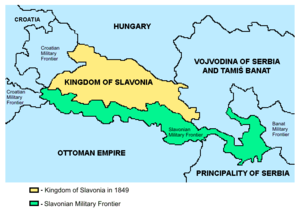 The Kingdom of Slavonia was formed from territories that Habsburg Monarchy
gained from Ottoman Empire
by the Treaty of Karlowitz
(1699). Initially, it was an separate Habsburg land under joint civil-military administration that lasted from 1699 to 1745. In 1745, the full civil administration was introduced and Kingdom of Slavonia, as one of the Lands of the Crown of St. Stephen
, was administratively included into both, the Habsburg Kingdom of Croatia
, and the Habsburg Kingdom of Hungary
. After 1849 the Kingdom of Slavonia and Kingdom of Croatia were affirmed as completely separate crownlands (constituent lands) of the Austrian Empire
. Following the 1868 Settlement (Nagodba) with the Kingdom of Hungary, Kingdom of Slavonia was joined with Kingdom of Croatia into the single Kingdom of Croatia-Slavonia
, which although it was under the suzerainty of the Crown of Saint Stephen kept a significant level of self-rule.
, 128,000 (45.7%) Croats
, 19,000 (6.8%) Hungarians, and 2,000 (0.7%) Germans
. The Kingdom of Slavonia in this time also included northern parts of eastern Syrmia
mainly inhabited by Serbs, hence the number of Serbs in the Kingdom was larger than the number of Croats.
According to other statistical estimations, in 1787 in civil Slavonia there were 265,670 inhabitants, and in 1804/1805 there were 286,349 inhabitants, but from that number clergy and nobility were excluded. Ethnicity can be (partially) determined through religion: Germans and Italians and Catholic Slavs were mostly of the same religion, and some Serbs were Roman Catholic as well. Only men were counted in that census. There were: 74,671 Roman Catholics, 68,390 Orthodox Christians
, 1,744 Calvinists, 97 Lutherans and 160 Jews
. Number of Orthodox Christians was higher in Syrmia
: 32,090 Orthodox Christians and 12,633 Roman Catholics. In other two counties of Slavonia: Požega and Virovitica, as in city of Požega, Roman Catholics outnumbered Orthodox population.
Croatian language
Croatian is the collective name for the standard language and dialects spoken by Croats, principally in Croatia, Bosnia and Herzegovina, the Serbian province of Vojvodina and other neighbouring countries...
and Serbian
Serbian language
Serbian is a form of Serbo-Croatian, a South Slavic language, spoken by Serbs in Serbia, Bosnia and Herzegovina, Montenegro, Croatia and neighbouring countries....
: Kraljevina Slavonija; ; ; ) was a province of the Habsburg Monarchy
Habsburg Monarchy
The Habsburg Monarchy covered the territories ruled by the junior Austrian branch of the House of Habsburg , and then by the successor House of Habsburg-Lorraine , between 1526 and 1867/1918. The Imperial capital was Vienna, except from 1583 to 1611, when it was moved to Prague...
and the Austrian Empire
Austrian Empire
The Austrian Empire was a modern era successor empire, which was centered on what is today's Austria and which officially lasted from 1804 to 1867. It was followed by the Empire of Austria-Hungary, whose proclamation was a diplomatic move that elevated Hungary's status within the Austrian Empire...
that existed from 1699 to 1868. The province included northern parts of present-day regions of Slavonia
Slavonia
Slavonia is a geographical and historical region in eastern Croatia...
(today in Croatia
Croatia
Croatia , officially the Republic of Croatia , is a unitary democratic parliamentary republic in Europe at the crossroads of the Mitteleuropa, the Balkans, and the Mediterranean. Its capital and largest city is Zagreb. The country is divided into 20 counties and the city of Zagreb. Croatia covers ...
) and Syrmia
Syrmia
Syrmia is a fertile region of the Pannonian Plain in Europe, between the Danube and Sava rivers. It is divided between Serbia in the east and Croatia in the west....
(today in Serbia
Serbia
Serbia , officially the Republic of Serbia , is a landlocked country located at the crossroads of Central and Southeast Europe, covering the southern part of the Carpathian basin and the central part of the Balkans...
and Croatia
Croatia
Croatia , officially the Republic of Croatia , is a unitary democratic parliamentary republic in Europe at the crossroads of the Mitteleuropa, the Balkans, and the Mediterranean. Its capital and largest city is Zagreb. The country is divided into 20 counties and the city of Zagreb. Croatia covers ...
). The southern parts of these regions were part of the Habsburg Military Frontier
Military Frontier
The Military Frontier was a borderland of Habsburg Austria and later the Austro-Hungarian Monarchy, which acted as the cordon sanitaire against incursions from the Ottoman Empire...
(Slavonian Krajina
Slavonian Krajina
The Slavonian Military Frontier or Slavonian Krajina was part of the Habsburg Military Frontier. It was formed out of territories the Habsburgs conquered from the Ottoman Empire and included southern parts of Slavonia and Syrmia; today the area it covered is mostly in eastern Croatia, with its...
).
History
Habsburg Monarchy
The Habsburg Monarchy covered the territories ruled by the junior Austrian branch of the House of Habsburg , and then by the successor House of Habsburg-Lorraine , between 1526 and 1867/1918. The Imperial capital was Vienna, except from 1583 to 1611, when it was moved to Prague...
gained from Ottoman Empire
Ottoman Empire
The Ottoman EmpireIt was usually referred to as the "Ottoman Empire", the "Turkish Empire", the "Ottoman Caliphate" or more commonly "Turkey" by its contemporaries...
by the Treaty of Karlowitz
Treaty of Karlowitz
The Treaty of Karlowitz was signed on 26 January 1699 in Sremski Karlovci , concluding the Austro-Ottoman War of 1683–1697 in which the Ottoman side had been defeated at the Battle of Zenta...
(1699). Initially, it was an separate Habsburg land under joint civil-military administration that lasted from 1699 to 1745. In 1745, the full civil administration was introduced and Kingdom of Slavonia, as one of the Lands of the Crown of St. Stephen
Lands of the Crown of St. Stephen
The historical term Lands of the Crown of Saint Stephen was used to denote a group of territories connected to the Kingdom of Hungary within Austria-Hungary...
, was administratively included into both, the Habsburg Kingdom of Croatia
Kingdom of Croatia (Habsburg)
The Kingdom of Croatia was an administrative division that existed between 1527 and 1868 within the Habsburg Monarchy . The Kingdom was a part of the Lands of the Crown of St. Stephen, but was subject to direct Imperial Austrian rule for significant periods of time, including its final years...
, and the Habsburg Kingdom of Hungary
Kingdom of Hungary
The Kingdom of Hungary comprised present-day Hungary, Slovakia and Croatia , Transylvania , Carpatho Ruthenia , Vojvodina , Burgenland , and other smaller territories surrounding present-day Hungary's borders...
. After 1849 the Kingdom of Slavonia and Kingdom of Croatia were affirmed as completely separate crownlands (constituent lands) of the Austrian Empire
Austrian Empire
The Austrian Empire was a modern era successor empire, which was centered on what is today's Austria and which officially lasted from 1804 to 1867. It was followed by the Empire of Austria-Hungary, whose proclamation was a diplomatic move that elevated Hungary's status within the Austrian Empire...
. Following the 1868 Settlement (Nagodba) with the Kingdom of Hungary, Kingdom of Slavonia was joined with Kingdom of Croatia into the single Kingdom of Croatia-Slavonia
Kingdom of Croatia-Slavonia
The Kingdom of Croatia-Slavonia or Croatia Slavonia was an autonomous kingdom within the Austro-Hungarian Empire. It was part of the Hungarian Kingdom within the dual Austro-Hungarian state, being within the Lands of the Crown of St. Stephen or Transleithania...
, which although it was under the suzerainty of the Crown of Saint Stephen kept a significant level of self-rule.
Population
The 1790 Austrian population census for the Kingdom of Slavonia recorded 131,000 (46.8%) SerbsSerbs
The Serbs are a South Slavic ethnic group of the Balkans and southern Central Europe. Serbs are located mainly in Serbia, Montenegro and Bosnia and Herzegovina, and form a sizable minority in Croatia, the Republic of Macedonia and Slovenia. Likewise, Serbs are an officially recognized minority in...
, 128,000 (45.7%) Croats
Croats
Croats are a South Slavic ethnic group mostly living in Croatia, Bosnia and Herzegovina and nearby countries. There are around 4 million Croats living inside Croatia and up to 4.5 million throughout the rest of the world. Responding to political, social and economic pressure, many Croats have...
, 19,000 (6.8%) Hungarians, and 2,000 (0.7%) Germans
Germans
The Germans are a Germanic ethnic group native to Central Europe. The English term Germans has referred to the German-speaking population of the Holy Roman Empire since the Late Middle Ages....
. The Kingdom of Slavonia in this time also included northern parts of eastern Syrmia
Syrmia
Syrmia is a fertile region of the Pannonian Plain in Europe, between the Danube and Sava rivers. It is divided between Serbia in the east and Croatia in the west....
mainly inhabited by Serbs, hence the number of Serbs in the Kingdom was larger than the number of Croats.
According to other statistical estimations, in 1787 in civil Slavonia there were 265,670 inhabitants, and in 1804/1805 there were 286,349 inhabitants, but from that number clergy and nobility were excluded. Ethnicity can be (partially) determined through religion: Germans and Italians and Catholic Slavs were mostly of the same religion, and some Serbs were Roman Catholic as well. Only men were counted in that census. There were: 74,671 Roman Catholics, 68,390 Orthodox Christians
Eastern Orthodox Church
The Orthodox Church, officially called the Orthodox Catholic Church and commonly referred to as the Eastern Orthodox Church, is the second largest Christian denomination in the world, with an estimated 300 million adherents mainly in the countries of Belarus, Bulgaria, Cyprus, Georgia, Greece,...
, 1,744 Calvinists, 97 Lutherans and 160 Jews
Jews
The Jews , also known as the Jewish people, are a nation and ethnoreligious group originating in the Israelites or Hebrews of the Ancient Near East. The Jewish ethnicity, nationality, and religion are strongly interrelated, as Judaism is the traditional faith of the Jewish nation...
. Number of Orthodox Christians was higher in Syrmia
Syrmia
Syrmia is a fertile region of the Pannonian Plain in Europe, between the Danube and Sava rivers. It is divided between Serbia in the east and Croatia in the west....
: 32,090 Orthodox Christians and 12,633 Roman Catholics. In other two counties of Slavonia: Požega and Virovitica, as in city of Požega, Roman Catholics outnumbered Orthodox population.
See also
- SlavoniaSlavoniaSlavonia is a geographical and historical region in eastern Croatia...
- Banovina of SlavoniaBanovina of SlavoniaThe Banovina of Slavonia was a province of the medieval Kingdom of Hungary and Kingdom of Croatia. It included parts of present-day Croatia and Bosnia and Herzegovina...
- Croatia-Slavonia
- Slavonian KrajinaSlavonian KrajinaThe Slavonian Military Frontier or Slavonian Krajina was part of the Habsburg Military Frontier. It was formed out of territories the Habsburgs conquered from the Ottoman Empire and included southern parts of Slavonia and Syrmia; today the area it covered is mostly in eastern Croatia, with its...
- Kingdom of DalmatiaKingdom of DalmatiaThe Kingdom of Dalmatia was an administrative division of the Habsburg Monarchy from 1815 to 1918. Its capital was Zadar.-History:...
- Timeline of Croatian historyTimeline of Croatian historyThis is a timeline of Croatian history. To read about the background to these events, see History of Croatia. See also the list of rulers of Croatia and years in Croatia.This timeline is incomplete; some important events may be missing...

