

Ruma

Encyclopedia

Town
A town is a human settlement larger than a village but smaller than a city. The size a settlement must be in order to be called a "town" varies considerably in different parts of the world, so that, for example, many American "small towns" seem to British people to be no more than villages, while...
and municipality
Municipality
A municipality is essentially an urban administrative division having corporate status and usually powers of self-government. It can also be used to mean the governing body of a municipality. A municipality is a general-purpose administrative subdivision, as opposed to a special-purpose district...
located in Vojvodina
Vojvodina
Vojvodina, officially called Autonomous Province of Vojvodina is an autonomous province of Serbia. Its capital and largest city is Novi Sad...
, Serbia
Serbia
Serbia , officially the Republic of Serbia , is a landlocked country located at the crossroads of Central and Southeast Europe, covering the southern part of the Carpathian basin and the central part of the Balkans...
at 45.00°N 19.83°E. In 2002 the town had a total population of 34,229, while Ruma municipality had a population of 60,006.
History
Traces of organized human life on the territory of Ruma municipality date back as far as the prehistoryPrehistory
Prehistory is the span of time before recorded history. Prehistory can refer to the period of human existence before the availability of those written records with which recorded history begins. More broadly, it refers to all the time preceding human existence and the invention of writing...
. The most important archaeological locality in the municipality is Bronze Age Gomolava near Hrtkovci
Hrtkovci
Hrtkovci is a village in Serbia. It is located in the Ruma municipality, in the Srem District, Vojvodina province. The village has a Serb ethnic majority and its population numbering 3,428 people...
, with two exclusive tombs of Bosut culture
Bosut culture
Bosut culture is a name of an prehistoric Iron Age culture, which was named after Gradina on Bosut archaeological site in Serbia. It is sometimes grouped with related Basarabi culture into Bosut-Basarabi complex...
dating to 9th century BC and 3000BC Vučedol culture
Vucedol culture
The Vučedol culture was a Indo-European culture that flourished between 3000 and 2200 BC , centered in Syrmia and eastern Slavonia on the right bank of the Danube river, but possibly spreading throughout the Pannonian plain and western Balkans...
pottery. First known inhabitants of this area were various peoples of Illyrian
Illyrians
The Illyrians were a group of tribes who inhabited part of the western Balkans in antiquity and the south-eastern coasts of the Italian peninsula...
and Celtic origin, such as the Amantini
Amantini
Amantini was the name of an Pannonian Illyrian tribe.They greatly resisted the Romans but were sold as slaves after their defeat.The Amantini were close to Sirmium but the tribe was probably present in southern areas as well due to the existence of a city name Amantia.This would make the south...
, Breuci, Scordisci
Scordisci
The Scordisci were an Iron Age tribe centered in the territory of present-day Serbia, at the confluence of the Savus , Dravus and Danube rivers. They were historically notable from the beginning of the third century BC until the turn of the common era...
, etc. During Roman
Roman Empire
The Roman Empire was the post-Republican period of the ancient Roman civilization, characterised by an autocratic form of government and large territorial holdings in Europe and around the Mediterranean....
rule, local inhabitants lost their ethnic character and adopted Roman culture. There were no larger Roman settlements on the territory of Ruma, but a certain number of agricultural estates known as "villae rusticae
Roman villa
A Roman villa is a villa that was built or lived in during the Roman republic and the Roman Empire. A villa was originally a Roman country house built for the upper class...
" were located there.
Migrations of Huns
Huns
The Huns were a group of nomadic people who, appearing from east of the Volga River, migrated into Europe c. AD 370 and established the vast Hunnic Empire there. Since de Guignes linked them with the Xiongnu, who had been northern neighbours of China 300 years prior to the emergence of the Huns,...
, Germanic peoples
Germanic peoples
The Germanic peoples are an Indo-European ethno-linguistic group of Northern European origin, identified by their use of the Indo-European Germanic languages which diversified out of Proto-Germanic during the Pre-Roman Iron Age.Originating about 1800 BCE from the Corded Ware Culture on the North...
, Avars
Eurasian Avars
The Eurasian Avars or Ancient Avars were a highly organized nomadic confederacy of mixed origins. They were ruled by a khagan, who was surrounded by a tight-knit entourage of nomad warriors, an organization characteristic of Turko-Mongol groups...
and Slavs destroyed the Roman culture in this area. During the following centuries, the region was ruled by Frankish Empire
Frankish Empire
Francia or Frankia, later also called the Frankish Empire , Frankish Kingdom , Frankish Realm or occasionally Frankland, was the territory inhabited and ruled by the Franks from the 3rd to the 10th century...
, Bulgarian Empire
Bulgarian Empire
Bulgarian Empire is a term used to describe two periods in the medieval history of Bulgaria, during which it acted as a key regional power in Europe in general and in Southeastern Europe in particular, rivalling Byzantium...
, Byzantine Empire
Byzantine Empire
The Byzantine Empire was the Eastern Roman Empire during the periods of Late Antiquity and the Middle Ages, centred on the capital of Constantinople. Known simply as the Roman Empire or Romania to its inhabitants and neighbours, the Empire was the direct continuation of the Ancient Roman State...
and Kingdom of Hungary
Kingdom of Hungary
The Kingdom of Hungary comprised present-day Hungary, Slovakia and Croatia , Transylvania , Carpatho Ruthenia , Vojvodina , Burgenland , and other smaller territories surrounding present-day Hungary's borders...
.
The settlement named Ruma was first mentioned in an Ottoman
Ottoman Empire
The Ottoman EmpireIt was usually referred to as the "Ottoman Empire", the "Turkish Empire", the "Ottoman Caliphate" or more commonly "Turkey" by its contemporaries...
defter
Defter
A Defter was a type of tax register in the Ottoman Empire. The information collected could vary, but tahrir defterleri typically included details of villages, dwellings, household heads , ethnicity/religion , and land use.The defter-i hakâni was a land registry, also used for tax...
from 1566/7. In that period Ruma was a village inhabited by Serbs
Serbs
The Serbs are a South Slavic ethnic group of the Balkans and southern Central Europe. Serbs are located mainly in Serbia, Montenegro and Bosnia and Herzegovina, and form a sizable minority in Croatia, the Republic of Macedonia and Slovenia. Likewise, Serbs are an officially recognized minority in...
, with 49 houses a church and three priests. http://www.ruma.rs/eng/index.php?option=com_content&view=category&layout=blog&id=34&Itemid=27
Since 1718, Ruma was under administration of the Habsburg Monarchy
Habsburg Monarchy
The Habsburg Monarchy covered the territories ruled by the junior Austrian branch of the House of Habsburg , and then by the successor House of Habsburg-Lorraine , between 1526 and 1867/1918. The Imperial capital was Vienna, except from 1583 to 1611, when it was moved to Prague...
. In 1746, the town of Ruma was founded near the village of Ruma. First inhabitants of the town were Serbs
Serbs
The Serbs are a South Slavic ethnic group of the Balkans and southern Central Europe. Serbs are located mainly in Serbia, Montenegro and Bosnia and Herzegovina, and form a sizable minority in Croatia, the Republic of Macedonia and Slovenia. Likewise, Serbs are an officially recognized minority in...
, http://www.ruma.rs/eng/index.php?option=com_content&view=category&layout=blog&id=34&Itemid=27 who came from neighboring settlements, as well as Germans
Germans
The Germans are a Germanic ethnic group native to Central Europe. The English term Germans has referred to the German-speaking population of the Holy Roman Empire since the Late Middle Ages....
, who came from Germany. In the beginning of the 19th century, Croats
Croats
Croats are a South Slavic ethnic group mostly living in Croatia, Bosnia and Herzegovina and nearby countries. There are around 4 million Croats living inside Croatia and up to 4.5 million throughout the rest of the world. Responding to political, social and economic pressure, many Croats have...
and Hungarians settled there as well. In 1807, a large rebellion of the Syrmia
Syrmia
Syrmia is a fertile region of the Pannonian Plain in Europe, between the Danube and Sava rivers. It is divided between Serbia in the east and Croatia in the west....
n peasants known as the Tican's Rebellion
Tican's Rebellion
The Tican's Rebellion was a rebellion of the Syrmian peasants against feudal relations in society. The rebellion started in April 1807 on the estate of Ruma of earl Karlo Pejačević and estate of Ilok of earl Odescalchi...
started on the estate of Ruma, with its center in the village of Voganj
Voganj
Voganj is a village in Serbia. It is situated in the Ruma municipality, in the Srem District, Vojvodina province. The village has a Serb ethnic majority and its population numbering 1,614 people .-History:...
. During the 1848-1849 revolution
Revolutions of 1848
The European Revolutions of 1848, known in some countries as the Spring of Nations, Springtime of the Peoples or the Year of Revolution, were a series of political upheavals throughout Europe in 1848. It was the first Europe-wide collapse of traditional authority, but within a year reactionary...
, Ruma was one of the important centers of Serbian national movement in Syrmia. According to the 1910 census, population of the Ruma municipality numbered 49,138 inhabitants, of whom 22,956 spoke Serbian
Serbian language
Serbian is a form of Serbo-Croatian, a South Slavic language, spoken by Serbs in Serbia, Bosnia and Herzegovina, Montenegro, Croatia and neighbouring countries....
, 15,529 German
German language
German is a West Germanic language, related to and classified alongside English and Dutch. With an estimated 90 – 98 million native speakers, German is one of the world's major languages and is the most widely-spoken first language in the European Union....
, 5,746 Hungarian
Hungarian language
Hungarian is a Uralic language, part of the Ugric group. With some 14 million speakers, it is one of the most widely spoken non-Indo-European languages in Europe....
, and 3,730 Croatian
Croatian language
Croatian is the collective name for the standard language and dialects spoken by Croats, principally in Croatia, Bosnia and Herzegovina, the Serbian province of Vojvodina and other neighbouring countries...
. http://www.talmamedia.com/php/district/district.php?county=Szer%E9m%20(Srijem)
After the collapse of the Habsburg Monarchy, on November 24, 1918, the Assembly of Syrmia in Ruma proclaimed the unification of Syrmia with the Kingdom of Serbia
Kingdom of Serbia
The Kingdom of Serbia was created when Prince Milan Obrenović, ruler of the Principality of Serbia, was crowned King in 1882. The Principality of Serbia was ruled by the Karađorđevic dynasty from 1817 onwards . The Principality, suzerain to the Porte, had expelled all Ottoman troops by 1867, de...
. In 1933, Ruma officially gained the status of a city.
When World War II
World War II
World War II, or the Second World War , was a global conflict lasting from 1939 to 1945, involving most of the world's nations—including all of the great powers—eventually forming two opposing military alliances: the Allies and the Axis...
began, Ruma was one of the centers of German
Germans
The Germans are a Germanic ethnic group native to Central Europe. The English term Germans has referred to the German-speaking population of the Holy Roman Empire since the Late Middle Ages....
national minority in Vojvodina
Vojvodina
Vojvodina, officially called Autonomous Province of Vojvodina is an autonomous province of Serbia. Its capital and largest city is Novi Sad...
.http://www.ruma.rs/eng/index.php?option=com_content&view=category&layout=blog&id=34&Itemid=27 In 1942, during the Axis
Axis Powers
The Axis powers , also known as the Axis alliance, Axis nations, Axis countries, or just the Axis, was an alignment of great powers during the mid-20th century that fought World War II against the Allies. It began in 1936 with treaties of friendship between Germany and Italy and between Germany and...
occupation of Syrmia, a unit of the Third Reich's
Nazi Germany
Nazi Germany , also known as the Third Reich , but officially called German Reich from 1933 to 1943 and Greater German Reich from 26 June 1943 onward, is the name commonly used to refer to the state of Germany from 1933 to 1945, when it was a totalitarian dictatorship ruled by...
Wehrmacht
Wehrmacht
The Wehrmacht – from , to defend and , the might/power) were the unified armed forces of Nazi Germany from 1935 to 1945. It consisted of the Heer , the Kriegsmarine and the Luftwaffe .-Origin and use of the term:...
, known as the Volunteer Company Ruma ES der DM, was formed from local Volksdeutsche
Volksdeutsche
Volksdeutsche - "German in terms of people/folk" -, defined ethnically, is a historical term from the 20th century. The words volk and volkische conveyed in Nazi thinking the meanings of "folk" and "race" while adding the sense of superior civilization and blood...
volunteers. http://www.axishistory.com/index.php?id=7283 A large number of non-German citizens of Ruma participated in anti-fascist struggle against Axis occupation. In 1944, as a consequence of the war, most members of German national minority left the town escaping before Yugoslav partisans and Soviet Red Army.
After the war, colonists from various parts of former Yugoslavia
Yugoslavia
Yugoslavia refers to three political entities that existed successively on the western part of the Balkans during most of the 20th century....
settled this area. During the 1990s, about 10,000 refugees from Croatia
Croatia
Croatia , officially the Republic of Croatia , is a unitary democratic parliamentary republic in Europe at the crossroads of the Mitteleuropa, the Balkans, and the Mediterranean. Its capital and largest city is Zagreb. The country is divided into 20 counties and the city of Zagreb. Croatia covers ...
, Bosnia
Bosnia and Herzegovina
Bosnia and Herzegovina , sometimes called Bosnia-Herzegovina or simply Bosnia, is a country in Southern Europe, on the Balkan Peninsula. Bordered by Croatia to the north, west and south, Serbia to the east, and Montenegro to the southeast, Bosnia and Herzegovina is almost landlocked, except for the...
and Kosovo
Kosovo
Kosovo is a region in southeastern Europe. Part of the Ottoman Empire for more than five centuries, later the Autonomous Province of Kosovo and Metohija within Serbia...
settled in Ruma as well. In 1949 The aeroclub of Yugoslavia (Vazduhoplovni Savez Jugoslavije) opened a pilot school, a school for parachute instructors and a school for aircraft modeling in Ruma, all of which were supported by the Airforces of Yugoslavia. This culminated in a praised International aeromeeting held in the central town in 1950.
Inhabited places
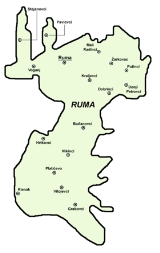
Ruma municipality includes the city of Ruma and the following villages:- Buđanovci
- VitojevciVitojevciVitojevci is a village in Serbia. It is situated in the Ruma municipality, in the Srem District, Vojvodina province. The village has a Serb ethnic majority and its population numbering 913 people .-See also:*List of places in Serbia...
- VoganjVoganjVoganj is a village in Serbia. It is situated in the Ruma municipality, in the Srem District, Vojvodina province. The village has a Serb ethnic majority and its population numbering 1,614 people .-History:...
- GrabovciGrabovciGrabovci is a village in Serbia. It is situated in the Ruma municipality, in the Srem District, Vojvodina province. The village has a Serb ethnic majority and its population numbering 1,480 people .-See also:*List of places in Serbia...
- DobrinciDobrinciDobrinci is a village in Serbia. It is situated in the Ruma municipality, in the Srem District, Vojvodina province. The village has a Serb ethnic majority and its population numbering 1,716 people ....
- Donji PetrovciDonji PetrovciDonji Petrovci is a village in Serbia. It is situated in Ruma municipality, Srem District, Vojvodina province. The village has a Serb ethnic majority and a population of 991 people...
- Žarkovac
- KlenakKlenakKlenak may refer to:* Klenak , a village in Ruma municipality, Vojvodina province, Serbia* Klenak, a part of Kaluđerica, suburb of Belgrade, Serbia* Klenak , a village in Montenegro...
- Kraljevci
- Mali RadinciMali RadinciMali Radinci is a village in Serbia. It is situated in the Ruma municipality, in the Srem District, Vojvodina province. The village has a Serb ethnic majority and its population numbering 598 people .-External links:*...
- NikinciNikinciNikinci is a village in Serbia. It is located in the Ruma municipality, in the Srem District, Vojvodina province. The village has a Serb ethnic majority and its population numbering 2,216 people .-History:...
- Pavlovci
- PlatičevoPlaticevoPlatičevo is a village in Serbia. It is located in the Ruma municipality, in the Srem District, Vojvodina province. The village has a Serb ethnic majority and its population numbering 2,760 people .-External links:*...
- PutinciPutinciPutinci is a village in Serbia. It is situated in the Ruma municipality, in the Srem District, Vojvodina province. The village has a Serb ethnic majority and its population numbering 3,244 people .-External links:*...
- StejanovciStejanovciStejanovci is a village in Serbia. It is situated in the Ruma municipality, in the Srem District, Vojvodina province. The village has a Serb ethnic majority and its population numbering 1,020 people .-See also:*List of places in Serbia...
- HrtkovciHrtkovciHrtkovci is a village in Serbia. It is located in the Ruma municipality, in the Srem District, Vojvodina province. The village has a Serb ethnic majority and its population numbering 3,428 people...
Ethnic groups in the Ruma municipality
- SerbsSerbsThe Serbs are a South Slavic ethnic group of the Balkans and southern Central Europe. Serbs are located mainly in Serbia, Montenegro and Bosnia and Herzegovina, and form a sizable minority in Croatia, the Republic of Macedonia and Slovenia. Likewise, Serbs are an officially recognized minority in...
= 51,957 (86.58%) - CroatsCroatsCroats are a South Slavic ethnic group mostly living in Croatia, Bosnia and Herzegovina and nearby countries. There are around 4 million Croats living inside Croatia and up to 4.5 million throughout the rest of the world. Responding to political, social and economic pressure, many Croats have...
= 1,987 (3.31%) - Hungarians = 1,306 (2.17%)
- YugoslavsYugoslavsYugoslavs is a national designation used by a minority of South Slavs across the countries of the former Yugoslavia and in the diaspora...
= 1,017 (1.69%) - Roma = 757 (1.26%)
- Others.
All settlements in the municipality have an ethnic Serb majority.
Ethnic groups in the Ruma town
- SerbsSerbsThe Serbs are a South Slavic ethnic group of the Balkans and southern Central Europe. Serbs are located mainly in Serbia, Montenegro and Bosnia and Herzegovina, and form a sizable minority in Croatia, the Republic of Macedonia and Slovenia. Likewise, Serbs are an officially recognized minority in...
= 28,032 (86.98%) - CroatsCroatsCroats are a South Slavic ethnic group mostly living in Croatia, Bosnia and Herzegovina and nearby countries. There are around 4 million Croats living inside Croatia and up to 4.5 million throughout the rest of the world. Responding to political, social and economic pressure, many Croats have...
= 1,027 (3.19%) - Others.
Notable citizens
- Teodor Toša Andrejević, musician.
- Aleksandar Berček, actor.
- Brana Crnčević, writer.
- Teodor FilipovićTeodor FilipovicTeodor Filipović , Serbian writer, jurist and educator, is also known by his pseudonym Božidar Grujović. одломци из дела Милован Ристић: Устанички законописац Теодор Филиповић , Просвета, Београд 1953.-Biography:...
(Boža Grujović), first secretary of "Praviteljstvujušči sovjet" in Karađorđe's Serbia. - Stjepko GutStjepko GutStjepko Gut is a Belgrade-based jazz musician. Studied jazz trumpet at the Swiss Jazz School in Bern,Switzerland and at the Berklee College of Music in Boston, Massachusetts. As a conductor, he won first place in the first Austrian Big Band Competition...
, jazz musician - Radovan Košutić, phylologist.
- Slavko Mađer, Croatian writer
- Dimitrije Matić, statesman and lawmaker.
- Dr. Žarko Miladinović, public worker, politician and minister in the government of the Kingdom of Serbs, Croats and Slovenes.
- Jovan Pantelić, painter.
- Konstantin Pantelić, painter.
- Paško Rakić, neuroscientist
- Atanasije Stojković, scientist and literate.
- Atanasije Teodorović, first professor of Serbian LyceumLyceumThe lyceum is a category of educational institution defined within the education system of many countries, mainly in Europe. The definition varies between countries; usually it is a type of secondary school.-History:...
. - Pavle Vujović, professor of the University of Belgrade.
- Nenad Vukelić Vendi, musician.
See also
- List of cities in Serbia
- List of cities, towns and villages in Vojvodina
- SyrmiaSyrmiaSyrmia is a fertile region of the Pannonian Plain in Europe, between the Danube and Sava rivers. It is divided between Serbia in the east and Croatia in the west....
- Srem DistrictSrem DistrictSyrmia or Srem District is a northwestern district of Serbia. It lies in the regions of Syrmia and Mačva, in the autonomous province of Vojvodina. It has a population of 309,981...