


European Parliament

Encyclopedia
The European Parliament (abbreviated as Europarl or the EP) is the directly elected
parliamentary institution of the
European Union
(EU). Together with the Council of the European Union
(the Council) and the Commission
, it exercises the legislative function of the EU and it has been described as one of the most powerful legislatures in the world. The Parliament is composed of 736 MEPs (Members of the European Parliament
), who serve the second largest democratic electorate in the world (after India) and the largest trans-national democratic electorate in the world (375 million eligible voters in 2009).
It has been directly elected every five years by universal suffrage
since 1979. Although the European Parliament has legislative power that such bodies as those above do not possess, it does not formally possess legislative initiative
, as most state parliaments within the Union
do. Parliament is the "first institution" of the EU (mentioned first in the treaties
, having ceremonial precedence over all authority at European level), and shares equal legislative and budgetary powers with the Council (except a few areas where the special legislative procedures apply). It likewise has equal control over the EU budget. Finally, the European Commission
, the executive body of the EU, is accountable to Parliament: in particular Parliament elects the President of the Commission, and approves (or not) the appointment of the Commission as a whole. It can subsequently force the Commission as a body to resign by adopting a motion of censure.
The President of the European Parliament
(Parliament's speaker
) is currently Jerzy Buzek
(EPP), elected in July 2009. He presides over a multi-party chamber, the two largest groups being the EPP and the Progressive Alliance of Socialists and Democrats
(S&D). The last Union-wide elections were the 2009 Parliamentary Elections
. Parliament has two meeting places, namely the Louise Weiss building
in Strasbourg
, France, which serves for twelve four-day plenary session
s per year and is the official seat, and the Espace Léopold
complex in Brussels
, Belgium, the larger of the two, which serves for committee meetings, political groups and complementary plenary sessions. The Secretariat of the European Parliament
, the Parliament's administrative body, is based in Luxembourg
.
(ECSC). It was a consultative assembly of 78 parliamentarians
drawn from the national parliaments of member states (see dual mandate
), having no legislative powers. This change since its foundation was highlighted by Professor David Farrell of the University of Manchester
;
Its development since its foundation is a testament to the evolution of the Union's structures without one clear "master plan". Some such as Tom Reid of the Washington Post said of the Union, "nobody would have deliberately designed a government as complex and as redundant as the EU". Even the Parliament's two seats, which have switched several times, are a result of various agreements or lack of agreements.
. It was assumed or hoped that difficulties with the British would be resolved to allow the Council of Europe's Assembly to perform the task. A separate Assembly was introduced during negotiations on the Treaty as an institution which would counterbalance and monitor the executive
while providing democratic legitimacy. The wording of the ECSC Treaty
demonstrated the leaders desire for more than a normal consultative assembly by using the term "representatives of the people" and allowed for direct election. Its early importance was highlighted when the Assembly was given the task of drawing up the draft treaty to establish a European Political Community
. In this, the Ad Hoc Assembly was established on 13 September 1952 with extra members but after the failure of the proposed European Defence Community
the project was dropped.
Despite this the European Economic Community
and Euratom were established in 1958 by the Treaties of Rome. The Common Assembly was shared by all three communities (which had separate executives) and it renamed itself the "European Parliamentary Assembly." The first meeting was held on 19 March 1958 having been set up in Luxembourg, it elected Schuman as its president and on 13 May it rearranged itself to sit according to political ideology rather than nationality. This is seen as the birth of the modern European Parliament, with Parliament's 50 years celebrations being held in March 2008 rather than 2002.
The three communities merged
their remaining organs as the European Communities
in 1967 and the body was renamed to the current "European Parliament" in 1962. In 1970 the Parliament was granted power over areas of the Community's budget, which were expanded to the whole budget in 1975. Under the Rome Treaties, the Parliament should have become elected. However the Council was required to agree a uniform voting system before hand, which it failed to do. The Parliament threatened to take the Council to the European Court of Justice
leading to a compromise whereby the Council would agree to elections, but the issue of voting systems would be put off till a later date.
 In 1979, its members were directly elected
for the first time
. This sets it apart from similar institutions such as those of the Parliamentary Assembly of the Council of Europe
or Pan-African Parliament
which are appointed. After that first election, the parliament held its first session on 11 July 1979, electing Simone Veil
MEP as its President. Veil was also the first female President of the Parliament since it was formed as the Common Assembly.
As an elected body, the Parliament began to draft proposals addressing the functioning of the EU. For example in 1984, inspired by its previous work on the Political Community, it drafted the "draft Treaty establishing the European Union" (also known as the 'Spinelli Plan' after its rapporteur Altiero Spinelli
MEP). Although it was not adopted, many ideas were later implemented by other treaties. Furthermore the Parliament began holding votes on proposed Commission Presidents
from the 1980s, before it was given any formal right to veto.
Since the election the membership of the European Parliament has simply expanded whenever new nations have joined (the membership was also adjusted upwards in 1994 after German reunification
). Following this the Treaty of Nice
imposed a cap on the number of members to be elected, 732.
Like the other institutions, the Parliament's seat
was not yet fixed. The provisional arrangements placed Parliament in Strasbourg
, while the Commission and Council had their seats in Brussels. In 1985 the Parliament, wishing to be closer to these institutions, built a second chamber in Brussels and moved some of its work there despite protests from some states. A final agreement was eventually reached by the European Council
in 1992. It stated the Parliament would retain its formal seat in Strasbourg, where twelve sessions a year would be held, but with all other parliamentary activity in Brussels. This two seat arrangement was contested by Parliament but was later enshrined in the Treaty of Amsterdam. To this day the institution's locations
are a source of contention.
The Parliament gained more powers from successive treaties, namely through the extension of the ordinary legislative procedure (then called the codecision procedure), and in 1999, the Parliament forced the resignation of the Santer Commission
. The Parliament had refused to approve the Community budget over allegations of fraud and mis-management in the Commission. The two main parties took on a government-opposition dynamic for the first time during the crisis which ended in the Commission resigning en masse, the first of any forced resignation, in the face of an impending censure from the Parliament.
MEPs raised doubts about some nominees with the Civil liberties committee
rejecting Rocco Buttiglione
from the post of Commissioner for Justice, Freedom and Security over his views on homosexuality. That was the first time the Parliament had ever voted against an incoming Commissioner and despite Barroso's insistence upon Buttiglione the Parliament forced Buttiglione to be withdrawn. A number of other Commissioners also had to be withdrawn or reassigned before Parliament allowed the Barroso Commission
to take office.
 Along with the extension of the ordinary legislative procedure, the Parliament's democratic mandate has given it greater control over legislation against the other institutions. In voting on the Bolkestein directive in 2006, the Parliament voted by a large majority for over 400 amendments that changed the fundamental principle of the law. The Financial Times
described it in the following terms:
In 2007, for the first time, Justice Commissioner Franco Frattini included Parliament in talks on the second Schengen Information System
even though MEPs only needed to be consulted on parts of the package. After that experiment, Frattini indicated he would like to include Parliament in all justice and criminal matters, informally pre-empting the new powers they could gain as part of the Treaty of Lisbon
. Between 2007 and 2009, a special working group on parliamentary reform
implemented a series of changes to modernise the institution such as more speaking time for rapporteurs, increase committee co-operation and other efficiency reforms.
 The Lisbon Treaty finally came into force on 1 December 2009, granting Parliament powers over the entire of the EU budget, making Parliament's legislative powers equal to the Council's in nearly all areas and linking the appointment of the Commission President
to Parliament's own elections. Despite some calls for the parties to put forward candidates before hand, only the EPP
(which had re-secured their position as largest party) had one in re-endorsing Barroso.
Barroso gained the support of the European Council for a second term and secured majority support from the Parliament in September 2009. Parliament voted 382 votes in favour and 219 votes against (117 abstentions ) with support of the European People's Party
, European Conservatives and Reformists
and the Alliance of Liberals and Democrats for Europe
. The liberals gave support after Barroso gave them a number of concessions; the liberals previously joined the socialists' call for a delayed vote (the EPP
had wanted to approve Barroso in July of that year).
Once Barroso put forward the candidates for his next Commission, another opportunity to gain concessions arose. Bulgarian nominee Rumiana Jeleva
was forced to step down by Parliament due to concerns over her experience and financial interests. She only had the support of the EPP
which began to retaliate on left wing candidates before Jeleva gave in and was replaced (setting back the final vote further).
Before the final vote, Parliament demanded a number of concessions as part of a future working agreement under the new Lisbon Treaty. The deal includes that Parliament's President will attend high level Commission meetings. Parliament will have a seat in the EU's Commission-lead international negotiations and have a right to information on agreements. However Parliament secured only an observer seat. Parliament also did not secure a say over the appointment of delegation heads and special representatives
for foreign policy. Although they will appear before parliament after they have been appointed by the High Representative
. One major internal power was that Parliament wanted a pledge from the Commission that it would put forward legislation when parliament requests. Barroso considered this an infringement on the Commission's powers but did agree to respond within three months. Most requests are already responded to positively.
During the setting up of the European External Action Service
(EEAS), Parliament used its control over the EU budget to influence the shape of the EEAS. MEPs had aimed at getting greater oversight over the EEAS by linking it to the Commission and having political deputies to the High Representative
. MEPs didn't manage to get everything they demanded, however they got broader financial control over the new body.
 The Parliament and Council can be regarded as two chambers in a bicameral legislative branch of the European Union, with law-making power being officially distributed equally between both parliamentary chambers. However there are some differences from national legislatures
; for example, neither the Parliament nor the Council have the power of legislative initiative
(except for the fact that the Council has the power in some intergovernmental matters). In Community matters, this is a power uniquely reserved for the European Commission
(the executive). Therefore, while Parliament can amend and reject legislation, to make a proposal for legislation, it needs the Commission to draft a bill
before anything can become law. However, the value of such a power is questioned, noting that only 15% of such initiatives in national parliaments become law due to the lack of executive support. Yet it has been argued by former Parliament president Hans-Gert Pöttering
that as the Parliament does have the right to ask the Commission to draft such legislation, and as the Commission is following Parliament's proposals more and more Parliament does have a de facto right of legislative initiative.
The Parliament also has a great deal of indirect influence, through non-binding resolutions and committee hearings, as a "pan-European soapbox
" with the ear of thousands of Brussels-based journalists. There is also an indirect effect on foreign policy
; the Parliament must approve all development grants, including those overseas. For example, the support for post-war Iraq reconstruction, or incentives for the cessation of Iranian nuclear development
, must be supported by the Parliament. Parliamentary support was also required for the transatlantic
passenger data-sharing deal with the United States. Finally, Parliament holds a non-binding vote on new EU treaties but cannot veto it. However when Parliament threatened to vote down the Nice Treaty, the Belgian
and Italian Parliaments
said they would veto the treaty on the European Parliament's behalf.
The few other areas that operate the special legislative procedures are justice & home affairs, budget and taxation and certain aspects of other policy areas: such as the fiscal aspects of environmental policy. In these areas, the Council or Parliament decide law alone. The procedure also depends upon which type of institutional act is being used. The strongest act is a regulation, an act
or law
which is directly applicable in its entirety. Then there are directives which bind member states to certain goals which they must achieve. They do this through their own laws and hence have room to manoeuvre in deciding upon them. A decision
is an instrument which is focused at a particular person or group and is directly applicable. Institutions may also issue recommendations and opinions
which are merely non-binding, declarations. There is a further document which does not follow normal procedures, this is a "written declaration" which is similar to an early day motion
used in the Westminster system
. It is a document proposed by up to five MEPs on a matter within the EU's activities used to launch a debate on that subject. Having been posted outside the entrance to the hemicycle, members can sign the declaration and if a majority do so it is forwarded to the President and announced to the plenary before being forwarded to the other institutions and formally noted in the minutes.
of the 1970s and the Lisbon Treaty. The EU budget is subject to a form of the ordinary legislative procedure with a single reading giving Parliament power over the entire budget (before 2009, its influence was limited to certain areas) on an equal footing to the Council. If there is a disagreement between them, it is taken to a conciliation committee as it is for legislative proposals. If the joint conciliation text is not approved, the Parliament may adopt it budget definitively.
The Parliament is also responsible for discharging the implementation of previous budgets based on the annual report of the European Court of Auditors
. It has refused to approve the budget only twice, in 1984 and in 1998. On the latter occasion it led to the resignation of the Santer Commission
; highlighting how the budgetary power gives Parliament a great deal of power over the Commission. Parliament also makes extensive use of its budgetary, and other powers, elsewhere; for example in the setting up of the European External Action Service
, Parliament has a defacto veto over its design as it has to approve the budgetary and staff changes.
s, there is a separation of powers
between the executive and legislative which makes the European Parliament more akin to the United States Congress
than an EU state legislature. The President of the European Commission
is proposed by the European Council on the basis of the European elections to Parliament. That proposal has to be approved by the Parliament (by a simple majority) who "elect" the President according to the treaties. Following the approval of the Commission President, the members of the Commission are proposed by the President in accord with the member-states. Each Commissioner comes before a relevant parliamentary committee hearing covering the proposed portfolio. They are then, as a body, approved or rejected by the Parliament. In practice, the Parliament has never voted against a President or his Commission, but it did seem likely when the Barroso Commission was put forward. The resulting pressure forced the proposal to be withdrawn and changed to be more acceptable to parliament. That pressure was seen as an important sign by some of the evolving nature of the Parliament and its ability to make the Commission accountable, rather than being a rubber stamp for candidates. Furthermore, in voting on the Commission, MEPs also voted along party lines, rather than national lines, despite frequent pressure from national governments on their MEPs. This cohesion and willingness to use the Parliament's power ensured greater attention from national leaders, other institutions and the public—who previously gave the lowest ever turnout for the Parliament's elections.
The Parliament also has the power to censure the Commission if they have a two-thirds majority which will force the resignation of the entire Commission from office. As with approval, this power has never been used but it was threatened to the Santer Commission
, who subsequently resigned of their own accord. There are a few other controls, such as: the requirement of Commission to submit reports to the Parliament and answer questions from MEPs; the requirement of the President-in-office of the Council to present its programme at the start of their presidency
; the obligation on the President of the European Council
to report to Parliament after each of its meetings; the right of MEPs to make requests for legislation and policy to the Commission; and the right to question members of those institutions (e.g. "Commission Question Time
" every Tuesday). At present, MEPs may ask a question on any topic whatsoever, but in July 2008 MEPs voted to limit questions to those within the EU's mandate and ban offensive or personal questions.
. The Parliament has the power to set up a Committee of Inquiry, for example over mad cow disease or CIA detention flights—the former led to the creation of the European veterinary agency
. The Parliament can call other institutions to answer questions and if necessary to take them to court if they break EU law or treaties. Furthermore it has powers over the appointment of the members of the Court of Auditors and the president and executive board of the European Central Bank
. The ECB president is also obliged to present an annual report to the parliament.
The European Ombudsman
is elected by the Parliament, who deals with public complaints against all institutions. Petitions
can also be brought forward by any EU citizen
on a matter within the EU's sphere of activities. The Committee on Petitions
hears cases, some 1500 each year, sometimes presented by the citizen themselves at the Parliament. While the Parliament attempts to resolve the issue as a mediator they do resort to legal proceedings if it is necessary to resolve the citizens dispute.
are known in English as Members of the European Parliament (MEPs). They are elected every five years by universal adult suffrage
and sit according to political allegiance; about a third are women. Before 1979 they were appointed by their national parliaments.
As states are allocated seats
according to population, the maximum number of MEPs is 736. However, enlargements may lead to this number being exceeded until the following election, for example between 2007 and 2009 due to the accession of Romania and Bulgaria however these rules have been changed under the Treaty of Lisbon. Under Lisbon, there will be 751 members (however, as the President cannot vote while in the chair there will only be 750 voting members at any one time). In addition, the number of seats allocated to Germany will be lowered to ninety-six, from the current ninety-nine, and the minimum number of seats will be raised to six, from the current five.
The seats are distributed according to "degressive proportionality
", meaning that the larger the state, the more citizens that are represented per MEP. Thus, for instance, Maltese and Luxembourgian voters have about 10x more influence than citizens of the six large countries. It is intended that the new system, including revising the seating well before elections, can avoid political horse trading when the numbers have to be revised.
Due to the delay in ratifying the Lisbon Treaty the seventh parliament was elected under the lower Nice Treaty cap. A small scale treaty amendment is, as of October 2011, nearing the end of ratification. This amendment would bring in transitional provisions to allow the extra MEPs to be elected or appointed before the 2014 election. Germany would be the only state to lose members, these extra seats would not be removed until the 2014 election.
Before 2009, members received the same salary as members of their national parliament. However as of 2009 a new members statute came into force, after years of attempts, which gives all members an equal monthly pay of 7,000 euro each, subject to a European Union tax and which can also be taxed nationally. MEPs would retire
at 63 and receive the whole of their pension
from the Parliament. Travelling expenses would also be given based on actual cost rather than a flat rate as happens now. Besides their pay, members are granted a number of privileges and immunities
. To ensure their free movement to and from the Parliament, they are accorded by their own states the facilities accorded to senior officials travelling abroad and by other state governments the facilities of visiting foreign representative
s. When in their own state they have all the immunities accorded to national parliamentarians, and in other states they have immunity from detention
and legal proceedings
. However immunity cannot be claimed when a member is found committing a criminal offence and the Parliament also has the right to strip a member of their immunity.
. The two largest groups are the European People's Party
(EPP) and the Socialists & Democrats
(S&D). These two groups have dominated the Parliament for much of its life, continuously holding between 50 and 70 percent of the seats together. No single group has ever held a majority in Parliament. As a result of being broad alliances of national parties, European groups parties are very decentralised and hence have more in common with parties in federal states like Germany or the United States than unitary states like the majority of the EU states. Although, the European groups, between 2004 and 2009, were actually more cohesive than their US counterparts.
Groups are often based on a single European political party
such as the socialist group
(before 2009). However they can, like the liberal group
, include more than one European party as well as national parties and independents. For a group to be recognised, it needs 25 MEPs from seven different countries. Once recognised, groups receive financial subsidies from the parliament and guaranteed seats on Committees, creating an incentive for the formation of groups. However some controversy occurred with the establishment of the short-lived Identity, Tradition, Sovereignty
(ITS) due to its ideology; the members of the group were far-right, so there were concerns about public funds going towards such a group. There were attempts to change the rules to block the formation of ITS, but that never came to fruition. They were, however, blocked from gaining leading positions on committees — traditionally (by agreement, not a rule) shared among all parties. When this group engaged in infighting, causing the withdrawal of some members, its size fell below the recognisable limit causing its collapse.
or Austrian Nationalrat than to a Westminster or French style Parliamentary system. Indeed for much of its life it has been dominated by a grand coalition
of the European People's Party and the Party of European Socialists. The two major parties tend to co-operate to find a compromise between their two groups leading to proposals endorsed by huge majorities. However, this does not always produce agreement, and each may instead try to build other alliances, the EPP normally with other centre-right or right wing Groups and the PES with centre-left or left wing Groups. Sometimes, the Liberal Group is then in the pivotal position.There are also occasions where very sharp party political divisions have emerged, for example over the resignation of the Santer Commission;
When the initial allegations against the Commission emerged, they were directed primarily against Édith Cresson
and Manuel Marín
, both socialist members. When the parliament was considering refusing to discharge the Community budget, President Jacques Santer stated that a no vote would be tantamount to a vote of no confidence. The Socialist group supported the Commission and saw the issue as an attempt by the EPP to discredit their party ahead of the 1999 elections. Socialist leader, Pauline Green
MEP, attempted a vote of confidence and the EPP put forward counter motions. During this period the two parties took on similar roles to a government-opposition
dynamic, with the Socialists supporting the executive and EPP renouncing its previous coalition support and voting it down. Politicisation such as this has been increasing, in 2007 Simon Hix of the London School of Economics
noted that:
During the fifth term, 1999 to 2004, there was a break in the grand coalition resulting in a centre-right coalition between the Liberal and People's parties. This was reflected in the Presidency of the Parliament with the terms being shared between the EPP and the ELDR, rather than the EPP and Socialists. In the following term the liberal group grew to hold 88 seats, the largest number of seats held by any third party in Parliament.
; while most members have a national list, some, like the UK and France, divide their allocation between regions. Seats are allocated to member-states according to their population, with no state having more than 99, but no fewer than 5, to maintain proportionality.
The most recent Union-wide elections to the European Parliament were the European elections of 2009
, held in June of that year. They were the largest simultaneous transnational elections ever held anywhere in the world, since nearly 380 million citizens were eligible to vote. The proportion of MEPs elected in 2009 who were female was 35%; in 1979 it was just 16.5%. There are a number of proposals to "dress up" the elections to attract greater public attention to them. These include most notably the idea of linking them more closely to the Commission presidency. This would be by having political parties running with candidates for the job, so the largest party would essentially be forming the government, as in the parliamentary system
of government. This was attempted in 2004, however only the European Green Party
, which was the first true pan-European party to be established with a common campaign, proposed a candidate for the post of President: Daniel Cohn-Bendit
. Meanwhile, the closest any other party had come in that election was when the People's Party mentioned four or five people they'd like to be President. In 2009, the incumbent President Barroso was formally nominated by the EPP, yet the Socialists were unable to agree on a candidate, in part due to some of their national leaders backing Barroso, leading to there only being one declared candidate (whose party formed the largest group regardless).
It is hoped such changes would add legitimacy and counter the falling turnout which has dropped consistently every year since the first election, and from 1999 it has been below 50%, though of the same order of magnitude as turnout in US Congress elections. In 2007 both Bulgaria and Romania elected their MEPs
in by-elections, having joined at the beginning of 2007. The Bulgarian and Romanian elections saw two of the lowest turnouts for European elections, just 28.6% and 28.3% respectively.
for part-sessions. In addition six 2-day part-sessions are organised in Brussels
throughout the year. Four weeks are allocated as constituency week to allow members to do exclusively constituency work. Finally there are no meetings planned during the summer weeks. The Parliament has the power to meet without being convened by another authority. Its meetings are partly controlled by the treaties but are otherwise up to Parliament according to its own "Rules of Procedure" (the regulations governing the parliament).
During sessions, members may speak after being called on by the President. Members of the Council or Commission may also attend and speak in debates. Partly due to the need for translation, and the politics of consensus in the chamber, debates tend to be calmer and more polite than, say, the Westminster system
. Voting is conducted primarily by a show of hands, that may be checked on request by electronic voting. Votes of MEPs are not recorded in either case however, that only occurs when there is a roll-call ballot. This is required for the final votes on legislation and also whenever a political group or 30 MEPs request it. The number of roll-call votes has increased with time. Votes can also be a completely secret ballot (for example when the President is elected). All recorded votes, along with minutes and legislation, are recorded in the Official Journal of the European Union
and can be accessed online. Votes usually do not follow a debate, but rather they are grouped with other due votes on specific occasions, usually at noon on Tuesdays, Wednesdays or Thursdays. This is because the length of the vote is unpredictable and if it continues for longer than allocated it can disrupt other debates and meetings later in the day.
Members are arranged in a hemicycle
according to their political groups (in the Common Assembly, prior to 1958, members sat alphabetically) who are ordered mainly by left to right, but some smaller groups are placed towards the outer ring of the Parliament. All desks are equipped with microphones, headphones for translation and electronic voting equipment. The leaders of the groups sit on the front benches at the centre, and in the very centre is a podium for guest speakers. The remaining half of the circular chamber is primarily composed of the raised area where the President and staff sit. Further benches are provided between the sides of this area and the MEPs, these are taken up by the Council on the far left and the Commission on the far right. Both the Brussels and Strasbourg hemicycle roughly follow this layout with only minor differences. The hemicycle design is a compromise between the different Parliamentary systems. The British-based system has the different groups directly facing each other while the French-based system is a semicircle (and the traditional German system had all members in rows facing a rostrum for speeches). Although the design is mainly based on a semicircle, the opposite ends of the spectrum do still face each other. With access to the chamber limited, entrance is controlled by ushers who aid MEPs in the chamber (for example in delivering documents). The ushers can also occasionally act as a form of police in enforcing the President, for example in ejecting an MEP who is disrupting the session (although this is rare). The first head of protocol in the Parliament was French, so many of the duties in the Parliament are based on the French model first developed following the French Revolution
. The 180 ushers are highly visible in the Parliament, dressed in black tails
and wearing a silver chain, and are recruited in the same manner as the European civil service. The President is allocated a personal usher.
MEP of the EPP, is essentially the speaker
of the Parliament. He or she presides over the plenary when it is in session and the President's signature is required for all acts adopted by co-decision, including the EU budget. The President is also responsible for representing the Parliament externally, including in legal matters, and for the application of the rules of procedure. He or she is elected for two-and-a-half-year terms, meaning two elections per parliamentary term.
In most countries, the protocol of the head of state
comes before all others, however in the EU the Parliament is listed as the first institution, and hence the protocol of its President comes before any other European, or national, protocol. The gifts given to numerous visiting dignitaries depend upon the President. President Josep Borrell
MEP of Spain gave his counterparts a crystal cup created by an artist from Barcelona who had engraved upon it parts of the Charter of Fundamental Rights
among other things.
A number of notable figures have been President of the Parliament and its predecessors. The first President was Paul-Henri Spaak
MEP, one of the founding fathers of the Union
. Other founding fathers include Alcide de Gasperi
MEP and Robert Schuman
MEP. The two female Presidents were Simone Veil
MEP in 1979 (first President of the elected Parliament) and Nicole Fontaine
MEP in 1999, both Frenchwomen. The current president, Jerzy Buzek
is the first East-Central Europe
an to lead an EU institution, a former Prime Minister of Poland who rose out of the Solidarity movement in Poland that helped overthrow communism in the Eastern Bloc
.
During the election of a President, the previous President (or, if unable to, one of the previous Vice-Presidents) presides over the chamber. Prior to 2009, the oldest member fulfilled this role but the rule was changed to prevent far-right French MEP Jean-Marie Le Pen
taking the chair.
Below the President, there are 14 Vice-Presidents
who chair debates when the President is not in the chamber. There are a number of other bodies and posts responsible for the running of parliament besides these speakers. The two main bodies are the Bureau
, which is responsible for budgetary and administration issues, and the Conference of Presidents
which is a governing body composed of the presidents of each of the parliament's political groups. Looking after the financial and administrative interests of members are six Quaestors
.
, the European Parliament budget was EUR 1,686 billion. A 2008 report on the Parliament's finances highlighted certain overspending and miss-payments. Despite some MEPs calling for the report to be published, Parliamentary authorities had refused until an MEP broke confidentiality and leaked it.
 The Parliament has 20 Standing Committee
s consisting of 28 to 86 MEPs each (reflecting the political makeup of the whole Parliament) including a Chairman, a bureau and secretariat. They meet twice a month in public to draw up, amend to adopt legislative proposals and reports to be presented to the plenary. The rapporteur
s for a committee are supposed to present the view of the committee, although notably this has not always been the case. In the events leading to the resignation of the Santer Commission, the rapporteur went against the Budgetary Control Committee's
narrow vote to discharge the budget, and urged the Parliament to reject it.
Committees can also set up sub-committees (e.g. the Subcommittee on Human Rights
) and temporary committees to deal with a specific topic (e.g. on extraordinary rendition
). The chairs of the Committees co-ordinate their work through the "Conference of Committee Chairmen". When co-decision was introduced it increased the Parliaments powers in a number of areas, but most notably those covered by the Committee on the Environment, Public Health and Food Safety
. Previously this committee was considered by MEPs as a "Cinderella
committee", however as it gained a new importance, it became more professional and rigorous attracting increasing attention to its work.
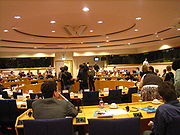 The nature of the committees differ from their national counterparts as, although smaller in comparison to those of the United States Congress
, the European Parliament's committees are unusually large by European standards with between eight and twelve dedicated members of staff and three to four support staff. Considerable administration, archives and research resources are also at the disposal of the whole Parliament when needed.
Delegations of the Parliament are formed in a similar manner and are responsible for relations with Parliaments outside the EU. There are 34 delegations made up of around 15 MEPs, chairpersons of the delegations also cooperate in a conference like the committee chairs do. They include "Interparliamentary delegations" (maintain relations with Parliament outside the EU), "joint parliamentary committees" (maintaining relations with parliaments of states which are candidates or associates of the EU), the delegation to the ACP EU Joint Parliamentary Assembly and the delegation to the Euro-Mediterranean Parliamentary Assembly
. MEPs also participate in other international activities such as the Euro-Latin American Parliamentary Assembly
, the Transatlantic Legislators' Dialogue
and through election observation
in third countries.
, ranging from English and German to Maltese
and Irish. Simultaneous interpreting is offered in all plenary sessions, and all final texts of legislation are translated. With twenty-three languages, the European Parliament is the most multilingual parliament in the world and the biggest employer of interpreters in the world (employing 350 full time and 400 free-lancers when there is higher demand). Citizens may also address the Parliament in Basque
, Catalan/Valencian
and Galician
.
Usually a language is translated from a foreign tongue into a translator's native tongue. Due to the large number of languages, some being minor ones, since 1995 interpreting is sometimes done the opposite way, out of an interpreter's native tongue (the "retour" system). In addition, a speech in a minor language may be interpreted through a third language for lack of interpreters ("relay" interpreting) —for example, when interpreting out of Estonian
into Maltese
. Interpreters need to be proficient in two other Union languages besides their native language. Due to the complexity of the issues, interpretation is not word for word. Instead, interpreters have to convey the political meaning of a speech, regardless of their own views. This requires detailed understanding of the politics and terms of the Parliament, involving a great deal of preparation beforehand (e.g. reading the documents in question). Difficulty can often arise when MEPs use colourful language, jokes and word play or speak too fast.
While some see speaking their native language as an important part of their identity, and can speak more fluently in debates, interpretation and its cost has been criticised by some. A 2006 report by Alexander Stubb
MEP highlighted that by only using English, French and German costs could be reduced from €
118,000 per day (for 21 languages then—Romanian
and Bulgarian
having not yet been included) to €8,900 per day. Although many see the ideal single language as being English due to its widespread usage, there is a campaign to make French the single tongue for all legal texts, due to the view that it is more clear and precise for legal purposes. Although this would not directly affect interpretation in the plenary, it would shift the balance towards French when discussing draft legislation.
Because the proceedings are translated into all of the official EU languages, they have been used to make a multilingual corpus
known as Europarl. It is widely used to train statistical machine translation
systems.
(none in August but two in September), which is the Parliament's official seat, while extra part sessions as well as committee meetings are held in Brussels
. Luxembourg hosts the Secretariat of the European Parliament
. The European Parliament is the only assembly in the world with more than one meeting place and one of the few that cannot decide its own location.
The Strasbourg seat is seen as a symbol of reconciliation between France and Germany, the Strasbourg region having been fought over by the two countries in the past. However it is questioned over the cost and inconvenience of having two seats for the parliament. While Strasbourg is the official seat, and sits alongside the Council of Europe
(with which the "mutual cooperation" is being continuously "fostered"), Brussels is home to nearly all other major EU institutions
, with the majority of Parliament's work already being carried out there. Therefore despite Strasbourg being the main seat, it is the one most questioned, although some do believe Strasbourg should be the single capital.
Critics have described the two-seat arrangement as a "travelling circus", and there is a strong movement to establish Brussels as the sole seat. This is because the other political institutions (the Commission, Council and European Council) are located there, and hence Brussels is treated as the 'capital
' of the EU. This movement has received strong backing through numerous figures, including the Commission First-Vice President who stated that "something that was once a very positive symbol of the EU reuniting France and Germany has now become a negative symbol—of wasting money, bureaucracy and the insanity of the Brussels institutions". The Green party
has also noted the environmental cost in a study led by Jean Lambert
MEP and Caroline Lucas
MEP; in addition to the extra 200 million euro spent on the extra seat, there are over 20,268 tonnes of additional carbon dioxide, undermining any environmental stance of the institution and the Union. The campaign is further backed by a million-strong online petition started by Cecilia Malmström
MEP.
In 2006 there were allegations of irregularity in the charges made by the city of Strasbourg on buildings the Parliament rented which harmed the city's image further. A poll of MEPs also found 89% of the respondents (39%) wanting a single seat, and 81% preferring Brussels. Another, more academic, survey found 68% support. However, as Parliament's seat is fixed by the treaties, it can only be changed by the Council unanimously, meaning it could be vetoed by a single country: notably, France. French President Nicolas Sarkozy
has stated that its seat is "non-negotiable", having no intention of surrendering the French based seat. In early 2011, the Parliament voted to scrap one of the Strasbourg sessions by holding two within a single week. The mayor of Strasbourg
officially reacted by stating "we will counter-attack by upturning the adversary's strength to our own profit, as a judo
ka would do." As of July 2011, an absolute majority of MEPs are in favour of a single seat.
Direct election
Direct election is a term describing a system of choosing political officeholders in which the voters directly cast ballots for the person, persons or political party that they desire to see elected. The method by which the winner or winners of a direct election are chosen depends upon the...
parliamentary institution of the
Institutions of the European Union
The European Union is governed by seven institutions. Article 13 of Treaty on European Union lists them in the following order: the European Parliament, the European Council, the Council of the European Union, the European Commission, the Court of Justice of the European Union, the European...
European Union
European Union
The European Union is an economic and political union of 27 independent member states which are located primarily in Europe. The EU traces its origins from the European Coal and Steel Community and the European Economic Community , formed by six countries in 1958...
(EU). Together with the Council of the European Union
Council of the European Union
The Council of the European Union is the institution in the legislature of the European Union representing the executives of member states, the other legislative body being the European Parliament. The Council is composed of twenty-seven national ministers...
(the Council) and the Commission
European Commission
The European Commission is the executive body of the European Union. The body is responsible for proposing legislation, implementing decisions, upholding the Union's treaties and the general day-to-day running of the Union....
, it exercises the legislative function of the EU and it has been described as one of the most powerful legislatures in the world. The Parliament is composed of 736 MEPs (Members of the European Parliament
Member of the European Parliament
A Member of the European Parliament is a person who has been elected to the European Parliament. The name of MEPs differ in different languages, with terms such as europarliamentarian or eurodeputy being common in Romance language-speaking areas.When the European Parliament was first established,...
), who serve the second largest democratic electorate in the world (after India) and the largest trans-national democratic electorate in the world (375 million eligible voters in 2009).
It has been directly elected every five years by universal suffrage
Universal suffrage
Universal suffrage consists of the extension of the right to vote to adult citizens as a whole, though it may also mean extending said right to minors and non-citizens...
since 1979. Although the European Parliament has legislative power that such bodies as those above do not possess, it does not formally possess legislative initiative
Legislative initiative
The right of initiative is the constitutionally defined power to propose a new law .The right of initiative is usually attributed to parliaments, which in most countries have the right to make law proposals, alone or sharing this right with the government.In parliamentary systems it is common that...
, as most state parliaments within the Union
National parliaments of the European Union
The national parliaments of the European Union are those legislatures responsible for each member state of the European Union . They have a certain degree of institutionalised influence which was expanded under the Treaty of Lisbon to include greater ability to scrutinise proposed EU...
do. Parliament is the "first institution" of the EU (mentioned first in the treaties
Treaties of the European Union
The Treaties of the European Union are a set of international treaties between the European Union member states which sets out the EU's constitutional basis. They establish the various EU institutions together with their remit, procedures and objectives...
, having ceremonial precedence over all authority at European level), and shares equal legislative and budgetary powers with the Council (except a few areas where the special legislative procedures apply). It likewise has equal control over the EU budget. Finally, the European Commission
European Commission
The European Commission is the executive body of the European Union. The body is responsible for proposing legislation, implementing decisions, upholding the Union's treaties and the general day-to-day running of the Union....
, the executive body of the EU, is accountable to Parliament: in particular Parliament elects the President of the Commission, and approves (or not) the appointment of the Commission as a whole. It can subsequently force the Commission as a body to resign by adopting a motion of censure.
The President of the European Parliament
President of the European Parliament
The President of the European Parliament presides over the debates and activities of the European Parliament. He or she also represents the Parliament within the EU and internationally. The President's signature is required for enacting most EU laws and the EU budget.Presidents serve...
(Parliament's speaker
Speaker (politics)
The term speaker is a title often given to the presiding officer of a deliberative assembly, especially a legislative body. The speaker's official role is to moderate debate, make rulings on procedure, announce the results of votes, and the like. The speaker decides who may speak and has the...
) is currently Jerzy Buzek
Jerzy Buzek
Jerzy Karol Buzek is a Polish engineer, academic lecturer and politician who was the ninth post-Cold War Prime Minister of Poland from 1997 to 2001...
(EPP), elected in July 2009. He presides over a multi-party chamber, the two largest groups being the EPP and the Progressive Alliance of Socialists and Democrats
Progressive Alliance of Socialists and Democrats
The Progressive Alliance of Socialists and Democrats is the social-democratic political group in the European Parliament, formed by MEPs of the Party of European Socialists and allied centre-left parties. The group dates its ancestry via various names back to the beginning of the European...
(S&D). The last Union-wide elections were the 2009 Parliamentary Elections
European Parliament election, 2009
Elections to the European Parliament were held in the 27 member states of the European Union between 4 and 7 June 2009. A total of 736 Members of the European Parliament were elected to represent some 500 million Europeans, making these the biggest trans-national elections in history...
. Parliament has two meeting places, namely the Louise Weiss building
Seat of the European Parliament in Strasbourg
The city of Strasbourg is the official seat of the European Parliament. The institution is legally bound to meet there twelve sessions a year lasting about four days each. Other work takes place in Brussels and Luxembourg City...
in Strasbourg
Strasbourg
Strasbourg is the capital and principal city of the Alsace region in eastern France and is the official seat of the European Parliament. Located close to the border with Germany, it is the capital of the Bas-Rhin département. The city and the region of Alsace are historically German-speaking,...
, France, which serves for twelve four-day plenary session
Plenary session
Plenary session is a term often used in conferences to define the part of the conference when all members of all parties are to attend.These sessions may contain a broad range of content from keynotes to panel discussions and are not necessarily related to a specific style of delivery.The term has...
s per year and is the official seat, and the Espace Léopold
Espace Léopold
The Espace Léopold or is the complex of parliament buildings in Brussels housing the European Parliament, a legislative chamber of the European Union ....
complex in Brussels
Brussels
Brussels , officially the Brussels Region or Brussels-Capital Region , is the capital of Belgium and the de facto capital of the European Union...
, Belgium, the larger of the two, which serves for committee meetings, political groups and complementary plenary sessions. The Secretariat of the European Parliament
Secretariat of the European Parliament
The secretariat of the European Parliament is the administrative body of the European Parliament headed by a Secretary-General. It is based in the Kirchberg district of Luxembourg and around the Brussels-Luxembourg Station in Brussels and employs 4000 officials.-Secretary-General:The Secretary...
, the Parliament's administrative body, is based in Luxembourg
European Parliament in Luxembourg
The European Parliament's presence in Sandweiler currently consists of the Parliament's secretariat, although the Parliament had held plenary sessions in the city for a brief period.-History:...
.
History
The Parliament, like the other institutions, was not designed in its current form when it first met on 10 September 1952. One of the oldest common institutions, it began as the "Common Assembly" of the European Coal and Steel CommunityEuropean Coal and Steel Community
The European Coal and Steel Community was a six-nation international organisation serving to unify Western Europe during the Cold War and create the foundation for the modern-day developments of the European Union...
(ECSC). It was a consultative assembly of 78 parliamentarians
Member of Parliament
A Member of Parliament is a representative of the voters to a :parliament. In many countries with bicameral parliaments, the term applies specifically to members of the lower house, as upper houses often have a different title, such as senate, and thus also have different titles for its members,...
drawn from the national parliaments of member states (see dual mandate
Dual mandate
A dual mandate is the practice in which elected officials served in more than one elected or other public position simultaneously. This practice is known as double jobbing in Britain and distinguished from double dipping in the United States For example, suppose a...
), having no legislative powers. This change since its foundation was highlighted by Professor David Farrell of the University of Manchester
University of Manchester
The University of Manchester is a public research university located in Manchester, United Kingdom. It is a "red brick" university and a member of the Russell Group of research-intensive British universities and the N8 Group...
;
Its development since its foundation is a testament to the evolution of the Union's structures without one clear "master plan". Some such as Tom Reid of the Washington Post said of the Union, "nobody would have deliberately designed a government as complex and as redundant as the EU". Even the Parliament's two seats, which have switched several times, are a result of various agreements or lack of agreements.
Consultative assembly
The body was not mentioned in the original Schuman DeclarationSchuman Declaration
The Schuman Declaration of 9 May 1950 was a governmental proposal by then-French Foreign Minister Robert Schuman to create a new form of organization of States in Europe called a supranational Community. Following the experiences of two world wars, France recognized that certain values such as...
. It was assumed or hoped that difficulties with the British would be resolved to allow the Council of Europe's Assembly to perform the task. A separate Assembly was introduced during negotiations on the Treaty as an institution which would counterbalance and monitor the executive
Executive (government)
Executive branch of Government is the part of government that has sole authority and responsibility for the daily administration of the state bureaucracy. The division of power into separate branches of government is central to the idea of the separation of powers.In many countries, the term...
while providing democratic legitimacy. The wording of the ECSC Treaty
Treaty of Paris (1951)
The Treaty of Paris was signed on 18 April 1951 between France, West Germany, Italy and the three Benelux countries , establishing the European Coal and Steel Community , which subsequently became part of the European Union...
demonstrated the leaders desire for more than a normal consultative assembly by using the term "representatives of the people" and allowed for direct election. Its early importance was highlighted when the Assembly was given the task of drawing up the draft treaty to establish a European Political Community
European Political Community
The European Political Community was proposed in 1952 as a combination of the existing European Coal and Steel Community and the proposed European Defence Community...
. In this, the Ad Hoc Assembly was established on 13 September 1952 with extra members but after the failure of the proposed European Defence Community
European Defence Community
The European Defense Community was a plan proposed in 1950 by René Pleven, the French President of the Council , in response to the American call for the rearmament of West Germany...
the project was dropped.
Despite this the European Economic Community
European Economic Community
The European Economic Community The European Economic Community (EEC) The European Economic Community (EEC) (also known as the Common Market in the English-speaking world, renamed the European Community (EC) in 1993The information in this article primarily covers the EEC's time as an independent...
and Euratom were established in 1958 by the Treaties of Rome. The Common Assembly was shared by all three communities (which had separate executives) and it renamed itself the "European Parliamentary Assembly." The first meeting was held on 19 March 1958 having been set up in Luxembourg, it elected Schuman as its president and on 13 May it rearranged itself to sit according to political ideology rather than nationality. This is seen as the birth of the modern European Parliament, with Parliament's 50 years celebrations being held in March 2008 rather than 2002.
The three communities merged
Merger Treaty
The Merger Treaty was a European treaty which combined the executive bodies of the European Coal and Steel Community , European Atomic Energy Community and the European Economic Community into a single institutional structure.The treaty was signed in Brussels on 8 April 1965 and came into force...
their remaining organs as the European Communities
European Communities
The European Communities were three international organisations that were governed by the same set of institutions...
in 1967 and the body was renamed to the current "European Parliament" in 1962. In 1970 the Parliament was granted power over areas of the Community's budget, which were expanded to the whole budget in 1975. Under the Rome Treaties, the Parliament should have become elected. However the Council was required to agree a uniform voting system before hand, which it failed to do. The Parliament threatened to take the Council to the European Court of Justice
European Court of Justice
The Court can sit in plenary session, as a Grand Chamber of 13 judges, or in chambers of three or five judges. Plenary sitting are now very rare, and the court mostly sits in chambers of three or five judges...
leading to a compromise whereby the Council would agree to elections, but the issue of voting systems would be put off till a later date.
Elected Parliament
Elections in the European Union
Elections to the Parliament of the European Union take place every five years by universal adult suffrage. 736 MEPs are elected to the European Parliament which has been directly elected since 1979. No other body is directly elected although the Council of the European Union and European Council is...
for the first time
European Parliament election, 1979
The 1979 European elections were parliamentary elections held across all 9 European Community member states. They were the first European elections to be held, allowing citizens to elect 410 MEPs to the European Parliament, and also the first international election in history.Seats in the...
. This sets it apart from similar institutions such as those of the Parliamentary Assembly of the Council of Europe
Parliamentary Assembly of the Council of Europe
The Parliamentary Assembly of the Council of Europe , which held its first session in Strasbourg on 10 August 1949, can be considered the oldest international parliamentary assembly with a pluralistic composition of democratically elected members of parliament established on the basis of an...
or Pan-African Parliament
Pan-African Parliament
The Pan-African Parliament , also known as the African Parliament, is the legislative body of the African Union and held its inaugural session in March 2004. The PAP exercises oversight, and has advisory and consultative powers, lasting for the first five years...
which are appointed. After that first election, the parliament held its first session on 11 July 1979, electing Simone Veil
Simone Veil
Simone Veil, DBE is a French lawyer and politician who served as Minister of Health under Valéry Giscard d'Estaing, President of the European Parliament and member of the Constitutional Council of France....
MEP as its President. Veil was also the first female President of the Parliament since it was formed as the Common Assembly.
As an elected body, the Parliament began to draft proposals addressing the functioning of the EU. For example in 1984, inspired by its previous work on the Political Community, it drafted the "draft Treaty establishing the European Union" (also known as the 'Spinelli Plan' after its rapporteur Altiero Spinelli
Altiero Spinelli
Altiero Spinelli was an Italian political theorist and a European federalist. Spinelli is referred to as one of the "Founding Fathers of the European Union" due to his co-authorship of the Ventotene Manifesto, his founding role in the European federalist movement, his strong influence on the first...
MEP). Although it was not adopted, many ideas were later implemented by other treaties. Furthermore the Parliament began holding votes on proposed Commission Presidents
President of the European Commission
The President of the European Commission is the head of the European Commission ― the executive branch of the :European Union ― the most powerful officeholder in the EU. The President is responsible for allocating portfolios to members of the Commission and can reshuffle or dismiss them if needed...
from the 1980s, before it was given any formal right to veto.
Since the election the membership of the European Parliament has simply expanded whenever new nations have joined (the membership was also adjusted upwards in 1994 after German reunification
German reunification
German reunification was the process in 1990 in which the German Democratic Republic joined the Federal Republic of Germany , and when Berlin reunited into a single city, as provided by its then Grundgesetz constitution Article 23. The start of this process is commonly referred by Germans as die...
). Following this the Treaty of Nice
Treaty of Nice
The Treaty of Nice was signed by European leaders on 26 February 2001 and came into force on 1 February 2003. It amended the Maastricht Treaty and the Treaty of Rome...
imposed a cap on the number of members to be elected, 732.
Like the other institutions, the Parliament's seat
Seat (legal entity)
In strict legal language, the term seat defines the seat of a corporation or organisation as a legal entity, indicating where the headquarters of this entity are located...
was not yet fixed. The provisional arrangements placed Parliament in Strasbourg
Strasbourg
Strasbourg is the capital and principal city of the Alsace region in eastern France and is the official seat of the European Parliament. Located close to the border with Germany, it is the capital of the Bas-Rhin département. The city and the region of Alsace are historically German-speaking,...
, while the Commission and Council had their seats in Brussels. In 1985 the Parliament, wishing to be closer to these institutions, built a second chamber in Brussels and moved some of its work there despite protests from some states. A final agreement was eventually reached by the European Council
European Council
The European Council is an institution of the European Union. It comprises the heads of state or government of the EU member states, along with the President of the European Commission and the President of the European Council, currently Herman Van Rompuy...
in 1992. It stated the Parliament would retain its formal seat in Strasbourg, where twelve sessions a year would be held, but with all other parliamentary activity in Brussels. This two seat arrangement was contested by Parliament but was later enshrined in the Treaty of Amsterdam. To this day the institution's locations
Location of European Union institutions
The governing institutions of the European Union are not concentrated in a single capital city; they are instead spread across three cities with other EU agencies and bodies based further away...
are a source of contention.
The Parliament gained more powers from successive treaties, namely through the extension of the ordinary legislative procedure (then called the codecision procedure), and in 1999, the Parliament forced the resignation of the Santer Commission
Santer Commission
The Santer Commission was the European Commission in office between 23 January 1995 and 15 March 1999. The administration was led by Jacques Santer ....
. The Parliament had refused to approve the Community budget over allegations of fraud and mis-management in the Commission. The two main parties took on a government-opposition dynamic for the first time during the crisis which ended in the Commission resigning en masse, the first of any forced resignation, in the face of an impending censure from the Parliament.
Barroso I
In 2004, following the largest trans-national election in history, despite the European Council choosing a President from the largest political group (the EPP), the Parliament again exerted pressure on the Commission. During the Parliament's hearings of the proposed CommissionersEuropean Commissioner
A European Commissioner is a member of the 27-member European Commission. Each Member within the college holds a specific portfolio and are led by the President of the European Commission...
MEPs raised doubts about some nominees with the Civil liberties committee
Committee on Civil Liberties, Justice and Home Affairs
The Committee on Civil Liberties, Justice and Home Affairs is a standing committee of the European Parliament.-External links:*...
rejecting Rocco Buttiglione
Rocco Buttiglione
Rocco Buttiglione is an Italian Christian Democrat politician and an academic.His nomination for a post as European Commissioner with a portfolio that was to include civil liberties, resulted in controversy as some political groups opposed him for his Roman Catholic views on homosexuality, despite...
from the post of Commissioner for Justice, Freedom and Security over his views on homosexuality. That was the first time the Parliament had ever voted against an incoming Commissioner and despite Barroso's insistence upon Buttiglione the Parliament forced Buttiglione to be withdrawn. A number of other Commissioners also had to be withdrawn or reassigned before Parliament allowed the Barroso Commission
Barroso Commission
The Barroso Commission is the European Commission that has been in office since 22 November 2004 and is due to serve until 2014. Its president is José Manuel Barroso, who presides over 26 other commissioners...
to take office.
Financial Times
The Financial Times is an international business newspaper. It is a morning daily newspaper published in London and printed in 24 cities around the world. Its primary rival is the Wall Street Journal, published in New York City....
described it in the following terms:
In 2007, for the first time, Justice Commissioner Franco Frattini included Parliament in talks on the second Schengen Information System
Schengen Information System
The Schengen Information System , is a governmental database used by European countries to maintain and distribute information on individuals and pieces of property of interest. The intended uses of this system are for national security, border control and law enforcement purposes...
even though MEPs only needed to be consulted on parts of the package. After that experiment, Frattini indicated he would like to include Parliament in all justice and criminal matters, informally pre-empting the new powers they could gain as part of the Treaty of Lisbon
Treaty of Lisbon
The Treaty of Lisbon of 1668 was a peace treaty between Portugal and Spain, concluded at Lisbon on 13 February 1668, through the mediation of England, in which Spain recognized the sovereignty of Portugal's new ruling dynasty, the House of Braganza....
. Between 2007 and 2009, a special working group on parliamentary reform
Special working group on parliamentary reform
In 2007 the President of the European Parliament, Hans-Gert Poettering, set up a special working group on parliamentary reform. It was chaired by Dagmar Roth-Behrendt MEP and was to improve the efficiency and image of the European Parliament. Some ideas included livening up the plenary sessions...
implemented a series of changes to modernise the institution such as more speaking time for rapporteurs, increase committee co-operation and other efficiency reforms.
Recent history
President of the European Commission
The President of the European Commission is the head of the European Commission ― the executive branch of the :European Union ― the most powerful officeholder in the EU. The President is responsible for allocating portfolios to members of the Commission and can reshuffle or dismiss them if needed...
to Parliament's own elections. Despite some calls for the parties to put forward candidates before hand, only the EPP
European People's Party
The European People's Party is a pro-European centre-right European political party. The EPP was founded in 1976 by Christian democratic parties, but later it increased its membership to include conservative parties and parties of other centre-right perspectives.The EPP is the most influential of...
(which had re-secured their position as largest party) had one in re-endorsing Barroso.
Barroso gained the support of the European Council for a second term and secured majority support from the Parliament in September 2009. Parliament voted 382 votes in favour and 219 votes against (117 abstentions ) with support of the European People's Party
European People's Party
The European People's Party is a pro-European centre-right European political party. The EPP was founded in 1976 by Christian democratic parties, but later it increased its membership to include conservative parties and parties of other centre-right perspectives.The EPP is the most influential of...
, European Conservatives and Reformists
European Conservatives and Reformists
The European Conservatives and Reformists, abbreviated to ECR, is a conservative anti-federalist political group in the European Parliament. The group currently comprises 57 MEPs, making it the fourth-largest group in the European Parliament....
and the Alliance of Liberals and Democrats for Europe
Alliance of Liberals and Democrats for Europe
The Alliance of Liberals and Democrats for Europe is a transnational alliance between two European political parties: the European Liberal Democrat and Reform Party and the European Democratic Party. It has political groups in the European Parliament, the EU Committee of the Regions, the...
. The liberals gave support after Barroso gave them a number of concessions; the liberals previously joined the socialists' call for a delayed vote (the EPP
European People's Party
The European People's Party is a pro-European centre-right European political party. The EPP was founded in 1976 by Christian democratic parties, but later it increased its membership to include conservative parties and parties of other centre-right perspectives.The EPP is the most influential of...
had wanted to approve Barroso in July of that year).
Once Barroso put forward the candidates for his next Commission, another opportunity to gain concessions arose. Bulgarian nominee Rumiana Jeleva
Rumiana Jeleva
Rumiana Ruseva Jeleva was Bulgaria's minister of foreign affairs , the third woman to hold this office after Irina Bokova and Nadezhda Mihailova. Jeleva was a key figure in the "Citizens for European Development of Bulgaria" political party which won the 2009 parliamentary elections...
was forced to step down by Parliament due to concerns over her experience and financial interests. She only had the support of the EPP
European People's Party
The European People's Party is a pro-European centre-right European political party. The EPP was founded in 1976 by Christian democratic parties, but later it increased its membership to include conservative parties and parties of other centre-right perspectives.The EPP is the most influential of...
which began to retaliate on left wing candidates before Jeleva gave in and was replaced (setting back the final vote further).
Before the final vote, Parliament demanded a number of concessions as part of a future working agreement under the new Lisbon Treaty. The deal includes that Parliament's President will attend high level Commission meetings. Parliament will have a seat in the EU's Commission-lead international negotiations and have a right to information on agreements. However Parliament secured only an observer seat. Parliament also did not secure a say over the appointment of delegation heads and special representatives
European Union Special Representative
The European Union Special Representatives are emissaries of the European Union with specific tasks abroad. While the EU's ambassadors are responsible for affairs with a single country, Special Representatives tackle specific issues, conflict areas or regions of countries...
for foreign policy. Although they will appear before parliament after they have been appointed by the High Representative
High Representative
High Representative may refer to either:* The High Representative of the Union for Foreign Affairs and Security Policy High Representative may refer to either:* The High Representative of the Union for Foreign Affairs and Security Policy High Representative may refer to either:* The High...
. One major internal power was that Parliament wanted a pledge from the Commission that it would put forward legislation when parliament requests. Barroso considered this an infringement on the Commission's powers but did agree to respond within three months. Most requests are already responded to positively.
During the setting up of the European External Action Service
European External Action Service
The European External Action Service is a European Union department that was established following the entry into force of the Treaty of Lisbon on 1 December 2009...
(EEAS), Parliament used its control over the EU budget to influence the shape of the EEAS. MEPs had aimed at getting greater oversight over the EEAS by linking it to the Commission and having political deputies to the High Representative
High Representative of the Union for Foreign Affairs and Security Policy
The High Representative of the Union for Foreign Affairs and Security Policy is the main co-ordinator and representative of the Common Foreign and Security Policy within the European Union...
. MEPs didn't manage to get everything they demanded, however they got broader financial control over the new body.
Powers and functions
National parliaments of the European Union
The national parliaments of the European Union are those legislatures responsible for each member state of the European Union . They have a certain degree of institutionalised influence which was expanded under the Treaty of Lisbon to include greater ability to scrutinise proposed EU...
; for example, neither the Parliament nor the Council have the power of legislative initiative
Legislative initiative
The right of initiative is the constitutionally defined power to propose a new law .The right of initiative is usually attributed to parliaments, which in most countries have the right to make law proposals, alone or sharing this right with the government.In parliamentary systems it is common that...
(except for the fact that the Council has the power in some intergovernmental matters). In Community matters, this is a power uniquely reserved for the European Commission
European Commission
The European Commission is the executive body of the European Union. The body is responsible for proposing legislation, implementing decisions, upholding the Union's treaties and the general day-to-day running of the Union....
(the executive). Therefore, while Parliament can amend and reject legislation, to make a proposal for legislation, it needs the Commission to draft a bill
Bill (proposed law)
A bill is a proposed law under consideration by a legislature. A bill does not become law until it is passed by the legislature and, in most cases, approved by the executive. Once a bill has been enacted into law, it is called an act or a statute....
before anything can become law. However, the value of such a power is questioned, noting that only 15% of such initiatives in national parliaments become law due to the lack of executive support. Yet it has been argued by former Parliament president Hans-Gert Pöttering
Hans-Gert Pöttering
Hans-Gert Pöttering is a German conservative politician , and was the President of the European Parliament from January 2007 to July 2009...
that as the Parliament does have the right to ask the Commission to draft such legislation, and as the Commission is following Parliament's proposals more and more Parliament does have a de facto right of legislative initiative.
The Parliament also has a great deal of indirect influence, through non-binding resolutions and committee hearings, as a "pan-European soapbox
Soapbox
A soapbox is a raised platform on which one stands to make an impromptu speech, often about a political subject. The term originates from the days when speakers would elevate themselves by standing on a wooden crate originally used for shipment of soap or other dry goods from a manufacturer to a...
" with the ear of thousands of Brussels-based journalists. There is also an indirect effect on foreign policy
Common Foreign and Security Policy
The Common Foreign and Security Policy is the organised, agreed foreign policy of the European Union for mainly security and defence diplomacy and actions. CFSP deals only with a specific part of the EU's external relations, which domains include mainly Trade and Commercial Policy and other areas...
; the Parliament must approve all development grants, including those overseas. For example, the support for post-war Iraq reconstruction, or incentives for the cessation of Iranian nuclear development
Nuclear program of Iran
The nuclear program of Iran was launched in the 1950s with the help of the United States as part of the Atoms for Peace program. The support, encouragement and participation of the United States and Western European governments in Iran's nuclear program continued until the 1979 Iranian Revolution...
, must be supported by the Parliament. Parliamentary support was also required for the transatlantic
Atlantic Ocean
The Atlantic Ocean is the second-largest of the world's oceanic divisions. With a total area of about , it covers approximately 20% of the Earth's surface and about 26% of its water surface area...
passenger data-sharing deal with the United States. Finally, Parliament holds a non-binding vote on new EU treaties but cannot veto it. However when Parliament threatened to vote down the Nice Treaty, the Belgian
Belgian Federal Parliament
The Belgian Federal Parliament is a bicameral parliament. It consists of the Chamber of Representatives and the Senate . It sits in the Palace of the Nation .- Chamber of Representatives :...
and Italian Parliaments
Parliament of Italy
The Parliament of Italy is the national parliament of Italy. It is a bicameral legislature with 945 elected members . The Chamber of Deputies, with 630 members is the lower house. The Senate of the Republic is the upper house and has 315 members .Since 2005, a party list electoral law is being...
said they would veto the treaty on the European Parliament's behalf.
Legislative procedure
With each new treaty, the powers of the Parliament, in terms of its role in the Union's legislative procedures, have expanded. The procedure which has slowly become dominant is the "ordinary legislative procedure" (previously named "codecision procedure"), which provides an equal footing between Parliament and Council. In particular, under the procedure, the Commission presents a proposal to Parliament and the Council which can only become law if both agree on a text, which they do (or not) through successive readings up to a maximum of three. In its first reading, Parliament may send amendments to the Council which can either adopt the text with those amendments or send back a "common position". That position may either be approved by Parliament, or it may reject the text by an absolute majority, causing it to fail, or it may adopt further amendments, also by an absolute majority. If the Council does not approve these, then a "Conciliation Committee" is formed. The Committee is composed of the Council members plus an equal number of MEPs who seek to agree a compromise. Once a position is agreed, it has to be approved by Parliament, by a simple majority. This is also aided by Parliament's mandate as the only directly democratic institution, which has given it leeway to have greater control over legislation than other institutions, for example over its changes to the Bolkestein directive in 2006.The few other areas that operate the special legislative procedures are justice & home affairs, budget and taxation and certain aspects of other policy areas: such as the fiscal aspects of environmental policy. In these areas, the Council or Parliament decide law alone. The procedure also depends upon which type of institutional act is being used. The strongest act is a regulation, an act
Act of Parliament
An Act of Parliament is a statute enacted as primary legislation by a national or sub-national parliament. In the Republic of Ireland the term Act of the Oireachtas is used, and in the United States the term Act of Congress is used.In Commonwealth countries, the term is used both in a narrow...
or law
Statutory law
Statutory law or statute law is written law set down by a legislature or by a legislator .Statutes may originate with national, state legislatures or local municipalities...
which is directly applicable in its entirety. Then there are directives which bind member states to certain goals which they must achieve. They do this through their own laws and hence have room to manoeuvre in deciding upon them. A decision
European Union decision
In European Union law, a decision is a legal instrument which is binding upon those individuals to which it is addressed. They are one of three kinds of legal instruments which may be effected under EU law which can have legally binding effects on individuals. Decisions may be addressed to member...
is an instrument which is focused at a particular person or group and is directly applicable. Institutions may also issue recommendations and opinions
European Union recommendation
A recommendation in the European Union, according to Article 288 of the Treaty on European Union , is one of two kinds of non-binding acts cited in the Treaty of Rome....
which are merely non-binding, declarations. There is a further document which does not follow normal procedures, this is a "written declaration" which is similar to an early day motion
Early day motion
An Early Day Motion , in the Westminster system, is a motion, expressed as a single sentence, tabled by Members of Parliament for debate "on an early day" . Controversial EDMs are not signed by Government Ministers, PPS or the Speaker of the House of Commons and very few are debated on the floor...
used in the Westminster system
Westminster System
The Westminster system is a democratic parliamentary system of government modelled after the politics of the United Kingdom. This term comes from the Palace of Westminster, the seat of the Parliament of the United Kingdom....
. It is a document proposed by up to five MEPs on a matter within the EU's activities used to launch a debate on that subject. Having been posted outside the entrance to the hemicycle, members can sign the declaration and if a majority do so it is forwarded to the President and announced to the plenary before being forwarded to the other institutions and formally noted in the minutes.
Budget
The legislative branch officially holds the Union's budgetary authority with powers gained through the Budgetary TreatiesBudgetary treaties of the European Communities
The Budgetary treaties of the European Communities were two treaties in the 1970s amending the Treaty of Rome in respects to powers over the Community budget....
of the 1970s and the Lisbon Treaty. The EU budget is subject to a form of the ordinary legislative procedure with a single reading giving Parliament power over the entire budget (before 2009, its influence was limited to certain areas) on an equal footing to the Council. If there is a disagreement between them, it is taken to a conciliation committee as it is for legislative proposals. If the joint conciliation text is not approved, the Parliament may adopt it budget definitively.
The Parliament is also responsible for discharging the implementation of previous budgets based on the annual report of the European Court of Auditors
European Court of Auditors
The Court of Auditors is the fifth institution of the European Union . It was established in 1975 in Luxembourg to audit the accounts of EU institutions...
. It has refused to approve the budget only twice, in 1984 and in 1998. On the latter occasion it led to the resignation of the Santer Commission
Santer Commission
The Santer Commission was the European Commission in office between 23 January 1995 and 15 March 1999. The administration was led by Jacques Santer ....
; highlighting how the budgetary power gives Parliament a great deal of power over the Commission. Parliament also makes extensive use of its budgetary, and other powers, elsewhere; for example in the setting up of the European External Action Service
European External Action Service
The European External Action Service is a European Union department that was established following the entry into force of the Treaty of Lisbon on 1 December 2009...
, Parliament has a defacto veto over its design as it has to approve the budgetary and staff changes.
Control of the executive
Unlike most EU states, which usually operate parliamentary systemParliamentary system
A parliamentary system is a system of government in which the ministers of the executive branch get their democratic legitimacy from the legislature and are accountable to that body, such that the executive and legislative branches are intertwined....
s, there is a separation of powers
Separation of powers
The separation of powers, often imprecisely used interchangeably with the trias politica principle, is a model for the governance of a state. The model was first developed in ancient Greece and came into widespread use by the Roman Republic as part of the unmodified Constitution of the Roman Republic...
between the executive and legislative which makes the European Parliament more akin to the United States Congress
United States Congress
The United States Congress is the bicameral legislature of the federal government of the United States, consisting of the Senate and the House of Representatives. The Congress meets in the United States Capitol in Washington, D.C....
than an EU state legislature. The President of the European Commission
President of the European Commission
The President of the European Commission is the head of the European Commission ― the executive branch of the :European Union ― the most powerful officeholder in the EU. The President is responsible for allocating portfolios to members of the Commission and can reshuffle or dismiss them if needed...
is proposed by the European Council on the basis of the European elections to Parliament. That proposal has to be approved by the Parliament (by a simple majority) who "elect" the President according to the treaties. Following the approval of the Commission President, the members of the Commission are proposed by the President in accord with the member-states. Each Commissioner comes before a relevant parliamentary committee hearing covering the proposed portfolio. They are then, as a body, approved or rejected by the Parliament. In practice, the Parliament has never voted against a President or his Commission, but it did seem likely when the Barroso Commission was put forward. The resulting pressure forced the proposal to be withdrawn and changed to be more acceptable to parliament. That pressure was seen as an important sign by some of the evolving nature of the Parliament and its ability to make the Commission accountable, rather than being a rubber stamp for candidates. Furthermore, in voting on the Commission, MEPs also voted along party lines, rather than national lines, despite frequent pressure from national governments on their MEPs. This cohesion and willingness to use the Parliament's power ensured greater attention from national leaders, other institutions and the public—who previously gave the lowest ever turnout for the Parliament's elections.
The Parliament also has the power to censure the Commission if they have a two-thirds majority which will force the resignation of the entire Commission from office. As with approval, this power has never been used but it was threatened to the Santer Commission
Santer Commission
The Santer Commission was the European Commission in office between 23 January 1995 and 15 March 1999. The administration was led by Jacques Santer ....
, who subsequently resigned of their own accord. There are a few other controls, such as: the requirement of Commission to submit reports to the Parliament and answer questions from MEPs; the requirement of the President-in-office of the Council to present its programme at the start of their presidency
Presidency of the Council of the European Union
The Presidency of the Council of the European Union is the responsibility for the functioning of the Council of the European Union that rotates between the member states of the European Union every six months. The presidency is not a single president but rather the task is undertaken by a national...
; the obligation on the President of the European Council
European Council
The European Council is an institution of the European Union. It comprises the heads of state or government of the EU member states, along with the President of the European Commission and the President of the European Council, currently Herman Van Rompuy...
to report to Parliament after each of its meetings; the right of MEPs to make requests for legislation and policy to the Commission; and the right to question members of those institutions (e.g. "Commission Question Time
Question Time
Question time in a parliament occurs when members of the parliament ask questions of government ministers , which they are obliged to answer. It usually occurs daily while parliament is sitting, though it can be cancelled in exceptional circumstances...
" every Tuesday). At present, MEPs may ask a question on any topic whatsoever, but in July 2008 MEPs voted to limit questions to those within the EU's mandate and ban offensive or personal questions.
Supervisory powers
The Parliament also has other powers of general supervision, mainly granted by the Maastricht TreatyMaastricht Treaty
The Maastricht Treaty was signed on 7 February 1992 by the members of the European Community in Maastricht, Netherlands. On 9–10 December 1991, the same city hosted the European Council which drafted the treaty...
. The Parliament has the power to set up a Committee of Inquiry, for example over mad cow disease or CIA detention flights—the former led to the creation of the European veterinary agency
European Medicines Agency
The European Medicines Agency is a European agency for the evaluation of medicinal products. From 1995 to 2004, the European Medicines Agency was known as European Agency for the Evaluation of Medicinal Products.Roughly parallel to the U.S...
. The Parliament can call other institutions to answer questions and if necessary to take them to court if they break EU law or treaties. Furthermore it has powers over the appointment of the members of the Court of Auditors and the president and executive board of the European Central Bank
European Central Bank
The European Central Bank is the institution of the European Union that administers the monetary policy of the 17 EU Eurozone member states. It is thus one of the world's most important central banks. The bank was established by the Treaty of Amsterdam in 1998, and is headquartered in Frankfurt,...
. The ECB president is also obliged to present an annual report to the parliament.
The European Ombudsman
European Ombudsman
The European Ombudsman is an ombudsman for the European Union, based in the Salvador de Madariaga Building in Strasbourg.-History:...
is elected by the Parliament, who deals with public complaints against all institutions. Petitions
European Citizens' Initiative
The European Citizens' Initiative is one of the major innovations of the Treaty of Lisbon, aimed at increasing direct democracy in the European Union...
can also be brought forward by any EU citizen
Citizenship of the European Union
Citizenship of the European Union was introduced by the Maastricht Treaty . European citizenship is supplementary to national citizenship and affords rights such as the right to vote in European elections, the right to free movement and the right to consular protection from other EU states'...
on a matter within the EU's sphere of activities. The Committee on Petitions
Committee on Petitions
The Committee on Petitions is a committee of the European Parliament.Petitions can also be brought forward by any EU citizen on a matter within the EU's sphere of activities. The Committee hears cases, some 1500 each year, sometimes presented by the citizen themselves at the Parliament...
hears cases, some 1500 each year, sometimes presented by the citizen themselves at the Parliament. While the Parliament attempts to resolve the issue as a mediator they do resort to legal proceedings if it is necessary to resolve the citizens dispute.
Members
The parliamentariansMember of Parliament
A Member of Parliament is a representative of the voters to a :parliament. In many countries with bicameral parliaments, the term applies specifically to members of the lower house, as upper houses often have a different title, such as senate, and thus also have different titles for its members,...
are known in English as Members of the European Parliament (MEPs). They are elected every five years by universal adult suffrage
Universal suffrage
Universal suffrage consists of the extension of the right to vote to adult citizens as a whole, though it may also mean extending said right to minors and non-citizens...
and sit according to political allegiance; about a third are women. Before 1979 they were appointed by their national parliaments.
As states are allocated seats
Apportionment in the European Parliament
Apportionment in the European Parliament relates to the distribution of legislative seats in the European Parliament among the states of the European Union...
according to population, the maximum number of MEPs is 736. However, enlargements may lead to this number being exceeded until the following election, for example between 2007 and 2009 due to the accession of Romania and Bulgaria however these rules have been changed under the Treaty of Lisbon. Under Lisbon, there will be 751 members (however, as the President cannot vote while in the chair there will only be 750 voting members at any one time). In addition, the number of seats allocated to Germany will be lowered to ninety-six, from the current ninety-nine, and the minimum number of seats will be raised to six, from the current five.
The seats are distributed according to "degressive proportionality
Degressive proportionality
Degressive proportionality is a type of formula for electing the members of a legislature or other decision-making body. If a body is elected by a number of regions, states or other subdivisions, degressive proportionality means that while the subdivisions do not each elect an equal number of...
", meaning that the larger the state, the more citizens that are represented per MEP. Thus, for instance, Maltese and Luxembourgian voters have about 10x more influence than citizens of the six large countries. It is intended that the new system, including revising the seating well before elections, can avoid political horse trading when the numbers have to be revised.
Due to the delay in ratifying the Lisbon Treaty the seventh parliament was elected under the lower Nice Treaty cap. A small scale treaty amendment is, as of October 2011, nearing the end of ratification. This amendment would bring in transitional provisions to allow the extra MEPs to be elected or appointed before the 2014 election. Germany would be the only state to lose members, these extra seats would not be removed until the 2014 election.
Before 2009, members received the same salary as members of their national parliament. However as of 2009 a new members statute came into force, after years of attempts, which gives all members an equal monthly pay of 7,000 euro each, subject to a European Union tax and which can also be taxed nationally. MEPs would retire
Retirement
Retirement is the point where a person stops employment completely. A person may also semi-retire by reducing work hours.Many people choose to retire when they are eligible for private or public pension benefits, although some are forced to retire when physical conditions don't allow the person to...
at 63 and receive the whole of their pension
Pension
In general, a pension is an arrangement to provide people with an income when they are no longer earning a regular income from employment. Pensions should not be confused with severance pay; the former is paid in regular installments, while the latter is paid in one lump sum.The terms retirement...
from the Parliament. Travelling expenses would also be given based on actual cost rather than a flat rate as happens now. Besides their pay, members are granted a number of privileges and immunities
Diplomatic immunity
Diplomatic immunity is a form of legal immunity and a policy held between governments that ensures that diplomats are given safe passage and are considered not susceptible to lawsuit or prosecution under the host country's laws...
. To ensure their free movement to and from the Parliament, they are accorded by their own states the facilities accorded to senior officials travelling abroad and by other state governments the facilities of visiting foreign representative
Diplomat
A diplomat is a person appointed by a state to conduct diplomacy with another state or international organization. The main functions of diplomats revolve around the representation and protection of the interests and nationals of the sending state, as well as the promotion of information and...
s. When in their own state they have all the immunities accorded to national parliamentarians, and in other states they have immunity from detention
Detention (imprisonment)
Detention is the process when a state, government or citizen lawfully holds a person by removing their freedom of liberty at that time. This can be due to criminal charges being raised against the individual as part of a prosecution or to protect a person or property...
and legal proceedings
Criminal procedure
Criminal procedure refers to the legal process for adjudicating claims that someone has violated criminal law.-Basic rights:Currently, in many countries with a democratic system and the rule of law, criminal procedure puts the burden of proof on the prosecution – that is, it is up to the...
. However immunity cannot be claimed when a member is found committing a criminal offence and the Parliament also has the right to strip a member of their immunity.
Political groups
MEPs in Parliament are organised into seven different parliamentary groups, including over thirty non-attached members known as non-inscritsNon-Inscrits
Non-Inscrits are Members of the European Parliament who do not sit in one of the recognized political groups....
. The two largest groups are the European People's Party
European People's Party
The European People's Party is a pro-European centre-right European political party. The EPP was founded in 1976 by Christian democratic parties, but later it increased its membership to include conservative parties and parties of other centre-right perspectives.The EPP is the most influential of...
(EPP) and the Socialists & Democrats
Progressive Alliance of Socialists and Democrats
The Progressive Alliance of Socialists and Democrats is the social-democratic political group in the European Parliament, formed by MEPs of the Party of European Socialists and allied centre-left parties. The group dates its ancestry via various names back to the beginning of the European...
(S&D). These two groups have dominated the Parliament for much of its life, continuously holding between 50 and 70 percent of the seats together. No single group has ever held a majority in Parliament. As a result of being broad alliances of national parties, European groups parties are very decentralised and hence have more in common with parties in federal states like Germany or the United States than unitary states like the majority of the EU states. Although, the European groups, between 2004 and 2009, were actually more cohesive than their US counterparts.
Groups are often based on a single European political party
European political party
A European political party, formally a political party at European level, informally a Europarty, is a type of political party organization operating transnationally in Europe and in the institutions of the European Union. They are regulated and funded by the European Union and are usually made up...
such as the socialist group
Party of European Socialists
The Party of European Socialists is a European political party led by Sergei Stanishev, former Prime Minister of Bulgaria. The PES comprises social-democratic national-level political parties primarily from Member state of the European Union, as well as other nations of the European continent. The...
(before 2009). However they can, like the liberal group
Alliance of Liberals and Democrats for Europe
The Alliance of Liberals and Democrats for Europe is a transnational alliance between two European political parties: the European Liberal Democrat and Reform Party and the European Democratic Party. It has political groups in the European Parliament, the EU Committee of the Regions, the...
, include more than one European party as well as national parties and independents. For a group to be recognised, it needs 25 MEPs from seven different countries. Once recognised, groups receive financial subsidies from the parliament and guaranteed seats on Committees, creating an incentive for the formation of groups. However some controversy occurred with the establishment of the short-lived Identity, Tradition, Sovereignty
Identity, Tradition, Sovereignty
thumb|right|Group logoIdentity, Tradition, Sovereignty was a political group in the European Parliament composed of 23 members from European parties variously described as right-wing and nationalist...
(ITS) due to its ideology; the members of the group were far-right, so there were concerns about public funds going towards such a group. There were attempts to change the rules to block the formation of ITS, but that never came to fruition. They were, however, blocked from gaining leading positions on committees — traditionally (by agreement, not a rule) shared among all parties. When this group engaged in infighting, causing the withdrawal of some members, its size fell below the recognisable limit causing its collapse.
Grand coalition
Given that the Parliament does not form the government in the traditional sense of a Parliamentary system, its politics have developed along more consensual lines rather than majority rule of competing parties and coalitions, again being more similar to the German BundestagBundestag
The Bundestag is a federal legislative body in Germany. In practice Germany is governed by a bicameral legislature, of which the Bundestag serves as the lower house and the Bundesrat the upper house. The Bundestag is established by the German Basic Law of 1949, as the successor to the earlier...
or Austrian Nationalrat than to a Westminster or French style Parliamentary system. Indeed for much of its life it has been dominated by a grand coalition
Grand coalition
A grand coalition is an arrangement in a multi-party parliamentary system in which the two largest political parties of opposing political ideologies unite in a coalition government...
of the European People's Party and the Party of European Socialists. The two major parties tend to co-operate to find a compromise between their two groups leading to proposals endorsed by huge majorities. However, this does not always produce agreement, and each may instead try to build other alliances, the EPP normally with other centre-right or right wing Groups and the PES with centre-left or left wing Groups. Sometimes, the Liberal Group is then in the pivotal position.There are also occasions where very sharp party political divisions have emerged, for example over the resignation of the Santer Commission;
When the initial allegations against the Commission emerged, they were directed primarily against Édith Cresson
Édith Cresson
Édith Cresson is a French politician. She was the first and so far only woman to have held the office of Prime Minister of France.- French Prime Minister :Cresson was appointed to the prime ministerial post by President François Mitterrand on 15 May 1991...
and Manuel Marín
Manuel Marín
Manuel Marín González is a Spanish politician, former President of the Congress of Deputies of Spain. He was a long-time member of the European Commission, and President during the interim Marin Commission following the Resignation of the Santer Commission, of which he was a member.-Early life and...
, both socialist members. When the parliament was considering refusing to discharge the Community budget, President Jacques Santer stated that a no vote would be tantamount to a vote of no confidence. The Socialist group supported the Commission and saw the issue as an attempt by the EPP to discredit their party ahead of the 1999 elections. Socialist leader, Pauline Green
Pauline Green
Dame Pauline Green DBE is a former Labour and Co-operative Member of the European Parliament and former Leader of the Parliamentary Group of the Party of European Socialists...
MEP, attempted a vote of confidence and the EPP put forward counter motions. During this period the two parties took on similar roles to a government-opposition
Opposition (parliamentary)
Parliamentary opposition is a form of political opposition to a designated government, particularly in a Westminster-based parliamentary system. Note that this article uses the term government as it is used in Parliamentary systems, i.e. meaning the administration or the cabinet rather than the state...
dynamic, with the Socialists supporting the executive and EPP renouncing its previous coalition support and voting it down. Politicisation such as this has been increasing, in 2007 Simon Hix of the London School of Economics
London School of Economics
The London School of Economics and Political Science is a public research university specialised in the social sciences located in London, United Kingdom, and a constituent college of the federal University of London...
noted that:
During the fifth term, 1999 to 2004, there was a break in the grand coalition resulting in a centre-right coalition between the Liberal and People's parties. This was reflected in the Presidency of the Parliament with the terms being shared between the EPP and the ELDR, rather than the EPP and Socialists. In the following term the liberal group grew to hold 88 seats, the largest number of seats held by any third party in Parliament.
Elections
Elections have taken place, directly in every member-state, every five years since 1979. As of 2009 there have been seven elections. Occasionally, when a nation joins mid-term, a by-election will be held to elect their representatives. This has happened four times, most recently when Romania and Bulgaria joined in 2007 (see below). Elections take place across four days according to local custom and, apart from having to be proportional, the electoral system is chosen by the member-state. This includes allocation of sub-national constituenciesEuropean Parliament constituency
Members of the European Parliament are elected by the population of the member states of the European Union , divided into constituencies....
; while most members have a national list, some, like the UK and France, divide their allocation between regions. Seats are allocated to member-states according to their population, with no state having more than 99, but no fewer than 5, to maintain proportionality.
The most recent Union-wide elections to the European Parliament were the European elections of 2009
European Parliament election, 2009
Elections to the European Parliament were held in the 27 member states of the European Union between 4 and 7 June 2009. A total of 736 Members of the European Parliament were elected to represent some 500 million Europeans, making these the biggest trans-national elections in history...
, held in June of that year. They were the largest simultaneous transnational elections ever held anywhere in the world, since nearly 380 million citizens were eligible to vote. The proportion of MEPs elected in 2009 who were female was 35%; in 1979 it was just 16.5%. There are a number of proposals to "dress up" the elections to attract greater public attention to them. These include most notably the idea of linking them more closely to the Commission presidency. This would be by having political parties running with candidates for the job, so the largest party would essentially be forming the government, as in the parliamentary system
Parliamentary system
A parliamentary system is a system of government in which the ministers of the executive branch get their democratic legitimacy from the legislature and are accountable to that body, such that the executive and legislative branches are intertwined....
of government. This was attempted in 2004, however only the European Green Party
European Green Party
The European Green Party is the Green political party at European level. As such it is a federation of green parties in Europe.-History:...
, which was the first true pan-European party to be established with a common campaign, proposed a candidate for the post of President: Daniel Cohn-Bendit
Daniel Cohn-Bendit
Daniel Marc Cohn-Bendit is a Franco-German politician, active in both countries. He was a student leader during the unrest of May 1968 in France and he was also known during that time as Dany le Rouge...
. Meanwhile, the closest any other party had come in that election was when the People's Party mentioned four or five people they'd like to be President. In 2009, the incumbent President Barroso was formally nominated by the EPP, yet the Socialists were unable to agree on a candidate, in part due to some of their national leaders backing Barroso, leading to there only being one declared candidate (whose party formed the largest group regardless).
It is hoped such changes would add legitimacy and counter the falling turnout which has dropped consistently every year since the first election, and from 1999 it has been below 50%, though of the same order of magnitude as turnout in US Congress elections. In 2007 both Bulgaria and Romania elected their MEPs
European Parliament election, 2007
Two member states of the European Union held elections to the European Parliament in 2007. For details, see*European Parliament election, 2007 *European Parliament election, 2007...
in by-elections, having joined at the beginning of 2007. The Bulgarian and Romanian elections saw two of the lowest turnouts for European elections, just 28.6% and 28.3% respectively.
Proceedings
Each year the activities of the Parliament cycle between committee weeks where reports are discussed in committees and interparliamentary delegations meet, political group weeks for members to discuss work within their political groups and session weeks where members spend 3½ days in StrasbourgStrasbourg
Strasbourg is the capital and principal city of the Alsace region in eastern France and is the official seat of the European Parliament. Located close to the border with Germany, it is the capital of the Bas-Rhin département. The city and the region of Alsace are historically German-speaking,...
for part-sessions. In addition six 2-day part-sessions are organised in Brussels
Brussels
Brussels , officially the Brussels Region or Brussels-Capital Region , is the capital of Belgium and the de facto capital of the European Union...
throughout the year. Four weeks are allocated as constituency week to allow members to do exclusively constituency work. Finally there are no meetings planned during the summer weeks. The Parliament has the power to meet without being convened by another authority. Its meetings are partly controlled by the treaties but are otherwise up to Parliament according to its own "Rules of Procedure" (the regulations governing the parliament).
During sessions, members may speak after being called on by the President. Members of the Council or Commission may also attend and speak in debates. Partly due to the need for translation, and the politics of consensus in the chamber, debates tend to be calmer and more polite than, say, the Westminster system
Westminster System
The Westminster system is a democratic parliamentary system of government modelled after the politics of the United Kingdom. This term comes from the Palace of Westminster, the seat of the Parliament of the United Kingdom....
. Voting is conducted primarily by a show of hands, that may be checked on request by electronic voting. Votes of MEPs are not recorded in either case however, that only occurs when there is a roll-call ballot. This is required for the final votes on legislation and also whenever a political group or 30 MEPs request it. The number of roll-call votes has increased with time. Votes can also be a completely secret ballot (for example when the President is elected). All recorded votes, along with minutes and legislation, are recorded in the Official Journal of the European Union
Official Journal of the European Union
The Official Journal of the European Union is the official gazette of record for the European Union . It is published every working day in all of the official languages of the member states. Only legal acts published in the Official Journal are binding.It was first published on 30 December 1952 as...
and can be accessed online. Votes usually do not follow a debate, but rather they are grouped with other due votes on specific occasions, usually at noon on Tuesdays, Wednesdays or Thursdays. This is because the length of the vote is unpredictable and if it continues for longer than allocated it can disrupt other debates and meetings later in the day.
Members are arranged in a hemicycle
Hemicycle (chamber)
In legislatures, a hemicycle is a term for a semicircular, or horseshoe shaped, debating chamber where deputies sit to discuss and pass legislation. Though composed of Greek roots, the term is French in origin...
according to their political groups (in the Common Assembly, prior to 1958, members sat alphabetically) who are ordered mainly by left to right, but some smaller groups are placed towards the outer ring of the Parliament. All desks are equipped with microphones, headphones for translation and electronic voting equipment. The leaders of the groups sit on the front benches at the centre, and in the very centre is a podium for guest speakers. The remaining half of the circular chamber is primarily composed of the raised area where the President and staff sit. Further benches are provided between the sides of this area and the MEPs, these are taken up by the Council on the far left and the Commission on the far right. Both the Brussels and Strasbourg hemicycle roughly follow this layout with only minor differences. The hemicycle design is a compromise between the different Parliamentary systems. The British-based system has the different groups directly facing each other while the French-based system is a semicircle (and the traditional German system had all members in rows facing a rostrum for speeches). Although the design is mainly based on a semicircle, the opposite ends of the spectrum do still face each other. With access to the chamber limited, entrance is controlled by ushers who aid MEPs in the chamber (for example in delivering documents). The ushers can also occasionally act as a form of police in enforcing the President, for example in ejecting an MEP who is disrupting the session (although this is rare). The first head of protocol in the Parliament was French, so many of the duties in the Parliament are based on the French model first developed following the French Revolution
French Revolution
The French Revolution , sometimes distinguished as the 'Great French Revolution' , was a period of radical social and political upheaval in France and Europe. The absolute monarchy that had ruled France for centuries collapsed in three years...
. The 180 ushers are highly visible in the Parliament, dressed in black tails
Tailcoat
A tailcoat is a coat with the front of the skirt cut away, so as to leave only the rear section of the skirt, known as the tails. The historical reason coats were cut this way was to make it easier for the wearer to ride a horse, but over the years tailcoats of varying types have evolved into forms...
and wearing a silver chain, and are recruited in the same manner as the European civil service. The President is allocated a personal usher.
President and organisation
The President, currently Jerzy BuzekJerzy Buzek
Jerzy Karol Buzek is a Polish engineer, academic lecturer and politician who was the ninth post-Cold War Prime Minister of Poland from 1997 to 2001...
MEP of the EPP, is essentially the speaker
Speaker (politics)
The term speaker is a title often given to the presiding officer of a deliberative assembly, especially a legislative body. The speaker's official role is to moderate debate, make rulings on procedure, announce the results of votes, and the like. The speaker decides who may speak and has the...
of the Parliament. He or she presides over the plenary when it is in session and the President's signature is required for all acts adopted by co-decision, including the EU budget. The President is also responsible for representing the Parliament externally, including in legal matters, and for the application of the rules of procedure. He or she is elected for two-and-a-half-year terms, meaning two elections per parliamentary term.
In most countries, the protocol of the head of state
Head of State
A head of state is the individual that serves as the chief public representative of a monarchy, republic, federation, commonwealth or other kind of state. His or her role generally includes legitimizing the state and exercising the political powers, functions, and duties granted to the head of...
comes before all others, however in the EU the Parliament is listed as the first institution, and hence the protocol of its President comes before any other European, or national, protocol. The gifts given to numerous visiting dignitaries depend upon the President. President Josep Borrell
Josep Borrell
Josep Borrell Fontelles is a Spanish politician. He was nominated President of the European University Institute on 12 December 2008, and assumed this position in January 2010. Borrell was President of the European Parliament from 20 July 2004 until 16 January 2007...
MEP of Spain gave his counterparts a crystal cup created by an artist from Barcelona who had engraved upon it parts of the Charter of Fundamental Rights
Charter of Fundamental Rights of the European Union
The Charter of Fundamental Rights of the European Union enshrines certain political, social, and economic rights for European Union citizens and residents, into EU law. It was drafted by the European Convention and solemnly proclaimed on 7 December 2000 by the European Parliament, the Council of...
among other things.
A number of notable figures have been President of the Parliament and its predecessors. The first President was Paul-Henri Spaak
Paul-Henri Spaak
Paul Henri Charles Spaak was a Belgian Socialist politician and statesman.-Early life:Paul-Henri Spaak was born on 25 January 1899 in Schaerbeek, Belgium, to a distinguished Belgian family. His grandfather, Paul Janson was an important member of the Liberal Party...
MEP, one of the founding fathers of the Union
Founding fathers of the European Union
The Founding Fathers of the European Union are a number of men who have been recognised as making a major contribution to the development of European unity and what is now the European Union. There is no official list of founding fathers or a single event defining them so some ideas vary.-Europe's...
. Other founding fathers include Alcide de Gasperi
Alcide De Gasperi
Alcide De Gasperi was an Italian statesman and politician and founder of the Christian Democratic Party. From 1945 to 1953 he was the prime minister of eight successive coalition governments. His eight-year rule remains a landmark of political longevity for a leader in modern Italian politics...
MEP and Robert Schuman
Robert Schuman
Robert Schuman was a noted Luxembourgish-born French statesman. Schuman was a Christian Democrat and an independent political thinker and activist...
MEP. The two female Presidents were Simone Veil
Simone Veil
Simone Veil, DBE is a French lawyer and politician who served as Minister of Health under Valéry Giscard d'Estaing, President of the European Parliament and member of the Constitutional Council of France....
MEP in 1979 (first President of the elected Parliament) and Nicole Fontaine
Nicole Fontaine
Nicole Fontaine is a French politician and Member of the European Parliament for the Île-de-France. She is a member of the Union for a Popular Movement, part of the European People's Party...
MEP in 1999, both Frenchwomen. The current president, Jerzy Buzek
Jerzy Buzek
Jerzy Karol Buzek is a Polish engineer, academic lecturer and politician who was the ninth post-Cold War Prime Minister of Poland from 1997 to 2001...
is the first East-Central Europe
East-Central Europe
East-Central Europe – a term defining the countries located between German-speaking countries and Russia. Those lands are described as situated “between two”: between two worlds, between two stages, between two futures...
an to lead an EU institution, a former Prime Minister of Poland who rose out of the Solidarity movement in Poland that helped overthrow communism in the Eastern Bloc
Eastern bloc
The term Eastern Bloc or Communist Bloc refers to the former communist states of Eastern and Central Europe, generally the Soviet Union and the countries of the Warsaw Pact...
.
During the election of a President, the previous President (or, if unable to, one of the previous Vice-Presidents) presides over the chamber. Prior to 2009, the oldest member fulfilled this role but the rule was changed to prevent far-right French MEP Jean-Marie Le Pen
Jean-Marie Le Pen
Jean-Marie Le Pen is a French far right-wing and nationalist politician who is founder and former president of the Front National party. Le Pen has run for the French presidency five times, most notably in 2002, when in a surprise upset he came second, polling more votes in the first round than...
taking the chair.
Below the President, there are 14 Vice-Presidents
Vice President of the European Parliament
There are fourteen Vice Presidents of the European Parliament who sit in for the President in presiding over the plenary of the European Parliament.-Role:...
who chair debates when the President is not in the chamber. There are a number of other bodies and posts responsible for the running of parliament besides these speakers. The two main bodies are the Bureau
Bureau (European Parliament)
The Bureau of the European Parliament is responsible for matters relating to the budget, administration, organisation and staff. It is composed of the President of the European Parliament along with all 14 Vice-Presidents and the five Quaestors . They are elected for two and a half years with the...
, which is responsible for budgetary and administration issues, and the Conference of Presidents
Conference of Presidents
In the European Union, the Conference of Presidents is a governing body of the European Parliament. The body is responsible for the organisation of Parliament, its administrative matters and agenda....
which is a governing body composed of the presidents of each of the parliament's political groups. Looking after the financial and administrative interests of members are six Quaestors
Quaestor (European Parliament)
Five Quaestors in the European Parliament look after the financial and administrative interests of Members of the European Parliament.The current Quaestors, elected 15 July 2009, are:...
.
, the European Parliament budget was EUR 1,686 billion. A 2008 report on the Parliament's finances highlighted certain overspending and miss-payments. Despite some MEPs calling for the report to be published, Parliamentary authorities had refused until an MEP broke confidentiality and leaked it.
Committees and delegations
Standing Committee
In the United States Congress, standing committees are permanent legislative panels established by the United States House of Representatives and United States Senate rules. . Because they have legislative jurisdiction, standing committees consider bills and issues and recommend measures for...
s consisting of 28 to 86 MEPs each (reflecting the political makeup of the whole Parliament) including a Chairman, a bureau and secretariat. They meet twice a month in public to draw up, amend to adopt legislative proposals and reports to be presented to the plenary. The rapporteur
Rapporteur
Rapporteur is used in international and European legal and political contexts to refer to a person appointed by a deliberative body to investigate an issue or a situation....
s for a committee are supposed to present the view of the committee, although notably this has not always been the case. In the events leading to the resignation of the Santer Commission, the rapporteur went against the Budgetary Control Committee's
Committee on Budgetary Control
-Responsibilities of the committee:As the name suggests, the CONT is the European Parliament committee charged with producing reports relating to the European Union's Budget.-Membership: Members of the Committee -External links:*...
narrow vote to discharge the budget, and urged the Parliament to reject it.
Committees can also set up sub-committees (e.g. the Subcommittee on Human Rights
Subcommittee on Human Rights
The Subcommittee on Human Rights is a subcommittee of the Committee on Foreign Affairs of the European Parliament. The committee is chaired by Barbara Lochbihler .- See also :* Sakharov Prize...
) and temporary committees to deal with a specific topic (e.g. on extraordinary rendition
Extraordinary rendition
Extraordinary rendition is the abduction and illegal transfer of a person from one nation to another. "Torture by proxy" is used by some critics to describe situations in which the United States and the United Kingdom have transferred suspected terrorists to other countries in order to torture the...
). The chairs of the Committees co-ordinate their work through the "Conference of Committee Chairmen". When co-decision was introduced it increased the Parliaments powers in a number of areas, but most notably those covered by the Committee on the Environment, Public Health and Food Safety
Committee on the Environment, Public Health and Food Safety
The Committee on the Environment, Public Health and Food Safety is a committee of the European Parliament. It has 68 members and a secretariat of 10 administrators. Its chairman is...
. Previously this committee was considered by MEPs as a "Cinderella
Cinderella
"Cinderella; or, The Little Glass Slipper" is a folk tale embodying a myth-element of unjust oppression/triumphant reward. Thousands of variants are known throughout the world. The title character is a young woman living in unfortunate circumstances that are suddenly changed to remarkable fortune...
committee", however as it gained a new importance, it became more professional and rigorous attracting increasing attention to its work.
United States Congressional committee
A congressional committee is a legislative sub-organization in the United States Congress that handles a specific duty . Committee membership enables members to develop specialized knowledge of the matters under their jurisdiction...
, the European Parliament's committees are unusually large by European standards with between eight and twelve dedicated members of staff and three to four support staff. Considerable administration, archives and research resources are also at the disposal of the whole Parliament when needed.
Delegations of the Parliament are formed in a similar manner and are responsible for relations with Parliaments outside the EU. There are 34 delegations made up of around 15 MEPs, chairpersons of the delegations also cooperate in a conference like the committee chairs do. They include "Interparliamentary delegations" (maintain relations with Parliament outside the EU), "joint parliamentary committees" (maintaining relations with parliaments of states which are candidates or associates of the EU), the delegation to the ACP EU Joint Parliamentary Assembly and the delegation to the Euro-Mediterranean Parliamentary Assembly
Euro-Mediterranean Parliamentary Assembly
The Euro-Mediterranean Parliamentary Assembly , established in Naples on 3 December 2003 by decision of the Ministerial Conference of the Euro-Mediterranean Partnership, is the most recent institution of the Barcelona Process. The EMPA opened its proceedings in Vouliagmeni on 22 and 23 March 2004...
. MEPs also participate in other international activities such as the Euro-Latin American Parliamentary Assembly
Euro-Latin American Parliamentary Assembly
The Euro-Latin American Parliamentary Assembly is a trans-national body of 150 Parliamentarians from Europe and Latin America. It was established in 2006 to bolster EU-Latin American relations...
, the Transatlantic Legislators' Dialogue
Transatlantic Legislators' Dialogue
Taking the existing interparliamentary relationship as its basis, the Transatlantic Legislators' Dialogue aims to strengthen and enhance the level of political discourse between European and American legislators. It does so against the background of the numerous other contacts that have resulted...
and through election observation
Election monitoring
Election monitoring is the observation of an election by one or more independent parties, typically from another country or a non-governmental organization , primarily to assess the conduct of an election process on the basis of national legislation and international standards. There are national...
in third countries.
Translation and interpreting
Speakers in the European Parliament are entitled to speak in any of the EU's 23 official languagesLanguages of the European Union
The languages of the European Union are languages used by people within the member states of the European Union. They include the twenty-three official languages of the European Union along with a range of others...
, ranging from English and German to Maltese
Maltese language
Maltese is the national language of Malta, and a co-official language of the country alongside English,while also serving as an official language of the European Union, the only Semitic language so distinguished. Maltese is descended from Siculo-Arabic...
and Irish. Simultaneous interpreting is offered in all plenary sessions, and all final texts of legislation are translated. With twenty-three languages, the European Parliament is the most multilingual parliament in the world and the biggest employer of interpreters in the world (employing 350 full time and 400 free-lancers when there is higher demand). Citizens may also address the Parliament in Basque
Basque language
Basque is the ancestral language of the Basque people, who inhabit the Basque Country, a region spanning an area in northeastern Spain and southwestern France. It is spoken by 25.7% of Basques in all territories...
, Catalan/Valencian
Catalan language
Catalan is a Romance language, the national and only official language of Andorra and a co-official language in the Spanish autonomous communities of Catalonia, the Balearic Islands and Valencian Community, where it is known as Valencian , as well as in the city of Alghero, on the Italian island...
and Galician
Galician language
Galician is a language of the Western Ibero-Romance branch, spoken in Galicia, an autonomous community located in northwestern Spain, where it is co-official with Castilian Spanish, as well as in border zones of the neighbouring territories of Asturias and Castile and León.Modern Galician and...
.
Usually a language is translated from a foreign tongue into a translator's native tongue. Due to the large number of languages, some being minor ones, since 1995 interpreting is sometimes done the opposite way, out of an interpreter's native tongue (the "retour" system). In addition, a speech in a minor language may be interpreted through a third language for lack of interpreters ("relay" interpreting) —for example, when interpreting out of Estonian
Estonian language
Estonian is the official language of Estonia, spoken by about 1.1 million people in Estonia and tens of thousands in various émigré communities...
into Maltese
Maltese language
Maltese is the national language of Malta, and a co-official language of the country alongside English,while also serving as an official language of the European Union, the only Semitic language so distinguished. Maltese is descended from Siculo-Arabic...
. Interpreters need to be proficient in two other Union languages besides their native language. Due to the complexity of the issues, interpretation is not word for word. Instead, interpreters have to convey the political meaning of a speech, regardless of their own views. This requires detailed understanding of the politics and terms of the Parliament, involving a great deal of preparation beforehand (e.g. reading the documents in question). Difficulty can often arise when MEPs use colourful language, jokes and word play or speak too fast.
While some see speaking their native language as an important part of their identity, and can speak more fluently in debates, interpretation and its cost has been criticised by some. A 2006 report by Alexander Stubb
Alexander Stubb
Cai-Göran Alexander Stubb is a Finnish politician and Minister for Foreign Affairs from 4 April 2008 to 22 June 2011...
MEP highlighted that by only using English, French and German costs could be reduced from €
Euro
The euro is the official currency of the eurozone: 17 of the 27 member states of the European Union. It is also the currency used by the Institutions of the European Union. The eurozone consists of Austria, Belgium, Cyprus, Estonia, Finland, France, Germany, Greece, Ireland, Italy, Luxembourg,...
118,000 per day (for 21 languages then—Romanian
Romanian language
Romanian Romanian Romanian (or Daco-Romanian; obsolete spellings Rumanian, Roumanian; self-designation: română, limba română ("the Romanian language") or românește (lit. "in Romanian") is a Romance language spoken by around 24 to 28 million people, primarily in Romania and Moldova...
and Bulgarian
Bulgarian language
Bulgarian is an Indo-European language, a member of the Slavic linguistic group.Bulgarian, along with the closely related Macedonian language, demonstrates several linguistic characteristics that set it apart from all other Slavic languages such as the elimination of case declension, the...
having not yet been included) to €8,900 per day. Although many see the ideal single language as being English due to its widespread usage, there is a campaign to make French the single tongue for all legal texts, due to the view that it is more clear and precise for legal purposes. Although this would not directly affect interpretation in the plenary, it would shift the balance towards French when discussing draft legislation.
Because the proceedings are translated into all of the official EU languages, they have been used to make a multilingual corpus
Text corpus
In linguistics, a corpus or text corpus is a large and structured set of texts...
known as Europarl. It is widely used to train statistical machine translation
Statistical machine translation
Statistical machine translation is a machine translation paradigm where translations are generated on the basis of statistical models whose parameters are derived from the analysis of bilingual text corpora...
systems.
Seat
The Parliament is based in three different cities with numerous buildings. A protocol attached to the Treaty of Amsterdam requires that 12 plenary sessions be held in StrasbourgStrasbourg
Strasbourg is the capital and principal city of the Alsace region in eastern France and is the official seat of the European Parliament. Located close to the border with Germany, it is the capital of the Bas-Rhin département. The city and the region of Alsace are historically German-speaking,...
(none in August but two in September), which is the Parliament's official seat, while extra part sessions as well as committee meetings are held in Brussels
Brussels
Brussels , officially the Brussels Region or Brussels-Capital Region , is the capital of Belgium and the de facto capital of the European Union...
. Luxembourg hosts the Secretariat of the European Parliament
Secretariat of the European Parliament
The secretariat of the European Parliament is the administrative body of the European Parliament headed by a Secretary-General. It is based in the Kirchberg district of Luxembourg and around the Brussels-Luxembourg Station in Brussels and employs 4000 officials.-Secretary-General:The Secretary...
. The European Parliament is the only assembly in the world with more than one meeting place and one of the few that cannot decide its own location.
The Strasbourg seat is seen as a symbol of reconciliation between France and Germany, the Strasbourg region having been fought over by the two countries in the past. However it is questioned over the cost and inconvenience of having two seats for the parliament. While Strasbourg is the official seat, and sits alongside the Council of Europe
Council of Europe
The Council of Europe is an international organisation promoting co-operation between all countries of Europe in the areas of legal standards, human rights, democratic development, the rule of law and cultural co-operation...
(with which the "mutual cooperation" is being continuously "fostered"), Brussels is home to nearly all other major EU institutions
Brussels and the European Union
Brussels is considered to be the de facto capital of the European Union, having a long history of hosting the institutions of the European Union within its European Quarter...
, with the majority of Parliament's work already being carried out there. Therefore despite Strasbourg being the main seat, it is the one most questioned, although some do believe Strasbourg should be the single capital.
Critics have described the two-seat arrangement as a "travelling circus", and there is a strong movement to establish Brussels as the sole seat. This is because the other political institutions (the Commission, Council and European Council) are located there, and hence Brussels is treated as the 'capital
Capital City
Capital City was a television show produced by Euston Films which focused on the lives of investment bankers in London living and working on the corporate trading floor for the fictional international bank Shane-Longman....
' of the EU. This movement has received strong backing through numerous figures, including the Commission First-Vice President who stated that "something that was once a very positive symbol of the EU reuniting France and Germany has now become a negative symbol—of wasting money, bureaucracy and the insanity of the Brussels institutions". The Green party
European Green Party
The European Green Party is the Green political party at European level. As such it is a federation of green parties in Europe.-History:...
has also noted the environmental cost in a study led by Jean Lambert
Jean Lambert
Jean Denise Lambert is an English politician, and Member of the European Parliament for the London Region. A member of the Green Party of England and Wales, she has been an MEP since 1999...
MEP and Caroline Lucas
Caroline Lucas
Caroline Patricia Lucas is a British politician. Lucas is the leader of the Green Party of England and Wales, and the Green Party's first and only Member of Parliament in the House of Commons of the United Kingdom...
MEP; in addition to the extra 200 million euro spent on the extra seat, there are over 20,268 tonnes of additional carbon dioxide, undermining any environmental stance of the institution and the Union. The campaign is further backed by a million-strong online petition started by Cecilia Malmström
Cecilia Malmström
Anna Cecilia Malmström is a Swedish politician currently serving as European Commissioner for Home Affairs in the Barroso Commission...
MEP.
In 2006 there were allegations of irregularity in the charges made by the city of Strasbourg on buildings the Parliament rented which harmed the city's image further. A poll of MEPs also found 89% of the respondents (39%) wanting a single seat, and 81% preferring Brussels. Another, more academic, survey found 68% support. However, as Parliament's seat is fixed by the treaties, it can only be changed by the Council unanimously, meaning it could be vetoed by a single country: notably, France. French President Nicolas Sarkozy
Nicolas Sarkozy
Nicolas Sarkozy is the 23rd and current President of the French Republic and ex officio Co-Prince of Andorra. He assumed the office on 16 May 2007 after defeating the Socialist Party candidate Ségolène Royal 10 days earlier....
has stated that its seat is "non-negotiable", having no intention of surrendering the French based seat. In early 2011, the Parliament voted to scrap one of the Strasbourg sessions by holding two within a single week. The mayor of Strasbourg
Roland Ries
Roland Ries is a French politician from Alsace, occupying several posts on local, regional and national level since 1997....
officially reacted by stating "we will counter-attack by upturning the adversary's strength to our own profit, as a judo
Judo
is a modern martial art and combat sport created in Japan in 1882 by Jigoro Kano. Its most prominent feature is its competitive element, where the object is to either throw or takedown one's opponent to the ground, immobilize or otherwise subdue one's opponent with a grappling maneuver, or force an...
ka would do." As of July 2011, an absolute majority of MEPs are in favour of a single seat.
See also
- ParlamentariumParlamentariumThe Parlamentarium is the visitors' centre of the European Parliament . Located in the Parliament's Espace Léopold complex in Brussels, it was officially inaugurated on 14 October 2011 by EP President Jerzy Buzek. It contains a permanent exhibition with hundreds of multimedia components, explaining...
- ParliamentwatchParliamentwatchParliamentwatch is an Internet portal that allows German citizens to question their representatives in the German Parliament publicly. The independent, nonpartisan site aims to increase transparency in government and deepen German democracy. Questions and answers are published, as well as the...
- State of the Union (European Union)
External links
- Official web site
- Tracking the votes at the European Parliament
- BBC - European Parliament guide
- 360° tour of European Parliament Brussels