


Epic poetry

Encyclopedia

An epic is a lengthy narrative poem, ordinarily concerning a serious subject containing details of heroic deeds and events significant to a culture or nation. Oral poetry
Oral poetry
Oral poetry can be defined in various ways. A strict definition would include only poetry that is composed and transmitted without any aid of writing. However, the complex relationships between written and spoken literature in some societies can make this definition hard to maintain, and oral...
may qualify as an epic, and Albert Lord
Albert Lord
Albert Bates Lord was a professor of Slavic and comparative literature at Harvard University who, after the death of Milman Parry, carried on that scholar's research into epic literature.-Personal life:...
and Milman Parry
Milman Parry
Milman Parry was a scholar of epic poetry and the founder of the discipline of oral tradition.-Biography:He was born in 1902 and studied at the University of California, Berkeley and at the Sorbonne . A student of the linguist Antoine Meillet at the Sorbonne, Parry revolutionized Homeric studies...
have argued that classical epics were fundamentally an oral poetic form. Nonetheless, epics have been written down at least since the works of Virgil
Virgil
Publius Vergilius Maro, usually called Virgil or Vergil in English , was an ancient Roman poet of the Augustan period. He is known for three major works of Latin literature, the Eclogues , the Georgics, and the epic Aeneid...
, Dante Alighieri
Dante Alighieri
Durante degli Alighieri, mononymously referred to as Dante , was an Italian poet, prose writer, literary theorist, moral philosopher, and political thinker. He is best known for the monumental epic poem La commedia, later named La divina commedia ...
, and John Milton
John Milton
John Milton was an English poet, polemicist, a scholarly man of letters, and a civil servant for the Commonwealth of England under Oliver Cromwell...
. Many probably would not have survived if not written down. The first epics are known as primary, or original, epics. One such epic is the Old English story Beowulf
Beowulf
Beowulf , but modern scholars agree in naming it after the hero whose life is its subject." of an Old English heroic epic poem consisting of 3182 alliterative long lines, set in Scandinavia, commonly cited as one of the most important works of Anglo-Saxon literature.It survives in a single...
. Epics that attempt to imitate these like Milton's Paradise Lost are known as literary, or secondary, epics. Another type of epic poetry is epyllion (plural: epyllia), which is a brief narrative poem with a romantic
Romanticism
Romanticism was an artistic, literary and intellectual movement that originated in the second half of the 18th century in Europe, and gained strength in reaction to the Industrial Revolution...
or mythological theme
Theme (literature)
A theme is a broad, message, or moral of a story. The message may be about life, society, or human nature. Themes often explore timeless and universal ideas and are almost always implied rather than stated explicitly. Along with plot, character,...
. The term, which means 'little epic', came into use in the nineteenth century. It refers primarily to the erudite, shorter hexameter poems of the Hellenistic period and the similar works composed at Rome from the age of the neoteric
Neoteric
The Neotericoi , Neoterics or the Neoteric period refers to avant-garde poets and their poetry, specifically those Greek and Latin poets in the Hellenistic Period who propagated a new style of Greek poetry, deliberately turning away from the classical Homeric epic poetry.Their poems featured...
s; to a lesser degree, the term includes some poems of the English Renaissance
English Renaissance
The English Renaissance was a cultural and artistic movement in England dating from the late 15th and early 16th centuries to the early 17th century. It is associated with the pan-European Renaissance that is usually regarded as beginning in Italy in the late 14th century; like most of northern...
, particularly those influenced by Ovid
Ovid
Publius Ovidius Naso , known as Ovid in the English-speaking world, was a Roman poet who is best known as the author of the three major collections of erotic poetry: Heroides, Amores, and Ars Amatoria...
. The most famous example of classical
Classical antiquity
Classical antiquity is a broad term for a long period of cultural history centered on the Mediterranean Sea, comprising the interlocking civilizations of ancient Greece and ancient Rome, collectively known as the Greco-Roman world...
epyllion is perhaps Catullus 64
Catullus 64
Catullus 64 is an epyllion or "little epic" poem written by Catullus. Catullus' longest poem, it retains his famed linguistic witticisms while expressing an appropriately epic tone....
.
In the East, the most famous works of epic poetry are the Ramayana
Ramayana
The Ramayana is an ancient Sanskrit epic. It is ascribed to the Hindu sage Valmiki and forms an important part of the Hindu canon , considered to be itihāsa. The Ramayana is one of the two great epics of India and Nepal, the other being the Mahabharata...
and Mahabharata
Mahabharata
The Mahabharata is one of the two major Sanskrit epics of ancient India and Nepal, the other being the Ramayana. The epic is part of itihasa....
, with the Iliad
Iliad
The Iliad is an epic poem in dactylic hexameters, traditionally attributed to Homer. Set during the Trojan War, the ten-year siege of the city of Troy by a coalition of Greek states, it tells of the battles and events during the weeks of a quarrel between King Agamemnon and the warrior Achilles...
and the Odyssey
Odyssey
The Odyssey is one of two major ancient Greek epic poems attributed to Homer. It is, in part, a sequel to the Iliad, the other work ascribed to Homer. The poem is fundamental to the modern Western canon, and is the second—the Iliad being the first—extant work of Western literature...
, which form part of the Western canon
Western canon
The term Western canon denotes a canon of books and, more broadly, music and art that have been the most important and influential in shaping Western culture. As such, it includes the "greatest works of artistic merit." Such a canon is important to the theory of educational perennialism and the...
, fulfilling the same function in the Western world.
Oral epics or world folk epics
The first epics were products of preliterateLiteracy
Literacy has traditionally been described as the ability to read for knowledge, write coherently and think critically about printed material.Literacy represents the lifelong, intellectual process of gaining meaning from print...
societies and oral poetic traditions
Oral history
Oral history is the collection and study of historical information about individuals, families, important events, or everyday life using audiotapes, videotapes, or transcriptions of planned interviews...
. In these traditions, poetry is transmitted to the audience and from performer to performer by purely oral means.
Early twentieth-century study of living oral epic traditions in the Balkans
Balkans
The Balkans is a geopolitical and cultural region of southeastern Europe...
by Milman Parry
Milman Parry
Milman Parry was a scholar of epic poetry and the founder of the discipline of oral tradition.-Biography:He was born in 1902 and studied at the University of California, Berkeley and at the Sorbonne . A student of the linguist Antoine Meillet at the Sorbonne, Parry revolutionized Homeric studies...
and Albert Lord demonstrated the paratactic
Parataxis
Parataxis is a literary technique, in writing or speaking, that favors short, simple sentences, with the use of coordinating rather than subordinating conjunctions...
model used for composing these poems. What they demonstrated was that oral epics tend to be constructed in short episodes, each of equal status, interest and importance. This facilitates memorization, as the poet is recalling each episode in turn and using the completed episodes to recreate the entire epic as he performs it.
Parry and Lord also showed that the most likely source for written texts of the epics of Homer
Homer
In the Western classical tradition Homer , is the author of the Iliad and the Odyssey, and is revered as the greatest ancient Greek epic poet. These epics lie at the beginning of the Western canon of literature, and have had an enormous influence on the history of literature.When he lived is...
was dictation from an oral performance.
Epic: a long narrative poem in elevated style presenting characters of high position in adventures forming an organic whole through their relation to a central heroic figure and through their development of episodes important to the history of a nation or race. (Harmon and Holman)
An attempt to deliminate nine main characteristics of an epic:
- It opens in medias resIn medias resIn medias res or medias in res is a Latin phrase denoting the literary and artistic narrative technique wherein the relation of a story begins either at the mid-point or at the conclusion, rather than at the beginning In medias res or medias in res (into the middle of things) is a Latin phrase...
. - The setting is vast, covering many nations, the world or the universe.
- Begins with an invocation to a museMuseThe Muses in Greek mythology, poetry, and literature, are the goddesses who inspire the creation of literature and the arts. They were considered the source of the knowledge, related orally for centuries in the ancient culture, that was contained in poetic lyrics and myths...
(epic invocation). - It starts with a statement of the theme.
- Includes the use of epithets.
- Contains long lists (epic catalogue).
- Features long and formal speeches.
- Shows divine intervention on human affairs.
- "Star" heroes that embody the values of the civilization.
The hero generally participates in a cyclical journey or quest, faces adversaries that try to defeat him in his journey and returns home significantly transformed by his journey. The epic hero illustrates traits, performs deeds, and exemplifies certain morals that are valued by the society the epic originates from. Many epic heroes are recurring character
Recurring character
A recurring character is a fictional character, usually in a prime time TV series, who appears from time to time during the series' run. Recurring characters often play major roles in an episode, sometimes being the main focus...
s in the legends of their native culture.
Conventions of epics:
- Praepositio: Opens by stating the theme or cause of the epic. This may take the form of a purpose (as in Milton, who proposed "to justify the ways of God to men"); of a question (as in the IliadIliadThe Iliad is an epic poem in dactylic hexameters, traditionally attributed to Homer. Set during the Trojan War, the ten-year siege of the city of Troy by a coalition of Greek states, it tells of the battles and events during the weeks of a quarrel between King Agamemnon and the warrior Achilles...
, which HomerHomerIn the Western classical tradition Homer , is the author of the Iliad and the Odyssey, and is revered as the greatest ancient Greek epic poet. These epics lie at the beginning of the Western canon of literature, and have had an enormous influence on the history of literature.When he lived is...
initiates by asking a Muse to sing of Achilles' anger); or of a situation (as in the Song of Roland, with CharlemagneCharlemagneCharlemagne was King of the Franks from 768 and Emperor of the Romans from 800 to his death in 814. He expanded the Frankish kingdom into an empire that incorporated much of Western and Central Europe. During his reign, he conquered Italy and was crowned by Pope Leo III on 25 December 800...
in Spain). - InvocationInvocationAn invocation may take the form of:*Supplication or prayer.*A form of possession.*Command or conjuration.*Self-identification with certain spirits....
: Writer invokes a MuseMuseThe Muses in Greek mythology, poetry, and literature, are the goddesses who inspire the creation of literature and the arts. They were considered the source of the knowledge, related orally for centuries in the ancient culture, that was contained in poetic lyrics and myths...
, one of the nine daughters of ZeusZeusIn the ancient Greek religion, Zeus was the "Father of Gods and men" who ruled the Olympians of Mount Olympus as a father ruled the family. He was the god of sky and thunder in Greek mythology. His Roman counterpart is Jupiter and his Etruscan counterpart is Tinia.Zeus was the child of Cronus...
. The poet prays to the Muses to provide him with divine inspiration to tell the story of a great hero. (This convention is obviously restricted to cultures influenced by European Classical culture. The Epic of GilgameshEpic of GilgameshEpic of Gilgamesh is an epic poem from Mesopotamia and is among the earliest known works of literature. Scholars believe that it originated as a series of Sumerian legends and poems about the protagonist of the story, Gilgamesh king of Uruk, which were fashioned into a longer Akkadian epic much...
, for example, or the Bhagavata PuranaBhagavata puranaThe Bhāgavata Purāṇa is one of the "Maha" Puranic texts of Hindu literature, with its primary focus on bhakti to the incarnations of Vishnu, particularly Krishna...
would obviously not contain this element). - In medias resIn medias resIn medias res or medias in res is a Latin phrase denoting the literary and artistic narrative technique wherein the relation of a story begins either at the mid-point or at the conclusion, rather than at the beginning In medias res or medias in res (into the middle of things) is a Latin phrase...
: narrative opens "in the middle of things", with the hero at his lowest point. Usually flashbacks show earlier portions of the story. - EnumeratioEnumeratioEnumeratio is the figure of amplification in which a subject is divided, detailing parts, causes, effects, or consequences to make a point more forcibly....
: Catalogues and genealogies are given. These long lists of objects, places, and people place the finite action of the epic within a broader, universal context. Often, the poet is also paying homage to the ancestors of audience members. - EpithetEpithetAn epithet or byname is a descriptive term accompanying or occurring in place of a name and having entered common usage. It has various shades of meaning when applied to seemingly real or fictitious people, divinities, objects, and binomial nomenclature. It is also a descriptive title...
: Heavy use of repetition or stock phrases: e.g., HomerEpithets in HomerA characteristic of Homer's style is the use of epithets, as in "rosy-fingered" dawn or "swift-footed" Achilles. Epithets are used because of the constraints of the dactylic hexameter and because of the oral transmission of the poems; they are mnemonic aids to the poet and the audience...
's "rosy-fingered dawn" and "wine-dark sea."
Literate societies have often copied the epic format. The earliest surviving European examples are the Argonautica of Apollonius of Rhodes
Apollonius of Rhodes
Apollonius Rhodius, also known as Apollonius of Rhodes , early 3rd century BCE – after 246 BCE, was a poet, and a librarian at the Library of Alexandria...
and Virgil's Aeneid
Aeneid
The Aeneid is a Latin epic poem, written by Virgil between 29 and 19 BC, that tells the legendary story of Aeneas, a Trojan who travelled to Italy, where he became the ancestor of the Romans. It is composed of roughly 10,000 lines in dactylic hexameter...
, which follow both the style and subject matter of Homer
Homer
In the Western classical tradition Homer , is the author of the Iliad and the Odyssey, and is revered as the greatest ancient Greek epic poet. These epics lie at the beginning of the Western canon of literature, and have had an enormous influence on the history of literature.When he lived is...
. Other obvious examples are Nonnus' Dionysiaca
Nonnus
Nonnus of Panopolis , was a Greek epic poet. He was a native of Panopolis in the Egyptian Thebaid, and probably lived at the end of the 4th or early 5th century....
, Tulsidas
Tulsidas
Tulsidas , was a Hindu poet-saint, reformer and philosopher renowned for his devotion for the god Rama...
' Sri Ramacharit Manas.
Notable epic poems
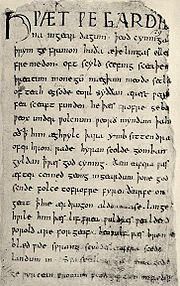
- This list can be compared with two others, national epicNational epicA national epic is an epic poem or a literary work of epic scope which seeks or is believed to capture and express the essence or spirit of a particular nation; not necessarily a nation-state, but at least an ethnic or linguistic group with aspirations to independence or autonomy...
and list of world folk-epics.
Ancient epics (to 500)
- 20th to 10th century BC:
- Epic of GilgameshEpic of GilgameshEpic of Gilgamesh is an epic poem from Mesopotamia and is among the earliest known works of literature. Scholars believe that it originated as a series of Sumerian legends and poems about the protagonist of the story, Gilgamesh king of Uruk, which were fashioned into a longer Akkadian epic much...
(Mesopotamian mythology) - AtrahasisAtra-HasisThe 18th century BCE Akkadian epic of Atra-Hasis is named after its protagonist. An "Atra-Hasis" appears on one of the Sumerian king lists as king of Shuruppak in the times before the flood. The Atra-Hasis tablets include both a creation myth and a flood account, which is one of three surviving...
(Mesopotamian mythology) - Enuma ElishEnûma ElishThe is the Babylonian creation myth . It was recovered by Austen Henry Layard in 1849 in the ruined Library of Ashurbanipal at Nineveh , and published by George Smith in 1876.The Enûma Eliš has about a thousand lines and is recorded in Old Babylonian on seven clay tablets, each holding...
(Babylonian mythology)
- Epic of Gilgamesh
(The date of compositions of Babylonian epics is often hard to determine, as they may survive on manuscripts that are much later than the first composition. There is also the complication that they underwent successive revisions and redactions.)
Anywhere between 20th and 5th centuries BC:
-
- MahābhārataMahabharataThe Mahabharata is one of the two major Sanskrit epics of ancient India and Nepal, the other being the Ramayana. The epic is part of itihasa....
, ascribed to VyasaVyasaVyasa is a central and revered figure in most Hindu traditions. He is also sometimes called Veda Vyasa , or Krishna Dvaipayana...
(Hindu mythology) - RamayanaRamayanaThe Ramayana is an ancient Sanskrit epic. It is ascribed to the Hindu sage Valmiki and forms an important part of the Hindu canon , considered to be itihāsa. The Ramayana is one of the two great epics of India and Nepal, the other being the Mahabharata...
, ascribed to ValmikiValmikiValmiki is celebrated as the poet harbinger in Sanskrit literature. He is the author of the epic Ramayana, based on the attribution in the text of the epic itself. He is revered as the Adi Kavi, which means First Poet, for he discovered the first śloka i.e...
(Hindu mythology)
- Mahābhārata
- 8th to 6th century BC:
- IliadIliadThe Iliad is an epic poem in dactylic hexameters, traditionally attributed to Homer. Set during the Trojan War, the ten-year siege of the city of Troy by a coalition of Greek states, it tells of the battles and events during the weeks of a quarrel between King Agamemnon and the warrior Achilles...
, ascribed to HomerHomerIn the Western classical tradition Homer , is the author of the Iliad and the Odyssey, and is revered as the greatest ancient Greek epic poet. These epics lie at the beginning of the Western canon of literature, and have had an enormous influence on the history of literature.When he lived is...
(Greek mythologyGreek mythologyGreek mythology is the body of myths and legends belonging to the ancient Greeks, concerning their gods and heroes, the nature of the world, and the origins and significance of their own cult and ritual practices. They were a part of religion in ancient Greece...
) - OdysseyOdysseyThe Odyssey is one of two major ancient Greek epic poems attributed to Homer. It is, in part, a sequel to the Iliad, the other work ascribed to Homer. The poem is fundamental to the modern Western canon, and is the second—the Iliad being the first—extant work of Western literature...
, ascribed to HomerHomerIn the Western classical tradition Homer , is the author of the Iliad and the Odyssey, and is revered as the greatest ancient Greek epic poet. These epics lie at the beginning of the Western canon of literature, and have had an enormous influence on the history of literature.When he lived is...
(Greek mythology) - Works and DaysWorks and DaysWorks and Days is a didactic poem of some 800 verses written by the ancient Greek poet Hesiod around 700 BC. At its center, the Works and Days is a farmer's almanac in which Hesiod instructs his brother Perses in the agricultural arts...
, ascribed to HesiodHesiodHesiod was a Greek oral poet generally thought by scholars to have been active between 750 and 650 BC, around the same time as Homer. His is the first European poetry in which the poet regards himself as a topic, an individual with a distinctive role to play. Ancient authors credited him and...
(Greek mythology) - TheogonyTheogonyThe Theogony is a poem by Hesiod describing the origins and genealogies of the gods of the ancient Greeks, composed circa 700 BC...
, ascribed to HesiodHesiodHesiod was a Greek oral poet generally thought by scholars to have been active between 750 and 650 BC, around the same time as Homer. His is the first European poetry in which the poet regards himself as a topic, an individual with a distinctive role to play. Ancient authors credited him and...
(Greek mythology) - Catalogue of WomenCatalogue of Womenthumb|275px|[[Guido Reni]]'s first Atalanta e Ippomene , depicting the race of [[Atalanta]], a myth which was known to Reni from [[Ovid]]'s [[Metamorphoses]], but is now also represented by several fragments of the Catalogue of Women.The Catalogue of Women —also known as...
, ascribed to HesiodHesiodHesiod was a Greek oral poet generally thought by scholars to have been active between 750 and 650 BC, around the same time as Homer. His is the first European poetry in which the poet regards himself as a topic, an individual with a distinctive role to play. Ancient authors credited him and...
(Greek mythology) - The Shield of HeraclesThe Shield of Heraclesthumb|An early 5th c. BCE depiction of Heracles fighting Cycnus The Shield of Heracles is an archaic Greek epic poem that was attributed to Hesiod during antiquity...
, ascribed to HesiodHesiodHesiod was a Greek oral poet generally thought by scholars to have been active between 750 and 650 BC, around the same time as Homer. His is the first European poetry in which the poet regards himself as a topic, an individual with a distinctive role to play. Ancient authors credited him and...
(Greek mythology)
- Iliad
- 3rd century BC:
- Argonautica by Apollonius of RhodesApollonius of RhodesApollonius Rhodius, also known as Apollonius of Rhodes , early 3rd century BCE – after 246 BCE, was a poet, and a librarian at the Library of Alexandria...
- Argonautica by Apollonius of Rhodes
- 2nd century BC:
- Annales by Quintus Ennius (Roman History)
- 1st century BC:
- AeneidAeneidThe Aeneid is a Latin epic poem, written by Virgil between 29 and 19 BC, that tells the legendary story of Aeneas, a Trojan who travelled to Italy, where he became the ancestor of the Romans. It is composed of roughly 10,000 lines in dactylic hexameter...
by VirgilVirgilPublius Vergilius Maro, usually called Virgil or Vergil in English , was an ancient Roman poet of the Augustan period. He is known for three major works of Latin literature, the Eclogues , the Georgics, and the epic Aeneid...
(LatinLatinLatin is an Italic language originally spoken in Latium and Ancient Rome. It, along with most European languages, is a descendant of the ancient Proto-Indo-European language. Although it is considered a dead language, a number of scholars and members of the Christian clergy speak it fluently, and...
mythology) - De rerum natura by LucretiusLucretiusTitus Lucretius Carus was a Roman poet and philosopher. His only known work is an epic philosophical poem laying out the beliefs of Epicureanism, De rerum natura, translated into English as On the Nature of Things or "On the Nature of the Universe".Virtually no details have come down concerning...
(Latin Literature, Epicurean philosophyEpicureanismEpicureanism is a system of philosophy based upon the teachings of Epicurus, founded around 307 BC. Epicurus was an atomic materialist, following in the steps of Democritus. His materialism led him to a general attack on superstition and divine intervention. Following Aristippus—about whom...
)
- Aeneid
- 1st century AD:
- MetamorphosesMetamorphoses (poem)Metamorphoses is a Latin narrative poem in fifteen books by the Roman poet Ovid describing the history of the world from its creation to the deification of Julius Caesar within a loose mythico-historical framework. Completed in AD 8, it is recognized as a masterpiece of Golden Age Latin literature...
by OvidOvidPublius Ovidius Naso , known as Ovid in the English-speaking world, was a Roman poet who is best known as the author of the three major collections of erotic poetry: Heroides, Amores, and Ars Amatoria...
(Latin mythology) - PharsaliaPharsaliaThe Pharsalia is a Roman epic poem by the poet Lucan, telling of the civil war between Julius Caesar and the forces of the Roman Senate led by Pompey the Great...
by LucanMarcus Annaeus LucanusMarcus Annaeus Lucanus , better known in English as Lucan, was a Roman poet, born in Corduba , in the Hispania Baetica. Despite his short life, he is regarded as one of the outstanding figures of the Imperial Latin period...
(Roman historyBattle of PharsalusThe Battle of Pharsalus was a decisive battle of Caesar's Civil War. On 9 August 48 BC at Pharsalus in central Greece, Gaius Julius Caesar and his allies formed up opposite the army of the republic under the command of Gnaeus Pompeius Magnus...
) - PunicaPunica (poem)The Punica is a Latin epic poem in seventeen books in dactylic hexameter written by Silius Italicus comprising some twelve thousand lines . It is the longest surviving Latin poem from antiquity...
by Silius ItalicusSilius ItalicusSilius Italicus, in full Tiberius Catius Asconius Silius Italicus , was a Roman consul, orator, and Latin epic poet of the 1st century CE,...
(Roman historySecond Punic WarThe Second Punic War, also referred to as The Hannibalic War and The War Against Hannibal, lasted from 218 to 201 BC and involved combatants in the western and eastern Mediterranean. This was the second major war between Carthage and the Roman Republic, with the participation of the Berbers on...
) - Argonautica by Gaius Valerius FlaccusGaius Valerius FlaccusGaius Valerius Flaccus was a Roman poet who flourished in the "Silver Age" under the emperors Vespasian and Titus and wrote a Latin Argonautica that owes a great deal to Apollonius of Rhodes' more famous epic....
(Roman poet, Greek mythology) - ThebaidThebaid (Latin poem)The Thebaid is a Latin epic in twelve books written in dactylic hexameter by Publius Papinius Statius . The poem deals with the Theban cycle of mythology and treats the assault of the seven champions of Argos against the city of Thebes.-Composition:Based on Statius' own testimony, the Thebaid was...
and AchilleidAchilleidThe Achilleid is an unfinished epic poem by Publius Papinius Statius that was intended to present the life of Achilles from his youth through his death at Troy. Only about one and a half books were completed before the poet's death...
by StatiusStatiusPublius Papinius Statius was a Roman poet of the 1st century CE . Besides his poetry in Latin, which include an epic poem, the Thebaid, a collection of occasional poetry, the Silvae, and the unfinished epic, the Achilleid, he is best known for his appearance as a major character in the Purgatory...
(Roman poet, Greek mythology)
- Metamorphoses
- 2nd century:
- BuddhacaritaBuddhacaritaBuddhacharita is an epic poem in the Sanskrit mahakavya style on the life of Gautama Buddha by , composed in the 2nd century AD...
by (Indian epic poetryIndian epic poetryIndian epic poetry is the epic poetry written in the Indian subcontinent, traditionally called Kavya . The Ramayana and Mahabharata, originally composed in Sanskrit and translated thereafter into many other Indian languages, are some of the oldest surviving epic poems on earth and form part of...
) - Saundaranandakavya by (Indian epic poetry)
- Buddhacarita
- 2nd to 5th century:
- The Five Great Epics of Tamil LiteratureThe Five Great Epics of Tamil LiteratureThe Five Great Epics of Tamil Literature are five large narrative Tamil epics according to later Tamil literary tradition. The first mention of the "Aimperumkappiyam" occurs in Mayilainathar's commentary of Nannūl. However, Mayilainathar does not mention the names of the five epics...
:- Silappadikaram by Prince Ilango AdigalIlango AdigalIlango Adigal was a Tamil poet and a Jain monk, who was instrumental in the creation of Silappathikaram, one of the five great epics of Tamil Literature. Prince Ilango was the brother of Chera king Cheran Chenguttuvan , in South India. Ilango Adigal was born in the Chera dynasty that ruled parts...
- ManimekalaiManimekalaiManimekalai or Maṇimekalai , written by the Tamil Buddhist poet Seethalai Saathanar is one of the masterpieces of Tamil literature. It is considered to be one of the five great epics of Tamil literature. Manimekalai is a poem in 30 cantos...
by Seethalai Saathanar - Civaka CintamaniCivaka CintamaniCivaka Cintamani is a classical epic poem. It is a Jain religious epic authored by Tirutakkatevar.It belongs to the Sangam tradition of Tamil literature, and is considered one of the five great Tamil epics. In its form, it anticipates the Ramayana of Kambar. Cīvaka Cintāmaṇi was much appreciated...
by TirutakakatevarTirutakakatevarTirutakkatevar was a Tamil poet who wrote Jivaka-chintamani, one of the five greatest epics of Tamil literature, . He, as a local king, also supported to create Kamban, one of the most famous poets of Tamil literature.... - KundalakesiKundalakesiKundalakesi is a fragmentary Tamil epic written by Nagakuthanaar. Tamil literary tradition places it among the five great epics, alongside such works as the Manimekalai and Cilappatikaram. Its time period has been estimated to be before fifth century C.E.-Sources and content:Of the five great...
by a BuddhistBuddhismBuddhism is a religion and philosophy encompassing a variety of traditions, beliefs and practices, largely based on teachings attributed to Siddhartha Gautama, commonly known as the Buddha . The Buddha lived and taught in the northeastern Indian subcontinent some time between the 6th and 4th...
poet - Valayapati by a JainaJainismJainism is an Indian religion that prescribes a path of non-violence towards all living beings. Its philosophy and practice emphasize the necessity of self-effort to move the soul towards divine consciousness and liberation. Any soul that has conquered its own inner enemies and achieved the state...
poet
- Silappadikaram by Prince Ilango Adigal
- The Five Great Epics of Tamil Literature
- 3rd to 4th century:
- PosthomericaPosthomericaThe Posthomerica is an epic poem by Quintus of Smyrna, probably written in the latter half of the 4th century, and telling the story of the Trojan War, between the death of Hector and the fall of Ilium....
by Quintus of Smyrna
- Posthomerica
- 4th century:
- Evangeliorum libri by JuvencusJuvencusGaius Vettius Aquilinus Juvencus, known as Juvencus or Juvenk, was a Roman Spanish Christian and composer of Latin poetry in the 4th century.-Life:...
- Kumārasambhava by KālidāsaKalidasaKālidāsa was a renowned Classical Sanskrit writer, widely regarded as the greatest poet and dramatist in the Sanskrit language...
(Indian epic poetryIndian epic poetryIndian epic poetry is the epic poetry written in the Indian subcontinent, traditionally called Kavya . The Ramayana and Mahabharata, originally composed in Sanskrit and translated thereafter into many other Indian languages, are some of the oldest surviving epic poems on earth and form part of...
) - RaghuvaṃśaRaghuvamsaRaghuwamsa or Raghu race is a legendary lineage of warrior kings tracing its ancestry to the Hindu solar deity Surya. Kalidasa's famous work, Raghuvaṃśa depicts the legend of this race. The progenitor of the lineage was Raghu, son of the emperor Dileepa. Raghu was father of Aja, and thus...
by Kālidāsa (Indian epic poetry) - De Raptu Proserpinae by ClaudianClaudianClaudian was a Roman poet, who worked for Emperor Honorius and the latter's general Stilicho.A Greek-speaking citizen of Alexandria and probably not a Christian convert, Claudian arrived in Rome before 395. He made his mark with a eulogy of his two young patrons, Probinus and Olybrius, thereby...
- Evangeliorum libri by Juvencus
- 5th century:
- Argonautica OrphicaArgonautica OrphicaArgonautica Orphica is a Greek epic poem dating from the 5th-6th centuries CE. It is narrated in the first person in the name of Orpheus and tells the story of Jason and the Argonauts. It is not known who the real author is...
by Anonymous - DionysiacaDionysiacaThe Dionysiaca is an ancient epic poem and the principal work of Nonnus. It is an epic in 48 books, the longest surviving poem from antiquity at 20,426 lines, composed in Homeric dialect and dactylic hexameters, the main subject of which is the life of Dionysus, his expedition to India, and his...
by NonnusNonnusNonnus of Panopolis , was a Greek epic poet. He was a native of Panopolis in the Egyptian Thebaid, and probably lived at the end of the 4th or early 5th century....
- Argonautica Orphica
Medieval epics (500-1500)
- 7th century:
- Táin Bó CúailngeTáin Bó Cúailngeis a legendary tale from early Irish literature, often considered an epic, although it is written primarily in prose rather than verse. It tells of a war against Ulster by the Connacht queen Medb and her husband Ailill, who intend to steal the stud bull Donn Cuailnge, opposed only by the teenage...
(Old Irish) - Bhaṭṭikāvya, Sanskrit courtly epic based on the RāmāyaṇaRamayanaThe Ramayana is an ancient Sanskrit epic. It is ascribed to the Hindu sage Valmiki and forms an important part of the Hindu canon , considered to be itihāsa. The Ramayana is one of the two great epics of India and Nepal, the other being the Mahabharata...
and the Aṣṭādhyāyī of Pāṇini - KiratarjuniyaKirātārjunīyaKirātārjunīya is a Sanskrit kavya by Bhāravi, written in the 6th century or earlier. It is an epic poem in eighteen cantos describing the combat between Arjuna and lord Shiva in the guise of a kirāta or mountain-dwelling hunter. Along with the Naiṣadhacarita and the Shishupala Vadha, it is one of...
by BharaviBharaviBharavi was a Sanskrit poet known for his Mahakavya , the Kirātārjunīya in 18 cantos based on an episode from the Mahabharata.-Time and place:...
, Sanskrit epic based on an episode in the MahabharataMahabharataThe Mahabharata is one of the two major Sanskrit epics of ancient India and Nepal, the other being the Ramayana. The epic is part of itihasa.... - Shishupala VadhaShishupala VadhaThe Shishupala Vadha is a work of classical Sanskrit poetry composed by Māgha in the 7th or 8th century. It is an epic poem in 20 sargas of about 1800 highly ornate stanzas, and is considered one of the six Sanskrit mahakavyas, or "great epics". It is also known as the Māgha-kāvya after its author...
by MaghaMagha (poet)Magha was a Sanskrit poet at King Varmalata's court at Srimala, the-then capital of Gujarat . Magha was son of Dattaka Sarvacharya and grandson of Suprabhadeva...
, Sanskrit epic based on another episode in the MahabharataMahabharataThe Mahabharata is one of the two major Sanskrit epics of ancient India and Nepal, the other being the Ramayana. The epic is part of itihasa....
- Táin Bó Cúailnge
- 8th to 10th century:
- BeowulfBeowulfBeowulf , but modern scholars agree in naming it after the hero whose life is its subject." of an Old English heroic epic poem consisting of 3182 alliterative long lines, set in Scandinavia, commonly cited as one of the most important works of Anglo-Saxon literature.It survives in a single...
(Old English) - WaldereWaldereWaldere or Waldhere is the conventional title given to two Old English fragments from a lost epic poem, discovered in 1860 by E. C. Werlauff, Librarian, in the Danish Royal Library at Copenhagen, where it is still preserved. The parchment pages had been reused as stiffening in the binding of an...
, Old English version of the story told in Waltharius (below), known only as a brief fragment - David of SasunDavid of SasunDavid of Sasun or David of Sassoun is an Armenian epic hero from the Daredevils of Sassoun who drove Arab invaders out of Armenia.The Sasuntsi Davit is an Armenian national epic poem recounting David's exploits...
(ArmenianArmenian languageThe Armenian language is an Indo-European language spoken by the Armenian people. It is the official language of the Republic of Armenia as well as in the region of Nagorno-Karabakh. The language is also widely spoken by Armenian communities in the Armenian diaspora...
)
- Beowulf
- 9th century:
- Bhagavata PuranaBhagavata puranaThe Bhāgavata Purāṇa is one of the "Maha" Puranic texts of Hindu literature, with its primary focus on bhakti to the incarnations of Vishnu, particularly Krishna...
(Sanskrit) "Stories of the Lord", based on earlier sources
- Bhagavata Purana
- 10th century:
- ShahnamehShahnamehThe Shahnameh or Shah-nama is a long epic poem written by the Persian poet Ferdowsi between c.977 and 1010 AD and is the national epic of Iran and related societies...
(Persian literaturePersian literaturePersian literature spans two-and-a-half millennia, though much of the pre-Islamic material has been lost. Its sources have been within historical Persia including present-day Iran as well as regions of Central Asia where the Persian language has historically been the national language...
; details PersianHistory of IranThe history of Iran has been intertwined with the history of a larger historical region, comprising the area from the Danube River in the west to the Indus River and Jaxartes in the east and from the Caucasus, Caspian Sea, and Aral Sea in the north to the Persian Gulf and the Gulf of Oman and Egypt...
legend and history from prehistoric times to the fall of the Sassanid EmpireSassanid EmpireThe Sassanid Empire , known to its inhabitants as Ērānshahr and Ērān in Middle Persian and resulting in the New Persian terms Iranshahr and Iran , was the last pre-Islamic Persian Empire, ruled by the Sasanian Dynasty from 224 to 651...
) - WalthariusWalthariusWaltharius, a Latin poem founded on German popular tradition, relates the exploits of the west Gothic hero Walter of Aquitaine.-History:Our knowledge of the author, Ekkehard, a monk of St. Gall, is due to a later Ekkehard, known as Ekkehard IV , who gives some account of him in the Casus Sancti Galli...
by Ekkehard of St. Gall (LatinLatinLatin is an Italic language originally spoken in Latium and Ancient Rome. It, along with most European languages, is a descendant of the ancient Proto-Indo-European language. Although it is considered a dead language, a number of scholars and members of the Christian clergy speak it fluently, and...
); about Walter of AquitaineWalter of AquitaineWalter of Aquitaine is a legendary king of the Visigoths. He figures in several epic poems and narratives in medieval languages:* Waldere, an Old English fragment* Waltharius, a Latin epic written by the monk Ekkehard I of St Gall...
- Shahnameh
- 11th century:
- Taghribat Bani HilalTaghribat Bani HilalTaghribat Bani Hilal is an Arabic epic recounting the Banu Hilal's journey from Najd to Tunisia via Egypt and conquest of the latter. It is built around historical events that took place in the 11th century...
(ArabicArabic languageArabic is a name applied to the descendants of the Classical Arabic language of the 6th century AD, used most prominently in the Quran, the Islamic Holy Book...
); see also Arabic epic literatureArabic epic literatureArabic epic literature encompasses epic poetry and epic fantasy in Arabic literature. Virtually all societies have developed folk tales encompassing tales of heroes... - RuodliebRuodliebRuodlieb is a fragmentary romance in Latin verse written by an unknown southern German poet who flourished about 1030. He was almost certainly a monk of the Bavarian abbey of Tegernsee....
(LatinLatinLatin is an Italic language originally spoken in Latium and Ancient Rome. It, along with most European languages, is a descendant of the ancient Proto-Indo-European language. Although it is considered a dead language, a number of scholars and members of the Christian clergy speak it fluently, and...
), by a German author - Digenis AkritasDigenis AcritasDigenes Akrites , known in folksongs as Digenes Akritas , is the most famous of the Acritic Songs. The epic details the life of its eponymous hero, Basil, a man, as the epithet signifies, of mixed Roman and Syrian blood...
(GreekGreek languageGreek is an independent branch of the Indo-European family of languages. Native to the southern Balkans, it has the longest documented history of any Indo-European language, spanning 34 centuries of written records. Its writing system has been the Greek alphabet for the majority of its history;...
); about a hero of the Byzantine EmpireByzantine EmpireThe Byzantine Empire was the Eastern Roman Empire during the periods of Late Antiquity and the Middle Ages, centred on the capital of Constantinople. Known simply as the Roman Empire or Romania to its inhabitants and neighbours, the Empire was the direct continuation of the Ancient Roman State... - Epic of King Gesar (TibetanTibetan languageThe Tibetan languages are a cluster of mutually-unintelligible Tibeto-Burman languages spoken primarily by Tibetan peoples who live across a wide area of eastern Central Asia bordering the Indian subcontinent, including the Tibetan Plateau and the northern Indian subcontinent in Baltistan, Ladakh,...
)
- Taghribat Bani Hilal
- 12th century:
- Chanson de Roland (Old FrenchOld FrenchOld French was the Romance dialect continuum spoken in territories that span roughly the northern half of modern France and parts of modern Belgium and Switzerland from the 9th century to the 14th century...
) - The Knight in the Panther Skin by Shota RustaveliShota RustaveliShota Rustaveli was a Georgian poet of the 12th century, and one of the greatest contributors to Georgian literature. He is author of "The Knight in the Panther's Skin" , the Georgian national epic poem....
- AlexandreisAlexandreisAlexandreis is a medieval Latin epic poem by Walter of Châtillon, a 12th-century French writer and theologian. A version of the Alexander romance, it gives an account of the life of Alexander the Great, based on Quintus Curtius Rufus' Historia Alexandri Magni...
by Walter of ChâtillonWalter of ChatillonWalter of Châtillon was a 12th-century French writer and theologian who wrote in the Latin language. He studied under Stephen of Beauvais and at the University of Paris. It was probably during his student years that he wrote a number of Latin poems in the Goliardic manner that found their way...
(LatinLatinLatin is an Italic language originally spoken in Latium and Ancient Rome. It, along with most European languages, is a descendant of the ancient Proto-Indo-European language. Although it is considered a dead language, a number of scholars and members of the Christian clergy speak it fluently, and...
) - De bello TroianoDe bello TroianoDaretis Phrygii Ilias De bello Troiano is an epic poem in Latin, written around 1183 by the English poet Joseph of Exeter. It tells the story of the ten year Trojan War as it was known in medieval western Europe...
and the lost Antiocheis by Joseph of ExeterJoseph of ExeterJoseph of Exeter was a twelfth century Latin poet from Exeter, England. Around 1180, he left to study at Gueldres, where he began his lifelong friendship with Guibert, who later became Abbot of Florennes... - Carmen de Prodicione GuenonisCarmen de Prodicione GuenonisCarmen de Prodicione Guenonis is an anonymous poem in medieval Latin, written in the first half of the 12th century. Composed in elegiac couplets by an unskilled versifier, it is a version of the legendary history of the Battle of Roncevaux Pass...
, version of the story of the Song of Roland in LatinLatinLatin is an Italic language originally spoken in Latium and Ancient Rome. It, along with most European languages, is a descendant of the ancient Proto-Indo-European language. Although it is considered a dead language, a number of scholars and members of the Christian clergy speak it fluently, and... - ArchitreniusArchitreniusArchitrenius is a medieval allegorical and satirical poem in hexameters by Johannes de Hauvilla . The poet was born in about 1150 and died after 1200, and dedicated the work to "Gualtero, archepiscopo Rotomagensium"...
by John of Hauville, LatinLatinLatin is an Italic language originally spoken in Latium and Ancient Rome. It, along with most European languages, is a descendant of the ancient Proto-Indo-European language. Although it is considered a dead language, a number of scholars and members of the Christian clergy speak it fluently, and...
satire - Liber ad honorem AugustiLiber ad honorem AugustiThe Liber ad honorem Augusti sive de rebus Siculis is an illustrated narrative epic in Latin elegiac couplets, written in Palermo in 1196 by Peter of Eboli...
by Peter of EboliPeter of EboliPeter of Eboli or Petrus de Ebulo was a didactic versifier and chronicler who wrote in Latin.A monk from Eboli , Peter became a court poet to Henry VI, Holy Roman Emperor and King of Sicily...
, narrative of the conquest of SicilySicilySicily is a region of Italy, and is the largest island in the Mediterranean Sea. Along with the surrounding minor islands, it constitutes an autonomous region of Italy, the Regione Autonoma Siciliana Sicily has a rich and unique culture, especially with regard to the arts, music, literature,...
by Henry VI, Holy Roman EmperorHenry VI, Holy Roman EmperorHenry VI was King of Germany from 1190 to 1197, Holy Roman Emperor from 1191 to 1197 and King of Sicily from 1194 to 1197.-Early years:Born in Nijmegen,...
(LatinLatinLatin is an Italic language originally spoken in Latium and Ancient Rome. It, along with most European languages, is a descendant of the ancient Proto-Indo-European language. Although it is considered a dead language, a number of scholars and members of the Christian clergy speak it fluently, and...
) - The Tale of Igor's CampaignThe Tale of Igor's CampaignThe Tale of Igor's Campaign is an anonymous epic poem written in the Old East Slavic language.The title is occasionally translated as The Song of Igor's Campaign, The Lay of Igor's Campaign, and The Lay of...
and Bylinas (11th-19th centuries)
- Chanson de Roland (Old French
- 13th century:
- NibelungenliedNibelungenliedThe Nibelungenlied, translated as The Song of the Nibelungs, is an epic poem in Middle High German. The story tells of dragon-slayer Siegfried at the court of the Burgundians, how he was murdered, and of his wife Kriemhild's revenge....
(Middle High GermanMiddle High GermanMiddle High German , abbreviated MHG , is the term used for the period in the history of the German language between 1050 and 1350. It is preceded by Old High German and followed by Early New High German...
) - ParzivalParzivalParzival is a major medieval German romance by the poet Wolfram von Eschenbach, in the Middle High German language. The poem, commonly dated to the first quarter of the 13th century, is itself largely based on Chrétien de Troyes’s Perceval, the Story of the Grail and mainly centers on the Arthurian...
by Wolfram von EschenbachWolfram von EschenbachWolfram von Eschenbach was a German knight and poet, regarded as one of the greatest epic poets of his time. As a Minnesinger, he also wrote lyric poetry.-Life:...
- (Middle High GermanMiddle High GermanMiddle High German , abbreviated MHG , is the term used for the period in the history of the German language between 1050 and 1350. It is preceded by Old High German and followed by Early New High German...
) - BrutBrut (Layamon)Layamon's Brut , also known as The Chronicle of Britain, is a Middle English poem compiled and recast by the English priest Layamon. The Brut is 16,095 lines long and narrates the history of Britain: it is the first historiography written in English since the Anglo-Saxon Chronicle...
by LayamonLayamonLayamon or Laghamon (ˈlaɣamon; in American English often modernised as ; ), occasionally written Lawman, was a poet of the early 13th century and author of the Brut, a notable English poem of the 12th century that was the first English language work to discuss the legends of Arthur and the...
(Early Middle EnglishMiddle EnglishMiddle English is the stage in the history of the English language during the High and Late Middle Ages, or roughly during the four centuries between the late 11th and the late 15th century....
) - Chanson de la Croisade AlbigeoiseChanson de la Croisade AlbigeoiseThe Song of the Albigensian Crusade is an Old Occitan epic poem narrating events of the Albigensian Crusade from March 1208 to June 1219. Modelled on the Old French chanson de geste, it was composed in two distinct parts: William of Tudela wrote the first towards 1213, and an anonymous continuator...
("Song of the Albigensian Crusade"; Occitan) - AntarAntarah ibn Shaddad'Antarah Ibn Shaddād al-'Absī عنترة بن شداد العبسي was a pre-Islamic Arabian hero and poet famous both for his poetry and his adventurous life. What many consider his best or chief poem is contained in the Mu'allaqat...
(ArabicArabic languageArabic is a name applied to the descendants of the Classical Arabic language of the 6th century AD, used most prominently in the Quran, the Islamic Holy Book...
); see also Arabic epic literatureArabic epic literatureArabic epic literature encompasses epic poetry and epic fantasy in Arabic literature. Virtually all societies have developed folk tales encompassing tales of heroes... - Sirat al-Zahir BaibarsSirat al-Zahir BaibarsSirat al-Zahir Baibars سيرة الظاهر بيبرس , also known as "al-Sirah al-Zahiriya", is a long Egyptian folkloric epic poem that narrates the life and heroic achievements of the Mamluk Sultan al-Zahir Baibars al-Bunduqdari....
(ArabicArabic languageArabic is a name applied to the descendants of the Classical Arabic language of the 6th century AD, used most prominently in the Quran, the Islamic Holy Book...
); see also Arabic epic literatureArabic epic literatureArabic epic literature encompasses epic poetry and epic fantasy in Arabic literature. Virtually all societies have developed folk tales encompassing tales of heroes... - Epic of SundiataSundiata KeitaSundiata Keita, Sundjata Keyita, Mari Djata I or just Sundiata was the founder of the Mali Empire and celebrated as a hero of the Malinke people of West Africa in the semi-historical Epic of Sundiata....
- El Cantar de Mio CidCantar de Mio CidEl Cantar de Myo Çid , also known in English as The Lay of the Cid and The Poem of the Cid is the oldest preserved Spanish epic poem...
, Spanish epic of the ReconquistaReconquistaThe Reconquista was a period of almost 800 years in the Middle Ages during which several Christian kingdoms succeeded in retaking the Muslim-controlled areas of the Iberian Peninsula broadly known as Al-Andalus...
(Old Spanish) - De triumphis ecclesiaeDe triumphis ecclesiaeDe triumphis ecclesiae is a Latin epic in elegiac metre, written c. 1250 by Johannes de Garlandia, an English grammarian who taught at the universities of Toulouse and Paris...
by Johannes de GarlandiaJohannes de Garlandia (philologist)Johannes de Garlandia or John of Garland was a philologist and university teacher. His dates of birth and death are unknown, but he probably lived from about 1190 to about 1270...
(LatinLatinLatin is an Italic language originally spoken in Latium and Ancient Rome. It, along with most European languages, is a descendant of the ancient Proto-Indo-European language. Although it is considered a dead language, a number of scholars and members of the Christian clergy speak it fluently, and...
) - Gesta Regum BritanniaeGesta Regum BritanniaeThe Gesta Regum Britanniae is a Latin epic written at some time between 1235 and 1254, and attributed to a Breton monk, William of Rennes.The Gesta is fundamentally a versification of Geoffrey of Monmouth's Historia Regum Britanniae in Latin epic hexameters...
by William of Rennes (LatinLatinLatin is an Italic language originally spoken in Latium and Ancient Rome. It, along with most European languages, is a descendant of the ancient Proto-Indo-European language. Although it is considered a dead language, a number of scholars and members of the Christian clergy speak it fluently, and...
) - Jewang ungiJewang ungiThe Jewang Ungi is a historical poem composed by Yi Seung-hyu in 1287, in the late Goryeo period. It depicts the history of Korea from Dangun to King Chungnyeol. A possible translation in English reads: "Rhymed Chronicles of Sovereigns"....
by Yi Seung-hyu ("Rhymed Chronicles of Sovereigns"; 1287 KoreaKoreaKorea ) is an East Asian geographic region that is currently divided into two separate sovereign states — North Korea and South Korea. Located on the Korean Peninsula, Korea is bordered by the People's Republic of China to the northwest, Russia to the northeast, and is separated from Japan to the...
)
- Nibelungenlied
- 14th century:
- Confessio AmantisConfessio AmantisConfessio Amantis is a 33,000-line Middle English poem by John Gower, which uses the confession made by an ageing lover to the chaplain of Venus as a frame story for a collection of shorter narrative poems. According to its prologue, it was composed at the request of Richard II...
by John GowerJohn GowerJohn Gower was an English poet, a contemporary of William Langland and a personal friend of Geoffrey Chaucer. He is remembered primarily for three major works, the Mirroir de l'Omme, Vox Clamantis, and Confessio Amantis, three long poems written in French, Latin, and English respectively, which...
(c. 1350) - Cursor MundiCursor MundiCursor Mundi is an anonymous Middle-English historical and religious poem of nearly 30,000 lines written around 1300 AD. The poem summarizes the history of the world as described in the Christian Bible and other sources, with additional legendary material drawn primarily from the Historia...
by an anonymousAnonymityAnonymity is derived from the Greek word ἀνωνυμία, anonymia, meaning "without a name" or "namelessness". In colloquial use, anonymity typically refers to the state of an individual's personal identity, or personally identifiable information, being publicly unknown.There are many reasons why a...
cleric (c. 1300) - Divina CommediaThe Divine ComedyThe Divine Comedy is an epic poem written by Dante Alighieri between 1308 and his death in 1321. It is widely considered the preeminent work of Italian literature, and is seen as one of the greatest works of world literature...
(The Divine Comedy) by Dante AlighieriDante AlighieriDurante degli Alighieri, mononymously referred to as Dante , was an Italian poet, prose writer, literary theorist, moral philosopher, and political thinker. He is best known for the monumental epic poem La commedia, later named La divina commedia ...
(ItalianItalian languageItalian is a Romance language spoken mainly in Europe: Italy, Switzerland, San Marino, Vatican City, by minorities in Malta, Monaco, Croatia, Slovenia, France, Libya, Eritrea, and Somalia, and by immigrant communities in the Americas and Australia...
) - AfricaAfrica (Petrarch)Africa is an epic poem in Latin hexameters by the 14th century Italian poet Petrarch . It tells the story of the Second Punic War, in which the Carthaginian general Hannibal invaded Italy, but Roman forces were eventually victorious after an invasion of north Africa led by Publius Cornelius Scipio...
by PetrarchPetrarchFrancesco Petrarca , known in English as Petrarch, was an Italian scholar, poet and one of the earliest humanists. Petrarch is often called the "Father of Humanism"...
(LatinLatinLatin is an Italic language originally spoken in Latium and Ancient Rome. It, along with most European languages, is a descendant of the ancient Proto-Indo-European language. Although it is considered a dead language, a number of scholars and members of the Christian clergy speak it fluently, and...
) - The Tale of the HeikeThe Tale of the Heikeis an epic account of the struggle between the Taira and Minamoto clans for control of Japan at the end of the 12th century in the Genpei War...
(JapaneseJapanese peopleThe are an ethnic group originating in the Japanese archipelago and are the predominant ethnic group of Japan. Worldwide, approximately 130 million people are of Japanese descent; of these, approximately 127 million are residents of Japan. People of Japanese ancestry who live in other countries...
epic war tale)
- Confessio Amantis
- 15th century:
- Alliterative Morte ArthureAlliterative Morte ArthureThe Alliterative Morte Arthure is a 4346-line Middle English alliterative poem, retelling the latter part of the legend of King Arthur. It is preserved in a single copy, in the early fifteenth-century Lincoln Thornton Manuscript.-History:...
(Middle EnglishMiddle EnglishMiddle English is the stage in the history of the English language during the High and Late Middle Ages, or roughly during the four centuries between the late 11th and the late 15th century....
) - Orlando innamoratoOrlando InnamoratoOrlando Innamorato is an epic poem written by the Italian Renaissance author Matteo Maria Boiardo. The poem is a romance concerning the heroic knight Orlando .-Composition and publication:...
by Matteo Maria BoiardoMatteo Maria BoiardoMatteo Maria Boiardo was an Italian Renaissance poet.Boiardo was born at, or near, Scandiano ; the son of Giovanni di Feltrino and Lucia Strozzi, he was of noble lineage, ranking as Count of Scandiano, with seignorial power over Arceto, Casalgrande, Gesso, and Torricella...
(1495) - Shmuel-BukhShmuel-BukhThe Shmuel-Bukh is a religious verse epic written in Yiddish. Composed no later than the second half of the 15th century and widely circulated in manuscript, it was first printed in Augsburg in 1544. Its stanzaic form resembles that of the Nibelungenlied, and its hero is the biblical David...
(Old Yiddish chivalry romance based on the Biblical book of Samuel - Mlokhim-BukhMlokhim-BukhThe Mlokhim-Bukh is a Yiddish religious verse epic by an unknown author, which recounts the monarchy of Solomon and the ancient history of the Hebrews up to the Babylonian Captivity. The oldest surviving fragment is dated to 1519-1525, though the poem is probably older...
(Old Yiddish epic poem based on the Biblical Books of KingsBooks of KingsThe Book of Kings presents a narrative history of ancient Israel and Judah from the death of David to the release of his successor Jehoiachin from imprisonment in Babylon, a period of some 400 years...
) - Book of Dede KorkutBook of Dede KorkutThe Book of Dede Korkut, also spelled as Dada Gorgud, Dede Qorqut or Korkut-ata , is the most famous epic stories of the Oghuz Turks The stories carry morals and values significant to the social lifestyle of the nomadic Turks and their pre-Islamic beliefs...
- Alliterative Morte Arthure
Modern epics (from 1500)
- 16th century:
- Orlando furiosoOrlando FuriosoOrlando Furioso is an Italian epic poem by Ludovico Ariosto which has exerted a wide influence on later culture. The earliest version appeared in 1516, although the poem was not published in its complete form until 1532...
by Ludovico AriostoLudovico AriostoLudovico Ariosto was an Italian poet. He is best known as the author of the romance epic Orlando Furioso . The poem, a continuation of Matteo Maria Boiardo's Orlando Innamorato, describes the adventures of Charlemagne, Orlando, and the Franks as they battle against the Saracens with diversions...
(1516) - Os LusíadasOs LusíadasOs Lusíadas , usually translated as The Lusiads, is a Portuguese epic poem by Luís Vaz de Camões ....
by Luís de CamõesLuís de CamõesLuís Vaz de Camões is considered Portugal's and the Portuguese language's greatest poet. His mastery of verse has been compared to that of Shakespeare, Vondel, Homer, Virgil and Dante. He wrote a considerable amount of lyrical poetry and drama but is best remembered for his epic work Os Lusíadas...
(c.1555) - La AraucanaLa AraucanaLa Araucana is an epic poem in Spanish about the Spanish conquest of Chile, by Alonso de Ercilla; it is also known in English as The Araucaniad...
by Alonso de Ercilla y Zúñiga (1569–1589) - La Gerusalemme liberata by Torquato TassoTorquato TassoTorquato Tasso was an Italian poet of the 16th century, best known for his poem La Gerusalemme liberata , in which he depicts a highly imaginative version of the combats between Christians and Muslims at the end of the First Crusade, during the siege of Jerusalem...
(1575) - Ramacharitamanasa (based on the RamayanaRamayanaThe Ramayana is an ancient Sanskrit epic. It is ascribed to the Hindu sage Valmiki and forms an important part of the Hindu canon , considered to be itihāsa. The Ramayana is one of the two great epics of India and Nepal, the other being the Mahabharata...
) by Goswami TulsidasTulsidasTulsidas , was a Hindu poet-saint, reformer and philosopher renowned for his devotion for the god Rama...
(1577) - Lepanto by King James VI of Scotland (1591)
- MatildaMatilda-People:* Empress Matilda, daughter of Henry I of England* Matilda , list of people named Matilda* Matilda of Flanders, wife of William the Conqueror* Matilda of Tuscany-Media and entertainment:* Matilda , by Roald Dahl...
by Michael DraytonMichael DraytonMichael Drayton was an English poet who came to prominence in the Elizabethan era.-Early life:He was born at Hartshill, near Nuneaton, Warwickshire, England. Almost nothing is known about his early life, beyond the fact that in 1580 he was in the service of Thomas Goodere of Collingham,...
(1594) - The Faerie QueeneThe Faerie QueeneThe Faerie Queene is an incomplete English epic poem by Edmund Spenser. The first half was published in 1590, and a second installment was published in 1596. The Faerie Queene is notable for its form: it was the first work written in Spenserian stanza and is one of the longest poems in the English...
by Edmund SpenserEdmund SpenserEdmund Spenser was an English poet best known for The Faerie Queene, an epic poem and fantastical allegory celebrating the Tudor dynasty and Elizabeth I. He is recognised as one of the premier craftsmen of Modern English verse in its infancy, and one of the greatest poets in the English...
(1596)
- Orlando furioso
- 17th century:
- The Barons' Wars by Michael DraytonMichael DraytonMichael Drayton was an English poet who came to prominence in the Elizabethan era.-Early life:He was born at Hartshill, near Nuneaton, Warwickshire, England. Almost nothing is known about his early life, beyond the fact that in 1580 he was in the service of Thomas Goodere of Collingham,...
(1603; early version 1596 entitled Mortimeriados) - The Purple Island by Phineas Fletcher (1633)
- Szigeti veszedelemPeril of SzigetSzigeti veszedelem was the title of the Hungarian epic poem in fifteen parts written by Miklós Zrínyi in 1647 and published in 1651 about the final battle of his great-grandfather Miklós Zrínyi against the Ottomans in 1566.The poem recounts in epic fashion the Battle of Szigetvár, in...
, also known under the Latin title Obsidionis Szigetianae, a HungarianHungarian languageHungarian is a Uralic language, part of the Ugric group. With some 14 million speakers, it is one of the most widely spoken non-Indo-European languages in Europe....
epic by Miklós Zrínyi (1651) - Davideis by Abraham CowleyAbraham CowleyAbraham Cowley was an English poet born in the City of London late in 1618. He was one of the leading English poets of the 17th century, with 14 printings of his Works published between 1668 and 1721.-Early life and career:...
(c. 1668) - Paradise LostParadise LostParadise Lost is an epic poem in blank verse by the 17th-century English poet John Milton. It was originally published in 1667 in ten books, with a total of over ten thousand individual lines of verse...
by John MiltonJohn MiltonJohn Milton was an English poet, polemicist, a scholarly man of letters, and a civil servant for the Commonwealth of England under Oliver Cromwell...
(1667) - Paradise RegainedParadise RegainedParadise Regained is a poem by the English poet John Milton, published in 1671. It is connected by name to his earlier and more famous epic poem Paradise Lost, with which it shares similar theological themes...
by John MiltonJohn MiltonJohn Milton was an English poet, polemicist, a scholarly man of letters, and a civil servant for the Commonwealth of England under Oliver Cromwell...
(1671) - Wojna chocimska by Wacław Potocki (1672)
- Prince Arthur by Richard BlackmoreRichard BlackmoreSir Richard Blackmore , English poet and physician, is remembered primarily as the object of satire and as an example of a dull poet. He was, however, a respected physician and religious writer....
(1695) - King Arthur by Richard BlackmoreRichard BlackmoreSir Richard Blackmore , English poet and physician, is remembered primarily as the object of satire and as an example of a dull poet. He was, however, a respected physician and religious writer....
(1697)
- The Barons' Wars by Michael Drayton
- 18th century:
- Eliza by Richard BlackmoreRichard BlackmoreSir Richard Blackmore , English poet and physician, is remembered primarily as the object of satire and as an example of a dull poet. He was, however, a respected physician and religious writer....
(1705) - Columbus by Ubertino Carrara (1714)
- Redemption by Richard BlackmoreRichard BlackmoreSir Richard Blackmore , English poet and physician, is remembered primarily as the object of satire and as an example of a dull poet. He was, however, a respected physician and religious writer....
(1722) - HenriadeHenriadeLa Henriade is an epic poem of 1723 written by the French Enlightenment writer and philosopher Voltaire. According to Voltaire himself, the poem concerns and was written in honour of the life of Henry IV of France, and is a celebration of his life...
by VoltaireVoltaireFrançois-Marie Arouet , better known by the pen name Voltaire , was a French Enlightenment writer, historian and philosopher famous for his wit and for his advocacy of civil liberties, including freedom of religion, free trade and separation of church and state...
(1723) - La Pucelle d'Orléans by VoltaireVoltaireFrançois-Marie Arouet , better known by the pen name Voltaire , was a French Enlightenment writer, historian and philosopher famous for his wit and for his advocacy of civil liberties, including freedom of religion, free trade and separation of church and state...
(1756) - Alfred by Richard BlackmoreRichard BlackmoreSir Richard Blackmore , English poet and physician, is remembered primarily as the object of satire and as an example of a dull poet. He was, however, a respected physician and religious writer....
(1723) - Utendi wa TambukaUtendi wa TambukaUtend̠i wa Tambuka or Utenzi wa Tambuka , also known as Kyuo kya Hereḳali , is an epic poem in the Swahili language dated 1728...
by Bwana Mwengo (1728) - Leonidas by Richard GloverRichard Glover (Poet)Richard Glover was an English poet and politician.-Life:The son of Richard Glover, a Hamburg merchant, was born in London. He was educated at Cheam in Surrey....
(1737) - Epigoniad by William WilkieWilliam WilkieWilliam Wilkie was a Scottish poet. The son of a farmer, he was born in West Lothian and educated at Edinburgh. In 1757 he published the Epigoniad, dealing with the Epigoni, sons of the seven heroes who fought against Thebes. He also wrote Moral Fables in Verse. In 1756 he entered the Church,...
(1757) - The Highlander; by James MacphersonJames MacphersonJames Macpherson was a Scottish writer, poet, literary collector and politician, known as the "translator" of the Ossian cycle of poems.-Early life:...
(1758) - The Works of OssianOssianOssian is the narrator and supposed author of a cycle of poems which the Scottish poet James Macpherson claimed to have translated from ancient sources in the Scots Gaelic. He is based on Oisín, son of Finn or Fionn mac Cumhaill, anglicised to Finn McCool, a character from Irish mythology...
by James MacPhersonJames MacphersonJames Macpherson was a Scottish writer, poet, literary collector and politician, known as the "translator" of the Ossian cycle of poems.-Early life:...
(1765) - O UraguaiO Uraguai"O Uraguai" is an epic poem by the Brazilian writer Basílio da Gama. This poem is a noted example of the Arcadianism and Indianism in Brazilian Literature...
by Basílio da Gama (1769) - Caoineadh Airt Uí LaoghaireCaoineadh Airt Uí LaoghaireCaoineadh Airt Uí Laoghaire or the Lament for Art Ó Laoghaire is an Irish keen, or dirge written by his wife Eibhlín Dubh Ní Chonaill. It has been described as the greatest poem written in either Ireland or Britain during the eighteenth century....
** by Eibhlín Dubh Ní ChonaillEibhlín Dubh Ní ChonaillEibhlín Dubh Ní Chonaill also Eileen O' Connell, was an Irish noblewoman and poet, the composer of Caoineadh Airt Uí Laoghaire....
(1773) - Der Messias by Friedrich Gottlieb KlopstockFriedrich Gottlieb KlopstockFriedrich Gottlieb Klopstock was a German poet.-Biography:Klopstock was born at Quedlinburg, the eldest son of a lawyer.Both in his birthplace and on the estate of Friedeburg on the Saale, which his father later rented, young Klopstock passed a happy childhood; and more attention having been given...
(1773) - Rossiada by Mikhail Matveyevich Kheraskov (1771–1779)
- VladimirVladimirVladimir is a city and the administrative center of Vladimir Oblast, Russia, located on the Klyazma River, to the east of Moscow along the M7 motorway. Population:...
by Mikhail Matveyevich Kheraskov (1785) - Athenaid by Richard GloverRichard Glover (Poet)Richard Glover was an English poet and politician.-Life:The son of Richard Glover, a Hamburg merchant, was born in London. He was educated at Cheam in Surrey....
(1787) - Joan of ArcJoan of ArcSaint Joan of Arc, nicknamed "The Maid of Orléans" , is a national heroine of France and a Roman Catholic saint. A peasant girl born in eastern France who claimed divine guidance, she led the French army to several important victories during the Hundred Years' War, which paved the way for the...
by Robert SoutheyRobert SoutheyRobert Southey was an English poet of the Romantic school, one of the so-called "Lake Poets", and Poet Laureate for 30 years from 1813 to his death in 1843...
(1796) - Hermann and DorotheaHermann and DorotheaHermann and Dorothea is an epic poem, an idyll, written by German writer Johann Wolfgang von Goethe between 1796 and 1797, and was to some extent suggested by Johann Heinrich Voss's Luise, an idyll in hexameters, first published in 1782-84...
by Johann Wolfgang von GoetheJohann Wolfgang von GoetheJohann Wolfgang von Goethe was a German writer, pictorial artist, biologist, theoretical physicist, and polymath. He is considered the supreme genius of modern German literature. His works span the fields of poetry, drama, prose, philosophy, and science. His Faust has been called the greatest long...
(1797)
- Eliza by Richard Blackmore
- 19th century:
- The Tale of KiềuThe Tale of KieuThe Tale of Kiều is an epic poem in Vietnamese written by Nguyễn Du , and is widely regarded as the most significant work of Vietnamese literature. It is even used as a source for bibliomancy. The original title in Vietnamese is Đoạn Trường Tân Thanh , but it is better known as Truyện Kiều...
by Nguyễn Du (1800?) - Thalaba the DestroyerThalaba the DestroyerThalaba the Destroyer is an 1801 epic poem composed by Robert Southey. The origins of the poem can be traced to Southey's school boy days, but he did not begin to write the poem until he finished composing Madoc at the age of 25. Thalaba the Destroyer was completed while Southey travelled in...
by Robert SoutheyRobert SoutheyRobert Southey was an English poet of the Romantic school, one of the so-called "Lake Poets", and Poet Laureate for 30 years from 1813 to his death in 1843...
(1801) - The Lay of the Last MinstrelThe Lay of the Last Minstrel"The Lay of the Last Minstrel" is a long narrative poem by Walter Scott. -Overview:...
by Walter ScottWalter ScottSir Walter Scott, 1st Baronet was a Scottish historical novelist, playwright, and poet, popular throughout much of the world during his time....
(1805) - MadocMadocMadoc or Madog ab Owain Gwynedd was, according to folklore, a Welsh prince who sailed to America in 1170, over three hundred years before Christopher Columbus's voyage in 1492. According to the story, he was a son of Owain Gwynedd who took to the sea to flee internecine violence at home...
by Robert SoutheyRobert SoutheyRobert Southey was an English poet of the Romantic school, one of the so-called "Lake Poets", and Poet Laureate for 30 years from 1813 to his death in 1843...
(1805) - FaustGoethe's FaustJohann Wolfgang von Goethe's Faust is a tragic play in two parts: and . Although written as a closet drama, it is the play with the largest audience numbers on German-language stages...
by Johann Wolfgang von GoetheJohann Wolfgang von GoetheJohann Wolfgang von Goethe was a German writer, pictorial artist, biologist, theoretical physicist, and polymath. He is considered the supreme genius of modern German literature. His works span the fields of poetry, drama, prose, philosophy, and science. His Faust has been called the greatest long...
(part 1 1806, part 2 c. 1833) - ColumbiadColumbiadThe Columbiad was a large caliber, smoothbore, muzzle loading cannon able to fire heavy projectiles at both high and low trajectories. This feature enabled the columbiad to fire solid shot or shell to long ranges, making it an excellent seacoast defense weapon for its day...
by Joel BarlowJoel BarlowJoel Barlow was an American poet, diplomat and politician. In his own time, Barlow was well-known for the epic Vision of Columbus. Modern readers may be more familiar with "The Hasty Pudding"...
(1807) - Milton: a PoemMilton: a PoemMilton a Poem is an epic poem by William Blake, written and illustrated between 1804 and 1810. Its hero is John Milton, who returns from Heaven and unites with Blake to explore the relationship between living writers and their predecessors, and to undergo a mystical journey to correct his own...
by William BlakeWilliam BlakeWilliam Blake was an English poet, painter, and printmaker. Largely unrecognised during his lifetime, Blake is now considered a seminal figure in the history of both the poetry and visual arts of the Romantic Age...
(1804–1810) - Marmion (poem) by Walter ScottWalter ScottSir Walter Scott, 1st Baronet was a Scottish historical novelist, playwright, and poet, popular throughout much of the world during his time....
(1808) - The Lady of the Lake (poem)The Lady of the Lake (poem)The Lady of the Lake is a narrative poem by Sir Walter Scott, first published in 1810. Set in the Trossachs region of Scotland, it is composed of six cantos, each of which concerns the action of a single day...
by Walter ScottWalter ScottSir Walter Scott, 1st Baronet was a Scottish historical novelist, playwright, and poet, popular throughout much of the world during his time....
(1810) - The Vision of Don RoderickThe Vision of Don RoderickThe Vision of Don Roderick is a poem by Sir Walter Scott, published in 1811. It celebrated the recent victories of the Duke of Wellington during the Peninsular War, and proceeds of its sale were to raise funds for Portugal...
by Walter ScottWalter ScottSir Walter Scott, 1st Baronet was a Scottish historical novelist, playwright, and poet, popular throughout much of the world during his time....
(1811) - The Curse of KehamaKehamaKehama is the name of a fictional Hindu rajah who obtains and sports with supernatural powers, whose adventures are given in Robert Southey's Curse of Kehama ....
by Robert SoutheyRobert SoutheyRobert Southey was an English poet of the Romantic school, one of the so-called "Lake Poets", and Poet Laureate for 30 years from 1813 to his death in 1843...
(1810) - Rokeby and The Bridal of TriermainThe Bridal of TriermainThe Bridal of Triermain is a rhymed, romantic, narrative-poem by Sir Walter Scott, written in 1813.The poem celebrates the exploits of a knight errant - Sir Roland De Vaux - as he seeks to rescue a beautiful maiden, Gyneth...
by Walter ScottWalter ScottSir Walter Scott, 1st Baronet was a Scottish historical novelist, playwright, and poet, popular throughout much of the world during his time....
(1813) - Queen Mab (poem)Queen Mab (poem)Queen Mab; A Philosophical Poem; With Notes, published in 1813 in nine cantos with seventeen notes, was the first large poetic work written by Percy Bysshe Shelley , the English Romantic poet...
by Percy Bysshe ShelleyPercy Bysshe ShelleyPercy Bysshe Shelley was one of the major English Romantic poets and is critically regarded as among the finest lyric poets in the English language. Shelley was famous for his association with John Keats and Lord Byron...
(1813) - Roderick, the Last of the Goths by Robert SoutheyRobert SoutheyRobert Southey was an English poet of the Romantic school, one of the so-called "Lake Poets", and Poet Laureate for 30 years from 1813 to his death in 1843...
(1814) - The Lord of the IslesThe Lord of the IslesThe Lord of the Isles is a rhymed, romantic, narrative-poem by Sir Walter Scott, written in 1815.In stunning narrative poetry, the story begins during the time when Robert Bruce, Earl of Carrick has been hunted out of Scotland into exile by the English and their allies...
by Walter ScottWalter ScottSir Walter Scott, 1st Baronet was a Scottish historical novelist, playwright, and poet, popular throughout much of the world during his time....
(1813) - Alastor, or The Spirit of SolitudeAlastor, or The Spirit of SolitudeAlastor, or The Spirit of Solitude is a poem by Percy Bysshe Shelley, written from September 10 to December 14 in 1815 in Bishopsgate, London and first published in 1816. The poem was without a title when Shelley passed it along to his contemporary and friend, Thomas Love Peacock. The poem is 720...
by Percy Bysshe ShelleyPercy Bysshe ShelleyPercy Bysshe Shelley was one of the major English Romantic poets and is critically regarded as among the finest lyric poets in the English language. Shelley was famous for his association with John Keats and Lord Byron...
(1815) - The Revolt of IslamThe Revolt of IslamThe Revolt of Islam is a poem in twelve cantos composed by Percy Bysshe Shelley in 1817. The poem was originally published under the title Laon and Cythna; or, The Revolution of the Golden City: A Vision of the Nineteenth Century by Charles and James Ollier in December, 1817...
(Laon and Cyntha) by Percy Bysshe ShelleyPercy Bysshe ShelleyPercy Bysshe Shelley was one of the major English Romantic poets and is critically regarded as among the finest lyric poets in the English language. Shelley was famous for his association with John Keats and Lord Byron...
(1817) - Harold the DauntlessHarold the DauntlessHarold the Dauntless is a rhymed, romantic, narrative-poem by Sir Walter Scott. The last of his long verse narratives, written in 1817, it weaves together elements of popular English legends and folklore using dramatic themes....
by Walter ScottWalter ScottSir Walter Scott, 1st Baronet was a Scottish historical novelist, playwright, and poet, popular throughout much of the world during his time....
(1817) - EndymionEndymion (poem)Endymion is a poem by John Keats first published in 1818. Beginning famously with the line "A thing of beauty is a joy for ever", Endymion, like many epic poems in English , is written in rhyming couplets in iambic pentameter...
, (1818) by John KeatsJohn KeatsJohn Keats was an English Romantic poet. Along with Lord Byron and Percy Bysshe Shelley, he was one of the key figures in the second generation of the Romantic movement, despite the fact that his work had been in publication for only four years before his death.Although his poems were not... - The Battle of Marathon by Elizabeth Barrett BrowningElizabeth Barrett BrowningElizabeth Barrett Browning was one of the most prominent poets of the Victorian era. Her poetry was widely popular in both England and the United States during her lifetime. A collection of her last poems was published by her husband, Robert Browning, shortly after her death.-Early life:Members...
(1820) - HyperionHyperion (poem)"Hyperion" is an abandoned epic poem by 19th-century English Romantic poet John Keats. It is based on the Titanomachia, and tells of the despair of the Titans after their fall to the Olympians...
, (1818), and The Fall of HyperionThe Fall of HyperionThe Fall of Hyperion is the second science fiction novel by Dan Simmons in his Hyperion Cantos fictional universe. The novel was written in 1990, and won both the British Science Fiction and a Locus Awards in 1991...
, (1819) by John KeatsJohn KeatsJohn Keats was an English Romantic poet. Along with Lord Byron and Percy Bysshe Shelley, he was one of the key figures in the second generation of the Romantic movement, despite the fact that his work had been in publication for only four years before his death.Although his poems were not... - L'Orléanide, Poème national en vingt-huit chants, by Philippe-Alexandre Le Brun de CharmettesPhilippe-Alexandre Le Brun de CharmettesPhilippe-Alexandre Le Brun de Charmettes was a French historian, poet, translator and official.De Charmettes was born in Bordeaux ....
(1821) - Phra Aphai ManiPhra Aphai ManiPhra Aphai Mani is a 30,000-line epic written by Thailand's best-known poet, Sunthorn Phu. It has been adapted into the films The Adventure of Sudsakorn and Legend of Sudsakorn, and the comics Apaimanee Saga....
by Sunthorn PhuSunthorn PhuPhra Sunthorn Vohara, known as Sunthorn Phu, is Thailand’s best-known royal poet. He was active in the Rattanakosin era....
(1821 or 1823–1845) - Promessi Sposi by Alessandro ManzoniAlessandro ManzoniAlessandro Francesco Tommaso Manzoni was an Italian poet and novelist.He is famous for the novel The Betrothed , generally ranked among the masterpieces of world literature...
- Don JuanDon Juan (Byron)Don Juan is a satiric poem by Lord Byron, based on the legend of Don Juan, which Byron reverses, portraying Juan not as a womanizer but as someone easily seduced by women. It is a variation on the epic form. Byron himself called it an "Epic Satire"...
by Lord ByronGeorge Gordon Byron, 6th Baron ByronGeorge Gordon Byron, 6th Baron Byron, later George Gordon Noel, 6th Baron Byron, FRS , commonly known simply as Lord Byron, was a British poet and a leading figure in the Romantic movement...
(1824) - Prometheus BoundPrometheus BoundPrometheus Bound is an Ancient Greek tragedy. In Antiquity, this drama was attributed to Aeschylus, but is now considered by some scholars to be the work of another hand, perhaps one as late as ca. 415 BC. Despite these doubts of authorship, the play's designation as Aeschylean has remained...
by Elizabeth Barrett BrowningElizabeth Barrett BrowningElizabeth Barrett Browning was one of the most prominent poets of the Victorian era. Her poetry was widely popular in both England and the United States during her lifetime. A collection of her last poems was published by her husband, Robert Browning, shortly after her death.-Early life:Members...
(1833) - Pan TadeuszPan TadeuszPan Tadeusz, the full title in English: Sir Thaddeus, or the Last Lithuanian Foray: A Nobleman's Tale from the Years of 1811 and 1812 in Twelve Books of Verse is an epic poem by the Polish poet, writer and philosopher Adam Mickiewicz...
by Adam MickiewiczAdam MickiewiczAdam Bernard Mickiewicz ) was a Polish poet, publisher and political writer of the Romantic period. One of the primary representatives of the Polish Romanticism era, a national poet of Poland, he is seen as one of Poland's Three Bards and the greatest poet in all of Polish literature...
(1834) - Krst pri Savici by France PrešerenFrance PrešerenFrance Prešeren was a Slovene Romantic poet. He is considered the Slovene national poet. Although he was not a particularly prolific author, he inspired virtually all Slovene literature thereafter....
(1835) - The Seraphim by Elizabeth Barrett BrowningElizabeth Barrett BrowningElizabeth Barrett Browning was one of the most prominent poets of the Victorian era. Her poetry was widely popular in both England and the United States during her lifetime. A collection of her last poems was published by her husband, Robert Browning, shortly after her death.-Early life:Members...
(1838) - Smrt Smail-age Čengića by Ivan MažuranićIvan MažuranicIvan Mažuranić was a Croatian poet, linguist and politician—probably the most important figure in Croatia's cultural life in the mid-19th century...
(1846) - EvangelineEvangelineEvangeline, A Tale of Acadie, is an epic poem published in 1847 by the American poet Henry Wadsworth Longfellow. The poem follows an Acadian girl named Evangeline and her search for her lost love Gabriel, set during the time of the Expulsion of the Acadians.The idea for the poem came from...
by Henry Wadsworth LongfellowHenry Wadsworth LongfellowHenry Wadsworth Longfellow was an American poet and educator whose works include "Paul Revere's Ride", The Song of Hiawatha, and Evangeline...
(1847) - The Mountain WreathThe Mountain WreathThe Mountain Wreath is a poem and a play, a masterpiece of Montenegrin and Serbian literature, written by Montenegrin Prince-Bishop and poet Petar II Petrović-Njegoš.Njegoš wrote The Mountain Wreath during 1846 in Cetinje and published it the following year after the...
by Petar II Petrović-NjegošPetar II Petrovic-NjegošPetar II Petrović-Njegoš , was a Serbian Orthodox Prince-Bishop of Montenegro , who transformed Montenegro from a theocracy into a secular state. However, he is most famous as a poet...
(1847) - Lazarica or Battle of Kosovo by Joksim Nović-Otočanin (1847)
- KalevalaKalevalaThe Kalevala is a 19th century work of epic poetry compiled by Elias Lönnrot from Finnish and Karelian oral folklore and mythology.It is regarded as the national epic of Finland and is one of the most significant works of Finnish literature...
by Elias LönnrotElias LönnrotElias Lönnrot was a Finnish philologist and collector of traditional Finnish oral poetry. He is best known for compiling the Kalevala, the Finnish national epic compiled from national folklore.-Education and early life:...
(1849 Finnish mythologyFinnish mythologyFinnish mythology is the mythology that went with Finnish paganism which was practised by the Finnish people prior to Christianisation. It has many features shared with fellow Finnic Estonian mythology and its non-Finnic neighbours, the Balts and the Scandinavians...
) - KalevipoegKalevipoegKalevipoeg is an epic poem by Friedrich Reinhold Kreutzwald held to be the Estonian national epic.- Origins : There existed an oral tradition within Ancient Estonia of legends explaining the origin of the world...
by Friedrich Reinhold KreutzwaldFriedrich Reinhold KreutzwaldFriedrich Reinhold Kreutzwald was an Estonian writer, who is considered to be the father of the national literature for the country.-Life:Friedrich's parents were serfs at the Jõepere estate, Virumaa. His father worked as a granary keeper and his mother was a chambermaid...
(1853 Estonian mythologyEstonian mythologyEstonian mythology is a complex of myths belonging the Estonian folk heritage and literary mythology.Information about the pre-Christian and medieval Estonian mythology is scattered in historical chronicles, travellers' accounts and in ecclesiastical registers...
) - The PreludeThe PreludeThe Prelude; or, Growth of a Poet's Mind is an autobiographical, "philosophical" poem in blank verse by the English poet William Wordsworth. Wordsworth wrote the first version of the poem when he was 28, and worked over the rest of it for his long life without publishing it...
by William WordsworthWilliam WordsworthWilliam Wordsworth was a major English Romantic poet who, with Samuel Taylor Coleridge, helped to launch the Romantic Age in English literature with the 1798 joint publication Lyrical Ballads.... - Song of MyselfSong of Myself"Song of Myself" is a poem by Walt Whitman that is included in his work Leaves of Grass. It has been credited as “representing the core of Whitman’s poetic vision.”-Publication history:...
by Walt WhitmanWalt WhitmanWalter "Walt" Whitman was an American poet, essayist and journalist. A humanist, he was a part of the transition between transcendentalism and realism, incorporating both views in his works. Whitman is among the most influential poets in the American canon, often called the father of free verse...
(1855) - The Song of HiawathaThe Song of HiawathaThe Song of Hiawatha is an 1855 epic poem, in trochaic tetrameter, by Henry Wadsworth Longfellow, featuring an Indian hero and loosely based on legends and ethnography of the Ojibwe and other Native American peoples contained in Algic Researches and additional writings of Henry Rowe Schoolcraft...
by Henry Wadsworth LongfellowHenry Wadsworth LongfellowHenry Wadsworth Longfellow was an American poet and educator whose works include "Paul Revere's Ride", The Song of Hiawatha, and Evangeline...
(1855) - La Fin de SatanLa fin de SatanLa Fin de Satan is a long religious epic by Victor Hugo, of which 5700 lines were written between 1854 and 1862, but left unfinished and published after his death....
by Victor HugoVictor HugoVictor-Marie Hugo was a Frenchpoet, playwright, novelist, essayist, visual artist, statesman, human rights activist and exponent of the Romantic movement in France....
(written between 1855 and 1860, published in 1886) - La Légende des SièclesLa Légende des sièclesLa Légende des siècles is a collection of poems by Victor Hugo, conceived as an immense depiction of the history and evolution of humanity....
(The Legend of the Centuries) by Victor HugoVictor HugoVictor-Marie Hugo was a Frenchpoet, playwright, novelist, essayist, visual artist, statesman, human rights activist and exponent of the Romantic movement in France....
(1859–1877) - The Ring and the BookThe Ring and the BookThe Ring and the Book is a long dramatic narrative poem, and, more specifically, a verse novel, of 21,000 lines, written by Robert Browning...
by Robert BrowningRobert BrowningRobert Browning was an English poet and playwright whose mastery of dramatic verse, especially dramatic monologues, made him one of the foremost Victorian poets.-Early years:...
(1868-69) - Martín FierroMartín FierroMartín Fierro is a 2,316 line epic poem by the Argentine writer José Hernández. The poem was originally published in two parts, El Gaucho Martín Fierro and La Vuelta de Martín Fierro . The poem is, in part, a protest against the modernist tendencies of Argentine president Domingo Faustino Sarmiento...
by José Hernández (1872) - Idylls of the KingIdylls of the KingIdylls of the King, published between 1856 and 1885, is a cycle of twelve narrative poems by the English poet Alfred, Lord Tennyson which retells the legend of King Arthur, his knights, his love for Guinevere and her tragic betrayal of him, and the rise and fall of Arthur's kingdom...
by Alfred Lord Tennyson (c. 1874) - ClarelClarelClarel: A Poem and Pilgrimage in the Holy Land is an American epic poem by Herman Melville, published in two volumes in 1876. Clarel is the longest poem in American literature, stretching to almost 18,000 lines...
by Herman MelvilleHerman MelvilleHerman Melville was an American novelist, short story writer, essayist, and poet. He is best known for his novel Moby-Dick and the posthumous novella Billy Budd....
(1876) - L'AtlàntidaL'AtlàntidaL'Atlàntida is an 1877 poem in Catalan by Jacint Verdaguer. It comprises an introduction, ten books, and a conclusion, dealing with the wanderings of Heracles in the Iberian Peninsula, the sinking of the continent of Atlantis, the creation of the Mediterranean Sea, and the discovery of the...
by Jacint VerdaguerJacint VerdaguerJacint Verdaguer i Santaló is regarded as one of the greatest poets of Catalan literature and a prominent literary figure of the Renaixença, a national revival movement of the late Romantic era. The bishop Josep Torras i Bages, one of the main figures of Catalan nationalism, called him the...
(1877) - The City of Dreadful Night by James Thomson (B.V.)James Thomson (B.V.)James Thomson , who wrote under the pseudonym Bysshe Vanolis, was a Scottish Victorian-era poet famous primarily for the long poem The City of Dreadful Night , an expression of bleak pessimism in a dehumanized, uncaring urban environment.-Life:Thomson was born in Port Glasgow, Scotland, and, after...
(finished in 1874, published in 1880) - Eros and Psyche by Robert BridgesRobert BridgesRobert Seymour Bridges, OM, was a British poet, and poet laureate from 1913 to 1930.-Personal and professional life:...
(1885) - Canigó by Jacint VerdaguerJacint VerdaguerJacint Verdaguer i Santaló is regarded as one of the greatest poets of Catalan literature and a prominent literary figure of the Renaixença, a national revival movement of the late Romantic era. The bishop Josep Torras i Bages, one of the main figures of Catalan nationalism, called him the...
(1886) - LāčplēsisLacplesisLāčplēsis is an epic poem by Andrejs Pumpurs, a Latvian poet, who wrote it between 1872-1887 based on local legends. Lāčplēsis is regarded as the Latvian national epic.-Synopsis:...
('The Bear-Slayer') by Andrejs PumpursAndrejs PumpursAndrejs Pumpurs was a poet who penned the Latvian epic Lāčplēsis and a prominent figure in the Young Latvia movement.Growing up on both banks of the Daugava river, he was one of three children from the civil...
(1888; Latvian Mythology) - The Wanderings of OisinThe Wanderings of OisinThe Wanderings of Oisin is an epic poem published by William Butler Yeats in 1889 in the book The Wanderings of Oisin and Other Poems. It was his first publication outside of magazines, and immediately won him a reputation as a significant poet....
by William Butler YeatsWilliam Butler YeatsWilliam Butler Yeats was an Irish poet and playwright, and one of the foremost figures of 20th century literature. A pillar of both the Irish and British literary establishments, in his later years he served as an Irish Senator for two terms...
(1889)
- The Tale of Kiều
- 20th century:
- Lahuta e Malcís by Gjergj FishtaGjergj FishtaGjergj Fishta was an Albanian Franciscan friar, poet, rilindas, and a translator. Notably he was the chairman of the commission of the Congress of Monastir, which sanctioned the Albanian alphabet. In 1937 he completed and published his epic masterpiece Lahuta e Malcis, an epic poem written in Gheg...
(composed 1902-1937) - Drake: An English Epic (1905–1908), The Torch-Bearers (1917–1930) by Alfred NoyesAlfred NoyesAlfred Noyes was an English poet, best known for his ballads, "The Highwayman" and "The Barrel-Organ".-Early years:...
- The Ballad of the White HorseThe Ballad of the White HorseThe Ballad of the White Horse is a poem by G. K. Chesterton about the idealized exploits of the Saxon King Alfred the Great, published in 1911. Written in ballad form, the work is usually considered the last great traditional epic poems ever written in the English language...
by G. K. ChestertonG. K. ChestertonGilbert Keith Chesterton, KC*SG was an English writer. His prolific and diverse output included philosophy, ontology, poetry, plays, journalism, public lectures and debates, literary and art criticism, biography, Christian apologetics, and fiction, including fantasy and detective fiction....
(1911) - Mensagem by Fernando PessoaFernando PessoaFernando Pessoa, born Fernando António Nogueira de Seabra Pessoa , was a Portuguese poet, writer, literary critic and translator described as one of the most significant literary figures of the 20th century and one of the greatest poets in the Portuguese language.-Early years in Durban:On 13 July...
(composed 1913-1934) - The CantosThe CantosThe Cantos by Ezra Pound is a long, incomplete poem in 120 sections, each of which is a canto. Most of it was written between 1915 and 1962, although much of the early work was abandoned and the early cantos, as finally published, date from 1922 onwards. It is a book-length work, widely considered...
by Ezra PoundEzra PoundEzra Weston Loomis Pound was an American expatriate poet and critic and a major figure in the early modernist movement in poetry...
(composed 1915-1969) - The Hashish-Eater; Or, The Apocalypse of Evil by Clark Ashton SmithClark Ashton SmithClark Ashton Smith was a self-educated American poet, sculptor, painter and author of fantasy, horror and science fiction short stories. He achieved early local recognition, largely through the enthusiasm of George Sterling, for traditional verse in the vein of Swinburne...
(1920) - The BridgeThe Bridge (long poem)The Bridge, first published in 1930 by the Black Sun Press, is Hart Crane's first, and only, attempt at a long poem. The Bridge was inspired by New York City's "poetry landmark", the...
by Hart CraneHart Crane-Career:Throughout the early 1920s, small but well-respected literary magazines published some of Crane’s lyrics, gaining him, among the avant-garde, a respect that White Buildings , his first volume, ratified and strengthened...
(1930) - KurukshetraKurukshetraKurukshetra is a land of historical and religious importance. Historically the land belonged to Punjab now a district in Haryana state of India. It is a holy place and is also known as Dharmakshetra . According to the Puranas, Kurukshetra is named after King Kuru, the ancestor of Kauravas and...
(1946), RashmirathiRashmirathiRashmirathi , meaning 'the Sun's charioteer', is one of the most popular epic poems of the great Hindi poet, Ramdhari Singh 'Dinkar'. It is one of the most appreciated works of Dinkar other than "Kurukshetra".-About the poem:...
(1952), Urvashi (1961), HunkarHunkar (epic poem)Hunkar is an epic poem by Rashtrakavi Ramdhari Singh 'Dinkar'. Himalaya is from the collection Hunkar which has been described by a critic as burning coals in the shade of playful rainbow...
by Ramdhari Singh 'Dinkar'Ramdhari Singh 'Dinkar'Ramdhari Singh 'Dinkar was an Indian Hindi poet, essayist and academic, who is considered as one of the most important modern Hindi poets. He remerged as a poet of rebellion as a consequence of his nationalist poetry written in the days before Indian independence... - SavitriSavitri (book)Savitri: A Legend and a Symbol is an epic poem in blank verse by Sri Aurobindo, based upon a myth from the Mahabharata. Its central theme revolves around the transcendence of man as the consummation of terrestrial evolution, and the immergence of an immortal supramental gnostic race upon earth...
by Aurobindo Ghose (1950) - The Odyssey: A Modern SequelThe Odyssey: A Modern Sequel'The Odyssey: A Modern Sequel is an epic poem by Greek poet and philosopher Nikos Kazantzakis, based on Homer's Odyssey. It is divided into twenty-four rhapsodies as is the original Odyssey and consists of 33,333 17-syllable verses. Kazantzakis began working on it in 1924 after he returned to Crete...
by Nikos KazantzakisNikos KazantzakisNikos Kazantzakis was a Greek writer and philosopher, celebrated for his novel Zorba the Greek, considered his magnum opus...
(GreekGreek languageGreek is an independent branch of the Indo-European family of languages. Native to the southern Balkans, it has the longest documented history of any Indo-European language, spanning 34 centuries of written records. Its writing system has been the Greek alphabet for the majority of its history;...
verse, composed 1924-1938) - DymerDymerDymer is a narrative poem by C.S. Lewis in 1926 under the pseudonym Clive Hamilton. Lewis worked on this poem, his most important poem, as early as 1916, when still only 17 years old, and completed it in 1925. It was Lewis's second published work.He thought of himself writing in the tradition of...
by C. S. LewisC. S. LewisClive Staples Lewis , commonly referred to as C. S. Lewis and known to his friends and family as "Jack", was a novelist, academic, medievalist, literary critic, essayist, lay theologian and Christian apologist from Belfast, Ireland...
(1926) - A Cycle of the WestCycle of the WestA Cycle of the West is a collection of five epic poems written and published over a nearly thirty-year span by John G. Neihardt...
by John NeihardtJohn NeihardtJohnathan Gneisenau Neihardt was an American author of poetry and prose, an amateur historian and ethnographer, and a philosopher of the Great Plains...
(composed 1921-1949) - "A" by Louis ZukofskyLouis ZukofskyLouis Zukofsky was an American poet. He was one of the founders and the primary theorist of the Objectivist group of poets and thus an important influence on subsequent generations of poets in America and abroad.-Life:...
(composed 1928-1968) - PatersonPaterson (poem)Paterson is a poem by influential modern American poet William Carlos Williams.The poem is composed of five books and a fragment of a sixth book. The five books of Paterson were published separately in 1946, 1948, 1949, 1951, and 1958, and the entire work was published as a unit in 1963. This book...
by William Carlos WilliamsWilliam Carlos WilliamsWilliam Carlos Williams was an American poet closely associated with modernism and Imagism. He was also a pediatrician and general practitioner of medicine, having graduated from the University of Pennsylvania...
(composed c.1940-1961) - Victory for the Slain by Hugh John Lofting (1942)
- The Maximus Poems by Charles OlsonCharles OlsonCharles Olson , was a second generation American modernist poet who was a link between earlier figures such as Ezra Pound and William Carlos Williams and the New American poets, which includes the New York School, the Black Mountain School, the Beat poets, and the San Francisco Renaissance...
(composed 1950-1970) - Libretto for the Republic of Liberia by Melvin B. TolsonMelvin B. TolsonMelvin Beaunorus Tolson was an American Modernist poet, educator, columnist, and politician. His work concentrated on the experience of African Americans and includes several long historical poems. His work was influenced by his study of the Harlem Renaissance, although he spent nearly all of...
(1953) - AniaraAniara (poem)Aniara is a poem of science fiction written by the Swedish Nobel laureate Harry Martinson in 1956. It was published on 13 October 1956...
by Harry MartinsonHarry MartinsonHarry Martinson was a Swedish sailor, author and poet. In 1949 he was elected into the Swedish Academy. He was awarded a joint Nobel Prize in Literature in 1974 together with fellow Swede Eyvind Johnson. The choice for Eyvind Johnson and Harry Martinson was very controversial as both were on the...
(composed 1956) - Mountains and Rivers Without EndMountains and Rivers Without EndMountains And Rivers Without End is a large 18th century silk painting by Korean artist Yi In-Mun, located in the National Museum of Korea....
by Gary SnyderGary SnyderGary Snyder is an American poet , as well as an essayist, lecturer, and environmental activist . Snyder is a winner of a Pulitzer Prize for Poetry...
(composed 1965-1996) - Helen in Egypt by H.D. (Hilda Doolittle) (1974)
- The Changing Light at SandoverThe Changing Light at SandoverThe Changing Light at Sandover is a 560-page epic poem by James Merrill . Sometimes described as a postmodern apocalyptic epic, the poem was published in three separate installments between 1976 and 1980, and in its entirety in 1982...
by James MerrillJames MerrillJames Ingram Merrill was an American poet whose awards include the Pulitzer Prize for Poetry for Divine Comedies...
(composed 1976-1982) - The Battlefield Where The Moon Says I Love YouThe Battlefield Where The Moon Says I Love YouThe Battlefield Where The Moon Says I Love You is a 15,283-line epic poem by the poet Frank Stanford. First published in 1977 as a 542-page book, the poem is visually characterized by its absence of stanzas and punctuation and is recognized as a complex, unusual work — at once both highly humorous...
by Frank StanfordFrank StanfordFrank Stanford was a prolific American poet. He is most known for his epic, The Battlefield Where The Moon Says I Love You— a labyrinthine, highly lexical book absent stanzas and punctuation...
(published 1977) - The Legend of Te Tuna by Richard AdamsRichard AdamsRichard Adams was a non-conforming English Presbyterian divine, known as author of sermons and other theological writings.-Life:...
(published 1982) - Genesis: An Epic Poem by Frederick TurnerFrederick Turner (poet)is an American poet, polymath and academic. He is the author of two science fiction epic poems, The New World and Genesis, several books of poetry, and a number of scholarly works on topics ranging from beauty and the biological basis of artistic production and appreciation to complexity and Julius...
(1988) - OmerosOmerosOmeros is a 1990 epic poem by Nobel Prize-winning author Derek Walcott. Many consider it his finest work.-Overview:The epic is set on the Caribbean island of St. Lucia. Although its name is Omeros it has just a minor touch of Homer's Iliad and Odyssey.The narrative of Omeros is multilayered...
by Derek WalcottDerek WalcottDerek Alton Walcott, OBE OCC is a Saint Lucian poet, playwright, writer and visual artist who was awarded the Nobel Prize for Literature in 1992 and the T. S. Eliot Prize in 2011 for White Egrets. His works include the Homeric epic Omeros...
(1990) - The Levant by Mircea CărtărescuMircea CartarescuMircea Cărtărescu is a Romanian poet, novelist and essayist.Born in Bucharest, he graduated from the University of Bucharest's Faculty of Letters, Department of Romanian Language And Literature, in 1980. Between 1980 and 1989 he worked as a Romanian language teacher, then he worked at the Writers'...
(1990) - Astronautilía Hvězdoplavba by Jan KřesadloJan KresadloJan Křesadlo was the primary pseudonym used by Václav Jaroslav Karel Pinkava , a Czech psychologist who was also a prizewinning novelist and poet....
(1995) - The Descent of Alette by Alice NotleyAlice NotleyAlice Notley is an American poet. She was born in Bisbee, Arizona and grew up in Needles, California. She received a B.A. from Barnard College in 1967 and an M.F.A. from the Iowa Writers' Workshop at the University of Iowa in 1969. She married poet Ted Berrigan in 1972, with whom she was active in...
(1996) - Cheikh Anta Diop: Poem for the Living by Mwatabu S. OkantahMwatabu S. OkantahMwatabu S. Okantah is an American poet, essayist, professor, and vocalist.He holds a B.A. degree in English and African Studies from Kent State University , where he studied with Halim El-Dabh and Fela Sowande. He earned a M.A...
(1997) - The Dream of Norumbega: Epic on the U.S. by James Wm. ChichettoJames Wm. ChichettoJames Wm. Chichetto is a poet, artist, critic, and a Catholic priest of the Congregation of Holy Cross, an international religious community that founded and sponsors the University of Notre Dame, Stonehill College, the University of Portland, and King's College, among others.-Bio:He was born 1941...
(c. 1990; p. 2000- )
- Lahuta e Malcís by Gjergj Fishta
Other epics
- Exact Epitome of the Four Monarchies by Anne BradstreetAnne BradstreetAnne Dudley Bradstreet was New England's first published poet. Her work met with a positive reception in both the Old World and the New World.-Biography:...
(1650) - The Conquest of CanaanThe Conquest of CanaanThe Conquest of Canaan is a silent film drama produced by Famous Players-Lasky and distributed by Paramount Pictures. It starred Thomas Meighan and Doris Kenyon and was directed by Roy William Neill...
by Timothy Dwight IVTimothy Dwight IVTimothy Dwight was an American academic and educator, a Congregationalist minister, theologian, and author...
(1785) - The Anarchiad by David HumphreysDavid Humphreys (soldier)David Humphreys was a American Revolutionary War colonel and aide de camp to George Washington, American minister to Portugal and then to Spain, entrepreneur who brought Merino sheep to America and member of the Connecticut state legislature...
, Joel BarlowJoel BarlowJoel Barlow was an American poet, diplomat and politician. In his own time, Barlow was well-known for the epic Vision of Columbus. Modern readers may be more familiar with "The Hasty Pudding"...
, John TrumbullJohn Trumbull (poet)John Trumbull was an American poet.-Biography:Trumbull was born in what is now Watertown, Connecticut, where his father was a Congregational preacher. At the age of seven he passed his entrance examinations at Yale, but did not enter until 1763; he graduated in 1767, studied law there, and in...
, and Lemuel Hopkins (1786–87) - The Anathemata by David JonesDavid Jones (poet)David Jones CH was both a painter and one of the first generation British modernist poets. As a painter he worked chiefly in watercolor, painting portraits and animal, landscape, legendary and religious subjects. He was also a wood-engraver and designer of inscriptions. As a writer he was...
(1952) - The Adagios Quartet by Judith FitzgeraldJudith FitzgeraldJudith Ariana Fitzgerald is a Canadian poet and journalist. Born in Toronto, Ontario, she attended York University . The award-winning poet, critic, and cultural commentarian published her first poem October 1970...
(poetry 1999-2009) - Canto generalCanto GeneralCanto General is Pablo Neruda's tenth book of poems. It was first published in Mexico in 1950, by Talleres Gráficos de la Nación. Neruda began to compose it in 1938....
by Pablo NerudaPablo NerudaPablo Neruda was the pen name and, later, legal name of the Chilean poet, diplomat and politician Neftalí Ricardo Reyes Basoalto. He chose his pen name after Czech poet Jan Neruda.... - Four QuartetsFour QuartetsFour Quartets is a set of four poems written by T. S. Eliot that were published individually over a six-year period. The first poem, "Burnt Norton", was written and published with a collection of his early works following the production of Eliot's play Murder in the Cathedral...
by T. S. EliotT. S. EliotThomas Stearns "T. S." Eliot OM was a playwright, literary critic, and arguably the most important English-language poet of the 20th century. Although he was born an American he moved to the United Kingdom in 1914 and was naturalised as a British subject in 1927 at age 39.The poem that made his... - Der Ring des NibelungenDer Ring des NibelungenDer Ring des Nibelungen is a cycle of four epic operas by the German composer Richard Wagner . The works are based loosely on characters from the Norse sagas and the Nibelungenlied...
by Richard WagnerRichard WagnerWilhelm Richard Wagner was a German composer, conductor, theatre director, philosopher, music theorist, poet, essayist and writer primarily known for his operas...
(opera, composed 1848-1874) - ParsifalParsifalParsifal is an opera in three acts by Richard Wagner. It is loosely based on Wolfram von Eschenbach's Parzival, the 13th century epic poem of the Arthurian knight Parzival and his quest for the Holy Grail, and on Chrétien de Troyes' Perceval, the Story of the Grail.Wagner first conceived the work...
by Richard WagnerRichard WagnerWilhelm Richard Wagner was a German composer, conductor, theatre director, philosopher, music theorist, poet, essayist and writer primarily known for his operas...
(opera, composed 1880-1882) - Fredy Neptune: A Novel in Verse by Les MurrayLes Murray (poet)Leslie Allan Murray, AO , known as Les Murray, is an Australian poet, anthologist and critic. His career spans over forty years, and he has published nearly 30 volumes of poetry, as well as two verse novels and collections of his prose writings...
See also
- Chanson de gesteChanson de gesteThe chansons de geste, Old French for "songs of heroic deeds", are the epic poems that appear at the dawn of French literature. The earliest known examples date from the late eleventh and early twelfth centuries, nearly a hundred years before the emergence of the lyric poetry of the trouvères and...
- DumaDuma (epic)A Duma is a sung epic poem which originated in Ukraine during the Hetmanate Era in the sixteenth century...
(Ukrainian epic) - BylinaBylinaBylina or Bylyna is a traditional Russian oral epic narrative poem. Byliny singers loosely utilize historical fact greatly embellished with fantasy or hyperbole to create their songs...
(Russian epic) - Hebrew and Jewish epic poetryHebrew and Jewish epic poetryThough an abundance of historical reminiscence and legend lay in the storehouse of Jewish literature, none of it was built into epic poems until relatively recently...
- TanakhTanakhThe Tanakh is a name used in Judaism for the canon of the Hebrew Bible. The Tanakh is also known as the Masoretic Text or the Miqra. The name is an acronym formed from the initial Hebrew letters of the Masoretic Text's three traditional subdivisions: The Torah , Nevi'im and Ketuvim —hence...
- Indian epic poetryIndian epic poetryIndian epic poetry is the epic poetry written in the Indian subcontinent, traditionally called Kavya . The Ramayana and Mahabharata, originally composed in Sanskrit and translated thereafter into many other Indian languages, are some of the oldest surviving epic poems on earth and form part of...
- Serbian epic poetrySerbian epic poetrySerb epic poetry is a form of epic poetry written by Serbs originating in today's Serbia, Bosnia and Herzegovina, Croatia, Macedonia and Montenegro. The main cycles were composed by unknown Serb authors between the 14th and 19th centuries...
- YukarYukarare Ainu sagas that form a long rich tradition of oral literature. In older periods the epics were performed by both men and women; during the 19th and early 20th centuries, when Ainu culture was in decline, women were generally the most skillful performers....
(Ainu epic) - List of world folk-epics
- MonomythMonomythJoseph Campbell's term monomyth, also referred to as the hero's journey, is a basic pattern that its proponents argue is found in many narratives from around the world. This widely distributed pattern was described by Campbell in The Hero with a Thousand Faces...
- National epicNational epicA national epic is an epic poem or a literary work of epic scope which seeks or is believed to capture and express the essence or spirit of a particular nation; not necessarily a nation-state, but at least an ethnic or linguistic group with aspirations to independence or autonomy...
- BibleBibleThe Bible refers to any one of the collections of the primary religious texts of Judaism and Christianity. There is no common version of the Bible, as the individual books , their contents and their order vary among denominations...
- CalliopeCalliopeIn Greek mythology, Calliope was the muse of epic poetry, daughter of Zeus and Mnemosyne, and is now best known as Homer's muse, the inspiration for the Odyssey and the Iliad....
(Greek muse of epic poetry) - Epic Hero
- AlpamyshAlpamyshAlpamysh, also spelled as Alp-amish or Alpamish , is an ancient Turkic epic or dastan — ornate oral history, generally set in verse — and one of the most important examples of the Turkic oral literature of Central Asia...
- RimurRímurIn Icelandic literature, a ríma is an epic poem written in any of the so-called rímnahættir . They are rhymed, they alliterate and consist of two to four lines per stanza...
- Epic FilmEpic filmAn epic is a genre of film that emphasizes human drama on a grand scale. Epics are more ambitious in scope than other film genres, and their ambitious nature helps to differentiate them from similar genres such as the period piece or adventure film...
- Mock epic
External links
- Clay Sanskrit Library publishes classical Indian literature, including the Mahabharata and Ramayana, with facing-page text and translation. Also offers searchable corpus and downloadable materials.
- Humanities Index has notes on epic poetry.
- World of Dante Multimedia website that offers Italian text of Divine Comedy, Allen Mandelbaum's translation, gallery, interactive maps, timeline, musical recordings, and searchable database for students and teachers.