
All Topics  
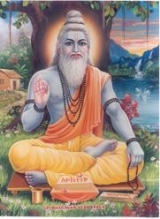
Vyasa

 
Vyasa

   Email Print
   Bookmark   Link


Vyasa


Vyasa (Devanagari
Devanagari

, or 'Nagari', is an abugida alphabet of India and Nepal. It is written from left to right, lacks distinct letter cases, and is recognizable by a distinctive horizontal line running along the tops of the letters that links them together....
: ?????) is a central and revered figure in the majority of Hindu
Hinduism

'Hinduism' is the predominant religion of the Indian subcontinent. Hinduism is often referred to as , a Sanskrit phrase meaning "the eternal dharma", by its practitioners....
 traditions. He is also sometimes called Veda Vyasa (??? ?????, veda vyasa), (the one who compiled the Vedas
Vedas

The Vedas are a large body of texts originating in History of India. They form the oldest layer of Sanskrit literature and the oldest Hindu scripture of Hinduism....
) or Krishna Dvaipayana (referring to his complexion and birthplace).


Discussion
Ask a question about 'Vyasa'
Start a new discussion about 'Vyasa'
Answer questions from other users
Full Discussion Forum


Encyclopedia


Vyasa
Vyasa (Devanagari
Devanagari

, or 'Nagari', is an abugida alphabet of India and Nepal. It is written from left to right, lacks distinct letter cases, and is recognizable by a distinctive horizontal line running along the tops of the letters that links them together....
: ?????) is a central and revered figure in the majority of Hindu
Hinduism

'Hinduism' is the predominant religion of the Indian subcontinent. Hinduism is often referred to as , a Sanskrit phrase meaning "the eternal dharma", by its practitioners....
 traditions. He is also sometimes called Veda Vyasa (??? ?????,
veda vyasa), (the one who compiled the Vedas
Vedas

The Vedas are a large body of texts originating in History of India. They form the oldest layer of Sanskrit literature and the oldest Hindu scripture of Hinduism....
) or Krishna Dvaipayana (referring to his complexion and birthplace). He is accredited as the scribe of both the Vedas, and the supplementary texts such as the Puranas
Puranas

The Puranas are a group of important Hindu religious texts, notably consisting of narratives of the history of the Universe from creation to destruction, genealogies of the kings, heroes, sages, and demigods, and descriptions of Hindu cosmology, philosophy, and geography....
. A number of Vaishnava traditions regard him as an avatar
Avatar

Avatar or Avatara , often translated into English as incarnation, literally means descent and usually implies a deliberate descent from higher spiritual realms to lower realms of existence for special purposes....
 of Vishnu
Vishnu

Vishnu , , is the Supreme God in Vaishnavite tradition of Hinduism. Smarta followers of Adi Shankara, among others, venerate Vishnu as one of panchadeva, and his supreme status is declared in the Hindu sacred texts like Yajurveda, the Rigveda and the Bhagavad Gita....
. Vyasa is also considered to be one of the eight Chiranjeevas (long lived, or immortals), who are still in existence according to general Hindu belief.

In the Mahabharata

Vyasa appears for the first time as the author of, and an important character in the Mahabharata
Mahabharata

The is one of the two major Sanskrit Indian epic poetrys of History of India, the other being the '. The epic is part of the Hindu itihasa , and forms an important part of Hindu mythology....
. He was the son of Satyavati
Satyavati

Satyavati is the great-grandmother of the Pandava and Kaurava princes, principal characters of the Mahabharata, one of the principal texts in Hindu mythology....
, daughter of a ferryman or fisherman, and the wandering sage Parashara
Parashara

is a Rigveda Maharsi and author of many ancient Indian texts. Parasara was the grandson of Vasishtha, the son of Shakti-muni, and the father of Vyasa....
. He was born on an island in the river Yamuna
Yamuna

The Yamuna is a major tributary river of the Ganges in northern India. With a total length of around , it is the largest tributary of the Ganges....
. This is said to be near
Kalpi
Kalpi

Kalpi is a city and a municipal board in Jalaun district in the Indian States and territories of India of Uttar Pradesh. It is on the right bank of the Yamuna....
in Jalaun
Jalaun

Jalaun is a city and a municipal board in Jalaun district in the Indian States and territories of India of Uttar Pradesh.The town was formerly the residence of a Maratha governor, but never the headquarters of the district, which are at Orai....
 district in Uttar Pradesh
Uttar Pradesh

Uttar Pradesh , [often referred to as U.P.] is a States and territories of India located in the northern part of India. With a population of over 190 million people,...
. Many also point out that the sage was born on the confluence of the rivers Koel,Sankha and Brahmani at the present steel city of Rourkela
Rourkela

Rourkela is a city located in the northwestern tip of the Indian state of Orissa at the heart of a rich mineral belt. It is the third largest city in orissa....
 in Northern Orissa
Orissa

Orissa , is a states and territories of India located on the east coast of India, by the Bay of Bengal. It was established on 1 April 1936 as a province in British India, and consists, predominantly of Oriya language speakers....
. The place is named after him as Vedvyas.He was dark-complexioned and hence may be called by the name
Krishna (black), and also the name Dwaipayana, meaning 'island-born'.

Vyasa was grandfather to the Kauravas and Pandavas. Both Dhritarashtra
Dhritarashtra

In the Mahabharata Dhritarashtra was the son born to Vichitravirya's first wife Ambika. He was fathered by Vyasa. This blind king of Hastinapura was father to a hundred children by his wife Gandhari ....
 and Pandu
Pandu

In the Mahabharata epic, Pandu is the son of Vichitravirya and his second wife, Ambalika from Vyasa. He is more popularly known as the father of the Pandavas....
, adopted as the sons of Vichitravirya by the royal family, were fathered by him. He had a third son, Vidura
Vidura

Vidura was half-brother to Dhritarashtra and Pandu. He was a son of a maid-servant who served the queens of Hastinapura, Ambika and Ambalika. In some accounts, he was an incarnation of Yama or Dharma Raja, who was cursed by the sage, Mandavya, for imposing punishment on him that exceed the sin....
, by a serving maid.

Veda Vyasa

Hindus traditionally hold that Vyasa categorised the primordial single Veda into four. Hence he was called Veda Vyasa, or "Splitter of the Vedas," the splitting being a feat that allowed people to understand the divine knowledge of the Veda. The word vyasa means split, differentiate, or describe.

It has been debated whether Vyasa was a single person or a class of scholars who did the splitting. The Vishnu Purana
Vishnu Purana

The Vishnu Purana is a religious Hindu text and one of eighteen Puranas. It is considered one of the most important Puranas and has been given the name Puranaratna ....
 has an interesting theory about Vyasa. The Hindu view of the universe is that of a cyclic phenomenon that comes into existence and dissolves repeatedly. Each cycle is presided over by a number of Manu
Manu

Manu may refer to:...
s, one for each Manvantara
Manvantara

Manvantara or Manuvantara , or age of a Manu , the Hindu progenitor of mankind, is an astronomical period of time measurement. Manvantara is a Sanskrit Sandhi, a combination of words manu and antara, manu-antara or manvantara, literally meaning the duration of a Manu, or his life span ....
, that has four ages, Yuga
Yuga

Yuga in Hindu philosophy is the name of an 'epoch' or 'era' within a cycle of four ages. These are the Satya Yuga , the Treta Yuga, the Dvapara Yuga and finally the Kali Yuga....
s of declining virtues. The Dvapara Yuga
Dvapara Yuga

Dvapara Yuga or Dwapara Yuga is the third out of four yugas, or ages, described in the scriptures of Hinduism. This yuga comes after Treta Yuga and is followed by Kali Yuga....
 is the third Yuga. The Vishnu Purana (Book 3, Ch 3) says:

In every third world age (Dvapara), Vishnu, in the person of Vyasa, in order to promote the good of mankind, divides the Veda, which is properly but one, into many portions. Observing the limited perseverance, energy, and application of mortals, he makes the Veda fourfold, to adapt it to their capacities; and the bodily form which he assumes, in order to effect that classification, is known by the name of Veda-vyasa. Of the different Vyasas in the present Manvantara and the branches which they have taught, you shall have an account. Twenty-eight times have the Vedas been arranged by the great Rishis in the Vaivasvata Manvantara... and consequently eight and twenty Vyasas have passed away; by whom, in the respective periods, the Veda has been divided into four. The first... distribution was made by Svayambhu (Brahma) himself; in the second, the arranger of the Veda (Vyasa) was Prajapati... (and so on up to twenty-eight).


Author of the Mahabharata

Vyasa is traditionally known as author of this epic. But he also features as an important character in it. His mother later married the king of Hastinapura
Hastinapura

Hastinapur is a town and a nagar panchayat in Meerut district in the Indian States and territories of India of Uttar Pradesh....
, and had two sons. Both sons died without an issue and taking recourse to an ancient practice called Niyoga
Niyoga

Niyoga is an ancient :Category:Hindu traditions, when a woman would request and appoint a person for helping her bear a child. According to this Hindu tradition the man who was appointed must be or would most likely be a Brahmin or Rishi or a revered person....
 where a chosen man can father sons with the widow of a person who dies issueless, she requests Vyasa to produce sons on behalf of her dead son Vichitravirya
Vichitravirya

Vichitravirya in the Hindu epic Mahabharata is the younger son of queen Satyavati and king Santanu. His elder brother, Chitrangada, had initially succeeded their father to the throne of Hastinapura, but when he died childless, Vichitravirya succeeded him....
.

Vyasa fathers the princes Dhritarashtra
Dhritarashtra

In the Mahabharata Dhritarashtra was the son born to Vichitravirya's first wife Ambika. He was fathered by Vyasa. This blind king of Hastinapura was father to a hundred children by his wife Gandhari ....
 and Pandu
Pandu

In the Mahabharata epic, Pandu is the son of Vichitravirya and his second wife, Ambalika from Vyasa. He is more popularly known as the father of the Pandavas....
 (by Ambika
Ambika

Ambika was the daughter of King of Varanasi and wife of Vichitravirya, King of Hastinapur.Along with her sisters Amba and Ambalika, she was taken by force by Bhishma from their Swayamvara....
 and Ambalika
Ambalika

Ambalika was the daughter of King of Varanasi and the wife of Vichitravirya, King of Hastinapur.Along with her sisters Amba and Ambika, she was taken by force by Bhishma from their Swayamvara....
, the wives of the dead king Vichitravirya
Vichitravirya

Vichitravirya in the Hindu epic Mahabharata is the younger son of queen Satyavati and king Santanu. His elder brother, Chitrangada, had initially succeeded their father to the throne of Hastinapura, but when he died childless, Vichitravirya succeeded him....
). Vyasa told them that they should come alone near him. First did Ambika, but because of shyness and fear she closed her eyes. Vyasa told Satyavati that her child would be blind. Later this child was named Dhritarashtra. Thus Satyavati sent Ambalika and warned her that she should remain calm. But Ambalika's face became pale because of fear. Vyasa told her that child would suffer from anaemia, and he would not be fit enough to rule the kingdom. Later this child was known as Pandu. Then Vyasa told Satyavati to send one of them again so that a healthy child can be born. This time Ambika and Ambalika sent a maid in the place of themselves. The maid was quite calm and composed, and she got a healthy child later named as Vidura
Vidura

Vidura was half-brother to Dhritarashtra and Pandu. He was a son of a maid-servant who served the queens of Hastinapura, Ambika and Ambalika. In some accounts, he was an incarnation of Yama or Dharma Raja, who was cursed by the sage, Mandavya, for imposing punishment on him that exceed the sin....
. While these are 'legally' not his sons, another son Shuka, born of his wife, sage Jabali's daughter Pinjala (Vatika), is considered his true spiritual heir. He was thus the grandfather of both the warring parties of the Mahabharata
Mahabharata

The is one of the two major Sanskrit Indian epic poetrys of History of India, the other being the '. The epic is part of the Hindu itihasa , and forms an important part of Hindu mythology....
, the Kaurava
Kaurava

The term Kaurava is a Sanskrit term, that means a descendant of Kuru , a legendary king who is the ancestor of many of the characters of the Mahabharata....
s and the Pandava
Pandava

In the Hinduism epic Mahabharata, the Pandava brothers are the five acknowledged sons of Pandu , by his two wives Kunti and Madri. Their names are Yudhishtira, Bhima, Arjuna, Nakula and Sahadeva....
s. He makes occasional appearances in the story as a spiritual guide to the young princes.

In the first book of the Mahabharata, it is described that Vyasa asked Ganesha
Ganesha

Ganesha , also spelled Ganesa or Ganesh and also known as Ganapati, Vinayaka, and Pillaiyar, is one of the best-known and most widely worshipped Hindu deities in the Hinduism Pantheon ....
 to aid him in writing the text, however Ganesha imposed a condition that he would do so only if Vyasa narrated the story without pause. To which Vyasa then made a counter-condition that Ganesha must understand the verse before he transcribed it. This is supposed to explain the complicated Sanskrit
Sanskrit

Sanskrit is a historical Indo-Aryan language, one of the liturgical languages of Hinduism and Buddhism, and one of the 22 official languages of India....
 used in some sections of the Mahabharata, recited by Vyasa when he wanted a break.

Vyasa is supposed to have meditated and authored the epic by the foothills of the river Beas (Vipasa) in the Punjab region.

Vyasa's Jaya

Vyasa's
Jaya, the core of Mahabharata is structured in the form of a dialogue between Dhritarashtra
Dhritarashtra

In the Mahabharata Dhritarashtra was the son born to Vichitravirya's first wife Ambika. He was fathered by Vyasa. This blind king of Hastinapura was father to a hundred children by his wife Gandhari ....
 (the Kuru king and the father of the Kauravas, who opposed the Pandavas in the Kurukshetra War
Kurukshetra war

The Kurukshetra War is the war between the kauravas and pandavas. It forms an essential component of the Indian epic poetry Mahabharata. According to Mahabharata, a dynastic struggle between sibling clans of Kauravas and the Pandavas for the throne of Hastinapura resulted in a battle in which a number of ancient kingdoms participated...
) and Sanjaya
Sanjaya

Sanjaya is a character from the ancient Indian epic Mahabharata. In this story of warring families, the father of the principals of the Kaurava side is the blindness monarch Dhritarashtra....
, his advisor and chariot driver. Sanjaya narrates each incident of the Kurukshetra War, fought in 18 days, as and when it happened. Dhritarashtra sometimes asks questions and doubts and sometimes laments, knowing about the destruction caused by the war, to his sons, friends and kinsmen. He also feels guilty, due to his own role, that led to this war, destructive to the entire Indian subcontinent.

In the beginning Sanjaya gives a description of the various continents of the Earth, the other planets, and focuses on the Indian Subcontinent and gives an elaborate list of hundreds of kingdoms, tribes, provinces, cities, towns, villages, rivers, mountains, forests etc of the (ancient) Indian Subcontinent (Bharata Varsha). He also explains about the 'military formations adopted by each side on each day, the death of each hero and the details of each war-racings. Some 18 chapters of Vyasa's Jaya constitutes the Bhagavad Gita
Bhagavad Gita

The Bhagavad Gita is an important Sanskrit Hindu scripture. It is revered as a sacred scripture of Hinduism, and considered as one of the most important religious classics of the world....
, the sacred text of the Hindus. Thus, this work of Vyasa, called Jaya deals with diverse subjects like geography, history, warfare, religion and morality.

Ugrasrava Sauti's Mahabharata

The final phase of Vyasa's work culminated as Mahabharata, structured as a narration by Ugrasrava Sauti
Ugrasrava Sauti

Reference: Mahabharata 1.1Ugrasrava Sauti was the narrator of the epic Mahabharata. Ugrasrava Sauti, like sage Vaisampayana, was the disciple of Krishna Dwaipayana Vyasa, the author of Mahabharata....
 (Sutji) who was a professional story teller, to an assembly of sages (rishi
Rishi

A rishi denotes a poet-sage through whom the Vedic hymns flowed, credited also as divine scribes. According to post-Vedic tradition the rishi is a "seer" or "shaman" to whom the Vedas were "originally revealed" through states of higher consciousness....
s) like Saunaka. Bharata is embedded inside it, and within it Jaya.

Reference to writing

Within the
Mahabharata, there is a tradition in which Vyasa wishes to write down or inscribe his work:

The Grandsire Brahma (creator of the universe) comes and tells Vyasa to get the help of Ganapati for his task. Ganapati writes down the stanzas recited by Vyasa from memory and thus the Mahabharata is inscribed or written. Ganapati could not cope up with Vyasa's speed and he misses many words or even stanzas.


The latest portions of the Mahabharata are estimated to date from roughly the 4th century BC, the time of the introduction of writing to India.

There is some evidence however that writing may have been known earlier based on archeological findings of styli
Stylus

A stylus is a writing utensil. The word is also used for a computer accessory . It usually refers to a narrow elongated staff, similar to a modern ballpoint pen....
 in the Painted Grey Ware culture, dated between 1100 BC and 700 BC. and archeological evidence of the Brahmi script being used from at least 600 BC.

The difficulty faced by Ganapati (Ganesha
Ganesha

Ganesha , also spelled Ganesa or Ganesh and also known as Ganapati, Vinayaka, and Pillaiyar, is one of the best-known and most widely worshipped Hindu deities in the Hinduism Pantheon ....
) in writing down Mahabharata as described in the tradition, could be real, and was most probably faced by those people who first attempted to write it down as some reciter recited it continuously. This is because, the reciter will not be able to stop the recitation in between and resume it, as the lines are committed to his memory as a continuous recording.

(The name Ganapati, was used in ancient days, to denote the head of a republic. In ancient India, there were
kingdoms ruled by kings or Rajas as well as republics ruled by elected heads or Ganapatis. Kambojas
Kamboja Kingdom

Kamboja or Kamvoja is one of the western kingdoms in the epic Mahabharata. Western kingdoms were cold countries and people used blankets. They also reared sheep and drank sheep milk....
 were a republic. To some extent Dwaraka
Dwaraka Kingdom

In the Mahabharata, Dvaraka is the capital of the Yadavas who ruled the Anarta Kingdom.The city was situated on the western point of Gujarat, and is submerged in the sea as per the volume 16 of the epic Mahabharata....
 had republican style of rule. Ganapati who wrote down Mahabharata, probably was one of these republic chiefs, well educated in the art of writing or inscription)

In the Puranas

Vyasa is also credited with the writing of the eighteen major, if not all, Pura?as.His son Shuka is the narrator of the major Pura?a Bhagavat-Pura?a.

In Buddhism

Within Buddhism
Buddhism

Buddhism is a family of beliefs and practices considered by most to be a religionand is based on the teachings attributed to Siddhartha Gautama, commonly known as "The Buddha" , who was born in what is today Nepal....
 Vyasa appears as Kanha-dipayana (the Pali
Páli

P?li is a village in Gyor-Moson-Sopron county, Hungary.External links...
 version of his name) in two Jataka
Jataka

The Jataka Tales also known in other languages refer to a voluminous body of folklore-like literature native to India concerning the previous births of the Gotama Buddha....
 tales: the Kanha-dipayana Jataka and Ghata Jataka. Whilst the former in which he appears as the Bodhisattva
Bodhisattva

In the Buddhist context, a bodhisattva means either "enlightened existence " or "enlightenment-being" or, given the variant Sanskrit spelling satva rather than sattva, "heroic-minded one for enlightenment "....
 has no relation to his tales from the Hindu works, his role in the latter one has parallels in an important event in the Mahabhrata.

In the 16th book of the epic, Mausala Parva, the end of the Vrishni
Vrishni

Vrishni s were an ancient clan who claimed their descent from Vrishni, a descendent of Yadu. It is believed that Vrishni was son of Satvata, a descendant of Yadu, the son of Yayati....
s, clansmen of Vyasa's namesake and Vishnu incarnate Krishna
Krishna

Krishna is a deity worshiped across many traditions in Hinduism in a variety of different perspectives. While many Vaishnava groups recognize him as an avatar of Vishnu, other traditions within Krishnaism consider Krishna to be svayam bhagavan, or the supreme being....
 is narrated. The epic says:
One day, the Vrishni heroes .. saw Vishvamitra, Kanwa
Kanwa

Kanwa was an ancient Hindu rishi, to whom some of the hymns of the Rig Veda are ascribed. He is sometimes included in the list of the seven sages ....
 and Narada
Narada

Narada or Narada Muni is a divine sage from the Hindu tradition, who plays a prominent role in a number of the Puranic texts, especially in the Bhagavata Purana, and in the Ramayana....
 arrived at Dwaraka. Afflicted by the rod of chastisement wielded by the deities, those heroes, causing Samba to be disguised like a woman, approached those ascetics and said, ‘This one is the wife of Vabhru of immeasurable energy who is desirous of having a son. Ye Rishis, do you know for certain what this one will bring forth?Those ascetics, attempted to be thus deceived, said: ‘This heir of Vasudeva, by name Samba, will bring forth a fierce iron bolt for the destruction of the Vrishnis and the Andhakas.

The important Bhagavata Purana
Bhagavata purana

The Bhagavata Purana is one of the "Maha" Puranic texts of Hinduism literature, and is Sanskrit for "The Book of God". Its primary focus is the process of bhakti yoga, which is Sanskrit for "Union with God through devotion for Him", in which Krishna is unequivocally declared to be Svayam Bhagavan....
 (book 11) too narrates the incident in a similar manner and names the sages as
Visvamitra, Asita, Kanva, Durvasa, Bhrigu, Angirâ, Kashyapa, Vâmadeva, Atri, Vasishthha, along with Nârada and others - it does not explicitly include Vyasa in the list.

The Ghata Jataka has a different spin on it:
The Vrishnis, wishing to test Kanha-dipayana's powers of clairvoyance, played a practical joke on him. They tied a pillow to the belly of a young lad, and dressing him up as a woman, took him to the ascetic and asked when the baby would be born. The ascetic replied that on the seventh day the person before him would give birth to a knot of acacia wood which would destroy the race of Vásudeva. The youths thereupon fell on him and killed him, but his prophecy came true .

Notably, he is not the Bodhisattva in the Ghata Jataka.

In the Arthashastra

The only non-religious book in which Vyasa has an interesting entry is the Arthashastra of Chanakya. In chapter 6, it says:

'Whosoever is of reverse character, whoever has not his organs of sense under his control, will soon perish, though possessed of the whole earth bounded by the four quarters. For example: Bhoja, known also by the name, Dándakya, making a lascivious attempt on a Bráhman maiden, perished along with his kingdom and relations; so also Karála, the Vaideha... Vátápi in his attempt under the influence of overjoy to attack Agastya, as well as the corporation of the Vrishnis in their attempt against Dwaipáyan.

This reference matches the Jataka version in including Vyasa as the sage attacked by the Vrishnis, though Vyasa does not die here.

Author of Brahma Sutra

The Brahma Sutra is attributed to Badarayana — which makes him the proponent of the crest-jewel school of Hindu philosophy, i.e., Vedanta
Vedanta

Vedanta is a spiritual tradition explained in the Upanishads that is concerned with the self-realisation by which one understands the ultimate nature of reality and teaches the believer's goal is to transcend the limitations of self-identity and realize one's unity with Brahman....
. As the island on which Vyasa was born is said to have been covered by Badara (Indian jujube) trees, he is known as Badarayana. Though traditionally, Vyasa is considered the Badarayana who wrote the Sutras, many historians think these were two different personalities.

Author of Yoga Bhashya

This text is a commentary on the Yoga Sutras of Patanjali
Patañjali

Pata?jali is the compiler of the Yoga Sutras, an important collection of aphorisms on Yoga practice, and also the author of the Mahabha?ya, a major commentary on Panini Ashtadhyayi....
. Vyasa is credited with this work also, though this is impossible, if Vyasa's immortality is not considered, as it is a later text.

See also

  • Historic Figures of Ancient India
    Historic Figures of Ancient India

    This article tries to compile and classify the prominent personalities of ancient India that find mention in more than one source of Sanskrit/vedas literature like the two Hindu Ithihasas viz the Mahabharata and the Ramayana, the Puranas and the Vedas with their supplement texts....


External links

  • , The Story of the Fortunate One (complete)
  • Ganguli translation, full text at sacred-texts.com