

Orlando Furioso

Encyclopedia
Orlando Furioso is an Italian
Italian literature
Italian literature is literature written in the Italian language, particularly within Italy. It may also refer to literature written by Italians or in Italy in other languages spoken in Italy, often languages that are closely related to modern Italian....
epic poem by Ludovico Ariosto
Ludovico Ariosto
Ludovico Ariosto was an Italian poet. He is best known as the author of the romance epic Orlando Furioso . The poem, a continuation of Matteo Maria Boiardo's Orlando Innamorato, describes the adventures of Charlemagne, Orlando, and the Franks as they battle against the Saracens with diversions...
which has exerted a wide influence on later culture. The earliest version appeared in 1516, although the poem was not published in its complete form until 1532. Orlando Furioso is a continuation of Matteo Maria Boiardo
Matteo Maria Boiardo
Matteo Maria Boiardo was an Italian Renaissance poet.Boiardo was born at, or near, Scandiano ; the son of Giovanni di Feltrino and Lucia Strozzi, he was of noble lineage, ranking as Count of Scandiano, with seignorial power over Arceto, Casalgrande, Gesso, and Torricella...
's unfinished romance Orlando Innamorato
Orlando Innamorato
Orlando Innamorato is an epic poem written by the Italian Renaissance author Matteo Maria Boiardo. The poem is a romance concerning the heroic knight Orlando .-Composition and publication:...
("Orlando in Love", published posthumously in 1495). The action takes place against the background of the war between, on the one side, Charlemagne
Charlemagne
Charlemagne was King of the Franks from 768 and Emperor of the Romans from 800 to his death in 814. He expanded the Frankish kingdom into an empire that incorporated much of Western and Central Europe. During his reign, he conquered Italy and was crowned by Pope Leo III on 25 December 800...
and his Christian paladin
Paladin
The paladins, sometimes known as the Twelve Peers, were the foremost warriors of Charlemagne's court, according to the literary cycle known as the Matter of France. They first appear in the early chansons de geste such as The Song of Roland, where they represent Christian martial valor against the...
s, and, on the other side, the Saracen
Saracen
Saracen was a term used by the ancient Romans to refer to a people who lived in desert areas in and around the Roman province of Arabia, and who were distinguished from Arabs. In Europe during the Middle Ages the term was expanded to include Arabs, and then all who professed the religion of Islam...
army which is attempting to invade Europe. However, Ariosto has little concern for historical or geographical accuracy, and the poem wanders at will from Japan
Japan
Japan is an island nation in East Asia. Located in the Pacific Ocean, it lies to the east of the Sea of Japan, China, North Korea, South Korea and Russia, stretching from the Sea of Okhotsk in the north to the East China Sea and Taiwan in the south...
to the Hebrides
Hebrides
The Hebrides comprise a widespread and diverse archipelago off the west coast of Scotland. There are two main groups: the Inner and Outer Hebrides. These islands have a long history of occupation dating back to the Mesolithic and the culture of the residents has been affected by the successive...
, as well as including many fantastical and magical elements, such as a trip to the moon and an array of fantastical creatures including a gigantic sea monster called the orc and the hippogriff
Hippogriff
A Hippogriff is a legendary creature, supposedly the offspring of a griffin and a mare.- Early references :...
. Many themes are interwoven in its complicated, episodic structure
Episode
An episode is a part of a dramatic work such as a serial television or radio program. An episode is a part of a sequence of a body of work, akin to a chapter of a book. The term sometimes applies to works based on other forms of mass media as well, as in Star Wars...
, but the most important plot is the paladin Orlando's unrequited love for the pagan princess Angelica
Angelica (character)
Angelica is a princess in the epic poem Orlando innamorato by Matteo Maria Boiardo. She reappears in the saga's continuation, Orlando furioso by Ludovico Ariosto, and in various later works based on the two original Orlando pieces...
, which develops into the madness of the title. After this comes the love between the female Christian warrior Bradamante
Bradamante
Bradamante is the sister of Rinaldo, and one of the heroines in Orlando Innamorato by Matteo Maria Boiardo and Orlando Furioso by Ludovico Ariosto in their handling of the Charlemagne legends, also called the Matter of France.She falls in love with the Saracen warrior Ruggiero, but refuses to...
and the Saracen Ruggiero
Ruggiero (character)
Ruggiero is a leading character in the Italian romantic epics Orlando innamorato by Matteo Maria Boiardo and Orlando furioso by Ludovico Ariosto. Ruggiero had originally appeared in the twelfth-century French epic, Aspremont, reworked by Andrea da Barberino as the chivalric romance Aspramonte...
, who are supposed to be the ancestors of Ariosto's patrons, the d'Este family of Ferrara
Ferrara
Ferrara is a city and comune in Emilia-Romagna, northern Italy, capital city of the Province of Ferrara. It is situated 50 km north-northeast of Bologna, on the Po di Volano, a branch channel of the main stream of the Po River, located 5 km north...
.
The poem is divided into forty-six cantos, each containing a variable number of eight-line stanza
Stanza
In poetry, a stanza is a unit within a larger poem. In modern poetry, the term is often equivalent with strophe; in popular vocal music, a stanza is typically referred to as a "verse"...
s in ottava rima
Ottava rima
Ottava rima is a rhyming stanza form of Italian origin. Originally used for long poems on heroic themes, it later came to be popular in the writing of mock-heroic works. Its earliest known use is in the writings of Giovanni Boccaccio....
(a rhyme scheme of abababcc). Ottava rima had been used in previous Italian romantic epics, including Luigi Pulci
Luigi Pulci
Luigi Pulci was an Italian poet best known for his Morgante, an epic story of a giant who is converted to Christianity and follows the knight Orlando....
's Morgante
Morgante
Morgante, sometimes also called Morgante Maggiore , is an Italian romantic epic by Luigi Pulci which appeared in its final form in 1483 .Based...
and Boiardo's Orlando Innamorato. Ariosto's work is 38,736 lines long in total, making it one of the longest poems in European literature.
Composition and publication
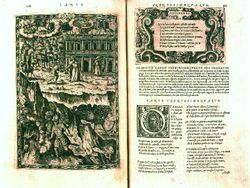
Ariosto began work on the poem around 1506, in which year he was 32. The first edition of the poem, in 40 cantos, was published in FerraraFerrara
Ferrara is a city and comune in Emilia-Romagna, northern Italy, capital city of the Province of Ferrara. It is situated 50 km north-northeast of Bologna, on the Po di Volano, a branch channel of the main stream of the Po River, located 5 km north...
in April 1516 and dedicated to the poet's patron Ippolito d'Este
Ippolito d'Este
Ippolito d'Este was an Italian Roman Catholic cardinal, and Archbishop of Esztergom. He was a member of the House of Este.-Biography:...
. A second edition appeared in 1521 with minor revisions.
Ariosto continued to write more material for the poem and in the 1520s he produced five more cantos, marking a further development of his poetry, which he decided not to include in the final edition. They were published after his death by his illegitimate son Virginio under the title Cinque canti and are highly regarded by some modern critics. The third and final version of Orlando Furioso, containing 46 cantos, appeared in 1532.
Ariosto had sought stylistic advice from the humanist
Humanism
Humanism is an approach in study, philosophy, world view or practice that focuses on human values and concerns. In philosophy and social science, humanism is a perspective which affirms some notion of human nature, and is contrasted with anti-humanism....
Pietro Bembo
Pietro Bembo
Pietro Bembo was an Italian scholar, poet, literary theorist, and cardinal. He was an influential figure in the development of the Italian language, specifically Tuscan, as a literary medium, and his writings assisted in the 16th-century revival of interest in the works of Petrarch...
to give his verse the last degree of polish and this is the version known to posterity.
The first English translation by John Harington was published in 1591 at the behest of Queen Elizabeth I
Elizabeth I of England
Elizabeth I was queen regnant of England and Ireland from 17 November 1558 until her death. Sometimes called The Virgin Queen, Gloriana, or Good Queen Bess, Elizabeth was the fifth and last monarch of the Tudor dynasty...
, who reportedly banned Harington from court until the translation was complete.
Ariosto and Boiardo
Ariosto's poem is a sequel to Matteo Maria BoiardoMatteo Maria Boiardo
Matteo Maria Boiardo was an Italian Renaissance poet.Boiardo was born at, or near, Scandiano ; the son of Giovanni di Feltrino and Lucia Strozzi, he was of noble lineage, ranking as Count of Scandiano, with seignorial power over Arceto, Casalgrande, Gesso, and Torricella...
's Orlando Innamorato
Orlando Innamorato
Orlando Innamorato is an epic poem written by the Italian Renaissance author Matteo Maria Boiardo. The poem is a romance concerning the heroic knight Orlando .-Composition and publication:...
(Orlando in Love). One of Boiardo's main achievements was his fusion of the Matter of France
Matter of France
The Matter of France, also known as the Carolingian cycle, is a body of literature and legendary material associated with the history of France, in particular involving Charlemagne and his associates. The cycle springs from the Old French chansons de geste, and was later adapted into a variety of...
, the tradition of stories about Charlemagne
Charlemagne
Charlemagne was King of the Franks from 768 and Emperor of the Romans from 800 to his death in 814. He expanded the Frankish kingdom into an empire that incorporated much of Western and Central Europe. During his reign, he conquered Italy and was crowned by Pope Leo III on 25 December 800...
and paladins such as Orlando – with the Matter of Britain
Matter of Britain
The Matter of Britain is a name given collectively to the body of literature and legendary material associated with Great Britain and its legendary kings, particularly King Arthur...
– the legends about King Arthur
King Arthur
King Arthur is a legendary British leader of the late 5th and early 6th centuries, who, according to Medieval histories and romances, led the defence of Britain against Saxon invaders in the early 6th century. The details of Arthur's story are mainly composed of folklore and literary invention, and...
and his knights; the character Orlando is a translation of Roland
Roland
Roland was a Frankish military leader under Charlemagne who became one of the principal figures in the literary cycle known as the Matter of France. Historically, Roland was military governor of the Breton March, with responsibility for defending the frontier of Francia against the Bretons...
from the 12th-century Song of Roland.
The latter contained the magical elements and love interest that were generally lacking in the more austere and warlike poems about Carolingian
Carolingian
The Carolingian dynasty was a Frankish noble family with origins in the Arnulfing and Pippinid clans of the 7th century AD. The name "Carolingian", Medieval Latin karolingi, an altered form of an unattested Old High German *karling, kerling The Carolingian dynasty (known variously as the...
heroes. Ariosto continued to mix these elements in his poem as well as adding material derived from Classical
Classics
Classics is the branch of the Humanities comprising the languages, literature, philosophy, history, art, archaeology and other culture of the ancient Mediterranean world ; especially Ancient Greece and Ancient Rome during Classical Antiquity Classics (sometimes encompassing Classical Studies or...
sources. However, Ariosto has an ironic tone rarely present in Boiardo, who treated the ideals of chivalry much more seriously. In Orlando Furioso, instead of chivalric ideals, no longer alive in the 16th century, a humanistic
Humanism
Humanism is an approach in study, philosophy, world view or practice that focuses on human values and concerns. In philosophy and social science, humanism is a perspective which affirms some notion of human nature, and is contrasted with anti-humanism....
conception of man and life is vividly celebrated under the appearance of a fantastical world.
Plot
Rodomonte
Rodomonte is a major character in the Italian romantic epics Orlando innamorato by Matteo Maria Boiardo and Orlando furioso by Ludovico Ariosto. He is the King of Sarza and Algiers and the leader of the Saracen army which besieges Charlemagne in Paris. He is in love with Doralice, Princess of...
– besiege Charlemagne in Paris.
Meanwhile Orlando, Charlemagne's most famous paladin, has been tempted to forget his duty to protect the emperor through his love for the pagan princess Angelica. At the beginning of the poem, Angelica escapes from the castle of the Bavarian Duke Namo, and Orlando sets off in pursuit. The two meet with various adventures until Angelica saves a wounded Saracen knight, Medoro, falls in love, and elopes with him to Cathay
Cathay
Cathay is the Anglicized version of "Catai" and an alternative name for China in English. It originates from the word Khitan, the name of a nomadic people who founded the Liao Dynasty which ruled much of Northern China from 907 to 1125, and who had a state of their own centered around today's...
.
When Orlando learns the truth, he goes mad with despair and rampages through Europe and Africa destroying everything in his path. The English knight Astolfo journeys to Ethiopia on the hippogriff
Hippogriff
A Hippogriff is a legendary creature, supposedly the offspring of a griffin and a mare.- Early references :...
to find a cure for Orlando's madness.
He flies up to the moon (in Elijah's flaming chariot no less) where everything lost on earth is to be found, including Orlando's wits. He brings them back in a bottle and makes Orlando sniff them, thus restoring him to sanity. (At the same time Orlando falls out of love with Angelica, as the author explains that love is itself a form of insanity.)
Orlando joins with Brandimart and Oliver to fight Agramante, Sobrino and Gradasso on the island of Lampedusa
Lampedusa
Lampedusa is the largest island of the Italian Pelagie Islands in the Mediterranean Sea. The comune of Lampedusa e Linosa is part of the Sicilian province of Agrigento which also includes the smaller islands of Linosa and Lampione. It is the southernmost part of Italy. Tunisia, which is about ...
. There Orlando kills King Agramante.

Ruggiero is taken captive by the sorceress Alcina
Alcina
Alcina is an opera seria by George Frideric Handel. Handel used the libretto of L'isola di Alcina, an opera that was set in 1728 in Rome by Riccardo Broschi, which he acquired the year after, during his travels in Italy...
and has to be freed from her magic island. He also has to avoid the enchantments of his foster father, the wizard Atlante
Atlantes (Sorcerer)
Atlantes was a powerful sorcerer featured in the chansons de geste. The sorcerer built a castle of iron in the Pyrenees to keep knights and ladies he had captured as a diversion for Ruggiero, a Saracen knight. Atlantes feared that Ruggiero would convert to Christianity and aid Charlemagne against...
, who does not want him to fight. Finally, Ruggiero converts to Christianity and marries Bradamante.
Rodomonte appears at the wedding feast and accuses him of being a traitor to the Saracen cause, and the poem ends with Ruggiero slaying Rodomonte in single combat
Single combat
Single combat is a fight between two single warriors which takes place in the context of a battle between two armies, with the two often considered the champions of their respective sides...
. Ruggiero and Bradamante are the ancestors of the House of Este, Ariosto's patrons, whose genealogy he gives at length in canto 3 of the poem.
The epic contains many other characters, including Orlando's cousin, the paladin Rinaldo, who is also in love with Angelica; the thief Brunello
Brunello (character)
Brunello is a character in the Italian romantic epics Orlando innamorato by Matteo Maria Boiardo and Orlando furioso by Ludovico Ariosto. Brunello is a dwarf and a cunning thief who works for the Saracen army of King Agramante. He first appears in the second book of Orlando innamorato where...
; and the tragic heroine Isabella.
Later literature
Orlando Furioso is "one of the most influential works in the whole of European literature" and it remains an inspiration for writers to this day.In 1559, Laura Terracina
Laura Terracina
-Life:Terracina was born in Chiaia, a suburb of Naples. Her mother, Diana Anfora of Sorrento and father, Paolo Terracina, had at least one more daughter and two sons. She got encouragement from the famous poet Vittoria Colonna, who sent her a brief poem praising her talents...
wrote the Discorso sopra il Principio di Trutti I Canti di Orlando Furioso which was linked to Orlando Furioso and in which several of the characters appeared.
The Italian novelist Italo Calvino
Italo Calvino
Italo Calvino was an Italian journalist and writer of short stories and novels. His best known works include the Our Ancestors trilogy , the Cosmicomics collection of short stories , and the novels Invisible Cities and If on a winter's night a traveler .Lionised in Britain and the United States,...
drew on Ariosto for several of his works of fiction including Il cavaliere inesistente ("The Nonexistent Knight
The Nonexistent Knight
The Nonexistent Knight is an allegorical fantasy novel by Italo Calvino, first published in Italian 1959 and in English translation in 1962. The novel tells the story of Agilulf, a medieval knight who perfectly exemplifies chivalry, piety, and faithfulness, but exists only as an empty suit of armor...
", 1959) and Il castello dei destini incrociati ("The Castle of Crossed Destinies", 1973). In 1970 Calvino brought out his own selection of extracts from the poem.
Orlando Furioso was a major influence on Edmund Spenser
Edmund Spenser
Edmund Spenser was an English poet best known for The Faerie Queene, an epic poem and fantastical allegory celebrating the Tudor dynasty and Elizabeth I. He is recognised as one of the premier craftsmen of Modern English verse in its infancy, and one of the greatest poets in the English...
's epic The Faerie Queene
The Faerie Queene
The Faerie Queene is an incomplete English epic poem by Edmund Spenser. The first half was published in 1590, and a second installment was published in 1596. The Faerie Queene is notable for its form: it was the first work written in Spenserian stanza and is one of the longest poems in the English...
. William Shakespeare
William Shakespeare
William Shakespeare was an English poet and playwright, widely regarded as the greatest writer in the English language and the world's pre-eminent dramatist. He is often called England's national poet and the "Bard of Avon"...
's Much Ado About Nothing
Much Ado About Nothing
Much Ado About Nothing is a comedy written by William Shakespeare about two pairs of lovers, Benedick and Beatrice, and Claudio and Hero....
takes one of its plots (Hero/Claudio/Don John) from Orlando Furioso (probably via Spenser or Bandello). In 1592, Robert Greene
Robert Greene (16th century)
Robert Greene was an English author best known for a posthumous pamphlet attributed to him, Greene's Groats-Worth of Wit, widely believed to contain a polemic attack on William Shakespeare. He was born in Norwich and attended Cambridge University, receiving a B.A. in 1580, and an M.A...
published a play called The Historie of Orlando Furioso. According to Barbara Reynolds, the English poet the closest in spirit to Ariosto is Lord Byron.
In Spain, Lope de Vega
Lope de Vega
Félix Arturo Lope de Vega y Carpio was a Spanish playwright and poet. He was one of the key figures in the Spanish Golden Century Baroque literature...
wrote a continuation of the epic (La hermosura de Angélica, 1602) as did Luis Barahona de Soto (Las lágrimas de Angélica, 1586). Góngora
Gongora
Gongora, abbreviated Gga in horticultural trade, is a member of the Orchid family . It consists of 65 species known from Central America, Trinidad, and tropical South America, with most species found in Colombia...
wrote a famous poem describing the idyllic honeymoon of Angelica and Medoro
Angelica and Medoro
Angelica and Medoro was a popular theme for Romantic painters, composers and writers from the sixteenth until the nineteenth century. Angelica and Medoro are two characters from the siwteenth-century Italian epic Orlando Furioso by Ludovico Ariosto...
(En un pastoral albergue). Orlando Furioso is mentioned among the romances in Don Quixote. Among the interpolated stories within Don Quixote is a retelling of a tale from canto 43 regarding a man who tests the fidelity of his wife. Additionally, various literary critics have noted the poem's likely influence on Garcilaso de la Vega's second eclogue. The modern Argentinian writer Jorge Luis Borges
Jorge Luis Borges
Jorge Francisco Isidoro Luis Borges Acevedo , known as Jorge Luis Borges , was an Argentine writer, essayist, poet and translator born in Buenos Aires. In 1914 his family moved to Switzerland where he attended school, receiving his baccalauréat from the Collège de Genève in 1918. The family...
was also an admirer of Orlando and included a poem, Ariosto y los árabes (Ariosto and the Arabs), exploring the relationship between the epic and the Arabian Nights in his 1960 collection, El hacedor. Borges also chose Attilio Momigliano's critical study of the work as one of the hundred volumes that were to make up his Personal Library.
In France, Jean de la Fontaine
Jean de La Fontaine
Jean de La Fontaine was the most famous French fabulist and one of the most widely read French poets of the 17th century. He is known above all for his Fables, which provided a model for subsequent fabulists across Europe and numerous alternative versions in France, and in French regional...
used the plots of some of the bawdier episodes for three of his Contes et Nouvelles en vers (1665–66). The modern Russian poet Osip Mandelstam
Osip Mandelstam
Osip Emilyevich Mandelstam was a Russian poet and essayist who lived in Russia during and after its revolution and the rise of the Soviet Union. He was one of the foremost members of the Acmeist school of poets...
paid tribute to Orlando Furioso in his poem Ariosto (1933).
Salman Rushdie's 2008 novel The Enchantress of Florence
The Enchantress of Florence
The Enchantress of Florence is the ninth novel by Salman Rushdie, and was published in 2008. According to Rushdie this is his "most researched book" which required "Years and years of reading"....
was partly inspired by Orlando Furioso.
Music
In the Baroque era, the poem was the basis of many operas. Among the earliest were Francesca CacciniFrancesca Caccini
Francesca Caccini was an Italian composer, singer, lutenist, poet, and music teacher of the early Baroque era. She was the daughter of Giulio Caccini, and was one of the best-known and most influential female European composers between Hildegard of Bingen in the 12th century and the 19th century...
's La liberazione di Ruggiero dall'isola d'Alcina ("The Liberation of Ruggiero from Alcina's Island", 1625) and Luigi Rossi's Il palazzo incantato (1642). Antonio Vivaldi
Antonio Vivaldi
Antonio Lucio Vivaldi , nicknamed because of his red hair, was an Italian Baroque composer, priest, and virtuoso violinist, born in Venice. Vivaldi is recognized as one of the greatest Baroque composers, and his influence during his lifetime was widespread over Europe...
wrote three opera
Opera
Opera is an art form in which singers and musicians perform a dramatic work combining text and musical score, usually in a theatrical setting. Opera incorporates many of the elements of spoken theatre, such as acting, scenery, and costumes and sometimes includes dance...
s on themes from Ariosto: Orlando furioso
Orlando furioso (Vivaldi)
Orlando furioso is an opera in three acts by Antonio Vivaldi to an Italian libretto by Grazio Braccioli, based on the poem of the same name by Ariosto. The first performance of the opera was at Teatro San Angelo, Venice, in 1727....
(1713), Orlando finto pazzo (1714) and Orlando (1727). Perhaps the most famous operas inspired by the poem are those by Handel
George Frideric Handel
George Frideric Handel was a German-British Baroque composer, famous for his operas, oratorios, anthems and organ concertos. Handel was born in 1685, in a family indifferent to music...
: Orlando
Orlando (opera)
Orlando is an opera seria in three acts by George Frideric Handel written for the Royal Academy of Music . The Italian-language libretto was adapted from Carlo Sigismondo Capece's L'Orlando after Ludovico Ariosto's Orlando Furioso, which was also the source of Handel's operas Alcina and...
(1733), Ariodante
Ariodante
Ariodante is an opera seria in three acts by Handel. The anonymous Italian libretto was based on a work by Antonio Salvi, which in turn was adapted from Canti 5 and 6 of Ludovico Ariosto's Orlando Furioso...
and Alcina
Alcina
Alcina is an opera seria by George Frideric Handel. Handel used the libretto of L'isola di Alcina, an opera that was set in 1728 in Rome by Riccardo Broschi, which he acquired the year after, during his travels in Italy...
(1735). In France, Jean-Baptiste Lully
Jean-Baptiste Lully
Jean-Baptiste de Lully was an Italian-born French composer who spent most of his life working in the court of Louis XIV of France. He is considered the chief master of the French Baroque style. Lully disavowed any Italian influence in French music of the period. He became a French subject in...
turned to Ariosto for his tragédie en musique Roland
Roland (Lully)
Roland is an opera with music by Jean-Baptiste Lully and a libretto by Philippe Quinault first performed at Versailles on January 8, 1685. The story is derived from Ariosto's epic poem Orlando Furioso...
(1685). Rameau's comic opera Les Paladins
Les Paladins
Les Paladins is an opera by Jean-Philippe Rameau first performed on 12 February 1760. The author of the libretto is unknown, but it has been attributed to Duplat de Monticourt...
(1760) is based on a story in canto 18 of Orlando (though Rameau's librettist derived the plot indirectly via La Fontaine's Contes). The enthusiasm for operas based on Ariosto continued into the Classical era and beyond with such examples as Niccolò Piccinni
Niccolò Piccinni
Niccolò Piccinni was an Italian composer of symphonies, sacred music, chamber music, and opera. Although he is somewhat obscure, even to music lovers today, Piccinni was one of the most popular composers of opera—particularly the Neapolitan opera buffa—of his day...
's Roland
Roland (Piccinni)
Roland is a tragédie lyrique in three acts by the composer Niccolò Piccinni. The opera was a new setting of a libretto written by Philippe Quinault for Jean-Baptiste Lully in 1685, specially adapted for Piccinni by Jean-François Marmontel...
(1778), Haydn's Orlando paladino
Orlando paladino
Orlando paladino , Hob. 28/11, is an opera in three acts by Joseph Haydn which was first performed at Eszterháza on 6 December 1782. The libretto by Nunziano Porta is based on another libretto, Le pazzie d'Orlando, by Carlo Francesco Badini , itself inspired by Ariosto's epic poem Orlando furioso...
(1782) and Méhul's Ariodant
Ariodant
Ariodant is an opéra comique in three acts by the French composer Étienne Méhul first performed at the Théâtre Favart in Paris on 11 October 1799. The libretto, by François-Benoît Hoffman is based on the same episode in Ariosto's Orlando Furioso that also inspired Handel's opera Ariodante...
(1799). Ambroise Thomas
Ambroise Thomas
Charles Louis Ambroise Thomas was a French composer, best known for his operas Mignon and Hamlet and as Director of the Conservatoire de Paris from 1871 till his death.-Biography:"There is good music, there is bad music, and then there is Ambroise Thomas."- Emmanuel Chabrier-Early life...
wrote a comedic one act Angélique et Médor in 1843.
Art
Orlando Furioso has been the inspiration for many works of art, including paintings by TiepoloGiovanni Battista Tiepolo
Giovanni Battista Tiepolo , also known as Gianbattista or Giambattista Tiepolo, was an Italian painter and printmaker from the Republic of Venice...
, Ingres
Jean Auguste Dominique Ingres
Jean-Auguste-Dominique Ingres was a French Neoclassical painter. Although he considered himself to be a painter of history in the tradition of Nicolas Poussin and Jacques-Louis David, by the end of his life it was Ingres's portraits, both painted and drawn, that were recognized as his greatest...
, Redon
Odilon Redon
Bertrand-Jean Redon, better known as Odilon Redon was a French symbolist painter, printmaker, draughtsman and pastellist.-Life:...
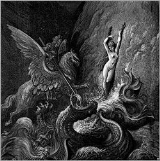
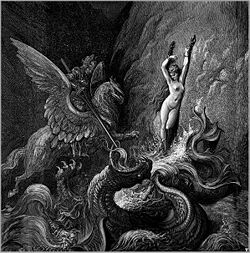
, and a series of illustrations by Gustave Doré
Gustave Doré
Paul Gustave Doré was a French artist, engraver, illustrator and sculptor. Doré worked primarily with wood engraving and steel engraving.-Biography:...
.
Other
In 1975, Luca RonconiLuca Ronconi
Luca Ronconi is an Italian actor, theater director, and opera director.- Biography :After growing up in Tunisia, where his mother was a school teacher, he graduated from the Academy of Dramatic Art in Rome in 1953. He acted in productions of Luigi Squarzina, Orazio Costa, Michelangelo Antonioni...
directed an Italian television mini-series based on Orlando Furioso, starring Massimo Foschi (it) as Orlando, and Silvia Dionisio
Silvia Dionisio
Silvia Dionisio is an Italian actress who appeared in several movies in the 1970s, including Amici miei and Ondata di piacere....
as Isabella.
In the late 1960's / early 1970's, the Bob and Ray comedy parody radio show Mary Backstayge, Noble Wife centered around the Backstayge's stage production of the fictional play "Westchester Furioso", an updating of Orlando Furioso that somehow involved musical numbers, tap dancing and ping pong.
In 1966, Italian Disney comics
Disney comics
Disney comics are comic books and comic strips featuring Walt Disney characters.The first Disney comics were newspaper strips appearing from 1930 on . In 1940, Western Publishing began producing Disney comic books in the United States...
artist Luciano Bottaro
Luciano Bottaro
Luciano Bottaro was an Italian comic book artist.Bottaro's characteristic style is highly appreciated in Europe - many countries publish his comics .Influenced by Otto Messmer's Felix the...
wrote a parody of Orlando Furioso starring Donald Duck
Donald Duck
Donald Fauntleroy Duck is a cartoon character created in 1934 at Walt Disney Productions and licensed by The Walt Disney Company. Donald is an anthropomorphic white duck with a yellow-orange bill, legs, and feet. He typically wears a sailor suit with a cap and a black or red bow tie. Donald is most...
, Paperin Furioso.
Critical reception
Orlando Furioso won immediate fame. Around the middle of the 16th century, some Italian critics such as Gian Giorgio TrissinoGian Giorgio Trissino
Gian Giorgio Trissino was an Italian Renaissance humanist, poet, dramatist, diplomat, and grammarian.-Biography:...
complained that the poem failed to observe the unity of action as defined by Aristotle
Aristotle
Aristotle was a Greek philosopher and polymath, a student of Plato and teacher of Alexander the Great. His writings cover many subjects, including physics, metaphysics, poetry, theater, music, logic, rhetoric, linguistics, politics, government, ethics, biology, and zoology...
, by having multiple plots rather than a single main story. The French poet Pierre de Ronsard
Pierre de Ronsard
Pierre de Ronsard was a French poet and "prince of poets" .-Early life:...
and the Italian poet Torquato Tasso
Torquato Tasso
Torquato Tasso was an Italian poet of the 16th century, best known for his poem La Gerusalemme liberata , in which he depicts a highly imaginative version of the combats between Christians and Muslims at the end of the First Crusade, during the siege of Jerusalem...
both felt that Orlando Furioso lacked structural unity. Ariosto's defenders, such as Giovanni Battista Giraldi
Giovanni Battista Giraldi
Giovanni Battista Giraldi was an Italian novelist and poet. He appended the nickname Cinthio to his name and is commonly referred to by that name .Born at Ferrara, he was educated at the university there, and in 1525 became its professor of natural philosophy...
, replied that it was not a Classical epic but a romanzo, a genre unknown to Aristotle; therefore his standards were irrelevant. Nevertheless, the strictures of the Classical critics influenced the next great Italian epic, Torquato Tasso
Torquato Tasso
Torquato Tasso was an Italian poet of the 16th century, best known for his poem La Gerusalemme liberata , in which he depicts a highly imaginative version of the combats between Christians and Muslims at the end of the First Crusade, during the siege of Jerusalem...
's Gerusalemme Liberata (1581). Tasso tried to combine Ariosto's freedom of invention with a more unified plot structure. In the following decades, Italian critics argued over the respective merits of the two epics. Partisans of Orlando praised its psychological realism and the naturalness of its language. In the 19th century, Hegel
Georg Wilhelm Friedrich Hegel
Georg Wilhelm Friedrich Hegel was a German philosopher, one of the creators of German Idealism. His historicist and idealist account of reality as a whole revolutionized European philosophy and was an important precursor to Continental philosophy and Marxism.Hegel developed a comprehensive...
considered that the work's many allegories and metaphors did not serve merely to refute the ideal of chivalry
Chivalry
Chivalry is a term related to the medieval institution of knighthood which has an aristocratic military origin of individual training and service to others. Chivalry was also the term used to refer to a group of mounted men-at-arms as well as to martial valour...
, but also to demonstrate the fallacy of human senses and judgment. Francesco de Sanctis
Francesco de Sanctis
Francesco de Sanctis was an Italian literary critic, considered the most important scholar of Italian language and literature in the 19th century....
and Attilio Momigliano (it) also wrote about Orlando Furioso.
Translations
There have been several verse translations of Orlando Furioso into English. The first one was by John Harington, published in 1591. William Huggins' and Henry Boyd's translations were published in 1757 and 1784, respectively. John HooleJohn Hoole
John Hoole was an English translator, the son of watch-maker and inventor, Samuel Hoole and Sarah Drury. He was born in London, and worked in India House , of which he rose to be principal auditor...
's 1783 translation used rhyming couplet
Couplet
A couplet is a pair of lines of meter in poetry. It usually consists of two lines that rhyme and have the same meter.While traditionally couplets rhyme, not all do. A poem may use white space to mark out couplets if they do not rhyme. Couplets with a meter of iambic pentameter are called heroic...
s. William Stewart Rose
William Stewart Rose
William Stewart Rose was a British poet and translator, son of George Rose, who held various Government offices, including that of Treasurer of the Navy...
produced an eight volume translation beginning publication in 1823 and ending in 1831. Barbara Reynolds
Barbara Reynolds
Barbara Reynolds is an English scholar, lexicographer and translator, wife of the philologist and translator Lewis Thorpe.-Early life:The daughter of Alfred Charles Reynolds, and the god-daughter of Dorothy L...
published a verse translation in 1975, while the most recent verse translation (extremely abridged), by David Slavitt, was published in 2009.
A few translations have also been made in prose format. A.H. Gilbert's translation was published in 1954. Richard Hodgens planned a multivolume translation, whose first volume, subtitled The Ring of Angelica, was published by Ballantine Books
Ballantine Books
Ballantine Books is a major book publisher located in the United States, founded in 1952 by Ian Ballantine with his wife, Betty Ballantine. It was acquired by Random House in 1973, which in turn was acquired by Bertelsmann AG in 1998 and remains part of that company today. Ballantine's logo is a...
as the fifty-fourth volume of its celebrated Ballantine Adult Fantasy series
Ballantine Adult Fantasy series
The Ballantine Adult Fantasy series was an imprint of Ballantine Books. Launched in 1969 , the series reissued a number of works of fantasy literature, which were out of print or dispersed in back issues of pulp magazines , in cheap paperback form—including works...
in October, 1973. The remaining volumes do not appear to have seen print. Most recently, Guido Waldman's complete prose translation was first published in 1973.
Major characters
- AngelicaAngelica (character)Angelica is a princess in the epic poem Orlando innamorato by Matteo Maria Boiardo. She reappears in the saga's continuation, Orlando furioso by Ludovico Ariosto, and in various later works based on the two original Orlando pieces...
- Astolfo
- AtlantesAtlantes (Sorcerer)Atlantes was a powerful sorcerer featured in the chansons de geste. The sorcerer built a castle of iron in the Pyrenees to keep knights and ladies he had captured as a diversion for Ruggiero, a Saracen knight. Atlantes feared that Ruggiero would convert to Christianity and aid Charlemagne against...
- BradamanteBradamanteBradamante is the sister of Rinaldo, and one of the heroines in Orlando Innamorato by Matteo Maria Boiardo and Orlando Furioso by Ludovico Ariosto in their handling of the Charlemagne legends, also called the Matter of France.She falls in love with the Saracen warrior Ruggiero, but refuses to...
- BrunelloBrunello (character)Brunello is a character in the Italian romantic epics Orlando innamorato by Matteo Maria Boiardo and Orlando furioso by Ludovico Ariosto. Brunello is a dwarf and a cunning thief who works for the Saracen army of King Agramante. He first appears in the second book of Orlando innamorato where...
- CharlemagneCharlemagneCharlemagne was King of the Franks from 768 and Emperor of the Romans from 800 to his death in 814. He expanded the Frankish kingdom into an empire that incorporated much of Western and Central Europe. During his reign, he conquered Italy and was crowned by Pope Leo III on 25 December 800...
- FerraùFerraùFerraù is a character in French and Italian romantic epics dealing with the Matter of France, including Orlando innamorato by Matteo Maria Boiardo and Orlando furioso by Ludovico Ariosto.-Ferragus in the Pseudo-Turpin Chronicle:The character appears in one of the main episodes of the so-called...
- MarfisaMarfisaMarfisa is a character in the Italian romantic epics Orlando innamorato by Matteo Maria Boiardo and Orlando furioso by Ludovico Ariosto. She is the sister of Ruggiero but was separated from him in early childhood. She becomes queen of India and fights as a warrior for the Saracens, taking part in...
- OrlandoRolandRoland was a Frankish military leader under Charlemagne who became one of the principal figures in the literary cycle known as the Matter of France. Historically, Roland was military governor of the Breton March, with responsibility for defending the frontier of Francia against the Bretons...
(also known as Roland in related literature) - RinaldoRenaud de MontaubanRenaud de Montauban, was a fictional hero who was introduced to literature in a 12th century Old French chanson de geste also known as Les Quatre Fils Aymon . His exploits form part of the Doon de Mayence cycle of chansons...
- RodomonteRodomonteRodomonte is a major character in the Italian romantic epics Orlando innamorato by Matteo Maria Boiardo and Orlando furioso by Ludovico Ariosto. He is the King of Sarza and Algiers and the leader of the Saracen army which besieges Charlemagne in Paris. He is in love with Doralice, Princess of...
- RuggieroRuggiero (character)Ruggiero is a leading character in the Italian romantic epics Orlando innamorato by Matteo Maria Boiardo and Orlando furioso by Ludovico Ariosto. Ruggiero had originally appeared in the twelfth-century French epic, Aspremont, reworked by Andrea da Barberino as the chivalric romance Aspramonte...
(also known as Rogero in older translations) - SacripanteSacripanteSacripante is a character in the Italian romantic epics Orlando innamorato by Matteo Maria Boiardo and Orlando furioso by Ludovico Ariosto. Sacripante is the King of Circassia and one of the leading Saracen knights...
External links
- Online Medieval & Classical Library E-text (William Stewart RoseWilliam Stewart RoseWilliam Stewart Rose was a British poet and translator, son of George Rose, who held various Government offices, including that of Treasurer of the Navy...
translation) English translation by William Stewart RoseWilliam Stewart RoseWilliam Stewart Rose was a British poet and translator, son of George Rose, who held various Government offices, including that of Treasurer of the Navy... - Orlando Furioso: Italian text
- Orlando Furioso: Italian Audiobook