

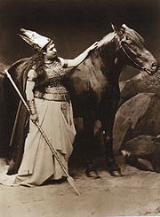
Der Ring des Nibelungen

Encyclopedia
Der Ring des Nibelungen is a cycle
of four epic
opera
s (or "dramas" to use the composer's preferred term) by the German
composer Richard Wagner
(1813–83). The works are based loosely on characters from the Norse saga
s and the Nibelungenlied
. The four dramas, which the composer described as a trilogy with a Vorabend ("preliminary evening"), are often referred to as the Ring Cycle, Wagner's Ring, or simply the Ring.
Wagner wrote the libretto
and music over the course of about twenty-six years, from 1848 to 1874. The four operas that constitute the Ring cycle are, in the order of the imagined events they portray:
Although individual operas are performed as works in their own right, Wagner intended them to be a coherent whole, performed in a series.
of the title is the dwarf Alberich, and the ring in question is the one he fashions from the Rhinegold. The title therefore denotes "Alberich's Ring". In German the "-en" ending of "Nibelungen" and the article "des" preceding it denote the possessive (genitive) case. "Nibelungen" is occasionally mistaken as a plural: thus the Ring of the Nibelungs is incorrect.
's pacing. The first and shortest opera, Das Rheingold, typically lasts two and a half hours, while the final and longest, Götterdämmerung, takes up four and a half hours, excluding act breaks.
The cycle is modelled after ancient Greek dramas
that were presented as three tragedies and one satyr play
. The Ring proper begins with Die Walküre and ends with Götterdämmerung, with Rheingold as a prelude
. Wagner called Das Rheingold a Vorabend or "Preliminary Evening", and Die Walküre, Siegfried and Götterdämmerung were subtitled First Day, Second Day and Third Day, respectively, of the trilogy
proper.
The scale and scope of the story is epic. It follows the struggles of god
s, hero
es, and several mythical creatures over the eponymous magic Ring that grants domination over the entire world. The drama and intrigue continue through three generations of protagonists, until the final cataclysm at the end of Götterdämmerung.
The music of the cycle is thick and richly textured, and grows in complexity as the cycle proceeds. Wagner wrote for an orchestra
of gargantuan proportions, including a greatly enlarged brass section with new instruments such as the Wagner tuba
, bass trumpet
and contrabass trombone. Remarkably, he uses a chorus only relatively briefly, in acts 2 and 3 of Götterdämmerung, and then mostly of men with just a few women. He eventually had a purpose-built theatre constructed, the Bayreuth Festspielhaus
, in which to perform this work. The theatre has a special stage that blends the huge orchestra with the singers' voices, allowing them to sing at a natural volume. The result was that the singers did not have to strain themselves vocally during the long performances.
dwarf Alberich
from gold he stole from the Rhine maidens in the river Rhine. Several mythic figures struggle for possession of the ring, including Wotan (Odin)
, the chief of the gods
. Wotan's scheme, spanning generations, to overcome his limitations, drives much of the action in the story. His grandson, the hero Siegfried
, wins the ring, as Wotan intended, but is eventually betrayed and slain. Finally, the Valkyrie
Brünnhilde, Siegfried's lover and Wotan's estranged daughter, returns the ring to the Rhine maidens. In the process, the Gods and their home, Valhalla
, are destroyed.
Details of the storylines can be found in the articles on each opera.
Wagner created the story of the Ring by fusing elements from many German
and Scandinavia
n myths and folk tales. The Old Norse
Edda
s supplied much of the material for Das Rheingold, while Die Walküre was largely based on the Völsungasaga. Siegfried contains elements from the Eddur, the Völsungasaga and Thidrekssaga. The final opera, Götterdämmerung, draws from the 12th century High German poem known as the Nibelungenlied
, which appears to have been the original inspiration for the Ring, and for which the cycle was named. For a detailed examination of Wagner's sources for the Ring and his treatment of them, see, among other works, Deryck Cooke
's unfinished study of the Ring, I Saw the World End, and Ernest Newman's Wagner Nights. For the philosophic ideas behind the Ring, see Bryan Magee
's Wagner and Philosophy. Also useful is a translation by Stewart Spencer (Wagner's Ring of the Nibelung: Companion, edited by Barry Millington) which, as well as containing essays, including one on the source material which provides an English translation of the entire text that strives to remain faithful to the early medieval Stabreim
technique Wagner used.
The Ring has been the subject of myriad interpretations. George Bernard Shaw
, in The Perfect Wagnerite
, argues for a view of The Ring as an essentially socialist critique of industrial society
and its abuses. Robert Donington in Wagner's Ring And Its Symbols interprets it in terms of Jungian psychology, as an account of the development of unconscious
archetype
s in the mind, leading towards individuation
.
and scena ed aria. For the Ring he decided to do away with them entirely and adopted a through-composed
style, whereby each act of each opera would be a continuous piece of music with no breaks whatsoever. In the essay Opera and Drama
, (1852) Wagner describes the way in which poetry, music and the visual arts should combine to form what he called The Artwork of the Future. He called these artworks "music-dramas", and thereafter very rarely referred to his works as operas.
As a new foundation for his music-dramas, Wagner adopted the use of what he called Grundthemen, or "base themes", although they are usually referred to elsewhere as leitmotifs. These are recurring melodies
and/or harmonic
progressions, sometimes tied to a particular key
and often to a particular orchestration
. They musically denote an action, object, emotion, character or other subject mentioned in the text and/or presented onstage. Wagner referred to them in Opera and Drama as "guides-to-feeling", and described how they could be used to inform the listener of a musical or dramatic subtext to the action onstage in the same way as a Greek Chorus
did for Attic Drama. While other composers before Wagner had already used leitmotifs, the Ring was unique in the extent to which they were employed, and in the ingenuity of their combination and development.
Any important subject in the Ring is usually accompanied by a leitmotif. Indeed, long stretches of music are constructed entirely from them. One such example occurs in the link between the prologue and first act of Götterdämmerung: Siegfried's departure from Brünnhilde and his journey down the river Rhine is described first through a rhapsody
on several ideas associated variously with Siegfried, Brünnhilde, and their love for each other; then with references to Loge's magic fire; then with the 'Rhine' theme and ideas derived from the singing of the Rhine-daughters; then with shapes originating in discussions of the ring and demonstrations of its power, and finally in new motifs denoting the Gibichung Hall.
There are many dozens of individual motifs scattered throughout the Ring. They often occur as a musical reference to a presentation of their subject onstage, or to a direct reference in the text, or more subtly implied by the text. Many of them appear in several operas, and some even in all four. Sometimes, as in the character of the Woodbird, a cluster of motives is associated with a single character.
As the cycle progresses, and especially from the third act of Siegfried on, these motives are presented in increasingly sophisticated combinations. Wagner also used Franz Liszt
's technique of "metamorphosis of themes" to effect a dynamic development of many leitmotifs into quite different ones with a life all of their own. A clear example occurs in the transition from the first to the second scene of Das Rheingold, in which the musical theme associated with the ring of power, newly forged, transforms into that of Valhalla
, Wotan's just-completed fortress, intended as a base from which he as chief of the gods can impose his law on the world, embodied by his spear. Thus an implication is made but left unstated in the libretto. However, regardless of how a listener might make the implied connection by associating the "ring" motive with Valhalla (which will be destroyed along with the ring), the burden of the argument at this point is entirely musical. The most important result of this kind of technique is the setting up of an infinitely complex web of musico-conceptual associations that continues to provide material for discussion.
Aspects of the leitmotif system did attract criticism for being too obvious. Some have misunderstood the function of leitmotifs, imagining them to be mere 'calling cards' whose function is tautological – simply informing the listener as to which character, object or idea has just arrived on stage or been mentioned; but this is no more what leitmotives are for than when, for example, Debussy
wrote La mer
to describe the sea to people who had not seen it for themselves. In particular, the leitmotivic profile of the cycle's end has attracted much criticism. George Bernard Shaw
dismissed the final bars of the Ring (the so-called "Redemption through love" motif, heard only once before, in Die Walküre when Sieglinde
learns she is to bear Siegfried
), saying "the gushing effect which is its sole valuable quality is so cheaply attained that it is hardly going too far to call it the most trumpery phrase in the entire tetralogy". Other critics, such as Theodor Adorno
in his essay In Search of Wagner, have speculated that Wagner did not actually know how to end the cycle, and merely spun together a few obvious motives that he chose simply because they were the most beautiful sounding. More veneratively Mark Doran has sought to explain the cycle's final bars as the 'all-knowing orchestra's "purely musical praise of Brünnhilde".
The advances in orchestration
and tonality
Wagner made in this work are of seminal importance in the history of Western music. He wrote for a very large orchestra, with a palette of seventeen different instrumental families used singly or in myriad combinations to express the great range of emotion and events of the drama. Wagner even went so far as to commission the production of new instruments, including the Wagner tuba
, invented to fill a gap he found between the tone qualities of the horn
and the trombone
, as well as variations of existing instruments, such as the bass trumpet
and a contrabass trombone with a double slide.
In addition, Wagner weakened traditional tonality to the extent that most of the Ring, especially from Siegfried act 3 onwards, cannot be said to be in traditionally defined "keys
", but rather in "key regions", each of which flow smoothly into the following one. This fluidity avoided the musical equivalent of "full stops" or "periods", and was an important part of the style that enabled Wagner to build the work's huge structures – Das Rheingold
is unbroken at two-and-a-half hours long. Tonal indeterminacy was heightened by the vastly increased freedom with which he used dissonance
and chromaticism
. Chromatically altered chords
, as well as a variety of sevenths and ninths are used very liberally in the Ring, and this work, together with Tristan und Isolde
, is frequently cited as a milestone on the way to Arnold Schoenberg
's revolutionary break with the traditional concept of key and his rejection of consonance as the basis of an organising principle in music.
All four operas have a very similar instrumentation, requiring the following core ensemble of instruments:
Das Rheingold requires the following additional instruments:
Die Walküre requires the following additional instruments:
Siegfried requires no additional instruments.
Götterdämmerung requires the following additional instruments:
, a 12th century High German poem which, since its rediscovery in 1755, had been hailed by the German Romantics as the "German national epic
". Siegfrieds Tod dealt with the death of Siegfried, the central heroic figure of the Nibelungenlied
.
By 1850, Wagner had completed a musical sketch (which he abandoned) for Siegfrieds Tod. He now felt that he needed a preliminary opera, Der junge Siegfried ("The Young Siegfried", later renamed to "Siegfried"), to explain the events in Siegfrieds Tod. The verse draft of Der junge Siegfried was completed in May 1851. By October, he had made the momentous decision to embark on a cycle of four operas, to be played over four nights: Das Rheingold, Die Walküre, Der Junge Siegfried and Siegfrieds Tod.
The text for all four operas was completed in December 1852, and privately published in February 1853.
and Die Meistersinger von Nürnberg
.
By 1869, Wagner was living at Tribschen
on Lake Lucerne
, sponsored by King Ludwig II of Bavaria
. He returned to Siegfried, and, remarkably, was able to pick up where he left off. In October, he completed the final opera in the cycle. He chose the title Götterdämmerung instead of Siegfrieds Tod for this opera. In the completed work the gods are destroyed in accordance with the new pessimistic thrust of the cycle, not redeemed as in the more optimistic originally planned ending. Wagner also decided to show onstage the events of Das Rheingold and Die Walküre, which had hitherto only been presented as back-narration in the other two operas. These changes resulted in some discrepancies in the cycle, but these do not diminish the value of the work.
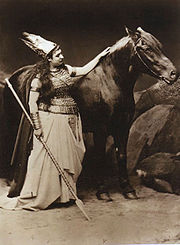 On King Ludwig's insistence, and over Wagner's objections, "special previews" of Das Rheingold and Die Walküre were given at the National Theatre in Munich, before the rest of the Ring. Thus, Das Rheingold premiered on 22 September 1869, and Die Walküre on 26 June 1870. Wagner subsequently delayed announcing his completion of Siegfried
to prevent this opera also being premiered against his wishes.
Wagner had long desired to have a special festival opera house, designed by himself, for the performance of the Ring. In 1871, he decided on a location in the Bavarian town of Bayreuth. In 1872, he moved to Bayreuth, and the foundation stone was laid. Wagner would spend the next two years attempting to raise capital for the construction, with scant success; King Ludwig finally rescued the project in 1874 by donating the needed funds. The Bayreuth Festspielhaus
opened in 1876 with the first complete performance of the Ring, which took place from 13 August to 17 August.
In 1882
, London impresario
Alfred Schulz-Curtius
organized the first staging in the United Kingdom of the Ring Cycle, conducted by Anton Seidl
and directed by Angelo Neumann.
The first production of the Ring in Italy was in Venice (the place where Wagner died), just two months after his 1883 death, at La Fenice
.
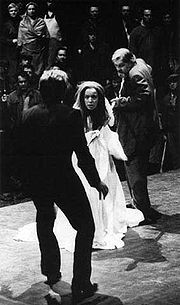 The Ring is a major undertaking for any opera company: staging four interlinked operas requires a huge commitment both artistically and financially. In most opera houses, production of a new Ring Cycle will happen over a number of years, with one or two operas in the cycle being added each year. The Bayreuth Festival
, where the complete cycle is performed most years, is unusual in that a new cycle is almost always created within a single year.
Early productions of the Ring Cycle stayed close to Wagner's original Bayreuth staging. Trends set at Bayreuth have continued to be influential. Following the closure of the Festspielhaus during the Second World War
, the 1950s saw productions by Wagner's grandsons Wieland
and Wolfgang Wagner
(known as the 'New Bayreuth' style), which emphasised the human aspects of the drama in a more abstract setting. Perhaps the most famous modern production was the centennial production of 1976 directed by Patrice Chéreau
and conducted by Pierre Boulez
. Set in the industrial revolution
, it replaced the depths of the Rhine with a hydroelectric power dam and featured grimy sets populated by men and gods in business suits. This drew heavily on the reading of the Ring as a revolutionary drama and critique of the modern world, famously exponded by George Bernard Shaw
in The Perfect Wagnerite. Early performances were booed but the audience of 1980 gave it a 90 minute ovation in its final year; the production is now generally regarded as revolutionary and a classic.
Although many Ring productions try to remain close to Wagner's original stage design and direction, others seek to re-interpret the Ring for modern audiences, often including decor and action that Wagner himself did not envisage. The production by Peter Hall, conducted by Georg Solti
at Bayreuth in 1983 is an example of the former, while the production by Richard Jones
at the Royal Opera House
Covent Garden in 1994–1996, conducted by Bernard Haitink
, is an example of the latter.
In 2003 the first production of the cycle in Russia
in modern times was conducted by Valery Gergiev
at the Mariinsky Opera, St. Petersburg, designed by George Tsypin
. The production drew parallels with Ossetia
n mythology.
The Royal Danish Opera performed a complete Ring Cycle in May 2006 in its new waterfront home, the Copenhagen Opera House. This version of the Ring tells the story from the viewpoint of Brünnhilde and has a distinct feminist angle. For example, in a key scene in Die Walküre, it is Sieglinde and not Siegmund who manages to pull the sword Nothung out of a tree. At the end of the cycle, Brünnhilde does not die, but instead gives birth to Siegfried's child.
San Francisco Opera
and Washington National Opera
began a coproduction of a new Ring Cycle in 2006 directed byFrancesca Zambello
. The production uses imagery from various eras of American history and has a feminist and environmentalist viewpoint.
The Metropolitan Opera
began a new Ring Cycle in 2010, conducted by James Levine
with Bryn Terfel
as Wotan. Deborah Voigt
was Brünnhilde in the April 2011 production of Die Walküre. The staging of Das Rheingold by Robert Lepage
involved 24 identical wedges able to rotate independently on a horizontal axis across the stage, providing level, sloping, angled or moving surfaces facing the audience. Bubbles, falling stones and fire are projected on to these surfaces, linked by computer with the music and movement of the characters.
It is possible to perform The Ring with fewer resources than usual. In 1990, the City of Birmingham Touring Opera (now Birmingham Opera Company
), presented a two-evening adaptation (by Jonathan Dove
) for a limited number of solo singers, each doubling several roles, and 18 orchestral players. This version made its American premiere at the Opera Theater of Pittsburgh
. Subsequently, it was performed in full at Long Beach Opera
in January 2006, and was performed in full with the Opera Theater of Pittsburgh in July 2006.
had a renowned 30-minute routine 'explaining' the plot and music of the Ring Cycle, which included a phrase which became identified with her, 'I'm not making this up, you know.'
In 1992 the National Theatre of Brent
performed a summary of the cycle in about 75 minutes, which also included a recapitulation of the composer's life, with a cast of three and a piano (inviting members of the audience to participate as Valkyries and as Gunther's vassals).
Tom Holt
's 1982 humorous fantasy novel, Expecting Someone Taller
, includes many of the characters of Wagner's operas, and features the Ring and the Tarnhelm.
's The Lord of the Rings
appears to borrow some elements from Der Ring des Nibelungen; however, Tolkien himself denied that he had been inspired by Wagner's work, saying that "Both rings were round, and there the resemblance ceases." Some similarities arise because Tolkien and Wagner both drew upon the same source material for inspiration, including the Völsungasaga and the Poetic Edda
. However, several researchers posit that both authors draw upon many of the same sources but Tolkien was indebted to some of the original developments, insights and artistic uses made of those in Wagner, such as that the ring gives its owner mastery of the world, the ring's inherently evil nature, its consequent corrupting influence upon the minds and wills of its possessors, and the necessity for its destruction so that the world can be redeemed.
There is evidence that Tolkien's denial of a relationship between his Ring and Nibelung's Ring "was an overreaction to the statements of" Åke Ohlmarks
, Tolkien's Swedish translator who, while analysing Tolkien's sources, "mixed material from various legends."
Literature cycle
Literary cycles are groups of stories grouped around common figures, often based on mythical figures or loosely on historic ones. Cycles which deal with an entire country are sometimes referred to as matters...
of four epic
Epic poetry
An epic is a lengthy narrative poem, ordinarily concerning a serious subject containing details of heroic deeds and events significant to a culture or nation. Oral poetry may qualify as an epic, and Albert Lord and Milman Parry have argued that classical epics were fundamentally an oral poetic form...
opera
Opera
Opera is an art form in which singers and musicians perform a dramatic work combining text and musical score, usually in a theatrical setting. Opera incorporates many of the elements of spoken theatre, such as acting, scenery, and costumes and sometimes includes dance...
s (or "dramas" to use the composer's preferred term) by the German
Germany
Germany , officially the Federal Republic of Germany , is a federal parliamentary republic in Europe. The country consists of 16 states while the capital and largest city is Berlin. Germany covers an area of 357,021 km2 and has a largely temperate seasonal climate...
composer Richard Wagner
Richard Wagner
Wilhelm Richard Wagner was a German composer, conductor, theatre director, philosopher, music theorist, poet, essayist and writer primarily known for his operas...
(1813–83). The works are based loosely on characters from the Norse saga
Saga
Sagas, are stories in Old Norse about ancient Scandinavian and Germanic history, etc.Saga may also refer to:Business*Saga DAB radio, a British radio station*Saga Airlines, a Turkish airline*Saga Falabella, a department store chain in Peru...
s and the Nibelungenlied
Nibelungenlied
The Nibelungenlied, translated as The Song of the Nibelungs, is an epic poem in Middle High German. The story tells of dragon-slayer Siegfried at the court of the Burgundians, how he was murdered, and of his wife Kriemhild's revenge....
. The four dramas, which the composer described as a trilogy with a Vorabend ("preliminary evening"), are often referred to as the Ring Cycle, Wagner's Ring, or simply the Ring.
Wagner wrote the libretto
Libretto
A libretto is the text used in an extended musical work such as an opera, operetta, masque, oratorio, cantata, or musical. The term "libretto" is also sometimes used to refer to the text of major liturgical works, such as mass, requiem, and sacred cantata, or even the story line of a...
and music over the course of about twenty-six years, from 1848 to 1874. The four operas that constitute the Ring cycle are, in the order of the imagined events they portray:
- Das RheingoldDas Rheingoldis the first of the four operas that constitute Richard Wagner's Der Ring des Nibelungen . It was originally written as an introduction to the tripartite Ring, but the cycle is now generally regarded as consisting of four individual operas.Das Rheingold received its premiere at the National Theatre...
(The Rhine Gold) - Die WalküreDie WalküreDie Walküre , WWV 86B, is the second of the four operas that form the cycle Der Ring des Nibelungen , by Richard Wagner...
(The Valkyrie) - SiegfriedSiegfried (opera)Siegfried is the third of the four operas that constitute Der Ring des Nibelungen , by Richard Wagner. It received its premiere at the Bayreuth Festspielhaus on 16 August 1876, as part of the first complete performance of The Ring...
- GötterdämmerungGötterdämmerungis the last in Richard Wagner's cycle of four operas titled Der Ring des Nibelungen...
(Twilight of the Gods)
Although individual operas are performed as works in their own right, Wagner intended them to be a coherent whole, performed in a series.
Title
Wagner's title is most literally rendered in English as the Ring of the Nibelung. The NibelungNibelung
The German Nibelungen and the corresponding Old Norse form Niflung is the name in Germanic and Norse mythology of the royal family or lineage of the Burgundians who settled at Worms....
of the title is the dwarf Alberich, and the ring in question is the one he fashions from the Rhinegold. The title therefore denotes "Alberich's Ring". In German the "-en" ending of "Nibelungen" and the article "des" preceding it denote the possessive (genitive) case. "Nibelungen" is occasionally mistaken as a plural: thus the Ring of the Nibelungs is incorrect.
Content
The cycle is a work of extraordinary scale. Perhaps the most outstanding facet of the monumental work is its sheer length: a full performance of the cycle takes place over four nights at the opera, with a total playing time of about 15 hours, depending on the conductorConducting
Conducting is the art of directing a musical performance by way of visible gestures. The primary duties of the conductor are to unify performers, set the tempo, execute clear preparations and beats, and to listen critically and shape the sound of the ensemble...
's pacing. The first and shortest opera, Das Rheingold, typically lasts two and a half hours, while the final and longest, Götterdämmerung, takes up four and a half hours, excluding act breaks.
The cycle is modelled after ancient Greek dramas
Theatre of Ancient Greece
The theatre of Ancient Greece, or ancient Greek drama, is a theatrical culture that flourished in ancient Greece between c. 550 and c. 220 BC. The city-state of Athens, which became a significant cultural, political and military power during this period, was its centre, where it was...
that were presented as three tragedies and one satyr play
Satyr play
Satyr plays were an ancient Greek form of tragicomedy, similar in spirit to burlesque. They featured choruses of satyrs, were based on Greek mythology, and were rife with mock drunkenness, brazen sexuality , pranks, sight gags, and general merriment.Satyric drama was one of the three varieties of...
. The Ring proper begins with Die Walküre and ends with Götterdämmerung, with Rheingold as a prelude
Prelude (music)
A prelude is a short piece of music, the form of which may vary from piece to piece. The prelude can be thought of as a preface. It may stand on its own or introduce another work...
. Wagner called Das Rheingold a Vorabend or "Preliminary Evening", and Die Walküre, Siegfried and Götterdämmerung were subtitled First Day, Second Day and Third Day, respectively, of the trilogy
Trilogy
A trilogy is a set of three works of art that are connected, and that can be seen either as a single work or as three individual works. They are commonly found in literature, film, or video games...
proper.
The scale and scope of the story is epic. It follows the struggles of god
Æsir
In Old Norse, áss is the term denoting a member of the principal pantheon in Norse paganism. This pantheon includes Odin, Frigg, Thor, Baldr and Tyr. The second pantheon comprises the Vanir...
s, hero
Hero
A hero , in Greek mythology and folklore, was originally a demigod, their cult being one of the most distinctive features of ancient Greek religion...
es, and several mythical creatures over the eponymous magic Ring that grants domination over the entire world. The drama and intrigue continue through three generations of protagonists, until the final cataclysm at the end of Götterdämmerung.
The music of the cycle is thick and richly textured, and grows in complexity as the cycle proceeds. Wagner wrote for an orchestra
Orchestra
An orchestra is a sizable instrumental ensemble that contains sections of string, brass, woodwind, and percussion instruments. The term orchestra derives from the Greek ορχήστρα, the name for the area in front of an ancient Greek stage reserved for the Greek chorus...
of gargantuan proportions, including a greatly enlarged brass section with new instruments such as the Wagner tuba
Wagner tuba
The Wagner tuba is a comparatively rare brass instrument that combines elements of both the French horn and the tuba. Also referred to as the "Bayreuth Tuba", it was originally created for Richard Wagner's operatic cycle Der Ring des Nibelungen. Since then, other composers have written for it, most...
, bass trumpet
Bass trumpet
The bass trumpet is a type of low trumpet which was first developed during the 1820s in Germany. It is usually pitched in 8' C or 9' B today, but is sometimes built in E and is treated as a transposing instrument sounding either an octave, a sixth or a ninth lower than written, depending on the...
and contrabass trombone. Remarkably, he uses a chorus only relatively briefly, in acts 2 and 3 of Götterdämmerung, and then mostly of men with just a few women. He eventually had a purpose-built theatre constructed, the Bayreuth Festspielhaus
Bayreuth Festspielhaus
The or Bayreuth Festival Theatre is an opera house north of Bayreuth, Germany, dedicated solely to the performance of operas by the 19th-century German composer Richard Wagner...
, in which to perform this work. The theatre has a special stage that blends the huge orchestra with the singers' voices, allowing them to sing at a natural volume. The result was that the singers did not have to strain themselves vocally during the long performances.
List of characters
| Gods Æsir In Old Norse, áss is the term denoting a member of the principal pantheon in Norse paganism. This pantheon includes Odin, Frigg, Thor, Baldr and Tyr. The second pantheon comprises the Vanir... |
Mortals | Valkyrie Valkyrie In Norse mythology, a valkyrie is one of a host of female figures who decides who dies in battle. Selecting among half of those who die in battle , the valkyries bring their chosen to the afterlife hall of the slain, Valhalla, ruled over by the god Odin... s |
Rhinemaidens Rhinemaidens The Rhinemaidens are the three water-nymphs who appear in Richard Wagner's opera cycle Der Ring des Nibelungen. Their individual names are Woglinde, Wellgunde, and Flosshilde , although they are generally treated as a single entity and they act together accordingly... , Giants Giant (mythology) The mythology and legends of many different cultures include monsters of human appearance but prodigious size and strength. "Giant" is the English word commonly used for such beings, derived from one of the most famed examples: the gigantes of Greek mythology.In various Indo-European mythologies,... & Nibelung Nibelung The German Nibelungen and the corresponding Old Norse form Niflung is the name in Germanic and Norse mythology of the royal family or lineage of the Burgundians who settled at Worms.... s |
Other characters |
|---|---|---|---|---|
|
Wälsungs Volsung In Norse mythology, Völsung was the son of Rerir and the eponymous ancestor of the ill-fortuned Völsung clan , including the greatest of Norse heroes, Sigurð...
Neidings
Gibichungs
|
Brynhildr Brynhildr is a shieldmaiden and a valkyrie in Norse mythology, where she appears as a main character in the Völsunga saga and some Eddic poems treating the same events. Under the name Brünnhilde she appears in the Nibelungenlied and therefore also in Richard Wagner's opera cycle Der Ring des... (soprano) |
Rhinemaidens
Giants
Nibelungs
|
|
Story
The plot revolves around a magic ring that grants the power to rule the world, forged by the NibelungNibelung
The German Nibelungen and the corresponding Old Norse form Niflung is the name in Germanic and Norse mythology of the royal family or lineage of the Burgundians who settled at Worms....
dwarf Alberich
Alberich
Alberich was a legendary sorcerer who originated in the mythology or epic sagas of the Frankish Merovingian Dynasty of the 5th to 8th century AD, and whose name means king of the elves , who possessed the ability to become invisible...
from gold he stole from the Rhine maidens in the river Rhine. Several mythic figures struggle for possession of the ring, including Wotan (Odin)
Odin
Odin is a major god in Norse mythology and the ruler of Asgard. Homologous with the Anglo-Saxon "Wōden" and the Old High German "Wotan", the name is descended from Proto-Germanic "*Wodanaz" or "*Wōđanaz"....
, the chief of the gods
Deity
A deity is a recognized preternatural or supernatural immortal being, who may be thought of as holy, divine, or sacred, held in high regard, and respected by believers....
. Wotan's scheme, spanning generations, to overcome his limitations, drives much of the action in the story. His grandson, the hero Siegfried
Sigurd
Sigurd is a legendary hero of Norse mythology, as well as the central character in the Völsunga saga. The earliest extant representations for his legend come in pictorial form from seven runestones in Sweden and most notably the Ramsund carving Sigurd (Old Norse: Sigurðr) is a legendary hero of...
, wins the ring, as Wotan intended, but is eventually betrayed and slain. Finally, the Valkyrie
Valkyrie
In Norse mythology, a valkyrie is one of a host of female figures who decides who dies in battle. Selecting among half of those who die in battle , the valkyries bring their chosen to the afterlife hall of the slain, Valhalla, ruled over by the god Odin...
Brünnhilde, Siegfried's lover and Wotan's estranged daughter, returns the ring to the Rhine maidens. In the process, the Gods and their home, Valhalla
Valhalla
In Norse mythology, Valhalla is a majestic, enormous hall located in Asgard, ruled over by the god Odin. Chosen by Odin, half of those that die in combat travel to Valhalla upon death, led by valkyries, while the other half go to the goddess Freyja's field Fólkvangr...
, are destroyed.
Details of the storylines can be found in the articles on each opera.
Wagner created the story of the Ring by fusing elements from many German
Germany
Germany , officially the Federal Republic of Germany , is a federal parliamentary republic in Europe. The country consists of 16 states while the capital and largest city is Berlin. Germany covers an area of 357,021 km2 and has a largely temperate seasonal climate...
and Scandinavia
Scandinavia
Scandinavia is a cultural, historical and ethno-linguistic region in northern Europe that includes the three kingdoms of Denmark, Norway and Sweden, characterized by their common ethno-cultural heritage and language. Modern Norway and Sweden proper are situated on the Scandinavian Peninsula,...
n myths and folk tales. The Old Norse
Norse mythology
Norse mythology, a subset of Germanic mythology, is the overall term for the myths, legends and beliefs about supernatural beings of Norse pagans. It flourished prior to the Christianization of Scandinavia, during the Early Middle Ages, and passed into Nordic folklore, with some aspects surviving...
Edda
Edda
The term Edda applies to the Old Norse Poetic Edda and Prose Edda, both of which were written down in Iceland during the 13th century in Icelandic, although they contain material from earlier traditional sources, reaching into the Viking Age...
s supplied much of the material for Das Rheingold, while Die Walküre was largely based on the Völsungasaga. Siegfried contains elements from the Eddur, the Völsungasaga and Thidrekssaga. The final opera, Götterdämmerung, draws from the 12th century High German poem known as the Nibelungenlied
Nibelungenlied
The Nibelungenlied, translated as The Song of the Nibelungs, is an epic poem in Middle High German. The story tells of dragon-slayer Siegfried at the court of the Burgundians, how he was murdered, and of his wife Kriemhild's revenge....
, which appears to have been the original inspiration for the Ring, and for which the cycle was named. For a detailed examination of Wagner's sources for the Ring and his treatment of them, see, among other works, Deryck Cooke
Deryck Cooke
Deryck Cooke was a British musician, musicologist and broadcaster.-Life:Cooke was born in Leicester to a poor and working class family; his father died when he was a child, but his mother was able to afford piano lessons. Cooke acquired a brilliant technique and began to compose...
's unfinished study of the Ring, I Saw the World End, and Ernest Newman's Wagner Nights. For the philosophic ideas behind the Ring, see Bryan Magee
Bryan Magee
Bryan Edgar Magee is a noted British broadcasting personality, politician, poet, and author, best known as a popularizer of philosophy.-Early life:...
's Wagner and Philosophy. Also useful is a translation by Stewart Spencer (Wagner's Ring of the Nibelung: Companion, edited by Barry Millington) which, as well as containing essays, including one on the source material which provides an English translation of the entire text that strives to remain faithful to the early medieval Stabreim
Alliterative verse
In prosody, alliterative verse is a form of verse that uses alliteration as the principal structuring device to unify lines of poetry, as opposed to other devices such as rhyme. The most commonly studied traditions of alliterative verse are those found in the oldest literature of many Germanic...
technique Wagner used.
The Ring has been the subject of myriad interpretations. George Bernard Shaw
George Bernard Shaw
George Bernard Shaw was an Irish playwright and a co-founder of the London School of Economics. Although his first profitable writing was music and literary criticism, in which capacity he wrote many highly articulate pieces of journalism, his main talent was for drama, and he wrote more than 60...
, in The Perfect Wagnerite
The Perfect Wagnerite: A Commentary on the Niblung's Ring
The Perfect Wagnerite: A Commentary on the Niblung's Ring is a philosophical commentary on Richard Wagner's Der Ring des Nibelungen, by the Irish writer George Bernard Shaw....
, argues for a view of The Ring as an essentially socialist critique of industrial society
Industrial society
In sociology, industrial society refers to a society driven by the use of technology to enable mass production, supporting a large population with a high capacity for division of labour. Such a structure developed in the west in the period of time following the Industrial Revolution, and replaced...
and its abuses. Robert Donington in Wagner's Ring And Its Symbols interprets it in terms of Jungian psychology, as an account of the development of unconscious
Unconscious mind
The unconscious mind is a term coined by the 18th century German romantic philosopher Friedrich Schelling and later introduced into English by the poet and essayist Samuel Taylor Coleridge...
archetype
Archetype
An archetype is a universally understood symbol or term or pattern of behavior, a prototype upon which others are copied, patterned, or emulated...
s in the mind, leading towards individuation
Individuation
Individuation is a concept which appears in numerous fields and may be encountered in work by Arthur Schopenhauer, Carl Jung, Gilbert Simondon, Bernard Stiegler, Gilles Deleuze, Henri Bergson, David Bohm, and Manuel De Landa...
.
Music
In his previous operas, Wagner had tried to make minimal use of recitativeRecitative
Recitative , also known by its Italian name "recitativo" , is a style of delivery in which a singer is allowed to adopt the rhythms of ordinary speech...
and scena ed aria. For the Ring he decided to do away with them entirely and adopted a through-composed
Through-composed
Through-composed music is relatively continuous, non-sectional, and/or non-repetitive. A song is said to be through-composed if it has different music for each stanza of the lyrics. This is in contrast to strophic form, in which each stanza is set to the same music...
style, whereby each act of each opera would be a continuous piece of music with no breaks whatsoever. In the essay Opera and Drama
Opera and Drama
"Opera and Drama" is a long essay written by Richard Wagner in 1851 setting out his ideas on the ideal characteristics of opera as an art form...
, (1852) Wagner describes the way in which poetry, music and the visual arts should combine to form what he called The Artwork of the Future. He called these artworks "music-dramas", and thereafter very rarely referred to his works as operas.
As a new foundation for his music-dramas, Wagner adopted the use of what he called Grundthemen, or "base themes", although they are usually referred to elsewhere as leitmotifs. These are recurring melodies
Melody
A melody , also tune, voice, or line, is a linear succession of musical tones which is perceived as a single entity...
and/or harmonic
Harmony
In music, harmony is the use of simultaneous pitches , or chords. The study of harmony involves chords and their construction and chord progressions and the principles of connection that govern them. Harmony is often said to refer to the "vertical" aspect of music, as distinguished from melodic...
progressions, sometimes tied to a particular key
Key (music)
In music theory, the term key is used in many different and sometimes contradictory ways. A common use is to speak of music as being "in" a specific key, such as in the key of C major or in the key of F-sharp. Sometimes the terms "major" or "minor" are appended, as in the key of A minor or in the...
and often to a particular orchestration
Orchestration
Orchestration is the study or practice of writing music for an orchestra or of adapting for orchestra music composed for another medium...
. They musically denote an action, object, emotion, character or other subject mentioned in the text and/or presented onstage. Wagner referred to them in Opera and Drama as "guides-to-feeling", and described how they could be used to inform the listener of a musical or dramatic subtext to the action onstage in the same way as a Greek Chorus
Greek chorus
A Greek chorus is a homogenous, non-individualised group of performers in the plays of classical Greece, who comment with a collective voice on the dramatic action....
did for Attic Drama. While other composers before Wagner had already used leitmotifs, the Ring was unique in the extent to which they were employed, and in the ingenuity of their combination and development.
Any important subject in the Ring is usually accompanied by a leitmotif. Indeed, long stretches of music are constructed entirely from them. One such example occurs in the link between the prologue and first act of Götterdämmerung: Siegfried's departure from Brünnhilde and his journey down the river Rhine is described first through a rhapsody
Rhapsody (music)
A rhapsody in music is a one-movement work that is episodic yet integrated, free-flowing in structure, featuring a range of highly contrasted moods, colour and tonality. An air of spontaneous inspiration and a sense of improvisation make it freer in form than a set of variations...
on several ideas associated variously with Siegfried, Brünnhilde, and their love for each other; then with references to Loge's magic fire; then with the 'Rhine' theme and ideas derived from the singing of the Rhine-daughters; then with shapes originating in discussions of the ring and demonstrations of its power, and finally in new motifs denoting the Gibichung Hall.
There are many dozens of individual motifs scattered throughout the Ring. They often occur as a musical reference to a presentation of their subject onstage, or to a direct reference in the text, or more subtly implied by the text. Many of them appear in several operas, and some even in all four. Sometimes, as in the character of the Woodbird, a cluster of motives is associated with a single character.
As the cycle progresses, and especially from the third act of Siegfried on, these motives are presented in increasingly sophisticated combinations. Wagner also used Franz Liszt
Franz Liszt
Franz Liszt ; ), was a 19th-century Hungarian composer, pianist, conductor, and teacher.Liszt became renowned in Europe during the nineteenth century for his virtuosic skill as a pianist. He was said by his contemporaries to have been the most technically advanced pianist of his age...
's technique of "metamorphosis of themes" to effect a dynamic development of many leitmotifs into quite different ones with a life all of their own. A clear example occurs in the transition from the first to the second scene of Das Rheingold, in which the musical theme associated with the ring of power, newly forged, transforms into that of Valhalla
Valhalla
In Norse mythology, Valhalla is a majestic, enormous hall located in Asgard, ruled over by the god Odin. Chosen by Odin, half of those that die in combat travel to Valhalla upon death, led by valkyries, while the other half go to the goddess Freyja's field Fólkvangr...
, Wotan's just-completed fortress, intended as a base from which he as chief of the gods can impose his law on the world, embodied by his spear. Thus an implication is made but left unstated in the libretto. However, regardless of how a listener might make the implied connection by associating the "ring" motive with Valhalla (which will be destroyed along with the ring), the burden of the argument at this point is entirely musical. The most important result of this kind of technique is the setting up of an infinitely complex web of musico-conceptual associations that continues to provide material for discussion.
Aspects of the leitmotif system did attract criticism for being too obvious. Some have misunderstood the function of leitmotifs, imagining them to be mere 'calling cards' whose function is tautological – simply informing the listener as to which character, object or idea has just arrived on stage or been mentioned; but this is no more what leitmotives are for than when, for example, Debussy
Claude Debussy
Claude-Achille Debussy was a French composer. Along with Maurice Ravel, he was one of the most prominent figures working within the field of impressionist music, though he himself intensely disliked the term when applied to his compositions...
wrote La mer
La Mer (Debussy)
La mer, trois esquisses symphoniques pour orchestre , or simply La mer , is an orchestral composition by the French composer Claude Debussy. It was started in 1903 in France and completed in 1905 on the English Channel coast in Eastbourne...
to describe the sea to people who had not seen it for themselves. In particular, the leitmotivic profile of the cycle's end has attracted much criticism. George Bernard Shaw
George Bernard Shaw
George Bernard Shaw was an Irish playwright and a co-founder of the London School of Economics. Although his first profitable writing was music and literary criticism, in which capacity he wrote many highly articulate pieces of journalism, his main talent was for drama, and he wrote more than 60...
dismissed the final bars of the Ring (the so-called "Redemption through love" motif, heard only once before, in Die Walküre when Sieglinde
Signy
Signy or Signe is the name of two heroines in two connected legends from Scandinavian mythology which were very popular in medieval Scandinavia. Both appear in the Völsunga saga, which was adapted into other works such as Wagner's Ring, including its famous opera The Valkyrie.The first Signe was...
learns she is to bear Siegfried
Sigurd
Sigurd is a legendary hero of Norse mythology, as well as the central character in the Völsunga saga. The earliest extant representations for his legend come in pictorial form from seven runestones in Sweden and most notably the Ramsund carving Sigurd (Old Norse: Sigurðr) is a legendary hero of...
), saying "the gushing effect which is its sole valuable quality is so cheaply attained that it is hardly going too far to call it the most trumpery phrase in the entire tetralogy". Other critics, such as Theodor Adorno
Theodor W. Adorno
Theodor W. Adorno was a German sociologist, philosopher, and musicologist known for his critical theory of society....
in his essay In Search of Wagner, have speculated that Wagner did not actually know how to end the cycle, and merely spun together a few obvious motives that he chose simply because they were the most beautiful sounding. More veneratively Mark Doran has sought to explain the cycle's final bars as the 'all-knowing orchestra's "purely musical praise of Brünnhilde".
The advances in orchestration
Orchestration
Orchestration is the study or practice of writing music for an orchestra or of adapting for orchestra music composed for another medium...
and tonality
Tonality
Tonality is a system of music in which specific hierarchical pitch relationships are based on a key "center", or tonic. The term tonalité originated with Alexandre-Étienne Choron and was borrowed by François-Joseph Fétis in 1840...
Wagner made in this work are of seminal importance in the history of Western music. He wrote for a very large orchestra, with a palette of seventeen different instrumental families used singly or in myriad combinations to express the great range of emotion and events of the drama. Wagner even went so far as to commission the production of new instruments, including the Wagner tuba
Wagner tuba
The Wagner tuba is a comparatively rare brass instrument that combines elements of both the French horn and the tuba. Also referred to as the "Bayreuth Tuba", it was originally created for Richard Wagner's operatic cycle Der Ring des Nibelungen. Since then, other composers have written for it, most...
, invented to fill a gap he found between the tone qualities of the horn
Horn (instrument)
The horn is a brass instrument consisting of about of tubing wrapped into a coil with a flared bell. A musician who plays the horn is called a horn player ....
and the trombone
Trombone
The trombone is a musical instrument in the brass family. Like all brass instruments, sound is produced when the player’s vibrating lips cause the air column inside the instrument to vibrate...
, as well as variations of existing instruments, such as the bass trumpet
Bass trumpet
The bass trumpet is a type of low trumpet which was first developed during the 1820s in Germany. It is usually pitched in 8' C or 9' B today, but is sometimes built in E and is treated as a transposing instrument sounding either an octave, a sixth or a ninth lower than written, depending on the...
and a contrabass trombone with a double slide.
In addition, Wagner weakened traditional tonality to the extent that most of the Ring, especially from Siegfried act 3 onwards, cannot be said to be in traditionally defined "keys
Key (music)
In music theory, the term key is used in many different and sometimes contradictory ways. A common use is to speak of music as being "in" a specific key, such as in the key of C major or in the key of F-sharp. Sometimes the terms "major" or "minor" are appended, as in the key of A minor or in the...
", but rather in "key regions", each of which flow smoothly into the following one. This fluidity avoided the musical equivalent of "full stops" or "periods", and was an important part of the style that enabled Wagner to build the work's huge structures – Das Rheingold
Das Rheingold
is the first of the four operas that constitute Richard Wagner's Der Ring des Nibelungen . It was originally written as an introduction to the tripartite Ring, but the cycle is now generally regarded as consisting of four individual operas.Das Rheingold received its premiere at the National Theatre...
is unbroken at two-and-a-half hours long. Tonal indeterminacy was heightened by the vastly increased freedom with which he used dissonance
Consonance and dissonance
In music, a consonance is a harmony, chord, or interval considered stable, as opposed to a dissonance , which is considered to be unstable...
and chromaticism
Chromaticism
Chromaticism is a compositional technique interspersing the primary diatonic pitches and chords with other pitches of the chromatic scale. Chromaticism is in contrast or addition to tonality or diatonicism...
. Chromatically altered chords
Chord (music)
A chord in music is any harmonic set of two–three or more notes that is heard as if sounding simultaneously. These need not actually be played together: arpeggios and broken chords may for many practical and theoretical purposes be understood as chords...
, as well as a variety of sevenths and ninths are used very liberally in the Ring, and this work, together with Tristan und Isolde
Tristan und Isolde
Tristan und Isolde is an opera, or music drama, in three acts by Richard Wagner to a German libretto by the composer, based largely on the romance by Gottfried von Straßburg. It was composed between 1857 and 1859 and premiered in Munich on 10 June 1865 with Hans von Bülow conducting...
, is frequently cited as a milestone on the way to Arnold Schoenberg
Arnold Schoenberg
Arnold Schoenberg was an Austrian composer, associated with the expressionist movement in German poetry and art, and leader of the Second Viennese School...
's revolutionary break with the traditional concept of key and his rejection of consonance as the basis of an organising principle in music.
Instrumentation
Wagner scored the Ring for an orchestra which, in his era, was exceptionally large. His score specifies the types and numbers of instruments for each of the four operas.All four operas have a very similar instrumentation, requiring the following core ensemble of instruments:
- WoodwindsWoodwind instrumentA woodwind instrument is a musical instrument which produces sound when the player blows air against a sharp edge or through a reed, causing the air within its resonator to vibrate...
: a piccoloPiccoloThe piccolo is a half-size flute, and a member of the woodwind family of musical instruments. The piccolo has the same fingerings as its larger sibling, the standard transverse flute, but the sound it produces is an octave higher than written...
, 3 fluteFluteThe flute is a musical instrument of the woodwind family. Unlike woodwind instruments with reeds, a flute is an aerophone or reedless wind instrument that produces its sound from the flow of air across an opening...
s (3rd doubles 2nd piccolo), 4 oboeOboeThe oboe is a double reed musical instrument of the woodwind family. In English, prior to 1770, the instrument was called "hautbois" , "hoboy", or "French hoboy". The spelling "oboe" was adopted into English ca...
s (4th doubles english horn), 3 clarinetClarinetThe clarinet is a musical instrument of woodwind type. The name derives from adding the suffix -et to the Italian word clarino , as the first clarinets had a strident tone similar to that of a trumpet. The instrument has an approximately cylindrical bore, and uses a single reed...
s in A and B-flat, a bass clarinetBass clarinetThe bass clarinet is a musical instrument of the clarinet family. Like the more common soprano B clarinet, it is usually pitched in B , but it plays notes an octave below the soprano B clarinet...
and 3 bassoonBassoonThe bassoon is a woodwind instrument in the double reed family that typically plays music written in the bass and tenor registers, and occasionally higher. Appearing in its modern form in the 19th century, the bassoon figures prominently in orchestral, concert band and chamber music literature...
s
- BrassBrass instrumentA brass instrument is a musical instrument whose sound is produced by sympathetic vibration of air in a tubular resonator in sympathy with the vibration of the player's lips...
: 8 hornHorn (instrument)The horn is a brass instrument consisting of about of tubing wrapped into a coil with a flared bell. A musician who plays the horn is called a horn player ....
s (5th and 7th double tenor Wagner tubasWagner tubaThe Wagner tuba is a comparatively rare brass instrument that combines elements of both the French horn and the tuba. Also referred to as the "Bayreuth Tuba", it was originally created for Richard Wagner's operatic cycle Der Ring des Nibelungen. Since then, other composers have written for it, most...
, 6th and 8th double bass Wagner tubasWagner tubaThe Wagner tuba is a comparatively rare brass instrument that combines elements of both the French horn and the tuba. Also referred to as the "Bayreuth Tuba", it was originally created for Richard Wagner's operatic cycle Der Ring des Nibelungen. Since then, other composers have written for it, most...
), 3 trumpetTrumpetThe trumpet is the musical instrument with the highest register in the brass family. Trumpets are among the oldest musical instruments, dating back to at least 1500 BCE. They are played by blowing air through closed lips, producing a "buzzing" sound which starts a standing wave vibration in the air...
s, a bass trumpetBass trumpetThe bass trumpet is a type of low trumpet which was first developed during the 1820s in Germany. It is usually pitched in 8' C or 9' B today, but is sometimes built in E and is treated as a transposing instrument sounding either an octave, a sixth or a ninth lower than written, depending on the...
, 4 trombones (3 tenor-bass and 1 contrabass doubling on bass) and a contrabass tubaTubaThe tuba is the largest and lowest-pitched brass instrument. Sound is produced by vibrating or "buzzing" the lips into a large cupped mouthpiece. It is one of the most recent additions to the modern symphony orchestra, first appearing in the mid-19th century, when it largely replaced the...
- PercussionPercussion instrumentA percussion instrument is any object which produces a sound when hit with an implement or when it is shaken, rubbed, scraped, or otherwise acted upon in a way that sets the object into vibration...
: 2 timpaniTimpaniTimpani, or kettledrums, are musical instruments in the percussion family. A type of drum, they consist of a skin called a head stretched over a large bowl traditionally made of copper. They are played by striking the head with a specialized drum stick called a timpani stick or timpani mallet...
pairs, a triangleTriangle (instrument)The triangle is an idiophone type of musical instrument in the percussion family. It is a bar of metal, usually steel but sometimes other metals like beryllium copper, bent into a triangle shape. The instrument is usually held by a loop of some form of thread or wire at the top curve...
, cymbals, a glockenspielGlockenspielA glockenspiel is a percussion instrument composed of a set of tuned keys arranged in the fashion of the keyboard of a piano. In this way, it is similar to the xylophone; however, the xylophone's bars are made of wood, while the glockenspiel's are metal plates or tubes, and making it a metallophone...
and a tam-tam
- Strings: 6 harpHarpThe harp is a multi-stringed instrument which has the plane of its strings positioned perpendicularly to the soundboard. Organologically, it is in the general category of chordophones and has its own sub category . All harps have a neck, resonator and strings...
s, 16 first violinViolinThe violin is a string instrument, usually with four strings tuned in perfect fifths. It is the smallest, highest-pitched member of the violin family of string instruments, which includes the viola and cello....
s, 16 second violinViolinThe violin is a string instrument, usually with four strings tuned in perfect fifths. It is the smallest, highest-pitched member of the violin family of string instruments, which includes the viola and cello....
s, 12 violaViolaThe viola is a bowed string instrument. It is the middle voice of the violin family, between the violin and the cello.- Form :The viola is similar in material and construction to the violin. A full-size viola's body is between and longer than the body of a full-size violin , with an average...
s, 12 violoncelloCelloThe cello is a bowed string instrument with four strings tuned in perfect fifths. It is a member of the violin family of musical instruments, which also includes the violin, viola, and double bass. Old forms of the instrument in the Baroque era are baryton and viol .A person who plays a cello is...
s and 8 double bassDouble bassThe double bass, also called the string bass, upright bass, standup bass or contrabass, is the largest and lowest-pitched bowed string instrument in the modern symphony orchestra, with strings usually tuned to E1, A1, D2 and G2...
es
Das Rheingold requires the following additional instruments:
- a bass drumBass drumBass drums are percussion instruments that can vary in size and are used in several musical genres. Three major types of bass drums can be distinguished. The type usually seen or heard in orchestral, ensemble or concert band music is the orchestral, or concert bass drum . It is the largest drum of...
, 18 anvilAnvilAn anvil is a basic tool, a block with a hard surface on which another object is struck. The inertia of the anvil allows the energy of the striking tool to be transferred to the work piece. In most cases the anvil is used as a forging tool...
s, thunder machineThunder machine (instrument)A thunder machine is a percussion instrument used to imitate the sound of thunder. Usually, this is a large sheet of metal that is shaken or a large drum....
and an additional onstage harpHarpThe harp is a multi-stringed instrument which has the plane of its strings positioned perpendicularly to the soundboard. Organologically, it is in the general category of chordophones and has its own sub category . All harps have a neck, resonator and strings...
, does not make use of the glockenspiel.
Die Walküre requires the following additional instruments:
- a steerhornSteerhornThe steerhorn is an extremely long medieval bugle horn. The instrument has been used both orchestrally and in war....
, a tenor drumTenor drumA tenor drum is a cylindrical drum that is higher pitched than a bass drum.In a symphony orchestra's percussion section, a tenor drum is a low-pitched drum, similar in size to a field snare, but without snares and played with soft mallets or hard sticks. Under various names, the drum has been used...
and a bass drumBass drumBass drums are percussion instruments that can vary in size and are used in several musical genres. Three major types of bass drums can be distinguished. The type usually seen or heard in orchestral, ensemble or concert band music is the orchestral, or concert bass drum . It is the largest drum of...
Siegfried requires no additional instruments.
Götterdämmerung requires the following additional instruments:
- 3 steerhorns and a tenor drumTenor drumA tenor drum is a cylindrical drum that is higher pitched than a bass drum.In a symphony orchestra's percussion section, a tenor drum is a low-pitched drum, similar in size to a field snare, but without snares and played with soft mallets or hard sticks. Under various names, the drum has been used...
Composition of the text
In summer 1848 Wagner wrote The Nibelung Myth as Sketch for a Drama, combining the medieval sources previously mentioned into a single narrative, very similar to the plot of the eventual Ring Cycle, but nevertheless with substantial differences. Later that year he began writing a libretto entitled Siegfrieds Tod ("Siegfried's Death"). He was likely encouraged by a series of articles in the Neue Zeitschrift für Musik, inviting composers to write a "national opera" based on the NibelungenliedNibelungenlied
The Nibelungenlied, translated as The Song of the Nibelungs, is an epic poem in Middle High German. The story tells of dragon-slayer Siegfried at the court of the Burgundians, how he was murdered, and of his wife Kriemhild's revenge....
, a 12th century High German poem which, since its rediscovery in 1755, had been hailed by the German Romantics as the "German national epic
National epic
A national epic is an epic poem or a literary work of epic scope which seeks or is believed to capture and express the essence or spirit of a particular nation; not necessarily a nation-state, but at least an ethnic or linguistic group with aspirations to independence or autonomy...
". Siegfrieds Tod dealt with the death of Siegfried, the central heroic figure of the Nibelungenlied
Nibelungenlied
The Nibelungenlied, translated as The Song of the Nibelungs, is an epic poem in Middle High German. The story tells of dragon-slayer Siegfried at the court of the Burgundians, how he was murdered, and of his wife Kriemhild's revenge....
.
By 1850, Wagner had completed a musical sketch (which he abandoned) for Siegfrieds Tod. He now felt that he needed a preliminary opera, Der junge Siegfried ("The Young Siegfried", later renamed to "Siegfried"), to explain the events in Siegfrieds Tod. The verse draft of Der junge Siegfried was completed in May 1851. By October, he had made the momentous decision to embark on a cycle of four operas, to be played over four nights: Das Rheingold, Die Walküre, Der Junge Siegfried and Siegfrieds Tod.
The text for all four operas was completed in December 1852, and privately published in February 1853.
Composition of the music
In November 1853, Wagner began the composition draft of Das Rheingold. Unlike the verses, which were written as it were in reverse order, the music would be composed in the same order as the narrative. Composition proceeded until 1857, when the final score up to the end of act 2 of Siegfried was completed. Wagner then laid the work aside for twelve years, during which he wrote Tristan und IsoldeTristan und Isolde
Tristan und Isolde is an opera, or music drama, in three acts by Richard Wagner to a German libretto by the composer, based largely on the romance by Gottfried von Straßburg. It was composed between 1857 and 1859 and premiered in Munich on 10 June 1865 with Hans von Bülow conducting...
and Die Meistersinger von Nürnberg
Die Meistersinger von Nürnberg
Die Meistersinger von Nürnberg is an opera in three acts, written and composed by Richard Wagner. It is among the longest operas still commonly performed today, usually taking around four and a half hours. It was first performed at the Königliches Hof- und National-Theater in Munich, on June 21,...
.
By 1869, Wagner was living at Tribschen
Tribschen
Tribschen is a suburb of Lucerne, in the Canton of Lucerne in central Switzerland.Tribschen is best known today as the home of the German composer Richard Wagner from 30 March 1866 to 22 April 1872. When Wagner was obliged to leave Munich in March 1866, he moved to a spacious villa in Tribschen on...
on Lake Lucerne
Lake Lucerne
Lake Lucerne is a lake in central Switzerland and the fourth largest in the country.The lake has a complicated shape, with bends and arms reaching from the city of Lucerne into the mountains. It has a total area of 114 km² , an elevation of 434 m , and a maximum depth of 214 m . Its volume is 11.8...
, sponsored by King Ludwig II of Bavaria
Ludwig II of Bavaria
Ludwig II was King of Bavaria from 1864 until shortly before his death. He is sometimes called the Swan King and der Märchenkönig, the Fairy tale King...
. He returned to Siegfried, and, remarkably, was able to pick up where he left off. In October, he completed the final opera in the cycle. He chose the title Götterdämmerung instead of Siegfrieds Tod for this opera. In the completed work the gods are destroyed in accordance with the new pessimistic thrust of the cycle, not redeemed as in the more optimistic originally planned ending. Wagner also decided to show onstage the events of Das Rheingold and Die Walküre, which had hitherto only been presented as back-narration in the other two operas. These changes resulted in some discrepancies in the cycle, but these do not diminish the value of the work.
First productions
Siegfried (opera)
Siegfried is the third of the four operas that constitute Der Ring des Nibelungen , by Richard Wagner. It received its premiere at the Bayreuth Festspielhaus on 16 August 1876, as part of the first complete performance of The Ring...
to prevent this opera also being premiered against his wishes.
Wagner had long desired to have a special festival opera house, designed by himself, for the performance of the Ring. In 1871, he decided on a location in the Bavarian town of Bayreuth. In 1872, he moved to Bayreuth, and the foundation stone was laid. Wagner would spend the next two years attempting to raise capital for the construction, with scant success; King Ludwig finally rescued the project in 1874 by donating the needed funds. The Bayreuth Festspielhaus
Bayreuth Festspielhaus
The or Bayreuth Festival Theatre is an opera house north of Bayreuth, Germany, dedicated solely to the performance of operas by the 19th-century German composer Richard Wagner...
opened in 1876 with the first complete performance of the Ring, which took place from 13 August to 17 August.
In 1882
1882 in music
-Events:*January - Richard Wagner completes Parsifal*Helsinki University Chorus is founded*Gustav Mahler is employed at Olomouc*Richard Strauss enters Munich University-Published popular music:...
, London impresario
Impresario
An impresario is a person who organizes and often finances concerts, plays or operas; analogous to a film producer in filmmaking, television production and an angel investor in business...
Alfred Schulz-Curtius
Alfred Schulz-Curtius
Alfred Schulz-Curtius was a classical music impresario who was active primarily in continental Europe and the United Kingdom from the 1870s until the 1920s....
organized the first staging in the United Kingdom of the Ring Cycle, conducted by Anton Seidl
Anton Seidl
Anton Seidl was a Hungarian conductor.-Biography:He was born at Pest, Hungary. He began the study of music at a very early age, and when only seven years old could pick out at the piano melodies which he had heard at the theatre...
and directed by Angelo Neumann.
The first production of the Ring in Italy was in Venice (the place where Wagner died), just two months after his 1883 death, at La Fenice
La Fenice
Teatro La Fenice is an opera house in Venice, Italy. It is one of the most famous theatres in Europe, the site of many famous operatic premieres. Its name reflects its role in permitting an opera company to "rise from the ashes" despite losing the use of two theatres...
.
Notable modern productions
Bayreuth Festival
The Bayreuth Festival is a music festival held annually in Bayreuth, Germany, at which performances of operas by the 19th century German composer Richard Wagner are presented...
, where the complete cycle is performed most years, is unusual in that a new cycle is almost always created within a single year.
Early productions of the Ring Cycle stayed close to Wagner's original Bayreuth staging. Trends set at Bayreuth have continued to be influential. Following the closure of the Festspielhaus during the Second World War
World War II
World War II, or the Second World War , was a global conflict lasting from 1939 to 1945, involving most of the world's nations—including all of the great powers—eventually forming two opposing military alliances: the Allies and the Axis...
, the 1950s saw productions by Wagner's grandsons Wieland
Wieland Wagner
Wieland Wagner was a German opera director.- Life :Wieland was the elder of two sons of Siegfried and Winifred Wagner and grandson of composer Richard Wagner....
and Wolfgang Wagner
Wolfgang Wagner
Wolfgang Wagner was a German opera director. He is best known as the director of the Bayreuth Festival, a position he initially assumed alongside his brother Wieland in 1951 until the latter's death in 1966...
(known as the 'New Bayreuth' style), which emphasised the human aspects of the drama in a more abstract setting. Perhaps the most famous modern production was the centennial production of 1976 directed by Patrice Chéreau
Patrice Chéreau
Patrice Chéreau is a French opera and theatre director, filmmaker, actor, and producer.-Biography:Patrice Chéreau was born in Lézigné, Maine-et-Loire, and went to school in Paris. At a young age he became well-known to Parisian critics as director, actor, and stage manager of his high-school theatre...
and conducted by Pierre Boulez
Pierre Boulez
Pierre Boulez is a French composer of contemporary classical music, a pianist, and a conductor.-Early years:Boulez was born in Montbrison, Loire, France. As a child he began piano lessons and demonstrated aptitude in both music and mathematics...
. Set in the industrial revolution
Industrial Revolution
The Industrial Revolution was a period from the 18th to the 19th century where major changes in agriculture, manufacturing, mining, transportation, and technology had a profound effect on the social, economic and cultural conditions of the times...
, it replaced the depths of the Rhine with a hydroelectric power dam and featured grimy sets populated by men and gods in business suits. This drew heavily on the reading of the Ring as a revolutionary drama and critique of the modern world, famously exponded by George Bernard Shaw
George Bernard Shaw
George Bernard Shaw was an Irish playwright and a co-founder of the London School of Economics. Although his first profitable writing was music and literary criticism, in which capacity he wrote many highly articulate pieces of journalism, his main talent was for drama, and he wrote more than 60...
in The Perfect Wagnerite. Early performances were booed but the audience of 1980 gave it a 90 minute ovation in its final year; the production is now generally regarded as revolutionary and a classic.
Although many Ring productions try to remain close to Wagner's original stage design and direction, others seek to re-interpret the Ring for modern audiences, often including decor and action that Wagner himself did not envisage. The production by Peter Hall, conducted by Georg Solti
Georg Solti
Sir Georg Solti, KBE, was a Hungarian-British orchestral and operatic conductor. He was a major classical recording artist, holding the record for having received the most Grammy Awards, having personally won 31 as a conductor, including the Grammy Lifetime Achievement Award. In addition to his...
at Bayreuth in 1983 is an example of the former, while the production by Richard Jones
Richard Jones (director)
Richard Jones is a British theatre and opera director.- Early life :Jones was born in London, and studied at the University of Hull and London...
at the Royal Opera House
Royal Opera House
The Royal Opera House is an opera house and major performing arts venue in Covent Garden, central London. The large building is often referred to as simply "Covent Garden", after a previous use of the site of the opera house's original construction in 1732. It is the home of The Royal Opera, The...
Covent Garden in 1994–1996, conducted by Bernard Haitink
Bernard Haitink
Bernard Johan Herman Haitink, CH, KBE is a Dutch conductor and violinist.- Early life :Haitink was born in Amsterdam, the son of Willem Haitink and Anna Haitink. He studied music at the conservatoire in Amsterdam...
, is an example of the latter.
In 2003 the first production of the cycle in Russia
Russia
Russia or , officially known as both Russia and the Russian Federation , is a country in northern Eurasia. It is a federal semi-presidential republic, comprising 83 federal subjects...
in modern times was conducted by Valery Gergiev
Valery Gergiev
Valery Abisalovich Gergiev is a Russian conductor and opera company director. He is general director and artistic director of the Mariinsky Theatre, principal conductor of the London Symphony Orchestra, and artistic director of the White Nights Festival in St. Petersburg.- Early life :Gergiev,...
at the Mariinsky Opera, St. Petersburg, designed by George Tsypin
George Tsypin
George Tsypin is an American sculptor, architect and stage designer .-Early life and education:...
. The production drew parallels with Ossetia
Ossetia
Ossetia Ossetic: Ир, Ирыстон Ir, Iryston; Russian: Осетия, Osetiya; Georgian: ოსეთი, Oset'i) is an ethnolinguistic region located on both sides of the Greater Caucasus Mountains, largely inhabited by the Ossetians. The Ossetian language is part of the Eastern Iranian branch of the Indo-European...
n mythology.
The Royal Danish Opera performed a complete Ring Cycle in May 2006 in its new waterfront home, the Copenhagen Opera House. This version of the Ring tells the story from the viewpoint of Brünnhilde and has a distinct feminist angle. For example, in a key scene in Die Walküre, it is Sieglinde and not Siegmund who manages to pull the sword Nothung out of a tree. At the end of the cycle, Brünnhilde does not die, but instead gives birth to Siegfried's child.
San Francisco Opera
San Francisco Opera
San Francisco Opera is an American opera company, based in San Francisco, California.It was founded in 1923 by Gaetano Merola and is the second largest opera company in North America...
and Washington National Opera
Washington National Opera
The Washington National Opera is an opera company in Washington, D.C., USA. Formerly the Opera Society of Washington and the Washington Opera, the company received Congressional designation as the National Opera Company in 2000. Performances are now given in the Opera House of the John F...
began a coproduction of a new Ring Cycle in 2006 directed byFrancesca Zambello
Francesca Zambello
Francesca Zambello is a leading American opera and theatre director. Zambello lived in Europe when she was a child, learning to speak French, Italian, German and Russian. Zambello is of Italian descent, the daughter of Jean , an actress and Charles C. Zambello, a former actor who became head of...
. The production uses imagery from various eras of American history and has a feminist and environmentalist viewpoint.
The Metropolitan Opera
Metropolitan Opera
The Metropolitan Opera is an opera company, located in New York City. Originally founded in 1880, the company gave its first performance on October 22, 1883. The company is operated by the non-profit Metropolitan Opera Association, with Peter Gelb as general manager...
began a new Ring Cycle in 2010, conducted by James Levine
James Levine
James Lawrence Levine is an American conductor and pianist. He is currently the music director of the Metropolitan Opera and former music director of the Boston Symphony Orchestra. Levine's first performance conducting the Metropolitan Opera was on June 5, 1971, and as of May 2011 he has...
with Bryn Terfel
Bryn Terfel
Bryn Terfel Jones CBE is a Welsh bass-baritone opera and concert singer. Terfel was initially associated with the roles of Mozart, particularly Figaro and Leporello, but has subsequently shifted his attention to heavier roles, especially those by Wagner....
as Wotan. Deborah Voigt
Deborah Voigt
Deborah Voigt is an American operatic soprano. Voigt regularly performs in opera houses and concert halls worldwide.- Early life and education :...
was Brünnhilde in the April 2011 production of Die Walküre. The staging of Das Rheingold by Robert Lepage
Robert Lepage
Robert Lepage, is a playwright, actor, film director, and stage director from Québec City, Québec, and is one of Canada's most honoured theatre artists.- Life and work :...
involved 24 identical wedges able to rotate independently on a horizontal axis across the stage, providing level, sloping, angled or moving surfaces facing the audience. Bubbles, falling stones and fire are projected on to these surfaces, linked by computer with the music and movement of the characters.
It is possible to perform The Ring with fewer resources than usual. In 1990, the City of Birmingham Touring Opera (now Birmingham Opera Company
Birmingham Opera Company
Birmingham Opera Company is a professional opera company based in the Jewellery Quarter in Birmingham, England, that specialises in innovative and avant-garde productions of the operatic repertoire, often in unusual venues....
), presented a two-evening adaptation (by Jonathan Dove
Jonathan Dove
Jonathan Dove is a British composer of opera, choral works, plays, films, and orchestral and chamber music. He has arranged a number of operas for English Touring Opera and the City of Birmingham Touring Opera , including in 1990 a famous 18-player two-evening adaptation of Wagner's Der Ring des...
) for a limited number of solo singers, each doubling several roles, and 18 orchestral players. This version made its American premiere at the Opera Theater of Pittsburgh
Opera Theater of Pittsburgh
Opera Theater of Pittsburgh is an American opera company based in Pittsburgh, Pennsylvania's Cultural District. It is one of two opera companies in the city, the other being Pittsburgh Opera...
. Subsequently, it was performed in full at Long Beach Opera
Long Beach Opera
Long Beach Opera is a Southern California opera company serving the greater Los Angeles and Orange County metroplex. Founded in 1979, it is the oldest established professional opera company in the L.A. area...
in January 2006, and was performed in full with the Opera Theater of Pittsburgh in July 2006.
Other treatments of the Ring Cycle
The comedienne Anna RussellAnna Russell
Anna Russell, née Anna Claudia Russell-Brown was an English–Canadian singer and comedienne. She gave many concerts in which she sang and played comic musical sketches on the piano...
had a renowned 30-minute routine 'explaining' the plot and music of the Ring Cycle, which included a phrase which became identified with her, 'I'm not making this up, you know.'
In 1992 the National Theatre of Brent
National Theatre of Brent
The National Theatre of Brent is a British comedy double-act, in the form of a mock two-man theatre troupe. Patrick Barlow plays Desmond Olivier Dingle, the troupe's founder, Artistic Director and Chief Executive...
performed a summary of the cycle in about 75 minutes, which also included a recapitulation of the composer's life, with a cast of three and a piano (inviting members of the audience to participate as Valkyries and as Gunther's vassals).
Tom Holt
Tom Holt
Tom Holt is a British novelist.He was born in London, the son of novelist Hazel Holt, and was educated at Westminster School, Wadham College, Oxford, and The College of Law, London....
's 1982 humorous fantasy novel, Expecting Someone Taller
Expecting Someone Taller
Expecting Someone Taller is the first humorous fantasy novel by popular British author Tom Holt. It was first published in hardcover in 1987, by Macmillan Publishers in the UK, and by St. Martin's Press in the US. A UK paperback edition was released in 1988 by Futura Orbit in 1988, and a US...
, includes many of the characters of Wagner's operas, and features the Ring and the Tarnhelm.
Wagner's Ring and Tolkien's Ring
J. R. R. TolkienJ. R. R. Tolkien
John Ronald Reuel Tolkien, CBE was an English writer, poet, philologist, and university professor, best known as the author of the classic high fantasy works The Hobbit, The Lord of the Rings, and The Silmarillion.Tolkien was Rawlinson and Bosworth Professor of Anglo-Saxon at Pembroke College,...
's The Lord of the Rings
The Lord of the Rings
The Lord of the Rings is a high fantasy epic written by English philologist and University of Oxford professor J. R. R. Tolkien. The story began as a sequel to Tolkien's earlier, less complex children's fantasy novel The Hobbit , but eventually developed into a much larger work. It was written in...
appears to borrow some elements from Der Ring des Nibelungen; however, Tolkien himself denied that he had been inspired by Wagner's work, saying that "Both rings were round, and there the resemblance ceases." Some similarities arise because Tolkien and Wagner both drew upon the same source material for inspiration, including the Völsungasaga and the Poetic Edda
Poetic Edda
The Poetic Edda is a collection of Old Norse poems primarily preserved in the Icelandic mediaeval manuscript Codex Regius. Along with Snorri Sturluson's Prose Edda, the Poetic Edda is the most important extant source on Norse mythology and Germanic heroic legends, and from the early 19th century...
. However, several researchers posit that both authors draw upon many of the same sources but Tolkien was indebted to some of the original developments, insights and artistic uses made of those in Wagner, such as that the ring gives its owner mastery of the world, the ring's inherently evil nature, its consequent corrupting influence upon the minds and wills of its possessors, and the necessity for its destruction so that the world can be redeemed.
There is evidence that Tolkien's denial of a relationship between his Ring and Nibelung's Ring "was an overreaction to the statements of" Åke Ohlmarks
Åke Ohlmarks
Åke Joel Ohlmarks was a Swedish author, translator and scholar of religion.He worked as a Lecturer at the University of Greifswald from 1941 to 1945...
, Tolkien's Swedish translator who, while analysing Tolkien's sources, "mixed material from various legends."
Sources
- Cooke, DeryckDeryck CookeDeryck Cooke was a British musician, musicologist and broadcaster.-Life:Cooke was born in Leicester to a poor and working class family; his father died when he was a child, but his mother was able to afford piano lessons. Cooke acquired a brilliant technique and began to compose...
, I Saw the World End: A Study of Wagner's Ring. New York: Oxford University Press, 2000 ISBN 0-19-315318-1. - Di Gaetani, John Louis, Penetrating Wagner's Ring: An Anthology. New York: Da Capo Press, 1978. ISBN 978-0-306-80437-3
- Gregor-Dellin, Martin, (1983) Richard Wagner: His Life, His Work, His Century. Harcourt, ISBN 0-15-177151-0
- Holman, J.K. Wagner's Ring: A Listener's Companion and Concordance. Portland OR: Amadeus Press, 2001.
- Lee, M. OwenM. Owen LeeM. Owen Lee, also known as Father Owen Lee , is an American classics and music scholar.Father Lee has been a member of the Basilian Fathers since 1947...
, (1994) Wagner's Ring: Turning the Sky Round. Amadeus Press, ISBN 978-0-87910-186-2 - Magee, BryanBryan MageeBryan Edgar Magee is a noted British broadcasting personality, politician, poet, and author, best known as a popularizer of philosophy.-Early life:...
, (2001) The Tristan ChordTristan chordThe Tristan chord is a chord made up of the notes F, B, D and G. More generally, it can be any chord that consists of these same intervals: augmented fourth, augmented sixth, and augmented ninth above a root...
: Wagner and Philosophy. Metropolitan Books, ISBN 0-8050-6788-4 - Magee, BryanBryan MageeBryan Edgar Magee is a noted British broadcasting personality, politician, poet, and author, best known as a popularizer of philosophy.-Early life:...
, (1988) Aspects of Wagner. Oxford University Press, ISBN 0-19-284012-6 - May, Thomas, (2004) Decoding Wagner. Amadeus Press, ISBN 978-1-57467-097-4
- Millington, Barry (editor) (2001) The Wagner Compendium. Thames and Hudson, ISBN 0-500-28274-9
- Sabor, Rudolph, (1997) Richard Wagner: Der Ring des Nibelungen: a companion volume. Phaidon Press, ISBN 0-7148-3650-8
- Spotts, Frederick, (1999) Bayreuth: A History of the Wagner Festival. Yale University Press ISBN 0-7126-5277-9