
All Topics  
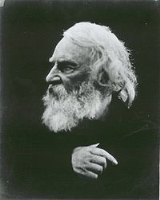
Henry Wadsworth Longfellow

 
Henry Wadsworth Longfellow

   Email Print
   Bookmark   Link


Henry Wadsworth Longfellow


Henry Wadsworth Longfellow (February 27, 1807 – March 24, 1882) was an American
United States

The United States of America is a Federal government constitutional republic comprising U.S. state and a federal district. The country is situated mostly in central North America, where its Contiguous United States and Washington, D.C., the Capital districts and territories, lie between the Pacific Ocean and Atlantic Oceans, Borders of the U...
 educator and poet
Poet

A poet is a person who writes poetry....
 whose works include "Paul Revere's Ride
Paul Revere's Ride (poem)

"Paul Revere's Ride" is poem by an United States poet Henry Wadsworth Longfellow that commemorates the actions of American patriot Paul Revere on April 18, 1775....
", The Song of Hiawatha
The Song of Hiawatha

The Song of Hiawatha is an 1855 epic poem by Henry Wadsworth Longfellow based on the legends of the Ojibwa. Longfellow credited as his source the work of pioneering ethnographer Henry Rowe Schoolcraft, specifically Schoolcraft's Algic Researches and History, Condition and Prospects of the Indian Tribes of the United States....
, and "Evangeline
Evangeline

Evangeline, A Tale of Acadie is a poem published in 1847 by the United States poet Henry Wadsworth Longfellow. The poem follows an Acadian girl named Evangeline and her search for her lost love Gabriel, set during the time of the Great Upheaval....
". He was also the first American to translate Dante Alighieri's
Dante Alighieri

Durante degli Alighieri , commonly known as Dante Alighieri, was a Florence poet of the Middle Ages. His Magnum opus, the Divine Comedy , is often considered the greatest literary work composed in the Italian language and a masterpiece of world literature....
 The Divine Comedy
The Divine Comedy

The Divine Comedy , written by Dante Alighieri between 1308 and his death in 1321, is widely considered the central epic poem of Italian literature, and is seen as one of the greatest works of world literature....
 and was one of the five members of the group known as the Fireside Poets
Fireside Poets

The Fireside Poets were a group of 19th-century American poets from New England....
.

Longfellow was born in Portland, Maine
Portland, Maine

Portland is the largest city in the U.S. state of Maine and the county seat of Cumberland County, Maine. The city population was 64,249 at the 2000 United States Census....
, and studied at Bowdoin College
Bowdoin College

Bowdoin College , founded in 1794, is a private Liberal arts colleges in the United States located in the coastal New England town of Brunswick, Maine, Maine....
. After spending time in Europe he became a professor at Bowdoin and, later, at Harvard College
Harvard College

Harvard College is the undergraduate section and oldest school of Harvard University, a private university in the United States founded in 1636 by the Massachusetts legislature....
.


Discussion
Ask a question about 'Henry Wadsworth Longfellow'
Start a new discussion about 'Henry Wadsworth Longfellow'
Answer questions from other users
Full Discussion Forum


Recent Posts


Quotations


A boy's will is the wind's will,And the thoughts of youth are long, long thoughts.

My Lost Youth, refrain (1858)

A feeling of sadness and longing,That is not akin to pain,And resembles sorrow onlyAs the mist resembles the rain.

St. 3

Ah, nothing is too lateTill the tired heart shall cease to palpitate.

St. 24

And suddenly through the drifting brumeThe blare of the horns began to ring.

King Olaf's War-Horns, st. 2

And the song, from beginning to end,I found again in the heart of a friend.

The Arrow and the Song, st. 3

Art is long, and Time is fleeting,And our hearts, though stout and brave,Still, like muffled drums, are beatingFuneral marches to the grave.

St. 4


Encyclopedia


Henry Wadsworth Longfellow (February 27, 1807 – March 24, 1882) was an American
United States

The United States of America is a Federal government constitutional republic comprising U.S. state and a federal district. The country is situated mostly in central North America, where its Contiguous United States and Washington, D.C., the Capital districts and territories, lie between the Pacific Ocean and Atlantic Oceans, Borders of the U...
 educator and poet
Poet

A poet is a person who writes poetry....
 whose works include "Paul Revere's Ride
Paul Revere's Ride (poem)

"Paul Revere's Ride" is poem by an United States poet Henry Wadsworth Longfellow that commemorates the actions of American patriot Paul Revere on April 18, 1775....
", The Song of Hiawatha
The Song of Hiawatha

The Song of Hiawatha is an 1855 epic poem by Henry Wadsworth Longfellow based on the legends of the Ojibwa. Longfellow credited as his source the work of pioneering ethnographer Henry Rowe Schoolcraft, specifically Schoolcraft's Algic Researches and History, Condition and Prospects of the Indian Tribes of the United States....
, and "Evangeline
Evangeline

Evangeline, A Tale of Acadie is a poem published in 1847 by the United States poet Henry Wadsworth Longfellow. The poem follows an Acadian girl named Evangeline and her search for her lost love Gabriel, set during the time of the Great Upheaval....
". He was also the first American to translate Dante Alighieri's
Dante Alighieri

Durante degli Alighieri , commonly known as Dante Alighieri, was a Florence poet of the Middle Ages. His Magnum opus, the Divine Comedy , is often considered the greatest literary work composed in the Italian language and a masterpiece of world literature....
 The Divine Comedy
The Divine Comedy

The Divine Comedy , written by Dante Alighieri between 1308 and his death in 1321, is widely considered the central epic poem of Italian literature, and is seen as one of the greatest works of world literature....
 and was one of the five members of the group known as the Fireside Poets
Fireside Poets

The Fireside Poets were a group of 19th-century American poets from New England....
.

Longfellow was born in Portland, Maine
Portland, Maine

Portland is the largest city in the U.S. state of Maine and the county seat of Cumberland County, Maine. The city population was 64,249 at the 2000 United States Census....
, and studied at Bowdoin College
Bowdoin College

Bowdoin College , founded in 1794, is a private Liberal arts colleges in the United States located in the coastal New England town of Brunswick, Maine, Maine....
. After spending time in Europe he became a professor at Bowdoin and, later, at Harvard College
Harvard College

Harvard College is the undergraduate section and oldest school of Harvard University, a private university in the United States founded in 1636 by the Massachusetts legislature....
. His first major poetry collections were Voices of the Night (1839) and Ballads and Other Poems (1841). Longfellow retired from teaching in 1854 to focus on his writing, living the remainder of his life in Cambridge, Massachusetts
Cambridge, Massachusetts

Cambridge is a city in the Greater Boston area of Massachusetts, United States. It was named in honor of the University of Cambridge in England....
, in a former headquarters of George Washington
George Washington

George Washington was the leader of the Continental Army in the American Revolutionary War and served as the List of Presidents of the United States President of the United States of the United States of Americas ....
. His first wife, Mary Potter, died in 1835 after a miscarriage. His second wife, Frances Appleton, died in 1861 after sustaining burns from her dress catching fire. After her death, Longfellow had difficulty writing poetry for a time and focused on his translation. He died in 1882.

Longfellow predominantly wrote lyric poems
Lyric poetry

Lyric poetry refers to a usually short poem that expresses personal feelings, which may or may not be set to music. Aristotle, in Poetics , contrasted lyric poetry with drama and epic poetry....
 which are known for their musicality and which often presented stories of mythology and legend. He became the most popular American poet of his day and also had success overseas. He has been criticized, however, for imitating European styles and writing specifically for the masses.

Life and work


Early life and education

Longfellow was born on February 27, 1807, to Stephen Longfellow
Stephen Longfellow

Stephen Longfellow was a United States House of Representatives from Maine....
 and Zilpah (Wadsworth) Longfellow in Portland, Maine
Portland, Maine

Portland is the largest city in the U.S. state of Maine and the county seat of Cumberland County, Maine. The city population was 64,249 at the 2000 United States Census....
, and he grew up in what is now known as the Wadsworth-Longfellow House
Wadsworth-Longfellow House

The Wadsworth-Longfellow House is a historic house now open as a museum. It is located at 489 Congress Street in Portland, Maine, United States, and is operated by the Maine Historical Society....
. His father was a lawyer, and his maternal grandfather, Peleg Wadsworth
Peleg Wadsworth

Peleg Wadsworth was an United States officer during the American Revolutionary War and a United States House of Representatives from Massachusetts representing the District of Maine....
, was a general in the American Revolutionary War
American Revolutionary War

The American Revolutionary War , also known as the American War of Independence, began as a war between the Kingdom of Great Britain and Thirteen Colonies on the North America, and ended in a global war between several European great powers....
 and a Member of Congress
United States House of Representatives

The United States House of Representatives, commonly referred to as "the House", is one of the bicameralism of the United States Congress; the other is the United States Senate....
. He was named after his mother's brother Henry Wadsworth, a Navy lieutenant who died only three years earlier at the Battle of Tripoli. Young Longfellow was the second of eight children; his siblings were Stephen (1805), Elizabeth (1808), Anne (1810), Alexander (1814), Mary (1816), Ellen (1818), and Samuel
Samuel Longfellow

Samuel Longfellow was an United States clergyman and hymn writer....
 (1819).

Henry was enrolled in a dame school
Dame school

A dame school was an early form of a private elementary school in English-speaking countries. They were usually taught by women and were often located in the home of the teacher....
 at the age of three and by age six was enrolled at the private Portland Academy. In his years there, he earned a reputation as being very studious and became fluent in Latin
Latin

Latin is an Italic language, historically spoken in Latium and Ancient Rome. Through the Military history of the Roman Empire, Latin spread throughout the Mediterranean and a large part of Europe....
. He printed his first poem — a patriotic and historical four stanza poem called "The Battle of Lovell's Pond" — in the Portland Gazette on November 17, 1820. He stayed at the Portland Academy until the age of fourteen. He spent much of his summers as a child at his grandfather Peleg's farm in the western Maine town of Hiram
Hiram, Maine

Hiram is a town in Oxford County, Maine, Maine, United States. The population was 1,423 at the United States Census, 2000. It includes the villages of Hiram, East Hiram, South Hiram and Durgintown....
.

In the fall of 1822, the 15-year old Longfellow enrolled at Bowdoin College
Bowdoin College

Bowdoin College , founded in 1794, is a private Liberal arts colleges in the United States located in the coastal New England town of Brunswick, Maine, Maine....
 in Brunswick, Maine
Brunswick (town), Maine

Brunswick is a New England town in Cumberland County, Maine, Maine, United States. The population was 21,172 at the 2000 United States Census. It is part of the Portland, Maine–South Portland, Maine–Biddeford, Maine, Maine Portland-South Portland-Biddeford metropolitan area....
, alongside his brother Stephen. His grandfather was a founder of the college and his father was a trustee. There, Longfellow met Nathaniel Hawthorne
Nathaniel Hawthorne

Nathaniel Hawthorne was an American novelist and short story writer.Nathaniel Hathorne was born in 1804 in the city of Salem, Massachusetts to Nathaniel Hathorne and Elizabeth Clarke Manning Hathorne....
, who would later become his lifelong friend. He boarded with a clergyman for a time before rooming on the third floor of what is now Maine Hall in 1823. He joined the Peucinian Society, a group of students with Federalist
Federalist Party (United States)

The Federalist Party was an American political party in the period 1792 to 1816, with remnants lasting into the 1820s. The Federalists controlled the federal government until 1801....
 leanings. In his senior year, Longfellow wrote to his father about his aspirations:
"I will not disguise it in the least... the fact is, I most eagerly aspire after future eminence in literature, my whole soul burns most ardently after it, and every earthly thought centres in it... I am almost confident in believing, that if I can ever rise in the world it must be by the exercise of my talents in the wide field of literature".


He pursued his literary goals by submitting poetry and prose to various newspapers and magazines. Between January 1824 and his graduation in 1825, he had published nearly 40 minor poems. About 24 of them appeared in the short-lived Boston periodical The United States Literary Gazette. When Longfellow graduated from Bowdoin, he was ranked fourth in the class and gave the student commencement address.

European tours and professorships

After graduating in 1825, he was offered a job as professor of modern languages at his alma mater. The story, possibly apocryphal, is that an influential trustee, Benjamin Orr
Benjamin Orr (Massachusetts politician)

Benjamin Orr was a member of the United States House of Representatives from Massachusetts.Orr was born in Bedford, New Hampshire on December 1, 1772....
, had been so by impressed Longfellow's translation of Horace
Horace

This article is about the Roman poet Horace. For other uses, see Horace .Quintus Horatius Flaccus, , known in the English language world as Horace, was the leading Roman Empire Lyric poetry during the time of Augustus....
 that he was hired under the condition that he travel to Europe to study French, Spanish, and Italian. Whatever the motivation, he began his tour of Europe in May 1826 aboard the ship Cadmus. His time abroad would last three years and cost his father $2,604.24. He traveled to France, Spain, Italy, Germany, back to France, then England before returning to the United States in mid-August 1829. In Madrid, he spent time with Washington Irving
Washington Irving

Washington Irving was an United States author, essays, biography and history of the early 19th century. He was best known for his short story "The Legend of Sleepy Hollow" and "Rip Van Winkle", both of which appear in his book The Sketch Book of Geoffrey Crayon His historical works include biographies of George Washington, Oliver Goldsmi...
 and was particularly impressed by the author's work ethic. Irving encouraged the young Longfellow to pursue writing. While in Spain, Longfellow was saddened to learn his favorite sister, Elizabeth, had died of tuberculosis
Tuberculosis

Tuberculosis is a common and often deadly infectious disease caused by mycobacterium, mainly Mycobacterium tuberculosis . Tuberculosis usually attacks the lungs but can also affect the central nervous system, the lymphatic system, the circulatory system, the genitourinary system, the gastrointestinal system, bones, joints, and even the...
 at the age of 20 that May while he was abroad.

On August 27, 1829, he wrote to the president of Bowdoin that he was turning down the professorship because he considered the $600 salary "disproportionate to the duties required". The trustees raised his salary to $800 with an additional $100 to serve as the college's librarian, a post which required one hour of work per day. During his years teaching at the college, he wrote textbooks in French, Italian, and Spanish; his first published book was in 1833, a translation of the poetry of medieval Spanish poet Jorge Manrique
Jorge Manrique

Jorge Manrique was a major Spain poet, whose main work, the Coplas a la muerte de su padre , is still read today. He was a supporter of the great Spanish queen, Isabel I of Castile, and actively participated on her side in the civil war that broke out against her half-brother, Enrique IV, when the latter attempted to make his daughter,...
. He also published a travel book, Outre-Mer: A Pilgrimage Beyond the Sea
Outre-Mer

Outre-Mer: A Pilgrimage Beyond the Sea is a prose collection which was the first major work by American poet Henry Wadsworth Longfellow. The term "outremer" is French language for "overseas"....
, first published in serial form before a book edition was released in 1835. Shortly after the book's publication, Longfellow attempted to join the literary circle in New York and asked George Pope Morris
George Pope Morris

George Pope Morris was an American editor, poet, and songwriter....
 for an editorial role at one of Morris's publications. Longfellow was considering moving to New York after New York University
New York University

New York University is a private university, nonsectarian, research university in New York City. NYU's main campus is situated in the Greenwich Village section of Manhattan....
 considered offering him a newly-created professorship of modern languages, though there would be no salary. The professorship was not created and Longfellow agreed to continue teaching at Bowdoin.

On September 14, 1831, Longfellow married Mary Storer Potter, a childhood friend from Portland. The couple settled in Brunswick, though the two were not happy there. Longfellow published several nonfiction and fiction prose pieces inspired by Irving, including "The Indian Summer" and "The Bald Eagle" in 1833.

In December 1834, Longfellow received a letter from Josiah Quincy III
Josiah Quincy III

Josiah Quincy III was a United States of America educator and political figure. He was a member of the United States House of Representatives , Mayor of Boston , and President of Harvard University ....
, president of Harvard College
Harvard College

Harvard College is the undergraduate section and oldest school of Harvard University, a private university in the United States founded in 1636 by the Massachusetts legislature....
, offering him the Smith Professorship of Modern Languages position with the stipulation that he spend a year or so abroad. In October 1835, during the trip, his wife Mary had a miscarriage about six months into her pregnancy. She did not recover and died after several weeks of illness at the age of 22 on November 29, 1835. Longfellow had her body embalmed immediately and placed into a lead coffin inside an oak coffin which was then shipped to Mount Auburn Cemetery
Mount Auburn Cemetery

Founded in 1831 as "America's first garden cemetery", or the first "rural cemetery", Mount Auburn Cemetery is an Elysium where, traditionally, chaste classical monuments were set in rolling landscaped terrain....
 near Boston. Three years later, he was inspired to write the poem "Footsteps of Angels" about her. Several years later, he wrote the poem "Mezzo Cammin" to express his sorrow over her death.

When he returned to the United States in 1836, Longfellow took up the professorship at Harvard. He was required to live in Cambridge to be close to the campus and moved in to the Craigie House in the spring of 1837, now preserved as the Longfellow National Historic Site
Longfellow National Historic Site

The Longfellow National Historic Site, also known as the Vassall-Craigie-Longfellow House, is a historic site located at 105 Brattle Street in Cambridge, Massachusetts....
. The home, built in 1759, had once been the headquarters of George Washington
George Washington

George Washington was the leader of the Continental Army in the American Revolutionary War and served as the List of Presidents of the United States President of the United States of the United States of Americas ....
 during the Siege of Boston
Siege of Boston

}|-||}The Siege of Boston was the opening phase of the American Revolutionary War, in which New England militiamen?who later became part of the Continental Army?surrounded the town of Boston, Massachusetts, to prevent movement by the British Army garrisoned within....
 beginning in July 1775. Previous occupants also included Jared Sparks
Jared Sparks

Jared Sparks was an United States historian, educator, and Unitarianism minister. He served as President of Harvard University of Harvard University from 1849 to 1853....
, Edward Everett
Edward Everett

Edward Everett was a Whig Party politician from Massachusetts. Everett was elected to the United States House of Representatives and United States Senate, and also served as President of Harvard University, United States Envoy Extraordinary and Minister Plenipotentiary to United Kingdom, and Governor of Massachusetts before being appointed...
, and Joseph Emerson Worcester
Joseph Emerson Worcester

Joseph Emerson Worcester was an American lexicographer and chief competitor of Webster's Dictionary in the mid-nineteenth-century....
. Longfellow began publishing his poetry, including Voices of the Night in 1839 and Ballads and Other Poems in 1841. The latter included "The Village Blacksmith
The Village Blacksmith

"The Village Blacksmith" is a poem by Henry Wadsworth Longfellow, first published in 1841. The poem describes a local blacksmith and his daily life....
" and "The Wreck of the Hesperus
The Wreck of the Hesperus

"The Wreck of the Hesperus" is a poem by American poet Henry Wadsworth Longfellow, first published in Ballads and Other Poems in 1842....
", which were instantly popular. Longfellow also became part of the local social scene, creating a group of friends who called themselves the Five of Clubs. Members included Cornelius Conway Felton
Cornelius Conway Felton

Cornelius Conway Felton was an American educator. He was regent of the Smithsonian Institution, as well as professor of Greek literature and President of Harvard University of Harvard University....
, George Stillman Hillard
George Stillman Hillard

George Stillman Hillard , United States lawyer and author....
, and Charles Sumner
Charles Sumner

Charles Sumner was an United States and statesman from Massachusetts. An academic lawyer and a powerful orator, Sumner was the leader of the antislavery forces in Massachusetts and a leader of the Radical Republican in the United States Senate during the American Civil War and Reconstruction era of the United States along with Thaddeus Stev...
, the latter of whom would become Longfellow's closest friend over the next 30 years.

Courtship of Frances Appleton

Fanny Appleton Longfellow Drawing
Longfellow began courting Frances "Fanny" Appleton, the daughter of a wealthy Boston industrialist, Nathan Appleton
Nathan Appleton

Nathan Appleton was an United States merchant and politician....
 and sister of Thomas Gold Appleton
Thomas Gold Appleton

File:Thomas Gold Appleton by Frederick P. Vinton.jpgThomas Gold Appleton , son of merchant Nathan Appleton, was an American writer, an artist, and a patron of the fine arts....
. At first, she was not interested but Longfellow was determined. In July 1839, he wrote to a friend: "[V]ictory hangs doubtful. The lady says she will not! I say she shall! It is not pride, but the madness of passion". His friend George Stillman Hillard encouraged Longfellow in the pursuit: "I delight to see you keeping up so stout a heart for the resolve to conquer is half the battle in love as well as war". During the courtship, Longfellow frequently walked from Cambridge to the Appleton home in Beacon Hill
Beacon Hill, Boston, Massachusetts

Beacon Hill is a neighborhood of Boston, Massachusetts that is home to about 10,000 people. It is a neighborhood of Georgian architecture rowhouses and is known for its narrow, gas lighting streets and brick sidewalks....
 in Boston by crossing the Boston Bridge. That bridge was subsequently demolished and replaced in 1906 by a new bridge, which was eventually renamed the Longfellow Bridge
Longfellow Bridge

The Longfellow Bridge, also known to locals as the "Salt and Pepper Bridge" or the "Salt and Pepper Shaker Bridge" due to the shape of its central towers, carries Massachusetts Route 3 and the Massachusetts Bay Transportation Authority's Red Line across the Charles River to connect Boston's Beacon Hill, Boston, Massachusetts neighborhood wit...
.

During his courtship, Longfellow continued writing and, in the fall of 1839, published Hyperion
Hyperion (Longfellow)

Hyperion: A Romance is one of Henry Wadsworth Longfellow's earliest works, published in 1839. It is a romance which was published along side his first volume of poems, Voices of the Night....
, a book in prose inspired by his trips abroad. A small collection, Poems on Slavery, was published in 1842 as his first public support of abolitionism. However, as Longfellow himself wrote, the poems were "so mild that even a Slaveholder might read them without losing his appetite for breakfast". A critic for The Dial
The Dial

The Dial was an American magazine published intermittently from 1840 to 1929. In its first form, from 1840 to 1844, it served as the chief publication of the Transcendentalists....
 agreed, calling it "the thinnest of all Mr. Longfellow's thin books; spirited and polished like its forerunners; but the topic would warrant a deeper tone". The New England Anti-Slavery Association, however, was satisfied with the collection enough to reprint it for further distribution.

In 1843, Longfellow also published a play, The Spanish Student, reflecting his memories from his time in Spain in the 1820s. There was some confusion over its original manuscript. After being printed in Graham's Magazine
Graham's Magazine

'Graham's Magazine' was a nineteenth century periodical based in Philadelphia established by George Rex Graham. It was alternatively referred to as Graham's Lady's and Gentleman's Magazine , Graham's Magazine of Literature and Art , Graham's American Monthly Magazine of Literature and Art , and Graham's Illustrated Magazine o...
, its editor Rufus Wilmot Griswold
Rufus Wilmot Griswold

Rufus Wilmot Griswold was an American anthology, editing, poet, and critic. Born in Vermont, Griswold left home when he was 15. He worked as a journalist, editor, and critic in Philadelphia, New York City, and elsewhere....
 saved the manuscript from the trash. Longfellow was surprised to hear that it had been saved, unusual for a printing office, and asked to borrow it so that he could revise it, forgetting to return it to Griswold. The often vindictive Griswold wrote an angry letter in response.

On May 10, 1843, after seven years, Longfellow received a letter from Fanny agreeing to marry him and, too restless to take a carriage, walked 90 minutes to meet her at her house. They were married shortly thereafter. Nathan Appleton bought the Craigie House as a wedding present to the pair. Longfellow would live there for the remainder of his life. His love for Fanny is evident in the following lines from Longfellow's only love poem, the sonnet "The Evening Star", which he wrote in October 1845: "O my beloved, my sweet Hesperus! My morning and my evening star of love!"

He and Fanny had six children: Charles Appleton (1844–1893), Ernest Wadsworth (1845–1921), Fanny (1847–1848), Alice Mary (1850–1928), Edith (1853–1915), and Anne Allegra (1855–1934). Their second-youngest daughter, Edith, married Richard Henry Dana III, son of the popular writer Richard Henry Dana, Jr.
Richard Henry Dana, Jr.

Richard Henry Dana Jr. was an United States lawyer and politician, and author of the book Two Years Before the Mast....
, author of Two Years Before the Mast
Two Years Before the Mast

Two Years Before the Mast is a book by the United States author Richard Henry Dana, Jr., written after a two-year sea voyage starting in 1834 and published in 1840....
. When the younger Fanny was born on April 7, 1847, Dr. Nathan Cooley Keep
Nathan Cooley Keep

Dr. Nathan Cooley Keep was a pioneer in the field of dentistry, and the founding Dean of the Harvard School of Dental Medicine.Biography...
 administered ether
Ether

Ether is a class of organic compounds which contain an ether functional group ? an oxygen atom connected to two alkyl or aryl groups ? of general formula R?O?R....
 as the first obstetric anesthetic
Anesthesia

Anesthesia, or anaesthesia , has traditionally meant the condition of having sensation blocked or temporarily taken away. This allows patients to undergo surgery and other procedures without the distress and pain they would otherwise experience....
 in the United States to Fanny Longfellow. A few months later, on November 1, 1847, the poem "Evangeline
Evangeline

Evangeline, A Tale of Acadie is a poem published in 1847 by the United States poet Henry Wadsworth Longfellow. The poem follows an Acadian girl named Evangeline and her search for her lost love Gabriel, set during the time of the Great Upheaval....
" was published for the first time. His literary income was increasing considerably: in 1840, he had made $219 from his work but the year 1850 brought him $1,900.

On June 14, 1853, Longfellow held a farewell dinner party at his Cambridge home for his friend Nathaniel Hawthorne, who was preparing to move overseas. Shortly thereafter in 1854, Longfellow retired from Harvard, devoting himself entirely to writing. He was awarded an honorary doctorate of Laws from Harvard in 1859.

Death of Frances

On July 9, 1861, a hot day, Fanny was putting locks of her children's hair into an envelope and attempting to seal it with hot sealing wax while Longfellow took a nap. Her dress suddenly caught fire, though it is unclear exactly how; it may have been burning wax or a lighted candle which fell on her dress. Longfellow, awoken from his nap, rushed to help her and threw a rug over her, though it was too small. He stifled the flames with his body as best he could, but she was already badly burned. Over a half a century later, Longfellow's youngest daughter Annie explained the story differently, claiming that there was no candle or wax but that the fire started from a self-lighting match that had fallen on the floor. In both versions of the story, however, Fanny was taken to her room to recover and a doctor was called. She was in and out of consciousness throughout the night and was administered ether
Ether

Ether is a class of organic compounds which contain an ether functional group ? an oxygen atom connected to two alkyl or aryl groups ? of general formula R?O?R....
. The next morning, July 10, 1861, she died shortly after 10 o'clock after requesting a cup of coffee. Longfellow, in trying to save her, had burned himself badly enough that he was unable to attend her funeral. His facial injuries caused him to stop shaving, thereafter wearing the beard which has become his trademark.

Devastated by her death, he never fully recovered and occasionally resorted to laudanum
Laudanum

Laudanum , also known as opium tincture or tincture of opium, is an alcoholic Herbalism of opium. It is made by combining ethanol with opium latex or powder....
 and ether to deal with it. He expressed his grief in the sonnet "The Cross of Snow" (1879), which he wrote eighteen years later to commemorate her death:

Such is the cross I wear upon my breast
These eighteen years, through all the changing scenes
And seasons, changeless since the day she died.


Later life and death

Longfellow spent several years translating Dante Alighieri's
Dante Alighieri

Durante degli Alighieri , commonly known as Dante Alighieri, was a Florence poet of the Middle Ages. His Magnum opus, the Divine Comedy , is often considered the greatest literary work composed in the Italian language and a masterpiece of world literature....
 Divine Comedy. To aid him in perfecting the translation and reviewing proofs, he invited friends to weekly meetings every Wednesday starting in 1864. The "Dante Club", as it was called, regularly included William Dean Howells
William Dean Howells

William Dean Howells was an United States Realism author and literary critic....
, James Russell Lowell
James Russell Lowell

James Russell Lowell was an United States Romanticism poet, critic, editor, and diplomat. He is associated with the Fireside Poets, a group of New England writers who were among the first American poets who rivaled the popularity of British poets....
, Charles Eliot Norton
Charles Eliot Norton

Charles Eliot Norton, was a leading United States author, social critic, and professor of art. He was a militant idealist, a progressive social reformer, and a liberal activist whom many of his contemporaries considered the most cultivated man in the United States....
 and other occasional guests. The full three-volume translation was published in the spring of 1867, though Longfellow would continue to revise it, and it went through four printings in its first year. By 1868, Longfellow's annual income was over $48,000.

During the 1860s, Longfellow supported abolitionism
Abolitionism

File:BLAKE10.JPGAbolitionism was a movement to end the slave trade and emancipate slaves in western Europe and the Americas. The slave system aroused little protest until the 18th century, when rationalist thinkers of the Age of Enlightenment criticized it for violating the rights of man, and Quaker and other evangelical religious groups con...
 and especially hoped for reconciliation between the northern and southern states after the American Civil War
American Civil War

The American Civil War , also known as the War Between the States and several Naming the American Civil War, was a civil war in the United States....
. He wrote in his journal in 1878: "I have only one desire; and that is for harmony, and a frank and honest understanding between North and South". Longfellow, despite his aversion to public speaking, accepted an offer from Joshua Chamberlain
Joshua Chamberlain

Joshua Lawrence Chamberlain was an United States college professor from the State of Maine, who volunteered during the American Civil War to join the Union Army....
 to speak at his fiftieth reunion at Bowdoin College; he read the poem "Morituri Salutamus" so quietly that few could hear him. The next year, 1876, he declined an offer to be nominated for the Board of Overseers at Harvard "for reasons very conclusive to my own mind".

On August 22, 1879, a female admirer traveled to Longfellow's house in Cambridge and, unaware to whom she was speaking, asked Longfellow: "Is this the house where Longfellow was born?" Longfellow told her it was not. The visitor then asked if he had died here. "Not yet", he replied. In March 1882, Longfellow went to bed with severe stomach pain. He endured the pain for several days with the help of opium
Opium

Opium is a narcotic formed from the latex released by lacerating the immature seed pods of Opium poppy . It contains up to 12% morphine, an opiate alkaloid, which is most frequently processed chemically to produce heroin for the illegal drug trade....
 before he died surrounded by family on Friday, March 24, 1882. He had been suffering from peritonitis
Peritonitis

Peritonitis is defined as inflammation of the peritoneum . It may be localised or generalised, generally has an acute course, and may depend on either infection or on a non-infectious process....
. At the time of his death, his estate was worth an estimated $356,320. He is buried with both of his wives at Mount Auburn Cemetery
Mount Auburn Cemetery

Founded in 1831 as "America's first garden cemetery", or the first "rural cemetery", Mount Auburn Cemetery is an Elysium where, traditionally, chaste classical monuments were set in rolling landscaped terrain....
 in Cambridge, Massachusetts. His last few years were spent translating the poetry of Michelangelo
Michelangelo

Michelangelo di Lodovico Buonarroti Simoni , commonly known as Michelangelo, was an Italian Renaissance Painting, sculptor, architect, poet, and engineer....
; though Longfellow never considered it complete enough to be published during his lifetime, a posthumous edition was collected in 1883. Scholars generally regard the work as autobiographical, reflecting the translator as an aging artist facing his impending death.

Writing


Style

Henrywadsworthlongfellowphotographfrombook
Though much of his work is categorized as lyric poetry
Lyric poetry

Lyric poetry refers to a usually short poem that expresses personal feelings, which may or may not be set to music. Aristotle, in Poetics , contrasted lyric poetry with drama and epic poetry....
, Longfellow experimented with many forms, including hexameter
Hexameter

Hexameter is a literature and poetry form, a Line consisting of six metrical foot, as in the Iliad. It was the standard epic metre in Greek and became standard for Latin too....
 and free verse
Free verse

Free Verse poetry does not have a strict pattern of rhyming. It does not have regular meter, rhyme, fixed line length, or a specific stanza pattern....
. His published poetry shows great versatility, using anapestic and trochaic
Trochee

A trochee or choree, choreus, is a metrical foot used in formal poetry. It consists of a stressed syllable syllable followed by an unstressed syllable one....
 forms, blank verse
Blank verse

Blank verse is a type of poetry, distinguished by having a regular meter , but no rhyme. In English, the meter most commonly used with blank verse has been iambic pentameter ....
, heroic couplet
Heroic couplet

A heroic couplet is a traditional form for English literature poetry, commonly used for epic poetry and narrative poetry; it refers to poems constructed from a sequence of rhyming pairs of iambic pentameter lines....
s, ballad
Ballad

A ballad is a form of verse, often a narrative story and set to music. Ballads were characteristic of particularly British and Irish popular poetry and song from the later medieval period until the nineteenth century and used extensively across Europe and later north America, Australia and north Africa....
s and sonnet
Sonnet

The sonnet is one of the Poetry that can be found in lyric poetry from Europe.The term "sonnet" derives from the Occitan word sonet and the Italian language word sonetto, both meaning "little song"....
s. Typically, Longfellow would carefully consider the subject of his poetic ideas for a long time before deciding on the right metrical form for it. Much of his work is recognized for its melody-like musicality. As he says, "what a writer asks of his reader is not so much to like as to listen".

As a very private man, Longfellow did not believe in adding autobiographical elements to his poetry. Two exceptions are dedicated to the death of members of his family. "Resignation", written as a response to the death of his daughter Fanny in 1848, does not use first-person pronouns and is instead a generalized poem of mourning. The death of his second wife Frances, as biographer Charles Calhoun wrote, deeply affected Longfellow personally but "seemed not to touch his poetry, at least directly". His memorial poem to her, a sonnet called "The Cross of Snow", was not published in his lifetime.

Longfellow often used allegory
Allegory

Allegory is generally treated as a figure of rhetoric, but an allegory does not have to be expressed in language: it may be addressed to the eye, and is often found in realistic painting, sculpture or some other form of Mimesis, or representative art....
 in his work. In "Nature", for example, death is depicted as bedtime for a cranky child. Though he often used didacticism
Didacticism

Didacticism is an artistic philosophy that emphasizes instructional and informative qualities in literature and other types of art. Didactic art intends not primarily to "Entertainment" or to pursue subjective goals....
 in his poetry, he focused on it less in his later years. Many of the metaphor
Metaphor

Metaphor is language that directly compares seemingly unrelated subjects. It is a figure of speech that compares two or more things without using the words "like" or "as." More generally, a metaphor describes a first subject as being or equal to a second object in some way....
s he used in his poetry as well as subject matter came from legends, mythology, and literature. He was inspired, for example, by Norse mythology
Norse mythology

Norse, Viking or Scandinavian mythology comprises the beliefs, myths and legends of the Norse paganism of the North Germanic language people, including those who settled on Faroe Islands and Iceland, where most of the written sources for Norse mythology were assembled....
 for "The Skeleton in Armor
The Skeleton in Armor

The Skeleton in Armor is the name given to a a skeleton associated with metal, bark and cloth artifacts which was unearthed in Fall River, Massachusetts in 1832....
" and by Finnish legends for The Song of Hiawatha. In fact, Longfellow rarely wrote on current subjects and seemed detached from contemporary American concerns. Even so, Longfellow, like many during this period, called for the development of high quality American literature. In Kavanagh, a character says:
We want a national literature commensurate with our mountains and rivers... We want a national epic that shall correspond to the size of the country... We want a national drama in which scope shall be given to our gigantic ideas and to the unparalleled activity of our people... In a word, we want a national literature altogether shaggy and unshorn, that shall shake the earth, like a herd of buffaloes thundering over the prairies.


He was also important as a translator; his translation of Dante became a required possession for those who wanted to be a part of high culture. He also encouraged and supported other translators. In 1845, he published The Poets and Poetry of Europe, an 800-page compilation of translations made by other writers, including many by his friend and colleague Cornelius Conway Felton
Cornelius Conway Felton

Cornelius Conway Felton was an American educator. He was regent of the Smithsonian Institution, as well as professor of Greek literature and President of Harvard University of Harvard University....
. Longfellow intended the anthology "to bring together, into a compact and convenient form, as large an amount as possible of those English translations which are scattered through many volumes, and are not accessible to the general reader". In honor of Longfellow's role with translations, Harvard established the Longfellow Institute in 1994, dedicated to literature written in the United States in languages other than English.

In 1874, Longfellow oversaw a 31-volume anthology called Poems of Places, which collected poems representing several geographical locations, including European, Asian, and Arabian countries. Emerson was disappointed and reportedly told Longfellow: "The world is expecting better things of you than this... You are wasting time that should be bestowed upon original production". In preparing the volume, Longfellow hired Katherine Sherwood Bonner as an amanuensis
Amanuensis

Amanuensis [ipa: ??m?nju'?ns?s] is a Latin word adopted in various languages, including English, for certain persons performing a function by hand, either writing down the words of another or performing manual labour....
.

Critical response

Longfellow's early collections, Voices of the Night and Ballads and Other Poems, made him instantly popular. The New-Yorker called him "one of the very few in our time who has successfully aimed in putting poetry to its best and sweetest uses". The Southern Literary Messenger
Southern Literary Messenger

The Southern Literary Messenger was a periodical published in Richmond, Virginia, Virginia, from 1834 until June 1864. Each issue carried a subtitle of "Devoted to Every Department of Literature and the Fine Arts" or some variation and included poetry, fiction, non-fiction, reviews, and historical notes....
 immediately put Longfellow "among the first of our American poets". Poet John Greenleaf Whittier
John Greenleaf Whittier

John Greenleaf Whittier was an influential American Quaker poet and ardent advocate of the abolition of slavery in the United States. He is usually listed as one of the Fireside Poets....
 said that Longfellow's poetry illustrated "the careful moulding by which art attains the graceful ease and chaste simplicity of nature". The rapidity with which American readers embraced Longfellow was unparalleled in publishing history in the United States; by 1874, he was earning $3,000 per poem. His popularity spread throughout Europe as well and his poetry was translated during his lifetime into Italian, French, German, and other languages. In the last two decades of his life, he often received requests for autographs from strangers, which he always sent. John Greenleaf Whittier suggested it was this massive correspondence that lead to Longfellow's death, writing: "My friend Longfellow was driven to death by these incessant demands".

Contemporary writer Edgar Allan Poe
Edgar Allan Poe

Edgar Allan Poe was an American poet, Short story writer, Editing and Literary criticism, and is considered part of the American Romanticism. Best known for his tales of Mystery and the macabre, Poe was one of the earliest American practitioners of the short story and is considered the inventor of the Detective fiction genre....
 wrote to Longfellow in May 1841 of his "fervent admiration which [your] genius has inspired in me" and later called him "unquestionably the best poet in America". However, after Poe's reputation as a critic increased, he publicly accused Longfellow of plagiarism
Plagiarism

Plagiarism is the use or close imitation of the language and ideas of another author and representation of them as one's own original work.Within academia, plagiarism by students, professors, or researchers is considered academic dishonesty or academic fraud and offenders are subject to academic censure....
 in what has been since termed by Poe biographers as "The Longfellow War". His assessment was that Longfellow was "a determined imitator and a dextrous adapter of the ideas of other people", specifically Alfred, Lord Tennyson
Alfred Tennyson, 1st Baron Tennyson

Alfred Tennyson, 1st Baron Tennyson was Poet Laureate of the United Kingdom and remains one of the most popular English poets.Tennyson excelled at penning short lyrics, including "In the valley of Cauteretz", "Break, break, break", "The Charge of the Light Brigade ", "Tears, Idle Tears" and "Crossing the Bar"....
. His accusations may have been a publicity stunt to boost readership of the Broadway Journal
Broadway Journal

The Broadway Journal was a short-lived New York City-based periodical founded by Charles Frederick Briggs and John Bisco in 1844. A year later, the publication was bought by Edgar Allan Poe, becoming the only journal he ever owned, though it failed after only a few months under his leadership....
, for which he was the editor at the time. Longfellow did not respond publicly, but, after Poe's death, he wrote: "The harshness of his criticisms I have never attributed to anything but the irritation of a sensitive nature chafed by some indefinite sense of wrong".

Margaret Fuller
Margaret Fuller

Sarah Margaret Fuller Ossoli, more commonly known as Margaret Fuller, was a journalist, critic and women's rights activist associated with the American transcendentalism movement....
 judged him "artificial and imitative" and lacking force. Poet Walt Whitman
Walt Whitman

Walter Whitman was an United States Poetry of the United States, essayist, journalism, and humanism. He was a part of the transition between Transcendentalism and literary realism, incorporating both views in his works....
 also considered Longfellow an imitator of European forms, though he praised his ability to reach a popular audience as "the expressor of common themes – of the little songs of the masses". Lewis Mumford
Lewis Mumford

Lewis Mumford was an United States historian of technology and science. Particularly noted for his study of city and urban architecture, he had a tremendously broad career as a writer that also included a period as an influential literary critic....
 said that Longfellow could be completely removed from the history of literature without much effect. Towards the end of his life, contemporaries considered him more of a children's poet
Children's poetry

Children's poetry is poetry written for or appropriate for children. The category includes folk poetry ; poetry written intentionally for young people ; poetry written originally for adults, but appropriate for young people ; and poems taken from prose works ....
 as many of his readers were children. A contemporary reviewer noted in 1848 that Longfellow was creating a "Goody two-shoes kind of literature... slipshod, sentimental stories told in the style of the nursery, beginning in nothing and ending in nothing". A more modern critic said, "Who, except wretched schoolchildren, now reads Longfellow?" A London critic in the London Quarterly Review, however, condemned all American poetry, saying, "with two or three exceptions, there is not a poet of mark in the whole union" but singled out Longfellow as one of those exceptions. As an editor of the Boston Evening Transcript wrote in 1846, "Whatever the miserable envy of trashy criticism may write against Longfellow, one thing is most certain, no American poet is more read".

Legacy

Longfellow was the most popular poet of his day. He was such an admired figure in the United States during his life that his 70th birthday in 1877 took on the air of a national holiday, with parades, speeches, and the reading of his poetry. He had become one of the first American celebrities and was also popular in Europe. It was reported that 10,000 copies of The Courtship of Miles Standish
The Courtship of Miles Standish

The Courtship of Miles Standish is an 1858 narrative poem by American poet Henry Wadsworth Longfellow about the early days of Plymouth Colony, the colonial settlement established in America by the Mayflower Pilgrims....
 sold in London in a single day. In 1884 he was the first non-British writer for whom a commemorative sculpted bust was placed in Poet's Corner of Westminster Abbey
Westminster Abbey

The Collegiate Church of St Peter at Westminster, which is almost always referred to popularly and informally as Westminster Abbey, is a large, mainly Gothic architecture Church , in Westminster, London, just to the west of the Palace of Westminster....
 in London
London

London is the capital of both England and the United Kingdom, and the most populous municipality in the European Union. An important settlement for two millennia, History of London goes back to its founding by the Roman Empire....
; he remains the only American poet represented with a bust.

Over the years, Longfellow's personality has become part of his reputation. He has been presented as a gentle, placid, poetic soul: an image perpetuated by his brother Samuel Longfellow, who wrote an early biography which specifically emphasized these points. As James Russell Lowell said, Longfellow had an "absolute sweetness, simplicity, and modesty". At Longfellow's funeral, his friend Ralph Waldo Emerson
Ralph Waldo Emerson

Ralph Waldo Emerson was an American essayist, philosopher, poet, and leader of the transcendentalism movement in the early 19th century. His teachings directly influenced the growing New Thought movement of the mid 1800s....
 called him "a sweet and beautiful soul". In reality, Longfellow's life was much more difficult than was assumed. He suffered from neuralgia
Neuralgia

Neuralgia or neuropathic pain can be defined most simply as non-nociception pain. Neuralgia is pain produced by a change in neurological structure or function....
, causing constant pain, and he also had poor eyesight. He wrote to friend Charles Sumner: "I do not believe anyone can be perfectly well, who has a brain and a heart". He had difficulty coping with the death of his second wife. Longfellow was very quiet, reserved, and private; in later years, he was known for being unsocial and avoided leaving home.

Over time, Longfellow's popularity rapidly declined, beginning shortly after his death and into the 20th century as academics began to appreciate poets like Walt Whitman, Edwin Arlington Robinson
Edwin Arlington Robinson

Edwin Arlington Robinson was an United States poet, who won three Pulitzer Prizes for his work....
, and Robert Frost
Robert Frost

Robert Lee Frost was an American poet. He is highly regarded for his realistic depictions of rural life and his command of American colloquial speech....
. More recently, he was honored in March 2007 when the United States Postal Service
United States Postal Service

The United States Postal Service is an Independent agencies of the United States government responsible for providing postal service in the United States....
 made a stamp commemorating him. A number of schools are named after him in various states as well. Neil Diamond
Neil Diamond

Neil Leslie Diamond is an United States of America singer-songwriter.Neil Diamond is one of pop music's most enduring and successful singer-songwriters....
's 1974 hit song, "Longfellow Serenade
Longfellow Serenade

"Longfellow Serenade" is the title of a 1974 song by the American singer-songwriter Neil Diamond. The song was written by Diamond, produced by Tom Catalano and was included on Diamond's album Serenade ....
", is a reference to the poet. He is a protagonist in Matthew Pearl's
Matthew Pearl

Matthew Pearl is an United States novelist and educator. His debut, The Dante Club, became a best-selling novel published in more than 40 countries....
 murder mystery The Dante Club
The Dante Club

The Dante Club is a mystery novel by Matthew Pearl and his debut work. Set amidst a series of murders in the American Civil War era, it also concerns a club of poets, including such historical figures as Henry Wadsworth Longfellow, Oliver Wendell Holmes, Sr., and James Russell Lowell, who are translating Dante's The Divine Comedy from...
 (2003).

List of works

Longfellow Village Blacksmith (manuscript 1)
*Outre-Mer: A Pilgrimage Beyond the Sea (Travelogue) (1835)
  • Hyperion, a Romance
    Hyperion (Longfellow)

    Hyperion: A Romance is one of Henry Wadsworth Longfellow's earliest works, published in 1839. It is a romance which was published along side his first volume of poems, Voices of the Night....
     (1839)
  • The Spanish Student. A Play in Three Acts (1843)
  • Evangeline
    Evangeline

    Evangeline, A Tale of Acadie is a poem published in 1847 by the United States poet Henry Wadsworth Longfellow. The poem follows an Acadian girl named Evangeline and her search for her lost love Gabriel, set during the time of the Great Upheaval....
    : A Tale of Acadie
    (epic poem) (1847)
  • "Kavanagh: A Tale" (1849)
  • "The Golden Legend" (poem) (1851)
  • The Song of Hiawatha
    The Song of Hiawatha

    The Song of Hiawatha is an 1855 epic poem by Henry Wadsworth Longfellow based on the legends of the Ojibwa. Longfellow credited as his source the work of pioneering ethnographer Henry Rowe Schoolcraft, specifically Schoolcraft's Algic Researches and History, Condition and Prospects of the Indian Tribes of the United States....
     (epic poem) (1855)
  • The Children's Hour
    The Children's Hour (poem)

    "The Children's Hour" is an 1860 poetry first published by American poet Henry Wadsworth Longfellow in the September 1860 edition of The Atlantic Monthly. The poem describes the poet's idyllic family life with his own three daughters, Alice, Edith, and Anne Allegra: "grave Alice, and laughing Allegra, and Edith with golden hair."...
     (1860)
  • Household Poems (1865)
  • The New England Tragedies (1868)
  • The Divine Tragedy (1871)
  • Christus: A Mystery (1872)
  • "Aftermath" (poem) (1873)
  • The Reaper and the Flowers (1839)
  • The Bell of Atri (from The Sicilian's Tale) (1863–72)
Poetry collections
  • Birds of Passage
  • Voices of the Night (1839)
  • Ballads and Other Poems (1841)
  • Poems on Slavery (1842)
  • The Belfry of Bruges and Other Poems (1845)
  • The Seaside and the Fireside (1850)
  • The Courtship of Miles Standish and Other Poems (1858)
  • Tales of a Wayside Inn (1863)
  • Flower-de-Luce (1867)
  • Three Books of Song (1872)
  • The Masque of Pandora and Other Poems (1875)
  • Kιramos and Other Poems (1878)
  • Ultima Thule (1880)
  • In the Harbor (1882)
  • Michel Angelo: A Fragment (incomplete; published posthumously)


Translations
  • Coplas de Don Jorge Manrique (Translation from Spanish) (1833)
  • Dante's Divine Comedy (Translation) (1867)


Anthologies
  • Poets and Poetry of Europe (Translations) (1844)
  • The Waif (1845)
  • Poems of Places (1874)


Sources

  • Arvin, Newton. Longfellow: His Life and Work. Boston: Little, Brown and Company, 1963.
  • Bayless, Joy. Rufus Wilmot Griswold: Poe's Literary Executor. Nashville: Vanderbilt University Press, 1943.
  • Brooks, Van Wyck. The Flowering of New England. New York: E. P. Dutton and Company, Inc., 1952.
  • Calhoun, Charles C. Longfellow: A Rediscovered Life. Boston: Beacon Press, 2004. ISBN 0807070262.
  • Irmscher, Christoph. Longfellow Redux. University of Illinois, 2006. ISBN 9780252030635.
  • McFarland, Philip. Hawthorne in Concord. New York: Grove Press, 2004. ISBN 0802117767.
  • Silverman, Kenneth. Edgar A. Poe: Mournful and Never-ending Remembrance. New York: Harper Perennial, 1991. ISBN 0060923318.
  • Thompson, Lawrance. Young Longfellow (1807–1843). New York: The Macmillan Company, 1938.
  • Wagenknecht, Edward. Henry Wadsworth Longfellow: Portrait of an American Humanist. New York: Oxford University Press, 1966.
  • Williams, Cecil B. Henry Wadsworth Longfellow. New York: Twayne Publishers, Inc., 1964.


External links

Sources
  • at Internet Archive
    Internet Archive

    The Internet Archive is a nonprofit organization dedicated to building and maintaining a free and openly accessible online digital library, including an archive site of the World Wide Web....
     - Scanned books, many illustrated and original editions.
  • Searchable poem text database, biographical data, lesson plans.
Other
  • in Cambridge, Massachusetts
  • in Portland, Maine