

The Cantos

Encyclopedia
The Cantos by Ezra Pound
is a long, incomplete poem
in 120 sections, each of which is a canto
. Most of it was written between 1915 and 1962, although much of the early work was abandoned and the early cantos, as finally published, date from 1922 onwards. It is a book-length work, widely considered to present formidable difficulties to the reader. The Cantos are generally considered one of the most significant works of modernist poetry
in the 20th century. As in Pound's prose writing, the themes of economics, governance
and culture are integral to the work's content.
The most striking feature of the text, to a casual browser, is the inclusion of Chinese character
s as well as quotations in European languages other than English. Recourse to scholarly commentaries is almost inevitable for a close reader
. The range of allusion to historical events is very broad, and abrupt changes occur with little transition. There is also wide geographical reference; Pound added to his earlier interests in the classical Mediterranean culture and East Asia selective topics from medieval and early modern Italy and Provence, the beginnings of the United States, England of the 17th century, and details from Africa he had obtained from Leo Frobenius
. References without explanation abound. Pound initially believed that he possessed poetic and rhetorical techniques which would themselves generate significance, but as time passed he became more concerned with the messages he wished to convey.
The section he wrote at the end of World War II, begun while he was interned in American-occupied Italy, has become known as The Pisan Cantos, is often considered to be self-contained. It was awarded the first Bollingen Prize
in 1948. There were many repercussions, since this in effect honoured a poet who had been condemned as a traitor in his native country, and who had been diagnosed with a serious mental illness
.
's fascism
became widely known. Much critical discussion of the poem has focused on the relationship between, on the one hand, the economic thesis on usura
, Pound's anti-Semitism
, his adulation of Confucian ideals of government and his attitude towards fascism
, and, on the other, passages of lyrical poetry and the historical scene-setting that he performed with his 'ideographic' technique. At one end of the spectrum George P. Elliot has drawn a parallel between Pound and Adolph Eichmann based on their anti-Semitism, while at the other Marjorie Perloff
places Pound's anti-Semitism in a wider context by examining the political views of many of his contemporaries, arguing that "We have to try to understand why" anti-Semitism was widespread in the early twentieth century, "and not say let's get rid of Ezra Pound, who also happens to be one of the greatest poets of the 20th C."
What is more relevant is that Pound's anti-Semitism was part of a systematic train of thought and analysis tied in with his economic theories. He in effect blamed the Jews—specifically the Rothschilds
, for the collapse of European culture after World War I. His anti-Semitism was a symptom of a larger issue in The Cantos, which was his lament at the passing on of cultural dominance from a class of elites to the masses, which for Pound included Jews, blacks, and other outsiders. Charles Olson, a poet who visited with Pound and was in many ways sympathetic to him, summarized, as follows, "Pound and his kind want to ignore [the masses]. They try to lock them out. But they swarm at the windows in such numbers they block out the light and the air. And in their little place Pound and his kind suffocate, their fear turns to hate. And their hate breeds death. They want to kill. And, organized by Hitler and Mussolini, they do kill--millions."
Wendy Stallard Flory made a close study of the poem and concluded that it contains seven passages of anti-Semitic sentiment in the 803 pages of the edition she used. But Flory's approach, at least as summarized here, is specious. Several of Pound's best known Cantos make anti-Semitic arguments as a whole, therefore analyzing pages where anti-Semitic passages appear obscures the true impact. Pound has always had serious if select defenders and disciples. Louis Zukofsky
was both, and also Jewish; according to William Cookson
he defended Pound on the basis of personal knowledge of anti-Semitism on the level of human exchange, even though, as reported by Basil Bunting
, their correspondence contained some of Pound's offensive views. Zukofsky's similarly formidable but distinctive long poem "A" follows in its ambitious scope the model of The Cantos.
The issue of incoherence of the work is reflected by the equivocal note sounded in the final two more-or-less completed cantos; according to William Cookson
, the final two cantos show that Pound has been unable to make his materials cohere, while they insist that the world itself still does cohere. Pound and T. S. Eliot
had previously approached the subject of fragmentation of human experience: while Eliot was writing, and Pound editing, The Waste Land
, Pound had said that he looked upon experience as similar to a series of iron filings on a mirror. Each filing is disconnected, but they are drawn into the shape of a rose by the presence of a magnet
. The Cantos takes a position between the mythic unity of Eliot's poem and Joyce's flow of consciousness and attempting to work out how history (as fragment) and personality (as shattered by modern existence) can cohere in the "field" of poetry.
Nevertheless, there are indications in Pound's other writings that there may have been some formal plan underlying the work. In his 1918 essay A Retrospect, Pound wrote "I think there is a 'fluid' as well as a 'solid' content, that some poems may have form as a tree has form, some as water poured into a vase. That most symmetrical forms have certain uses. That a vast number of subjects cannot be precisely, and therefore not properly rendered in symmetrical forms". Critics like Hugh Kenner
who take a more positive view of The Cantos have tended to follow this hint, seeing the poem as a poetic record of Pound's life and reading that sends out new branches as new needs arise with the final poem, like a tree, displaying a kind of unpredictable inevitability.
Another approach to the structure of the work is based on a letter Pound wrote to his father in the 1920s, in which he stated that his plan was:
[The letter columns ACB/ABC may indicate the sequences in which the concepts could be presented.]
In the light of cantos written later than this letter, it would be possible to add other recurring motifs to this list, such as: periploi ('voyages around'); vegetation rituals such as the Eleusinian Mysteries
; usura, banking and credit; and the drive towards clarity in art, such as the 'clear line' of Renaissance painting and the 'clear song' of the troubadour
s.
The poem's symbolic structure also makes use of an opposition between darkness and light. Images of light are used variously, and may represent Neoplatonic
ideas of divinity, the artistic impulse, love (both sacred and physical) and good governance, amongst other things. The moon is frequently associated in the poem with creativity, while the sun is more often found in relation to the sphere of political and social activity, although there is frequent overlap between the two. From the Rock Drill sequence on, the poem's effort is to merge these two aspects of light into a unified whole.
The Cantos was initially published in the form of separate sections, each containing several cantos that were numbered sequentially using Roman numerals
(except cantos 85–109, first published with Arabic numerals
). The original publication dates for the groups of cantos are as given below.
Pound had been considering writing a long poem since around 1905, but work did not begin until sometime between 1912 and 1917, when the initial versions of the first three cantos of the proposed "poem of some length" were published in the journal Poetry
. In this version, the poem began as an address by the poet to the ghost of Robert Browning
. Pound came to believe that this narrative voice compromised the revolutionary intent of his poetic vision, and these first three ur-cantos were soon abandoned and a new starting point sought. The answer was a Latin version of Homer
's Odyssey
by the Renaissance
scholar Andreas Divus
that Pound had bought in Paris sometime between 1906 and 1910.
Using the metre
and syntax
of his 1911 version of the Anglo-Saxon poem The Seafarer, Pound made an English version of Divus' rendering of the nekuia episode in which Odysseus
and his companions sail to Hades
in order to find out what their future holds. In using this passage to open the poem, Pound introduces a major theme: the excavating of the "dead" past to illuminate the present and future. He also echoes Dante
's opening to The Divine Comedy
in which the poet also descends into hell to interrogate the dead. The canto concludes with some fragments from the Second Homeric Hymn to Aphrodite
, in a Latin version by Georgius Dartona which Pound found in the Divus volume, followed by "So that:"—an invitation to read on.
Canto II opens with some lines rescued from the ur-cantos in which Pound reflects on the indeterminacy of identity by setting side by side four different versions of the troubadour poet Sordello
: Browning's poem of that name, the actual Sordello of flesh and blood, Pound's own version of the poet, and the Sordello of the brief life appended to manuscripts of his poems. These lines are followed by a sequence of identity shifts involving a seal, the daughter of Lir
, and other figures associated with the sea: Eleanor of Aquitaine
who, through a pair of Homeric epithets that echo her name, shifts into Helen of Troy, Homer with his ear for the "sea surge", the old men of Troy
who want to send Helen back over the sea, and an extended, Imagistic retelling of the story of the abduction of Dionysus
by sailors and his transformation of his abductors into dolphins. Although this last story is found in the Homeric Hymn to Dionysus, also contained in the Divus volume, Pound draws on the version in Ovid
's poem Metamorphoses
, thus introducing the world of ancient Rome into the poem.
 The next five cantos (III–VII), again drawing heavily on Pound's Imagist past for their technique, are essentially based in the Mediterranean, drawing on classical mythology
, Renaissance
history, the world of the troubadour
s, Sappho
's poetry, a scene from the legend of El Cid
that introduces the theme of banking and credit
, and Pound's own visits to Venice
to create a textual collage saturated with Neoplatonic images of clarity and light.
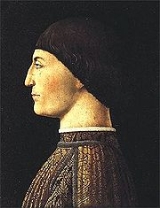
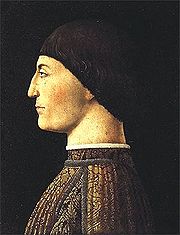
Cantos VIII–XI draw on the story of Sigismondo Pandolfo Malatesta, 15th-century poet, condottiero, lord of Rimini
and patron of the arts. Quoting extensively from primary sources, including Malatesta's letters, Pound especially focuses on the building of the church of San Francesco, also known as the Tempio Malatestiano
. Designed by Leon Battista Alberti and decorated by artists including Piero della Francesca
and Agostino di Duccio
, this was a landmark Renaissance building, being the first church to use the Roman triumphal arch
as part of its structure. For Pound, who spent a good deal of time seeking patrons for himself, Joyce
, Eliot
and a string of little magazines and small press
es, the role of the patron was a crucial cultural question, and Malatesta is the first in a line of ruler-patrons to appear in The Cantos.
Canto XII consists of three moral tales on the subject of profit. The first and third of these treat of the creation of profit ex nihilo
by exploiting the money supply
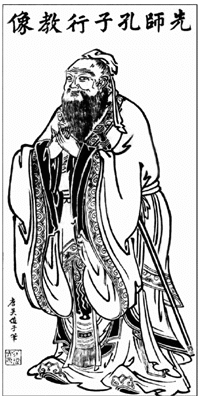
, comparing this activity with "unnatural" fertility. The central parable contrasts this with wealth-creation based on the creation of useful goods. Canto XIII then introduces Confucius
, or Kung, who is presented as the embodiment of the ideal of social order based on ethics
.
This section of The Cantos concludes with a vision of Hell
. Cantos XIV and XV use the convention of the Divine Comedy to present Pound/Dante moving through a hell populated by bankers, newspaper editors, hack writers and other 'perverters of language' and the social order. In Canto XV, Plotinus
takes the role of guide played by Virgil
in Dante's poem. In Canto XVI, Pound emerges from Hell and into an earthly paradise where he sees some of the personages encountered in earlier cantos. The poem then moves to recollections of World War I, and of Pound's writer and artist friends who fought in it. These include Richard Aldington
, Henri Gaudier-Brzeska
, Wyndham Lewis
, Ernest Hemingway
and Fernand Léger
, whose war memories the poem includes a passage from (in French). Finally, there is a transcript of Lincoln Steffens
' account of the Russian Revolution
. These two events, the war and revolution, mark a decisive break with the historic past, including the early modernist period when these writers and artists formed a more-or-less coherent movement.
Originally, Pound conceived of Cantos XVII–XXVII as a group that would follow the first volume by starting with the Renaissance and ending with the Russian Revolution. He then added a further three cantos and the whole eventually appeared as A Draft of XXX Cantos in an edition of 200 copies. The major locus of these cantos is the city of Venice.
Canto XVII opens with the words "So that", echoing the end of Canto I, and then moves on to another Dionysus-related metamorphosis story. The rest of the canto is concerned with Venice, which is portrayed as a stone forest growing out of the water. Cantos XVIII and XIX return to the theme of financial exploitation, beginning with the Venetian explorer Marco Polo
's account of Kublai Khan
's paper money. Canto XIX deals mainly with those who profit from war, returning briefly to the Russian Revolution, and ends on the stupidity of wars and those who promote them.
Canto XX opens with a grouping of phrases, words and images from Mediterranean poetry, ranging from Homer through Ovid
, Propertius and Catullus
to the Song of Roland and Arnaut Daniel
. These fragments constellate to form an exemplum of what Pound calls "clear song". There follows another exemplum, this time of the linguistic
scholarship that enables us to read these old poetries and the specific attention to words this study requires. Finally, this "clear song" and intellectual activity is implicitly contrasted with the inertia and indolence of the lotus eaters, whose song completes the canto. There are references to the Malatesta family and to Borso d'Este
, who tried to keep the peace between the warring Italian city states.
Canto XXI deals with the machinations of the Medici bank
, especially with the Medici
s' effect on Venice. These are contrasted with the actions of Thomas Jefferson
, who is shown as a cultured leader with an interest in the arts. A phrase from one of Sigismondo Pandolfo's letters inserted into the Jefferson passage draws an explicit parallel between the two men, a theme that is to recur later in the poem. The next canto continues the focus on finance by introducing the Social Credit
theories of C.H. Douglas for the first time.
Canto XXIII returns to the world of the troubadours via Homer and Renaissance Neoplatonism. Pound saw Provençal
culture as a nexus of survival of the old pagan beliefs, and the destruction of the Cathar
stronghold at Montsegur
at the end of the Albigensian Crusade
is held up as an example of the tendency of authority to crush all such alternative cultures. The destruction of Mont Segur is implicitly compared with the destruction of Troy in the closing lines of the canto. Canto XXIV then returns to 15th-century Italy and the d'Este family, again focusing on their Venetian activities and Niccolo d'Este
's voyage to the Holy Land
.
Cantos XXV and XXVI draw on the Book of the Council Major in Venice and Pound's personal memories of the city. Anecdotes on Titian
and Mozart deal with the relationship between artist and patron. Canto XXVII returns to the Russian Revolution, which is seen as being destructive, not constructive, and echoes the ruin of Eblis from Canto VI. XXVIII returns to the contemporary scene, with a passage on transatlantic flight
. The last two cantos in the series return to the world of "clear song". In Canto XXIX, a story from their visit to the Provençal site at Excideuil
contrasts Pound and Eliot on the subject of Christianity
, with Pound implicitly rejecting that religion. Finally, the series closes with a glimpse of the printer Hieronymus Soncinus of Fano
preparing to print the works of Petrarch
.

The first four cantos of this volume (Cantos XXXI–XXXVI) quote extensively from the letters and other writings of Thomas Jefferson
, John Adams
, John Quincy Adams
, Andrew Jackson
, Martin Van Buren
and others to deal with the emergence of the fledgling United States and, particularly, the American banking system. Canto XXXI opens with the Malatesta family motto Tempus loquendi, tempus tacendi ("a time to speak, a time to be silent") to link again Jefferson and Sigismondo as individuals and the Italian and American "rebirths" as historical movements.
Canto XXXV contrasts the dynamism of Revolutionary America with the "general indefinite wobble" of the decaying aristocratic society of Mitteleuropa
. This canto contains some distinctly unpleasant expressions of anti-Semitic opinions. Canto XXXVI opens with a translation of Cavalcanti's canzone
Donna mi pregha ("A lady asks me"). This poem, a lyric meditation of the nature and philosophy of love, was a touchstone text for Pound. He saw it as an example of the post-Montsegur survival of the Provençal tradition of "clear song", precision of thought and language, and nonconformity of belief. The canto then closes with the figure of the 9th-century Irish
philosopher and poet
John Scotus Eriugena
, who was an influence on the Cathars and whose writings were condemned as heretical in both the 11th and 13th centuries. Canto XXXVII then turns to Jackson, Van Buren, Nicholas Biddle, Alexander Hamilton
and the Bank War
and also contains a reference to the Peggy Eaton affair.
Canto XXXVIII opens with a quotation from Dante in which he accuses Albert of Germany
of falsifying the coinage. The canto then turns to modern commerce and the arms trade and introduces Frobenius as "the man who made the tempest". There is also a passage on Douglas' account of the problem of purchasing power. Canto XXXIX returns to the island of Circe
and the events before the voyage undertaken in the first canto unfolds as a hymn to natural fertility and ritual sex. Canto XL opens with Adam Smith
on trade as a conspiracy against the general public, followed by another periplus
, a condensed version of Hanno the Navigator
's account of his voyage along the west coast of Africa. The book closes with an account of Benito Mussolini
as a man of action and another lament on the waste of war.
Cantos XLII, XLIII and XLIV move to the Sienese
bank, the Monte dei Paschi di Siena
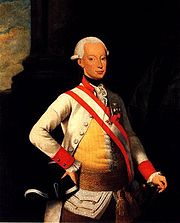
, and to the 18th-century reforms of Pietro Leopoldo
, Habsburg Arch Duke of Tuscany. Founded in 1624, the Monte dei Paschi was a low-interest, not-for-profit credit institution whose funds were based on local productivity as represented by the natural increase generated by the grazing of sheep on community land (the "BANK of the grassland" of Canto XLIII). As such, it represents a Poundian non-capitalist ideal.
 Canto XLV is a litany
against Usura or usury
, which Pound later defined as a charge on credit regardless of potential or actual production and the creation of wealth ex nihilo by a bank to the benefit of its shareholders. The canto declares this practice as both contrary to the laws of nature and inimical to the production of good art and culture. Pound later came to see this canto as a key central point in the poem.
Canto XLVI contrasts what has gone before with the practices of institutions such as the Bank of England
that are designed to exploit the issuing of credit to make profits, thereby, in Pound's view, contributing to poverty, social deprivation, crime and the production of "bad" art as exemplified by the baroque
.
In Canto XLVII, the poem returns to the island of Circe and Odysseus about to "sail after knowledge". There follows a long lyrical passage in which a ritual of floating votive candles on the bay at Rapallo
near Pound's home every July merges with the cognate myths of Tammuz and Adonis
, agricultural activity set in a calendar based on natural cycles, and fertility rituals.
Canto XLVIII presents more instances of what Pound considers to be usury, some of which display signs of his anti-Semitic position. The canto then moves via Montsegur to the village of St-Bertrand-de-Comminges, which stands on the site of the ancient city of Lugdunum Convenarum. The destruction of this city represents, for the poet, the treatment of civilisation by those he considers barbarous.
Canto XLIX is a poem of tranquil nature derived from a Chinese
picture book that Pound's parents brought with them when they retired to Rapallo. Canto L, which again contains anti-Semitic statements, moves from John Adams to the failure of the Medici bank
and more general images of European decay since the time of Napoleon I
. The final canto in this sequence returns to the usura litany of Canto XLV, followed by detailed instructions on making flies for fishing (man in harmony with nature) and ends with a reference to the anti-Venetian League of Cambrai and the first Chinese written characters to appear in the poem, representing the Rectification of Names from the Analects of Confucius (the ideogram representing honesty at the end of Canto XLI was added when The Cantos was published as a single volume).
These eleven cantos are based on the first eleven volumes of the twelve-volume Histoire generale de la Chine by Joseph-Anna-Marie de Moyriac de Mailla
. De Mailla was a French Jesuit
who spent 37 years in Peking and wrote his history there. The work was completed in 1730 but not published until 1777–1783. De Mailla was very much an Enlightenment
figure and his view of Chinese history reflects this; he found Confucian political philosophy, with its emphasis on rational order, much to his liking. He also disliked what he saw as the superstitious pseudo-mysticism promulgated by both Buddhists and Taoists, to the detriment of rational politics. Pound, in turn, fitted de Mailla's take on China into his own views on Christianity, the need for strong leadership to address 20th-century fiscal and cultural problems, and his support of Mussolini. In an introductory note to the section, Pound is at pains to point out that the ideograms and other fragments of foreign-language text incorporated in The Cantos should not put the reader off, as they serve to underline things that are in the English text.
Canto LII opens with references to Duke Leopoldo, John Adams and Gertrude Bell
, before sliding into a particularly virulent anti-Semitic passage, directed mainly at the Rothschild family
. The remainder of the canto is concerned with the classic Chinese text known as the Li Ki or Classic of Rites
, especially those parts that deal with agriculture and natural increase. The diction is the same as that used in earlier cantos on similar subjects.
Canto LIII covers the period from the founding of the Hai dynasty
to the life of Confucius and up to circa 225 BCE. Special mention is made of emperors that Confucius approved of and the sage's interest in cultural matters is stressed. For example, we are told that he edited the Book of Odes, cutting it from 3000 to 300 poems. The canto also ascribes the Poundian motto (and title of a 1934 collection of essays) Make it New to the emperor Tching Tang. Canto LIV moves the story on to around 805 CE. The line "Some cook, some do not cook, / some things can not be changed" refers to Pound's domestic situation and recurs, in part, in Canto LXXXI.
Canto LV is mainly concerned with the rise of the Tatars and the Tartar Wars, ending about 1200. There is a lot on money policy in this canto and Pound quotes approvingly the Tartar ruler Oulo who noted that the people "cannot eat jewels". This is echoed in Canto LVI when KinKwa remarks that both gold and jade are inedible. This canto is mainly concerned with Ghengis
and Kublai Khan and the rise of their Yuan dynasty
. The canto closes with the overthrow of the Yeun and the establishment of the Ming dynasty
, bringing us to around 1400.
Canto LVII opens with the story of the flight of the emperor Kien Ouen Ti
in 1402 or 1403 and continues with the history of the Ming up to the middle of the 16th century. Canto LVIII opens with a condensed history of Japan from the legendary first emperor, Emperor Jimmu
, who supposedly ruled in the 7th century BCE, to the late 16th-century Toyotomi Hideyoshi
(anglicised by Pound as Messier Undertree), who issued edicts against Christianity and raided Korea
, thus putting pressure on China's eastern borders. The canto then goes on to outline the concurrent pressure placed on the western borders by activities associated with the great Tartar horse fairs, leading to the rise of the Manchu dynasty
.
The translation of the Confucian classics into Manchu opens the following canto, Canto LIX. The canto is then concerned with the increasing European interest in China, as evidenced by a Sino-Russian border treaty and the founding of the Jesuit mission in 1685 under Jean-François Gerbillon
. Canto LX deals with the activities of the Jesuits, who, we are told, introduced astronomy
, western music, physics and the use of quinine
. The canto ends with limitations being placed on Christians, who had come to be seen as enemies of the state.
The final canto in the sequence, Canto LXI, covers the reigns of Yong Tching
and Kien Long
, bringing the story up to the end of de Mailla's account. Yong Tching is shown banning Christianity as "immoral" and "seeking to uproot Kung's laws". He also established just prices for foodstuffs, bringing us back to the ideas of Social Credit. There are also references to the Italian Risorgimento, John Adams, and Dom Metello de Souza, who gained some measure of relief for the Jesuit mission.
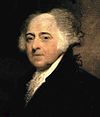
This section of the cantos is, for the most part, made up of fragmentary citations from the writings of John Adams
. Pound's intentions appear to be to show Adams as an example of the rational Enlightenment leader, thereby continuing the primary theme of the preceding China Cantos sequence, which these cantos also follow from chronologically. Adams is depicted as a well-rounded figure; he is a strong leader with interests in political, legal and cultural matters in much the same way that Malatesta and Mussolini are portrayed elsewhere in the poem. The English jurist
Sir Edward Coke
, who is an important figure in some later cantos, first appears in this section of the poem. Given the fragmentary nature of the citations used, these cantos can be quite difficult to follow for the reader with no knowledge of the history of the United States in the late 18th and early 19th centuries.
Canto LXII opens with a brief history of the Adams family in America from 1628. The rest of the canto is concerned with events leading up to the revolution, Adams' time in France, and the formation of Washington's
administration. Alexander Hamilton reappears, again cast as the villain of the piece. The appearance of the single Greek word "THUMON", meaning heart, returns us to the world of Homer's Odyssey and Pound's use of Odysseus as a model for all his heroes, including Adams. The word is used of Odysseus in the fourth line of the Odyssey: "he suffered woes in his heart on the seas".
The next canto, Canto LXIII, is concerned with Adams' career as a lawyer and especially his reports of the legal arguments presented by James Otis
in the Writs of Assistance case and their importance in the build-up to the revolution. The Latin phrase Eripuit caelo fulmen ("He snatched the thunderbolt from heaven") is taken from an inscription on a bust of Benjamin Franklin
. Cavalcanti's canzone, Pound's touchstone text of clear intellection and precision of language, reappears with the insertion of the lines "In quella parte / dove sta memoria" into the text.
Canto LXIV covers the Stamp Act
and other resistance to British taxation of the American colonies. It also shows Adams defending the accused in the Boston Massacre
and engaging in agricultural experiments to ascertain the suitability of Old-World crops for American conditions. The phrases Cumis ego oculis meis, tu theleis, respondebat illa and apothanein are from the passage (taken from Petronius
' Satyricon
) that T.S. Eliot used as epigraph to The Waste Land at Pound's suggestion. The passage translates as "For with my own eyes I saw the Sibyl hanging in a jar at Cumae, and when the boys said to her, 'Sibyl, what do you want?' she replied, 'I want to die.'"
The nomination of Washington as president dominates the opening pages of Canto LXV. The canto shows Adams concerned with the practicalities of waging war, particularly of establishing a navy
. Following a passage on the drafting of the Declaration of Independence
, the canto returns to Adams' mission to France, focusing on his dealings with the American legation
in that country, consisting of Franklin, Silas Deane
and Edward Bancroft
and with the French foreign minister, the Comte de Vergennes. Intertwined with this is the fight to save the rights of Americans to fish the Atlantic coastline. A passage on Adams' opposition to American involvement in European wars is highlighted, echoing Pound's position on his own times. In Canto LXVI, we see Adams in London serving as minister to the Court of St. James's
. The body of the canto consists of quotations from Adams' writings on the legal basis for the Revolution, including citations from Magna Carta
and Coke and on the importance of trial by jury
(per pares et legem terrae).
Canto LXVII opens with a passage on the limits on the powers of the British monarch drawn from Adams' writings under the pseudonym Novanglus. The rest of the canto is concerned with the study of government and with the requirements of the franchise. The following canto, LXVIII, begins with a meditation on the tripartite division of society into the one, the few and the many. A parallel is drawn between Adams and Lycurgus, the just king of Sparta
. Then the canto returns to Adams' notes on the practicalities of funding the war and the negotiation of a loan from the Dutch.
Canto LXIX continues the subject of the Dutch loan and then turns to Adams' fear of the emergence of a native aristocracy in America, as noted in his remark that Jefferson feared rule by "the one" (monarch or dictator), while he, Adams, feared "the few". The remainder of the canto is concerned with Hamilton, James Madison
and the affair of the assumption of debt certificates by Congress which resulted in a significant shift of economic power to the federal government from the individual states.
Canto LXX deals mainly with Adams' time as vice-president and president, focusing on his statement "I am for balance", highlighted in the text by the addition of the ideogram for balance. The section ends with Canto LXXI, which summarises many of the themes of the foregoing cantos and adds material on Adams' relationship with Native Americans
and their treatment by the British during the Indian Wars
. The canto closes with the opening lines of Epictetus
' Hymn of Cleanthus, which Pound tells us formed part of Adams' paideuma. These lines invoke Zeus
as one "who rules by law", a clear parallel to the Adams presented by Pound.
These two cantos, written in Italian, were not collected until their posthumous inclusion in the 1987 revision of the complete text of the poem. Pound reverts to the model of Dante
's Divine Comedy and casts himself as conversing with ghosts from Italy's remote and recent past.
In Canto LXXII, imitative of Dante's tercet
s (terza rima), Pound meets the recently dead Futurist writer Filippo Tommaso Marinetti
, and they discuss the current war and the dangers of excessive love of the past (Pound's librarian friend, Manlio Torquato Dazzi) or of the future (Marinetti). Then the violent ghost of Dante's Ezzelino III da Romano
, brother of Cunizza of Cantos VI and XXIX, explains to Pound that he has been misrepresented as an evil tyrant only because he was against the Pope's party, and goes on to attack the present Pope Pius XII and "traitors" (like King Victor Emmanuel III) who "betrayed" Mussolini, and to promise that the Italian troops will eventually "return" to El Alamein
.
Canto LXXIII is subtitled "Cavalcanti – Republican Correspondence" and is written in the style of Cavalcanti's "Donna mi prega" of Canto XXXVI. Guido Cavalcanti
appears on horseback to tell Pound about a heroic deed of a girl from Rimini who led a troop of Canadian soldiers to a mined field and died with the "enemy". (This was a propaganda story featured in Italian newspapers in October 1944; Pound was interested in it because of the connection with Sigismondo Malatesta's Rimini.)
Both cantos end on a positive and optimistic note, typical of Pound, and are unusually straightforward. Except for a scathing reference (by Cavalcanti's ghost) to "Roosevelt, Churchill and Eden / bastards and small Jews", and for a denial (by Ezzelino) that "the world was created by a Jew", they are notably free of anti-Semitic content, although it must be said that there are several positive references to Italian fascism
and some racist expressions (e.g., "pieno di marocchini ed altra immondizia"—"full of Moroccans and other crap", Canto LXXII). Italian scholars have been intrigued by Pound's idiosyncratic recreation of the poetry of Dante
and Cavalcanti
. For example, Furio Brugnolo of the University of Padua claims that these cantos are "the only notable example of epic poetry in 20th-century Italian literature".
With the outbreak of war in 1939, Pound was in Italy, where he remained, despite a request for repatriation he made after Pearl Harbor
. During this period, his main source of income was a series of radio broadcasts he made on Rome Radio. He used these broadcasts to express his full range of opinions on culture, politics and economics, including his opposition to American involvement in a European war and his anti-Semitism. In 1943, he was indicted for treason in absence, and wrote a letter to the indicting judge in which he claimed the right to freedom of speech
in his defence.
Pound was arrested in Rapallo by Italian partisans on May 3, 1945, was detained in Genoa, and was eventually transferred to the American Disciplinary Training Center (DTC) north of Pisa on May 22. Here he was held in a specially reinforced cage, initially sleeping on the ground in the open air. After three weeks, he had a breakdown that resulted in his being given a cot and pup tent in the medical compound. Here he gained access to a typewriter. For reading matter, he had a regulation-issue Bible along with three books he was allowed to bring in as his own "religious" texts: a Chinese text of Confucius, James Legge
's translation of the same, and a Chinese dictionary. He later found a copy of the Pocket Book of Verse, edited by Morris Edmund Speare, in the latrine. The only other thing he brought with him was a eucalyptus
pip. Throughout the Pisan sequence, Pound repeatedly likens the camp to Francesco del Cossa
's March fresco
depicting men working at a grape arbour.
With his political certainties collapsing around him and his library inaccessible, Pound turned inward for his materials and much of the Pisan sequence is concerned with memory, especially of his years in London and Paris and of the writers and artists he knew in those cities. There is also a deepening of the ecological concerns of the poem. The awarding of the Bollingen Prize to the book caused considerable controversy, with many people objecting to the honoring of someone they saw as a madman and/or traitor. However, The Pisan Cantos is generally the most admired and read section of the work. It is also among the most influential, having affected poets as different as H.D.
and Gary Snyder
.
Canto LXXIV immediately introduces the reader to the method used in the Pisan Cantos, which is one of interweaving themes somewhat in the manner of a fugue
. These themes pick up on many of the concerns of the earlier cantos and frequently run across sections of the Pisan sequence. This canto begins with Pound looking out of the DTC at peasants working in the fields nearby and reflecting on the news of the death of Mussolini, "hung by the heels".
In the first thread, the figure of Pound/Odysseus reappears in the guise of "OY TIS", or No Man, the name the hero uses in the Cyclops
episode of the Odyssey. This figure blends into the Australia rain god Wuluwaid
, who had his mouth closed up by his father (was deprived of freedom of speech) because he "created too many things". He, in turn, becomes the Chinese Ouan Jin, or "man with an education". This theme recurs in the line "a man on whom the sun has gone down", a reference to the nekuia from canto I, which is then explicitly referred to. This recalls The Seafarer, and Pound quotes a line from his translation, "Lordly men are to earth o'ergiven", lamenting the loss of the exiled poet's companions. This is then applied to a number of Pound's dead friends from the London/Paris years, including W.B. Yeats, James Joyce
, Ford Madox Ford
, Victor Plarr
and Maurice Hewlett
. Finally, Pound/Odysseus is seen "on a raft blown by the wind".
Another major theme running through this canto is that of the vision of a goddess in the poet's tent. This starts from the identification of a nearby mountain with the Chinese holy mountain Taishan
and the naming of the moon as sorella la luna (sister moon). This thread then runs through the appearance of Kuanon
, the Buddhist goddess of mercy, the moon spirit from Hagaromo (a Noh
play translated by Pound some 40 years earlier), Sigismondo's lover Ixotta
(linked in the text with Aphrodite
via a reference to the goddess' birthplace Cythera), a girl painted by Manet
and finally Aphrodite herself, rising from the sea on her shell and rescuing Pound/Odysseus from his raft. The two threads are further linked by the placement of the Greek word brododactylos ("rosy-fingered") applied by Homer to the dawn but given here in the dialect of Sappho
and used by her in a poem of unrequited love. These images are often intimately associated with the poet's close observation of the natural world as it imposes itself on the camp; birds, a lizard, clouds, the weather and other images of nature run through the canto.
Images of light and brightness associated with these goddesses come to focus in the phrase "all things that are, are lights" quoted from John Scotus Eriugena. He, in turn, brings us back to the Albigensian Crusade and the troubadour world of Bernard de Ventadorn
. Another theme sees Ecbatana
, the seven-walled "city of Dioce", blend with the city of Wagadu, from the African tale of Gassire's Lute that Pound derived from Frobenius. This city, four times rebuilt, with its four walls, four gates and four towers at the corners is a symbol for spiritual endurance. It, in turn, blends with the DTC in which the poet is imprisoned.
The question of banking and money also recurs, with an anti-Semitic passage aimed at the banker Mayer Amschel Rothschild
. Pound brings in biblical injunctions on usury and a reference to the issuing of a stamp scrip currency in the Austrian town of Wörgl
. The canto then moves on to a longish passage of memories of the moribund literary scene Pound encountered in London when he first arrived, with the phrase "beauty is difficult", quoted from Aubrey Beardsley
, acting as a refrain. After more memories of America and Venice, the canto ends in a passage that brings together Dante's celestial rose, the rose formed by the effect of a magnet on iron filings, an image from Paul Verlaine
of a fountain playing in the moonlight, and a reference to a poem by Ben Jonson
in a composite image of hope for "those who have passed over Lethe
".
Canto LXXV is mainly a facsimile of the German pianist Gerhart Münch's violin setting of the 16th-century Italian Francesco Da Milano's transcription for lute of French composer
Clément Janequin
's choral work Le Chant des oiseaux, an ancient song recalled to Pound's mind by the singing of birds on the fence of the DTC, and a symbol for him of an indestructible form preserved and transmitted through many versions, times, nations and artists. (Compare the nekuia of canto I.) Münch was a friend and collaborator of Pound in Rapallo, and the short prose section at the beginning of the canto celebrates his work on other early music figures.
Canto LXXVI opens with a vision of a group of goddesses in Pound's room on the Rapallo hillside and then moves, via Mont Segur, to memories of Paris and Jean Cocteau
. There follows a passage in which the poet recognises the Jewish authorship of the prohibition on usury found in Leviticus
. Conversations in the camp are then cross-cut into memories of Provence and Venice, details of the American Revolution and further visions. These memories lead to a consideration of what has or may have been destroyed in the war. Pound remembers the moment in Venice when he decided not to destroy his first book of verse, A Lume Spento, an affirmation of his decision to become a poet and a decision that ultimately led to his incarceration in the DTC. The canto ends with the goddess, in the form of a butterfly, leaving the poet's tent amid further references to Sappho and Homer.
The main focus of Canto LXXVII is accurate use of language, and at its centre is the moment when Pound hears that the war is over. Pound draws on examples of language use from Confucius, the Japanese dancer Michio Itô, who worked with Pound and Yeats in London, a Dublin cab driver, Aristotle
, Basil Bunting
, Yeats, Joyce and the vocabulary of the U.S. Army. The goddess in her various guises appears again, as does Awoi's hennia, the spirit of jealousy from Aoi No Ue, a Noh play translated by Pound. The canto closes with an invocation of Dionysus
(Zagreus).
After opening with a glimpse of Mount Ida
, an important locus for the history of the Trojan War
, Canto LXXVIII moves through much that is familiar from the earlier cantos in the sequence: del Cossa, the economic basis of war, Pound's writer and artist friends in London, "virtuous" rulers (Lorenzo de Medici, the emperors Justinian
, Titus
and Antoninus
, Mussolini), usury and stamp scripts culminating in the Nausicaa
episode from the Odyssey and a reference to the Confucian classic Annals of Spring and Autumn in which "there are no righteous wars".
The moon and clouds appear at the opening of Canto LXXIX, which then moves on through a passage in which birds on the wire fence recall musical notation and the sounds of the camp and thoughts of Wolfgang Mozart, del Cossa and Marshal Philippe Pétain
meld to form musical counterpoint. After references to politics, economics, and the nobility of the world of the Noh and the ritual dance of the moon-nymph in Hagaromo that dispels mortal doubt, the canto closes with an extended fertility hymn to Dionysus in the guise of his sacred lynx
.
Canto LXXX opens in the camp in the shadow of death and soon turns to memories of London, Paris and Spain, including a recollection of Walter Rummel, who worked with Pound on troubadour music before World War I and of Eliot, Wyndham Lewis
, Laurence Binyon
and others. The canto is concerned with the aftermath of war, drawing on Yeats' experiences after the Irish Civil War
as well as the contemporary situation. Hagoromo appears again before the poem returns to Beardsley, also in the shadow of death, declaring the difficulty of beauty with a phrase from Symons and Sappho/Homer's rosy-fingered dawn woven through the passage.
Pound writes of the decline of the sense of the spirit in painting from a high-point in Sandro Botticelli
to the fleshiness of Rubens and its recovery in the 20th century as evidenced in the works of Marie Laurencin
and others. This is set between two further references to Mont Segur. Pound/Odysseus is then saved from his sinking raft by Walt Whitman
and Richard Lovelace
as discovered in the anthology of poetry found in the camp toilet and the other prisoners are compared with Odysseus' crew, "men of no fortune". The canto then closes with two passages, one a pastiche of Browning, the other of Edward Fitzgerald
's Rubaiyat of Omar Khayyam
, lamenting the lost London of Pound's youth and an image of nature as designer.
Canto LXXXI opens with a complex image that illustrates well Pound's technical approach. The opening line, "Zeus
lies in Ceres' bosom", merges the conception of Demeter, passages in previous cantos on ritual copulation as a means of ensuring fertility, and the direct experience of the sun (Zeus) still hidden at dawn by two hills resembling breasts in the Pisan landscape. This is followed by an image of the other mountain that reminded the poet of Taishan
surrounded by vapors and surmounted by the planet Venus
("Taishan is attended of loves / under Cythera, before sunrise").
The canto then moves through memories of Spain, a story told by Basil Bunting, and anecdotes of a number of familiar personages and of George Santayana
. At the core of this passage is the line "(to break the pentameter, that was the first heave)", Pound's comment on the "revolution of the word" that led to the emergence of Modernist poetry
in the early years of the century.
The goddess of love then returns after a lyric passage situating Pound's work in the great tradition of English lyric, in the sense of words intended to be sung. This heralds perhaps the most widely quoted passages in The Cantos, in which Pound expresses his realisation that "What thou lovest well remains, / the rest is dross" and an acceptance of the need for human humility in the face of the natural world that prefigures some of the ideas associated with the deep ecology
movement.
The opening of Canto LXXXII marks a return to the camp and its inmates. This is followed by a passage that draws on Pound's London memories and his reading of the Pocket Book of Verse. Pound laments his failure to recognise the Greek qualities of Swinburne
's work and celebrates Wilfred Scawen Blunt, Rudyard Kipling
, Ford Madox Ford
, Walt Whitman
, Yeats and others. After an expanded clarification of the Annals of Spring and Autumn / "there are no righteous wars" passage from Canto LXXVIII, this canto culminates in images of the poet drowning in earth (in a quasi-sexual embrace) and a recurrence of the Greek word for weeping, ending with more bird-notes seen as a periplum.
After a number of cantos in which the elements of earth and air feature so strongly, Canto LXXXIII opens with images of water and light, drawn from Pindar
, George Gemistos Plethon, John Scotus Eriugena, the mermaid carvings of Pietro Lombardo
and Heraclitus
' phrase panta rei ("everything flows"). A passage addressed to a Dryad
speaks out against the death sentence
and cages for wild animals and is followed by lines on equity in government and natural processes based on the writings of Mencius
. The tone of placid acceptance is underscored by three Chinese characters that translate as "don't help to grow that which will grow of itself" followed by another appearance of the Greek word for weeping in the context of remembered places.
Close observation of a wasp building a mud nest returns the canto to earth and to the figure of Tiresias
, last encountered in Cantos I and XLVII. The canto moves on through a long passage remembering Pound's time as Yeats' secretary in 1914 and a shorter meditation on the decline in standards in public life deriving from a remembered visit to the senate in the company of Pound's mother while that house was in session. The closing lines, "Down derry-down / Oh let an old man rest", return the poem from the world of memory to the poet's present plight.
Canto LXXXIV opens with the delivery of Dorothy Pound's first letter to the DTC on October 8. This letter contained news of the death in the war of J.P. Angold, a young English poet whom Pound admired. This news is woven through phrases from a lament by the troubadour Bertran de Born
(which Pound had once translated as "Planh for the Young English King") and a double occurrence of the Greek word tethneke ("died") remembered from the story of the death of Pan
in Canto XXIII.
This death, reviving memories of the poet's dead friends from World War I, is followed by a passage on Pound's 1939 visit to Washington, D.C.
to try to avert American involvement in the forthcoming European war. Much of the rest of the canto is concerned with the economic basis of war and the general lack of interest in this subject on the part of historians and politicians; John Adams is again held up as an ideal. The canto also contains a reproduction, in Italian, of a conversation between the poet and a "swineherd's sister" through the DTC fence. He asks her if the American troops behave well and she replies OK. He then asks how they compare to the Germans and she replies that they are the same.
The moon/goddess reappears at the core of the canto as "pin-up" and "chronometer" close to the line "out of all this beauty something must come". The closing lines of the canto, and of the sequence, "If the hoar frost grip thy tent / Thou wilt give thanks when night is spent", sound a final note of acceptance and resignation, despite the return to the sphere of action, prompted by the death of Angold, that marks most of the canto.
Pound was flown from Pisa to Washington to face trial on a charge of treason in 1946. Found unfit to stand trial because of the state of his mental health, he was incarcerated in St. Elizabeths Hospital
, where he was to remain until 1958. Here he began to entertain writers and academics with an interest in his work and to write, working on translations of the Confucian Book of Odes and of Sophocles
' play Women of Trachis
as well as two new sections of the cantos; the first of these was Rock Drill.
.jpg) The two main written sources for the Rock Drill cantos are the Confucian Classic of History
The two main written sources for the Rock Drill cantos are the Confucian Classic of History
, in an edition by the French Jesuit Séraphin Couvreur
, which contained the Chinese text and translations into Latin and French under the title Chou King (which Pound uses in the poem), and Senator Thomas Hart Benton
's Thirty Years View: Or A History of the American Government for Thirty Years From 1820–1850, which covers the period of the bank wars. In an interview given in 1962, and reprinted by J. P. Sullivan (see References), Pound said that the title Rock Drill "was intended to imply the necessary resistance in getting a main thesis across — hammering."
The first canto in the sequence, Canto LXXXV, contains 104 Chinese characters from the Chou King, in addition to a number of Latin phrases, mostly taken from Couvreur's translation. There are also a small number of Greek words. The overall effect for the English-speaking reader is one of unreadability, and the canto is hard to elucidate unless read alongside a copy of Couvreur's text.
The core meaning is summed up in Pound's footnote to the effect that the History Classic contains the essentials of the Confucian view of good government. In the canto, these are summed up in the line "Our dynasty came in because of a great sensibility", where sensibility translates the key character Ling, and in the reference to the four Tuan, or foundations, benevolence, rectitude, manners and knowledge. Rulers who Pound viewed as embodying some or all of these characteristics are adduced: Queen Elizabeth I
, Cleopatra
, Alexander the Great, as are Napoleon III, Franklin D. Roosevelt
and Harry Dexter White
, who stand for everything Pound opposes in government and finance.
The world of nature, Pound's source of wealth and spiritual nourishment, also features strongly; images of roots, grass and surviving traces of fertility rites in Catholic Italy cluster around the sacred tree Yggdrasil
. The natural world and the world of government are related to tekhne or art. Richard of St. Victor
, with his emphasis on modes of thinking, makes an appearance, in close company with Eriugena, the philosopher of light.
Canto LXXXVI opens with a passage on the Congress of Vienna
and continues to hold up examples of good and bad rulers as defined by the poet with Latin and Chinese phrases from Couvreur woven through them. The word Sagetrieb, meaning something like the transmission of tradition, apparently coined by Pound, is repeated after its first use in the previous canto, underlining Pound's belief that he is transmitting a tradition of political ethics that unites China, Revolutionary America and his own beliefs.
Canto LXXXVII opens on usury and moves through a number of references to "good" and "bad" leaders and lawgivers interwoven with Neoplatonic philosophers and images of the power of natural process. This culminates in a passage bringing together Laurence Binyon
's dictum slowness is beauty, the San Ku, or three sages, figures from the Chou King who are responsible for the balance between heaven and earth, Jacques de Molay
, the golden section, a room in the church of St. Hilaire
, Poitiers
built to that rule where one can stand without throwing a shadow, Mencius on natural phenomena, the 17th-century English mystic John Heydon
(who Pound remembered from his days working with Yeats) and other images relating to the worship of light including "'MontSegur, sacred to Helios
". The canto then closes with more on economics.
The following canto, Canto LXXXVIII, is almost entirely derived from Benton's book and focuses mainly on John Randolph of Roanoke
and the campaign against the establishment of the Bank of the United States
. Pound viewed the setting up of this bank as a selling out of the principles of economic equity on which the U.S. Constitution was based. At the centre of the canto there is a passage on monopolies that draws on the lives and writings of Thales of Miletus, the emperor Antoninus Pius
and St. Ambrose, amongst others.
Canto LXXXIX continues with Benton and also draws on Alexander del Mar
's A History of Money Systems. The same examples of good rule are drawn on, with the addition of the Emperor Aurelian
. Possibly in defence of his focus on so much "unpoetical" material, Pound quotes Rodolphus Agricola
to the effect that one writes "to move, to teach or to delight" (ut moveat, ut doceat, ut delectet), with the implication that the present cantos are designed to teach. The naturalists Alexander von Humboldt
and Louis Agassiz
are mentioned in passing.
Apart from a passing reference to Randolph of Roanoke, Canto XC moves to the world of myth and love, both divine and sexual. The canto opens with an epigraph in Latin to the effect that while the human spirit is not love, it delights in the love that proceeds from it. The Latin is paraphrased in English as the final lines of the canto. Following a reference to signatures in nature and Yggdrasil, the poet introduces Baucis and Philemon
, an aged couple who, in a story from Ovid
's Metamorphoses
, offer hospitality to the gods in their humble house and are rewarded. In this context, they may be intended to represent the poet and his wife.
This canto then moves to the fountain of Castalia
on Parnassus. This fountain was sacred to the Muse
s and its water was said to inspire poetry in those who drank it. The next line, "Templum aedificans not yet marble", refers to a period when the gods were worshiped in natural settings prior to the rigid codification of religion as represented by the erection of marble temples. The "fount in the hills fold" and the erect temple (Templum aedificans) also serve as images of sexual love.
Pound then invokes Amphion
, the mythical founder of music, before recalling the San Ku/St Hilaire/Jacques de Molay/Eriugena/Sagetrieb cluster from Canto LXXXVII. Then the goddess appears in a number of guises: the moon, Mother Earth (in the Randolph reference), the Sibyl (last encountered in the context of the American Revolution in Canto LXIV), Isis
and Kuanon. In a litany, she is thanked for raising Pound up (m'elevasti, a reference to Dante's praise of his beloved Beatrice in the Paradiso) out of hell (Erebus
).
The canto closes with a number of instances of sexual love between gods and humans set in a paradisiacal vision of the natural world. The invocation of the goddess and the vision of paradise are sandwiched between two citations of Richard of St. Victor's statement ubi amor, ibi oculuc est ("where love is, there the eye is"), binding together the concepts of love, light and vision in a single image.
Canto XCI continues the paradisiacal theme, opening with a snatch of the "clear song" of Provençe. The central images are the invented figure Ra
-Set
, a composite sun/moon deity whose boat floats on a river of crystal. The crystal image, which is to remain important until the end of The Cantos, is a composite of frozen light, the emphasis on inorganic form found in the writings of the mystic Heydon, the air in Dante's Paradiso, and the mirror of crystal in the Chou King amongst other sources. Apollonius of Tyana
appears, as do Helen of Tyre, partner of Simon Magus
and the emperor Justinian
and his consort Theodora
. These couples can be seen as variants on Ra-Set.
Much of the rest of the canto consists of references to mystic doctrines of light, vision and intellection. There is an extract from a hymn to Diana from Layamon
's 12th-century poem Brut. An italicised section, claiming that the 1913 foundation of the Federal Reserve Bank
, which took power over interest rates away from Congress, and the teaching of Karl Marx
and Sigmund Freud
in American universities ("beaneries") are examples of what Julien Benda
termed La trahison des clercs, contains anti-Semitic language. Towards the close of the canto, the reader is returned to the world of Odysseus; a line from Book Five of the Odyssey tells of the winds breaking up the hero's boat and is followed shortly by Leucothea
, "Kadamon thugater" or Cadmon's daughter) offering him her veil to carry him to shore ("my bikini is worth yr raft").
An image of the distribution of seeds from the sacred mountain opens Canto XCII, continuing the concern with the relationship between natural process and the divine. The kernel of this canto is the idea that the Roman Empire
's preference for Christianity over Apollonius and its lack respect for its currency resulted in the almost total loss of the "true" religious tradition for a thousand years. A number of Neoplatonic philosophers, familiar from earlier cantos but with the addition of Avicenna
, are listed as representing a fine thread of light in these Dark Ages.
Canto XCIII opens with a quote, "A man's paradise is his good nature", taken from The Maxims of King Kati to His Son Merikara
. The canto then proceeds to look at examples of benevolent action by public figures that, for Pound, illustrate this maxim. These include Apollonius making his peace with animals, Saint Augustine
on the need to feed people before attempting to convert them, and Dante and William Shakespeare
writing on distributive justice, an aspect of their work that the poet points out is generally overlooked. Central to this aspect is a fragment from Dante, non fosse cive, taken from a passage in Paradiso, Canto VIII, in which Dante is asked "would it be worse for man on earth if he were not a citizen?" and unhesitatingly answers in the affirmative.
Towards the end of the canto, the Make it new ideograms from Canto LIII reappear as the poem moves back towards the world of myth, closing with another phrase from the Divine Comedy, this time from Purgatorio, Canto XXVIII. The phrase tu mi fai rimembrar translates as "you remind me" and comes from a passage in which Dante addresses Matilda, the presiding spirit of the Garden of Eden
. What she reminds him of is Persephone at the moment that she is abducted by Hades and the spring flowers fell from her lap. This blending of a pagan sense of the divine into a Christian context stands for much of what appealed to Pound in medieval mysticism.
We return to the world of books in Canto XCIV. The canto opens with the name of Hendrik van Brederode, a lost leader of the Dutch Revolution, forgotten while William I, Prince of Orange is remembered. This name is lifted from correspondence between John Adams and Benjamin Rush
which was finally published in 1898 by Alexander Biddle
, a descendant of Pound's "villain" Nicholas. The rest of the canto consists mainly of paraphrases and quotations from Philostratus
' Life of Apollonius. At its conclusion, the poem returns to the world of light via Ra-Set and Ocellus.
Canto XLV opens with the word "LOVE" in block capitals and recaps many of the Rock Drill examples of the relationship between love, light and politics. A passage deriving polis from a Greek root word for ploughing also returns us to Pound's belief that society and economic activity are based on natural productivity. The canto, and sequence, then closes with an extended treatment of the passage from the fifth book of the Odyssey in which a drowning Odysseus/Pound is rescued by Leucothea
.
Thrones was the second volume of cantos written while Pound was incarcerated in St. Elizabeth's. In the same 1962 interview, Pound said of this section of the poem: "The thrones in Dante's Paradiso are for the spirits of the people who have been responsible for good government. The thrones in The Cantos are an attempt to move out from egoism and to establish some definition of an order possible or at any rate conceivable on earth … Thrones concerns the states of mind of people responsible for something more than their personal conduct."
The opening canto of the sequence, Canto XCVI, begins with a fragmentary synopsis of the decline of the Roman Empire
and the rise of the Byzantine Empire
in the east and of the Carolingian Empire
, Germanic
kingdoms
and the Lombards
in Western Europe
. This culminates in a detailed passage on the Book of the Prefect
(or Eparch; in Greek the Eparchikon Biblion), a 9th-century edict of the Emperor Leo VI the Wise
. This document, which was based on Roman law, lays out the rules that governed the Byzantine Guild
system, including the setting of just prices and so on. The original Greek is quoted extensively and an aside claiming the right to write for a specialist audience is included. The close attention paid to the actual words prefigures the closer focus on philology
in this section of the poem. This focus on words ties in closely with what Pound referred to as the method of "luminous detail", in which fragments of language intended to form the most compressed expression of an image or idea act as tessera
e in the making of these late cantos.
Canto XCVII draws heavily on Alexander del Mar's History of Monetary Systems in a survey ranging from Abd al Melik, the first Caliph
to strike distinctly Islamic coinage, through Athelstan, who helped introduce the guild system into England, to the American Revolution. The canto closes with a passage that sees the return of the goddess as moon and Fortuna
together with Greek forms of solar worship and the Flamen Dialis
that is intended to integrate gold and silver as attributes of coin and the divine.
After an opening passage that draws together many of the main themes of the poem through images of Ra-Set, Ocellus on light (echoing Eriugena), the tale of Gassire's Lute, Leucothoe's rescue of Odysseus, Helen of Troy, Gemisto, Demeter, and Plotinus, Canto XCVIII turns to the Sacred Edict of the emperor K'ang Hsi. This is a 17th-century set of maxims on good government written in a high literary style, but later simplified for a broader audience. Pound draws on one such popular version, by Wang the Commissioner of the Imperial Salt Works in a translation by F.W. Baller. Comparison is drawn between this Chinese text and the Book of the Prefect, and the canto closes with images of light as divine creation drawn from Dante's Paradiso.
K'ang Hsi's son Iong Cheng
published commentaries on his father's maxims and these form the basis for Canto XCIX. The main theme of this canto is one of harmony between human society and the natural order, and a number of passing references are made to related items from earlier cantos: Confucius, Kati, Dante on citizenship, the Book of the Prefect and Plotinus amongst them. Canto C covers a range of examples of European and American statesman who Pound sees as exemplifying the maxims of the Sacred Edict to a greater or lesser extent. At the core of this canto, the motif of Luecothoe's veil (kredemnon) resurfaces; this time, the hero has reached the safety of the shore and returns the magic garment to the goddess.
The focus of Canto CI is around the Greek phrase kalon kagathon ("the beautiful and good"), which calls to mind Plotinus' attitude to the world of things and the more general Greek belief in the moral aspect of beauty. This canto introduces the figure of St. Anselm of Canterbury
, who is to feature over the rest of this section of the long poem. Canto CII returns to the island of Calypso and Odysseus' voyage to Hades from Book Ten of the Odyssey. There are a number of references to vegetation cults and sacrifices, and the canto closes by returning to the world of Byzantium and the decline of the Western Empire.
Cantos CIII and CIV range over a number of examples of the relationships between war, money and government drawn from American and European history, mostly familiar from earlier sections of the work. The latter canto is notable for Pound's suggestion that both Honoré Mirabeau in his imprisonment and Ovid in his exile "had it worse" than Pound in his incarceration.
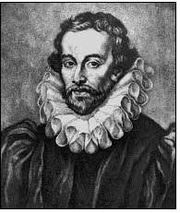 At the core of Canto CV are a number of citations and quotations from the writings of St. Anselm. This 11th-century philosopher and inventor of the ontological argument
for the existence of God who wrote poems in rhymed prose appealed to Pound because of his emphasis on the role of reason in religion and his envisioning of the divine essence as light. In the 1962 interview already quoted, Pound points to Anselm's clash with William Rufus over his investiture as part of the history of the struggle for individual rights. Pound also claims in this canto that Anselm's writings influenced Cavalcanti and François Villon
.
Canto CVI turns to visions of the goddess as fertility symbol via Demeter and Persephone, in her lunar, love aspect as Selena
, Helen and Aphrodite Euploia ("of safe voyages") and as hunter Athene (Proneia: "of forethought", the form in which she is worshiped at Delphi) and Diana (through quotes from Layamon). The sun as Zeus/Helios also features. These vision fragments are cross-cut with an invocation of the Taoist Kuan Tzu (Book of Master Kuan). This work argues that the mind should rule the body as the basis of good living and good governance.
Another such figure, the English jurist
and champion of civil liberties Sir Edward Coke
, dominates the final three cantos of this section. These cantos, CVII, CVIII, CIX, consist mainly of "luminous details" lifted from Coke's Institutes, a comprehensive study of English law up to his own time. In Canto CVII, Coke is placed in a river of light tradition that also includes Confucius, Ocellus and Agassiz. This canto also refers to Dante's vision of philosophers that reveal themselves as light in the Paradiso. In Canto CVIII, Pound highlights Coke's view that minting coin "Pertain(s) to the King onely" and has passages on sources of state revenue. He also draws a comparison between Coke and Iong Cheng
. A similar parallel between Coke and the author of the Book of the Eparch is highlighted in Canto CIX.
The canto and section end with a reference to the following lines from the second canto of the Paradiso—
—which read, in the translation by Charles Eliot Norton
, "O ye, who are in a little bark, desirous to listen, following behind my craft which singing passes on, turn to see again Your shores; put not out upon the deep; for haply losing me, ye would remain astray." This reference signalled Pound's intent to close the poem with a final volume based on his own paradisiacal vision.
In 1958, Pound was declared incurably insane and permanently incapable of standing trial. Consequent on this, he was released from St Elizabeth's on condition that he return to Europe, which he promptly did. At first, he lived with his daughter Mary in Tyrol
, but soon returned to Rapallo. In November 1959, Pound wrote to his publisher James Laughlin
(speaking in the third person) that he "has forgotten what or which politics he ever had. Certainly has none now". His crisis of belief, together with the effects of aging, meant that the proposed paradise cantos were slow in coming and turned out to be radically different from anything the poet had envisaged.
 Pound was reluctant to publish these late cantos, but the appearance in 1967 of a pirate edition of Cantos 110–116 forced his hand. Laughlin pushed Pound to publish an authorised edition, and the poet responded by supplying the more-or-less abandoned drafts and fragments he had, plus two fragments dating from 1941. The resulting book, therefore, can hardly be described as representing Pound's definitive planned ending to the poem. This situation has been further complicated by the addition of more fragments in editions of the complete poem published after the poet's death. One of these was labelled "Canto CXX" at one point, on no particular authority. This title was later removed.
Although some of Pound's intention to "write a paradise" survives in the text as we have it, especially in images of light and of the natural world, other themes also intrude. These include the poet's coming to terms with a sense of artistic failure, and jealousies and hatreds that must be faced and expiated.
Canto CX opens with a pun on the word wake, conflating the wake of the little boat from the end of the previous canto and an image of Pound waking in his daughter's house in Tyrol, both from sleep and, by extension, from the nightmare of his prolonged incarceration. The goddess appears as Kuanon, Artemis and Hebe
(through her characteristic epithet Kallistragalos, "of fair ankles"), the goddess of youth. The Buddhist painter Toba Sojo
represents directness of artistic handling.
The Noh figure of Awoi (from AOI NO UE), ravaged by jealousy, reappears together with the poet Ono no Komachi, the central character in two more Noh plays translated by Pound. She represents a life spent meditating on beauty which resulted in vanity and ended in loss and solitude. The canto draws to a close with the phrase Lux enim ("light indeed") and an image of the oval moon.
Pound's "nice, quiet paradise" is seen, in the notes for Canto CXI, to be based on serenity, pity, intelligence and individual acceptance of responsibility as illustrated by the French diplomat Talleyrand. This theme is continued in the short extract titled from Canto CXII, which also draws on the work of the anthropologist and explorer Joseph F. Rock in recording legends and religious rituals from China and Tibet
. Again, this section of the poem closes with an image of the moon.
Canto CXIII opens with an image of the sun moving through the zodiac, the first of a number of cycle images that occur through the canto, recalling a line from Pound's version of AOI NO UE: "Man's life is a wheel on the axle, there is no turn whereby to escape". A reference to Marcella Spann, a young woman whose presence in Tyrol further complicated the already strained relationships between the poet, his wife Dorothy and his lover Olga Rudge
, casts further light on the recurrent jealousy theme. The phrase "Syrian onyx" lifted from his 1919 Homage to Sextus Propertius, where it occurs in a section that paraphrases Propertius' instructions to his lover on how to behave after his death, reflects the elderly Pound's sense of his own mortality.
The theme of hatred is addressed directly at the opening of Canto CXIV, where Voltaire
is quoted to the effect that he hates nobody, not even his archenemy Elie Fréron
. The remainder of this canto is primarily concerned with recognising indebtedness to the poet's genetic and cultural ancestors. The short extract from Canto CXV is a reworking from an earlier version first published in the Belfast
-based magazine Threshold in 1962 and centres around two main ideas. The first of these is the hostilities that existed amongst Pound's modernist friends and the negative impact that it had on all their works. The second is the image of the poet as a "blown husk", again a borrowing from the Noh, this time the play Kakitsubata.
Canto CXVI was the last canto completed by Pound. It opens with a passage in which we see the Odysseus/Pound figure, homecoming achieved, reconciled with the sea-god. However, the home achieved is not the place intended when the poem was begun but is the terzo cielo ("third heaven") of human love. The canto contains the following well-known lines:
This passage has often been taken as an admission of failure on Pound's part, but the reality may be more complex. The crystal image relates back to the Sacred Edict on self-knowledge and the demigod/cohere lines relate directly to Pound's translation of the Women of Trachis. In this, the demigod
Herakles cries out "WHAT SPLENDOUR / IT ALL COHERES" as he is dying. These lines, read in conjunction with the later "i.e. it coheres all right / even if my notes do not cohere", point toward the conclusion that towards the end of his effort, Pound was coming to accept not only his own "errors" and "madness" but the conclusion that it was beyond him, and possibly beyond poetry, to do justice to the coherence of the universe. Images of light saturate this canto, culminating in the closing lines: "A little light, like a rushlight / to lead back to splendour". These lines again echo the Noh of Kakitsubata, the "light that does not lead on to darkness" in Pound's version.
This final complete canto is followed by the two fragments of the 1940s. The first of these, "Addendum for C", is a rant against usury that moves a bit away from the usual anti-Semitism in the line "the defiler, beyond race and against race". The second is an untitled fragment that prefigures the Pisan sequence in its nature imagery and its reference to Jannequin.
Notes for Canto CXVII et seq. originally consisted of three fragments, with a fourth, sometimes titled Canto CXX, added after Pound's death. The first of these has the poet raising an altar to Bacchus (Zagreus) and his mother Semele
, whose death was as a result of jealousy. The second centres on the lines "that I lost my center / fighting the world", which were intended as an admission of mistakes made as a younger man. The third fragment is the one that is also known as Canto CXX. It is, in fact, some rescued lines from the earlier version of Canto CXV, and has Pound asking forgiveness for his actions from both the gods and those he loves. The final fragment returns to beginnings with the name of François Bernonad, the French printer of A Draft of XVI Cantos. After quoting two phrases from Bernart de Ventadorn's Can vei la lauzeta mover, a poem in which the speaker contemplates a lark's flight as a token of the coming of spring, the fragment closes with the line "To be men not destroyers." This stood as the close of The Cantos until later editions appended a brief dedicatory fragment addressed to Olga Rudge.
and William Carlos Williams
wrote long poems that show this influence. Almost all of H.D.'s poetry from 1940 onwards takes the form of long sequences, and her Helen in Egypt, written during the 1950s, covers much of the same Homeric ground as The Cantos (but from a feminist perspective), and the three sequences that make up Hermetic Definition (1972) include direct quotations from Pound's poem. In the case of Williams, his Paterson (1963) follows Pound in using incidents and documents from the early history of the United States as part of its material. As with Pound, Williams includes Alexander Hamilton as the villain of the piece.
Pound was a major influence on the Objectivist poets
, and the effect of The Cantos on Zukofsky's "A" has already been noted. The other major long work by an Objectivist, Charles Reznikoff
's Testimony (1934–1978), follows Pound in the direct use of primary source documents as its raw material. In the next generation of American poets, Charles Olson
also drew on Pound's example in writing his own unfinished Modernist epic, The Maximus Poems.
Pound was also an important figure for the poets of the Beat generation
, especially Gary Snyder
and Allen Ginsberg
. Snyder's interest in things Chinese and Japanese stemmed from his early reading of Pound's writings. and his long poem Mountains and Rivers Without End
(1965–1996) reflects his reading of The Cantos in many of the formal devices used. In Ginsberg's development, reading Pound was influential in his move away from the long, Whitmanesque
lines of his early poetry, and towards the more varied metric and inclusive approach to a variety of subjects in the single poem that is to be found especially in his book-length sequences Planet News
(1968) and The Fall of America: Poems of These States
(1973). More generally, The Cantos, with its wide range of references and inclusion of primary sources, including prose texts, can be seen as prefiguring found poetry
. Pound's tacit insistence that this material becomes poetry because of his action in including it in a text he chose to call a poem also prefigures the attitudes and practices that underlie 20th-century Conceptual art
.
The poetic response to The Cantos is summed up in Basil Bunting
's poem, "On the Fly-Leaf of Pound's Cantos":
Online
Ezra Pound
Ezra Weston Loomis Pound was an American expatriate poet and critic and a major figure in the early modernist movement in poetry...
is a long, incomplete poem
Poetry
Poetry is a form of literary art in which language is used for its aesthetic and evocative qualities in addition to, or in lieu of, its apparent meaning...
in 120 sections, each of which is a canto
Canto
The canto is a principal form of division in a long poem, especially the epic. The word comes from Italian, meaning "song" or singing. Famous examples of epic poetry which employ the canto division are Lord Byron's Don Juan, Valmiki's Ramayana , Dante's The Divine Comedy , and Ezra Pound's The...
. Most of it was written between 1915 and 1962, although much of the early work was abandoned and the early cantos, as finally published, date from 1922 onwards. It is a book-length work, widely considered to present formidable difficulties to the reader. The Cantos are generally considered one of the most significant works of modernist poetry
Modernist poetry
Modernist poetry refers to poetry written between 1890 and 1950 in the tradition of modernist literature in the English language, but the dates of the term depend upon a number of factors, including the nation of origin, the particular school in question, and the biases of the critic setting the...
in the 20th century. As in Pound's prose writing, the themes of economics, governance
Governance
Governance is the act of governing. It relates to decisions that define expectations, grant power, or verify performance. It consists of either a separate process or part of management or leadership processes...
and culture are integral to the work's content.
The most striking feature of the text, to a casual browser, is the inclusion of Chinese character
Chinese character
Chinese characters are logograms used in the writing of Chinese and Japanese , less frequently Korean , formerly Vietnamese , or other languages...
s as well as quotations in European languages other than English. Recourse to scholarly commentaries is almost inevitable for a close reader
Close reading
Close reading describes, in literary criticism, the careful, sustained interpretation of a brief passage of text. Such a reading places great emphasis on the particular over the general, paying close attention to individual words, syntax, and the order in which sentences and ideas unfold as they...
. The range of allusion to historical events is very broad, and abrupt changes occur with little transition. There is also wide geographical reference; Pound added to his earlier interests in the classical Mediterranean culture and East Asia selective topics from medieval and early modern Italy and Provence, the beginnings of the United States, England of the 17th century, and details from Africa he had obtained from Leo Frobenius
Leo Frobenius
Leo Viktor Frobenius was an ethnologist and archaeologist and a major figure in German ethnography.-Life:He was born in Berlin as the son of a Prussian officer and died in Biganzolo, Lago Maggiore, Piedmont, Italy...
. References without explanation abound. Pound initially believed that he possessed poetic and rhetorical techniques which would themselves generate significance, but as time passed he became more concerned with the messages he wished to convey.
The section he wrote at the end of World War II, begun while he was interned in American-occupied Italy, has become known as The Pisan Cantos, is often considered to be self-contained. It was awarded the first Bollingen Prize
Bollingen Prize
The Bollingen Prize for Poetry, which is currently awarded every two years by Beinecke Library of Yale University, is a literary honor bestowed on an American poet in recognition of the best book of new verse within the last two years, or for lifetime achievement.-Inception and controversy:The...
in 1948. There were many repercussions, since this in effect honoured a poet who had been condemned as a traitor in his native country, and who had been diagnosed with a serious mental illness
Mental illness
A mental disorder or mental illness is a psychological or behavioral pattern generally associated with subjective distress or disability that occurs in an individual, and which is not a part of normal development or culture. Such a disorder may consist of a combination of affective, behavioural,...
.
Publication history
The earliest part of The Cantos to be published were released by Three Mountains Press in 1925 under the title A Draft of XVI Cantos. The first complete edition was New Direction's The Cantos (1-109) (1964).Controversy
The Cantos has always been a controversial work, initially so because of the experimental nature of the writing. The controversy has intensified since 1940 when Pound's very public stance on the war in Europe and his support for Benito MussoliniBenito Mussolini
Benito Amilcare Andrea Mussolini was an Italian politician who led the National Fascist Party and is credited with being one of the key figures in the creation of Fascism....
's fascism
Italian Fascism
Italian Fascism also known as Fascism with a capital "F" refers to the original fascist ideology in Italy. This ideology is associated with the National Fascist Party which under Benito Mussolini ruled the Kingdom of Italy from 1922 until 1943, the Republican Fascist Party which ruled the Italian...
became widely known. Much critical discussion of the poem has focused on the relationship between, on the one hand, the economic thesis on usura
Usury
Usury Originally, when the charging of interest was still banned by Christian churches, usury simply meant the charging of interest at any rate . In countries where the charging of interest became acceptable, the term came to be used for interest above the rate allowed by law...
, Pound's anti-Semitism
Anti-Semitism
Antisemitism is suspicion of, hatred toward, or discrimination against Jews for reasons connected to their Jewish heritage. According to a 2005 U.S...
, his adulation of Confucian ideals of government and his attitude towards fascism
Fascism
Fascism is a radical authoritarian nationalist political ideology. Fascists seek to rejuvenate their nation based on commitment to the national community as an organic entity, in which individuals are bound together in national identity by suprapersonal connections of ancestry, culture, and blood...
, and, on the other, passages of lyrical poetry and the historical scene-setting that he performed with his 'ideographic' technique. At one end of the spectrum George P. Elliot has drawn a parallel between Pound and Adolph Eichmann based on their anti-Semitism, while at the other Marjorie Perloff
Marjorie Perloff
Marjorie Perloff is an Austrian-born U.S. poetry critic.Perloff was born Gabriele Mintz into a secularized Jewish family in Vienna. Faced with Nazi terror, her family emigrated in 1938 when she was six-and-a-half, going first to Zürich and then to the United States, settling in Riverdale, New York...
places Pound's anti-Semitism in a wider context by examining the political views of many of his contemporaries, arguing that "We have to try to understand why" anti-Semitism was widespread in the early twentieth century, "and not say let's get rid of Ezra Pound, who also happens to be one of the greatest poets of the 20th C."
What is more relevant is that Pound's anti-Semitism was part of a systematic train of thought and analysis tied in with his economic theories. He in effect blamed the Jews—specifically the Rothschilds
Rothschild family
The Rothschild family , known as The House of Rothschild, or more simply as the Rothschilds, is a Jewish-German family that established European banking and finance houses starting in the late 18th century...
, for the collapse of European culture after World War I. His anti-Semitism was a symptom of a larger issue in The Cantos, which was his lament at the passing on of cultural dominance from a class of elites to the masses, which for Pound included Jews, blacks, and other outsiders. Charles Olson, a poet who visited with Pound and was in many ways sympathetic to him, summarized, as follows, "Pound and his kind want to ignore [the masses]. They try to lock them out. But they swarm at the windows in such numbers they block out the light and the air. And in their little place Pound and his kind suffocate, their fear turns to hate. And their hate breeds death. They want to kill. And, organized by Hitler and Mussolini, they do kill--millions."
Wendy Stallard Flory made a close study of the poem and concluded that it contains seven passages of anti-Semitic sentiment in the 803 pages of the edition she used. But Flory's approach, at least as summarized here, is specious. Several of Pound's best known Cantos make anti-Semitic arguments as a whole, therefore analyzing pages where anti-Semitic passages appear obscures the true impact. Pound has always had serious if select defenders and disciples. Louis Zukofsky
Louis Zukofsky
Louis Zukofsky was an American poet. He was one of the founders and the primary theorist of the Objectivist group of poets and thus an important influence on subsequent generations of poets in America and abroad.-Life:...
was both, and also Jewish; according to William Cookson
William Cookson
William Cookson was a British poet, writer on poetry and literary editor, best-known for his influential poetry magazine Agenda....
he defended Pound on the basis of personal knowledge of anti-Semitism on the level of human exchange, even though, as reported by Basil Bunting
Basil Bunting
Basil Cheesman Bunting was a significant British modernist poet whose reputation was established with the publication of Briggflatts in 1966. He had a lifelong interest in music that led him to emphasise the sonic qualities of poetry, particularly the importance of reading poetry aloud...
, their correspondence contained some of Pound's offensive views. Zukofsky's similarly formidable but distinctive long poem "A" follows in its ambitious scope the model of The Cantos.
Structure
The Cantos can appear on first reading to be chaotic or structureless because it lacks plot or a definite ending. R.P. Blackmur, an early critic, wrote,The Cantos are not complex, they are complicated; they are not arrayed by logic or driven by pursuing emotion, they are connected because they follow one another, are set side by side, and because an anecdote, an allusion or a sentence begun in one Canto may be continued in another and may never be completed at all; and as for a theme to be realized, they seem to have only, like MauberleyHugh Selwyn MauberleyHugh Selwyn Mauberley is a long poem by Ezra Pound. It has been regarded as a turning point in Pound's career , and its completion was swiftly followed by his departure from England. The name "Selwyn" might have been an homage to Rhymers' Club member Selwyn Image. The name and personality of the...
, the general sense of continuity — not unity — which may arise in the mind when read seriatimSeriatimSeriatim is a legal term typically used to indicate that a court is addressing multiple issues in a certain order, such as the order that the issues were originally presented to the court....
. The Cantos are what Mr Pound himself called them in a passage now excised from the canon, a rag-bag.
The issue of incoherence of the work is reflected by the equivocal note sounded in the final two more-or-less completed cantos; according to William Cookson
William Cookson
William Cookson was a British poet, writer on poetry and literary editor, best-known for his influential poetry magazine Agenda....
, the final two cantos show that Pound has been unable to make his materials cohere, while they insist that the world itself still does cohere. Pound and T. S. Eliot
T. S. Eliot
Thomas Stearns "T. S." Eliot OM was a playwright, literary critic, and arguably the most important English-language poet of the 20th century. Although he was born an American he moved to the United Kingdom in 1914 and was naturalised as a British subject in 1927 at age 39.The poem that made his...
had previously approached the subject of fragmentation of human experience: while Eliot was writing, and Pound editing, The Waste Land
The Waste Land
The Waste Land[A] is a 434-line[B] modernist poem by T. S. Eliot published in 1922. It has been called "one of the most important poems of the 20th century." Despite the poem's obscurity—its shifts between satire and prophecy, its abrupt and unannounced changes of speaker, location and time, its...
, Pound had said that he looked upon experience as similar to a series of iron filings on a mirror. Each filing is disconnected, but they are drawn into the shape of a rose by the presence of a magnet
Magnet
A magnet is a material or object that produces a magnetic field. This magnetic field is invisible but is responsible for the most notable property of a magnet: a force that pulls on other ferromagnetic materials, such as iron, and attracts or repels other magnets.A permanent magnet is an object...
. The Cantos takes a position between the mythic unity of Eliot's poem and Joyce's flow of consciousness and attempting to work out how history (as fragment) and personality (as shattered by modern existence) can cohere in the "field" of poetry.
Nevertheless, there are indications in Pound's other writings that there may have been some formal plan underlying the work. In his 1918 essay A Retrospect, Pound wrote "I think there is a 'fluid' as well as a 'solid' content, that some poems may have form as a tree has form, some as water poured into a vase. That most symmetrical forms have certain uses. That a vast number of subjects cannot be precisely, and therefore not properly rendered in symmetrical forms". Critics like Hugh Kenner
Hugh Kenner
William Hugh Kenner , was a Canadian literary scholar, critic and professor.Kenner was born in Peterborough, Ontario on January 7, 1923; his father taught classics...
who take a more positive view of The Cantos have tended to follow this hint, seeing the poem as a poetic record of Pound's life and reading that sends out new branches as new needs arise with the final poem, like a tree, displaying a kind of unpredictable inevitability.
Another approach to the structure of the work is based on a letter Pound wrote to his father in the 1920s, in which he stated that his plan was:
- A. A. Live man goes down into world of dead.
- C. B. 'The repeat in history.'
- B. C. The 'magic moment' or moment of metamorphosis, bust through from quotidian into 'divine or permanent world.' Gods, etc.
[The letter columns ACB/ABC may indicate the sequences in which the concepts could be presented.]
In the light of cantos written later than this letter, it would be possible to add other recurring motifs to this list, such as: periploi ('voyages around'); vegetation rituals such as the Eleusinian Mysteries
Eleusinian Mysteries
The Eleusinian Mysteries were initiation ceremonies held every year for the cult of Demeter and Persephone based at Eleusis in ancient Greece. Of all the mysteries celebrated in ancient times, these were held to be the ones of greatest importance...
; usura, banking and credit; and the drive towards clarity in art, such as the 'clear line' of Renaissance painting and the 'clear song' of the troubadour
Troubadour
A troubadour was a composer and performer of Old Occitan lyric poetry during the High Middle Ages . Since the word "troubadour" is etymologically masculine, a female troubadour is usually called a trobairitz....
s.
The poem's symbolic structure also makes use of an opposition between darkness and light. Images of light are used variously, and may represent Neoplatonic
Neoplatonism
Neoplatonism , is the modern term for a school of religious and mystical philosophy that took shape in the 3rd century AD, based on the teachings of Plato and earlier Platonists, with its earliest contributor believed to be Plotinus, and his teacher Ammonius Saccas...
ideas of divinity, the artistic impulse, love (both sacred and physical) and good governance, amongst other things. The moon is frequently associated in the poem with creativity, while the sun is more often found in relation to the sphere of political and social activity, although there is frequent overlap between the two. From the Rock Drill sequence on, the poem's effort is to merge these two aspects of light into a unified whole.
The Cantos was initially published in the form of separate sections, each containing several cantos that were numbered sequentially using Roman numerals
Roman numerals
The numeral system of ancient Rome, or Roman numerals, uses combinations of letters from the Latin alphabet to signify values. The numbers 1 to 10 can be expressed in Roman numerals as:...
(except cantos 85–109, first published with Arabic numerals
Arabic numerals
Arabic numerals or Hindu numerals or Hindu-Arabic numerals or Indo-Arabic numerals are the ten digits . They are descended from the Hindu-Arabic numeral system developed by Indian mathematicians, in which a sequence of digits such as "975" is read as a numeral...
). The original publication dates for the groups of cantos are as given below.
I–XVI
- Published in 1924/5 as A Draft of XVI Cantos by the Three Mountains Press in Paris.
Pound had been considering writing a long poem since around 1905, but work did not begin until sometime between 1912 and 1917, when the initial versions of the first three cantos of the proposed "poem of some length" were published in the journal Poetry
Poetry (magazine)
Poetry , published in Chicago, Illinois since 1912, is one of the leading monthly poetry journals in the English-speaking world. Published by the Poetry Foundation and currently edited by Christian Wiman, the magazine has a circulation of 30,000 and prints 300 poems per year out of approximately...
. In this version, the poem began as an address by the poet to the ghost of Robert Browning
Robert Browning
Robert Browning was an English poet and playwright whose mastery of dramatic verse, especially dramatic monologues, made him one of the foremost Victorian poets.-Early years:...
. Pound came to believe that this narrative voice compromised the revolutionary intent of his poetic vision, and these first three ur-cantos were soon abandoned and a new starting point sought. The answer was a Latin version of Homer
Homer
In the Western classical tradition Homer , is the author of the Iliad and the Odyssey, and is revered as the greatest ancient Greek epic poet. These epics lie at the beginning of the Western canon of literature, and have had an enormous influence on the history of literature.When he lived is...
's Odyssey
Odyssey
The Odyssey is one of two major ancient Greek epic poems attributed to Homer. It is, in part, a sequel to the Iliad, the other work ascribed to Homer. The poem is fundamental to the modern Western canon, and is the second—the Iliad being the first—extant work of Western literature...
by the Renaissance
Renaissance
The Renaissance was a cultural movement that spanned roughly the 14th to the 17th century, beginning in Italy in the Late Middle Ages and later spreading to the rest of Europe. The term is also used more loosely to refer to the historical era, but since the changes of the Renaissance were not...
scholar Andreas Divus
Andreas Divus
Andreas Divus was a Renaissance scholar, about whose life little is known; in Italian he is called Andrea Divo giustinopolitano or di Capodistria, i.e. surnamed Justinopolitanus in Latin and implying an origin at Koper, now in Slovenia, which was named at different times Aegida, Justinopolis and...
that Pound had bought in Paris sometime between 1906 and 1910.
Using the metre
Meter (poetry)
In poetry, metre is the basic rhythmic structure of a verse or lines in verse. Many traditional verse forms prescribe a specific verse metre, or a certain set of metres alternating in a particular order. The study of metres and forms of versification is known as prosody...
and syntax
Syntax
In linguistics, syntax is the study of the principles and rules for constructing phrases and sentences in natural languages....
of his 1911 version of the Anglo-Saxon poem The Seafarer, Pound made an English version of Divus' rendering of the nekuia episode in which Odysseus
Odysseus
Odysseus or Ulysses was a legendary Greek king of Ithaca and the hero of Homer's epic poem the Odyssey. Odysseus also plays a key role in Homer's Iliad and other works in the Epic Cycle....
and his companions sail to Hades
Hades
Hades , Hadēs, originally , Haidēs or , Aidēs , meaning "the unseen") was the ancient Greek god of the underworld. The genitive , Haidou, was an elision to denote locality: "[the house/dominion] of Hades". Eventually, the nominative came to designate the abode of the dead.In Greek mythology, Hades...
in order to find out what their future holds. In using this passage to open the poem, Pound introduces a major theme: the excavating of the "dead" past to illuminate the present and future. He also echoes Dante
Dante Alighieri
Durante degli Alighieri, mononymously referred to as Dante , was an Italian poet, prose writer, literary theorist, moral philosopher, and political thinker. He is best known for the monumental epic poem La commedia, later named La divina commedia ...
's opening to The Divine Comedy
The Divine Comedy
The Divine Comedy is an epic poem written by Dante Alighieri between 1308 and his death in 1321. It is widely considered the preeminent work of Italian literature, and is seen as one of the greatest works of world literature...
in which the poet also descends into hell to interrogate the dead. The canto concludes with some fragments from the Second Homeric Hymn to Aphrodite
Aphrodite
Aphrodite is the Greek goddess of love, beauty, pleasure, and procreation.Her Roman equivalent is the goddess .Historically, her cult in Greece was imported from, or influenced by, the cult of Astarte in Phoenicia....
, in a Latin version by Georgius Dartona which Pound found in the Divus volume, followed by "So that:"—an invitation to read on.
Canto II opens with some lines rescued from the ur-cantos in which Pound reflects on the indeterminacy of identity by setting side by side four different versions of the troubadour poet Sordello
Sordello
Sordello da Goito or Sordel de Goit was a 13th-century Lombard troubadour, born in the municipality of Goito in the province of Mantua...
: Browning's poem of that name, the actual Sordello of flesh and blood, Pound's own version of the poet, and the Sordello of the brief life appended to manuscripts of his poems. These lines are followed by a sequence of identity shifts involving a seal, the daughter of Lir
Lir
Ler or Lir is a sea god in Irish mythology. His name suggests that he is a personification of the sea, rather than a distinct deity. He is named Allód in early genealogies, and corresponds to the Llŷr of Welsh mythology...
, and other figures associated with the sea: Eleanor of Aquitaine
Eleanor of Aquitaine
Eleanor of Aquitaine was one of the wealthiest and most powerful women in Western Europe during the High Middle Ages. As well as being Duchess of Aquitaine in her own right, she was queen consort of France and of England...
who, through a pair of Homeric epithets that echo her name, shifts into Helen of Troy, Homer with his ear for the "sea surge", the old men of Troy
Troy
Troy was a city, both factual and legendary, located in northwest Anatolia in what is now Turkey, southeast of the Dardanelles and beside Mount Ida...
who want to send Helen back over the sea, and an extended, Imagistic retelling of the story of the abduction of Dionysus
Dionysus
Dionysus was the god of the grape harvest, winemaking and wine, of ritual madness and ecstasy in Greek mythology. His name in Linear B tablets shows he was worshipped from c. 1500—1100 BC by Mycenean Greeks: other traces of Dionysian-type cult have been found in ancient Minoan Crete...
by sailors and his transformation of his abductors into dolphins. Although this last story is found in the Homeric Hymn to Dionysus, also contained in the Divus volume, Pound draws on the version in Ovid
Ovid
Publius Ovidius Naso , known as Ovid in the English-speaking world, was a Roman poet who is best known as the author of the three major collections of erotic poetry: Heroides, Amores, and Ars Amatoria...
's poem Metamorphoses
Metamorphoses (poem)
Metamorphoses is a Latin narrative poem in fifteen books by the Roman poet Ovid describing the history of the world from its creation to the deification of Julius Caesar within a loose mythico-historical framework. Completed in AD 8, it is recognized as a masterpiece of Golden Age Latin literature...
, thus introducing the world of ancient Rome into the poem.
Classical mythology
Classical mythology or Greco-Roman mythology is the cultural reception of myths from the ancient Greeks and Romans. Along with philosophy and political thought, mythology represents one of the major survivals of classical antiquity throughout later Western culture.Classical mythology has provided...
, Renaissance
Renaissance
The Renaissance was a cultural movement that spanned roughly the 14th to the 17th century, beginning in Italy in the Late Middle Ages and later spreading to the rest of Europe. The term is also used more loosely to refer to the historical era, but since the changes of the Renaissance were not...
history, the world of the troubadour
Troubadour
A troubadour was a composer and performer of Old Occitan lyric poetry during the High Middle Ages . Since the word "troubadour" is etymologically masculine, a female troubadour is usually called a trobairitz....
s, Sappho
Sappho
Sappho was an Ancient Greek poet, born on the island of Lesbos. Later Greeks included her in the list of nine lyric poets. Her birth was sometime between 630 and 612 BC, and it is said that she died around 570 BC, but little is known for certain about her life...
's poetry, a scene from the legend of El Cid
El Cid
Rodrigo Díaz de Vivar , known as El Cid Campeador , was a Castilian nobleman, military leader, and diplomat...
that introduces the theme of banking and credit
Credit (finance)
Credit is the trust which allows one party to provide resources to another party where that second party does not reimburse the first party immediately , but instead arranges either to repay or return those resources at a later date. The resources provided may be financial Credit is the trust...
, and Pound's own visits to Venice
Venice
Venice is a city in northern Italy which is renowned for the beauty of its setting, its architecture and its artworks. It is the capital of the Veneto region...
to create a textual collage saturated with Neoplatonic images of clarity and light.
Cantos VIII–XI draw on the story of Sigismondo Pandolfo Malatesta, 15th-century poet, condottiero, lord of Rimini
Rimini
Rimini is a medium-sized city of 142,579 inhabitants in the Emilia-Romagna region of Italy, and capital city of the Province of Rimini. It is located on the Adriatic Sea, on the coast between the rivers Marecchia and Ausa...
and patron of the arts. Quoting extensively from primary sources, including Malatesta's letters, Pound especially focuses on the building of the church of San Francesco, also known as the Tempio Malatestiano
Tempio Malatestiano
The Tempio Malatestiano is the cathedral church of Rimini, Italy. Officially named for St. Francis, it takes the popular name from Sigismondo Pandolfo Malatesta, who commissioned its reconstruction by the famous Renaissance theorist and architect Leon Battista Alberti around 1450.-History:San...
. Designed by Leon Battista Alberti and decorated by artists including Piero della Francesca
Piero della Francesca
Piero della Francesca was a painter of the Early Renaissance. As testified by Giorgio Vasari in his Lives of the Artists, to contemporaries he was also known as a mathematician and geometer. Nowadays Piero della Francesca is chiefly appreciated for his art. His painting was characterized by its...
and Agostino di Duccio
Agostino di Duccio
Agostino di Duccio was an Italian early Renaissance sculptor.Born in Florence, he worked in Prato with Donatello and Michelozzo, who influenced him greatly. In 1441, he was accused of stealing precious materials from a monastery in Florence and was banished from his native city as a result...
, this was a landmark Renaissance building, being the first church to use the Roman triumphal arch
Triumphal arch
A triumphal arch is a monumental structure in the shape of an archway with one or more arched passageways, often designed to span a road. In its simplest form a triumphal arch consists of two massive piers connected by an arch, crowned with a flat entablature or attic on which a statue might be...
as part of its structure. For Pound, who spent a good deal of time seeking patrons for himself, Joyce
James Joyce
James Augustine Aloysius Joyce was an Irish novelist and poet, considered to be one of the most influential writers in the modernist avant-garde of the early 20th century...
, Eliot
T. S. Eliot
Thomas Stearns "T. S." Eliot OM was a playwright, literary critic, and arguably the most important English-language poet of the 20th century. Although he was born an American he moved to the United Kingdom in 1914 and was naturalised as a British subject in 1927 at age 39.The poem that made his...
and a string of little magazines and small press
Small press
Small press is a term often used to describe publishers with annual sales below a certain level. Commonly, in the United States, this is set at $50 million, after returns and discounts...
es, the role of the patron was a crucial cultural question, and Malatesta is the first in a line of ruler-patrons to appear in The Cantos.
Canto XII consists of three moral tales on the subject of profit. The first and third of these treat of the creation of profit ex nihilo
Ex nihilo
Ex nihilo is a Latin phrase meaning "out of nothing". It often appears in conjunction with the concept of creation, as in creatio ex nihilo, meaning "creation out of nothing"—chiefly in philosophical or theological contexts, but also occurs in other fields.In theology, the common phrase creatio ex...
by exploiting the money supply
Money supply
In economics, the money supply or money stock, is the total amount of money available in an economy at a specific time. There are several ways to define "money," but standard measures usually include currency in circulation and demand deposits .Money supply data are recorded and published, usually...
, comparing this activity with "unnatural" fertility. The central parable contrasts this with wealth-creation based on the creation of useful goods. Canto XIII then introduces Confucius
Confucius
Confucius , literally "Master Kong", was a Chinese thinker and social philosopher of the Spring and Autumn Period....
, or Kung, who is presented as the embodiment of the ideal of social order based on ethics
Ethics
Ethics, also known as moral philosophy, is a branch of philosophy that addresses questions about morality—that is, concepts such as good and evil, right and wrong, virtue and vice, justice and crime, etc.Major branches of ethics include:...
.
This section of The Cantos concludes with a vision of Hell
Hell
In many religious traditions, a hell is a place of suffering and punishment in the afterlife. Religions with a linear divine history often depict hells as endless. Religions with a cyclic history often depict a hell as an intermediary period between incarnations...
. Cantos XIV and XV use the convention of the Divine Comedy to present Pound/Dante moving through a hell populated by bankers, newspaper editors, hack writers and other 'perverters of language' and the social order. In Canto XV, Plotinus
Plotinus
Plotinus was a major philosopher of the ancient world. In his system of theory there are the three principles: the One, the Intellect, and the Soul. His teacher was Ammonius Saccas and he is of the Platonic tradition...
takes the role of guide played by Virgil
Virgil
Publius Vergilius Maro, usually called Virgil or Vergil in English , was an ancient Roman poet of the Augustan period. He is known for three major works of Latin literature, the Eclogues , the Georgics, and the epic Aeneid...
in Dante's poem. In Canto XVI, Pound emerges from Hell and into an earthly paradise where he sees some of the personages encountered in earlier cantos. The poem then moves to recollections of World War I, and of Pound's writer and artist friends who fought in it. These include Richard Aldington
Richard Aldington
Richard Aldington , born Edward Godfree Aldington, was an English writer and poet.Aldington was best known for his World War I poetry, the 1929 novel, Death of a Hero, and the controversy arising from his 1955 Lawrence of Arabia: A Biographical Inquiry...
, Henri Gaudier-Brzeska
Henri Gaudier-Brzeska
Henri Gaudier-Brzeska was a French sculptor who developed a rough hewn, primitive style of direct carving....
, Wyndham Lewis
Wyndham Lewis
Percy Wyndham Lewis was an English painter and author . He was a co-founder of the Vorticist movement in art, and edited the literary magazine of the Vorticists, BLAST...
, Ernest Hemingway
Ernest Hemingway
Ernest Miller Hemingway was an American author and journalist. His economic and understated style had a strong influence on 20th-century fiction, while his life of adventure and his public image influenced later generations. Hemingway produced most of his work between the mid-1920s and the...
and Fernand Léger
Fernand Léger
Joseph Fernand Henri Léger was a French painter, sculptor, and filmmaker. In his early works he created a personal form of Cubism which he gradually modified into a more figurative, populist style...
, whose war memories the poem includes a passage from (in French). Finally, there is a transcript of Lincoln Steffens
Lincoln Steffens
-Biography:Steffens was born April 6, 1866, in San Francisco. He grew up in a wealthy family and attended a military academy. He studied in France and Germany after graduating from the University of California....
' account of the Russian Revolution
Russian Revolution of 1917
The Russian Revolution is the collective term for a series of revolutions in Russia in 1917, which destroyed the Tsarist autocracy and led to the creation of the Soviet Union. The Tsar was deposed and replaced by a provisional government in the first revolution of February 1917...
. These two events, the war and revolution, mark a decisive break with the historic past, including the early modernist period when these writers and artists formed a more-or-less coherent movement.
XVII–XXX
- XVII–XXVII published in 1924/5 as A Draft of XVI Cantos by the Three Mountains Press in Paris. Cantos I–XXX published in 1930 in A Draft of XXX Cantos by Nancy CunardNancy CunardNancy Clara Cunard was a writer, heiress and political activist. She was born into the British upper class but strongly rejected her family's values, devoting much of her life to fighting racism and fascism...
's Hours Press.
Originally, Pound conceived of Cantos XVII–XXVII as a group that would follow the first volume by starting with the Renaissance and ending with the Russian Revolution. He then added a further three cantos and the whole eventually appeared as A Draft of XXX Cantos in an edition of 200 copies. The major locus of these cantos is the city of Venice.
Canto XVII opens with the words "So that", echoing the end of Canto I, and then moves on to another Dionysus-related metamorphosis story. The rest of the canto is concerned with Venice, which is portrayed as a stone forest growing out of the water. Cantos XVIII and XIX return to the theme of financial exploitation, beginning with the Venetian explorer Marco Polo
Marco Polo
Marco Polo was a Venetian merchant traveler from the Venetian Republic whose travels are recorded in Il Milione, a book which did much to introduce Europeans to Central Asia and China. He learned about trading whilst his father and uncle, Niccolò and Maffeo, travelled through Asia and apparently...
's account of Kublai Khan
Kublai Khan
Kublai Khan , born Kublai and also known by the temple name Shizu , was the fifth Great Khan of the Mongol Empire from 1260 to 1294 and the founder of the Yuan Dynasty in China...
's paper money. Canto XIX deals mainly with those who profit from war, returning briefly to the Russian Revolution, and ends on the stupidity of wars and those who promote them.
Canto XX opens with a grouping of phrases, words and images from Mediterranean poetry, ranging from Homer through Ovid
Ovid
Publius Ovidius Naso , known as Ovid in the English-speaking world, was a Roman poet who is best known as the author of the three major collections of erotic poetry: Heroides, Amores, and Ars Amatoria...
, Propertius and Catullus
Catullus
Gaius Valerius Catullus was a Latin poet of the Republican period. His surviving works are still read widely, and continue to influence poetry and other forms of art.-Biography:...
to the Song of Roland and Arnaut Daniel
Arnaut Daniel
Arnaut Daniel de Riberac was an Occitan troubadour of the 12th century, praised by Dante as "il miglior fabbro" and called "Grand Master of Love" by Petrarch...
. These fragments constellate to form an exemplum of what Pound calls "clear song". There follows another exemplum, this time of the linguistic
Linguistics
Linguistics is the scientific study of human language. Linguistics can be broadly broken into three categories or subfields of study: language form, language meaning, and language in context....
scholarship that enables us to read these old poetries and the specific attention to words this study requires. Finally, this "clear song" and intellectual activity is implicitly contrasted with the inertia and indolence of the lotus eaters, whose song completes the canto. There are references to the Malatesta family and to Borso d'Este
Borso d'Este
thumb|Borso d'Este, attributed to [[Vicino da Ferrara]], [[Pinacoteca]] of the [[Castello Sforzesco|Sforza Castle]] in [[Milan]], [[Italy]].Borso d'Este was the first Duke of Ferrara, which he ruled from 1450 until his death...
, who tried to keep the peace between the warring Italian city states.
Canto XXI deals with the machinations of the Medici bank
Medici bank
The Medici Bank was a financial institution created by the Medici family in Italy during the 15th century. It was the largest and most respected bank in Europe during its prime. There are some estimates that the Medici family was, for a period of time, the wealthiest family in Europe...
, especially with the Medici
Medici
The House of Medici or Famiglia de' Medici was a political dynasty, banking family and later royal house that first began to gather prominence under Cosimo de' Medici in the Republic of Florence during the late 14th century. The family originated in the Mugello region of the Tuscan countryside,...
s' effect on Venice. These are contrasted with the actions of Thomas Jefferson
Thomas Jefferson
Thomas Jefferson was the principal author of the United States Declaration of Independence and the Statute of Virginia for Religious Freedom , the third President of the United States and founder of the University of Virginia...
, who is shown as a cultured leader with an interest in the arts. A phrase from one of Sigismondo Pandolfo's letters inserted into the Jefferson passage draws an explicit parallel between the two men, a theme that is to recur later in the poem. The next canto continues the focus on finance by introducing the Social Credit
Social Credit
Social Credit is an economic philosophy developed by C. H. Douglas , a British engineer, who wrote a book by that name in 1924. Social Credit is described by Douglas as "the policy of a philosophy"; he called his philosophy "practical Christianity"...
theories of C.H. Douglas for the first time.
Canto XXIII returns to the world of the troubadours via Homer and Renaissance Neoplatonism. Pound saw Provençal
Provence
Provence ; Provençal: Provença in classical norm or Prouvènço in Mistralian norm) is a region of south eastern France on the Mediterranean adjacent to Italy. It is part of the administrative région of Provence-Alpes-Côte d'Azur...
culture as a nexus of survival of the old pagan beliefs, and the destruction of the Cathar
Cathar
Catharism was a name given to a Christian religious sect with dualistic and gnostic elements that appeared in the Languedoc region of France and other parts of Europe in the 11th century and flourished in the 12th and 13th centuries...
stronghold at Montsegur
Montségur
The Château de Montségur is a former fortress near Montségur, a commune in the Ariège department in southwestern France. Its ruins are the site of a razed stronghold of the Cathars. The present fortress on the site, though described as one of the "Cathar castles," is actually of a later period...
at the end of the Albigensian Crusade
Albigensian Crusade
The Albigensian Crusade or Cathar Crusade was a 20-year military campaign initiated by the Catholic Church to eliminate Catharism in Languedoc...
is held up as an example of the tendency of authority to crush all such alternative cultures. The destruction of Mont Segur is implicitly compared with the destruction of Troy in the closing lines of the canto. Canto XXIV then returns to 15th-century Italy and the d'Este family, again focusing on their Venetian activities and Niccolo d'Este
Niccolò III d'Este
Niccolò III d'Este was Marquess of Ferrara from 1393 until his death. He was also a condottiero.-Biography:...
's voyage to the Holy Land
Holy Land
The Holy Land is a term which in Judaism refers to the Kingdom of Israel as defined in the Tanakh. For Jews, the Land's identifiction of being Holy is defined in Judaism by its differentiation from other lands by virtue of the practice of Judaism often possible only in the Land of Israel...
.
Cantos XXV and XXVI draw on the Book of the Council Major in Venice and Pound's personal memories of the city. Anecdotes on Titian
Titian
Tiziano Vecelli or Tiziano Vecellio Tiziano Vecelli or Tiziano Vecellio Tiziano Vecelli or Tiziano Vecellio (c. 1488/1490 – 27 August 1576 better known as Titian was an Italian painter, the most important member of the 16th-century Venetian school. He was born in Pieve di Cadore, near...
and Mozart deal with the relationship between artist and patron. Canto XXVII returns to the Russian Revolution, which is seen as being destructive, not constructive, and echoes the ruin of Eblis from Canto VI. XXVIII returns to the contemporary scene, with a passage on transatlantic flight
Transatlantic flight
Transatlantic flight is the flight of an aircraft across the Atlantic Ocean. A transatlantic flight may proceed east-to-west, originating in Europe or Africa and terminating in North America or South America, or it may go in the reverse direction, west-to-east...
. The last two cantos in the series return to the world of "clear song". In Canto XXIX, a story from their visit to the Provençal site at Excideuil
Excideuil
Excideuil is a commune in the Dordogne department in Aquitaine in southwestern France.-Geography:It should not be confused with Exideuil in the Charente department....
contrasts Pound and Eliot on the subject of Christianity
Christianity
Christianity is a monotheistic religion based on the life and teachings of Jesus as presented in canonical gospels and other New Testament writings...
, with Pound implicitly rejecting that religion. Finally, the series closes with a glimpse of the printer Hieronymus Soncinus of Fano
Fano
Fano is a town and comune of the province of Pesaro and Urbino in the Marche region of Italy. It is a beach resort 12 km southeast of Pesaro, located where the Via Flaminia reaches the Adriatic Sea...
preparing to print the works of Petrarch
Petrarch
Francesco Petrarca , known in English as Petrarch, was an Italian scholar, poet and one of the earliest humanists. Petrarch is often called the "Father of Humanism"...
.
XXXI–XLI (XI New Cantos)
- Published as Eleven New Cantos XXXI–XLI. New York: Farrar & Rinehart Inc., 1934.
The first four cantos of this volume (Cantos XXXI–XXXVI) quote extensively from the letters and other writings of Thomas Jefferson
Thomas Jefferson
Thomas Jefferson was the principal author of the United States Declaration of Independence and the Statute of Virginia for Religious Freedom , the third President of the United States and founder of the University of Virginia...
, John Adams
John Adams
John Adams was an American lawyer, statesman, diplomat and political theorist. A leading champion of independence in 1776, he was the second President of the United States...
, John Quincy Adams
John Quincy Adams
John Quincy Adams was the sixth President of the United States . He served as an American diplomat, Senator, and Congressional representative. He was a member of the Federalist, Democratic-Republican, National Republican, and later Anti-Masonic and Whig parties. Adams was the son of former...
, Andrew Jackson
Andrew Jackson
Andrew Jackson was the seventh President of the United States . Based in frontier Tennessee, Jackson was a politician and army general who defeated the Creek Indians at the Battle of Horseshoe Bend , and the British at the Battle of New Orleans...
, Martin Van Buren
Martin Van Buren
Martin Van Buren was the eighth President of the United States . Before his presidency, he was the eighth Vice President and the tenth Secretary of State, under Andrew Jackson ....
and others to deal with the emergence of the fledgling United States and, particularly, the American banking system. Canto XXXI opens with the Malatesta family motto Tempus loquendi, tempus tacendi ("a time to speak, a time to be silent") to link again Jefferson and Sigismondo as individuals and the Italian and American "rebirths" as historical movements.
Canto XXXV contrasts the dynamism of Revolutionary America with the "general indefinite wobble" of the decaying aristocratic society of Mitteleuropa
Mitteleuropa
Mitteleuropa is the German term equal to Central Europe. The word has political, geographic and cultural meaning. While it describes a geographical location, it also is the word denoting a political concept of a German-dominated and exploited Central European union that was put into motion during...
. This canto contains some distinctly unpleasant expressions of anti-Semitic opinions. Canto XXXVI opens with a translation of Cavalcanti's canzone
Canzone
Literally "song" in Italian, a canzone is an Italian or Provençal song or ballad. It is also used to describe a type of lyric which resembles a madrigal...
Donna mi pregha ("A lady asks me"). This poem, a lyric meditation of the nature and philosophy of love, was a touchstone text for Pound. He saw it as an example of the post-Montsegur survival of the Provençal tradition of "clear song", precision of thought and language, and nonconformity of belief. The canto then closes with the figure of the 9th-century Irish
Irish people
The Irish people are an ethnic group who originate in Ireland, an island in northwestern Europe. Ireland has been populated for around 9,000 years , with the Irish people's earliest ancestors recorded having legends of being descended from groups such as the Nemedians, Fomorians, Fir Bolg, Tuatha...
philosopher and poet
Poet
A poet is a person who writes poetry. A poet's work can be literal, meaning that his work is derived from a specific event, or metaphorical, meaning that his work can take on many meanings and forms. Poets have existed since antiquity, in nearly all languages, and have produced works that vary...
John Scotus Eriugena
Johannes Scotus Eriugena
Johannes Scotus Eriugena was an Irish theologian, Neoplatonist philosopher, and poet. He is known for having translated and made commentaries upon the work of Pseudo-Dionysius.-Name:...
, who was an influence on the Cathars and whose writings were condemned as heretical in both the 11th and 13th centuries. Canto XXXVII then turns to Jackson, Van Buren, Nicholas Biddle, Alexander Hamilton
Alexander Hamilton
Alexander Hamilton was a Founding Father, soldier, economist, political philosopher, one of America's first constitutional lawyers and the first United States Secretary of the Treasury...
and the Bank War
Bank War
The Bank War is the name given to the controversy over the Second Bank of the United States and the attempts to destroy it by President Andrew Jackson. At that time, it was the only nationwide bank and, along with its president Nicholas Biddle, exerted tremendous influence over the nation's...
and also contains a reference to the Peggy Eaton affair.
Canto XXXVIII opens with a quotation from Dante in which he accuses Albert of Germany
Albert I of Germany
Albert I of Habsburg was King of the Romans and Duke of Austria, the eldest son of German King Rudolph I of Habsburg and his first wife Gertrude of Hohenburg.-Life:...
of falsifying the coinage. The canto then turns to modern commerce and the arms trade and introduces Frobenius as "the man who made the tempest". There is also a passage on Douglas' account of the problem of purchasing power. Canto XXXIX returns to the island of Circe
Circe
In Greek mythology, Circe is a minor goddess of magic , described in Homer's Odyssey as "The loveliest of all immortals", living on the island of Aeaea, famous for her part in the adventures of Odysseus.By most accounts, Circe was the daughter of Helios, the god of the sun, and Perse, an Oceanid...
and the events before the voyage undertaken in the first canto unfolds as a hymn to natural fertility and ritual sex. Canto XL opens with Adam Smith
Adam Smith
Adam Smith was a Scottish social philosopher and a pioneer of political economy. One of the key figures of the Scottish Enlightenment, Smith is the author of The Theory of Moral Sentiments and An Inquiry into the Nature and Causes of the Wealth of Nations...
on trade as a conspiracy against the general public, followed by another periplus
Periplus
Periplus is the Latinization of an ancient Greek word, περίπλους , literally "a sailing-around." Both segments, peri- and -plous, were independently productive: the ancient Greek speaker understood the word in its literal sense; however, it developed a few specialized meanings, one of which became...
, a condensed version of Hanno the Navigator
Hanno the Navigator
Hanno the Navigator was a Carthaginian explorer c. 500 BC, best known for his naval exploration of the African coast...
's account of his voyage along the west coast of Africa. The book closes with an account of Benito Mussolini
Benito Mussolini
Benito Amilcare Andrea Mussolini was an Italian politician who led the National Fascist Party and is credited with being one of the key figures in the creation of Fascism....
as a man of action and another lament on the waste of war.
XLII–LI (Fifth Decad, called also Leopoldine Cantos)
- Published as The Fifth Decad of the Cantos XLII–LI. London: Faber & Faber, 1937.
Cantos XLII, XLIII and XLIV move to the Sienese
Siena
Siena is a city in Tuscany, Italy. It is the capital of the province of Siena.The historic centre of Siena has been declared by UNESCO a World Heritage Site. It is one of the nation's most visited tourist attractions, with over 163,000 international arrivals in 2008...
bank, the Monte dei Paschi di Siena
Monte dei Paschi di Siena
Banca Monte dei Paschi di Siena S.p.A. is the oldest surviving bank in the world. Founded in 1472 by the Magistrate of the city state of Siena, Italy, as a mount of piety, it has been operating ever since. Today it consists of approximately 3,000 branches, 33,000 employees and 4.5 million...
, and to the 18th-century reforms of Pietro Leopoldo
Leopold II, Holy Roman Emperor
Leopold II , born Peter Leopold Joseph Anton Joachim Pius Gotthard, was Holy Roman Emperor and King of Hungary and Bohemia from 1790 to 1792, Archduke of Austria and Grand Duke of Tuscany from 1765 to 1790. He was a son of Emperor Francis I and his wife, Empress Maria Theresa...
, Habsburg Arch Duke of Tuscany. Founded in 1624, the Monte dei Paschi was a low-interest, not-for-profit credit institution whose funds were based on local productivity as represented by the natural increase generated by the grazing of sheep on community land (the "BANK of the grassland" of Canto XLIII). As such, it represents a Poundian non-capitalist ideal.
Litany
A litany, in Christian worship and some forms of Jewish worship, is a form of prayer used in services and processions, and consisting of a number of petitions...
against Usura or usury
Usury
Usury Originally, when the charging of interest was still banned by Christian churches, usury simply meant the charging of interest at any rate . In countries where the charging of interest became acceptable, the term came to be used for interest above the rate allowed by law...
, which Pound later defined as a charge on credit regardless of potential or actual production and the creation of wealth ex nihilo by a bank to the benefit of its shareholders. The canto declares this practice as both contrary to the laws of nature and inimical to the production of good art and culture. Pound later came to see this canto as a key central point in the poem.
Canto XLVI contrasts what has gone before with the practices of institutions such as the Bank of England
Bank of England
The Bank of England is the central bank of the United Kingdom and the model on which most modern central banks have been based. Established in 1694, it is the second oldest central bank in the world...
that are designed to exploit the issuing of credit to make profits, thereby, in Pound's view, contributing to poverty, social deprivation, crime and the production of "bad" art as exemplified by the baroque
Baroque
The Baroque is a period and the style that used exaggerated motion and clear, easily interpreted detail to produce drama, tension, exuberance, and grandeur in sculpture, painting, literature, dance, and music...
.
In Canto XLVII, the poem returns to the island of Circe and Odysseus about to "sail after knowledge". There follows a long lyrical passage in which a ritual of floating votive candles on the bay at Rapallo
Rapallo
Rapallo is a municipality in the province of Genoa, in Liguria, northern Italy. As of 2007 it counts approximately 34,000 inhabitants, it is part of the Tigullio Gulf and is located in between Portofino and Chiavari....
near Pound's home every July merges with the cognate myths of Tammuz and Adonis
Adonis
Adonis , in Greek mythology, the god of beauty and desire, is a figure with Northwest Semitic antecedents, where he is a central figure in various mystery religions. The Greek , Adōnis is a variation of the Semitic word Adonai, "lord", which is also one of the names used to refer to God in the Old...
, agricultural activity set in a calendar based on natural cycles, and fertility rituals.
Canto XLVIII presents more instances of what Pound considers to be usury, some of which display signs of his anti-Semitic position. The canto then moves via Montsegur to the village of St-Bertrand-de-Comminges, which stands on the site of the ancient city of Lugdunum Convenarum. The destruction of this city represents, for the poet, the treatment of civilisation by those he considers barbarous.
Canto XLIX is a poem of tranquil nature derived from a Chinese
China
Chinese civilization may refer to:* China for more general discussion of the country.* Chinese culture* Greater China, the transnational community of ethnic Chinese.* History of China* Sinosphere, the area historically affected by Chinese culture...
picture book that Pound's parents brought with them when they retired to Rapallo. Canto L, which again contains anti-Semitic statements, moves from John Adams to the failure of the Medici bank
Medici bank
The Medici Bank was a financial institution created by the Medici family in Italy during the 15th century. It was the largest and most respected bank in Europe during its prime. There are some estimates that the Medici family was, for a period of time, the wealthiest family in Europe...
and more general images of European decay since the time of Napoleon I
Napoleon I
Napoleon Bonaparte was a French military and political leader during the latter stages of the French Revolution.As Napoleon I, he was Emperor of the French from 1804 to 1815...
. The final canto in this sequence returns to the usura litany of Canto XLV, followed by detailed instructions on making flies for fishing (man in harmony with nature) and ends with a reference to the anti-Venetian League of Cambrai and the first Chinese written characters to appear in the poem, representing the Rectification of Names from the Analects of Confucius (the ideogram representing honesty at the end of Canto XLI was added when The Cantos was published as a single volume).
LII–LXI (The China Cantos)
- First published in Cantos LII–LXXI. Norfolk Conn.: New Directions, 1940.
These eleven cantos are based on the first eleven volumes of the twelve-volume Histoire generale de la Chine by Joseph-Anna-Marie de Moyriac de Mailla
Joseph-Anna-Marie de Moyriac de Mailla
Joseph-Anne-Marie de Moyriac de Mailla was a French Jesuit missionary to China.-Biography:...
. De Mailla was a French Jesuit
Society of Jesus
The Society of Jesus is a Catholic male religious order that follows the teachings of the Catholic Church. The members are called Jesuits, and are also known colloquially as "God's Army" and as "The Company," these being references to founder Ignatius of Loyola's military background and a...
who spent 37 years in Peking and wrote his history there. The work was completed in 1730 but not published until 1777–1783. De Mailla was very much an Enlightenment
Age of Enlightenment
The Age of Enlightenment was an elite cultural movement of intellectuals in 18th century Europe that sought to mobilize the power of reason in order to reform society and advance knowledge. It promoted intellectual interchange and opposed intolerance and abuses in church and state...
figure and his view of Chinese history reflects this; he found Confucian political philosophy, with its emphasis on rational order, much to his liking. He also disliked what he saw as the superstitious pseudo-mysticism promulgated by both Buddhists and Taoists, to the detriment of rational politics. Pound, in turn, fitted de Mailla's take on China into his own views on Christianity, the need for strong leadership to address 20th-century fiscal and cultural problems, and his support of Mussolini. In an introductory note to the section, Pound is at pains to point out that the ideograms and other fragments of foreign-language text incorporated in The Cantos should not put the reader off, as they serve to underline things that are in the English text.
Canto LII opens with references to Duke Leopoldo, John Adams and Gertrude Bell
Gertrude Bell
Gertrude Margaret Lowthian Bell, CBE was an English writer, traveller, political officer, administrator, and archaeologist who explored, mapped, and became highly influential to British imperial policy-making due to her extensive travels in Greater Syria, Mesopotamia, Asia Minor, and Arabia. Along...
, before sliding into a particularly virulent anti-Semitic passage, directed mainly at the Rothschild family
Rothschild family
The Rothschild family , known as The House of Rothschild, or more simply as the Rothschilds, is a Jewish-German family that established European banking and finance houses starting in the late 18th century...
. The remainder of the canto is concerned with the classic Chinese text known as the Li Ki or Classic of Rites
Classic of Rites
The Classic of Rites , also known as the Book of Rites, Book of Customs, the Record of Rites, was one of the Chinese Five Classics of the Confucian canon. It described the social forms, governmental system, and ancient/ceremonial rites of the Zhou Dynasty...
, especially those parts that deal with agriculture and natural increase. The diction is the same as that used in earlier cantos on similar subjects.
Canto LIII covers the period from the founding of the Hai dynasty
Xia Dynasty
The Xia Dynasty is the first dynasty in China to be described in ancient historical chronicles such as Bamboo Annals, Classic of History and Records of the Grand Historian. The Xia Dynasty was established by the legendary Yu the Great after Shun, the last of the Five Emperors gave his throne to him...
to the life of Confucius and up to circa 225 BCE. Special mention is made of emperors that Confucius approved of and the sage's interest in cultural matters is stressed. For example, we are told that he edited the Book of Odes, cutting it from 3000 to 300 poems. The canto also ascribes the Poundian motto (and title of a 1934 collection of essays) Make it New to the emperor Tching Tang. Canto LIV moves the story on to around 805 CE. The line "Some cook, some do not cook, / some things can not be changed" refers to Pound's domestic situation and recurs, in part, in Canto LXXXI.
Canto LV is mainly concerned with the rise of the Tatars and the Tartar Wars, ending about 1200. There is a lot on money policy in this canto and Pound quotes approvingly the Tartar ruler Oulo who noted that the people "cannot eat jewels". This is echoed in Canto LVI when KinKwa remarks that both gold and jade are inedible. This canto is mainly concerned with Ghengis
Genghis Khan
Genghis Khan , born Temujin and occasionally known by his temple name Taizu , was the founder and Great Khan of the Mongol Empire, which became the largest contiguous empire in history after his death....
and Kublai Khan and the rise of their Yuan dynasty
Yuan Dynasty
The Yuan Dynasty , or Great Yuan Empire was a ruling dynasty founded by the Mongol leader Kublai Khan, who ruled most of present-day China, all of modern Mongolia and its surrounding areas, lasting officially from 1271 to 1368. It is considered both as a division of the Mongol Empire and as an...
. The canto closes with the overthrow of the Yeun and the establishment of the Ming dynasty
Ming Dynasty
The Ming Dynasty, also Empire of the Great Ming, was the ruling dynasty of China from 1368 to 1644, following the collapse of the Mongol-led Yuan Dynasty. The Ming, "one of the greatest eras of orderly government and social stability in human history", was the last dynasty in China ruled by ethnic...
, bringing us to around 1400.
Canto LVII opens with the story of the flight of the emperor Kien Ouen Ti
Jianwen Emperor
The Jianwen Emperor , with the personal name Zhu Yunwen , reigned as the second Emperor of the Ming dynasty...
in 1402 or 1403 and continues with the history of the Ming up to the middle of the 16th century. Canto LVIII opens with a condensed history of Japan from the legendary first emperor, Emperor Jimmu
Emperor Jimmu
was the first Emperor of Japan, according to the traditional order of succession. He is also known as Kamuyamato Iwarebiko and personally as Wakamikenu no Mikoto or Sano no Mikoto....
, who supposedly ruled in the 7th century BCE, to the late 16th-century Toyotomi Hideyoshi
Toyotomi Hideyoshi
was a daimyo warrior, general and politician of the Sengoku period. He unified the political factions of Japan. He succeeded his former liege lord, Oda Nobunaga, and brought an end to the Sengoku period. The period of his rule is often called the Momoyama period, named after Hideyoshi's castle...
(anglicised by Pound as Messier Undertree), who issued edicts against Christianity and raided Korea
Korea
Korea ) is an East Asian geographic region that is currently divided into two separate sovereign states — North Korea and South Korea. Located on the Korean Peninsula, Korea is bordered by the People's Republic of China to the northwest, Russia to the northeast, and is separated from Japan to the...
, thus putting pressure on China's eastern borders. The canto then goes on to outline the concurrent pressure placed on the western borders by activities associated with the great Tartar horse fairs, leading to the rise of the Manchu dynasty
Qing Dynasty
The Qing Dynasty was the last dynasty of China, ruling from 1644 to 1912 with a brief, abortive restoration in 1917. It was preceded by the Ming Dynasty and followed by the Republic of China....
.
The translation of the Confucian classics into Manchu opens the following canto, Canto LIX. The canto is then concerned with the increasing European interest in China, as evidenced by a Sino-Russian border treaty and the founding of the Jesuit mission in 1685 under Jean-François Gerbillon
Jean-François Gerbillon
Jean-François Gerbillon was a French missionary, who worked in China.He entered the Society of Jesus, 5 Oct, 1670, and after completing the usual course of study taught grammar and humanities for seven years...
. Canto LX deals with the activities of the Jesuits, who, we are told, introduced astronomy
Astronomy
Astronomy is a natural science that deals with the study of celestial objects and phenomena that originate outside the atmosphere of Earth...
, western music, physics and the use of quinine
Quinine
Quinine is a natural white crystalline alkaloid having antipyretic , antimalarial, analgesic , anti-inflammatory properties and a bitter taste. It is a stereoisomer of quinidine which, unlike quinine, is an anti-arrhythmic...
. The canto ends with limitations being placed on Christians, who had come to be seen as enemies of the state.
The final canto in the sequence, Canto LXI, covers the reigns of Yong Tching
Yongzheng Emperor
The Yongzheng Emperor , born Yinzhen , was the fifth emperor of the Manchu Qing Dynasty and the third Qing emperor from 1722 to 1735. A hard-working ruler, Yongzheng's main goal was to create an effective government at minimal expense. Like his father, the Kangxi Emperor, Yongzheng used military...
and Kien Long
Qianlong Emperor
The Qianlong Emperor was the sixth emperor of the Manchu-led Qing Dynasty, and the fourth Qing emperor to rule over China proper. The fourth son of the Yongzheng Emperor, he reigned officially from 11 October 1735 to 8 February 1796...
, bringing the story up to the end of de Mailla's account. Yong Tching is shown banning Christianity as "immoral" and "seeking to uproot Kung's laws". He also established just prices for foodstuffs, bringing us back to the ideas of Social Credit. There are also references to the Italian Risorgimento, John Adams, and Dom Metello de Souza, who gained some measure of relief for the Jesuit mission.
LXII–LXXI (The Adams Cantos)
- First published in Cantos LII–LXXI. Norfolk Conn.: New Directions, 1940.
This section of the cantos is, for the most part, made up of fragmentary citations from the writings of John Adams
John Adams
John Adams was an American lawyer, statesman, diplomat and political theorist. A leading champion of independence in 1776, he was the second President of the United States...
. Pound's intentions appear to be to show Adams as an example of the rational Enlightenment leader, thereby continuing the primary theme of the preceding China Cantos sequence, which these cantos also follow from chronologically. Adams is depicted as a well-rounded figure; he is a strong leader with interests in political, legal and cultural matters in much the same way that Malatesta and Mussolini are portrayed elsewhere in the poem. The English jurist
Jurist
A jurist or jurisconsult is a professional who studies, develops, applies, or otherwise deals with the law. The term is widely used in American English, but in the United Kingdom and many Commonwealth countries it has only historical and specialist usage...
Sir Edward Coke
Edward Coke
Sir Edward Coke SL PC was an English barrister, judge and politician considered to be the greatest jurist of the Elizabethan and Jacobean eras. Born into a middle class family, Coke was educated at Trinity College, Cambridge before leaving to study at the Inner Temple, where he was called to the...
, who is an important figure in some later cantos, first appears in this section of the poem. Given the fragmentary nature of the citations used, these cantos can be quite difficult to follow for the reader with no knowledge of the history of the United States in the late 18th and early 19th centuries.
Canto LXII opens with a brief history of the Adams family in America from 1628. The rest of the canto is concerned with events leading up to the revolution, Adams' time in France, and the formation of Washington's
George Washington
George Washington was the dominant military and political leader of the new United States of America from 1775 to 1799. He led the American victory over Great Britain in the American Revolutionary War as commander-in-chief of the Continental Army from 1775 to 1783, and presided over the writing of...
administration. Alexander Hamilton reappears, again cast as the villain of the piece. The appearance of the single Greek word "THUMON", meaning heart, returns us to the world of Homer's Odyssey and Pound's use of Odysseus as a model for all his heroes, including Adams. The word is used of Odysseus in the fourth line of the Odyssey: "he suffered woes in his heart on the seas".
The next canto, Canto LXIII, is concerned with Adams' career as a lawyer and especially his reports of the legal arguments presented by James Otis
James Otis, Jr.
James Otis, Jr. was a lawyer in colonial Massachusetts, a member of the Massachusetts provincial assembly, and an early advocate of the political views that led to the American Revolution. The phrase "Taxation without Representation is Tyranny" is usually attributed to him...
in the Writs of Assistance case and their importance in the build-up to the revolution. The Latin phrase Eripuit caelo fulmen ("He snatched the thunderbolt from heaven") is taken from an inscription on a bust of Benjamin Franklin
Benjamin Franklin
Dr. Benjamin Franklin was one of the Founding Fathers of the United States. A noted polymath, Franklin was a leading author, printer, political theorist, politician, postmaster, scientist, musician, inventor, satirist, civic activist, statesman, and diplomat...
. Cavalcanti's canzone, Pound's touchstone text of clear intellection and precision of language, reappears with the insertion of the lines "In quella parte / dove sta memoria" into the text.
Canto LXIV covers the Stamp Act
Stamp Act
A stamp act is any legislation that requires a tax to be paid on the transfer of certain documents. Those that pay the tax receive an official stamp on their documents, making them legal documents. The taxes raised under a stamp act are called stamp duty. This system of taxation was first devised...
and other resistance to British taxation of the American colonies. It also shows Adams defending the accused in the Boston Massacre
Boston Massacre
The Boston Massacre, called the Boston Riot by the British, was an incident on March 5, 1770, in which British Army soldiers killed five civilian men. British troops had been stationed in Boston, capital of the Province of Massachusetts Bay, since 1768 in order to protect and support...
and engaging in agricultural experiments to ascertain the suitability of Old-World crops for American conditions. The phrases Cumis ego oculis meis, tu theleis, respondebat illa and apothanein are from the passage (taken from Petronius
Petronius
Gaius Petronius Arbiter was a Roman courtier during the reign of Nero. He is generally believed to be the author of the Satyricon, a satirical novel believed to have been written during the Neronian age.-Life:...
' Satyricon
Satyricon
Satyricon is a Latin work of fiction in a mixture of prose and poetry. It is believed to have been written by Gaius Petronius, though the manuscript tradition identifies the author as a certain Titus Petronius...
) that T.S. Eliot used as epigraph to The Waste Land at Pound's suggestion. The passage translates as "For with my own eyes I saw the Sibyl hanging in a jar at Cumae, and when the boys said to her, 'Sibyl, what do you want?' she replied, 'I want to die.'"
The nomination of Washington as president dominates the opening pages of Canto LXV. The canto shows Adams concerned with the practicalities of waging war, particularly of establishing a navy
Navy
A navy is the branch of a nation's armed forces principally designated for naval and amphibious warfare; namely, lake- or ocean-borne combat operations and related functions...
. Following a passage on the drafting of the Declaration of Independence
United States Declaration of Independence
The Declaration of Independence was a statement adopted by the Continental Congress on July 4, 1776, which announced that the thirteen American colonies then at war with Great Britain regarded themselves as independent states, and no longer a part of the British Empire. John Adams put forth a...
, the canto returns to Adams' mission to France, focusing on his dealings with the American legation
Legation
A legation was the term used in diplomacy to denote a diplomatic representative office lower than an embassy. Where an embassy was headed by an Ambassador, a legation was headed by a Envoy Extraordinary and Minister Plenipotentiary....
in that country, consisting of Franklin, Silas Deane
Silas Deane
Silas Deane was an American merchant, politician and diplomat. Originally a supporter of American independence Deane served as a delegate to the Continental Congress and then as the United States' first foreign diplomat when he travelled to France to lobby the French government for aid...
and Edward Bancroft
Edward Bancroft
Edward Bancroft was an American physician and double-agent spy during the American Revolution.He worked as a spy for Benjamin Franklin in Britain before the Revolution, and also while serving as secretary to the American Commission in Paris...
and with the French foreign minister, the Comte de Vergennes. Intertwined with this is the fight to save the rights of Americans to fish the Atlantic coastline. A passage on Adams' opposition to American involvement in European wars is highlighted, echoing Pound's position on his own times. In Canto LXVI, we see Adams in London serving as minister to the Court of St. James's
Court of St. James's
The Court of St James's is the royal court of the United Kingdom. It previously had the same function in the Kingdom of England and in the Kingdom of Great Britain .-Overview:...
. The body of the canto consists of quotations from Adams' writings on the legal basis for the Revolution, including citations from Magna Carta
Magna Carta
Magna Carta is an English charter, originally issued in the year 1215 and reissued later in the 13th century in modified versions, which included the most direct challenges to the monarch's authority to date. The charter first passed into law in 1225...
and Coke and on the importance of trial by jury
Trial by Jury
Trial by Jury is a comic opera in one act, with music by Arthur Sullivan and libretto by W. S. Gilbert. It was first produced on 25 March 1875, at London's Royalty Theatre, where it initially ran for 131 performances and was considered a hit, receiving critical praise and outrunning its...
(per pares et legem terrae).
Canto LXVII opens with a passage on the limits on the powers of the British monarch drawn from Adams' writings under the pseudonym Novanglus. The rest of the canto is concerned with the study of government and with the requirements of the franchise. The following canto, LXVIII, begins with a meditation on the tripartite division of society into the one, the few and the many. A parallel is drawn between Adams and Lycurgus, the just king of Sparta
Sparta
Sparta or Lacedaemon, was a prominent city-state in ancient Greece, situated on the banks of the River Eurotas in Laconia, in south-eastern Peloponnese. It emerged as a political entity around the 10th century BC, when the invading Dorians subjugated the local, non-Dorian population. From c...
. Then the canto returns to Adams' notes on the practicalities of funding the war and the negotiation of a loan from the Dutch.
Canto LXIX continues the subject of the Dutch loan and then turns to Adams' fear of the emergence of a native aristocracy in America, as noted in his remark that Jefferson feared rule by "the one" (monarch or dictator), while he, Adams, feared "the few". The remainder of the canto is concerned with Hamilton, James Madison
James Madison
James Madison, Jr. was an American statesman and political theorist. He was the fourth President of the United States and is hailed as the “Father of the Constitution” for being the primary author of the United States Constitution and at first an opponent of, and then a key author of the United...
and the affair of the assumption of debt certificates by Congress which resulted in a significant shift of economic power to the federal government from the individual states.
Canto LXX deals mainly with Adams' time as vice-president and president, focusing on his statement "I am for balance", highlighted in the text by the addition of the ideogram for balance. The section ends with Canto LXXI, which summarises many of the themes of the foregoing cantos and adds material on Adams' relationship with Native Americans
Native Americans in the United States
Native Americans in the United States are the indigenous peoples in North America within the boundaries of the present-day continental United States, parts of Alaska, and the island state of Hawaii. They are composed of numerous, distinct tribes, states, and ethnic groups, many of which survive as...
and their treatment by the British during the Indian Wars
Indian Wars
American Indian Wars is the name used in the United States to describe a series of conflicts between American settlers or the federal government and the native peoples of North America before and after the American Revolutionary War. The wars resulted from the arrival of European colonizers who...
. The canto closes with the opening lines of Epictetus
Epictetus
Epictetus was a Greek sage and Stoic philosopher. He was born a slave at Hierapolis, Phrygia , and lived in Rome until banishment when he went to Nicopolis in northwestern Greece where he lived the rest of his life. His teachings were noted down and published by his pupil Arrian in his Discourses...
' Hymn of Cleanthus, which Pound tells us formed part of Adams' paideuma. These lines invoke Zeus
Zeus
In the ancient Greek religion, Zeus was the "Father of Gods and men" who ruled the Olympians of Mount Olympus as a father ruled the family. He was the god of sky and thunder in Greek mythology. His Roman counterpart is Jupiter and his Etruscan counterpart is Tinia.Zeus was the child of Cronus...
as one "who rules by law", a clear parallel to the Adams presented by Pound.
LXXII–LXXIII (The Italian Cantos)
- Written between 1944 and 1945.
These two cantos, written in Italian, were not collected until their posthumous inclusion in the 1987 revision of the complete text of the poem. Pound reverts to the model of Dante
DANTE
Delivery of Advanced Network Technology to Europe is a not-for-profit organisation that plans, builds and operates the international networks that interconnect the various national research and education networks in Europe and surrounding regions...
's Divine Comedy and casts himself as conversing with ghosts from Italy's remote and recent past.
In Canto LXXII, imitative of Dante's tercet
Tercet
A tercet is composed of three lines of poetry, forming a stanza or a complete poem. English-language haiku is an example of an unrhymed tercet poem...
s (terza rima), Pound meets the recently dead Futurist writer Filippo Tommaso Marinetti
Filippo Tommaso Marinetti
Filippo Tommaso Emilio Marinetti was an Italian poet and editor, the founder of the Futurist movement, and a fascist ideologue.-Childhood and adolescence:...
, and they discuss the current war and the dangers of excessive love of the past (Pound's librarian friend, Manlio Torquato Dazzi) or of the future (Marinetti). Then the violent ghost of Dante's Ezzelino III da Romano
Ezzelino III da Romano
Ezzelino III da Romano was an Italian feudal lord in the March of Treviso who was a close ally of the emperor Frederick II and ruled Verona, Vicenza and Padua for almost two decades...
, brother of Cunizza of Cantos VI and XXIX, explains to Pound that he has been misrepresented as an evil tyrant only because he was against the Pope's party, and goes on to attack the present Pope Pius XII and "traitors" (like King Victor Emmanuel III) who "betrayed" Mussolini, and to promise that the Italian troops will eventually "return" to El Alamein
El Alamein
El Alamein is a town in the northern Matrouh Governorate of Egypt. Located on the Mediterranean Sea, it lies west of Alexandria and northwest of Cairo. As of 2007, it has a local population of 7,397 inhabitants.- Climate :...
.
Canto LXXIII is subtitled "Cavalcanti – Republican Correspondence" and is written in the style of Cavalcanti's "Donna mi prega" of Canto XXXVI. Guido Cavalcanti
Guido Cavalcanti
Guido Cavalcanti was a Florentine poet, as well as an intellectual influence on his best friend, Dante. His poems in their original Italian are available on Wikisource .-Historical background:...
appears on horseback to tell Pound about a heroic deed of a girl from Rimini who led a troop of Canadian soldiers to a mined field and died with the "enemy". (This was a propaganda story featured in Italian newspapers in October 1944; Pound was interested in it because of the connection with Sigismondo Malatesta's Rimini.)
Both cantos end on a positive and optimistic note, typical of Pound, and are unusually straightforward. Except for a scathing reference (by Cavalcanti's ghost) to "Roosevelt, Churchill and Eden / bastards and small Jews", and for a denial (by Ezzelino) that "the world was created by a Jew", they are notably free of anti-Semitic content, although it must be said that there are several positive references to Italian fascism
Italian Fascism
Italian Fascism also known as Fascism with a capital "F" refers to the original fascist ideology in Italy. This ideology is associated with the National Fascist Party which under Benito Mussolini ruled the Kingdom of Italy from 1922 until 1943, the Republican Fascist Party which ruled the Italian...
and some racist expressions (e.g., "pieno di marocchini ed altra immondizia"—"full of Moroccans and other crap", Canto LXXII). Italian scholars have been intrigued by Pound's idiosyncratic recreation of the poetry of Dante
DANTE
Delivery of Advanced Network Technology to Europe is a not-for-profit organisation that plans, builds and operates the international networks that interconnect the various national research and education networks in Europe and surrounding regions...
and Cavalcanti
Cavalcanti
Cavalcanti is an Italian surname, also common in Brazil where it is used by people of ancient Italian origin. In Italy and Brazil the variant Cavalcante is also used. The family came to Brazil in 1560...
. For example, Furio Brugnolo of the University of Padua claims that these cantos are "the only notable example of epic poetry in 20th-century Italian literature".
LXXIV–LXXXIV (The Pisan Cantos)
- First published as The Pisan Cantos. New York: New Directions, 1948.
With the outbreak of war in 1939, Pound was in Italy, where he remained, despite a request for repatriation he made after Pearl Harbor
Pearl Harbor
Pearl Harbor, known to Hawaiians as Puuloa, is a lagoon harbor on the island of Oahu, Hawaii, west of Honolulu. Much of the harbor and surrounding lands is a United States Navy deep-water naval base. It is also the headquarters of the U.S. Pacific Fleet...
. During this period, his main source of income was a series of radio broadcasts he made on Rome Radio. He used these broadcasts to express his full range of opinions on culture, politics and economics, including his opposition to American involvement in a European war and his anti-Semitism. In 1943, he was indicted for treason in absence, and wrote a letter to the indicting judge in which he claimed the right to freedom of speech
Freedom of speech
Freedom of speech is the freedom to speak freely without censorship. The term freedom of expression is sometimes used synonymously, but includes any act of seeking, receiving and imparting information or ideas, regardless of the medium used...
in his defence.
Pound was arrested in Rapallo by Italian partisans on May 3, 1945, was detained in Genoa, and was eventually transferred to the American Disciplinary Training Center (DTC) north of Pisa on May 22. Here he was held in a specially reinforced cage, initially sleeping on the ground in the open air. After three weeks, he had a breakdown that resulted in his being given a cot and pup tent in the medical compound. Here he gained access to a typewriter. For reading matter, he had a regulation-issue Bible along with three books he was allowed to bring in as his own "religious" texts: a Chinese text of Confucius, James Legge
James Legge
James Legge was a noted Scottish sinologist, a Scottish Congregationalist, representative of the London Missionary Society in Malacca and Hong Kong , and first professor of Chinese at Oxford University...
's translation of the same, and a Chinese dictionary. He later found a copy of the Pocket Book of Verse, edited by Morris Edmund Speare, in the latrine. The only other thing he brought with him was a eucalyptus
Eucalyptus
Eucalyptus is a diverse genus of flowering trees in the myrtle family, Myrtaceae. Members of the genus dominate the tree flora of Australia...
pip. Throughout the Pisan sequence, Pound repeatedly likens the camp to Francesco del Cossa
Francesco del Cossa
Francesco del Cossa was an Italian early-Renaissance painter of the School of Ferrara.-Biography:...
's March fresco
Fresco
Fresco is any of several related mural painting types, executed on plaster on walls or ceilings. The word fresco comes from the Greek word affresca which derives from the Latin word for "fresh". Frescoes first developed in the ancient world and continued to be popular through the Renaissance...
depicting men working at a grape arbour.
With his political certainties collapsing around him and his library inaccessible, Pound turned inward for his materials and much of the Pisan sequence is concerned with memory, especially of his years in London and Paris and of the writers and artists he knew in those cities. There is also a deepening of the ecological concerns of the poem. The awarding of the Bollingen Prize to the book caused considerable controversy, with many people objecting to the honoring of someone they saw as a madman and/or traitor. However, The Pisan Cantos is generally the most admired and read section of the work. It is also among the most influential, having affected poets as different as H.D.
H.D.
H.D. was an American poet, novelist and memoirist known for her association with the early 20th century avant-garde Imagist group of poets such as Ezra Pound and Richard Aldington...
and Gary Snyder
Gary Snyder
Gary Snyder is an American poet , as well as an essayist, lecturer, and environmental activist . Snyder is a winner of a Pulitzer Prize for Poetry...
.
Canto LXXIV immediately introduces the reader to the method used in the Pisan Cantos, which is one of interweaving themes somewhat in the manner of a fugue
Fugue
In music, a fugue is a compositional technique in two or more voices, built on a subject that is introduced at the beginning in imitation and recurs frequently in the course of the composition....
. These themes pick up on many of the concerns of the earlier cantos and frequently run across sections of the Pisan sequence. This canto begins with Pound looking out of the DTC at peasants working in the fields nearby and reflecting on the news of the death of Mussolini, "hung by the heels".
In the first thread, the figure of Pound/Odysseus reappears in the guise of "OY TIS", or No Man, the name the hero uses in the Cyclops
Cyclops
A cyclops , in Greek mythology and later Roman mythology, was a member of a primordial race of giants, each with a single eye in the middle of his forehead...
episode of the Odyssey. This figure blends into the Australia rain god Wuluwaid
Wuluwaid
In Australian aboriginal mythology, Wuluwaid is a rain god. See also Wuluwait. Wuluwait is a god from northern Arnhem Land and is known to work with Bunbulama as a rainmaker...
, who had his mouth closed up by his father (was deprived of freedom of speech) because he "created too many things". He, in turn, becomes the Chinese Ouan Jin, or "man with an education". This theme recurs in the line "a man on whom the sun has gone down", a reference to the nekuia from canto I, which is then explicitly referred to. This recalls The Seafarer, and Pound quotes a line from his translation, "Lordly men are to earth o'ergiven", lamenting the loss of the exiled poet's companions. This is then applied to a number of Pound's dead friends from the London/Paris years, including W.B. Yeats, James Joyce
James Joyce
James Augustine Aloysius Joyce was an Irish novelist and poet, considered to be one of the most influential writers in the modernist avant-garde of the early 20th century...
, Ford Madox Ford
Ford Madox Ford
Ford Madox Ford was an English novelist, poet, critic and editor whose journals, The English Review and The Transatlantic Review, were instrumental in the development of early 20th-century English literature...
, Victor Plarr
Victor Plarr
Victor Gustave Plarr was an English poet; he is probably best known for the poem Epitaphium Citharistriae....
and Maurice Hewlett
Maurice Hewlett
Maurice Henry Hewlett , was an English historical novelist, poet and essayist. He was born at Weybridge, the eldest son of Henry Gay Hewlett, of Shaw Hall, Addington, Kent. He was educated at the London International College, Spring Grove, Isleworth, and was called to the bar in 1891. He gave up...
. Finally, Pound/Odysseus is seen "on a raft blown by the wind".
Another major theme running through this canto is that of the vision of a goddess in the poet's tent. This starts from the identification of a nearby mountain with the Chinese holy mountain Taishan
Taishan
Taishan is a coastal county-level city in Guangdong Province, China. The city is part of the Greater Taishan Region....
and the naming of the moon as sorella la luna (sister moon). This thread then runs through the appearance of Kuanon
Kuan Yin
Guanyin is the bodhisattva associated with compassion as venerated by East Asian Buddhists, usually as a female. The name Guanyin is short for Guanshiyin which means "Observing the Sounds of the World". She is also sometimes referred to as Guanyin Pusa...
, the Buddhist goddess of mercy, the moon spirit from Hagaromo (a Noh
Noh
, or - derived from the Sino-Japanese word for "skill" or "talent" - is a major form of classical Japanese musical drama that has been performed since the 14th century. Many characters are masked, with men playing male and female roles. Traditionally, a Noh "performance day" lasts all day and...
play translated by Pound some 40 years earlier), Sigismondo's lover Ixotta
Isotta degli Atti
Isotta degli Atti was an Italian Renaissance woman, who was the mistress and later wife of the condottiero and lord of Rimini Sigismondo Pandolfo Malatesta...
(linked in the text with Aphrodite
Aphrodite
Aphrodite is the Greek goddess of love, beauty, pleasure, and procreation.Her Roman equivalent is the goddess .Historically, her cult in Greece was imported from, or influenced by, the cult of Astarte in Phoenicia....
via a reference to the goddess' birthplace Cythera), a girl painted by Manet
Manet
-MANET as an abbreviation:*MANET is a mobile ad hoc network, a self-configuring mobile wireless network.*MANET database or Molecular Ancestry Network, bioinformatics database-People with the surname Manet:*Édouard Manet, a 19th-century French painter....
and finally Aphrodite herself, rising from the sea on her shell and rescuing Pound/Odysseus from his raft. The two threads are further linked by the placement of the Greek word brododactylos ("rosy-fingered") applied by Homer to the dawn but given here in the dialect of Sappho
Sappho
Sappho was an Ancient Greek poet, born on the island of Lesbos. Later Greeks included her in the list of nine lyric poets. Her birth was sometime between 630 and 612 BC, and it is said that she died around 570 BC, but little is known for certain about her life...
and used by her in a poem of unrequited love. These images are often intimately associated with the poet's close observation of the natural world as it imposes itself on the camp; birds, a lizard, clouds, the weather and other images of nature run through the canto.
Images of light and brightness associated with these goddesses come to focus in the phrase "all things that are, are lights" quoted from John Scotus Eriugena. He, in turn, brings us back to the Albigensian Crusade and the troubadour world of Bernard de Ventadorn
Bernart de Ventadorn
Bernart de Ventadorn , also known as Bernard de Ventadour or Bernat del Ventadorn, was a prominent troubador of the classical age of troubadour poetry. Now thought of as "the Master Singer" he developed the cançons into a more formalized style which allowed for sudden turns...
. Another theme sees Ecbatana
Ecbatana
Ecbatana is supposed to be the capital of Astyages , which was taken by the Persian emperor Cyrus the Great in the sixth year of Nabonidus...
, the seven-walled "city of Dioce", blend with the city of Wagadu, from the African tale of Gassire's Lute that Pound derived from Frobenius. This city, four times rebuilt, with its four walls, four gates and four towers at the corners is a symbol for spiritual endurance. It, in turn, blends with the DTC in which the poet is imprisoned.
The question of banking and money also recurs, with an anti-Semitic passage aimed at the banker Mayer Amschel Rothschild
Mayer Amschel Rothschild
Mayer Amschel Rothschild was the founder of the Rothschild family international banking dynasty that became the most successful business family in history. In 2005, he was ranked 7th on the Forbes magazine list of "The Twenty Most Influential Businessmen Of All Time"...
. Pound brings in biblical injunctions on usury and a reference to the issuing of a stamp scrip currency in the Austrian town of Wörgl
Wörgl
Wörgl is a town in Tyrol, Austria, in the Kufstein district. It is 20 km from the state border with Bavaria.-Transport:Wörgl is an important railway junction between the line from Innsbruck to Munich, and the inner-Austrian line to Salzburg...
. The canto then moves on to a longish passage of memories of the moribund literary scene Pound encountered in London when he first arrived, with the phrase "beauty is difficult", quoted from Aubrey Beardsley
Aubrey Beardsley
Aubrey Vincent Beardsley was an English illustrator and author. His drawings, done in black ink and influenced by the style of Japanese woodcuts, emphasized the grotesque, the decadent, and the erotic. He was a leading figure in the Aesthetic movement which also included Oscar Wilde and James A....
, acting as a refrain. After more memories of America and Venice, the canto ends in a passage that brings together Dante's celestial rose, the rose formed by the effect of a magnet on iron filings, an image from Paul Verlaine
Paul Verlaine
Paul-Marie Verlaine was a French poet associated with the Symbolist movement. He is considered one of the greatest representatives of the fin de siècle in international and French poetry.-Early life:...
of a fountain playing in the moonlight, and a reference to a poem by Ben Jonson
Ben Jonson
Benjamin Jonson was an English Renaissance dramatist, poet and actor. A contemporary of William Shakespeare, he is best known for his satirical plays, particularly Volpone, The Alchemist, and Bartholomew Fair, which are considered his best, and his lyric poems...
in a composite image of hope for "those who have passed over Lethe
Lethe
In Greek mythology, Lethe was one of the five rivers of Hades. Also known as the Ameles potamos , the Lethe flowed around the cave of Hypnos and through the Underworld, where all those who drank from it experienced complete forgetfulness...
".
Canto LXXV is mainly a facsimile of the German pianist Gerhart Münch's violin setting of the 16th-century Italian Francesco Da Milano's transcription for lute of French composer
Composer
A composer is a person who creates music, either by musical notation or oral tradition, for interpretation and performance, or through direct manipulation of sonic material through electronic media...
Clément Janequin
Clément Janequin
Clément Janequin was a French composer of the Renaissance. He was one of the most famous composers of popular chansons of the entire Renaissance, and along with Claudin de Sermisy, was hugely influential in the development of the Parisian chanson, especially the programmatic type...
's choral work Le Chant des oiseaux, an ancient song recalled to Pound's mind by the singing of birds on the fence of the DTC, and a symbol for him of an indestructible form preserved and transmitted through many versions, times, nations and artists. (Compare the nekuia of canto I.) Münch was a friend and collaborator of Pound in Rapallo, and the short prose section at the beginning of the canto celebrates his work on other early music figures.
Canto LXXVI opens with a vision of a group of goddesses in Pound's room on the Rapallo hillside and then moves, via Mont Segur, to memories of Paris and Jean Cocteau
Jean Cocteau
Jean Maurice Eugène Clément Cocteau was a French poet, novelist, dramatist, designer, playwright, artist and filmmaker. His circle of associates, friends and lovers included Kenneth Anger, Pablo Picasso, Jean Hugo, Jean Marais, Henri Bernstein, Marlene Dietrich, Coco Chanel, Erik Satie, María...
. There follows a passage in which the poet recognises the Jewish authorship of the prohibition on usury found in Leviticus
Leviticus
The Book of Leviticus is the third book of the Hebrew Bible, and the third of five books of the Torah ....
. Conversations in the camp are then cross-cut into memories of Provence and Venice, details of the American Revolution and further visions. These memories lead to a consideration of what has or may have been destroyed in the war. Pound remembers the moment in Venice when he decided not to destroy his first book of verse, A Lume Spento, an affirmation of his decision to become a poet and a decision that ultimately led to his incarceration in the DTC. The canto ends with the goddess, in the form of a butterfly, leaving the poet's tent amid further references to Sappho and Homer.
The main focus of Canto LXXVII is accurate use of language, and at its centre is the moment when Pound hears that the war is over. Pound draws on examples of language use from Confucius, the Japanese dancer Michio Itô, who worked with Pound and Yeats in London, a Dublin cab driver, Aristotle
Aristotle
Aristotle was a Greek philosopher and polymath, a student of Plato and teacher of Alexander the Great. His writings cover many subjects, including physics, metaphysics, poetry, theater, music, logic, rhetoric, linguistics, politics, government, ethics, biology, and zoology...
, Basil Bunting
Basil Bunting
Basil Cheesman Bunting was a significant British modernist poet whose reputation was established with the publication of Briggflatts in 1966. He had a lifelong interest in music that led him to emphasise the sonic qualities of poetry, particularly the importance of reading poetry aloud...
, Yeats, Joyce and the vocabulary of the U.S. Army. The goddess in her various guises appears again, as does Awoi's hennia, the spirit of jealousy from Aoi No Ue, a Noh play translated by Pound. The canto closes with an invocation of Dionysus
Dionysus
Dionysus was the god of the grape harvest, winemaking and wine, of ritual madness and ecstasy in Greek mythology. His name in Linear B tablets shows he was worshipped from c. 1500—1100 BC by Mycenean Greeks: other traces of Dionysian-type cult have been found in ancient Minoan Crete...
(Zagreus).
After opening with a glimpse of Mount Ida
Mount Ida
In Greek mythology, two sacred mountains are called Mount Ida, the "Mountain of the Goddess": Mount Ida in Crete; and Mount Ida in the ancient Troad region of western Anatolia which was also known as the Phrygian Ida in classical antiquity and is the mountain that is mentioned in the Iliad of...
, an important locus for the history of the Trojan War
Trojan War
In Greek mythology, the Trojan War was waged against the city of Troy by the Achaeans after Paris of Troy took Helen from her husband Menelaus, the king of Sparta. The war is among the most important events in Greek mythology and was narrated in many works of Greek literature, including the Iliad...
, Canto LXXVIII moves through much that is familiar from the earlier cantos in the sequence: del Cossa, the economic basis of war, Pound's writer and artist friends in London, "virtuous" rulers (Lorenzo de Medici, the emperors Justinian
Justinian I
Justinian I ; , ; 483– 13 or 14 November 565), commonly known as Justinian the Great, was Byzantine Emperor from 527 to 565. During his reign, Justinian sought to revive the Empire's greatness and reconquer the lost western half of the classical Roman Empire.One of the most important figures of...
, Titus
Titus
Titus , was Roman Emperor from 79 to 81. A member of the Flavian dynasty, Titus succeeded his father Vespasian upon his death, thus becoming the first Roman Emperor to come to the throne after his own father....
and Antoninus
Antoninus Pius
Antoninus Pius , also known as Antoninus, was Roman Emperor from 138 to 161. He was a member of the Nerva-Antonine dynasty and the Aurelii. He did not possess the sobriquet "Pius" until after his accession to the throne...
, Mussolini), usury and stamp scripts culminating in the Nausicaa
Nausicaa
Nausicaa is a character in Homer's Odyssey . She is the daughter of King Alcinous and Queen Arete of Phaeacia. Her name, in Greek, means "burner of ships".-Role in the Odyssey:...
episode from the Odyssey and a reference to the Confucian classic Annals of Spring and Autumn in which "there are no righteous wars".
The moon and clouds appear at the opening of Canto LXXIX, which then moves on through a passage in which birds on the wire fence recall musical notation and the sounds of the camp and thoughts of Wolfgang Mozart, del Cossa and Marshal Philippe Pétain
Philippe Pétain
Henri Philippe Benoni Omer Joseph Pétain , generally known as Philippe Pétain or Marshal Pétain , was a French general who reached the distinction of Marshal of France, and was later Chief of State of Vichy France , from 1940 to 1944...
meld to form musical counterpoint. After references to politics, economics, and the nobility of the world of the Noh and the ritual dance of the moon-nymph in Hagaromo that dispels mortal doubt, the canto closes with an extended fertility hymn to Dionysus in the guise of his sacred lynx
Lynx
A lynx is any of the four Lynx genus species of medium-sized wildcats. The name "lynx" originated in Middle English via Latin from Greek word "λύγξ", derived from the Indo-European root "*leuk-", meaning "light, brightness", in reference to the luminescence of its reflective eyes...
.
Canto LXXX opens in the camp in the shadow of death and soon turns to memories of London, Paris and Spain, including a recollection of Walter Rummel, who worked with Pound on troubadour music before World War I and of Eliot, Wyndham Lewis
Wyndham Lewis
Percy Wyndham Lewis was an English painter and author . He was a co-founder of the Vorticist movement in art, and edited the literary magazine of the Vorticists, BLAST...
, Laurence Binyon
Laurence Binyon
Robert Laurence Binyon was an English poet, dramatist and art scholar. His most famous work, For the Fallen, is well known for being used in Remembrance Sunday services....
and others. The canto is concerned with the aftermath of war, drawing on Yeats' experiences after the Irish Civil War
Irish Civil War
The Irish Civil War was a conflict that accompanied the establishment of the Irish Free State as an entity independent from the United Kingdom within the British Empire....
as well as the contemporary situation. Hagoromo appears again before the poem returns to Beardsley, also in the shadow of death, declaring the difficulty of beauty with a phrase from Symons and Sappho/Homer's rosy-fingered dawn woven through the passage.
Pound writes of the decline of the sense of the spirit in painting from a high-point in Sandro Botticelli
Sandro Botticelli
Alessandro di Mariano di Vanni Filipepi, better known as Sandro Botticelli was an Italian painter of the Early Renaissance...
to the fleshiness of Rubens and its recovery in the 20th century as evidenced in the works of Marie Laurencin
Marie Laurencin
Marie Laurencin was a French painter and printmaker. -Biography:Laurencin was born in Paris, where she was raised by her mother and lived much of her life. At 18, she studied porcelain painting in Sèvres...
and others. This is set between two further references to Mont Segur. Pound/Odysseus is then saved from his sinking raft by Walt Whitman
Walt Whitman
Walter "Walt" Whitman was an American poet, essayist and journalist. A humanist, he was a part of the transition between transcendentalism and realism, incorporating both views in his works. Whitman is among the most influential poets in the American canon, often called the father of free verse...
and Richard Lovelace
Richard Lovelace
Richard Lovelace was an English poet in the seventeenth century. He was a cavalier poet who fought on behalf of the king during the Civil war. His best known works are To Althea, from Prison, and To Lucasta, Going to the Warres....
as discovered in the anthology of poetry found in the camp toilet and the other prisoners are compared with Odysseus' crew, "men of no fortune". The canto then closes with two passages, one a pastiche of Browning, the other of Edward Fitzgerald
Edward Fitzgerald
Edward Fitzgerald may refer to:* Lord Edward FitzGerald , Irish revolutionary*Edward Fitzgerald , Irish* Edward FitzGerald, 7th Duke of Leinster * Edward Fitzgerald...
's Rubaiyat of Omar Khayyam
Rubaiyat of Omar Khayyam
The Rubáiyát of Omar Khayyám is the title that Edward FitzGerald gave to his translation of a selection of poems, originally written in Persian and of which there are about a thousand, attributed to Omar Khayyám , a Persian poet, mathematician and astronomer...
, lamenting the lost London of Pound's youth and an image of nature as designer.
Canto LXXXI opens with a complex image that illustrates well Pound's technical approach. The opening line, "Zeus
Zeus
In the ancient Greek religion, Zeus was the "Father of Gods and men" who ruled the Olympians of Mount Olympus as a father ruled the family. He was the god of sky and thunder in Greek mythology. His Roman counterpart is Jupiter and his Etruscan counterpart is Tinia.Zeus was the child of Cronus...
lies in Ceres' bosom", merges the conception of Demeter, passages in previous cantos on ritual copulation as a means of ensuring fertility, and the direct experience of the sun (Zeus) still hidden at dawn by two hills resembling breasts in the Pisan landscape. This is followed by an image of the other mountain that reminded the poet of Taishan
Taishan
Taishan is a coastal county-level city in Guangdong Province, China. The city is part of the Greater Taishan Region....
surrounded by vapors and surmounted by the planet Venus
Venus
Venus is the second planet from the Sun, orbiting it every 224.7 Earth days. The planet is named after Venus, the Roman goddess of love and beauty. After the Moon, it is the brightest natural object in the night sky, reaching an apparent magnitude of −4.6, bright enough to cast shadows...
("Taishan is attended of loves / under Cythera, before sunrise").
The canto then moves through memories of Spain, a story told by Basil Bunting, and anecdotes of a number of familiar personages and of George Santayana
George Santayana
George Santayana was a philosopher, essayist, poet, and novelist. A lifelong Spanish citizen, Santayana was raised and educated in the United States and identified himself as an American. He wrote in English and is generally considered an American man of letters...
. At the core of this passage is the line "(to break the pentameter, that was the first heave)", Pound's comment on the "revolution of the word" that led to the emergence of Modernist poetry
Modernist poetry
Modernist poetry refers to poetry written between 1890 and 1950 in the tradition of modernist literature in the English language, but the dates of the term depend upon a number of factors, including the nation of origin, the particular school in question, and the biases of the critic setting the...
in the early years of the century.
The goddess of love then returns after a lyric passage situating Pound's work in the great tradition of English lyric, in the sense of words intended to be sung. This heralds perhaps the most widely quoted passages in The Cantos, in which Pound expresses his realisation that "What thou lovest well remains, / the rest is dross" and an acceptance of the need for human humility in the face of the natural world that prefigures some of the ideas associated with the deep ecology
Deep ecology
Deep ecology is a contemporary ecological philosophy that recognizes an inherent worth of all living beings, regardless of their instrumental utility to human needs. The philosophy emphasizes the interdependence of organisms within ecosystems and that of ecosystems with each other within the...
movement.
The opening of Canto LXXXII marks a return to the camp and its inmates. This is followed by a passage that draws on Pound's London memories and his reading of the Pocket Book of Verse. Pound laments his failure to recognise the Greek qualities of Swinburne
Swinburne
Swinburne may refer to:* A place:**Swinburne University of Technology in Melbourne, Australia**Swinburne University of Technology Sarawak Campus in Kuching, Malaysia**Swinburne Senior Secondary College in Melbourne, Australia...
's work and celebrates Wilfred Scawen Blunt, Rudyard Kipling
Rudyard Kipling
Joseph Rudyard Kipling was an English poet, short-story writer, and novelist chiefly remembered for his celebration of British imperialism, tales and poems of British soldiers in India, and his tales for children. Kipling received the 1907 Nobel Prize for Literature...
, Ford Madox Ford
Ford Madox Ford
Ford Madox Ford was an English novelist, poet, critic and editor whose journals, The English Review and The Transatlantic Review, were instrumental in the development of early 20th-century English literature...
, Walt Whitman
Walt Whitman
Walter "Walt" Whitman was an American poet, essayist and journalist. A humanist, he was a part of the transition between transcendentalism and realism, incorporating both views in his works. Whitman is among the most influential poets in the American canon, often called the father of free verse...
, Yeats and others. After an expanded clarification of the Annals of Spring and Autumn / "there are no righteous wars" passage from Canto LXXVIII, this canto culminates in images of the poet drowning in earth (in a quasi-sexual embrace) and a recurrence of the Greek word for weeping, ending with more bird-notes seen as a periplum.
After a number of cantos in which the elements of earth and air feature so strongly, Canto LXXXIII opens with images of water and light, drawn from Pindar
Pindar
Pindar , was an Ancient Greek lyric poet. Of the canonical nine lyric poets of ancient Greece, his work is the best preserved. Quintilian described him as "by far the greatest of the nine lyric poets, in virtue of his inspired magnificence, the beauty of his thoughts and figures, the rich...
, George Gemistos Plethon, John Scotus Eriugena, the mermaid carvings of Pietro Lombardo
Pietro Lombardo
Pietro Lombardo was an Italian Renaissance sculptor and architect; born in Carona , he was the father of Tullio Lombardo and Antonio Lombardo....
and Heraclitus
Heraclitus
Heraclitus of Ephesus was a pre-Socratic Greek philosopher, a native of the Greek city Ephesus, Ionia, on the coast of Asia Minor. He was of distinguished parentage. Little is known about his early life and education, but he regarded himself as self-taught and a pioneer of wisdom...
' phrase panta rei ("everything flows"). A passage addressed to a Dryad
Dryad
Dryads are tree nymphs in Greek mythology. In Greek drys signifies 'oak,' from an Indo-European root *derew- 'tree' or 'wood'. Thus Dryads are specifically the nymphs of oak trees, though the term has come to be used for all tree nymphs in general...
speaks out against the death sentence
Death Sentence
Death Sentence is a short story by the American science-fiction writer Isaac Asimov. It was first published in the November 1943 issue of Astounding Science Fiction and reprinted in the 1972 collection The Early Asimov.-Plot summary:...
and cages for wild animals and is followed by lines on equity in government and natural processes based on the writings of Mencius
Mencius
Mencius was a Chinese philosopher who was arguably the most famous Confucian after Confucius himself.-Life:Mencius, also known by his birth name Meng Ke or Ko, was born in the State of Zou, now forming the territory of the county-level city of Zoucheng , Shandong province, only thirty kilometres ...
. The tone of placid acceptance is underscored by three Chinese characters that translate as "don't help to grow that which will grow of itself" followed by another appearance of the Greek word for weeping in the context of remembered places.
Close observation of a wasp building a mud nest returns the canto to earth and to the figure of Tiresias
Tiresias
In Greek mythology, Tiresias was a blind prophet of Thebes, famous for clairvoyance and for being transformed into a woman for seven years. He was the son of the shepherd Everes and the nymph Chariclo; Tiresias participated fully in seven generations at Thebes, beginning as advisor to Cadmus...
, last encountered in Cantos I and XLVII. The canto moves on through a long passage remembering Pound's time as Yeats' secretary in 1914 and a shorter meditation on the decline in standards in public life deriving from a remembered visit to the senate in the company of Pound's mother while that house was in session. The closing lines, "Down derry-down / Oh let an old man rest", return the poem from the world of memory to the poet's present plight.
Canto LXXXIV opens with the delivery of Dorothy Pound's first letter to the DTC on October 8. This letter contained news of the death in the war of J.P. Angold, a young English poet whom Pound admired. This news is woven through phrases from a lament by the troubadour Bertran de Born
Bertran de Born
Bertran de Born was a baron from the Limousin in France, and one of the major Occitan troubadours of the twelfth century.-Life and works:...
(which Pound had once translated as "Planh for the Young English King") and a double occurrence of the Greek word tethneke ("died") remembered from the story of the death of Pan
Pan (mythology)
Pan , in Greek religion and mythology, is the god of the wild, shepherds and flocks, nature, of mountain wilds, hunting and rustic music, as well as the companion of the nymphs. His name originates within the Greek language, from the word paein , meaning "to pasture." He has the hindquarters, legs,...
in Canto XXIII.
This death, reviving memories of the poet's dead friends from World War I, is followed by a passage on Pound's 1939 visit to Washington, D.C.
Washington, D.C.
Washington, D.C., formally the District of Columbia and commonly referred to as Washington, "the District", or simply D.C., is the capital of the United States. On July 16, 1790, the United States Congress approved the creation of a permanent national capital as permitted by the U.S. Constitution....
to try to avert American involvement in the forthcoming European war. Much of the rest of the canto is concerned with the economic basis of war and the general lack of interest in this subject on the part of historians and politicians; John Adams is again held up as an ideal. The canto also contains a reproduction, in Italian, of a conversation between the poet and a "swineherd's sister" through the DTC fence. He asks her if the American troops behave well and she replies OK. He then asks how they compare to the Germans and she replies that they are the same.
The moon/goddess reappears at the core of the canto as "pin-up" and "chronometer" close to the line "out of all this beauty something must come". The closing lines of the canto, and of the sequence, "If the hoar frost grip thy tent / Thou wilt give thanks when night is spent", sound a final note of acceptance and resignation, despite the return to the sphere of action, prompted by the death of Angold, that marks most of the canto.
LXXXV–XCV (Section: Rock-Drill)
- Published in 1956 as Section: Rock-Drill, 85–95 de los cantares by New Directions, New York.
Pound was flown from Pisa to Washington to face trial on a charge of treason in 1946. Found unfit to stand trial because of the state of his mental health, he was incarcerated in St. Elizabeths Hospital
St. Elizabeths Hospital
St. Elizabeths Hospital is a psychiatric hospital operated by the District of Columbia Department of Mental Health. It was the first large-scale, federally-run psychiatric hospital in the United States. Housing several thousand patients at its peak, St. Elizabeths had a fully functioning...
, where he was to remain until 1958. Here he began to entertain writers and academics with an interest in his work and to write, working on translations of the Confucian Book of Odes and of Sophocles
Sophocles
Sophocles is one of three ancient Greek tragedians whose plays have survived. His first plays were written later than those of Aeschylus, and earlier than or contemporary with those of Euripides...
' play Women of Trachis
The Trachiniae
Women of Trachis is an Athenian tragedy by Sophocles.-Synopsis:The story begins with Deianeira, the wife of Heracles, relating the story of her early life and her plight adjusting to married life. She is now distraught over her husband's neglect of her family. Often involved in some adventure, he...
as well as two new sections of the cantos; the first of these was Rock Drill.
Classic of History
The Classic of History is a compilation of documentary records related to events in ancient history of China. It is also commonly known as the Shàngshū , or simply Shū...
, in an edition by the French Jesuit Séraphin Couvreur
Séraphin Couvreur
Séraphin Couvreur was a French Jesuit missionary to China, sinologist and creator of the EFEO Chinese transcription in 1902...
, which contained the Chinese text and translations into Latin and French under the title Chou King (which Pound uses in the poem), and Senator Thomas Hart Benton
Thomas Hart Benton (senator)
Thomas Hart Benton , nicknamed "Old Bullion", was a U.S. Senator from Missouri and a staunch advocate of westward expansion of the United States. He served in the Senate from 1821 to 1851, becoming the first member of that body to serve five terms...
's Thirty Years View: Or A History of the American Government for Thirty Years From 1820–1850, which covers the period of the bank wars. In an interview given in 1962, and reprinted by J. P. Sullivan (see References), Pound said that the title Rock Drill "was intended to imply the necessary resistance in getting a main thesis across — hammering."
The first canto in the sequence, Canto LXXXV, contains 104 Chinese characters from the Chou King, in addition to a number of Latin phrases, mostly taken from Couvreur's translation. There are also a small number of Greek words. The overall effect for the English-speaking reader is one of unreadability, and the canto is hard to elucidate unless read alongside a copy of Couvreur's text.
The core meaning is summed up in Pound's footnote to the effect that the History Classic contains the essentials of the Confucian view of good government. In the canto, these are summed up in the line "Our dynasty came in because of a great sensibility", where sensibility translates the key character Ling, and in the reference to the four Tuan, or foundations, benevolence, rectitude, manners and knowledge. Rulers who Pound viewed as embodying some or all of these characteristics are adduced: Queen Elizabeth I
Elizabeth I of England
Elizabeth I was queen regnant of England and Ireland from 17 November 1558 until her death. Sometimes called The Virgin Queen, Gloriana, or Good Queen Bess, Elizabeth was the fifth and last monarch of the Tudor dynasty...
, Cleopatra
Cleopatra VII of Egypt
Cleopatra VII Philopator was the last pharaoh of Ancient Egypt.She was a member of the Ptolemaic dynasty, a family of Greek origin that ruled Egypt after Alexander the Great's death during the Hellenistic period...
, Alexander the Great, as are Napoleon III, Franklin D. Roosevelt
Franklin D. Roosevelt
Franklin Delano Roosevelt , also known by his initials, FDR, was the 32nd President of the United States and a central figure in world events during the mid-20th century, leading the United States during a time of worldwide economic crisis and world war...
and Harry Dexter White
Harry Dexter White
Harry Dexter White was an American economist, and senior U.S. Treasury department official, participating in the Bretton Woods conference...
, who stand for everything Pound opposes in government and finance.
The world of nature, Pound's source of wealth and spiritual nourishment, also features strongly; images of roots, grass and surviving traces of fertility rites in Catholic Italy cluster around the sacred tree Yggdrasil
Yggdrasil
In Norse mythology, Yggdrasil is an immense tree that is central in Norse cosmology. It was said to be the world tree around which the nine worlds existed...
. The natural world and the world of government are related to tekhne or art. Richard of St. Victor
Richard of St. Victor
Richard of Saint Victor is known today as one of the most influential religious thinkers of his time. He was a prominent mystical theologian, and was prior of the famous Augustinian Abbey of Saint Victor in Paris from 1162 until his death in 1173....
, with his emphasis on modes of thinking, makes an appearance, in close company with Eriugena, the philosopher of light.
Canto LXXXVI opens with a passage on the Congress of Vienna
Congress of Vienna
The Congress of Vienna was a conference of ambassadors of European states chaired by Klemens Wenzel von Metternich, and held in Vienna from September, 1814 to June, 1815. The objective of the Congress was to settle the many issues arising from the French Revolutionary Wars, the Napoleonic Wars,...
and continues to hold up examples of good and bad rulers as defined by the poet with Latin and Chinese phrases from Couvreur woven through them. The word Sagetrieb, meaning something like the transmission of tradition, apparently coined by Pound, is repeated after its first use in the previous canto, underlining Pound's belief that he is transmitting a tradition of political ethics that unites China, Revolutionary America and his own beliefs.
Canto LXXXVII opens on usury and moves through a number of references to "good" and "bad" leaders and lawgivers interwoven with Neoplatonic philosophers and images of the power of natural process. This culminates in a passage bringing together Laurence Binyon
Laurence Binyon
Robert Laurence Binyon was an English poet, dramatist and art scholar. His most famous work, For the Fallen, is well known for being used in Remembrance Sunday services....
's dictum slowness is beauty, the San Ku, or three sages, figures from the Chou King who are responsible for the balance between heaven and earth, Jacques de Molay
Jacques de Molay
Jacques de Molay was the 23rd and last Grand Master of the Knights Templar, leading the Order from 20 April 1292 until it was dissolved by order of Pope Clement V in 1312...
, the golden section, a room in the church of St. Hilaire
Église Saint-Hilaire-le-Grand
The Église Saint-Hilaire-le-Grand is a church in Poitiers, France. It was named after Hilary of Poitiers .It dates back to the 11th century.Partially damaged during the French Revolution, it was rebuilt at the end of the 19th century....
, Poitiers
Poitiers
Poitiers is a city on the Clain river in west central France. It is a commune and the capital of the Vienne department and of the Poitou-Charentes region. The centre is picturesque and its streets are interesting for predominant remains of historical architecture, especially from the Romanesque...
built to that rule where one can stand without throwing a shadow, Mencius on natural phenomena, the 17th-century English mystic John Heydon
John Heydon
John Heydon was an English Neoplatonist occult philosopher, Rosicrucian, astrologer and attorney.-Life:Rosicrucian sources, including Heydon's own English Physician's Guide and Frederick Talbot's The Wise Man's Crown, give a florid biography for Heydon, in which he is descended from a King of...
(who Pound remembered from his days working with Yeats) and other images relating to the worship of light including "'MontSegur, sacred to Helios
Helios
Helios was the personification of the Sun in Greek mythology. Homer often calls him simply Titan or Hyperion, while Hesiod and the Homeric Hymn separate him as a son of the Titans Hyperion and Theia or Euryphaessa and brother of the goddesses Selene, the moon, and Eos, the dawn...
". The canto then closes with more on economics.
The following canto, Canto LXXXVIII, is almost entirely derived from Benton's book and focuses mainly on John Randolph of Roanoke
John Randolph of Roanoke
John Randolph , known as John Randolph of Roanoke, was a planter and a Congressman from Virginia, serving in the House of Representatives , the Senate , and also as Minister to Russia...
and the campaign against the establishment of the Bank of the United States
First Bank of the United States
The First Bank of the United States is a National Historic Landmark located in Philadelphia, Pennsylvania within Independence National Historical Park.-Banking History:...
. Pound viewed the setting up of this bank as a selling out of the principles of economic equity on which the U.S. Constitution was based. At the centre of the canto there is a passage on monopolies that draws on the lives and writings of Thales of Miletus, the emperor Antoninus Pius
Antoninus Pius
Antoninus Pius , also known as Antoninus, was Roman Emperor from 138 to 161. He was a member of the Nerva-Antonine dynasty and the Aurelii. He did not possess the sobriquet "Pius" until after his accession to the throne...
and St. Ambrose, amongst others.
Canto LXXXIX continues with Benton and also draws on Alexander del Mar
Alexander del Mar
Alexander del Mar, also Alex Delmar , was an American political economist, historian, numismatist and author.In business affairs he was frequently referred to in contemporary reports and newspapers as Delmar; however, many of his published works appeared under the name of del Mar. He sometimes...
's A History of Money Systems. The same examples of good rule are drawn on, with the addition of the Emperor Aurelian
Aurelian
Aurelian , was Roman Emperor from 270 to 275. During his reign, he defeated the Alamanni after a devastating war. He also defeated the Goths, Vandals, Juthungi, Sarmatians, and Carpi. Aurelian restored the Empire's eastern provinces after his conquest of the Palmyrene Empire in 273. The following...
. Possibly in defence of his focus on so much "unpoetical" material, Pound quotes Rodolphus Agricola
Rodolphus Agricola
Rodolphus Agricola was a pre-Erasmian humanist of the northern Low Countries, famous for his supple Latin and one of the first north of the Alps to know Greek well...
to the effect that one writes "to move, to teach or to delight" (ut moveat, ut doceat, ut delectet), with the implication that the present cantos are designed to teach. The naturalists Alexander von Humboldt
Alexander von Humboldt
Friedrich Wilhelm Heinrich Alexander Freiherr von Humboldt was a German naturalist and explorer, and the younger brother of the Prussian minister, philosopher and linguist Wilhelm von Humboldt...
and Louis Agassiz
Louis Agassiz
Jean Louis Rodolphe Agassiz was a Swiss paleontologist, glaciologist, geologist and a prominent innovator in the study of the Earth's natural history. He grew up in Switzerland and became a professor of natural history at University of Neuchâtel...
are mentioned in passing.
Apart from a passing reference to Randolph of Roanoke, Canto XC moves to the world of myth and love, both divine and sexual. The canto opens with an epigraph in Latin to the effect that while the human spirit is not love, it delights in the love that proceeds from it. The Latin is paraphrased in English as the final lines of the canto. Following a reference to signatures in nature and Yggdrasil, the poet introduces Baucis and Philemon
Baucis and Philemon
In Ovid's moralizing fable , which stands on the periphery of Greek mythology and Roman mythology, Baucis and Philemon were an old married couple in the region of Tyana, which Ovid places in Phrygia, and the only ones in their town to welcome disguised gods Zeus and Hermes , thus embodying the...
, an aged couple who, in a story from Ovid
Ovid
Publius Ovidius Naso , known as Ovid in the English-speaking world, was a Roman poet who is best known as the author of the three major collections of erotic poetry: Heroides, Amores, and Ars Amatoria...
's Metamorphoses
Metamorphoses (poem)
Metamorphoses is a Latin narrative poem in fifteen books by the Roman poet Ovid describing the history of the world from its creation to the deification of Julius Caesar within a loose mythico-historical framework. Completed in AD 8, it is recognized as a masterpiece of Golden Age Latin literature...
, offer hospitality to the gods in their humble house and are rewarded. In this context, they may be intended to represent the poet and his wife.
This canto then moves to the fountain of Castalia
Castalia
Castalia , in Greek mythology, was a nymph whom Apollo transformed into a fountain at Delphi, at the base of Mount Parnassos, or at Mount Helicon. Castalia could inspire the genius of poetry to those who drank her waters or listened to their quiet sound; the sacred water was also used to clean the...
on Parnassus. This fountain was sacred to the Muse
Muse
The Muses in Greek mythology, poetry, and literature, are the goddesses who inspire the creation of literature and the arts. They were considered the source of the knowledge, related orally for centuries in the ancient culture, that was contained in poetic lyrics and myths...
s and its water was said to inspire poetry in those who drank it. The next line, "Templum aedificans not yet marble", refers to a period when the gods were worshiped in natural settings prior to the rigid codification of religion as represented by the erection of marble temples. The "fount in the hills fold" and the erect temple (Templum aedificans) also serve as images of sexual love.
Pound then invokes Amphion
Amphion
There are several characters named Amphion in Greek mythology:* Amphion, son of Zeus and Antiope, and twin brother of Zethus . Together they are famous for building Thebes. Amphion married Niobe, and killed himself after the loss of his wife and children at the hands of Apollo and Artemis...
, the mythical founder of music, before recalling the San Ku/St Hilaire/Jacques de Molay/Eriugena/Sagetrieb cluster from Canto LXXXVII. Then the goddess appears in a number of guises: the moon, Mother Earth (in the Randolph reference), the Sibyl (last encountered in the context of the American Revolution in Canto LXIV), Isis
Isis
Isis or in original more likely Aset is a goddess in Ancient Egyptian religious beliefs, whose worship spread throughout the Greco-Roman world. She was worshipped as the ideal mother and wife as well as the matron of nature and magic...
and Kuanon. In a litany, she is thanked for raising Pound up (m'elevasti, a reference to Dante's praise of his beloved Beatrice in the Paradiso) out of hell (Erebus
Erebus
In Greek mythology, Erebus , also Erebos , was often conceived as a primordial deity, representing the personification of darkness; for instance, Hesiod's Theogony places him as the first five beings to come into existence from Chaos...
).
The canto closes with a number of instances of sexual love between gods and humans set in a paradisiacal vision of the natural world. The invocation of the goddess and the vision of paradise are sandwiched between two citations of Richard of St. Victor's statement ubi amor, ibi oculuc est ("where love is, there the eye is"), binding together the concepts of love, light and vision in a single image.
Canto XCI continues the paradisiacal theme, opening with a snatch of the "clear song" of Provençe. The central images are the invented figure Ra
Ra
Ra is the ancient Egyptian sun god. By the Fifth Dynasty he had become a major deity in ancient Egyptian religion, identified primarily with the mid-day sun...
-Set
Set (mythology)
Set was in Ancient Egyptian religion, a god of the desert, storms, and foreigners. In later myths he was also the god of darkness, and chaos...
, a composite sun/moon deity whose boat floats on a river of crystal. The crystal image, which is to remain important until the end of The Cantos, is a composite of frozen light, the emphasis on inorganic form found in the writings of the mystic Heydon, the air in Dante's Paradiso, and the mirror of crystal in the Chou King amongst other sources. Apollonius of Tyana
Apollonius of Tyana
Apollonius of Tyana was a Greek Neopythagorean philosopher from the town of Tyana in the Roman province of Cappadocia in Asia Minor. Little is certainly known about him...
appears, as do Helen of Tyre, partner of Simon Magus
Simon Magus
Simon the Sorcerer or Simon the Magician, in Latin Simon Magus, was a Samaritan magus or religious figure and a convert to Christianity, baptised by Philip the Apostle, whose later confrontation with Peter is recorded in . The sin of simony, or paying for position and influence in the church, is...
and the emperor Justinian
Justinian I
Justinian I ; , ; 483– 13 or 14 November 565), commonly known as Justinian the Great, was Byzantine Emperor from 527 to 565. During his reign, Justinian sought to revive the Empire's greatness and reconquer the lost western half of the classical Roman Empire.One of the most important figures of...
and his consort Theodora
Theodora
Theodora is a name of Greek origin, meaning "God's gift". It is the feminine form of the Greek name, Θεόδωρος meaning "God's gift" , neuter gender...
. These couples can be seen as variants on Ra-Set.
Much of the rest of the canto consists of references to mystic doctrines of light, vision and intellection. There is an extract from a hymn to Diana from Layamon
Layamon
Layamon or Laghamon (ˈlaɣamon; in American English often modernised as ; ), occasionally written Lawman, was a poet of the early 13th century and author of the Brut, a notable English poem of the 12th century that was the first English language work to discuss the legends of Arthur and the...
's 12th-century poem Brut. An italicised section, claiming that the 1913 foundation of the Federal Reserve Bank
Federal Reserve Bank
The twelve Federal Reserve Banks form a major part of the Federal Reserve System, the central banking system of the United States. The twelve federal reserve banks together divide the nation into twelve Federal Reserve Districts, the twelve banking districts created by the Federal Reserve Act of...
, which took power over interest rates away from Congress, and the teaching of Karl Marx
Karl Marx
Karl Heinrich Marx was a German philosopher, economist, sociologist, historian, journalist, and revolutionary socialist. His ideas played a significant role in the development of social science and the socialist political movement...
and Sigmund Freud
Sigmund Freud
Sigmund Freud , born Sigismund Schlomo Freud , was an Austrian neurologist who founded the discipline of psychoanalysis...
in American universities ("beaneries") are examples of what Julien Benda
Julien Benda
Julien Benda was a French philosopher and novelist. He remains famous for his essay The Betrayal of the Intellectuals.- Life :...
termed La trahison des clercs, contains anti-Semitic language. Towards the close of the canto, the reader is returned to the world of Odysseus; a line from Book Five of the Odyssey tells of the winds breaking up the hero's boat and is followed shortly by Leucothea
Leucothea
In Greek mythology, Leucothea , "white goddess") was one of the aspects under which an ancient sea goddess was recognized, in this case as a transformed nymph....
, "Kadamon thugater" or Cadmon's daughter) offering him her veil to carry him to shore ("my bikini is worth yr raft").
An image of the distribution of seeds from the sacred mountain opens Canto XCII, continuing the concern with the relationship between natural process and the divine. The kernel of this canto is the idea that the Roman Empire
Roman Empire
The Roman Empire was the post-Republican period of the ancient Roman civilization, characterised by an autocratic form of government and large territorial holdings in Europe and around the Mediterranean....
's preference for Christianity over Apollonius and its lack respect for its currency resulted in the almost total loss of the "true" religious tradition for a thousand years. A number of Neoplatonic philosophers, familiar from earlier cantos but with the addition of Avicenna
Avicenna
Abū ʿAlī al-Ḥusayn ibn ʿAbd Allāh ibn Sīnā , commonly known as Ibn Sīnā or by his Latinized name Avicenna, was a Persian polymath, who wrote almost 450 treatises on a wide range of subjects, of which around 240 have survived...
, are listed as representing a fine thread of light in these Dark Ages.
Canto XCIII opens with a quote, "A man's paradise is his good nature", taken from The Maxims of King Kati to His Son Merikara
Merykara
The Teaching for King Merykara , alt. Instruction Addressed to King Merikare, is a literary composition in Middle Egyptian, the classical phase of the Egyptian language, probably of Middle Kingdom date ....
. The canto then proceeds to look at examples of benevolent action by public figures that, for Pound, illustrate this maxim. These include Apollonius making his peace with animals, Saint Augustine
Augustine of Hippo
Augustine of Hippo , also known as Augustine, St. Augustine, St. Austin, St. Augoustinos, Blessed Augustine, or St. Augustine the Blessed, was Bishop of Hippo Regius . He was a Latin-speaking philosopher and theologian who lived in the Roman Africa Province...
on the need to feed people before attempting to convert them, and Dante and William Shakespeare
William Shakespeare
William Shakespeare was an English poet and playwright, widely regarded as the greatest writer in the English language and the world's pre-eminent dramatist. He is often called England's national poet and the "Bard of Avon"...
writing on distributive justice, an aspect of their work that the poet points out is generally overlooked. Central to this aspect is a fragment from Dante, non fosse cive, taken from a passage in Paradiso, Canto VIII, in which Dante is asked "would it be worse for man on earth if he were not a citizen?" and unhesitatingly answers in the affirmative.
Towards the end of the canto, the Make it new ideograms from Canto LIII reappear as the poem moves back towards the world of myth, closing with another phrase from the Divine Comedy, this time from Purgatorio, Canto XXVIII. The phrase tu mi fai rimembrar translates as "you remind me" and comes from a passage in which Dante addresses Matilda, the presiding spirit of the Garden of Eden
Garden of Eden
The Garden of Eden is in the Bible's Book of Genesis as being the place where the first man, Adam, and his wife, Eve, lived after they were created by God. Literally, the Bible speaks about a garden in Eden...
. What she reminds him of is Persephone at the moment that she is abducted by Hades and the spring flowers fell from her lap. This blending of a pagan sense of the divine into a Christian context stands for much of what appealed to Pound in medieval mysticism.
We return to the world of books in Canto XCIV. The canto opens with the name of Hendrik van Brederode, a lost leader of the Dutch Revolution, forgotten while William I, Prince of Orange is remembered. This name is lifted from correspondence between John Adams and Benjamin Rush
Benjamin Rush
Benjamin Rush was a Founding Father of the United States. Rush lived in the state of Pennsylvania and was a physician, writer, educator, humanitarian and a Christian Universalist, as well as the founder of Dickinson College in Carlisle, Pennsylvania....
which was finally published in 1898 by Alexander Biddle
Alexander Biddle
Alexander Biddle was an officer in the Union Army during the American Civil War.-Life:His father was Thomas A. Biddle , the son of American Revolutionary War soldier Clement Biddle ....
, a descendant of Pound's "villain" Nicholas. The rest of the canto consists mainly of paraphrases and quotations from Philostratus
Philostratus
Philostratus or Lucius Flavius Philostratus , , called "the Athenian", was a Greek sophist of the Roman imperial period. His father was a minor sophist of the same name. He was born probably around 172, and is said by the Suda to have been living in the reign of emperor Philip the Arab . His death...
' Life of Apollonius. At its conclusion, the poem returns to the world of light via Ra-Set and Ocellus.
Canto XLV opens with the word "LOVE" in block capitals and recaps many of the Rock Drill examples of the relationship between love, light and politics. A passage deriving polis from a Greek root word for ploughing also returns us to Pound's belief that society and economic activity are based on natural productivity. The canto, and sequence, then closes with an extended treatment of the passage from the fifth book of the Odyssey in which a drowning Odysseus/Pound is rescued by Leucothea
Leucothea
In Greek mythology, Leucothea , "white goddess") was one of the aspects under which an ancient sea goddess was recognized, in this case as a transformed nymph....
.
XCVI–CIX (Thrones)
- First published as Thrones: 96–109 de los cantares. New York: New Directions, 1959.
Thrones was the second volume of cantos written while Pound was incarcerated in St. Elizabeth's. In the same 1962 interview, Pound said of this section of the poem: "The thrones in Dante's Paradiso are for the spirits of the people who have been responsible for good government. The thrones in The Cantos are an attempt to move out from egoism and to establish some definition of an order possible or at any rate conceivable on earth … Thrones concerns the states of mind of people responsible for something more than their personal conduct."
The opening canto of the sequence, Canto XCVI, begins with a fragmentary synopsis of the decline of the Roman Empire
Decline of the Roman Empire
The decline of the Roman Empire refers to the gradual societal collapse of the Western Roman Empire. Many theories of causality prevail, but most concern the disintegration of political, economic, military, and other social institutions, in tandem with foreign invasions and usurpers from within the...
and the rise of the Byzantine Empire
Byzantine Empire
The Byzantine Empire was the Eastern Roman Empire during the periods of Late Antiquity and the Middle Ages, centred on the capital of Constantinople. Known simply as the Roman Empire or Romania to its inhabitants and neighbours, the Empire was the direct continuation of the Ancient Roman State...
in the east and of the Carolingian Empire
Carolingian Empire
Carolingian Empire is a historiographical term which has been used to refer to the realm of the Franks under the Carolingian dynasty in the Early Middle Ages. This dynasty is seen as the founders of France and Germany, and its beginning date is based on the crowning of Charlemagne, or Charles the...
, Germanic
Germanic peoples
The Germanic peoples are an Indo-European ethno-linguistic group of Northern European origin, identified by their use of the Indo-European Germanic languages which diversified out of Proto-Germanic during the Pre-Roman Iron Age.Originating about 1800 BCE from the Corded Ware Culture on the North...
kingdoms
Monarchy
A monarchy is a form of government in which the office of head of state is usually held until death or abdication and is often hereditary and includes a royal house. In some cases, the monarch is elected...
and the Lombards
Lombards
The Lombards , also referred to as Longobards, were a Germanic tribe of Scandinavian origin, who from 568 to 774 ruled a Kingdom in Italy...
in Western Europe
Western Europe
Western Europe is a loose term for the collection of countries in the western most region of the European continents, though this definition is context-dependent and carries cultural and political connotations. One definition describes Western Europe as a geographic entity—the region lying in the...
. This culminates in a detailed passage on the Book of the Prefect
Book of the Prefect
The Book of the Prefect or Eparch is a Byzantine commercial manual or guide addressed to the eparch of Constantinople...
(or Eparch; in Greek the Eparchikon Biblion), a 9th-century edict of the Emperor Leo VI the Wise
Leo VI the Wise
Leo VI, surnamed the Wise or the Philosopher , was Byzantine emperor from 886 to 912. The second ruler of the Macedonian dynasty , he was very well-read, leading to his surname...
. This document, which was based on Roman law, lays out the rules that governed the Byzantine Guild
Guild
A guild is an association of craftsmen in a particular trade. The earliest types of guild were formed as confraternities of workers. They were organized in a manner something between a trade union, a cartel, and a secret society...
system, including the setting of just prices and so on. The original Greek is quoted extensively and an aside claiming the right to write for a specialist audience is included. The close attention paid to the actual words prefigures the closer focus on philology
Philology
Philology is the study of language in written historical sources; it is a combination of literary studies, history and linguistics.Classical philology is the philology of Greek and Classical Latin...
in this section of the poem. This focus on words ties in closely with what Pound referred to as the method of "luminous detail", in which fragments of language intended to form the most compressed expression of an image or idea act as tessera
Tessera
A tessera is an individual tile in a mosaic, usually formed in the shape of a cube. It is also known as an abaciscus, abaculus, or, in Persian کاشي معرق. In antiquity, mosaics were formed from naturally colored pebbles, but by 200 BC purpose-made tesserae were being used...
e in the making of these late cantos.
Canto XCVII draws heavily on Alexander del Mar's History of Monetary Systems in a survey ranging from Abd al Melik, the first Caliph
Caliph
The Caliph is the head of state in a Caliphate, and the title for the ruler of the Islamic Ummah, an Islamic community ruled by the Shari'ah. It is a transcribed version of the Arabic word which means "successor" or "representative"...
to strike distinctly Islamic coinage, through Athelstan, who helped introduce the guild system into England, to the American Revolution. The canto closes with a passage that sees the return of the goddess as moon and Fortuna
Fortuna (mythology)
Fortuna was the goddess of fortune and personification of luck in Roman religion. She might bring good luck or bad: she could be represented as veiled and blind, as in modern depictions of Justice, and came to represent life's capriciousness...
together with Greek forms of solar worship and the Flamen Dialis
Flamen Dialis
In ancient Roman religion, the Flamen Dialis was the high priest of Jupiter. There were 15 flamines, of which three were flamines maiores, serving the three gods of the Archaic Triad...
that is intended to integrate gold and silver as attributes of coin and the divine.
After an opening passage that draws together many of the main themes of the poem through images of Ra-Set, Ocellus on light (echoing Eriugena), the tale of Gassire's Lute, Leucothoe's rescue of Odysseus, Helen of Troy, Gemisto, Demeter, and Plotinus, Canto XCVIII turns to the Sacred Edict of the emperor K'ang Hsi. This is a 17th-century set of maxims on good government written in a high literary style, but later simplified for a broader audience. Pound draws on one such popular version, by Wang the Commissioner of the Imperial Salt Works in a translation by F.W. Baller. Comparison is drawn between this Chinese text and the Book of the Prefect, and the canto closes with images of light as divine creation drawn from Dante's Paradiso.
K'ang Hsi's son Iong Cheng
Yongzheng Emperor
The Yongzheng Emperor , born Yinzhen , was the fifth emperor of the Manchu Qing Dynasty and the third Qing emperor from 1722 to 1735. A hard-working ruler, Yongzheng's main goal was to create an effective government at minimal expense. Like his father, the Kangxi Emperor, Yongzheng used military...
published commentaries on his father's maxims and these form the basis for Canto XCIX. The main theme of this canto is one of harmony between human society and the natural order, and a number of passing references are made to related items from earlier cantos: Confucius, Kati, Dante on citizenship, the Book of the Prefect and Plotinus amongst them. Canto C covers a range of examples of European and American statesman who Pound sees as exemplifying the maxims of the Sacred Edict to a greater or lesser extent. At the core of this canto, the motif of Luecothoe's veil (kredemnon) resurfaces; this time, the hero has reached the safety of the shore and returns the magic garment to the goddess.
The focus of Canto CI is around the Greek phrase kalon kagathon ("the beautiful and good"), which calls to mind Plotinus' attitude to the world of things and the more general Greek belief in the moral aspect of beauty. This canto introduces the figure of St. Anselm of Canterbury
Anselm of Canterbury
Anselm of Canterbury , also called of Aosta for his birthplace, and of Bec for his home monastery, was a Benedictine monk, a philosopher, and a prelate of the church who held the office of Archbishop of Canterbury from 1093 to 1109...
, who is to feature over the rest of this section of the long poem. Canto CII returns to the island of Calypso and Odysseus' voyage to Hades from Book Ten of the Odyssey. There are a number of references to vegetation cults and sacrifices, and the canto closes by returning to the world of Byzantium and the decline of the Western Empire.
Cantos CIII and CIV range over a number of examples of the relationships between war, money and government drawn from American and European history, mostly familiar from earlier sections of the work. The latter canto is notable for Pound's suggestion that both Honoré Mirabeau in his imprisonment and Ovid in his exile "had it worse" than Pound in his incarceration.
Ontological argument
The ontological argument for the existence of God is an a priori argument for the existence of God. The ontological argument was first proposed by the eleventh-century monk Anselm of Canterbury, who defined God as the greatest possible being we can conceive...
for the existence of God who wrote poems in rhymed prose appealed to Pound because of his emphasis on the role of reason in religion and his envisioning of the divine essence as light. In the 1962 interview already quoted, Pound points to Anselm's clash with William Rufus over his investiture as part of the history of the struggle for individual rights. Pound also claims in this canto that Anselm's writings influenced Cavalcanti and François Villon
François Villon
François Villon was a French poet, thief, and vagabond. He is perhaps best known for his Testaments and his Ballade des Pendus, written while in prison...
.
Canto CVI turns to visions of the goddess as fertility symbol via Demeter and Persephone, in her lunar, love aspect as Selena
Selena
Selena Quintanilla-Pérez , known simply as Selena, was a Mexican American singer-songwriter. She was named the "top Latin artist of the '90s" and "Best selling Latin artist of the decade" by Billboard for her fourteen top-ten singles in the Top Latin Songs chart, including seven number-one hits...
, Helen and Aphrodite Euploia ("of safe voyages") and as hunter Athene (Proneia: "of forethought", the form in which she is worshiped at Delphi) and Diana (through quotes from Layamon). The sun as Zeus/Helios also features. These vision fragments are cross-cut with an invocation of the Taoist Kuan Tzu (Book of Master Kuan). This work argues that the mind should rule the body as the basis of good living and good governance.
Another such figure, the English jurist
Jurist
A jurist or jurisconsult is a professional who studies, develops, applies, or otherwise deals with the law. The term is widely used in American English, but in the United Kingdom and many Commonwealth countries it has only historical and specialist usage...
and champion of civil liberties Sir Edward Coke
Edward Coke
Sir Edward Coke SL PC was an English barrister, judge and politician considered to be the greatest jurist of the Elizabethan and Jacobean eras. Born into a middle class family, Coke was educated at Trinity College, Cambridge before leaving to study at the Inner Temple, where he was called to the...
, dominates the final three cantos of this section. These cantos, CVII, CVIII, CIX, consist mainly of "luminous details" lifted from Coke's Institutes, a comprehensive study of English law up to his own time. In Canto CVII, Coke is placed in a river of light tradition that also includes Confucius, Ocellus and Agassiz. This canto also refers to Dante's vision of philosophers that reveal themselves as light in the Paradiso. In Canto CVIII, Pound highlights Coke's view that minting coin "Pertain(s) to the King onely" and has passages on sources of state revenue. He also draws a comparison between Coke and Iong Cheng
Yongzheng Emperor
The Yongzheng Emperor , born Yinzhen , was the fifth emperor of the Manchu Qing Dynasty and the third Qing emperor from 1722 to 1735. A hard-working ruler, Yongzheng's main goal was to create an effective government at minimal expense. Like his father, the Kangxi Emperor, Yongzheng used military...
. A similar parallel between Coke and the author of the Book of the Eparch is highlighted in Canto CIX.
The canto and section end with a reference to the following lines from the second canto of the Paradiso—
- O voi che siete in piccioletta barca,
- desiderosi d’ascoltar, seguiti
- dietro al mio legno che cantando varca,
- tornate a riveder li vostri liti:
- non vi mettete in pelago, ché forse,
- perdendo me, rimarreste smarriti.
—which read, in the translation by Charles Eliot Norton
Charles Eliot Norton
Charles Eliot Norton, was a leading American author, social critic, and professor of art. He was a militant idealist, a progressive social reformer, and a liberal activist whom many of his contemporaries considered the most cultivated man in the United States.-Biography:Norton was born at...
, "O ye, who are in a little bark, desirous to listen, following behind my craft which singing passes on, turn to see again Your shores; put not out upon the deep; for haply losing me, ye would remain astray." This reference signalled Pound's intent to close the poem with a final volume based on his own paradisiacal vision.
Drafts and fragments of Cantos CX–CXVII
- First published as Drafts and Fragments of Cantos CX–CXVII. New York: New Directions, 1969.
In 1958, Pound was declared incurably insane and permanently incapable of standing trial. Consequent on this, he was released from St Elizabeth's on condition that he return to Europe, which he promptly did. At first, he lived with his daughter Mary in Tyrol
German Tyrol
German Tyrol is a historical region in the Alps now divided between Austria and Italy. It includes largely ethnic German areas of historical County of Tyrol: the Austrian state of Tyrol and the province of South Tyrol but not the largely Italian-speaking province of Trentino .-History:German...
, but soon returned to Rapallo. In November 1959, Pound wrote to his publisher James Laughlin
James Laughlin
James Laughlin was an American poet and literary book publisher who founded New Directions Publishers.- Biography :He was born in Pittsburgh, Pennsylvania, the son of Henry Hughart and Marjory Rea Laughlin...
(speaking in the third person) that he "has forgotten what or which politics he ever had. Certainly has none now". His crisis of belief, together with the effects of aging, meant that the proposed paradise cantos were slow in coming and turned out to be radically different from anything the poet had envisaged.
Although some of Pound's intention to "write a paradise" survives in the text as we have it, especially in images of light and of the natural world, other themes also intrude. These include the poet's coming to terms with a sense of artistic failure, and jealousies and hatreds that must be faced and expiated.
Canto CX opens with a pun on the word wake, conflating the wake of the little boat from the end of the previous canto and an image of Pound waking in his daughter's house in Tyrol, both from sleep and, by extension, from the nightmare of his prolonged incarceration. The goddess appears as Kuanon, Artemis and Hebe
Hebe (mythology)
In Greek mythology, Hēbē is the goddess of youth . She is the daughter of Zeus and Hera. Hebe was the cupbearer for the gods and goddesses of Mount Olympus, serving their nectar and ambrosia, until she was married to Heracles ; her successor was the young Trojan prince Ganymede...
(through her characteristic epithet Kallistragalos, "of fair ankles"), the goddess of youth. The Buddhist painter Toba Sojo
Toba Sojo
, also known as , was a Japanese astronomer, an artist-monk, and the son of Minamoto-no-Takakuni.Although he is frequently credited as the artist of the famous picture scroll Chōjū-giga, there is no conclusive proof of this claim.- References :...
represents directness of artistic handling.
The Noh figure of Awoi (from AOI NO UE), ravaged by jealousy, reappears together with the poet Ono no Komachi, the central character in two more Noh plays translated by Pound. She represents a life spent meditating on beauty which resulted in vanity and ended in loss and solitude. The canto draws to a close with the phrase Lux enim ("light indeed") and an image of the oval moon.
Pound's "nice, quiet paradise" is seen, in the notes for Canto CXI, to be based on serenity, pity, intelligence and individual acceptance of responsibility as illustrated by the French diplomat Talleyrand. This theme is continued in the short extract titled from Canto CXII, which also draws on the work of the anthropologist and explorer Joseph F. Rock in recording legends and religious rituals from China and Tibet
Tibet
Tibet is a plateau region in Asia, north-east of the Himalayas. It is the traditional homeland of the Tibetan people as well as some other ethnic groups such as Monpas, Qiang, and Lhobas, and is now also inhabited by considerable numbers of Han and Hui people...
. Again, this section of the poem closes with an image of the moon.
Canto CXIII opens with an image of the sun moving through the zodiac, the first of a number of cycle images that occur through the canto, recalling a line from Pound's version of AOI NO UE: "Man's life is a wheel on the axle, there is no turn whereby to escape". A reference to Marcella Spann, a young woman whose presence in Tyrol further complicated the already strained relationships between the poet, his wife Dorothy and his lover Olga Rudge
Olga Rudge
Olga Rudge was an American-born concert violinist, now mainly remembered as the long-time mistress of the poet Ezra Pound, by whom she had a daughter, Mary....
, casts further light on the recurrent jealousy theme. The phrase "Syrian onyx" lifted from his 1919 Homage to Sextus Propertius, where it occurs in a section that paraphrases Propertius' instructions to his lover on how to behave after his death, reflects the elderly Pound's sense of his own mortality.
The theme of hatred is addressed directly at the opening of Canto CXIV, where Voltaire
Voltaire
François-Marie Arouet , better known by the pen name Voltaire , was a French Enlightenment writer, historian and philosopher famous for his wit and for his advocacy of civil liberties, including freedom of religion, free trade and separation of church and state...
is quoted to the effect that he hates nobody, not even his archenemy Elie Fréron
Élie Catherine Fréron
Élie Catherine Fréron was a French critic and controversialist whose career focused on countering the influence of the philosophes of the French Enlightenment, partly thorough his vehicle, the Année littéraire...
. The remainder of this canto is primarily concerned with recognising indebtedness to the poet's genetic and cultural ancestors. The short extract from Canto CXV is a reworking from an earlier version first published in the Belfast
Belfast
Belfast is the capital of and largest city in Northern Ireland. By population, it is the 14th biggest city in the United Kingdom and second biggest on the island of Ireland . It is the seat of the devolved government and legislative Northern Ireland Assembly...
-based magazine Threshold in 1962 and centres around two main ideas. The first of these is the hostilities that existed amongst Pound's modernist friends and the negative impact that it had on all their works. The second is the image of the poet as a "blown husk", again a borrowing from the Noh, this time the play Kakitsubata.
Canto CXVI was the last canto completed by Pound. It opens with a passage in which we see the Odysseus/Pound figure, homecoming achieved, reconciled with the sea-god. However, the home achieved is not the place intended when the poem was begun but is the terzo cielo ("third heaven") of human love. The canto contains the following well-known lines:
- I have brought the great ball of crystal;
-
- Who can lift it?
-
- Can you enter the great acorn of light?
- But the beauty is not the madness
- Tho' my errors and wrecks lie about me.
- And I am not a demigod,
- I cannot make it cohere.
This passage has often been taken as an admission of failure on Pound's part, but the reality may be more complex. The crystal image relates back to the Sacred Edict on self-knowledge and the demigod/cohere lines relate directly to Pound's translation of the Women of Trachis. In this, the demigod
Demigod
The term "demigod" , meaning "half-god", is commonly used to describe mythological figures whose one parent was a god and whose other parent was human; as such, demigods are human-god hybrids...
Herakles cries out "WHAT SPLENDOUR / IT ALL COHERES" as he is dying. These lines, read in conjunction with the later "i.e. it coheres all right / even if my notes do not cohere", point toward the conclusion that towards the end of his effort, Pound was coming to accept not only his own "errors" and "madness" but the conclusion that it was beyond him, and possibly beyond poetry, to do justice to the coherence of the universe. Images of light saturate this canto, culminating in the closing lines: "A little light, like a rushlight / to lead back to splendour". These lines again echo the Noh of Kakitsubata, the "light that does not lead on to darkness" in Pound's version.
This final complete canto is followed by the two fragments of the 1940s. The first of these, "Addendum for C", is a rant against usury that moves a bit away from the usual anti-Semitism in the line "the defiler, beyond race and against race". The second is an untitled fragment that prefigures the Pisan sequence in its nature imagery and its reference to Jannequin.
Notes for Canto CXVII et seq. originally consisted of three fragments, with a fourth, sometimes titled Canto CXX, added after Pound's death. The first of these has the poet raising an altar to Bacchus (Zagreus) and his mother Semele
Semele
Semele , in Greek mythology, daughter of the Boeotian hero Cadmus and Harmonia, was the mortal mother of Dionysus by Zeus in one of his many origin myths. In another version of his mythic origin, he is the son of Persephone...
, whose death was as a result of jealousy. The second centres on the lines "that I lost my center / fighting the world", which were intended as an admission of mistakes made as a younger man. The third fragment is the one that is also known as Canto CXX. It is, in fact, some rescued lines from the earlier version of Canto CXV, and has Pound asking forgiveness for his actions from both the gods and those he loves. The final fragment returns to beginnings with the name of François Bernonad, the French printer of A Draft of XVI Cantos. After quoting two phrases from Bernart de Ventadorn's Can vei la lauzeta mover, a poem in which the speaker contemplates a lark's flight as a token of the coming of spring, the fragment closes with the line "To be men not destroyers." This stood as the close of The Cantos until later editions appended a brief dedicatory fragment addressed to Olga Rudge.
Legacy
Despite all the controversy surrounding both poem and poet, The Cantos has been influential in the development of English-language long poems since the appearance of the early sections in the 1920s. Amongst poets of Pound's own generation, both H.D.H.D.
H.D. was an American poet, novelist and memoirist known for her association with the early 20th century avant-garde Imagist group of poets such as Ezra Pound and Richard Aldington...
and William Carlos Williams
William Carlos Williams
William Carlos Williams was an American poet closely associated with modernism and Imagism. He was also a pediatrician and general practitioner of medicine, having graduated from the University of Pennsylvania...
wrote long poems that show this influence. Almost all of H.D.'s poetry from 1940 onwards takes the form of long sequences, and her Helen in Egypt, written during the 1950s, covers much of the same Homeric ground as The Cantos (but from a feminist perspective), and the three sequences that make up Hermetic Definition (1972) include direct quotations from Pound's poem. In the case of Williams, his Paterson (1963) follows Pound in using incidents and documents from the early history of the United States as part of its material. As with Pound, Williams includes Alexander Hamilton as the villain of the piece.
Pound was a major influence on the Objectivist poets
Objectivist poets
The Objectivist poets were a loose-knit group of second-generation Modernists who emerged in the 1930s. They were mainly American and were influenced by, amongst others, Ezra Pound and William Carlos Williams...
, and the effect of The Cantos on Zukofsky's "A" has already been noted. The other major long work by an Objectivist, Charles Reznikoff
Charles Reznikoff
Charles Reznikoff was the poet for whom the term Objectivist was first coined. When asked by Harriet Munroe to provide an introduction to what became known as the Objectivist issue of Poetry, Louis Zukofsky provided his essay Sincerity and Objectification: With Special Reference to the Work of...
's Testimony (1934–1978), follows Pound in the direct use of primary source documents as its raw material. In the next generation of American poets, Charles Olson
Charles Olson
Charles Olson , was a second generation American modernist poet who was a link between earlier figures such as Ezra Pound and William Carlos Williams and the New American poets, which includes the New York School, the Black Mountain School, the Beat poets, and the San Francisco Renaissance...
also drew on Pound's example in writing his own unfinished Modernist epic, The Maximus Poems.
Pound was also an important figure for the poets of the Beat generation
Beat generation
The Beat Generation refers to a group of American post-WWII writers who came to prominence in the 1950s, as well as the cultural phenomena that they both documented and inspired...
, especially Gary Snyder
Gary Snyder
Gary Snyder is an American poet , as well as an essayist, lecturer, and environmental activist . Snyder is a winner of a Pulitzer Prize for Poetry...
and Allen Ginsberg
Allen Ginsberg
Irwin Allen Ginsberg was an American poet and one of the leading figures of the Beat Generation in the 1950s. He vigorously opposed militarism, materialism and sexual repression...
. Snyder's interest in things Chinese and Japanese stemmed from his early reading of Pound's writings. and his long poem Mountains and Rivers Without End
Mountains and Rivers Without End
Mountains And Rivers Without End is a large 18th century silk painting by Korean artist Yi In-Mun, located in the National Museum of Korea....
(1965–1996) reflects his reading of The Cantos in many of the formal devices used. In Ginsberg's development, reading Pound was influential in his move away from the long, Whitmanesque
Walt Whitman
Walter "Walt" Whitman was an American poet, essayist and journalist. A humanist, he was a part of the transition between transcendentalism and realism, incorporating both views in his works. Whitman is among the most influential poets in the American canon, often called the father of free verse...
lines of his early poetry, and towards the more varied metric and inclusive approach to a variety of subjects in the single poem that is to be found especially in his book-length sequences Planet News
Planet News
Planet News is a book of poetry written by Allen Ginsberg and published by City Lights. It is number twenty three in the Pocket Poets series. It contains poems written by Ginsberg between 1961 and 1967, many written during his travels to India, Japan, Europe, Africa, and many other places...
(1968) and The Fall of America: Poems of These States
The Fall of America: Poems of These States
The Fall of America: Poems of These States is a book of poetry by Allen Ginsberg, published by City Lights in 1973 for which Ginsberg won the National Book Award. It's characterized by a prophetic tone inspired by William Blake and Walt Whitman, as well as an objective view characterized by William...
(1973). More generally, The Cantos, with its wide range of references and inclusion of primary sources, including prose texts, can be seen as prefiguring found poetry
Found poetry
Found poetry is a type of poetry created by taking words, phrases, and sometimes whole passages from other sources and reframing them as poetry by making changes in spacing and/or lines , or by altering the text by additions and/or deletions...
. Pound's tacit insistence that this material becomes poetry because of his action in including it in a text he chose to call a poem also prefigures the attitudes and practices that underlie 20th-century Conceptual art
Conceptual art
Conceptual art is art in which the concept or idea involved in the work take precedence over traditional aesthetic and material concerns. Many of the works, sometimes called installations, of the artist Sol LeWitt may be constructed by anyone simply by following a set of written instructions...
.
The poetic response to The Cantos is summed up in Basil Bunting
Basil Bunting
Basil Cheesman Bunting was a significant British modernist poet whose reputation was established with the publication of Briggflatts in 1966. He had a lifelong interest in music that led him to emphasise the sonic qualities of poetry, particularly the importance of reading poetry aloud...
's poem, "On the Fly-Leaf of Pound's Cantos":
- There are the Alps. What is there to say about them?
- They don't make sense. Fatal glaciers, crags cranks climb,
- jumbled boulder and weed, pasture and boulder, scree,
- et l'on entend, maybe, le refrain joyeux et leger.
- Who knows what the ice will have scraped on the rock it is smoothing?
- There they are, you will have to go a long way round
- if you want to avoid them.
- It takes some getting used to. There are the Alps,
- fools! Sit down and wait for them to crumble!
Sources
Print- Ackroyd, PeterPeter AckroydPeter Ackroyd CBE is an English biographer, novelist and critic with a particular interest in the history and culture of London. For his novels about English history and culture and his biographies of, among others, Charles Dickens, T. S. Eliot and Sir Thomas More he won the Somerset Maugham Award...
. Ezra Pound and His World (Thames and Hudson, 1980). ISBN 0-500-13069-8 - Bacigalupo, Massimo. "America in Ezra Pound's Posthumous Cantos." Journal of Modern Literature 27.1–2 (2003–2004): 90–98.
- Bacigalupo, Massimo. "Ezra Pound's Cantos 72 and 73: An Annotated Translation." Paideuma 20.1–2 (1991): 9–41.
- Cookson, WilliamWilliam CooksonWilliam Cookson was a British poet, writer on poetry and literary editor, best-known for his influential poetry magazine Agenda....
. A Guide to the Cantos of Ezra Pound (Anvil, 1985). ISBN 0-89255-246-8 - Flory, Wendy Stallard. "The Return to Italy: 'To Confess Wrong…'". In The American Ezra Pound. (New Haven: Yale University PressYale University PressYale University Press is a book publisher founded in 1908 by George Parmly Day. It became an official department of Yale University in 1961, but remains financially and operationally autonomous....
, 1989). - Flory, Wendy Stallard. "Pound and Antisemitism." The Cambridge Companion to Ezra Pound. Ed. Ira B. Nadel (Cambridge University PressCambridge University PressCambridge University Press is the publishing business of the University of Cambridge. Granted letters patent by Henry VIII in 1534, it is the world's oldest publishing house, and the second largest university press in the world...
, 1999) ISBN 0-521-64920-X, ISBN 0-521-43117-4 - Kenner, HughHugh KennerWilliam Hugh Kenner , was a Canadian literary scholar, critic and professor.Kenner was born in Peterborough, Ontario on January 7, 1923; his father taught classics...
. The Pound Era (Faber and Faber, 1975 edition). ISBN 0-571-10668-4 - Liebregts, P. Th. M. G. Ezra Pound and Neoplatonism. Fairleigh Dickinson University PressFairleigh Dickinson University PressFairleigh Dickinson University Press is a publishing house under the operation and oversight of Fairleigh Dickinson University, the largest private university in New Jersey, USA. FDU Press was established in 1967 by the university's founder Peter Sammartino, in cooperation with the publisher...
, 2004. ISBN 0-8386-4011-7 - Sullivan, J.P. (ed). Ezra Pound (Penguin critical anthologies series, 1970). ISBN 0-14-080033-6
- Terrell, Carroll F. A Companion to The Cantos of Ezra Pound (University of California Press, 1980). ISBN 0-520-08287-7
Online