
All Topics  
Pablo Neruda


   Email Print
   Bookmark   Link


Pablo Neruda


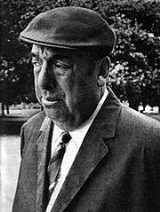
Pablo Neruda (July 12, 1904–September 23, 1973) was the pen name and, later, legal name of the Chile
Chile

Chile, officially the Republic of Chile , is a country in South America occupying a long and narrow coastal strip wedged between the Andes mountains and the Pacific Ocean....
an writer and politician Neftalí Ricardo Reyes Basoalto. Neruda assumed his pen name as a teenager, partly because it was in vogue, partly to hide his poetry from his father, a rigid man who wanted his son to have a "practical" occupation. Neruda's pen name was derived from Czech
Czech people

Czechs are a West Slavs people of Central Europe, living predominantly in the Czech Republic. Small populations of Czechs also live in Slovakia, Austria, United States, Brazil, Argentina, Canada, Germany, Russia and other countries....
 writer and poet Jan Neruda
Jan Neruda

Jan Nepomuk Neruda was a Czechs journalist, writer and poet, one of the most prominent representatives of Czech Realism and a member of "the May school"....
; Pablo is thought to be from Paul Verlaine
Paul Verlaine

Paul-Marie Verlaine was a French poet associated with the Symbolism movement. He is considered one of the greatest representatives of the fin de si?cle in international and French poetry....
.


Discussion
Ask a question about 'Pablo Neruda'
Start a new discussion about 'Pablo Neruda'
Answer questions from other users
Full Discussion Forum


Recent Posts


Quotations


Debajo de tu piel vive la luna.

The moon lives in the lining of your skin., "Ode to a Beautiful Nude" (Oda a la Bella Desnuda), from Nuevas Odas Elementales (1956), trans. Nathaniel Tarn in Selected Poems by Pablo Neruda Houghton Mifflin, 1990, ISBN 0-395-54418-1 (p. 349)


Encyclopedia


Pablo Neruda (July 12, 1904–September 23, 1973) was the pen name and, later, legal name of the Chile
Chile

Chile, officially the Republic of Chile , is a country in South America occupying a long and narrow coastal strip wedged between the Andes mountains and the Pacific Ocean....
an writer and politician Neftalí Ricardo Reyes Basoalto. Neruda assumed his pen name as a teenager, partly because it was in vogue, partly to hide his poetry from his father, a rigid man who wanted his son to have a "practical" occupation. Neruda's pen name was derived from Czech
Czech people

Czechs are a West Slavs people of Central Europe, living predominantly in the Czech Republic. Small populations of Czechs also live in Slovakia, Austria, United States, Brazil, Argentina, Canada, Germany, Russia and other countries....
 writer and poet Jan Neruda
Jan Neruda

Jan Nepomuk Neruda was a Czechs journalist, writer and poet, one of the most prominent representatives of Czech Realism and a member of "the May school"....
; Pablo is thought to be from Paul Verlaine
Paul Verlaine

Paul-Marie Verlaine was a French poet associated with the Symbolism movement. He is considered one of the greatest representatives of the fin de si?cle in international and French poetry....
. With his works translated into many languages, Pablo Neruda is considered one of the greatest and most influential poets of the 20th century.

Neruda was accomplished in a variety of styles ranging from erotically charged love poems like his collection Twenty Poems of Love and a Song of Despair, surrealist
Surrealism

Surrealism is a cultural movement that began in the early-1920s, and is best known for the visual artworks and writings of the group members....
 poems, historical epics, and overtly political manifestos. In 1971 Neruda won the Nobel Prize for Literature, a controversial award because of his political activism
Activism

Activism, in a general sense, can be described as intentional action to bring about social change or politics change. This action is in support of, or opposition to, one side of an often controversy argument....
. Colombian
Colombian people

Colombian people are from a multiethnic nation in South American called Colombia. Colombians are predominantly Roman Catholic Church and overwhelmingly speakers of Spanish language, and that a majority of them are the result of the a mixture of Europeans, Africans, Amerindians....
 novelist Gabriel García Márquez
Gabriel García Márquez

Gabriel Jos? de la Concordia Garc?a M?rquez is a Colombian novelist, short-story writer, screenwriter and journalist. Garc?a M?rquez, familiarly known as "Gabo" in his native country, is considered one of the most significant authors of the 20th century....
 once called him "the greatest poet of the 20th century in any language".

On July 15, 1945, at Pacaembu Stadium in São Paulo
São Paulo

S?o Paulo is the largest city in Brazil, and along with Tokyo, Seoul and Mexico City is among the four largest metropolitan regions of the world....
, Brazil
Brazil

Brazil , officially the Federative Republic of Brazil , is a country in South America. It is the List of countries and outlying territories by total area country by geographical area, occupying nearly half of South America, the List of countries by population country, and the fourth most populous democracy in the world....
, he read to 100,000 people in honor of Communist revolutionary leader Luís Carlos Prestes
Luís Carlos Prestes

Lu?s Carlos Prestes was a leader of the 1920s Tenente revolts and the communism opposition to the dictatorship of Get?lio Vargas in Brazil.Known as the "knight of hope," - title of the biography of him written by Jorge Amado - Prestes was involved in organizing the failed tenente rebellion of 1922, a revolt by the largely middle class...
. When Neruda returned to Chile after his Nobel Prize acceptance speech, Salvador Allende
Salvador Allende

Salvador Isabelino Allende Gossens was President of Chile of Chile from November 1970 until his death during the 1973 Chilean coup d'?tat.Allende's involvement in Chilean political life spanned a period of nearly forty years....
 invited him to read at the Estadio Nacional
Estadio Nacional de Chile

The Estadio Nacional Julio Mart?nez Pr?danos is the national stadium of Chile. It is located in ?u?oa, Santiago, Chile. It is the largest stadium in Chile with an official capacity of almost 67,000, and is part of a large sporting complex which also features tennis courts, swimming pools, and a modern gymnasium....
 before 70,000 people.

During his lifetime, Neruda occupied many diplomatic posts and served a stint as a senator for the Chilean Communist Party. When Conservative Chilean President González Videla
Gabriel González Videla

Gabriel Gonz?lez Videla was a Chilean politician. He was a deputy and senator in the Chilean Congress and was List of Presidents of Chile of Chile from 1946 to 1952....
 outlawed communism in Chile, a warrant was issued for Neruda's arrest. Friends hid him for months in a house basement in the Chilean port of Valparaíso
Valparaíso

Valpara?so is a major city in Chile and one of that country's most important seaports and an increasingly vital cultural center in the hemisphere's Pacific Southwest....
. Later, Neruda escaped into exile through a mountain pass near Maihue Lake
Maihue Lake

The Maihue Lake is a lake located east of Ranco Lake in the Andes of southern Chile . The lake is of glacier origin and it is enclosed by mountain ranges of the Andes, by all sides, and drains west to Ranco Lake....
 into Argentina. Years later, Neruda was a close collaborator to socialist
Socialism

Socialism refers to a broad set of economic theories of social organization advocating public or state ownership and administration of the means of production and distribution of goods, and a society characterized by equality for all individuals, with a fair or Egalitarianism method of compensation....
 President Salvador Allende
Salvador Allende

Salvador Isabelino Allende Gossens was President of Chile of Chile from November 1970 until his death during the 1973 Chilean coup d'?tat.Allende's involvement in Chilean political life spanned a period of nearly forty years....
.

Neruda was hospitalized with cancer at the time of the Chilean coup d'état led by Augusto Pinochet. Twelve days after being hospitalized, Neruda died of heart failure. Already a legend in life, Neruda's death reverberated around the world. Pinochet had denied permission to transform Neruda's funeral into a public event. However, thousands of grieving Chileans disobeyed the curfew and crowded the streets.ref>"Pablo Neruda, The Poet's Calling" . Neruda's funeral became the first public protest against the Chilean military dictatorship.

Early years

Ricardo Eliezer Neftalí Reyes y Basoalto was born in Parral
Parral, Chile

The municipality of Parral was founded in 1795 by the Viceroy of Peru, Ambrosio O'Higgins. It was originally named "Villa Maria Luisa of Parma del Parral", in honor of the wife of the King of Spain, Carlos IV....
, a city in Linares Province
Linares Province

Linares is a Chilean province located in the southeastern part of Maule Region . The provincial capital and most populous center is the city of Linares, Chile....
 in the Maule Region
Maule Region

The VII Maule Region is one of Chile's 15 first order administrative divisions. Its Capital is Talca. The region takes its name from the Maule River, which running westward from the Andes, bisects the region and spans a Drainage basin of about 20,600 km?....
, some 400 km south of Santiago
Santiago, Chile

Santiago , is the Capital and largest city of Chile, and the center of its largest conurbation . It is located in the country's central valley, at an elevation of 520 m Above mean sea level....
. His father, José del Carmen Reyes Morales, was a railway employee; his mother, Rosa Basoalto, was a school teacher who died two months after he was born. Neruda and his father soon moved to Temuco
Temuco

Temuco is the capital of the Araucan?a Region, Chile. The name comes from the Mapudungun language, meaning "temu water"; "Blepharocalyx cruckshankii" is a tree used by Mapuches for medicinal purposes....
, where his father married Trinidad Candia Marverde, a woman with whom he had had a child nine years earlier, a boy named Rodolfo. Neruda also grew up with his half-sister Laura, one of his father's children by another woman.

The young Neruda was christened "Neftalí", his late mother's middle name. His father was opposed to Neruda's interest in writing and literature, but Neruda received encouragement from others, including future Nobel Prize winner Gabriela Mistral
Gabriela Mistral

Gabriela Mistral was the pseudonym of Lucila de Mar?a del Perpetuo Socorro Godoy Alcayaga, a Chilean Poetry, educator, diplomat, and Feminism who was the first Latin American to win the Nobel Prize in Literature, in 1945....
, who headed the local girls' school. His first published work was an essay he wrote for the local daily newspaper, La Mañana, at the age of thirteen: Entusiasmo y perseverancia ("Enthusiasm and Perseverance"). By 1920, when he adopted the pseudonym of Pablo Neruda, he was a published author of poetry, prose, and journalism.

Veinte poemas

In the following year (1921), he moved to Santiago
Santiago, Chile

Santiago , is the Capital and largest city of Chile, and the center of its largest conurbation . It is located in the country's central valley, at an elevation of 520 m Above mean sea level....
 to study French
French language

French is a Romance language spoken around the world by around 80 million people as first language, by 190 million as second language, and by about another 200 million people as an acquired tongue, with significant speakers in 54 countries....
 at the Universidad de Chile with the intention of becoming a teacher, but soon Neruda was devoting himself full time to poetry. In 1923 his first volume of verse, Crepusculario ("Book of Twilights"), was published, followed the next year by Veinte poemas de amor y una canción desesperada ("Twenty Love Poems and a Desperate Song"), a collection of love poems that was controversial for its eroticism, especially considering its author's young age. Both works were critically acclaimed and were translated into many languages. Over the decades, Veinte poemas would sell millions of copies and become Neruda's best-known work.

Neruda's reputation was growing both inside and outside of Chile
Chile

Chile, officially the Republic of Chile , is a country in South America occupying a long and narrow coastal strip wedged between the Andes mountains and the Pacific Ocean....
, but he was plagued by poverty. In 1927, out of desperation, he took an honorary consulship in Rangoon
Yangon

Yangon is the largest city and a former capital of Burma. It is the capital of Yangon Division. Although the State Peace and Development Council has officially relocated the capital to Naypyidaw since March 2006, Yangon, with a population of four million, continues to be the country's largest city and the most important commercial center....
, then a part of colonial Burma
Myanmar

Burma, officially the Union of Myanmar, is the largest country by geographical area in mainland Southeast Asia, or Indochina. The country is bordered by the People's Republic of China on the northeast, Laos on the east, Thailand on the southeast, Bangladesh on the west, India on the northwest, and the Bay of Bengal to the southwest with...
 and a place of which he had never heard before. Later, he worked stints in Colombo
Colombo

Colombo is the largest city and former administrative capital of Sri Lanka. It is located on the west coast of the island and adjacent to Sri Jayawardenepura Kotte, the present administrative capital of Sri Lanka....
 (Ceylon), Batavia
Jakarta

Jakarta is the Capital and largest city of Indonesia. It also has a List of urban areas by population than any other city in Southeast Asia. It was formerly known as Sunda Kelapa , Jayakarta , Batavia, Dutch East Indies , and Djakarta ....
 (Java), and Singapore
Singapore

Singapore , officially the Republic of Singapore, is an island country microstate located at the southern tip of the Malay Peninsula. It lies 137 kilometres north of the equator, south of the Malaysian state of Johor and north of Indonesia's Riau Islands....
. In Java he met and married his first wife, a tall Dutch bank employee named Maryka Antonieta Hagenaar Vogelzang. While on diplomatic service, Neruda read large amounts of poetry and experimented with many different poetic forms. He wrote the first two volumes of Residencia en la tierra, which included many surrealistic
Surrealism

Surrealism is a cultural movement that began in the early-1920s, and is best known for the visual artworks and writings of the group members....
 poems.

Spanish Civil War

After returning to Chile, Neruda was given diplomatic posts in Buenos Aires
Buenos Aires

Buenos Aires is the Capital and largest city of Argentina. It is located on the southern shore of the R?o de la Plata, on the southeastern coast of the South American continent....
 and then Barcelona
Barcelona

Barcelona is the capital and most populous city of the Autonomous communities of Spain of Catalonia and the second largest city in Spain, with a population of 1,615,908 in 2008, while the population of the Metropolitan Area was 3,161,081....
, Spain
Spain

Spain or the Kingdom of Spain , is a country located in Southern Europe on the Iberian Peninsula.The Spanish constitution does not establish any official denomination of the country, even though Espa?a , Estado espa?ol and Naci?n espa?ola are used interchangeably....
. He later replaced Gabriela Mistral as consul in Madrid
Madrid

Madrid is the Capital and largest city of Spain. It is the Largest cities of the European Union by population within city limits in the European Union after Greater London and Berlin, and its Madrid metropolitan area is the Largest urban areas of the European Union in the European Union after Paris aire urbaine, Greater London Urban Area, a...
, where he became the center of a lively literary circle, befriending such writers as Rafael Alberti
Rafael Alberti

Rafael Alberti Merello was a Mexican poet, a member of the Generation of '27.Alberti published his first books of poetry towards the end of the 1920s: Marinero en tierra , La Amante and El alba del alhel? ....
, Federico García Lorca
Federico García Lorca

Federico Garc?a Lorca was a Spain poet, dramatist and theatre director. An emblematic member of the Generation of '27, he was abducted and murdered by persons likely affiliated with the Nationalist cause at the beginning of the Spanish Civil War....
, and the Peru
Peru

Peru , officially the Republic of Peru , is a country in western South America. It is bordered on the north by Ecuador and Colombia, on the east by Brazil, on the southeast by Bolivia, on the south by Chile, and on the west by the Pacific Ocean....
vian poet César Vallejo
César Vallejo

C?sar Abraham Vallejo Mendoza was a Peruvian poet. Although he published only three books of poetry during his lifetime, he is considered one of the great poetic innovators of the 20th century....
. A daughter, Malva Marina Trinidad, was born in Madrid in 1934; she was to be plagued with health problems, especially hydrocephalus
Hydrocephalus

Hydrocephalus is a term derived from the Greek words "hydro" meaning water, and "cephalus" meaning head, and this condition is sometimes known as "water on the brain"....
, for the whole of her short life. During this period, Neruda became slowly estranged from his wife and took up with Delia del Carril, an Argentine
Argentina

Argentina, officially the Argentine Republic , is a country in South America, constituted as a federation of 23 provinces and an autonomous city....
 woman who was twenty years his senior and who would eventually become his second wife. He divorced from his Dutch wife in 1936, who moved to the Netherlands with his only child; this child died in 1943.

As Spain became engulfed in civil war, Neruda became intensely politicized for the first time. His experiences of the Spanish Civil War and its aftermath moved him away from distinctive, privately focused labor in the direction of collective obligation and better cohesion. Neruda became an ardent communist, and remained so for the rest of his life. The radical leftist politics of his literary friends, as well as that of del Carril, were contributing factors, but the most important catalyst was the execution of García Lorca by forces loyal to Francisco Franco
Francisco Franco

Francisco Paulino Hermenegildo Te?dulo Franco y Bahamonde, Salgado y Pardo de Andrade , commonly known as Francisco Franco or Francisco Franco y Bahamonde was the dictator and Head of State of Spain from October 1936, and de facto regent of the nominally restored Kingdom of Spain from 1947 until his death in 1975....
. By means of his speeches and writings, Neruda threw his support behind the Republican side, publishing a collection of poetry called España en el corazón ("Spain in My Heart"). Neruda’s wife and child moved to Monte Carlo
Monte Carlo

Monte Carlo is one of Monaco's various administrative areas, sometimes erroneously believed to be a town or the country's capital. The official capital is Monaco-Ville and covers all quarters of the territory....
; he was never to see either of them again. After leaving his wife, he took up full time with del Carril in France
France

France , officially the French Republic , is a country whose Metropolitan France is located in Western Europe and that also comprises various Overseas departments and territories of France....
.

Following the election in 1938 of President Pedro Aguirre Cerda
Pedro Aguirre Cerda

Pedro Abelino Aguirre Cerda was a Chilean political figure. A member of the Radical Party , he was chosen as the Popular Front 's candidate for the Chilean presidential election, 1938, and was triumphally elected....
, whom Neruda supported, he was appointed special consul for Spanish emigration in Paris
Paris

Paris is the Capital of France and the country's largest city. It is situated on the river Seine, in northern France, at the heart of the ?le-de-France Regions of France ....
. There Neruda was given responsibility for what he called "the noblest mission I have ever undertaken": shipping 2,000 Spanish refugees, who had been housed by the French in squalid camps
Concentration camps in France

There have been internment camps and concentration camps in France before, during and after World War II. Beside the camps created during World War I to intern German, Austrian and Ottoman civilian prisoners, the French Third Republic opened various internment camps for the Spanish political refugees fleeing the Spanish Civil War ....
, to Chile on an old boat called the Winnipeg
Winnipeg (ship)

The Winnipeg is the name of a ship which arrived at Valpara?so, Chile, on 3 September, 1939, with 2,200 Spanish people immigrants fleeing Francisco Franco's victory in the Spanish Civil War ....
. Neruda is sometimes charged with only selecting Communists for emigration while excluding others who had fought on the side of the Republic ; others deny these accusations, pointing out that Neruda chose only a few hundred of the refugees personally; the rest were selected by the Service for the Evacuation of Spanish Refugees, set up by Juan Negrín
Juan Negrín

Juan Negr?n y L?pez was a Spain politician and physician.Born in Las Palmas de Gran Canaria, he became a university professor of physiology....
, president of the Spanish Republican government-in-exile.

Mexico

Neruda's next diplomatic post was as Consul General in Mexico City
Mexico City

Mexico City is the capital city of Mexico. It is the most important economic, industrial, and cultural center in the country; the most populous city with over 8,836,045 inhabitants in 2008....
, where he spent the years 1940 to 1943. While in Mexico, he divorced Hagenaar, married del Carril, and learned that his daughter had died, age eight, in Nazi-occupied Netherlands
Netherlands

The Netherlands is a country that is part of the Kingdom of the Netherlands. It is a parliamentary democratic constitutional monarchy. The Netherlands is located in North-West Europe, and bordered by the North Sea to the north and west, Belgium to the south, and Germany to the east....
 from various health problems. He also became a friend of the Stalinist assassin Vittorio Vidali
Vittorio Vidali

Vittorio Vidali , also known as Vittorio Vidale, Enea Sormenti, Jacobo Hurwitz Zender, Carlos Contreras, "Comandante Carlos") was an Italy-born Communist fighter....
 .

After the failed 1940 assassination attempt against Leon Trotsky
Leon Trotsky

Leon Trotsky , born Lev Davidovich Bronstein , was a Bolshevik revolutionary and Marxism theorist. He was one of the leaders of the Russian October Revolution, second only to Lenin....
, Neruda arranged a Chilean visa for the Mexican painter David Alfaro Siqueiros
David Alfaro Siqueiros

Jos? David Alfaro Siqueiros was a social realist List of painters , and also a Stalinism, known for large murals in fresco that established the Mexican Muralism together with work by Diego Rivera, Jos? Clemente Orozco, and others....
 who was accused of having been one of the conspirators. Neruda later said he did it at the request of Mexican President Manuel Ávila Camacho
Manuel Ávila Camacho

Manuel ?vila Camacho served as the President of Mexico of Mexico from 1940 to 1946.Manuel ?vila was born in the city of Teziutl?n, a small town in Puebla , to middle-class parents, Manuel ?vila Castillo and Eufrosina Camacho Bello....
. This enabled Siqueiros, then jailed, to leave Mexico for Chile, where he stayed at Neruda's private residence. In exchange for Neruda's assistance, Siqueiros spent over a year painting a mural in a school in Chillán
Chillán

Chill?n is a city in the B?o-B?o Region of Chile located about 400 km south of the capital, Santiago de Chile, near the geographical center of the country....
. Neruda's relationship with Siqueiros attracted criticism and Neruda dismissed the allegations that his intent had been to help an assassin as "sensationalist politico-literary harassment". In Mexico, Pablo Neruda met the famous Mexican writer Octavio Paz
Octavio Paz

Octavio Paz Lozano was a Mexican writer, poet, and diplomacy, and the winner of the 1990 Nobel Prize for Literature....
 where he nearly came to blows in 1942.

Return to Chile

In 1943, following his return to Chile, Neruda made a tour of Peru
Peru

Peru , officially the Republic of Peru , is a country in western South America. It is bordered on the north by Ecuador and Colombia, on the east by Brazil, on the southeast by Bolivia, on the south by Chile, and on the west by the Pacific Ocean....
, where he visited Machu Picchu
Machu Picchu

Machu Picchu is a pre-Columbian Inca Empire site located above sea level. It is situated on a mountain ridge above the Urubamba Valley in Peru, which is northwest of Cuzco and through which the Urubamba River flows....
. The austere beauty of the Inca
Inca

The Inca civilization began as a tribe in the Cuzco area, where the legendary first Sapa Inca, Manco Capac founded the Kingdom of Cuzco around 1200....
 citadel later inspired Alturas de Macchu Picchu, a book-length poem in twelve parts which he completed in 1945 and which marked a growing awareness and interest in the ancient civilizations of the Americas: themes he was to explore further in Canto General
Canto General

Canto General is Pablo Neruda tenth book of poems. It was first published in Mexico in 1950, by Talleres Gr?ficos de la Naci?n. Neruda began to compose it in 1938....
. In this work, Neruda celebrated the achievement of Machu Picchu, but also condemned the slavery which had made it possible. In the Canto XII, he called upon the dead of many centuries to be born again and to speak through him. Martin Espada
Martín Espada

Mart?n Espada is a poet and professor at the University of Massachusetts Amherst, Massachusetts, where he teaches creative writing and Latino poetry....
, poet and professor of creative writing at the University of Massachusetts
University of Massachusetts

The University of Massachusetts is the five-campus public university system of the Massachusetts.The system includes University of Massachusetts Amherst, University of Massachusetts Boston, University of Massachusetts Dartmouth , University of Massachusetts Lowell, and the University of Massachusetts Medical School....
, has hailed the work as a masterpiece, declaring that "there is no greater political poem".

Neruda and Stalinism

Bolstered by his experiences in the Spanish Civil War, Neruda, like many left-leaning intellectuals of his generation, came to admire the Soviet Union
Soviet Union

The Union of Soviet Socialist Republics was a Constitution of the Soviet Union socialist state that existed in Eurasia from 1922 to 1991.The name is a translation of the , romanization of Russian Soyuz Sovetskikh Sotsialisticheskikh Respublik, abbreviated ????, SSSR....
 of Joseph Stalin
Joseph Stalin

Joseph Stalin was the General Secretary of the Communist Party of the Soviet Union's Central Committee of the Communist Party of the Soviet Union from 1922 until his death in 1953....
, partly for the role it played in defeating Nazi Germany
Nazi Germany

Nazi Germany and the Third Reich are the colloquial English names for Germany under the regime of Adolf Hitler and the Nazi Party , which established a Totalitarianism dictatorship that existed from 1933 to 1945....
 (poems Canto a Stalingrado (1942) and Nuevo canto de amor a Stalingrado (1943)). In 1953 Neruda was awarded the Stalin Peace Prize. On Stalin's death that same year, Neruda wrote an ode to him, as he also (during World War II
World War II

World War II, or the Second World War , was a global military conflict which involved a Participants in World War II, including all of the great powers, organised into two opposing military alliances: the Allies of World War II and the Axis powers....
) wrote praise of Fulgencio Batista
Fulgencio Batista

Fulgencio Batista y Zald?var was a Cuban military officer, dictator and politician.Batista was the military leader of Cuba from 1933 to 1940 and President of Cuba from 1940 to 1944....
 (Saludo a Batista, i.e Salute to Batista) and later of Fidel Castro
Fidel Castro

Fidel Alejandro Castro Ruz is a Cuban revolutionary leader who was prime minister of Cuba from February 1959 to December 1976 and then president, premier until his resignation from the office in February 2008....
 .

His fervent Stalinism eventually drove a wedge between Neruda and longtime friend Octavio Paz
Octavio Paz

Octavio Paz Lozano was a Mexican writer, poet, and diplomacy, and the winner of the 1990 Nobel Prize for Literature....
 who commented that "Neruda became more and more Stalinist, while I became less and less enchanted with Stalin". Their differences came to a head after the 1939 Nazi-Soviet Ribbentrop-Molotov Pact when they almost came to blows in an argument over Stalin. Although Paz still considered Neruda "the greatest poet of his generation", in an essay on Aleksandr Solzhenitsyn
Aleksandr Solzhenitsyn

Aleksandr Isayevich Solzhenitsyn was a Russians novelist, dramatist and historian. Through his writings, he made the world aware of the Gulag, the Soviet Union's forced labour camp system, and for these efforts Solzhenitsyn was exiled from the Soviet Union in 1974....
 he wrote that when he
thinks of … Neruda and other famous Stalinist writers I feel the gooseflesh that I get from reading certain passages of Dante’s Inferno. No doubt they began in good faith, but insensibly, commitment by commitment, they saw themselves becoming entangled in a mesh of lies, falsehoods, deceits and perjuries, until they lost their souls.


Neruda called Lenin the "great genius of this century". Another speech (June 5, 1946) is a tribute to the late Soviet leader Mikhail Kalinin
Mikhail Kalinin

Mikhail Ivanovich Kalinin was a Bolshevik revolutionary and the titular head of state of the Soviet Union from 1919 to 1946. Though only four years older than Joseph Stalin, Kalinin was celebrated as Dedushka by the Young Pioneers....
, who for Neruda was "man of noble life", "the great constructor of the future", "a comrade of arms of Lenin and Stalin".

Neruda later came to rue his support of the Soviet leader; after Nikita Khrushchev
Nikita Khrushchev

Nikita Sergeyevich Khrushchev served as General Secretary of the Communist Party of the Soviet Union of the Communist Party of the Soviet Union from 1953 to 1964, following the death of Joseph Stalin, and Premier of the Soviet Union from 1958 to 1964....
's famous Secret Speech 20th Party Congress in 1956, in which he denounced the "cult of personality
Cult of personality

A cult of personality or personality cult arises when a country's leader uses mass media to create a heroic public image through unquestioning flattery and praise....
" that surrounded Stalin and accused him of committing crimes during the Great Purges, Neruda wrote in his memoirs "I had contributed to my share to the personality cult," explaining that "in those days, Stalin seemed to us the conqueror who had crushed Hitler's armies". Of a subsequent visit to China
China

China is a Culture of China, an ancient civilization, and, depending on perspective, a national or multinational entity extending over a large area in East Asia....
 in 1957, Neruda would later write: "What has estranged me from the Chinese revolutionary process has not been Mao Tse-tung
Mao Zedong

Mao Zedong was a China military and politics dictator. Mao led the Communist Party of China to victory against the Kuomintang in the Chinese Civil War, and was the leader of the People?s Republic of China from its establishment in 1949 until his death in 1976....
 but Mao Tse-tungism", which he dubbed Mao Tse-Stalinism: "the repetition of a cult of a Socialist deity". However, despite his disillusionment with Stalin, Neruda never lost his essential faith in communism and remained loyal to "the Party". Anxious not to give ammunition to his ideological enemies, he would later refuse publicly to condemn the Soviet repression of dissident
Dissident

A dissident, broadly defined, is a person who actively challenges an established doctrine, policy, or institution. When individual dissidents unite in a common cause they may become known as a dissident Political movement....
 writers like Boris Pasternak
Boris Pasternak

Boris Leonidovich Pasternak was a Nobel Prize-winning Russian poet and writer. In the West he is best known for his epic novel Doctor Zhivago , a tragedy whose events span the last period of Tsarist Russia and the early days of the Soviet Union....
 and Joseph Brodsky
Joseph Brodsky

Iosif Aleksandrovich Brodsky was a Russian poet, essayist, and Nobel Prize in Literature. He was appointed Poet Laureate Consultant in Poetry to the Library of Congress in 1991....
: an attitude with which even some of his staunchest admirers disagreed.

Senator

On March 4, 1945 Neruda was elected a Communist party senator
Senate of Chile

The Senate of the Republic of Chile is the upper house of Chile's Bicameralism National Congress of Chile, as established in the current Constitution of Chile....
 for the northern provinces of Antofagasta
Antofagasta Region

The II Antofagasta Region is one of Chile's 15 first order administrative divisions. Its capital is the port city of Antofagasta. It comprises three provinces, Antofagasta Province, El Loa and Tocopilla, It is bordered to the north by Tarapac? Region and by Atacama Region to the south....
 and Tarapacá
Tarapacá Region

The I Tarapac? Region is one of Chile's 15 first order administrative divisions. It borders the Chilean Arica-Parinacota Region to the north, Bolivia's Oruro Department on the east, the Antofagasta Region on the south and the Pacific Ocean on the west....
 in the arid and inhospitable Atacama Desert
Atacama Desert

The Atacama Desert is a virtually rainless plateau in South America, covering a 966 km strip of land on the Pacific Ocean coast of South America, west of the Andes mountains....
. He officially joined the Communist Party of Chile
Communist Party of Chile

The Communist Party of Chile is a Chilean political party that advocates communism. It was founded in 1922, as the continuation of the Socialist Workers Party ....
 four months later.

In 1946, Radical Party presidential candidate Gabriel González Videla
Gabriel González Videla

Gabriel Gonz?lez Videla was a Chilean politician. He was a deputy and senator in the Chilean Congress and was List of Presidents of Chile of Chile from 1946 to 1952....
 asked Neruda to act as his campaign manager. González Videla was supported by a coalition of left-wing parties and Neruda fervently campaigned on his behalf. Once in office, however, González Videla turned against the Communist Party. The breaking point for Senator Neruda was the violent repression of a Communist-led miners' strike in Lota
Lota, Chile

Lota is a city located in the center of the Chile on the Gulf of Arauco. The first Spanish settlement, Santa Maria de Guadalupe was founded by the governor ?ngel de Peredo on October 12, 1662 but it did not survive long in the hostilities of the Arauco War....
 in October 1947, where striking workers were herded into island military prisons and a concentration camp in the town of Pisagua
Pisagua

Pisagua is a Chilean port on the Pacific Ocean, located in Huara comuna , in Iquique Region, northern Chile. In 2007, the new province of El Tamarugal was established and the comuna of Huara, previously within the province of Iquique, was incorporated to the newly created province....
. Neruda's criticism of González Videla culminated in a dramatic speech in the Chilean senate on 6 January, 1948 called Yo acuso ("I accuse"), in the course of which he read out the names of the miners and their families who were imprisoned at the concentration camp.

Exile

A few weeks later, Neruda went into hiding and he and his wife were smuggled from house to house, hidden by supporters and admirers for the next thirteen months. While in hiding, Senator Neruda was removed from office and in September 1948 the Communist Party was banned altogether under the Ley de Defensa Permanente de la Democracia (Law for the Permanent Defense of Democracy), called by critics the Ley Maldita ("Accursed Law"), which eliminated over 26,000 people from the electoral registers, thus stripping them of their right to vote. Neruda moved later to Valdivia
Valdivia, Chile

Valdivia is a city and commune in southern Chile administered by the Municipality of Valdivia. The city is named after its founder Pedro de Valdivia and is located at the confluence of the Calle-Calle River, Valdivia River and Cau-Cau River Rivers, approximately 15 km east of the coastal towns of Corral, Chile and Niebla, Chile....
 in southern Chile. Neruda's life underground ended in March 1949 when he fled over the Lilpela Pass
Lilpela Pass

Lilpela or Ipela is a mountain pass through the Andes along the border between Chile and Argentina. Is is most notable for being the pass used by Pablo Neruda to flee from Chile in 1949....
 on the Andes Mountains to Argentina
Argentina

Argentina, officially the Argentine Republic , is a country in South America, constituted as a federation of 23 provinces and an autonomous city....
 on horseback. He would dramatically recount his escape from Chile in his Nobel Prize lecture.

Once out of Chile, he spent the next three years in exile. In Buenos Aires
Buenos Aires

Buenos Aires is the Capital and largest city of Argentina. It is located on the southern shore of the R?o de la Plata, on the southeastern coast of the South American continent....
 a friend of Neruda, the future Nobel winner and novelist Miguel Ángel Asturias
Miguel Ángel Asturias

Miguel ?ngel Asturias Rosales was a Nobel Prize?winning Guatemalan poet, novelist, and diplomat. Asturias helped establish Latin American literature's contribution to mainstream Western culture, and at the same time drew attention to the importance of indigenous cultures, especially those of his native Guatemala....
, was cultural attaché to the Guatemalan embassy. There was some slight resemblance between the two men, so Neruda went to Europe using Asturias's passport. Pablo Picasso
Pablo Picasso

Pablo Diego Jos? Francisco de Paula Juan Nepomuceno Mar?a de los Remedios Cipriano de la Sant?sima Trinidad Ruiz y Picasso was a Spanish people Painting, drawing, and Sculpture....
 arranged his entrance into Paris
Paris

Paris is the Capital of France and the country's largest city. It is situated on the river Seine, in northern France, at the heart of the ?le-de-France Regions of France ....
 and Neruda made a surprise appearance there to a stunned World Congress of Peace Forces, the Chilean government meanwhile denying that the poet could have escaped the country.

Neruda spent those three years traveling extensively throughout Europe
Europe

Europe is, conventionally, one of the world's seven continents. Comprising the westernmost peninsula of Eurasia, Europe is generally divided from Asia to its east by the water divide of the Ural Mountains, the Ural , the Caspian Sea, and by the Caucasus Mountains to the southeast....
 as well as taking trips to India
India

India, officially the Republic of India , is a country in South Asia. It is the List of countries and outlying territories by total area country by geographical area, the List of countries by population country, and the most populous liberal democracy in the world....
, China
China

China is a Culture of China, an ancient civilization, and, depending on perspective, a national or multinational entity extending over a large area in East Asia....
,Sri Lanka
Sri Lanka

Sri Lanka, officially the Democratic Socialist Republic of Sri Lanka is an island country in South Asia, located about off the southern coast of India....
 and the Soviet Union
Soviet Union

The Union of Soviet Socialist Republics was a Constitution of the Soviet Union socialist state that existed in Eurasia from 1922 to 1991.The name is a translation of the , romanization of Russian Soyuz Sovetskikh Sotsialisticheskikh Respublik, abbreviated ????, SSSR....
. His trip to Mexico
Mexico

The United Mexican States , commonly known as Mexico , is a federalism constitutionalism republic in North America. It is bordered on the north by the United States; on the south and west by the Pacific Ocean; on the southeast by Guatemala, Belize, and the Caribbean Sea; and on the east by the Gulf of Mexico....
 in late 1949 was lengthened due to a serious bout of phlebitis
Phlebitis

Phlebitis Phlebitis is an inflammation of a vein, usually in the legs.When phlebitis is associated with the formation of blood clots , usually in the deep veins of the legs, the condition is called thrombophlebitis....
. A Chilean singer named Matilde Urrutia
Matilde Urrutia

Matilde Urrutia was the third wife of Chilean poet Pablo Neruda, from 1966 until his death in 1973. They met in Santiago de Chile in 1946. Urrutia was the inspiration behind Neruda's work 100 Love Sonnets which includes a beautiful dedication to her....
 was hired to care for him and they began an affair that would, years later, culminate in marriage. During his exile,Urrutia would travel from country to country shadowing him and they would arrange meetings whenever they could. Matilde Urrutia was the muse for "Los versos del Capitán", which he later published anonymously in 1952.

While in Mexico Neruda also published his lengthy epic poem Canto General
Canto General

Canto General is Pablo Neruda tenth book of poems. It was first published in Mexico in 1950, by Talleres Gr?ficos de la Naci?n. Neruda began to compose it in 1938....
, a Whitmanesque
Walt Whitman

Walter Whitman was an United States Poetry of the United States, essayist, journalism, and humanism. He was a part of the transition between Transcendentalism and literary realism, incorporating both views in his works....
 catalog of the history, geography, and flora and fauna of South America
South America

South America is the southern continent of the Americas, situated entirely in the Western Hemisphere and mostly in the Southern Hemisphere, with a relatively small portion in the Northern Hemisphere....
, accompanied by Neruda's observations and experiences. Many of them dealt with his time underground in Chile, which is when he composed much of the poem. In fact, he had carried the manuscript with him on his escape on horseback. A month later, a different edition of five thousand copies was boldly published in Chile by the outlawed Communist Party based on a manuscript Neruda had left behind. In Mexico, he was granted honorary Mexican citizenship.

His 1952 stay in a villa owned by Italian
Italy

Italy , officially the Italian Republic , is a country located on the Italian Peninsula in Southern Europe and on the two largest islands in the Mediterranean Sea, Sicily and Sardinia....
 historian Edwin Cerio
Edwin Cerio

Edwin Cerio was a prominent Italian writer, engineer, architect, historian, and botanist. He was born on the island of Capri to an English artist mother and a well-known local physician, Ignazio Cerio....
 on the island of Capri
Capri

Capri is an Italy island off the Sorrentine Peninsula, on the south side of the Gulf of Naples. It has been a resort since the time of the Roman Republic....
 was fictionalized in the popular film Il Postino
Il Postino

Il Postino is a 1994 Italian language film directed by Michael Radford.The film was originally released in the United States as The Postman, a straight translation of the Italian title....
 ("The Postman", 1994).

Return to Chile

By 1952, the González-Videla government was on its last legs, weakened by corruption scandals. The Chilean Socialist Party was in the process of nominating Salvador Allende
Salvador Allende

Salvador Isabelino Allende Gossens was President of Chile of Chile from November 1970 until his death during the 1973 Chilean coup d'?tat.Allende's involvement in Chilean political life spanned a period of nearly forty years....
 as its candidate for the September 1952 presidential elections and was keen to have the presence of Neruda—by now Chile's most prominent left-wing literary figure—to support the campaign.

Neruda returned in August of that year and rejoined Delia del Carril, who had traveled ahead of him some months earlier, but the marriage was crumbling. Del Carril eventually learned of his torrid affair with Matilde Urrutia and left him in 1955, moving back to Europe. Now united with Urrutia, Neruda would spend the rest of his life in Chile, many foreign trips notwithstanding and a stint as Allende's ambassador to France from 1970 to 1973.

By this time, Neruda enjoyed worldwide fame as a poet, and his books were being translated into virtually all the major languages of the world. He was also vocal on political issues, vigorously denouncing the U.S. during the Cuban missile crisis
Cuban Missile Crisis

File:EXCOMM meeting, , 29 October 1962.jpgFile:Jupiter IRBM.jpgThe Cuban Missile Crisis was a confrontation between the United States, the Soviet Union, and Cuba that occurred in the early 1960s during the Cold War....
 (later in the decade he would likewise repeatedly condemn the U.S. for the Vietnam War
Vietnam War

The Vietnam War, also known as the Second Indochina Wars, the Vietnam Conflict, or often in Vietnam the American War occurred in Vietnam, Laos and Cambodia from 1959 to April 30, 1975....
). But being one of the most prestigious and outspoken leftwing intellectuals alive also attracted opposition from ideological opponents. The Congress for Cultural Freedom, an anti-communist organization covertly established and funded by the U.S. Central Intelligence Agency
Central Intelligence Agency

The Central Intelligence Agency is a civilian intelligence agency of the Federal government of the United States. It is the successor of the Office of Strategic Services formed during World War II to coordinate espionage activities between the branches of the US military services....
, adopted Neruda as one of its primary targets and launched a campaign to undermine his reputation, reviving the old claim he had been an accomplice in the attack on Trotsky in Mexico City in 1940. The campaign became more intense when it became known that Neruda was a candidate for the 1964 Nobel prize, which was eventually awarded to Jean-Paul Sartre
Jean-Paul Sartre

Jean-Paul Charles Aymard Sartre , commonly known simply as Jean-Paul Sartre , was a French existentialism philosopher, playwright, novelist, screenwriter, political activist, biographer, and literary criticism....
.

In 1966, Neruda was invited to attend an International PEN
International PEN

International PEN, the worldwide association of writers, was founded in London in 1921 to promote friendship and intellectual co-operation among writers everywhere....
 conference in New York City. Officially, he was barred from entering the U.S. because he was a communist, but the conference organizer, playwright Arthur Miller
Arthur Miller

Arthur Miller was an United States playwright and essayist. He was a prominent figure in Theater in the United States and film for almost 100 years, writing a wide variety of dramas, including celebrated Play such as The Crucible, A View from the Bridge, All My Sons, and Death of a Salesman, which are studied and performed w...
, eventually prevailed upon the Johnson
Lyndon B. Johnson

Lyndon Baines Johnson , often referred to as LBJ, was the List of Presidents of the United States President of the United States and List of Vice Presidents of the United States Vice President of the United States ....
 Administration to grant Neruda a visa. Neruda gave readings to packed halls, and even recorded some poems for the Library of Congress
Library of Congress

The Library of Congress is the de facto national library of the United States and the research arm of the United States Congress. Located in three buildings in Washington, D.C., it is the largest library in the world by shelf space and holds the largest number of books....
. Miller later opined that Neruda's adherence to his communist ideals of the 1930s was a result of his protracted exclusion from "bourgeois society". Due to the presence of many East Bloc writers, Mexican writer Carlos Fuentes
Carlos Fuentes

Carlos Fuentes Mac?as is a Mexican writer and one of the best-known living novelists and essayists in the Spanish-speaking world. Fuentes has influenced contemporary Latin American literature, and his works have been widely translated into English and other languages....
 later wrote that the PEN conference marked a "beginning of the end" of the Cold War
Cold War

The Cold War was the continuing state of conflict, tension and competition that existed between a number of world powers, including the United States, the Soviet Union, People's Republic of China, France, United Kingdom and those countries' respective allies from the mid-1940s to the early 1990s....
.

Upon Neruda's return to Chile, he stopped off in Peru, where he gave readings to enthusiastic crowds in Lima and Arequipa
Arequipa

Arequipa is the capital of the Arequipa Region in southern Peru. With a population of 1,000,291 it is the List of 20 largest cities in Peru of the country....
 and was received by President Fernando Belaúnde Terry
Fernando Belaúnde Terry

Fernando Bela?nde Terry was President of Peru for two terms . Deposed by a military coup in 1968, he was re-elected in 1980 after twelve years of military rule....
. However, the visit prompted an unpleasant backlash. The Peruvian government had come out against the government in Cuba
Cuba

The Republic of Cuba is a country in the Caribbean. It consists of the island of Cuba , the island of Isla de la Juventud, and several adjacent small islands....
 of Fidel Castro
Fidel Castro

Fidel Alejandro Castro Ruz is a Cuban revolutionary leader who was prime minister of Cuba from February 1959 to December 1976 and then president, premier until his resignation from the office in February 2008....
, and in July 1966 retaliation against Neruda came in the form of a letter signed by more than one hundred Cuban intellectuals who charged Neruda with colluding with the enemy, and called him an example of the "tepid, pro-Yankee revisionism" then prevalent in Latin America. The affair was particularly painful for Neruda because of his previous outspoken support for the Cuban revolution, and he never visited the island again, even after an invitation in 1968.

After the death of Che Guevara
Che Guevara

Ernesto "Che" Guevara , commonly known as Che Guevara, El Che, or simply Che, was an Argentina Marxism revolutionary, politician, author, physician, military theorist, and guerrilla leader....
 in Bolivia
Bolivia

The Republic of Bolivia , named after Sim?n Bol?var, is a landlocked country in central South America. It is bordered by Brazil on the north and east, Paraguay and Argentina on the south, and Chile and Peru on the west....
 in 1967, Neruda wrote several articles regretting the loss of a "great hero". At the same time, he told his friend Aida Figueroa not to cry for Che, but for Luis Emilio Recabarren
Luis Emilio Recabarren

Luis Emilio Recabarren Serrano was a Chilean political figure. He was elected several times as Chamber of Deputies of Chile, and was the driving force behind the Worker's Movement in that country....
, the father of the Chilean communist movement, who preached a pacifist revolution over Che's violent ways.

Final years

In 1970, Neruda was nominated as a candidate for the Chilean presidency, but ended up giving his support to Salvador Allende
Salvador Allende

Salvador Isabelino Allende Gossens was President of Chile of Chile from November 1970 until his death during the 1973 Chilean coup d'?tat.Allende's involvement in Chilean political life spanned a period of nearly forty years....
, who later won the election and was inaugurated in 1970 as the first democratically elected socialist head of state. Shortly thereafter, Allende appointed Neruda the Chilean ambassador to France (lasting from 1970-1972; his final diplomatic posting). Neruda returned to Chile two and half years later due to failing health.

In 1971, having sought the prize for years, Neruda was finally awarded the Nobel Prize
Nobel Prize

The Nobel Prize , established in the 1895 will of Swedish chemist Alfred Nobel; it was first awarded in Nobel Prize in Physics, Nobel Prize in Chemistry, Nobel Prize in Physiology or Medicine, Nobel Prize in Literature, and Nobel Peace Prize in 1901....
. This decision did not come easily, as some of the committee members had not forgotten Neruda's past praise of Stalinist dictatorship. But his Swedish translator, Artur Lundkvist
Artur Lundkvist

Artur Lundkvist was a Sweden writer, poet and literary critic. He was a member of the Swedish Academy from 1968.He wrote around 80 books, and his works have been translated into some 30 languages....
, did his best to ensure the Chilean the prize. As the disturbances of 1973
Chilean coup of 1973

The Chilean coup d'?tat of 1973 is a landmark in the history of Chile and the Soviet-American Cold War. On 11 September 1973, the government of President Salvador Allende was overthrown by the military in a coup d??tat....
 unfolded, Neruda, then terminally ill with prostate cancer
Prostate cancer

Prostate cancer is a disease in which cancer develops in the prostate, a gland in the male reproductive system. It occurs when cell s of the prostate Mutation and begin to multiply out of control....
, was devastated by the mounting attacks on the Allende government. The military coup led by General Augusto Pinochet on 11 September saw Neruda's hopes for a marxist
Marxism

Marxism is the political philosophy and practice derived from the work of Karl Marx and Friedrich Engels. Marxism holds at its core a Marxist analysis of Critique of capitalism and a theory of social change....
 Chile destroyed. Shortly thereafter, during a search of the house and grounds at Isla Negra by Chilean armed forces at which he was present, Neruda famously remarked: Neruda died of heart failure on the evening of September 23, 1973, at Santiago's Santa María Clinic. The funeral took place amidst a massive police
Carabineros de Chile

Carabineros de Chile are the uniformed Chilean national police force and gendarmery, created on April 27, 1927. Their mission is to maintain order and create public respect for the laws of the country....
 presence, and mourners took advantage of the occasion to protest against the new regime, established just a couple of weeks before.

Matilde Urrutia subsequently compiled and edited for publication the memoirs that Neruda had been working on just days prior to his death including, possibly his final poem 'Right Comrade, It's the Hour of the Garden'. These and other activities brought her into conflict with Pinochet's government, which continually sought to curtail Neruda's influence on the Chilean collective consciousness. Urrutia's own memoir, My Life with Pablo Neruda, was published posthumously in 1986.

Neruda owned three houses in Chile; today they are all open to the public as museums: La Chascona in Santiago, La Sebastiana in Valparaíso
Valparaíso

Valpara?so is a major city in Chile and one of that country's most important seaports and an increasingly vital cultural center in the hemisphere's Pacific Southwest....
, and Casa de Isla Negra
Casa de Isla Negra

Casa de Isla Negra was one of Pablo Neruda's three houses in Chile. It is located at Isla Negra, El Quisco, San Antonio Province, Valpara?so Region about 85 km to the south of Valpara?so and 110 km to the west of Santiago....
 in Isla Negra
El Quisco

,El Quisco is a Chilean city and commune in San Antonio Province, Valpara?so Region. Located in the country's central coast, it serves as a popular summer resort for the population of Santiago, Chile....
, where he and Matilde Urrutia are buried.

Legacy


  • An edition of Neruda's On the Blue Shore of Silence was printed in honor of the poet's 100th birthday in 2004. The book featured translations of Neruda's original poems by Scottish poet Alastair Reid
    Alastair Reid

    Alastair Reid is a poet and a scholar of Spanish literature from Galloway in Scotland. He is known for his lighthearted style of poems and for his translations of South American poets Jorge Luis Borges and Pablo Neruda....
     and original paintings from artist Mary Heebner's
    Mary Heebner

    Mary Heebner is an artist known for paintings ? especially abstract landscape paintings ? artist books and paper making. Her work has been exhibited internationally, including in the San Francisco Museum of Modern Art, the National Gallery of Art, the Santa Barbara Museum of Art, the University of Chicago and the Getty Center....
     series Laguna Salada.
  • Neruda always wrote in green ink because it was the color of Esperanza (hope).
  • In The Simpsons
    The Simpsons

    The Simpsons is an Television in the United States animated cartoon Situation comedy created by Matt Groening for the Fox Broadcasting Company....
    , Pablo is referred to in the quote: (Lisa: Hmm. Pablo Neruda said "Laughter is the language of the soul." Bart: I am familiar with the works of Pablo Neruda)
  • Neruda was good friends with Venezuelan intellectuals and diplomats, such as Arturo Uslar Pietri
    Arturo Uslar Pietri

    Arturo Uslar Pietri was one of the most prominent Venezuelan figures of the twentieth century. He was a writer and an intellectual, who made important contributions as an educator, journalist, diplomat, politician and government official....
    , Juan Oropeza
    Juan Oropeza

    Juan Oropeza Riera was a Venezuelan diplomat, lawyer, educator, and writer. He was born in Carora in the state of Lara, and was the younger brother of pediatrics pioneer, Pastor Oropeza Riera....
     and Miguel Otero Silva
    Miguel Otero Silva

    Miguel Otero Silva , was a Venezuelan writer, journalist, humorist and politician. Remaining a figure of great reference in Venezuelan literature, his literary and journalistic works were strictly related to the social and political history of Venezuela....
    .
  • In the Italian film Il Postino
    Il Postino

    Il Postino is a 1994 Italian language film directed by Michael Radford.The film was originally released in the United States as The Postman, a straight translation of the Italian title....
    , Pablo Neruda, portrayed by Philippe Noiret
    Philippe Noiret

    Philippe Noiret was a Cinema of France actor....
    , befriends a postman and inspires in him a love of poetry.
  • Neruda is mentioned briefly in "En El Ultimo Lugar Del Mundo," a song by Ricardo Montaner
    Ricardo Montaner

    Ricardo Montaner is an Argentina-Venezuelan singer and songwriter. Starting his career in the early 80s, he has already released more than 15 albums with numerous successful singles and over 22 million units sold....
    .
  • A stands on the south side of the Organization of American States building in Washington D.C.
  • The South African musician Johnny Clegg drew heavily on Neruda in his early work with the band Juluka
    Juluka

    Juluka was a South African music band formed in 1969 by Johnny Clegg and Sipho Mchunu. Juluka means "sweat", and was the name of a bull owned by Mchunu....
    .
  • Neruda is referred to frequently as "The Poet" in the novel The House of the Spirits
    The House of the Spirits

    The House of the Spirits is a debut novel by Isabel Allende. Initially, the novel was rejected by several Spanish-language publishers, but became an instant best seller when published in Barcelona in 1982....
     by Isabel Allende
    Isabel Allende

    Isabel Allende Llona, , is a Chilean-United States novelist. Allende, whose works sometimes contain aspects of the "magic realism" tradition, is one of the first successful women novelists in Latin America....
    . One character, Clara "the Clarivoyant" Trueba, is said to have helped him in his rise to fame and another member of the Trueba family later attends his funeral.
  • Greek composer Mikis Theodorakis
    Mikis Theodorakis

    Mikis Theodorakis is one of the most popular Greek composers. He is known internationally for his scores in the films, Zorba the Greek , Z , and Serpico ....
     set to music the famous "Canto General" (one of the most famous poems by Neruda) when he was exiled from his homeland by the dictatorship in Greece (1967-1974). It's a very well-known and popular musical work in both countries (Chile and Greece). The world premiere of this music work occurred in Athens, Greece in 1975. Over 125,000 attended this concert. Theodorakis has visited Chile many times and had the opportunity to present "Canto General" in concerts in Santiago.
  • "Neruda Songs," a classical and operatic cycle based on five of Neruda's love poems, received the $200,000 University of Louisville's Grawemeyer Award for Musical Composition. The composer, Peter Lieberson
    Peter Lieberson

    Peter Lieberson is an American composer. His mother Brigitta was a ballerina and choreography, also professionally known as Vera Zorina. His father, Goddard Lieberson, was president of Columbia Records....
    , dedicated the music to his wife, mezzo-soprano
    Mezzo-soprano

    A mezzo-soprano is a type of European classical music female voice type whose range lies between the soprano and the contralto singing voices, usually extending from the A below middle C to the A two octaves above ....
     Lorraine Hunt Lieberson
    Lorraine Hunt Lieberson

    Lorraine Hunt Lieberson was a renowned United States soprano then mezzo-soprano....
    , who performed the music exemplifying what Neruda referred to as "the arc of love" at its world premiere.
  • A documentary film is in production on Neruda's life, times, and poetry, , directed by Mexican director Carlos Bolado and Mark Eisner, narrated by singer/songwriter Suzanne Vega
    Suzanne Vega

    Suzanne Nadine Vega is an American songwriter and singer known for her highly literate lyrics and eclectic folk music-inspired music.Record companies saw little prospect of commercial success in the beginning; Vega's demo tape was rejected by every major record company?twice by A&M....
    .
  • In 2008 the writer Roberto Ampuero
    Roberto Ampuero

    Roberto Ampuero is a prolific award-winning and best-selling Chilean people novelist, columnist and professor. He is the author of the popular detective series featuring Cayetano Brul?, a Cuban private detective who lives in Chile....
     published a fictional novel El caso Neruda, about his private eye Cayetano Brulé, where Pablo Neruda is one of the protagonists.


See also

  • Cien Sonetos de Amor
    Cien Sonetos de Amor

    Cien Sonetos de Amor is a collection of sonnets written by the Chilean poet and Nobel Laureate, Pablo Neruda between 1955-1957 that were originally published by Editorial Losada, S.A., Buenos Aires in 1960....


Further reading

English
  • Pablo Neruda, Selected Poems, ed. Ilan Stavans (2003).
  • Translating Neruda: The Way to Macchu Picchu, by John Felstiner (1980)
  • Pablo Neruda / Durán, Manuel., 1981
  • Pablo Neruda: The Secrets of the Chilean Poet and Diplomat, 1981
  • Pablo Neruda: all poets the poet / Bizzarro, Salvatore., 1979
  • The poetry of Pablo Neruda / Costa, René de., 1979
  • Pablo Neruda: Memoirs (Confieso que he vivido: Memorias) / tr. St. Martin, Hardie., 1977
  • / ed. Mark Eisner, intro by Lawrence Ferlinghetti (City Lights), 2004
  • Paz and Neruda: A Clash of Literary Titans/ Americas Magazine, July 2008/ Jaime Perales Contreras/


Spanish' '*Paz y Neruda: Historia de una amistad/Jaime Perales Contreras.,2008. Revista Américas, (Organización de los Estados Americanos), julio 2008.
  • Pablo Neruda en Cuba y Cuba en Pablo Neruda / Angel I Augier., 2005
  • Neruda por Skármeta / Antonio Skármeta., 2004
  • Neruda, memoria crepitante / Virginia Vidal., 2003
  • Voy a vivirme : variaciones y complementos nerudianos / Volodia Teitelboim., 1998
  • Neruda y Arauco / Maria Maluenda., 1998
  • Para leer a Neruda / Hugo Montes., 1997
  • Neruda y la mujer / Berna Pérez de Burrell., 1993
  • Para leer a Pablo Neruda / José Carlos Rovira., 1991
  • Neruda, voz y universo / Mario Ferrero., 1988
  • Neruda total / Eulogio Suárez., 1988
  • Nuevas aproximaciones a Pablo Neruda / Angel Flores., 1987
  • Neruda : un hombre de la Araucania / Rafael Aguayo., 1987
  • Asturias y Neruda : cuatro estudios para dos poetas / Giuseppe Tavani., 1985
  • Neruda, 10 años después / Floridor Pérez., 1983
  • El pensamiento poético de Pablo Neruda / Alain Sicard., 1981
  • Poesía y estilo de Pablo Neruda / Amado Alonso., 1979
  • Mi pequeña historia de Pablo Neruda / Arturo Aldunate Phillips., 1979
  • Conocer Neruda y su obra / Alberto Cousté., 1979
  • La poesía de Neruda / Luis Rosales., 1978
  • Pablo Neruda : naturaleza, historia y poética / Eduardo Camacho Guizado., 1978
  • Rilke, Pound, Neruda : tres claves de la poesía contemporánea / José Miguel Ibáñez Langlois., 1978
  • Poesía y estilo de Pablo Neruda : interpretación de una poesía hermética / Amado Alonso., 1977


External links

  • (some translated into English)
  • , Amy Goodman of Democracy Now! interviews Martín Espada
    Martín Espada

    Mart?n Espada is a poet and professor at the University of Massachusetts Amherst, Massachusetts, where he teaches creative writing and Latino poetry....
    , poet and professor at the University of Massachusetts Amherst
    University of Massachusetts Amherst

    The University of Massachusetts Amherst is a selective research and land-grant university in Amherst, Massachusetts, Massachusetts. The University of Massachusetts Amherst offers over 90 undergraduate and 65 graduate areas of study....
    .
  • site dedicated to spreading Neruda's poetry and furthering his fight for social justice.
  • hear the poem (Spanish)
  • hear the poem (English)
  • by the contemporary composer Luca Belcastro
    Luca Belcastro

    Luca Belcastro is an Italy composer of european classical music.He graduated in Classical guitar and in Composition, with the highest grade. He attended specialization courses with Azio Corghi at the Accademia G....
    , with poems by Pablo Neruda
  • In most of them translations and audio files are provided
  • Flip360.cl
  • (Portuguese and spanish)