
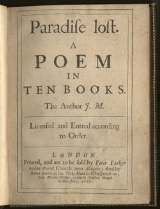
Paradise Lost is an epic poem in
blank verseBlank verse is poetry written in unrhymed iambic pentameter. It has been described as "probably the most common and influential form that English poetry has taken since the sixteenth century" and Paul Fussell has claimed that "about three-quarters of all English poetry is in blank verse."The first...
by the 17th-century English poet
John MiltonJohn Milton was an English poet, polemicist, a scholarly man of letters, and a civil servant for the Commonwealth of England under Oliver Cromwell...
. It was originally published in 1667 (though written nearly ten years earlier) in ten books, with a total of over ten thousand individual lines of
verseA verse is formally a single line in a metrical composition, e.g. poetry. However, the word has come to represent any division or grouping of words in such a composition, which traditionally had been referred to as a stanza....
. A second edition followed in 1674, changed into twelve books (in the manner of the division of
VirgilPublius Vergilius Maro, usually called Virgil or Vergil in English , was an ancient Roman poet of the Augustan period. He is known for three major works of Latin literature, the Eclogues , the Georgics, and the epic Aeneid...
's
AeneidThe Aeneid is a Latin epic poem, written by Virgil between 29 and 19 BC, that tells the legendary story of Aeneas, a Trojan who travelled to Italy, where he became the ancestor of the Romans. It is composed of roughly 10,000 lines in dactylic hexameter...
) with minor revisions throughout and a note on the versification; most of the poem was written while Milton was
blindBlindness is the condition of lacking visual perception due to physiological or neurological factors.Various scales have been developed to describe the extent of vision loss and define blindness...
, and was
transcribedTranscription in the linguistic sense is the systematic representation of language in written form. The source can either be utterances or preexisting text in another writing system, although some linguists only consider the former as transcription.Transcription should not be confused with...
for him.
The poem concerns the
ChristianA Christian is a person who adheres to Christianity, an Abrahamic, monotheistic religion based on the life and teachings of Jesus of Nazareth as recorded in the Canonical gospels and the letters of the New Testament...
story of the Fall of Man: the temptation of
Adam and EveAdam and Eve were, according to the Genesis creation narratives, the first human couple to inhabit Earth, created by YHWH, the God of the ancient Hebrews...
by the
fallen angelFallen angel is a concept developed in Jewish mythology from interpretation of the Book of Enoch. The actual term fallen angel is not found in either the Hebrew Bible or the New Testament. Christians adopted the concept of fallen angels mainly based on their interpretations of the Book of...
SatanSatan , "the opposer", is the title of various entities, both human and divine, who challenge the faith of humans in the Hebrew Bible...
and their expulsion from the
Garden of EdenThe Garden of Eden is in the Bible's Book of Genesis as being the place where the first man, Adam, and his wife, Eve, lived after they were created by God. Literally, the Bible speaks about a garden in Eden...
. Milton's purpose, stated in Book I, is to "justify the ways of God to men" and elucidate the conflict between God's eternal
foresightOmniscience omniscient point-of-view in writing) is the capacity to know everything infinitely, or at least everything that can be known about a character including thoughts, feelings, life and the universe, etc. In Latin, omnis means "all" and sciens means "knowing"...
and
free will"To make my own decisions whether I am successful or not due to uncontrollable forces" -Troy MorrisonA pragmatic definition of free willFree will is the ability of agents to make choices free from certain kinds of constraints. The existence of free will and its exact nature and definition have long...
. Although the primary event in the epic is about the Fall of Man, the character Satan serves as an anti-hero and as a prominent driving force in the plot. His depiction has fascinated critics, some of which have interpreted
Paradise Lost as a poem questioning the church's power (a common theme during the English Renaissance) rather than only a description of the fall of Adam and Eve.
Milton incorporates
PaganismPaganism is a blanket term, typically used to refer to non-Abrahamic, indigenous polytheistic religious traditions....
, classical mythology, and Christianity into the poem. While Milton's principal goal in the work is to give a compelling
TheodicyTheodicy is a theological and philosophical study which attempts to prove God's intrinsic or foundational nature of omnibenevolence , omniscience , and omnipotence . Theodicy is usually concerned with the God of the Abrahamic religions Judaism, Christianity, and Islam, due to the relevant...
, he nevertheless deals with a range of topics, from
marriageMarriage is a social union or legal contract between people that creates kinship. It is an institution in which interpersonal relationships, usually intimate and sexual, are acknowledged in a variety of ways, depending on the culture or subculture in which it is found...
to
politicsPolitics is a process by which groups of people make collective decisions. The term is generally applied to the art or science of running governmental or state affairs, including behavior within civil governments, but also applies to institutions, fields, and special interest groups such as the...
(Milton was politically active during the time of the
English Civil WarThe English Civil War was a series of armed conflicts and political machinations between Parliamentarians and Royalists...
). Many difficult theological issues are deliberately addressed, including
fateDestiny or fate refers to a predetermined course of events. It may be conceived as a predetermined future, whether in general or of an individual...
,
predestinationPredestination, in theology is the doctrine that all events have been willed by God. John Calvin interpreted biblical predestination to mean that God willed eternal damnation for some people and salvation for others...
, the
TrinityThe Christian doctrine of the Trinity defines God as three divine persons : the Father, the Son , and the Holy Spirit. The three persons are distinct yet coexist in unity, and are co-equal, co-eternal and consubstantial . Put another way, the three persons of the Trinity are of one being...
, the introduction of
sinIn religion, sin is the violation or deviation of an eternal divine law or standard. The term sin may also refer to the state of having committed such a violation. Christians believe the moral code of conduct is decreed by God In religion, sin (also called peccancy) is the violation or deviation...
and
deathDeath is the permanent termination of the biological functions that sustain a living organism. Phenomena which commonly bring about death include old age, predation, malnutrition, disease, and accidents or trauma resulting in terminal injury....
into the world, as well as the nature of
angelAngels are mythical beings often depicted as messengers of God in the Hebrew and Christian Bibles along with the Quran. The English word angel is derived from the Greek ἄγγελος, a translation of in the Hebrew Bible ; a similar term, ملائكة , is used in the Qur'an...
s, fallen angels, Satan and the war in heaven. Milton draws on his knowledge of languages, and diverse sources — primarily Genesis, much of the
New TestamentThe New Testament is the second major division of the Christian biblical canon, the first such division being the much longer Old Testament....
, the deuterocanonical
Book of EnochThe Book of Enoch is an ancient Jewish religious work, traditionally ascribed to Enoch, the great-grandfather of Noah. It is not part of the biblical canon as used by Jews, apart from Beta Israel...
, and other parts of the
Old TestamentThe Old Testament, of which Christians hold different views, is a Christian term for the religious writings of ancient Israel held sacred and inspired by Christians which overlaps with the 24-book canon of the Masoretic Text of Judaism...
. Milton's epic is often considered one of the greatest literary works in the English language, along with those of
ShakespeareWilliam Shakespeare was an English poet and playwright, widely regarded as the greatest writer in the English language and the world's pre-eminent dramatist. He is often called England's national poet and the "Bard of Avon"...
.
Synopsis
The story is separated into twelve books, broken down shortly after initial publication, following the model of the
AeneidThe Aeneid is a Latin epic poem, written by Virgil between 29 and 19 BC, that tells the legendary story of Aeneas, a Trojan who travelled to Italy, where he became the ancestor of the Romans. It is composed of roughly 10,000 lines in dactylic hexameter...
of
VirgilPublius Vergilius Maro, usually called Virgil or Vergil in English , was an ancient Roman poet of the Augustan period. He is known for three major works of Latin literature, the Eclogues , the Georgics, and the epic Aeneid...
. The books' lengths vary; longest being Book IX, with 1,189 lines, and the shortest Book VII, having 640. In the second edition, each book was preceded by a summary titled "The Argument". The poem follows the epic tradition of starting
in medias resIn medias res or medias in res is a Latin phrase denoting the literary and artistic narrative technique wherein the relation of a story begins either at the mid-point or at the conclusion, rather than at the beginning In medias res or medias in res (into the middle of things) is a Latin phrase...
(Latin for
in the midst of things), the background story being recounted later.
Milton's story has two arcs: one of
SatanSatan , "the opposer", is the title of various entities, both human and divine, who challenge the faith of humans in the Hebrew Bible...
(Lucifer) and another of
Adam and EveAdam and Eve were, according to the Genesis creation narratives, the first human couple to inhabit Earth, created by YHWH, the God of the ancient Hebrews...
. It begins after Satan and the other
rebel angelsFallen angel is a concept developed in Jewish mythology from interpretation of the Book of Enoch. The actual term fallen angel is not found in either the Hebrew Bible or the New Testament. Christians adopted the concept of fallen angels mainly based on their interpretations of the Book of...
have been defeated and banished to
HellIn many religious traditions, a hell is a place of suffering and punishment in the afterlife. Religions with a linear divine history often depict hells as endless. Religions with a cyclic history often depict a hell as an intermediary period between incarnations...
, or as it is also called in the poem,
TartarusIn classic mythology, below Uranus , Gaia , and Pontus is Tartarus, or Tartaros . It is a deep, gloomy place, a pit, or an abyss used as a dungeon of torment and suffering that resides beneath the underworld. In the Gorgias, Plato In classic mythology, below Uranus (sky), Gaia (earth), and Pontus...
. In
PandæmoniumPandæmonium is the capital of Hell in the epic poem Paradise Lost by the 17th century English poet John Milton."Pandæmonium" stems from Greek "παν", meaning "all" or "every", and "δαιμόνιον", meaning "little spirit" or "little angel", or, as Christians interpreted it, "little daemon", and later,...
, Satan employs his rhetorical skill to organize his followers; he is aided by his lieutenants
MammonMammon is a term, derived from the Christian Bible, used to describe material wealth or greed, most often personified as a deity, and sometimes included in the seven princes of Hell.-Etymology:...
and
BeelzebubBeelzebub -Religious meaning:Ba‘al Zəbûb is variously understood to mean "lord of flies", or "lord of the dwelling". Originally the name of a Philistine god, Beelzebub is also identified in the New Testament as Satan, the "prince of the demons". In Arabic the name is retained as Ba‘al dhubaab /...
.
BelialBelial is one of the four crown princes of Hell and a demon in the Bible, Jewish apocrypha and Christian apocrypha...
and
MolochMoloch — also rendered as Molech, Molekh, Molok, Molek, Molock, or Moloc — is the name of an ancient Semitic god...
are also present. At the end of the debate, Satan volunteers himself to poison the newly-created
EarthEarth is the third planet from the Sun, and the densest and fifth-largest of the eight planets in the Solar System. It is also the largest of the Solar System's four terrestrial planets...
and God's new and most favored creation, Mankind. He braves the dangers of the
AbyssAbyss refers to a bottomless pit, to the underworld, to the deepest ocean floor, or to hell.The English word "abyss" derives from the late Latin abyssimus through French abisme , hence the poetic form "abysm", with examples dating to 1616 and earlier to rhyme with "time"...
alone in a manner reminiscent of
OdysseusOdysseus or Ulysses was a legendary Greek king of Ithaca and the hero of Homer's epic poem the Odyssey. Odysseus also plays a key role in Homer's Iliad and other works in the Epic Cycle....
or
AeneasAeneas , in Greco-Roman mythology, was a Trojan hero, the son of the prince Anchises and the goddess Aphrodite. His father was the second cousin of King Priam of Troy, making Aeneas Priam's second cousin, once removed. The journey of Aeneas from Troy , which led to the founding a hamlet south of...
. After arduously traversing the Chaos outside Hell, he enters God's new material World, and later the Garden of Eden.
Partway through the story, the Angelic War over Heaven is recounted. Satan's rebellion follows the epic convention of large-scale warfare. The battles between the faithful angels and Satan's forces take place over three days. The final battle involves the Son of God single-handedly defeating the entire legion of angelic rebels and banishing them from Heaven. Following the purging of Heaven, God creates the World, culminating in his creation of Adam and Eve. While God gave Adam and Eve
total freedom"To make my own decisions whether I am successful or not due to uncontrollable forces" -Troy MorrisonA pragmatic definition of free willFree will is the ability of agents to make choices free from certain kinds of constraints. The existence of free will and its exact nature and definition have long...
and power to rule over all creation, He gave them one explicit command: not to eat from the Tree of the Knowledge of Good and Evil on penalty of death.
The story of Adam and Eve's temptation and fall is a fundamentally different, new kind of epic: a domestic one. Adam and Eve are presented for the first time in Christian literature as having a full relationship while still without
sinIn religion, sin is the violation or deviation of an eternal divine law or standard. The term sin may also refer to the state of having committed such a violation. Christians believe the moral code of conduct is decreed by God In religion, sin (also called peccancy) is the violation or deviation...
. They have passions and distinct personalities. Satan, disguised in the form of a serpent, successfully tempts Eve to eat from the Tree by preying on her vanity and tricking her with
rhetoricRhetoric is the art of discourse, an art that aims to improve the facility of speakers or writers who attempt to inform, persuade, or motivate particular audiences in specific situations. As a subject of formal study and a productive civic practice, rhetoric has played a central role in the Western...
. Later, Adam seeing Eve has sinned, knowingly commits the same sin. He declares to Eve that since she was made from his flesh, they are bound to one another so that if she dies, he must also die. In this manner, Milton portrays Adam as a heroic figure, but also as a deeper sinner than Eve, as he is aware that what he is doing is wrong.
After eating the fruit, Adam and Eve have lustful sex, and at first, Adam is convinced that Eve was right in thinking that eating the fruit would be beneficial. However, they soon fall asleep, having terrible nightmares, and after they awake, they experience
guiltGuilt is the state of being responsible for the commission of an offense. It is also a cognitive or an emotional experience that occurs when a person realizes or believes—accurately or not—that he or she has violated a moral standard, and bears significant responsibility for that...
and
shameShame is, variously, an affect, emotion, cognition, state, or condition. The roots of the word shame are thought to derive from an older word meaning to cover; as such, covering oneself, literally or figuratively, is a natural expression of shame....
for the first time. Realizing that they have committed a terrible act against God, they engage in mutual recrimination.
However, Eve's pleas to Adam reconcile them somewhat. Her encouragement enables Adam and Eve both to approach God, to "bow and sue for grace with suppliant knee", and to receive grace from God. Adam is shown a vision by the angel Michael, in which Adam witnesses everything that will happen to mankind until the Great Flood. Since Adam is very upset by this vision of humankind's future, Michael also tells him about humankind's potential redemption from original sin through
Jesus ChristJesus of Nazareth , commonly referred to as Jesus Christ or simply as Jesus or Christ, is the central figure of Christianity...
(whom Michael calls "King Messiah").
Adam and Eve are then cast out of Eden, and Michael says that Adam may find "a paradise within thee, happier far". Adam and Eve also now have a more distant relationship with God, who is omnipresent, but invisible (unlike the previous tangible Father in the
Garden of EdenThe Garden of Eden is in the Bible's Book of Genesis as being the place where the first man, Adam, and his wife, Eve, lived after they were created by God. Literally, the Bible speaks about a garden in Eden...
).
Characters
Satan: SatanSatan , "the opposer", is the title of various entities, both human and divine, who challenge the faith of humans in the Hebrew Bible...
is the first major character introduced in the poem. Formerly the most beautiful of all angels in Heaven, he's a tragic figure best described by the now-famous quote "Better to reign in Hell than to serve in Heaven". He is introduced to Hell after he leads a failed rebellion to wrestle control of Heaven from God. Satan's desire to rebel against his creator stems from his unwillingness to be subjugated by God and his Son, falsely claiming that angels are "self-begot, self-raised", thereby denying God's authority over them as their creator.
Satan is deeply arrogant, albeit powerful and charismatic. Satan's persuasive powers are evident throughout the book; not only is he cunning and deceptive, but he also is able to rally the demons to continue in the rebellion after their agonizing defeat in the Angelic War. He argues that God rules as a tyrant and that all the angels ought to rule as gods.
Satan is comparable in many ways to the tragic heroes of classic Greek literature but, Satan's hubris far surpasses those of previous tragedies. Though at times he plays the narrative role of an anti-hero, he is still commonly understood to be the antagonist of the epic. However, the true nature of his role in the poem has been the subject of much notoriety and scholarly debate. While the general consensus view, as espoused by critics like William H. Marshall, interprets the poem as a genuine Christian morality tale, others view it as more ironic:
William BlakeWilliam Blake was an English poet, painter, and printmaker. Largely unrecognised during his lifetime, Blake is now considered a seminal figure in the history of both the poetry and visual arts of the Romantic Age...
stated Milton "wrote in fetters when [he] wrote of Angels and God, and at liberty when of Devils and Hell, [because] he was a true Poet and of the Devil's party without knowing it".
Adam: AdamAdam is a figure in the Book of Genesis. According to the creation myth of Abrahamic religions, he is the first human. In the Genesis creation narratives, he was created by Yahweh-Elohim , and the first woman, Eve was formed from his rib...
is the first human created by God. Considered as God's prized creation, Adam along with his wife rule over all the creatures of the world and reside in the Garden of Eden. He is more intelligent and curious than Eve. He is also stronger in his moral devotion to God than his wife. From the questions he asks the angel Raphael, it is clear that Adam has a deep, intellectual curiosity about his existence, God, Heaven and the nature of the world. He is completely infatuated with Eve, which while pure in and of itself, eventually contributes to his reasons for joining Eve in disobedience to God.
As opposed to the Biblical Adam, this version of Adam is given a glimpse of the future of mankind (this includes a synopsis of stories from The Old and New Testaments), by the angel Michael, before he has to leave Paradise.
Eve: EveEve is the first woman created by God in the Book of Genesis.Eve may also refer to:-People:*Eve , a common given name and surname*Eve , American recording artist and actress-Places:...
is the second human created by God, taken from one of Adam's ribs and shaped into a female form of Adam. In her innocence, she is the model of a good wife, graceful and happily submissive to Adam. Eve is extremely beautiful and thoroughly in love with Adam. She consents to Adam leading her away from her reflection when they first meet, trusting Adam’s authority in their relationship. One day, she convinces Adam that it would be good for them to split up and work different parts of the Garden. In her solitude, she is tempted by Satan to sin against God. Adam shortly follows along with her.
The Son of God: The
Son of God"Son of God" is a phrase which according to most Christian denominations, Trinitarian in belief, refers to the relationship between Jesus and God, specifically as "God the Son"...
is Jesus Christ, though he is never named explicitly, since he has not yet entered human form. The Son of God shares total union with God, and indeed is understood to be a person of the
GodheadGodhead , may refer to:*Deity*Divinity, the quality of being God*Conceptions of God*Godhead , the totality of gods, in Platonism the Transcendent One....
, along with the Father and the
SpiritHoly Spirit is a term introduced in English translations of the Hebrew Bible, but understood differently in the main Abrahamic religions.While the general concept of a "Spirit" that permeates the cosmos has been used in various religions Holy Spirit is a term introduced in English translations of...
. He is the ultimate hero of the epic and infinitely powerful, singlehandedly defeating Satan and his followers when they violently rebel against God and driving them into Hell. The Son of God tells Adam & Eve of God's judgment after their sin. However, he sacrificially volunteers to eventually journey to the World, become a man himself, and redeem the Fall of Man through his own death and resurrection. In the final scene, a vision of Salvation through the Son of God is revealed to Adam by Michael. Still, the name, Jesus of Nazareth, and the details of Jesus' story are not depicted in the poem.
God the Father: God the FatherGod the Father is a gendered title given to God in many monotheistic religions, particularly patriarchal, Abrahamic ones. In Judaism, God is called Father because he is the creator, life-giver, law-giver, and protector...
is the creator of Heaven, Hell, the World, and of everyone and everything there is. He desires glory and praise from all his creation. He is an all-powerful, all-knowing, infinitely good being who cannot be overthrown by even the great army of angels Satan incites against him. The poem begins with the purpose of justifying the ways of God to men, so God often converses with the Son of God concerning his plans and reveals his motives regarding his actions. The poem portrays God’s process of creation in the way that Milton believed it was done, that God created Heaven, Earth, Hell, and all the creatures that inhabit these separate planes from part of Himself, not out of nothing. Thus, according to Milton, the ultimate authority of God derives from his being the "author" of creation. Satan tries to justify his rebellion by denying this aspect of God and claiming self-creation, but he admits to himself this is not the case, and that God "deserved no such return/ From me, whom He created what I was."
Raphael: RaphaelRaphael is an archangel of Judaism, Christianity, and Islam, who in the Judeo-Christian tradition performs all manners of healing....
is an angel who is sent by God to warn Adam about Satan's infiltration of Eden and to warn him that Satan is going to try to curse Adam and Eve. He also has a lengthy discussion with the curious Adam regarding creation and events which transpired in Heaven.
Michael: Michael is a mighty
archangelAn archangel is an angel of high rank. Archangels are found in a number of religious traditions, including Judaism, Christianity and Islam. Michael and Gabriel are recognized as archangels in Judaism and by most Christians. Michael is the only archangel specifically named in the Protestant Bible...
who fought for God in the Angelic War. In the first battle, he wounds Satan terribly with a powerful sword that God designed to even cut through the substance of angels. After Adam and Eve disobey God by eating from the Tree of Knowledge, God sends the angel
MichaelMichael , Micha'el or Mîkhā'ēl; , Mikhaḗl; or Míchaël; , Mīkhā'īl) is an archangel in Jewish, Christian, and Islamic teachings. Roman Catholics, Anglicans, and Lutherans refer to him as Saint Michael the Archangel and also simply as Saint Michael...
to visit Adam and Eve. His duty is to escort Adam and Eve out of Paradise. But before this happens, Michael shows Adam visions of the future which cover an outline of the Bible, from the story of Cain and Abel in Genesis, up through the story of Jesus Christ in the
New TestamentThe New Testament is the second major division of the Christian biblical canon, the first such division being the much longer Old Testament....
.
Composition
Milton began writing the epic in 1658 at the age of fifty, during the last years of the English Republic. Although he probably finished the work by 1664, Milton did not publish until 1667 after the
Great PlagueThe Great Plague was a massive outbreak of disease in the Kingdom of England that killed an estimated 100,000 people, 20% of London's population. The disease is identified as bubonic plague, an infection by the bacterium Yersinia pestis, transmitted through a flea vector...
and the
Great FireThe Great Fire of London was a major conflagration that swept through the central parts of the English city of London, from Sunday, 2 September to Wednesday, 5 September 1666. The fire gutted the medieval City of London inside the old Roman City Wall...
.
Milton composed the entire work while completely blind. It is presumed he had
glaucomaGlaucoma is an eye disorder in which the optic nerve suffers damage, permanently damaging vision in the affected eye and progressing to complete blindness if untreated. It is often, but not always, associated with increased pressure of the fluid in the eye...
, necessitating the use of paid
amanuensesAmanuensis is a Latin word adopted in various languages, including English, for certain persons performing a function by hand, either writing down the words of another or performing manual labour...
and his daughters.
Marriage
Milton first presents Adam and Eve in Book IV with impartiality. The relationship between Adam and Eve is one of "mutual dependence, not a relation of domination or hierarchy." While the author does place Adam above Eve in regard to his intellectual knowledge, and in turn his relation to God, he also grants Eve the benefit of knowledge through experience. Hermine Van Nuis clarifies that although there is a sense of stringency associated with the specified roles of the male and the female, each unreservedly accepts the designated role because it is viewed as an asset. Instead of believing that these roles are forced upon them, each uses the obligatory requirement as a strength in their relationship with each other. These minor discrepancies reveal the author’s view on the importance of mutuality between a husband and a wife.
When examining the relationship between Adam and Eve, critics tend to accept an either Adam- or Eve-centered view in terms of
hierarchyA hierarchy is an arrangement of items in which the items are represented as being "above," "below," or "at the same level as" one another...
and importance to God. David Mikics argues, by contrast, these positions "overstate the independence of the characters' stances, and therefore miss the way in which Adam and Eve are entwined with each other". Milton's true vision reflects one where the husband and wife (in this instance, Adam and Eve) depend on each other and only through each other’s differences are able to thrive.
Although Milton does not directly mention
divorceDivorce is the final termination of a marital union, canceling the legal duties and responsibilities of marriage and dissolving the bonds of matrimony between the parties...
, critics posit theories on Milton's view of divorce based on inferences found within the poem. Other works by Milton suggest he viewed marriage as an entity separate from the church. Discussing
Paradise Lost, Biberman entertains the idea that "marriage is a contract made by both the man and the woman". Based on this inference, Milton would believe that both man and woman would have equal access to divorce, as they do to marriage.
Feminist critics of
Paradise Lost suggest that Eve is forbidden the knowledge of her own identity. Moments after her creation, before Eve is led to Adam, she becomes enraptured by an image reflected in the water (her own, unbeknownst to Eve). God urges Eve to look away from her own image, her beauty, which is also the object of Adam’s desire. Adam delights in both her beauty and submissive charms, yet Eve may never be permitted to gaze upon her individual form. Critic Julia M. Walker argues that because Eve “neither recognizes nor names herself ... she can know herself only in relation to Adam.” “Eve’s sense of self becomes important in its absence ... [she] is never allowed to know what she is supposed to see.” Eve therefore knows not what she is, only what she is not: male. Starting in Book IV, Eve learns that Adam, the male form, is superior and “How beauty is excelled by manly grace/ And wisdom which alone is truly fair.” Led by his gentle hand, she yields, a woman without individual purpose, destined to fall by “free will.”
Idolatry
Milton's 17th century contemporaries by and large criticized Milton’s ideas and considered him as a radical, mostly because of his well-known Protestant views on politics and religion. One of Milton's greatest and most controversial arguments centers on his concept of what is idolatrous; this topic is deeply embedded in
Paradise Lost.
Milton's first criticism of
idolatryIdolatry is a pejorative term for the worship of an idol, a physical object such as a cult image, as a god, or practices believed to verge on worship, such as giving undue honour and regard to created forms other than God. In all the Abrahamic religions idolatry is strongly forbidden, although...
focuses on the practice of constructing temples and other buildings to serve as places of worship. In Book XI of
Paradise Lost, Adam tries to atone for his sins by offering to build altars to worship God. In response, the angel Michael explains Adam does not need to build physical objects to experience the presence of God. Joseph Lyle points to this example, explaining "When Milton objects to architecture, it is not a quality inherent in buildings themselves he finds offensive, but rather their tendency to act as convenient loci to which idolatry, over time, will inevitably adhere." Even if the idea is pure in nature, Milton still believes that it will unavoidably lead to idolatry simply because of the nature of humans. Instead of placing their thoughts and beliefs into God, as they should, humans tend to turn to erected objects and falsely invest their faith. While Adam attempts to build an altar to God, critics note Eve is similarly guilty of idolatry, but in a different manner. Harding believes Eve's
narcissismNarcissism is a term with a wide range of meanings, depending on whether it is used to describe a central concept of psychoanalytic theory, a mental illness, a social or cultural problem, or simply a personality trait...
and obsession with herself constitutes idolatry. Specifically, Harding claims that "... under the serpent’s influence, Eve’s idolatry and self-deification foreshadow the errors into which her 'Sons' will stray." Much like Adam, Eve falsely places her faith into herself, the Tree of Knowledge, and to some extent, the Serpent, all of which do not compare to the ideal nature of God.
Furthermore, Milton makes his views on idolatry more explicit with the creation of
PandemoniumPandæmonium is the capital of Hell in the epic poem Paradise Lost by the 17th century English poet John Milton."Pandæmonium" stems from Greek "παν", meaning "all" or "every", and "δαιμόνιον", meaning "little spirit" or "little angel", or, as Christians interpreted it, "little daemon", and later,...
and the exemplary allusion to Solomon’s temple. In the beginning of
Paradise Lost, as well as throughout the poem, there are several references to the rise and eventual fall of Solomon's temple. Critics elucidate that "Solomon’s temple provides an explicit demonstration of how an artifact moves from its genesis in devotional practice to an idolatrous end." This example, out of the many presented, conveys Milton’s views on the dangers of idolatry distinctly. Even if one builds a structure in the name of God, even the best of intentions can become immoral. In addition, critics have drawn parallels between both
PandemoniumPandæmonium is the capital of Hell in the epic poem Paradise Lost by the 17th century English poet John Milton."Pandæmonium" stems from Greek "παν", meaning "all" or "every", and "δαιμόνιον", meaning "little spirit" or "little angel", or, as Christians interpreted it, "little daemon", and later,...
and Saint Peter's Basilica, and the
PantheonThe Pantheon ,Rarely Pantheum. This appears in Pliny's Natural History in describing this edifice: Agrippae Pantheum decoravit Diogenes Atheniensis; in columnis templi eius Caryatides probantur inter pauca operum, sicut in fastigio posita signa, sed propter altitudinem loci minus celebrata.from ,...
. The majority of these similarities revolve around a structural likeness, but as Lyle explains, they play a greater role. By linking Saint Peter’s Basilica and the
PantheonThe Pantheon ,Rarely Pantheum. This appears in Pliny's Natural History in describing this edifice: Agrippae Pantheum decoravit Diogenes Atheniensis; in columnis templi eius Caryatides probantur inter pauca operum, sicut in fastigio posita signa, sed propter altitudinem loci minus celebrata.from ,...
to
PandemoniumPandæmonium is the capital of Hell in the epic poem Paradise Lost by the 17th century English poet John Milton."Pandæmonium" stems from Greek "παν", meaning "all" or "every", and "δαιμόνιον", meaning "little spirit" or "little angel", or, as Christians interpreted it, "little daemon", and later,...
—an ideally false structure, the two famous buildings take on a false meaning. This comparison best represents Milton's Protestant views, as it rejects both the purely Catholic perspective and the Pagan perspective.
In addition to rejecting Catholicism, Milton revolted against the idea of a monarch ruling by
divine rightDivine Right may refer to:* The Divine right of kings, the doctrine that a monarch derives his or her power directly from God* Episcopal polity, the doctrine that is required in the church jure divino, i.e...
. He saw the practice as idolatrous. Barbara Lewalski concludes that the theme of idolatry in
Paradise Lost "is an exaggerated version of the idolatry Milton had long associated with the Stuart ideology of divine kingship". In the opinion of Milton, any object, human or non-human, that receives special attention befitting of God, is considered idolatrous.
Response and criticism
This epic is generally considered one of the greatest works in the English language. In the verses below the portrait in the fourth edition,
John DrydenJohn Dryden was an influential English poet, literary critic, translator, and playwright who dominated the literary life of Restoration England to such a point that the period came to be known in literary circles as the Age of Dryden.Walter Scott called him "Glorious John." He was made Poet...
linked Milton with
HomerIn the Western classical tradition Homer , is the author of the Iliad and the Odyssey, and is revered as the greatest ancient Greek epic poet. These epics lie at the beginning of the Western canon of literature, and have had an enormous influence on the history of literature.When he lived is...
and
VirgilPublius Vergilius Maro, usually called Virgil or Vergil in English , was an ancient Roman poet of the Augustan period. He is known for three major works of Latin literature, the Eclogues , the Georgics, and the epic Aeneid...
, suggesting Milton encompassed and surpassed both:
"Three Poets, in three distant Ages born,
Greece, Italy, and England did adorn.
The First in loftiness of thought surpass'd;
The Next in Majesty; in both the Last.
The force of Nature cou'd no farther goe:
To make a third she joynd the former two."
Since
Paradise Lost is based upon scripture, its significance in the
Western canonThe term Western canon denotes a canon of books and, more broadly, music and art that have been the most important and influential in shaping Western culture. As such, it includes the "greatest works of artistic merit." Such a canon is important to the theory of educational perennialism and the...
has been thought by some to have lessened due to increasing
secularismSecularism is the principle of separation between government institutions and the persons mandated to represent the State from religious institutions and religious dignitaries...
. This is not the general consensus, and even academics labelled as secular realize the merits of the work. In
William BlakeWilliam Blake was an English poet, painter, and printmaker. Largely unrecognised during his lifetime, Blake is now considered a seminal figure in the history of both the poetry and visual arts of the Romantic Age...
's
The Marriage of Heaven and HellThe Marriage of Heaven and Hell is a book by the English poet and printmaker William Blake. It is a series of texts written in imitation of biblical prophecy but expressing Blake's own intensely personal Romantic and revolutionary beliefs. Like his other books, it was published as printed sheets...
, the "voice of the devil" argues:
- The reason Milton wrote in fetters when he wrote of Angels & God, and at liberty when of Devils & Hell, is because he was a true Poet and of the Devil's party without knowing it.
This statement summarizes what would become the most common interpretation of the work in the twentieth century. Some critics, including
C. S. LewisClive Staples Lewis , commonly referred to as C. S. Lewis and known to his friends and family as "Jack", was a novelist, academic, medievalist, literary critic, essayist, lay theologian and Christian apologist from Belfast, Ireland...
, and later
Stanley FishStanley Eugene Fish is an American literary theorist and legal scholar. He was born and raised in Providence, Rhode Island...
, reject this interpretation. Rather, such critics hold that the theology of
Paradise Lost conforms to the passages of
ScriptureThe Bible refers to any one of the collections of the primary religious texts of Judaism and Christianity. There is no common version of the Bible, as the individual books , their contents and their order vary among denominations...
on which it is based.
The latter half of the twentieth century saw critical understanding of Milton's epic shift to a more political and philosophical focus. Rather than the
RomanticRomanticism was an artistic, literary and intellectual movement that originated in the second half of the 18th century in Europe, and gained strength in reaction to the Industrial Revolution...
conception of the
DevilThe Devil is believed in many religions and cultures to be a powerful, supernatural entity that is the personification of evil and the enemy of God and humankind. The nature of the role varies greatly...
as hero, it is generally accepted that Satan is presented in terms that begin classically heroic, then diminish him until he is finally reduced to a dust-eating serpent unable even to control his own body. The political angle enters into consideration in the underlying friction between Satan's
conservativeConservatism is a political and social philosophy that promotes the maintenance of traditional institutions and supports, at the most, minimal and gradual change in society. Some conservatives seek to preserve things as they are, emphasizing stability and continuity, while others oppose modernism...
, hierarchical view of the universe, and the contrasting "new way" of
GodGod is the English name given to a singular being in theistic and deistic religions who is either the sole deity in monotheism, or a single deity in polytheism....
and the
Son of God"Son of God" is a phrase which according to most Christian denominations, Trinitarian in belief, refers to the relationship between Jesus and God, specifically as "God the Son"...
as illustrated in Book III. In other words, in contemporary criticism the main thrust of the work becomes not the perfidy or heroism of Satan, but rather the tension between classical conservative "Old Testament" hierarchs (evidenced in Satan's worldview and even in that of the
archangelAn archangel is an angel of high rank. Archangels are found in a number of religious traditions, including Judaism, Christianity and Islam. Michael and Gabriel are recognized as archangels in Judaism and by most Christians. Michael is the only archangel specifically named in the Protestant Bible...
s
RaphaelRaphael is an archangel of Judaism, Christianity, and Islam, who in the Judeo-Christian tradition performs all manners of healing....
and
GabrielIn Abrahamic religions, Gabriel is an Archangel who typically serves as a messenger to humans from God.He first appears in the Book of Daniel, delivering explanations of Daniel's visions. In the Gospel of Luke Gabriel foretells the births of both John the Baptist and of Jesus...
), and "New Testament" revolutionaries (embodied in the Son of God, Adam, and Eve) who represent a new system of universal organization. This new order is based not in tradition, precedence, and unthinking habit, but on sincere and conscious acceptance of faith and on station chosen by ability and responsibility. Naturally, this interpretation makes much use of Milton's other works and his biography, grounding itself in his personal history as an English revolutionary and social critic.
Samuel JohnsonSamuel Johnson , often referred to as Dr. Johnson, was an English author who made lasting contributions to English literature as a poet, essayist, moralist, literary critic, biographer, editor and lexicographer...
praised the poem lavishly, but conceded that "None ever wished it longer than it is."
In Paul Stevens of University of Toronto's
Milton's Satan, he claimed the Satan figure was one of the earliest examples of an anti-hero who does not submit to authority, but the actions are greatly based on his own arrogance and delusion. Stevens also claimed
Paradise Lost was a story about Milton himself, who wrote in support of events that eventually led to English Civil War. That analysis was debuted in 2009 season of TVO's Best Lecturer series.
Iconography and cultural references
The first illustrations to accompany the text of
Paradise Lost were added to the fourth edition of 1688, with one engraving prefacing each book, of which up to eight of the twelve were by Sir
John Baptist MedinaSir John Baptist Medina or John Baptiste de Medina was an artist of Flemish-Spanish origin who worked in England and Scotland, mostly as a portrait painter, though he was also the first illustrator of Paradise Lost by John Milton in 1688.-Life and portrait-painting:Medina was the son of a Spanish...
, one by
Bernard Lens IIBernard Lens II was an English engraver, pioneer of mezzotint technique, and publisher.Bernard Lens II was the son of the first Bernard Lens, "an obscure painter" of Dutch origin...
, and perhaps up to four (including Books I and XII, perhaps the most memorable) by another hand.
Some of the most notable illustrators of
Paradise Lost included
William BlakeWilliam Blake was an English poet, painter, and printmaker. Largely unrecognised during his lifetime, Blake is now considered a seminal figure in the history of both the poetry and visual arts of the Romantic Age...
,
Gustave DoréPaul Gustave Doré was a French artist, engraver, illustrator and sculptor. Doré worked primarily with wood engraving and steel engraving.-Biography:...
and
Henry FuseliHenry Fuseli was a British painter, draughtsman, and writer on art, of Swiss origin.-Biography:...
(1799); however, the epic's illustrators also include, among others,
John MartinJohn Martin was an English Romantic painter, engraver and illustrator.-Biography:Martin was born in July 1789, in a one-room family cottage, at Haydon Bridge, near Hexham in Northumberland, the 4th son of Fenwick Martin, a one time fencing master...
, Edward Burney,
Richard WestallRichard Westall was an English painter and illustrator of portraits, historical and literary events, best-known for his portraits of Byron. He was also Queen Victoria's drawing master.-Life and works:...
,
Francis HaymanFrancis Hayman was an English painter and illustrator who became one of the founding members of the Royal Academy in 1768 and later its first librarian....
.
Outside of book illustrations, the epic has also inspired other visual works by well-known painters like
Salvador DalíSalvador Domènec Felip Jacint Dalí i Domènech, Marquis de Púbol , commonly known as Salvador Dalí , was a prominent Spanish Catalan surrealist painter born in Figueres,Spain....
who executed a set of ten colour
engravingEngraving is the practice of incising a design on to a hard, usually flat surface, by cutting grooves into it. The result may be a decorated object in itself, as when silver, gold, steel, or glass are engraved, or may provide an intaglio printing plate, of copper or another metal, for printing...
s in 1974.
Milton's achievement in writing
Paradise Lost without his sight inspired a more biographical work in a painting by
Eugène DelacroixFerdinand Victor Eugène Delacroix was a French Romantic artist regarded from the outset of his career as the leader of the French Romantic school...
entitled "Milton Dictating
Paradise Lost to his Daughters".
Paradise Lost has also inspired works in the fields of music and literature. A contemporary example is
His Dark MaterialsHis Dark Materials is a trilogy of fantasy novels by Philip Pullman comprising Northern Lights , The Subtle Knife , and The Amber Spyglass...
by
Philip PullmanPhilip Pullman CBE, FRSL is an English writer from Norwich. He is the best-selling author of several books, most notably his trilogy of fantasy novels, His Dark Materials, and his fictionalised biography of Jesus, The Good Man Jesus and the Scoundrel Christ...
which takes its title from
Paradise Lost. Pullman has stated that Milton's poem directly inspired the basic plot and central conflict of
His Dark Materials.
Musical tributes to the book include an opera version by the Polish composer
Krzysztof PendereckiKrzysztof Penderecki , born November 23, 1933 in Dębica) is a Polish composer and conductor. His 1960 avant-garde Threnody to the Victims of Hiroshima for string orchestra brought him to international attention, and this success was followed by acclaim for his choral St. Luke Passion. Both these...
and
Joseph HaydnFranz Joseph Haydn , known as Joseph Haydn , was an Austrian composer, one of the most prolific and prominent composers of the Classical period. He is often called the "Father of the Symphony" and "Father of the String Quartet" because of his important contributions to these forms...
's
oratorioAn oratorio is a large musical composition including an orchestra, a choir, and soloists. Like an opera, an oratorio includes the use of a choir, soloists, an ensemble, various distinguishable characters, and arias...
The Creation.
Films
Paradise Lost is scheduled to be made into an action film in 2012, directed by
Alex ProyasAlexander "Alex" Proyas is a Australian film director, screenwriter, and producer. He is best known for directing such films as The Crow, Dark City, I, Robot and Knowing. He is known for employing a stylish photographic techniques in his films, with dark overtones usually in a post-apocalyptic...
and slated for release sometime in 2013.
Bradley CooperBradley Cooper is an American film, theater, and television actor. He is known for his roles in the films The Hangover, The A-Team, and Limitless. In 2011, People magazine named Cooper "Sexiest Man Alive".-Early life:...
has been confirmed to be playing the role of Satan.
Benjamin WalkerBenjamin "Ben" Walker is an American actor, best known for his film appearances in Kinsey , Harlon Block in Clint Eastwood's Flags of Our Fathers, and his critically acclaimed portrayal of Andrew Jackson in the Off- and On Broadway incarnations of Bloody Bloody Andrew Jackson.-Education and...
is set to play the archangel
MichaelMichael , Micha'el or Mîkhā'ēl; , Mikhaḗl; or Míchaël; , Mīkhā'īl) is an archangel in Jewish, Christian, and Islamic teachings. Roman Catholics, Anglicans, and Lutherans refer to him as Saint Michael the Archangel and also simply as Saint Michael...
, and
Djimon HounsouDjimon Diaw Hounsou is a Beninese actor and model. As an actor, Hounsou has been nominated for two Academy Awards.-Early life:Djimon Hounsou was born in Cotonou, Benin, in 1964, to lbertine and Pierre Hounsou, a cook. He emigrated to Lyon in France at the age of thirteen with his brother, Edmond....
is cast to play the seraph
AbdielAbdiel is a biblical name which has been used as the name for a number of fictional characters and as a given name for several notable people...
. Adam and Eve will be played by Diego Boneta and
Camilla BelleCamilla Belle is an American actress. Her works include The Lost World: Jurassic Park, When a Stranger Calls, 10,000 BC, The Quiet, Push and Speedy Singhs.- Early life :...
.
Casey AffleckCaleb Casey McGuire Affleck-Boldt , better known as Casey Affleck, is an American actor and film director. Throughout the 1990s and early 2000s, he played supporting roles in mainstream hits like Good Will Hunting and Ocean's Eleven as well as in critically acclaimed independent films such as...
will be Gabriel.
See also
- John Milton's poetic style
The poetic style of John Milton, also known as Miltonic verse, Miltonic epic, or Miltonic blank verse, was a highly influential poetic structure popularized by Milton...
- Paradise Regained
Paradise Regained is a poem by the English poet John Milton, published in 1671. It is connected by name to his earlier and more famous epic poem Paradise Lost, with which it shares similar theological themes...
, a shorter, later poem by Milton about the Temptation of ChristThe temptation of Christ is detailed in the Gospels of Matthew, Mark, and Luke. According to these texts, after being baptized, Jesus fasted for forty days and nights in the Judean desert. During this time, the devil appeared to Jesus and tempted him...
by Satan
Further reading
- Patrides, C. A.
Constantinos Apostolos Patrides was a Greek–American academic and writer, and “one of the greatest scholars of Renaissance literature of his generation”. His books list the name C. A. Patrides; his Christian name “Constantinos” was shortened to the familiar “Dinos” and “Dean” by friends.Born...
Approaches to Paradise Lost: The York Tercentenary Lectures (University of Toronto, 1968) ISBN 0802015778
External links
Online text
Other information
- darkness visible – comprehensive site for students and others new to Milton: contexts, plot and character summaries, reading suggestions, critical history, gallery of illustrations of Paradise Lost, and much more. By students at Milton's Cambridge college, Christ's College.
- Selected bibliography at the Milton Reading Room – includes background, biography, criticism.
- Paradise Lost learning guide, quotes, close readings, thematic analyses, character analyses, teacher resources