

Bylina

Encyclopedia
History
Most historians of Russian folklore believe that byliny as a genre arose during the Kievan period, during the tenth and eleventh century; byliny continued to be written till about the arrival of the Tatars in the thirteenth century and the destruction of the Old East Slavic civilization. Byliny incorporate elements of history from several epochs into their stories. For example, byliny singers refer to many of the enemies of the Kievan people as Tartars though the stories originally referred to other steppe peoples in conflict with Kievan Rus’. The character of Prince Vladimir refers to a generalized “epic Vladimir” rather than an allusion to a specific historical Vladimir.Collections
Byliny have been collected in Russia since the seventeenth century; initially they were published for entertainment in prose paraphrases. The Cossack Kirsha DanilovKirsha Danilov
Kirsha Danilov was the supposed compiler of a collection of 70 Russian heroic, religious and humorous folksongs that made its first appearance in print in 1804. The anthology is entitled The Ancient Russian Poems and includes 71 texts set down in manuscript in the mid-18th century, probably in the...
compiled the most notable of the early collections in the Ural region for the mill owner Prokofi Demidov
Prokofi Demidov
Prokofi Akinfiyevich Demidov was a Russian industrialist and philanthropist.The eldest son of Akinfiy Demidov, Prokofi inherited the enormous Demidov family fortune on his father's death in 1745...
in the middle of the eighteenth century. In the middle of the nineteenth century Pavel Rybnikov traveled through the region of Lake Onega and rediscovered that the bylina tradition, which was thought to be extinct, still flourished among the peasants of northeast Russia. A storm stranded Rybnikov on an island in Lake Onega
Lake Onega
Lake Onega is a lake in the north-west European part of Russia, located on the territory of Republic of Karelia, Leningrad Oblast and Vologda Oblast. It belongs to the basin of Baltic Sea, Atlantic Ocean, and is the second largest lake in Europe after Lake Ladoga...
where he heard the sound of a bylina being sung; he persuaded the singer to repeat the song and wrote down his words. He proceeded to collect several hundred bylina, all of which he recorded from spoken paraphrase, and published them from 1861 to 1867 in several volumes entitled Songs Collected by P. N. Rybnikov.
Another influential collector, Alexander Gilferding, published one collection entitled Onega Bylinas Recorded by A. F. Gilferding in the Summer of 1871. He improved upon Rybnikov’s work by transcribing the byliny directly from the sung performance rather than the spoken retellings. He noticed that the rhythm differed between the sung and spoken versions, and asked the performers to pause for a longer period of time between lines to allow him time to record the words from the song itself. He also organized his collection by singer rather than subject and included short biographical sketches of the performers with their collected songs, thus focusing on the singer’s role in the composition of the song. Following the work of Rybnikov and Gilferding, many more scholars searched for byliny everywhere in northern Russia, and obtained byliny from the shores of the White Sea and the rivers flowing to the north.
Classifications
There are several ways to categorize bylina, and scholars disagree on which classification to use. Scholars from the mythological school differentiate between byliny about ‘older’ and ‘younger’ heroes. The ‘older’ heroes resembled mythological figures, while the ‘younger’ heroes resembled ordinary human beings. The historical school classifies byliny based on the principality in which the story took place, as in Kivan, Novgorodian, and Galician-Volhynian cycles. The mythological byliny of giants and the like probably originated long before the Kievan state was founded, and cannot be classified easily by principality. Scholars of the historical school often consider mythological byliny separately. Other scholars group byliny based on content, including heroic, fairy tale type, novella type and ballad-byliny. Most scholars prefer classification based on principalities.Structure
Because of their nature as performed pieces, byliny singers employ basically linear and easy to follow structure. Byliny structure typically includes three basic parts, introduction, narrative portion and epilogue. The introduction sometimes includes a verse to entice the audience to listen. Introductions often describe heroes at a feast being given a task or setting out on a mission. The narrative portion relates the adventure with exaggerated details and hyperbole to make the story more exciting. The epilogue refers to the reward for the mission, a moral or a reference to the sea, since byliny were often performed to attempt to calm the sea. To help listeners grasp the story, singers used ‘tag lines’ to preface speeches or dialogues, setting up for the audience who is talking to whom.Common Themes
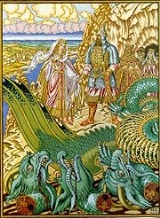
Scenes common to byliny include a hero taking leave of his mother, saddling a horse, entering a council chamber, bragging, departing over the wall of a city, going on a journey, urging on his horse, in battle, dressing in the morning, exchanging taunts with an enemy, becoming blood brothers with another hero, and asking for mercy. Singers may use their telling of these scenes in many of their songs, incorporating different elements in song after song. Themes in many bylina include the birth and childhood of a hero, father and son fighting, battling a monster, the imprisoned or reluctant hero returning in time to save his city, matchmaking or bride taking, a husband arriving at the wedding of his wife and encounters with a sorceress who turns men into animals. Christian beliefs mixed with pre-Christian ideas of magic and paganism in byliny, for instance, saints would appear to defend mortals against darkness.Adaptations
Vasily KalinnikovVasily Kalinnikov
Vasily Sergeyevich Kalinnikov was a Russian composer of two symphonies, several additional orchestral works and numerous songs, all of them imbued with characteristics of folksong...
, a famous russian composer from the XIX century composed an overture
Overture
Overture in music is the term originally applied to the instrumental introduction to an opera...
on this theme, Bylina.