

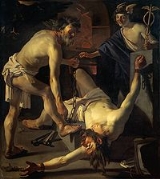
Prometheus Bound

Encyclopedia
Prometheus Bound is an Ancient Greek tragedy. In Antiquity
, this drama was attributed to Aeschylus
, but is now considered by some scholars to be the work of another hand, perhaps one as late as ca. 415 BC. Despite these doubts of authorship, the play's designation as Aeschylean has remained conventional. The tragedy is based on the myth of Prometheus
, a Titan
who was punished by the god Zeus
for giving fire
to mankind
.
(strength), Bia
(force), and the smith
-god Hephaestus
chain the Titan Prometheus to a mountain in the Caucasus
and then depart. According to the author, Prometheus is being punished not only for stealing fire, but also for thwarting Zeus
's plan to obliterate the human race. This punishment is especially galling since Prometheus was instrumental in Zeus's victory in the Titanomachy
.
The Oceanids appear and attempt to comfort Prometheus by conversing with him. Prometheus cryptically tells them that he knows of a potential marriage that would lead to Zeus's downfall. A Titan named Oceanus
commiserates with Prometheus and urges him to make peace with Zeus. Prometheus tells the chorus
that the gift of fire to mankind was not his only benefaction; in the so-called Catalogue of the Arts (447-506), he reveals that he taught men all the civilizing arts, such as writing, medicine, mathematics, astronomy, metallurgy, architecture, and agriculture.
Prometheus is then visited by Io
, a human maiden pursued by a lustful Zeus; the Olympian transformed Io into a cow, and a gadfly sent by Zeus's wife Hera
has chased Io all the way from Argos
. Prometheus forecasts Io's future travels, telling her that Zeus will eventually end her torment in Egypt
, where she will bear a son named Epaphus
. He says one of her descendants (an unnamed Heracles
), thirteen generations hence, will release him from his own torment.
Finally, Hermes the messenger-god is sent down by the angered Zeus to demand that Prometheus tell him who threatens to overthrow him. Prometheus refuses, and Zeus strikes him with a thunderbolt that plunges Prometheus into the abyss.
's Theogony
(511-616) and Works and Days
(42-105). Hesiod essentially portrays the Titan as a lowly trickster and semi-comic foil to Zeus' authority. Zeus' anger toward Prometheus is in turn responsible for mortal man's having to provide for himself; before, all of man's needs had been provided by the gods. Prometheus' theft of fire also prompts the arrival of the first woman, Pandora
, and her jar of evils. Pandora is entirely absent from Prometheus Bound, and Prometheus becomes a human benefactor and divine king-maker, rather than an object of blame for human suffering.
, but the other two plays, Prometheus Unbound
and Prometheus the Fire-Bringer, survive only in fragments. In Prometheus Unbound, Heracles frees Prometheus from his chains and kills the eagle that had been sent daily to eat the Titan's perpetually regenerating liver. Perhaps foreshadowing his eventual reconciliation with Prometheus, we learn that Zeus has released the other Titans whom he imprisoned at the conclusion of the Titanomachy. In Prometheus the Fire-Bringer, the Titan finally warns Zeus not to lie with the sea nymph Thetis
, for she is fated to give birth to a son greater than the father. Not wishing to be overthrown, Zeus would later marry Thetis off to the mortal Peleus
; the product of that union will be Achilles
, Greek hero of the Trojan War
. Grateful for the warning, Zeus finally reconciles with Prometheus.
of Alexandria
unanimously deemed Aeschylus to be the author of Prometheus Bound. Since the 19th century, however, several scholars have doubted Aeschylus' authorship of the drama. These doubts initially took the form of the so-called "Zeus Problem." That is, how could the playwright who demonstrated such piety toward Zeus in (for example) The Suppliants
and Agamemnon be the same playwright who, in Prometheus Bound, inveighs against Zeus for being a violent tyrant? This objection prompted the theory of a Zeus who (like the Furies in the Oresteia) "evolves" in the course of the trilogy. Thus, by the conclusion of Prometheus the Fire-Bringer, Aeschylus' Zeus would be more like the just Zeus found in the works of Hesiod.
Increasingly, arguments for and against the attribution to Aeschylus have been based on metrical-stylistic grounds: the play's diction, the use of so-called Eigenworter, the use of recitative anapests in the meter, etc. Using such criteria in 1977, Mark Griffith made a case against the attribution. C. J. Herington, however, repeatedly argued for it. Since Griffith's landmark study, confidence in Aeschylean authorship has steadily eroded. Influential scholars such as M.L West, Alan Sommerstein, and Anthony Podlecki have made arguments against authenticity. West has argued that the Prometheus Bound and its trilogy are at least partially and probably wholly the work of Aeschylus' son, Euphorion, who was also a playwright. Based upon allusions to Prometheus Bound found in the works of comic playwright Aristophanes
, Podlecki has recently suggested that the tragedy might date from ca. 415 BC. Those who trust in the verdict of antiquity and still favor Aeschylean authorship have dated the play anywhere from the 480s to 456 BC. The matter may never be settled to the satisfaction of all. As Griffith himself, who argues against authenticity, puts it: "We cannot hope for certainty one way or the other."
' The Frogs
(405 BC) makes clear. Allusions to the play are evident in his The Birds
of 414 BC, and in the tragedian Euripides
' fragmentary Andromeda
, dated to 412 BC. If Aeschylean authorship is assumed, then these allusions several decades after the play's first performance speak to the enduring popularity of Prometheus Bound. Moreover, a performance of the play itself (rather than a depiction of the generic myth) appears on fragments of a Greek vase dated ca. 370-360 BC.
In the early 19th century, the Romantic
writers came to identify with the defiant Prometheus. Johann Wolfgang von Goethe
wrote a poem on the theme, as did Lord Byron
. Percy Bysshe Shelley
wrote a play, Prometheus Unbound, which used some of the materials of the play as a vehicle for Shelley's own vision.
Classical antiquity
Classical antiquity is a broad term for a long period of cultural history centered on the Mediterranean Sea, comprising the interlocking civilizations of ancient Greece and ancient Rome, collectively known as the Greco-Roman world...
, this drama was attributed to Aeschylus
Aeschylus
Aeschylus was the first of the three ancient Greek tragedians whose work has survived, the others being Sophocles and Euripides, and is often described as the father of tragedy. His name derives from the Greek word aiskhos , meaning "shame"...
, but is now considered by some scholars to be the work of another hand, perhaps one as late as ca. 415 BC. Despite these doubts of authorship, the play's designation as Aeschylean has remained conventional. The tragedy is based on the myth of Prometheus
Prometheus
In Greek mythology, Prometheus is a Titan, the son of Iapetus and Themis, and brother to Atlas, Epimetheus and Menoetius. He was a champion of mankind, known for his wily intelligence, who stole fire from Zeus and gave it to mortals...
, a Titan
Titan (mythology)
In Greek mythology, the Titans were a race of powerful deities, descendants of Gaia and Uranus, that ruled during the legendary Golden Age....
who was punished by the god Zeus
Zeus
In the ancient Greek religion, Zeus was the "Father of Gods and men" who ruled the Olympians of Mount Olympus as a father ruled the family. He was the god of sky and thunder in Greek mythology. His Roman counterpart is Jupiter and his Etruscan counterpart is Tinia.Zeus was the child of Cronus...
for giving fire
Fire
Fire is the rapid oxidation of a material in the chemical process of combustion, releasing heat, light, and various reaction products. Slower oxidative processes like rusting or digestion are not included by this definition....
to mankind
Human
Humans are the only living species in the Homo genus...
.
Synopsis
The play is composed almost entirely of speeches and contains little action since its protagonist is chained and immobile throughout. At the beginning, KratosCratos
In Greek mythology, Kratos or Cratus was the son of Pallas and Styx, and the personification of strength and power. Kratos and his siblings - Nike , Bia and Zelus - were the winged enforcers of Olympian God Zeus...
(strength), Bia
Bia (mythology)
In Greek mythology, Bia was the personification of force, daughter of Pallas and Styx. She was the sister of Nike, Kratos, and Zelus; she and her siblings were constant companions of Zeus. They achieved this honour after supporting Zeus in the war against the Titans along with their mother...
(force), and the smith
Blacksmith
A blacksmith is a person who creates objects from wrought iron or steel by forging the metal; that is, by using tools to hammer, bend, and cut...
-god Hephaestus
Hephaestus
Hephaestus was a Greek god whose Roman equivalent was Vulcan. He is the son of Zeus and Hera, the King and Queen of the Gods - or else, according to some accounts, of Hera alone. He was the god of technology, blacksmiths, craftsmen, artisans, sculptors, metals, metallurgy, fire and volcanoes...
chain the Titan Prometheus to a mountain in the Caucasus
Caucasus
The Caucasus, also Caucas or Caucasia , is a geopolitical region at the border of Europe and Asia, and situated between the Black and the Caspian sea...
and then depart. According to the author, Prometheus is being punished not only for stealing fire, but also for thwarting Zeus
Zeus
In the ancient Greek religion, Zeus was the "Father of Gods and men" who ruled the Olympians of Mount Olympus as a father ruled the family. He was the god of sky and thunder in Greek mythology. His Roman counterpart is Jupiter and his Etruscan counterpart is Tinia.Zeus was the child of Cronus...
's plan to obliterate the human race. This punishment is especially galling since Prometheus was instrumental in Zeus's victory in the Titanomachy
Titanomachy
In Greek mythology, the Titanomachy or War of the Titans , was the ten-year series of battles fought in Thessaly between the two camps of deities long before the existence of mankind: the Titans, based on Mount Othrys, and the Olympians, who would come to reign on Mount Olympus...
.
The Oceanids appear and attempt to comfort Prometheus by conversing with him. Prometheus cryptically tells them that he knows of a potential marriage that would lead to Zeus's downfall. A Titan named Oceanus
Oceanus
Oceanus ; , Ōkeanós) was a pseudo-geographical feature in classical antiquity, believed by the ancient Greeks and Romans to be the world-ocean, an enormous river encircling the world....
commiserates with Prometheus and urges him to make peace with Zeus. Prometheus tells the chorus
Greek chorus
A Greek chorus is a homogenous, non-individualised group of performers in the plays of classical Greece, who comment with a collective voice on the dramatic action....
that the gift of fire to mankind was not his only benefaction; in the so-called Catalogue of the Arts (447-506), he reveals that he taught men all the civilizing arts, such as writing, medicine, mathematics, astronomy, metallurgy, architecture, and agriculture.
Prometheus is then visited by Io
Io (mythology)
Io was, in Greek mythology, a priestess of Hera in Argos, a nymph who was seduced by Zeus, who changed her into a heifer to escape detection. His wife Hera set ever-watchful Argus Panoptes to guard her, but Hermes was sent to distract the guardian and slay him...
, a human maiden pursued by a lustful Zeus; the Olympian transformed Io into a cow, and a gadfly sent by Zeus's wife Hera
Hera
Hera was the wife and one of three sisters of Zeus in the Olympian pantheon of Greek mythology and religion. Her chief function was as the goddess of women and marriage. Her counterpart in the religion of ancient Rome was Juno. The cow and the peacock were sacred to her...
has chased Io all the way from Argos
Argos
Argos is a city and a former municipality in Argolis, Peloponnese, Greece. Since the 2011 local government reform it is part of the municipality Argos-Mykines, of which it is a municipal unit. It is 11 kilometres from Nafplion, which was its historic harbour...
. Prometheus forecasts Io's future travels, telling her that Zeus will eventually end her torment in Egypt
Egypt
Egypt , officially the Arab Republic of Egypt, Arabic: , is a country mainly in North Africa, with the Sinai Peninsula forming a land bridge in Southwest Asia. Egypt is thus a transcontinental country, and a major power in Africa, the Mediterranean Basin, the Middle East and the Muslim world...
, where she will bear a son named Epaphus
Epaphus
In Greek mythology, Epaphus , also called Apis, was the son of Zeus and Io and a king of Egypt.The name/word Epaphus means "Touch". This refers to the manner in which he was conceived, by the touch of Zeus' hand. He was born in Euboea or, according to others, in Egypt, on the river Nile, after...
. He says one of her descendants (an unnamed Heracles
Heracles
Heracles ,born Alcaeus or Alcides , was a divine hero in Greek mythology, the son of Zeus and Alcmene, foster son of Amphitryon and great-grandson of Perseus...
), thirteen generations hence, will release him from his own torment.
Finally, Hermes the messenger-god is sent down by the angered Zeus to demand that Prometheus tell him who threatens to overthrow him. Prometheus refuses, and Zeus strikes him with a thunderbolt that plunges Prometheus into the abyss.
Departures from Hesiod
The treatment of the myth of Prometheus in Prometheus Bound is a radical departure from the earlier accounts found in HesiodHesiod
Hesiod was a Greek oral poet generally thought by scholars to have been active between 750 and 650 BC, around the same time as Homer. His is the first European poetry in which the poet regards himself as a topic, an individual with a distinctive role to play. Ancient authors credited him and...
's Theogony
Theogony
The Theogony is a poem by Hesiod describing the origins and genealogies of the gods of the ancient Greeks, composed circa 700 BC...
(511-616) and Works and Days
Works and Days
Works and Days is a didactic poem of some 800 verses written by the ancient Greek poet Hesiod around 700 BC. At its center, the Works and Days is a farmer's almanac in which Hesiod instructs his brother Perses in the agricultural arts...
(42-105). Hesiod essentially portrays the Titan as a lowly trickster and semi-comic foil to Zeus' authority. Zeus' anger toward Prometheus is in turn responsible for mortal man's having to provide for himself; before, all of man's needs had been provided by the gods. Prometheus' theft of fire also prompts the arrival of the first woman, Pandora
Pandora
In Greek mythology, Pandora was the first woman. As Hesiod related it, each god helped create her by giving her unique gifts...
, and her jar of evils. Pandora is entirely absent from Prometheus Bound, and Prometheus becomes a human benefactor and divine king-maker, rather than an object of blame for human suffering.
Prometheus Trilogy
There is evidence that Prometheus Bound was the first play in a trilogy conventionally called the PrometheiaPrometheia
The Prometheia is a trilogy of plays about the titan Prometheus. It was attributed in Antiquity to the 5th-century BC Greek tragedian Aeschylus...
, but the other two plays, Prometheus Unbound
Prometheus Unbound (Aeschylus)
Prometheus Unbound is a play by the Greek poet Aeschylus, concerned with the torments of the Greek mythological figure Prometheus and his suffering at the hands of Zeus...
and Prometheus the Fire-Bringer, survive only in fragments. In Prometheus Unbound, Heracles frees Prometheus from his chains and kills the eagle that had been sent daily to eat the Titan's perpetually regenerating liver. Perhaps foreshadowing his eventual reconciliation with Prometheus, we learn that Zeus has released the other Titans whom he imprisoned at the conclusion of the Titanomachy. In Prometheus the Fire-Bringer, the Titan finally warns Zeus not to lie with the sea nymph Thetis
Thetis
Silver-footed Thetis , disposer or "placer" , is encountered in Greek mythology mostly as a sea nymph or known as the goddess of water, one of the fifty Nereids, daughters of the ancient one of the seas with shape-shifting abilities who survives in the historical vestiges of most later Greek myths...
, for she is fated to give birth to a son greater than the father. Not wishing to be overthrown, Zeus would later marry Thetis off to the mortal Peleus
Peleus
In Greek mythology, Pēleus was a hero whose myth was already known to the hearers of Homer in the late 8th century BCE. Peleus was the son of Aeacus, king of the island of Aegina, and Endeïs, the oread of Mount Pelion in Thessaly; he was the father of Achilles...
; the product of that union will be Achilles
Achilles
In Greek mythology, Achilles was a Greek hero of the Trojan War, the central character and the greatest warrior of Homer's Iliad.Plato named Achilles the handsomest of the heroes assembled against Troy....
, Greek hero of the Trojan War
Trojan War
In Greek mythology, the Trojan War was waged against the city of Troy by the Achaeans after Paris of Troy took Helen from her husband Menelaus, the king of Sparta. The war is among the most important events in Greek mythology and was narrated in many works of Greek literature, including the Iliad...
. Grateful for the warning, Zeus finally reconciles with Prometheus.
Debate over authenticity
Scholars at the Great LibraryLibrary of Alexandria
The Royal Library of Alexandria, or Ancient Library of Alexandria, in Alexandria, Egypt, was the largest and most significant great library of the ancient world. It flourished under the patronage of the Ptolemaic dynasty and functioned as a major center of scholarship from its construction in the...
of Alexandria
Alexandria
Alexandria is the second-largest city of Egypt, with a population of 4.1 million, extending about along the coast of the Mediterranean Sea in the north central part of the country; it is also the largest city lying directly on the Mediterranean coast. It is Egypt's largest seaport, serving...
unanimously deemed Aeschylus to be the author of Prometheus Bound. Since the 19th century, however, several scholars have doubted Aeschylus' authorship of the drama. These doubts initially took the form of the so-called "Zeus Problem." That is, how could the playwright who demonstrated such piety toward Zeus in (for example) The Suppliants
The Suppliants
The Suppliants may refer to:* The Suppliants by Aeschylus, an ancient Greek play where the Danaides seek protection from King Pelasgus...
and Agamemnon be the same playwright who, in Prometheus Bound, inveighs against Zeus for being a violent tyrant? This objection prompted the theory of a Zeus who (like the Furies in the Oresteia) "evolves" in the course of the trilogy. Thus, by the conclusion of Prometheus the Fire-Bringer, Aeschylus' Zeus would be more like the just Zeus found in the works of Hesiod.
Increasingly, arguments for and against the attribution to Aeschylus have been based on metrical-stylistic grounds: the play's diction, the use of so-called Eigenworter, the use of recitative anapests in the meter, etc. Using such criteria in 1977, Mark Griffith made a case against the attribution. C. J. Herington, however, repeatedly argued for it. Since Griffith's landmark study, confidence in Aeschylean authorship has steadily eroded. Influential scholars such as M.L West, Alan Sommerstein, and Anthony Podlecki have made arguments against authenticity. West has argued that the Prometheus Bound and its trilogy are at least partially and probably wholly the work of Aeschylus' son, Euphorion, who was also a playwright. Based upon allusions to Prometheus Bound found in the works of comic playwright Aristophanes
Aristophanes
Aristophanes , son of Philippus, of the deme Cydathenaus, was a comic playwright of ancient Athens. Eleven of his forty plays survive virtually complete...
, Podlecki has recently suggested that the tragedy might date from ca. 415 BC. Those who trust in the verdict of antiquity and still favor Aeschylean authorship have dated the play anywhere from the 480s to 456 BC. The matter may never be settled to the satisfaction of all. As Griffith himself, who argues against authenticity, puts it: "We cannot hope for certainty one way or the other."
Reception and influence
Prometheus Bound enjoyed a measure of popularity in antiquity. Aeschylus was very popular in Athens decades after his death, as AristophanesAristophanes
Aristophanes , son of Philippus, of the deme Cydathenaus, was a comic playwright of ancient Athens. Eleven of his forty plays survive virtually complete...
' The Frogs
The Frogs
The Frogs is a comedy written by the Ancient Greek playwright Aristophanes. It was performed at the Lenaia, one of the Festivals of Dionysus, in 405 BC, and received first place.-Plot:...
(405 BC) makes clear. Allusions to the play are evident in his The Birds
The Birds (play)
The Birds is a comedy by the Ancient Greek playwright Aristophanes. It was performed in 414 BCE at the City Dionysia where it won second prize. It has been acclaimed by modern critics as a perfectly realized fantasy remarkable for its mimicry of birds and for the gaiety of its songs...
of 414 BC, and in the tragedian Euripides
Euripides
Euripides was one of the three great tragedians of classical Athens, the other two being Aeschylus and Sophocles. Some ancient scholars attributed ninety-five plays to him but according to the Suda it was ninety-two at most...
' fragmentary Andromeda
Andromeda (mythology)
Andromeda is a princess from Greek mythology who, as divine punishment for her mother's bragging, the Boast of Cassiopeia, was chained to a rock as a sacrifice to a sea monster. She was saved from death by Perseus, her future husband. Her name is the Latinized form of the Greek Ἀνδρομέδη...
, dated to 412 BC. If Aeschylean authorship is assumed, then these allusions several decades after the play's first performance speak to the enduring popularity of Prometheus Bound. Moreover, a performance of the play itself (rather than a depiction of the generic myth) appears on fragments of a Greek vase dated ca. 370-360 BC.
In the early 19th century, the Romantic
Romanticism
Romanticism was an artistic, literary and intellectual movement that originated in the second half of the 18th century in Europe, and gained strength in reaction to the Industrial Revolution...
writers came to identify with the defiant Prometheus. Johann Wolfgang von Goethe
Johann Wolfgang von Goethe
Johann Wolfgang von Goethe was a German writer, pictorial artist, biologist, theoretical physicist, and polymath. He is considered the supreme genius of modern German literature. His works span the fields of poetry, drama, prose, philosophy, and science. His Faust has been called the greatest long...
wrote a poem on the theme, as did Lord Byron
George Gordon Byron, 6th Baron Byron
George Gordon Byron, 6th Baron Byron, later George Gordon Noel, 6th Baron Byron, FRS , commonly known simply as Lord Byron, was a British poet and a leading figure in the Romantic movement...
. Percy Bysshe Shelley
Percy Bysshe Shelley
Percy Bysshe Shelley was one of the major English Romantic poets and is critically regarded as among the finest lyric poets in the English language. Shelley was famous for his association with John Keats and Lord Byron...
wrote a play, Prometheus Unbound, which used some of the materials of the play as a vehicle for Shelley's own vision.
Performance
In February 1979 Theatro Technis London performed `Prometheus Bound` in the English language. The production directed by George Evgeniou explored "to harrowing effect"(Time Out )the parallels between the persecution of Prometheus 2000 years ago and the tortures carried out by the Greek junta during 1967-1974 on persons for spreading "communist ideas". Prometheus was played by Koraltan Ahmed and Io by Angelique RockasMemorable lines
- το συνγηνησ τοι δεινον 'ε θ'ομιλια. To sungenes toi deinon he th'omilia. (Kinship and companionship are terrible things.)
- 'ομοια μορφει γλοσσα σου γερυται. Homoia morphei glossa sou geruetai. (Your speech and your appearance – both alike.)
- τυφλὰς ἐν αὐτοῖς ἐλπίδας κατῴκισα. Tuphlas in autois elpidas katoikisa. (I established in them blind hopes.)
- σαφῶς μ᾽ ἐς οἶκον σὸς λόγος στέλλει πάλιν. Saphos m'es oikon sos logos stellei palin. (Your speech returns me clearly home.)
Translations
- Thomas MedwinThomas MedwinThomas Medwin was an early 19th century English poet and translator, who is chiefly known for his biographies of his cousin Percy Bysshe Shelley and his recollections of his close friend Lord Byron.-Early life:...
and Percy Bysshe ShelleyPercy Bysshe ShelleyPercy Bysshe Shelley was one of the major English Romantic poets and is critically regarded as among the finest lyric poets in the English language. Shelley was famous for his association with John Keats and Lord Byron...
, 1832, 1837 (Pagan Press reprint 2011) - Elizabeth Barrett BrowningElizabeth Barrett BrowningElizabeth Barrett Browning was one of the most prominent poets of the Victorian era. Her poetry was widely popular in both England and the United States during her lifetime. A collection of her last poems was published by her husband, Robert Browning, shortly after her death.-Early life:Members...
, 1833 - verse - Edward Hayes PlumptreEdward Hayes PlumptreEdward Hayes Plumptre was an English divine and scholar, and was born in London.-Life:This son of E.H. Plumptre was born in London. A scholar of University College, Oxford, he graduated with a double-first class degree in 1844. In the same year he was elected Fellow of Brasenose College. Married...
, 1868 - verse: full text - J. Case, 1905 - verse
- John Stuart Blackie, 1906 - verse: full text
- Robert Whitelaw, 1907 - verse
- E. D. A. Morshead, 1908 - verse: full text
- Walter Headlam and C. E. S. Headlam, 1909 - prose
- G.M.Cookson, 1924 - verse: full text
- Herbert Weir Smyth, 1926 - prose: full text
- Clarence W. Mendell, 1926 - verse
- Robert C. Trevelyan, 1939 - verse
- David Grene, 1942 - prose and verse
- E. A. Havelock, 1950 -prose and verse
- Philip Vellacott, 1961 - verse
- Paul Roche, 1964 - verse
- Robert Lowell, 1967 - prose
- C. John Herrington and James Scully, 1975 - verse
- G. Theodoridis, prose, full text: http://bacchicstage.wordpress.com/