
All Topics  
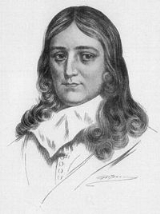
John Milton

 
John Milton

   Email Print
   Bookmark   Link


John Milton


John Milton II (9 December 1608 – 8 November 1674) was an English poet
Poet

A poet is a person who writes poetry....
, author
Author

An author is defined both as "the person who originates or gives existence to anything" and that authorship determines responsibility for what is created....
, polemicist and civil servant for the Commonwealth of England
Commonwealth of England

The Commonwealth of England was the republic which ruled first Kingdom of England and Wales, and then Kingdom of Ireland and Kingdom of Scotland from 1649 to 1660....
. He is best known for his epic poem
Epic poetry

An epic is a lengthy narrative poem, ordinarily concerning a serious subject containing details of heroic deeds and events significant to a culture or nation....
 Paradise Lost
Paradise Lost

Paradise Lost is an epic poem in blank verse by the 17th-century England poet John Milton. It was originally published in 1667 in ten books....
 and for his treatise condemning censorship, Areopagitica
Areopagitica

Areopagitica: A speech of Mr. John Milton for the liberty of unlicensed printing to the Parliament of England is a 1644 prose polemical tract by John Milton against censorship....
.

Milton was writing at a time of religious and political flux in England. His poetry and prose reflect deep convictions, often reacting to contemporary circumstances, but it is not always easy to locate the writer in an obvious religious category.


Discussion
Ask a question about 'John Milton'
Start a new discussion about 'John Milton'
Answer questions from other users
Full Discussion Forum


Recent Posts


Quotations


Above the smoke and stir of this dim spotWhich men call earth.

l. 5

And add to these retired Leisure,That in trim gardens takes his pleasure.

l. 49

And every shepherd tells his taleUnder the hawthorn in the dale.

l. 67

And join with thee, calm Peace and Quiet,Spare Fast, that oft with gods doth diet.

l. 45

And looks commercing with the skies,Thy rapt soul sitting in thine eyes.

l. 39

And the gilded car of day,His glowing axle doth allayIn the steep Atlantic stream.

l. 95


Encyclopedia


John Milton II (9 December 1608 – 8 November 1674) was an English poet
Poet

A poet is a person who writes poetry....
, author
Author

An author is defined both as "the person who originates or gives existence to anything" and that authorship determines responsibility for what is created....
, polemicist and civil servant for the Commonwealth of England
Commonwealth of England

The Commonwealth of England was the republic which ruled first Kingdom of England and Wales, and then Kingdom of Ireland and Kingdom of Scotland from 1649 to 1660....
. He is best known for his epic poem
Epic poetry

An epic is a lengthy narrative poem, ordinarily concerning a serious subject containing details of heroic deeds and events significant to a culture or nation....
 Paradise Lost
Paradise Lost

Paradise Lost is an epic poem in blank verse by the 17th-century England poet John Milton. It was originally published in 1667 in ten books....
 and for his treatise condemning censorship, Areopagitica
Areopagitica

Areopagitica: A speech of Mr. John Milton for the liberty of unlicensed printing to the Parliament of England is a 1644 prose polemical tract by John Milton against censorship....
.

Milton was writing at a time of religious and political flux in England. His poetry and prose reflect deep convictions, often reacting to contemporary circumstances, but it is not always easy to locate the writer in an obvious religious category. His views may be described as broadly Protestant, and he was an accomplished, scholarly man of letters, polemical writer and an official in the government of Oliver Cromwell
Oliver Cromwell

Oliver Cromwell was an English people Military history of the United Kingdom and Politics of England leader best known for his involvement in making England into a republican Commonwealth and for his later role as Lord Protector of England, Scotland, and Ireland....
.

After his death, Milton became the subject of partisan biographies, such as those by Edward Phillips
Edward Phillips

Edward Phillips , was an England author....
 and John Toland
John Toland

John Toland was an Ireland philosopher....
, and a hostile account by Anthony ŕ Wood. Samuel Johnson
Samuel Johnson

Samuel Johnson was an English author. Beginning as a Grub Street journalist, he made lasting contributions to English literature as a poet, essayist, moralist, novelist, literary critic, biographer, editor and lexicographer....
 described him as "an acrimonious and surly republican"; but William Hayley
William Hayley

William Hayley , was an England writer, best known as the friend and biographer of William Cowper.Born at Chichester, he was sent to Eton College in 1757, and to Trinity Hall, Cambridge, in 1762; his connection with the Middle Temple, London, where he was admitted in 1766, was merely nominal....
's 1796 biography called him the "greatest English author", at a time when his reputation was particularly in play.

Biography

The phases of Milton's life closely parallel the major historical divisions of Stuart
House of Stuart

The House of Stuart, also known as the House of Stewart is an important European royal house. Founded by Robert II of Scotland, the Stewarts first became monarchs of the Kingdom of Scotland during the late 14th century....
 Britain: the Caroline Ancien Régime
Ancien Régime

Ancien R?gime refers primarily to the aristocracy, sociology, and politics system established in France under the Valois Dynasty and House of Bourbon dynasties ....
, the Commonwealth of England
Commonwealth of England

The Commonwealth of England was the republic which ruled first Kingdom of England and Wales, and then Kingdom of Ireland and Kingdom of Scotland from 1649 to 1660....
 and the Restoration
English Restoration

The English Restoration, or simply The Restoration began in 1660 when the English monarchy, Scottish monarchy and Irish monarchy were restored under Charles II of England after the Interregnum that followed the English Civil War....
. One can situate both his poetry and his politics historically. Both sprang from the philosophical and religious beliefs Milton developed from his reading and experience, from student days to the English Revolution
English Revolution

The term "English Revolution" refers to the period of the English Civil Wars and Commonwealth of England period 1640-1660, in which Parliament challenged King Charles I of England's authority, engaged in civil conflict against his forces, and executed him in 1649....
.

By the time of his death in 1674, Milton was blind, impoverished and yet unrepentant for his political choices. Milton had by then attained Europe-wide fame, and notoriety, for his radical political and religious beliefs, as well as his writings in English and Latin poetry.

Early life

John Milton's father
John Milton (composer)

John Milton was an England composer and father of poet John Milton. Early in his life he converted to Protestantism and his own father, Richard Milton, subsequently disowned him....
, also named John Milton (1562-1647), moved to London
London

London is the capital of both England and the United Kingdom, and the most populous municipality in the European Union. An important settlement for two millennia, History of London goes back to its founding by the Roman Empire....
 around 1583 after being disinherited by his devout Catholic
Catholic

Catholic is an adjective derived from the Greek language adjective , meaning "whole" or "complete". In the context of Christianity ecclesiology, it has a rich history and several usages....
 father, Richard Milton, for embracing Protestantism
Protestantism

Protestantism is a movement within Christianity that originated in the sixteenth-century Protestant Reformation. It is considered to be one of the three principal traditions of Christianity, together with Roman Catholicism and Eastern Orthodoxy....
. In London, Milton senior married Sarah Jeffrey (1572-1637), the poet's mother, and found lasting financial success as a scrivener
Scrivener

A scrivener was traditionally a person who could literacy. This usually indicated secretary and Administration duties such as dictation and keeping business, judicial, and history records for monarchs, nobility, temples, and municipality....
. He lived and worked out of a house on Bread Street
Bread Street

Bread Street is a ward of the City of London and is named from its principal street, which was antiently the bread market; for by the records it appears that in 1302, the bakers of London were ordered to sell no bread at their houses but in the open market....
, where the Mermaid Tavern
Mermaid Tavern

The Mermaid Tavern was a tavern on Cheapside in London during the Elizabethan era, located east of St. Paul's Cathedral on the corner of Friday Street and Bread Street....
 was located in Cheapside
Cheapside

Cheapside is a street in Cheap of the City of London that links Newgate with the junction of Queen Victoria Street, Cornhill, London, Threadneedle Street, Princes Street, Lombard Street, London and King William Street ....
. The elder Milton was noted for his skill as a musical composer, and this talent left Milton with a lifetime appreciation for music and friendship with musicians like Henry Lawes
Henry Lawes

Henry Lawes was an England musician and composer.He was born at Dinton in Wiltshire, and received his musical education from John Cooper, better known under his Italian language pseudonym Giovanni Coperario, a famous composer of the day....
. After Milton was born, on 9 December 1608, his father's prosperity provided his eldest son with a private tutor, Thomas Young
Thomas Young (1587-1655)

Thomas Young was a Scottish Presbyterian minister and theologian, resident in England and a member of the Westminster Assembly. He was the major author of the Smectymnuus group of leading Puritan churchmen....
, and then a place at St Paul's School in London. There he began the study of Latin and Greek, and the classical languages left an imprint on his poetry in English (he wrote also in Italian and Latin). His first datable compositions are two psalms done at age 15 at Long Bennington
Long Bennington

Long Bennington is a village in South Kesteven, south Lincolnshire, England. It is equidistant from Newark-on-Trent and Grantham, and from the villages of Stubton and Orston....
. One contemporary source is the Brief Lives
Brief Lives

Brief Lives is a collection of short Biography written by John Aubrey in the last decades of the seventeenth century. Aubrey initially began collecting biographical material to assist the Oxford scholar Anthony Wood, who was working on his own collection of biographies....
 of John Aubrey
John Aubrey

John Aubrey was an England antiquary and writer, best known as the author of the collection of short biographical pieces usually referred to as Brief Lives and as the discoverer of the Aubrey holes in Stonehenge....
, an uneven compilation including first-hand reports. In the work, Aubrey quotes Christopher, Milton's younger brother: "When he was young, he studied very hard and sat up very late, commonly till twelve or one o'clock at night".

John Milton matriculated at Christ's College, Cambridge
Christ's College, Cambridge

Christ?s College is one of the Colleges of the University of Cambridge of the University of Cambridge. With a reputation for its high academic standards it has consistently finished in the top ten colleges in the Tompkins Table....
, in 1625 and graduated with a B.A. in 1629, ranking fourth of 24 honours graduates that year in the University of Cambridge
University of Cambridge

The University of Cambridge , located in Cambridge, England, is the List of oldest universities in continuous operation university in the Anglosphere....
. Preparing to become an Anglican priest, he stayed on to obtain his Master of Arts degree on 3 July 1632.

Milton was probably rusticated
Rustication (academia)

Use in the United KingdomRustication is a term used at some United Kingdom academic institutions for a disciplinary action. The term derives from the Latin word rus, countryside, to indicate that a student has been sent back to his family in the country and is also traditionally used at Oxford University and Cambridge University un...
 for quarrelling in his first year with his tutor, William Chappell
William Chappell (bishop)

William Chappell was an England scholar and clergyman. He became Church of Ireland bishop of Cork and Ross....
. He was certainly at home in the Lent Term 1626; there he wrote his Elegia Prima, a first Latin elegy
Elegy

An elegy is a mournful, melancholic or plaintive Poetry#Elegy, especially a funeral song or a lament for the dead....
, to Carolo Diodati. Based on remarks of John Aubrey
John Aubrey

John Aubrey was an England antiquary and writer, best known as the author of the collection of short biographical pieces usually referred to as Brief Lives and as the discoverer of the Aubrey holes in Stonehenge....
, Chappell "whipt" Milton. This story is now disputed. Certainly Milton disliked Chappell. Christopher Hill
Christopher Hill (historian)

John Edward Christopher Hill, usually known simply as Christopher Hill, February 6, 1912–February 23, 2003 was an England Marxist historian and author of many history textbooks....
 cautiously notes that Milton was "apparently" rusticated, and that the differences between Chappell and Milton may have been either religious or personal, as far as we can know. Another factor, possibly, was the plague
Plague

Plague may refer to:...
, by which Cambridge was badly affected in 1625. Later in 1626 Milton's tutor was Nathaniel Tovey.

At Cambridge Milton was on good terms with Edward King
Edward King (British poet)

Edward King , the subject of John Milton Lycidas, was born in Ireland in 1612, the son of Sir John King, a member of a Yorkshire family which had migrated to Ireland....
, for whom he later wrote Lycidas
Lycidas

"Lycidas" is a poem by John Milton, written in 1637 as a pastoral elegy, first appearing in a 1638 collection of elegies entitled Justa Edouardo King Naufrago dedicated to the memory of Edward King , a collegemate of Milton's at Cambridge who had been drowned when his ship sank in the Irish Sea off the coast of Wales in August 1637....
. He also befriended Anglo-American dissident and theologian, Roger Williams
Roger Williams (theologian)

Roger Williams was an England theology, a notable proponent of religious toleration and the separation of church and state and an advocate for fair dealings with Native Americans in the United States....
. Milton tutored Williams in Hebrew in exchange for lessons in Dutch. Otherwise at Cambridge he developed a reputation for poetic skill and general erudition, but experienced alienation from his peers and university life as a whole. Watching his fellow students attempting comedy upon the college stage, he later observed that 'they thought themselves gallant men, and I thought them fools'. Milton, due to his hair, which he wore long, and his general delicacy of manner, was known as the "Lady of Christ's".

The university curriculum worked towards formal debates on topics, conducted in Latin. Yet his corpus is not devoid of humour, notably his sixth prolusion and his epitaphs on the death of Thomas Hobson
Thomas Hobson

Thomas Hobson , sometimes called "The Cambridge Carrier," is best known as the name behind the expression Hobson's choice.A mail from Cambridge, England, Hobson delivered mail between London and Cambridge, operating a livery stable outside the gates of St Catharine's College, Cambridge....
. While at Cambridge he wrote a number of his well-known shorter English poems, among them On the Morning of Christ's Nativity, his Epitaph on the admirable Dramatick Poet, W. Shakespeare, his first poem to appear in print, L'Allegro
L'Allegro

[Image:Cole Thomas L-Allegro L'Allegro is a pastoral poem by John Milton published in 1645. L'Allegro is invariably paired with the contrasting pastoral poem, Il Penseroso , which depicts a similar day spent in contemplation and thought....
 and Il Penseroso
Il Penseroso

Il Penseroso is a pastoral poem by John Milton published in 1645. Invoking "divinest Melancholy", the poem is in praise of the contemplative, withdrawn life of study, philosophy, thought and meditation, and is a counterpiece to L'Allegro, which praises the more cheerful sides of life and literature....
.

Study, poetry and travel

Upon receiving his M.A. in 1632, Milton retired to Hammersmith
Hammersmith

Hammersmith is an urban centre in the London Borough of Hammersmith and Fulham in west London, approximately 5 miles west of Charing Cross on the north bank of the River Thames....
, his father's new home since the previous year. He also lived at Horton
Horton, Berkshire

Horton is a village in Berkshire, England. It is located between Windsor, Berkshire and Staines. Prior to the administrative boundary changes in 1974 the village was in Buckinghamshire....
, from 1635, and undertook six years of self-directed private study. Christopher Hill points out that this was not retreat into a rural or pastoral idyll at all: Hammersmith was then a "suburban village" falling into the orbit of London, and that Horton was becoming deforested, and suffered from the plague. He read both ancient and modern works of theology
Theology

Theology is the study of the existence or attributes of a deity or gods, or more generally the study of religion or spirituality. It is sometimes contrasted with religious studies: theology is understood as the study of religion from an internal perspective , and religious studies as the study of religion from an external perspective....
, philosophy, history, politics, literature and science, in preparation for a prospective poetical career. Milton's intellectual development can be charted via entries in his commonplace book, now in the British Library
British Library

The British Library is the national library of the United Kingdom. It is based in London and is one of the world's largest List of Research libraries, holding over 150 million items in all known languages and formats; books, journals, newspapers, magazines, Sound recording, patents, databases, maps, stamps, Printmaking, drawings and much mor...
. As a result of such intensive study, Milton is considered to be among the most learned of all English poets; in addition to his six years of private study, Milton had command of Latin, Greek, Hebrew, French, Spanish, and Italian from his school and undergraduate days; he also added Old English to his linguistic repertoire in the 1650s while researching his History of Britain, and probably acquired proficiency in Dutch soon after.

Milton continued to write poetry during this period of study: his Arcades
Arcades (Milton)

"Arcades" is a masque written by John Milton and performed on 4 May 1634. The piece was written to celebrate the character of Alice Spencer, the Countess Dowager of Darby, widow of Ferdinando Stanley, 5th Earl of Derby, during her 75th birthday....
 and Comus
Comus (John Milton)

Comus is a masque in honour of chastity, written by John Milton. It was first presented on Michaelmas, 1634, before John Egerton, 1st Earl of Bridgewater at Ludlow Castle in celebration of the Earl's new post as President of Wales....
 were both commissioned for masques composed for noble patrons, connections of the Egerton family, and performed in 1632 and 1634 respectively. He contributed his pastoral
Pastoral

Pastoral, as an adjective, refers to the lifestyle of shepherds and pastoralists, moving livestock around larger areas of land according to seasons and availability of water and food....
 elegy
Elegy

An elegy is a mournful, melancholic or plaintive Poetry#Elegy, especially a funeral song or a lament for the dead....
 Lycidas
Lycidas

"Lycidas" is a poem by John Milton, written in 1637 as a pastoral elegy, first appearing in a 1638 collection of elegies entitled Justa Edouardo King Naufrago dedicated to the memory of Edward King , a collegemate of Milton's at Cambridge who had been drowned when his ship sank in the Irish Sea off the coast of Wales in August 1637....
 to a memorial collection for one of his Cambridge classmates in 1638. Drafts of these poems are preserved in Milton’s poetry notebook, known as the Trinity Manuscript because it is now kept at Trinity College, Cambridge
Trinity College, Cambridge

Trinity College is one of the 31 Colleges of the University of Cambridge of the University of Cambridge. Trinity has more members than any other college in Cambridge or University of Oxford, with around 700 undergraduates, 430 graduate students, and over 160 Fellows; however, counting only the student body it has somewhat fewer than Homert...
.

After completing his course of private study in early 1638, Milton embarked upon a tour of France and Italy in May until either the July or August of 1639. This was a standard course of action that those in Milton's financial position entered into, and his travels exposed them to the urban environment of Europe that he was unable to be influenced by while living in Horton. While in Europe, Milton experienced various artistic traditions and religious traditions, especially variants of Roman Catholicism. He also met many famous theorists and intellectuals with whom he was able to display his poetic skills, which helped further him in his poetic pursuits. As for the specific details to what happened within Milton's European travel, there is only one major source: Milton's own Defensio Secunda
Defensio Secunda

Defension Secunda was a 1654 political tract by John Milton, a sequel to his Defensio pro Populo Anglicano. It is a defence of the Parliamentary regime, by then controlled by Oliver Cromwell; and also defense of his own reputation against a royalist tract published under the name Salmasius in 1652, and others criticism lodged against...
. Although there are other records, some letters, some mentions in his other prose tracts and the rest, the bulk of the information comes from a work that, according to Barbara Lewalski, "was not intended as autobiography but as rhetoric, designed to emphasize his sterling reputation with the learned of Europe."

In [Florence], which I have always admired above all others because of the elegance, not just of its tongue, but also of its wit, I lingered for about two months. There I at once became the friend of many gentlemen eminent in rank and learning, whose private academies I frequented — a Florentine institution which deserves great praise not only for promoting humane studies but also for encouraging friendly intercourse.
– Milton's account of Florence in Defensio Secunda
He travelled a route common to other Englishmen touring Europe at the time. He first went to Calais then onto Paris, which he would accomplish riding horseback. While in Paris, he brought a letter from Wotton which allowed him to be introduced at the British embassy while at Paris. From John Scudamore, Milton received other letters of introduction and was directly introduced to Hugo Grotius
Hugo Grotius

Hugo Grotius worked as a jurist in the Dutch Republic. With Francisco de Vitoria and Alberico Gentili he laid the foundations for international law, based on natural law....
. Milton quickly left France after this meeting and after visiting a few landmarks. He traveled south, from Nice to Genoa and then onto Livorno and Pisa. Eventually, he reached Florence in July 1638. While there, Milton enjoyed many of the sites and structures of the city. He also met many intellectuals and spent time at the Florentine academies . In particular, Milton probably visited the Florentine Academy and the Academia della Crusca along with smaller academies in the area including the Apastisti and the Svogliati. His candor of manner and erudite neo-Latin poetry made him many friends in Florentine intellectual circles, and he met a number of famous and influential people through these connections including the astronomer Galileo at Arcetri
Arcetri

Arcetri is a region of Florence, Italy, in the hills to the south of the city centre.A numerous of historic buildings are situated there, including the house of the famous scientist Galileo Galilei , the Convent of San Matteo and the Torre del Gallo....
, Benedetto Buonmattei, Antonio Malatesti and others.

Although Milton enjoyed himself in Florence, he left in September to continue onward to Rome. With the many connects from Florence, Milton was able to have easy access into Rome's intellectual society. His poetic abilities impressed those like Giovanni Salzilli, who praised Milton within an epigram. In late October, Milton attended a dinner helped by the English Jesuit College even though he disliked the Jesuit order. There is little knowledge about the other major occurrences during this time beyond that he met David Codner, who also praised Milton's poetry, and that he attended various musical events, including oratorios, operas, and melodramas. Milton left for Naples near the end of November and he stayed only for a month because Spanish control diminished the local intellectual and artistic community. During that time, he was introduced to Giovanni Battista Manso, patron to both Torquato Tasso
Torquato Tasso

Torquato Tasso was an Italy poet of the 16th century, best known for his poem La Gerusalemme liberata , in which he depicts a highly imaginative version of the combats between Christians and Muslims at the end of the First Crusade, during the siege of Jerusalem ....
 and to Giovanni Battista Marino. Manso became Milton's guide through Naples and gifted Milton with books and distich that teases Milton through Gregory the Great's pun on "Angle" and "angel" when describing the English. Milton responded in his Mansus that he was grateful for the gesture of good will and claims Manso as his patron.

Originally, Milton wanted leave Naples in order to travel to Sicily, and then onto Greece, but he returned to England during the summer of 1639 because of what he claimed, in Defensio Secunda, were "sad tidings of civil war in England." To further complicate matters, Milton received word that his childhood friend, Diodati, died. Milton stayed another seven months in Europe on his trip home and spent time at Geneva with Diodati's uncle after he returned to Rome. In Defensio Secunda, Milton proclaimed that he was warned away from returning to Rome because of his openness about religion, but he stayed in the city for two months and was able to experience Carnival and meet Lukas Holste, a Vatican librarian who guided Milton through the Vatican's collection library. He was also introduced to Cardinal Francesco Barberini, who invited Milton to an opera hosted by the Cardinal. Around March, Milton traveled once again to Florence and stayed there for two months. While there, he attended more meetings of the academies and spent time with the friends that he made on his previous visit. After leaving Florence, he traveled through Lucca, Bologna, and Ferrara before eventually coming to Venice. In Venice, Milton was exposed to a model of Republicanism, but he soon found another model when he traveled to Geneva. From Switzerland, Milton traveled to Paris and then to Calais before finally arriving in England in either July or August 1639.

Civil war, prose tracts and marriage

Upon returning to England, where the Bishops' Wars
Bishops' Wars

The Bishops? Wars ? Bella Episcoporum ? refers to two armed encounters between Charles I of England and the Scottish Covenanter in 1639 and 1640, which helped to set the stage for the English Civil War and the subsequent Wars of the Three Kingdoms...
 suggested that armed conflict between King Charles
Charles I of England

Charles I was List of English monarchs, List of monarchs of Scotland and King of Ireland from 27 March 1625 until his capital punishment on 30 January 1649....
 and his parliamentary opponents was imminent, Milton put poetry aside and began to write prose tract
Tract (literature)

A tract is a literature, and in current usage, usually religious in nature. The notion of what constitutes a tract has changed over time. By the early part of the twenty-first century, these meant small pamphlets used for religious and political purposes, though far more often the former....
s against episcopacy, in the service of the Puritan
Puritan

A Puritan of 16th and 17th century England was an associate of any number of religious groups advocating for more "purity" of worship and doctrine, as well as personal and group pietism....
 and Parliamentary
Long Parliament

The Long Parliament is the name of the List of Parliaments of England called by Charles I of England, on 3 November 1640, following the Bishops' Wars....
 cause. Milton’s first foray into polemics was Of Reformation touching Church Discipline in England (1641), followed by Of Prelatical Episcopacy, the two defences of Smectymnuus
Smectymnuus

Smectymnuus was the nom de plume of a group of Puritan clergymen active in England in 1641. It comprised four leading English churchmen, and one Scottish minister ....
 (an organisation of Protestant divines named from their initials: the "TY" belonged to Milton's old tutor Thomas Young), and The Reason of Church-Government Urged against Prelaty
The Reason of Church-Government Urged against Prelaty

The Reason of Church-Government Urged against Prelaty is an essay by England poet John Milton distributed as one of a series of religious pamphlets by the writer....
. With frequent passages of real eloquence lighting up the rough controversial style of the period, and with a wide knowledge of ecclesiastical antiquity, he vigorously attacked the High-church party of the Church of England and their leader, William Laud
William Laud

Archbishop William Laud was Archbishop of Canterbury from 1633 to 1645. He pursued a High Church course and opposed Radical Reformation of Puritanism....
, Archbishop of Canterbury
Archbishop of Canterbury

The Archbishop of Canterbury is the chief bishop and principal leader of the Church of England, the symbolic head of the worldwide Anglican Communion and the Diocesan Bishop of the Diocese of Canterbury, the Episcopal see that churches must be in communion with in order to be a part of the Anglican Communion....
.

Though supported by his father’s investments, at this time Milton also became a private schoolmaster, educating his nephews and other children of the well-to-do. This experience, and discussions with educational reformer Samuel Hartlib
Samuel Hartlib

Samuel Hartlib was a German-British polymath. An active promoter and expert writer in many fields, he was interested in science, medicine, agriculture, politics, and education....
, led him to write in 1644 his short tract, Of Education
Of Education

The tractate Of Education was published in 1644, first appearing anonymously as a single eight-page quarto sheet . Presented as a letter written in response to a request from the Puritan educational reformer Samuel Hartlib, it represents John Milton's most comprehensive statement on educational reform , and gives voice to his views ?conc...
, urging a reform of the national universities.

In June 1642, Milton took a mysterious trip into the countryside and returned with a 16-year-old bride, Mary Powell. A month later, finding life difficult with the severe 33-year-old schoolmaster and pamphleteer, Mary returned to her family. Because of the outbreak of the Civil War
English Civil War

The English Civil War was a series of armed conflicts and political machinations between Roundhead and Cavalier. The First English Civil War and Second English Civil War civil wars pitted the supporters of Charles I of England against the supporters of the Long Parliament, while the Third English Civil War saw fighting between supporters...
, she did not return until 1645; in the meantime her desertion prompted Milton, over the next three years, to publish a series of pamphlets
Milton's divorce tracts

Milton's divorce tracts refer to the four interlinked polemical pamphlets--The Doctrine and Discipline of Divorce, The Judgment of Martin Bucer, Tetrachordon, and Colasterion--written by John Milton from 1643-45 arguing for the legitimacy for divorce on grounds of spousal incompatibility....
 arguing for the legality and morality of divorce. In 1643 Milton had a brush with the authorities over these writings, in parallel with Hezekiah Woodward
Hezekiah Woodward

Hezekiah Woodward was an English nonconformist minister and educator, also involved in the pamphlet wars of the 1640s. He was a Comenian in educational theory, and an associate of Samuel Hartlib....
 who had more trouble. It was the hostile response accorded the divorce tracts that spurred Milton to write Areopagitica
Areopagitica

Areopagitica: A speech of Mr. John Milton for the liberty of unlicensed printing to the Parliament of England is a 1644 prose polemical tract by John Milton against censorship....
, his celebrated attack on censorship
Censorship

Censorship is the suppression of freedom of speech or deletion of communicative material which may be considered objectionable, harmful or sensitive, as determined by a censor....
.

Secretary of Foreign Tongues

With the parliamentary victory in the Civil War, Milton used his pen in defence of the republican principles represented by the Commonwealth. The Tenure of Kings and Magistrates
The Tenure of Kings and Magistrates

In The Tenure of Kings and Magistrates, John Milton defends the right of people to execute a guilty sovereign.In the text John Milton conjectures about the formation of commonwealths....
 (1649) defended popular
Populism

Populism is a discourse which supports "the people" versus "the elites." Populism may involve either a philosophy urging social and political system changes and/or a rhetorical style deployed by members of political or social movements competing for advantage within the existing party system....
 government
Government

Government is the body within any organization that has the authority to make and the power to enforce laws, regulations, or rules. Typically, the government refers to a civil government -- local, provincial, or national -- but commercial, academic, religious, or other formal organizations are also administered by governing bodies....
 and implicitly sanctioned the regicide
Regicide

The broad definition of regicide is the deliberate killing of a monarch, or the person responsible for the killing of a monarch. In a narrower sense, in the United Kingdom tradition, it refers to the judicial execution of a king after alleged due process of law....
; Milton’s political reputation got him appointed Secretary for Foreign Tongues by the Council of State in March 1649. Though Milton's main job description was to compose the English Republic's foreign correspondence in Latin, he also was called upon to produce propaganda for the regime and to serve as a censor. In October 1649 he published Eikonoklastes
Eikonoklastes

Eikonoklastes is a book by John Milton, published October 1649. In it he provides a justification for the execution of Charles I, which had taken place on 30 January 1649....
, an explicit defence of the regicide, in response to the Eikon Basilike
Eikon Basilike

The Eikon Basilike , The Pourtrature of His Sacred Majestie in His Solitudes and Sufferings, was a purported spiritual autobiography attributed to King Charles I of England....
, a phenomenal best-seller popularly attributed to Charles I
Charles I of England

Charles I was List of English monarchs, List of monarchs of Scotland and King of Ireland from 27 March 1625 until his capital punishment on 30 January 1649....
 that portrayed the King as an innocent Christian martyr
Martyr

The term martyr is most commonly used today to describe an individual who sacrifices his or her life in order to further a cause or belief for many....
.

A month after Milton had tried to break this powerful image of Charles I (the literal translation of Eikonoklastes is 'the image breaker'), the exiled Charles II
Charles II of England

Charles II was the Monarchy of Kingdom of England, Kingdom of Scotland, and Kingdom of Ireland.His father Charles I of England Regicide#The regicide of Charles I of England at Palace of Whitehall on 30 January 1649, at the climax of the English Civil War....
 and his party published a defence of monarchy, Defensio Regia Pro Carolo Primo, written by one of Europe's most renowned orators and scholars, Claudius Salmasius
Claudius Salmasius

Claudius Salmasius is the Latin name of Claude Saumaise , a France classical scholar....
. By January of the following year, Milton was ordered to write a defence of the English people by the Council of State. Given the European audience and the English Republic's desire to establish diplomatic and cultural legitimacy, Milton worked much slower than usual, as he drew upon the vast array of learning marshalled throughout his years of study to compose a suitably withering riposte. On 24 February 1652 Milton published his Latin defence of the English People, Defensio Pro Populo Anglicano
Defensio pro Populo Anglicano

Defensio pro Populo Anglicano is a Latin polemic by John Milton, published in 1651. The full title in English is John Milton an Englishman His Defence of the People of England. It can be considered a piece of propaganda in a non-pejorative sense, since it makes a politics argument in support of what was at the time the government of...
, also known as the First Defence. Milton's pure Latin prose and evident learning, exemplified in the First Defence, quickly made him a European reputation, and the work ran to numerous editions.

In 1654, in response to a Royalist tract, Regii sanguinis clamor, a work that made many personal attacks on Milton, he completed a second defence of the English nation, Defensio secunda, which praised Oliver Cromwell
Oliver Cromwell

Oliver Cromwell was an English people Military history of the United Kingdom and Politics of England leader best known for his involvement in making England into a republican Commonwealth and for his later role as Lord Protector of England, Scotland, and Ireland....
, now Lord Protector, while exhorting him to remain true to the principles of the Revolution. Alexander More
Alexander Morus

Alexander Morus was a Franco-Scottish Calvinism preacher....
, to whom Milton wrongly attributed the Clamor, published an attack on Milton, in response to which Milton published the autobiographical Defensio pro se in 1655. In addition to these literary defences of the Commonwealth and his character, Milton continued to translate official correspondence into Latin. The probable onset of glaucoma
Glaucoma

Glaucoma is a group of diseases of the optic nerve involving loss of ganglion cell in a characteristic pattern of optic atrophy. Raised intraocular pressure is a significant risk factor for developing glaucoma ....
 finally resulted in total blindness
Blindness

Blindness is the condition of lacking visual perception due to physiological or neurological factors.Various scales have been developed to describe the extent of vision loss and define "blindness." Total blindness is the complete lack of form and visual light perception and is clinically recorded as "NLP," an abbreviation for "no ligh...
 by 1654, forcing him to dictate his verse
Verse (poetry)

A verse is formally a single line in a metrical composition, e.g. poetry. However, the word has come to represent any division or grouping of words in such a composition, which traditionally had been referred to as a stanza....
 and prose to amanuenses
Amanuensis

Amanuensis [ipa: ??m?nju'?ns?s] is a Latin word adopted in various languages, including English, for certain persons performing a function by hand, either writing down the words of another or performing manual labour....
, one of whom was the poet Andrew Marvell
Andrew Marvell

Andrew Marvell was an England Metaphysical poets, Parliamentarian, and the son of a Church of England clergyman . As a metaphysical poet, he is associated with John Donne and George Herbert....
. One of his most well-known sonnets "On His Blindness
On His Blindness

On His Blindness is one of the most well known of the sonnets of John Milton, written about 1650.:"When I consider how my light is spent: Ere half my days in this dark world and wide,: And that one talent which is death to hide: Lodg'd with me useless, though my soul more bent: To serve therewith my Maker, and present: My true...
" is presumed to date from this period.

After bearing him four children—Anne, Mary, John, and Deborah—Milton’s wife, Mary, died on 5 May 1652 from complications following Deborah's birth on 2 May. In June, John died at age 15 months; Milton’s daughters survived to adulthood, but he always had a strained relationship with them. On 12 November 1656, Milton remarried, this time to Katherine Woodcock. She died on 3 February 1658, less than four months after giving birth to their daughter, Katherine, who also died.

Two nephews John Phillips
John Phillips (author)

John Phillips , was an England author, the brother of Edward Phillips, and a nephew of John Milton.Anne Phillips, mother of John and Edward, was the sister of John Milton, the poet....
 and Edward Phillips
Edward Phillips

Edward Phillips , was an England author....
, were known as writers. They were sons of Milton's sister Anne; John acted as a secretary, and Edward was Milton's first biographer.

Milton and the Restoration

John Milton 1
Though Cromwell’s death in 1658 caused the English Republic to collapse into feuding military and political factions, Milton stubbornly clung to the beliefs that had originally inspired him to write for the Commonwealth. In 1659 he published A Treatise of Civil Power
A Treatise of Civil Power

A Treatise of Civil Power was published by John Milton in February 1658. The work argues over the definition and nature of heresy and free thought, and Milton tries to convince the new English Parliament to further his cause....
, attacking the concept of a state church (known as Erastianism), as well as Considerations touching the likeliest means to remove hirelings, denouncing corrupt practises in church governance. As the Republic disintegrated Milton wrote several proposals to retain a non-monarchical government against the wishes of parliament, soldiers and the people:
  • A Letter to a Friend, Concerning the Ruptures of the Commonwealth, written in October 1659, responsed to General Lambert
    John Lambert (general)

    General John Lambert served as an England Parliament of England general in the English Civil War....
    's recent dissolution of the Rump Parliament
    Rump Parliament

    The Rump Parliament was the name of the English Parliament after Pride's Purge purged the Long Parliament on 6 December 1648 of those Members of Parliament hostile to the Grandee intention to try King Charles I of England for high treason....
  • Proposals of certain expedients for the preventing of a civil war now feared, written in November 1659
  • The Ready and Easy Way to Establishing a Free Commonwealth, in two editions, responded to General Monck
    George Monck, 1st Duke of Albemarle

    George Monck, 1st Duke of Albemarle, Order of the Garter was an England soldier and politician and a key figure in the English Restoration of Charles II of England....
    's march towards London to restore the Long Parliament
    Long Parliament

    The Long Parliament is the name of the List of Parliaments of England called by Charles I of England, on 3 November 1640, following the Bishops' Wars....
     (which eventually led to the restoration of the monarchy). The work is an impassioned, bitter, and futile jeremiad
    Jeremiad

    A jeremiad is a long literary work, usually in prose, but sometimes in poetry, in which the author bitterly laments the state of society and its morals in a serious tone of sustained invective, and always contains a prophecy of society's imminent downfall....
     damning the English people for backsliding from the cause of liberty
    Liberty

    Liberty, the freedom to act or believe without being stopped by unnecessary force, is generally considered in modern time to be a concept of political philosophy and identifies the condition in which an individual has the right to act according to his or her own free will....
     and advocating the establishment of an authoritarian rule by an elitist, unelected parliament.


Upon the Restoration
English Restoration

The English Restoration, or simply The Restoration began in 1660 when the English monarchy, Scottish monarchy and Irish monarchy were restored under Charles II of England after the Interregnum that followed the English Civil War....
 in May 1660, Milton went into hiding for his life as a warrant was issued for his arrest and his writings burnt. Re-emerging after a general pardon was issued, he was nevertheless arrested and briefly imprisoned before influential friends, such as Marvell, now an MP, intervened. On 24 February 1663 Milton remarried, for a third and final time, a Wistaston
Wistaston

Wistaston is a civil parish and village in the Crewe and Nantwich, Cheshire, in north-west England. It is approximately two miles west of Crewe town centre and three miles east of Nantwich town centre....
, Cheshire
Cheshire

Cheshire is a Counties of England in North West England. The county town, and the location of the county council, is the City status in the United Kingdom of Chester, although Cheshire's largest town in terms of area and population is Warrington....
-born woman Elizabeth (Betty) Minshull, then aged 24, and spent the remaining decade of his life living quietly in London, with the exception of retiring to a cottage
Milton's Cottage

Milton's Cottage is a Timber framing 16th century building located in the Buckinghamshire village of Chalfont St Giles.In 1665 John Milton and his wife, moved into the cottage to escape the Great Plague of London in London....
 in Chalfont St. Giles (his only extant home) during the Great Plague
Great Plague of London

The Great Plague was a massive outbreak of disease in England that killed an estimated 100,000 people, a third of London's population. The disease was historically identified as bubonic plague, an infection by the bacterium Yersinia pestis, transmitted through a flea vector ....
.

During this period Milton published several minor prose works, such as a grammar textbook, his Art of Logic, and his History of Britain. His only explicitly political tracts were the 1672 Of True Religion, arguing for toleration
Toleration

Toleration and tolerance are terms used in sociology, culture and religion contexts to describe attitudes which are "...
 (except for Catholics), and a translation of a Polish tract advocating an elective monarchy. Both these works participated in the Exclusion
Exclusion Bill

The Exclusion Bill Crisis ran from 1678 through 1681 in the reign of Charles II of England. The Exclusion Bill sought to exclude the king's brother and heir presumptive, James II of England, from the throne of England because he was Roman Catholic....
 debate that would preoccupy politics in the 1670s and '80s and precipitate the formation of the Whig party
British Whig Party

The Whigs are often described as one of two political party in Kingdom of England and later the United Kingdom from the late 17th to the mid-19th centuries....
 and the Glorious Revolution
Glorious Revolution

The Glorious Revolution, also called the Revolution of 1688, was the overthrow of British monarchy James II of England in 1688 by a union of Parliament of England with an invading army led by the Dutch Republic stadtholder William III of England , who as a result ascended the English throne as William III of England....
.

Milton died of kidney failure on 8 November 1674 and was buried in the church of St Giles Cripplegate; according to an early biographer, his funeral was attended by “his learned and great Friends in London, not without a friendly concourse of the Vulgar.”

Published poetry


Milton's poetry was slow to see the light of day, at least under his name. His first published poem was On Shakespear (1630), anonymously included in the Second Folio
Second Folio

Second Folio is the term applied to the 1632 in literature edition of the works of William Shakespeare, following upon the First Folio of 1623 in literature....
 edition of Shakespeare. In the midst of the excitement attending the possibility of establishing a new English government, Milton collected his work in 1645 Poems. The anonymous edition of Comus was published in 1637, and the publication of Lycidas in 1638 in Justa Edouardo King Naufrago was signed J. M. Otherwise the 1645 collection was the only poetry of his to see print, until Paradise Lost
Paradise Lost

Paradise Lost is an epic poem in blank verse by the 17th-century England poet John Milton. It was originally published in 1667 in ten books....
 appeared in 1667.

Paradise Lost

Milton’s magnum opus
Magnum opus

Magnum opus , from the Latin meaning great work, refers to the largest, and perhaps the best, greatest, most popular, or most renowned achievement of an author, artist, or composer....
, the blank-verse epic poem
Epic poetry

An epic is a lengthy narrative poem, ordinarily concerning a serious subject containing details of heroic deeds and events significant to a culture or nation....
 Paradise Lost
Paradise Lost

Paradise Lost is an epic poem in blank verse by the 17th-century England poet John Milton. It was originally published in 1667 in ten books....
, which appeared in a quarto
Bookbinding

Bookbinding is the process of physically assembling a book from a number of folded or unfolded sheets of paper or other material. It also usually involves attaching covers to the resulting text-block....
 edition in 1667, was composed by the blind Milton from 1658-1664 through dictation given to a series of aides in his employ. It reflects his personal despair at the failure of the Revolution, yet affirms an ultimate optimism in human potential. Milton encoded many references to his unyielding support for the "Good Old Cause
Good Old Cause

The Good Old Cause was the retrospective name given by the soldiers of the New Model Army for the complex of reasons for which they fought, on behalf of the Parliament of England....
."

Milton sold the copyright of this monumental work to his publisher for a seemingly trifling Ł10; this was not a particularly outlandish deal at the time. Milton followed up Paradise Lost with its sequel, Paradise Regained
Paradise Regained

Paradise Regained is a poem by the 17th century England poet John Milton, published in 1671. It is connected by name to his earlier and more famous epic poem Paradise Lost, with which it shares similar theology theme s....
, published alongside the tragedy Samson Agonistes
Samson Agonistes

Samson Agonistes is a tragedy closet drama by John Milton. It appeared with the publication of Milton's Paradise Regained in 1671, as the title page of that volume states: "Paradise Regained / A Poem / In IV Books / To Which Is Added / Samson Agonistes"....
, in 1671. Both these works also resonate with Milton’s post-Restoration political situation. Just before his death in 1674, Milton supervised a second edition of Paradise Lost, accompanied by an explanation of "why the poem rhymes not" and prefatory verses by Marvell. Milton republished his 1645 Poems in 1673, as well a collection of his letters and the Latin prolusions from his Cambridge days. A 1668 edition of Paradise Lost, reported to have been Milton's personal copy, is now housed in the archives of the University of Western Ontario
University of Western Ontario

The University of Western Ontario is a public research university located in London, Ontario. It is one of Canada's oldest universities, founded in 1878 by Bishop Isaac Hellmuth and the Anglican Diocese of Huron as The Western University of London Ontario....
.

Milton's views

Milton's idiosyncratic beliefs stemmed from the Puritan
Puritan

A Puritan of 16th and 17th century England was an associate of any number of religious groups advocating for more "purity" of worship and doctrine, as well as personal and group pietism....
 emphasis on the centrality and inviolability of conscience. In all of his strongly held opinions, Milton can generally be called a "party of one" for going well beyond the orthodoxy of the time. He is in no sense a representative thinker of his time, across a range of issues where he was his own man: it is, though, one of his less original and more representative positions, in Areopagitica, where he was anticipated by Henry Robinson
Henry Robinson (writer)

Henry Robinson was an English merchant and writer. He is best known for a work on religious toleration, Liberty of Conscience from 1644....
 and others, that has lasted best of his works as engaged intellectual. His thinking on divorce caused him the most trouble with the authorities. Milton's unfinished religious manifesto, De doctrina christiana
De Doctrina Christiana (Milton)

De doctrina Christiana is a British Latin Literature manuscript found in 1823 and is attributed to John Milton, who died 148 years prior. Since Milton was blind by the time the work was created, the attribution assumes an amanuensis wrote the manuscript....
, in which he laid out many of his heterodox theological views, was not discovered and published until 1823.

Philosophy

By the late 1650s, Milton was a proponent of monism
Monism

Monism is any philosophical view which holds that there is unity in a given field of inquiry, where this is not to be expected. Thus, some philosophers may hold that the Universe is really just one thing, despite its many appearances and diversities; or theology may support the view that there is one God, with many manifestations in different...
 or animist materialism, the notion that a single material substance which is "animate, self-active, and free" composes everything in the universe: from stones and trees and bodies to minds, souls, angels, and God. Milton devised this position to avoid the mind-body dualism
Dualism (philosophy of mind)

In philosophy of mind, dualism is a set of views about the relationship between mind and matter, which begins with the claim that mind phenomena are, in some respects, non-physical entity....
 of Plato
Plato

Plato , was a Classical Greece Greeks philosopher, mathematician, writer of philosophical dialogues, and founder of the Platonic Academy in Ancient Athens, the first institution of higher learning in the western world....
 and Descartes as well as the mechanistic
Mechanism (philosophy)

In philosophy, mechanism is a theory that all natural phenomena can be explained by physical causes. It can be contrasted with vitalism, the philosophical theory that vital forces are active in life, so that life cannot be explained solely by mechanism....
 determinism
Determinism

Determinism is the philosophy proposition that every event, including human cognition and behavior, decision and action, is causality determined by an unbroken chain of prior occurrences. With numerous historical debates, many varieties and philosophical positions on the subject of determinism exist from traditions throughout...
 of Hobbes. Milton's monism is most notably reflected in Paradise Lost when he has angels eat (5.433-39) and engage in sexual intercourse (8.622-29) and the De Doctrina, where he denies the dual natures of man and argues for a theory of Creation ex Deo
Ex nihilo

The Latin phrase ex nihilo means "out of nothing". It often appears in conjunction with the concept of creation, as in creatio ex nihilo, meaning "creation out of nothing"....
.

Political thought

In his political writing, Milton addressed particular themes at different periods. The years 1641-42 were dedicated to church politics and the struggle against episcopacy. After his divorce writings, Areopagitica, and a gap, he wrote in 1649-54 in the aftermath of the execution of Charles I, and in polemic justification of the regicide and the existing Parliamentarian regime. Then in 1659-60 he foresaw the Restoration, and wrote to head it off.

Milton's own beliefs were in some cases both unpopular and dangerous, and this was true particularly to his commitment to republicanism
Republicanism

Republicanism is the ideology of governing a nation as a republic, where the head of state is appointed by other means than hereditary, often elections....
. In coming centuries, Milton would be claimed as an early apostle of liberalism
Liberalism

Liberalism is a broad class of political philosophy that considers individualism liberty and equality to be the most important political goals....
. According to James Tully:

A friend and ally in the pamphlet wars was Marchamont Nedham. Austin Woolrych considers that although they were quite close, there is "little real affinity, beyond a broad republicanism", between their approaches. Blair Worden remarks that both Milton and Nedham, with others such as Andrew Marvell
Andrew Marvell

Andrew Marvell was an England Metaphysical poets, Parliamentarian, and the son of a Church of England clergyman . As a metaphysical poet, he is associated with John Donne and George Herbert....
 and James Harrington, would have taken the problem with the Rump Parliament
Rump Parliament

The Rump Parliament was the name of the English Parliament after Pride's Purge purged the Long Parliament on 6 December 1648 of those Members of Parliament hostile to the Grandee intention to try King Charles I of England for high treason....
 to be not the republic, but the fact that it was not a proper republic. Woolrych speaks of "the gulf between Milton's vision of the Commonwealth's future and the reality". In the early version of his History of Britain
History of Britain (John Milton)

The History of Britain, that Part especially now called England; from the first traditional Beginning, continued to the Norman Conquest. Collected out of the antientest and best Authours thereof, a prose work by the English poet John Milton, was published in 1670....
, begun in 1649, Milton was already writing off the members of the Long Parliament
Long Parliament

The Long Parliament is the name of the List of Parliaments of England called by Charles I of England, on 3 November 1640, following the Bishops' Wars....
 as incorrigible.

He praised Oliver Cromwell
Oliver Cromwell

Oliver Cromwell was an English people Military history of the United Kingdom and Politics of England leader best known for his involvement in making England into a republican Commonwealth and for his later role as Lord Protector of England, Scotland, and Ireland....
 as the Protectorate was set up; though subsequently he had major reservations. When Cromwell seemed to be backsliding as a revolutionary, after a couple of years in power, Milton moved closer to the position of Sir Henry Vane
Henry Vane the Younger

Sir Henry Vane , son of Henry Vane the Elder, served as a statesman and Member of Parliament in a career spanning England and Massachusetts. A constant theme of his life was religious tolerance....
, to whom he wrote a sonnet in 1652. The group of disaffected republicans included, besides Vane, John Bradshaw
John Bradshaw (judge)

John Bradshaw was an English judge. He is most notable for his role in the High Court of Justice for the trial of Charles I....
, John Hutchinson
John Hutchinson (Colonel)

Sir John Hutchinson was one of the Puritan leaders, and a prominent Roundhead in the English Civil War to the extent of being the 13th ofList of regicides of Charles I to sign the death-warrant of King Charles I of England....
, Edmund Ludlow
Edmund Ludlow

Edmund Ludlow was an England Parliament of England, best known for his involvement in the execution of Charles I of England, and for his Memoirs, which were published posthumously in a rewritten form and which have become a major source for historians of the Wars of the Three Kingdoms....
, Henry Marten
Henry Marten (regicide)

Sir Henry Marten was a regicide of King Charles I of England....
, Robert Overton
Robert Overton

Major-General Robert Overton was prominent soldier and scholar, who supported the Parliamentary cause during the English Civil War, and was imprisoned a number of times during the Protectorate and the English Restoration for his strong republican views....
, Edward Sexby
Edward Sexby

Colonel Edward Sexby or Saxby was an England Puritans soldier and Levellers in the army of Oliver Cromwell. Later he turned against Cromwell and plotted his assassination....
 and John Streater
John Streater

John Streater was an English soldier, political writer and printer. An opponent of Oliver Cromwell, Streater was a "key republican critic of the regime" He was a leading example of the ?commonwealthmen?, one division among the English republicans of the period, along with James Harrington , Edmund Ludlow, and Henry Nevile....
; but not Marvell, who remained with Cromwell's party. Milton had already commended Overton, along with Edmund Whalley and Bulstrode Whitelocke
Bulstrode Whitelocke

Sir Bulstrode Whitelocke was an English people lawyer, writer, Parliament of Englandarian and Lord Keeper of the Great Seal of England....
, in Defensio Secunda
Defensio Secunda

Defension Secunda was a 1654 political tract by John Milton, a sequel to his Defensio pro Populo Anglicano. It is a defence of the Parliamentary regime, by then controlled by Oliver Cromwell; and also defense of his own reputation against a royalist tract published under the name Salmasius in 1652, and others criticism lodged against...
. Nigel Smith writes that

As Richard Cromwell
Richard Cromwell

Richard Cromwell was the third son of Oliver Cromwell, and was the second Lord Protector#Cromwellian_republican_Commonwealth of England, Scotland and Ireland, for just under nine months, from 3 September 1658 until 25 May 1659....
 fell from power, he envisaged a step towards a freer republic or “free commonwealth”, writing in the hope of this outcome in early 1660. Milton had argued for an awkward position, in the Ready and Easy Way
The Ready and Easy Way to Establish a Free Commonwealth

The Ready and Easy Way to Establish a Free Commonwealth was published by John Milton at the end of February 1660. In the tract, Milton warns against the dangers inherent in a monarchical form of government....
, because he wanted to invoke the Good Old Cause
Good Old Cause

The Good Old Cause was the retrospective name given by the soldiers of the New Model Army for the complex of reasons for which they fought, on behalf of the Parliament of England....
 and gain the support of the republicans, but without offering a democratic solution of any kind. His proposal, backed by reference (amongst other reasons) to the oligarchical Dutch and Venetian constitutions, was for a council with perpetual membership. This attitude cut right across the grain of popular opinion of the time, which swung decisively behind the restoration of the Stuart monarchy that took place later in the year. Milton, an associate of and advocate on behalf of the regicides, was silenced on political matters as Charles II returned.

Theology


Like many Renaissance
Renaissance

The Renaissance was a cultural movement that spanned roughly the 14th to the 17th century, beginning in Italy in the late Middle Ages and later spreading to the rest of Europe....
 artists before him, Milton attempted to integrate Christian theology with classical modes. In his early poems, the poet narrator expresses a tension between vice and virtue, the latter invariably related to Protestantism
Protestantism

Protestantism is a movement within Christianity that originated in the sixteenth-century Protestant Reformation. It is considered to be one of the three principal traditions of Christianity, together with Roman Catholicism and Eastern Orthodoxy....
. In Comus Milton may make ironic use of the Caroline
Charles I of England

Charles I was List of English monarchs, List of monarchs of Scotland and King of Ireland from 27 March 1625 until his capital punishment on 30 January 1649....
 court masque
Masque

The masque was a form of festive Noble court entertainment which flourished in sixteenth and early seventeenth century Europe, though it was developed earlier in Italy, in forms including the intermedio....
 by elevating notions of purity and virtue over the conventions of court revelry and superstition. In his later poems, Milton's theological concerns become more explicit.

Milton embraced many heterodox Christian theological views. He rejected the Trinity
Trinity

In Christianity doctrine, the Trinity is the unity of God the Father, God the Son, and Holy Spirit as three persons in monotheism. The doctrine states that God is the Triune God, existing as three persons, or in the Greek hypostasis , but one being....
, in the belief that the Son was subordinate to the Father, a position known as Arianism
Arianism

Arianism is the theological teaching of Arius , a Christian priest, who was first ruled a heresy at the First Council of Nicea, later exonerated and then pronounced a heretic again after his death....
; and his sympathy or curiosity was probably engaged by Socinianism
Socinianism

Socinianism is a form of Antitrinitarianism, named for Laelius Socinus and of his nephew Faustus Socinus ....
: in August 1650 he licensed for publication by William Dugard
William Dugard

William Dugard, or Du Gard, was a respected schoolmaster and printer. During the English Interregnum, he printed many important documents and propaganda, first in support of Charles I and later the Oliver Cromwell....
 the Racovian Catechism
Racovian Catechism

The Racovian Catechism is a nontrinitarian statement of faith from the 16th century.When the views of Faustus Socinus became widely known, it became hard for him to stay in Italy....
, based on a non-trinitarian creed.

Milton abandoned his campaign to legitimize divorce after 1645, but he expressed support for polygamy
Polygamy

The term polygamy is used in related ways in social anthropology, sociobiology, and sociology. Polygamy can be defined as any "Types of marriages in which a person [has] more than one spouse."...
 in the De doctrina christiana
De Doctrina Christiana (Milton)

De doctrina Christiana is a British Latin Literature manuscript found in 1823 and is attributed to John Milton, who died 148 years prior. Since Milton was blind by the time the work was created, the attribution assumes an amanuensis wrote the manuscript....
, the theological treatise left in manuscript that provides the clearest evidence for his views.

In his 1641 treatise, Of Reformation
Of Reformation

Of Reformation is a 1641 pamphlet by John Milton, and his debut in the public arena. Its full title is Of Reformation of Church-Discipline in England....
, Milton expressed his dislike for Catholicism
Catholicism

Catholicism is a broad term for the body of the Catholic faith, its Theology and doctrines, its Catholic liturgy, Ethics, spiritual, and behavioral characteristics, as well as a religious people as a whole....
 and episcopacy, presenting Rome
Rome

Rome is the capital city of Italy and Lazio, and is Italy's largest and most populous city, with 2,724,347 residents in an urban area of some ....
 as a modern Babylon
Babylon

Babylon was a city-state of ancient Mesopotamia, sometimes considered an empire, the remains of which can be found in present-day Al Hillah, Babil Governorate, Iraq, about 85 kilometers south of Baghdad....
, and bishops as Egyptian taskmasters. These analogies conform to Milton's puritan
Puritan

A Puritan of 16th and 17th century England was an associate of any number of religious groups advocating for more "purity" of worship and doctrine, as well as personal and group pietism....
ical preference for Old Testament
Old Testament

In Western Christianity, the Old Testament refers to the books that form the first of the two-part Christianity Bible Biblical canon. These works correspond to the Hebrew Bible , with some variations and additions....
 imagery. He knew at least four commentaries on Genesis: those of John Calvin
John Calvin

John Calvin was an influential French people theology and pastor during the Protestant Reformation. He was a principal figure in the development of the system of Christian theology later called Calvinism....
, Paulus Fagius, David Pareus
David Pareus

Dr. David Pareus was a Germany Protestant theology and reformer.Pareus studied from the age of fourteen in Hirschberg. His father then disinherited him because of the opinions that David formed during his studies....
 and Andreus Rivetus.

Through the Interregnum
Interregnum

An interregnum is a period of discontinuity of a government, organization, or social order. Archetypally, it was the period of time between the reign of one monarch and the next , and the concepts of interregnum and Regent therefore overlap....
, Milton often presents England, rescued from the trappings of a worldly monarchy, as an elect nation akin to the Old Testament Israel
Israel

Israel officially the State of Israel , is a country in the Middle East located on the eastern shore of the Mediterranean Sea. It borders Lebanon in the north, Syria in the northeast, Jordan in the east, and Egypt on the southwest, and contains geographically diverse features within its relatively small area....
, and shows its leader, Oliver Cromwell, as a latter-day Moses
Moses

Moses is a Hebrew Bible Hebrews religious leader, lawgiver, prophet, to whom the Mosaic authorship of the Torah is traditionally attributed. Also called Moshe Rabbeinu in Hebrew , he is the most important prophet in Judaism, and also an important prophet of Christianity, Islam, the Bah?'? Faith, Rastafari movement, Chrislam and many ot...
. These views were bound up in Protestant views of the Millennium
Millennium

A millennium is a period of time equal to one thousand years . The term may implicitly refer to calendar millenniums; periods tied numerically to a particular calendar, specifically ones that begin at the starting point of the calendar in question or in later years which are whole number multiples of a thousand years after it....
, which some sects, such as the Fifth Monarchists
Fifth Monarchists

The Fifth Monarchists or Fifth Monarchy Men were active from 1649 to 1661 during the Interregnum , following the English Civil Wars of the 17th century....
 predicted would arrive in England. Milton, however, would later criticise the "worldly" millenarian views of these and others, and expressed orthodox ideas on the prophecy of the Four Empires.

The Restoration
English Restoration

The English Restoration, or simply The Restoration began in 1660 when the English monarchy, Scottish monarchy and Irish monarchy were restored under Charles II of England after the Interregnum that followed the English Civil War....
 of the Stuart
House of Stuart

The House of Stuart, also known as the House of Stewart is an important European royal house. Founded by Robert II of Scotland, the Stewarts first became monarchs of the Kingdom of Scotland during the late 14th century....
 monarchy in 1660 began a new phase in Milton's work. In Paradise Lost, Paradise Regained
Paradise Regained

Paradise Regained is a poem by the 17th century England poet John Milton, published in 1671. It is connected by name to his earlier and more famous epic poem Paradise Lost, with which it shares similar theology theme s....
 and Samson Agonistes
Samson Agonistes

Samson Agonistes is a tragedy closet drama by John Milton. It appeared with the publication of Milton's Paradise Regained in 1671, as the title page of that volume states: "Paradise Regained / A Poem / In IV Books / To Which Is Added / Samson Agonistes"....
 Milton mourns the end of the godly Commonwealth. The Garden of Eden
Garden of Eden

The Garden of Eden is a location described in the Book of Genesis as being the place where the first man, Adam , and his wife, Eve , lived after they were created by God....
 may allegorically reflect Milton's view of England's recent Fall from Grace
The Fall of Man

The Fall of Man, or simply the Fall, in Christian doctrine refers to the transition of the first humans from a state of innocent obedience to God, to a state of guilty disobedience to God....
, while Samson's
Samson

Samson, Shimshon or Shamshoun ????? is the third to last of the Biblical judges of the ancient Children of Israel mentioned in the Tanakh , and the Talmud....
 blindness and captivity – mirroring Milton's own lost sight – may be a metaphor for England's blind acceptance of Charles II
Charles II of England

Charles II was the Monarchy of Kingdom of England, Kingdom of Scotland, and Kingdom of Ireland.His father Charles I of England Regicide#The regicide of Charles I of England at Palace of Whitehall on 30 January 1649, at the climax of the English Civil War....
 as king. Illustrated by Paradise Lost is mortalism, the belief that the soul lies dormant after the body dies.

Despite the Restoration of the monarchy Milton did not lose his personal faith; Samson shows how the loss of national salvation
Salvation

In religion, salvation is the concept that God saves humanity from death. As commonly conceived, He has both Will of God and omnipotence to realize human salvation....
 did not necessarily preclude the salvation of the individual, while Paradise Regained expresses Milton's continuing belief in the promise of Christian salvation through Jesus Christ.

Though he may have maintained his personal faith in spite of the defeats suffered by his cause, the Dictionary of National Biography
Dictionary of National Biography

The Dictionary of National Biography is a standard work of reference on notable figures from History of the United Kingdom, published from 1885....
 recounts how he had been alienated from the Church of England
Church of England

The Church of England is the State religion Christianity Ecclesia in England, the Mother Church of the worldwide Anglican Communion and the oldest among the communion's thirty-eight independent national and regional churches....
 by Archbishop William Laud
William Laud

Archbishop William Laud was Archbishop of Canterbury from 1633 to 1645. He pursued a High Church course and opposed Radical Reformation of Puritanism....
, and then moved similarly from the Dissenters by their denunciation of religious tolerance in England.

"Milton had come to stand apart from all sects, though apparently finding the Quakers most congenial. He never went to any religious services in his later years. When a servant brought back accounts of sermons from nonconformist meetings, Milton became so sarcastic that the man at last gave up his place".


Divorce


An orthodox view of the time was that Milton's views on divorce constituted a one-man heresy
Heresy

Heresy is an introduced change to some system of belief, especially a religion, that conflicts with the previously established canon of that belief....
:

Even here, though, his originality is qualified: Thomas Gataker
Thomas Gataker

Thomas Gataker was an England clergyman and theologian....
 had already identified "mutual solace" as a principal goal in marriage.

History


History was particularly important for the political class of the period, and Lewalski considers that Milton "more than most illustrates" a remark of Thomas Hobbes
Thomas Hobbes

Thomas Hobbes was an English philosophy, remembered today for his work on political philosophy. His 1651 book Leviathan established the foundation for most of Western political philosophy from the perspective of social contract theory....
 on the weight placed at the time on the classical Latin historical writers Tacitus
Tacitus

Publius Cornelius Tacitus was a Roman Senate and a historian of the Roman Empire. The surviving portions of his two major works—the Annals and the Histories —examine the reigns of the Roman Emperors Tiberius, Claudius, Nero and those that reigned in the Year of the Four Emperors....
, Livy
Livy

Titus Livius , known as Livy in English language, was a Ancient Rome historian who wrote a monumental history of Rome, Ab Urbe Condita, from its founding through the reign of Augustus in Livy's own time....
, Sallust
Sallust

For the philosopher, see Sallustius; for other uses, see Sallust .Gaius Sallustius Crispus, generally known simply as Sallust, , a Roman Republic historian, belonged to a well-known plebeian family, and was born at Amiternum in the country of the Sabines....
 and Cicero
Cicero

Marcus Tullius Cicero was a Ancient Rome philosopher, statesman, lawyer, political theorist, and Constitution of the Roman Republic. Cicero is widely considered one of Rome's greatest rhetoric and prose stylists....
, and their republican attitudes. Milton himself wrote that "Worthy deeds are not often destitute of worthy relaters", in Book II of his History of Britain. A sense of history mattered greatly to him:

Legacy and influence


Once Paradise Lost was published, Milton's stature as epic poet was immediately recognised. He cast a formidable shadow over English poetry in the 18th and 19th centuries; he was often judged equal or superior to all other English poets, including Shakespeare. Very early on, though, he was championed by Whigs, and decried by Tories: with the regicide Edmund Ludlow
Edmund Ludlow

Edmund Ludlow was an England Parliament of England, best known for his involvement in the execution of Charles I of England, and for his Memoirs, which were published posthumously in a rewritten form and which have become a major source for historians of the Wars of the Three Kingdoms....
 he was claimed as an early Whig, while the High Tory Anglican minister Luke Milbourne (1649-1720) lumped Milton in with other "Agents of Darkness" such as John Knox
John Knox

John Knox was a Scotland clergyman and leader of the Protestant Reformation who is considered the founder of the Presbyterianism denomination....
, George Buchanan
George Buchanan

George Buchanan may refer to:*George Buchanan , Scottish humanist*Sir George Buchanan , Chief Medical Officer for England*Sir George Buchanan , British diplomat...
, Richard Baxter
Richard Baxter

Richard Baxter was an English Puritan church leader, Theology and Polemic, called by Arthur Penrhyn Stanley "the chief of English Protestant Schoolmen"....
, Algernon Sidney and John Locke
John Locke

John Locke was an English philosopher. Locke is considered the first of the British Empiricism, but is equally important to social contract theory....
.

Milton coined many words that are now familiar; in Paradise Lost readers were confronted by neologisms like dreary, pandćmonium
Pandćmonium (Paradise Lost)

Pand?monium is the capital of Hell in the epic poem Paradise Lost by the 17th century England poet John Milton."Pand?monium" stems from Greek language "pa?", meaning "all" or "every", and "da???????", meaning "little spirit" or "little angel", or, as Christians interpreted it, "little daemon", and later, "demon" ; or it can be i...
, acclaim, rebuff, self-esteem, unaided, impassive, enslaved, jubilant, serried, solaced, and satanic.

Early reception of the poetry

John Dryden
John Dryden

John Dryden was an influential English poet, literary critic, translator, and playwright who dominated the literary life of English Restoration to such a point that the period came to be known in literary circles as the Age of Dryden....
, an early enthusiast, in 1677 began the trend of describing Milton as the poet of the sublime
Sublime (philosophy)

In aesthetics, the sublime...
. Dryden's The State of Innocence and the Fall of Man: an Opera (1677) is evidence of an immediate cultural influence. In 1695, Patrick Hume became the first editor of Paradise Lost, providing an extensive apparatus of annotation and commentary, particularly chasing down allusions.

In 1732 the classical scholar Richard Bentley
Richard Bentley

Richard Bentley was an England theologian, Classics and critic....
 offered a corrected version of Paradise Lost. Bentley was considered presumptuous, and was attacked in the following year by Zachary Pearce
Zachary Pearce

Zachary Pearce was an English bishop of Bangor and bishop of Rochester. He was a controversialist, and a notable early critical writer defending John Milton, attacking the Richard Bentley 1732 edition of Paradise Lost the following year....
. Christopher Ricks
Christopher Ricks

Christopher Ricks is a British literary critic and scholar. He is the William M. and Sara B. Warren Professor of the Humanities at Boston University and Co-Director of the Editorial Institute at Boston University, and has been since 2004 Professor of Poetry at the University of Oxford ....
 judges that, as critic, Bentley was both acute and wrong-headed, and "incorrigibly eccentric"; William Empson
William Empson

Sir William Empson was an England literary critic and poet.He is sometimes praised as the greatest English literary critic after Samuel Johnson and William Hazlitt, and widely influential for his practice of close reading literary works, fundamental to the New Critics....
 also finds Pearce to be more sympathetic to Bentley's underlying line of thought than is warranted.

There was an early, partial translation of Paradise Lost into German by Theodore Haak
Theodore Haak

Theodore Haak was a German Calvinist scholar. He came to England aged about 20. He worked as a translator, from 1645, on the Dutch Annotations Upon the Whole Bible ....
, and based on that a standard verse translation by Ernest Gottlieb von Berge. A subsequent prose translation by Johann Jakob Bodmer
Johann Jakob Bodmer

Johann Jakob Bodmer was a Switzerland author and critic....
 was very popular; it influenced Friedrich Gottlieb Klopstock
Friedrich Gottlieb Klopstock

Friedrich Gottlieb Klopstock was a Germany poet....
. The German-language Milton tradition returned to England in the person of the artist Henry Fuseli
Henry Fuseli

Henry Fuseli was a United Kingdom Painting, drawing, and writer on art, of German-Swiss origin. |}...
.

Milton and Blake


William Blake
William Blake

William Blake was an English people English poetry, Painting, and printmaker. Largely unrecognized during his lifetime, Blake is now considered a seminal figure in the history of both poetry and the visual arts of the Romanticism....
 considered Milton the major English poet. Blake placed Edmund Spenser
Edmund Spenser

Edmund Spenser was an important England poet best known for The Faerie Queene, an epic poem celebrating, through fantastical allegory, the Tudor dynasty and Elizabeth I....
 as Milton's precursor, and saw himself as Milton's poetical son. In his Milton: a Poem
Milton: a Poem

Milton: a Poem is an epic poem by William Blake, written and illustrated between 1804 and 1810. Its hero is John Milton, who returns from heaven and unites with Blake to explore the relationship between living writers and their predecessors, and to undergo a mystical journey to correct his own spiritual errors....
, Blake uses Milton as a character.

Romantic theory


Edmund Burke
Edmund Burke

Edmund Burke was an Irish statesman, author, orator, political theorist, and philosophy who, after relocating to Great Britain, served for many years in the British House of Commons as a member of the British Whig Party party....
 was a theorist of the sublime, and he regarded Milton's description of Hell as exemplary of sublimity as aesthetic concept. For Burke it was to set alongside mountain-tops, a storm at sea, and infinity
Infinity

Infinity comes from the Latin infinitas or "unboundedness." It refers to several distinct concepts – usually linked to the idea of "without end" – which arise in philosophy, mathematics, and theology....
. In The Beautiful and the Sublime he wrote "No person seems better to have understood the secret of heightening, or of setting terrible things, if I may use the expression, in their strongest light, by the force of a judicious obscurity than Milton."

The Romantic poets valued his exploration of blank verse, but for the most part rejected his religiosity. William Wordsworth
William Wordsworth

William Wordsworth was a major England Romantic poetry poet who, with Samuel Taylor Coleridge, helped to launch the Romanticism in English literature with the 1798 joint publication Lyrical Ballads....
 began his sonnet "London, 1802
London, 1802

"London, 1802" is a sonnet by the English Romanticism poet William Wordsworth. In the poem Wordsworth castigates the English people as stagnant and selfish, and eulogizes seventeenth-century poet John Milton....
" with "Milton! thou should'st be living at this hour" and modeled The Prelude
The Prelude

The Prelude; or, Growth of a Poet's Mind is an autobiographical, "philosophical" poem in blank verse by the England poet William Wordsworth....
, his own blank verse epic, on Paradise Lost. John Keats
John Keats

John Keats was an England poetry who became one of the principal poets of the English Romanticism movement during the early nineteenth century....
 found the yoke of Milton's style uncongenial; he exclaimed that "Miltonic verse cannot be written but in an artful or rather artist's humour." Keats felt that Paradise Lost was a "beautiful and grand curiosity"; but his own unfinished attempt at epic poetry, Hyperion
Hyperion (poem)

"Hyperion" is an uncompleted epic poetry by 19th-century England Romanticism poet John Keats. It is based on the Titanomachy, and tells of the despair of the Titans after their fall to the Olympians....
, was unsatisfactory to the author because, amongst other things, it had too many "Miltonic inversions". In The Madwoman in the Attic
The Madwoman in the Attic

The Madwoman in the Attic: The Woman Writer and the Nineteenth-Century Literary Imagination, published in 1979, examines Victorian literature from a feminist perspective....
, Sandra Gilbert
Sandra Gilbert

Dr. Sandra M. Gilbert , Professor Emerita of English language at the University of California, Davis, is an influential literary critic and poet who has published widely in the fields of feminist literary criticism, feminist theory, and psychoanalytic criticism....
 and Susan Gubar
Susan Gubar

Dr. Susan D. Gubar is a Distinguished Professor of English and Women's Studies. She has taught at Indiana University for more than twenty years....
 note that Mary Shelley
Mary Shelley

Mary Shelley was a British novelist, short story writer, dramatist, essayist, biographer, and travel literature, best known for her Gothic fiction Frankenstein ....
's novel Frankenstein
Frankenstein

Frankenstein; or, The Modern Prometheus, generally known as Frankenstein, is a novel written by the British author Mary Shelley. Shelley started writing Frankenstein when she was 18 and finished when she was 19....
 is, in the view of many critics, "one of the key 'Romantic' readings of Paradise Lost."

Later legacy

The Victorian age witnessed a continuation of Milton's influence, George Eliot
George Eliot

Mary Anne Evans , better known by her pen name George Eliot, was an England novelist. She was one of the leading writers of the Victorian era....
 and Thomas Hardy
Thomas Hardy

Thomas Hardy, Order of Merit was an England author of the naturalism movement, though he regarded himself primarily as a poet and composed novels mainly for financial gain....
 being particularly inspired by Milton's poetry and biography. By contrast, the early 20th century, with the efforts of T. S. Eliot
T. S. Eliot

'Thomas Stearns Eliot', Order of Merit , was a poet, dramatist, and literary critic. He received the Nobel Prize in Literature in 1948. Among his most famous writings are the poems The Love Song of J....
 and Ezra Pound
Ezra Pound

Ezra Weston Loomis Pound was an United States expatriate poetry, critic and intellectual who was a major figure of the Modernist poetry movement in the first half of the 20th century....
, witnessed a reduction in Milton's critical stature. Harold Bloom
Harold Bloom

Harold Bloom is an United States author, intellectual and literary critic. Bloom defended 19th-century Romanticism poets at a time when their reputations stood at a low ebb, has constructed controversial theories of poetic influence, and advocates an aesthetic approach to literature against Feminist literary criticism, Marxist literary...
, in The Anxiety of Influence
The Anxiety of Influence

The Anxiety of Influence: A Theory of Poetry is a book by Harold Bloom, published in 1973 in literature. It was the first in a series of books that advanced a new "revisionary" or antithetical approach to literary criticism....
, could still write that "Milton is the central problem in any theory and history of poetic influence in English [...]".

Milton's Areopagitica
Areopagitica

Areopagitica: A speech of Mr. John Milton for the liberty of unlicensed printing to the Parliament of England is a 1644 prose polemical tract by John Milton against censorship....
 is still cited as relevant to the First Amendment to the United States Constitution
First Amendment to the United States Constitution

The First Amendment to the United States Constitution is the part of the United States Bill of Rights that expressly prohibits the United States Congress from making laws "Establishment Clause of the First Amendment" or that prohibit the Free Exercise Clause of the First Amendment, laws that infringe the Freedom of speech in the United State...
. A quotation from Areopagitica – "A good book is the precious lifeblood of a master spirit, embalmed and treasured up on purpose to a life beyond life" – is displayed in many public libraries, including the New York Public Library
New York Public Library

The New York Public Library is one of the leading Public library of the world and is one of the United States's most significant research libraries....
.

The title of Phillip Pullman's His Dark Materials
His Dark Materials

His Dark Materials is a trilogy of fantasy literature by Philip Pullman comprising Northern Lights , The Subtle Knife and The Amber Spyglass ....
 trilogy is derived from a quotation, "His dark materials to create more worlds", line 915 of Book II in Paradise Lost. Pullman was concerned to produce a version of Milton's poem accessible to teenagers, and has spoken of Milton as "our greatest public poet".

T. S. Eliot
T. S. Eliot

'Thomas Stearns Eliot', Order of Merit , was a poet, dramatist, and literary critic. He received the Nobel Prize in Literature in 1948. Among his most famous writings are the poems The Love Song of J....
 believed that "of no other poet is it so difficult to consider the poetry simply as poetry, without our theological and political dispositions... making unlawful entry".

Poetic and dramatic works

  • L'Allegro
    L'Allegro

    [Image:Cole Thomas L-Allegro L'Allegro is a pastoral poem by John Milton published in 1645. L'Allegro is invariably paired with the contrasting pastoral poem, Il Penseroso , which depicts a similar day spent in contemplation and thought....
     (1631)
  • Il Penseroso
    Il Penseroso

    Il Penseroso is a pastoral poem by John Milton published in 1645. Invoking "divinest Melancholy", the poem is in praise of the contemplative, withdrawn life of study, philosophy, thought and meditation, and is a counterpiece to L'Allegro, which praises the more cheerful sides of life and literature....
     (1631)
  • Comus
    Comus (John Milton)

    Comus is a masque in honour of chastity, written by John Milton. It was first presented on Michaelmas, 1634, before John Egerton, 1st Earl of Bridgewater at Ludlow Castle in celebration of the Earl's new post as President of Wales....
     (a masque
    Masque

    The masque was a form of festive Noble court entertainment which flourished in sixteenth and early seventeenth century Europe, though it was developed earlier in Italy, in forms including the intermedio....
    )(1634)
  • Lycidas
    Lycidas

    "Lycidas" is a poem by John Milton, written in 1637 as a pastoral elegy, first appearing in a 1638 collection of elegies entitled Justa Edouardo King Naufrago dedicated to the memory of Edward King , a collegemate of Milton's at Cambridge who had been drowned when his ship sank in the Irish Sea off the coast of Wales in August 1637....
     (1638)
  • Poems of Mr John Milton, Both English and Latin (1645)
  • Paradise Lost
    Paradise Lost

    Paradise Lost is an epic poem in blank verse by the 17th-century England poet John Milton. It was originally published in 1667 in ten books....
     (1667)
  • Paradise Regained
    Paradise Regained

    Paradise Regained is a poem by the 17th century England poet John Milton, published in 1671. It is connected by name to his earlier and more famous epic poem Paradise Lost, with which it shares similar theology theme s....
     (1671)
  • Samson Agonistes
    Samson Agonistes

    Samson Agonistes is a tragedy closet drama by John Milton. It appeared with the publication of Milton's Paradise Regained in 1671, as the title page of that volume states: "Paradise Regained / A Poem / In IV Books / To Which Is Added / Samson Agonistes"....
     (1671)
  • Poems, &c, Upon Several Occasions (1673)


Political, philosophical and religious prose

  • Of Reformation
    Of Reformation

    Of Reformation is a 1641 pamphlet by John Milton, and his debut in the public arena. Its full title is Of Reformation of Church-Discipline in England....
     (1641)
  • Of Prelatical Episcopacy
    Of Prelatical Episcopacy

    Of Prelatical Episcopacy is a religious tract written by John Milton in either June or July 1641....
     (1641)
  • Animadversions
    Animadversions

    Animadversions is the third of John Milton's Milton's antiprelatical tracts, in the form of a response to the works and claims of Bishop Joseph Hall ....
     (1641)
  • The Reason of Church-Government Urged against Prelaty
    The Reason of Church-Government Urged against Prelaty

    The Reason of Church-Government Urged against Prelaty is an essay by England poet John Milton distributed as one of a series of religious pamphlets by the writer....
     (1642)
  • Apology for Smectymnuus
    Apology for Smectymnuus

    Apology for Smectymnuus, or An Apology for a Pamphlet, was published by John Milton in April 1642. It was the final of his Milton's antiprelatical tracts which criticize the structure of the Church of England....
     (1642)
  • Doctrine and Discipline of Divorce
    Doctrine and Discipline of Divorce

    The Doctrine and Discipline of Divorce: Restor'd to the Good of Both Sexes, From the Bondage of Canon Law was published by John Milton on 1 August 1643....
     (1643)
  • Judgement of Martin Bucer Concerning Divorce
    Judgement of Martin Bucer Concerning Divorce

    Judgment of Martin Bucer was published John Milton on 15 July 1644. The work consists mostly of Milton's translations of pro-divorce arguments from Martin Bucer's De Regno Christi....
     (1644)
  • Of Education
    Of Education

    The tractate Of Education was published in 1644, first appearing anonymously as a single eight-page quarto sheet . Presented as a letter written in response to a request from the Puritan educational reformer Samuel Hartlib, it represents John Milton's most comprehensive statement on educational reform , and gives voice to his views ?conc...
     (1644)
  • Areopagitica
    Areopagitica

    Areopagitica: A speech of Mr. John Milton for the liberty of unlicensed printing to the Parliament of England is a 1644 prose polemical tract by John Milton against censorship....
     (1644)
  • Tetrachordon
    Tetrachordon

    Tetrachordon was published by John Milton with his Colasterion on 4 March 1645. The title symbolizes Milton's attempt to connect four passages of Biblical Scripture to rationalize the legalization of divorce....
     (1645)
  • Colasterion
    Colasterion

    Colasterion was published by John Milton with his Tetrachordon on 4 March 1645. The tract is a response to an anonymous pamphlet attacking the first edition of The Doctrine and Discipline of Divorce....
     (1645)
  • The Tenure of Kings and Magistrates
    The Tenure of Kings and Magistrates

    In The Tenure of Kings and Magistrates, John Milton defends the right of people to execute a guilty sovereign.In the text John Milton conjectures about the formation of commonwealths....
     (1649)
  • Eikonoklastes
    Eikonoklastes

    Eikonoklastes is a book by John Milton, published October 1649. In it he provides a justification for the execution of Charles I, which had taken place on 30 January 1649....
     (1649)
  • Defensio pro Populo Anglicano
    Defensio pro Populo Anglicano

    Defensio pro Populo Anglicano is a Latin polemic by John Milton, published in 1651. The full title in English is John Milton an Englishman His Defence of the People of England. It can be considered a piece of propaganda in a non-pejorative sense, since it makes a politics argument in support of what was at the time the government of...
     [First Defense] (1651)
  • Defensio Secunda
    Defensio Secunda

    Defension Secunda was a 1654 political tract by John Milton, a sequel to his Defensio pro Populo Anglicano. It is a defence of the Parliamentary regime, by then controlled by Oliver Cromwell; and also defense of his own reputation against a royalist tract published under the name Salmasius in 1652, and others criticism lodged against...
     [Second Defense] (1654)
  • A treatise of Civil Power
    A Treatise of Civil Power

    A Treatise of Civil Power was published by John Milton in February 1658. The work argues over the definition and nature of heresy and free thought, and Milton tries to convince the new English Parliament to further his cause....
     (1659)
  • The Likeliest Means to Remove Hirelings from the Church (1659)
  • The Ready and Easy Way to Establish a Free Commonwealth
    The Ready and Easy Way to Establish a Free Commonwealth

    The Ready and Easy Way to Establish a Free Commonwealth was published by John Milton at the end of February 1660. In the tract, Milton warns against the dangers inherent in a monarchical form of government....
     (1660)
  • Brief Notes Upon a Late Sermon (1660)
  • Accedence Commenced Grammar (1669)
  • History of Britain
    History of Britain (John Milton)

    The History of Britain, that Part especially now called England; from the first traditional Beginning, continued to the Norman Conquest. Collected out of the antientest and best Authours thereof, a prose work by the English poet John Milton, was published in 1670....
     (1670)
  • Artis logicae plenior institutio [Art of Logic] (1672)
  • Of True Religion (1673)
  • Epistolae Familiaries (1674)
  • Prolusiones (1674)
  • A brief History of Moscovia, and other less known Countries lying Eastward of Russia as far as Cathay, gathered from the writings of several Eye-witnesses (1682)
  • De Doctrina Christiana
    De Doctrina Christiana (Milton)

    De doctrina Christiana is a British Latin Literature manuscript found in 1823 and is attributed to John Milton, who died 148 years prior. Since Milton was blind by the time the work was created, the attribution assumes an amanuensis wrote the manuscript....
     (1823)


External links

  • - an open set of Milton's works, together with ancillary information and tools, in a form designed for reuse, launched on Milton's 400th Birthday by the Open Knowledge Foundation
    Open Knowledge Foundation

    The Open Knowledge Foundation is an organization aiming to promote open content . It was founded 24 May 2004 in United Kingdom. The foundation has published the Open Knowledge Definition and runs several projects....
  • on John Milton
  • – online, almost fully annotated, collection of all of Milton's poetry and selections of his prose
  • - A scholarly website devoted to the life, literature and times of Milton. It hosts the webpage for the Milton Society of America, as well as the Milton listserv, an Internet discussion group for Milton.
  • – lots of Milton material and details of the Milton 400th Anniversary Celebrations, from Christ's College, Cambridge
    Christ's College, Cambridge

    Christ?s College is one of the Colleges of the University of Cambridge of the University of Cambridge. With a reputation for its high academic standards it has consistently finished in the top ten colleges in the Tompkins Table....
    , where Milton studied
  • by Gilbert McInnis
  • Cornell University Library Historical Monographs Collection.
  • on BBC Radio 4
    BBC Radio 4

    BBC Radio 4 is a domestic UK radio station that broadcasts a wide variety of spoken-word programmes, including news, drama, comedy, science and history....
    ’s In Our Time
    In Our Time (BBC Radio 4)

    In Our Time is a discussion programme hosted since 2002 by Melvyn Bragg on BBC Radio 4 in the United Kingdom, described as a series investigating the "history of ideas"....
    , featuring John Carey, Lisa Jardine, Blair Worden
  • 2008 ArtsEditor.com article
  • Frank Kermode
    Frank Kermode

    Sir John Frank Kermode , is a British literary critic....
     on Milton, from The New York Review of Books
    The New York Review of Books

    The New York Review of Books is a fortnightly magazine with articles on literature, culture and current affairs published in New York City....