

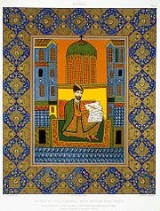
Shota Rustaveli

Encyclopedia
Shota Rustaveli (1172–1216) was a Georgian
poet of the 12th century, and one of the greatest contributors to Georgian literature. He is author of "The Knight in the Panther's Skin
" (ვეფხისტყაოსანი, Vepkhistkaosani), the Georgian national epic poem
.
at Jerusalem. The fresco was described by the Georgian pilgrim Timote Gabashvili in 1757/58, and rediscovered by a team of Georgian scholars in 1960. The same Jerusalem document speaks of Shota as a sponsor of the monastery and a "high treasurer," thus echoing a popular legend that Rustaveli was a minister at Queen Tamar’s court and retired to the monastery at an advanced age. Both a folk tradition and the 17th century royal poet Archil
identify Rustaveli as a native of the southern Georgian region of Meskheti
, where his home village Rustavi was located (not to be confused with the modern-day city of Rustavi
near Tbilisi
). He is assumed to have been born between 1160 and 1165. A legend states that Rustaveli was educated at the medieval Georgian academies of Gelati
and Ikalto
, and then in "Greece
" (i.e., the Byzantine Empire
). He must have produced his major work no earlier than the 1180s and no later than the first decade of the 13th century, most probably c. 1205-1207.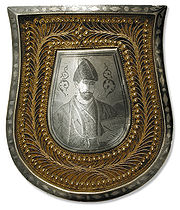
" has been translated into many languages. It was first printed in 1712 in the Georgian capital Tbilisi
. The manuscripts of "The Knight in the Panther's Skin" occupy an important place among the works produced in Georgia.
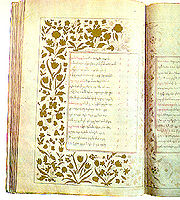 Two folios of this text, dating from the 16th century, are located in the Institute of Manuscripts of Georgia in Tbilisi, and some lines of the poem from the 14th century are also held there. All other copies of the poem date from the 17th century.
 The highest Georgian state prize in the fields of art and literature is the Shota Rustaveli State Prize
. Tbilisi's main thoroughfare is Rustaveli Avenue. In Tbilisi, one can also find the Rustaveli Theatre
, the Shota Rustaveli Institute of Georgian Literature of the Georgian Academy of Sciences
, and the Shota Rustaveli Underground Station, among many other landmarks bearing his name.
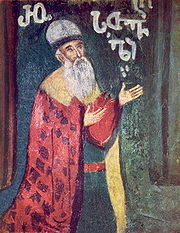
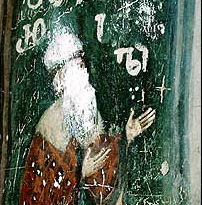 The fresco representing the legendary Georgian poet Shota Rustaveli was vandalized in June 2004 in the 11th-century Georgian-built Monastery of the Holy Cross
. An unknown vandal scratched out the face of Shota Rustaveli and part of the accompanying Georgian inscription with his name on the south-west pier. Georgia officially complained to Israel after the priceless fresco was defaced in Jerusalem.
and Georgia jointly issued postage stamp
s to honor Shota Rustaveli. Designed by Yitzhak Granot, the Israeli stamp (3.40 NIS) showed the author with Hebrew text in the background.
, a 19th century Hungarian
painter, rose to the rank of "national painter" in Georgia as he produced the classic illustrations that have been frequently used in editions of Rustaveli's poetry. A sculpture and a street commemorate Zichy's work in Tbilisi
.
Georgia (country)
Georgia is a sovereign state in the Caucasus region of Eurasia. Located at the crossroads of Western Asia and Eastern Europe, it is bounded to the west by the Black Sea, to the north by Russia, to the southwest by Turkey, to the south by Armenia, and to the southeast by Azerbaijan. The capital of...
poet of the 12th century, and one of the greatest contributors to Georgian literature. He is author of "The Knight in the Panther's Skin
The Knight in the Panther's Skin
The Knight in the Panther's Skin is an epic poem, consisting of over 1600 shairi quatrains, was written in the 12th century by the Georgian epic-poet Shota Rustaveli, who was a Prince and Treasurer at the royal court of Queen Tamar of Georgia. The Knight in the Panther's Skin is often seen as...
" (ვეფხისტყაოსანი, Vepkhistkaosani), the Georgian national epic poem
Epic poetry
An epic is a lengthy narrative poem, ordinarily concerning a serious subject containing details of heroic deeds and events significant to a culture or nation. Oral poetry may qualify as an epic, and Albert Lord and Milman Parry have argued that classical epics were fundamentally an oral poetic form...
.
Biography
Little, if anything, is known about Rustaveli from contemporary sources. His poem itself, namely the prologue, provides a clue to his identity: the poet identifies himself as "a certain Rustveli." "Rustveli" is not a surname, but a territorial epithet which can be interpreted as "of/from/holder of Rustavi." Later Georgian authors of the 15th-18th centuries are more informative: they are almost unanimous in identifying him as Shota Rustaveli, a name which is preserved on a fresco and a document from the formerly Georgian Monastery of the Holy CrossMonastery of the Cross
The Monastery of the Cross is a monastery near the Nayot neighborhood of Jerusalem, Israel. It is located in the Valley of the Cross, below the Israel Museum and the Knesset.- History :...
at Jerusalem. The fresco was described by the Georgian pilgrim Timote Gabashvili in 1757/58, and rediscovered by a team of Georgian scholars in 1960. The same Jerusalem document speaks of Shota as a sponsor of the monastery and a "high treasurer," thus echoing a popular legend that Rustaveli was a minister at Queen Tamar’s court and retired to the monastery at an advanced age. Both a folk tradition and the 17th century royal poet Archil
Archil of Imereti
Archil , was a Georgian prince of the Bagrationi Dynasty and poet. He ruled as king of Imereti in western Georgia and of Kakheti in eastern Georgia...
identify Rustaveli as a native of the southern Georgian region of Meskheti
Meskheti
Meskheti is in a mountainous area of Moschia and is a former province in southwestern Georgia. The ancient Georgian tribes of Meskhi and Mosiniks were the indigenous population of this region. A majority of the modern Georgian population of Meskheti are descendants of these ancient tribes...
, where his home village Rustavi was located (not to be confused with the modern-day city of Rustavi
Rustavi
Rustavi is a city in the southeast of Georgia, in the province of Kvemo Kartli, situated southeast of the capital Tbilisi. It stands on the Mtkvari River at...
near Tbilisi
Tbilisi
Tbilisi is the capital and the largest city of Georgia, lying on the banks of the Mt'k'vari River. The name is derived from an early Georgian form T'pilisi and it was officially known as Tiflis until 1936...
). He is assumed to have been born between 1160 and 1165. A legend states that Rustaveli was educated at the medieval Georgian academies of Gelati
Gelati
Gelati may refer to:* Gelati Monastery, a medieval monastery in Georgia* Gelato, an Italian ice cream* A layered parfait of water ice and frozen custard, popular in the Philadelphia metropolitan region...
and Ikalto
Ikalto
Ikalto is a village about 10 km west of the town Telavi in the Kakheti region of Eastern Georgia. It is mostly known for its monastery complex and the Ikalto Academy....
, and then in "Greece
Greece
Greece , officially the Hellenic Republic , and historically Hellas or the Republic of Greece in English, is a country in southeastern Europe....
" (i.e., the Byzantine Empire
Byzantine Empire
The Byzantine Empire was the Eastern Roman Empire during the periods of Late Antiquity and the Middle Ages, centred on the capital of Constantinople. Known simply as the Roman Empire or Romania to its inhabitants and neighbours, the Empire was the direct continuation of the Ancient Roman State...
). He must have produced his major work no earlier than the 1180s and no later than the first decade of the 13th century, most probably c. 1205-1207.
His work
"The Knight in the Panther's SkinThe Knight in the Panther's Skin
The Knight in the Panther's Skin is an epic poem, consisting of over 1600 shairi quatrains, was written in the 12th century by the Georgian epic-poet Shota Rustaveli, who was a Prince and Treasurer at the royal court of Queen Tamar of Georgia. The Knight in the Panther's Skin is often seen as...
" has been translated into many languages. It was first printed in 1712 in the Georgian capital Tbilisi
Tbilisi
Tbilisi is the capital and the largest city of Georgia, lying on the banks of the Mt'k'vari River. The name is derived from an early Georgian form T'pilisi and it was officially known as Tiflis until 1936...
. The manuscripts of "The Knight in the Panther's Skin" occupy an important place among the works produced in Georgia.
Shota Rustaveli State Prize
The Shota Rustaveli State Prize is the highest prize awarded by Georgia in the fields of art and literature. The first prize-winners of this prize were Konstantine Gamsakhurdia , Irakli Abashidze and Lado Gudiashvili in 1965...
. Tbilisi's main thoroughfare is Rustaveli Avenue. In Tbilisi, one can also find the Rustaveli Theatre
Rustaveli Theatre
Rustaveli National Theatre also referred to as Rustaveli State Drama Theatre, is found in Tbilisi, Georgia. The theatre is conveniently located at 17 Rustaveli Avenue, one of the main streets in Tbilisi...
, the Shota Rustaveli Institute of Georgian Literature of the Georgian Academy of Sciences
Georgian Academy of Sciences
The Georgian National Academy of Sciences is a main learned society of the Georgia. It was named Georgian SSR Academy of Sciences until November 1990...
, and the Shota Rustaveli Underground Station, among many other landmarks bearing his name.
Vandalism of Rustaveli fresco in Israel
Monastery of the Cross
The Monastery of the Cross is a monastery near the Nayot neighborhood of Jerusalem, Israel. It is located in the Valley of the Cross, below the Israel Museum and the Knesset.- History :...
. An unknown vandal scratched out the face of Shota Rustaveli and part of the accompanying Georgian inscription with his name on the south-west pier. Georgia officially complained to Israel after the priceless fresco was defaced in Jerusalem.
Other
On September 3, 2001, IsraelIsrael
The State of Israel is a parliamentary republic located in the Middle East, along the eastern shore of the Mediterranean Sea...
and Georgia jointly issued postage stamp
Postage stamp
A postage stamp is a small piece of paper that is purchased and displayed on an item of mail as evidence of payment of postage. Typically, stamps are made from special paper, with a national designation and denomination on the face, and a gum adhesive on the reverse side...
s to honor Shota Rustaveli. Designed by Yitzhak Granot, the Israeli stamp (3.40 NIS) showed the author with Hebrew text in the background.
Mihály Zichy
Mihály ZichyMihály Zichy
Mihály Zichy |Zala]], HungaryFebruary 28, 1906, St. Petersburg, Russia) was a Hungarian painter and graphic artist.Mihály Zichy was a significant representative of Hungarian romantic painting. During his law studies in Pest from 1842, he attended Jakab Marastoni's school as well. In Vienna he was...
, a 19th century Hungarian
Kingdom of Hungary
The Kingdom of Hungary comprised present-day Hungary, Slovakia and Croatia , Transylvania , Carpatho Ruthenia , Vojvodina , Burgenland , and other smaller territories surrounding present-day Hungary's borders...
painter, rose to the rank of "national painter" in Georgia as he produced the classic illustrations that have been frequently used in editions of Rustaveli's poetry. A sculpture and a street commemorate Zichy's work in Tbilisi
Tbilisi
Tbilisi is the capital and the largest city of Georgia, lying on the banks of the Mt'k'vari River. The name is derived from an early Georgian form T'pilisi and it was officially known as Tiflis until 1936...
.
External links
- The Man in the Panther's Skin: full text of M. Wardrop's English translation.
- Shota Rustaveli. "The Knight in the Panther's Skin" (Fragments in English).
- Illustrations by Sergo Kobuladze.
- "Shota Rustaveli. "Der Ritter im Tigerfell" (In German).
- Shota Rustaveli Institute of Georgian Literature of the Georgian Academy of Sciences.
Literature
- Tite MargwelaschwiliTite MargwelaschwiliTite Margwelaschwili was a Georgian philosopher and writer. He studied at the University of Leipzig and did a doctor's degree in history at the University Halle-Wittenberg in 1914...
. "Der Mann in Pantherfell".- "Georgica", London, 1936 (in German) - Zviad GamsakhurdiaZviad GamsakhurdiaZviad Gamsakhurdia was a dissident, scientist and writer, who became the first democratically elected President of the Republic of Georgia in the post-Soviet era...
. "Tropology of "The Knight in the Panther's skin"" (a monograph), Tbilisi, 1991, 352 pp (in Georgian, English summary)