

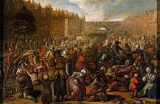
Dutch Revolt

Encyclopedia
The Dutch Revolt or the Revolt of the Netherlands (1566 or 1568–1609)This article adopts 1568 as the starting date of the war, as this was the year of the first battles between armies. However, since there is a long period of Protestant vs. Catholic (establishment) unrest leading to this war, it is not easy to give an exact date when the war started.
The first open violence that would lead to the war was the 1566 iconoclasm, and sometimes the first Spanish repressions of the riots (i.e. battle of Oosterweel
, 1567) are considered the starting point. Most accounts cite the 1568 invasions of armies of mercenaries paid by William of Orange as the official start of the war; this article adopts that point of view. Alternatively, the start of the war is sometimes set at the capture of Brielle
by the Gueux in 1572. was the partially successful revolt of the Protestant Seventeen Provinces
of the defunct Duchy of Burgundy
in the Low Countries
against the ardent militant religious policies of Roman Catholicism pressed by both Charles V and his son Philip II of Spanish Empire
. The religious 'clash of cultures
' built up gradually but inexorably into outbursts of violence against the perceived repression of the Spanish Crown. These tensions marked the beginning of the Thirty Years' War
and led to the formation of the independent Dutch Republic
. The first leader was William of Orange
, followed by several of his descendants and relations. This revolt was one of the first successful secession
s in Europe, and led to one of the first European republics of the modern era, the United Provinces.
Spain was initially successful in suppressing the rebellion. In 1572, however, the rebels captured Brielle
and the rebellion resurged. The northern provinces became independent, first de facto
, and in 1648 de jure
. During the revolt, the United Provinces of the Netherlands, better known as the Dutch Republic
, rapidly grew to become a world power through its merchant shipping and experienced a period of economic, scientific, and cultural growth. The Southern Netherlands
(situated in modern-day Belgium
, Luxembourg
, northern France
and southern Netherlands; see Spanish Netherlands and French Netherlands) remained under Spanish rule. The continuous heavy-handed rule by the Spanish in the south caused many of its financial, intellectual, and cultural elite to flee north, contributing to the success of the Dutch Republic. The Dutch imposed a rigid blockade on the southern provinces which prevented Baltic grain relieving famine in the southern towns, especially in the years 1587-9. Additionally, by the end of the war in 1648 large areas of the Southern Netherlands had been lost to France which had, under the guidance of Cardinal Richelieu and Louis XIII of France
, allied itself with the Dutch Republic in the 1630s against Spain.
The first phase of the conflict can be considered to be the Dutch War of Independence. The focus of the latter phase was to gain official recognition of the already de facto independence of the United Provinces. This phase coincided with the rise of the Dutch Republic as a major power and the founding of the Dutch Empire
.
expanded their original territory by adding to it a series of fiefdoms, including the Seventeen Provinces
. Although Burgundy
itself had been lost to France in 1477, the Burgundian Netherlands were still intact when Charles V
was born in Ghent
in 1500. He was raised in the Netherlands and spoke fluent Dutch, French, Spanish, and some German. In 1506 he became lord of the Burgundian states, among which were the Netherlands. Subsequently, in 1516, he inherited several titles, including the combined kingdoms of Aragon
, and Castile and León
which had become a worldwide empire with the Spanish colonization of the Americas
. In 1519 he became ruler of the Habsburg empire, and he gained the title Holy Roman Emperor
in 1530. Although Friesland
and Guelders
offered prolonged resistance (under Grutte Pier
and Charles of Egmond, respectively), virtually all of the Netherlands had been incorporated into the Habsburg domains by the early 1540s.
had long been a very wealthy region, and had been coveted by the French kings for a long time. The other Netherlands had also grown into wealthy and entrepreneur
ial regions within the empire. Charles V
's empire became a worldwide empire with large American and European territories. The latter were, however, distributed throughout Europe. Control and defence of these were hampered by the disparateness of the territories and huge length of the empire's borders. This large realm was almost continuously at war with its neighbours in its European heartlands, most notably against France in the Italian Wars
and against the Turks
in the Mediterranean Sea
. Further wars were fought against Protestant princes in Germany
. The Netherlands paid heavy taxes to fund these wars, but perceived them as unnecessary and sometimes downright harmful, because they were directed against their most important trading partners.
, felt it was their duty to fight Protestantism, which was considered a heresy
by the Catholic Church. The harsh measures led to increasing grievances in the Netherlands, where the local governments had embarked on a course of peaceful coexistence. In the second half of the century, the situation escalated. Philip sent troops to crush the rebellion and make the Netherlands once more a Catholic region.
The Dutch Protestants compared their humble lifestyle favorably with the supposedly luxurious habits of the ecclesiastical nobility.
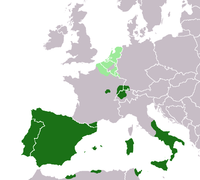
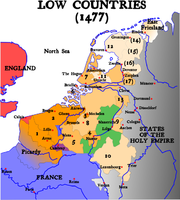 Part of the shifting balance of power in the late Middle Ages meant that besides the local nobility, many of the Dutch administrators by now were not traditional aristocrat
s, but instead stemmed from non-noble families that had risen in status over the last centuries. By the 15th century, Brussels
had thus become the de facto capital of the Seventeen Provinces.
Dating back to the Middle Ages the districts of the Netherlands, represented by its nobility and the wealthy city-dwelling merchants still had a large measure of autonomy in appointing its administrators. Charles V and Philip II set out to improve the management of the empire by increasing the authority of the central government in matters like law and taxes, a policy which caused suspicion both among the nobility and the merchant class. An example of this is the takeover of power in the city of Utrecht
in 1528 when Charles V supplanted the council of guild
masters governing the city by his own stadtholder
, who took over worldly powers in the whole province of Utrecht from the archbishop of Utrecht
. Charles ordered the construction of the heavily fortified castle of Vredenburg
, for defence against the Duchy of Gelre and to control the citizens of Utrecht.
Under the governorship of Mary of Hungary (1531–1555), traditional power had for a large part been taken away both from the stadtholders of the provinces and from the high noblemen, who had been replaced by professional jurists in the Council of State
.
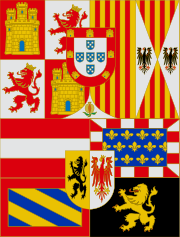
. Charles, despite his harsh actions, had been seen as a ruler empathetic to the needs of the Netherlands. Philip, on the other hand, was raised in Spain and spoke neither Dutch nor French. During Philip's reign, tensions flared in the Netherlands over heavy taxation, suppression of Protestantism, and centralisation efforts. The growing conflict would reach a boiling point and would lead ultimately to the war of independence.
as governor of the Netherlands. He continued the policy of his father of appointing members of the high nobility of the Netherlands to the Raad van State (Council of State), the governing body of the seventeen Netherlands, that advised her. He made his confidant Antoine Perrenot de Granvelle
head of that Council. However, already in 1558 the States of the provinces and the States-General of the Netherlands
started to contradict Philip's wishes, by objecting to his tax proposals and by demanding, with eventual success, the withdrawal of Spanish troops which had been left by Philip to guard the Southern Netherlands' borders with France, but which they saw as a threat to their own independence (1559–1561). Subsequent reforms met with much opposition, which was mainly directed at Granvelle. Petitions to King Philip by the high nobility went unanswered. Some of the most influential nobles, including Lamoral, Count of Egmont
, Philip de Montmorency, Count of Hoorn
, and William the Silent
, withdrew from the Council of State until Philip recalled Granvelle. In late 1564, the nobles had noticed the growing power of the reformation and urged Philip to come up with realistic measures to prevent violence. Philip answered that sterner measures could be the only answer. Subsequently Egmont, Horne and Orange withdrew once more from the Council and Bergen and Meghem resigned their Stadholdership. During the same period, the religious protests were increasing in spite of increased oppression. In 1566, a league of about 400 members of the nobility presented a petition to the governor Margaret of Parma
, to suspend persecution until the rest had returned. One of Margaret's courtiers, Count Berlaymont
, called the presentation of this petition an act of 'beggars' (French gueux), a name taken up as an honour by the petitioners (Geuzen
). The petition was sent on to Philip for a final verdict.
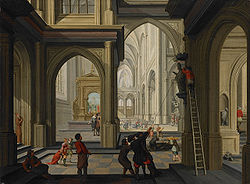
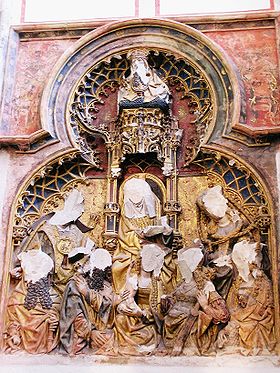 The atmosphere in the Netherlands was tense due to the rebellion preaching of Calvinist leaders, hunger after the bad harvest of 1565, and economic difficulties due to the Northern Seven Years' War
. Early August 1566, a monastery church at Steenvoorde
in Flanders (now in Northern France) was sacked by a mob led by the preacher Sebastian Matte. This incident was followed by similar riots elsewhere in Flanders, and before long the Netherlands had become the scene of the Beeldenstorm
, a riotous iconoclastic
movement by Calvinists, who stormed churches and other religious buildings to desecrate and destroy church art and all kinds of decorative fittings over most of the country. The number of actual image-breakers appears to have been relatively small and the exact backgrounds of the movement are debated, but in general, local authorities did not step in to rein in the vandalism. The actions of the iconoclasts drove the nobility into two camps, with Orange and other grandees opposing the movement and others, notably Henry of Brederode, supporting it. Even before he answered the petition by the nobles, Philip had lost control in the troublesome Netherlands. He saw no other option than to send an army
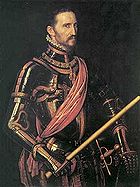
to suppress the rebellion. On 22 August 1567, Fernando Álvarez de Toledo, 3rd Duke of Alba
, marched into Brussels at the head of 10,000 troops.
 Alba took harsh measures and rapidly established a special court (Raad van Beroerten or Council of Troubles
) to judge anyone who opposed the King. No one, not even high nobility who had been pleading for less harsh measures, was safe. Alba considered himself the direct representative of Philip in the Netherlands and frequently bypassed Margaret of Parma and made use of her to lure back some of the fugitive nobles, notably the counts of Egmont and Horne
, causing her to resign office in September 1567. Egmont and Horne were arrested for high treason, condemned, and a year later decapitated
on the Grand Place
in Brussels. Egmont and Horne had been Catholic nobles who were loyal to the King of Spain until their death. The reason for their execution was that Alba considered they had been treasonous to the king in their tolerance to Protestantism. Their death, ordered by a Spanish noble, rather than a local court, provoked outrage throughout the Netherlands. Over one thousand people were executed in the following months. The large number of executions led the court to be nicknamed the "Blood Court" in the Netherlands, and Alba to be called the "Iron Duke". Rather than pacifying the Netherlands, these measures helped to fuel the unrest.
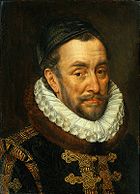
 William I of Orange was stadtholder
of the provinces Holland, Zeeland
and Utrecht
, and Margrave
of Antwerp; and the most influential noble in the States General who had signed the petition. After the arrival of Alba, to avoid arrest, as had happened to Egmont and Horne, he fled to the lands ruled by his wife
's father — the Count
-Elector of Saxony
. All his lands and titles in the Netherlands were forfeited to the Spanish King.
In 1568, William returned to try to drive the highly unpopular Duke of Alba from Brussels
. He did not see this as an act of treason against the King (Philip II
), but as an option for reconciliation with the Spanish King. William's disposing of misguided ministers like Alba would allow the king to take his legal place once more. This view is reflected in today's Dutch national anthem
, the Wilhelmus
, in which the last lines of the first stanza read: den koning van Hispanje heb ik altijd geëerd (I have always honoured the King of Spain). In pamphlets and in his letters to allies in the Netherlands William also called attention to the right of subjects to renounce their oath of obedience if the sovereign would not respect their privileges. An attempt was made to encroach on the Netherlands from four different directions, with armies led by his brothers invading from Germany and with French Huguenots invading from the south. Although the Battle of Rheindalen
near Roermond
occurred already on 23 April 1568 and was won by the Spanish, the Battle of Heiligerlee
, fought on 23 May 1568, is commonly regarded as the beginning of the Eighty Years' War, and it resulted in a victory for the rebel army. But the campaign ended in failure as William ran out of money and his own army disintegrated, while those of his allies were destroyed by the Duke of Alba.
William of Orange stayed at large and, being the only one of the grandees still able to offer resistance, was from then on seen as the leader of the rebellion. When the revolt broke out once more in 1572 he moved his court back to the Netherlands, to Delft
in Holland, as the ancestral lands of Orange in Breda remained occupied by the Spanish. Delft remained William's base of operations until his assassination by Balthasar Gérard
in 1584.
.jpg) Spain was hampered by the fact that it was waging war on multiple fronts simultaneously.
Spain was hampered by the fact that it was waging war on multiple fronts simultaneously.
Its struggle against the Ottoman Empire
in the Mediterranean Sea
put serious limits on the military power it could deploy against the rebels in the Netherlands. France too was opposing Spain at every juncture. Furthermore, England, particularly English privateers, were harassing Spanish shipping and its colonies in the Atlantic.
Already in 1566 William I of Orange had asked for Ottoman support. As Suleiman the Magnificent
claimed that he felt religiously close to the Protestants, ("since they did not worship idols, believed in one God and fought against the Pope and Emperor") he supported the Dutch
together with the French
and the English
, as well as generally support Protestants and Calvinists, as a way to counter Habsburg attempts at supremacy in Europe.
Even so, by 1570 the Spanish had more or less suppressed the rebellion throughout the Netherlands. However, in March 1569, in an effort to finance his troops, Alva had proposed to the States that new taxes be introduced, among them the "Tenth Penny", a 1/10 levy on all sales other than landed property.
This proposal was rejected by the States, and a compromise was subsequently agreed upon. Then, in 1571, Alba decided to press forward with the collection of the Tenth Penny regardless of the States' opposition. This aroused strong protest from both Catholics and Protestants, and support for the rebels grew once more and was fanned by a large group of refugees who had fled the country during Alva's rule.
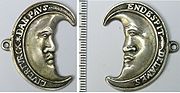 On March 1, 1572, the English Queen Elizabeth I ousted the Gueux, known as Sea Beggars, from the English harbours in an attempt to appease the Spanish King. The Gueux under their leader Lumey
then unexpectedly captured the almost undefended town of Brill
on April 1. In securing Brill, the rebels had gained a foothold, and more importantly a token victory in the north. This was a sign for Protestants all over the Low Countries to rebel once more.
Most of the important cities in the provinces of Holland and Zealand declared loyalty to the rebels. Notable exceptions were Amsterdam
and Middelburg
, which remained loyal to the Catholic cause until 1578. William of Orange was put at the head of the revolt. He was recognized as Governor-General and Stadholder of Holland, Zeeland, Friesland and Utrecht at a meeting in Dordrecht
in July 1572. It was agreed that power would be shared between Orange and the States. With the influence of the rebels rapidly growing in the northern provinces, the war entered a second and more decisive phase.
However, this also led to an increased discord amongst the Dutch. On one side there was a militant Calvinist minority that wanted to continue fighting the Catholic Philip II and convert all Dutch citizens to Calvinism. On the other end was a mostly Catholic minority that wanted to remain loyal to the governor and his administration in Brussels. In between was the large majority of (Catholic) Dutch that had no particular allegiance, but mostly wanted to restore Dutch privileges and the expulsion of the Spanish mercenary armies. William of Orange was the central figure who had to rally these groups to a common goal. In the end he was forced to move more and more towards the radical Calvinist side, because the Calvinists were most fanatic in fighting the Spanish. He went over to Calvinism himself in 1573.
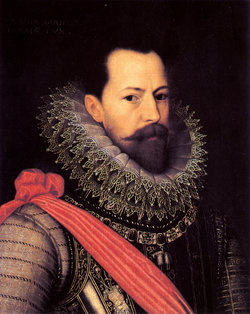
 Being unable to deal with the rebellion, Alba was replaced in 1573 by Luis de Requesens and a new policy of moderation was attempted. Spain, however, had to declare bankruptcy in 1575.
Don Luis de Requesens had not managed to broker a policy acceptable to both the Spanish King and the Netherlands when he died in early 1576.
The inability to pay the Spanish mercenary armies endured, leading to numerous mutinies and in November 1576 troops sacked Antwerp
at the cost of some 8,000 lives. This so-called "Spanish Fury" strengthened the resolve of the rebels in the 17 provinces to take fate into their own hands.
The Netherlands negotiated an internal treaty, the Pacification of Ghent
in the same year 1576, in which the provinces agreed to religious tolerance and pledged to fight together against the mutinous Spanish forces.
For the mostly Catholic provinces, the destruction by mutinous foreign troops was the principal reason to join in an open revolt, but formally the provinces still remained loyal to the sovereign Philip II.
However, some religious hostilities continued and Spain, aided by shipments of Bullion from the New World
, was able to send a new army under Alexander Farnese, Duke of Parma and Piacenza.
, Hainault
and the so-called Walloon Flanders
located in what is now France and Wallonia) left the alliance agreed upon by the pacification of Ghent and signed the Union of Arras (Atrecht), expressing their loyalty to the Spanish king. This meant an early end to the goal of united independence for the 17 provinces of the Low Countries on the basis of religious tolerance, agreed upon only three years previously.
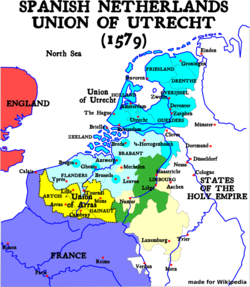
In response to the union of Arras, William united the provinces of Holland, Zeeland, Utrecht, Guelders
and Groningen
in the Union of Utrecht
on January 23, 1579; Brabant
and Flanders
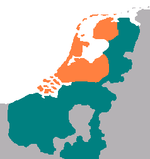
joined a month later, in February 1579. Effectively, the 17 provinces were now divided into a southern group loyal to the Spanish king, and a rebellious northern group.
tried to find a suitable replacement for Philip. The Protestant Queen of England, Elizabeth I
seemed the obvious choice to be protector of the Netherlands. Elizabeth, however, found the idea abhorrent as she had learned from her mistake intervening with the French Huguenots Treaty of Hampton Court
, and had promised herself not to involve herself in any of her fellow Monarchs’ domestic affairs for not only would intervention provoke Philip but it would set an inconvenient precedent; if she could interfere in other Monarchs affairs, they very well might return the favour. Subsequently Elizabeth did break her promise by guaranteeing the Dutch rebels aid with the Treaty of Nonsuch
in 1585, and as a consequence Philip aided the Irish in the Nine Years War. The States-General
responded to Elizabeth's refusal by inviting the younger brother of the French King, the Duke of Anjou
, to be sovereign ruler. Anjou accepted on the condition that the Netherlands officially denounce any loyalty to Philip. In 1581, the Act of Abjuration was issued, in which the Netherlands proclaimed that the King of Spain had not upheld his responsibilities to the Netherlands population and would therefore no longer be accepted as rightful King. Anjou was, however, deeply distrusted by the population and he became increasingly bothered by the limited influence the States were willing to allow him. After some effort to increase his power by military action against the uncooperative cities, Anjou left the Netherlands in 1583.
Elizabeth was now offered the sovereignty of the Netherlands, but she declined. All options for foreign royalty being exhausted, the civilian body States General eventually decided to rule as a republican body instead.
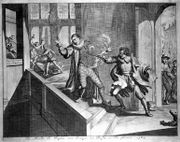 Immediately after the Act of Abjuration, Spain sent a new army to recapture the United Provinces. Over the following years, Parma reconquered the major part of Flanders
and Brabant
, as well as large parts of the northeastern provinces. The Roman Catholic
religion was restored in much of this area. In 1585, Antwerp — the largest city in the Low Countries at the time — fell into his hands, which caused over half its population to flee to the north (see also Siege of Antwerp). Between 1560 and 1590, the population of Antwerp plummeted from c. 100,000 inhabitants to c. 42,000.
William of Orange, who had been declared an outlaw
by Philip II in March 1580, was assassinated by a supporter of the King on July 10, 1584. He would be succeeded as leader of the rebellion by his son Maurice of Nassau, Prince of Orange
.
The Netherlands were split into an independent northern part, while the southern part remained under Spanish control. Due to the almost uninterrupted rule of the Calvinist-dominated separatists, most of the population of the northern provinces became converted to Protestantism over the next decades. The south, under Spanish rule, remained a Catholic stronghold; most of its Protestants fled to the north. Spain retained a large military presence in the south, where it could also be used against France.

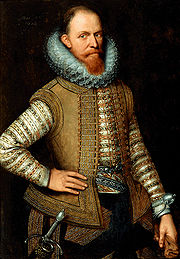 With the war going against them, the United Provinces had sought help from the kingdoms of France and England
and, in February to May 1585, even offered each monarch sovereignty over the Netherlands, but both had declined.
While England had unofficially been supporting the Dutch for years, Elizabeth had not officially supported the Dutch because she was afraid it might aggravate Spain into a war. However, the year before, the Catholics of France had signed a treaty with Spain in order to destroy the French Protestants. Afraid that France would fall under control of the Habsburgs, Elizabeth now decided to act. In 1585, under the Treaty of Nonsuch
, Elizabeth I
sent the Earl of Leicester to take the rule as lord-regent, with 5,000 to 6,000 troops, including 1,000 cavalry. The Earl of Leicester proved to be a poor commander, and also did not understand the sensitive trade arrangements between the Dutch regents and the Spanish. Moreover, Leicester sided with the radical Calvinists, earning him the distrust of the Catholics and moderates. Leicester also collided with many Dutch patricians when he tried to strengthen his own power at the cost of the Provincial States. Within a year of his arrival, he had lost his public support. Leicester returned to England, after which the States-General, being unable to find any other suitable regent, appointed Maurice of Orange (William's son), at the age of 20, to the position of Captain General
of the Dutch army in 1587. On 7 September 1589 Philip II ordered Parma to move all available forces south to prevent Henry of Navarre from becoming King of France. For Spain the Netherlands had become a side show in comparison to the French Wars of Religion
.
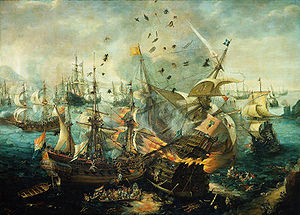
The borders of the present-day Netherlands were largely defined by the campaigns of Maurice of Orange. The Dutch successes owed not only to his tactical skill but also to the financial burden Spain incurred replacing ships lost in the disastrous campaign of the Spanish Armada
in 1588, and the need to refit its navy to recover control of the sea after the subsequent English counter attack
. One of the most notable features of this war are the number of mutinies by the troops in the Spanish army because of arrears of pay. At least 40 mutinies in the period 1570 to 1607 are known. In 1595, when Henry IV of France
declared war against Spain, the Spanish government declared bankruptcy again. However, by regaining control of the sea, Spain was able to greatly increase its supply of gold and silver from the Americas, which allowed it to increase military pressure on England and France.
 Under financial and military pressure, in 1598, Philip ceded the Netherlands to his favorite daughter Isabella
and to her husband, Philip's nephew Archduke Albert of Austria
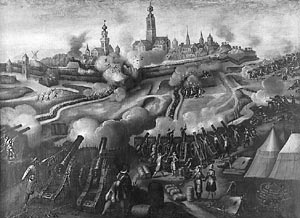
(they proved to be highly competent governors) following the conclusion of the Treaty of Vervins with France. By that time Maurice was engaged in conquering important cities in the Netherlands. Starting with the important fortification of Bergen op Zoom
(1588), Maurice conquered Breda
(1590), Zutphen, Deventer
, Delfzijl
and Nijmegen (1591), Steenwijk
, Coevorden
(1592) Geertruidenberg
(1593) Groningen (1594) Grol
, Enschede
, Ootmarsum
, Oldenzaal (1597) and Grave (1602). As this campaign was restricted to the border areas of the current Netherlands, the heartland of Holland remained at peace, during which time it moved into its Golden age
.
By now, it had become clear that Spanish control of the Southern Netherlands was strong. However, control over Zeeland meant that the Northern Netherlands could control and close the estuary of the Scheldt
, the entry to the sea for the important port of Antwerp. The port of Amsterdam benefited greatly from the blockade of the port of Antwerp, to the extent that merchants in the North began to question the desirability of reconquering the South. A campaign to control the Southern provinces' coast region was launched against Maurice's advice in 1600. Although portrayed as a liberation of the Southern Netherlands, the campaign was chiefly aimed at eliminating the threat to Dutch trade posed by the Spanish-supported Dunkirkers
. The Spaniards strengthened their positions along the coast, leading to the Battle of Nieuwpoort
.
Although the States-General army won great acclaim for itself and its commander by inflicting a then-surprising defeat of a Spanish army in open battle, Maurice halted the march on Dunkirk and returned to the Northern Provinces. Maurice never forgave the regents, led by van Oldenbarneveld, for being sent on this mission. By now the division of the Netherlands into separate states had become almost inevitable. With the failure to eliminate the Dunkirk threat to trade, the states decided to build up their navy to protect sea trade, which had greatly increased through the creation of the Dutch East Indies Company in 1602. The strengthened Dutch fleets would prove to be a formidable force, hampering Spain's naval ambitions thereafter.
, afterwards called the Twelve Years' Truce
, between the United Provinces and the Spanish controlled southern states, mediated by France and England at The Hague
. It was during this ceasefire the Dutch made great efforts to build their navy, which was later to have a crucial bearing on the course of the war.
During the Truce, two factions emerged in the Dutch camp, along political and religious lines. On one side were the Arminians
, whose prominent supporters included Johan van Oldenbarnevelt and Hugo Grotius
. They tended to be well-to-do merchants who accepted a less strict interpretation of the Bible than did classical Calvinists. They were opposed by the more radical Gomarists, who had openly proclaimed their allegiance to Prince Maurice in 1610. In 1617 the conflict escalated when republicans pushed the "Sharp Resolution", allowing the cities to take measures against the Gomarists. Prince Maurice accused van Oldenbarnevelt of treason, had him arrested, and in 1619, executed. Hugo Grotius fled the country after escaping from imprisonment in Castle Loevestein
.
and the Americas) which could not be resolved. The Spanish made one last effort to reconquer the North, and the Dutch used their navy to enlarge their colonial trade routes to the detriment of Spain. The war was on once more — and crucially, merging with the wider Thirty Years' War
.
In 1622, a Spanish attack on the important fortress town of Bergen op Zoom
was repelled. However, in 1625 Maurice died while the Spanish laid siege to the city of Breda
. Ignoring orders, the Spanish commander Ambrogio Spinola succeeded in conquering the city of Breda. The war was now more focused on trade, much of it in between the Dutch and the Dunkirkers
, but also Dutch attacks on Spanish convoys but above all the seizure of the undermanned Portuguese trading forts and ill defended territories. Maurice's half-brother, Frederick Henry
had succeeded his brother and took command of the army. Frederick Henry conquered the pivotal fortified city of 's-Hertogenbosch in 1629. This town, largest in the northern part of Brabant, had been considered to be impregnable from attack. Its loss was a serious blow to the Spanish.
In 1632, Frederick Henry captured Venlo
, Roermond
, and Maastricht
during his famous "March along the Meuse" in a pincer move to prepare for the conquest of the major cities of Flanders. Attempts in the next years to attack Antwerp and Brussels failed, however. The Dutch were disappointed by the lack of support they received from the Flemish population. This was mainly because of the pillaging of Tienen and the new generation that had been raised in Flanders and Brabant, that had been thoroughly reconverted to Roman Catholicism and now distrusted the Calvinist Dutch even more than it loathed the Spanish occupants.
 As more European countries began to build their empires, the war between the countries extended to colonies
as well. Battles for profitable colonies were fought as far away as Macau
, East Indies
, Ceylon, Formosa (Taiwan
), the Philippines
, Brazil
, and others. The most important of these conflicts would become known as the Dutch-Portuguese War
. The Dutch carved out a trading empire all over the world, using their dominance at sea to great advantage. The Dutch East India Company
was founded to administer all Dutch trade with the East, while the Dutch West India Company
did the same for the West.
In the Western colonies, the Dutch States General mostly restricted itself to supporting privateer
ing by their captains in the Caribbean to drain the Spanish coffers, and to fill their own. The most successful of these raids was the capture of the larger part of the Spanish treasure fleet
by Piet Hein
in 1628; which allowed Frederick Henry to finance the siege of 's Hertogenbosch; and seriously troubled Spanish payments of troops. But attempts were also made to conquer existing colonies or found new ones in Brazil, North America and Africa. Most of these would be only briefly or partially successful. In the East the activities led to the conquest of many profitable trading colonies, a major factor in bringing about the Dutch Golden Age
.
bound for Flanders
, carrying 20,000 troops to assist in a last large scale attempt to defeat the northern "rebels". The armada was decisively defeated by Lieutenant-Admiral Maarten Tromp
in the Battle of the Downs
. This victory had historic consequences far beyond the Eighty Years' War as it marked the end of Spain as the dominant sea power.
An alliance with France changed the balance of power. The Republic could now hope to reconquer the Southern Netherlands. However, this would not mean that they would become a part of the Netherlands, but that they would be divided among the victors, resulting in a powerful French state bordering on the Republic. Furthermore it would mean that the port of Antwerp would most likely no longer be blockaded and might become serious competition for Amsterdam. With the Thirty Years' War
decided, there was also no longer any need to fight on in order to support fellow Protestant nations. As a result, the decision was made to end the war.
 On January 30, 1648, the war ended with the Treaty of Münster
between Spain and the Netherlands. In Münster on May 15, 1648, the parties exchanged ratified copies of the treaty. This treaty was part of the European scale Peace of Westphalia
that also ended the Thirty Years' War
. In the treaty, the power balance in Western Europe was readjusted to the actual geopolitical reality. This meant that de jure the Dutch Republic was recognised as an independent state and retained control over the territories that were conquered in the later stages of the war. The new republic consisted of seven provinces: Holland, Zeeland, Utrecht, Guelders, Overijssel
, Friesland
, and Groningen. Each province was governed by its local Provincial States and by a stadtholder. In theory, each stadtholder was elected and subordinate to the States-General. However, the princes of Orange-Nassau, beginning with William I of Orange, became de facto hereditary stadtholders in Holland and Zeeland. In practice they usually became stadtholder of the other provinces as well. A constant power struggle, which already had shown its precursor during the Twelve years' Truce, emerged between the Orangists
, who supported the stadtholders, and the Regent's supporters.
The border states, parts of Flanders, Brabant and Limburg that were conquered by the Dutch in the final stages of the war, were to be federally governed by the States-General. The so called Generality Lands
(Generaliteitslanden), which consisted of Staats-Brabant (present North Brabant
), Staats-Vlaanderen (present Zeeuws-Vlaanderen
) and Staats-Limburg (around Maastricht
).
The peace would not be long-lived as the newly emerged world powers, the Republic of the Netherlands and the Commonwealth of England
, would start their first war in 1652, only four years after the peace was signed.
, which demanded much of Spain's financial and human resources.
As the revolt and its suppression centered largely around issues of religious freedom and taxation, the conflict necessarily involved not only soldiers, but also civilians at all levels of society. This may be one reason for the resolve and subsequent successes of the Dutch rebels in defending cities. Another factor was the fact that the unpopularity of the Spanish army, which existed even before the start of the revolt, was exacerbated when in the early stage of the war a few cities were purposely sacked by the Spanish troops after having surrendered; this was done in order to intimidate the remaining rebel cities into surrender. Given the involvement of all sectors of Dutch society in the conflict, a more-or-less organized, irregular army emerged alongside the regular forces. Among these were the geuzen
(from the French word "gueux" meaning "beggars"), who waged a guerrilla
war against Spanish interests. Especially at sea, the 'watergeuzen' were effective agents of the Dutch cause.
Another aspect of warfare in the Netherlands was its relatively static character. There were very few pitched battles where armies met in the field. Most military operations were sieges, as was typical of the era, resulting in protracted and expensive use of the military forces available. The Dutch had fortified most of their cities and even many smaller towns in accordance with the most modern views of the time
, and these cities had to be subdued one by one. Sometimes sieges were broken off when the enemy threatened to attack the besieging army, or, on the Spanish side, conquered cities were given up immediately, or occasionally sold back to the Dutch, when the conquering army turned mutinous.
In the later stages, Maurice raised a professional standing army that was even paid when no hostilities were taking place, a radical innovation in that time and part of the Military Revolution
. This ensured him of loyal soldiers, who were trained in cooperating among each other and were intimately familiar with the doctrines of their commanders and were capable of carrying out complicated manoeuvres.
 In the Pragmatic Sanction of 1549
, Charles V established the Seventeen Provinces of the Netherlands as an entity separate from France, Burgundy, or the Holy Roman Empire. The Netherlands at this point were among the wealthiest regions in Europe, and an important center of trade, finance, and art. The Eighty Years' War introduced a sharp breach in the region, with the Dutch Republic (the present-day Netherlands
) growing into a world power (see Dutch Golden Age
), and the Southern Netherlands (more or less present-day Belgium
) losing much of its economic and cultural significance for centuries to come. The naval blockade during much of the Eighty Years' War of Antwerp, once the largest commercial centre of Europe, greatly contributed to the rise of Amsterdam as the new centre of European and world trade.
Politically, a unique situation had emerged in the Netherlands where a republican body (the States General) ruled, but where a (increasingly hereditary) noble function of Stadtholder was occupied by the house of Orange-Nassau
. This division of power prevented large scale fighting between nobility and civilians as happened in the English Civil War
. The frictions between the civil and noble fractions, that already started in the twelve years' truce, were numerous and would finally lead to an outburst with the French supported Batavian Republic
, where Dutch bourgeoisie
hoped to get rid of the increasing self-esteem in the nobility once and for all. However, in a dramatic resurgence of nobility after the Napoleonic era
the republic would be abandoned in favor of the foundation of the United Kingdom of the Netherlands
. Thus, one of the oldest republics of Europe was turned into a monarchy, which it still is today.
 The conquest of various American
territories made Spain the leading European power of the 16th century. This brought them into continuous conflict with France and the emerging power that was England. In addition, the deeply religious monarchs Charles V and Philip II saw a role for themselves as protectors of the Catholic faith against Islam
in the Mediterranean and against Protestantism in northern Europe. This meant the Spanish Empire was almost continuously at war. Of all these conflicts, the Eighty Years' War was the most prolonged and had a major effect on the Spanish finances and the morale of the Spanish people, who saw taxes increase and soldiers not returning, with little successes to balance the scales. The Spanish government had to declare several bankruptcies
. The Spanish population increasingly questioned the necessity of the war in the Netherlands and even the necessity of the Empire in general. The loss of Portugal
in 1640
and the Peace of Westphalia in 1648, ending the war were the first signs that the role of the Spanish Empire
in Europe was declining.
, and eventually led to the Dutch Republic
. The acceptance of a non-monarchic country by the other European powers in 1648 spread across Europe, fueling resistance against the divine power of Kings.
The first open violence that would lead to the war was the 1566 iconoclasm, and sometimes the first Spanish repressions of the riots (i.e. battle of Oosterweel
Battle of Oosterweel
The Battle of Oosterweel took place on March 13, 1567, and is traditionally seen as the beginning of the Eighty Years' War. The battle was fought near the village of Oosterweel, north of Antwerp. A Spanish professional army under General Beauvoir defeated an army of radical Calvinists rebels under...
, 1567) are considered the starting point. Most accounts cite the 1568 invasions of armies of mercenaries paid by William of Orange as the official start of the war; this article adopts that point of view. Alternatively, the start of the war is sometimes set at the capture of Brielle
Capture of Brielle
The Capture of Brielle by the Sea Beggars, or Watergeuzen, on 1 April 1572 marked a turning point in the uprising of the Low Countries against Spain in the Eighty Years' War. Militarily the success was minor, as Brielle was not being defended at the time...
by the Gueux in 1572. was the partially successful revolt of the Protestant Seventeen Provinces
Seventeen Provinces
The Seventeen Provinces were a personal union of states in the Low Countries in the 15th century and 16th century, roughly covering the current Netherlands, Belgium, Luxembourg, a good part of the North of France , and a small part of Western Germany.The Seventeen Provinces were originally held by...
of the defunct Duchy of Burgundy
Duchy of Burgundy
The Duchy of Burgundy , was heir to an ancient and prestigious reputation and a large division of the lands of the Second Kingdom of Burgundy and in its own right was one of the geographically larger ducal territories in the emergence of Early Modern Europe from Medieval Europe.Even in that...
in the Low Countries
Low Countries
The Low Countries are the historical lands around the low-lying delta of the Rhine, Scheldt, and Meuse rivers, including the modern countries of Belgium, the Netherlands, Luxembourg and parts of northern France and western Germany....
against the ardent militant religious policies of Roman Catholicism pressed by both Charles V and his son Philip II of Spanish Empire
Spanish Empire
The Spanish Empire comprised territories and colonies administered directly by Spain in Europe, in America, Africa, Asia and Oceania. It originated during the Age of Exploration and was therefore one of the first global empires. At the time of Habsburgs, Spain reached the peak of its world power....
. The religious 'clash of cultures
Culture Clash
Culture Clash may refer to:* Culture Clash , American performance troupe* Culture Clash , British band which plays Harare Jit music...
' built up gradually but inexorably into outbursts of violence against the perceived repression of the Spanish Crown. These tensions marked the beginning of the Thirty Years' War
Thirty Years' War
The Thirty Years' War was fought primarily in what is now Germany, and at various points involved most countries in Europe. It was one of the most destructive conflicts in European history....
and led to the formation of the independent Dutch Republic
Dutch Republic
The Dutch Republic — officially known as the Republic of the Seven United Netherlands , the Republic of the United Netherlands, or the Republic of the Seven United Provinces — was a republic in Europe existing from 1581 to 1795, preceding the Batavian Republic and ultimately...
. The first leader was William of Orange
William the Silent
William I, Prince of Orange , also widely known as William the Silent , or simply William of Orange , was the main leader of the Dutch revolt against the Spanish that set off the Eighty Years' War and resulted in the formal independence of the United Provinces in 1648. He was born in the House of...
, followed by several of his descendants and relations. This revolt was one of the first successful secession
Secession
Secession is the act of withdrawing from an organization, union, or especially a political entity. Threats of secession also can be a strategy for achieving more limited goals.-Secession theory:...
s in Europe, and led to one of the first European republics of the modern era, the United Provinces.
Spain was initially successful in suppressing the rebellion. In 1572, however, the rebels captured Brielle
Capture of Brielle
The Capture of Brielle by the Sea Beggars, or Watergeuzen, on 1 April 1572 marked a turning point in the uprising of the Low Countries against Spain in the Eighty Years' War. Militarily the success was minor, as Brielle was not being defended at the time...
and the rebellion resurged. The northern provinces became independent, first de facto
De facto
De facto is a Latin expression that means "concerning fact." In law, it often means "in practice but not necessarily ordained by law" or "in practice or actuality, but not officially established." It is commonly used in contrast to de jure when referring to matters of law, governance, or...
, and in 1648 de jure
De jure
De jure is an expression that means "concerning law", as contrasted with de facto, which means "concerning fact".De jure = 'Legally', De facto = 'In fact'....
. During the revolt, the United Provinces of the Netherlands, better known as the Dutch Republic
Dutch Republic
The Dutch Republic — officially known as the Republic of the Seven United Netherlands , the Republic of the United Netherlands, or the Republic of the Seven United Provinces — was a republic in Europe existing from 1581 to 1795, preceding the Batavian Republic and ultimately...
, rapidly grew to become a world power through its merchant shipping and experienced a period of economic, scientific, and cultural growth. The Southern Netherlands
Southern Netherlands
Southern Netherlands were a part of the Low Countries controlled by Spain , Austria and annexed by France...
(situated in modern-day Belgium
Belgium
Belgium , officially the Kingdom of Belgium, is a federal state in Western Europe. It is a founding member of the European Union and hosts the EU's headquarters, and those of several other major international organisations such as NATO.Belgium is also a member of, or affiliated to, many...
, Luxembourg
Luxembourg
Luxembourg , officially the Grand Duchy of Luxembourg , is a landlocked country in western Europe, bordered by Belgium, France, and Germany. It has two principal regions: the Oesling in the North as part of the Ardennes massif, and the Gutland in the south...
, northern France
France
The French Republic , The French Republic , The French Republic , (commonly known as France , is a unitary semi-presidential republic in Western Europe with several overseas territories and islands located on other continents and in the Indian, Pacific, and Atlantic oceans. Metropolitan France...
and southern Netherlands; see Spanish Netherlands and French Netherlands) remained under Spanish rule. The continuous heavy-handed rule by the Spanish in the south caused many of its financial, intellectual, and cultural elite to flee north, contributing to the success of the Dutch Republic. The Dutch imposed a rigid blockade on the southern provinces which prevented Baltic grain relieving famine in the southern towns, especially in the years 1587-9. Additionally, by the end of the war in 1648 large areas of the Southern Netherlands had been lost to France which had, under the guidance of Cardinal Richelieu and Louis XIII of France
Louis XIII of France
Louis XIII was a Bourbon monarch who ruled as King of France and of Navarre from 1610 to 1643.Louis was only eight years old when he succeeded his father. His mother, Marie de Medici, acted as regent during Louis' minority...
, allied itself with the Dutch Republic in the 1630s against Spain.
The first phase of the conflict can be considered to be the Dutch War of Independence. The focus of the latter phase was to gain official recognition of the already de facto independence of the United Provinces. This phase coincided with the rise of the Dutch Republic as a major power and the founding of the Dutch Empire
Dutch Empire
The Dutch Empire consisted of the overseas territories controlled by the Dutch Republic and later, the modern Netherlands from the 17th to the 20th century. The Dutch followed Portugal and Spain in establishing an overseas colonial empire, but based on military conquest of already-existing...
.
Background
In a series of marriages and conquests, a succession of Dukes of BurgundyDuke of Burgundy
Duke of Burgundy was a title borne by the rulers of the Duchy of Burgundy, a small portion of traditional lands of Burgundians west of river Saône which in 843 was allotted to Charles the Bald's kingdom of West Franks...
expanded their original territory by adding to it a series of fiefdoms, including the Seventeen Provinces
Seventeen Provinces
The Seventeen Provinces were a personal union of states in the Low Countries in the 15th century and 16th century, roughly covering the current Netherlands, Belgium, Luxembourg, a good part of the North of France , and a small part of Western Germany.The Seventeen Provinces were originally held by...
. Although Burgundy
Duchy of Burgundy
The Duchy of Burgundy , was heir to an ancient and prestigious reputation and a large division of the lands of the Second Kingdom of Burgundy and in its own right was one of the geographically larger ducal territories in the emergence of Early Modern Europe from Medieval Europe.Even in that...
itself had been lost to France in 1477, the Burgundian Netherlands were still intact when Charles V
Charles V, Holy Roman Emperor
Charles V was ruler of the Holy Roman Empire from 1519 and, as Charles I, of the Spanish Empire from 1516 until his voluntary retirement and abdication in favor of his younger brother Ferdinand I and his son Philip II in 1556.As...
was born in Ghent
Ghent
Ghent is a city and a municipality located in the Flemish region of Belgium. It is the capital and biggest city of the East Flanders province. The city started as a settlement at the confluence of the Rivers Scheldt and Lys and in the Middle Ages became one of the largest and richest cities of...
in 1500. He was raised in the Netherlands and spoke fluent Dutch, French, Spanish, and some German. In 1506 he became lord of the Burgundian states, among which were the Netherlands. Subsequently, in 1516, he inherited several titles, including the combined kingdoms of Aragon
Aragon
Aragon is a modern autonomous community in Spain, coextensive with the medieval Kingdom of Aragon. Located in northeastern Spain, the Aragonese autonomous community comprises three provinces : Huesca, Zaragoza, and Teruel. Its capital is Zaragoza...
, and Castile and León
Castile and León
Castile and León is an autonomous community in north-western Spain. It was so constituted in 1983 and it comprises the historical regions of León and Old Castile...
which had become a worldwide empire with the Spanish colonization of the Americas
Spanish colonization of the Americas
Colonial expansion under the Spanish Empire was initiated by the Spanish conquistadores and developed by the Monarchy of Spain through its administrators and missionaries. The motivations for colonial expansion were trade and the spread of the Christian faith through indigenous conversions...
. In 1519 he became ruler of the Habsburg empire, and he gained the title Holy Roman Emperor
Holy Roman Emperor
The Holy Roman Emperor is a term used by historians to denote a medieval ruler who, as German King, had also received the title of "Emperor of the Romans" from the Pope...
in 1530. Although Friesland
Friesland
Friesland is a province in the north of the Netherlands and part of the ancient region of Frisia.Until the end of 1996, the province bore Friesland as its official name. In 1997 this Dutch name lost its official status to the Frisian Fryslân...
and Guelders
Guelders
Guelders or Gueldres is the name of a historical county, later duchy of the Holy Roman Empire, located in the Low Countries.-Geography:...
offered prolonged resistance (under Grutte Pier
Pier Gerlofs Donia
Pier Gerlofs Donia was a Frisian warrior, pirate, and rebel. He is best known by his West Frisian nickname "Grutte Pier" , or by the Dutch translations "Grote Pier" and "Lange Pier", or, in Latin, "Pierius Magnus", which referred to his legendary size and strength. His life is mostly shrouded in...
and Charles of Egmond, respectively), virtually all of the Netherlands had been incorporated into the Habsburg domains by the early 1540s.
Taxation
FlandersFlanders
Flanders is the community of the Flemings but also one of the institutions in Belgium, and a geographical region located in parts of present-day Belgium, France and the Netherlands. "Flanders" can also refer to the northern part of Belgium that contains Brussels, Bruges, Ghent and Antwerp...
had long been a very wealthy region, and had been coveted by the French kings for a long time. The other Netherlands had also grown into wealthy and entrepreneur
Entrepreneur
An entrepreneur is an owner or manager of a business enterprise who makes money through risk and initiative.The term was originally a loanword from French and was first defined by the Irish-French economist Richard Cantillon. Entrepreneur in English is a term applied to a person who is willing to...
ial regions within the empire. Charles V
Charles V, Holy Roman Emperor
Charles V was ruler of the Holy Roman Empire from 1519 and, as Charles I, of the Spanish Empire from 1516 until his voluntary retirement and abdication in favor of his younger brother Ferdinand I and his son Philip II in 1556.As...
's empire became a worldwide empire with large American and European territories. The latter were, however, distributed throughout Europe. Control and defence of these were hampered by the disparateness of the territories and huge length of the empire's borders. This large realm was almost continuously at war with its neighbours in its European heartlands, most notably against France in the Italian Wars
Italian Wars
The Italian Wars, often referred to as the Great Italian Wars or the Great Wars of Italy and sometimes as the Habsburg–Valois Wars, were a series of conflicts from 1494 to 1559 that involved, at various times, most of the city-states of Italy, the Papal States, most of the major states of Western...
and against the Turks
Ottoman Empire
The Ottoman EmpireIt was usually referred to as the "Ottoman Empire", the "Turkish Empire", the "Ottoman Caliphate" or more commonly "Turkey" by its contemporaries...
in the Mediterranean Sea
Mediterranean Sea
The Mediterranean Sea is a sea connected to the Atlantic Ocean surrounded by the Mediterranean region and almost completely enclosed by land: on the north by Anatolia and Europe, on the south by North Africa, and on the east by the Levant...
. Further wars were fought against Protestant princes in Germany
Germany
Germany , officially the Federal Republic of Germany , is a federal parliamentary republic in Europe. The country consists of 16 states while the capital and largest city is Berlin. Germany covers an area of 357,021 km2 and has a largely temperate seasonal climate...
. The Netherlands paid heavy taxes to fund these wars, but perceived them as unnecessary and sometimes downright harmful, because they were directed against their most important trading partners.
Protestantism
During the 16th century, Protestantism rapidly gained ground in northern Europe. Dutch Protestants, after initial repression, were tolerated by local authorities. By the 1560s, the Protestant community had become a significant influence in the Netherlands, although it clearly formed a minority then. In a society dependent on trade, freedom and tolerance were considered essential. Nevertheless, Charles V, and later Philip IIPhilip II of Spain
Philip II was King of Spain, Portugal, Naples, Sicily, and, while married to Mary I, King of England and Ireland. He was lord of the Seventeen Provinces from 1556 until 1581, holding various titles for the individual territories such as duke or count....
, felt it was their duty to fight Protestantism, which was considered a heresy
Heresy
Heresy is a controversial or novel change to a system of beliefs, especially a religion, that conflicts with established dogma. It is distinct from apostasy, which is the formal denunciation of one's religion, principles or cause, and blasphemy, which is irreverence toward religion...
by the Catholic Church. The harsh measures led to increasing grievances in the Netherlands, where the local governments had embarked on a course of peaceful coexistence. In the second half of the century, the situation escalated. Philip sent troops to crush the rebellion and make the Netherlands once more a Catholic region.
The Dutch Protestants compared their humble lifestyle favorably with the supposedly luxurious habits of the ecclesiastical nobility.
Centralisation
Aristocracy (class)
The aristocracy are people considered to be in the highest social class in a society which has or once had a political system of Aristocracy. Aristocrats possess hereditary titles granted by a monarch, which once granted them feudal or legal privileges, or deriving, as in Ancient Greece and India,...
s, but instead stemmed from non-noble families that had risen in status over the last centuries. By the 15th century, Brussels
Brussels
Brussels , officially the Brussels Region or Brussels-Capital Region , is the capital of Belgium and the de facto capital of the European Union...
had thus become the de facto capital of the Seventeen Provinces.
Dating back to the Middle Ages the districts of the Netherlands, represented by its nobility and the wealthy city-dwelling merchants still had a large measure of autonomy in appointing its administrators. Charles V and Philip II set out to improve the management of the empire by increasing the authority of the central government in matters like law and taxes, a policy which caused suspicion both among the nobility and the merchant class. An example of this is the takeover of power in the city of Utrecht
Utrecht (city)
Utrecht city and municipality is the capital and most populous city of the Dutch province of Utrecht. It is located in the eastern corner of the Randstad conurbation, and is the fourth largest city of the Netherlands with a population of 312,634 on 1 Jan 2011.Utrecht's ancient city centre features...
in 1528 when Charles V supplanted the council of guild
Guild
A guild is an association of craftsmen in a particular trade. The earliest types of guild were formed as confraternities of workers. They were organized in a manner something between a trade union, a cartel, and a secret society...
masters governing the city by his own stadtholder
Stadtholder
A Stadtholder A Stadtholder A Stadtholder (Dutch: stadhouder [], "steward" or "lieutenant", literally place holder, holding someones place, possibly a calque of German Statthalter, French lieutenant, or Middle Latin locum tenens...
, who took over worldly powers in the whole province of Utrecht from the archbishop of Utrecht
Roman Catholic Archdiocese of Utrecht
The Archdiocese of Utrecht is an archdiocese of the Catholic Church in the Netherlands. The archdiocese is the metropolitan for 6 suffragans, the dioceses of Breda, Groningen-Leeuwarden, Haarlem-Amsterdam, Roermond, Rotterdam, and 's-Hertogenbosch....
. Charles ordered the construction of the heavily fortified castle of Vredenburg
Vredenburg (castle)
Vredenburg or Vredeborch was a 16th-century castle built by Habsburg emperor Charles V in the city of Utrecht in the Netherlands. Some remains of the castle, which stood for only 50 years, are still visible on what is now Vredenburg square in Utrecht....
, for defence against the Duchy of Gelre and to control the citizens of Utrecht.
Under the governorship of Mary of Hungary (1531–1555), traditional power had for a large part been taken away both from the stadtholders of the provinces and from the high noblemen, who had been replaced by professional jurists in the Council of State
Dutch Council of State
In the Netherlands, the Council of State is a constitutionally established advisory body to the government which consists of members of the royal family and Crown-appointed members generally having political, commercial, diplomatic, or military experience...
.
Initial stages (1555–1572)
Prelude to the rebellion (1555–1568)
In 1556 Charles passed on his throne to his son Philip II of SpainPhilip II of Spain
Philip II was King of Spain, Portugal, Naples, Sicily, and, while married to Mary I, King of England and Ireland. He was lord of the Seventeen Provinces from 1556 until 1581, holding various titles for the individual territories such as duke or count....
. Charles, despite his harsh actions, had been seen as a ruler empathetic to the needs of the Netherlands. Philip, on the other hand, was raised in Spain and spoke neither Dutch nor French. During Philip's reign, tensions flared in the Netherlands over heavy taxation, suppression of Protestantism, and centralisation efforts. The growing conflict would reach a boiling point and would lead ultimately to the war of independence.
Nobility in opposition
In an effort to build a stable and trustworthy government of the Netherlands, Philip appointed his half-sister Margaret of ParmaMargaret of Parma
Margaret, Duchess of Parma , Governor of the Netherlands from 1559 to 1567 and from 1578 to 1582, was the illegitimate daughter of Charles V and Johanna Maria van der Gheynst...
as governor of the Netherlands. He continued the policy of his father of appointing members of the high nobility of the Netherlands to the Raad van State (Council of State), the governing body of the seventeen Netherlands, that advised her. He made his confidant Antoine Perrenot de Granvelle
Antoine Perrenot de Granvelle
Antoine Perrenot de Granvelle , Comte de La Baume Saint Amour, was a Burgundian statesman, made a cardinal, who followed his father as a leading minister of the Spanish Habsburgs, and was one of the most influential European politicians during the time which immediately followed the appearance of...
head of that Council. However, already in 1558 the States of the provinces and the States-General of the Netherlands
States-General of the Netherlands
The States-General of the Netherlands is the bicameral legislature of the Netherlands, consisting of the Senate and the House of Representatives. The parliament meets in at the Binnenhof in The Hague. The archaic Dutch word "staten" originally related to the feudal classes in which medieval...
started to contradict Philip's wishes, by objecting to his tax proposals and by demanding, with eventual success, the withdrawal of Spanish troops which had been left by Philip to guard the Southern Netherlands' borders with France, but which they saw as a threat to their own independence (1559–1561). Subsequent reforms met with much opposition, which was mainly directed at Granvelle. Petitions to King Philip by the high nobility went unanswered. Some of the most influential nobles, including Lamoral, Count of Egmont
Lamoral, Count of Egmont
Lamoral, Count of Egmont, Prince of Gavere was a general and statesman in the Habsburg Netherlands just before the start of the Eighty Years' War, whose execution helped spark the national uprising that eventually led to the independence of the Netherlands.The Count of Egmont headed one of the...
, Philip de Montmorency, Count of Hoorn
Philip de Montmorency, Count of Hoorn
Philip de Montmorency was also known as Count of Horn or Hoorne or Hoorn.-Biography:De Montmorency was born, between 1518 and 1526, possibly at the Ooidonk Castle, as the son of Jozef van Montmorency, Count of Nevele and Anna van Egmont...
, and William the Silent
William the Silent
William I, Prince of Orange , also widely known as William the Silent , or simply William of Orange , was the main leader of the Dutch revolt against the Spanish that set off the Eighty Years' War and resulted in the formal independence of the United Provinces in 1648. He was born in the House of...
, withdrew from the Council of State until Philip recalled Granvelle. In late 1564, the nobles had noticed the growing power of the reformation and urged Philip to come up with realistic measures to prevent violence. Philip answered that sterner measures could be the only answer. Subsequently Egmont, Horne and Orange withdrew once more from the Council and Bergen and Meghem resigned their Stadholdership. During the same period, the religious protests were increasing in spite of increased oppression. In 1566, a league of about 400 members of the nobility presented a petition to the governor Margaret of Parma
Margaret of Parma
Margaret, Duchess of Parma , Governor of the Netherlands from 1559 to 1567 and from 1578 to 1582, was the illegitimate daughter of Charles V and Johanna Maria van der Gheynst...
, to suspend persecution until the rest had returned. One of Margaret's courtiers, Count Berlaymont
Charles de Berlaymont
Charles de Berlaymont was a noble who sided with the Spanish during the Eighty years war, and was a member of the Council of Troubles. He was the son of Michiel de Berlaymont and Maria de Berault. He was lord of Floyon and Haultpenne, and baron of Hierges...
, called the presentation of this petition an act of 'beggars' (French gueux), a name taken up as an honour by the petitioners (Geuzen
Geuzen
Geuzen was a name assumed by the confederacy of Calvinist Dutch nobles and other malcontents, who from 1566 opposed Spanish rule in the Netherlands. The most successful group of them operated at sea, and so were called Watergeuzen...
). The petition was sent on to Philip for a final verdict.
1566 — Iconoclasm and repression
Northern Seven Years' War
The Northern Seven Years' War was the war between Kingdom of Sweden and a coalition of Denmark–Norway, Lübeck and the Polish–Lithuanian union, fought between 1563 and 1570...
. Early August 1566, a monastery church at Steenvoorde
Steenvoorde
Steenvoorde is a commune in the Nord department in northern France. The Beeldenstorm iconoclasm started in Steenvoorde. Steenvoorde is a city of the giants -Heraldry:-References:* -External links:*...
in Flanders (now in Northern France) was sacked by a mob led by the preacher Sebastian Matte. This incident was followed by similar riots elsewhere in Flanders, and before long the Netherlands had become the scene of the Beeldenstorm
Beeldenstorm
Beeldenstorm in Dutch, roughly translatable to "statue storm", or Bildersturm in German , also the Iconoclastic Fury, is a term used for outbreaks of destruction of religious images that occurred in Europe in the 16th century...
, a riotous iconoclastic
Iconoclasm
Iconoclasm is the deliberate destruction of religious icons and other symbols or monuments, usually with religious or political motives. It is a frequent component of major political or religious changes...
movement by Calvinists, who stormed churches and other religious buildings to desecrate and destroy church art and all kinds of decorative fittings over most of the country. The number of actual image-breakers appears to have been relatively small and the exact backgrounds of the movement are debated, but in general, local authorities did not step in to rein in the vandalism. The actions of the iconoclasts drove the nobility into two camps, with Orange and other grandees opposing the movement and others, notably Henry of Brederode, supporting it. Even before he answered the petition by the nobles, Philip had lost control in the troublesome Netherlands. He saw no other option than to send an army
Army of Flanders
The Army of Flanders was a Spanish Habsburg army based in the Netherlands during the 16th to 18th centuries. It was notable for being the longest standing army of the period, being in continuous service from 1567 until its disestablishment in 1706...
to suppress the rebellion. On 22 August 1567, Fernando Álvarez de Toledo, 3rd Duke of Alba
Fernando Álvarez de Toledo, 3rd Duke of Alba
Don Fernando Álvarez de Toledo y Pimentel, 3rd Duke of Alba was a Spanish general and governor of the Spanish Netherlands , nicknamed "the Iron Duke" in the Low Countries because of his harsh and cruel rule there and his role in the execution of his political opponents and the massacre of several...
, marched into Brussels at the head of 10,000 troops.
Council of Troubles
The Council of Troubles was the special tribunal instituted on September 9, 1567 by Fernando Álvarez de Toledo, 3rd Duke of Alba, governor-general of the Habsburg Netherlands on the orders of Philip II of Spain to punish the ringleaders of the recent political and religious "troubles" in the...
) to judge anyone who opposed the King. No one, not even high nobility who had been pleading for less harsh measures, was safe. Alba considered himself the direct representative of Philip in the Netherlands and frequently bypassed Margaret of Parma and made use of her to lure back some of the fugitive nobles, notably the counts of Egmont and Horne
Philip de Montmorency, Count of Hoorn
Philip de Montmorency was also known as Count of Horn or Hoorne or Hoorn.-Biography:De Montmorency was born, between 1518 and 1526, possibly at the Ooidonk Castle, as the son of Jozef van Montmorency, Count of Nevele and Anna van Egmont...
, causing her to resign office in September 1567. Egmont and Horne were arrested for high treason, condemned, and a year later decapitated
Decapitation
Decapitation is the separation of the head from the body. Beheading typically refers to the act of intentional decapitation, e.g., as a means of murder or execution; it may be accomplished, for example, with an axe, sword, knife, wire, or by other more sophisticated means such as a guillotine...
on the Grand Place
Grand Place
The Grand Place or Grote Markt is the central square of Brussels. It is surrounded by guildhalls, the city's Town Hall, and the Breadhouse . The square is the most important tourist destination and most memorable landmark in Brussels, along with the Atomium and Manneken Pis...
in Brussels. Egmont and Horne had been Catholic nobles who were loyal to the King of Spain until their death. The reason for their execution was that Alba considered they had been treasonous to the king in their tolerance to Protestantism. Their death, ordered by a Spanish noble, rather than a local court, provoked outrage throughout the Netherlands. Over one thousand people were executed in the following months. The large number of executions led the court to be nicknamed the "Blood Court" in the Netherlands, and Alba to be called the "Iron Duke". Rather than pacifying the Netherlands, these measures helped to fuel the unrest.
William of Orange
Stadtholder
A Stadtholder A Stadtholder A Stadtholder (Dutch: stadhouder [], "steward" or "lieutenant", literally place holder, holding someones place, possibly a calque of German Statthalter, French lieutenant, or Middle Latin locum tenens...
of the provinces Holland, Zeeland
Zeeland
Zeeland , also called Zealand in English, is the westernmost province of the Netherlands. The province, located in the south-west of the country, consists of a number of islands and a strip bordering Belgium. Its capital is Middelburg. With a population of about 380,000, its area is about...
and Utrecht
Utrecht (province)
Utrecht is the smallest province of the Netherlands in terms of area, and is located in the centre of the country. It is bordered by the Eemmeer in the north, Gelderland in the east, the river Rhine in the south, South Holland in the west, and North Holland in the northwest...
, and Margrave
Margrave
A margrave or margravine was a medieval hereditary nobleman with military responsibilities in a border province of a kingdom. Border provinces usually had more exposure to military incursions from the outside, compared to interior provinces, and thus a margrave usually had larger and more active...
of Antwerp; and the most influential noble in the States General who had signed the petition. After the arrival of Alba, to avoid arrest, as had happened to Egmont and Horne, he fled to the lands ruled by his wife
Anna of Saxony
Anna of Saxony was the only child and heiress of Maurice, Elector of Saxony, and Agnes, eldest daughter of Philip I, Landgrave of Hesse. She was the second wife of William the Silent.Anna was born and died in Dresden...
's father — the Count
Count
A count or countess is an aristocratic nobleman in European countries. The word count came into English from the French comte, itself from Latin comes—in its accusative comitem—meaning "companion", and later "companion of the emperor, delegate of the emperor". The adjective form of the word is...
-Elector of Saxony
Electorate of Saxony
The Electorate of Saxony , sometimes referred to as Upper Saxony, was a State of the Holy Roman Empire. It was established when Emperor Charles IV raised the Ascanian duchy of Saxe-Wittenberg to the status of an Electorate by the Golden Bull of 1356...
. All his lands and titles in the Netherlands were forfeited to the Spanish King.
In 1568, William returned to try to drive the highly unpopular Duke of Alba from Brussels
Brussels
Brussels , officially the Brussels Region or Brussels-Capital Region , is the capital of Belgium and the de facto capital of the European Union...
. He did not see this as an act of treason against the King (Philip II
Philip II of Spain
Philip II was King of Spain, Portugal, Naples, Sicily, and, while married to Mary I, King of England and Ireland. He was lord of the Seventeen Provinces from 1556 until 1581, holding various titles for the individual territories such as duke or count....
), but as an option for reconciliation with the Spanish King. William's disposing of misguided ministers like Alba would allow the king to take his legal place once more. This view is reflected in today's Dutch national anthem
Anthem
The term anthem means either a specific form of Anglican church music , or more generally, a song of celebration, usually acting as a symbol for a distinct group of people, as in the term "national anthem" or "sports anthem".-Etymology:The word is derived from the Greek via Old English , a word...
, the Wilhelmus
Wilhelmus
Wilhelmus van Nassouwe, usually known just as the Wilhelmus , , is the national anthem of the Netherlands and is the oldest national anthem in the world though the words of the Japanese national anthem date back to the ninth century...
, in which the last lines of the first stanza read: den koning van Hispanje heb ik altijd geëerd (I have always honoured the King of Spain). In pamphlets and in his letters to allies in the Netherlands William also called attention to the right of subjects to renounce their oath of obedience if the sovereign would not respect their privileges. An attempt was made to encroach on the Netherlands from four different directions, with armies led by his brothers invading from Germany and with French Huguenots invading from the south. Although the Battle of Rheindalen
Battle of Rheindalen
The Battle of Dahlen was fought on April 23, 1568, between a Dutch rebel army led by Joost de Soete, Lord of Villers, and a Spanish army commanded by Sancho Dávila y Daza. As a part of William of Orange's planned invasion, the Dutch rebels were trying to conquer the town of Roermond when the...
near Roermond
Roermond
Roermond is a city, a municipality, and a diocese in the southeastern part of the Netherlands.The city of Roermond is a historically important town, on the lower Roer at the east bank of the Meuse river. It received city rights in 1231...
occurred already on 23 April 1568 and was won by the Spanish, the Battle of Heiligerlee
Battle of Heiligerlee
The Battle of Heiligerlee was fought between Dutch rebels and the Spanish army of Friesland. This was the first Dutch victory during the Eighty Years' War....
, fought on 23 May 1568, is commonly regarded as the beginning of the Eighty Years' War, and it resulted in a victory for the rebel army. But the campaign ended in failure as William ran out of money and his own army disintegrated, while those of his allies were destroyed by the Duke of Alba.
William of Orange stayed at large and, being the only one of the grandees still able to offer resistance, was from then on seen as the leader of the rebellion. When the revolt broke out once more in 1572 he moved his court back to the Netherlands, to Delft
Delft
Delft is a city and municipality in the province of South Holland , the Netherlands. It is located between Rotterdam and The Hague....
in Holland, as the ancestral lands of Orange in Breda remained occupied by the Spanish. Delft remained William's base of operations until his assassination by Balthasar Gérard
Balthasar Gérard
Balthasar Gérard was the assassin of the Dutch independence leader, William I of Orange...
in 1584.
Resurgence (1572–1585)
Its struggle against the Ottoman Empire
Ottoman Empire
The Ottoman EmpireIt was usually referred to as the "Ottoman Empire", the "Turkish Empire", the "Ottoman Caliphate" or more commonly "Turkey" by its contemporaries...
in the Mediterranean Sea
Mediterranean Sea
The Mediterranean Sea is a sea connected to the Atlantic Ocean surrounded by the Mediterranean region and almost completely enclosed by land: on the north by Anatolia and Europe, on the south by North Africa, and on the east by the Levant...
put serious limits on the military power it could deploy against the rebels in the Netherlands. France too was opposing Spain at every juncture. Furthermore, England, particularly English privateers, were harassing Spanish shipping and its colonies in the Atlantic.
Already in 1566 William I of Orange had asked for Ottoman support. As Suleiman the Magnificent
Suleiman the Magnificent
Suleiman I was the tenth and longest-reigning Sultan of the Ottoman Empire, from 1520 to his death in 1566. He is known in the West as Suleiman the Magnificent and in the East, as "The Lawgiver" , for his complete reconstruction of the Ottoman legal system...
claimed that he felt religiously close to the Protestants, ("since they did not worship idols, believed in one God and fought against the Pope and Emperor") he supported the Dutch
Netherlands
The Netherlands is a constituent country of the Kingdom of the Netherlands, located mainly in North-West Europe and with several islands in the Caribbean. Mainland Netherlands borders the North Sea to the north and west, Belgium to the south, and Germany to the east, and shares maritime borders...
together with the French
France
The French Republic , The French Republic , The French Republic , (commonly known as France , is a unitary semi-presidential republic in Western Europe with several overseas territories and islands located on other continents and in the Indian, Pacific, and Atlantic oceans. Metropolitan France...
and the English
England
England is a country that is part of the United Kingdom. It shares land borders with Scotland to the north and Wales to the west; the Irish Sea is to the north west, the Celtic Sea to the south west, with the North Sea to the east and the English Channel to the south separating it from continental...
, as well as generally support Protestants and Calvinists, as a way to counter Habsburg attempts at supremacy in Europe.
Even so, by 1570 the Spanish had more or less suppressed the rebellion throughout the Netherlands. However, in March 1569, in an effort to finance his troops, Alva had proposed to the States that new taxes be introduced, among them the "Tenth Penny", a 1/10 levy on all sales other than landed property.
This proposal was rejected by the States, and a compromise was subsequently agreed upon. Then, in 1571, Alba decided to press forward with the collection of the Tenth Penny regardless of the States' opposition. This aroused strong protest from both Catholics and Protestants, and support for the rebels grew once more and was fanned by a large group of refugees who had fled the country during Alva's rule.
William II de la Marck
William II de la Marck was Lord of Lumey and initially admiral of the Watergeuzen, the so-called 'sea beggars' who fought in the Eighty Years' War , together with among others William the Silent, Prince of Orange-Nassau...
then unexpectedly captured the almost undefended town of Brill
Capture of Brielle
The Capture of Brielle by the Sea Beggars, or Watergeuzen, on 1 April 1572 marked a turning point in the uprising of the Low Countries against Spain in the Eighty Years' War. Militarily the success was minor, as Brielle was not being defended at the time...
on April 1. In securing Brill, the rebels had gained a foothold, and more importantly a token victory in the north. This was a sign for Protestants all over the Low Countries to rebel once more.
Most of the important cities in the provinces of Holland and Zealand declared loyalty to the rebels. Notable exceptions were Amsterdam
Amsterdam
Amsterdam is the largest city and the capital of the Netherlands. The current position of Amsterdam as capital city of the Kingdom of the Netherlands is governed by the constitution of August 24, 1815 and its successors. Amsterdam has a population of 783,364 within city limits, an urban population...
and Middelburg
Middelburg
Middelburg is a municipality and a city in the south-western Netherlands and the capital of the province of Zeeland. It is situated in the Midden-Zeeland region. It has a population of about 48,000.- History of Middelburg :...
, which remained loyal to the Catholic cause until 1578. William of Orange was put at the head of the revolt. He was recognized as Governor-General and Stadholder of Holland, Zeeland, Friesland and Utrecht at a meeting in Dordrecht
Dordrecht
Dordrecht , colloquially Dordt, historically in English named Dort, is a city and municipality in the western Netherlands, located in the province of South Holland. It is the fourth largest city of the province, having a population of 118,601 in 2009...
in July 1572. It was agreed that power would be shared between Orange and the States. With the influence of the rebels rapidly growing in the northern provinces, the war entered a second and more decisive phase.
However, this also led to an increased discord amongst the Dutch. On one side there was a militant Calvinist minority that wanted to continue fighting the Catholic Philip II and convert all Dutch citizens to Calvinism. On the other end was a mostly Catholic minority that wanted to remain loyal to the governor and his administration in Brussels. In between was the large majority of (Catholic) Dutch that had no particular allegiance, but mostly wanted to restore Dutch privileges and the expulsion of the Spanish mercenary armies. William of Orange was the central figure who had to rally these groups to a common goal. In the end he was forced to move more and more towards the radical Calvinist side, because the Calvinists were most fanatic in fighting the Spanish. He went over to Calvinism himself in 1573.
Pacification of Ghent
Don Luis de Requesens had not managed to broker a policy acceptable to both the Spanish King and the Netherlands when he died in early 1576.
The inability to pay the Spanish mercenary armies endured, leading to numerous mutinies and in November 1576 troops sacked Antwerp
Sack of Antwerp
The sack of Antwerp or the Spanish Fury at Antwerp was an episode of the Eighty Years' War.On 4 November 1576, Spanish tercios began the sack of Antwerp, leading to three days of horror among the population of the city, which was the cultural, economic and financial center of the Netherlands. The...
at the cost of some 8,000 lives. This so-called "Spanish Fury" strengthened the resolve of the rebels in the 17 provinces to take fate into their own hands.
The Netherlands negotiated an internal treaty, the Pacification of Ghent
Pacification of Ghent
The Pacification of Ghent, signed on November 8, 1576, was an alliance of the provinces of the Habsburg Netherlands for the purpose of driving mutinying Spanish mercenary troops from the country, and at the same time a peace treaty with the rebelling provinces Holland and Zeeland.-Background:In...
in the same year 1576, in which the provinces agreed to religious tolerance and pledged to fight together against the mutinous Spanish forces.
For the mostly Catholic provinces, the destruction by mutinous foreign troops was the principal reason to join in an open revolt, but formally the provinces still remained loyal to the sovereign Philip II.
However, some religious hostilities continued and Spain, aided by shipments of Bullion from the New World
New World
The New World is one of the names used for the Western Hemisphere, specifically America and sometimes Oceania . The term originated in the late 15th century, when America had been recently discovered by European explorers, expanding the geographical horizon of the people of the European middle...
, was able to send a new army under Alexander Farnese, Duke of Parma and Piacenza.
Unions of Arras and Utrecht
On January 6, 1579, prompted by the new Spanish governor Alexander Farnese, the later Duke of Parma, and upset by aggressive Calvinism, some of the Southern States (ArtoisArtois
Artois is a former province of northern France. Its territory has an area of around 4000 km² and a population of about one million. Its principal cities are Arras , Saint-Omer, Lens and Béthune.-Location:...
, Hainault
Hainault
Hainault is an area in the London Borough of Redbridge in north east London. It is a suburban development located north east of Charing Cross...
and the so-called Walloon Flanders
Walloon Flanders
Walloon Flanders is part of the County of Flanders.Walloon Flanders usually means the same territory, the bailiwick of Douai and the castelleny of Lille, but in two different periods :In the Spanish Low Countries, it was the part of Romance Flanders which signed the Union of Arras on January 6,...
located in what is now France and Wallonia) left the alliance agreed upon by the pacification of Ghent and signed the Union of Arras (Atrecht), expressing their loyalty to the Spanish king. This meant an early end to the goal of united independence for the 17 provinces of the Low Countries on the basis of religious tolerance, agreed upon only three years previously.
In response to the union of Arras, William united the provinces of Holland, Zeeland, Utrecht, Guelders
Guelders
Guelders or Gueldres is the name of a historical county, later duchy of the Holy Roman Empire, located in the Low Countries.-Geography:...
and Groningen
Groningen (province)
Groningen [] is the northeasternmost province of the Netherlands. In the east it borders the German state of Niedersachsen , in the south Drenthe, in the west Friesland and in the north the Wadden Sea...
in the Union of Utrecht
Union of Utrecht
The Union of Utrecht was a treaty signed on 23 January 1579 in Utrecht, the Netherlands, unifying the northern provinces of the Netherlands, until then under the control of Habsburg Spain....
on January 23, 1579; Brabant
Duchy of Brabant
The Duchy of Brabant was a historical region in the Low Countries. Its territory consisted essentially of the three modern-day Belgian provinces of Flemish Brabant, Walloon Brabant and Antwerp, the Brussels-Capital Region and most of the present-day Dutch province of North Brabant.The Flag of...
and Flanders
County of Flanders
The County of Flanders was one of the territories constituting the Low Countries. The county existed from 862 to 1795. It was one of the original secular fiefs of France and for centuries was one of the most affluent regions in Europe....
joined a month later, in February 1579. Effectively, the 17 provinces were now divided into a southern group loyal to the Spanish king, and a rebellious northern group.
Act of Abjuration
In the late 16th century, it was not conceivable that a country could be governed by anyone but high nobility, if not a king, so the States GeneralStates-General of the Netherlands
The States-General of the Netherlands is the bicameral legislature of the Netherlands, consisting of the Senate and the House of Representatives. The parliament meets in at the Binnenhof in The Hague. The archaic Dutch word "staten" originally related to the feudal classes in which medieval...
tried to find a suitable replacement for Philip. The Protestant Queen of England, Elizabeth I
Elizabeth I of England
Elizabeth I was queen regnant of England and Ireland from 17 November 1558 until her death. Sometimes called The Virgin Queen, Gloriana, or Good Queen Bess, Elizabeth was the fifth and last monarch of the Tudor dynasty...
seemed the obvious choice to be protector of the Netherlands. Elizabeth, however, found the idea abhorrent as she had learned from her mistake intervening with the French Huguenots Treaty of Hampton Court
Treaty of Hampton Court
The Treaty of Hampton Court may refer to:* The Treaty of Hampton Court , between Henry VIII of England and Francis I of France* The Treaty of Hampton Court , between Elizabeth I of England and the Huguenot leader Louis I de Bourbon, prince de Condé...
, and had promised herself not to involve herself in any of her fellow Monarchs’ domestic affairs for not only would intervention provoke Philip but it would set an inconvenient precedent; if she could interfere in other Monarchs affairs, they very well might return the favour. Subsequently Elizabeth did break her promise by guaranteeing the Dutch rebels aid with the Treaty of Nonsuch
Treaty of Nonsuch
The Treaty of Nonsuch was signed by Elizabeth I of England and the Netherlands on 10 August 1585 at Nonsuch Palace in Surrey.-Background:The treaty was provoked by the signing of the Treaty of Joinville in 1584 between Philip II of Spain and the Catholic League in France in which Philip II promised...
in 1585, and as a consequence Philip aided the Irish in the Nine Years War. The States-General
States-General of the Netherlands
The States-General of the Netherlands is the bicameral legislature of the Netherlands, consisting of the Senate and the House of Representatives. The parliament meets in at the Binnenhof in The Hague. The archaic Dutch word "staten" originally related to the feudal classes in which medieval...
responded to Elizabeth's refusal by inviting the younger brother of the French King, the Duke of Anjou
François, Duke of Anjou
Francis, Duke of Anjou and Alençon was the youngest son of Henry II of France and Catherine de' Medici.-Early years:...
, to be sovereign ruler. Anjou accepted on the condition that the Netherlands officially denounce any loyalty to Philip. In 1581, the Act of Abjuration was issued, in which the Netherlands proclaimed that the King of Spain had not upheld his responsibilities to the Netherlands population and would therefore no longer be accepted as rightful King. Anjou was, however, deeply distrusted by the population and he became increasingly bothered by the limited influence the States were willing to allow him. After some effort to increase his power by military action against the uncooperative cities, Anjou left the Netherlands in 1583.
Elizabeth was now offered the sovereignty of the Netherlands, but she declined. All options for foreign royalty being exhausted, the civilian body States General eventually decided to rule as a republican body instead.
The Fall of Antwerp
County of Flanders
The County of Flanders was one of the territories constituting the Low Countries. The county existed from 862 to 1795. It was one of the original secular fiefs of France and for centuries was one of the most affluent regions in Europe....
and Brabant
Duchy of Brabant
The Duchy of Brabant was a historical region in the Low Countries. Its territory consisted essentially of the three modern-day Belgian provinces of Flemish Brabant, Walloon Brabant and Antwerp, the Brussels-Capital Region and most of the present-day Dutch province of North Brabant.The Flag of...
, as well as large parts of the northeastern provinces. The Roman Catholic
Roman Catholic Church
The Catholic Church, also known as the Roman Catholic Church, is the world's largest Christian church, with over a billion members. Led by the Pope, it defines its mission as spreading the gospel of Jesus Christ, administering the sacraments and exercising charity...
religion was restored in much of this area. In 1585, Antwerp — the largest city in the Low Countries at the time — fell into his hands, which caused over half its population to flee to the north (see also Siege of Antwerp). Between 1560 and 1590, the population of Antwerp plummeted from c. 100,000 inhabitants to c. 42,000.
William of Orange, who had been declared an outlaw
Outlaw
In historical legal systems, an outlaw is declared as outside the protection of the law. In pre-modern societies, this takes the burden of active prosecution of a criminal from the authorities. Instead, the criminal is withdrawn all legal protection, so that anyone is legally empowered to persecute...
by Philip II in March 1580, was assassinated by a supporter of the King on July 10, 1584. He would be succeeded as leader of the rebellion by his son Maurice of Nassau, Prince of Orange
Maurice of Nassau, Prince of Orange
Maurice of Nassau, Prince of Orange was sovereign Prince of Orange from 1618, on the death of his eldest half brother, Philip William, Prince of Orange,...
.
The Netherlands were split into an independent northern part, while the southern part remained under Spanish control. Due to the almost uninterrupted rule of the Calvinist-dominated separatists, most of the population of the northern provinces became converted to Protestantism over the next decades. The south, under Spanish rule, remained a Catholic stronghold; most of its Protestants fled to the north. Spain retained a large military presence in the south, where it could also be used against France.
De facto independence of the north (1585–1609)
England
England is a country that is part of the United Kingdom. It shares land borders with Scotland to the north and Wales to the west; the Irish Sea is to the north west, the Celtic Sea to the south west, with the North Sea to the east and the English Channel to the south separating it from continental...
and, in February to May 1585, even offered each monarch sovereignty over the Netherlands, but both had declined.
While England had unofficially been supporting the Dutch for years, Elizabeth had not officially supported the Dutch because she was afraid it might aggravate Spain into a war. However, the year before, the Catholics of France had signed a treaty with Spain in order to destroy the French Protestants. Afraid that France would fall under control of the Habsburgs, Elizabeth now decided to act. In 1585, under the Treaty of Nonsuch
Treaty of Nonsuch
The Treaty of Nonsuch was signed by Elizabeth I of England and the Netherlands on 10 August 1585 at Nonsuch Palace in Surrey.-Background:The treaty was provoked by the signing of the Treaty of Joinville in 1584 between Philip II of Spain and the Catholic League in France in which Philip II promised...
, Elizabeth I
Elizabeth I of England
Elizabeth I was queen regnant of England and Ireland from 17 November 1558 until her death. Sometimes called The Virgin Queen, Gloriana, or Good Queen Bess, Elizabeth was the fifth and last monarch of the Tudor dynasty...
sent the Earl of Leicester to take the rule as lord-regent, with 5,000 to 6,000 troops, including 1,000 cavalry. The Earl of Leicester proved to be a poor commander, and also did not understand the sensitive trade arrangements between the Dutch regents and the Spanish. Moreover, Leicester sided with the radical Calvinists, earning him the distrust of the Catholics and moderates. Leicester also collided with many Dutch patricians when he tried to strengthen his own power at the cost of the Provincial States. Within a year of his arrival, he had lost his public support. Leicester returned to England, after which the States-General, being unable to find any other suitable regent, appointed Maurice of Orange (William's son), at the age of 20, to the position of Captain General
Captain General
Captain general is a high military rank and a gubernatorial title.-History:This term Captain General started to appear in the 14th century, with the meaning of commander in chief of an army in the field, probably the first usage of the term General in military settings...
of the Dutch army in 1587. On 7 September 1589 Philip II ordered Parma to move all available forces south to prevent Henry of Navarre from becoming King of France. For Spain the Netherlands had become a side show in comparison to the French Wars of Religion
French Wars of Religion
The French Wars of Religion is the name given to a period of civil infighting and military operations, primarily fought between French Catholics and Protestants . The conflict involved the factional disputes between the aristocratic houses of France, such as the House of Bourbon and House of Guise...
.
The borders of the present-day Netherlands were largely defined by the campaigns of Maurice of Orange. The Dutch successes owed not only to his tactical skill but also to the financial burden Spain incurred replacing ships lost in the disastrous campaign of the Spanish Armada
Spanish Armada
This article refers to the Battle of Gravelines, for the modern navy of Spain, see Spanish NavyThe Spanish Armada was the Spanish fleet that sailed against England under the command of the Duke of Medina Sidonia in 1588, with the intention of overthrowing Elizabeth I of England to stop English...
in 1588, and the need to refit its navy to recover control of the sea after the subsequent English counter attack
English Armada
The English Armada, also known as the Counter Armada or the Drake-Norris Expedition, was a fleet of warships sent to the Iberian Coast by Queen Elizabeth I of England in 1589, during the Anglo-Spanish War...
. One of the most notable features of this war are the number of mutinies by the troops in the Spanish army because of arrears of pay. At least 40 mutinies in the period 1570 to 1607 are known. In 1595, when Henry IV of France
Henry IV of France
Henry IV , Henri-Quatre, was King of France from 1589 to 1610 and King of Navarre from 1572 to 1610. He was the first monarch of the Bourbon branch of the Capetian dynasty in France....
declared war against Spain, the Spanish government declared bankruptcy again. However, by regaining control of the sea, Spain was able to greatly increase its supply of gold and silver from the Americas, which allowed it to increase military pressure on England and France.
Infanta Isabella Clara Eugenia of Spain
Isabella Clara Eugenia of Austria was sovereign of the Spanish Netherlands in the Low Countries and the north of modern France, together with her husband Albert. In some sources, she is referred to as Clara Isabella Eugenia...
and to her husband, Philip's nephew Archduke Albert of Austria
Albert VII, Archduke of Austria
Archduke Albert VII of Austria was, jointly with his wife, the Infanta Isabella Clara Eugenia, sovereign of the Habsburg Netherlands between 1598 and 1621, ruling the Habsburg territories in the southern Low Countries and the north of modern France...
(they proved to be highly competent governors) following the conclusion of the Treaty of Vervins with France. By that time Maurice was engaged in conquering important cities in the Netherlands. Starting with the important fortification of Bergen op Zoom
Bergen op Zoom
Bergen op Zoom is a municipality and a city located in the south of the Netherlands.-History:Bergen op Zoom was granted city status probably in 1266. In 1287 the city and its surroundings became a lordship as it was separated from the lordship of Breda. The lordship was elevated to a margraviate...
(1588), Maurice conquered Breda
Breda
Breda is a municipality and a city in the southern part of the Netherlands. The name Breda derived from brede Aa and refers to the confluence of the rivers Mark and Aa. As a fortified city, the city was of strategic military and political significance...
(1590), Zutphen, Deventer
Deventer
Deventer is a municipality and city in the Salland region of the Dutch province of Overijssel. Deventer is largely situated on the east bank of the river IJssel, but also has a small part of its territory on the west bank. In 2005 the municipality of Bathmen Deventer is a municipality and city in...
, Delfzijl
Delfzijl
Delfzijl is a municipality and city in the northeast of the Netherlands. It is situated on the left bank of the river Ems estuary, which forms the border with Germany.-Population centres:...
and Nijmegen (1591), Steenwijk
Steenwijk
Steenwijk is a city in the Dutch province of Overijssel. It is located in the municipality of Steenwijkerland. It is the largest town of the municipality.Steenwijk received city rights in 1327...
, Coevorden
Coevorden
Coevorden is a municipality and a city in the northeastern Netherlands. During the municipal reorganisation in the province in 1998, Coevorden merged with Dalen, Sleen, Oosterhesselen and Zweeloo.- Population centers :...
(1592) Geertruidenberg
Geertruidenberg
Geertruidenberg is a city and municipality in the province North Brabant in the south of the Netherlands. The city, named after Saint Gertrude of Nivelles, received city rights in 1213 from the count of Holland. The fortified city prospered until the 15th century.Today, the municipality of...
(1593) Groningen (1594) Grol
Groenlo
Groenlo is a city in the municipality of Oost Gelre, situated in the eastern part of the Netherlands on the German border, a region in the province of Gelderland called the Achterhoek . Groenlo was a municipality until January 1, 2005, when it merged with Lichtenvoorde. Until May 19 2006 Groenlo...
, Enschede
Enschede
Enschede , also known as Eanske in the local dialect of Twents, is a municipality and a city in the eastern Netherlands in the province of Overijssel and in the Twente region...
, Ootmarsum
Ootmarsum
Ootmarsum is a city in the Dutch province of Overijssel. It is a part of the municipality of Dinkelland, and lies about 10 km north of Oldenzaal. It received city rights in 1325....
, Oldenzaal (1597) and Grave (1602). As this campaign was restricted to the border areas of the current Netherlands, the heartland of Holland remained at peace, during which time it moved into its Golden age
Dutch Golden Age
The Golden Age was a period in Dutch history, roughly spanning the 17th century, in which Dutch trade, science, military and art were among the most acclaimed in the world. The first half is characterised by the Eighty Years' War till 1648...
.
By now, it had become clear that Spanish control of the Southern Netherlands was strong. However, control over Zeeland meant that the Northern Netherlands could control and close the estuary of the Scheldt
Scheldt
The Scheldt is a 350 km long river in northern France, western Belgium and the southwestern part of the Netherlands...
, the entry to the sea for the important port of Antwerp. The port of Amsterdam benefited greatly from the blockade of the port of Antwerp, to the extent that merchants in the North began to question the desirability of reconquering the South. A campaign to control the Southern provinces' coast region was launched against Maurice's advice in 1600. Although portrayed as a liberation of the Southern Netherlands, the campaign was chiefly aimed at eliminating the threat to Dutch trade posed by the Spanish-supported Dunkirkers
Dunkirkers
During the Dutch Revolt the Dunkirkers or Dunkirk Privateers, were commerce raiders in the service of the Spanish Monarchy. They were also part of the Dunkirk fleet, which consequently was a part of the Spanish Monarchy's Flemish fleet ...
. The Spaniards strengthened their positions along the coast, leading to the Battle of Nieuwpoort
Battle of Nieuwpoort
The Battle of Nieuwpoort, between a Dutch army under Maurice of Nassau and Francis Vere and a Spanish army under Albert of Austria, took place on 2 July 1600 near the present-day Belgian city Nieuwpoort.-Campaign:...
.
Although the States-General army won great acclaim for itself and its commander by inflicting a then-surprising defeat of a Spanish army in open battle, Maurice halted the march on Dunkirk and returned to the Northern Provinces. Maurice never forgave the regents, led by van Oldenbarneveld, for being sent on this mission. By now the division of the Netherlands into separate states had become almost inevitable. With the failure to eliminate the Dunkirk threat to trade, the states decided to build up their navy to protect sea trade, which had greatly increased through the creation of the Dutch East Indies Company in 1602. The strengthened Dutch fleets would prove to be a formidable force, hampering Spain's naval ambitions thereafter.
Twelve Years' Truce (1609–1621)
1609 saw the start of a ceasefireCeasefire
A ceasefire is a temporary stoppage of a war in which each side agrees with the other to suspend aggressive actions. Ceasefires may be declared as part of a formal treaty, but they have also been called as part of an informal understanding between opposing forces...
, afterwards called the Twelve Years' Truce
Twelve Years' Truce
The Twelve Years' Truce was the name given to the cessation of hostilities between the Habsburg rulers of Spain and the Southern Netherlands and the Dutch Republic as agreed in Antwerp on 9 April 1609. It was a watershed in the Eighty Years' War, marking the point from which the independence of the...
, between the United Provinces and the Spanish controlled southern states, mediated by France and England at The Hague
The Hague
The Hague is the capital city of the province of South Holland in the Netherlands. With a population of 500,000 inhabitants , it is the third largest city of the Netherlands, after Amsterdam and Rotterdam...
. It was during this ceasefire the Dutch made great efforts to build their navy, which was later to have a crucial bearing on the course of the war.
During the Truce, two factions emerged in the Dutch camp, along political and religious lines. On one side were the Arminians
Arminianism
Arminianism is a school of soteriological thought within Protestant Christianity based on the theological ideas of the Dutch Reformed theologian Jacobus Arminius and his historic followers, the Remonstrants...
, whose prominent supporters included Johan van Oldenbarnevelt and Hugo Grotius
Hugo Grotius
Hugo Grotius , also known as Huig de Groot, Hugo Grocio or Hugo de Groot, was a jurist in the Dutch Republic. With Francisco de Vitoria and Alberico Gentili he laid the foundations for international law, based on natural law...
. They tended to be well-to-do merchants who accepted a less strict interpretation of the Bible than did classical Calvinists. They were opposed by the more radical Gomarists, who had openly proclaimed their allegiance to Prince Maurice in 1610. In 1617 the conflict escalated when republicans pushed the "Sharp Resolution", allowing the cities to take measures against the Gomarists. Prince Maurice accused van Oldenbarnevelt of treason, had him arrested, and in 1619, executed. Hugo Grotius fled the country after escaping from imprisonment in Castle Loevestein
Loevestein
Castle Loevestein is a medieval castle built by the knight Dirc Loef van Horne between 1357 and 1397....
.
War recommences
Negotiations for a permanent peace went on throughout the truce. Two major issues could not be resolved. First, the Spanish demand for religious freedom of Catholics in Northern Netherlands was countered by a Dutch demand for a similar religious freedom for Protestants in the Southern Netherlands. Second, there was a growing disagreement over the trade routes to the different colonies (in the Far EastFar East
The Far East is an English term mostly describing East Asia and Southeast Asia, with South Asia sometimes also included for economic and cultural reasons.The term came into use in European geopolitical discourse in the 19th century,...
and the Americas) which could not be resolved. The Spanish made one last effort to reconquer the North, and the Dutch used their navy to enlarge their colonial trade routes to the detriment of Spain. The war was on once more — and crucially, merging with the wider Thirty Years' War
Thirty Years' War
The Thirty Years' War was fought primarily in what is now Germany, and at various points involved most countries in Europe. It was one of the most destructive conflicts in European history....
.
In 1622, a Spanish attack on the important fortress town of Bergen op Zoom
Bergen op Zoom
Bergen op Zoom is a municipality and a city located in the south of the Netherlands.-History:Bergen op Zoom was granted city status probably in 1266. In 1287 the city and its surroundings became a lordship as it was separated from the lordship of Breda. The lordship was elevated to a margraviate...
was repelled. However, in 1625 Maurice died while the Spanish laid siege to the city of Breda
Breda
Breda is a municipality and a city in the southern part of the Netherlands. The name Breda derived from brede Aa and refers to the confluence of the rivers Mark and Aa. As a fortified city, the city was of strategic military and political significance...
. Ignoring orders, the Spanish commander Ambrogio Spinola succeeded in conquering the city of Breda. The war was now more focused on trade, much of it in between the Dutch and the Dunkirkers
Dunkirkers
During the Dutch Revolt the Dunkirkers or Dunkirk Privateers, were commerce raiders in the service of the Spanish Monarchy. They were also part of the Dunkirk fleet, which consequently was a part of the Spanish Monarchy's Flemish fleet ...
, but also Dutch attacks on Spanish convoys but above all the seizure of the undermanned Portuguese trading forts and ill defended territories. Maurice's half-brother, Frederick Henry
Frederick Henry, Prince of Orange
Frederick Henry, or Frederik Hendrik in Dutch , was the sovereign Prince of Orange and stadtholder of Holland, Zeeland, Utrecht, Guelders, and Overijssel from 1625 to 1647.-Early life:...
had succeeded his brother and took command of the army. Frederick Henry conquered the pivotal fortified city of 's-Hertogenbosch in 1629. This town, largest in the northern part of Brabant, had been considered to be impregnable from attack. Its loss was a serious blow to the Spanish.
In 1632, Frederick Henry captured Venlo
Venlo
Venlo is a municipality and a city in the southeastern Netherlands, next to the German border. It is situated in the province of Limburg.In 2001, the municipalities of Belfeld and Tegelen were merged into the municipality of Venlo. Tegelen was originally part of the Duchy of Jülich centuries ago,...
, Roermond
Roermond
Roermond is a city, a municipality, and a diocese in the southeastern part of the Netherlands.The city of Roermond is a historically important town, on the lower Roer at the east bank of the Meuse river. It received city rights in 1231...
, and Maastricht
Maastricht
Maastricht is situated on both sides of the Meuse river in the south-eastern part of the Netherlands, on the Belgian border and near the German border...
during his famous "March along the Meuse" in a pincer move to prepare for the conquest of the major cities of Flanders. Attempts in the next years to attack Antwerp and Brussels failed, however. The Dutch were disappointed by the lack of support they received from the Flemish population. This was mainly because of the pillaging of Tienen and the new generation that had been raised in Flanders and Brabant, that had been thoroughly reconverted to Roman Catholicism and now distrusted the Calvinist Dutch even more than it loathed the Spanish occupants.
Colonial theatre
Colonialism
Colonialism is the establishment, maintenance, acquisition and expansion of colonies in one territory by people from another territory. It is a process whereby the metropole claims sovereignty over the colony and the social structure, government, and economics of the colony are changed by...
as well. Battles for profitable colonies were fought as far away as Macau
Macau
Macau , also spelled Macao , is, along with Hong Kong, one of the two special administrative regions of the People's Republic of China...
, East Indies
East Indies
East Indies is a term used by Europeans from the 16th century onwards to identify what is now known as Indian subcontinent or South Asia, Southeastern Asia, and the islands of Oceania, including the Malay Archipelago and the Philippines...
, Ceylon, Formosa (Taiwan
Taiwan
Taiwan , also known, especially in the past, as Formosa , is the largest island of the same-named island group of East Asia in the western Pacific Ocean and located off the southeastern coast of mainland China. The island forms over 99% of the current territory of the Republic of China following...
), the Philippines
Philippines
The Philippines , officially known as the Republic of the Philippines , is a country in Southeast Asia in the western Pacific Ocean. To its north across the Luzon Strait lies Taiwan. West across the South China Sea sits Vietnam...
, Brazil
Brazil
Brazil , officially the Federative Republic of Brazil , is the largest country in South America. It is the world's fifth largest country, both by geographical area and by population with over 192 million people...
, and others. The most important of these conflicts would become known as the Dutch-Portuguese War
Dutch-Portuguese War
The Dutch–Portuguese War was an armed conflict involving Dutch forces, in the form of the Dutch East India Company and the Dutch West India Company, against the Portuguese Empire. Beginning in 1602, the conflict primarily involved the Dutch companies invading Portuguese colonies in the Americas,...
. The Dutch carved out a trading empire all over the world, using their dominance at sea to great advantage. The Dutch East India Company
Dutch East India Company
The Dutch East India Company was a chartered company established in 1602, when the States-General of the Netherlands granted it a 21-year monopoly to carry out colonial activities in Asia...
was founded to administer all Dutch trade with the East, while the Dutch West India Company
Dutch West India Company
Dutch West India Company was a chartered company of Dutch merchants. Among its founding fathers was Willem Usselincx...
did the same for the West.
In the Western colonies, the Dutch States General mostly restricted itself to supporting privateer
Privateer
A privateer is a private person or ship authorized by a government by letters of marque to attack foreign shipping during wartime. Privateering was a way of mobilizing armed ships and sailors without having to spend public money or commit naval officers...
ing by their captains in the Caribbean to drain the Spanish coffers, and to fill their own. The most successful of these raids was the capture of the larger part of the Spanish treasure fleet
Spanish treasure fleet
The Spanish treasure fleets was a convoy system adopted by the Spanish Empire from 1566 to 1790...
by Piet Hein
Piet Pieterszoon Hein
Pieter Pietersen Heyn was a Dutch naval officer and folk hero during the Eighty Years' War between the United Provinces and Spain.-Early life:...
in 1628; which allowed Frederick Henry to finance the siege of 's Hertogenbosch; and seriously troubled Spanish payments of troops. But attempts were also made to conquer existing colonies or found new ones in Brazil, North America and Africa. Most of these would be only briefly or partially successful. In the East the activities led to the conquest of many profitable trading colonies, a major factor in bringing about the Dutch Golden Age
Dutch Golden Age
The Golden Age was a period in Dutch history, roughly spanning the 17th century, in which Dutch trade, science, military and art were among the most acclaimed in the world. The first half is characterised by the Eighty Years' War till 1648...
.
From war to peace
In 1639, Spain sent an armadaNaval fleet
A fleet, or naval fleet, is a large formation of warships, and the largest formation in any navy. A fleet at sea is the direct equivalent of an army on land....
bound for Flanders
Flanders
Flanders is the community of the Flemings but also one of the institutions in Belgium, and a geographical region located in parts of present-day Belgium, France and the Netherlands. "Flanders" can also refer to the northern part of Belgium that contains Brussels, Bruges, Ghent and Antwerp...
, carrying 20,000 troops to assist in a last large scale attempt to defeat the northern "rebels". The armada was decisively defeated by Lieutenant-Admiral Maarten Tromp
Maarten Tromp
Maarten Harpertszoon Tromp was an officer and later admiral in the Dutch navy. His first name is also spelled as Maerten.-Early life:...
in the Battle of the Downs
Battle of the Downs
The naval Battle of the Downs took place on 31 October 1639 , during the Eighty Years' War, and was a decisive defeat of the Spanish, commanded by Admiral Antonio de Oquendo, by the United Provinces, commanded by Lieutenant-Admiral Maarten Tromp.- Background :The entry of France in the Thirty...
. This victory had historic consequences far beyond the Eighty Years' War as it marked the end of Spain as the dominant sea power.
An alliance with France changed the balance of power. The Republic could now hope to reconquer the Southern Netherlands. However, this would not mean that they would become a part of the Netherlands, but that they would be divided among the victors, resulting in a powerful French state bordering on the Republic. Furthermore it would mean that the port of Antwerp would most likely no longer be blockaded and might become serious competition for Amsterdam. With the Thirty Years' War
Thirty Years' War
The Thirty Years' War was fought primarily in what is now Germany, and at various points involved most countries in Europe. It was one of the most destructive conflicts in European history....
decided, there was also no longer any need to fight on in order to support fellow Protestant nations. As a result, the decision was made to end the war.
Peace
Peace of Münster
The Peace of Münster was a treaty between the Dutch Republic and Spain signed in 1648. It was a landmark treaty for the Dutch republic and one of the key events in Dutch history; with it, the United Netherlands finally became independent from the Spanish Crown...
between Spain and the Netherlands. In Münster on May 15, 1648, the parties exchanged ratified copies of the treaty. This treaty was part of the European scale Peace of Westphalia
Peace of Westphalia
The Peace of Westphalia was a series of peace treaties signed between May and October of 1648 in Osnabrück and Münster. These treaties ended the Thirty Years' War in the Holy Roman Empire, and the Eighty Years' War between Spain and the Dutch Republic, with Spain formally recognizing the...
that also ended the Thirty Years' War
Thirty Years' War
The Thirty Years' War was fought primarily in what is now Germany, and at various points involved most countries in Europe. It was one of the most destructive conflicts in European history....
. In the treaty, the power balance in Western Europe was readjusted to the actual geopolitical reality. This meant that de jure the Dutch Republic was recognised as an independent state and retained control over the territories that were conquered in the later stages of the war. The new republic consisted of seven provinces: Holland, Zeeland, Utrecht, Guelders, Overijssel
Overijssel
Overijssel is a province of the Netherlands in the central eastern part of the country. The region has a NUTS classification of NL21. The province's name means "Lands across river IJssel". The capital city of Overijssel is Zwolle and the largest city is Enschede...
, Friesland
Friesland
Friesland is a province in the north of the Netherlands and part of the ancient region of Frisia.Until the end of 1996, the province bore Friesland as its official name. In 1997 this Dutch name lost its official status to the Frisian Fryslân...
, and Groningen. Each province was governed by its local Provincial States and by a stadtholder. In theory, each stadtholder was elected and subordinate to the States-General. However, the princes of Orange-Nassau, beginning with William I of Orange, became de facto hereditary stadtholders in Holland and Zeeland. In practice they usually became stadtholder of the other provinces as well. A constant power struggle, which already had shown its precursor during the Twelve years' Truce, emerged between the Orangists
Orangism (Netherlands)
Orangism is a monarchist political support for the House of Orange-Nassau as monarchy of the Netherlands. It played a significant role in the political history of the Netherlands since the Dutch revolt...
, who supported the stadtholders, and the Regent's supporters.
The border states, parts of Flanders, Brabant and Limburg that were conquered by the Dutch in the final stages of the war, were to be federally governed by the States-General. The so called Generality Lands
Generality Lands
The Generality Lands, Lands of the Generality or Common Lands were about one fifth of the territories of the United Provinces of the Netherlands, that were directly governed by the States-General...
(Generaliteitslanden), which consisted of Staats-Brabant (present North Brabant
North Brabant
North Brabant , sometimes called Brabant, is a province of the Netherlands, located in the south of the country, bordered by Belgium in the south, the Meuse River in the north, Limburg in the east and Zeeland in the west.- History :...
), Staats-Vlaanderen (present Zeeuws-Vlaanderen
Zeeuws-Vlaanderen
Zeelandic Flanders is the southernmost region of the province of Zeeland in south-western Netherlands. It lies south of the Western Scheldt that separates the region from the remainder of Zeeland to the north...
) and Staats-Limburg (around Maastricht
Maastricht
Maastricht is situated on both sides of the Meuse river in the south-eastern part of the Netherlands, on the Belgian border and near the German border...
).
The peace would not be long-lived as the newly emerged world powers, the Republic of the Netherlands and the Commonwealth of England
Commonwealth of England
The Commonwealth of England was the republic which ruled first England, and then Ireland and Scotland from 1649 to 1660. Between 1653–1659 it was known as the Commonwealth of England, Scotland and Ireland...
, would start their first war in 1652, only four years after the peace was signed.
Nature of the war
The Eighty Years' War began with a series of battles mostly fought by mercenaries, as was typical of the time. While successes for both parties were limited, costs were high and continued to grow as the war progressed. The structural inability of the Spanish government to pay its soldiers—it went bankrupt several times—led to perpetual large-scale mutinies among the Spanish army in the Netherlands, which continually frustrated Spain's military campaigns. On the Dutch side the States of Holland, with its opulent capital Amsterdam, bore the brunt of the costs of war and were able to do so successfully. The Spanish effort in the Netherlands was also hampered by the war against the Ottoman Empire in the Mediterranean during the 1570sOttoman–Venetian War (1570–1573)
The Fourth Ottoman–Venetian War, also known as the War of Cyprus was fought between 1570–1573. It was waged between the Ottoman Empire and the Republic of Venice, the latter joined by the Holy League, a coalition of Christian states formed under the auspices of the Pope, which included Spain , the...
, which demanded much of Spain's financial and human resources.
As the revolt and its suppression centered largely around issues of religious freedom and taxation, the conflict necessarily involved not only soldiers, but also civilians at all levels of society. This may be one reason for the resolve and subsequent successes of the Dutch rebels in defending cities. Another factor was the fact that the unpopularity of the Spanish army, which existed even before the start of the revolt, was exacerbated when in the early stage of the war a few cities were purposely sacked by the Spanish troops after having surrendered; this was done in order to intimidate the remaining rebel cities into surrender. Given the involvement of all sectors of Dutch society in the conflict, a more-or-less organized, irregular army emerged alongside the regular forces. Among these were the geuzen
Geuzen
Geuzen was a name assumed by the confederacy of Calvinist Dutch nobles and other malcontents, who from 1566 opposed Spanish rule in the Netherlands. The most successful group of them operated at sea, and so were called Watergeuzen...
(from the French word "gueux" meaning "beggars"), who waged a guerrilla
Guerrilla warfare
Guerrilla warfare is a form of irregular warfare and refers to conflicts in which a small group of combatants including, but not limited to, armed civilians use military tactics, such as ambushes, sabotage, raids, the element of surprise, and extraordinary mobility to harass a larger and...
war against Spanish interests. Especially at sea, the 'watergeuzen' were effective agents of the Dutch cause.
Another aspect of warfare in the Netherlands was its relatively static character. There were very few pitched battles where armies met in the field. Most military operations were sieges, as was typical of the era, resulting in protracted and expensive use of the military forces available. The Dutch had fortified most of their cities and even many smaller towns in accordance with the most modern views of the time
Star fort
A star fort, or trace italienne, is a fortification in the style that evolved during the age of gunpowder, when cannon came to dominate the battlefield, and was first seen in the mid-15th century in Italy....
, and these cities had to be subdued one by one. Sometimes sieges were broken off when the enemy threatened to attack the besieging army, or, on the Spanish side, conquered cities were given up immediately, or occasionally sold back to the Dutch, when the conquering army turned mutinous.
In the later stages, Maurice raised a professional standing army that was even paid when no hostilities were taking place, a radical innovation in that time and part of the Military Revolution
Military Revolution
The Military Revolution refers to a radical change in military strategy and tactics with resulting major changes in government. The concept was introduced by Michael Roberts in the 1950s as he focused on Sweden 1560–1660 searching for major changes in the European way of war caused by introduction...
. This ensured him of loyal soldiers, who were trained in cooperating among each other and were intimately familiar with the doctrines of their commanders and were capable of carrying out complicated manoeuvres.
Effect on the Low Countries
Pragmatic Sanction of 1549
The Pragmatic Sanction of 1549 was an edict, promulgated by Charles V, Holy Roman Emperor, reorganizing the Seventeen Provinces.It was his plan to centralize the administrative units of Holy Roman Empire. The Pragmatic Sanction transformed this agglomeration of lands into a unified entity, of which...
, Charles V established the Seventeen Provinces of the Netherlands as an entity separate from France, Burgundy, or the Holy Roman Empire. The Netherlands at this point were among the wealthiest regions in Europe, and an important center of trade, finance, and art. The Eighty Years' War introduced a sharp breach in the region, with the Dutch Republic (the present-day Netherlands
Netherlands
The Netherlands is a constituent country of the Kingdom of the Netherlands, located mainly in North-West Europe and with several islands in the Caribbean. Mainland Netherlands borders the North Sea to the north and west, Belgium to the south, and Germany to the east, and shares maritime borders...
) growing into a world power (see Dutch Golden Age
Dutch Golden Age
The Golden Age was a period in Dutch history, roughly spanning the 17th century, in which Dutch trade, science, military and art were among the most acclaimed in the world. The first half is characterised by the Eighty Years' War till 1648...
), and the Southern Netherlands (more or less present-day Belgium
Belgium
Belgium , officially the Kingdom of Belgium, is a federal state in Western Europe. It is a founding member of the European Union and hosts the EU's headquarters, and those of several other major international organisations such as NATO.Belgium is also a member of, or affiliated to, many...
) losing much of its economic and cultural significance for centuries to come. The naval blockade during much of the Eighty Years' War of Antwerp, once the largest commercial centre of Europe, greatly contributed to the rise of Amsterdam as the new centre of European and world trade.
Politically, a unique situation had emerged in the Netherlands where a republican body (the States General) ruled, but where a (increasingly hereditary) noble function of Stadtholder was occupied by the house of Orange-Nassau
House of Orange-Nassau
The House of Orange-Nassau , a branch of the European House of Nassau, has played a central role in the political life of the Netherlands — and at times in Europe — since William I of Orange organized the Dutch revolt against Spanish rule, which after the Eighty Years' War...
. This division of power prevented large scale fighting between nobility and civilians as happened in the English Civil War
English Civil War
The English Civil War was a series of armed conflicts and political machinations between Parliamentarians and Royalists...
. The frictions between the civil and noble fractions, that already started in the twelve years' truce, were numerous and would finally lead to an outburst with the French supported Batavian Republic
Batavian Republic
The Batavian Republic was the successor of the Republic of the United Netherlands. It was proclaimed on January 19, 1795, and ended on June 5, 1806, with the accession of Louis Bonaparte to the throne of the Kingdom of Holland....
, where Dutch bourgeoisie
Bourgeoisie
In sociology and political science, bourgeoisie describes a range of groups across history. In the Western world, between the late 18th century and the present day, the bourgeoisie is a social class "characterized by their ownership of capital and their related culture." A member of the...
hoped to get rid of the increasing self-esteem in the nobility once and for all. However, in a dramatic resurgence of nobility after the Napoleonic era
Napoleonic Era
The Napoleonic Era is a period in the history of France and Europe. It is generally classified as including the fourth and final stage of the French Revolution, the first being the National Assembly, the second being the Legislative Assembly, and the third being the Directory...
the republic would be abandoned in favor of the foundation of the United Kingdom of the Netherlands
United Kingdom of the Netherlands
United Kingdom of the Netherlands is the unofficial name used to refer to Kingdom of the Netherlands during the period after it was first created from part of the First French Empire and before the new kingdom of Belgium split out in 1830...
. Thus, one of the oldest republics of Europe was turned into a monarchy, which it still is today.
Effect on the Spanish Empire
Americas
The Americas, or America , are lands in the Western hemisphere, also known as the New World. In English, the plural form the Americas is often used to refer to the landmasses of North America and South America with their associated islands and regions, while the singular form America is primarily...
territories made Spain the leading European power of the 16th century. This brought them into continuous conflict with France and the emerging power that was England. In addition, the deeply religious monarchs Charles V and Philip II saw a role for themselves as protectors of the Catholic faith against Islam
Islam
Islam . The most common are and . : Arabic pronunciation varies regionally. The first vowel ranges from ~~. The second vowel ranges from ~~~...
in the Mediterranean and against Protestantism in northern Europe. This meant the Spanish Empire was almost continuously at war. Of all these conflicts, the Eighty Years' War was the most prolonged and had a major effect on the Spanish finances and the morale of the Spanish people, who saw taxes increase and soldiers not returning, with little successes to balance the scales. The Spanish government had to declare several bankruptcies
Bankruptcy
Bankruptcy is a legal status of an insolvent person or an organisation, that is, one that cannot repay the debts owed to creditors. In most jurisdictions bankruptcy is imposed by a court order, often initiated by the debtor....
. The Spanish population increasingly questioned the necessity of the war in the Netherlands and even the necessity of the Empire in general. The loss of Portugal
Portugal
Portugal , officially the Portuguese Republic is a country situated in southwestern Europe on the Iberian Peninsula. Portugal is the westernmost country of Europe, and is bordered by the Atlantic Ocean to the West and South and by Spain to the North and East. The Atlantic archipelagos of the...
in 1640
Iberian Union
The Iberian union was a political unit that governed all of the Iberian Peninsula south of the Pyrenees from 1580–1640, through a dynastic union between the monarchies of Portugal and Spain after the War of the Portuguese Succession...
and the Peace of Westphalia in 1648, ending the war were the first signs that the role of the Spanish Empire
Spanish Empire
The Spanish Empire comprised territories and colonies administered directly by Spain in Europe, in America, Africa, Asia and Oceania. It originated during the Age of Exploration and was therefore one of the first global empires. At the time of Habsburgs, Spain reached the peak of its world power....
in Europe was declining.
Political implications in Europe
The Dutch revolt against their lawful sovereign, most obviously illustrated in the Act of abjuration (1581), implied that a sovereign could be deposed by the population if there was agreement that he did not fulfill his God given responsibility. This act by the Dutch challenged the concept of a divine right of kingsDivine Right of Kings
The divine right of kings or divine-right theory of kingship is a political and religious doctrine of royal and political legitimacy. It asserts that a monarch is subject to no earthly authority, deriving his right to rule directly from the will of God...
, and eventually led to the Dutch Republic
Dutch Republic
The Dutch Republic — officially known as the Republic of the Seven United Netherlands , the Republic of the United Netherlands, or the Republic of the Seven United Provinces — was a republic in Europe existing from 1581 to 1795, preceding the Batavian Republic and ultimately...
. The acceptance of a non-monarchic country by the other European powers in 1648 spread across Europe, fueling resistance against the divine power of Kings.
Consequences and example for other rebellions, revolutions and revolts
The Dutch rebellion against the Spanish Empire didn't only have consequences for the Netherlands but also for the rest of the world. The impact of the Dutch independence and declaring of the Dutch Republic was very big in Europe. The French Revolution of 1789 was inspired by William the Silent's rebellion against the Spanish monarchs.See also
- Battles of the Eighty Years' WarBattles of the Eighty Years' WarList of battles of the Eighty Years' War:*Battle of Oosterweel: March 13, 1567*Battle of Rheindalen: April 23, 1568*Battle of Heiligerlee: May 23, 1568*Battle of Jemmingen: July 21, 1568*Battle of Jodoigne: October 20, 1568...
- Dutch-Portuguese WarDutch-Portuguese WarThe Dutch–Portuguese War was an armed conflict involving Dutch forces, in the form of the Dutch East India Company and the Dutch West India Company, against the Portuguese Empire. Beginning in 1602, the conflict primarily involved the Dutch companies invading Portuguese colonies in the Americas,...
- European wars of religionEuropean wars of religionThe European wars of religion were a series of wars waged in Europe from ca. 1524 to 1648, following the onset of the Protestant Reformation in Western and Northern Europe...
- Synod of Dordrecht
- Union of DelftUnion of DelftThe Act of Federation of 1576, was signed on the 25th April 1576 by William the Silent and the provinces of Holland, and Zeeland in the Netherlands and made a definitive federation of the two provinces...
Further reading
- The works of John Lothrop MotleyJohn Lothrop MotleyJohn Lothrop Motley was an American historian and diplomat.-Biography:...
(1814–1877) give an old but very detailed account of the Dutch republic in this time— (free E-texts) - Geyl, PieterPieter GeylPieter Catharinus Arie Geyl was a Dutch historian, well-known for his studies in early modern Dutch history and in historiography.-Background:...
. (1932), The Revolt of the Netherlands, 1555–1609. Williams & Norgate, UK. - Geyl, PieterPieter GeylPieter Catharinus Arie Geyl was a Dutch historian, well-known for his studies in early modern Dutch history and in historiography.-Background:...
. (1936), The Netherlands Divided, 1609–1648. Williams & Norgate, UK. - Israel, Jonathan IJonathan IsraelProfessor Jonathan Irvine Israel is a British writer on Dutch history, the Age of Enlightenment and European Jewry. Israel was appointed the Modern European History Professor in the School of Historical Studies at the Institute for Advanced Study, Princeton Township, New Jersey, U.S...
. (1998), The Dutch Republic. Its Rise, Greatness, and Fall 1477–1806, Clarendon Press, Oxford, ISBN 0-19-820734-4. (2001) Monarchies, States Generals and Parliaments. The Netherlands in the fifteenth and sixteenth centuries, Cambridge U.P., ISBN 928-0-521-04437-0 paperback - Parker, Geoffrey (1977), The Dutch revolt, Penguin books, London
- Pepijn Brandon (2007), "The Dutch Revolt: a Social Analysis" from International Socialism journal 116, autumn 2007.
External links
- De Bello Belgico – about the Revolt of the Netherlands, website of Leiden University, also in English
- De canon van Nederland – about Dutch history, contains topics related to the Eighty Years' War, also in English Las guerras de Flandes – about the Flanders' War