

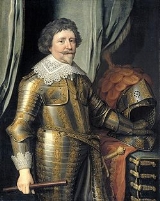
Frederick Henry, Prince of Orange

Encyclopedia
Frederick Henry, or Frederik Hendrik in Dutch
(29 January 1584 – 14 March 1647), was the sovereign Prince of Orange
and stadtholder
of Holland, Zeeland, Utrecht, Guelders, and Overijssel from 1625 to 1647.
, Holland, Dutch Republic
. He was the youngest child of William the Silent
and Louise de Coligny
. His father William was stadtholder of Holland, Zeeland, Utrecht, and Friesland. His mother Louise was daughter of the Huguenot leader Gaspard de Coligny
, and was the fourth wife of his father. He was thus the half brother of his predecessor Maurice of Orange, no issue, deceased in 1625.
Frederick Henry was born six months before his father's assassination
on 10 July 1584. The boy was trained to arms by his elder brother Maurice, one of the finest generals of his age. After Maurice threatened to legimitize his illegitimate children if he did not marry, Frederick Henry married Amalia of Solms-Braunfels
in 1625. His illegitimate son by Margaretha Catharina Bruyns (1595–1625), Frederick Nassau de Zuylenstein was born in 1624 before his marriage. This son later became the governor of the young William III of England
for seven years.
ates of the five provinces of Holland, Zeeland
, Utrecht
, Overijssel
and Guelders
, and in the important posts of captain and admiral-general of the Union (commander-in-chief of the Dutch States Army
and of the Dutch navy
).
Frederick Henry proved himself almost as good a general as his brother, and a far more capable statesman and politician. For twenty-two years he remained at the head of government in the United Provinces, and in his time the power of the stadtholderate reached its highest point. The "Period of Frederick Henry," as it is usually styled by Dutch writers, is generally accounted the golden age
of the republic. It was marked by great military and naval triumphs, by worldwide maritime and commercial expansion, and by a wonderful outburst of activity in the domains of art and literature.
The chief military exploits of Frederick Henry were the sieges and captures of Grol
in 1627, 's-Hertogenbosch
in 1629, of Maastricht
in 1632, of Breda
in 1637, of Sas van Gent in 1644, and of Hulst
in 1645. During the greater part of his administration the alliance with France against Spain had been the pivot of Frederick Henry's foreign policy, but in his last years he sacrificed the French alliance for the sake of concluding a separate peace with Spain, by which the United Provinces obtained from that power all the advantages they had been seeking for eighty years.
Frederick Henry built the country houses Huis Honselaarsdijk
, Huis ter Nieuwburg
, and for his wife Huis ten Bosch
, and he renovated the Noordeinde Palace
in The Hague
. Huis Honselaarsdijk and Huis ter Nieuwburg are now demolished.
, Holland, Dutch Republic. He left a wife, a son William II, Prince of Orange
, four daughters, and the illegitimate son Frederick Nassau de Zuylenstein.
On Frederick Henry's death, he was buried with great pomp beside his father and brother at Delft. The treaty of Munster
, ending the long struggle between the Dutch and the Spaniards, was not actually signed until 30 January 1648, the illness and death of the stadtholder having caused a delay in the negotiations. Frederick Henry left an account of his campaigns in his Mémoires de Frédéric Henri (Amsterdam, 1743). See Cambridge Mod. Hist. vol. iv. chap. 24.
|-
|-
|-
Dutch language
Dutch is a West Germanic language and the native language of the majority of the population of the Netherlands, Belgium, and Suriname, the three member states of the Dutch Language Union. Most speakers live in the European Union, where it is a first language for about 23 million and a second...
(29 January 1584 – 14 March 1647), was the sovereign Prince of Orange
Prince of Orange
Prince of Orange is a title of nobility, originally associated with the Principality of Orange, in what is now southern France. In French it is la Principauté d'Orange....
and stadtholder
Stadtholder
A Stadtholder A Stadtholder A Stadtholder (Dutch: stadhouder [], "steward" or "lieutenant", literally place holder, holding someones place, possibly a calque of German Statthalter, French lieutenant, or Middle Latin locum tenens...
of Holland, Zeeland, Utrecht, Guelders, and Overijssel from 1625 to 1647.
Early life
Frederick Henry was born on 29 January 1584 in DelftDelft
Delft is a city and municipality in the province of South Holland , the Netherlands. It is located between Rotterdam and The Hague....
, Holland, Dutch Republic
Dutch Republic
The Dutch Republic — officially known as the Republic of the Seven United Netherlands , the Republic of the United Netherlands, or the Republic of the Seven United Provinces — was a republic in Europe existing from 1581 to 1795, preceding the Batavian Republic and ultimately...
. He was the youngest child of William the Silent
William the Silent
William I, Prince of Orange , also widely known as William the Silent , or simply William of Orange , was the main leader of the Dutch revolt against the Spanish that set off the Eighty Years' War and resulted in the formal independence of the United Provinces in 1648. He was born in the House of...
and Louise de Coligny
Louise de Coligny
Louise de Coligny was the daughter of Gaspard de Coligny and Charlotte de Laval and the fourth and last spouse of William the Silent.-Biography:...
. His father William was stadtholder of Holland, Zeeland, Utrecht, and Friesland. His mother Louise was daughter of the Huguenot leader Gaspard de Coligny
Gaspard de Coligny
Gaspard de Coligny , Seigneur de Châtillon, was a French nobleman and admiral, best remembered as a disciplined Huguenot leader in the French Wars of Religion.-Ancestry:...
, and was the fourth wife of his father. He was thus the half brother of his predecessor Maurice of Orange, no issue, deceased in 1625.
Frederick Henry was born six months before his father's assassination
Assassination
To carry out an assassination is "to murder by a sudden and/or secret attack, often for political reasons." Alternatively, assassination may be defined as "the act of deliberately killing someone, especially a public figure, usually for hire or for political reasons."An assassination may be...
on 10 July 1584. The boy was trained to arms by his elder brother Maurice, one of the finest generals of his age. After Maurice threatened to legimitize his illegitimate children if he did not marry, Frederick Henry married Amalia of Solms-Braunfels
Amalia of Solms-Braunfels
Amalia of Solms-Braunfels , was a regent of Orange. She was the wife of Frederick Henry, Prince of Orange. She was the daughter of John Albert I of Solms-Braunfels and Agnes of Sayn-Wittgenstein.-Childhood:...
in 1625. His illegitimate son by Margaretha Catharina Bruyns (1595–1625), Frederick Nassau de Zuylenstein was born in 1624 before his marriage. This son later became the governor of the young William III of England
William III of England
William III & II was a sovereign Prince of Orange of the House of Orange-Nassau by birth. From 1672 he governed as Stadtholder William III of Orange over Holland, Zeeland, Utrecht, Guelders, and Overijssel of the Dutch Republic. From 1689 he reigned as William III over England and Ireland...
for seven years.
Stadtholder
On the death of Maurice in 1625, Frederick Henry succeeded him in his paternal dignities and estates, and also in the stadtholderStadtholder
A Stadtholder A Stadtholder A Stadtholder (Dutch: stadhouder [], "steward" or "lieutenant", literally place holder, holding someones place, possibly a calque of German Statthalter, French lieutenant, or Middle Latin locum tenens...
ates of the five provinces of Holland, Zeeland
Zeeland
Zeeland , also called Zealand in English, is the westernmost province of the Netherlands. The province, located in the south-west of the country, consists of a number of islands and a strip bordering Belgium. Its capital is Middelburg. With a population of about 380,000, its area is about...
, Utrecht
Utrecht (province)
Utrecht is the smallest province of the Netherlands in terms of area, and is located in the centre of the country. It is bordered by the Eemmeer in the north, Gelderland in the east, the river Rhine in the south, South Holland in the west, and North Holland in the northwest...
, Overijssel
Overijssel
Overijssel is a province of the Netherlands in the central eastern part of the country. The region has a NUTS classification of NL21. The province's name means "Lands across river IJssel". The capital city of Overijssel is Zwolle and the largest city is Enschede...
and Guelders
Guelders
Guelders or Gueldres is the name of a historical county, later duchy of the Holy Roman Empire, located in the Low Countries.-Geography:...
, and in the important posts of captain and admiral-general of the Union (commander-in-chief of the Dutch States Army
Dutch States Army
The Dutch States Army was the army of the Dutch Republic. It was usually called this, because it was formally the army of the States-General of the Netherlands, the sovereign power of that federal republic...
and of the Dutch navy
Naval history of the Netherlands
The history of the Navy of the Netherlands dates back to the 15th century. As overseas trade was a traditional cornerstone of the Dutch economy, naval defence was indispensable for the protection of commercial interests..-Origins:...
).
Frederick Henry proved himself almost as good a general as his brother, and a far more capable statesman and politician. For twenty-two years he remained at the head of government in the United Provinces, and in his time the power of the stadtholderate reached its highest point. The "Period of Frederick Henry," as it is usually styled by Dutch writers, is generally accounted the golden age
Dutch Golden Age
The Golden Age was a period in Dutch history, roughly spanning the 17th century, in which Dutch trade, science, military and art were among the most acclaimed in the world. The first half is characterised by the Eighty Years' War till 1648...
of the republic. It was marked by great military and naval triumphs, by worldwide maritime and commercial expansion, and by a wonderful outburst of activity in the domains of art and literature.
The chief military exploits of Frederick Henry were the sieges and captures of Grol
Groenlo
Groenlo is a city in the municipality of Oost Gelre, situated in the eastern part of the Netherlands on the German border, a region in the province of Gelderland called the Achterhoek . Groenlo was a municipality until January 1, 2005, when it merged with Lichtenvoorde. Until May 19 2006 Groenlo...
in 1627, 's-Hertogenbosch
Siege of 's-Hertogenbosch
The Siege of 's-Hertogenbosch was in 1629 an action of the Eighty Years' War in which a Dutch Republican army captured the city of 's-Hertogenbosch which had been loyal to the King of Spain since 1579 and thus part of the Spanish Netherlands.-Background:...
in 1629, of Maastricht
Maastricht
Maastricht is situated on both sides of the Meuse river in the south-eastern part of the Netherlands, on the Belgian border and near the German border...
in 1632, of Breda
Siege of Breda
The Siege of Breda is the name for two major sieges of the Eighty Years' War and Thirty Years' War. The Dutch fortress city of Breda fell to a Spanish army under Ambrosio Spinola in 1625; it was retaken by Frederick Henry of Orange in the 1637 Siege of Breda.-The Battle:Under Spinola's orders the...
in 1637, of Sas van Gent in 1644, and of Hulst
Hulst
Hulst is a municipality and a city in southwestern Netherlands in the east of Zeelandic Flanders.- History :Hulst received city rights in the 12th century....
in 1645. During the greater part of his administration the alliance with France against Spain had been the pivot of Frederick Henry's foreign policy, but in his last years he sacrificed the French alliance for the sake of concluding a separate peace with Spain, by which the United Provinces obtained from that power all the advantages they had been seeking for eighty years.
Frederick Henry built the country houses Huis Honselaarsdijk
Huis Honselaarsdijk
Huis Honselaarsdijk was a palace in Honselersdijk, Holland, Dutch Republic. The palace was designed by the Dutch architects Bartholomeus van Bassen, Jacob van Campen and Pieter Post, and was built in the first half of the 17th century as a buitenplaats for stadtholder Frederick Henry, Prince of...
, Huis ter Nieuwburg
Huis ter Nieuwburg
Huis ter Nieuwburg or Huis ter Nieuburch was a palace in Rijswijk, Holland, Dutch Republic. The symmetrical French Classicist building was probably designed by the French architect Jacques de la Vallée and was built between 1633 and 1636 for stadtholder Prince Frederick Henry.The palace with...
, and for his wife Huis ten Bosch
Huis ten Bosch
Huis ten Bosch is one of the three official residences of the Dutch Royal Family, located in The Hague in the Netherlands. It has been home to Queen Beatrix since 1981. The other Royal palace in The Hague, Noordeinde Palace, is used for work-related purposes...
, and he renovated the Noordeinde Palace
Noordeinde Palace
Noordeinde Palace is one of the three official palaces of the Dutch royal family. Located in The Hague in the province of South Holland, it has been used as the "working palace" for Queen Beatrix since 1984.-From farmhouse to palace:...
in The Hague
The Hague
The Hague is the capital city of the province of South Holland in the Netherlands. With a population of 500,000 inhabitants , it is the third largest city of the Netherlands, after Amsterdam and Rotterdam...
. Huis Honselaarsdijk and Huis ter Nieuwburg are now demolished.
Death
Frederick Henry died on 14 March 1647 in The HagueThe Hague
The Hague is the capital city of the province of South Holland in the Netherlands. With a population of 500,000 inhabitants , it is the third largest city of the Netherlands, after Amsterdam and Rotterdam...
, Holland, Dutch Republic. He left a wife, a son William II, Prince of Orange
William II, Prince of Orange
William II, Prince of Orange was sovereign Prince of Orange and stadtholder of the United Provinces of the Netherlands from 14 March 1647 until his death three years later.-Biography:...
, four daughters, and the illegitimate son Frederick Nassau de Zuylenstein.
On Frederick Henry's death, he was buried with great pomp beside his father and brother at Delft. The treaty of Munster
Treaty of Münster
Treaty of Münster may refer to:* Peace of Münster, a treaty between the Dutch Republic and Spain signed in January 1648 ending the Eighty Years' War...
, ending the long struggle between the Dutch and the Spaniards, was not actually signed until 30 January 1648, the illness and death of the stadtholder having caused a delay in the negotiations. Frederick Henry left an account of his campaigns in his Mémoires de Frédéric Henri (Amsterdam, 1743). See Cambridge Mod. Hist. vol. iv. chap. 24.
Children
Frederick Henry and his wife Amalia van Solms had nine children:- William II, Prince of OrangeWilliam II, Prince of OrangeWilliam II, Prince of Orange was sovereign Prince of Orange and stadtholder of the United Provinces of the Netherlands from 14 March 1647 until his death three years later.-Biography:...
(1626—50) - Luise Henriette of Nassau (1627—67)
- Henriëtte Amalia of Nassau (1628)
- Elisabeth of Nassau (1630)
- Isabella Charlotte of Nassau (1632—42)
- Albertine Agnes of NassauAlbertine Agnes of NassauAlbertine Agnes , was a regent of Friesland, Groningen and Drenthe. She was the fifth daughter of stadtholder Frederick Henry, Prince of Orange and Amalia of Solms-Braunfels.-Family:...
(1634–96) - Henriette Catherine of NassauHenriette Catherine of NassauHenriette Catherine of Nassau was a daughter of Frederick Henry, Prince of Orange and his wife Amalia of Solms-Braunfels. Henriette was a member of the House of Orange-Nassau .- Family :...
(1637—1708) - Hendrik Lodewijk of Nassau (1639)
- Maria of Nassau (1642—88)
Arms
Frederick Henry used two sets of arms as shown: before and after he became prince of Orange, Stadholder and Captain-General:Ancestors
| Frederick Henry, Prince of Orange | Father: William the Silent William the Silent William I, Prince of Orange , also widely known as William the Silent , or simply William of Orange , was the main leader of the Dutch revolt against the Spanish that set off the Eighty Years' War and resulted in the formal independence of the United Provinces in 1648. He was born in the House of... |
Paternal Grandfather: William I, Count of Nassau-Dillenburg William I, Count of Nassau-Dillenburg William of Nassau was a count of Nassau-Dillenburg from the House of Nassau. He was called William the Rich.... |
Paternal Great-grandfather: Count John V of Nassau-Dillenburg |
| Paternal Great-grandmother: Landgravine Elisabeth of Hesse-Marburg |
|||
| Paternal Grandmother: Juliana of Stolberg Juliana of Stolberg Juliana, Countess of Stolberg-Wernigerode was the mother of William the Silent, the leader of the Dutch revolt against the Spanish in the 16th century.... |
Paternal Great-grandfather: Bodo VIII, Count of Stolberg-Wernigerode Bodo VIII, Count of Stolberg-Wernigerode Count Bodo VIII of Stolberg-Wernigerode was Count of Stolberg and Hohnstein and Lord of Wernigerode from 1511 until his death.- Life :... |
||
| Paternal Great-grandmother: Anna of Eppstein-Königstein |
|||
| Mother: Louise de Coligny Louise de Coligny Louise de Coligny was the daughter of Gaspard de Coligny and Charlotte de Laval and the fourth and last spouse of William the Silent.-Biography:... |
Maternal Grandfather: Gaspard de Coligny Gaspard de Coligny Gaspard de Coligny , Seigneur de Châtillon, was a French nobleman and admiral, best remembered as a disciplined Huguenot leader in the French Wars of Religion.-Ancestry:... |
Maternal Great-grandfather: Gaspard I de Coligny Gaspard I de Coligny Gaspard I de Coligny, seigneur de Châtillon , known as the Marshal of Châtillon, was a French soldier. He served in the Italian Wars from 1495 to 1515, and was created Marshal of France in 1516.... |
|
| Maternal Great-grandmother: Louise de Montmorency Louise de Montmorency Louise de Montmorency was a French noblewoman from the ancient House of Montmorency. She was the younger sister of Anne de Montmorency, Constable of France, and the mother of Gaspard de Coligny, Admiral of France.... |
|||
| Maternal Grandmother: Charlotte de Laval Charlotte de Laval Charlotte de Laval, Dame de Châtillon , was a French noblewoman from one of the most powerful families in Brittany. She was the first wife of Gaspard de Coligny, Seigneur de Châtillon, Admiral of France and a prominent Huguenot leader during the French Wars of Religion. She was the mother of Louise... |
Maternal Great-grandfather: Guy XVI de Laval, Comte de Laval |
||
| Maternal Great-grandmother: Antoinette de Daillon |
External links
Frederik Hendrik. Prins van Oranje. Een biografisch drieluik, a biography by J.J. Poelhekke|-
|-
|-