

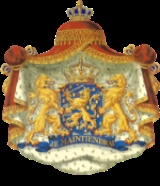
House of Orange-Nassau

Encyclopedia
The House of Orange-Nassau (in Dutch
: Huis van Oranje-Nassau), a branch of the European House of Nassau
, has played a central role in the political life
of the Netherlands
— and at times in Europe
— since William I of Orange (also known as "William the Silent" and "Father of the Fatherland") organized the Dutch revolt against Spanish
rule, which after the Eighty Years' War led to an independent Dutch state
.
Several members of the house served during this war and after as governor
or stadtholder
(Dutch stadhouder) during the Dutch Republic
. However, in 1815, after a long period as a republic, the Netherlands became a monarchy
under the House of Orange-Nassau.
The dynasty was established as a result of the marriage
of Hendrik III of Nassau-Breda from Germany
and Claudia of Châlon-Orange from French Burgundy in 1515.
Their son René inherited in 1530 the Principality of Orange
from his mother's brother, Philibert of Châlon
. As the first Nassau to be the Prince of Orange, René could have used "Orange-Nassau" as his new family name. However, his uncle, in his will, had stipulated that René should continue the use of the name Châlon-Orange. History knows him therefore as René of Châlon
. After the death of René in 1544 his cousin William of Nassau-Dillenburg inherited all his lands. This "William I of Orange" - in English better known as William the Silent
- became the founder of the House of Orange-Nassau.
(German: Dudo-Heinrich von Laurenburg), the founder of the House of Nassau. In 1120, Dudo-Henry's sons and successors, Counts Robert I
(German: Ruprecht; also translated Rupert) and Arnold I of Laurenburg
, established themselves at Nassau Castle with its tower. They renovated and extended the castle complex in 1124.
The first man to be called the count
of Nassau
was Henry I, who lived in the first half of the 13th century. The Nassau family married into the family of the neighboring Counts of Arnstein (now Kloster Arnstein). His sons Walram and Otto split the Nassau possessions. The descendants of Walram became known as the Walram Line, which became Dukes of Nassau, and in 1890, the Grand Dukes of Luxembourg. The descendants of Otto became known as the Otton Line, which inherited parts of the Nassau county, properties in France
, and in the Netherlands
.
The House of Orange-Nassau stem from the Otton Line. The second person was Engelbert I, who offered his services to the Duke of Burgundy
, married in 1403 the Dutch noblewoman Johanna van Polanen and so inherited lands in the Netherlands, with the barony of Breda as the core of the Dutch possessions & the family fortune.
The importance of the Nassaus grew throughout the 15th and 16th century.
Hendrik III of Nassau-Breda was appointed stadtholder
of Holland and Zeeland
by Charles of Ghent
in the beginning of the 16th century. Hendrik was succeeded by his son René of Châlon-Orange
in 1538, who was, as his full name stated, the Prince of Orange
. When René died prematurely on the battlefield in 1544 his possessions passed to his cousin, William I of Orange. From then on, the family members called themselves "Orange-Nassau." >
See also Adolf of Germany
Although Charles V
resisted the Protestant Reformation
, he ruled the Dutch territories wisely with moderation and regard for local customs, and he did not persecute his Protestant subjects on a large scale. His son Philip II
inherited his antipathy for the Protestants but not his moderation. Under the reign of Philip, a true persecution of Protestants was initiated and taxes were raised to an outrageous level. Discontent arose and William of Orange (with his vague Lutheran childhood) stood up for the Protestant (mainly Calvinist) inhabitants of the Netherlands. Things went badly after the Eighty Years' War started in 1568, but luck turned to his advantage when Protestant rebels attacking from the North Sea captured Brielle
, a coastal town in present-day South Holland
in 1572. Many cities in Holland began to support William. During the 1570s he had to defend his core territories in Holland several times, but in the 1580s the inland cities in Holland were secure. William of Orange was considered a threat to Spanish rule in the area and was assassinated in 1584 by a hired killer sent by Philip.
William was succeeded by his second son Maurits
, a Protestant who proved an excellent military commander. His abilities as a commander and the lack of strong leadership in Spain
after the death of Philip II (1598) gave Maurits excellent opportunities to conquer large parts of the present-day Dutch territory.
In 1585 Maurits was elected stadtholder
of the Provinces of Holland and Zealand as his father's successor and as a counterpose to Elizabeth's delegate, the Earl of Leicester. In 1587 he was appointed captain-general (military commander-in-chief) of the armies of the Dutch Republic
. In the early years of the 17th century there arose quarrels between stadtholder and oligarchist
regents
— a group of powerful merchants led by Johan van Oldebarnevelt — because Maurits wanted more powers in the Republic. Maurits won this power struggle by arranging the judicial murder of Oldebarnevelt.
(Dutch: Frederik Hendrik), youngest son of William I. Maurits urged his successor on his deathbed to marry as soon as possible. A few weeks after Maurits's death, he married Amalia van Solms-Braunfels.
Frederick Henry and Amalia were the parents of a son and several daughters. These daughters were married to important noble houses such as the house of Hohenzollern, but also to the Frisian Nassaus, who were stadtholders in Friesland
. His only son, William, married Mary, Princess Royal and Princess of Orange
, the eldest daughter of Charles I of England
. These dynastic moves were the work of Amalia.
.jpg) Frederick Henry died in 1647 and his son succeeded him. As the Treaty of Munster
Frederick Henry died in 1647 and his son succeeded him. As the Treaty of Munster
was about to be signed, thereby ending the Eighty Years War, William tried to extend his powers beyond the military to make his function valuable at peace, at the great distress of the regents. When Andries Bicker
and Cornelis de Graeff
, the great regents of the city of Amsterdam
refused some mayors he appointed, he besieged Amsterdam. The siege provoked the wrath of the regents. William died of smallpox on November 6, 1650, leaving only a posthumous son, William III
(*November 14, 1650). Since there was no Prince of Orange upon the death of William II, the regents used this opportunity to leave the stadtholdership vacant. This inaugurated the era in Dutch history that is known as the First Stadtholderless Period
. A quarrel about the education of the young prince arose between his mother and his grandmother Amalia (who outlived her husband by 28 years). Amalia wanted an education which was pointed at the resurgence of the House of Orange to power, but Mary wanted a pure English education. The Estates of Holland, under Jan de Witt and Cornelis de Graeff, meddled in the education and made William a "child of state" to be educated by the state. The doctrine used in this education was keeping William from the throne. William became indeed very docile to the wishes of the regents and the Estates.
The Dutch Republic was attacked by France and England in 1672. The military function of stadtholder was no longer superfluous, and with the support of the Orangists, William was restored, and he became the stadtholder as "William III". William successfully repelled the invasion and seized royal power. He became more powerful than his predecessors from the Eighty Years War. In 1677, William married his cousin Mary Stuart
, the daughter of the future king James II of England
. In 1688, William embarked on a mission to depose his Catholic father-in-law from the thrones of England, Scotland and Ireland. He and his wife were crowned the King and Queen of England on April 11, 1689. With the accession to the thrones of the three kingdoms, he became one of the most powerful sovereigns in Europe, and the only one to defeat Louis XIV of France
. Many members of the House of Orange were devoted admirers of the King-Stadtholder afterwards. William III died childless after a riding accident on March 8, 1702, leaving the House of Orange extinct, and leaving Scotland, England and Ireland to his sister-in-law Queen Anne
.
, who both claimed the title Prince of Orange. Both descended from Frederick Henry, Prince of Orange
. The King of Prussia was his grandson through his mother, Countess Luise Henriette of Nassau. Frederick Henry in his will had appointed this line as successor in the case the main House of Orange-Nassau would die out. John William Friso was a great-grandson of Frederick Henry and was appointed heir in William III's will. The principality was captured by the forces of King Louis XIV of France
under François Adhémar de Monteil, Count of Grignan
, in the Franco-Dutch War
in 1672, and again in August 1682. With the Treaty of Utrecht
that ended the wars of Louis XIV, the territory was finally ceded to France
by Frederick I in 1713. The treaty also decided that both claimants and their descendents were allowed to bear the title. John William Friso drowned in 1711 in the Hollands Diep near Moerdijk
, and he left his posthumously-born son Willem IV of Nassau. William IV was proclaimed the stadtholder of Guelders
, Overijssel
, Drenthe
, and Utrecht in 1722. When the French invaded Holland in 1747, William IV was restored as the stadtholder of the entire Dutch Republic, hereditary in both the male and the female lines.
His marriage to Wilhelmina of Prussia relieved this defect to some degree. In 1787, Willem V survived a coup by the Patriots
(democratic revolutionaries) after the Kingdom of Prussia
intervened. When the French invaded Holland in 1795, Willem V was forced to flee, and he was never to return to Holland.
After 1795, the House of Orange-Nassau faced a difficult period, surviving in exile at other European courts, especially those of Prussia and of England. In 1802 William V's son William VI unconditionally renounced the stadtholdership in return for a few territories from Napoleon Bonaparte (Treaty of Amiens), which was erected into the Principality of Nassau-Orange-Fulda
. Willem V died in 1806.
At the invitation of the provisional government, William VI returned to the Netherlands on November 30. This move was strongly supported by the United Kingdom, which sought ways to strengthen the Netherlands and deny future French aggressors easy access to the Low Countries' Channel ports. On December 6, William proclaimed himself hereditary sovereign prince of the Netherlands (having previously declined the offer of kingship considering a stadtholdership could give him more power). In 1814 the former Austrian Netherlands (now Belgium
) was added to his realm. On March 15, 1815 with the support of the powers gathered at the Congress of Vienna
, William proclaimed himself King William I
. He was also made grand duke of Luxembourg
, and the title 'Prince of Orange' was changed to 'Prince of Oranje'. The two countries remained separate despite sharing a common monarch.
As king of the United Kingdom of the Netherlands
, William tried to establish one common culture. This provoked resistance in the southern parts of the country, which had been culturally separate from the north since 1581. He was considered an enlightened despot.
The Prince of Orange held rights to Nassau lands (Dillenburg, Dietz, Beilstein, Hadamar, Siegen) in central Germany. On the other hand the King of Prussia, Frederick William III--brother-in-law and first cousin of William I, had beginning from 1813 managed to establish his rule in Luxembourg, which he regarded as his inheritance from Anne, Duchess of Luxembourg
who had died over three centuries earlier. At the Congress of Vienna, the two brothers-in-law agreed to a trade—Frederick William received William I's ancestral lands while William I received Luxembourg. Both got what was geographically nearer to their center of power.
In 1830 Belgium declared its independence and William fought a disastrous war until 1839 when he was forced to settle for peace. With his realm halved, he decided to abdicate in 1840. Royal power was curbed during the reign of his son William II
in a constitution ordered by the King to prevent the Revolution of 1848 from spreading to his country.
, a rather conservative
, even a reactionary man. William III was sharply opposed to the new 1848 constitution, and he continually tried to form his own royal governments. In 1868, he tried to sell Luxembourg
to France
, which was the source of a quarrel between Prussia
and France
.
William III had a rather unhappy marriage with Sophie of Württemberg
, and his heirs died young. This raised the possibility of the extinction of the House of Orange-Nassau. After the death of Queen Sophie in 1877, William remarried, to Emma of Waldeck and Pyrmont in 1879. One year later, Queen Emma gave birth to their daughter and the royal heiress, Wilhelmina
.
Since females were not allowed to hold power in Luxembourg, due to Salic law
, Luxembourg passed to the House of Nassau-Weilburg, a collateral line to the House of Orange. The Dutch Royal Family faced the threat of a complete extinction until 1909, when Wilhemina gave birth to her daughter, Juliana
. The Dutch royal house remained quite small until the latter 1930s and the early 1940s, during which Juliana gave birth to four children. Although the House of Orange died out in its male line with the death of Queen Wilhelmina, the name "Orange" continues to be used by the Dutch royalty.
for 58 years, from 1890 to 1948. Because she was only 10 years old in 1890, her mother, Queen Emma
, was the regent until Wilhelmina's 18th birthday in 1898. The Netherlands remained neutral in World War I
, during her reign, and this country was not invaded by Germany
, as neighboring Belgium
was.
Nevertheless, Queen Wilhelmina became a symbol of the Dutch resistance during World War II
. The moral authority of the Monarchy was restored because of her rule. After fifty years on the throne as the Queen, Wilhelmina decided to abdicate in favour of her daughter, Juliana. Juliana had the reputation of making the monarchy less "aloof", and under her reign the Monarchy became known as the "cycling monarchy". Members of the royal family were often seen bicycling
through the cities and the countryside under Juliana.
A royal marriage policy quarrel occurred starting in 1966, when the future Queen Beatrix
decided to marry Claus von Amsberg
, a German diplomat. The marriage of a member of the royal family to a German was quite controversial in the Netherlands, which had suffered under Nazi German occupation in 1940 - 45. This reluctance to accept a German consort probably was exacerbated by von Amsberg's former membership in the Hitler Youth
under the Nazi regime in his native country, and also his following service in the German Wehrmacht
.
Permission was needed from the civilian government for Beatrix to marry anyone, but after some argument, it was granted. As the years went by, Prince Claus was fully accepted by the Dutch people. In time, he became one of the most popular members of the Dutch monarchy, and his death in 2002 was widely mourned.
On April 30, 1980, Queen Juliana abdicated in favor of her daughter, Beatrix. In the early years of the twenty-first century, the Dutch monarchy seems to be popular with a large part of the population. The first-born son of Beatrix and her husband, Prince Claus, Crown Prince Willem-Alexander
, was born on April 27, 1967 - the first male heir to the Dutch throne in almost 100 years. Willem-Alexander married Máxima Zorreguieta in 2002. They are already the parents of three daughters: Catharina-Amalia, Alexia, and Ariane. When Beatrix of the Netherlands
passes away, or abdicates the throne, the Crown Prince will take the throne, most likely as King William IV.
After a long struggle with neurological illiness, Queen Juliana
died on March 20, 2004, and her husband, Prince Bernhard, died on December 1 of that same year.
.
The royal family is the Orange-Nassau family. This includes people born into the family or who have married into the family. They are entitled to bear the title "prince or princess of Oranje-Nassau." However, not every member of which is a member of the Royal House, and entitled to bear the designation "prince or princess of the Netherlands". By Act of Parliament, the members of the Royal House
are:
Members of the Royal House can lose their membership and designation as prince or princess of the Netherlands if they marry without the consent of the Dutch Parliament. For example, this happened with Prince Friso when he married Mabel Wisse Smit
. This is written down explicitly in the part of the constitution of the Netherlands that controls the Monarchy of the Netherlands
.
.
A summary family tree of the House of Orange-Nassaufrom the joining of the house of Nassau-Breda/Dillenburg and the House of Châlon-Arlay
to the end of the Dutch Republic. The family spawned many famous statesmen and generals, including two of the acknowledged "first captains of their age", Maurice of Nassau
and the Marshal de Turenne
.
The house of Orange-Nassau was relatively unlucky in establishing a hereditary dynasty in an age that favoured hereditary rule. The Stuarts and the Bourbons came to power at the same time as the Oranges, and the Vasas were able to establish a hereditary kingship in Sweden. The House of Orange was no less gifted than those houses, in fact, some might argue more so, as their ranks included some the foremost statesmen and captains of the time. Although the institutions of the United Provinces
became more republican and entrenched as time went on, William the Silent had been offered the countship of Holland and Zealand, and only his assassination prevented his accession to those offices. This fact did not go unforgotten by his successors.
The Prince of Orange
was also not just another noble among equals in the Netherlands. First, he was the traditional leader of the nation in war and in rebellion against Spain. He was uniquely able to transcend the local issues of the cities, towns and provinces. He was also a soveriegn ruler in his own right (see Prince of Orange
article). This gave him a great deal of prestige, even in a republic. He was the center of a real court like the Stuarts and Bourbons, French speaking, and extravagant to a scale. It was natural for foreign ambassadors and dignitaries to present themselves to him and consult with him as well as to the States General
to which they were officially credited. The marriage policy of the princes, allying themselves twice with the Royal Stuarts, also gave them acceptance into the royal caste of rulers.
Besides showing the relationships among the family, the tree above then also points out an extraordinary run of bad luck. In the 211 years from the death of William the Silent to the conquest by France, there was only one time that a son directly succeeded his father as Prince of Orange, Stadholder and Captain-General without a minority (William II). When the Oranges were in power, they also tended to settle for the actualities of power, rather than the appearances, which increasingly tended to upset the ruling regents of the towns and cities. On being offered the dukedom of Gelderland by the States of that province, William III
let the offer lapse as liable to raise too much opposition in the other provinces.
In 1814, William VI of Orange became King of the Netherlands. The institution of the monarch in the Netherlands
is considered an office under the Dutch Constitution
. There are none of the religious connotations to the office as in some other monarchies. A Dutch sovereign is inaugurated rather than crowned/"coronated". It was initially more of a crowned/hereditary presidency, and a continuation of the status quo ante of the pre-1795 hereditary stadholderate
in the republic. In practice today, the monarch has considerably less power. This summary genealogical tree shows how the now Royal house of Orange-Nassau is related:
The ancestral coat of arms of the Ottonian line of the house of Nassau
is shown below. Their distant cousins of the Walramian line added a red coronet to distinguish them. The fact that these were arms were very similar to those of the counts of Burgundy (Franche-Comté) did not seem to cause too much confusion.
Henry III of Nassau-Breda came to the Netherlands in 1499 as heir to his uncle, Engelbrecht II of Nassau-Breda
. His and his uncle's arms are shown below. When Philbert, prince of Orange
died in 1530, his sister's son René of Breda
inherited the Princedom of Orange on condition that he used the name and coat of arms of the Châlon-Orange family. History knows him therefore as René of Châlon instead of as "René of Nassau-Breda." The 1st and 4th grand quarters show the arms of the Chalons-Arlay (the gold bend) princes of Orange (the bugle). The blue and gold cross is the arms of Jeanne of Geneva, who married one of the Chalons princes. The 2nd and 3rd show the quarterings of Brittany and Luxembourg-St. Pol. The inescutcheon overall is his paternal arms quarterd of Nassau and Breda.
William the Silent
's father, William the Rich, was rich only in children. He bore the arms shown below. Clockwise from upper left they displayed the arms of Nassau (1st quarter), Katzenelenbogen (3rd quarter), Dietz (2nd quarter), Vianden (4th quarter).
The princes of Orange in the 16th and 17th century used the following sets of arms. On becoming prince of Orange, William placed the Châlon-Arlay arms in the center ("as an inescutcheon") of his father's arms. He used these arms until 1582 when he purchased the marquisate of Veere and Vlissingen. It had been the property of Philip II since 1567, but had fallen into arrears to the province. In 1580 the Court of Holland ordered it sold. William bought it as it gave him two more votes in the States of Zeeland. He owned the government of the two towns, and so could appoint their magistrates. He already had one as First Noble for Philip William, who had inherited Maartensdijk. This made William the predominant member of the States of Zeeland. It was a smaller version of the countship of Zeeland (& Holland) promised to William, and was a potent political base for his descendants. William then added the shield of Veere and Buren to his arms as shown in the arms of Frederick Henry
, William II and William III with the arms of the marquisate in the top center, and the arms of the county of Buren in the bottom center. William also started the tradition of keeping the number of billets in the upper left quarter for Nassau at 17 to symbolize the original 17 provinces of the Burgundian/Habsburg Netherlands, which he always hoped would form one united nation.
The princes of Orange also had personal arms before they became reigning prince. Maurice never changed his as he rarely used the tile of "Prince of Orange". Some others are:
The main house of Orange-Nassau also spawned several illegitimate branches. These branches contributed to the political and economic history of England and the Netherlands. Louis of Nassau, Lord of De Lek and Beverweerd was a younger illegitimate son of Prince Maurice
and Margaretha van Mechelen
. His descendants were Counts of Nassau-LaLecq. One of his sons was the famous general Henry de Nassau, Lord of Overkirk, King William III
's Master of the Horse
, and one of the most trusted generals of John Churchill, 1st Duke of Marlborough
. His descendants became the Earls of Grantham
in England. Frederick van Nassau, Lord of Zuylestein
, an illegitimate son of Frederick Henry, Prince of Orange
, gave rise to the Earls of Rochford
in England. The 4th earl of Rochford
was a famous English diplomat and a statesman.
The house of Orange-Nassau also had many younger branches in the 16th, 17th and 18th centuries descended from William the Silent's younger brother Count John of Nassau-Dillenburg. The division and re-uniting of this patriomony is complex and outlined at the article on the County of Nassau-Dillenburg. One branch, the Nassau-Dietz branch in the 17th century, succeeded to the Dutch title of prince of Orange and the stadholderate in the 18th century. They also survived the other braches and inherited the whole German patrimony. The arms are:
When John William Friso became Prince of Orange, he used the arms below. However, he was never recognized outside of Holland and areas friendly to Holland as Prince of Orange. His son, William IV
, recognized as Prince of Orange, seems to have used the original arms of William the Silent
. When the princes of Orange fled the Netherlands during the Batavian Republic and the Kingdom of Holland, and when France occupied the Netherlands, they were compensated by Napoleon with the Principality of Nassau-Orange-Fulda
. These principalities were confiscated when Napoleon invaded Germany (1806) and William VI supported his Prussian relatives. He succeeded his father as prince of Orange later that year, after William V's death.
When William VI of Orange
returned to the Netherlands in 1813 and was proclaimed Sovereign Prince of the Netherlands, he quartered the former Arms of the Dutch Republic
(1st and 4th quarter) with the "Châlon-Orange" arms (2nd and 3rd quarter), which had come to symbolize Orange. As an inescutcheon he placed his ancestral arms of Nassau. When he became King in 1815, he combined the Dutch Republic Lion
with the billets of the Nassau arms and added a royal crown to from the Coat of arms of the Netherlands
. In 1907, Queen Wilhelmina replaced the royal crown on the arms with a coronet.
Wilhelmina further decreted that in perpetuit her descendants should be styled "princes and princesses of Orange-Nassau" and that the name of the house would be "Orange-Nassau" (in Dutch "Oranje-Nassau". Only those members of the members of the Dutch Royal House that are part of the smaller "Royal Family" can use the title of prince or princess of the Netherlands. Since then, individual members of the House of Orange-Nassau are also given their own arms by the reigning monarch, similar to the United Kingdom. This is usually the royal arms, quartered with the arms of the principality of Orange
, and an inescutcheon of their paternal arms.
The standards of the ruling king or queen:
The standards of the current sons of Queen Beatrix and their wives and the Queen's husband:
The standards of the sisters of Queen Beatrix and their children:
The standards of former members of the Royal Family:
Traditionally, members of the Nassau family were buried in Breda, but as that city was in Spanish hands when William died, he was buried in a new crypt
the New Church
in Delft
. His monument on his tomb was originally very modest, but it was replaced in 1623 by a new one, made by Hendrik de Keyser and his son Pieter. Since then, most of the members of the House of Orange-Nassau
, including all Dutch monarchs have been buried in the same church. His great-grandson William the third
, King of England and Scotland and Stadtholder in the Netherlands, was buried in Westminster Abbey
Dutch language
Dutch is a West Germanic language and the native language of the majority of the population of the Netherlands, Belgium, and Suriname, the three member states of the Dutch Language Union. Most speakers live in the European Union, where it is a first language for about 23 million and a second...
: Huis van Oranje-Nassau), a branch of the European House of Nassau
House of Nassau
The House of Nassau is a diversified aristocratic dynasty in Europe. It is named after the lordship associated with Nassau Castle, located in present-day Nassau, Rhineland-Palatinate, Germany. The lords of Nassau were originally titled Count of Nassau, then elevated to the princely class as...
, has played a central role in the political life
Politics and government of the Netherlands (1581–1795)
The Dutch Republic — officially known as the Republic of the Seven United Netherlands , the Republic of the United Netherlands, or the Republic of the Seven United Provinces — was a republic in Europe existing from 1581 to 1795, preceding the Batavian Republic and ultimately the...
of the Netherlands
Netherlands
The Netherlands is a constituent country of the Kingdom of the Netherlands, located mainly in North-West Europe and with several islands in the Caribbean. Mainland Netherlands borders the North Sea to the north and west, Belgium to the south, and Germany to the east, and shares maritime borders...
— and at times in Europe
Europe
Europe is, by convention, one of the world's seven continents. Comprising the westernmost peninsula of Eurasia, Europe is generally 'divided' from Asia to its east by the watershed divides of the Ural and Caucasus Mountains, the Ural River, the Caspian and Black Seas, and the waterways connecting...
— since William I of Orange (also known as "William the Silent" and "Father of the Fatherland") organized the Dutch revolt against Spanish
Spain
Spain , officially the Kingdom of Spain languages]] under the European Charter for Regional or Minority Languages. In each of these, Spain's official name is as follows:;;;;;;), is a country and member state of the European Union located in southwestern Europe on the Iberian Peninsula...
rule, which after the Eighty Years' War led to an independent Dutch state
Dutch Republic
The Dutch Republic — officially known as the Republic of the Seven United Netherlands , the Republic of the United Netherlands, or the Republic of the Seven United Provinces — was a republic in Europe existing from 1581 to 1795, preceding the Batavian Republic and ultimately...
.
Several members of the house served during this war and after as governor
Governor
A governor is a governing official, usually the executive of a non-sovereign level of government, ranking under the head of state...
or stadtholder
Stadtholder
A Stadtholder A Stadtholder A Stadtholder (Dutch: stadhouder [], "steward" or "lieutenant", literally place holder, holding someones place, possibly a calque of German Statthalter, French lieutenant, or Middle Latin locum tenens...
(Dutch stadhouder) during the Dutch Republic
Dutch Republic
The Dutch Republic — officially known as the Republic of the Seven United Netherlands , the Republic of the United Netherlands, or the Republic of the Seven United Provinces — was a republic in Europe existing from 1581 to 1795, preceding the Batavian Republic and ultimately...
. However, in 1815, after a long period as a republic, the Netherlands became a monarchy
Monarchy of the Netherlands
The Netherlands has been an independent monarchy since 16 March 1815, and has been governed by members of the House of Orange-Nassau since.-Constitutional role and position of the monarch:...
under the House of Orange-Nassau.
The dynasty was established as a result of the marriage
Marriage
Marriage is a social union or legal contract between people that creates kinship. It is an institution in which interpersonal relationships, usually intimate and sexual, are acknowledged in a variety of ways, depending on the culture or subculture in which it is found...
of Hendrik III of Nassau-Breda from Germany
Germany
Germany , officially the Federal Republic of Germany , is a federal parliamentary republic in Europe. The country consists of 16 states while the capital and largest city is Berlin. Germany covers an area of 357,021 km2 and has a largely temperate seasonal climate...
and Claudia of Châlon-Orange from French Burgundy in 1515.
Their son René inherited in 1530 the Principality of Orange
Principality of Orange
The Principality of Orange was a feudal state in Provence, in the south of modern-day France, on the left bank of the River Rhone north of the city of Avignon....
from his mother's brother, Philibert of Châlon
Philibert of Châlon
Philibert de Châlon was the last prince of Orange from the house of Châlon.Born at Nozeroy to John IV of Chalon-Arlay, Philibert served Emperor Charles V as commander in Italy, fighting in the War of the League of Cognac. He took part in the Sack of Rome and was killed during the final stages of...
. As the first Nassau to be the Prince of Orange, René could have used "Orange-Nassau" as his new family name. However, his uncle, in his will, had stipulated that René should continue the use of the name Châlon-Orange. History knows him therefore as René of Châlon
René of Châlon
René of Châlon , also known as Renatus of Châlon, was a Prince of Orange and stadtholder of Holland, Zeeland, Utrecht and Gelre....
. After the death of René in 1544 his cousin William of Nassau-Dillenburg inherited all his lands. This "William I of Orange" - in English better known as William the Silent
William the Silent
William I, Prince of Orange , also widely known as William the Silent , or simply William of Orange , was the main leader of the Dutch revolt against the Spanish that set off the Eighty Years' War and resulted in the formal independence of the United Provinces in 1648. He was born in the House of...
- became the founder of the House of Orange-Nassau.
The House of Nassau
The castle of Nassau was founded around 1100 by Count Dudo-Henry of LaurenburgDudo-Henry of Laurenburg
Dudo-Henry of Laurenburg was Count of Laurenburg in 1093 and is considered the founder of the House of Nassau...
(German: Dudo-Heinrich von Laurenburg), the founder of the House of Nassau. In 1120, Dudo-Henry's sons and successors, Counts Robert I
Robert I of Nassau
Robert I of Nassau was from 1123 co-Count of Laurenburg and would later title himself the first Count of Nassau. The House of Nassau would become an important aristocratic family in Germany, from which are descended the present-day rulers of both the Netherlands and Luxembourg.-Biography:Robert...
(German: Ruprecht; also translated Rupert) and Arnold I of Laurenburg
Arnold I of Laurenburg
Arnold I of Laurenburg , an early member of the House of Nassau, was from 1123 co-Count of Laurenburg. The House of Nassau would become an important aristocratic family in Germany, from which are descended the present-day Kings of the Netherlands and Grand Dukes of Luxembourg.-Biography:Arnold was...
, established themselves at Nassau Castle with its tower. They renovated and extended the castle complex in 1124.
The first man to be called the count
Count
A count or countess is an aristocratic nobleman in European countries. The word count came into English from the French comte, itself from Latin comes—in its accusative comitem—meaning "companion", and later "companion of the emperor, delegate of the emperor". The adjective form of the word is...
of Nassau
Nassau (state)
Nassau was a German state within the Holy Roman Empire and later in the German Confederation. Its ruling dynasty, now extinct in male line, was the House of Nassau.-Origins:...
was Henry I, who lived in the first half of the 13th century. The Nassau family married into the family of the neighboring Counts of Arnstein (now Kloster Arnstein). His sons Walram and Otto split the Nassau possessions. The descendants of Walram became known as the Walram Line, which became Dukes of Nassau, and in 1890, the Grand Dukes of Luxembourg. The descendants of Otto became known as the Otton Line, which inherited parts of the Nassau county, properties in France
France
The French Republic , The French Republic , The French Republic , (commonly known as France , is a unitary semi-presidential republic in Western Europe with several overseas territories and islands located on other continents and in the Indian, Pacific, and Atlantic oceans. Metropolitan France...
, and in the Netherlands
Netherlands
The Netherlands is a constituent country of the Kingdom of the Netherlands, located mainly in North-West Europe and with several islands in the Caribbean. Mainland Netherlands borders the North Sea to the north and west, Belgium to the south, and Germany to the east, and shares maritime borders...
.
The House of Orange-Nassau stem from the Otton Line. The second person was Engelbert I, who offered his services to the Duke of Burgundy
Duke of Burgundy
Duke of Burgundy was a title borne by the rulers of the Duchy of Burgundy, a small portion of traditional lands of Burgundians west of river Saône which in 843 was allotted to Charles the Bald's kingdom of West Franks...
, married in 1403 the Dutch noblewoman Johanna van Polanen and so inherited lands in the Netherlands, with the barony of Breda as the core of the Dutch possessions & the family fortune.
The importance of the Nassaus grew throughout the 15th and 16th century.
Hendrik III of Nassau-Breda was appointed stadtholder
Stadtholder
A Stadtholder A Stadtholder A Stadtholder (Dutch: stadhouder [], "steward" or "lieutenant", literally place holder, holding someones place, possibly a calque of German Statthalter, French lieutenant, or Middle Latin locum tenens...
of Holland and Zeeland
Zeeland
Zeeland , also called Zealand in English, is the westernmost province of the Netherlands. The province, located in the south-west of the country, consists of a number of islands and a strip bordering Belgium. Its capital is Middelburg. With a population of about 380,000, its area is about...
by Charles of Ghent
Charles V, Holy Roman Emperor
Charles V was ruler of the Holy Roman Empire from 1519 and, as Charles I, of the Spanish Empire from 1516 until his voluntary retirement and abdication in favor of his younger brother Ferdinand I and his son Philip II in 1556.As...
in the beginning of the 16th century. Hendrik was succeeded by his son René of Châlon-Orange
René of Châlon
René of Châlon , also known as Renatus of Châlon, was a Prince of Orange and stadtholder of Holland, Zeeland, Utrecht and Gelre....
in 1538, who was, as his full name stated, the Prince of Orange
Prince of Orange
Prince of Orange is a title of nobility, originally associated with the Principality of Orange, in what is now southern France. In French it is la Principauté d'Orange....
. When René died prematurely on the battlefield in 1544 his possessions passed to his cousin, William I of Orange. From then on, the family members called themselves "Orange-Nassau." >
See also Adolf of Germany
The Dutch rebellion
andAlthough Charles V
Charles V, Holy Roman Emperor
Charles V was ruler of the Holy Roman Empire from 1519 and, as Charles I, of the Spanish Empire from 1516 until his voluntary retirement and abdication in favor of his younger brother Ferdinand I and his son Philip II in 1556.As...
resisted the Protestant Reformation
Protestant Reformation
The Protestant Reformation was a 16th-century split within Western Christianity initiated by Martin Luther, John Calvin and other early Protestants. The efforts of the self-described "reformers", who objected to the doctrines, rituals and ecclesiastical structure of the Roman Catholic Church, led...
, he ruled the Dutch territories wisely with moderation and regard for local customs, and he did not persecute his Protestant subjects on a large scale. His son Philip II
Philip II of Spain
Philip II was King of Spain, Portugal, Naples, Sicily, and, while married to Mary I, King of England and Ireland. He was lord of the Seventeen Provinces from 1556 until 1581, holding various titles for the individual territories such as duke or count....
inherited his antipathy for the Protestants but not his moderation. Under the reign of Philip, a true persecution of Protestants was initiated and taxes were raised to an outrageous level. Discontent arose and William of Orange (with his vague Lutheran childhood) stood up for the Protestant (mainly Calvinist) inhabitants of the Netherlands. Things went badly after the Eighty Years' War started in 1568, but luck turned to his advantage when Protestant rebels attacking from the North Sea captured Brielle
Brielle
Brielle , also called Den Briel is a town and municipality in the western Netherlands, in the province of South Holland, on the north side of the island of Voorne-Putten, at the mouth of the New Maas. The municipality covers an area of 31.12 km² of which 3.63 km² is water...
, a coastal town in present-day South Holland
South Holland
South Holland is a province situated on the North Sea in the western part of the Netherlands. The provincial capital is The Hague and its largest city is Rotterdam.South Holland is one of the most densely populated and industrialised areas in the world...
in 1572. Many cities in Holland began to support William. During the 1570s he had to defend his core territories in Holland several times, but in the 1580s the inland cities in Holland were secure. William of Orange was considered a threat to Spanish rule in the area and was assassinated in 1584 by a hired killer sent by Philip.
William was succeeded by his second son Maurits
Maurice of Nassau, Prince of Orange
Maurice of Nassau, Prince of Orange was sovereign Prince of Orange from 1618, on the death of his eldest half brother, Philip William, Prince of Orange,...
, a Protestant who proved an excellent military commander. His abilities as a commander and the lack of strong leadership in Spain
Spain
Spain , officially the Kingdom of Spain languages]] under the European Charter for Regional or Minority Languages. In each of these, Spain's official name is as follows:;;;;;;), is a country and member state of the European Union located in southwestern Europe on the Iberian Peninsula...
after the death of Philip II (1598) gave Maurits excellent opportunities to conquer large parts of the present-day Dutch territory.
In 1585 Maurits was elected stadtholder
Stadtholder
A Stadtholder A Stadtholder A Stadtholder (Dutch: stadhouder [], "steward" or "lieutenant", literally place holder, holding someones place, possibly a calque of German Statthalter, French lieutenant, or Middle Latin locum tenens...
of the Provinces of Holland and Zealand as his father's successor and as a counterpose to Elizabeth's delegate, the Earl of Leicester. In 1587 he was appointed captain-general (military commander-in-chief) of the armies of the Dutch Republic
Dutch Republic
The Dutch Republic — officially known as the Republic of the Seven United Netherlands , the Republic of the United Netherlands, or the Republic of the Seven United Provinces — was a republic in Europe existing from 1581 to 1795, preceding the Batavian Republic and ultimately...
. In the early years of the 17th century there arose quarrels between stadtholder and oligarchist
Oligarchy
Oligarchy is a form of power structure in which power effectively rests with an elite class distinguished by royalty, wealth, family ties, commercial, and/or military legitimacy...
regents
Regenten
In the 16th, 17th and 18th centuries, the regenten were the rulers of the Dutch Republic, the leaders of the Dutch cities or the heads of organisations . Though not formally a hereditary "class", they were de facto "patricians", comparable to that ancient Roman class...
— a group of powerful merchants led by Johan van Oldebarnevelt — because Maurits wanted more powers in the Republic. Maurits won this power struggle by arranging the judicial murder of Oldebarnevelt.
Expansion of dynastic power
Maurits died unmarried in 1625 and left no legitimate children. He was succeeded by his half-brother Frederick HenryFrederick Henry, Prince of Orange
Frederick Henry, or Frederik Hendrik in Dutch , was the sovereign Prince of Orange and stadtholder of Holland, Zeeland, Utrecht, Guelders, and Overijssel from 1625 to 1647.-Early life:...
(Dutch: Frederik Hendrik), youngest son of William I. Maurits urged his successor on his deathbed to marry as soon as possible. A few weeks after Maurits's death, he married Amalia van Solms-Braunfels.
Frederick Henry and Amalia were the parents of a son and several daughters. These daughters were married to important noble houses such as the house of Hohenzollern, but also to the Frisian Nassaus, who were stadtholders in Friesland
Friesland
Friesland is a province in the north of the Netherlands and part of the ancient region of Frisia.Until the end of 1996, the province bore Friesland as its official name. In 1997 this Dutch name lost its official status to the Frisian Fryslân...
. His only son, William, married Mary, Princess Royal and Princess of Orange
Mary, Princess Royal and Princess of Orange
Mary, Princess Royal, Princess of Orange and Countess of Nassau was the eldest daughter of King Charles I of England, Scotland, and Ireland and his queen, Henrietta Maria of France...
, the eldest daughter of Charles I of England
Charles I of England
Charles I was King of England, King of Scotland, and King of Ireland from 27 March 1625 until his execution in 1649. Charles engaged in a struggle for power with the Parliament of England, attempting to obtain royal revenue whilst Parliament sought to curb his Royal prerogative which Charles...
. These dynastic moves were the work of Amalia.
Exile and resurgence
Peace of Münster
The Peace of Münster was a treaty between the Dutch Republic and Spain signed in 1648. It was a landmark treaty for the Dutch republic and one of the key events in Dutch history; with it, the United Netherlands finally became independent from the Spanish Crown...
was about to be signed, thereby ending the Eighty Years War, William tried to extend his powers beyond the military to make his function valuable at peace, at the great distress of the regents. When Andries Bicker
Andries Bicker
Andries Bicker was a wealthy merchant on Moscovia, a member of the vroedschap, the leader of the Arminians, an administrator of the VOC, representative of the States-General of the Netherlands and colonel in the Civic guard...
and Cornelis de Graeff
Cornelis de Graeff
Cornelis de Graeff, also Cornelis de Graeff van Polsbroek was the most illustrious member of the De Graeff family. He was a mayor of Amsterdam from the Dutch Golden Age and a powerful Amsterdam regent after the sudden death of stadholder William II of Orange...
, the great regents of the city of Amsterdam
Amsterdam
Amsterdam is the largest city and the capital of the Netherlands. The current position of Amsterdam as capital city of the Kingdom of the Netherlands is governed by the constitution of August 24, 1815 and its successors. Amsterdam has a population of 783,364 within city limits, an urban population...
refused some mayors he appointed, he besieged Amsterdam. The siege provoked the wrath of the regents. William died of smallpox on November 6, 1650, leaving only a posthumous son, William III
William III of England
William III & II was a sovereign Prince of Orange of the House of Orange-Nassau by birth. From 1672 he governed as Stadtholder William III of Orange over Holland, Zeeland, Utrecht, Guelders, and Overijssel of the Dutch Republic. From 1689 he reigned as William III over England and Ireland...
(*November 14, 1650). Since there was no Prince of Orange upon the death of William II, the regents used this opportunity to leave the stadtholdership vacant. This inaugurated the era in Dutch history that is known as the First Stadtholderless Period
First Stadtholderless Period
The First Stadtholderless Period or Era is the period in the history of the Dutch Republic in which the office of a Stadtholder was absent in five of the seven Dutch provinces...
. A quarrel about the education of the young prince arose between his mother and his grandmother Amalia (who outlived her husband by 28 years). Amalia wanted an education which was pointed at the resurgence of the House of Orange to power, but Mary wanted a pure English education. The Estates of Holland, under Jan de Witt and Cornelis de Graeff, meddled in the education and made William a "child of state" to be educated by the state. The doctrine used in this education was keeping William from the throne. William became indeed very docile to the wishes of the regents and the Estates.
The Dutch Republic was attacked by France and England in 1672. The military function of stadtholder was no longer superfluous, and with the support of the Orangists, William was restored, and he became the stadtholder as "William III". William successfully repelled the invasion and seized royal power. He became more powerful than his predecessors from the Eighty Years War. In 1677, William married his cousin Mary Stuart
Mary II of England
Mary II was joint Sovereign of England, Scotland, and Ireland with her husband and first cousin, William III and II, from 1689 until her death. William and Mary, both Protestants, became king and queen regnant, respectively, following the Glorious Revolution, which resulted in the deposition of...
, the daughter of the future king James II of England
James II of England
James II & VII was King of England and King of Ireland as James II and King of Scotland as James VII, from 6 February 1685. He was the last Catholic monarch to reign over the Kingdoms of England, Scotland, and Ireland...
. In 1688, William embarked on a mission to depose his Catholic father-in-law from the thrones of England, Scotland and Ireland. He and his wife were crowned the King and Queen of England on April 11, 1689. With the accession to the thrones of the three kingdoms, he became one of the most powerful sovereigns in Europe, and the only one to defeat Louis XIV of France
Louis XIV of France
Louis XIV , known as Louis the Great or the Sun King , was a Bourbon monarch who ruled as King of France and Navarre. His reign, from 1643 to his death in 1715, began at the age of four and lasted seventy-two years, three months, and eighteen days...
. Many members of the House of Orange were devoted admirers of the King-Stadtholder afterwards. William III died childless after a riding accident on March 8, 1702, leaving the House of Orange extinct, and leaving Scotland, England and Ireland to his sister-in-law Queen Anne
Anne of Great Britain
Anne ascended the thrones of England, Scotland and Ireland on 8 March 1702. On 1 May 1707, under the Act of Union, two of her realms, England and Scotland, were united as a single sovereign state, the Kingdom of Great Britain.Anne's Catholic father, James II and VII, was deposed during the...
.
The second stadtholderless era
The regents found that they had suffered under the powerful leadership of King William III and declared the stadtholdership vacant for the second time. Since William III died childless in 1702 the principality became a matter of dispute between Prince John William Friso of Nassau-Dietz of the Frisian Nassaus and King Frederick I of PrussiaFrederick I of Prussia
Frederick I , of the Hohenzollern dynasty, was Elector of Brandenburg and Duke of Prussia in personal union . The latter function he upgraded to royalty, becoming the first King in Prussia . From 1707 he was in personal union the sovereign prince of the Principality of Neuchâtel...
, who both claimed the title Prince of Orange. Both descended from Frederick Henry, Prince of Orange
Frederick Henry, Prince of Orange
Frederick Henry, or Frederik Hendrik in Dutch , was the sovereign Prince of Orange and stadtholder of Holland, Zeeland, Utrecht, Guelders, and Overijssel from 1625 to 1647.-Early life:...
. The King of Prussia was his grandson through his mother, Countess Luise Henriette of Nassau. Frederick Henry in his will had appointed this line as successor in the case the main House of Orange-Nassau would die out. John William Friso was a great-grandson of Frederick Henry and was appointed heir in William III's will. The principality was captured by the forces of King Louis XIV of France
Louis XIV of France
Louis XIV , known as Louis the Great or the Sun King , was a Bourbon monarch who ruled as King of France and Navarre. His reign, from 1643 to his death in 1715, began at the age of four and lasted seventy-two years, three months, and eighteen days...
under François Adhémar de Monteil, Count of Grignan
Comte de Grignan
François Adhémar de Monteil, Comte de Grignan was a French aristocrat, remembered chiefly for being Lieutenant-Governor of Provence and the beloved son-in-law of Madame de Sévigne.- Life :...
, in the Franco-Dutch War
Franco-Dutch War
The Franco-Dutch War, often called simply the Dutch War was a war fought by France, Sweden, the Bishopric of Münster, the Archbishopric of Cologne and England against the United Netherlands, which were later joined by the Austrian Habsburg lands, Brandenburg and Spain to form a quadruple alliance...
in 1672, and again in August 1682. With the Treaty of Utrecht
Treaty of Utrecht
The Treaty of Utrecht, which established the Peace of Utrecht, comprises a series of individual peace treaties, rather than a single document, signed by the belligerents in the War of Spanish Succession, in the Dutch city of Utrecht in March and April 1713...
that ended the wars of Louis XIV, the territory was finally ceded to France
Kingdom of France
The Kingdom of France was one of the most powerful states to exist in Europe during the second millennium.It originated from the Western portion of the Frankish empire, and consolidated significant power and influence over the next thousand years. Louis XIV, also known as the Sun King, developed a...
by Frederick I in 1713. The treaty also decided that both claimants and their descendents were allowed to bear the title. John William Friso drowned in 1711 in the Hollands Diep near Moerdijk
Moerdijk
Moerdijk is a municipality and a town in the South of the Netherlands, in the province of North Brabant.- History :The municipality of Moerdijk was founded in 1997 following the merger of the municipalities of Fijnaart en Heijningen, Klundert, Standdaarbuiten, Willemstad and Zevenbergen. At that...
, and he left his posthumously-born son Willem IV of Nassau. William IV was proclaimed the stadtholder of Guelders
Guelders
Guelders or Gueldres is the name of a historical county, later duchy of the Holy Roman Empire, located in the Low Countries.-Geography:...
, Overijssel
Overijssel
Overijssel is a province of the Netherlands in the central eastern part of the country. The region has a NUTS classification of NL21. The province's name means "Lands across river IJssel". The capital city of Overijssel is Zwolle and the largest city is Enschede...
, Drenthe
Drenthe
Drenthe is a province of the Netherlands, located in the north-east of the country. The capital city is Assen. It is bordered by Overijssel to the south, Friesland to the west, Groningen to the north, and Germany to the east.-History:Drenthe, unlike many other parts of the Netherlands, has been a...
, and Utrecht in 1722. When the French invaded Holland in 1747, William IV was restored as the stadtholder of the entire Dutch Republic, hereditary in both the male and the female lines.
The end of the republic
William IV died in 1751, leaving his three-year-old son, Willem V of Orange, as the stadtholder. Since Willem V was still a minor, the regents reigned for him. He developed to be an indecisive person, a character defect which would follow Willem V for his whole life.His marriage to Wilhelmina of Prussia relieved this defect to some degree. In 1787, Willem V survived a coup by the Patriots
Patriots (faction)
The Patriots were a political faction in the Dutch Republic in the second half of the 18th century. They were led by Joan van der Capellen tot den Pol, gaining power from November 1782....
(democratic revolutionaries) after the Kingdom of Prussia
Prussia
Prussia was a German kingdom and historic state originating out of the Duchy of Prussia and the Margraviate of Brandenburg. For centuries, the House of Hohenzollern ruled Prussia, successfully expanding its size by way of an unusually well-organized and effective army. Prussia shaped the history...
intervened. When the French invaded Holland in 1795, Willem V was forced to flee, and he was never to return to Holland.
After 1795, the House of Orange-Nassau faced a difficult period, surviving in exile at other European courts, especially those of Prussia and of England. In 1802 William V's son William VI unconditionally renounced the stadtholdership in return for a few territories from Napoleon Bonaparte (Treaty of Amiens), which was erected into the Principality of Nassau-Orange-Fulda
Principality of Nassau-Orange-Fulda
Nassau-Orange-Fulda was the name of a short-lived principality of the Holy Roman Empire, which was created for the Prince of Orange and existed only from 1803 to 1806....
. Willem V died in 1806.
A new spirit: the United Kingdom of the Netherlands
After a repressed Dutch rebel action, Prussian and Cossack troops drove out the French in 1813, with the support of the Patriots of 1785. Although most of the leaders were the same men who had driven out William V, it was virtually taken that any new government would have to be headed by his son, William VI, prince of Orange (known in Dutch as Willem Frederik). All agreed that it would be better in the long term for the Dutch to restore William themselves rather than have him imposed by the allies.At the invitation of the provisional government, William VI returned to the Netherlands on November 30. This move was strongly supported by the United Kingdom, which sought ways to strengthen the Netherlands and deny future French aggressors easy access to the Low Countries' Channel ports. On December 6, William proclaimed himself hereditary sovereign prince of the Netherlands (having previously declined the offer of kingship considering a stadtholdership could give him more power). In 1814 the former Austrian Netherlands (now Belgium
Belgium
Belgium , officially the Kingdom of Belgium, is a federal state in Western Europe. It is a founding member of the European Union and hosts the EU's headquarters, and those of several other major international organisations such as NATO.Belgium is also a member of, or affiliated to, many...
) was added to his realm. On March 15, 1815 with the support of the powers gathered at the Congress of Vienna
Congress of Vienna
The Congress of Vienna was a conference of ambassadors of European states chaired by Klemens Wenzel von Metternich, and held in Vienna from September, 1814 to June, 1815. The objective of the Congress was to settle the many issues arising from the French Revolutionary Wars, the Napoleonic Wars,...
, William proclaimed himself King William I
William I of the Netherlands
William I Frederick, born Willem Frederik Prins van Oranje-Nassau , was a Prince of Orange and the first King of the Netherlands and Grand Duke of Luxembourg....
. He was also made grand duke of Luxembourg
Luxembourg
Luxembourg , officially the Grand Duchy of Luxembourg , is a landlocked country in western Europe, bordered by Belgium, France, and Germany. It has two principal regions: the Oesling in the North as part of the Ardennes massif, and the Gutland in the south...
, and the title 'Prince of Orange' was changed to 'Prince of Oranje'. The two countries remained separate despite sharing a common monarch.
As king of the United Kingdom of the Netherlands
United Kingdom of the Netherlands
United Kingdom of the Netherlands is the unofficial name used to refer to Kingdom of the Netherlands during the period after it was first created from part of the First French Empire and before the new kingdom of Belgium split out in 1830...
, William tried to establish one common culture. This provoked resistance in the southern parts of the country, which had been culturally separate from the north since 1581. He was considered an enlightened despot.
The Prince of Orange held rights to Nassau lands (Dillenburg, Dietz, Beilstein, Hadamar, Siegen) in central Germany. On the other hand the King of Prussia, Frederick William III--brother-in-law and first cousin of William I, had beginning from 1813 managed to establish his rule in Luxembourg, which he regarded as his inheritance from Anne, Duchess of Luxembourg
Anne, Duchess of Luxembourg
Anne of Bohemia and Austria was a Duchess of Luxembourg in her own right, and as consort, Landgravine of Thuringia and of Saxony....
who had died over three centuries earlier. At the Congress of Vienna, the two brothers-in-law agreed to a trade—Frederick William received William I's ancestral lands while William I received Luxembourg. Both got what was geographically nearer to their center of power.
In 1830 Belgium declared its independence and William fought a disastrous war until 1839 when he was forced to settle for peace. With his realm halved, he decided to abdicate in 1840. Royal power was curbed during the reign of his son William II
William II of the Netherlands
William II was King of the Netherlands, Grand Duke of Luxembourg, and Duke of Limburg from 7 October 1840 until his death in 1849.- Early life and education :...
in a constitution ordered by the King to prevent the Revolution of 1848 from spreading to his country.
William III and the threat of extinction
William II died in 1849. He was succeeded by his son, King William IIIWilliam III of the Netherlands
William III was from 1849 King of the Netherlands and Grand Duke of Luxembourg until his death and the Duke of Limburg until the abolition of the Duchy in 1866.-Early life:William was born in Brussels as son of William II of the Netherlands and...
, a rather conservative
Conservatism
Conservatism is a political and social philosophy that promotes the maintenance of traditional institutions and supports, at the most, minimal and gradual change in society. Some conservatives seek to preserve things as they are, emphasizing stability and continuity, while others oppose modernism...
, even a reactionary man. William III was sharply opposed to the new 1848 constitution, and he continually tried to form his own royal governments. In 1868, he tried to sell Luxembourg
Luxembourg
Luxembourg , officially the Grand Duchy of Luxembourg , is a landlocked country in western Europe, bordered by Belgium, France, and Germany. It has two principal regions: the Oesling in the North as part of the Ardennes massif, and the Gutland in the south...
to France
France
The French Republic , The French Republic , The French Republic , (commonly known as France , is a unitary semi-presidential republic in Western Europe with several overseas territories and islands located on other continents and in the Indian, Pacific, and Atlantic oceans. Metropolitan France...
, which was the source of a quarrel between Prussia
Prussia
Prussia was a German kingdom and historic state originating out of the Duchy of Prussia and the Margraviate of Brandenburg. For centuries, the House of Hohenzollern ruled Prussia, successfully expanding its size by way of an unusually well-organized and effective army. Prussia shaped the history...
and France
France
The French Republic , The French Republic , The French Republic , (commonly known as France , is a unitary semi-presidential republic in Western Europe with several overseas territories and islands located on other continents and in the Indian, Pacific, and Atlantic oceans. Metropolitan France...
.
William III had a rather unhappy marriage with Sophie of Württemberg
Sophie of Württemberg
Princess Sophia Frederika Mathilde of Württemberg was Queen of the Netherlands as the first wife of King William III of the Netherlands.-Biography:...
, and his heirs died young. This raised the possibility of the extinction of the House of Orange-Nassau. After the death of Queen Sophie in 1877, William remarried, to Emma of Waldeck and Pyrmont in 1879. One year later, Queen Emma gave birth to their daughter and the royal heiress, Wilhelmina
Wilhelmina of the Netherlands
Wilhelmina was Queen regnant of the Kingdom of the Netherlands from 1890 to 1948. She ruled the Netherlands for fifty-eight years, longer than any other Dutch monarch. Her reign saw World War I and World War II, the economic crisis of 1933, and the decline of the Netherlands as a major colonial...
.
Since females were not allowed to hold power in Luxembourg, due to Salic law
Salic law
Salic law was a body of traditional law codified for governing the Salian Franks in the early Middle Ages during the reign of King Clovis I in the 6th century...
, Luxembourg passed to the House of Nassau-Weilburg, a collateral line to the House of Orange. The Dutch Royal Family faced the threat of a complete extinction until 1909, when Wilhemina gave birth to her daughter, Juliana
Juliana of the Netherlands
Juliana was the Queen regnant of the Kingdom of the Netherlands between 1948 and 1980. She was the only child of Queen Wilhelmina and Prince Henry...
. The Dutch royal house remained quite small until the latter 1930s and the early 1940s, during which Juliana gave birth to four children. Although the House of Orange died out in its male line with the death of Queen Wilhelmina, the name "Orange" continues to be used by the Dutch royalty.
A modern monarchy
Wilhelmina was queen of the NetherlandsNetherlands
The Netherlands is a constituent country of the Kingdom of the Netherlands, located mainly in North-West Europe and with several islands in the Caribbean. Mainland Netherlands borders the North Sea to the north and west, Belgium to the south, and Germany to the east, and shares maritime borders...
for 58 years, from 1890 to 1948. Because she was only 10 years old in 1890, her mother, Queen Emma
Emma of Waldeck and Pyrmont
Princess Emma of Waldeck and Pyrmont was Queen consort of William III, King of the Netherlands and Grand Duke of Luxembourg...
, was the regent until Wilhelmina's 18th birthday in 1898. The Netherlands remained neutral in World War I
World War I
World War I , which was predominantly called the World War or the Great War from its occurrence until 1939, and the First World War or World War I thereafter, was a major war centred in Europe that began on 28 July 1914 and lasted until 11 November 1918...
, during her reign, and this country was not invaded by Germany
Germany
Germany , officially the Federal Republic of Germany , is a federal parliamentary republic in Europe. The country consists of 16 states while the capital and largest city is Berlin. Germany covers an area of 357,021 km2 and has a largely temperate seasonal climate...
, as neighboring Belgium
Belgium
Belgium , officially the Kingdom of Belgium, is a federal state in Western Europe. It is a founding member of the European Union and hosts the EU's headquarters, and those of several other major international organisations such as NATO.Belgium is also a member of, or affiliated to, many...
was.
Nevertheless, Queen Wilhelmina became a symbol of the Dutch resistance during World War II
World War II
World War II, or the Second World War , was a global conflict lasting from 1939 to 1945, involving most of the world's nations—including all of the great powers—eventually forming two opposing military alliances: the Allies and the Axis...
. The moral authority of the Monarchy was restored because of her rule. After fifty years on the throne as the Queen, Wilhelmina decided to abdicate in favour of her daughter, Juliana. Juliana had the reputation of making the monarchy less "aloof", and under her reign the Monarchy became known as the "cycling monarchy". Members of the royal family were often seen bicycling
Bicycle
A bicycle, also known as a bike, pushbike or cycle, is a human-powered, pedal-driven, single-track vehicle, having two wheels attached to a frame, one behind the other. A person who rides a bicycle is called a cyclist, or bicyclist....
through the cities and the countryside under Juliana.
A royal marriage policy quarrel occurred starting in 1966, when the future Queen Beatrix
Beatrix of the Netherlands
Beatrix is the Queen regnant of the Kingdom of the Netherlands comprising the Netherlands, Curaçao, Sint Maarten, and Aruba. She is the first daughter of Queen Juliana of the Netherlands and Prince Bernhard of Lippe-Biesterfeld. She studied law at Leiden University...
decided to marry Claus von Amsberg
Claus von Amsberg
Prince Claus of the Netherlands was the prince consort of the current Queen regnant of the Netherlands, Queen Beatrix.-Biography:...
, a German diplomat. The marriage of a member of the royal family to a German was quite controversial in the Netherlands, which had suffered under Nazi German occupation in 1940 - 45. This reluctance to accept a German consort probably was exacerbated by von Amsberg's former membership in the Hitler Youth
Hitler Youth
The Hitler Youth was a paramilitary organization of the Nazi Party. It existed from 1922 to 1945. The HJ was the second oldest paramilitary Nazi group, founded one year after its adult counterpart, the Sturmabteilung...
under the Nazi regime in his native country, and also his following service in the German Wehrmacht
Wehrmacht
The Wehrmacht – from , to defend and , the might/power) were the unified armed forces of Nazi Germany from 1935 to 1945. It consisted of the Heer , the Kriegsmarine and the Luftwaffe .-Origin and use of the term:...
.
Permission was needed from the civilian government for Beatrix to marry anyone, but after some argument, it was granted. As the years went by, Prince Claus was fully accepted by the Dutch people. In time, he became one of the most popular members of the Dutch monarchy, and his death in 2002 was widely mourned.
On April 30, 1980, Queen Juliana abdicated in favor of her daughter, Beatrix. In the early years of the twenty-first century, the Dutch monarchy seems to be popular with a large part of the population. The first-born son of Beatrix and her husband, Prince Claus, Crown Prince Willem-Alexander
Willem-Alexander, Prince of Orange
Willem-Alexander, Prince of Orange is the eldest child of Queen Beatrix and Prince Claus. Since 1980 he is the heir apparent to the throne of the Kingdom of the Netherlands. He is also the head of the House of Amsberg since the death of his father in 2002. He was in military service and he studied...
, was born on April 27, 1967 - the first male heir to the Dutch throne in almost 100 years. Willem-Alexander married Máxima Zorreguieta in 2002. They are already the parents of three daughters: Catharina-Amalia, Alexia, and Ariane. When Beatrix of the Netherlands
Beatrix of the Netherlands
Beatrix is the Queen regnant of the Kingdom of the Netherlands comprising the Netherlands, Curaçao, Sint Maarten, and Aruba. She is the first daughter of Queen Juliana of the Netherlands and Prince Bernhard of Lippe-Biesterfeld. She studied law at Leiden University...
passes away, or abdicates the throne, the Crown Prince will take the throne, most likely as King William IV.
After a long struggle with neurological illiness, Queen Juliana
Juliana of the Netherlands
Juliana was the Queen regnant of the Kingdom of the Netherlands between 1948 and 1980. She was the only child of Queen Wilhelmina and Prince Henry...
died on March 20, 2004, and her husband, Prince Bernhard, died on December 1 of that same year.
The Royal Family and the Royal House
A distinction is made in the Netherlands between the royal family and the Royal HouseDutch Royal House
In the Kingdom of the Netherlands, the Monarchy is a constitutional office and is controlled by the constitution of the Netherlands. A distinction is made between members of the royal family and members of the Royal House. The royal family is the Orange-Nassau family, however not every member is a...
.
The royal family is the Orange-Nassau family. This includes people born into the family or who have married into the family. They are entitled to bear the title "prince or princess of Oranje-Nassau." However, not every member of which is a member of the Royal House, and entitled to bear the designation "prince or princess of the Netherlands". By Act of Parliament, the members of the Royal House
Dutch Royal House
In the Kingdom of the Netherlands, the Monarchy is a constitutional office and is controlled by the constitution of the Netherlands. A distinction is made between members of the royal family and members of the Royal House. The royal family is the Orange-Nassau family, however not every member is a...
are:
- the monarch (King or Queen);
- the former monarch (on abdication);
- the members of the royal family in the line of succession to the throne;
- the spouses of the above.
Members of the Royal House can lose their membership and designation as prince or princess of the Netherlands if they marry without the consent of the Dutch Parliament. For example, this happened with Prince Friso when he married Mabel Wisse Smit
Princess Mabel of Orange-Nassau
Princess Mabel of Orange-Nassau is the wife of Prince Friso of Orange-Nassau ....
. This is written down explicitly in the part of the constitution of the Netherlands that controls the Monarchy of the Netherlands
Monarchy of the Netherlands
The Netherlands has been an independent monarchy since 16 March 1815, and has been governed by members of the House of Orange-Nassau since.-Constitutional role and position of the monarch:...
.
Family Tree
The house of Orange and Nassau is traceable to the 10th century, and a detailed family tree can be found at http://genealogy.euweb.cz/nassau/index.html. A detailed family tree of the House of Orange-Nassau from the 15th century can be found on the Dutch Wikipedia at at Dutch monarchs family treeDutch monarchs family tree
The following is a family tree for the Princes of Orange, a line which culminated in the Dutch monarchy with the accession of Prince William VI to the newly created throne of the Netherlands in 1815. Dates given are those of birth and death; for Princes of Orange , the intermediate date is the date...
.
A summary family tree of the House of Orange-Nassaufrom the joining of the house of Nassau-Breda/Dillenburg and the House of Châlon-Arlay
House of Chalon-Arlay
This page is a list of the lords of Chalon-Arlay and the principality of Orange.The lords of Chalons and Arlay were a cadet branch of the ruling house of the county of Burgundy, the Anscarids or House of Ivrea....
to the end of the Dutch Republic. The family spawned many famous statesmen and generals, including two of the acknowledged "first captains of their age", Maurice of Nassau
Maurice of Nassau, Prince of Orange
Maurice of Nassau, Prince of Orange was sovereign Prince of Orange from 1618, on the death of his eldest half brother, Philip William, Prince of Orange,...
and the Marshal de Turenne
Henri de la Tour d'Auvergne, Vicomte de Turenne
Henri de la Tour d'Auvergne, Vicomte de Turenne,often called simply Turenne was the most illustrious member of the La Tour d'Auvergne family. He achieved military fame and became a Marshal of France...
.
The house of Orange-Nassau was relatively unlucky in establishing a hereditary dynasty in an age that favoured hereditary rule. The Stuarts and the Bourbons came to power at the same time as the Oranges, and the Vasas were able to establish a hereditary kingship in Sweden. The House of Orange was no less gifted than those houses, in fact, some might argue more so, as their ranks included some the foremost statesmen and captains of the time. Although the institutions of the United Provinces
Dutch Republic
The Dutch Republic — officially known as the Republic of the Seven United Netherlands , the Republic of the United Netherlands, or the Republic of the Seven United Provinces — was a republic in Europe existing from 1581 to 1795, preceding the Batavian Republic and ultimately...
became more republican and entrenched as time went on, William the Silent had been offered the countship of Holland and Zealand, and only his assassination prevented his accession to those offices. This fact did not go unforgotten by his successors.
The Prince of Orange
Prince of Orange
Prince of Orange is a title of nobility, originally associated with the Principality of Orange, in what is now southern France. In French it is la Principauté d'Orange....
was also not just another noble among equals in the Netherlands. First, he was the traditional leader of the nation in war and in rebellion against Spain. He was uniquely able to transcend the local issues of the cities, towns and provinces. He was also a soveriegn ruler in his own right (see Prince of Orange
Prince of Orange
Prince of Orange is a title of nobility, originally associated with the Principality of Orange, in what is now southern France. In French it is la Principauté d'Orange....
article). This gave him a great deal of prestige, even in a republic. He was the center of a real court like the Stuarts and Bourbons, French speaking, and extravagant to a scale. It was natural for foreign ambassadors and dignitaries to present themselves to him and consult with him as well as to the States General
States-General of the Netherlands
The States-General of the Netherlands is the bicameral legislature of the Netherlands, consisting of the Senate and the House of Representatives. The parliament meets in at the Binnenhof in The Hague. The archaic Dutch word "staten" originally related to the feudal classes in which medieval...
to which they were officially credited. The marriage policy of the princes, allying themselves twice with the Royal Stuarts, also gave them acceptance into the royal caste of rulers.
Besides showing the relationships among the family, the tree above then also points out an extraordinary run of bad luck. In the 211 years from the death of William the Silent to the conquest by France, there was only one time that a son directly succeeded his father as Prince of Orange, Stadholder and Captain-General without a minority (William II). When the Oranges were in power, they also tended to settle for the actualities of power, rather than the appearances, which increasingly tended to upset the ruling regents of the towns and cities. On being offered the dukedom of Gelderland by the States of that province, William III
William III of England
William III & II was a sovereign Prince of Orange of the House of Orange-Nassau by birth. From 1672 he governed as Stadtholder William III of Orange over Holland, Zeeland, Utrecht, Guelders, and Overijssel of the Dutch Republic. From 1689 he reigned as William III over England and Ireland...
let the offer lapse as liable to raise too much opposition in the other provinces.
In 1814, William VI of Orange became King of the Netherlands. The institution of the monarch in the Netherlands
Monarchy of the Netherlands
The Netherlands has been an independent monarchy since 16 March 1815, and has been governed by members of the House of Orange-Nassau since.-Constitutional role and position of the monarch:...
is considered an office under the Dutch Constitution
Constitution of the Netherlands
The Constitution of the Netherlands is the fundamental law of the European territory of the Kingdom of the Netherlands. The present constitution is generally seen as directly derived from the one issued in 1815, constituting a constitutional monarchy. A revision in 1848 instituted a system of...
. There are none of the religious connotations to the office as in some other monarchies. A Dutch sovereign is inaugurated rather than crowned/"coronated". It was initially more of a crowned/hereditary presidency, and a continuation of the status quo ante of the pre-1795 hereditary stadholderate
Stadtholder
A Stadtholder A Stadtholder A Stadtholder (Dutch: stadhouder [], "steward" or "lieutenant", literally place holder, holding someones place, possibly a calque of German Statthalter, French lieutenant, or Middle Latin locum tenens...
in the republic. In practice today, the monarch has considerably less power. This summary genealogical tree shows how the now Royal house of Orange-Nassau is related:
Arms
The gallery below show the coats of arms used by members of the house of Orange-Nassau. Their growing complexity and use of crowns shows how arms are used to reflect the growing political position and royal aspirations of the family. A much more complete armorial is given at the Armorial de la Maison de Nassau, section Lignée Ottonienne at the French Wikipedia, and another one at Wapen van Nassau, Tak van Otto at the Dutch Wikipedia.The ancestral coat of arms of the Ottonian line of the house of Nassau
House of Nassau
The House of Nassau is a diversified aristocratic dynasty in Europe. It is named after the lordship associated with Nassau Castle, located in present-day Nassau, Rhineland-Palatinate, Germany. The lords of Nassau were originally titled Count of Nassau, then elevated to the princely class as...
is shown below. Their distant cousins of the Walramian line added a red coronet to distinguish them. The fact that these were arms were very similar to those of the counts of Burgundy (Franche-Comté) did not seem to cause too much confusion.
Henry III of Nassau-Breda came to the Netherlands in 1499 as heir to his uncle, Engelbrecht II of Nassau-Breda
Engelbert II of Nassau
Engelbert II of Nassau, Engelbrecht in Dutch, , was count of Nassau and Vianden, lord of Breda and Lek, Diest, Roosendaal, Nispen and Wouw...
. His and his uncle's arms are shown below. When Philbert, prince of Orange
Philibert of Châlon
Philibert de Châlon was the last prince of Orange from the house of Châlon.Born at Nozeroy to John IV of Chalon-Arlay, Philibert served Emperor Charles V as commander in Italy, fighting in the War of the League of Cognac. He took part in the Sack of Rome and was killed during the final stages of...
died in 1530, his sister's son René of Breda
René of Châlon
René of Châlon , also known as Renatus of Châlon, was a Prince of Orange and stadtholder of Holland, Zeeland, Utrecht and Gelre....
inherited the Princedom of Orange on condition that he used the name and coat of arms of the Châlon-Orange family. History knows him therefore as René of Châlon instead of as "René of Nassau-Breda." The 1st and 4th grand quarters show the arms of the Chalons-Arlay (the gold bend) princes of Orange (the bugle). The blue and gold cross is the arms of Jeanne of Geneva, who married one of the Chalons princes. The 2nd and 3rd show the quarterings of Brittany and Luxembourg-St. Pol. The inescutcheon overall is his paternal arms quarterd of Nassau and Breda.
William the Silent
William the Silent
William I, Prince of Orange , also widely known as William the Silent , or simply William of Orange , was the main leader of the Dutch revolt against the Spanish that set off the Eighty Years' War and resulted in the formal independence of the United Provinces in 1648. He was born in the House of...
's father, William the Rich, was rich only in children. He bore the arms shown below. Clockwise from upper left they displayed the arms of Nassau (1st quarter), Katzenelenbogen (3rd quarter), Dietz (2nd quarter), Vianden (4th quarter).
The princes of Orange in the 16th and 17th century used the following sets of arms. On becoming prince of Orange, William placed the Châlon-Arlay arms in the center ("as an inescutcheon") of his father's arms. He used these arms until 1582 when he purchased the marquisate of Veere and Vlissingen. It had been the property of Philip II since 1567, but had fallen into arrears to the province. In 1580 the Court of Holland ordered it sold. William bought it as it gave him two more votes in the States of Zeeland. He owned the government of the two towns, and so could appoint their magistrates. He already had one as First Noble for Philip William, who had inherited Maartensdijk. This made William the predominant member of the States of Zeeland. It was a smaller version of the countship of Zeeland (& Holland) promised to William, and was a potent political base for his descendants. William then added the shield of Veere and Buren to his arms as shown in the arms of Frederick Henry
Frederick Henry, Prince of Orange
Frederick Henry, or Frederik Hendrik in Dutch , was the sovereign Prince of Orange and stadtholder of Holland, Zeeland, Utrecht, Guelders, and Overijssel from 1625 to 1647.-Early life:...
, William II and William III with the arms of the marquisate in the top center, and the arms of the county of Buren in the bottom center. William also started the tradition of keeping the number of billets in the upper left quarter for Nassau at 17 to symbolize the original 17 provinces of the Burgundian/Habsburg Netherlands, which he always hoped would form one united nation.
The princes of Orange also had personal arms before they became reigning prince. Maurice never changed his as he rarely used the tile of "Prince of Orange". Some others are:
The main house of Orange-Nassau also spawned several illegitimate branches. These branches contributed to the political and economic history of England and the Netherlands. Louis of Nassau, Lord of De Lek and Beverweerd was a younger illegitimate son of Prince Maurice
Maurice of Nassau, Prince of Orange
Maurice of Nassau, Prince of Orange was sovereign Prince of Orange from 1618, on the death of his eldest half brother, Philip William, Prince of Orange,...
and Margaretha van Mechelen
Margaretha van Mechelen
Margaretha van Mechelen was a South Dutch noblewoman and the mistress of Maurice of Nassau, Prince of Orange, with whom she had 3 sons:*Willem of Nassau, lord of the Lek...
. His descendants were Counts of Nassau-LaLecq. One of his sons was the famous general Henry de Nassau, Lord of Overkirk, King William III
William III of England
William III & II was a sovereign Prince of Orange of the House of Orange-Nassau by birth. From 1672 he governed as Stadtholder William III of Orange over Holland, Zeeland, Utrecht, Guelders, and Overijssel of the Dutch Republic. From 1689 he reigned as William III over England and Ireland...
's Master of the Horse
Master of the Horse
The Master of the Horse was a position of varying importance in several European nations.-Magister Equitum :...
, and one of the most trusted generals of John Churchill, 1st Duke of Marlborough
John Churchill, 1st Duke of Marlborough
John Churchill, 1st Duke of Marlborough, Prince of Mindelheim, KG, PC , was an English soldier and statesman whose career spanned the reigns of five monarchs through the late 17th and early 18th centuries...
. His descendants became the Earls of Grantham
Earl of Grantham
Earl of Grantham was a title in the Peerage of England created on 24 December 1698, along with the titles Viscount Boston and Baron Alford, for Henry de Nassau d'Auverquerque, with a special remainder, failing heirs male of his body, to his three brothers Cornelius, Maurice and Francis, in like...
in England. Frederick van Nassau, Lord of Zuylestein
Frederick Nassau de Zuylestein
Frederick Nassau de Zuylestein was an illegitimate son of Frederick Henry, Prince of Orange.-Life:In 1640 his father gave him the castle and title Heer van Zuylestein and made him captain of infantry for the state. In 1659, he was made governor of the household of his nephew, William III of Orange...
, an illegitimate son of Frederick Henry, Prince of Orange
Frederick Henry, Prince of Orange
Frederick Henry, or Frederik Hendrik in Dutch , was the sovereign Prince of Orange and stadtholder of Holland, Zeeland, Utrecht, Guelders, and Overijssel from 1625 to 1647.-Early life:...
, gave rise to the Earls of Rochford
Earl of Rochford
Earl of Rochford was a a title in the Peerage of England. It was created in 1695 for William Nassau de Zuylestein, one of the most trusted companions of his kinsman, William of Orange. He was made Viscount Tunbridge at the same time, also in the Peerage of England. He was the son of Frederick...
in England. The 4th earl of Rochford
William Nassau de Zuylestein, 4th Earl of Rochford
William Henry Nassau, 4th Earl of Rochford, PC, KG was a British courtier, diplomat and statesman of Anglo-Dutch descent. He occupied senior ambassadorial posts at Madrid and Paris, and served as Secretary of State in both the Northern and Southern Departments...
was a famous English diplomat and a statesman.
The house of Orange-Nassau also had many younger branches in the 16th, 17th and 18th centuries descended from William the Silent's younger brother Count John of Nassau-Dillenburg. The division and re-uniting of this patriomony is complex and outlined at the article on the County of Nassau-Dillenburg. One branch, the Nassau-Dietz branch in the 17th century, succeeded to the Dutch title of prince of Orange and the stadholderate in the 18th century. They also survived the other braches and inherited the whole German patrimony. The arms are:
When John William Friso became Prince of Orange, he used the arms below. However, he was never recognized outside of Holland and areas friendly to Holland as Prince of Orange. His son, William IV
William IV, Prince of Orange
William IV, Prince of Orange-Nassau , born Willem Karel Hendrik Friso, was the first hereditary stadtholder of the Netherlands.-Early life:...
, recognized as Prince of Orange, seems to have used the original arms of William the Silent
William the Silent
William I, Prince of Orange , also widely known as William the Silent , or simply William of Orange , was the main leader of the Dutch revolt against the Spanish that set off the Eighty Years' War and resulted in the formal independence of the United Provinces in 1648. He was born in the House of...
. When the princes of Orange fled the Netherlands during the Batavian Republic and the Kingdom of Holland, and when France occupied the Netherlands, they were compensated by Napoleon with the Principality of Nassau-Orange-Fulda
Principality of Nassau-Orange-Fulda
Nassau-Orange-Fulda was the name of a short-lived principality of the Holy Roman Empire, which was created for the Prince of Orange and existed only from 1803 to 1806....
. These principalities were confiscated when Napoleon invaded Germany (1806) and William VI supported his Prussian relatives. He succeeded his father as prince of Orange later that year, after William V's death.
When William VI of Orange
William I of the Netherlands
William I Frederick, born Willem Frederik Prins van Oranje-Nassau , was a Prince of Orange and the first King of the Netherlands and Grand Duke of Luxembourg....
returned to the Netherlands in 1813 and was proclaimed Sovereign Prince of the Netherlands, he quartered the former Arms of the Dutch Republic
Dutch Republic Lion
The Dutch Republic Lion was the badge of the Union of Utrecht, the Republic of the Seven United Netherlands and is a precursor of the current coat of arms of the Kingdom the Netherlands.- Origin :...
(1st and 4th quarter) with the "Châlon-Orange" arms (2nd and 3rd quarter), which had come to symbolize Orange. As an inescutcheon he placed his ancestral arms of Nassau. When he became King in 1815, he combined the Dutch Republic Lion
Dutch Republic Lion
The Dutch Republic Lion was the badge of the Union of Utrecht, the Republic of the Seven United Netherlands and is a precursor of the current coat of arms of the Kingdom the Netherlands.- Origin :...
with the billets of the Nassau arms and added a royal crown to from the Coat of arms of the Netherlands
Coat of arms of the Netherlands
The Greater Coat of Arms of the Realm, , is the personal coat of arms of the monarch of the Netherlands . The government of the Netherlands uses a smaller version without the mantle or the pavilion or sometimes even only uses the shield and crown...
. In 1907, Queen Wilhelmina replaced the royal crown on the arms with a coronet.
Wilhelmina further decreted that in perpetuit her descendants should be styled "princes and princesses of Orange-Nassau" and that the name of the house would be "Orange-Nassau" (in Dutch "Oranje-Nassau". Only those members of the members of the Dutch Royal House that are part of the smaller "Royal Family" can use the title of prince or princess of the Netherlands. Since then, individual members of the House of Orange-Nassau are also given their own arms by the reigning monarch, similar to the United Kingdom. This is usually the royal arms, quartered with the arms of the principality of Orange
Prince of Orange
Prince of Orange is a title of nobility, originally associated with the Principality of Orange, in what is now southern France. In French it is la Principauté d'Orange....
, and an inescutcheon of their paternal arms.
Standards
The Dutch Royal Family also makes extensive use of royal standards that are based on their coats of arms, but not identical to them (as the British Royal Family does). Some examples from the Royal Family's website are:The standards of the ruling king or queen:
The standards of the current sons of Queen Beatrix and their wives and the Queen's husband:
The standards of the sisters of Queen Beatrix and their children:
The standards of former members of the Royal Family:
See also
For further about the Dutch Monarchy and the Dutch Royal House:- Dutch monarchy
- House of NassauHouse of NassauThe House of Nassau is a diversified aristocratic dynasty in Europe. It is named after the lordship associated with Nassau Castle, located in present-day Nassau, Rhineland-Palatinate, Germany. The lords of Nassau were originally titled Count of Nassau, then elevated to the princely class as...
- Prince of OrangePrince of OrangePrince of Orange is a title of nobility, originally associated with the Principality of Orange, in what is now southern France. In French it is la Principauté d'Orange....
- Orange InstitutionOrange InstitutionThe Orange Institution is a Protestant fraternal organisation based mainly in Northern Ireland and Scotland, though it has lodges throughout the Commonwealth and United States. The Institution was founded in 1796 near the village of Loughgall in County Armagh, Ireland...
- William III of EnglandWilliam III of EnglandWilliam III & II was a sovereign Prince of Orange of the House of Orange-Nassau by birth. From 1672 he governed as Stadtholder William III of Orange over Holland, Zeeland, Utrecht, Guelders, and Overijssel of the Dutch Republic. From 1689 he reigned as William III over England and Ireland...
Traditionally, members of the Nassau family were buried in Breda, but as that city was in Spanish hands when William died, he was buried in a new crypt
Crypt
In architecture, a crypt is a stone chamber or vault beneath the floor of a burial vault possibly containing sarcophagi, coffins or relics....
the New Church
Nieuwe Kerk (Delft)
Nieuwe Kerk is a landmark Protestant church in Delft, Netherlands. The building is located on Delft Market Square , opposite to the City Hall . In 1584, William the Silent was entombed here in a mausoleum designed by Hendrick and Pieter de Keyser. Since then members of the House of Orange-Nassau...
in Delft
Delft
Delft is a city and municipality in the province of South Holland , the Netherlands. It is located between Rotterdam and The Hague....
. His monument on his tomb was originally very modest, but it was replaced in 1623 by a new one, made by Hendrik de Keyser and his son Pieter. Since then, most of the members of the House of Orange-Nassau
House of Orange-Nassau
The House of Orange-Nassau , a branch of the European House of Nassau, has played a central role in the political life of the Netherlands — and at times in Europe — since William I of Orange organized the Dutch revolt against Spanish rule, which after the Eighty Years' War...
, including all Dutch monarchs have been buried in the same church. His great-grandson William the third
William III of England
William III & II was a sovereign Prince of Orange of the House of Orange-Nassau by birth. From 1672 he governed as Stadtholder William III of Orange over Holland, Zeeland, Utrecht, Guelders, and Overijssel of the Dutch Republic. From 1689 he reigned as William III over England and Ireland...
, King of England and Scotland and Stadtholder in the Netherlands, was buried in Westminster Abbey
Westminster Abbey
The Collegiate Church of St Peter at Westminster, popularly known as Westminster Abbey, is a large, mainly Gothic church, in the City of Westminster, London, United Kingdom, located just to the west of the Palace of Westminster. It is the traditional place of coronation and burial site for English,...
- Crypt of the House of Orange-Nassau in DelftDelftDelft is a city and municipality in the province of South Holland , the Netherlands. It is located between Rotterdam and The Hague....
- Burial Monument to William the Silent
- Crypt of the Frisian Nassaus in Leeuwarden
- Crypt of the Nassau-LaLecqs in Ouderkerk aan den IJssel
- Original Crypt of Netherland Nassaus in BredaBredaBreda is a municipality and a city in the southern part of the Netherlands. The name Breda derived from brede Aa and refers to the confluence of the rivers Mark and Aa. As a fortified city, the city was of strategic military and political significance...
- Crypt of Engelbrecht II van Nassau in BredaBredaBreda is a municipality and a city in the southern part of the Netherlands. The name Breda derived from brede Aa and refers to the confluence of the rivers Mark and Aa. As a fortified city, the city was of strategic military and political significance...
- Crypt of the Nassau-Bergens in Bergen
- Crypt of the Nassau-Siegens in SiegenSiegenSiegen is a city in Germany, in the south Westphalian part of North Rhine-Westphalia.It is located in the district of Siegen-Wittgenstein in the Arnsberg region...
Literature
- Herbert H. RowenHerbert H. RowenHerbert Harvey Rowen, , was a noted American historian of Early Modern Europe and "arguably the most important English-speaking historian of the Dutch Republic since John Lothrop Motley."-Early life and education:The son of Joseph M...
, The princes of Orange: the stadholders in the Dutch Republic. Cambridge and New York: Cambridge University Press, 1988. - John Lothrop MotleyJohn Lothrop MotleyJohn Lothrop Motley was an American historian and diplomat.-Biography:...
, "The Rise of the Dutch Republic". New York: Harper & Brothers, 1855. - John Lothrop MotleyJohn Lothrop MotleyJohn Lothrop Motley was an American historian and diplomat.-Biography:...
, "History of the United Netherlands from the Death of William the Silent to the Synod of Dort". London: John Murray, 1860. - John Lothrop MotleyJohn Lothrop MotleyJohn Lothrop Motley was an American historian and diplomat.-Biography:...
, "The Life and Death of John of Barenvelt". New York & London: Harper and Brothers Publishing, 1900. - Petrus Johannes BlokPetrus Johannes BlokPetrus Johannes Blok was a Dutch historian.-Biography:Born in Den Helder, Blok studied at the Latin School of Alkmaar and read classics at Leiden University, receiving his doctorate for a study of Sextus Pompeius...
, "History of the people of the Netherlands". New York: G. P. Putnam's sons, 1898. - Jonathan I. Israel, "The Dutch Republic: Its Rise, Greatness, and Fall, 1477–1806" Oxford University Press, 1995. ISBN 0-19-820734-4
- Pieter GeylPieter GeylPieter Catharinus Arie Geyl was a Dutch historian, well-known for his studies in early modern Dutch history and in historiography.-Background:...
, "Orange and Stuart 1641-1672" Phoenix Press, 2002>
External links
- Dutch Royal House – official website