


Battle of the Downs

Encyclopedia
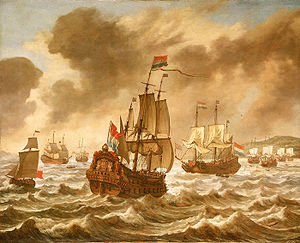
The naval Battle of the Downs took place on 31 October 1639 (New style), during the Eighty Years' War, and was a decisive defeat of the Spanish
Spanish Empire
The Spanish Empire comprised territories and colonies administered directly by Spain in Europe, in America, Africa, Asia and Oceania. It originated during the Age of Exploration and was therefore one of the first global empires. At the time of Habsburgs, Spain reached the peak of its world power....
, commanded by Admiral Antonio de Oquendo
Antonio de Oquendo
Antonio de Oquendo was a Spanish admiral; in 1639 he was in command of the Spanish forces at the Battle of the Downs.-Naval career:...
, by the United Provinces
Dutch Republic
The Dutch Republic — officially known as the Republic of the Seven United Netherlands , the Republic of the United Netherlands, or the Republic of the Seven United Provinces — was a republic in Europe existing from 1581 to 1795, preceding the Batavian Republic and ultimately...
, commanded by Lieutenant-Admiral Maarten Tromp
Maarten Tromp
Maarten Harpertszoon Tromp was an officer and later admiral in the Dutch navy. His first name is also spelled as Maerten.-Early life:...
.
Background
The entry (in 1635) of FranceKingdom of France
The Kingdom of France was one of the most powerful states to exist in Europe during the second millennium.It originated from the Western portion of the Frankish empire, and consolidated significant power and influence over the next thousand years. Louis XIV, also known as the Sun King, developed a...
in the Thirty Years War had blocked off the overland "Spanish Road
Spanish Road
The "Spanish Road" was a military supply/trade route used from 1567–1620, which stretched from Northern Italy to the Low Countries. It crossed through relatively neutral territory, and was therefore Europe's most preferred military route...
" to Flanders
Flanders
Flanders is the community of the Flemings but also one of the institutions in Belgium, and a geographical region located in parts of present-day Belgium, France and the Netherlands. "Flanders" can also refer to the northern part of Belgium that contains Brussels, Bruges, Ghent and Antwerp...
. To support the Spanish army of Flanders of Cardinal-Infante Ferdinand, the Spanish navy had to ferry supplies by sea via Dunkirk, the last Spanish-controlled port on the North Sea coast. A Spanish fleet, under admiral Lope de Hoces y Córdova, had managed to make the trip to Dunkirk in 1636 and again in 1637, without being spotted by Dutch squadrons. In 1638, the French invaded Spain, and laid siege to Fuentarrabia
Siege of Fuenterrabía (1638)
The Siege of Fuenterrabía of 1638 took place in June – September, 1638, between Spain and France during the Thirty Years' War and the Franco-Spanish War ....
. Lope de Hoces was hurriedly dispatched to rescue the city, but his fleet was destroyed
Action of 22 July 1638
The Action of 22 July 1638 or the Battle of Guetaria are the names given to a battle in the Franco-Spanish War , which took place on 22 July 1638 at Guetaria, northern Spain, when a French fleet under de Sourdis attacked and destroyed a Spanish fleet of 12 galleons, under Lope de Hoces, which were...
by the French navy under Henri de Sourdis
Henri de Sourdis
Henri d'Escoubleau de Sourdis was a French naval commander and Archbishop of Bordeaux.Like many churchmen of his day, de Sourdis was a military man as well as a prelate. He fought in the Thirty Years' War and in 1628 served as commander of the artillery at the Siege of La Rochelle...
while it lay at anchor near Getaria
Getaria (Spain)
Getaria is a town located in the province of Gipuzkoa, in the autonomous community of Basque Country, in the North of Spain.Its most famous sons are Juan Sebastián Elcano, Admiral Miguel de Oquendo, who commanded the Guipúzcoa Squadron of the Spanish Armada, the explorer Domingo de Bonechea, and...
. As the remainder of the Spanish navy was engaged on missions in the Mediterranean and Brazil, there were not enough ships left for an attempt to Dunkirk that year.
In the Spring of 1639, the Count-Duke of Olivares ordered the construction and assembly of a new fleet at A Coruña
A Coruña
A Coruña or La Coruña is a city and municipality of Galicia, Spain. It is the second-largest city in the autonomous community and seventeenth overall in the country...
for a new relief jaunt to Dunkirk. 29 warships were assembled in four squadrons, soon joined by an additional 22 warships (also in four squadrons) from the Spanish Meditteranean fleet. 12 English
Kingdom of England
The Kingdom of England was, from 927 to 1707, a sovereign state to the northwest of continental Europe. At its height, the Kingdom of England spanned the southern two-thirds of the island of Great Britain and several smaller outlying islands; what today comprises the legal jurisdiction of England...
transport ships also arrived, contracted to carry the Spanish army under the flag of English neutrality. Lope de Hoces was offered overall command, but he turned it down, as a result the command passed to Antonio de Oquendo
Antonio de Oquendo
Antonio de Oquendo was a Spanish admiral; in 1639 he was in command of the Spanish forces at the Battle of the Downs.-Naval career:...
, commander of the Mediterranean fleet. Oquendo was under instructions to assume a half-moon formation, to induce the Dutch into a boarding battle. The flagship was placed on the right wing (rather than the center), as that is where it was expected the Dutch firepower would come from. In a curious decision, ships of different squadrons were mixed through the formation, an attempt to ensure that the smaller ships would be supported by larger ones. The vanguard was to be composed of the seven-ship "Dunkirk squadron" commanded by Miguel de Horna, in light of their experience with the channel.
The Dutch States-General made their own preparations. From intelligence networks, the Dutch learned that the Spanish fleet might attempt to make for the anchorage known as The Downs
The Downs
The Downs are a roadstead or area of sea in the southern North Sea near the English Channel off the east Kent coast, between the North and the South Foreland in southern England. In 1639 the Battle of the Downs took place here, when the Dutch navy destroyed a Spanish fleet which had sought refuge...
, on the English coast, between Dover
Dover
Dover is a town and major ferry port in the home county of Kent, in South East England. It faces France across the narrowest part of the English Channel, and lies south-east of Canterbury; east of Kent's administrative capital Maidstone; and north-east along the coastline from Dungeness and Hastings...
and Deal
Deal, Kent
Deal is a town in Kent England. It lies on the English Channel eight miles north-east of Dover and eight miles south of Ramsgate. It is a former fishing, mining and garrison town...
, and anchor in there under the protection of English neutrality, and ferry the army and supplies on smaller, fast boats across the English channel
English Channel
The English Channel , often referred to simply as the Channel, is an arm of the Atlantic Ocean that separates southern England from northern France, and joins the North Sea to the Atlantic. It is about long and varies in width from at its widest to in the Strait of Dover...
to Dunkirk. The States-General ordered a fleet of 23 warships and some fireships, under the overall command of Maarten Tromp
Maarten Tromp
Maarten Harpertszoon Tromp was an officer and later admiral in the Dutch navy. His first name is also spelled as Maerten.-Early life:...
into the channel to prevent this eventuality, while the rest of the Dutch fleet was still being prepared. Tromp was under instructions to watch for and, if necessary, harass and delay the Spanish fleet, but was forbidden from engaging them in battle until the rest of the Dutch fleet, some fifty vessels under Johan Evertsen
Johan Evertsen
Johan Evertsen was a Dutch admiral from the 17th century.- Biography :Johan was the eldest surviving son of Johan Evertsen, known as Captain Jan, who died in 1617 fighting near La Rochelle against a French corsair...
, had been launched and joined them. Setting out, Tromp divided his fleet into three squadrons - one squadron of fifteen ships, under rear admiral Joost Banckert
Joost Banckert
Joost van Trappen Banckert was a Dutch Vice Admiral who worked most of his sailing life for the admiralty of Zeeland....
, was dispatched to a position above the Downs, in case the Spanish fleet had circumvented the British Isles and was coming from that side, a second squadron of six ships under Witte de With was put inside the English channel, on patrol by the English coast, while Tromp himself took the remaining 12 ships to patrol the French side of the channel.
Opening phase
The Spanish fleet of 75 ships and 24,000 soldiers and sailors set out on 27 August from A CoruñaA Coruña
A Coruña or La Coruña is a city and municipality of Galicia, Spain. It is the second-largest city in the autonomous community and seventeenth overall in the country...
(in another calculation, 51 galleons, with the troops carried aboard 7 pataches and 12 English transports; on the whole, an estimated 8,000 sailors and 8,000 troops). The fleet reached the mouth of the English channel
English Channel
The English Channel , often referred to simply as the Channel, is an arm of the Atlantic Ocean that separates southern England from northern France, and joins the North Sea to the Atlantic. It is about long and varies in width from at its widest to in the Strait of Dover...
on September 11. On September 15, they learned from a passing English ship that a Dutch squadron was anchored near Calais
Calais
Calais is a town in Northern France in the department of Pas-de-Calais, of which it is a sub-prefecture. Although Calais is by far the largest city in Pas-de-Calais, the department's capital is its third-largest city of Arras....
.
On the morning of September 16th, the Spanish fleet spotted the 12-ship squadron of Maarten Tromp near the French coast. Tromp immediately dispatched one of his ships to warn Banckert, leaving him with only 11. De With's squadron were visible at a distance, but too late to reach Tromp. With odds of 57 against 11, Oquedo could have probably just made for Dunkirk directly, and there would be little Tromp could to do stop it. But Oquedo could not resist the chance to make battle with such favorable odds.
Perhaps not realizing the size of the Spanish fleet, Tromp did not decline battle but rather ordered his squadron into a tight line of battle
Line of battle
In naval warfare, the line of battle is a tactic in which the ships of the fleet form a line end to end. A primitive form had been used by the Portuguese under Vasco Da Gama in 1502 near Malabar against a Muslim fleet.,Maarten Tromp used it in the Action of 18 September 1639 while its first use in...
. Believing Tromp's squad was attempting to slip past his right wing, Oquendo impetuously ordered his flagship to turn hard starboard, hoping to board Tromp's flagship. This maneouver, however, was effected without warning the rest of the Spanish fleet. Some of the ships near Oquendo turned with him, others were confused and maintained bearing. The half-moon formation quickly distintegrated, and only the Dunkirk squadron and the galleon San Juan, kept up with the Spanish flagship's pursuit of Tromp.
Had Oquendo given the order for a line, the immense Spanish fleet could have probably encircled and dispatched the Dutch squadron in a few hours. But Oquendo seemed intent on boarding the Dutch flagship. When he finally decided to turn for a shot, he did it too late and sailed past the Tromp's poop. Trying to correct his error, Oquendo decided to attempt to board the second ship in the Dutch column, the latter also avoided him. Oquendo's flagship and one of the Dunkirk ships, the Santiago, were now downwind and on the receiving end of the cannonades of the remaining nine ships of the Dutch column. Tromp turned his column and went for another round on the Santiago. Oquendo, the other six Dunkirk ships and the San Juan, unable to turn upwind, fired what they could. The artillery did little damage, but the Spanish musketry picked off many on the Dutch decks.
This encounter lasted for three hours, in the course of which the Dutch ship Groot Christoffel accidentally exploded. By noon, the six ships of the De With column had reached Tromp, and increased his number to 16. Although the rest of the Spanish fleet remained dispersed and disorganized, many units had finally turned and were also approaching from the other side. For Tromp, this was building up into a dangerous situation, as the Spanish units upwind would cut off his exit, and force the Dutch squadron to turn into the shoals of the bay of Boulogne, and almost certainly run aground. But at this moment, Oquendo ordered the Spanish fleet to resume a half-moon formation. The Spanish ships turned, allowing Tromp's squadron to also turn, gain upwind, and escape the danger.
There were no more engagements that evening. The fleets anchored in, and the next day, rear-admiral Joost Banckert
Joost Banckert
Joost van Trappen Banckert was a Dutch Vice Admiral who worked most of his sailing life for the admiralty of Zeeland....
arrived, bringing the total Dutch fleet to thirty-two, but there was no engagement, just preparations for what was to become known as the Action of 18 September 1639
Action of 18 September 1639
This battle took place between 17 and 19 September 1639 when a Dutch squadron under Admiral Maarten Tromp and Admiral Witte Corneliszoon de With, met with a much larger but poorly led Spanish fleet under Antonio D'Oquendo, consisting of 40 to 45 men–of–war and 40 to 50 transport vessels filled with...
.
The Spanish, whose first priority was to protect the troops, not to endanger them by continuing the battle, were driven to take refuge off the coast of England
England
England is a country that is part of the United Kingdom. It shares land borders with Scotland to the north and Wales to the west; the Irish Sea is to the north west, the Celtic Sea to the south west, with the North Sea to the east and the English Channel to the south separating it from continental...
, in the anchorage known as The Downs
The Downs
The Downs are a roadstead or area of sea in the southern North Sea near the English Channel off the east Kent coast, between the North and the South Foreland in southern England. In 1639 the Battle of the Downs took place here, when the Dutch navy destroyed a Spanish fleet which had sought refuge...
between Dover
Dover
Dover is a town and major ferry port in the home county of Kent, in South East England. It faces France across the narrowest part of the English Channel, and lies south-east of Canterbury; east of Kent's administrative capital Maidstone; and north-east along the coastline from Dungeness and Hastings...
and Deal
Deal, Kent
Deal is a town in Kent England. It lies on the English Channel eight miles north-east of Dover and eight miles south of Ramsgate. It is a former fishing, mining and garrison town...
, near an English squadron commanded by Vice-Admiral John Pennington. They hoped the usual autumn storms would soon disperse the Dutch fleet. Tromp, as always, endured De With's insubordination with complacency. In a famous scene, described by De With himself, after the battle, he entered Tromp's cabin with his face sooty, his clothes torn, and limping from a leg wound. Tromp looked up from his desk and asked: "Are you alright, De With?" De With replied: "What do you think? Would I have been if you had come to help me?"
On the evening of the 28th, Tromp and De With withdrew to resupply, as they were short on gunpowder. They feared they had failed in their mission until they rediscovered the Spanish at the Downs on the 30th. Together, they blockaded the Spanish and sent urgently to the Netherlands for reinforcements. The five Dutch admiralties hired any large armed merchant ship they could find. Many joined voluntarily, hoping for a rich bounty. By the end of October, Tromp had 95 ships and 12 fire ship
Fire ship
A fire ship, used in the days of wooden rowed or sailing ships, was a ship filled with combustibles, deliberately set on fire and steered into an enemy fleet, in order to destroy ships, or to create panic and make the enemy break formation. Ships used as fire ships were usually old and worn out or...
s.
Meanwhile, the Spanish, who earlier had managed to sneak 13 or 14 Dunkirker frigates through the blockade, began to transport their troops and money to Flanders on British ships under an English flag. Tromp stopped this by searching the English vessels and detaining any Spanish troops he found. Uneasy about the possible English reaction to this, he pretended to Pennington to be worried by his secret orders from the States-General
States-General of the Netherlands
The States-General of the Netherlands is the bicameral legislature of the Netherlands, consisting of the Senate and the House of Representatives. The parliament meets in at the Binnenhof in The Hague. The archaic Dutch word "staten" originally related to the feudal classes in which medieval...
. He showed him, "confidentially", a missive commanding him to attack the Spanish armada wherever it might be located and to prevent by force of arms any interference by a third power.
Legend also says that Tromp formally asked de Oquendo why he refused battle though he had superior firepower. De Oquendo replied that his fleet had to be repaired first, but that he could not obtain masts and other materials now that the Dutch blockaded him. On learning this, Tromp supplied the Spanish with the necessary materials for repair. Nevertheless they did not leave the English coast.
The battle
Weather gage
The weather gage is a nautical term used to describe the advantageous position of a fighting sailing vessel, relative to another. The term is from the Age of Sail, and is now antiquated. A ship is said to possess the weather gage if it is in any position, at sea, upwind of the other vessel...
, Tromp having dispatched 30 ships under De With to watch the English and prevent them from interfering, kept two squadrons to the north (under Cornelis Jol
Cornelis Jol
Cornelis Corneliszoon Jol , nicknamed Houtebeen , was a 17th-Century Dutch corsair and admiral in the Dutch West India Company during the Eighty Year's War between Spain and the fledgling Dutch Republic...
) and the south (under Commodore Jan Hendriksz de Nijs) to block escape routes and attacked with three squadrons. Some of the large, unmanoeuverable Spanish ships panicked on approach of the Dutch fleet and grounded themselves deliberately; they were immediately plundered by the English populace, present in great numbers to watch the uncommon spectacle. Others tried a planned breakthrough.
De Oquendo's Royal Flagship, the Santiago, came out first followed by the Santa Teresa, the Portuguese flagship. Five blazing fireships were sent into the Spanish ships. The first ship could disengage and avoid three of them in the last moment but these hit the following Santa Teresa, who had just managed to repel the attack of the other two. Too big (the biggest ship in the Spanish/Portuguese fleet) and slow to manoeuvre, and with no time to react, the Santa Teresa was finally grappled and set on fire by one fire ship. With Admiral Lope de Hoces already dead by his wounds, she fiercely burned with great loss of life.
The Portuguese ships were intercepted by the squadron of the Zealandic Vice-Admiral Johan Evertsen
Johan Evertsen
Johan Evertsen was a Dutch admiral from the 17th century.- Biography :Johan was the eldest surviving son of Johan Evertsen, known as Captain Jan, who died in 1617 fighting near La Rochelle against a French corsair...
who launched his fireships against them: most were taken or destroyed, leaving according to some reports 15,200 dead and 1,800 prisoner. The number of dead is today considered as greatly exaggerated; for example, it does not take into account that a third of the troops had already reached Flanders. De Oquendo managed to escape in the fog with about ten ships, most of them Dunkirkers
Dunkirkers
During the Dutch Revolt the Dunkirkers or Dunkirk Privateers, were commerce raiders in the service of the Spanish Monarchy. They were also part of the Dunkirk fleet, which consequently was a part of the Spanish Monarchy's Flemish fleet ...
, and reach Dunkirk. Nine of the ships driven ashore during the battle could be later refloated and also reached Dunkirk.
Losses
According to the Spanish naval historian Cesáreo Fernández DuroCesáreo Fernández Duro
Cesáreo Fernández Duro was a Spanish naval captain, writer, scholar and historian....
, of the 38 ships that attempted to break the Dutch blockade, 12 ran aground on the Downs (of which 9 were reffloated and managed to reach Dunkirk), one was burnt by a Dutch fireship, 9 surrendered (of which 3 were so damaged that sank on the way to port) and 3 ran aground on the coasts of France or Flanders to avoid capture.
The French diplomat Comte d'Estrades
Godefroi, Comte d'Estrades
Godefroi, Comte d'Estrades was a French diplomatist and marshal.He was born in Agen, the son of Francois d'Estrades , a partisan of Henry IV, and brother of Jean d'Estrades, bishop of Condom...
, in a letter to Cardinal Richelieu, claimed that the Spanish had lost 13 ships burnt or sunk, 16 captured with 4,000 prisoners, and 14 lost off the coasts of France and Flanders, a figure higher than the number of Spanish ships present at the Downs. D'Estrades also reported in his letter that the Dutch had lost 10 ships sunk or burnt. This source is cited by Jean Le Clerc in his Histoire des Provinces-Unies des Pays-Bas.
The Portuguese Admiral and historian Ignacio Costa Quintella gives figures of 43 ships and 6,000 men lost by the Spanish and some ships and more than 1,000 men by the Dutch.
The Dutch sources only mention one Dutch ship lost that got entangled with the Santa Teresa and about a hundred persons dead.Historian M.G de Boer who did extensive research and published a book about the subject confirms this and puts Spanish losses in ships and men at about 40 and 7000 respectively.
Aftermath
The celebrated Dutch victory marked a significant moment in the shifting balance of naval power. The Spanish mission itself was not a complete failure, as the larger part of the infantry troops and all the money reached Flanders. Of the ships that succeeded in breaking through the blockade, many were severely damaged. Spain, straining under the vast commitments of the Thirty Years war, was in no position to rebuild its naval dominance. Fighting over trade continued between Dutch and Dunkirker forces and the convoy itself was just one of a number; but these convoys paid a heavy price in lives and ships in running the Dutch blockades. This complicated operations in the Low Countries and left the overall Spanish Habsburg forces and finances in a precarious situation. The Dutch, English and French were quick to take advantage by seizing some small Spanish island possessions in the Caribbean. But by far the worst effects for Spain were the increased difficulties it suffered in maintaining its position in the Southern NetherlandsSouthern Netherlands
Southern Netherlands were a part of the Low Countries controlled by Spain , Austria and annexed by France...
.
Tromp was hailed as a hero on his return and was rewarded with 10,000 guldens invoking the jealousy of De With who only got 1,000. De With wrote some anonymous pamphlet
Pamphlet
A pamphlet is an unbound booklet . It may consist of a single sheet of paper that is printed on both sides and folded in half, in thirds, or in fourths , or it may consist of a few pages that are folded in half and saddle stapled at the crease to make a simple book...
s painting Tromp as avaricious and himself as the real hero of the battle. With Spain beginning to gradually lose its dominant naval position, England weak and France not yet in possession of a strong navy, the Dutch allowed their own to diminish greatly after the peace treaty was signed in 1648. So, with an ineffective naval administration, ships that were too light and too few in number, they were to find themselves at a serious disadvantage in their coming struggles with the English. However, they were able to maintain their large mercantile advantage over the English, entering into a period of increasing Dutch maritime superiority, both mercantile and naval, from the Second Anglo-Dutch War
Second Anglo-Dutch War
The Second Anglo–Dutch War was part of a series of four Anglo–Dutch Wars fought between the English and the Dutch in the 17th and 18th centuries for control over the seas and trade routes....
, until the onset of the 18th century.
The Battle of the Downs was a flagrant violation of English neutrality within sight of the English coast. For the English, their navy's inability to intervene was a humiliation. Lingering resentment from this incident may have influenced the breakout of the First Anglo-Dutch War
First Anglo-Dutch War
The First Anglo–Dutch War was the first of the four Anglo–Dutch Wars. It was fought entirely at sea between the navies of the Commonwealth of England and the United Provinces of the Netherlands. Caused by disputes over trade, the war began with English attacks on Dutch merchant shipping, but...
, not far from the Downs at the Battle of Goodwin Sands
Battle of Goodwin Sands
The naval Battle of Goodwin Sands , fought on 29 May 1652 , was the first engagement of the First Anglo-Dutch War between the navies of the Commonwealth of England and the United Provinces of the Netherlands.- Background :The English Parliament had passed the first of the Navigation...
in 1652.
The Netherlands (Maarten Tromp)
(not complete: the contemporaneous Dutch sources give only lists of participating captains; in many cases it is unknown which ship they commanded)26 September:
Aemilia
Dutch ship Aemilia (1632)
The Aemilia was the flagship of Admiral Maarten Tromp during part of the Eighty Years' War. It was a Dutch 57-gun ship of the line. Built by Jan Salomonszoon van den Tempel for the Admiralty of Rotterdam in 1632, the ship was the largest Dutch warship built up to that time.At the Battle of the...
57 (Tromp, flagcaptain Barend Barendsz Cramer) Rotterdam
Frederik Hendrik 36 (Pieter Pietersz de Wint) Amsterdam; on 31 October this was Witte de With's flagship
Hollandsche Tuyn 32 (Lambert IJsbrandszoon Halfhoorn) Northern Quarter (Noorderkwartier)
Salamander 40 (Laurens Pietersz Backhuysen) - WIC ship
Gelderland 34 (Willem van Colster) Rotterdam
Sampson 32 (Claes Cornelisz Ham) Noorderkwartier
Omlandia 28 (Jan Gerbrandszoon) Frisia
Groot Christoffel 28 (hired by Noorderkwartier admiralty, Frederick Pieterszoon) - blew up on 26 September
Deventer 28 (Robert Post) Amsterdam
Gideon 24 (Hendrick Jansz Kamp) Frisia
Meerminne 28 (Jan Pauluszoon) Zealand
unidentified ship of 32 cannon under Cornelis Ringelszoon from the Zealand admiralty.
Reinforcements 27 September:
Maeght van Dordrecht 42 (Vice-Admiral Witte de With) Rotterdam
Overijssel 24 (Jacques Forant) Amsterdam
Utrecht 30 (Gerrit Meyndertsz den Uyl) Amsterdam
Sint Laurens 32 (A.Dommertszoon)
Bommel 28 (Sybrant Barentsz Waterdrincker) Amsterdam
Reinforcements 28 September:
Banckert squadron:
t Wapen van Zeeland 28 (Vice-Admiral Joost Banckert) Zealand
Zeeridder 34 (Frans Jansz van Vlissingen) Zealand
Zutphen 28 (Joris van Cats) Amsterdam
Walcheren 28 (Jan Theunisz Sluis) Amsterdam
t Wapen van Holland 39 (Lieven Cornelisz de Zeeuw) Noorderkwartier
Neptunis 33 (Albert 't Jongen Hoen) Noorderkwartier
Amsterdam 10 (Pieter Barentsz Dorrevelt) Amsterdam
Drenthe 16 (Gerrit Veen) Amsterdam
Rotterdam 10 (Joris Pietersz van den Broecke
Joris Pieters van den Broeck
Joris Pieters van den Broeck was a Frisian sailor in the service of the Admiralty of Friesland.-Service:In the days before the Battle of the Downs, Maarten Harpertszoon Tromp had chosen a position off the coast near Dunkirk...
) Frisia
Arnemuyden 22 (Adriaen Jansz de Gloeyende Oven) Zealand
Ter Goes 24 (Abraham Crijnssen) Zealand
Friesland 22 (Tjaert de Groot) Frisia
After reinforcements 31 September
Evertsen squadron:
Vlissingen 34 (Vice-Admiral Johan Evertsen, flagcaptain Frans Jansen) Zealand
De With squadron: thirty ships, four fireships
Jol squadron, seven ships:
Jupiter (Cornelis Cornelisz Jol "Houtebeen") WIC
De Nijs squadron, eight ships
Spain/Portugal (Antonio de Oquendo)
Order of Battle of the Spanish Armada, 6 September 1639 (Orden de Batalla en media Luna). Total is 75 ships. Dates are now NS.Name guns (squadron/type/commander etc.) - Fate
Santiago 60 (Castile) - Capitana Real or Royal Flagship. Escaped into
Dunkirk, 1 November 1639
San Antonio (pinnace) (Masibradi) - Driven ashore 31 October
San Agustin (pinnace) (Martin Ladron de Guevara) - Driven ashore 31 October
Santa Teresa 60 (Portugal) - Don Lope de Hoces, commander. Destroyed in action 31 October
San Jeronimo
San Agustin (Naples) - Vice-Admiral. Driven ashore 31 October, sunk 3 or 4 days later
El Gran Alejandro (Martin Ladron de Guevara) - Taken by the Dutch
Santa Ana (Portugal)
San Sebastian
Santa Catalina (Guipuzcoa) - Driven ashore 31 October
San Lazaro
San Blas (Masibradi) - Driven ashore 31 October
San Jerónimo (Masibradi) - Burnt in the Downs 31 October
San Nicolas
Santiago (Castile) - Burnt off Dover on the night of 2 November
San Juan Bautista (Guipuzcoa) - Sunk 31 October
Esquevel 16 (hired Dane) - Captured 28 September
San Jose (Dunkirk)
Los Angeles (Castile) - Driven ashore 31 October
Santiago (Portugal) - Driven ashore 31 October
Delfin Dorado (Naples) - Driven ashore 31 October
San Antonio (Naples) - Driven ashore 31 October
San Juan Evangelista (Dunkirk)
El Pingue (hired ship) - Sunk in the Downs 31 October
San Carlos (Masibradi)
San Nicolas (Masibradi)
San Miguel
Orfeo 44 (Naples) - Lost on the Goodwin sands 31 October
San Vicente Ferrer (Dunkerque)
San Martin (Dunkerque)
Nuestra Senora de Monteagudo (Dunkerque) - Escaped into Dunkirk 1 November
Santiago 60? (Galicia) - Captured 31 October
? (flag of Masibradi) - Captured 28 September, retaken same day, escaped to Dunkirk, 1 November, wrecked 4 days later
Santo Tomas (Martin Ladron de Guevara) - Driven ashore 31 October
Nuestra Senora de Luz
Santa Clara
San Gedeon (Dunkerque)
San Jacinto
San Carlos (Dunkerque) - Sunk 31 October
Santo Cristo de Burgos (San Josef) - Lost off the French coast 31 October
San Paulo (Masibradi)
San Miguel
La Corona (hired ship)
La Presa or San Pablo La Presa (Castile)
San Esteban (Martin Ladron de Guevara) - Captured 31 October
San Pedro de la Fortuna (hired ship) - Driven ashore but got off, 31 October
Los Angeles (hired ship)
Aguila Imperial
La Mujer
Santo Domingo de Polonia (hired Polish ship) - Driven ashore 31 October
San Jose (flagship of Vizcaya) - Captured 31 October
San Salvador (flagship of Dunkirk) - Escaped into Dunkirk 1 November
São Baltasar (Vice-Admiral of Portugal) - 800 tons. Back at Lisbon in 1640
San Francisco 50? (Rear-Admiral of Dunkerque) - Escaped into Dunkirk 1 November
San Pedro el Grande (flagship of Ladron de Guevara)
Santiago (Martin Ladron de Guevara)
Jesus Maria (pinnace)
San Pedro Martir (urca) (hired ship) - Driven ashore 31 October
Fama (Urca) (hired ship) - Driven ashore 31 October
Santa Cruz (Masibradi)
San Daniel (Guipuzcoa) - Driven ashore 31 October
San Juan Evangelista (hired ship of Hamburg) - Driven ashore 31 October
Santa Agnes (frigate) (Naples) - Stranded but got off, 3 November
Grune? (Castile) - Driven ashore, 31 October 1639
Santa Teresa (Saetia) (Castile) - Taken by a French privateer 31 October
Exchange (hired English transport) - All 8 English transports put into Plymouth 13 September, and reached the Downs 22 October, where they were detained
Peregrine (hired English transport)
Assurance (hired English transport)
5 other hired English transports