
All Topics  
William the Silent

 
William the Silent

   Email Print
   Bookmark   Link


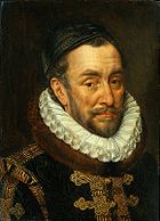
William the Silent


William I, Prince of Orange (April 24 1533—July 10 1584), also widely known as William the Silent , or simply William of Orange , was born in the House of Nassau
House of Nassau

The House of Nassau is a diversified aristocratic dynasty in Europe. It is named after the lordship associated with Nassau Castle, located in present-day Nassau, Germany, Rhineland-Palatinate, Germany....
 as a count of Nassau-Dillenburg
Nassau (state)

Nassau was a Germany state within the Holy Roman Empire and later in the German Confederation. Its ruling dynasty, now extinct in male line, was the House of Nassau....
. He became Prince of Orange
Prince of Orange

Prince of Orange is a title of nobility, originally associated with the Principality of Orange, now in southern France.It is carried by members of the House of Orange-Nassau, as heirs to the crown of the Netherlands, and is also seen carried by the pretenders by members of the Hohenzollern....
 in 1544 and is thereby the founder of the branch House of Orange-Nassau
House of Orange-Nassau

The House of Orange-Nassau , a branch of the European House of Nassau, has played a central role in the political life of the Netherlands — and at times in Europe — since William I of Orange organized the Dutch revolt against Spain rule, which after the Eighty Years' War led to an independent Dutch state....
. He was the main leader of the Dutch
Netherlands

The Netherlands is a country that is part of the Kingdom of the Netherlands. It is a parliamentary democratic constitutional monarchy. The Netherlands is located in North-West Europe, and bordered by the North Sea to the north and west, Belgium to the south, and Germany to the east....
 revolt against the Spanish
Spain

Spain or the Kingdom of Spain , is a country located in Southern Europe on the Iberian Peninsula.The Spanish constitution does not establish any official denomination of the country, even though Espa?a , Estado espa?ol and Naci?n espa?ola are used interchangeably....
 that set off the Eighty Years' War and resulted in the formal independence of the United Provinces
Dutch Republic

The Republic of the Seven United Netherlands was a European republic between 1581 and 1795, in about the same location as the modern Kingdom of the Netherlands, which is the successor state....
 in 1648.

A wealthy nobleman
Nobility

Nobility is a government-privileged title which may be either hereditary or for a lifetime. Titles of nobility exist today in many countries although it is usually associated with present or former monarchies....
, William originally served at the court of Margaret of Parma
Margaret of Parma

Margaret, Duchess of Parma Governors of the Habsburg Netherlands from 1559 to 1567, was the illegitimate daughter of Charles V, Holy Roman Emperor....
, governor of the Spanish Netherlands.


Discussion
Ask a question about 'William the Silent'
Start a new discussion about 'William the Silent'
Answer questions from other users
Full Discussion Forum


Encyclopedia


William I, Prince of Orange (April 24 1533—July 10 1584), also widely known as William the Silent , or simply William of Orange , was born in the House of Nassau
House of Nassau

The House of Nassau is a diversified aristocratic dynasty in Europe. It is named after the lordship associated with Nassau Castle, located in present-day Nassau, Germany, Rhineland-Palatinate, Germany....
 as a count of Nassau-Dillenburg
Nassau (state)

Nassau was a Germany state within the Holy Roman Empire and later in the German Confederation. Its ruling dynasty, now extinct in male line, was the House of Nassau....
. He became Prince of Orange
Prince of Orange

Prince of Orange is a title of nobility, originally associated with the Principality of Orange, now in southern France.It is carried by members of the House of Orange-Nassau, as heirs to the crown of the Netherlands, and is also seen carried by the pretenders by members of the Hohenzollern....
 in 1544 and is thereby the founder of the branch House of Orange-Nassau
House of Orange-Nassau

The House of Orange-Nassau , a branch of the European House of Nassau, has played a central role in the political life of the Netherlands — and at times in Europe — since William I of Orange organized the Dutch revolt against Spain rule, which after the Eighty Years' War led to an independent Dutch state....
. He was the main leader of the Dutch
Netherlands

The Netherlands is a country that is part of the Kingdom of the Netherlands. It is a parliamentary democratic constitutional monarchy. The Netherlands is located in North-West Europe, and bordered by the North Sea to the north and west, Belgium to the south, and Germany to the east....
 revolt against the Spanish
Spain

Spain or the Kingdom of Spain , is a country located in Southern Europe on the Iberian Peninsula.The Spanish constitution does not establish any official denomination of the country, even though Espa?a , Estado espa?ol and Naci?n espa?ola are used interchangeably....
 that set off the Eighty Years' War and resulted in the formal independence of the United Provinces
Dutch Republic

The Republic of the Seven United Netherlands was a European republic between 1581 and 1795, in about the same location as the modern Kingdom of the Netherlands, which is the successor state....
 in 1648.

A wealthy nobleman
Nobility

Nobility is a government-privileged title which may be either hereditary or for a lifetime. Titles of nobility exist today in many countries although it is usually associated with present or former monarchies....
, William originally served at the court of Margaret of Parma
Margaret of Parma

Margaret, Duchess of Parma Governors of the Habsburg Netherlands from 1559 to 1567, was the illegitimate daughter of Charles V, Holy Roman Emperor....
, governor of the Spanish Netherlands. Unhappy with the lack of political power
Political power

Political power is a type of power held by a political organization in a society which allows administration of some or all of public resources, including labour, and wealth....
 for the local nobility and the Spanish persecution of Dutch Protestants
Protestantism

Protestantism is a movement within Christianity that originated in the sixteenth-century Protestant Reformation. It is considered to be one of the three principal traditions of Christianity, together with Roman Catholicism and Eastern Orthodoxy....
, William joined the Dutch uprising and turned against his former masters. The most influential and politically capable of the rebels, he led the Dutch to several successes in the fight against the Spanish. Declared an outlaw
Outlaw

An outlaw or bandit is a person living the lifestyle of outlawry; the word literally means "outside the law", by folk-etymology from the original meaning "laid outside" of the Old Norse word ?tlagi, from which the word outlaw was borrowed into English....
 by the Spanish king in 1580, he was assassinated by Balthasar Gérard
Balthasar Gérard

Balthasar G?rard was the assassin of the Netherlands independence leader, William I of House of Orange-Nassau, also known as William the Silent....
 (also written as 'Gerardts') in Delft
Delft

See also: Delft, Cape Town, Delft Island Media:Nl-Delft.ogg is a city and municipality in the province of South Holland . It is located in between Rotterdam and The Hague....
 four years later.

There are several explanations for the origin of this nickname
Nickname

A nickname is a descriptive name given in place of or in addition to the official name of a person, place or thing. Another class of nickname is the familiar or truncated form of the proper name, such as Bob, Bobby, Rob, Robbie, and Bert for Robert, more properly called a short name....
 "William the Silent". The most common one is that he rarely spoke out clearly on controversial matters at the court or in public, or (by some accounts) even completely avoided speaking about such topics. In the Netherlands, he is also known as the Vader des Vaderlands, "Father of the Fatherland
Pater Patriae

Pater Patriae , also seen as Parens Patriae, is a Latin language honorific meaning "Father of the Country," or more literally, "Father of the Fatherland"....
", and the Dutch national anthem
National anthem

A national anthem is a generally patriotism musical composition that evokes and eulogizes the history, traditions and struggles of its people, recognized either by a nation's government as the official national song, or by convention through use by the people....
, Het Wilhelmus, was written in his honour.

Early life

William was born in the castle of Dillenburg
Dillenburg

Art = Stadt|Wappen = Wappen Dillenburg.png|lat_deg = 50 |lat_min = 44|lon_deg = 08 |lon_min = 17|Lageplan = Lahn-Dill-Kreis Dillenburg.png...
 in Nassau, present-day Germany
Germany

Germany , officially the Federal Republic of Germany , is a country in Central Europe. It is bordered to the north by the North Sea, Denmark, and the Baltic Sea; to the east by Poland and the Czech Republic; to the south by Austria and Switzerland; and to the west by France, Luxembourg, Belgium, and the Netherlands....
. He was the eldest son of William, Count of Nassau
William I, Count of Nassau-Dillenburg

William of Nassau , was a count of Nassau-Dillenburg from the House of Nassau. He was called William the Rich.William was born in Dillenburg as the younger son of Count John V of Nassau-Dillenburg and landgravine Elisabeth of Hesse , daughter of Landgrave Henry III of Hesse-Marburg and Anna of Katzenelnbogen He was the brother of c...
 and Juliana of Stolberg-Werningerode
Juliana of Stolberg

Juliana, Countess of Stolberg-Wernigerode was the mother of William the Silent, the leader of the Netherlands revolt against the Spain in the 16th century....
, and was raised a Lutheran. He had four younger brothers and seven younger sisters: John, Hermanna, Louis
Louis of Nassau

Louis of Nassau was the third son of William the Rich, and Juliana of Stolberg and the younger brother of Prince William the Silent.Louis was a key figure in the revolt of the Netherlands against Spain, unlike his brother William, he was a strongly convinced Calvinist....
, Mary, Anna, Elisabeth, Katharine, Juliane, Magdalene, Adolf
Adolf of Nassau

Adolf of Nassau may refer to:*Adolf of Nassau-Weilburg, King of the Romans *Adolph II of Nassau *Adolphe, Grand Duke of Luxembourg, *Adolf of Nassau , brother of Louis of Nassau and William I of Orange, killed in the Battle of Heiligerlee...
 and Henry
Henry of Nassau-Dillenburg

Henry of Nassau, count of Nassau-Dillenburg, was the youngest brother of William the Silent.He was the twelfth and last child of William I, Count of Nassau-Dillenburg and Juliana of Stolberg, and was raised a Lutheran Church....
.

When his cousin, René of Châlon
René of Châlon

Ren? of Ch?lon , also known as Renatus of Ch?lon, was a Prince of Orange and stadtholder of Holland, Zeeland, Diocese of Utrecht and Gelre....
, Prince of Orange, died childless in 1544, the eleven-year-old William inherited all Châlon's property, including the title Prince of Orange, on the condition that he would receive a Roman Catholic education. Besides Châlon's properties he also inherited vast estates in the Netherlands (present-day Netherlands and Belgium). Because of his young age, Holy Roman Emperor Charles V
Charles V, Holy Roman Emperor

Charles V was ruler of the Holy Roman Empire from 1519 and, as Charles I of Spain, of the Spanish realms from 1516 until his abdication in 1556....
 served as the regent of the principality until William was fit to rule. William was sent to Brussels
Brussels

Brussels , officially the Brussels Capital-Region, is the de facto capital city of the European Union and the largest urban area in Belgium....
 to study under the supervision of Mary of Habsburg (aka Mary of Hungary), the sister of Charles V and governor of the Habsburg Netherlands
Governors of the Habsburg Netherlands

The Governor of the Habsburg Netherlands ruled the Habsburg Netherlands, as a representative of the Duke of Burgundy , the King of Spain or the Archduke of Austria , all from the house of Habsburg....
 (Seventeen Provinces
Seventeen Provinces

The Seventeen Provinces were a personal union of states in the Low Countries in the 15th century and 16th century, roughly covering the current Netherlands, Belgium, Luxembourg, a good part of the North of France , and a small part of the West of Germany....
). In Brussels, he was taught foreign languages and received military and diplomatic education.

On 6 July 1551, he married Anna van Egmond en Buren, the wealthy heir to the lands of her father, and William earned the titles Lord of Egmond and Count of Buren
Buren

Media:Nl-Buren.ogg is a municipality and a city in the eastern Netherlands and is strongly linked to the Dutch monarchy....
. They had three children. Later that same year, William was appointed captain in the cavalry
Cavalry

The Cavalry is the second oldest of the Combat Arms, and as soldiers or warriors who fought mounted on horseback in combat, it represents the mobility and offensive power of the armed forces....
. Favoured by Charles V, he made quick promotions, and became commander of one of the Emperor's armies at age 22. He was made a member of the Raad van State, the highest political advisory council in the Netherlands in 1555; the same year Charles abdicated in favour of his son, Philip II of Spain
Philip II of Spain

Philip II was King of Spain from 1556 until 1598, List of monarchs of Naples from 1554 until 1598, king consort of England, as husband of Mary I of England, from 1554 to 1558, lord of the Seventeen Provinces from 1556 until 1581, holding various titles for the individual territories, such as Duke or Count; and King of Portugal as Philip I...
. It was on the shoulder of William that the gout-afflicted Emperor leaned during his abdication ceremony.

His wife Anna died on March 24, 1558. Later, William had a brief relationship with one Eva Elincx, leading to the birth of their illegitimate son, Justinus van Nassau
Justinus van Nassau

Justinus van Nassau was the only extramarital child of William the Silent. He was a Dutch army commander known for unsuccessfully Siege of Breda, and the depiction of his surrender on the famous picture by Diego Velazquez....
: William officially recognised him and took responsibility for his education — Justinus would become an admiral in his later years.

In 1559, Philip appointed William as the stadtholder
Stadtholder

A Stadtholder in the Low Countries was a medieval function which during the 18th century developed into a rare type of de facto hereditary head of state of the thus "crowned" Dutch Republic....
 (governor) of the provinces Holland
Holland

Holland is a name in common usage given to two regions in the western part of Netherlands. The name 'Holland' is also often mistakenly used to refer to the whole of The Netherlands....
, Zeeland
Zeeland

Zeeland , also called Zealand in English language and Zeelandic, is a province of the Netherlands. The province, located in the south-west of the country, consists of a number of islands and a strip bordering Belgium....
, Utrecht
Utrecht (province)

Utrecht is the smallest Provinces of the Netherlands of the Netherlands, and is located in the center of the country. It is bordered by the Eemmeer in the north, Gelderland in the east, the river Rhine in the south, South Holland in the west, and North Holland in the northwest....
 and Burgundy
Burgundy

Burgundy is a region historically situated in modern-day France and Switzerland....
, thereby greatly increasing his political power.

From politician to rebel

Battleofheiligerlee
Although he never directly opposed the Spanish king, William soon became one of the most prominent members of the opposition in the Raad van State, together with Philip de Montmorency, Count of Hoorn
Philip de Montmorency, Count of Hoorn

Philip de Montmorency was also known as Count of County of Horn.De Montmorency was born, between 1518 and 1526, possibly at the Ooidonk Castle, as the son of Jozef van Montmorency, Count of Nevele and Anna van Egmont....
 and Lamoral, Count of Egmont. They were mainly seeking more political power for the Dutch nobility, and complained that too many Spaniards were involved in governing the Netherlands. William was also dissatisfied with the increasing persecution of Protestants in the Netherlands. Brought up as both a Lutheran and later a Catholic, William was very religious but still was a proponent of freedom of religion for all people. The inquisition
Inquisition

The term Inquisition can refer to any one of several institutions charged with trying and convicting Christian heresy within the Roman Catholic Church....
 policy in the Netherlands, carried out by Cardinal Granvelle
Antoine Perrenot de Granvelle

Antoine Perrenot de Granvelle , Comte de La Baume Saint Amour, was a France statesman, made a Cardinal , who followed his father as a leading minister of the Spain Habsburgs, and was one of the most influential European politicians during the time which immediately followed the appearance of Protestantism in Europe; "the dominating Imperial...
, prime minister to the new governor
Governors of the Habsburg Netherlands

The Governor of the Habsburg Netherlands ruled the Habsburg Netherlands, as a representative of the Duke of Burgundy , the King of Spain or the Archduke of Austria , all from the house of Habsburg....
 Margaret of Parma
Margaret of Parma

Margaret, Duchess of Parma Governors of the Habsburg Netherlands from 1559 to 1567, was the illegitimate daughter of Charles V, Holy Roman Emperor....
 (1522–83) (natural half-sister to Philip II), increased opposition to the Spanish rule among the — then mostly Catholic — population of the Netherlands.

On 25 August 1561, William of Orange married for the second time. His new wife, Anna of Saxony
Anna of Saxony

Anna of Saxony was the only child and heiress of Maurice, Elector of Saxony, and Agnes of Hesse, eldest daughter of Philip I, Landgrave of Hesse....
, was described by contemporaries as "self-absorbed, weak, assertive, and cruel", and it is generally assumed that William married her to gain more influence in Saxony
Saxony

The Free State of Saxony is a States of Germany of Germany. Located in the southeastern part of present-day Germany. It is the tenth-largest German state in area and the sixth largest in population , of Germany's sixteen states....
, Hesse
Hesse

Hesse is a States of Germany of Germany with an area of 21,110 km? and just over six million inhabitants. The state capital is Wiesbaden. Hesse's largest city is nearby Frankfurt am Main....
 and the Palatine. The couple had five children. In early 1565, a large group of lesser noblemen, including William's younger brother Louis
Louis of Nassau

Louis of Nassau was the third son of William the Rich, and Juliana of Stolberg and the younger brother of Prince William the Silent.Louis was a key figure in the revolt of the Netherlands against Spain, unlike his brother William, he was a strongly convinced Calvinist....
, formed the Confederacy of Noblemen. On 5 April, they offered a petition to Margaret of Austria, requesting an end to the persecution of Protestants. From August to October 1566, a wave of iconoclasm
Iconoclasm

Iconoclasm, Greek for "image-breaking," is the deliberate destruction of important symbolic images recognized within a culture, religion, or society....
 (known as the Beeldenstorm) spread through the Low Countries. Calvinists
Calvinism

Calvinism is a theology system and an approach to the Christian life that emphasizes the rule of God over all things. It was developed by several theologians, but it bears the name of the French Protestant Reformation John Calvin because of his prominent influence on it and because of his role in the confessional and ecclesiastical debates t...
, angry with their being persecuted by the Roman Catholic Church and opposed to the Catholic images of saints (which in their eyes conflicted with the Second Commandment
Ten Commandments

The Ten Commandments, or Decalogue, are a list of religious and moral imperatives that, according to Judeo-Christian tradition, were authored by God and given to Moses on the mountain referred to as "Biblical Mount Sinai" or "Mount Horeb" in the form of two stone tablets....
), destroyed statues in hundreds of churches and monasteries
Monastery

Monastery , a term derived from the Greek language word ???ast?????, neut. of ???ast????? - monasterios denotes the building, or complex of buildings, that houses a room reserved for prayer as well as the domestic quarters and workplace of Monk, whether monks or nuns, and whether living in Cenobium or alone ....
 throughout the Netherlands.

Following the Beeldenstorm, unrest in the Netherlands grew, and Margaret agreed to grant the wishes of the Confederacy, provided the noblemen would help to restore order. She also allowed more important noblemen, including William of Orange, to assist the Confederacy. In late 1566, and early 1567, it became clear that the she would not be allowed to fulfill her promises, and when several minor rebellions failed, many Calvinists
Calvinism

Calvinism is a theology system and an approach to the Christian life that emphasizes the rule of God over all things. It was developed by several theologians, but it bears the name of the French Protestant Reformation John Calvin because of his prominent influence on it and because of his role in the confessional and ecclesiastical debates t...
 (the major Protestant denomination) and Lutherans fled the country. Following the announcement that Philip II, unhappy with the situation in the Netherlands, would dispatch his loyal general Fernando Álvarez de Toledo, Duke of Alba (also known as "The Iron Duke") to restore order, William laid down his functions and retreated to his native Nassau in April 1567. He had been (financially) involved with several of the rebellions.

After his arrival in August 1567, Alba established the Council of Troubles (known to the people as the Council of Blood) to judge those involved with the rebellion and the iconoclasm. William was one of the 10,000 to be summoned before the Council, but he failed to appear. He was subsequently declared an outlaw, and his properties were confiscated. As one of the most prominent and popular politicians of the Netherlands, William of Orange emerged as the leader of an armed resistance. He financed the Watergeuzen
Geuzen

Geuzen was a name assumed by the confederacy of Calvinist Dutch nobles and other malcontents, who from 1566 opposed Spain rule in the Netherlands....
, refugee Protestants who formed bands of corsairs
Privateer

A privateer was a private warship authorized by a country's government by letters of marque to attack foreign shipping. Strictly, a privateer was only entitled by its state to attack and rob enemy vessels during wartime....
 and raided the coastal cities of the Netherlands (often killing Spanish and Dutch alike). He also raised an army, consisting mostly of German mercenaries
Mercenary

A mercenary is a person who takes part in an armed conflict, who is not a national or a party to the conflict, and is "motivated to take part in the hostilities essentially by the desire for private gain and, in fact, is promised, by or on behalf of a party to the conflict, material compensation substantially in excess of that promised or p...
 to fight Alba on land. William allied with the French Huguenots, following the end the second Religious War in France when they had troops to spare. Led by his brother Louis, the army invaded the northern Netherlands in 1568. However the plan failed almost from the start. The Huguenots were defeated by French Royal Troops before they could invade, and a small force under Jean de Villers was captured within two days. Villers gave all the plans to the campaign to the Spanish following this capture. On 23 May, the army under the command of Louis won the Battle of Heiligerlee
Battle of Heiligerlee

The Battle of Heiligerlee was fought between Netherlands rebels and the Spain army of Friesland. This was the first Dutch victory during the Eighty Years' War....
 in the northern province of Groningen
Groningen (province)

Groningen is the northeasternmost province of the Netherlands. In the east it borders the Germany state of Lower Saxony , in the south Drenthe, in the west Friesland and in the north the Wadden Sea....
 against a Spanish army led by the stadtholder of the northern provinces, Jean de Ligne, Duke of Aremberg
Jean de Ligne, Duke of Aremberg

Jean de Ligne, House of Arenberg was stadtholder of the Dutch provinces of Friesland, Groningen , Drenthe and Overijssel from 1559 until his death....
. Aremberg was killed in the battle, as was William's brother Adolf. Alba countered by killing a number of convicted noblemen (including the Counts of Egmont and Hoorn on 6 June), and then by leading an expedition to Groningen. There, he annihilated Louis’ forces on German territory in the Battle of Jemmingen
Battle of Jemmingen

After the Battle of Heiligerlee Louis of Nassau failed to capture the city Groningen . Louis was driven away by Fernando ?lvarez de Toledo, Duke of Alva and defeated at the Battle of Jemmingen on 21 July 1568....
 on 21 July, although Louis managed to escape. These two battles are now considered to be the start of the Eighty Years' War.

War

Prinsenvlag
William responded by leading a large army into Brabant
Duchy of Brabant

The Duchy of Brabant was a historical region in the Low Countries. It consisted of not only the three modern-day Belgium provinces of Flemish Brabant, Walloon Brabant and Antwerp as well as the Brussels-Capital Region, but also the present-day Netherlands province of North Brabant....
, but Alba carefully avoided a decisive confrontation, expecting the army to fall apart quickly. As William advanced, riots broke out in his army, and with winter apporaching and money running out, William decided to turn back. William made several more plans to invade in the next few years, but little came of it, lacking support and money. He remained popular with the public, partially through an extensive propaganda
Propaganda

Propaganda is the dissemination of information aimed at influencing the opinions or behaviors of large numbers of people. As opposed to Objectivity providing information, propaganda in its most basic sense presents information in order to influence its audience....
 campaign through pamphlets. One of his most important claims, with which he attempted to justify his actions, was that he was not fighting the rightful owner of the land, the Spanish king, but only the inadequate rule of the foreign governors in the Netherlands, and the presence of foreign soldiers. On April 1, 1572 a band of Watergeuzen captured the city of Brielle
Brielle

Media:Nl-Brielle.ogg, also called Den Briel is a town and municipality in the western Netherlands, in the province of South Holland, on the north side of the island of Voorne, at the mouth of the New Maas....
, which had been left unattended by the Spanish garrison. Contrary to their normal "hit and run" tactics, they occupied the town and claimed it for the prince by raising the Prince of Orange's flag above the city. This event was followed by other cities in opening their gates for the Watergeuzen, and soon most cities in Holland
Holland

Holland is a name in common usage given to two regions in the western part of Netherlands. The name 'Holland' is also often mistakenly used to refer to the whole of The Netherlands....
 and Zeeland
Zeeland

Zeeland , also called Zealand in English language and Zeelandic, is a province of the Netherlands. The province, located in the south-west of the country, consists of a number of islands and a strip bordering Belgium....
 were in the hands of the rebels, notable exceptions being Amsterdam
Amsterdam

Amsterdam is the Capital of the Netherlands and List of cities in the Netherlands with over 100,000 people of the Netherlands, located in the Provinces of the Netherlands of North Holland in the west of the country....
 and Middelburg
Middelburg

Middelburg is a municipality and a city in the south-western Netherlands and the Capital of the province of Zeeland. It is situated on the peninsula of Walcheren....
. The rebel cities then called a meeting of the Staten Generaal (which they were technically unqualified to do), and reinstated William as the stadtholder of Holland and Zeeland.

Concurrently, rebel armies captured cities throughout the entire country, from Deventer
Deventer

Media:Nl-Deventer.ogg is a municipality and city in the Salland region of the Netherlands province of Overijssel. Deventer is largely situated on the east bank of the river IJssel, but also has a small part of its territory on the west bank....
 to Mons
Mons

Mons is a Walloon Region city and Municipalities in Belgium located in the Belgium Provinces of Belgium of Hainaut , of which it is the capital....
. William himself then advanced with his own army and marched into several cities in the south, including Roermond
Roermond

Roermond is a city, a municipality, and a Diocese of Roermond in the southeastern part of the Netherlands.The city of Roermond is a historically important town, on the east bank of the river Maas ....
 and Leuven
Leuven

Leuven is the capital of the province of Flemish Brabant in the Flanders, Belgium. It is located about 30 kilometers east of Brussels, with as other neighbouring cities Mechelen, Aarschot, Tienen, and Wavre....
. William had counted on intervention from the French Protestants (Huguenots) as well, but this plan was thwarted after the St. Bartholomew's Day Massacre
St. Bartholomew's Day massacre

The St. Bartholomew's Day massacre in 1572 was a targeted group of assassinations, followed by a wave of Roman Catholic mob violence, both directed against the Huguenots , during the French Wars of Religion....
 on 24 August, which signalled the start of a wave of violence against the Huguenots. After a successful Spanish attack on his army, William had to flee and he retreated to Enkhuizen
Enkhuizen

Media:Nl-Enkhuizen.ogg is a municipality and a town in the Netherlands, in the province of North Holland and the region of West Friesland ....
, in Holland. The Spanish then organised countermeasures, and sacked several rebel cities, sometimes massacring their inhabitants, such as in Mechelen
Mechelen

Mechelen is a Dutch-speaking city and municipality in the province of Antwerp , Flanders, Belgium. The municipality comprises the city of Mechelen proper, some quarters at its outskirts, the hamlets of Nekkerspoel and Battel , as well as the villages of Walem, Heffen, Leest, Hombeek, and Muizen....
 or Zutphen
Zutphen

Media:Nl-Zutphen.ogg is a city in the province of Gelderland in the Netherlands. It lies some 30 km north-east of Arnhem, on the Eastern bank of the river IJssel at the point where it is joined by the Berkel....
. They had more trouble with the cities in Holland, where they took Haarlem
Siege of Haarlem

In the Eighty Years' War the city of Haarlem in the Netherlands was put under a bloody siege by a Spain army that wanted to reclaim the rebellious city for Philip II of Spain, the Spanish king....
 after seven months and a loss of 8,000 soldiers, and they had to give up their siege
Siege

A siege is a military blockade of a city or fortress with the intent of conquering by Battle of attrition and/or assault. The term derives from sedere, Latin for "to sit." A siege occurs when an attacker encounters a city or fortress that cannot be easily taken by a coup de main and refuses to surrender ....
 of Alkmaar
Alkmaar

Alkmaar is a municipality and a city in the Netherlands, in the province of North Holland. Alkmaar is well-known for its traditional cheese market....
.

In 1574, William's armies won several minor battles, including several naval encounters. The Spanish, lead by Don Luis de Zúñiga y Requesens
Luis de Zúñiga y Requesens

File:Luis de Requesens.jpg Luis de Z??iga y Requesens , Spain governor of the Netherlands, had the misfortune to succeed the Fernando ?lvarez de Toledo, Duke of Alba and to govern amid hopeless difficulties under the direction of Philip II of Spain....
 since Philip replaced Alba in 1573, also had their successes. Their decisive victory in the Battle of Mookerheyde
Battle of Mookerheyde

The Battle of Mookerheyde was a battle of the Eighty Years' War fought on 14 April 1574 near the village Mook_en_Middelaar and the river Meuse River....
 in the south east, on the Meuse
Meuse

Meuse is a departments of France in northeast France, named after the Meuse River....
 embankment, on 14 April cost the lives of two of William's brothers, Louis and Henry. Requesens's armies also besieged the city of Leiden
Leiden

Media:Nl-Leiden.ogg is a city and municipality in the province of South Holland in the Netherlands and has 118,000 inhabitants. It forms a single urban area with Oegstgeest, Leiderdorp, Voorschoten, Valkenburg, Rijnsburg and Katwijk, with 254,000 inhabitants....
. They broke up their siege when nearby dykes were cut by the Dutch. William was very content with the victory, and established the University of Leiden, the first university in the Northern Provinces.

William had his previous marriage legally disbanded in 1571, on claims that his wife Anna was insane. He then married for the third time on 24 April 1575 to Charlotte de Bourbon-Monpensier
Charlotte of Bourbon

Charlotte of Bourbon, Princess of Orange , was the fourth daughter of Louis III de Bourbon, Duke of Montpensier and Jacqueline de Longwy, Countess of Bar-sur-Seine ....
, a former French nun
Nun

A Nun is a woman who has taken special vows committing her to a religious life. She may be an monasticism who voluntarily chooses to leave mainstream society and live her life in prayer and contemplation in a monastery or convent....
, who was also popular with the public. Together, they had six daughters.

After failed peace negotiations in Breda in 1575, the war lingered on. The situation improved for the rebels when Don Requesens died unexpectedly in March 1576, and a large group of Spanish soldiers, not having received their salary in months, mutinied in November of that year and unleashed the Spanish Fury on the city of Antwerp
Sack of Antwerp

The sack of Antwerp during the Eighty Years' War is known as the Spanish Fury.On 4 November 1576, Spain tercios began the sack of Antwerp, leading to three days of horror among the population of the city, which was the cultural, economic and financial center of the Seventeen Provinces....
, a tremendous propaganda coup for the Dutch Revolt
Dutch Revolt

The Dutch Revolt, Eighty Years' War or the Revolt of the Netherlands , was the successful revolt of the Seventeen Provinces in the Low Countries against the Spanish Empire....
. While the new governor, Don John of Austria, was under way, William of Orange managed to have most of the provinces and cities sign the Pacification of Ghent
Pacification of Ghent

The Pacification of Ghent, signed on November 8,1576, was an alliance of the provinces of the Habsburg Netherlands for the purpose of driving mutinying Spanish Empire mercenary troops from the country, and at the same time a peace treaty with the rebelling provinces Holland and Zeeland....
, in which they declared to fight for the expulsion of Spanish troops together. However, he failed to achieve unity in matters of religion. Catholic cities and provinces would not allow freedom for Calvinists, and vice versa.

When Don John signed the Perpetual Edict in February 1577, promising to comply with the conditions of the Pacification of Ghent, it seemed that the war had been decided in favour of the rebels. However, after Don John took the city of Namur
Namur (city)

Namur is a city and Municipalities in Belgium in Wallonia, in southern Belgium. It is both the capital of the Provinces of Belgium of Namur and of the Walloon Region ....
 in 1577, the uprising spread throughout the entire Netherlands. Don John attempted to negotiate peace, but the prince intentionally let the negotiations fail. On 24 September 1577, he made his triumphal entry in the capital Brussels. At the same time, Calvinist rebels grew more radical, and attempted to forbid Catholicism in their areas of control. William was opposed to this both for personal and political reasons. He desired freedom of religion, and he also needed the support of the less radical Protestants and Catholics to reach his political goals. On 6 January 1579, several southern provinces, unhappy with William's radical following, sealed the Treaty of Arras, in which they agreed to accept their governor, Alessandro Farnese, Duke of Parma (who had succeeded Don John).

Five northern provinces, later followed by most cities in Brabant and Flanders
Flanders

Flanders is a geographical region located in parts of present-day Belgium, France, and the Netherlands. Over the course of history, the geographical territory that was called "Flanders" has varied....
, then signed the Union of Utrecht
Union of Utrecht

The Union of Utrecht is a treaty signed on 23 January 1579 in Utrecht , the Netherlands, unifying the northern provinces of the Netherlands, until then under the control of Spain....
 on 23 January, confirming their unity. William was initially opposed to the Union, as he still hoped to unite all provinces. Nevertheless, he formally gave his support on 3 May. The Union of Utrecht would later become a de facto constitution
Constitution

A constitution is a system for government — often codified as a written document — that establishes the rules and principles of an autonomous political entity....
, and would remain the only formal connection between the Dutch provinces until 1795.

Declaration of independence

Nicholas Hilliard 002
In spite of the renewed union, the Duke of Parma was successful in reconquering most of the southern part of the Netherlands. Because he had agreed to remove the Spanish troops from the provinces under the Treaty of Arras, and because Philip II needed them in Spain's war with Portugal, the Duke of Parma was unable to advance any further until the end of 1581. In the mean time, William and his supporters were looking for foreign support. The prince had already sought for French assistance on several occasions, and this time he managed to gain the support of François, Duke of Anjou
François, Duke of Anjou

Hercule Fran?ois, Duke of Anjou and Counts and dukes of Alen?on, often simply referred to as "the Duke of Alen?on", was the youngest son of Henry II of France and Catherine de' Medici....
, brother of king Henry III of France
Henry III of France

Henry III of France , born Alexandre-?douard de Valois-Angoul?me, was King of France from 1574 to 1589, and as Henry of Valois, first elected List of Polish rulers#Polish-Lithuanian Commonwealth and List of Lithuanian rulers#Polish-Lithuanian Commonwealth from 1573 to 1574....
. On September 29, 1580, the Staten Generaal (with the exception of Zeeland and Holland) signed the Treaty of Plessis-les-Tours
Treaty of Plessis-les-Tours

The Treaty of Plessis-les-Tours was signed on September 29, 1580 between the Dutch Staten Generaal and Fran?ois, Duke of Anjou . Based on the terms of the treaty, Fran?ois assumed the title of "Protector of the Liberty of the Netherlands" and became sovereign of the Dutch Republic....
 with the Duke of Anjou. The Duke would gain the title "Protector of the Liberty of the Netherlands" and become the new sovereign. This, however, required that the Staten Generaal and William would let go of their formal support of the King of Spain, which they had maintained officially up to that moment.

On July 22, 1581, the Staten Generaal declared their decision to no longer recognise Philip II as their king, in the Act of Abjuration. This formal declaration of independence
Declaration of independence

This article is about declarations of independence in general. Specific declarations of independence are listed below in alphabetical order. For the painting of this name, see Trumbull's Declaration of Independence....
 enabled the Duke of Anjou to come to the aid of the resisters. He did not arrive until February 10, 1582, when he was officially welcomed by William in Flushing
Flushing, Netherlands

Vlissingen , or Flushing in English, is a municipality and a city in the southwestern Netherlands on the former island of Walcheren. With its strategic location between the Scheldt river and the North Sea, Vlissingen has been an important harbour for centuries....
. On March 18, the Spaniard Juan de Jáuregui
Juan de Jáuregui

Juan de J?uregui was killed trying to assassinate Prince William I of Orange. He was a Biscayan by his birth in Bilbao.In 1582, he was in the service of a Spanish fur merchant, Gaspar de A?astro from Vitoria, who resided at Antwerp....
 attempted to assassinate William in Antwerp
Antwerp

||-||-||-||}Antwerp is a city and municipality in Belgium and the capital of the Antwerp in Flanders, one of Belgium's three regions....
. Although William suffered severe injuries, he survived thanks to the care of his wife Charlotte and his sister Mary. While William slowly recovered, the intensive care by Charlotte took its toll, and she died on May 5. The Duke of Anjou was not very popular with the population. In their view, the French were enemies, and the Duke of Anjou was not very concerned with the people's religious issues. The Duke was even accused of planning Jáuregui's failed attempt to kill the prince. The provinces of Zeeland and Holland refused to recognise him as their sovereign, and William was widely criticised for what were called his "French politics". When the Anjou's French troops arrived in late 1582, William's plan seemed to pay off, as even the Duke of Parma feared that the Dutch would now gain the upper hand.

However, the Duke of Anjou himself was displeased with his limited power, and decided to take the city of Antwerp
Antwerp

||-||-||-||}Antwerp is a city and municipality in Belgium and the capital of the Antwerp in Flanders, one of Belgium's three regions....
 by force on January 18, 1583. The citizens, who were warned in time, defended their city in what is known as the "French Fury
French Fury

[Image:Queen Elizabeth I Feeds the Dutch Cow.png|thumb|right|300px|In this satirical Flemish painting, c. 1586. - i.e. three years after the Antwerp fiasco - the cow represents the Dutch provinces is shown defecating on the hands of Fran?ois, Duke of Anjou's, who is holding its tail....
". The position of Anjou after this attack became impossible to hold, and he eventually left the country in June. His leave also discredited William, who nevertheless maintained his support for Anjou. He stood virtually alone on this issue, and became politically isolated. Holland and Zeeland nevertheless maintained him as their stadtholder, and attempted to declare him count of Holland and Zeeland, thus making him the official sovereign. In the middle of all this, William had married for the fourth and final time on April 12, 1583 to Louise de Coligny
Louise de Coligny

Louise de Coligny was the daughter of Gaspard de Coligny and Charlotte de Laval and the fourth and last spouse of William the Silent....
, a French Huguenot
Huguenot

The Huguenots were members of the Protestantism Reformed Church of France of France from the sixteenth to the eighteenth centuries....
 and daughter of Gaspard de Coligny
Gaspard de Coligny

Lord Gaspard de Coligny , Seigneur de Ch?tillon held the office of Admiral of France and is best remembered as an austerely disciplined Huguenot leader in the French Wars of Religion....
. She would be the mother of Frederick Henry
Frederick Henry, Prince of Orange

Frederick Henry, or Frederik Hendrik in Dutch language , was the Prince of Orange and stadtholder of Holland, Zeeland, Utrecht, Guelders, and Overijssel from 1625 to 1647....
 (1584–1647), William's fourth legitimate son.

Assassination

Moordwillemzwijger2
The Catholic Frenchman Balthasar Gérard
Balthasar Gérard

Balthasar G?rard was the assassin of the Netherlands independence leader, William I of House of Orange-Nassau, also known as William the Silent....
 (born 1557) was a supporter of Philip II, and in his opinion, William of Orange had betrayed the Spanish king and the Catholic religion. After Philip II declared William an outlaw and promised a reward of 25,000 crowns for his assassination, which Gérard found out in 1581, he decided to travel to the Netherlands to kill William. He served in the army of the governor of Luxembourg
Luxembourg

Luxembourg , officially the Grand Duchy of Luxembourg , is a small landlocked country in western Europe, bordered by Belgium, France, and Germany....
, Peter Ernst I von Mansfeld-Vorderort for two years, hoping to get close to William when the armies met. This never happened, and Gérard left the army in 1584. He went to the Duke of Parma to present his plans, but the Duke was unimpressed. In May 1584, he presented himself to William as a French nobleman, and gave him the seal of the Count of Mansfelt. This seal would allow for forgeries of messages of Mansfelt. William sent Gérard back to France
France

France , officially the French Republic , is a country whose Metropolitan France is located in Western Europe and that also comprises various Overseas departments and territories of France....
 to pass the seal to his French allies.

Gérard returned in July, having bought pistols on his return voyage. On 10 July, he made an appointment with William of Orange in his home in Delft
Delft

See also: Delft, Cape Town, Delft Island Media:Nl-Delft.ogg is a city and municipality in the province of South Holland . It is located in between Rotterdam and The Hague....
, nowadays known as the Prinsenhof. When William left the dining room and climbed down the stairs, Gérard shot him in the chest from close range, and fled. According to British historian of science Lisa Jardine
Lisa Jardine

Lisa Anne Jardine Order of the British Empire , n?e Lisa Anne Bronowski, is a United Kingdom historian of the early modern period. She is professor of Renaissance Studies and Director of the Centre for Editing Lives and Letters at Queen Mary, University of London, and is Chairman of the Human Fertilisation and Embryology Authority ....
, he is reputed to be the first world head of state
Head of State

Head of state is the generic term for the individual or collective office that serves as the chief public representative of a monarchic or republican nation-state, federation, commonwealth or any other political state....
 assassinated through use of a handgun
Handgun

A handgun is a firearm designed to be held and operated by one hand, with the other hand optionally supporting the shooting hand. This characteristic differentiates handguns as a general class of firearms from their larger counterparts: long guns such as rifles and shotguns , mounted weapons such as machine guns and autocannons, and l...
. According to official records, his last words are said to have been:

Members of the Nassau family were traditionally buried in Breda, but as that city was in Spanish hands when William died, he was buried in the New Church (Nieuwe Kerk) in Delft
Delft

See also: Delft, Cape Town, Delft Island Media:Nl-Delft.ogg is a city and municipality in the province of South Holland . It is located in between Rotterdam and The Hague....
. His grave monument was originally very sober, but it was replaced in 1623 by a new one, made by Hendrik de Keyser and his son Pieter. Since then, most of the members of the House of Orange-Nassau
House of Orange-Nassau

The House of Orange-Nassau , a branch of the European House of Nassau, has played a central role in the political life of the Netherlands — and at times in Europe — since William I of Orange organized the Dutch revolt against Spain rule, which after the Eighty Years' War led to an independent Dutch state....
, including all Dutch monarchs have been buried in the same church. His great-grandson William the third, King of England and Scotland and Stadtholder in the Netherlands was buried in Westminster Abbey

Gérard was caught before he could flee Delft, and imprisoned. He was tortured before his trial on 13 July, where he was sentenced to be brutally — even by the standards of that time — killed. The magistrates sentenced that the right hand of Gérard should be burned off with a red-hot iron, that his flesh should be torn from his bones with pincers in six different places, that he should be quartered and disemboweled alive, that his heart should be torn from his bosom and flung in his face, and that, finally, his head should be cut off.

Legacy


Philip William
Philip William, Prince of Orange

Philip William, Prince of Orange . He was the eldest son of William the Silent, who played an important role during the Dutch Revolt, by his first wife Anna van Egmont....
, William's eldest son from his first marriage, to Anna of Egmond, succeeded him as Prince of Orange
Prince of Orange

Prince of Orange is a title of nobility, originally associated with the Principality of Orange, now in southern France.It is carried by members of the House of Orange-Nassau, as heirs to the crown of the Netherlands, and is also seen carried by the pretenders by members of the Hohenzollern....
 at the suggestion of Johan van Oldenbarneveldt. Phillip William died in Brussels on February 20, 1618 and was succeeded by his half-brother Maurice, the eldest son from William's second marriage, to Anna of Saxony
Anna of Saxony

Anna of Saxony was the only child and heiress of Maurice, Elector of Saxony, and Agnes of Hesse, eldest daughter of Philip I, Landgrave of Hesse....
, who became Prince of Orange. A strong military leader, he won several victories over the Spanish. Van Oldenbarneveldt managed to sign a very favourable twelve-year armistice in 1609, although Maurice was unhappy with this. Maurice was a heavy drinker and died on April 23, 1625 from liver disease. Maurice had several sons with Margaretha van Mechelen, but he never married her. So, Frederick Henry
Frederick Henry, Prince of Orange

Frederick Henry, or Frederik Hendrik in Dutch language , was the Prince of Orange and stadtholder of Holland, Zeeland, Utrecht, Guelders, and Overijssel from 1625 to 1647....
, Maurice's half-brother (and William's youngest son from his fourth marriage, to Louise de Coligny) inherited the title of Prince of Orange. Frederick Henry
Frederick Henry, Prince of Orange

Frederick Henry, or Frederik Hendrik in Dutch language , was the Prince of Orange and stadtholder of Holland, Zeeland, Utrecht, Guelders, and Overijssel from 1625 to 1647....
 continued the battle against the Spanish. Frederick Henry
Frederick Henry, Prince of Orange

Frederick Henry, or Frederik Hendrik in Dutch language , was the Prince of Orange and stadtholder of Holland, Zeeland, Utrecht, Guelders, and Overijssel from 1625 to 1647....
 died on March 14, 1647 and is buried with his father William "The Silent" in Nieuwe Kerk, Delft. The Netherlands became formally independent after the Peace of Westphalia
Peace of Westphalia

The term Peace of Westphalia refers to the two Peace treaty of Osnabr?ck and M?nster, signed on May 15 and October 24, 1648, respectively, and written in Latin, that ended both the Thirty Years' War in the Holy Roman Empire and the Dutch Revolt between Spain and the Dutch Republic....
 in 1648.

The son of Frederick Henry, William II of Orange succeeded his father as stadtholder, as did his son, William III of Orange. The latter also became king of England
Kingdom of England

The Kingdom of England was, from 927 to 1707, a state in North-West Europe. The Kingdom of England spanned the southern two-thirds of the island of Great Britain and a number of smaller outlying islands?what is today the legal unit of England and Wales....
, Scotland
Kingdom of Scotland

The Kingdom of Scotland was a state in North-West Europe which existed from 843 until 1707. It occupied the northern third of the island of Great Britain and shared a Anglo-Scottish border to the south with the Kingdom of England, with which it was united to form the Kingdom of Great Britain, under the terms of the Acts of Union 1707, in 170...
 and Ireland
Kingdom of Ireland

The Kingdom of Ireland was the name given to the Irish state from 1541, by the Crown of Ireland Act 1542 of the Parliament of Ireland. It was based on the contested legitimacy of the right of conquest....
 from 1689. Although he was married to Mary II
Mary II of England

Mary II reigned as List of English monarchs, List of Scottish monarchs, and King of Ireland from 1689 until her death. Mary, a Protestantism, came to the thrones following the Glorious Revolution, which resulted in the deposition of her Roman Catholic father, James II of England....
, Queen of Scotland and England for 17 years, he died childless in 1702. He appointed his cousin Johan Willem Friso (William's great-great-great-grandson) as his successor. Because Albertine Agnes, a daughter of Frederick Henry, married William Frederik of Nassau-Dietz, the present royal house of the Netherlands descends from William the Silent through the female line. See House of Orange for a more extensive overview. As the chief financer and political and military leader of the early years of the Dutch revolt, William is considered a national hero in the Netherlands, even though he was born in Germany, and usually spoke French
French language

French is a Romance language spoken around the world by around 80 million people as first language, by 190 million as second language, and by about another 200 million people as an acquired tongue, with significant speakers in 54 countries....
. Many of the Dutch national symbols can be traced back to William of Orange:

  • The flag of the Netherlands
    Flag of the Netherlands

    The flag of the Netherlands is a horizontal tricolour of red, white, and blue. Introduced in 1572, it is one of the first tricolours and the oldest tricolour still in use today....
     (red, white and blue) is derived from the flag of the prince, which was orange, white and blue.
  • The coat of arms
    Coat of arms

    A coat of arms, more properly called an armorial achievement, armorial bearings or often just arms for short, in European tradition, is a design belonging to a particular person and used by them in a wide variety of ways....
     of the Netherlands is based on that of William of Orange. Its motto Je maintiendrai (French, "I will maintain") was also used by William of Orange, who based it on the motto of his cousin René of Châlon, who used Je maintiendrai Châlon.
  • The national anthem
    National anthem

    A national anthem is a generally patriotism musical composition that evokes and eulogizes the history, traditions and struggles of its people, recognized either by a nation's government as the official national song, or by convention through use by the people....
     of the Netherlands, Het Wilhelmus, was originally a propaganda song for William. It was probably written by Philips van Marnix, lord of Sint-Aldegonde
    Philips van Marnix, lord of Sint-Aldegonde

    Philips of Marnix, lord of Saint-Aldegonde , was a Southern Netherlands and United Provinces writer and statesman, and the probable author of the text of the Netherlands national anthem, the Wilhelmus....
    , a supporter of William of Orange.
  • The national colour of the Netherlands is orange
    Orange (colour)

    The color orange occurs between red and yellow in the visible Optical spectrum at a wavelength of about 585 ? 620 nanometre, and has a hue of 30? in HSV colour space....
    , and it is used, among other things, in clothing of Dutch athletes.
  • The Prussian Order of the Black Eagle
    Order of the Black Eagle

    The Order of the Black Eagle was the highest Order in the Kingdom of Prussia. The order was founded on January 17, 1701 by Elector Friedrich III of Brandenburg ....
     was in honor of the Dutch Dynasty of William the Silent.
  • A statue of William the Silent stands at the main campus of Rutgers University in New Brunswick, New Jersey, a legacy of the university's founding by ministers of the Dutch Reformed Church in 1766.
  • In January 2008, a planetoid was named after him.


Issue


Between his first and second marriage, William had an extramarital relation with one Eva Elincx. They had a son, Justinus van Nassau
Justinus van Nassau

Justinus van Nassau was the only extramarital child of William the Silent. He was a Dutch army commander known for unsuccessfully Siege of Breda, and the depiction of his surrender on the famous picture by Diego Velazquez....
 (1559–1631), whom William acknowledged.

See also

  • Wheellock
    Wheellock

    Wheellock, wheel-lock or wheel lock, is a mechanism for firing a firearm. It was the next major development in firearms technology after the matchlock and the first self-igniting firearm....
     pistol