

States-General of the Netherlands

Encyclopedia
The States-General of the Netherlands is the bicameral
legislature
of the Netherlands
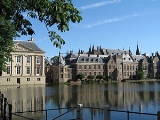
, consisting of the Senate and the House of Representatives. The parliament meets in at the Binnenhof
in The Hague
. The archaic Dutch word "staten" originally related to the feudal classes ("estates") in which medieval European societies were stratified (the clergy, the nobility and the commons). As in the United Kingdom the meaning of "the Commons" widened from just the social class, to the assembly in which those were represented; so in Dutch "staten" became to mean the political body in which the respective classes were (more or less) united. Dutch explorers named several places "Staten Island
", a name that derives from the name of the parliament.
on Day of the Princelings
. On special occasions, such as when the States-General vote on a marriage of a member of the royal house, when a king is inaugurated or when a member of the royal house dies, both houses also meet in a joint session (Dutch: Verenigde Vergadering), with the President of the Senate presiding. They take place in the Ridderzaal
(Hall of Knights) in the Binnenhof, except for the inauguration of the monarch, which occurs in the Nieuwe Kerk
in Amsterdam
. The rest of the time, the two chambers sit separately.
Constitutionally, all functions of the parliament are given to both houses, except for the rights of initiative and amendment. In practice, however, the House of Representatives has these functions, as the Senate meets only one day a week. The Joint Session also appoints the monarch if there is no heir to the throne and the regent is unable to exercise his or her powers.
An important question is whether the relationship between cabinet and parliament should be dualistic
or monistic. That is, whether ministers and leaders of governing parliamentary parties should prepare important political decisions. According to the dualistic position, members of parliament of governing parties should remain independent of the cabinet. The term 'monism' is used to refer to a stance that important decisions should be prepared by the people of the governing coalition in order to promote political stability.
, and dated from about the middle of the 15th century, under the rule of the Dukes of Burgundy
. The first session was on January 9, 1464, in Bruges
in Flanders
at the behest of Philip III, Duke of Burgundy
. Later, regular sessions were held at Coudenberg
, Brussels
(Brabant
). After the abjuration of the king in 1581 and the separation of the northern Netherlands from the Spanish dominions, the States-General replaced the king as the supreme authority and as the central government of the northern Netherlands, which then became known as the United Provinces
. Regional government was taken on by the States-Provincial
. The representatives, now in The Hague
(Holland
), were elected as the general government of the United Provinces
by the seven sovereign States-Provincial
. The States-General, in which the voting was by province, each of the seven provinces having one vote, were established from 1593. Twenty per cent of the new Republic's territory, known as the Generality Lands
, was not assigned to any provincial council and so was under the direct rule of the Generality (generaliteit). As such, this territory had no vote in the States-General. The Dutch East India Company
and the Dutch West India Company
were also under its general supervision; Staten Island
in New York City
(originally New Amsterdam
) and Staten Island, Argentina (Discovered by Dutchman Jacob le Maire
), are among places named after the Staten-Generaal.
The Southern Netherlands
kept their own States-General in Brussels.
The States-General in both The Hague and Brussels came to an end after 1795; the South was annexed by France, and the North saw the proclamation of the Batavian Republic
and the subsequent convocation of the National Assembly (1 March 1796). The title of Staten-Generaal, however, continued in the title of subsequent Dutch parliament
s reconstituted in 1814, after the end of Napoleonic
rule. There was one chamber until 1815, and two thereafter.
They were defunct from 1940–1945, during the German occupation.
established Dutch trade in Staten Island
, New York City
and named the island Staaten Eylandt after the Staten-Generaal.
The Argentine island Isla de los Estados
was also named after this institution, the Spanish name being a translation of the Dutch.
Abel Tasman
originally gave the name Staten Landt to what would become New Zealand
.
Bicameralism
In the government, bicameralism is the practice of having two legislative or parliamentary chambers. Thus, a bicameral parliament or bicameral legislature is a legislature which consists of two chambers or houses....
legislature
Legislature
A legislature is a kind of deliberative assembly with the power to pass, amend, and repeal laws. The law created by a legislature is called legislation or statutory law. In addition to enacting laws, legislatures usually have exclusive authority to raise or lower taxes and adopt the budget and...
of the Netherlands
Netherlands
The Netherlands is a constituent country of the Kingdom of the Netherlands, located mainly in North-West Europe and with several islands in the Caribbean. Mainland Netherlands borders the North Sea to the north and west, Belgium to the south, and Germany to the east, and shares maritime borders...
, consisting of the Senate and the House of Representatives. The parliament meets in at the Binnenhof
Binnenhof
The Binnenhof , is a complex of buildings in The Hague. It has been the location of meetings of the Staten-Generaal, the Dutch parliament, since 1446, and has been the centre of Dutch politics for many centuries....
in The Hague
The Hague
The Hague is the capital city of the province of South Holland in the Netherlands. With a population of 500,000 inhabitants , it is the third largest city of the Netherlands, after Amsterdam and Rotterdam...
. The archaic Dutch word "staten" originally related to the feudal classes ("estates") in which medieval European societies were stratified (the clergy, the nobility and the commons). As in the United Kingdom the meaning of "the Commons" widened from just the social class, to the assembly in which those were represented; so in Dutch "staten" became to mean the political body in which the respective classes were (more or less) united. Dutch explorers named several places "Staten Island
Staten Island
Staten Island is a borough of New York City, New York, United States, located in the southwest part of the city. Staten Island is separated from New Jersey by the Arthur Kill and the Kill Van Kull, and from the rest of New York by New York Bay...
", a name that derives from the name of the parliament.
Functions
The States-General meets in joint session at least once a year, at the opening of the parliamentary year, when the queen gives her Speech from the ThroneSpeech from the Throne
A speech from the throne is an event in certain monarchies in which the reigning sovereign reads a prepared speech to a complete session of parliament, outlining the government's agenda for the coming session...
on Day of the Princelings
Prinsjesdag
Prinsjesdag is the day on which the reigning monarch of the Netherlands addresses a joint session of the Dutch Senate and House of Representatives in the Ridderzaal or Hall of Knights in The Hague. The Speech from the Throne sets out the main features of government policy for the coming...
. On special occasions, such as when the States-General vote on a marriage of a member of the royal house, when a king is inaugurated or when a member of the royal house dies, both houses also meet in a joint session (Dutch: Verenigde Vergadering), with the President of the Senate presiding. They take place in the Ridderzaal
Ridderzaal
The Ridderzaal is the main building at the Binnenhof in The Hague, Netherlands, which is used for the state opening of Parliament on the third Tuesday in September, Prinsjesdag, when the Dutch monarch drives to Parliament in the Golden Carriage and delivers the speech from the throne...
(Hall of Knights) in the Binnenhof, except for the inauguration of the monarch, which occurs in the Nieuwe Kerk
Nieuwe Kerk (Amsterdam)
The Nieuwe Kerk is a 15th-century church in Amsterdam, located on Dam Square, next to the Royal Palace.-History:The bishop of Utrecht gave the city of Amsterdam permission to use a second the parish church in 1408 because the Oude Kerk had grown too small for the growing population of the city....
in Amsterdam
Amsterdam
Amsterdam is the largest city and the capital of the Netherlands. The current position of Amsterdam as capital city of the Kingdom of the Netherlands is governed by the constitution of August 24, 1815 and its successors. Amsterdam has a population of 783,364 within city limits, an urban population...
. The rest of the time, the two chambers sit separately.
Constitutionally, all functions of the parliament are given to both houses, except for the rights of initiative and amendment. In practice, however, the House of Representatives has these functions, as the Senate meets only one day a week. The Joint Session also appoints the monarch if there is no heir to the throne and the regent is unable to exercise his or her powers.
An important question is whether the relationship between cabinet and parliament should be dualistic
Dualism (politics)
In Dutch politics the term dualism is used to refer to the separation of powers between the Dutch cabinet and parliament. In this respect, the way the Dutch cabinets function is somewhere in between the USA and UK systems of government...
or monistic. That is, whether ministers and leaders of governing parliamentary parties should prepare important political decisions. According to the dualistic position, members of parliament of governing parties should remain independent of the cabinet. The term 'monism' is used to refer to a stance that important decisions should be prepared by the people of the governing coalition in order to promote political stability.
History
Historically, the convocation of the States-General consisted of delegates from the States-ProvincialStates-Provincial
The States'-Provincial is the provincial parliament and legislative assembly in each of the Provinces of the Netherlands. It is elected for each province simultaneously once every four years and has the responsibility for matters of sub-national or regional importance...
, and dated from about the middle of the 15th century, under the rule of the Dukes of Burgundy
Duchy of Burgundy
The Duchy of Burgundy , was heir to an ancient and prestigious reputation and a large division of the lands of the Second Kingdom of Burgundy and in its own right was one of the geographically larger ducal territories in the emergence of Early Modern Europe from Medieval Europe.Even in that...
. The first session was on January 9, 1464, in Bruges
Bruges
Bruges is the capital and largest city of the province of West Flanders in the Flemish Region of Belgium. It is located in the northwest of the country....
in Flanders
County of Flanders
The County of Flanders was one of the territories constituting the Low Countries. The county existed from 862 to 1795. It was one of the original secular fiefs of France and for centuries was one of the most affluent regions in Europe....
at the behest of Philip III, Duke of Burgundy
Philip III, Duke of Burgundy
Philip the Good KG , also Philip III, Duke of Burgundy was Duke of Burgundy from 1419 until his death. He was a member of a cadet line of the Valois dynasty . During his reign Burgundy reached the height of its prosperity and prestige and became a leading center of the arts...
. Later, regular sessions were held at Coudenberg
Coudenberg
Coudenberg or Koudenberg is a small hill in Brussels where the Palace of Coudenberg was built.For nearly 700 years, the Castle and then the Palace of Coudenberg were the seat of government of the counts, dukes, archdukes, kings, emperors and governors who from the 11th century until its...
, Brussels
Brussels
Brussels , officially the Brussels Region or Brussels-Capital Region , is the capital of Belgium and the de facto capital of the European Union...
(Brabant
Duchy of Brabant
The Duchy of Brabant was a historical region in the Low Countries. Its territory consisted essentially of the three modern-day Belgian provinces of Flemish Brabant, Walloon Brabant and Antwerp, the Brussels-Capital Region and most of the present-day Dutch province of North Brabant.The Flag of...
). After the abjuration of the king in 1581 and the separation of the northern Netherlands from the Spanish dominions, the States-General replaced the king as the supreme authority and as the central government of the northern Netherlands, which then became known as the United Provinces
Dutch Republic
The Dutch Republic — officially known as the Republic of the Seven United Netherlands , the Republic of the United Netherlands, or the Republic of the Seven United Provinces — was a republic in Europe existing from 1581 to 1795, preceding the Batavian Republic and ultimately...
. Regional government was taken on by the States-Provincial
States-Provincial
The States'-Provincial is the provincial parliament and legislative assembly in each of the Provinces of the Netherlands. It is elected for each province simultaneously once every four years and has the responsibility for matters of sub-national or regional importance...
. The representatives, now in The Hague
The Hague
The Hague is the capital city of the province of South Holland in the Netherlands. With a population of 500,000 inhabitants , it is the third largest city of the Netherlands, after Amsterdam and Rotterdam...
(Holland
County of Holland
The County of Holland was a county in the Holy Roman Empire and from 1482 part of the Habsburg Netherlands in what is now the Netherlands. It covered an area roughly corresponding to the current Dutch provinces of North-Holland and South-Holland, as well as the islands of Terschelling, Vlieland,...
), were elected as the general government of the United Provinces
Dutch Republic
The Dutch Republic — officially known as the Republic of the Seven United Netherlands , the Republic of the United Netherlands, or the Republic of the Seven United Provinces — was a republic in Europe existing from 1581 to 1795, preceding the Batavian Republic and ultimately...
by the seven sovereign States-Provincial
States-Provincial
The States'-Provincial is the provincial parliament and legislative assembly in each of the Provinces of the Netherlands. It is elected for each province simultaneously once every four years and has the responsibility for matters of sub-national or regional importance...
. The States-General, in which the voting was by province, each of the seven provinces having one vote, were established from 1593. Twenty per cent of the new Republic's territory, known as the Generality Lands
Generality Lands
The Generality Lands, Lands of the Generality or Common Lands were about one fifth of the territories of the United Provinces of the Netherlands, that were directly governed by the States-General...
, was not assigned to any provincial council and so was under the direct rule of the Generality (generaliteit). As such, this territory had no vote in the States-General. The Dutch East India Company
Dutch East India Company
The Dutch East India Company was a chartered company established in 1602, when the States-General of the Netherlands granted it a 21-year monopoly to carry out colonial activities in Asia...
and the Dutch West India Company
Dutch West India Company
Dutch West India Company was a chartered company of Dutch merchants. Among its founding fathers was Willem Usselincx...
were also under its general supervision; Staten Island
Staten Island
Staten Island is a borough of New York City, New York, United States, located in the southwest part of the city. Staten Island is separated from New Jersey by the Arthur Kill and the Kill Van Kull, and from the rest of New York by New York Bay...
in New York City
New York City
New York is the most populous city in the United States and the center of the New York Metropolitan Area, one of the most populous metropolitan areas in the world. New York exerts a significant impact upon global commerce, finance, media, art, fashion, research, technology, education, and...
(originally New Amsterdam
New Amsterdam
New Amsterdam was a 17th-century Dutch colonial settlement that served as the capital of New Netherland. It later became New York City....
) and Staten Island, Argentina (Discovered by Dutchman Jacob le Maire
Jacob Le Maire
Jacob Le Maire was a Dutch mariner who circumnavigated the earth in 1615-16. The strait between Tierra del Fuego and Isla de los Estados was named the Le Maire Strait in his honor, though not without controversy...
), are among places named after the Staten-Generaal.
The Southern Netherlands
Southern Netherlands
Southern Netherlands were a part of the Low Countries controlled by Spain , Austria and annexed by France...
kept their own States-General in Brussels.
The States-General in both The Hague and Brussels came to an end after 1795; the South was annexed by France, and the North saw the proclamation of the Batavian Republic
Batavian Republic
The Batavian Republic was the successor of the Republic of the United Netherlands. It was proclaimed on January 19, 1795, and ended on June 5, 1806, with the accession of Louis Bonaparte to the throne of the Kingdom of Holland....
and the subsequent convocation of the National Assembly (1 March 1796). The title of Staten-Generaal, however, continued in the title of subsequent Dutch parliament
Parliament
A parliament is a legislature, especially in those countries whose system of government is based on the Westminster system modeled after that of the United Kingdom. The name is derived from the French , the action of parler : a parlement is a discussion. The term came to mean a meeting at which...
s reconstituted in 1814, after the end of Napoleonic
Napoleon I of France
Napoleon Bonaparte was a French military and political leader during the latter stages of the French Revolution.As Napoleon I, he was Emperor of the French from 1804 to 1815...
rule. There was one chamber until 1815, and two thereafter.
They were defunct from 1940–1945, during the German occupation.
Derivation of geographical names
In 1609, Henry HudsonHenry Hudson
Henry Hudson was an English sea explorer and navigator in the early 17th century. Hudson made two attempts on behalf of English merchants to find a prospective Northeast Passage to Cathay via a route above the Arctic Circle...
established Dutch trade in Staten Island
Staten Island
Staten Island is a borough of New York City, New York, United States, located in the southwest part of the city. Staten Island is separated from New Jersey by the Arthur Kill and the Kill Van Kull, and from the rest of New York by New York Bay...
, New York City
New York City
New York is the most populous city in the United States and the center of the New York Metropolitan Area, one of the most populous metropolitan areas in the world. New York exerts a significant impact upon global commerce, finance, media, art, fashion, research, technology, education, and...
and named the island Staaten Eylandt after the Staten-Generaal.
The Argentine island Isla de los Estados
Isla de los Estados
Isla de los Estados is an Argentine island that lies off the eastern extremity of the Argentine portion of Tierra del Fuego, from which it is separated by the Le Maire Strait...
was also named after this institution, the Spanish name being a translation of the Dutch.
Abel Tasman
Abel Tasman
Abel Janszoon Tasman was a Dutch seafarer, explorer, and merchant, best known for his voyages of 1642 and 1644 in the service of the VOC . His was the first known European expedition to reach the islands of Van Diemen's Land and New Zealand and to sight the Fiji islands...
originally gave the name Staten Landt to what would become New Zealand
New Zealand
New Zealand is an island country in the south-western Pacific Ocean comprising two main landmasses and numerous smaller islands. The country is situated some east of Australia across the Tasman Sea, and roughly south of the Pacific island nations of New Caledonia, Fiji, and Tonga...
.