

.gif)
Utrecht (city)

Encyclopedia
Utrecht (ˈytrɛxt, ˈjuːtrɛkt) city and municipality is the capital and most populous city of the Dutch
province of Utrecht
. It is located in the eastern corner of the Randstad
conurbation, and is the fourth largest city of the Netherlands
with a population of 312,634 on 1 Jan 2011.
Utrecht's ancient city centre features many buildings and structures from the Early Middle Ages
. It has been the religious centre of the Netherlands since the eighth century. Currently it is the see of the Archbishop of Utrecht
, the most important Dutch Roman Catholic leader. Utrecht is also the see of the archbishop of the Old Catholic church, titular head of the Union of Utrecht (Old Catholic), and the location of the offices of the main Protestant church
. Until the golden age, Utrecht was the city of most importance of the Netherlands until Amsterdam became its cultural and most populous centre.
Utrecht is host to Utrecht University
, the largest university of the Netherlands, as well as several other institutes for higher education. Due to its central position within the country, it is an important transport hub for both rail
and road transport
. It has the second highest number of cultural events in the Netherlands, after Amsterdam.
(app. 2200 BCE) and settling in the Bronze Age
(app. 1800–800 BCE), the founding date of the city is usually related to the construction of a Roman
fortification (castellum
), probably built in around 50 CE. These fortresses were designed to house a cohort
of about 500 Roman soldiers. Near the fort a settlement would grow housing artisan
s, traders and soldiers' wives and children.
A line of such fortresses was built after the Roman emperor
Claudius
decided the empire should not expand further north. To consolidate the border the limes Germanicus
defense line was constructed. This line was located at the borders of the main branch of the river Rhine, which at that time flowed through a more northern bed compared to today, along what is now the Kromme Rijn
.
In Roman times, the name of the Utrecht fortress was simply Traiectum denoting its location on the Rhine at a ford
. Traiectum became Dutch Trecht. The U comes from Old Dutch
"uut" meaning downriver. It was added to distinguish from the other Tricht, Maas-tricht. In 11th century official documents it was then Latinized as Ultra Traiectum.
Around the year 200, the wooden walls of the fortification were replaced by sturdier tuff
stone walls, remnants of which are still to be found below the buildings around Dom Square.
From the middle of the 3rd century Germanic tribes regularly invaded the Roman territories. Around 275 the Romans could no longer maintain the northern border and Utrecht was abandoned. Little is known about the next period 270-650. Utrecht is first spoken of again in the 7th century when the influence of the growing realms of the Franks
led Dagobert I
to build a church devoted to Saint Martin
within the walls of the Roman fortress. In ongoing border conflicts with the Frisians
the church was however destroyed.
appointed their leader, Willibrordus, bishop
of the Frisians; which is usually considered to be the beginning of the Bishopric of Utrecht. In 723, the Frankish king bestowed the fortress in Utrecht and the surrounding lands as the base of bishops. From then on Utrecht became one of the most influential seats of power for the Roman Catholic Church in the Netherlands.
The see of the archbishops of Utrecht was located at the uneasy northern border of the Carolingian Empire
. Furthermore it had to compete with the nearby trading centre Dorestad
, also founded near the location of a Roman fortress. After the downfall of Dorestad around 850, Utrecht became one of the most important cities in the Netherlands. The importance of Utrecht as a centre of Christianity is illustrated by the appointment of the Utrecht-born Adriaan Florenszoon Boeyens
as pope in 1522 (the last non-Italian pope before John Paul II).
, the Bishops of Utrecht came to exercise worldly power as prince-bishop
s. The realm of the bishopry included not only the land of the modern province of Utrecht (Nedersticht, 'lower Sticht'), but also extended to the northeast. However, the feudalist system resulted in conflict between the different lords. The prince bishopry had its conflicts with the Counts of Holland
and the Dukes of Guelders
. The Veluwe
region was soon taken by Guelders, but large areas in the modern province of Overijssel
remained as the Oversticht.
Cathedral of Saint Martin
, inside the old Roman fortress. The construction of this cathedral started in 1254 after an earlier romanesque
cathedral had been badly damaged by fire. When the choir and transept
were finished from 1320 the ambitious Dom tower
was built. The central nave
was the last part to be constructed from 1420. By that time, however, the time of the great cathedrals had ended and declining finances prevented this ambitious cathedral from being finished, resulting in the construction of the central nave being suspended before finishing the planned flying buttress
es.
Besides the cathedral there were four additional collegiate church
es in Utrecht: St. Salvator's Church
(demolished in the 16th century), on the Dom square, dating back to the early 8th century. Saint John
(Janskerk), originating in 1040; Saint Peter
, building started in 1039 and Saint Mary
's church building started around 1090 (demolished in the early 19th century, cloister survives).
Besides these churches the city housed Saint Paul abbey
. The 15th century beguine monastery
of Saint Nicholas
, and a 14th century chapter house of the Teutonic Knights
.
Besides these buildings which were part of the hierarchy of the bishopric; an additional four parish church
es were constructed in the city: the Jacobikerk
(dedicated to Saint James), founded in the 11th century, with the current gothic church dating back to the 14th century; the Buurkerk (Neighbourhood-church) of the 11th century parish in the centre of the city; Nicolaichurch (dedicated to Saint Nicholas
), from the 12th century and the 13th century Geertekerk (dedicated to Saint Gertrude of Nivelles
).
by Henry V.
in 1122.
When the main flow of the Rhine moved south, the old bed, which still flowed through the heart of the town became evermore canal
ized; and a unique wharf system was built as an inner city harbour system. On the wharfs storage facilities (werfkelders) were built, on top of which the main street, including houses was constructed. The wharfs and the cellars are accessible from a platform at water level with stairs descending from the street level to form a unique structure.All other canal cities in The Netherlands (such as Leiden, Amsterdam and Delft) have the water in canals bordering directly to the road surface The relations between the bishop, who controlled many lands outside of the city, and the citizens of Utrecht was not always easy. The bishop, for example dam
med the Kromme Rijn
at Wijk bij Duurstede
to protect his estates from flooding. This threatened shipping for the city and led the city of Utrecht to commission a canal to ensure access to the town for shipping trade: the Vaartse Rijn, connecting Utrecht to the Hollandse IJssel
at IJsselstein
.
, who became the Lord of the Seventeen Provinces
, (the current Benelux
and the northern parts of France). This transition was not an easy one and Charles V wanted to exert his power over the citizens of the city, who had achieved a certain level of independence from the bishops and were not willing to give this power to their new lord. Charles decided to build a heavily fortified castle Vredenburg
to house a large garrison whose most important task would be to maintain order in the city. The castle would last less than 50 years before it was demolished in an uprising in the early stages of the Dutch Revolt
.
.jpg) In 1579 the northern seven provinces signed the Union of Utrecht
In 1579 the northern seven provinces signed the Union of Utrecht
, in which they decided to join forces against Spanish rule. The Union of Utrecht is seen as the beginning of the Dutch Republic
. In 1580 the new and predominantly Protestant state abolished the bishoprics, including the one in Utrecht, which had become an archbishop
ric in 1559. The stadtholder
s disapproved of the independent course of the Utrecht bourgeoisie and brought the city under much more direct control of the Holland dominated leadership of the republic. This was the start of a long period of stagnation of trade and development in Utrecht, an atypical city in the new state, still about 40% Catholic in the mid-17th century, and even more so among the elite groups, who included many rural nobility and gentry with town houses there.
The city, which was held against its will in the states of the Republic, failed to defend itself against the French invasion in 1672 (the Disaster Year
)
The lack of structural integrity proved to be the undoing of the central section of the cathedral of St Martin church when Utrecht was struck by a tornado
in 1674.
The Treaty of Utrecht in 1713 settled the War of the Spanish Succession
.
Since 1723 (but especially after 1870) Utrecht became the centre of the non-Roman Old Catholic Church
es in the world.
that remains largely intact today.
Growth of the city increased when, in 1843, a railway connecting Utrecht to Amsterdam was opened. After that, Utrecht gradually became the main hub of the Dutch railway network
.
In 1853, the Dutch government allowed the bishopric of Utrecht to be reinstated by Rome
, and Utrecht became the centre of Dutch Catholicism once more.
With the industrial revolution
finally gathering speed in the Netherlands and the ramparts taken down, Utrecht began to grow far beyond the medieval center from the 1880s onward with the construction of neighbourhoods such as Oudwijk, Wittevrouwen, Vogelenbuurt to the East, and Lombok to the West. New middle class residential areas, such as Tuindorp and Oog in Al
, were built in the 1920s and 1930s. During this period, several Jugendstil houses and office buildings were built, followed by Rietveld
who built the Rietveld Schröder House
(1924), and Dudok's
construction of the city theater (1941).
During World War II
, Utrecht was held by the Germans until the general German surrender of the Netherlands on 5 May 1945. Canadian
troops that surrounded the city entered it after that surrender, on May 7, 1945.
Since World War II, the city has grown considerably when new neighbourhoods such as Overvecht, Kanaleneiland
, Hoograven and Lunetten
were built. Additionally the area surrounding Utrecht Centraal railway station
and the station itself have been developed following modernist ideas of the 1960s, in a brutalist
style. This led to the construction of the shopping mall Hoog Catharijne, music centre Vredenburg (Hertzberger
, 1979), and conversion of part of the ancient canal structure into a highway (Catherijnebaan). Protest against further modernisation of the city centre followed even before the last buildings were finalised. In the early 21st century the whole area is being redeveloped.
Currently the city is expanding once more with the development of the Leidsche Rijn
housing area.
(Köppen climate classification
Cfb) similar to almost all of the Netherlands.
for homosexual.The term ‘Utrechtenaar’ has become a profane expression for homosexual after the 1730-31 sodomy trials, and has fallen into disuse since. This distinction, however, is not always known by Dutch speakers from outside the region, who may use the term ‘Utrechtenaar’ without being aware of the specific connotation.
Utrecht city had a population of 296,305 in 2007. Utrecht is a growing municipality and projections are that the city's population will surpass 392,000 by 2025.
In Utrecht 52% of the population is female, 48% is male. Utrecht has a young population, with many inhabitants in the age category from 20 and 30 years, due to the presence of a large university.
The majority of households (52.5%) in Utrecht are single person households. About 29% of people living in Utrecht are either married, or have another legal partnership. About 3% of the population of Utrecht is divorced.
About 69% of the population is of Dutch ancestry. Approximately 10% of the population consists of immigrants from Western countries, while 21% of the population is of non-Western origin (9% Moroccan, 5% Turkish, 3% Surinamese and Dutch Caribbean and 5% of other countries). With 9% of its population being of Moroccan heritage, Utrecht contains the largest proportion of people of Moroccan descent of any Dutch municipality. Many of the city's boroughs have a relatively high percentage of originally non-Dutch inhabitants - i.e. Kanaleneiland 83% and Overvecht 57%.
Like Rotterdam, Amsterdam, The Hague and other large Dutch cities, Utrecht faces socio-economic problems. About 38% percent of its population either earns a minimum income or is dependant on social welfare
(17% of all households). Boroughs such as Kanaleneiland, Overvecht and Hoograven consist primarily of high-rise housing developments, and are known for relatively high poverty and crime rate.
, which was a separate municipality until 2001. Vleuten-De Meern in turn included the villages of Haarzuilens and Veldhuizen. Thus the municipality of Utrecht includes several population centres:
Utrecht is the centre of a densely populated area, which makes concise definitions of its agglomeration difficult, and somewhat arbitrary. The smaller Utrecht agglomeration counts some 420,000 inhabitants and includes Nieuwegein
, IJsselstein
and Maarssen
. It is sometimes argued that the municipalities De Bilt
, Zeist
, Houten
, Vianen, Driebergen-Rijsenburg
(Utrechtse Heuvelrug
), and Bunnik
should also be counted towards the Utrecht agglomeration, bringing the total to 640,000 inhabitants. The larger region, including slightly more remote towns such as Woerden
and Amersfoort
counts up to 820,000 inhabitants.
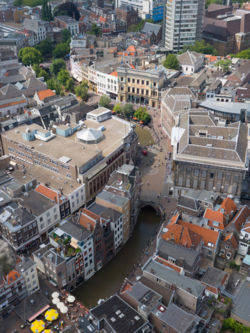 Utrecht's cityscape features the Dom Tower
, belonging to the former cathedral (Dom Church
). An ongoing debate is if any building in or near the centre of town may surpass the Dom Tower in height (112 m). Nevertheless, some tall buildings are now being constructed that will become part of the skyline of Utrecht. The second highest building of the city, the Rabobank
-tower, completed in 2010 and standing 105 m (344.49 ft) tall. Two antennas will increase that height to 120 m (393.7 ft). Two other buildings were constructed around the Nieuw Galgenwaard stadium (2007). These buildings, the 'Kantoortoren Galghenwert' and 'Apollo Residence', stand 85.5 and 64.5 metres high respectively.
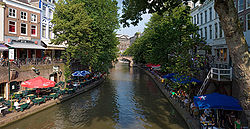
Another landmark is the old centre and the canal structure in the inner city. The Oudegracht
is a curved canal, partly following an old arm of the Rhine. It is lined with the unique wharf-basement structures that create a two-level street along the canals. The inner city has largely retained its Medieval structure, and the moat ringing the old town is largely intact. Because of the role of Utrecht as a fortified city,which restricted construction outside the walls, until the 19th century the city has remained very compact. Surrounding the medieval core there is a ring of late 19th and early 20th century neighbourhoods, with newer neighbourhoods positioned farther out. The eastern part of Utrecht remains fairly open. The Dutch Water Line
, moved east of the city in the early 19th century required open lines of fire thus prohibiting all permanent constructions until the mid of the 20th century on the east side of the city.
Due to the past importance of Utrecht as a religious centre, several monumental churches have survived. Most prominent is the Dom Church
. Other notable churches include the romanesque St Peter's and St John's churches, the gothic churches of St James and St Nicholas, and the so-called Buurkerk, now converted into a museum for automatically playing musical instruments
.
, Utrecht Overvecht
, Utrecht Terwijde
and Utrecht Zuilen
. Utrecht Maliebaan closed in 1939 and has since been converted into the Dutch Railway Museum.
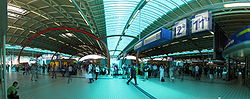
From Utrecht Centraal, there are regular services to all major Dutch cities; direct services to Schiphol Airport began in March 2006 with the opening of the Utrechtboog
. International InterCityExpress
(ICE) services to Germany
as well as regular local trains to all areas surrounding Utrecht also depart from Utrecht Centraal.
 The Utrecht sneltram
is a light rail
scheme running southwards Utrecht Centraal to the suburbs of IJsselstein
, Kanaleneiland
, Lombok-Leidseweg and Nieuwegein
. The sneltram began operating in 1983 and is currently operated by the private transport company Connexxion
; from December 2011, it will be operated by Qbuzz.
Utrecht is also the location of the headquarters of both Nederlandse Spoorwegen
(English: Dutch Railways) - the largest rail operator in the Netherlands - and ProRail
- the state-owned company responsible for the construction and maintenance of the country's rail infrastructure.
es in Utrecht are operated by GVU - its services include a high-frequency service to the Uithof
university district. Regional buses from the city are operated by Arriva
, Connexxion
, Qliner and Veolia. Utrecht Centraal's bus station is the busiest in the Netherlands.
The Utrecht Centraal railway station is also served by the pan-European services of Eurolines
. Furthermore, it acts as departure and arrival place of many coach companies serving holiday resorts in Spain
and France
- and during winter in Austria
and Switzerland
.
and A2
motorways connect Amsterdam
, Arnhem
, The Hague
and Maastricht
, as well as Belgium and Germany. Other major motorways in the area are the Almere
–Breda
A27
and the Utrecht–Groningen A28
Due to the increasing traffic, traffic congestion is a common phenomenon in and around Utrecht, causing elevated levels of air pollutants. This has led to a passionate debate in the city about the best way to improve the city's air quality.
Additionally, some tourist boat trips are organised from various places on the Oudegracht.
 The economy of Utrecht depends for a large part on the several large institutions located in the city. Production industry has a relatively small influence in Utrecht. Rabobank
, a large bank, has its headquarters in Utrecht. It is the centre of the Dutch railroad network and the location of the head office of Nederlandse Spoorwegen
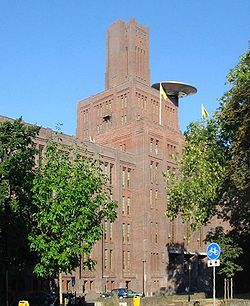
. The former offices of Nederlandse Spoorwegen - De Inktpot - is the largest brick building in the Netherlands (the "UFO" featured on its facade stems from an art program in 2000). The building is currently used by ProRail
.
A large indoor shopping centre called is located between Utrecht Centraal railway station and the city centre. The corridors have been considered public places like streets, and the route between the station and the city centre is open all night. Over the next 20 years (counting from 2004), parts of Hoog Catharijne will disappear as a consequence of the renovation of the station area. Parts of the city's network of canals, which were filled to create the shopping center and central station area, will be recreated.
The Jaarbeurs
, one of the largest convention centres in the Netherlands, is located at the west side of the central railway station.
One of Europe's biggest used car markets is located in the Voordorp
district. It is open every Tuesday except on official holidays. With thousands of second-hand vehicles on sale the market is a special point of interest for customers from Eastern European countries who even organize special one-way bus tours for shopping there.
(est. 1636), the largest university of the Netherlands
with 29,927 students (as of 2009). The university is partially based in the inner city as well as in the Uithof
campus area, on the east of the city. According to Shanghai Jiaotong University's university ranking in 2010 it is the 50th best university in the world. Utrecht also houses the much smaller University of Humanistics (estimated at a few hundred students).
Utrecht is home of one of the locations of TiasNimbas, focused on post-experience management education and the largest management school of its kind in the Netherlands. In 2008, its executive MBA program was rated the 24th best program in the world by the Financial Times
.
Utrecht is also home to two other large institutions of higher education: the Hogeschool Utrecht
(30,000 students), with locations in the city and the Uithof campus, and the HKU Utrecht School of the Arts
(3,000 students).
There are many schools for primary and secondary education
; allowing for different philosophies and religions as is inherent in the Dutch school system
. There is some debate about segregation
in the primary schools (which is a common occurrence in many large cities in the Netherlands). This is a result of immigrant families lack of Dutch language skills and a lack of knowledge of Dutch culture, leading Dutch parents to send their children to schools which are able to maintain high standards in turn leading to a situation where schools with a large proportion of immigrant children squeeze out more and more Dutch children.
of Europe in 2018.
There are several theatres and theatre companies. The 1941 main city theatre was built by Dudok
. Besides theatres there is a large number of cinemas including three arthouse cinemas. Utrecht is host to the Netherlands Film Festival
.
The city has an important classical music hall Vredenburg (1979 by Herman Hertzberger
). Its acoustics are considered among the best of the 20th century original music halls. Young musicians are educated in the conservatory (a department of the Utrecht School of the Arts
). There is a specialised museum
of automatically playing musical instruments. Located at the Oudegracht is the rock club Tivoli (which has a second location just outside the centre). There are several other venues for music throughout the city.
There are many art galleries in Utrecht. There are also several foundations to support art, and artists. Training of artists is done at the Utrecht School of the Arts
. The Centraal Museum
has many exhibitions on the arts, including a permanent exhibition on the works of Utrecht resident illustrator Dick Bruna
, who is best known for creating Miffy
("Nijntje", in Dutch).
Utrecht also houses one of the landmarks of modern architecture, the 1924 Rietveld Schröder House
, which is listed on UNESCO's world heritage sites.
To involve the city population as a whole (rather than the elite alone) in the cultural riches of the city, Utrecht city, in collaboration with the different cultural organisations, regularly organise cultural Sundays. During a thematic Sunday several organisations create a program, which is open to everyone without, or with a very much reduced, admission fee.
Furthermore there are many initiatives for amateur
artists; e.g. in the performing arts, painting and sculpture. The city subsidises an organisation for amateur education in arts aimed at all inhabitants (Utrechts Centrum voor de Kunsten), as does the university for its staff and students. Additionally there are also several private initiatives. The city council provides coupons for discounts to inhabitants who receive welfare to be used with many of the initiatives.
club FC Utrecht, which plays in Stadium Nieuw Galgenwaard. It is also the home of Kampong, the largest (amateur) sportsclub of the Netherlands (4,500 members), SV Kampong. Kampong features fieldhockey, soccer, cricket, tennis, squash and jeu de boules. Kampong's men and women top hockey squads play in the highest Dutch hockey league, the Rabohoofdklasse.
Utrecht's waterways are used by several rowing clubs. Viking is a large club open to the general public, and the student clubs Orca
and Triton compete in the Varsity
each year.
, Tivoli De Helling
, Vredenburg
, EKKO, DBs and RASA. Utrecht hosts the yearly Utrecht Early Music Festival - Festival Oude Muziek Utrecht. In Jaarbeurs it hosts Trance Energy
too. Every summer there is the Summer Darkness festival, which celebrates goth culture and music. In November the Le Guess Who?
festival, focused on indie rock
, art rock
and experimental rock
, takes place in many of the city's venues together.
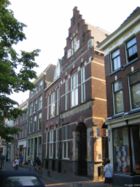
Over the ages famous people have been born and raised in Utrecht.
Among the most famous Utrechters are:
with: León, Nicaragua
Brno
, Czech Republic
Kinshasa
, Democratic Republic of the Congo
Maps
Netherlands
The Netherlands is a constituent country of the Kingdom of the Netherlands, located mainly in North-West Europe and with several islands in the Caribbean. Mainland Netherlands borders the North Sea to the north and west, Belgium to the south, and Germany to the east, and shares maritime borders...
province of Utrecht
Utrecht (province)
Utrecht is the smallest province of the Netherlands in terms of area, and is located in the centre of the country. It is bordered by the Eemmeer in the north, Gelderland in the east, the river Rhine in the south, South Holland in the west, and North Holland in the northwest...
. It is located in the eastern corner of the Randstad
Randstad
Image:Randstad_with_scale.png|400px|thumb|right|Clickable schematic map of the Randstadcircle 528 380 26 Schipholrect 426 356 498 436 Haarlemmermeerrect 399 166 479 245 Velsencircle 250 716 32 Delftcircle 220 642 60 The Hague...
conurbation, and is the fourth largest city of the Netherlands
Netherlands
The Netherlands is a constituent country of the Kingdom of the Netherlands, located mainly in North-West Europe and with several islands in the Caribbean. Mainland Netherlands borders the North Sea to the north and west, Belgium to the south, and Germany to the east, and shares maritime borders...
with a population of 312,634 on 1 Jan 2011.
Utrecht's ancient city centre features many buildings and structures from the Early Middle Ages
Early Middle Ages
The Early Middle Ages was the period of European history lasting from the 5th century to approximately 1000. The Early Middle Ages followed the decline of the Western Roman Empire and preceded the High Middle Ages...
. It has been the religious centre of the Netherlands since the eighth century. Currently it is the see of the Archbishop of Utrecht
Roman Catholic Archdiocese of Utrecht
The Archdiocese of Utrecht is an archdiocese of the Catholic Church in the Netherlands. The archdiocese is the metropolitan for 6 suffragans, the dioceses of Breda, Groningen-Leeuwarden, Haarlem-Amsterdam, Roermond, Rotterdam, and 's-Hertogenbosch....
, the most important Dutch Roman Catholic leader. Utrecht is also the see of the archbishop of the Old Catholic church, titular head of the Union of Utrecht (Old Catholic), and the location of the offices of the main Protestant church
Protestant Church in the Netherlands
The Protestant Church in the Netherlands is the largest Protestant Christian denomination in the Netherlands. With 2,000 congregations and a membership of some 1.8 million , it is the second largest church in the Netherlands after the Roman Catholic Church.It was founded 1 May 2004 as a merger of...
. Until the golden age, Utrecht was the city of most importance of the Netherlands until Amsterdam became its cultural and most populous centre.
Utrecht is host to Utrecht University
Utrecht University
Utrecht University is a university in Utrecht, Netherlands. It is one of the oldest universities in the Netherlands and one of the largest in Europe. Established March 26, 1636, it had an enrollment of 29,082 students in 2008, and employed 8,614 faculty and staff, 570 of which are full professors....
, the largest university of the Netherlands, as well as several other institutes for higher education. Due to its central position within the country, it is an important transport hub for both rail
Rail transport
Rail transport is a means of conveyance of passengers and goods by way of wheeled vehicles running on rail tracks. In contrast to road transport, where vehicles merely run on a prepared surface, rail vehicles are also directionally guided by the tracks they run on...
and road transport
Road transport
Road transport or road transportation is transport on roads of passengers or goods. A hybrid of road transport and ship transport is the historic horse-drawn boat.-History:...
. It has the second highest number of cultural events in the Netherlands, after Amsterdam.
Origins (until 650)
Although there is some evidence of earlier inhabitation in the region of Utrecht, dating back to the Stone AgeStone Age
The Stone Age is a broad prehistoric period, lasting about 2.5 million years , during which humans and their predecessor species in the genus Homo, as well as the earlier partly contemporary genera Australopithecus and Paranthropus, widely used exclusively stone as their hard material in the...
(app. 2200 BCE) and settling in the Bronze Age
Bronze Age
The Bronze Age is a period characterized by the use of copper and its alloy bronze as the chief hard materials in the manufacture of some implements and weapons. Chronologically, it stands between the Stone Age and Iron Age...
(app. 1800–800 BCE), the founding date of the city is usually related to the construction of a Roman
Roman Empire
The Roman Empire was the post-Republican period of the ancient Roman civilization, characterised by an autocratic form of government and large territorial holdings in Europe and around the Mediterranean....
fortification (castellum
Castellum
A castellum is a small Roman detached fort or fortlet used as a watch tower or signal station. The Latin word castellum is a diminutive of castra , which in turn is the plural of castrum ; it is the source of the English word "castle".The term castellum was also used to refer to a settling or...
), probably built in around 50 CE. These fortresses were designed to house a cohort
Cohort (military unit)
A cohort was the basic tactical unit of a Roman legion following the reforms of Gaius Marius in 107 BC.-Legionary cohort:...
of about 500 Roman soldiers. Near the fort a settlement would grow housing artisan
Artisan
An artisan is a skilled manual worker who makes items that may be functional or strictly decorative, including furniture, clothing, jewellery, household items, and tools...
s, traders and soldiers' wives and children.
A line of such fortresses was built after the Roman emperor
Roman Emperor
The Roman emperor was the ruler of the Roman State during the imperial period . The Romans had no single term for the office although at any given time, a given title was associated with the emperor...
Claudius
Claudius
Claudius , was Roman Emperor from 41 to 54. A member of the Julio-Claudian dynasty, he was the son of Drusus and Antonia Minor. He was born at Lugdunum in Gaul and was the first Roman Emperor to be born outside Italy...
decided the empire should not expand further north. To consolidate the border the limes Germanicus
Limes Germanicus
The Limes Germanicus was a line of frontier fortifications that bounded the ancient Roman provinces of Germania Inferior, Germania Superior and Raetia, dividing the Roman Empire and the unsubdued Germanic tribes from the years 83 to about 260 AD...
defense line was constructed. This line was located at the borders of the main branch of the river Rhine, which at that time flowed through a more northern bed compared to today, along what is now the Kromme Rijn
Kromme Rijn
The Kromme Rijn is a river in Utrecht , Netherlands.In Roman times, this northernmost branch of the Rhine delta was the main distributary of this major European river...
.
In Roman times, the name of the Utrecht fortress was simply Traiectum denoting its location on the Rhine at a ford
Ford (crossing)
A ford is a shallow place with good footing where a river or stream may be crossed by wading or in a vehicle. A ford is mostly a natural phenomenon, in contrast to a low water crossing, which is an artificial bridge that allows crossing a river or stream when water is low.The names of many towns...
. Traiectum became Dutch Trecht. The U comes from Old Dutch
Old Dutch
In linguistics, Old Dutch denotes the forms of West Franconian spoken and written in the Netherlands and present-day northern Belgium during the Early Middle Ages. It is regarded as the primary stage in the development of a separate Dutch language...
"uut" meaning downriver. It was added to distinguish from the other Tricht, Maas-tricht. In 11th century official documents it was then Latinized as Ultra Traiectum.
Around the year 200, the wooden walls of the fortification were replaced by sturdier tuff
Tuff
Tuff is a type of rock consisting of consolidated volcanic ash ejected from vents during a volcanic eruption. Tuff is sometimes called tufa, particularly when used as construction material, although tufa also refers to a quite different rock. Rock that contains greater than 50% tuff is considered...
stone walls, remnants of which are still to be found below the buildings around Dom Square.
From the middle of the 3rd century Germanic tribes regularly invaded the Roman territories. Around 275 the Romans could no longer maintain the northern border and Utrecht was abandoned. Little is known about the next period 270-650. Utrecht is first spoken of again in the 7th century when the influence of the growing realms of the Franks
Franks
The Franks were a confederation of Germanic tribes first attested in the third century AD as living north and east of the Lower Rhine River. From the third to fifth centuries some Franks raided Roman territory while other Franks joined the Roman troops in Gaul. Only the Salian Franks formed a...
led Dagobert I
Dagobert I
Dagobert I was the king of Austrasia , king of all the Franks , and king of Neustria and Burgundy . He was the last Merovingian dynast to wield any real royal power...
to build a church devoted to Saint Martin
Martin of Tours
Martin of Tours was a Bishop of Tours whose shrine became a famous stopping-point for pilgrims on the road to Santiago de Compostela. Around his name much legendary material accrued, and he has become one of the most familiar and recognizable Christian saints...
within the walls of the Roman fortress. In ongoing border conflicts with the Frisians
Frisians
The Frisians are a Germanic ethnic group native to the coastal parts of the Netherlands and Germany. They are concentrated in the Dutch provinces of Friesland and Groningen and, in Germany, East Frisia and North Frisia, that was a part of Denmark until 1864. They inhabit an area known as Frisia...
the church was however destroyed.
Centre of Christianity in the Netherlands (650-1579)
By the mid 7th century, English and Irish missionaries set out to convert the Frisians. The popePope
The Pope is the Bishop of Rome, a position that makes him the leader of the worldwide Catholic Church . In the Catholic Church, the Pope is regarded as the successor of Saint Peter, the Apostle...
appointed their leader, Willibrordus, bishop
Bishop
A bishop is an ordained or consecrated member of the Christian clergy who is generally entrusted with a position of authority and oversight. Within the Catholic Church, Eastern Orthodox, Oriental Orthodox Churches, in the Assyrian Church of the East, in the Independent Catholic Churches, and in the...
of the Frisians; which is usually considered to be the beginning of the Bishopric of Utrecht. In 723, the Frankish king bestowed the fortress in Utrecht and the surrounding lands as the base of bishops. From then on Utrecht became one of the most influential seats of power for the Roman Catholic Church in the Netherlands.
The see of the archbishops of Utrecht was located at the uneasy northern border of the Carolingian Empire
Carolingian Empire
Carolingian Empire is a historiographical term which has been used to refer to the realm of the Franks under the Carolingian dynasty in the Early Middle Ages. This dynasty is seen as the founders of France and Germany, and its beginning date is based on the crowning of Charlemagne, or Charles the...
. Furthermore it had to compete with the nearby trading centre Dorestad
Dorestad
In the Early Middle Ages, Dorestad was the largest settlement of northwestern Europe. It was a large, flourishing trading place, three kilometers long, situated where the rivers Rhine and Lek diverge southeast of Utrecht in the Netherlands near the modern town of Wijk bij Duurstede...
, also founded near the location of a Roman fortress. After the downfall of Dorestad around 850, Utrecht became one of the most important cities in the Netherlands. The importance of Utrecht as a centre of Christianity is illustrated by the appointment of the Utrecht-born Adriaan Florenszoon Boeyens
Pope Adrian VI
Pope Adrian VI , born Adriaan Florenszoon Boeyens, served as Pope from 9 January 1522 until his death some 18 months later...
as pope in 1522 (the last non-Italian pope before John Paul II).
Prince-Bishops
When the Frankish rulers established the system of feudalismFeudalism
Feudalism was a set of legal and military customs in medieval Europe that flourished between the 9th and 15th centuries, which, broadly defined, was a system for ordering society around relationships derived from the holding of land in exchange for service or labour.Although derived from the...
, the Bishops of Utrecht came to exercise worldly power as prince-bishop
Prince-Bishop
A Prince-Bishop is a bishop who is a territorial Prince of the Church on account of one or more secular principalities, usually pre-existent titles of nobility held concurrently with their inherent clerical office...
s. The realm of the bishopry included not only the land of the modern province of Utrecht (Nedersticht, 'lower Sticht'), but also extended to the northeast. However, the feudalist system resulted in conflict between the different lords. The prince bishopry had its conflicts with the Counts of Holland
County of Holland
The County of Holland was a county in the Holy Roman Empire and from 1482 part of the Habsburg Netherlands in what is now the Netherlands. It covered an area roughly corresponding to the current Dutch provinces of North-Holland and South-Holland, as well as the islands of Terschelling, Vlieland,...
and the Dukes of Guelders
Guelders
Guelders or Gueldres is the name of a historical county, later duchy of the Holy Roman Empire, located in the Low Countries.-Geography:...
. The Veluwe
Veluwe
The Veluwe is a forest-rich ridge of hills in the province of Gelderland in the Netherlands. The Veluwe features many different landscapes including woodland, heath, some small lakes and Europe's largest sand drifts....
region was soon taken by Guelders, but large areas in the modern province of Overijssel
Overijssel
Overijssel is a province of the Netherlands in the central eastern part of the country. The region has a NUTS classification of NL21. The province's name means "Lands across river IJssel". The capital city of Overijssel is Zwolle and the largest city is Enschede...
remained as the Oversticht.
Clerical buildings
The clergy built several churches and monasteries inside, or close to, the city of Utrecht. Most dominant of these was the gothicGothic architecture
Gothic architecture is a style of architecture that flourished during the high and late medieval period. It evolved from Romanesque architecture and was succeeded by Renaissance architecture....
Cathedral of Saint Martin
Cathedral of Saint Martin, Utrecht
St. Martin's Cathedral, Utrecht, or Dom Church was the cathedral of the diocese of Utrecht during the Middle Ages. Once the Netherland's largest church, dedicated to Saint Martin of Tours, it is one of the country's two pre-Reformation cathedrals, along with the cathedral in Middleburg, Province...
, inside the old Roman fortress. The construction of this cathedral started in 1254 after an earlier romanesque
Romanesque architecture
Romanesque architecture is an architectural style of Medieval Europe characterised by semi-circular arches. There is no consensus for the beginning date of the Romanesque architecture, with proposals ranging from the 6th to the 10th century. It developed in the 12th century into the Gothic style,...
cathedral had been badly damaged by fire. When the choir and transept
Transept
For the periodical go to The Transept.A transept is a transverse section, of any building, which lies across the main body of the building. In Christian churches, a transept is an area set crosswise to the nave in a cruciform building in Romanesque and Gothic Christian church architecture...
were finished from 1320 the ambitious Dom tower
Dom Tower of Utrecht
The Dom Tower of Utrecht is the tallest church tower in the Netherlands, at 112.5 metres in height, and the Gothic-style tower is the symbol of the city. The tower was part of the Cathedral of Saint Martin, Utrecht, also known as Dom Church, and was built between 1321 and 1382, to a design by...
was built. The central nave
Nave
In Romanesque and Gothic Christian abbey, cathedral basilica and church architecture, the nave is the central approach to the high altar, the main body of the church. "Nave" was probably suggested by the keel shape of its vaulting...
was the last part to be constructed from 1420. By that time, however, the time of the great cathedrals had ended and declining finances prevented this ambitious cathedral from being finished, resulting in the construction of the central nave being suspended before finishing the planned flying buttress
Flying buttress
A flying buttress is a specific form of buttressing most strongly associated with Gothic church architecture. The purpose of any buttress is to resist the lateral forces pushing a wall outwards by redirecting them to the ground...
es.
Besides the cathedral there were four additional collegiate church
Collegiate church
In Christianity, a collegiate church is a church where the daily office of worship is maintained by a college of canons; a non-monastic, or "secular" community of clergy, organised as a self-governing corporate body, which may be presided over by a dean or provost...
es in Utrecht: St. Salvator's Church
St. Salvator's Church
The Sint-Salvator church was one of the five collegiate chapters in the Dutch city of Utrecht. The others were the Dom Church, the St. Peter's Church, the St. John's church and the St. Mary's church. The St. Salvator church was situated on the present-day Dom square right next to the Dom Church....
(demolished in the 16th century), on the Dom square, dating back to the early 8th century. Saint John
John the Baptist
John the Baptist was an itinerant preacher and a major religious figure mentioned in the Canonical gospels. He is described in the Gospel of Luke as a relative of Jesus, who led a movement of baptism at the Jordan River...
(Janskerk), originating in 1040; Saint Peter
Pieterskerk, Utrecht
The Pieterskerk is one of the oldest Roman Catholic churches in the Dutch city of Utrecht, dedicated to Peter the Apostle. Its construction began in 1039 and it was inaugurated on 1 May 1048 by Bernold, Bishop of Utrecht...
, building started in 1039 and Saint Mary
Mary (mother of Jesus)
Mary , commonly referred to as "Saint Mary", "Mother Mary", the "Virgin Mary", the "Blessed Virgin Mary", or "Mary, Mother of God", was a Jewish woman of Nazareth in Galilee...
's church building started around 1090 (demolished in the early 19th century, cloister survives).
Besides these churches the city housed Saint Paul abbey
Abbey
An abbey is a Catholic monastery or convent, under the authority of an Abbot or an Abbess, who serves as the spiritual father or mother of the community.The term can also refer to an establishment which has long ceased to function as an abbey,...
. The 15th century beguine monastery
Monastery
Monastery denotes the building, or complex of buildings, that houses a room reserved for prayer as well as the domestic quarters and workplace of monastics, whether monks or nuns, and whether living in community or alone .Monasteries may vary greatly in size – a small dwelling accommodating only...
of Saint Nicholas
Saint Nicholas
Saint Nicholas , also called Nikolaos of Myra, was a historic 4th-century saint and Greek Bishop of Myra . Because of the many miracles attributed to his intercession, he is also known as Nikolaos the Wonderworker...
, and a 14th century chapter house of the Teutonic Knights
Teutonic Knights
The Order of Brothers of the German House of Saint Mary in Jerusalem , commonly the Teutonic Order , is a German medieval military order, in modern times a purely religious Catholic order...
.
Besides these buildings which were part of the hierarchy of the bishopric; an additional four parish church
Parish church
A parish church , in Christianity, is the church which acts as the religious centre of a parish, the basic administrative unit of episcopal churches....
es were constructed in the city: the Jacobikerk
Jacobikerk
The Jacobikerk is a landmark Protestant church in Utrecht , the Netherlands. The building is located on the St Jacobsstraat, named for its patron saint St. James the Greater. The church is one of the medieval parish churches of Utrecht, along with the Buurkerk, the Nicolaïkerk and the Geertekerk...
(dedicated to Saint James), founded in the 11th century, with the current gothic church dating back to the 14th century; the Buurkerk (Neighbourhood-church) of the 11th century parish in the centre of the city; Nicolaichurch (dedicated to Saint Nicholas
Saint Nicholas
Saint Nicholas , also called Nikolaos of Myra, was a historic 4th-century saint and Greek Bishop of Myra . Because of the many miracles attributed to his intercession, he is also known as Nikolaos the Wonderworker...
), from the 12th century and the 13th century Geertekerk (dedicated to Saint Gertrude of Nivelles
Gertrude of Nivelles
Saint Gertrude of Nivelles was abbess of the Benedictine monastery of Nivelles, in present-day Belgium.She was a daughter of Pepin I of Landen and Saint Itta, and a younger sister of Saint Begga, Abbess of Andenne, Saint Bavo and Grimoald I.One day, when she was about ten years of age, her father...
).
City of Utrecht
The location on the banks of the river Rhine allowed Utrecht to become an important trade centre in the Northern Netherlands. The growing town Utrecht was granted city rightsCity rights in the Netherlands
City rights are a medieval phenomenon in the history of the Low Countries. A liegelord, usually a count, duke or similar member of high nobility, granted a settlement he owned certain town privileges that settlements without city rights did not have....
by Henry V.
Henry V, Holy Roman Emperor
Henry V was King of Germany and Holy Roman Emperor , the fourth and last ruler of the Salian dynasty. Henry's reign coincided with the final phase of the great Investiture Controversy, which had pitted pope against emperor...
in 1122.
When the main flow of the Rhine moved south, the old bed, which still flowed through the heart of the town became evermore canal
Canal
Canals are man-made channels for water. There are two types of canal:#Waterways: navigable transportation canals used for carrying ships and boats shipping goods and conveying people, further subdivided into two kinds:...
ized; and a unique wharf system was built as an inner city harbour system. On the wharfs storage facilities (werfkelders) were built, on top of which the main street, including houses was constructed. The wharfs and the cellars are accessible from a platform at water level with stairs descending from the street level to form a unique structure.All other canal cities in The Netherlands (such as Leiden, Amsterdam and Delft) have the water in canals bordering directly to the road surface The relations between the bishop, who controlled many lands outside of the city, and the citizens of Utrecht was not always easy. The bishop, for example dam
Dam
A dam is a barrier that impounds water or underground streams. Dams generally serve the primary purpose of retaining water, while other structures such as floodgates or levees are used to manage or prevent water flow into specific land regions. Hydropower and pumped-storage hydroelectricity are...
med the Kromme Rijn
Kromme Rijn
The Kromme Rijn is a river in Utrecht , Netherlands.In Roman times, this northernmost branch of the Rhine delta was the main distributary of this major European river...
at Wijk bij Duurstede
Wijk bij Duurstede
- The city of Wijk bij Duurstede :The city is located on the Rhine. At Wijk bij Duurstede, the Kromme Rijn branches off, and the main branch is called Lek River downstream from Wijk bij Duurstede....
to protect his estates from flooding. This threatened shipping for the city and led the city of Utrecht to commission a canal to ensure access to the town for shipping trade: the Vaartse Rijn, connecting Utrecht to the Hollandse IJssel
Hollandse IJssel
The Hollandse IJssel is a branch of the Rhine delta that flows westward from Nieuwegein on river Lek through IJsselstein, Gouda and Capelle aan den IJssel to Krimpen aan den IJssel, where it ends in the Nieuwe Maas. Another branch called Enge IJssel flows southwest from Nieuwegein...
at IJsselstein
IJsselstein
IJsselstein is a municipality and a town in the Netherlands, in the province of Utrecht. IJsselstein received city rights in 1331. IJsselstein owes its name to the river Hollandse IJssel which flows through the city....
.
The end of independence
In 1528, the worldly powers of the bishop over both Neder- and Oversticht - which included the city of Utrecht - were transferred to Charles V, Holy Roman EmperorCharles V, Holy Roman Emperor
Charles V was ruler of the Holy Roman Empire from 1519 and, as Charles I, of the Spanish Empire from 1516 until his voluntary retirement and abdication in favor of his younger brother Ferdinand I and his son Philip II in 1556.As...
, who became the Lord of the Seventeen Provinces
Seventeen Provinces
The Seventeen Provinces were a personal union of states in the Low Countries in the 15th century and 16th century, roughly covering the current Netherlands, Belgium, Luxembourg, a good part of the North of France , and a small part of Western Germany.The Seventeen Provinces were originally held by...
, (the current Benelux
Benelux
The Benelux is an economic union in Western Europe comprising three neighbouring countries, Belgium, the Netherlands, and Luxembourg. These countries are located in northwestern Europe between France and Germany...
and the northern parts of France). This transition was not an easy one and Charles V wanted to exert his power over the citizens of the city, who had achieved a certain level of independence from the bishops and were not willing to give this power to their new lord. Charles decided to build a heavily fortified castle Vredenburg
Vredenburg (castle)
Vredenburg or Vredeborch was a 16th-century castle built by Habsburg emperor Charles V in the city of Utrecht in the Netherlands. Some remains of the castle, which stood for only 50 years, are still visible on what is now Vredenburg square in Utrecht....
to house a large garrison whose most important task would be to maintain order in the city. The castle would last less than 50 years before it was demolished in an uprising in the early stages of the Dutch Revolt
Dutch Revolt
The Dutch Revolt or the Revolt of the Netherlands This article adopts 1568 as the starting date of the war, as this was the year of the first battles between armies. However, since there is a long period of Protestant vs...
.
Republic of the Netherlands (1579–1815)
Union of Utrecht
The Union of Utrecht was a treaty signed on 23 January 1579 in Utrecht, the Netherlands, unifying the northern provinces of the Netherlands, until then under the control of Habsburg Spain....
, in which they decided to join forces against Spanish rule. The Union of Utrecht is seen as the beginning of the Dutch Republic
Dutch Republic
The Dutch Republic — officially known as the Republic of the Seven United Netherlands , the Republic of the United Netherlands, or the Republic of the Seven United Provinces — was a republic in Europe existing from 1581 to 1795, preceding the Batavian Republic and ultimately...
. In 1580 the new and predominantly Protestant state abolished the bishoprics, including the one in Utrecht, which had become an archbishop
Archbishop
An archbishop is a bishop of higher rank, but not of higher sacramental order above that of the three orders of deacon, priest , and bishop...
ric in 1559. The stadtholder
Stadtholder
A Stadtholder A Stadtholder A Stadtholder (Dutch: stadhouder [], "steward" or "lieutenant", literally place holder, holding someones place, possibly a calque of German Statthalter, French lieutenant, or Middle Latin locum tenens...
s disapproved of the independent course of the Utrecht bourgeoisie and brought the city under much more direct control of the Holland dominated leadership of the republic. This was the start of a long period of stagnation of trade and development in Utrecht, an atypical city in the new state, still about 40% Catholic in the mid-17th century, and even more so among the elite groups, who included many rural nobility and gentry with town houses there.
The city, which was held against its will in the states of the Republic, failed to defend itself against the French invasion in 1672 (the Disaster Year
Rampjaar
The rampjaar was the year 1672 in Dutch history. In that year,the Republic of the Seven United Provinces was after the outbreak of the Franco-Dutch War and the Third Anglo-Dutch War attacked by England, France, and the prince-electors Bernhard von Galen, bishop of Münster and Maximilian Henry of...
)
The lack of structural integrity proved to be the undoing of the central section of the cathedral of St Martin church when Utrecht was struck by a tornado
Tornado
A tornado is a violent, dangerous, rotating column of air that is in contact with both the surface of the earth and a cumulonimbus cloud or, in rare cases, the base of a cumulus cloud. They are often referred to as a twister or a cyclone, although the word cyclone is used in meteorology in a wider...
in 1674.
The Treaty of Utrecht in 1713 settled the War of the Spanish Succession
War of the Spanish Succession
The War of the Spanish Succession was fought among several European powers, including a divided Spain, over the possible unification of the Kingdoms of Spain and France under one Bourbon monarch. As France and Spain were among the most powerful states of Europe, such a unification would have...
.
Since 1723 (but especially after 1870) Utrecht became the centre of the non-Roman Old Catholic Church
Old Catholic Church
The term Old Catholic Church is commonly used to describe a number of Ultrajectine Christian churches that originated with groups that split from the Roman Catholic Church over certain doctrines, most importantly that of Papal Infallibility...
es in the world.
Modern history (1815-present)
In the early 19th century, the role of Utrecht as a fortified town had become obsolete. The fortifications of the Nieuwe Hollandse Waterlinie were moved east of Utrecht. The town walls could now be demolished to allow for expansion. The moats remained intact and formed an important feature of the Zocher plantsoen, an English style landscape parkEnglish garden
The English garden, also called English landscape park , is a style of Landscape garden which emerged in England in the early 18th century, and spread across Europe, replacing the more formal, symmetrical Garden à la française of the 17th century as the principal gardening style of Europe. The...
that remains largely intact today.
Growth of the city increased when, in 1843, a railway connecting Utrecht to Amsterdam was opened. After that, Utrecht gradually became the main hub of the Dutch railway network
Train routes in the Netherlands
This list of train routes in the Netherlands focuses on the routes taken by trains travelling on railway lines in the Netherlands. A list including all stops on the train routes can be found at Dutch railway services...
.
In 1853, the Dutch government allowed the bishopric of Utrecht to be reinstated by Rome
Roman Catholic Church
The Catholic Church, also known as the Roman Catholic Church, is the world's largest Christian church, with over a billion members. Led by the Pope, it defines its mission as spreading the gospel of Jesus Christ, administering the sacraments and exercising charity...
, and Utrecht became the centre of Dutch Catholicism once more.
With the industrial revolution
Industrial Revolution
The Industrial Revolution was a period from the 18th to the 19th century where major changes in agriculture, manufacturing, mining, transportation, and technology had a profound effect on the social, economic and cultural conditions of the times...
finally gathering speed in the Netherlands and the ramparts taken down, Utrecht began to grow far beyond the medieval center from the 1880s onward with the construction of neighbourhoods such as Oudwijk, Wittevrouwen, Vogelenbuurt to the East, and Lombok to the West. New middle class residential areas, such as Tuindorp and Oog in Al
Oog in Al
Oog in Al is a residential area in the west of the city of Utrecht in the Netherlands. The Amsterdam-Rhine Canal, the Merwede Canal and the Leidse Rijn canal form the area's limits, rendering it a man-made island in the shape of a triangle....
, were built in the 1920s and 1930s. During this period, several Jugendstil houses and office buildings were built, followed by Rietveld
Gerrit Rietveld
Gerrit Thomas Rietveld was a Dutch furniture designer and architect. One of the principal members of the Dutch artistic movement called De Stijl, Rietveld is famous for his Red and Blue Chair and for the Rietveld Schröder House, which is a UNESCO World Heritage Site.-Biography:Rietveld was born in...
who built the Rietveld Schröder House
Rietveld Schröder House
The Rietveld Schröder House in Utrecht was built in 1924 by Dutch architect Gerrit Rietveld for Mrs. Truus Schröder-Schräder and her three children. She commissioned the house to be designed preferably without walls. Rietveld worked side by side with Schröder-Schräder to create the house...
(1924), and Dudok's
Willem Marinus Dudok
Willem Marinus Dudok , was a Dutch modernist architect, best known for the brick Hilversum City Hall....
construction of the city theater (1941).
During World War II
World War II
World War II, or the Second World War , was a global conflict lasting from 1939 to 1945, involving most of the world's nations—including all of the great powers—eventually forming two opposing military alliances: the Allies and the Axis...
, Utrecht was held by the Germans until the general German surrender of the Netherlands on 5 May 1945. Canadian
Canada
Canada is a North American country consisting of ten provinces and three territories. Located in the northern part of the continent, it extends from the Atlantic Ocean in the east to the Pacific Ocean in the west, and northward into the Arctic Ocean...
troops that surrounded the city entered it after that surrender, on May 7, 1945.
Since World War II, the city has grown considerably when new neighbourhoods such as Overvecht, Kanaleneiland
Kanaleneiland
Kanaleneiland is a district within the Southwest section of the Dutch city of Utrecht. It was created in the massive expansion of the city in the 1960s. Today it is listed as one of 40 "problem neighborhoods" that require extra attention by the Dutch Ministry of Housing.Kanaleneiland's residents...
, Hoograven and Lunetten
Lunetten
Lunetten is a neighbourhood in the southeastern part of the city of Utrecht, that has approximately 12,000 inhabitants. It is mainly a residential area, since there is no significant industry present. Lunetten was constructed as an urban experiment mostly during the 1970s and 80s...
were built. Additionally the area surrounding Utrecht Centraal railway station
Utrecht Centraal railway station
Utrecht Centraal is the central railway station for the city of Utrecht in the Netherlands. It is the largest railway station in the Netherlands in terms of size, with fourteen platforms With Utrecht being located centrally in the Netherlands, Utrecht Centraal is also the largest station in terms...
and the station itself have been developed following modernist ideas of the 1960s, in a brutalist
Brutalist architecture
Brutalist architecture is a style of architecture which flourished from the 1950s to the mid 1970s, spawned from the modernist architectural movement.-The term "brutalism":...
style. This led to the construction of the shopping mall Hoog Catharijne, music centre Vredenburg (Hertzberger
Herman Hertzberger
Herman Hertzberger is a Dutch architect and emeritus professor.-Biography:Herman Hertzberger was born on 6 July 1932 in Amsterdam, Netherlands....
, 1979), and conversion of part of the ancient canal structure into a highway (Catherijnebaan). Protest against further modernisation of the city centre followed even before the last buildings were finalised. In the early 21st century the whole area is being redeveloped.
Currently the city is expanding once more with the development of the Leidsche Rijn
Leidsche Rijn
Leidsche Rijn is a neighbourhood under construction west of Utrecht in the central Netherlands. The neighbourhood is expected to be completed in 2025 and will have approximately 80,000 inhabitants....
housing area.
Climate
Utrecht experiences an oceanic climateOceanic climate
An oceanic climate, also called marine west coast climate, maritime climate, Cascadian climate and British climate for Köppen climate classification Cfb and subtropical highland for Köppen Cfb or Cwb, is a type of climate typically found along the west coasts at the middle latitudes of some of the...
(Köppen climate classification
Köppen climate classification
The Köppen climate classification is one of the most widely used climate classification systems. It was first published by Crimea German climatologist Wladimir Köppen in 1884, with several later modifications by Köppen himself, notably in 1918 and 1936...
Cfb) similar to almost all of the Netherlands.
Demographics
Inhabitants of Utrecht are called ‘Utrechter’ or more rarely, usually by mistake, ‘Utrechtenaar’ as the latter is also a known Dutch euphemismEuphemism
A euphemism is the substitution of a mild, inoffensive, relatively uncontroversial phrase for another more frank expression that might offend or otherwise suggest something unpleasant to the audience...
for homosexual.The term ‘Utrechtenaar’ has become a profane expression for homosexual after the 1730-31 sodomy trials, and has fallen into disuse since. This distinction, however, is not always known by Dutch speakers from outside the region, who may use the term ‘Utrechtenaar’ without being aware of the specific connotation.
Utrecht city had a population of 296,305 in 2007. Utrecht is a growing municipality and projections are that the city's population will surpass 392,000 by 2025.
In Utrecht 52% of the population is female, 48% is male. Utrecht has a young population, with many inhabitants in the age category from 20 and 30 years, due to the presence of a large university.
The majority of households (52.5%) in Utrecht are single person households. About 29% of people living in Utrecht are either married, or have another legal partnership. About 3% of the population of Utrecht is divorced.
About 69% of the population is of Dutch ancestry. Approximately 10% of the population consists of immigrants from Western countries, while 21% of the population is of non-Western origin (9% Moroccan, 5% Turkish, 3% Surinamese and Dutch Caribbean and 5% of other countries). With 9% of its population being of Moroccan heritage, Utrecht contains the largest proportion of people of Moroccan descent of any Dutch municipality. Many of the city's boroughs have a relatively high percentage of originally non-Dutch inhabitants - i.e. Kanaleneiland 83% and Overvecht 57%.
Like Rotterdam, Amsterdam, The Hague and other large Dutch cities, Utrecht faces socio-economic problems. About 38% percent of its population either earns a minimum income or is dependant on social welfare
Welfare state
A welfare state is a "concept of government in which the state plays a key role in the protection and promotion of the economic and social well-being of its citizens. It is based on the principles of equality of opportunity, equitable distribution of wealth, and public responsibility for those...
(17% of all households). Boroughs such as Kanaleneiland, Overvecht and Hoograven consist primarily of high-rise housing developments, and are known for relatively high poverty and crime rate.
| Population in Utrecht | ||||
| Female | Age | Male | ||
|---|---|---|---|---|
| 22761 | 15% | 0-14 | 23994 | 17% |
| 44732 | 30% | 15-29 | 36165 | 26% |
| 36444 | 24% | 30-44 | 39434 | 28% |
| 15574 | 10% | 45-54 | 15996 | 11% |
| 11899 | 8% | 55-64 | 11484 | 8% |
| 8317 | 6% | 65-74 | 7457 | 5% |
| 9374 | 6% | 74+ | 4764 | 3% |
Population centres and agglomeration
Besides the city of Utrecht, the municipality of Utrecht also includes Vleuten-De MeernVleuten-De Meern
Vleuten-De Meern is a former municipality in the Dutch province of Utrecht. It was created in a merger of Haarzuilens, Veldhuizen, Vleuten and a part of Oudenrijn in 1954, and existed until 2001, when it was merged with Utrecht to become a city part of it....
, which was a separate municipality until 2001. Vleuten-De Meern in turn included the villages of Haarzuilens and Veldhuizen. Thus the municipality of Utrecht includes several population centres:
- The city of Utrecht (population: app. 258000)
- Vleuten-De Meern (population: app. 30000)
- VleutenVleutenVleuten is a former village in the Dutch province of Utrecht. It is a part of the city of Utrecht, and lies about 6 km west of it. In 2001, it became together with De Meern, a city part of Utrecht called Vleuten-De Meern. Vleuten has a railway station on the line between Utrecht and Woerden.In...
- De MeernDe MeernDe Meern is a former town in the Dutch province of Utrecht. It is a part of the city of Utrecht, and lies about 5 km west of it. In 2001, it became together with Vleuten, a city part of Utrecht called Vleuten-De Meern....
- HaarzuilensHaarzuilensHaarzuilens is a small village in the Dutch province of Utrecht. It is a part of the municipality of Utrecht, and lies about 8 km west of Utrecht. It was a separate municipality until 1954, when it was joined to the municipality of Vleuten....
- VeldhuizenVeldhuizenVeldhuizen is a hamlet in the Dutch province of Utrecht. It is located in the municipality of Utrecht, south of De Meern. It is also the name of a new neighbourhood of Utrecht, built close to the hamlet....
- Vleuten
Utrecht is the centre of a densely populated area, which makes concise definitions of its agglomeration difficult, and somewhat arbitrary. The smaller Utrecht agglomeration counts some 420,000 inhabitants and includes Nieuwegein
Nieuwegein
Nieuwegein is a municipality and city in the Dutch province of Utrecht. It is bordered on the north by the city of Utrecht, the provincial capital...
, IJsselstein
IJsselstein
IJsselstein is a municipality and a town in the Netherlands, in the province of Utrecht. IJsselstein received city rights in 1331. IJsselstein owes its name to the river Hollandse IJssel which flows through the city....
and Maarssen
Maarssen
Maarssen is a town and former municipality in the Netherlands, in the province of Utrecht, along the river Vecht. It lies in an area called the Vechtstreek.On January 1, 2011 Maarssen merged with Breukelen and Loenen to Stichtse Vecht....
. It is sometimes argued that the municipalities De Bilt
De Bilt
De Bilt is a municipality and a town in the Netherlands, in the province of Utrecht.-Population centres :The municipality of De Bilt consists of the following cities, towns, villages and/or districts: Bilthoven, De Bilt, Groenekan, Hollandsche Rading, Maartensdijk, Westbroek...
, Zeist
Zeist
Zeist is a municipality and a town in the central Netherlands, located east of the city of Utrecht.-Population centres :*Austerlitz*Bosch en Duin*Den Dolder*Huis ter Heide*Zeist- The town of Zeist :...
, Houten
Houten
Houten is a municipality in the Netherlands, in the province of Utrecht. The expected population in 2015 will be 50,000. The municipality consists of the following towns:* Houten * 't Goy * Schalkwijk...
, Vianen, Driebergen-Rijsenburg
Driebergen-Rijsenburg
Driebergen-Rijsenburg is a town in the municipality Utrechtse Heuvelrug in the central Netherlands, in the province of Utrecht.-External links:**...
(Utrechtse Heuvelrug
Utrechtse Heuvelrug
Utrechtse Heuvelrug is a municipality in the Netherlands, in the province of Utrecht. It was formed on 1 January 2006 by combining the former municipalities of Amerongen, Doorn, Driebergen-Rijsenburg, Leersum, and Maarn.-Name:...
), and Bunnik
Bunnik
Bunnik is a municipality and a village in the Netherlands, in the province of Utrecht. The recorded history of the village dates back nearly 2000 years, when the Romans constructed a fort at Fectio with a harbour facing the river Rhine, which marked the border of the Roman Empire...
should also be counted towards the Utrecht agglomeration, bringing the total to 640,000 inhabitants. The larger region, including slightly more remote towns such as Woerden
Woerden
Woerden is a municipality and a city in the central Netherlands. Due to its central location between Amsterdam, Rotterdam, The Hague and Utrecht, and the fact that it has excellent rail and road connections to those cities, it is a popular town for commuters who work in those cities.-Population...
and Amersfoort
Amersfoort
Amersfoort is a municipality and the second largest city of the province of Utrecht in central Netherlands. The city is growing quickly but has a well-preserved and protected medieval centre. Amersfoort is one of the largest railway junctions in the country, because of its location on two of the...
counts up to 820,000 inhabitants.
Cityscape
Dom Tower of Utrecht
The Dom Tower of Utrecht is the tallest church tower in the Netherlands, at 112.5 metres in height, and the Gothic-style tower is the symbol of the city. The tower was part of the Cathedral of Saint Martin, Utrecht, also known as Dom Church, and was built between 1321 and 1382, to a design by...
, belonging to the former cathedral (Dom Church
Cathedral of Saint Martin, Utrecht
St. Martin's Cathedral, Utrecht, or Dom Church was the cathedral of the diocese of Utrecht during the Middle Ages. Once the Netherland's largest church, dedicated to Saint Martin of Tours, it is one of the country's two pre-Reformation cathedrals, along with the cathedral in Middleburg, Province...
). An ongoing debate is if any building in or near the centre of town may surpass the Dom Tower in height (112 m). Nevertheless, some tall buildings are now being constructed that will become part of the skyline of Utrecht. The second highest building of the city, the Rabobank
Rabobank
Rabobank is a financial services provider with offices worldwide. Their main location is in the Netherlands. They are a global leader in Food and Agri financing and in sustainability-oriented banking...
-tower, completed in 2010 and standing 105 m (344.49 ft) tall. Two antennas will increase that height to 120 m (393.7 ft). Two other buildings were constructed around the Nieuw Galgenwaard stadium (2007). These buildings, the 'Kantoortoren Galghenwert' and 'Apollo Residence', stand 85.5 and 64.5 metres high respectively.
Another landmark is the old centre and the canal structure in the inner city. The Oudegracht
Oudegracht
The Oudegracht, or "old canal", runs through the center of Utrecht, the Netherlands. It starts in the southeast of the city. Here the Kromme Rijn and the Vaartse Rijn arrive to meet the original moat of the fortified town, and the Oudegracht goes from there...
is a curved canal, partly following an old arm of the Rhine. It is lined with the unique wharf-basement structures that create a two-level street along the canals. The inner city has largely retained its Medieval structure, and the moat ringing the old town is largely intact. Because of the role of Utrecht as a fortified city,which restricted construction outside the walls, until the 19th century the city has remained very compact. Surrounding the medieval core there is a ring of late 19th and early 20th century neighbourhoods, with newer neighbourhoods positioned farther out. The eastern part of Utrecht remains fairly open. The Dutch Water Line
Dutch Water Line
The Dutch Water Line was a series of water based defences conceived by Maurice of Nassau in the early 17th century, and realised by his half brother Frederick Henry...
, moved east of the city in the early 19th century required open lines of fire thus prohibiting all permanent constructions until the mid of the 20th century on the east side of the city.
Due to the past importance of Utrecht as a religious centre, several monumental churches have survived. Most prominent is the Dom Church
Cathedral of Saint Martin, Utrecht
St. Martin's Cathedral, Utrecht, or Dom Church was the cathedral of the diocese of Utrecht during the Middle Ages. Once the Netherland's largest church, dedicated to Saint Martin of Tours, it is one of the country's two pre-Reformation cathedrals, along with the cathedral in Middleburg, Province...
. Other notable churches include the romanesque St Peter's and St John's churches, the gothic churches of St James and St Nicholas, and the so-called Buurkerk, now converted into a museum for automatically playing musical instruments
Museum Van Speelklok tot Pierement
thumb|Replica of a 1598 musical clock by Nicholas Vallin, that plays its music on 13 bellsMuseum Speelklok is a museum in Utrecht, The Netherlands. It has a collection of automatically playing musical instruments, most of which still work and therefore still can play their music...
.
Public transport
Because of its central location, Utrecht is well connected to the rest of the Netherlands and has a well-developed public transport network.Heavy and light rail
Utrecht Centraal is the main railway station of Utrecht. There are also some smaller stations in the suburbs: Utrecht LunettenUtrecht Lunetten railway station
Utrecht Lunetten is a railway station located in Utrecht, The Netherlands. The station originally opened on 10 June 1874 and is located on the Utrecht–Boxtel railway and the Hilversum–Lunetten railway . The station closed on 15 May 1932. The station was re-opened on 25 September 1980...
, Utrecht Overvecht
Utrecht Overvecht railway station
Utrecht Overvecht is a suburb railway station located in Utrecht, the Netherlands. The station opened in 1968 and is on the Utrecht–Kampen railway...
, Utrecht Terwijde
Utrecht Terwijde railway station
Utrecht Terwijde is a railway station on the Utrecht–Rotterdam railway. It is located between Vleuten and the future railway station Utrecht Leidsche Rijn.The Terwijde neighbourhood is part of the Leidsche Rijn area under construction, west of Utrecht....
and Utrecht Zuilen
Utrecht Zuilen railway station
Utrecht Zuilen is a railway station located in Utrecht, The Netherlands. The station opened on 10 June 2007 and is located on the Amsterdam–Arnhem railway...
. Utrecht Maliebaan closed in 1939 and has since been converted into the Dutch Railway Museum.
From Utrecht Centraal, there are regular services to all major Dutch cities; direct services to Schiphol Airport began in March 2006 with the opening of the Utrechtboog
Utrechtboog
The Utrechtboog is a flyover railway line in the south-east of Amsterdam, completed in March 2006, that directly connects Utrecht and Schiphol. After completion, it reduced journey times between the two by seven minutes. Prior to its construction, passengers travelling this route were required to...
. International InterCityExpress
InterCityExpress
The Intercity-Express or ICE is a system of high-speed trains predominantly running in Germany and neighbouring countries. It is the highest service category offered by DB Fernverkehr and is the flagship of Deutsche Bahn...
(ICE) services to Germany
Germany
Germany , officially the Federal Republic of Germany , is a federal parliamentary republic in Europe. The country consists of 16 states while the capital and largest city is Berlin. Germany covers an area of 357,021 km2 and has a largely temperate seasonal climate...
as well as regular local trains to all areas surrounding Utrecht also depart from Utrecht Centraal.
Utrecht sneltram
The Utrecht sneltram is a light rail scheme in the Dutch city of Utrecht. The sneltram light rail system was constructed during the late 1970s and early 1980s, and the first sections - between Utrecht city centre and the suburb of Nieuwegein - opened to passengers on 17th December 1983....
is a light rail
Light rail
Light rail or light rail transit is a form of urban rail public transportation that generally has a lower capacity and lower speed than heavy rail and metro systems, but higher capacity and higher speed than traditional street-running tram systems...
scheme running southwards Utrecht Centraal to the suburbs of IJsselstein
IJsselstein
IJsselstein is a municipality and a town in the Netherlands, in the province of Utrecht. IJsselstein received city rights in 1331. IJsselstein owes its name to the river Hollandse IJssel which flows through the city....
, Kanaleneiland
Kanaleneiland
Kanaleneiland is a district within the Southwest section of the Dutch city of Utrecht. It was created in the massive expansion of the city in the 1960s. Today it is listed as one of 40 "problem neighborhoods" that require extra attention by the Dutch Ministry of Housing.Kanaleneiland's residents...
, Lombok-Leidseweg and Nieuwegein
Nieuwegein
Nieuwegein is a municipality and city in the Dutch province of Utrecht. It is bordered on the north by the city of Utrecht, the provincial capital...
. The sneltram began operating in 1983 and is currently operated by the private transport company Connexxion
Connexxion
Connexxion is the largest public transport bus company in the Netherlands, operating in the west, middle, east and far northern part of the country. It was formed in 1999 as result of a fusion between the public transport companies NZH, ZWN, Midnet and Oostnet. Its name is a mutation of the French...
; from December 2011, it will be operated by Qbuzz.
Utrecht is also the location of the headquarters of both Nederlandse Spoorwegen
Nederlandse Spoorwegen
Nederlandse Spoorwegen , or NS, is the principal passenger railway operator in the Netherlands.Its trains operate over the tracks of the Dutch national railinfrastructure, operated by ProRail, which was split off from NS in 2003...
(English: Dutch Railways) - the largest rail operator in the Netherlands - and ProRail
ProRail
In the Netherlands, ProRail is a government task organisation that takes care of maintenance and extensions of the national railway network infrastructure , of allocating rail capacity, and of traffic control...
- the state-owned company responsible for the construction and maintenance of the country's rail infrastructure.
Bus transport
The main local and regional bus station of Utrecht is located adjacent to Utrecht Centraal railway station. Local busBus
A bus is a road vehicle designed to carry passengers. Buses can have a capacity as high as 300 passengers. The most common type of bus is the single-decker bus, with larger loads carried by double-decker buses and articulated buses, and smaller loads carried by midibuses and minibuses; coaches are...
es in Utrecht are operated by GVU - its services include a high-frequency service to the Uithof
Uithof
De Uithof is the campus area of the Utrecht University and the University of Professional Education Utrecht. It is located on the east of Utrecht, near the Galgenwaard Stadium of FC Utrecht. Except for the faculties of Law, Humanities, and University College, which are located in the inner city of...
university district. Regional buses from the city are operated by Arriva
Arriva
Arriva plc is a multinational public transport company owned by Deutsche Bahn and headquartered in Sunderland, United Kingdom. It has bus, coach, train, tram and waterbus operations in 12 countries across Europe, employs more than 47,500 people and services over 1.5 billion passenger journeys each...
, Connexxion
Connexxion
Connexxion is the largest public transport bus company in the Netherlands, operating in the west, middle, east and far northern part of the country. It was formed in 1999 as result of a fusion between the public transport companies NZH, ZWN, Midnet and Oostnet. Its name is a mutation of the French...
, Qliner and Veolia. Utrecht Centraal's bus station is the busiest in the Netherlands.
The Utrecht Centraal railway station is also served by the pan-European services of Eurolines
Eurolines
Eurolines is a coach organisation, operating international bus routes within Europe and Morocco to over 500 destinations in over 25 countries. Rather than being a single company, Eurolines is a network of co-operating bus companies from all over Europe, offering integrated ticketing and extensive...
. Furthermore, it acts as departure and arrival place of many coach companies serving holiday resorts in Spain
Spain
Spain , officially the Kingdom of Spain languages]] under the European Charter for Regional or Minority Languages. In each of these, Spain's official name is as follows:;;;;;;), is a country and member state of the European Union located in southwestern Europe on the Iberian Peninsula...
and France
France
The French Republic , The French Republic , The French Republic , (commonly known as France , is a unitary semi-presidential republic in Western Europe with several overseas territories and islands located on other continents and in the Indian, Pacific, and Atlantic oceans. Metropolitan France...
- and during winter in Austria
Austria
Austria , officially the Republic of Austria , is a landlocked country of roughly 8.4 million people in Central Europe. It is bordered by the Czech Republic and Germany to the north, Slovakia and Hungary to the east, Slovenia and Italy to the south, and Switzerland and Liechtenstein to the...
and Switzerland
Switzerland
Switzerland name of one of the Swiss cantons. ; ; ; or ), in its full name the Swiss Confederation , is a federal republic consisting of 26 cantons, with Bern as the seat of the federal authorities. The country is situated in Western Europe,Or Central Europe depending on the definition....
.
Road transport
Utrecht is well-connected to the Dutch road network. Two of the most important major roads serve the city of Utrecht: the A12A12 motorway (Netherlands)
The A12 motorway is a motorway in the Netherlands. The road connects the city of The Hague, with the German border, near Zevenaar, and the German Autobahn BAB 3...
and A2
A2 motorway (Netherlands)
The A2 motorway is a motorway in the Netherlands. It is one of the busiest highways in the Netherlands. The road connects the city of Amsterdam, near the interchange Amstel, with the Belgian border, near Maastricht and Liège , and the Belgian road A25....
motorways connect Amsterdam
Amsterdam
Amsterdam is the largest city and the capital of the Netherlands. The current position of Amsterdam as capital city of the Kingdom of the Netherlands is governed by the constitution of August 24, 1815 and its successors. Amsterdam has a population of 783,364 within city limits, an urban population...
, Arnhem
Arnhem
Arnhem is a city and municipality, situated in the eastern part of the Netherlands. It is the capital of the province of Gelderland and located near the river Nederrijn as well as near the St. Jansbeek, which was the source of the city's development. Arnhem has 146,095 residents as one of the...
, The Hague
The Hague
The Hague is the capital city of the province of South Holland in the Netherlands. With a population of 500,000 inhabitants , it is the third largest city of the Netherlands, after Amsterdam and Rotterdam...
and Maastricht
Maastricht
Maastricht is situated on both sides of the Meuse river in the south-eastern part of the Netherlands, on the Belgian border and near the German border...
, as well as Belgium and Germany. Other major motorways in the area are the Almere
Almere
Almere is a planned city and municipality in the province of Flevoland, the Netherlands, bordering Lelystad and Zeewolde. The municipality of Almere comprises the districts Almere Stad, Almere Haven, Almere Buiten, Almere Hout, Almere Poort and Almere Pampus .Almere is the youngest city in the...
–Breda
Breda
Breda is a municipality and a city in the southern part of the Netherlands. The name Breda derived from brede Aa and refers to the confluence of the rivers Mark and Aa. As a fortified city, the city was of strategic military and political significance...
A27
A27 motorway (Netherlands)
The A27 motorway is a motorway in the Netherlands. It is approximately 109 kilometers in length.The A27 is located in the Dutch provinces North Brabant, South Holland, Utrecht, North Holland, and Flevoland. It connects the city of Breda with the Almere...
and the Utrecht–Groningen A28
A28 motorway (Netherlands)
The A28 motorway is a motorway in the Netherlands. It is approximately 188 kilometers in length.The A28 traverses the Dutch provinces of Utrecht, Gelderland, Overijssel, Drenthe and Groningen...
Due to the increasing traffic, traffic congestion is a common phenomenon in and around Utrecht, causing elevated levels of air pollutants. This has led to a passionate debate in the city about the best way to improve the city's air quality.
Shipping
Utrecht has a industrial port located on the Amsterdam-Rijnkanaal. The container terminal has a capacity of 80,000 containers a year. In 2003, the port facilitated the transport of four million tons of cargo; mostly sand, gravel, fertilizer and fodder.Additionally, some tourist boat trips are organised from various places on the Oudegracht.
Economy
Rabobank
Rabobank is a financial services provider with offices worldwide. Their main location is in the Netherlands. They are a global leader in Food and Agri financing and in sustainability-oriented banking...
, a large bank, has its headquarters in Utrecht. It is the centre of the Dutch railroad network and the location of the head office of Nederlandse Spoorwegen
Nederlandse Spoorwegen
Nederlandse Spoorwegen , or NS, is the principal passenger railway operator in the Netherlands.Its trains operate over the tracks of the Dutch national railinfrastructure, operated by ProRail, which was split off from NS in 2003...
. The former offices of Nederlandse Spoorwegen - De Inktpot - is the largest brick building in the Netherlands (the "UFO" featured on its facade stems from an art program in 2000). The building is currently used by ProRail
ProRail
In the Netherlands, ProRail is a government task organisation that takes care of maintenance and extensions of the national railway network infrastructure , of allocating rail capacity, and of traffic control...
.
A large indoor shopping centre called is located between Utrecht Centraal railway station and the city centre. The corridors have been considered public places like streets, and the route between the station and the city centre is open all night. Over the next 20 years (counting from 2004), parts of Hoog Catharijne will disappear as a consequence of the renovation of the station area. Parts of the city's network of canals, which were filled to create the shopping center and central station area, will be recreated.
The Jaarbeurs
Jaarbeurs
The Jaarbeurs is an exhibition and convention center in Utrecht, the Netherlands, which is well-known in the Netherlands because of national events such as formerly Space '86 and the Hobby Computer Club Days ....
, one of the largest convention centres in the Netherlands, is located at the west side of the central railway station.
One of Europe's biggest used car markets is located in the Voordorp
Voordorp
Voordorp is a district in the North East of the city of Utrecht, the Netherlands. It has a population of approximately 3,000 citizens.- History :...
district. It is open every Tuesday except on official holidays. With thousands of second-hand vehicles on sale the market is a special point of interest for customers from Eastern European countries who even organize special one-way bus tours for shopping there.
Education
Utrecht is well known for its institutions of higher education. The most prominent of these is Utrecht UniversityUtrecht University
Utrecht University is a university in Utrecht, Netherlands. It is one of the oldest universities in the Netherlands and one of the largest in Europe. Established March 26, 1636, it had an enrollment of 29,082 students in 2008, and employed 8,614 faculty and staff, 570 of which are full professors....
(est. 1636), the largest university of the Netherlands
Netherlands
The Netherlands is a constituent country of the Kingdom of the Netherlands, located mainly in North-West Europe and with several islands in the Caribbean. Mainland Netherlands borders the North Sea to the north and west, Belgium to the south, and Germany to the east, and shares maritime borders...
with 29,927 students (as of 2009). The university is partially based in the inner city as well as in the Uithof
Uithof
De Uithof is the campus area of the Utrecht University and the University of Professional Education Utrecht. It is located on the east of Utrecht, near the Galgenwaard Stadium of FC Utrecht. Except for the faculties of Law, Humanities, and University College, which are located in the inner city of...
campus area, on the east of the city. According to Shanghai Jiaotong University's university ranking in 2010 it is the 50th best university in the world. Utrecht also houses the much smaller University of Humanistics (estimated at a few hundred students).
Utrecht is home of one of the locations of TiasNimbas, focused on post-experience management education and the largest management school of its kind in the Netherlands. In 2008, its executive MBA program was rated the 24th best program in the world by the Financial Times
Financial Times
The Financial Times is an international business newspaper. It is a morning daily newspaper published in London and printed in 24 cities around the world. Its primary rival is the Wall Street Journal, published in New York City....
.
Utrecht is also home to two other large institutions of higher education: the Hogeschool Utrecht
University of Professional Education Utrecht
The HU University of Applied Sciences Utrecht is a Vocational University. It is one of the higher education institutions located in the city of Utrecht and one of the largest educational institutions in the Netherlands. The institution shares its main campus, the Uithof, with the largest...
(30,000 students), with locations in the city and the Uithof campus, and the HKU Utrecht School of the Arts
Utrecht School of the Arts
The Utrecht School of the Arts is a performing arts and visual arts educational institution in Utrecht, Netherlands. The institution has 570 teachers and staff members...
(3,000 students).
There are many schools for primary and secondary education
Secondary education
Secondary education is the stage of education following primary education. Secondary education includes the final stage of compulsory education and in many countries it is entirely compulsory. The next stage of education is usually college or university...
; allowing for different philosophies and religions as is inherent in the Dutch school system
Education in the Netherlands
Education in the Netherlands is characterized by division: education is orientated toward the needs and background of the pupil. Education is divided over schools for different age groups, some of which are divided in streams for different educational levels...
. There is some debate about segregation
Racial segregation
Racial segregation is the separation of humans into racial groups in daily life. It may apply to activities such as eating in a restaurant, drinking from a water fountain, using a public toilet, attending school, going to the movies, or in the rental or purchase of a home...
in the primary schools (which is a common occurrence in many large cities in the Netherlands). This is a result of immigrant families lack of Dutch language skills and a lack of knowledge of Dutch culture, leading Dutch parents to send their children to schools which are able to maintain high standards in turn leading to a situation where schools with a large proportion of immigrant children squeeze out more and more Dutch children.
Culture
Utrecht city has an active cultural life, in the Netherlands second only to Amsterdam. Utrecht aims to become cultural capitalEuropean Capital of Culture
The European Capital of Culture is a city designated by theEuropean Union for a period of one calendar year during which it organises a series of cultural events with a strong European dimension....
of Europe in 2018.
There are several theatres and theatre companies. The 1941 main city theatre was built by Dudok
Willem Marinus Dudok
Willem Marinus Dudok , was a Dutch modernist architect, best known for the brick Hilversum City Hall....
. Besides theatres there is a large number of cinemas including three arthouse cinemas. Utrecht is host to the Netherlands Film Festival
Netherlands Film Festival
The Netherlands Film Festival is an annual film festival, held in September and October of each year in the city of Utrecht.During the ten-day festival, all Dutch film productions of the previous year are exhibited. Besides feature films, the program also consists of short subjects, documentary...
.
The city has an important classical music hall Vredenburg (1979 by Herman Hertzberger
Herman Hertzberger
Herman Hertzberger is a Dutch architect and emeritus professor.-Biography:Herman Hertzberger was born on 6 July 1932 in Amsterdam, Netherlands....
). Its acoustics are considered among the best of the 20th century original music halls. Young musicians are educated in the conservatory (a department of the Utrecht School of the Arts
Utrecht School of the Arts
The Utrecht School of the Arts is a performing arts and visual arts educational institution in Utrecht, Netherlands. The institution has 570 teachers and staff members...
). There is a specialised museum
Museum Van Speelklok tot Pierement
thumb|Replica of a 1598 musical clock by Nicholas Vallin, that plays its music on 13 bellsMuseum Speelklok is a museum in Utrecht, The Netherlands. It has a collection of automatically playing musical instruments, most of which still work and therefore still can play their music...
of automatically playing musical instruments. Located at the Oudegracht is the rock club Tivoli (which has a second location just outside the centre). There are several other venues for music throughout the city.
There are many art galleries in Utrecht. There are also several foundations to support art, and artists. Training of artists is done at the Utrecht School of the Arts
Utrecht School of the Arts
The Utrecht School of the Arts is a performing arts and visual arts educational institution in Utrecht, Netherlands. The institution has 570 teachers and staff members...
. The Centraal Museum
Centraal Museum
The Centraal Museum is a museum in Utrecht, The Netherlands. The museum was founded in 1838. Initially, the collection - exhibited on the top floor of the Utrecht townhall - was limited to art related to the city of Utrecht...
has many exhibitions on the arts, including a permanent exhibition on the works of Utrecht resident illustrator Dick Bruna
Dick Bruna
Dick Bruna is a Dutch author, artist, illustrator and graphic designer.Bruna is best known for his children's books which he authored and illustrated, now numbering over 200. His best known creation is Miffy , a small rabbit drawn with heavy graphic lines, simple shapes and primary colors...
, who is best known for creating Miffy
Miffy
Miffy is a small female rabbit in a series of picture books drawn and written by Dutch artist Dick Bruna. Miffy's original Dutch name is Nijntje which stems from a toddler's pronunciation of the word "konijntje" meaning "little rabbit"....
("Nijntje", in Dutch).
Utrecht also houses one of the landmarks of modern architecture, the 1924 Rietveld Schröder House
Rietveld Schröder House
The Rietveld Schröder House in Utrecht was built in 1924 by Dutch architect Gerrit Rietveld for Mrs. Truus Schröder-Schräder and her three children. She commissioned the house to be designed preferably without walls. Rietveld worked side by side with Schröder-Schräder to create the house...
, which is listed on UNESCO's world heritage sites.
To involve the city population as a whole (rather than the elite alone) in the cultural riches of the city, Utrecht city, in collaboration with the different cultural organisations, regularly organise cultural Sundays. During a thematic Sunday several organisations create a program, which is open to everyone without, or with a very much reduced, admission fee.
Furthermore there are many initiatives for amateur
Amateur
An amateur is generally considered a person attached to a particular pursuit, study, or science, without pay and often without formal training....
artists; e.g. in the performing arts, painting and sculpture. The city subsidises an organisation for amateur education in arts aimed at all inhabitants (Utrechts Centrum voor de Kunsten), as does the university for its staff and students. Additionally there are also several private initiatives. The city council provides coupons for discounts to inhabitants who receive welfare to be used with many of the initiatives.
Sports
Utrecht is home to the premier league (professional) footballFootball (soccer)
Association football, more commonly known as football or soccer, is a sport played between two teams of eleven players with a spherical ball...
club FC Utrecht, which plays in Stadium Nieuw Galgenwaard. It is also the home of Kampong, the largest (amateur) sportsclub of the Netherlands (4,500 members), SV Kampong. Kampong features fieldhockey, soccer, cricket, tennis, squash and jeu de boules. Kampong's men and women top hockey squads play in the highest Dutch hockey league, the Rabohoofdklasse.
Utrecht's waterways are used by several rowing clubs. Viking is a large club open to the general public, and the student clubs Orca
Orca Rowing Club
Algemene Utrechtse Studenten Roeivereniging ORCA -History:The General Utrecht Student Rowing Club ORCA, The Netherlands, located on the Merwedekanaal at Utrecht , was founded on 24 October 1970 out of the fusion of two older Utrecht student rowing clubs, Charon and Batavier. During a general...
and Triton compete in the Varsity
Varsity (rowing regatta)
The Varsity is a rowing regatta on the Amsterdam–Rhine Canal in Houten, Netherlands. The Varsity is the oldest and most prestigious student rowing regatta in the Netherlands....
each year.
Museums
Utrecht has several smaller and larger museums. Many of those are located in the southern part of the old town, the Museumkwartier.- Aboriginal Art Museum Located at the Oudegracht this museum has a small exhibit of Australian Aboriginal Art
- Centraal MuseumCentraal MuseumThe Centraal Museum is a museum in Utrecht, The Netherlands. The museum was founded in 1838. Initially, the collection - exhibited on the top floor of the Utrecht townhall - was limited to art related to the city of Utrecht...
Located in the MuseumQuarter this municipal museum has a large collection of art, design, and historical artifacts. - Dick Bruna Huis Part of Centraal Museum this separate location is dedicated to Miffy creator Dick Bruna
- Museum Catharijneconvent Museum of the Catholic Church shows the history of Christian culture and arts in the Netherlands
- National museum 'From musical clock to street organ'Museum Van Speelklok tot Pierementthumb|Replica of a 1598 musical clock by Nicholas Vallin, that plays its music on 13 bellsMuseum Speelklok is a museum in Utrecht, The Netherlands. It has a collection of automatically playing musical instruments, most of which still work and therefore still can play their music...
National Museum in the centre of the city, displays several centuries of mechanical musical instruments. - Railroad MuseumNederlands SpoorwegmuseumThe Nederlands Spoorwegmuseum is the Dutch national railway museum. It was established in 1927; since 1954 it has been housed in the "Maliebaan station", a former station in Utrecht.- History :...
Railroad sponsored museum on the history of the Dutch railroads - University museum Utrecht UniversityUtrecht UniversityUtrecht University is a university in Utrecht, Netherlands. It is one of the oldest universities in the Netherlands and one of the largest in Europe. Established March 26, 1636, it had an enrollment of 29,082 students in 2008, and employed 8,614 faculty and staff, 570 of which are full professors....
museum includes the ancient botanical gardenBotanical gardenA botanical garden The terms botanic and botanical, and garden or gardens are used more-or-less interchangeably, although the word botanic is generally reserved for the earlier, more traditional gardens. is a well-tended area displaying a wide range of plants labelled with their botanical names... - Volksbuurtmuseum Wijk C
- Money museum, museum of the Royal Dutch MintRoyal Dutch MintThe Koninklijke Nederlandse Munt , seated in Utrecht, the Netherlands, is a company owned entirely by the Dutch State, and since 1807 the only Dutch entity allowed to strike and give out coins.-History:...
, located in the actual building where Dutch coins are minted.
Music and Events
The city has several music venues such as Tivoli OudegrachtTivoli (Utrecht)
Tivoli is a popular music venue and cultural center in Utrecht, Netherlands. Tivoli is run by a non-profit organisation that has existed since 1979 in its current appearance...
, Tivoli De Helling
Tivoli (Utrecht)
Tivoli is a popular music venue and cultural center in Utrecht, Netherlands. Tivoli is run by a non-profit organisation that has existed since 1979 in its current appearance...
, Vredenburg
Vredenburg
Vredenburg is a town of the Cape West Coast in the Western Cape province of South Africa. "Vrede" is Afrikaans for peace. It is the transportation and commercial hub of the West Coast area and administrative center of the Saldanha Bay Local Municipality...
, EKKO, DBs and RASA. Utrecht hosts the yearly Utrecht Early Music Festival - Festival Oude Muziek Utrecht. In Jaarbeurs it hosts Trance Energy
Trance Energy
Energy is a Dutch dance event featuring Electronic Dance Music DJs from around the world. It is organized by ID&T and has been held from 1999 to the present day in various venues in the Netherlands twice a year. Traditionally, there was a "small" edition and a big edition each year...
too. Every summer there is the Summer Darkness festival, which celebrates goth culture and music. In November the Le Guess Who?
Le Guess Who?
Le Guess Who? is an independent music festival for independent music culture such as noise rock, indie rock, IDM, held in Utrecht, in The Netherlands, since 2007. The festival takes place on various locations in the city of Utrecht; Tivoli Oudegracht...
festival, focused on indie rock
Indie rock
Indie rock is a genre of alternative rock that originated in the United Kingdom and the United States in the 1980s. Indie rock is extremely diverse, with sub-genres that include lo-fi, post-rock, math rock, indie pop, dream pop, noise rock, space rock, sadcore, riot grrrl and emo, among others...
, art rock
Art rock
Art rock is a subgenre of rock music that originated in the United Kingdom in the 1960s, with influences from art, avant-garde, and classical music. The first usage of the term, according to Merriam-Webster Online Dictionary, was in 1968. Influenced by the work of The Beatles, most notably their Sgt...
and experimental rock
Experimental rock
Experimental rock or avant-garde rock is a type of music based on rock which experiments with the basic elements of the genre, or which pushes the boundaries of common composition and performance technique....
, takes place in many of the city's venues together.
Theatre
There are two main theaters in the city, the Theater Kikker and the Stadsschouwburg Utrecht. The city also hosts the yearly Festival a/d Werf which offers a selection of contemporary international theater pieces, together with visual arts, public art and music.Notable people from Utrecht
- See also the category People from Utrecht
Over the ages famous people have been born and raised in Utrecht.
Among the most famous Utrechters are:
- Pope Adrian VIPope Adrian VIPope Adrian VI , born Adriaan Florenszoon Boeyens, served as Pope from 9 January 1522 until his death some 18 months later...
(1459–1523) - head of the Catholic Church - C.H.D. Buys BallotC.H.D. Buys BallotChristophorus Henricus Diedericus Buys Ballot was a Dutch chemist and meteorologist after whom Buys Ballot's law and the Buys Ballot table are named.-Biography:...
(1817–1890) - meteorologist (Buys-Ballot's lawBuys-Ballot's lawIn meteorology, Buys Ballot's law may be expressed as follows: In the Northern Hemisphere, if a person stands with his back to the wind, the low pressure area will be on his left. This is because wind travels counterclockwise around low pressure zones in the Northern Hemisphere...
) - Theo van DoesburgTheo van DoesburgTheo van Doesburg was a Dutch artist, practicing in painting, writing, poetry and architecture. He is best known as the founder and leader of De Stijl.-Biography:-Early life:...
(1883–1931) - painter, artist (De StijlDe StijlDe Stijl , propagating the group's theories. Next to van Doesburg, the group's principal members were the painters Piet Mondrian , Vilmos Huszár , and Bart van der Leck , and the architects Gerrit Rietveld , Robert van 't Hoff , and J.J.P. Oud...
movement) - Gerrit RietveldGerrit RietveldGerrit Thomas Rietveld was a Dutch furniture designer and architect. One of the principal members of the Dutch artistic movement called De Stijl, Rietveld is famous for his Red and Blue Chair and for the Rietveld Schröder House, which is a UNESCO World Heritage Site.-Biography:Rietveld was born in...
(1888–1964) - designer, architect (De StijlDe StijlDe Stijl , propagating the group's theories. Next to van Doesburg, the group's principal members were the painters Piet Mondrian , Vilmos Huszár , and Bart van der Leck , and the architects Gerrit Rietveld , Robert van 't Hoff , and J.J.P. Oud...
movement) - Karel DoormanKarel DoormanKarel Willem Frederik Marie Doorman was a Dutch Rear Admiral who commanded ABDACOM Naval forces, a hastily-organized multinational naval force formed to defend the East Indies against an overwhelming Imperial Japanese attack. Doorman was killed and the main body of ABDACOM Naval forces destroyed...
(1889–1942) - Rear Admiral (Battle of the Java SeaBattle of the Java SeaThe Battle of the Java Sea was a decisive naval battle of the Pacific campaign of World War II, that sealed the fate of the Netherlands East Indies....
) - Dick BrunaDick BrunaDick Bruna is a Dutch author, artist, illustrator and graphic designer.Bruna is best known for his children's books which he authored and illustrated, now numbering over 200. His best known creation is Miffy , a small rabbit drawn with heavy graphic lines, simple shapes and primary colors...
(1927) - writer, illustrator (MiffyMiffyMiffy is a small female rabbit in a series of picture books drawn and written by Dutch artist Dick Bruna. Miffy's original Dutch name is Nijntje which stems from a toddler's pronunciation of the word "konijntje" meaning "little rabbit"....
) - Louis AndriessenLouis AndriessenLouis Andriessen is a Dutch composer and pianist based in Amsterdam. He teaches composition at the Royal Conservatory of The Hague...
(1939) - composer - Marco Van Basten (1964) - football player
Twin towns
Utrecht is twinnedTown twinning
Twin towns and sister cities are two of many terms used to describe the cooperative agreements between towns, cities, and even counties in geographically and politically distinct areas to promote cultural and commercial ties.- Terminology :...
with: León, Nicaragua
Nicaragua
Nicaragua is the largest country in the Central American American isthmus, bordered by Honduras to the north and Costa Rica to the south. The country is situated between 11 and 14 degrees north of the Equator in the Northern Hemisphere, which places it entirely within the tropics. The Pacific Ocean...
Brno
Brno
Brno by population and area is the second largest city in the Czech Republic, the largest Moravian city, and the historical capital city of the Margraviate of Moravia. Brno is the administrative centre of the South Moravian Region where it forms a separate district Brno-City District...
, Czech Republic
Czech Republic
The Czech Republic is a landlocked country in Central Europe. The country is bordered by Poland to the northeast, Slovakia to the east, Austria to the south, and Germany to the west and northwest....
Kinshasa
Kinshasa
Kinshasa is the capital and largest city of the Democratic Republic of the Congo. The city is located on the Congo River....
, Democratic Republic of the Congo
Democratic Republic of the Congo
The Democratic Republic of the Congo is a state located in Central Africa. It is the second largest country in Africa by area and the eleventh largest in the world...
- previously
 Germany Hannover, GermanyGermanyGermany , officially the Federal Republic of Germany , is a federal parliamentary republic in Europe. The country consists of 16 states while the capital and largest city is Berlin. Germany covers an area of 357,021 km2 and has a largely temperate seasonal climate...
, between 1970 and 1976
See also
- List of mayors of Utrecht
- Utrecht (agglomeration)Utrecht (agglomeration)The city of Utrecht and the surrounding cities, villages, and townships form an agglomeration in the middle of The Netherlands. It is located entirely in the province of Utrecht, and is the eastern part of so-called North Wing the larger Randstad urban area....
- Utrecht (province)Utrecht (province)Utrecht is the smallest province of the Netherlands in terms of area, and is located in the centre of the country. It is bordered by the Eemmeer in the north, Gelderland in the east, the river Rhine in the south, South Holland in the west, and North Holland in the northwest...
- OndiepOndiepOndiep is a working-class district in northwest Utrecht, Netherlands, between the river Vecht and Amsterdamsestraatweg street.The population has traditionally been highly sedentary with a high percentage of people being born there continuing to live in the district after marriage. However, recent...
External links
- Official website of the city
- Official website of the city
- Mobile website of the city
- CU 2030, redevelopment of the Utrecht Central railroad station area
Maps