

English Armada

Encyclopedia
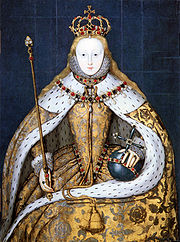
The English Armada, also known as the Counter Armada or the Drake-Norris Expedition, was a fleet of warships sent to the Iberian Coast by Queen Elizabeth I of England
in 1589, during the Anglo-Spanish War
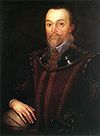
(1585–1604). It was led by Sir Francis Drake
as admiral and Sir John Norreys
as general, and failed to drive home the advantage England had won upon the dispersal of the Spanish Armada
in the previous year. The campaign resulted in the utter defeat of the English and eventually to a withdrawal with heavy losses both in lives and ships. The Spanish victory marked a revival of Philip II naval power through the next decade.
and raise a revolt there against Philip II
(Philip I of Portugal), and then to continue south and establish a permanent base in the Azores. A further aim was to seize the Spanish treasure fleet
as it returned from America
to Cádiz
, although this depended largely on the success of the Azores campaign.
The critical calculation was based on an understanding of Portuguese
politics. The Portuguese empire included Brazil
, and the East Indies
, among other areas, and trading posts in India and China. By securing an allegiance with the Portuguese crown, Elizabeth hoped to curb Spanish Habsburg power in Europe and open up for her favourites the trade routes that these possessions commanded.
It was a difficult proposition, because the domestic aristocracy and clergy of Portugal had accepted Philip as their King in 1581
at the Cortes of Tomar. The pretender to the throne, António, Prior of Crato
— last surviving heir of the House of Aviz
— failed to establish an effective government in exile in the Azores, and turned to the English for support. But he was not a charismatic figure, and with his cause compromised by his illegitimacy, he faced an opponent with perhaps the better claim, in the eyes of the Portuguese nobles of the Cortes
, Catherine, Duchess of Braganza
.
The complex politics were not the only drawback for the expedition. Like its Spanish predecessor, the English Armada suffered from overly optimistic planning, based on hopes of repeating Drake's successful raid on Cadiz in 1587. A critical contradiction lay between the separate plans, each of which was ambitious in its own right. But the most pressing need was the destruction of the Spanish Atlantic fleet lying at port at A Coruña
, San Sebastián
and Santander
along the north coast of Spain, as directly ordered by the Queen.
The expedition was floated as a joint stock company, with capital of about £80,000 — one quarter to come from the Queen, and one eighth from the Dutch, the balance to be made up by various noblemen, merchants and guilds. Concerns over logistics and adverse weather delayed the departure of the fleet, and confusion grew as it waited in port. The Dutch failed to supply their promised warships, a third of the victuals had already been consumed, and the number of veteran soldiers was only 1,800 while the ranks of volunteers had increased the planned contingent of troops from 10,000 to 19,000. The fleet also lacked siege guns and cavalry — items that had been lavishly laid on in the Spanish Armada expedition of the previous year — which raises serious doubts about the intentions of those in charge of the preparations.
s, 60 English armed merchantmen, 60 Dutch flyboat
s and about 20 pinnace
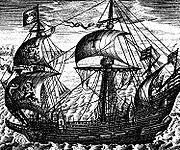
s. In addition to the troops, there were 4,000 sailors and 1,500 officers and gentlemen adventurers. Drake assigned his vessels to five squadrons, led respectively by himself in the Revenge, Sir John Norreys in the Nonpareil, Norreys' brother Edward in the Foresight, Thomas Fenner in the Dreadnought, and Roger Williams in the Swiftsure. Also sailing with them — against the Queen's express orders — was the Earl of Essex
.
Most of the ships lost in Philip II's expedition of 1588 had been armed merchantmen, while the core of the armada — the galleons of the Spanish navy's Atlantic fleet — survived their voyage home and docked in Spain's Atlantic ports for a refit, where they lay for months, vulnerable to attack.
Unforeseen delays and a fear of becoming embayed in the Bay of Biscay led Drake to bypass Santander, where most of this refitting was underway, and attack Corunna in Galicia instead. Norreys took the lower town, killed 500 Spaniards, and plundered the wine cellars, while Drake destroyed 13 merchant ships in the harbour. For the next two weeks the wind blew westerly, and while the English waited for a change a siege of Corunna's fortified upper town consumed their efforts. A pair of Spanish galleys slipped past the English fleet and repeatedly resupplied the defenders, and at length, with a favourable wind returning, the English abandoned the siege, having lost four captains and several hundred soldiers in the fighting, along with 3,000 other personnel in 24 of the transports, including many of the Dutch, who found reasons to return to England
or put into La Rochelle
. Those who remained then turned their attention, first to Puente de Burgos, where Norreys won a modest victory, and then to Lisbon.
 Lisbon was said to be defended by a disaffected garrison, but while the English bloodied themselves at Corunna the Spaniards spent a crucial fortnight shoring up Portugal's defences. When Norreys invested the city, the expected uprising was not forthcoming and little was achieved. Drake did take the opportunity on 30 June of seizing a fleet of 20 French
and 60 Hanseatic
ships, which had broken the English blockade on trade with Spain by sailing all around the north of Scotland only to fetch up before the English cannon in the mouth of the Tagus. This seizure, notes R. B. Wernham, 'dealt a useful blow to Spanish preparations', but later required a publicly-printed justification, a Declaration of Causes, from the Queen's own printer, as, without booty, she and her fellow English investors faced considerable losses.
The English dealt a further blow to Spanish naval preparations and food supplies by destroying the Lisbon granaries, but despite the bravado of Essex, who thrust a sword in at the gates of the city with a challenge to the defenders, the English could not take Lisbon without artillery or open Portuguese support. The expected rising failed to eventuate, in part because of the absence of Drake, the land and naval forces having divided and lost contact after the landing at Peniche, and the defenders would not risk battle.
Essex received orders from Elizabeth to return to court, along with a refusal to send reinforcements or a siege train, the queen having no desire to carry the main burden of a land war in Portugal. It was therefore decided to concentrate on the third aim of the expedition, the establishment of a permanent base in the Azores. But the campaign had taken its toll. Drake's forces had initially caught the Spanish authorities off guard but Spain had now prepared its defences and the English were wearing out and suffering increasingly from disease. Two armed merchantmen were caught off Lisbon by 9 Spanish galleys commanded by Alfonso Bazán. One of them, the William, was saved by the Revenge
after being abandoned by her crew, but the ship did not have enough manpower to sail away after the battle and had to be scuttled. The other vessel was engulfed by flames after a long struggle and eventually sank along with her skipper, a Captain Minshaw. One of three boats carrying William's complement was sunk with all hands after being attacked by the Spanish warships.
 It was soon understood that any attempt to land in the Azores was out of the question, and Drake made a final attempt to retrieve the mission. At this point, most men were out of action and only 2,000 were fit to be mustered. Stormy weather had also damaged a number of ships. While Norreys sailed for home with the sick and wounded, Drake took his pick of what was left and set out with 20 ships to hunt for the treasure fleet. He was struck by another heavy storm and was unable to carry out even that task, and while Porto Santo in Madeira
was plundered, his flagship, the Revenge, sprang a leak and almost foundered as it led the remainder of the fleet home to Plymouth.
The expedition was a naval disaster. Without counting the 18 barges lost at La Coruña and Lisbon, about 30 ships were lost in all. Of these, 3 were lost at La Coruña, 6 were lost to naval actions led by Padilla, 3 to Bazan and 2 to Aramburu. Another dozen were lost in the storms on the return voyage and the outbreak of diseases on board were transmitted to the port town populations upon the expedition's return to England. None of the campaign's aims were accomplished and for many years the result discouraged further joint-stock adventures on such a scale. The English sustained heavy losses of ships, men and resources, but only brought back 150 captured cannon and £30,000 of plunder. The only accomplishment was, perhaps, a temporary disruption to Spanish shipping and the induced diversion of Spanish resources that might have contributed to a mutiny of Spanish forces under Parma
in Flanders
that August.
 With the opportunity to strike a decisive blow against the weakened Spanish lost, the failure of the expedition further depleted the crown treasury that had been so carefully restored during the long reign of Elizabeth I
. The Anglo-Spanish war
was very costly to both sides, and Spain itself, also fighting France
and the United Provinces
, had to default on its debt repayments in 1596, following another raid on Cadiz
. But the failure of the English Armada was a turning point, and the fortunes of the various parties to this complicated conflict fluctuated until the Treaty of London
in 1604, when a peace was agreed.
Spain's navy quickly recovered and shipped a greatly increased amount of precious metals from the Americas.
Elizabeth I of England
Elizabeth I was queen regnant of England and Ireland from 17 November 1558 until her death. Sometimes called The Virgin Queen, Gloriana, or Good Queen Bess, Elizabeth was the fifth and last monarch of the Tudor dynasty...
in 1589, during the Anglo-Spanish War
Anglo-Spanish War (1585)
The Anglo–Spanish War was an intermittent conflict between the kingdoms of Spain and England that was never formally declared. The war was punctuated by widely separated battles, and began with England's military expedition in 1585 to the Netherlands under the command of the Earl of Leicester in...
(1585–1604). It was led by Sir Francis Drake
Francis Drake
Sir Francis Drake, Vice Admiral was an English sea captain, privateer, navigator, slaver, and politician of the Elizabethan era. Elizabeth I of England awarded Drake a knighthood in 1581. He was second-in-command of the English fleet against the Spanish Armada in 1588. He also carried out the...
as admiral and Sir John Norreys
John Norreys
Sir John Norreys , also frequently spelt John Norris, was an English soldier of a Berkshire family of court gentry, the son of Henry Norris, 1st Baron Norreys a lifelong friend of Queen Elizabeth....
as general, and failed to drive home the advantage England had won upon the dispersal of the Spanish Armada
Spanish Armada
This article refers to the Battle of Gravelines, for the modern navy of Spain, see Spanish NavyThe Spanish Armada was the Spanish fleet that sailed against England under the command of the Duke of Medina Sidonia in 1588, with the intention of overthrowing Elizabeth I of England to stop English...
in the previous year. The campaign resulted in the utter defeat of the English and eventually to a withdrawal with heavy losses both in lives and ships. The Spanish victory marked a revival of Philip II naval power through the next decade.
Aims and planning
Queen Elizabeth's intentions were to capitalise upon Spain's temporary weakness at sea after the successful repulsion of the Spanish Armada and to compel Philip II to sue for peace. It was not a simple matter, and the expedition had three distinct aims: to burn the Spanish Atlantic fleet, to make a landing at LisbonLisbon
Lisbon is the capital city and largest city of Portugal with a population of 545,245 within its administrative limits on a land area of . The urban area of Lisbon extends beyond the administrative city limits with a population of 3 million on an area of , making it the 9th most populous urban...
and raise a revolt there against Philip II
Philip II of Spain
Philip II was King of Spain, Portugal, Naples, Sicily, and, while married to Mary I, King of England and Ireland. He was lord of the Seventeen Provinces from 1556 until 1581, holding various titles for the individual territories such as duke or count....
(Philip I of Portugal), and then to continue south and establish a permanent base in the Azores. A further aim was to seize the Spanish treasure fleet
Spanish treasure fleet
The Spanish treasure fleets was a convoy system adopted by the Spanish Empire from 1566 to 1790...
as it returned from America
Americas
The Americas, or America , are lands in the Western hemisphere, also known as the New World. In English, the plural form the Americas is often used to refer to the landmasses of North America and South America with their associated islands and regions, while the singular form America is primarily...
to Cádiz
Cádiz
Cadiz is a city and port in southwestern Spain. It is the capital of the homonymous province, one of eight which make up the autonomous community of Andalusia....
, although this depended largely on the success of the Azores campaign.
The critical calculation was based on an understanding of Portuguese
Portugal
Portugal , officially the Portuguese Republic is a country situated in southwestern Europe on the Iberian Peninsula. Portugal is the westernmost country of Europe, and is bordered by the Atlantic Ocean to the West and South and by Spain to the North and East. The Atlantic archipelagos of the...
politics. The Portuguese empire included Brazil
Brazil
Brazil , officially the Federative Republic of Brazil , is the largest country in South America. It is the world's fifth largest country, both by geographical area and by population with over 192 million people...
, and the East Indies
East Indies
East Indies is a term used by Europeans from the 16th century onwards to identify what is now known as Indian subcontinent or South Asia, Southeastern Asia, and the islands of Oceania, including the Malay Archipelago and the Philippines...
, among other areas, and trading posts in India and China. By securing an allegiance with the Portuguese crown, Elizabeth hoped to curb Spanish Habsburg power in Europe and open up for her favourites the trade routes that these possessions commanded.
It was a difficult proposition, because the domestic aristocracy and clergy of Portugal had accepted Philip as their King in 1581
Struggle for the throne of Portugal
The 1580 Portuguese succession crisis came about as a result of the 1578 death of young King Sebastian I of Portugal in the Battle of Ksar El Kebir...
at the Cortes of Tomar. The pretender to the throne, António, Prior of Crato
António, Prior of Crato
António, Prior of Crato , was a grandson of King Manuel I of Portugal, claimant of the Portuguese throne during the 1580 dynastic crisis, who was King of Portugal as António I of Portugal during 33 days in the continent in 1580, and, after the crowning of Philip II of Spain as King of Portugal,...
— last surviving heir of the House of Aviz
House of Aviz
The House of Aviz is a dynasty of kings of Portugal. In 1385, the Interregnum of the 1383-1385 crisis ended with the acclamation of the Master of the Order of Aviz, John, natural son of king Peter I and Dona Teresa Lourenço as king...
— failed to establish an effective government in exile in the Azores, and turned to the English for support. But he was not a charismatic figure, and with his cause compromised by his illegitimacy, he faced an opponent with perhaps the better claim, in the eyes of the Portuguese nobles of the Cortes
Portuguese Cortes
In the Medieval Kingdom of Portugal, the Cortes was an assembly of representatives of the estates of the realm - the nobility, clergy and bourgeoisie. It was called and dismissed by the King of Portugal at will, at a place of his choosing...
, Catherine, Duchess of Braganza
Catherine, Duchess of Braganza
Infanta Catherine of Guimarães, Duchess of Braganza by marriage was a Portuguese infanta claimant to the throne following the death of King Henry of Portugal in 1580....
.
The complex politics were not the only drawback for the expedition. Like its Spanish predecessor, the English Armada suffered from overly optimistic planning, based on hopes of repeating Drake's successful raid on Cadiz in 1587. A critical contradiction lay between the separate plans, each of which was ambitious in its own right. But the most pressing need was the destruction of the Spanish Atlantic fleet lying at port at A Coruña
A Coruña
A Coruña or La Coruña is a city and municipality of Galicia, Spain. It is the second-largest city in the autonomous community and seventeenth overall in the country...
, San Sebastián
San Sebastián
Donostia-San Sebastián is a city and municipality located in the north of Spain, in the coast of the Bay of Biscay and 20 km away from the French border. The city is the capital of Gipuzkoa, in the autonomous community of the Basque Country. The municipality’s population is 186,122 , and its...
and Santander
Santander, Cantabria
The port city of Santander is the capital of the autonomous community and historical region of Cantabria situated on the north coast of Spain. Located east of Gijón and west of Bilbao, the city has a population of 183,446 .-History:...
along the north coast of Spain, as directly ordered by the Queen.
The expedition was floated as a joint stock company, with capital of about £80,000 — one quarter to come from the Queen, and one eighth from the Dutch, the balance to be made up by various noblemen, merchants and guilds. Concerns over logistics and adverse weather delayed the departure of the fleet, and confusion grew as it waited in port. The Dutch failed to supply their promised warships, a third of the victuals had already been consumed, and the number of veteran soldiers was only 1,800 while the ranks of volunteers had increased the planned contingent of troops from 10,000 to 19,000. The fleet also lacked siege guns and cavalry — items that had been lavishly laid on in the Spanish Armada expedition of the previous year — which raises serious doubts about the intentions of those in charge of the preparations.
Execution
When the fleet sailed, it was made up of 6 royal galleonGalleon
A galleon was a large, multi-decked sailing ship used primarily by European states from the 16th to 18th centuries. Whether used for war or commerce, they were generally armed with the demi-culverin type of cannon.-Etymology:...
s, 60 English armed merchantmen, 60 Dutch flyboat
Flyboat
The flyboat was a European light vessel of between 70 to 200 tons, used in the late 16th and early 17th century; the name was subsequently applied to a number of disparate vessels.The name "flyboat" is derived from Dutch vlieboot, a boat with a shallow enough draught to be...
s and about 20 pinnace
Pinnace (ship's boat)
As a ship's boat the pinnace is a light boat, propelled by sails or oars, formerly used as a "tender" for guiding merchant and war vessels. In modern parlance, pinnace has come to mean a boat associated with some kind of larger vessel, that doesn't fit under the launch or lifeboat definitions...
s. In addition to the troops, there were 4,000 sailors and 1,500 officers and gentlemen adventurers. Drake assigned his vessels to five squadrons, led respectively by himself in the Revenge, Sir John Norreys in the Nonpareil, Norreys' brother Edward in the Foresight, Thomas Fenner in the Dreadnought, and Roger Williams in the Swiftsure. Also sailing with them — against the Queen's express orders — was the Earl of Essex
Robert Devereux, 2nd Earl of Essex
Robert Devereux, 2nd Earl of Essex, KG was an English nobleman and a favourite of Elizabeth I. Politically ambitious, and a committed general, he was placed under house arrest following a poor campaign in Ireland during the Nine Years' War in 1599...
.
Most of the ships lost in Philip II's expedition of 1588 had been armed merchantmen, while the core of the armada — the galleons of the Spanish navy's Atlantic fleet — survived their voyage home and docked in Spain's Atlantic ports for a refit, where they lay for months, vulnerable to attack.
Unforeseen delays and a fear of becoming embayed in the Bay of Biscay led Drake to bypass Santander, where most of this refitting was underway, and attack Corunna in Galicia instead. Norreys took the lower town, killed 500 Spaniards, and plundered the wine cellars, while Drake destroyed 13 merchant ships in the harbour. For the next two weeks the wind blew westerly, and while the English waited for a change a siege of Corunna's fortified upper town consumed their efforts. A pair of Spanish galleys slipped past the English fleet and repeatedly resupplied the defenders, and at length, with a favourable wind returning, the English abandoned the siege, having lost four captains and several hundred soldiers in the fighting, along with 3,000 other personnel in 24 of the transports, including many of the Dutch, who found reasons to return to England
England
England is a country that is part of the United Kingdom. It shares land borders with Scotland to the north and Wales to the west; the Irish Sea is to the north west, the Celtic Sea to the south west, with the North Sea to the east and the English Channel to the south separating it from continental...
or put into La Rochelle
La Rochelle
La Rochelle is a city in western France and a seaport on the Bay of Biscay, a part of the Atlantic Ocean. It is the capital of the Charente-Maritime department.The city is connected to the Île de Ré by a bridge completed on 19 May 1988...
. Those who remained then turned their attention, first to Puente de Burgos, where Norreys won a modest victory, and then to Lisbon.
France
The French Republic , The French Republic , The French Republic , (commonly known as France , is a unitary semi-presidential republic in Western Europe with several overseas territories and islands located on other continents and in the Indian, Pacific, and Atlantic oceans. Metropolitan France...
and 60 Hanseatic
Hanseatic League
The Hanseatic League was an economic alliance of trading cities and their merchant guilds that dominated trade along the coast of Northern Europe...
ships, which had broken the English blockade on trade with Spain by sailing all around the north of Scotland only to fetch up before the English cannon in the mouth of the Tagus. This seizure, notes R. B. Wernham, 'dealt a useful blow to Spanish preparations', but later required a publicly-printed justification, a Declaration of Causes, from the Queen's own printer, as, without booty, she and her fellow English investors faced considerable losses.
The English dealt a further blow to Spanish naval preparations and food supplies by destroying the Lisbon granaries, but despite the bravado of Essex, who thrust a sword in at the gates of the city with a challenge to the defenders, the English could not take Lisbon without artillery or open Portuguese support. The expected rising failed to eventuate, in part because of the absence of Drake, the land and naval forces having divided and lost contact after the landing at Peniche, and the defenders would not risk battle.
Essex received orders from Elizabeth to return to court, along with a refusal to send reinforcements or a siege train, the queen having no desire to carry the main burden of a land war in Portugal. It was therefore decided to concentrate on the third aim of the expedition, the establishment of a permanent base in the Azores. But the campaign had taken its toll. Drake's forces had initially caught the Spanish authorities off guard but Spain had now prepared its defences and the English were wearing out and suffering increasingly from disease. Two armed merchantmen were caught off Lisbon by 9 Spanish galleys commanded by Alfonso Bazán. One of them, the William, was saved by the Revenge
HMS Revenge (1577)
Revenge was an English race-built galleon of 46 guns, built in 1577 and captured by the Spanish in 1591, sinking soon afterwards. She was the first of thirteen English and Royal Navy ships to bear the name.Since she was built and served prior to the English Restoration of 1660, she did not carry...
after being abandoned by her crew, but the ship did not have enough manpower to sail away after the battle and had to be scuttled. The other vessel was engulfed by flames after a long struggle and eventually sank along with her skipper, a Captain Minshaw. One of three boats carrying William's complement was sunk with all hands after being attacked by the Spanish warships.
Madeira
Madeira is a Portuguese archipelago that lies between and , just under 400 km north of Tenerife, Canary Islands, in the north Atlantic Ocean and an outermost region of the European Union...
was plundered, his flagship, the Revenge, sprang a leak and almost foundered as it led the remainder of the fleet home to Plymouth.
The expedition was a naval disaster. Without counting the 18 barges lost at La Coruña and Lisbon, about 30 ships were lost in all. Of these, 3 were lost at La Coruña, 6 were lost to naval actions led by Padilla, 3 to Bazan and 2 to Aramburu. Another dozen were lost in the storms on the return voyage and the outbreak of diseases on board were transmitted to the port town populations upon the expedition's return to England. None of the campaign's aims were accomplished and for many years the result discouraged further joint-stock adventures on such a scale. The English sustained heavy losses of ships, men and resources, but only brought back 150 captured cannon and £30,000 of plunder. The only accomplishment was, perhaps, a temporary disruption to Spanish shipping and the induced diversion of Spanish resources that might have contributed to a mutiny of Spanish forces under Parma
Alexander Farnese, Duke of Parma
Alexander Farnese was Duke of Parma and Piacenza from 1586 to 1592, and Governor of the Spanish Netherlands from 1578 to 1592.-Biography:...
in Flanders
Flanders
Flanders is the community of the Flemings but also one of the institutions in Belgium, and a geographical region located in parts of present-day Belgium, France and the Netherlands. "Flanders" can also refer to the northern part of Belgium that contains Brussels, Bruges, Ghent and Antwerp...
that August.
Consequences
Elizabeth I of England
Elizabeth I was queen regnant of England and Ireland from 17 November 1558 until her death. Sometimes called The Virgin Queen, Gloriana, or Good Queen Bess, Elizabeth was the fifth and last monarch of the Tudor dynasty...
. The Anglo-Spanish war
Anglo-Spanish War (1585)
The Anglo–Spanish War was an intermittent conflict between the kingdoms of Spain and England that was never formally declared. The war was punctuated by widely separated battles, and began with England's military expedition in 1585 to the Netherlands under the command of the Earl of Leicester in...
was very costly to both sides, and Spain itself, also fighting France
France
The French Republic , The French Republic , The French Republic , (commonly known as France , is a unitary semi-presidential republic in Western Europe with several overseas territories and islands located on other continents and in the Indian, Pacific, and Atlantic oceans. Metropolitan France...
and the United Provinces
Dutch Republic
The Dutch Republic — officially known as the Republic of the Seven United Netherlands , the Republic of the United Netherlands, or the Republic of the Seven United Provinces — was a republic in Europe existing from 1581 to 1795, preceding the Batavian Republic and ultimately...
, had to default on its debt repayments in 1596, following another raid on Cadiz
Cádiz
Cadiz is a city and port in southwestern Spain. It is the capital of the homonymous province, one of eight which make up the autonomous community of Andalusia....
. But the failure of the English Armada was a turning point, and the fortunes of the various parties to this complicated conflict fluctuated until the Treaty of London
Treaty of London, 1604
The Treaty of London, signed on 18 August O.S. 1604, concluded the nineteen-year Anglo-Spanish War. The negotiations took place at Somerset House in London and are sometimes known as the Somerset House Conference....
in 1604, when a peace was agreed.
Spain's navy quickly recovered and shipped a greatly increased amount of precious metals from the Americas.
External links
- Wes Ulm, "The Defeat of the English Armada and the 16th-Century Spanish Naval Resurgence: A More Detailed Look at the Spanish Armada, its Immediate Results, its Long-Term Effects, and its Lesser-Known Aftermath"
- Library of Congress: Hans P. Kraus, "Sir Francis Drake: A Pictorial Biography": "The Beginning of the End: The Drake-Norris Expedition, 1589"