
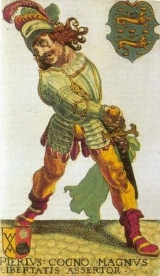
Pier Gerlofs Donia was a
FrisiaFrisia is a coastal region along the southeastern corner of the North Sea, i.e. the German Bight. Frisia is the traditional homeland of the Frisians, a Germanic people who speak Frisian, a language group closely related to the English language...
n
warriorA warrior is a person skilled in combat or warfare, especially within the context of a tribal or clan-based society that recognizes a separate warrior class.-Warrior classes in tribal culture:...
, pirate, and
rebelRebellion, uprising or insurrection, is a refusal of obedience or order. It may, therefore, be seen as encompassing a range of behaviors aimed at destroying or replacing an established authority such as a government or a head of state...
. He is best known by his
West FrisianWest Frisian is a language spoken mostly in the province of Friesland in the north of the Netherlands. West Frisian is the name by which this language is usually known outside the Netherlands, to distinguish it from the closely related Frisian languages of Saterland Frisian and North Frisian,...
nickname "
Grutte Pier" ("Big Pier" in the
Old FrisianOld Frisian is a West Germanic language spoken between the 8th and 16th centuries in the area between the Rhine and Weser on the European North Sea coast. The Frisian settlers on the coast of South Jutland also spoke Old Frisian but no medieval texts of this area are known...
spelling), or by the
DutchDutch is a West Germanic language and the native language of the majority of the population of the Netherlands, Belgium, and Suriname, the three member states of the Dutch Language Union. Most speakers live in the European Union, where it is a first language for about 23 million and a second...
translations "Grote Pier" and "Lange Pier", or, in Latin, "Pierius Magnus", which referred to his legendary size and strength.
His life is mostly shrouded in legend. Based upon a description now attributed to Pier’s contemporary
Petrus ThaboritaPetrus Jacobi Thaborita was a Frisian monk, historian and writer. He is best known for his writings on the Frisian freedom fighter Pier Gerlofs Donia, and for writing down Donia's last words...
, the 19th-century historian Conrad Busken Huet wrote that Grutte Pier was
Early life and family
Grutte Pier was born Pier Gerlofs Donia (Pier Gerlofs), around 1480 in Kimswerd near the city of
HarlingenHarlingen is a municipality and a city in the northern Netherlands, in the province of Friesland at the Wadden Sea. Harlingen is an old town with a long history of fishing and shipping....
, Wonseradeel in
FrieslandFriesland is a province in the north of the Netherlands and part of the ancient region of Frisia.Until the end of 1996, the province bore Friesland as its official name. In 1997 this Dutch name lost its official status to the Frisian Fryslân...
,
NetherlandsThe Netherlands is a constituent country of the Kingdom of the Netherlands, located mainly in North-West Europe and with several islands in the Caribbean. Mainland Netherlands borders the North Sea to the north and west, Belgium to the south, and Germany to the east, and shares maritime borders...
. Pier Gerlofs was one of at least four children born to Fokel Sybrants Bonga and Gerlof Piers. Pier's mother Fokel was the daughter of the Schieringer noblemen Sybrant Doytsesz. Bonga of Bongastate, Kimswerd.
Pier married Rintsje Syrtsema and they had two children, a son named Gerlof and a daughter named Wobbel, who were born around 1510. Pier died in 1520, and in 1525, Pier's mother appointed in her will Pier's brother, Sybren, as guardian of Pier's children, who still were minors. Pier and Pier's brother-in-law Ane Pijbes (husband of Tijdt Gerlofs), were partners in the farming estate of Meyllemastate in Kimswerd.
Pier was the direct descendant of the Frisian chieftain
Haring HarinxmaHaring Harinxma was a powerful Frisian chieftain and Schieringer who lived during the 13th and early 14th centuries. Haring also used the surname Donia, and is considered the patriarch of this well known Frisian family...
(1323–1404), a Schieringer and potestate of Westergo, and the third cousin of
Jancko DouwamaJancko Douwama was a Frisian nobleman who fought to free Friesland from foreign rule.He was born in 1482 into a Vetkoper 'hoofdelingen' or 'untitled noble' family near Oldeboorn, Friesland. He was the son of the chieftain Douwe Douwama and his wife Riem Eesckes...
.
Wijerd JelckamaWijerd Jelckama was a Frisian military commander, warlord and member of the Arumer Zwarte Hoop . He was the lieutenant of Pier Gerlofs Donia and fought along his side against the Saxon and Hollandic invaders...
often is described by 18th and 19th century authors as the nephew of Grutte Pier. Contemporary Worp van Thabor identifies him simply as Wierd van Bolsward. Modern authors such as J.J. Kalma doubt the nephew connection and Brouwer in the
Encyclopedia of Friesland states that Wierd was not Grutte Pier's nephew but instead his "lieutenant".
Rebellion
Approximately 7 kilometres (4.3 mi) to the north-east of Donia's village of Kimswerd, in the city of
FranekerFraneker is one of the eleven historical cities of Friesland and capital of the municipality of Franekeradeel. It is located about 20 km west of Leeuwarden on the Van Harinxma Canal. As of 1 January 2006, it had 12,996 inhabitants. The city is famous for the Eisinga Planetarium from around...
, the
Black BandThe Black Band was a formation of 16th century mercenaries, largely pikemen, probably serving as Landsknechts. They fought in the French army for ten years, seeing service in several notable engagements, including the Battle of Marignano and the Battle of Pavia.- Origin :Some uncertainty exists...
, a
LandsknechtLandsknechte were European, predominantly German mercenary pikemen and supporting foot soldiers from the late 15th to the late 16th century, and achieved the reputation for being the universal mercenary of Early modern Europe.-Etymology:The term is from German, Land "land, country" + Knecht...
regiment in the service of
George, Duke of SaxonyGeorge the Bearded, Duke of Saxony , was duke of Saxony from 1500 to 1539.Duke George was a member of the Order of the Golden Fleece.-Early life:...
was quartered. The regiment was charged with suppressing the
civil warThe Schieringers and Vetkopers were two opposing Frisian factional parties from the medieval period. They were responsible for a bloody civil war that lasted for over a century and which eventually led to the end of the highly praised "Frisian freedom".These factional parties arose because of an...
between the Vetkopers, who opposed Burgundian and subsequently
HabsburgThe House of Habsburg , also found as Hapsburg, and also known as House of Austria is one of the most important royal houses of Europe and is best known for being an origin of all of the formally elected Holy Roman Emperors between 1438 and 1740, as well as rulers of the Austrian Empire and...
rule, and the Schieringers. The
Black BandThe Black Band was a formation of 16th century mercenaries, largely pikemen, probably serving as Landsknechts. They fought in the French army for ten years, seeing service in several notable engagements, including the Battle of Marignano and the Battle of Pavia.- Origin :Some uncertainty exists...
were notorious as a violent military force; when their pay was insufficient or lacking, they would extract payments from local villagers and on 29 January 1515, the Black Band plundered Donia's village, then allegedly raped and killed his wife, Rintze Syrtsema, and burnt to the ground both the village church and Donia's estate. Seeking revenge, Pier started a
guerrilla warGuerrilla warfare is a form of irregular warfare and refers to conflicts in which a small group of combatants including, but not limited to, armed civilians use military tactics, such as ambushes, sabotage, raids, the element of surprise, and extraordinary mobility to harass a larger and...
campaign against the
HabsburgThe House of Habsburg , also found as Hapsburg, and also known as House of Austria is one of the most important royal houses of Europe and is best known for being an origin of all of the formally elected Holy Roman Emperors between 1438 and 1740, as well as rulers of the Austrian Empire and...
s and allied himself with
Charles of Egmond, Duke of GueldersCharles of Egmond was Duke of Guelders, Count of Zutphen between 1492 and his death. He was the son of Adolf of Egmond and Catharine of Bourbon...
(1492–1538).
Peasant rebels
Pier's armed band, known as the
Arumer Zwarte HoopThe Arumer Zwarte Hoop was an army of peasant rebels in Friesland fighting the Dutch authorities from 1515 to 1523....
(English: Black Gang from
ArumArum is a genus of about 25 species of flowering plants in the family Araceae, native to Europe, northern Africa, and western Asia, with the highest species diversity in the Mediterranean region....
), were pirates mainly active against the Hollanders and Burgundians at sea. He managed to capture many English and Dutch ships, mainly on the
Zuider ZeeThe Zuiderzee was a shallow bay of the North Sea in the northwest of the Netherlands, extending about 100 km inland and at most 50 km wide, with an overall depth of about 4 to 5 metres and a coastline of about 300 km . It covered...
(today's ‘
IJsselmeerIJsselmeer is a shallow artificial lake of 1100 km² in the central Netherlands bordering the provinces of Flevoland, North Holland and Friesland, with an average depth of 5 to 6 m. The IJsselmeer is the largest lake in Western Europe....
’). In the biggest battle of his career, in 1515, he captured 28 Dutch ships, which earned him the nickname "Cross of the Dutchmen". Erasmus criticized Grutte Pier's exploits.
Pier targeted ships that travelled the Zuider Zee and was very active in 1517, when he used his "signal ships" to attack ships in the region of the West Frisian coast, to which he also transported Geldrian forces, setting them ashore at
MedemblikMedemblik is a municipality and a town in the Netherlands, in the province of North Holland and the region of West-Frisia.- History :...
. Pier bore a personal enmity to Medemblik and its inhabitants as, in earlier years, soldiers from Medemblik had cooperated with the Holland army commanded by
Duke Charles, the future EmperorCharles V was ruler of the Holy Roman Empire from 1519 and, as Charles I, of the Spanish Empire from 1516 until his voluntary retirement and abdication in favor of his younger brother Ferdinand I and his son Philip II in 1556.As...
. In March 1498, Medemblik was where representatives of the Schieringers met the Saxon ruler
duke AlbrechtAlbert III was a Duke of Saxony. He was nicknamed Albert the Bold or Albert the Courageous and founded the Albertine line of the House of Wettin....
to request Saxon protection from the Vetkopers — a request that resulted in the Saxon occupation of Friesland, Netherlands. On 24 June 1517, Grutte Pier and his Arumer Zwarte Hoop, consisting of some 4,000 soldiers from Frisia and
GueldersGuelders or Gueldres is the name of a historical county, later duchy of the Holy Roman Empire, located in the Low Countries.-Geography:...
, sailed to West Frisia, passing
EnkhuizenEnkhuizen is a municipality and a town in the Netherlands, in the province of North Holland and the region of West-Frisia.Enkhuizen was one of the harbour-towns of the VOC, just like Hoorn and Amsterdam, from where overseas trade with the East Indies was conducted. It received city rights in 1355...
, landing near
WervershoofWervershoof is a former municipality and a town in the north-western Netherlands, in the province of North Holland and the region of West-Frisia...
and advancing to Medemblik. They swiftly captured Medemblik, killing many inhabitants and taking many others prisoner. Some were released on payment of a high ransom. Some of the town's inhabitants fled and found safety at Medemblik Castle. The castle's governor, Joost van Buren, succeeded in keeping the aggressors outside the castle walls. Unable to take the castle, the Arumer Zwarte Hoop plundered the town and set it on fire. With most houses made of wood, the town, including the church, monastery and town hall, were completely razed. After this partial victory, Pier and his army stormed both Nieuwburg and Middleburg Castle near
AlkmaarAlkmaar is a municipality and a city in the Netherlands, in the province of Noord Holland. Alkmaar is well known for its traditional cheese market. For tourists, it is a popular cultural destination.-History:...
, plundered and set them on fire, leaving only ruins.
In 1517, the Arumer Zwarte Hoop captured the town of
AsperenAsperen is a village in the Dutch province of Gelderland. It is a part of the municipality of Lingewaal, and lies about 10 km east of Gorinchem on the river Linge. It received city rights in 1313....
, slaughtering virtually all its inhabitants. They then used the heavily fortified city as a base until driven out by Holland's Stadhouder. In response to the attacks on Medemblik and Alkmaar and the failure of the Captain General of Amstelland, Waterland and Gooiland to defend his territories, the Stadhouder of Holland agreed to fit out a war fleet in July 1517. The fleet came under the supreme command of Anthonius van den Houte, Lord of Vleteren, appropriately titled "Admiral of the Zuider Zee". In the name of Charles V, van den Houte announced he would free the region of Frisian and Gelder piracy. Although van den Houte was initially successful, with some of the Frisian vessels being burnt near
Bunschoten, Grutte Pier responded by seizing 11 of Holland's ships in a battle off the coast near
Hoorn-Cities :* Purmerend * Enkhuizen * Alkmaar * Amsterdam * Lelystad * Den Helder * Leeuwarden -Towns :* Edam...
in 1518.
Shortly after this victory, Pier defeated 300 Hollanders in Hindelopen. According to a legend, Pier forced his captives to repeat a
shibbolethA shibboleth is a custom, principle, or belief distinguishing a particular class or group of people, especially a long-standing one regarded as outmoded or no longer important...
to distinguish Frisians from Holland and Lower German infiltrators:
Bûter, brea en griene tsiis: wa't dat net sizze kin, is gjin oprjochte Fries. (Butter, bread, and green cheese: if you can’t say that, you’re not a real Frisian.)
Despite his successes, Pier could not turn the Burgundian/Habsburg tide and he retired, disillusioned, in 1519. Wierd Jelckama took over the command of Pier’s forces. Pier died peacefully in his bed at Grootzand 12 in the Frisian city of
SneekSneek is a city southwest of Leeuwarden and seat of the former municipality of Sneek in the province of Friesland . As for 2011 it is part of the municipality Súdwest Fryslân...
on 18 October 1520. Pier is buried in Sneek in the 15th-century Groote Kerk (also called the Martinikerk). His tomb is located at the north side of the church.
Superhuman strength and size
In 1791, Jacobus Kok wrote that above the porticus of the New City Hall of
Leeuwarden, two remarkably large swords were found which were said to have belonged to Grutte Pier and Wijerd Jelckama. Donia was noted for the ability to wield this great sword so efficiently that he could behead multiple people with it in a single blow.
Today, a great sword that is said to have belonged to Pier is on display at the Fries museum in
Leeuwarden. It measures 2.15 metres (7 ft) in length and weighs about 6.6 kilograms (14.6 lb). Some sources put his height at 7 ft. Pier was alleged to be so strong that he could bend coins using just his thumb, index and middle finger. A huge helmet said to be Grutte Pier's is kept in the town hall of Sneek.
In popular culture
The legendary status of Grote Pier as a hero or a villain has endured over the centuries with his exploits retold in book, poetry, song and more recently television.
Gysbert Japicx
The seventeenth century Friese poet
Gysbert JapicxGysbert Japicx was a Frisian writer, poet, schoolteacher and cantor.He admired Horace and Ovid and was a defender for the memmetaal which elevated Frisian to a literature language...
(1603–1666) wrote in his composition ‘Tjesck Moars See Aengste’ [Grandmothers’s Sea Anguish] the following verse in reverence to Grote Pier (eng. trans., Tall Peter):
Grandmothers’s Sea Anguish
- Thee I’ll follow, noble Peter,
- Thou wert nobler far and greater,
- Than the noblest, home-kept lord,
- Battling like an ancient roman,
- For his country with her foeman,
- Whom he chased with fire and sword.
Fivefal
Stories about Pier grew into legends that often share themes with stories of other strong men in Germanic heroic literature. For example, one story says Pier ploughed his land by pulling the plough himself instead of using horses. Another story states that Pier could lift a horse above his head.
Fivefal is the name in Frisian of a Frisian legend. It tells the story of Pier beating five strong men who came to fight him: the place where he beat them is known as Fivefal, (Lit. Five fall) for all five of them fell to the ground.
Television
In the 1970s, in the
DutchDutch is a West Germanic language and the native language of the majority of the population of the Netherlands, Belgium, and Suriname, the three member states of the Dutch Language Union. Most speakers live in the European Union, where it is a first language for about 23 million and a second...
Floris seriesFloris is a 1969 Dutch television action series, written by Gerard Soeteman starring Rutger Hauer and Jos Bergman and directed by Paul Verhoeven.-Concept:...
, Donia was a major character played by actor
Hans BoskampHans Boskamp was a Dutch footballer and actor.-Club career:Rotterdam-born Boskamp played his club football in Amsterdam for Ajax, BVC Amsterdam and DWS.-International career:...
.
Sport
The Greate Pier rugby club in
Leeuwarden, which plays on a regional level, is named after Donia in Friesland. Many other clubs and several ships are named after him.
External links