
All Topics  
Holland


   Email Print
   Bookmark   Link


Holland


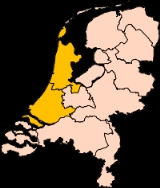
Holland is a name in common usage given to two regions in the western part of the Netherlands
Netherlands

The Netherlands is a country that is part of the Kingdom of the Netherlands. It is a parliamentary democratic constitutional monarchy. The Netherlands is located in North-West Europe, and bordered by the North Sea to the north and west, Belgium to the south, and Germany to the east....
. The name 'Holland' is also often mistakenly used to refer to the whole of The Netherlands. From the 10th century to the 16th century it was a unified political region ruled by the Count of Holland
Count of Holland

The Counts of Holland ruled over the county of Holland in the Low Countries between the 10th and the 16th century....
. By the 17th century, Holland had risen to become a maritime and economic power, dominating other parts of The Netherlands. Today, the former County of Holland consists of the two Dutch provinces of North Holland
North Holland

North Holland is a Provinces of the Netherlands situated on the North Sea in the northwest part of the Netherlands. The provincial capital is Haarlem and its largest city is Amsterdam....
 and South Holland
South Holland

South Holland is a Provinces of the Netherlands situated on the North Sea in the western part of the Netherlands. The provincial capital is The Hague and its largest city is Rotterdam....
.

Etymology
The name Holland first appeared in sources in 866 for the region around Haarlem
Haarlem

, in the past usually 'Harlem' in English, is a city in the Netherlands. It is also the Capital of the province of North Holland, the northern half of Holland, which at one time was one of the most powerful of the seven provinces of the Dutch Republic....
, and by 1064 was being used as the name of the entire county.


Discussion
Ask a question about 'Holland'
Start a new discussion about 'Holland'
Answer questions from other users
Full Discussion Forum


Timeline

400   The Franks establish themselves in Northern Holland.

1061   Most of West Frisia (later known as Holland) is conquered by imperial German armies and given to the bishop of Utrecht.

1287   A fringing barrier between the North Sea and a shallow lake in Holland collapses during a heavy storm, causing the fifth largest flood in recorded history which creates the Zuider Zee inlet and kills over 50,000 people; it also gives sea access to Amsterdam, allowing its development as an important port city.

1299   The house of Holland becomes extinct. The County of Holland becomes a part of a personal union with the County of Hainaut.

1304   Holland and Zeeland are occupied by duke John II of Brabant and Guy of Dampierre. Count John II recovers the counties.

1345   Holland, Hainaut and Zeeland are inherited by emperor Louis IV of the Holy Roman Empire and becomes part of the imperial crown domain, until 1347.

1362   The "Grote Mandrenke" storm tide strikes Holland, England, Germany and Denmark destroying the city of Rungholt in Nordfriesland, Germany.

1481   Battle of Westbroek - Holland defeats troops of Utrecht.

1577   The Union of Brussels is formed. First without the protestant counties of Holland and Zeeland, which was accepted by king Philip II of Spain. Later with the protestants, which meant open rebellion of the whole of the Netherlands.

1672   William III of Orange appointed Stadtholder of Holland, Zeeland and Utrecht.


Encyclopedia


Holland is a name in common usage given to two regions in the western part of the Netherlands
Netherlands

The Netherlands is a country that is part of the Kingdom of the Netherlands. It is a parliamentary democratic constitutional monarchy. The Netherlands is located in North-West Europe, and bordered by the North Sea to the north and west, Belgium to the south, and Germany to the east....
. The name 'Holland' is also often mistakenly used to refer to the whole of The Netherlands. From the 10th century to the 16th century it was a unified political region ruled by the Count of Holland
Count of Holland

The Counts of Holland ruled over the county of Holland in the Low Countries between the 10th and the 16th century....
. By the 17th century, Holland had risen to become a maritime and economic power, dominating other parts of The Netherlands. Today, the former County of Holland consists of the two Dutch provinces of North Holland
North Holland

North Holland is a Provinces of the Netherlands situated on the North Sea in the northwest part of the Netherlands. The provincial capital is Haarlem and its largest city is Amsterdam....
 and South Holland
South Holland

South Holland is a Provinces of the Netherlands situated on the North Sea in the western part of the Netherlands. The provincial capital is The Hague and its largest city is Rotterdam....
.

Etymology


The name Holland first appeared in sources in 866 for the region around Haarlem
Haarlem

, in the past usually 'Harlem' in English, is a city in the Netherlands. It is also the Capital of the province of North Holland, the northern half of Holland, which at one time was one of the most powerful of the seven provinces of the Dutch Republic....
, and by 1064 was being used as the name of the entire county. By this time, the inhabitants of Holland were referring to themselves as "Hollanders". Holland is derived from the Middle Dutch term holtland ("wooded land"). This spelling variation remained in use until around the 14th century, at which time the name stabilised as Holland (alternative spellings at the time were Hollant and Hollandt). Popular, but incorrect, etymology holds that Holland is derived from hol land ("hollow land") and was inspired by the low-lying
Lowland

In physical geography, a lowland is any broad expanse of land with a general low level. The term is thus applied to the landward portion of the upward slope from oceanic depths to continental highlands, to a region of depression in the interior of a mountainous region, to a plain of denudation, or to any region in contrast to a highland ....
 geography
Geography

Geography is the study of the Earth and its lands, features, inhabitants, and phenomena. A literal translation would be "to describe or write about the Earth"....
 of Holland.

Usage

The proper name of the area in both Dutch and English is "Holland". "Holland" is a part of the Netherlands. "Holland" is informally and quite incorrectly used in English
English language

English is a West Germanic language that originated in Anglo-Saxon England and has lingua franca status in many parts of the world as a result of the military, economic, scientific, political and cultural influence of the British Empire in the 18th, 19th and early 20th centuries and that of the United States from the mid 20th century onwa...
 and other languages, including sometimes the Dutch language
Dutch language

Dutch is a West Germanic languages spoken by over 22 million people as a first language, and about 5 million people as a second language."1% of the EU population claims to speak Dutch well enough in order to have a conversation." Outside the European Union the number of second language speakers of Dutch is very small. Most native...
 itself, to mean the whole of the modern country of the Netherlands
Netherlands (terminology)

The Netherlands is known under various terms both in English language and Netherlands #Other languages. These are used to describe the different overlapping geographical, linguistic and political areas of the Netherlands....
 (this example of pars pro toto
Pars pro toto

Pars pro toto is Latin for " a part for the whole" where a portion of an object or concept represents the entire object or context. See also synecdoche....
 or synecdoche
Synecdoche

Synecdoche is a figure of speech in which:* a term denoting a part of something is used to refer to the whole thing , or* a term denoting a thing is used to refer to part of it , or...
 is similar to the tendency to refer to the United Kingdom as "England").

The people of Holland are referred to as "Hollanders" in both Dutch and English. Today this refers specifically to people from the current provinces of North Holland and South Holland. Strictly speaking, the term "Hollanders" does not refer to people from the other provinces in the Netherlands, but colloquially "Hollanders" is sometimes mistakenly used in this wider sense.

When referring to the Netherlands as a whole, the adjective
Adjective

In grammar, an adjective is a word whose main syntax role is to grammatical modifier a noun or pronoun, giving more information about the noun or pronoun's definition....
 is "Dutch". "Dutch" is not used as an adjective for "Holland" in a modern context because "Dutch" refers to all of the Netherlands, not just Holland. However, there is a good deal of confusion about this. In actual practice, the adjective "Dutch" is often (but somewhat inaccurately) used in the specific context of Holland.

In Dutch, the Dutch word "Hollands" is the adjectival form for "Holland", but in English there is no commonly used adjective for "Holland". "Hollands" is ordinarily expressed in English in two ways:
  • a possessive
    Possessive case

    The possessive case of a language is a grammatical case used to indicate a relationship of Possession . It is not the same as the genitive case, which can express a wider range of relationships, though the two have similar meanings in many languages....
     construction (e.g. "Holland's economic power"); or
  • an "of Holland" or "from Holland" construction (e.g. "the Maid of Holland"; "a girl from Holland").


The following usages apply in certain limited situations but do not ordinarily serve as the English equivalent of the commonly used Dutch adjective "Hollands".
  • Occasionally, the noun "Holland" is used in apposition
    Apposition

    Not to be confused with Dislocation , which are grammatically incorrectApposition is a grammar construction in which two elements, normally noun phrases, are placed side by side, with one element serving to define or modify the other....
     (e.g. "the Holland Society
    Holland Society

    The Holland Society of New York was founded in New York City in 1885 to collect information respecting the settlement and history of New Netherland....
    ").
  • The adjective "Hollandic" is occasionally used by some historians and other academic writers as an adjective for Holland. Historians who use the word tend to reserve it to pre-Napoleonic Holland. Hollandic
    Hollandic

    Hollandic or Hollandish is, together with Brabantian, the most frequently used dialect of the Dutch language. The other important Low Franconian languages dialects are East Flemish, West Flemish and Limburgish....
     is also the name linguists give to the dialect spoken in Holland.
  • Historically the English word "Dutch" had a different, broader meaning that could occasionally include "Hollands".
  • The adjective "Hollandish" is a word in English but is currently no longer in use.


Geography


Holland is situated in the west of the Netherlands. A maritime water-oriented region, Holland lies on the North Sea
North Sea

The North Sea is a marginal sea, epeiric sea on the European continental shelf. The Dover Strait and the English Channel in the south and the Norwegian Sea in the north connect it to the Atlantic Ocean....
 at the mouths of the Rhine and the Meuse
Meuse

Meuse is a departments of France in northeast France, named after the Meuse River....
 (Maas
Maas

Maas is a Dutch language and Low German surname allegedly from a short form of Thomas .Many believe Maas to be a shortened Americanized form of the surname Moskowitz...
). It has numerous rivers and lakes and an extensive inland canal and waterway system. To the south is Zealand
Zeeland

Zeeland , also called Zealand in English language and Zeelandic, is a province of the Netherlands. The province, located in the south-west of the country, consists of a number of islands and a strip bordering Belgium....
. The region is bordered on the east by the IJsselmeer
IJsselmeer

IJsselmeer is a shallow lake of 1100 km? in the central Netherlands bordering the Provinces of the Netherlands of Flevoland, North Holland and Friesland, with an average depth of 5 to 6 m....
 and four different provinces of the Netherlands.

Holland is protected from the sea by a long line of coastal dunes. Most of the land area behind the dunes consists of polder
Polder

A polder is a low-lying tract of land enclosed by embankments known as dike , that forms an artificial hydrology entity, meaning it has no connection with outside water other than through manually-operated devices....
 landscape lying well below sea level
Sea level

Mean sea level is the average height of the sea, with reference to a suitable reference surface. Defining the reference level , however, involves complex measurement, and accurately determining MSL can prove difficult....
. At present the lowest point in Holland is a polder near Rotterdam
Rotterdam

Rotterdam ; city and municipality in the Netherlands province of South Holland, situated in the west of the Netherlands. The municipality is the List of cities in the Netherlands with over 100,000 people in the country, with a population of 584,046 on 1 January 2007 and comprises the southern part of the Randstad, the List of metropolitan are...
, which is about seven meters below sea level. Continuous drainage is necessary to keep Holland from flooding. In earlier centuries windmill
Windmill

A windmill is a machine that is powered by the energy of the wind. It is designed to convert the energy of the wind into more useful forms using rotating blades or sails....
s were used for this task. The landscape was (and in places still is) dotted with windmills, which have become a symbol of Holland.

Holland is 7,494 square kilometres (land and water included), making it roughly 13% of the area of the Netherlands. Looking at land alone, it is 5,488 square kilometres in size. The combined population is 6.1 million.

The main cities in Holland are Amsterdam, Rotterdam and The Hague. Hague is formally the capital of the Netherlands
Capital of the Netherlands

The capital of the Netherlands is Amsterdam, even though the States-General of the Netherlands and the government have been both situated in The Hague since 1588....
 and its most important city. The Port of Rotterdam
Port of Rotterdam

The port of Rotterdam is the largest port in Europe, located in the city of Rotterdam, South Holland, the Netherlands. From 1962 until 1986 it was the world's busiest port, now overtaken by Asian ports like Port of Singapore and Shanghai....
 is Europe's largest and most important harbour and port. Amsterdam
Amsterdam

Amsterdam is the Capital of the Netherlands and List of cities in the Netherlands with over 100,000 people of the Netherlands, located in the Provinces of the Netherlands of North Holland in the west of the country....
 is the seat of government
Seat of government

The seat of government is defined by Brewer's Politics as "the building, complex of buildings or city from which a government exercises its authority"....
 of the Netherlands. These cities, combined with Utrecht
Utrecht (city)

Utrecht city and municipality is the capital and most populous city of the Netherlands province of Utrecht . It is located in the North-Eastern end of the Randstad, and is the fourth largest city of the Netherlands, with a population of 300,030....
 and other smaller municipalities, effectively form a single city - a conurbation called Randstad
Randstad

Image:Randstad_with_scale.png|400px|thumb|right|Schematic map of the Randstadcircle 528 380 26 Schipholrect 426 356 498 436 Haarlemmermeer...
.

The Randstad area is one of the most densely populated regions of Europe, but still relatively free of urban sprawl. There are strict zoning laws. Population pressures are enormous, property values are high, and new housing is constantly under development on the edges of the built-up areas. Surprisingly, much of the province still has a rural character. The remaining agricultural land and natural areas are highly valued and protected. Most of the arable land is used for intensive agriculture, including horticulture and greenhouse
Greenhouse

A greenhouse is a building where plants are cultivated.A greenhouse is a structure with a glass or plastic roof and frequently glass or plastic walls; it heats up because incoming solar radiation from the sun warms plants, soil, and other things inside the building....
 agri-businesses.

Language

See the article on the Dutch language
Dutch language

Dutch is a West Germanic languages spoken by over 22 million people as a first language, and about 5 million people as a second language."1% of the EU population claims to speak Dutch well enough in order to have a conversation." Outside the European Union the number of second language speakers of Dutch is very small. Most native...
 for a more detailed description.

The language primarily spoken in Holland is Dutch
Dutch language

Dutch is a West Germanic languages spoken by over 22 million people as a first language, and about 5 million people as a second language."1% of the EU population claims to speak Dutch well enough in order to have a conversation." Outside the European Union the number of second language speakers of Dutch is very small. Most native...
. Hollanders often refer to the Dutch language as "Hollands".

The standard Dutch that is spoken in the Netherlands is mostly based on the Dutch spoken in Holland; however, there are many local variations in dialect throughout the Netherlands.

Despite the correspondence between standard Dutch and the Dutch spoken in Holland, there are local variations within Holland itself that differ from standard Dutch. The main cities each have their own traditional dialect. A small number of people, especially in the area north of Amsterdam, still speak what is considered to be an original, older dialect, called "Hollandic
Hollandic

Hollandic or Hollandish is, together with Brabantian, the most frequently used dialect of the Dutch language. The other important Low Franconian languages dialects are East Flemish, West Flemish and Limburgish....
". The areas where people still speak with the Hollandic dialect are Volendam and Marken and the area around there, West Friesland
West Friesland

West Friesland or Westfriesland can refer to the following:*The contemporary region of West Friesland in the province of North Holland in the Netherlands....
 and the Zaanstreek.

Territory and political structure

"Holland" is not in itself a province of the Netherlands. It is divided into two provinces of the Netherlands
Provinces of the Netherlands

A Dutch province represents the administrative layer in between the national government and the local municipalities, having the responsibility for matters of subnational or regional importance....
 -- North Holland
North Holland

North Holland is a Provinces of the Netherlands situated on the North Sea in the northwest part of the Netherlands. The provincial capital is Haarlem and its largest city is Amsterdam....
 (Noord-Holland) and South Holland
South Holland

South Holland is a Provinces of the Netherlands situated on the North Sea in the western part of the Netherlands. The provincial capital is The Hague and its largest city is Rotterdam....
 (Zuid-Holland). These provinces were created in 1840 largely because it was unacceptable for Holland to remain such an overwhelmingly large and powerful province in comparison to the other provinces. A few regions that were historically part of Holland have been ceded to other provinces.

  • Some cessions occurred as a result of reforms during the French occupation (1795-1813).
  • In 1818 Willemstad
    Moerdijk

    Moerdijk is a municipality and a town in the South of the Netherlands, in the province of North Brabant....
     and surroundings, the Biesbosch
    Biesbosch

    De Biesbosch , is one of the largest national parks of the Netherlands and one of the last freshwater tide areas in Europe. The Biesbosch consists of a rather large network of rivers and smaller and larger creeks with islands....
     and the Land van Altena
    Land van Altena

    The Land of Heusden and Altena is a island in the estuary of the rivers Rhine and Meuse river. It is located in the Netherlands province of North Brabant and enclosed by rivers Boven Merwede , Afgedamde Maas , Bergse Maas and Steurgat ....
     became part of the province of North Brabant
    North Brabant

    North Brabant is a Provinces of the Netherlands of the Netherlands, located in the south of the country, bordered by Belgium in the south, the Meuse River in the north, Limburg in the east and Zeeland in the west....
    .
  • In 1942, after the Battle of the Netherlands
    Battle of the Netherlands

    The Battle of the Netherlands was part of Case Yellow , the Battle of France of the Low Countries and France during World War II. The battle lasted from 10 May 1940 until 14 May 1940 when the Dutch main force surrendered....
    , the Germans transferred the islands of Vlieland
    Vlieland

    Vlieland is a municipality in the northern Netherlands. The municipality of Vlieland has only one major town: Oost-Vlieland . It is the second-least population density municipality in the Netherlands ....
     and Terschelling
    Terschelling

    Terschelling is a municipality and an island in the northern Netherlands, one of the West Frisian Islands.Wadden islanders are known for their resourcefulness in using anything and everything that washes ashore....
     to the province of Friesland
    Friesland

    Friesland is a province in the north of the Netherlands and part of the bigger region known as Frisia. In order to distinguish it from the other Frisian regions, it is commonly specified as Westerlauwer Frisia, Westerlauwer Friesland, West Frisia or West Friesland....
    . This was not changed back after World War II
    World War II

    World War II, or the Second World War , was a global military conflict which involved a Participants in World War II, including all of the great powers, organised into two opposing military alliances: the Allies of World War II and the Axis powers....
    .
  • In 1950, the island of Urk
    Urk

    Urk is a municipality and a town in the Flevoland province in the central Netherlands.Urk is first mentioned in historical records dating to the 10th century, when it was still an island in the Almere, a lake that would become part of the Zuider Zee in the 13th century after a series of incursions by the North Sea....
     went to the province of Overijssel
    Overijssel

    Overijssel is a province of the Netherlands in the central eastern part of the country. The region has a Nomenclature of Territorial Units for Statistics classification of NL21....
     and then in 1986 to the province of Flevoland
    Flevoland

    Flevoland is a province of the Netherlands. Located in the centre of the country, at the location of the former Zuider Zee, the province was established on January 1, 1986; the twelfth province of the country, with Lelystad as its capital....
    .
  • In 1970 Oudewater
    Oudewater

    Media:Nl-Oudewater.ogg is a municipality and a town in the Netherlands, in the province of Utrecht ....
     was transferred from South Holland to the province of Utrecht
    Utrecht (province)

    Utrecht is the smallest Provinces of the Netherlands of the Netherlands, and is located in the center of the country. It is bordered by the Eemmeer in the north, Gelderland in the east, the river Rhine in the south, South Holland in the west, and North Holland in the northwest....
    .
  • In 1989 Woerden
    Woerden

    Woerden is a municipality and a city in the central Netherlands. Due to its central location between Amsterdam, Rotterdam, The Hague and Utrecht , and the fact that it has excellent rail and road connections to those cities, it is a popular town for commuters who work in those cities....
     was transferred from South Holland to the province of Utrecht.
  • In 2002 Vianen
    Vianen

    Vianen is a municipality and a city in the central Netherlands, in the province of Utrecht . It is the only municipality in Utrecht located south of the Lek River....
     was transferred from South Holland to the province of Utrecht.
  • The municipality of Eemnes
    Eemnes

    Media:Nl-Eemnes.ogg is a municipality and a town in the Netherlands, in the province of Utrecht ....
     has a co-operation with Laren
    Laren

    is a municipality and a town in the Netherlands, in the province of North Holland. Located in the region called 't Gooi, it is the oldest town in that area....
     and Blaricum
    Blaricum

    Media:Nl-Blaricum.ogg is a municipality and village in the Netherlands, in the province of North Holland.It is known for its many monumental farm buildings, local cafes and restaurants, nature, several annual community events and extensive up-market residential areas....
    . They are collectively referred to as the "BEL region".


Some territory was gained:
  • In 1989 Woerdense Verlaat
    Woerdense Verlaat

    Woerdense Verlaat is a town in the Netherlands province of South Holland. It is a part of the municipality of Nieuwkoop, and lies about 8 km north of Woerden....
     and Vrouwenakker
    Vrouwenakker

    Vrouwenakker is a village in the Netherlands, about 12 km southeast of Hoofddorp. It lies largely in the municipality of Nieuwkoop , in the province of South Holland, but a small part lies in the municipality of Uithoorn, in North Holland....
     were transferred from the province of Utrecht to South Holland
  • In 2000 Loosdrecht
    Loosdrecht

    Loosdrecht is a village in the municipality of Wijdemeren, North Holland, Netherlands.Loosdrecht was until 2002 a separate municipality in the province of Utrecht , covering the villages of Oud-Loosdrecht and Nieuw-Loosdrecht, and the hamlets Breukeleveen, Muyeveld, and Boomhoek....
     in the province of Utrecht, was merged with 's-Graveland
    's-Graveland

    s-Graveland is a village in the Netherlands province of North Holland. It is a part of the municipality of Wijdemeren, and lies about 4 km northwest of Hilversum....
     and Kortenhoef
    Kortenhoef

    Kortenhoef is a town in the Netherlands province of North Holland. It is a part of the municipality of Wijdemeren, and lies about 3 km northwest of Hilversum....
    , both in the province of North Holland.


History

Each of the provinces in the Netherlands has a history that deserves full attention on its own. However, to a certain extent at least, the history of Holland is the history of the Netherlands, and vice versa. See the article on "History of the Netherlands
History of the Netherlands

The historical period sets in with the Roman Empire, as the parts south of the Rhine were included in the Roman province of Gallia Belgica, and later of Germania Inferior....
" for a more detailed history. The article here focuses on those points that are specific to Holland itself or that highlight the nature of the role played by Holland in the Netherlands as a whole.

Reclamation of the land

The land that is now Holland had never been stable. Historical maps of Holland bear little resemblance to the maps of today. Over the millennia the geography of the region had been dynamic. The western coastline shifted up to thirty kilometres to the east and storm surges regularly wreaked havoc with the coastline. The coastline was constantly changing. The Frisian Isles
Frisian Islands

||-||-||-||-||-||-||-||-||-||-||}The Frisian Islands, also known as the Wadden Islands or Wadden Sea Islands, form an archipelago at the eastern edge of the North Sea in northwestern Europe, stretching from the north-west of the Netherlands through Germany to the west of Denmark....
, originally joined to the mainland, became detached islands in the north. At some point the sea broke a natural barrier and rushed in to fill in the area that used to be called the Zuiderzee (now the IJsselmeer). The main rivers, the Rhine
Rhine

File:Swiss Grand Canyon.jpgThe Rhine is one of the longest and most important rivers in Europe, at , with an average discharge of more than ....
 and the Meuse (Maas)
Meuse River

File:01-Namur-290305 JPG.jpgThe Meuse , is a major European river, rising in France and flowing through Belgium and the Netherlands before draining into the North Sea....
, flooded regularly and changed course repeatedly and dramatically.

The people of Holland found themselves living in an unstable, watery environment. Behind the row of coastal dunes a peat
Peat

Peat is an accumulation of partially decayed vegetation biological tissue. Peat forms in wetlands or peatlands, variously called bogs, Moorland, muskegs, pocosins, mires, and peat swamp forests....
 plateau had grown. Much of the area was marsh
Marsh

In geography, a marsh, or morass, is a type of wetland which is subject to frequent or continuous flood . Typically the water is shallow and features Poaceaees, Juncaceaees, Phragmites, typhas, Cyperaless, and other herbaceous plants....
 and bog
Bog

A bog or mire is a wetland type that accumulates acidic peat, a deposit of dead plant material—usually mosses, but also lichens in Arctic climates....
. The inhabitants set about cultivating this land by draining it. By the tenth century this area was brought under cultivation. The drainage however resulted in extreme soil shrinkage, lowering the surface of the land by up to fifteen metres. This combination of factors threatened the inhabitants. There were catastrophic floods
Floods in the Netherlands

This is a chronological list of floods that have occurred in the Netherlands, till 1500 most parts of the Netherlands were in Frisia.*838 December 26: A large part of the northwest of the Netherlands was flooded by a storm....
 that literally washed away entire regions and killed thousands. The early inhabitants understood that human intervention was needed to save the land. The counts and large monasteries took the lead in these efforts, building the first heavy emergency dikes to bolster critical points. Later special administrative bodies were formed, the waterschappen ("water control boards"), which had the power to enforce their decisions on water management
Water management

Water management is the practices of planning, developing, distribution and optimum utilizing of water resources under defined water polices and regulations....
. As the centuries went by, they eventually constructed an extensive dike system that covered the coastline and the polders, thus protecting the land from further incursions by the sea.

However, the Hollanders did not stop there. Starting around the 16th century, they took the offensive and began land reclamation
Land reclamation

Land reclamation is either of two distinct practices. One involves creating new land from sea- or riverbeds, the other refers to restoring an area to a more natural state ....
 projects, converting lakes and marshy areas into polders. This continued right into the 20th century.

This ongoing struggle to master the water played an important role in the development of Holland as a maritime and economic power and in the development of the character of the people of Holland.

County of Holland

Until the 9th century, the inhabitants of the area that became Holland were Frisians. The area was part of Frisia
Frisia

Frisia is a coastal region along the southeastern corner of the North Sea, i.e. the German Bight. Frisia is the traditional homeland of the Frisians, a Germanic people who speak Frisian languages, a language group closely related to the English language....
. At the end of the 9th century, Holland became a separate county
County

A county is a land area of Local government government within a larger state. A county may have city and towns within its area....
 in the Holy Roman Empire
Holy Roman Empire

The Holy Roman Empire was a union of territories in Central Europe during the Middle Ages and the Early modern Europe under a Holy Roman Emperor....
. The first count of Holland
Count of Holland

The Counts of Holland ruled over the county of Holland in the Low Countries between the 10th and the 16th century....
 known about with certainty was Dirk I
Dirk I, Count of Holland

Dirk I was Count of Holland, thought to have been in office from ca. 921 to ca. 928 or 939....
, who ruled (also as count of Frisia) from 896 to 931. He was succeeded by a long line of counts
Counts of Holland family tree

This is a family tree of the Count of Holland from 916 to 1299, when a personal union was formed with the County of Hainaut. After this date, the diagram continues at Counts of Hainaut family tree....
 in the House of Holland. When John I
John I, Count of Holland

John I was Count of Holland and son of Floris V, Count of Holland. John inherited the county in 1296 after the murder of his father.Shortly after his birth, after negotiations between Floris and Edward I of England in April 1285, he was betrothed to princess Elizabeth of Rhuddlan, a daughter of Edward and his first Queen consort Eleanor of...
, count of Holland, died childless in 1299, the county was inherited by John II of Avesnes
John II, Count of Holland

John II of Avesnes was the oldest son of John I of Avesnes and Adelaide of Holland....
, count of Hainaut. By the time of Willian V (House of Wittelsbach; 1354-1388) the count of Holland was also the count of Hainaut
County of Hainaut

The County of Hainaut was a historical region in the Low Countries. It consisted of what is now the Belgium province of Hainaut and the southern part of the French d?partement Nord ....
, Flanders
Flanders

Flanders is a geographical region located in parts of present-day Belgium, France, and the Netherlands. Over the course of history, the geographical territory that was called "Flanders" has varied....
 and Zealand
Zeeland

Zeeland , also called Zealand in English language and Zeelandic, is a province of the Netherlands. The province, located in the south-west of the country, consists of a number of islands and a strip bordering Belgium....
. In this time a part of Frisia
Frisia

Frisia is a coastal region along the southeastern corner of the North Sea, i.e. the German Bight. Frisia is the traditional homeland of the Frisians, a Germanic people who speak Frisian languages, a language group closely related to the English language....
, West Friesland
West Friesland (historical region)

West Friesland is a historical region in the northern part of the Netherlands. It was located in parts of what now is Noord-Holland and the Waddenzee....
, was conquered (as a result, most provincial institutions, including the States of Holland and West Frisia
States of Holland

The States of Holland and West Frisia were the representation of the two Estates of the realm to the court of the Count of Holland. After the Dutch Republic were formed ? and there no longer was a count, but only his "lieutenant" - they continued to function as the government of the County of Holland....
, would for centuries refer to "Holland and West Frisia" as a unit). The Hook and Cod wars
Hook and Cod wars

The Hook and Cod wars comprise a series of wars and battles in Holland between 1350 and 1490. Most of these wars were fought over the title of count of Holland, but some have argued that the underlying reason was because of the power struggle of the bourgeois in the cities against the ruling nobility....
 started around this time and ended when the countess of Holland, Jacoba or Jacqueline
Jacqueline, Countess of Hainaut

Jacqueline of Wittelsbach was Duchess of Bavaria-Straubing, Count of Hainaut and Count of Holland from 1417 to 1432.She was the only daughter of William VI, Count of Holland from his marriage with Margaret of Burgundy, daughter of Margaret III of Flanders and Philip the Bold....
 was forced to give up Holland to the Burgundian Philip I in 1432.

The last count of Holland was Philip III, better known as Philip II
Philip II

Philip II may refer to:* Philip II of Macedon * Philip II of France * Philip V of France and Philip II of Navarre * Philip II of Taranto * Philip II, Duke of Burgundy ...
 king of Spain. He was abolished in 1581 by the socalled Act of Abjuration, although the kings of Spain continued to carry the titular title of count of Holland until the Peace of Münster
Peace of Münster

The Peace of M?nster was a treaty between the United Netherlands and Spain signed in 1648. It was a landmark treaty for the Dutch republic and one of the key events in Dutch history; with it, the United Netherlands finally became independent from the Holy Roman Empire....
 signed in 1648.

Holland's prominence in the United Provinces and Dutch Republic

In 1432 Holland became part of the Burgundian Netherlands
Burgundian Netherlands

In the history of the Low Countries, the Burgundian Netherlands refers to the period when the Duke of Burgundy ruled the area, as well as Luxembourg and parts of northern France, from 1384 to 1530....
 and since 1477 of the Habsburg
Habsburg

The House of Habsburg was an important royal house of Europe and is best known as supplying all of the formally elected Holy Roman Emperors between 1452 and 1740, as well as rulers of Spanish Empire and the Austrian Empire....
 Seventeen Provinces
Seventeen Provinces

The Seventeen Provinces were a personal union of states in the Low Countries in the 15th century and 16th century, roughly covering the current Netherlands, Belgium, Luxembourg, a good part of the North of France , and a small part of the West of Germany....
. In the 16th century the region became more densely urbanised, with the majority of the population living in cities. Within the Burgundian Netherlands, Holland was the dominant province in the north; the political influence of Holland largely determined the extent of Burgundian dominion in that area. In the Dutch Rebellion against the Habsburgs during the Eighty Years' War, the naval forces of the rebels, the Watergeuzen, established their first permanent base in 1572 in the town of Brill. In this way, Holland, now a sovereign state in a larger Dutch confederation, became the centre of the rebellion. It became the cultural, political and economic centre of the United Provinces in the 17th century Dutch Golden Age
Dutch Golden Age

The Golden Age was a period in Netherlands history, roughly spanning the 17th century, in which Dutch trade, science, and art were among the most acclaimed in the world....
, the wealthiest nation in the world. After the King of Spain was deposed as the count of Holland, the executive and legislative power rested with the States of Holland, which was led by a political figure who held the office of Grand Pensionary
Grand Pensionary

The Grand Pensionary was the most important Dutch official during the time of the Dutch Republic. In theory he was only a civil servant of the Estates of the dominant province among the Seven United Provinces: the county of Holland....
.

The largest cities in the Dutch Republic
Dutch Republic

The Republic of the Seven United Netherlands was a European republic between 1581 and 1795, in about the same location as the modern Kingdom of the Netherlands, which is the successor state....
 were in the province of Holland such as Amsterdam
Amsterdam

Amsterdam is the Capital of the Netherlands and List of cities in the Netherlands with over 100,000 people of the Netherlands, located in the Provinces of the Netherlands of North Holland in the west of the country....
, Rotterdam
Rotterdam

Rotterdam ; city and municipality in the Netherlands province of South Holland, situated in the west of the Netherlands. The municipality is the List of cities in the Netherlands with over 100,000 people in the country, with a population of 584,046 on 1 January 2007 and comprises the southern part of the Randstad, the List of metropolitan are...
, Leiden
Leiden

Media:Nl-Leiden.ogg is a city and municipality in the province of South Holland in the Netherlands and has 118,000 inhabitants. It forms a single urban area with Oegstgeest, Leiderdorp, Voorschoten, Valkenburg, Rijnsburg and Katwijk, with 254,000 inhabitants....
, Alkmaar
Alkmaar

Alkmaar is a municipality and a city in the Netherlands, in the province of North Holland. Alkmaar is well-known for its traditional cheese market....
, The Hague
The Hague

The Hague is the third largest city in the Netherlands after Amsterdam and Rotterdam, with a population of 475,904 and an area of approximately 100 km?....
, Delft
Delft

See also: Delft, Cape Town, Delft Island Media:Nl-Delft.ogg is a city and municipality in the province of South Holland . It is located in between Rotterdam and The Hague....
, Dordrecht
Dordrecht

Media:Nl-Dordrecht.ogg , in English Dort and in the local dialect Dordt, is a city and municipality in the Netherlands province of South Holland, the third largest city of the province....
 and Haarlem
Haarlem

, in the past usually 'Harlem' in English, is a city in the Netherlands. It is also the Capital of the province of North Holland, the northern half of Holland, which at one time was one of the most powerful of the seven provinces of the Dutch Republic....
. From the great ports of Holland, Hollandic merchants sailed to and from destinations all over Europe
Europe

Europe is, conventionally, one of the world's seven continents. Comprising the westernmost peninsula of Eurasia, Europe is generally divided from Asia to its east by the water divide of the Ural Mountains, the Ural , the Caspian Sea, and by the Caucasus Mountains to the southeast....
, and merchants from all over Europe gathered to trade in the warehouses of Amsterdam and other trading cities of Holland.

Many Europeans thought of the United Provinces first as "Holland" rather than as the "Republic of the Seven United Provinces of the Netherlands". A strong impression of "Holland" was planted in the minds of other Europeans, which then was projected back onto the Republic as a whole. Within the provinces themselves, a gradual slow process of cultural expansion took place, leading to a "Hollandification" of the other provinces and a more uniform culture for the whole of the Republic. The dialect of urban Holland became the standard language
Standard language

A standard language is a particular variety of a language that has been given either legal or quasi-legal status. As it is usually the form promoted in schools and the media, it is usually considered by speakers of the language to be more "correct" in some sense than other dialects....
.

Kingdom of Holland

The formation of the Batavian Republic
Batavian Republic

The Batavian Republic was the Succession of states of the Dutch Republic. It was proclaimed on January 19, 1795 and ended on June 5, 1806 with the accession of Louis Bonaparte to the throne of the Kingdom of Holland....
, inspired by the French revolution
French Revolution

The French Revolution was a period of political and social upheaval and radical change in the history of France, during which the French governmental structure, previously an absolute monarchy with feudalism for the aristocracy and Roman Catholic Church clergy, underwent radical change to forms based on Age of Enlightenment principles of cit...
, led to a more centralised government. Holland became a province of a unitary state
Unitary state

A unitary state is a country whose three organs of state are governed as one single unit. The political power of government in such states may well be transferred to lower levels, to national, regional or local elected assemblies, governors and mayors , but the central government retains the principal right to recall such delegated power ....
. Its independence was further reduced by an administrative reform in 1798, in which its territory was divided into several departments called Amstel, Delf, Texel, and part of Schelde en Maas.

From 1806 to 1810 Napoleon
Napoleon I of France

Napoleon Bonaparte later known as Emperor Napoleon I, was a military and political leader of France whose actions shaped European politics in the early 19th century....
 styled his vassal state, governed by his brother Louis Napoleon
Louis Bonaparte

Louis Napol?on Bonaparte, Prince Fran?ais, King of Holland, Comte de Saint-Leu-la-For?t was the fifth surviving child and fourth surviving son of Carlo Buonaparte and Letizia Ramolino....
 and shortly by the son of Louis, Napoleon Louis Bonaparte
Napoleon Louis Bonaparte

Napoleon Louis Bonaparte , or Louis II of Holland, was the middle son of Louis Bonaparte, Kingdom of Holland, and Hortense de Beauharnais....
, as the "Kingdom of Holland
Kingdom of Holland

The Kingdom of Holland 1806 - 1810 was set up by Napoleon I as a Puppet state for his third brother, Louis Bonaparte, in order to better control the Netherlands....
". This kingdom encompassed much of what would become the modern Netherlands. The name reflects how natural at the time it had become to equate Holland with the non-belgian Netherlands as a whole.

During the period the Low Countries were annexed by the French Empire
First French Empire

The Empire of the French , also known as the Greater French Empire or First French Empire, but more commonly known as the Napoleonic Empire, was the empire of Napoleon I of France in France....
 and actually incorporated into France (from 1810 to 1813), Holland was divided into the départements Zuyderzée
Zuyderzée

Zuyderz?e is the name of a d?partement in France of the First French Empire in the present Netherlands. It is named after the Zuider Zee sea inlet....
 and Bouches-de-la-Meuse
Bouches-de-la-Meuse

Bouches-de-la-Meuse is the name of a d?partement in France of the First French Empire in the present Netherlands. It is named after the mouth of the river Meuse River....
.

Provinces like any other

After 1813, Holland was restored as a province of the United Kingdom of the Netherlands
United Kingdom of the Netherlands

United Kingdom of the Netherlands was the unofficial name used to refer to a new unified European state created from part of the First French Empire during the Congress of Vienna in 1815....
.

Holland was divided into the present provinces North Holland
North Holland

North Holland is a Provinces of the Netherlands situated on the North Sea in the northwest part of the Netherlands. The provincial capital is Haarlem and its largest city is Amsterdam....
 and South Holland
South Holland

South Holland is a Provinces of the Netherlands situated on the North Sea in the western part of the Netherlands. The provincial capital is The Hague and its largest city is Rotterdam....
 in 1840, after the Belgian Revolution
Belgian Revolution

The Belgian Revolution was the conflict which led to the secession of the Southern provinces of the United Kingdom of the Netherlands and the establishment of an independent Kingdom of Belgium....
 of 1830. This reflected an historical division of Holland along the IJ
IJ (bay)

The IJ is a river, formerly a bay, in the Netherlands province of North Holland. It is known for being Amsterdam's waterfront. The name derives from the generic Germanic languages term for "water" and is similar to other Aa River for bodies of water....
 into a Southern Quarter (Zuiderkwartier) and a Northern Quarter (Noorderkwartier).

From 1850 a strong process of nation formation took place, the Netherlands being culturally unified and economically integrated by a modernisation process, with the cities of Holland at its centre.

The image of Holland at home and abroad

The predominance of Holland in the Netherlands has resulted in regionalism
Regionalism (politics)

Regionalism is a term used in international relations. Regionalism also constitutes one of the three constituents of the international trade . It refers to the expression of a common sense of identity and purpose combined with the creation and implementation of institutions that express a particular identity and shape collective action within...
 on the part of the other provinces. This is a reaction to the perceived threat that Holland poses to the identities and local cultures of the other provinces. The other provinces have a strong, and often negative, image of Holland and the Hollanders, to whom certain qualities are ascribed.

Hollanders themselves, however, have a weak self-image. They take Holland's cultural dominance for granted. To them, the concepts of "Holland" and the "Netherlands" coincide. Consequently they see themselves not primarily as "Hollanders", but simply as "Dutch" (Nederlanders). This phenomenon is called "hollandocentrism".

Holland tends to be associated with a particular image. The stereotypical image of Holland is an artificial amalgam of tulip
Tulip

Tulipa, commonly called tulip, is a genus of about 150 species of bulbous flowering plants in the family Liliaceae. The native range of the species includes southern Europe, north Africa, and Asia from Anatolia and Iran in the west to northeast of China....
s, windmill
Windmill

A windmill is a machine that is powered by the energy of the wind. It is designed to convert the energy of the wind into more useful forms using rotating blades or sails....
s, clogs
Clog (shoe)

The word clog, as applied to footwear, has these meanings:#A type of shoe or sandal made predominantly out of wood.#A type of heavy boot or shoe with leather sides and uppers and typically thick wooden soles....
, cheese
Cheese

Cheese is a food consisting of proteins and fat from milk, usually the milk of cattle, Water Buffalo, goats, or sheep's milk. It is produced by Coagulation of the milk protein casein....
 and traditional dress (klederdracht). As is the case with many stereotypes, this is far from the truth and reality of life in Holland. This can at least in part be explained by the active exploitation of these stereotypes in promotions of Holland and the Netherlands. In fact only in a few of the more traditional villages, such as Volendam and locations in the Zaan
Zaan

The Zaan is a small river in the province of North-Holland in The Netherlands.The river was originally a side arm of the IJ bay. It runs about 10 kilometers through the municipality of Zaanstad north of Amsterdam, from West-Knollendam in the north to Zaandam in the south, where it empties into the IJ ....
 area, are the different costumes and wooden shoes still worn by some inhabitants.

External links